





1. Introduction
Explicitation was introduced as a core concept in translation studies by Vinay and Darbelnet (Reference Vinay and Darbelnet1995, p. 342). They originally defined it as ‘a stylistic translation technique which consists of making explicit in the target language what remains implicit in the source language because it is apparent from either the context or the situation’. Building on this notion, Blum-Kulka (Reference Blum-Kulka, House and Blum-Kulka1986, p. 19) subsequently formulated the Explicitation Hypothesis, stating that translation typically exhibits greater clarity in the use of cohesion and connective mechanisms compared to the source texts. Baker (Reference Baker, Baker, Francis and Tognini-Bonelli1993, p. 243) further integrated explicitation into the framework of translation universals, highlighting its empirical observability and theoretical significance in corpus-based studies. Building on these foundations, empirical research generally adheres to a core principle: such an increase in explicitness should be optional in nature; in other words, ‘to prove that there was explicitation, there must have been the possibility of a correct but less explicit or less precise version’ (Séguinot, Reference Séguinot1988, p. 108).
Research on explicitation has mainly followed three perspectives: linguistic, sociocultural and cognitive. The earliest approach, the linguistic perspective, focuses on differences in language use and typology, attributing explicitation phenomena to factors such as typological differences (Molés-Cases, Reference Molés-Cases2019), grammatical metaphor (Steiner, Reference Steiner, Steiner and Yallop2001) and language contact (Kruger & Van Rooy, Reference Kruger and Van Rooy2012). The sociocultural perspective centers on translation acceptability, arguing that explicitation stems from translators’ risk-aversion strategies to comply with target-language norms and readers’ expectations (Becher, Reference Becher2010; Pym, Reference Pym, Károly and Fóris2005, Reference Pym2015). From a cognitive perspective, explicitation is interpreted through the lenses of cognitive linguistics and cognitive psychology, with a focus on translators’ cognitive load and working memory. Representative theories include the Complexity Principle (Rohdenburg, Reference Rohdenburg1996) and theories of processing efficiency (Hawkins, Reference Hawkins2014). This perspective holds that explicitation is an unconscious choice made by translators (Kruger & Van Rooy, Reference Kruger and Van Rooy2016b; Olohan & Baker, Reference Olohan and Baker2000).
In terms of specific linguistic forms, optional that is a key grammatical marker in English for introducing complement clauses. According to the Cambridge International Dictionary of English, that not only signals the syntactic dependency between main and subordinate clauses but also exhibits a ‘property of encoding’ (Hansen-Schirra et al., Reference Hansen-Schirra, Neumann and Steiner2007, p. 246), serving as an important linguistic device to connect subordinate structures (Procter, Reference Procter1995, p. 1507). The grammatical optionality of that is considered an effective indicator of translators’ linguistic preference, sociocultural conditions and cognitive processing, making it one of the crucial linguistic units for testing the explicitation hypothesis.
Olohan and Baker (Reference Olohan and Baker2000) were the first to conduct a corpus-based, contrastive study comparing translated English from the Translational English Corpus (TEC) with original English from the British National Corpus (BNC). They found that the optional complementizer that is used far more frequently after the reporting verbs say and tell in translated English than in original English. This reveals evidence for subliminal processes of explicitation, opening up an empirical research path for investigating the complementizer that in translation studies. Subsequent research extended this line of inquiry across different language pairs and text types (Kajzer-Wietrzny, Reference Kajzer-Wietrzny2012; Kruger & Van Rooy, Reference Kruger and Van Rooy2012; Morselli, Reference Morselli2014), consistently finding that translated English exhibits a significantly higher frequency of the complementizer that compared to original English, thus further corroborating the hypothesis that translated language is more explicit. De Sutter and Vermeire (Reference De Sutter, Vermeire, Vandevoorde, Daems and Defrancq2019) further advanced this line of research by applying a multifactorial corpus-based approach, namely MuPDAR, to investigate the that/zero alternation across 120 lemmas. Taken together, previous research suggests that the increased use of explicit that is associated with several factors, including risk-aversion strategies (De Sutter & Vermeire, Reference De Sutter, Vermeire, Vandevoorde, Daems and Defrancq2019; Kruger, Reference Kruger2019), source-language transfer (De Sutter & Vermeire, Reference De Sutter, Vermeire, Vandevoorde, Daems and Defrancq2019; Kruger, Reference Kruger2019), cognitive processing load (Kruger, Reference Kruger2019), language proficiency (De Sutter & Lefer, Reference De Sutter and Lefer2020) and task expertise (De Sutter & Lefer, Reference De Sutter and Lefer2020). These studies reveal the multiple drivers behind the explicit use of that in translated English.
Extending the scope to oral contexts, Kajzer-Wietrzny (Reference Kajzer-Wietrzny, Russo, Bendazzoli and Defrancq2018) observed a higher frequency of the complementizer that in both L2 and interpreted English compared to original English, suggesting that this phenomenon may not be specific to written discourse but may also characterize spoken modes of language use. In terms of intermodal variation, Hu and Tao’s (Reference Hu and Tao2013) analysis of the Chinese-English Conference Interpreting Corpus (CECIC) revealed marked differences across production modes: the frequency of the complementizer that in interpreted English was 13% higher than in original spoken English and three times that observed in translated English. These findings suggest a pronounced tendency toward explicitation within Chinese–English conference interpreting.
Despite significant advances in exploring the explicit use of that in translated and interpreted English, insufficient attention has been paid to the differences in the frequency of that across modalities. To the best of our knowledge, Hu and Tao’s (Reference Hu and Tao2013) study represents the only attempt to adopt such an intermodal perspective. However, several limitations in their study warrant further investigation. First, a control corpus of original written English in a similar register was absent from their study. Second, because the study reports only the frequency of the complementizer that and does not account for zero realization, it is unclear whether the higher rate of that reflects a genuine preference for lexicogrammatical explicitness or simply a greater incidence of complement clauses. Finally, the unexpectedly low frequency of the complementizer that in translated English in Hu and Tao (Reference Hu and Tao2013) stands in stark contrast to findings from studies restricted to written translation (e.g., Kruger, Reference Kruger2019; Olohan & Baker, Reference Olohan and Baker2000), where translated texts typically exhibit increased explicitness. This discrepancy underscores the need for more comparable, multimodal corpus analyses that treat complementizer choice as a probabilistic alternation.
To address these gaps, this study employs the constrained communication framework (Kotze, Reference Kotze, Granger and Lefer2022), utilizing the Chinese-English Political Interpreting Corpus (CEPIC) for interpreted English and original spoken English, the Parallel Corpus of Xi Jinping: The Governance of China (PCGC) for translated English and the Corpus of the U.S. Annual Report to Congress on Military and Security Developments Involving the People’s Republic of China (CMSC) for original written English. Through distinctive collexeme and multifactorial analysis, we systematically investigate that-explicitation across constrained and unconstrained English, addressing two core questions:
-
(1) What differences exist in the frequency and distribution of optional complementizer that across four varieties? How do these differences reflect distinctive register-related or mediation-specific features?
-
(2) To what extent is the choice of the complementizer that in interpreting and in translation driven by linguistic, cognitive and sociocultural factors, and how do these factors interact in shaping modality-specific patterns?
This study aims to identify the factors underlying the use of that across the four varieties and to provide intermodal empirical evidence of the increased explicitness in constrained language.
2. Literature review
2.1. Constrained language and the constrained communication framework
In recent years, ‘constrained language’ has gradually gained academic attention as an independent research topic (Kotze, Reference Kotze, Vandevoorde, Daems and Defrancq2019, pp. 344–348). It refers to language production that is shaped by multiple constraints in specific communicative contexts (Kruger & Van Rooy, Reference Kruger and Van Rooy2016a, p. 27). Among the theoretical models proposed, Kotze’s (Reference Kotze, Vandevoorde, Daems and Defrancq2019, Reference Kotze, Granger and Lefer2022) constrained communication framework is one of the most systematic attempts to describe and compare constrained varieties. The framework identifies five core dimensions that jointly shape constrained production, namely, Language Activation, Modality and Register, Text Production, Proficiency and Task Expertise, and highlights the complex interactions among them in shaping the structural features of translationese and second-language varieties. By integrating linguistic, sociocultural and cognitive perspectives, the framework provides a novel lens for explaining language phenomena across registers.
Research on constrained language has so far focused predominantly on written registers, with a particular emphasis on the dimensions of language activation and text production. Existing studies have explored the characteristics of written constrained language through specific lexical and syntactic features, such as collocations (Ferraresi, Reference Ferraresi2019; Ferraresi & Bernardini, Reference Ferraresi and Bernardini2023), the optional complementizer that (Partridge, Reference Partridge, Van Rooy and Kotze2024) and embedded inversion (Gilquin & Meriläinen, Reference Gilquin and Meriläinen2024). Beyond these feature-specific analyses, some studies have sought to develop a broader linguistic profile of constrained language by drawing on a more extensive set of linguistic features, as exemplified by 67 lexicogrammatical features (Kruger & Van Rooy, Reference Kruger and Van Rooy2016a), POS dependency bigrams (Ivaska et al., Reference Ivaska, Ferraresi, Bernardini, Granger and Lefer2022) and dependency distance and dependency direction (Ma et al., Reference Ma, Jiang and Qian2024). Collectively, these studies indicate that written constrained language shares common trends, including increased explicitness, heightened simplification and reduced complexity, primarily associated with cognitive and social constraints arising from bilingual activation.
In research on constrained language that has predominantly focused on written registers, translation is regarded as a highly constrained form of bilingual language production, imposing substantial cognitive pressure (Kajzer-Wietrzny, Reference Kajzer-Wietrzny2022). Compared with translation, interpreting is subject to stricter temporal constraints, rendering its bilingual activation and language processing more immediate and intensive, and potentially more cognitively demanding. Therefore, expanding the research perspective from written to spoken mediated language and comparing the two constrained modes from an intermodal perspective holds significant theoretical and empirical value.
Against this backdrop, Kajzer-Wietrzny and her collaborators conducted a series of representative intermodal studies on constrained language based on the European Parliament Translation and Interpreting Corpus (EPTIC). At the lexical level, Kajzer-Wietrzny and Ivaska (Reference Kajzer-Wietrzny and Ivaska2020) compared six language varieties, focusing on lexical diversity and its distributional patterns. The study revealed that interpreting exhibited significantly lower lexical diversity than translation, indicating that spoken mediated language tends to adopt more restricted lexical selection strategies. At the information processing level, Kajzer-Wietrzny et al. (Reference Kajzer-Wietrzny, Ivaska and Ferraresi2021) took numerals as a starting point to compare simultaneous interpreting and written translation when processing the same source text. The results showed that numeral conversion error rates were significantly higher in interpreting than in translation, with this difference influenced by multiple factors such as source numeral type, in-sentence numeral density, speech rate and translation directionality. At the level of discourse cohesion, Kajzer-Wietrzny (Reference Kajzer-Wietrzny2022) compared patterns in the use of cohesive devices and found that, despite substantial differences in modality and processing conditions, interpreting and translation displayed a high degree of consistency in their overall frequency. This suggests that mediated texts may exhibit similar explicitation tendencies at the discourse cohesion. Together, Kajzer-Wietrzny’s work demonstrates that modality exerts a significant influence on constrained production.
However, existing intermodal research has predominantly focused on European language pairs. Given that Chinese and English differ fundamentally in their typological structures (Lian, Reference Lian2010), it is reasonable to expect additional challenges for Chinese–English translators and interpreters (Ma, Reference Ma2021). In this context, the present study adopts an intermodal perspective to investigate the frequency of the complementizer that across translated, interpreted, original spoken and original written English. By doing so, we aim to extend the empirical scope and cross-linguistic applicability of the constrained communication framework.
2.2. Multifactorial studies of the factors that condition that/zero alternation
The conditioning factors of that/zero alternation, well established in L1 and L2 English research (e.g., Jaeger, Reference Jaeger2010; Wulff et al., Reference Wulff, Lester and Martinez-Garcia2014, Reference Wulff, Gries, Lester, Tyler, Huang and Jan2018), are increasingly being scrutinized within the context of mediated varieties (e.g., Kotze, Reference Kotze, Granger and Lefer2022; Kruger, Reference Kruger2019).
Drawing on Kotze (Reference Kotze, Granger and Lefer2022, pp. 83–84), the variables influencing that/zero alternation can be divided into complexity-based factors, which stem from cognitive processing constraints and conventionality-based factors, where the preference for either variant is linked by convention to particular contexts.
In terms of complexity-related predictors, the complexity of the matrix subject has been shown to condition the that/zero alternation (Jaeger, Reference Jaeger2010, pp. 24–25; Torres Cacoullos & Walker, Reference Torres Cacoullos and Walker2009, pp. 32–33). Generally, I and you correlate with an increased likelihood of zero-complementizer, particularly with simple, high-frequency verbs. Other measures of syntactic complexity in the matrix clause that are reported to influence the that/zero alternation include the presence of intervening material between the matrix subject and the matrix verb and the presence of intervening material between the matrix verb and the onset of the complement clause (Jaeger, Reference Jaeger2010; Kruger, Reference Kruger2019; Partridge, Reference Partridge, Van Rooy and Kotze2024; Tagliamonte & Smith, Reference Tagliamonte and Smith2005; Torres Cacoullos & Walker, Reference Torres Cacoullos and Walker2009).
The that/zero alternation is also sensitive to the complexity of the complement clause. Factors such as the complexity of the complement-clause subject (Jaeger, Reference Jaeger2010, p. 16; Tagliamonte & Smith, Reference Tagliamonte and Smith2005, p. 304) and the presence of intervening material between the onset of the complement clause and the subject of the complement clause (Jaeger, Reference Jaeger2010, p. 18; Partridge, Reference Partridge, Van Rooy and Kotze2024, pp. 108–109) correlate positively with the presence of that. However, though they have been extensively investigated within L1 and L2 varieties, these factors remain largely under-explored in the field of translation and interpreting studies.
In terms of conventionality-related predictors, the semantics of the matrix verb is said to condition the that/zero alternation. Thompson and Mulac (Reference Thompson and Mulac1991) suggest that entire semantic classes of matrix verbs (more specifically, epistemic verbs) might exhibit preferences to occur with that- or zero-complementizer. Dor (Reference Dor2005) similarly argues that truth-claim (matrix) predicates allow zero-complementizer on the grounds that zero-preferring predicates denote ‘asserted propositions’ (i.e., propositions regarding which some epistemic assertion is made regarding their truth validity) made on the part of some ‘cognitive agent’. These stand in opposition to that-preferring predicates, which simply signal that a proposition has been made.
The frequency of the matrix verb also plays an important role, with high-frequency verbs more likely to cue complementizer omission (Tagliamonte & Smith, Reference Tagliamonte and Smith2005; Torres Cacoullos & Walker, Reference Torres Cacoullos and Walker2009; Wulff et al., Reference Wulff, Lester and Martinez-Garcia2014). However, it is pointed out that the frequency operationalization in many existing studies is problematic, since some studies focus only on high-frequency verbs (e.g., Torres Cacoullos & Walker, Reference Torres Cacoullos and Walker2009), while others consider pure lemma frequency for the matrix verb as a criterion (e.g., Jaeger, Reference Jaeger2010). The measure Delta P used by Wulff et al. (Reference Wulff, Lester and Martinez-Garcia2014) and Wulff et al. (Reference Wulff, Gries, Lester, Tyler, Huang and Jan2018) is derived from a collostructional analysis, which provides an indication of the attraction of a particular lemma to the construction with or without the complementizer. The robustness of this measure is further corroborated by Partridge (Reference Partridge, Van Rooy and Kotze2024), who applied conditional inference trees to investigate the alternation in South African English. Her findings indicate that the Delta PWC variable serves as the highest-level predictor in the conditional inference tree.
Register has repeatedly been found to be one of the variables influencing the that/zero alternation and is considered a socio-cognitive conditioner since it describes the environment in which the text or utterance is situated. The main contrast is between spoken and written language with spoken registers displaying a higher rate of zero-complementation than written registers (Jaeger, Reference Jaeger2010; Torres Cacoullos & Walker, Reference Torres Cacoullos and Walker2009; Wulff et al., Reference Wulff, Lester and Martinez-Garcia2014). Written language is often further differentiated on the grounds of formality. Formal registers tend to retain the complementizer that, while registers that are more informal are said to display a higher rate of zero-complementizer (Kruger, Reference Kruger2019; Van Rooy & Kruger, Reference Van Rooy and Kruger2016).
Taken together, existing research indicates that the realization of the optional complementizer is jointly shaped by cognitive processing constraints and conventionalized associations with particular socio-communicative contexts. A comprehensive account of the constraints governing the that/zero alternation therefore requires an integrated approach that considers both sets of factors.
3. Corpus and methods
3.1. Corpus composition
This study focuses exclusively on political discourse and incorporates four English varieties: interpreted English, translated English, original spoken and original written English (henceforth interpreted, translated, original spoken and original written, respectively). Data used for interpreted and original spoken English were extracted from the CEPIC,Footnote 1 an open-access corpus consisting of political speeches and their interpreting in both Chinese and English. Speeches covered by the corpus were delivered by top government officials on official occasions. The main locales of the speeches were Hong Kong SAR, Beijing, London, and Washington, DC. According to Pan (Reference Pan2019), the corpus included 16 sub-datasets, totaling over 6 million tokens. The data used for translated English were sourced from the Multilingual PCGC,Footnote 2 a parallel corpus developed by Shanghai International Studies University. The corpus encompasses Volume I, II and III of Xi Jinping: The Governance of China in 28 languages, including reports, speeches, talks, addresses, instructions, directives and congratulatory messages delivered by General Secretary Xi Jinping. These texts were translated by a highly experienced team from China International Communications Group specializing in the translation of official Chinese political texts. In total, the corpus contains 270 texts with a total word count of 520,925. Data for the original written English were retrieved from a self-constructed Corpus of the CMSC.Footnote 3 Mandated to the U.S. Department of Defense, this report documents the development of China’s military capabilities and strategic frameworks and is submitted annually to meet legislative requirements. The self-constructed corpus for the present study comprises 20 texts, with a total word count of 550,251.
CMSC covers the period 2000–2020, PCGC spans 2012–2020 and CEPIC covers 1997–2017. To ensure maximum comparability across the four varieties and to mitigate the potential influence of diachronic linguistic shifts, the present study restricts its sampling period to a synchronized six-year window from 2012 to 2017. A summary of the corpora is presented in Table 1.
Corpus composition

Table 1. Long description
Columns represent translated, interpreted, original spoken, and original written English. The corresponding corpora are PCGC, CEPIC, CEPIC, and CMSC; corpus sizes are 520,925, 2,578,911, 3,815,083, and 550,251 words; and coverage periods are 2012–2020, 1997–2017, 1997–2017, and 2000–2020, respectively.
Drawing on Kotze’s (Reference Kotze, Vandevoorde, Daems and Defrancq2019, Reference Kotze, Granger and Lefer2022) constrained language model, this study compares the selected corpora across the five constraint dimensions summarized in Table 2. The table shows that, relative to unconstrained language, the constrained varieties are subject to stronger constraints in language activation and text production. It also highlights a further distinction between interpreted English and translated English in modality and register.
Constraint matrix for translated, interpreted, original spoken and original written English

Table 2. Long description
Translated and interpreted English are bilingual, proficient, mediated varieties with expert task performance; translated English is written and interpreted English is spoken. Original spoken and original written English are monolingual, proficient, non-mediated varieties with expert task performance; their modalities are spoken and written, respectively.
3.2. Data extraction and coding
Building on prior work (De Sutter & Vermeire, Reference De Sutter, Vermeire, Vandevoorde, Daems and Defrancq2019; Olohan & Baker, Reference Olohan and Baker2000), we constructed the dataset as follows. To identify that/zero constructions, we retrieved all instances in which a finite complement clause with either a that- or zero-complementizer occurred after one of the 157 matrix verb lemmas classified by Quirk et al. (Reference Quirk, Greenbaum, Leech and Svartvik1985) as public,Footnote 4 privateFootnote 5 and suasiveFootnote 6 verbs. This process produced 903 instances from interpreted English, 2,239 from original spoken English, 439 from translated English and 253 from original written English. All hits were manually verified to exclude non-target contexts, following the procedure of Olohan and Baker (Reference Olohan and Baker2000).
The instances were then manually annotated. The dependent variable is the presence or absence of that. Predictors comprise (i) a four-level factor, production mode (ProdMode), distinguishing four varieties (translated, interpreted, original spoken and original written), and (ii) two sets of linguistic predictors: complexity-related predictors and conventionality-related predictors based on the literature discussed in Section 2.2. Following Kotze (Reference Kotze, Granger and Lefer2022) and Partridge (Reference Partridge, Van Rooy and Kotze2024), these predictors and the levels of each predictor are summarized below.
3.2.1. Conventionality-related predictors
-
(1) Semantic class of the matrix verb (MCVerbSemantics): A categorical variable with the following values: private, public, suasive.
-
(2) An association measure that quantifies how likely the matrix verb lemma is to take a that/zero-complementizer (DELTAPW2C): A continuous variable ranging from −1 through 0 to 1.Footnote 7
-
(3) An association measure that quantifies how likely the that/zero-complementizer is to occur with the matrix verb lemma in question (DELTAPC2W): A continuous variable ranging from −1 through 0 to 1.Footnote 8
3.2.2. Complexity-related predictors
-
(4) Tense and modality of the matrix clause (MCVerbTenseModality): A categorical variable with the following values: present, past, modal, semi-modal, ing-participle.
-
(5) Aspect of the matrix clause (MCVerbAspect): A categorical variable with the following values: simple, perfect, progressive.
-
(6) Polarity of the matrix clause (MCPolarity): A categorical variable with the following values: positive, negative.
-
(7) The distance between the subject in the matrix clause and the verb in the matrix clause (DistMCSubjToMCVerb): A continuous variable of the number measured in characters (space excluded).
-
(8) Number of the subject in the matrix clause (MCSubjNum): A categorical variable with the following values: singular, plural, no subject.
-
(9) Syntactic structure of the subject of the matrix clause (MCSubjForm): A categorical variable with the following values: pronoun, clause, relative pronoun, gap (no overt subject), NP.
-
(10) The distance between the matrix-clause verb and the onset of the complement clause (DistMCVerbToComp): A continuous variable of the number measured in characters (space excluded).
-
(11) The distance between the start of the complement clause and the subject in the complement clause (DistCompToCCSubj): A continuous variable of the number measured in characters (space excluded).
-
(12) The number of the subject of the complement clause (CCSubjNum): A categorical variable with the following values: singular, plural, no subject.
-
(13) The syntactic structure of the subject in the complement clause (CCSubjForm): A categorical variable with the following values: pronoun, clause, relative pronoun, gap (no overt subject), NP.
The linguistic annotation in this study was conducted by two researchers with specialized backgrounds in linguistics. To ensure the reliability and consistency of the data, an inter-annotator agreement analysis was performed, yielding a Cohen’s kappa coefficient of 0.88. Discrepancies between the annotators were infrequent. Any controversial instances were subsequently resolved through comprehensive discussion until a consensus was reached.
3.3. Data analysis
This section first presents descriptive statistics on the use of that in four varieties. Four pairwise chi-square tests were conducted on the raw counts using 2 × 2 contingency tables. This step aims to provide a preliminary understanding of the distribution of that/zero alternation.
Next, to identify those collexemes that distinguish best among the four varieties with respect to the use of that, we conducted a multiple distinctive collexeme analysis with Coll.analysis 4.1 (Gries, Reference Gries2024), an R script designed for different types of collostructional analysis, running in R version 4.4.1. This analytical approach is capable of measuring not only the dissimilarities between semantically similar constructions but also those of the same construction across different language varieties (Gries & Stefanowitsch, Reference Gries and Stefanowitsch2004; Wulff et al., Reference Wulff, Stefanowitsch, Gries, Radden, Berg, Köpcke and Siemund2007, Reference Wulff, Lester and Martinez-Garcia2014).
Finally, to explore the influence of various predictor variables on the use of that, we conducted a conditional inference tree as implemented in the ‘ctree’ function in the R package ‘partykit’ (Hothorn & Zeileis, Reference Hothorn and Zeileis2015), which is suitable for ‘messy’ data with empty cells and non-normal distribution (Kotze, Reference Kotze, Granger and Lefer2022, p. 81), and is more intuitively interpretable than the coefficients table usually reported for regression models (Baayen et al., Reference Baayen, Janda, Nesset, Endresen and Makarova2013, p. 265; Gries, Reference Gries2020, pp. 618–619). The results of the conditional inference tree analysis are compared with the results of random forest analysis as implemented in the R package ‘randomForest’ (Liaw & Wiener, Reference Liaw and Wiener2002). Random forests provide the importance measure for each variable averaged over many conditional inference trees. It adds an additional layer of randomness to the analysis and protects against overfitting (Gries, Reference Gries2020, pp. 618–619).
4. Findings
This section first provides an overview of the frequency and distribution of the complementizer that across the constrained and unconstrained varieties (RQ 1), and then examines the factors that condition the use of that across the four varieties (RQ 2).
4.1. Overall frequencies of the complementizer that across four varieties
Table 3 presents the frequencies and proportions of that and zero in four varieties, and Table 4 reports four pairwise chi-square tests calculated on raw counts using 2 × 2 tables.
Occurrences of that/zero-complementizer across four varieties

Table 3. Long description
Translated English has 379 that and 60 zero tokens, or 86.33% and 13.67%. Interpreted English has 704 that and 199 zero tokens, or 77.96% and 22.04%. Original written English has 178 that and 75 zero tokens, or 70.36% and 29.64%. Original spoken English has 1,437 that and 802 zero tokens, or 64.18% and 35.82%.
Differences between the investigated varieties with respect to occurrences of that: results of chi-square tests calculated on raw counts in 2 × 2 contingency tables

Table 4. Long description
Pairwise chi-square results are: original written versus translated, χ2 = 26.091, p < 0.001; original spoken versus interpreted, χ2 = 56.301, p < 0.001; translated versus interpreted, χ2 = 13.288, p < 0.001; and original spoken versus original written, χ2 = 3.801, p = 0.051.
As shown in Table 3, there are clear differences in the use of that across the four varieties: translated English exhibits the highest proportion of that (86.33%), followed by interpreted English (77.96%), original written English (70.36%) and original spoken English (64.18%). These figures are notably higher than those reported by Kruger (Reference Kruger2019), who reported frequencies of 66% and 74% for original written and translated English, respectively, in a multi-register context. Such high frequency likely reflects the formal nature of the political register examined here (see Section 5.3 for a detailed discussion).
To determine whether the differences are significant, we conducted four chi-square tests calculated on raw counts in 2 × 2 contingency tables. Table 4 presents the results of the four pairwise comparisons between the varieties.
As shown in Table 4, all comparisons involving constrained language (translated or interpreted) versus corresponding unconstrained varieties (written or spoken) yielded significant differences (p < 0.001). Conversely, the difference between the two unconstrained varieties (spoken versus written) did not show statistical significance (p = 0.051). This pattern indicates that mediation exerts a more profound influence on the use of that than the mode of production (spoken versus written) itself. Based on these findings, we conclude that the explicitation hypothesis is supported in both interpreted and translated English.
4.2. Distinctive collexeme analyses of matrix verbs in that-complement constructions
This section employs Coll.analysis 4.1 (Gries, Reference Gries2024) to identify those matrix verbs that distinguish among the four varieties, in the sense that they are more typical of one variety than of the others. For each matrix verb, the analysis compares its observed frequency in a given variety with the frequency expected on the basis of its distribution across all four varieties (Gries, Reference Gries2024; Wulff et al., Reference Wulff, Lester and Martinez-Garcia2014). The strength and direction of association were measured by Pearson residuals. To facilitate the interpretation of the systematic differences, the distinctive collexemes were subsequently classified into semantic categories following Quirk et al. (Reference Quirk, Greenbaum, Leech and Svartvik1985). Table 5 provides an overview of all distinctive collexemes for the four varieties, ranked according to their Pearson residuals,Footnote 9 Table 6 shows the distribution of all distinctive collexemes according to semantic class and variety, and Table 7 provides the corresponding summed Pearson residuals per class and variety.
Distinctive matrix verb collexemes in that-complement constructions across the four varieties

Table 5. Long description
The table lists matrix verbs followed by positive Pearson residuals, with larger values indicating stronger distinctiveness. Interpreted: ensure 10.220, see 7.949, estimate 7.521, hope 5.535, forecast 4.087, expect 3.787, move 3.235, consider 3.117, notice 2.745. Original spoken: think 6.873, know 6.592, confirm 5.680, say 4.796, announce 2.609, report 2.163. Translated: require 6.434, prove 5.437, propose 4.721, stipulate 4.528, remember 4.279, demand 3.766, believe 3.584, observe 3.216, realize 2.876, mean 2.713, demonstrate 2.432, learn 2.350, feel 2.293, guarantee 2.293, dream 2.293. Original written: state 12.312, suggest 11.436, claim 9.713, maintain 8.840, indicate 8.192, assert 7.318, rule 6.298, note 5.718, argue 5.263, declare 5.143, affirm 5.143, contend 5.143, judge 4.527, acknowledge 3.636, hold 2.908, request 2.718, determine 2.550.
Distribution of distinctive collexemes according to semantic classes

Table 6. Long description
Counts by semantic class are as follows. Public: interpreted 1, original spoken 4, translated 1, original written 10, total 16. Private: 6, 2, 10, 5, total 23. Suasive: 2, 0, 4, 2, total 8. Column totals are 9, 6, 15, and 17, for an overall total of 47.
Distribution of summed Pearson Residuals of distinctive collexemes according to semantic classes

Table 7. Long description
Summed Pearson residuals by semantic class are as follows. Public: interpreted 4.087, original spoken 15.248, translated 2.293, original written 73.947, total 95.575. Private: 30.654, 13.465, 31.473, 23.895, total 99.487. Suasive: 13.455, 0.000, 19.449, 9.016, total 41.920. Column totals are 48.196, 28.713, 53.215, and 106.858, for an overall total of 236.982.
The semantic classification of the distinctive collexemes reveals systematic cross-variety differences in the matrix verbs occurring in that-complement constructions. The clearest contrast concerns public verbs. Original written English has ten distinctive public verbs, with a cumulative Pearson residual of 73.947, while original spoken English has four, with a substantially lower cumulative residual sum of 15.248. Interpreted and translated English each have only one distinctive public verb, with cumulative residuals of 4.087 and 2.293, respectively.
Private verbs constitute the largest semantic class, comprising 23 distinctive collexemes. They are most numerous in translated English (10), followed by interpreted (6), original written (5) and original spoken English (2). Although translated English has the highest residual sum (31.473), interpreted English follows closely (30.654) despite having considerably fewer private verbs, suggesting that individual private verbs are, on average, more strongly associated with interpreted English. Original written English occupies an intermediate position (23.895), whereas original spoken English relies exclusively on think and know, which have a combined residual of 13.465.
Suasive verbs form the smallest semantic class, comprising eight distinctive collexemes overall. They are most numerous in translated English (4), followed by interpreted and original written English (2 each), while none attains distinctive status in original spoken English. The cumulative residual shows the same general pattern: translated English exhibits the strongest overall association (19.449), followed by interpreted English (13.455) and original written English (9.016). Although interpreted English has only two distinctive suasive verbs, its relatively high cumulative residual again suggests strong associations at the level of individual verbs.
Overall, the distinctive collexemes reveal clear semantic variation across the four varieties. Translated English is characterized by a broad combination of private and suasive verbs, whereas interpreted English exhibits a narrower but individually stronger concentration of private verbs. Original written English is dominated by public verbs, with private verbs forming a secondary component. Original spoken English presents a more restricted profile, comprising public and private verbs but no distinctive suasive verbs.
These semantic and constructional differences may help account for cross-variety variation in that retention. In particular, original spoken English, which has the lowest rate of the complementizer that, is distinctively associated with the private verbs think and know. Such verbs typically express intellectual states or acts that are not directly observable by others (Quirk et al., Reference Quirk, Greenbaum, Leech and Svartvik1985, p. 1181) and often occur with first-person pronominal subjects, especially I and we. Highly conventionalized constructions, such as I think and I know, combine syntactically simple subjects with cognitively entrenched patterns, both of which favor zero realization, as discussed in Section 2.2. The prominence of think and know in original spoken English may therefore contribute, from a constructional perspective, to its comparatively low rate of overt that.
4.3. Multivariate analysis of factors conditioning the that/zero alternation across the four varieties
To investigate the effects of the predictor variables on the likelihood of the complementizer that, the predictor variables were used to grow a conditional inference tree, as explained in Section 3.2. The model formula for the tree is:

and yields the treeFootnote 10 presented in Figure 1.
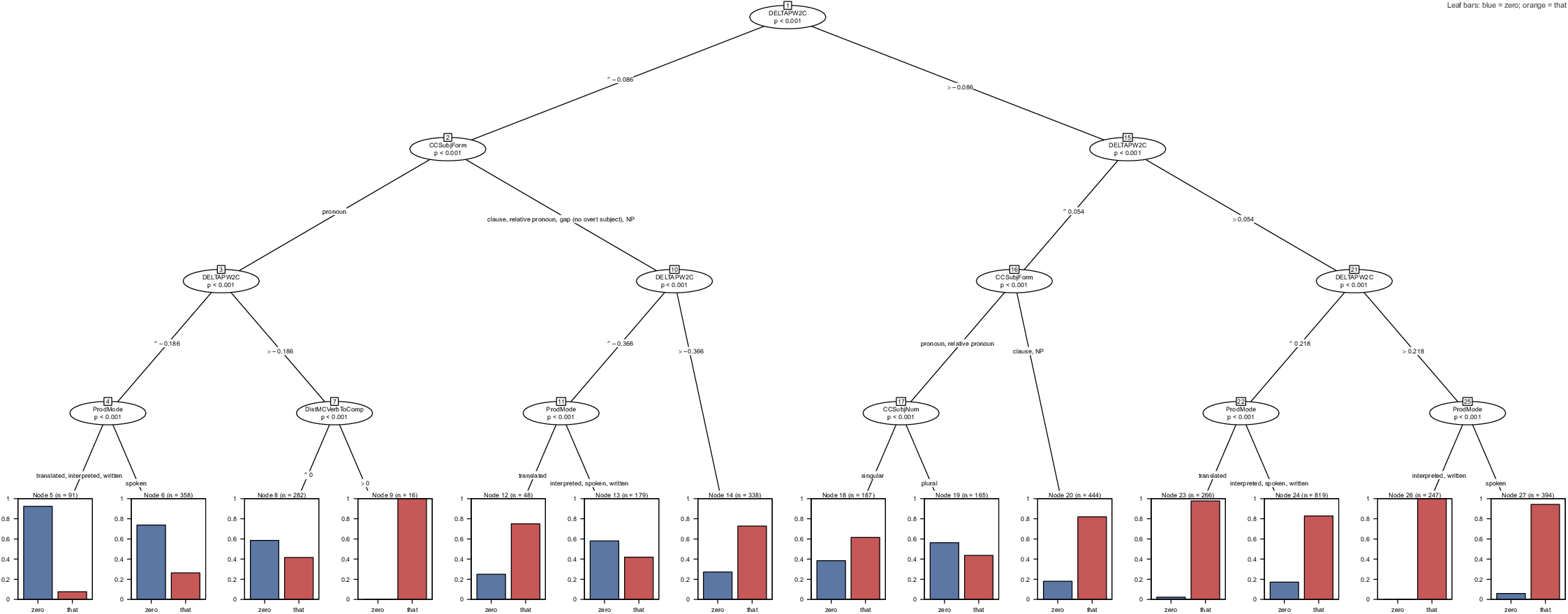
Conditional inference tree for all four varieties combined.

The conditional inference tree presented in Figure 1 visualizes the complex interactions among the predictor variables conditioning the that/zero alternation. At first glance, it is clear that there is a large degree of similarity across the four varieties, as evidenced by the absence of ProdMode-based splits at the higher nodes of the tree. However, at lower levels of the tree, there are factors that do affect the choice between that/zero in the four varieties in different ways.
The first split in the tree is based on DELTAPW2C (node 1), with a cut-off value of −0.086. The left branch, representing values at or below −0.086, shows a modest overall preference for zero-complementizer (55.0%). By contrast, the right branch, representing values above −0.086, displays a strong preference for that-complementizer (83.5%).
Within the left branch of node 1, the next split is based on the complexity of the subject in the complement clause (node 2). When the complement-clause subject is a pronoun, DELTAPW2C produces a further split at −0.186 (node 3). For values at or below this threshold, production mode (ProdMode) conditions the choice between the that/zero alternation (node 4).
When the complement-clause subject is a pronoun and DELTAPW2C falls between −0.186 and − 0.086, the distance between the matrix verb and the onset of the complement clause becomes relevant (node 7). If there is no intervening material between the matrix verb and the complement clause, zero-complementizer remains the preferred option (node 8, n = 282; 58.5% zero), as illustrated in Example 1. If there is any intervening material between the matrix verb and the complement clause, the choice is categorically in favor of that-complementizer (node 9, n = 16; 100% that), as illustrated in Example 2.
-
(1) The PLA believes [ΔPwc = −0.151] Ø [DistMCVerbToComp = 0] electronic warfare (EW) is one method to reduce or eliminate U.S. technological advantage. (CMSC: written)
-
(2) You have said [ΔPwc = −0.086] on many occasions [DistMCVerbToComp > 0] that you must work hard to promote social equity and justice. (CEPIC: spoken)
The other sub-branch of node 2 comprises complement clauses whose subjects are realized as clauses, relative pronouns, gaps, or noun phrases. Within this branch, DELTAPW2C generates a further split at −0.366 (node 10). When DELTAPW2C is at or below this threshold, indicating a strong lexical association with the zero-complementizer, production mode becomes decisive (node 11). Translated English nevertheless favors overt that (node 12, n = 48; 75.0% that), as illustrated in Example 3, whereas interpreted, original spoken and original written English collectively show a moderate preference for zero (node 13, n = 179; 58.1% zero), as illustrated in Example 4. When DELTAPW2C exceeds −0.366, that predominates and no further statistically significant split by production mode emerges (node 14, n = 338; 72.8% that).
-
(3) We hope [ΔPwc = −0.402] that both sides [NP] can work together on the understanding that we are one family. (PCGC: translated)
-
(4) I do not think [ΔPwc = −0.394] Ø House Republicans [NP] would suggest we are there yet. (CEPIC: spoken)
The right branch of node 1, in which DELTAPW2C exceeds −0.086, displays a stronger overall preference for that. This branch is divided again at a DELTAPW2C value of 0.054 (node 15). For values between −0.086 and 0.054, complement-clause subject form conditions the subsequent choice (node 16). When the complement-clause subject is a pronoun or relative pronoun, complement-clause subject number produces a further split (node 17). Singular subjects favor that (node 18, n = 187; 61.5% that), whereas plural subjects show a modest preference for zero (node 19, n = 165; 56.4% zero). By comparison, complement clauses with clausal, gaps, or noun-phrase subjects strongly favor that (node 20, n = 444; 82.0% that).
When DELTAPW2C exceeds 0.054, the preference for that becomes particularly pronounced (90.2% of cases = that). Values between 0.054 and 0.218 are further differentiated by production mode (node 22). Translated language shows a near-categorical preference for that (node 23, n = 266; 97.7% that), while interpreted, original spoken and original written language also favor that, though less categorically (node 24, n = 819; 82.8% that).
At DELTAPW2C values above 0.218, a distinction emerges between interpreted, original written English and spoken English; the former two varieties show near-categorical that-usage (node 26, n = 247, 100% that), as exemplified in example (5), whereas original spoken English retains a slight margin for omission (node 27, n = 394; 94.2% that), as exemplified in example (6).
-
(5) This shows [ΔPwc > 0.218] that we Chinese people have the courage. (CEPIC: interpreted)
-
(6) Surveys show [ΔPwc > 0.218] Ø our standing around the world is higher than when I was elected to this office. (CEPIC: spoken)
Overall, the constrained varieties and their non-constrained counterparts are governed by similar conventionality- and complexity-related constraints, as reflected in the higher-level splits of the tree. Production mode does not operate as the principal global determinant of complementizer choice; instead, it modulates the effects of these constraints under particular linguistic conditions.
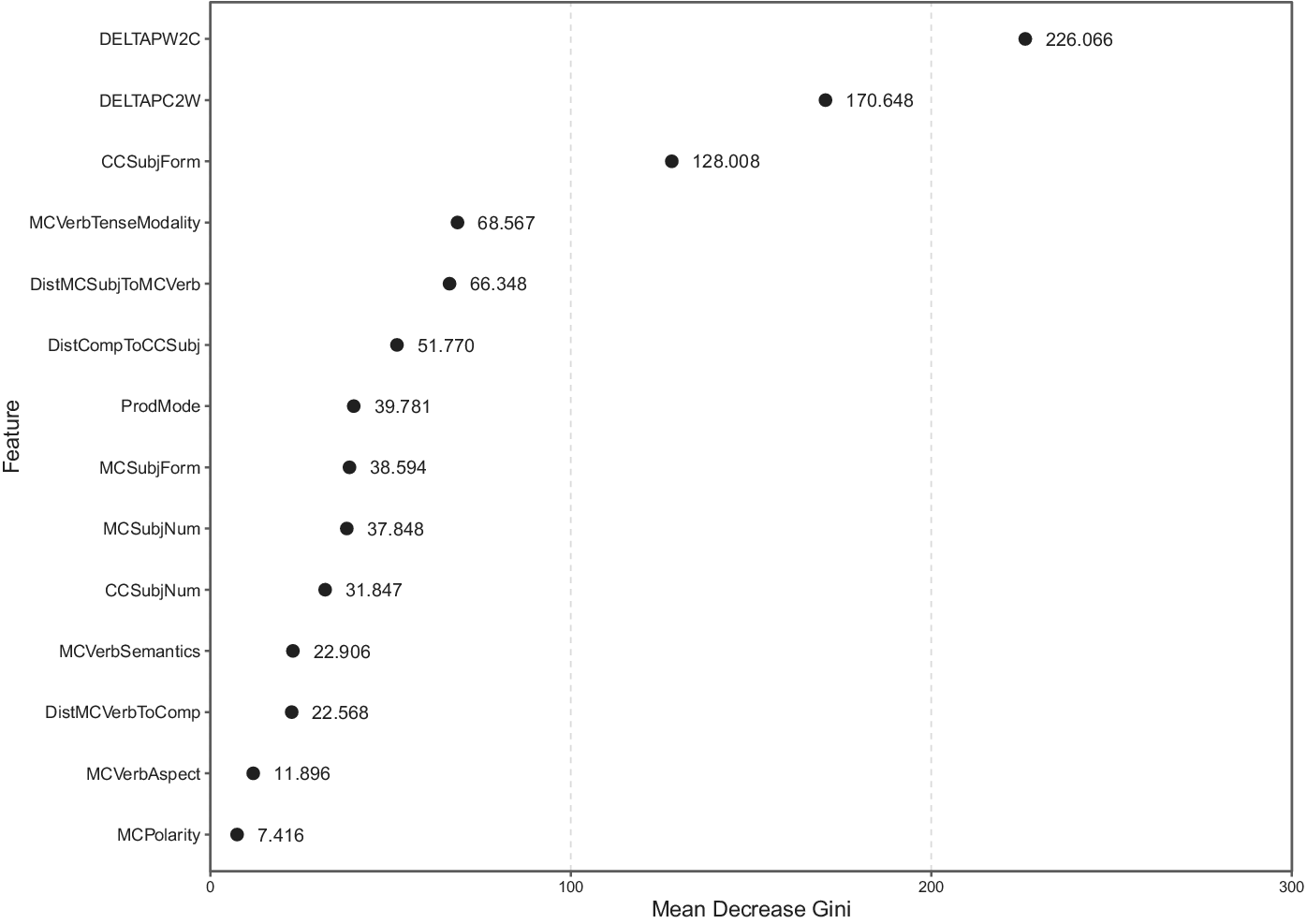
To add a layer of randomness to the analysis, the same predictor variables used to grow the conditional inference tree were used to grow a random forest, as explained in Section 3.3. The results of the random forest analysis are shown in the variable importance plotFootnote 11 in Figure 2 and provide information on the importance of the predictor variables.
Random forest variable importance for all four varieties combined.

Figure 2 Long description
A horizontal dot plot ranks 14 predictors from greatest to least random-forest importance, measured by Mean Decrease Gini. Values are DELTAPW2C 226.066; DELTAPC2W 170.648; CCSubjForm 128.008; MCVerbTenseModality 68.567; DistMCSubjToMCVerb 66.348; DistCompToCCSubj 51.770; ProdMode 39.781; MCSubjForm 38.594; MCSubjNum 37.848; CCSubjNum 31.847; MCVerbSemantics 22.906; DistMCVerbToComp 22.568; MCVerbAspect 11.896; and MCPolarity 7.416. Larger values indicate greater contribution to node purity and therefore greater importance.
Figure 2 reveals that two conventionality-related variables, DELTAPW2C and DELTAPC2W, are the two strongest predictors of the that/zero alternation, with an importance score of 226.066 and 170.648, respectively. This aligns with the conditional inference tree, where DELTAPW2C served as the highest-level splitting variable. Following these, complexity-related factors, including CCSubjForm, MCVerbTenseModality, DistMCSubjToMCVerb and DistCompToCCSubj, show relatively high importance. Then comes ProdMode, which has a greater impact than the rest of complexity-related factors, namely, MCSubjForm, MCSubjNum and CCSubjNum. Another conventionality-related factor, MCVerbSemantics, ranks relatively lower in the importance score, which aligns with the phenomenon that it is absent from the conditional inference tree.
The relatively low importance of ProdMode in the random forest analysis largely correlates with the findings from the conditional inference tree. This suggests that the four varieties are generally governed by a shared set of constraints when choosing between that- and zero-complementizer. However, the nuanced differences among the four varieties revealed by conditional inference tree remain opaque in the random forest. This can be attributed to the difference between the conditional inference trees and random forests. The latter successfully ranks the relative importance of factors, but it cannot illustrate how these variables functionally intersect with specific varieties to condition that-omission (Gries, Reference Gries2020).
5. Discussion
The results show that the frequency of that in constrained language is significantly higher than in unconstrained language. Significant differences also exist between constrained varieties, with translated English using that more frequently than interpreted English. This finding is consistent with the findings of Olohan and Baker (Reference Olohan and Baker2000), Kruger and De Sutter (Reference Kruger and De Sutter2018), Kruger (Reference Kruger2019), De Sutter and Lefer (Reference De Sutter and Lefer2020) and De Sutter and Vermeire (Reference De Sutter, Vermeire, Vandevoorde, Daems and Defrancq2019), which show that translated English uses that more frequently than original English. It also aligns with Kajzer-Wietrzny’s (Reference Kajzer-Wietrzny, Russo, Bendazzoli and Defrancq2018) finding that explicit use of that also occurs in interpreted English. However, it contradicts Hu and Tao’s (Reference Hu and Tao2013) finding that the frequency of that in interpreted English is three times that of translated English. Their study focused primarily on the frequency of overt that rather than the that/zero alternation (Hu & Tao, Reference Hu and Tao2013, p. 636). Multivariate analysis shows that constrained and unconstrained varieties are shaped by similar conventionality- and complexity-related constraints, but they exhibit different patterns under specific linguistic conditions. This pattern is explained by the constrained communication framework proposed by Kotze (Reference Kotze, Vandevoorde, Daems and Defrancq2019, Reference Kotze, Granger and Lefer2022).
5.1. Language activation dimension
The language activation dimension reflects the degree of multilingual activation during language use and its cognitive impact on language production (Kotze & Van Rooy, Reference Kotze, Van Rooy, Van Rooy and Kotze2024, p. 11). Unlike original English, which involves the activation of a single language, translated and interpreted English are produced under the simultaneous activation of both languages. Research has shown that even when only a single language is used during interlanguage production, the other language remains cognitively active (Shook & Marian, Reference Shook and Marian2012). This bilingual activation state requires translators and interpreters to activate highly complex cognitive mechanisms, including the inhibition of the non-target language, the dynamic retrieval of language knowledge and the regulation of activation levels in both languages. This cognitive regulation places greater demands on working memory (Bialystok et al., Reference Bialystok, Craik and Luk2008, p. 860). The use of explicit structures is a strategy for reducing cognitive load and optimizing the allocation of memory resources. However, the cognitive mechanisms of language activation always occur within specific communicative contexts and serve specific communicative purposes (Halverson & Kotze, Reference Halverson, Kotze, Halverson and García2021). Therefore, it is necessary to approach language activation from both cognitive and social perspectives.
From a cognitive perspective, the Complexity Principle holds that ‘language users tend to use more explicit grammatical forms in cognitively complex environments’ (Rohdenburg, Reference Rohdenburg1996, p. 149). One response to such processing demands is analyticity, that is, the use of more transparent and regular mappings between form and function, often realized through explicit lexicogrammatical encoding (Partridge, Reference Partridge, Van Rooy and Kotze2024). Mesthrie (Reference Mesthrie, Kortmann and Szmrecsanyi2012, p. 99) similarly argues that increased analyticity can facilitate L2 processing because greater overt surface marking reduces cognitive complexity by making grammatical relations more transparent. This account is particularly relevant to the present study, in which the translators and interpreters produced English as an L2.
From a social perspective, communicative risks have been argued to increase in bilingual settings (Lanstyák & Heltai, Reference Lanstyák and Heltai2012), potentially encouraging translators to minimize semantic ambiguity by selecting communicatively and normatively safer forms (Pym, Reference Pym2015, p. 70). The split at node 11 in Section 4.3 lends support to this account. Within a lexical environment that strongly favors complementizer omission, translated English instead favors the complementizer that, whereas the other three varieties collectively favor zero. This distribution closely matches the pattern used by Kruger (Reference Kruger2019, p. 1) to test the pragmatic risk-aversion hypothesis: translators appear to favor the communicatively and normatively ‘safer’ option of retaining the complementizer in contexts in which non-translated English would typically favor omission. The contrast at node 25, however, calls for a more cautious interpretation. Here, interpreted English patterns with original written English, with both showing categorical retention of that, whereas original spoken English exhibits only a low rate of omission. Since this lexical environment already strongly favors that, and interpreted English does not differ from original written English, the result provides at best limited evidence for pragmatic risk aversion in interpreting. It may instead reflect the greater analyticity of interpreted language and the pressures imposed by online processing.
5.2. Text production dimension
The text production dimension emphasizes whether language production depends on prior texts and how this dependence constrains language choices (Kotze & Van Rooy, Reference Kotze, Van Rooy, Van Rooy and Kotze2024, p. 12). In both translation and interpreting contexts, the source language is one of the most important factors directly influencing language production.
From a typological perspective, Chinese relies heavily on implicit coherence, making little use of the explicit connectives that are pervasive in English (Lian, Reference Lian2010, pp. 77–78). Logically, the frequency of that in translated and interpreted English should be influenced by the source-language shining-through effect (Teich, Reference Teich2003, pp. 145–146), resulting in a lower frequency of that than in original English. However, empirical results show the opposite trend: the frequency of that in translated and interpreted English is significantly higher than in the original English. This apparent anomaly may be partly explained by the typological and morphosyntactic distance between Chinese and English. Chinese, as a Sinitic language, is highly analytic and tends to leave interclausal relations implicit, whereas English, a Germanic language, relies more heavily on overt grammatical marking and explicit clausal linkage. Translating or interpreting between such typologically distant languages may therefore impose additional cognitive effort, which in turn weakens the expected source-language shining-through effect. Within the constrained communication framework, the language activation dimension may become the dominant constraint in such contexts, overriding source-language influence on target-language grammar (Kotze & Van Rooy, Reference Kotze, Van Rooy, Van Rooy and Kotze2024). More specifically, under conditions of intense bilingual activation, typological distance and cognitive load, translators and interpreters may opt for the explicit that to reduce processing demands and enhance clarity and stability, thereby producing a higher frequency of that.
Furthermore, the translator’s target-language proficiency and genre sensitivity also influence the choice of grammatical structures in the translation. Highly proficient translators often generalize and normalize expressions in the target language, which can diminish the influence of source-language structures (Venuti, Reference Venuti2018). The translations in the corpus selected for this article are all from professional translators with high levels of linguistic proficiency in the target language and familiarity with target language usage norms. This phenomenon is consistent with Hansen-Schirra and Steiner’s (Reference Hansen-Schirra, Steiner, Hansen-Schirra, Neumann and Steiner2012, p. 272) concept of the norm continuum, which posits that source-language shining-through and translation normalization (Baker, Reference Baker and Somers1996, p. 183) are not binary opposites but rather points along a dynamic continuum. Translators navigate this continuum by balancing the two tendencies in response to task demands, contextual pressures and their own abilities, thereby directly shaping the linguistic features manifested in the translated texts.
5.3. Modality and register dimension
Modality and register are fundamental dimensions of language use, as communicative goals and participant constellations in a given context profoundly shape linguistic behavior. As demonstrated in Section 4.1, all varieties analyzed in this study exhibit a notably high frequency of that compared to prior research (Kruger, Reference Kruger2019).
This higher frequency may partly reflect, first, the specific register under investigation: political discourse. Schäffner (Reference Schäffner and Schäffner1997, p. 3) emphasizes that politicians often speak as representatives of their parties, which limits what they can do and how they can express themselves. In this sensitive context, translation and interpreting are not merely auxiliary but are integral parts of political activity (Schäffner & Bassnett, Reference Schäffner, Bassnett, Schäffner and Bassnett2010, p. 13). Consequently, the demands placed on translators and interpreters in this domain may be intensified by the high-stakes nature of political discourse and by their potential accountability for perceived errors (Buri, Reference Buri2015). Although the present study does not directly compare registers, these pressures offer one possible explanation for the widespread use of the complementizer that across the four varieties.
Second, the sociopragmatic dimensions of interaction and intersubjective alignment manifest differently in spoken and written modalities, which may account for more pronounced risk avoidance in translation than in interpreting. Real-time speech imposes processing constraints but simultaneously permits adjustment, correction and interaction on the basis of continuous feedback, enabling interpreters to adapt to interlocutors and audiences to secure communicative success. Written discourse, by contrast, does not face the challenges of immediacy but lacks real-time feedback and interactivity. Consequently, translators working with written texts must rely on more careful and explicit expression to anticipate how readers will best interpret the discourse, since writing lacks the shared spatiotemporal context of spoken interaction for co-constructing meaning. This may help explain why written translators are more likely to adopt risk-averse strategies in order to align with readers’ expectations and the normative conventions of the target language (Kotze & Van Rooy, Reference Kotze, Van Rooy, Van Rooy and Kotze2024). Moreover, in contrast to the typically more fragmented input of interpreting, the source texts in written translation are generally characterized by higher syntactic complexity. This suggests that the divergence in the rate of that use may stem from intermodal differences in the density of the source material.
6. Conclusion
This study investigates the distribution of that- and zero-complementizer across translated, interpreted, original written and original spoken English from an intermodal perspective, using distinctive collexeme analysis and multivariate analysis. The findings can be summarized as follows. At the frequency level, both constrained varieties show significantly higher rates of that than their unconstrained counterparts, and translated English shows a significantly higher rate than interpreted English. These patterns are consistent with a general tendency toward explicitation. Distinctive collexeme analysis reveals different semantic – constructional profiles across the four varieties. Translated English is characterized by a broad combination of private and suasive verbs, interpreted English by a narrower but individually stronger concentration of private verbs, original written English predominantly by public verbs, and original spoken English by a restricted set of public and private verbs. Multifactorial analysis indicates that the four varieties appear to share a broadly similar constraint system, while production mode introduces conditional differences in specific environments. Taken together, this study provides intermodal empirical evidence from the Chinese–English language pair for increased explicitness in constrained language. It should be noted that the syntactic complexity of the source text may also play a role, as the observed effects on the complementizer that might stem from inherent complexity differences in the source language. Future studies should incorporate source-language syntactic complexity as a potential predictor to further disentangle the multifaceted drivers of that/zero alternation in mediated language.
Data availability statement
The data, R scripts and outputs are available on the OSF: https://osf.io/h83fq/.
Competing interests
The authors declare none.








 Open access

