


The typical voting age around the world is eighteen. One of the arguments against lowering the voting age to sixteen is that individuals under eighteen potentially lack the appropriate political knowledge for voting.Footnote 1 I study whether having the right to vote in itself can stimulate young people to acquire political knowledge, that is, if youths who are given the right to vote ‘rise to the occasion’. Such a dynamic effect would increase the likelihood that sixteen year olds will attain the requisite level of knowledge by the time they cast their vote, but would not guarantee this outcome, since an invidiual’s initial level of political knowledge is the most important factor for informed voting.
The appropriate voting age has been discussed in many countries over the last ten years, and several countries have lowered their voting age from eighteen to sixteen. In 2007, Austria became the first European nation to adopt a voting age of sixteen,Footnote 2 and Argentina followed suit in 2012.Footnote 3 Sixteen year olds were also allowed to vote in the Scottish independence referendum in 2014.Footnote 4 However, in the UK two government commissions have rejected lowering the voting age from 18 in part due to concerns that young people are not mature enough to vote.Footnote 5
Therefore it is important to evaluate the arguments for and against a lower voting age. In this Research Note I focus on the claim that sixteen and seventeen year olds have inadequate levels of political knowledge to be able to vote competently. To evaluate this argument, researchers must gather information about the political knowledge of sixteen and seventeen year olds in relation to their older fellow citizens. There have been two major contributions to this topic, and they have reached completely different conclusions.
Chan and Clayton used British survey data from the 1990s and 2001 to study the political knowledge of different age groups. They find a clear age gradient in political knowledge, with sixteen and seventeen year olds at the bottom. Based on this finding they argue that the voting age should not be lowered to sixteen since this would lead to negative consequences for the quality of democracy.Footnote 6
Wagner, Johann and Kritzinger, however, using Austrian survey data from 2009, reach the opposite conclusion. They find that sixteen and seventeen year olds are about equally able to make informed voting decisions as their somewhat older fellow citizens. Based on this finding, they argue that sixteen and seventeen year olds should not be excluded from voting on the grounds of insufficient political knowledge.Footnote 7
Why are the results so different? Wagner, Johann and Kritzinger offer a potential explanation. The sixteen and seventeen year olds who were surveyed in Chan and Clayton did not have the right vote, while the corresponding group in Wagner, Johann and Kritzinger did have that right. Wagner, Johann and Kritzinger argue that individuals without the right to vote have few incentives to become politically knowledgeable. Thus, according to them, sixteen and seventeen year olds in Austria are more politically mature compared to their older fellow citizens than their counterparts in the UK partly because the Austrians have the right to vote.Footnote 8 This reasoning suggests that the youths ‘rise to the occasion’.
This idea gets support from Hart and Atkins, and Zeglovits and Zandonella.Footnote 9 Hart and Atkins argue that the voting age should be lowered to sixteen because there is evidence suggesting that opportunities for political socialization during adolescence lead to a deeper civic commitment in early adulthood.Footnote 10 Zeglovits and Zandonella examined the political interests of sixteen and seventeen year olds in Austria before and after the voting age was lowered to sixteen in 2007. They found that their political interest was higher in 2008 than in 2004. This is consistent with a reaction to the change in the voting age, but does not constitute proof of a causal relationship.Footnote 11 However, if a lower voting age causally increases political interest, it is not unreasonable to expect political knowledge to be affected as well.
While the hypothesis that youths react to changes in the voting age is intriguing, the current evidence is insufficient to confirm it. The diverging results from Austria and the UK could also be explained by other differences between the countries. The conceptual question that needs to be answered is: consider a sample of identical twins, in which one twin in each pair is allowed to vote at sixteen and the other at eighteen. Will the twins who were allowed to vote at sixteen exhibit higher levels of political knowledge at sixteen than the other twins?Footnote 12
It is hard to obtain data to answer this question, but I answer a very similar question. In Sweden, individuals are eligible to vote if they turn eighteen before or on the day of the election.Footnote 13 Since Swedish register data contain the exact date of birth of all individuals born from 1969 onward, I can employ a regression discontinuity (RD) strategy to estimate the causal effect of having the first voting opportunity at eighteen, compared to three years later, on measures of political knowledge around age eighteen.
INSTITUTIONAL SETTING, DATA AND RESEARCH DESIGN
This study usesFootnote Swedish registers with birthdate information for all individuals born from 1969 onward. This enables me to perform RD analyses with date of birth as the running variable for all elections from 1988 onward.Footnote 15 To this birth register I link information on educational outcomes and parental characteristics. The register data stop in 2010, so I can only use elections prior to 2010. Table 1 provides a list of all elections during the period 1988–2006. Elections to the European Parliament are not included in the study since the turnout is low. I also drop the Swedish Parliamentary election in 1994, since those who turned eighteen just after this election could vote shortly afterwards anyway.
Elections in Sweden 1988–2006
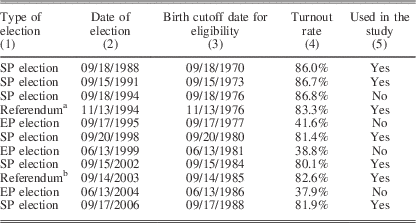
Note: SP=Swedish Parliament. EP=European Parliament. a=EU, b=EURO. Information on all elections comes from Statistics Sweden.14
To avoid problems with cohort effects I study individuals who turned eighteen in the same year. Hence, the ‘controls’ with respect to the referendum in 1994 (that is, those who turned eighteen just after the election) are those born between 14 November 1976 and 31 December 1976. No other election took place later in the year; consequently this interval of 48 days can be used throughout the study. Thus the studied individuals turned eighteen in an interval from 48 days before the election to 48 days after. Table 2 clarifies the birth dates used to construct the relevant samples.
Samples of Treated and Controls
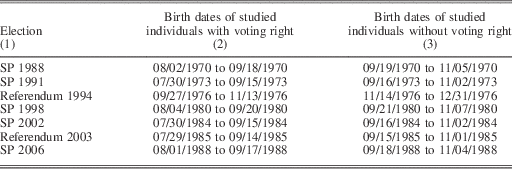
Note: the period consists of 48 days before and after the cutoff dates. SP=Swedish Parliament.
The numerical value of the birth date of every individual has been normalized by subtracting the numerical value of the respective cutoff dates (see Column 3 of Table 1).Footnote 16 A problem with using the exact date of birth is that previous evidence indicates that children born on weekends tend to be different from those born on weekdays (with respect to parental characteristics).Footnote 17 Therefore I aggregate the data to full weeks. Individuals with a normalized birth date in the interval [−6,0] belong to week 0 and individuals with a normalized birth date in the interval [1,7] belong to week 1. Since I study individuals born within 48 days of the cutoff, the week numbers go from −6 to 7.Footnote 18
Table 3 presents descriptive statistics for the studied sample. Column 1 describes the extent to which information exists for the different variables. Column 2 describes the mean values for the full sample. Column 3 describes the mean values for those who turned eighteen just before an election (that is, Voting right=1) and Column 4 presents statistics for those who turned eighteen just after an election (that is, Voting right=0). I want to highlight three characteristics of the data. First, those who turned eighteen just before an election had their first major voting opportunity three years before those who turned eighteen just after (Columns 3–4 of row 2), indicating a substantial ‘treatment’. Secondly, when looking at predetermined variables we see that the two groups are somewhat different from each other.Footnote 19 Parental education and employment characteristics measured when the youths are aged fifteen are very similar between the groups (rows 5–8), but those who turned eighteen just before an election have better junior high school grades (rows 3–4).Footnote 20 Thirdly, although the differences in the outcome variables (rows 9–10) are consistent with a positive voting right effect, the values are confounded by unbalanced predetermined variables. This highlights the need for a model that isolates the potential voting right effect. Below, I describe this research design.
Descriptive Statistics for the Most Widely Used Sample
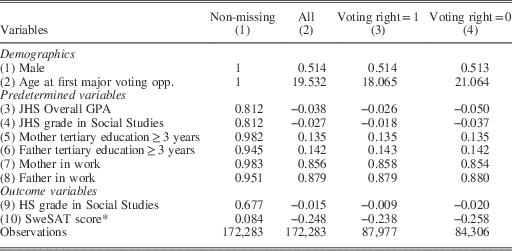
Note: JHS=Junior High School; HS=High School. All grade measures are standardized within graduation year. The SweSAT score is standardized within a given test. Note that just a few percent of individuals have absolute top results on the variables in rows 9–10. Thus the possibility of observing a ‘rising to the occasion’ effect should not be constrained by ineligible students already being at the top knowledge level. * Only individuals that turned eighteen in 1988, 1991 or 1994 can have data on this variable.
I employ an RD design. The normalized week number is the running variable, denoted by Z ie where e indicates the specific election.Footnote 21 Equation 1 specifies the baseline model:
 $$Y_{i} {\equals}\beta _{0} {\plus}\beta _{1} I\left[ {Z_{{ie}} \leq 0} \right]{\plus}\beta _{2} Z_{{ie}} {\plus}\beta _{3} I\left[ {Z_{{ie}} \leq 0} \right]{\asterisk}Z_{{ie}} {\plus}\delta _{e} {\plus}u_{i} $$
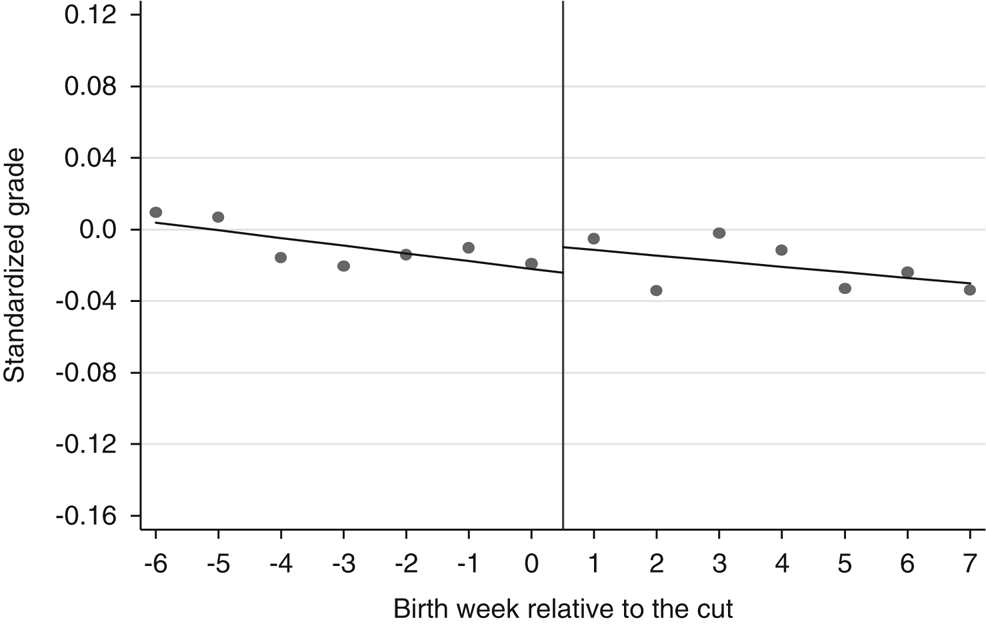
The outcome is a measure of political knowledge. δ e captures election fixed effects and u i is an error term. I include separate linear controls for the running variable on the two sides of the threshold (Z ie and I[Z ie≤0]*Z ie) and I[Z ie≤0] is an indicator for having the opportunity to vote just after turning eighteen. In Figure 1, β 2+β 3 represents the slope of the line to the left of the threshold, β 2 the slope to the right and β 1 represents the ‘jump’ that occurs when crossing the cutoff from the positive side. This procedure amounts to running separate local linear regressions on both sides of the threshold and comparing the values of those regressions at the cutoff. Under the assumption that potential confounders are continuous in the running variable, β 1 corresponds to the causal effect of voting right on political knowledge.Footnote 22 Thus if the assumption holds, it is not necessary to include any additional controls in the model, which is a great advantage compared to a standard ordinary least squares model in which the risk of omitted variable bias is almost always present. Following the advice of Lee and Card on the choice of standard errors when using a discrete running variable, I cluster the standard errors on the week-times-election level.Footnote 23
Relationship between high school grade in Social Studies and the running variable Note: the figure is based on individuals with valid information on the high school grade in Social Studies. The sample includes 116,713 observations. A dot represents the mean value of individuals born in a certain week relative to the cutoff date. Individuals born to the left of the cutoff have the right to vote. The line represents the mean predicted value of the grade (conditional on the model specified in Equation 1) for individuals born in a certain week relative to the cutoff date. In Appendix Figure B2 I provide a clearer picture of the raw data by plotting the raw mean value for individuals born on a certain day, relative to the cutoff date, separately for all seven elections.
The typical way of testing the identifying assumption is to investigate if the distribution of the running variable evolves smoothly over the cutoff and if predetermined variables are continuous around the cutoff.Footnote 24 Common sense suggests that the assumption is valid here. It seems unlikely that parents are able (and willing) to manipulate births to take place before rather than after a cutoff. Nonetheless, I have performed the standard validity tests. Figure B1 shows that the running variable evolves smoothly over the cutoff (the McCrary test is insignificant) and Table B1 shows that there are no jumps in predetermined variables at the cutoff.Footnote 25 In summary, all the tests confirm the validity of the empirical strategy.
POLITICAL KNOWLEDGE
Delli Carpini and Keeter define political knowledge as ‘the range of factual information about politics that is stored in long-term memory’.Footnote 26 These facts should be centered on the exact nature and function of government (for example, the structure of the party system and what issues the government can influence).Footnote 27 Accordingly, political knowledge is typically measured by asking subjects questions on factual political knowledge. Questions can, for example, be about the name of the prime minister.Footnote 28 However, fact-based survey questions are not an uncontroversial method of measuring political knowledge. Some scholars argue that we know little about how well survey results capture other forms of political abilities such as voting competently.Footnote 29 Voting competently requires voters to identify which political alternative corresponds most closely to their own beliefs and opinions. In order to capture this essential form of political ability, it might be more informative to ask respondents to place parties on an ideological scale and/or to identify different parties’ concrete policy positions. Even though Butt argues that high levels of factual political knowledge are associated with a better ability to identify parties’ policy positions, it might be better to measure this ability more directly.Footnote 30 This is what Wagner, Johann and Kritzinger do when they let survey respondents place Austrian parties on the left–right scale.Footnote 31 I employ the high school grade in Social Studies as the measure of political knowledge. As receiving a good grade in Social Studies requires both factual knowledge and a deeper understanding of the history and ideologies of different political movements, it can be said to combine the measures discussed above.Footnote 32
MEASURING POLITCAL KNOWLEDGE: THE SWEDISH CONTEXT
In Sweden, the typical student graduates from high school in the summer of the year they turn nineteen. Elections take place in the fall of the year they turn eighteen, that is, when they have completed about two-thirds of their high school education. I assume that the voting right starts to matter (if it matters at all) about one year before the election, because that is roughly when the election campaign starts to unfold. Thus, conditional on this assumption, students can be affected by the voting right from the second year in high school onward.
The main measure of political knowledge in this article is the high school grade in Social Studies. This subject has eight objectives (see Table A1). Three of these objectives are directly linked to political knowledge. According to these three objectives, students should (1) have knowledge about the evolution and function of democracy and be able to apply democratic working, (2) understand how the political system works (at different levels) and (3) understand how they can influence the decisions within this system (points 1, 3 and 4 in Table A1). In addition, several of the other objectives contain components that are related to political knowledge.Footnote 33 Thus at least 37.5 per cent of the grade should be based on the students’ competence in political knowledge. Political knowledge is therefore measured with noise that should reduce precision but not bias the estimates. However, I have access to a large number of observations, thanks to the nationwide registers on high school grades, which is positive for precision.
Two additional pieces of evidence support the claim that the grade in Social Studies can measure political knowledge. First, a Swedish Government report from 2007 uses survey data on students in high school and junior high school to study the association between grades in Social Studies and political interest. It finds a strong positive association, with top-performing students being much more interested in politics than the others.Footnote 34 Secondly, a study from 2010 examined high school students in the United States and shows Social Studies grades are a strong predictor of future electoral engagement – stronger than overall GPA or math GPA.Footnote 35 While none of these studies speaks directly to the correlation between political knowledge and Social Studies grades, they at least suggest there is a relevant connection, given the strong correlation between political interest and political knowledge.Footnote 36
Students graduating from high school in or before 1996 received their final grade in Social Studies at the time of graduation.Footnote 37 Thus since most of the grade was determined after the point at which the voting right is assumed to have influenced their interest in obtaining political knowledge, it should be possible to detect a potential voting right effect. Students graduating after 1996 were graded in courses and when a course was finished, the grade for that particular course could no longer be influenced. There were three courses in Social Studies: A, B and C. All students took Social Studies A, while typically only students in the Social Science track took Social Studies B and C. For this period the grade in Social Studies A functions as the main measure of political knowledge. A problem with using the grade in Social Studies A is that some students took the course early and got their grade after their first year in high school. It is unlikely that having the right to vote influenced those early grades. However, there was large variation in the timing of Social Studies A across tracks and schools.Footnote 38 In the empirical exercises this late period is included, but I also look at the early period separately.
As an alternative measure of political knowledge I use the performance on the General Knowledge section of the Swedish Scholastic Assessment Test (SweSAT).Footnote 39 The section was included in the test in the years 1977–95 and consisted of thirty multiple choice questions aimed at capturing general knowledge about society. Stage estimates that about 15 per cent of the questions can be categorized as political knowledge.Footnote 40
FINDINGS
Figure 1 shows the relationship between the high school grade in Social Studies and the running variable.Footnote 41 Individuals who had the opportunity to vote just after turning eighteen (to the left of the cutoff) have a higher grade than the controls, on average, but right at the threshold they have lower grades. The negative estimate is, however, small (about 1.3 per cent of a standard deviation) and insignificant.
Table 4 (A) provides estimates of the effect of having the opportunity to vote at a relatively young age on the high school Social Studies grade, conditional on seven different empirical specifications; Specification 1 corresponds to the difference at the cutoff in Figure 1. Since this specification relies on the choice of a linear control function for the running variable, its robustness must be tested. With a smaller bandwidth the functional form matters less, suggesting that estimates from linear regressions using small bandwidths are more credible, but reducing the bandwidth comes at the price of less precision. In Columns 2–4 the bandwidth is gradually reduced, which leads to smaller estimates; the effect becomes marginally positive in Column 4. In Column 5 I use the full sample and an alternative method to reduce the reliance on the linear control function. I introduce quadratic controls which also get the estimate closer to zero compared to Specification 1. Still, nothing dramatic happens despite the substantial variations I expose the model to, suggesting that the true effect is close to zero. However, to gain even more credibility I run two additional regressions. In Column 6 I include the predetermined variables, which increase the precision but only marginally affect the estimate in relation to Specification 1. In Column 7 I use date of birth as running variable and include weekday dummies. The estimate is virtually the same as in Specification 1.Footnote 42
RD Estimates for the High School Grade in Social Studies
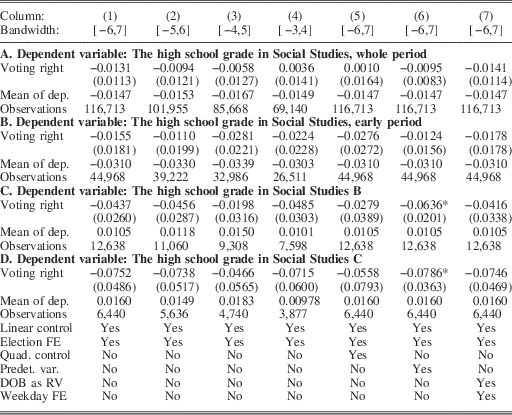
Note: standard errors are clustered on week * election level (in parentheses). *= significant on the 5 per cent level. RV=running variable; DOB=day of birth; FE=fixed effects.
The table also includes alternative measures of the grade in Social Studies. In Panel B I focus on individuals born in 1970, 1973 or 1976 when the individuals were given a final grade in the subject Social Studies. In Panels C and D I focus on individuals born in 1980, 1984, 1985 or 1988 when the students could take advanced courses in Social Studies. Panels B, C and D provide a similar picture to Panel A but the estimates are generally more negative and never on the positive side. Again there is no support for a positive voting right effect.
Overall, we generally find negative and insignificant effects. But given that there is statistical uncertainty, it is important to consider whether it is possible to rule out large positive effects. Consider the most positive result in Table 4, that is, the estimate in Column 4 of Panel A. A 95 per cent confidence interval includes the values [−0.0248, 0.0319]. Thus the positive effect can amount to about 3 per cent of a standard deviation. Effect sizes measured in terms of standard deviations are typically required to be above 0.1 to be of practical relevance.Footnote 43 Thus even at this maximal value of the effect the practical relevance is limited.
In Table 5 I provide estimates of the effect of being eligible to vote shortly after turning eighteen, relative to twenty-one, on the SweSAT General Knowledge score.Footnote 44 I use the same specifications as in Table 4. The point estimates are sensitive to the choice of model and range from −0.0524 to 0.0310. A 95 per cent confidence interval around 0.0310 includes 0.1, which would be a meaningful positive effect. However, all the other estimates are close to zero or negative, suggesting that it is unlikely that the right to vote increases the performance on the SweSAT, and that even if it did it would be a small effect.
RD estimates for the SweSAT Score (General Knowledge Section)
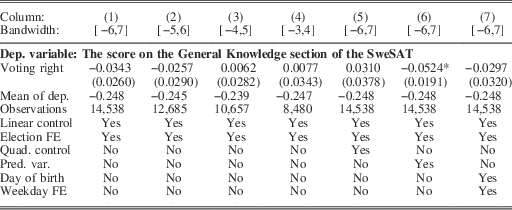
Note: standard errors are clustered on week * election level (in parentheses). *= significant on the 5 per cent level. RV=running variable. FE=fixed effects.
A potential concern about the RD estimates in Tables 4 and 5 is that they are based on intra-cohort comparisons that might be contaminated by spillover effects. If the right to vote motivates eligible students to learn more about politics, and this increased knowledge spills over to non-eligible cohort peers through network effects, this would create a downward bias on the estimated effects. I find it unlikely, however, that spillovers can totally mask positive effects. Nonetheless, I looked at inter-cohort differences in political knowledge to test the robustness of the results. If the voting right increases political knowledge and leads to spillovers, then cohorts that turn eighteen during an election year should have higher grades than adjacent cohorts. But as can be seen in Figure B3, there are no such systematic differences. Comparing grades across cohorts comes with problems of its own (which is why it is not my main strategy)Footnote 45 but it gives an additional indication that the voting right does not lead to increased political knowledge.
DISCUSSION
This study investigates whether young people respond by becoming more politically knowledgeable when they are allowed to vote. Such an effect would increase the likelihood that newly enfranchised voters reach the requisite level of political knowledge, but would not guarantee this since the initial level is the most important factor.
To the extent that my measures capture political knowledge, the collected evidence shows that individuals who had their first voting opportunity at eighteen do not exhibit higher levels of political knowledge than comparable individuals whose first voting opportunity took place three years later. This finding indicates that the putative benefits of a lower voting age, in terms of increased political knowledge among young people, do not exist. This result in is line with the conclusion in Bergh.Footnote 46 A competing interpretation would be that both marginally eligible and ineligible individuals learn more about politics when there is an election because politics becomes salient for both groups. The inter-cohort comparison in Figure B3 does not support this interpretation, but I acknowledge that there is some remaining uncertainty regarding the interpretation of the zero effect.
A caveat with studying eighteen year olds instead of sixteen year olds could be that they react differently to having the right to vote. While this cannot be ruled out I argue that the behavior of eighteen year olds is a reasonable approximation of the behavior of sixteen year olds. First, there is evidence suggesting that there is no (or very little) improvement of cognitive capacity after the age of sixteen.Footnote 47 Secondly, in Sweden both sixteen and eighteen year olds live with their parents, and both groups are typically in school rather than working. Thus, they tend to live similar lives.
Another potential problem is the uncertainty about when the voting right can start affecting individuals. I assume that the voting right starts affecting people about one year before the election because this is roughly when public awareness about the election is increased through initial debates and statements from the parties. But even if I assume that the potential voting right effect is switched on only one month before the election, it should be possible for an increase in political knowledge to show up in the Social Studies grade because the eligible students will then study their full last year in high school under the potential voting right influence.Footnote 48
Overall, I argue that the research design has the capacity to detect voting right effects on political knowledge, which it does not. This leads me to conclude that ‘the rising to the occasion’ argument should be used with caution in the voting age debate. If having the right to vote in general has little effect on political knowledge, we should also not expect other disenfranchised groups (for example, non-citizens) to become more politically knowledgeable when they are allowed to vote. But more research is needed to determine the generalizability of the result.



