I. INTRODUCTION
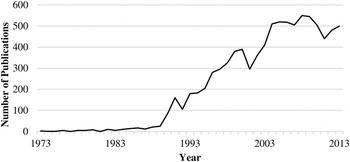
In the last few decades, diamond-like carbon (DLC) coatings have attracted much attention of industries and research groups from all over the world (Fig. 1). This increase in demand can be attributed to outstanding physical, chemical, tribological, and optical properties of DLC coatings which make them suitable for a wide range of industrial applications especially those involving boundary lubricant regimes. Low coefficient of friction, high resistance against wear, increased hardness, and stability against environmental species are some of the distinguished characteristics of DLC coatings.Reference Love, Cook, Harvey, Dearnley and Wood2,Reference Jia, Li, Fischer and Gallois3 Another benefit associated with the usage of DLC coatings is that they can be deposited on literally any material ranging from metals to ceramics, nonmetals, and metalloids.
Annual number of publications on DLC coatings from 1970 to 2013.Reference Jia, Li, Fischer and Gallois3

Tribological behavior of DLC coatings is strongly dependent on various intrinsic and extrinsic parameters. To select an optimum DLC coating for a particular application, there is a need to evaluate how various types of coatings perform in operating conditions replicating real life scenarios. A lot of experimental studies have been carried out by the tribologists to investigate the effects of intrinsic (hydrogen concentration, hardness, elastic modulus, interlayers, atomic configuration of carbon atoms, and metal/nonmetal doping) and extrinsic factors (temperature, applied load, sliding speed, substrate/counter body material, base oil, and additive package) on friction and wear characteristics of DLC coatings. Another important aspect of these studies was to understand the mechanisms responsible for a particular tribological behavior. Due to diverse test conditions and conflicting remarks mentioned in the literature, there is a need to consolidate the already published data in a more organized and apprehensible way. In this way, it will become easy to select a most suitable DLC coating for particular operating conditions and more logical continuation of the research on DLC coatings can be carried out.
In this review paper, a concise preface of DLC coatings encompassing a brief history, classification, and industrial applications is presented followed by a detailed discussion on the effects of operating conditions, materials and lubricant formulations on the tribological performance of DLC coatings.
II. EVOLUTION OF DLC COATINGS
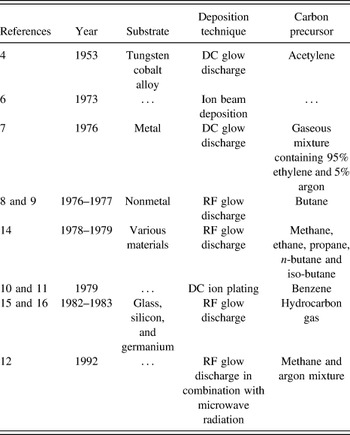
The history of DLC coatings can be traced back to the mid of 20th century. A brief overview of techniques and related details used for the deposition of DLC coatings is given in Table I. In 1953, carbon films were first mentioned in the literature by Schmellenmeier.Reference Schmellenmeier4 He used tungsten cobalt alloy as a substrate and investigated whether tungsten carbide metallic layers can be deposited on it at low temperatures using direct current (DC) glow discharge in an ionized acetylene environment. In another research, Schmellenmeier deposited a few micrometers thick amorphous carbon film on the substrate. It was also revealed that the newly developed carbon coating possessed properties similar to that of diamond.Reference Aisenberg and Chabot5 After a gap of almost two decades, Eisenberg and Chabot conducted a comprehensive research by depositing amorphous carbon films using ion beam deposition technique and coined the term “DLC” for this new type of hard coatings.Reference Whitmell and Williamson6 For their contributions in the development of DLC coatings, Eisenberg and Chabot are often considered as forefathers of DLC coatings. In the late 1970s, Whitmell and his team used DC glow discharge technique for the deposition of DLCs on metallic substrates. Instead of using acetylene, they used a gaseous mixture containing 95% ethylene and 5% argon.Reference Holland7 Later on, Holland and his coworkersReference Holland and Ojha8,Reference Andersson, Berg, Norström, Olaison and Towta9 invented a new way of depositing hydrogenated DLC (a-C:H) coatings on nonmetallic substrates by using radio frequency (RF) glow discharge technique and butane as a precursor. A similar deposition technique was also used by Andersson and his team to investigate the effect of carbon precursors on the deposition rates of a-C:H coatings. They used different hydrocarbon gases such as ethane, propane, methane, n-butane and iso-butane. It was observed that highest deposition rates can be achieved with butane (both iso-butane and n-butane), whereas, methane gave the lowest rates.Reference Jia, Li, Fischer and Gallois3 In the late 1970s, Weissmental and coworkers developed two other techniques for the deposition of DLC coatings i.e., dual beam technique and DC ion plating technique.Reference Weissmantel, Reisse, Erler, Henny, Bewilogua, Ebersbach and Schürer10,Reference Bewilogua, Dietrich, Pagel, Schürer and Weissmantel11 In addition to that, they extensively used microscopic and spectroscopic techniques to reveal the chemical and structural properties of DLC coatings. As a result of these comprehensive studies, the myths about the structure of DLC coatings were busted and it was found that they have amorphous structure instead of crystalline. In the early 1980s, Bubenzer and his team studied the influence of deposition parameters related to RF glow discharge technique such as hydrocarbon gas pressure and substrate voltage on the density of deposited DLC films. They found that density of a-C:H coatings can be improved by increasing the negative bias voltage applied to the substrate, whereas, it decreases with an increase in gas pressure. In 1992, Martinu and coworkers improved the mechanical properties of a-C:H coatings such as hardness using RF glow discharge technique in combination with microwave radiation. The resulting coating appeared to be deposited with higher rates and with less hydrogen concentration as compared to coatings achieved with previously used techniques.Reference Bubenzer, Dischler, Brandt and Koidl12 After 1990, number of experimental investigations focusing on the exploration of mechanical and tribological properties of DLC coatings started to increase exponentially.Reference Bubenzer, Dischler and Nyaiesh13 The primary objective of these studies was to evaluate the effectiveness of DLC coatings in improving the friction and wear characteristics of the interacting surfaces. Although DLC coatings were limited to optical applications till 1980s but as a result of systematic studies from 1990 to 2010, DLC coatings were started to be used as surface protective films in diverse engineering applications.
A brief overview of deposition techniques used for DLC coatings.

III. TYPES OF DLC COATINGS
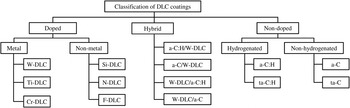
DLC coatings can be deposited by various techniques using broad ranges of deposition parameters. In addition to that, different hydrocarbons such as acetylene (C2H2), benzene (C6H6), ethane (C2H6), iso-butane (C4H10), methane (CH4), n-butane (C4H10), and propane (C3H8) can be used as carbon precursors.Reference Martinu, Raveh, Domingue, Bertrand, Klemberg-Sapieha, Gujrathi and Wertheimer14 Due to high degree of flexibility associated with the deposition of DLCs, different variants of these coatings can be achieved. Broadly, DLC coatings can be classified into three wide categories namely doped, nondoped, and hybrid DLCs. In case of nondoped DLC coatings, carbon atoms are bonded with either carbon or hydrogen atoms, whereas, no other element is present in the structure. Based on the hydrogen concentration, nondoped DLC coatings can be further subdivided into hydrogenated [hydrogenated amorphous DLC (a-C:H) and hydrogenated tetrahedral DLC (ta-C:H)]Reference Grill17 and nonhydrogenated DLC coatings [hydrogen-free amorphous DLC (a-C) and tetrahedral DLC (ta-C)].Reference Ronkainen, Varjus, Koskinen and Holmberg18,Reference Donnet, Fontaine, Grill and Le Mogne19 Since, DLC coatings are considered to be chemically inert, doping with reactive metals increases their reactivity with lubricant additives and helps in forming beneficial tribochemical films.Reference Sanchez-Lopez, Erdemir, Donnet and Rojas20,Reference Grischke, Hieke, Morgenweck and Dimigen21 In addition to that, doping with foreign elements increases their service life by improving adhesion strength with the substrate, enhancing wear resistance, and decreasing internal compressive stresses entrapped during deposition.Reference Donnet22–Reference Garrelie, Loir, Donnet, Rogemond, Le Harzic, Belin, Audouard and Laporte25 Based on the type of doping element, doped-DLC coatings can be divided into metal-doped [titanium (Ti), tungsten (W), molybdenum (Mo), and chromium (Cr)] and nonmetal doped-DLC coatings [silicon (Si), fluorine (F), and nitrogen (N)]. To further enhance the load carrying capacity of DLC coatings and equal distribution of load, hybrid type known as multilayered DLC (ML-DLC) coating is also used in industrial applications.Reference Kim and Kim26,Reference Kim and Kim27 ML-DLC coatings (a-C:H/W-DLC, a-C/W-DLC, VTiN, etc.) comprised of very thin alternate layers of both nondoped and doped DLC coatings stacked together to combine the advantages of both types in a single coating. Generally, tungsten-doped DLC (W-DLC) coating is used as a top layer but in some studies, a-C:H and a-C coatings are also used. The above-mentioned scheme of DLC coatings classification is shown in the form of a hierarchy chart in Fig. 2.
Classification of DLC coatings.Reference Zahid, Masjuki, Varman, Mufti, Kalam and Gulzar28

IV. APPLICATIONS OF DLC COATINGS
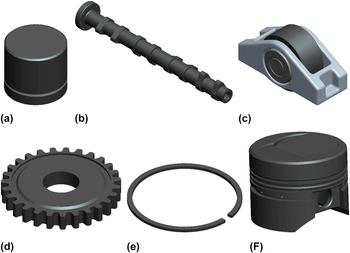
Due to their extraordinary mechanical, tribological and optical properties, carbon coatings were started to be used as an important engineering material immediately after their invention in 1970s. As a result of extensive research carried out in the last four decades, DLC coatings are now used as surface protective layers in numerous industrial applications such as microelectromechanical systems, electronics, manufacturing, optics, biomedical implants, and mechanical equipment.Reference Bubenzer, Dischler and Nyaiesh13,Reference Kalin, Velkavrh, Vižintin and Ožbolt29,Reference Ouyang, Sasaki, Murakami, Zhou and Zhang30 Although, DLC coatings were first applied on cutting blades to reduce the friction between the cutter and paper but after that these coatings were majorly used for optical applications till 1990s.Reference Aisenberg and Chabot31 DLC coatings were applied on glasses composed of different materials to make them scratch-resistant and antireflective.Reference Grill17 Another application involves deposition of DLC coatings on contact lenses at low temperatures to protect them against abrasive wear.Reference Kimock and Knapp32 Magnetic storage devices and razor blades are some of the consumer products in which DLC coatings (a-C:H and ta-C, respectively) are in use from many years.Reference Bubenzer, Dischler and Nyaiesh13,Reference Hauert33,Reference Daniels, Brown and Kimock34 The main purpose of these coatings is to increase the lifetime of the products by improving the performance and durability of sliding parts involved in the functioning. DLC coatings also proved to be very helpful for a number of automotive applications (Fig. 3). Some of the engine parts and assemblies which showed improved tribological performance after depositing DLC coatings include fuel injection system,Reference Bubenzer, Dischler and Nyaiesh13,Reference Lawes, Fitzpatrick and Hainsworth35,Reference Vengudusamy, Grafl and Preinfalk36 piston assembly,Reference Tung and Gao37–Reference Cho, Lee and Lee39 bearings,Reference Franklin and Baranowska40,Reference Vanhulsel, Velasco, Jacobs, Eersels, Havermans, Roberts, Sherrington, Anderson and Gaillard41 valve train assembly,Reference Schamel, Grischke and Bethke42–Reference Gangopadhyay, McWatt, Zdrodowski, Simko, Matera, Sheffer and Furby48 and gears.Reference Snidle and Evans49,Reference Kalin and Vižintin50 Because of their biocompatibility and outstanding material properties such as high hardness, low friction, corrosion resistance, and moderate wear of counterbodies, DLC coatings found number of applications in the field of biomedical engineering.Reference Dearnaley and Arps51 An extensive research is going on to optimize DLC coatings for various biomedical applications such as orthopedic, cardiovascular and dental implants. In the field of manufacturing, DLC coatings found numerous applications ranging from machine tools and mechanical components to injection molding machines.Reference Vandevelde, Vandierendonck, Van Stappen, Du Mong and Perremans52 DLC-coated parts are frequently used in the manufacturing of medicines, textiles, and edible items in which conventional lubricants cannot be used.
Automotive applications of DLC coatings: (a) tappet, (b) camshaft, (c) finger roller follower, (d) camshaft sprocket, (e) piston ring, and (f) piston.Reference Zahid, Masjuki, Varman, Mufti, Kalam and Gulzar28

In addition to above-mentioned applications, DLC manufacturers are working closely with their industrial partners for tailoring many different types of DLC coatings that are not only application specific but also tribologically beneficial for the intended role.
V. INFLUENCE OF INTRINSIC/EXTRINSIC CONDITIONS
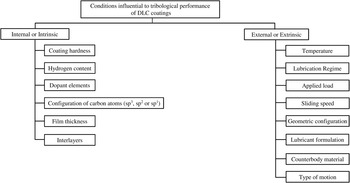
The tribological performance of DLC coatings is not only dependent on its synergistic correlation with lubricant constituents but also on various conditions and operating parameters (Fig. 4). Internal or intrinsic conditions can be defined as those that specify the inherent nature of DLC coatings and are independent of the external conditions. These features are generally defined during the deposition of DLC coatings on the substrates such as hardness, hydrogen content, nature of dopants, configuration of carbon atoms within the structure, carbon precursor, film thickness, and interlayers. Contrary to that, external or extrinsic conditions are those that are application specific and define the environment in which DLC coatings are supposed to operate. These parameters include temperature, lubrication regime, applied load, sliding speed, geometric configuration, lubricant formulation, counterbody material, and type of motion. Although a lot of experimental studies were conducted by various researchers in this regard, still there is a lack of understanding due to contradictory remarks. Therefore, there is a need to address the inconsistencies and arrange the published data in a more organized and comprehensible way. In this way, it will become easy to fully understand the effects of these parameters on the tribological characteristics and select an optimum DLC coating for a particular industrial application.
Intrinsic and extrinsic conditions influential to tribological performance of DLC coatings.

A. Hydrogen content
DLC coatings are well known for their high hardness and excellent tribological properties. Hydrogen plays a vital role in defining the tribological and mechanical properties of DLC coatings.Reference Erdemir, Eryilmaz and Kim53 DLC coatings with about 40 at.% of hydrogen are denoted as hydrogenated DLC coatings, whereas, those with less than 1 at.% are known as nonhydrogenated DLCs.Reference Erdemir54 It is possible to achieve ultralow friction coefficients with hydrogenated DLC coatings in the presence of inert gases and under vacuum,Reference Erdemir, Eryilmaz and Fenske55 whereas, no such behavior is associated with nonhydrogenated DLCs.Reference Andersson, Erck and Erdemir56 This improvement in friction performance can be attributed to the evolution of hydrogen due to strain and thermal effects experienced during sliding and formation of soft porous graphitic layer, independent of tribochemical interaction between DLC coatings and lubricant additives.Reference Komori and Umehara57 It has also been observed that DLC coatings passivated with hydrogen atoms offers low coefficient of friction compare with those passivated with environmental species such as oxygen or moisture.Reference Paulmier, Zaidi, Nery, Huu and Mathia58 On the other hand, relatively inferior friction performance of nonhydrogenated DLC coatings can be improved by either increasing the humidity level or by using a lubricant containing glycerol mono-oleate (GMO).Reference Erdemir, Eryilmaz and Fenske55,Reference Bouchet, Matta, Le-Mogne, Martin, Zhang, Goddard, Kano, Mabuchi and Ye59 Hardness of DLC coatings is also dependent on the atomic concentration of hydrogen in their structure and it is generally decreased with an increase in hydrogen content.Reference Komori and Umehara57,Reference Bhushan60,Reference Flege, Hatada, Ensinger and Baba61 Due to their high hardness, hydrogen-free DLC coatings (a-C and ta-C) are more wear-resistant compared with hydrogenated DLCs.Reference Hainsworth and Uhure62
In an experimental investigation, Vengudusamy et al.Reference Vengudusamy, Green, Lamb and Spikes63 investigated the effect of hydrogen concentration on the tribological characteristics of self-mated a-C:H coatings by varying it from 17 to 25%. A decrease in friction levels between symmetrical a-C:H contact was observed with an increase in hydrogen content. The lowest value of friction was observed with 22 at.% of hydrogen (0.05), whereas, 18 at.% (0.07) gave the highest value irrespective of lubricant formulation. No particular relation of wear coefficient with concentration of hydrogen can be drawn from the experimental results given in the literature. However, a decrease in zinc dialkyldithiophosphate (ZDDP)-derived tribofilm concentration, comprised of zinc, phosphorus, and sulfur, was observed with DLC coatings rich in hydrogen. A similar behavior was also observed by Haque and his team.Reference Haque, Morina, Neville, Kapadia and Arrowsmith64 They found no evidence of ZDDP-derived tribofilm on a-C:H coatings containing 30 at.% of hydrogen when tested in the presence of ZDDP and molybdenum dithiocarbamate (MoDTC) containing lubricant.
In a similar study, de Barros'Bouchet et al.Reference de Barros'Bouchet, Martin, Le-Mogne and Vacher65 tested a-C:H coating containing 50 at.% hydrogen in its structure in combination with polyalphaolefin (PAO) additivated with MoDTC and ZDDP and compared the tribological parameters with a-C coating. They used American Iron and Steel Institute (AISI) 52100 steel cylinders as counterbody. Improved tribological performance was observed in the coating containing hydrogen in its structure. In case of a-C:H/steel contact, friction coefficients of 0.05 and a wear coefficient of 0.8 × 10⁻⁸ mm3/(N m) were recorded, whereas, a-C/steel tribopair gave values of 0.08 and 1.5 × 10⁻⁸ mm3/(N m), respectively. According to hard soft acids bases principle, hydrogenated DLC coatings are soft bases and preferably react with the soft acids such as Mo4+ resulting in the formation of MoS2 which acts as solid lubricant. On the other hand, nonhydrogenated DLCs are hard bases and are attracted toward Mo6+ to form MoO3 which is ineffective in enhancing the friction performance.
Komori and his teamReference Komori and Umehara57 investigated the effect of hydrogen content on the tribological performance of various DLC coatings sliding against steel counterbodies using ZDDP and MoDTC containing fully formulated oil. They observed that ratio of MoS2/MoO3 in additive-derived tribofilm generally increases with an increase in hydrogen content which in turn decreases the values of coefficient of friction. It was also witnessed that a-C:H coatings with very high surface roughness and hardness values also showed the formation of additive-derived tribofilms but with less durability eventually resulting in lower MoS2/MoO3 ratio. A similar behavior was also observed with hydrogen-free DLC coatings having high hardness and surface roughness values. The highest concentration of metallic-molybdenum and molybdenum carbide was detected with DLCs containing hydrogen content in the range of 25–40 at.%, whereas, no such species were found in case of DLCs with lower hydrogen content. It is interesting to note that highest value of metallic-molybdenum and molybdenum carbide was observed in a-C:H coating (33 at.% hydrogen) which was completely worn out during tribotesting. This effect can be attributed to decrease in hardness with an increase in hydrogen content which resulted in structural transformation from diamond to soft graphite phase. Due to this transformation, aggravated wear was observed in DLC coatings with higher concentration of hydrogen. The other factors which played a vital role in accelerated wearing of the DLC-coated surface and steel counterbody include the formation of transfer layer, tribochemical reaction with MoDTC, and the formation of hard compounds such as molybdenum carbide.
In another experimental investigation, Masuko et al.Reference Masuko, Ono, Aoki, Suzuki and Ito66 compared the tribological performance of self-mated a-C:H coatings containing 10 and 20 at.% of hydrogen with ta-C coating. MoDTC and other molybdenum-containing compounds were used as lubricant additives in PAO. An increase in wearing rates of hydrogenated DLC coatings was observed when MoDTC and other molybdenum-based additives were used as additives, whereas, no such behavior was observed with hydrogen-free DLC (ta-C). Contrary to that, PAO additivated with MoDTC maintained the coefficient of friction at a value of 0.055 for all three tribopairs (a-C:10H/steel, a-C:30H/steel and ta-C/steel). It was also observed that the additivation of MoDTC-containing lubricant with ZDDP can result in decreased wear of hydrogenated DLC coatings. Although MoO3 was detected on all types of DLC coatings tested with MoDTC-additivated lubricants but no direct relation between amplified wear and MoO3 was observed.
B. sp 3/sp 2 content
Like other intrinsic factors, sp 3/sp 2 ratio of C–C bonds plays an important role in defining the tribological behavior of DLC coatings. Within the structure of DLCs, carbon atoms are bonded with each other either in sp 2 or sp 3 configuration with a negligible amount of sp 1 bonded carbon atoms.Reference Neuville and Matthews67,Reference Foong, Koh, Hsieh and Chua68 DLC coatings which have high percentage of sp 2 bonded carbon atoms in their structure are more inclined toward graphite in terms of tribological characteristics and are relatively soft.Reference Grill17,Reference Sullivan, Friedmann and Hjort69 On the other hand, hard DLC coatings have high sp 3 content due to which their mechanical and tribological properties are closer to that of diamond.Reference Donnet, Fontaine, Grill and Le Mogne19,Reference Foong, Koh, Hsieh and Chua68,Reference Wang, Ma, Tang and Sun70 Suitability and service life of DLC coatings for various applications can be improved if somehow coatings with high hardness can be manufactured.Reference Neuville and Matthews67 Among the DLC coatings, the highest percentage of sp 3 content is found in ta-C (above 80%), whereas, a-C contains the lowest content of sp 3 bonded carbon atoms in its structure.Reference Al Mahmud, Kalam, Masjuki, Mobarak and Zulkifli71 Hydrogenated DLCs generally have higher sp 3/sp 2 ratio.Reference Bhushan60 The sp 3/sp 2 ratio of the coatings can be adjusted according to the application by varying the deposition parameters to impart either diamond or graphite-like characteristics.Reference Vetter72 One drawback associated with increasing the sp 3/sp 2 ratio is that it amplifies the level of internal stresses during the deposition process. It makes the coatings more prone to delamination during the operation due to poor adhesion with the substrate and drastically affects the service life of the components.Reference Dearnley, Neville, Turner, Scheibe, Tietema, Tap, Stüber, Hovsepian, Layyous and Stenbom73,Reference Bewilogua, Cooper, Specht, Schröder, Wittorf and Grischke74
In an experimental study, Vengudusamy and his teamReference Vengudusamy, Mufti, Lamb, Green and Spikes75 investigated the effect of sp 3 concentration on the tribological performance of self-mated ta-C coating in combination with API group III (A-III) base oil. Two different coatings with sp 3 concentration of 40 and 75% were tested at a temperature of 100 °C using identical tribotest conditions. It was observed that coatings with higher concentration of sp 3 content offered improved wear resistance compared to the one which is rich in sp 2 content. Disc and ball wear coefficients recorded for ta-C coating containing 40% sp 3 content were 1.6 × 10⁻⁸ and 1.1 × 10⁻⁸ mm3/(N m), respectively, whereas, values of 1.4 × 10⁻⁸ and 0.5 × 10⁻⁸ mm3/(N m) were observed for ta-C coating having higher sp 3/sp 2 ratio (75% sp 3 content). However, no significant change in the friction performance was realized. This improved wear resistance of ta-C coating with 75% of sp 3 content can be attributed to its higher hardness/elastic modulus ratio relative to the one having a sp 3 concentration of 40%.
C. Temperature
Among the tribotest conditions, temperature is one of the most critical factors that can directly influence the tribological performance of a contact by changing viscosity of the lubricant and eventually the lubrication regime. In addition to that, different phenomena that can change the friction and wear characteristics of a tribosystem such as graphitization are also temperature dependent. Moreover, lubricant additives have a threshold temperature under which they cannot interact with the sliding surfaces to form beneficial tribofilms and perform their intended role. Therefore, a lot of experimental investigations were carried out to understand the effect of temperature variations on the tribological behavior of various DLC coatings in combination with additivated and nonadditivated lubricants.
In an experimental study, Al Mahmud et al.Reference Al Mahmud, Varman, Kalam, Masjuki, Mobarak and Zulkifli76 investigated the effect of temperature on the tribological performance of ta-C/steel and a-C:H/steel tribopairs in combination with society of automotive engineers (SAE) 40 fully formulated lubricant. Three sets of tribotests were performed at 50, 100, and 150 °C with a constant applied load of 392 N. At higher test temperatures, an increase in I D/I G ratio of both tribopairs was verified by Raman spectroscopy which confirmed that phenomenon of graphitization took place as a result of sliding. Although, improvement in friction performance was observed at higher temperatures due to graphitization but it adversely affected the wear resistance of DLC coatings especially a-C:H which was completely delaminated during sliding at 150 °C. On the other hand, ta-C/steel contact was able to withstand the harsh tribotest conditions due to the formation of ZDDP-derived tribofilm on the interacting surfaces which not only prohibited the delamination of DLC coating but also prevented the wearing of the counterbody.
A similar behavior was observed by Kim and his teamReference Kim and Kim26 in multilayered W-DLC coating sliding against AISI 52100 steel balls in the presence of SAE 5W20 fully formulated lubricant rich in GMO. When temperature was increased from 27 to 160 °C in steps, improvement in friction performance of the contact was observed due to the increase in the extent of graphitization and enhanced tribochemical interaction between lubricant additives and interacting surfaces. Additive-derived tribochemical compounds were majorly found on steel surfaces, whereas, no such compounds were found on DLC-coated surfaces. Contrary to friction results, an increase in composite wear coefficient was observed with an increase in temperature. This deterioration in wear resistance can be attributed to the increase in the intensity of corrosive wear and decrease in durability of tribofilms at elevated temperatures.
In a similar study, Amanov and his teamReference Amanov, Watabe, Tsuboi and Sasaki77 analyzed silicon-doped DLC (Si-DLC) sliding against alumina balls in the presence of nonadditivated PAO to see the effect of temperature variation on friction and wear characteristics. When test temperature was increased from 25 to 100 °C, friction coefficient was also increased from 0.14 to 0.18 due to the formation of oxygen-rich film and accumulation of wear debris. Contrary to that, an exponential improvement in friction performance of Si-DLC was observed at 200 °C due to structural transformation from diamond to graphite phase and friction coefficient was reduced to its lowest value of 0.10. No significant change in the wear coefficient of Si-DLC coated disc was observed at lower test temperatures i.e., 25, 50, and 100 °C. It is well known that graphitization adversely affects the structural integrity of nondoped DLC coatings due to which they become soft and more vulnerable to excessive wearing. Although, occurrence of graphitization was witnessed at 200 °C but still a substantial improvement in wear characteristics of Si-DLC was observed and wear coefficient was reduced from 0.4 × 10⁻⁹ to 0.24 × 10⁻⁹ mm3/(N m). From these observations, it can be concluded that doped-DLC coatings such as Si-DLC behaves differently from nondoped DLC coatings as far as wear behavior at elevated temperature in combination with graphitization is concerned.
In another study, Abdullah Tasdemir and his teamReference Abdullah Tasdemir, Wakayama, Tokoroyama, Kousaka, Umehara, Mabuchi and Higuchi78 studied the effect of changing temperature, ranging from 25 to 110 °C, on wear characteristics of ta-C/steel contact using additivated and nonadditivated versions of PAO as lubricants. Overall, deterioration in wear properties of ta-C coatings was observed at high temperatures in case of nonadditivated PAO, whereas, additives proved to be helpful in overcoming the excessive wear by forming additive-derived tribofilms and surface passivation. No effect of temperature variation on the wear performance of ta-C coating was observed when PAO + ZDDP was used. Contrary to that, significant increase in wear coefficient was seen with nonadditivated PAO when temperature was increased beyond 50 °C and the highest value of 34.0 × 10⁻⁸ mm3/(N m) was observed at 110 °C. This effect can be attributed to different wear mechanisms involved at elevated temperatures such as delamination, brittle fracture, graphitization, and tribofilm formation compared to polishing wear which usually occurred at room temperature.Reference Ouyang and Sasaki79 An improvement in wear performance of ta-C/steel tribopair was experienced with GMO-additivated lubricants. Effectiveness of GMO in reducing friction between the contacts amplified with an increase in temperature in both PAO + GMO and PAO + GMO + ZDDP lubricants, whereas, opposite behavior was observed with PAO + ZDDP. In case of PAO, coefficient of friction was initially decreased when temperature increased from 25 to 50 °C but significant increase from 0.02 to 0.08 was observed when temperature was further elevated to 80 and 110 °C. A similar deterioration in wear characteristics and improvement in friction performance of titanium-doped DLC (Ti-DLC)/steel and a-C:H/a-C:H contacts at elevated temperature were also observed in the experimental studies carried out by Ouyang and SasakiReference Ouyang and Sasaki79 and Kalin et al.Reference Kalin, Roman and Vižintin80
D. Sliding speed and load
Sliding speed and applied load are some of the application specific conditions that can significantly alter the tribological behavior and service life of DLC-coated components. It is mentioned in the literature that coefficient of friction is generally decreased with an increase in sliding speed and applied load.Reference Ouyang, Sasaki, Murakami, Zhou and Zhang30,Reference Yasuada44 A similar behavior also exists between wear coefficient and applied load, whereas, opposite is true for sliding speed.Reference Kim and Kim26,Reference Ouyang and Sasaki79
Zaidi and his teamReference Zaidi, Le Huu, Robert, Bedri, Kadiri and Paulmier81 studied the effect of sliding speed and normal load on tribological characteristics of a-C:H coatings in vacuum under dry conditions. They found an indirect relation of sliding speed and normal load with coefficient of friction. At 4 N applied load, value of friction coefficient was 0.16, whereas, it decreased to 0.12 when load was increased to 8 N. Similarly, coefficient of friction was reduced from 0.1 to 0.085 when sliding speed of the contact was increased from 0.03 to 0.27 m/s. With an increase in normal load, a decrease in endurance life or abrasive wear resistance was also detected. This tribological behavior can be attributed to increase in contact temperature at high values of applied loads and sliding speeds due to which hydrogen is desorbed from the coating resulting in structural transformation from diamond to graphite phase.
In a similar study, Erdemir and his teamReference Erdemir, Bindal, Fenske, Zuiker and Wilbur82 used zirconia balls sliding against a-C:H coated disks at three different velocities i.e., 1, 2, and 6 m/s. Tribological experiments were performed in air without using any liquid lubricant between the interacting surfaces. The highest and lowest values of coefficient of friction were observed at 1 and 6 m/s, respectively. An improvement in friction performance with an increase in sliding speed can be attributed to the transformation of DLC coating from diamond to graphite phase. It was also observed that steady state coefficient of friction can be achieved much earlier at higher sliding speeds but it adversely affects the service life of DLC coatings.
In another study, Kim and KimReference Kim and Kim27 investigated the friction and wear characteristics of multilayered a-C:H coated disc sliding against AISI 52100 steel balls under dry conditions. To investigate the influence of applied load and sliding speed on tribological characteristics of a-C:H/steel contact, six different values of sliding speeds (0.0625, 0.125, 0.25, 0.5, 1, and 2 m/s) and three different levels of applied loads (6.1, 20.7, and 49.0 N) were selected. Tribological experiments were performed in the presence of ambient air with a relative humidity of 26% and temperature of 18 °C. Reduction in friction was observed with an increase in both sliding speed and applied load. Lowest value of friction coefficient (0.05) was observed at a sliding speed of 1 m/s and applied load of 49.0 N, whereas, the highest level of friction (0.18) between the interacting surfaces was observed at sliding speed and applied load of 0.06 m/s and 6.1 N, respectively. This enhanced friction performance of the contact can be attributed to surface graphitization and formation of transfer layer at extreme test conditions. Similar to friction results, lowest values of wear coefficients of a-C:H coated disc [5.0 × 10⁻⁸ mm3/(N m)] and AISI 52100 steel ball [0.2 × 10⁻⁸ mm3/(N m)] were observed at elevated values of sliding speed (2 m/s) and applied load (49.0 N), whereas, highest values [55.0 × 10⁻⁸ mm3/(N m) and 1.2 × 10⁻⁸ mm3/(N m), respectively] were observed at an applied load of 6.1 N and intermediate values of sliding speeds (0.125–0.25 m/s). Wear coefficients of both surfaces were initially increased and then decreased with an increase in sliding velocity. This effect can be attributed to the asperity breakages at higher sliding velocities which resulted in decreased number of asperity contacts and increase in the tribochemical products concentrations on the interacting surfaces.Reference Kim and Kim26
Kano and his teamReference Kano, Yasuda, Okamoto, Mabuchi, Hamada, Ueno, Ye, Konishi, Takeshima and Martin83 studied the effect of sliding velocity on the friction characteristics of ta-C/steel and a-C:H/steel contacts using pin-on-disc configuration and reciprocating rig. SAE 5W30 and PAO additivated with GMO were used as lubricants and tribological results were compared with needle bearing in pure rolling contact. A decrease in coefficient of friction was observed with an increase in sliding speed from 0.1 to 1 m/s irrespective of contact type. However, a-C:H/steel contact showed high values of friction compared to ta-C/steel tribopair and needle bearings irrespective of oil formulation. A steady-state and ultralow coefficient of friction of 0.006 was achieved in case of ta-C/steel when tested in the presence of PAO + GMO at a sliding speed of 0.10 m/s however, no further reduction in friction was observed with increase in speed. This value of friction is equal to the value obtained with needle bearings in pure rolling contact. This shows that level of friction observed in case of rolling contact can also be obtained with sliding contact under boundary lubrication regime using ta-C coatings and PAO + GMO as a lubricant.
Ouyang and his teamReference Ouyang, Sasaki, Murakami, Zhou and Zhang30 studied the effect of varying normal load i.e., 2 and 5 N, on friction and wear performance of Ti-DLC coating sliding against steel and alumina balls under dry conditions and at room temperature. Ti-DLC surfaces showed aggravated wear and amplified friction when slid against steel compared with alumina. An increase in wear coefficient of Ti-DLC coated flat was observed in both Ti-DLC/steel and Ti-DLC/alumina tribopairs with an increase in applied load. When the load was increased from 2 to 5 N, wear coefficient of Ti-DLC coating was increased from 0.182 × 10⁻⁸ to 0.287 × 10⁻⁸ mm3/(N m) when alumina ball was used as counterbody. Similar deterioration in wear behavior was also observed in case of Ti-DLC/steel tribopair and wear rate of Ti-DLC coated surface was increased from 0.434 × 10⁻⁸ to 0.517 × 10⁻⁸ mm3/(N m). Comparatively, high value of friction was achieved with Ti-DLC/steel tribo-pair irrespective of the value of applied load. Although, a decrease in coefficient of friction was noted when load was increased from 2 to 5 N in both Ti-DLC/steel and Ti-DLC/alumina tribopairs, however, improvement in friction performance was more pronounced when steel was used as counterbody. When load was increased from 2 to 5 N, friction coefficients was decreased from 0.135 to 0.13 and 0.235 to 0.19 for Ti-DLC/alumina and Ti-DLC/steel contacts, respectively.
In a similar study, Gangopadhyay and his teamReference Gangopadhyay, Zdrodowski and Simko84 tribologically evaluated Si-DLC coating using cylinder-on-flat geometric configuration in combination with SAE 5W30 fully formulated oil at a temperature of 100 °C and sliding speed of 0.3 m/s. No additive-derived tribofilm was observed on the DLC-coated flat till the value of applied load was increased to 240 N. Beyond 240 N, additive-derived tribofilm started to build up and kept on thickening with the subsequent increase in the value of applied load. On further increasing the load, a decrease in the tribofilm thickness was observed. When the same tests were conducted on uncoated steel flat at an applied load of 80 N, calcium containing tribofilms containing identical concentrations were observed on the interacting surfaces. These results shows that there exists a threshold value of applied load at which additive-derived tribofilms can be formed on the sliding surfaces and that level is very much higher for DLC-coated surfaces as compared to ferrous-based materials. In addition to that, thicker tribofilms were observed on the steel surfaces as compared to Si-DLC coating.
E. Interlayers
To improve the suitability of DLC coatings for various industrial applications and increase their service life, there is a need to promote their adhesion with various substrate materials and minimize the residual stresses entrapped in their structure during the deposition process.Reference Moon, Jensen, Hutchinson, Oh and Evans85 This can be achieved by depositing either ceramic or metallic adhesion promoting interlayers that can be bonded strongly with both substrate surface and top DLC layer as a result of a chemical reaction.Reference Bewilogua and Hofmann1,Reference Bubenzer, Dischler and Nyaiesh13 Interlayers also help in uniformly distributing the load across the substrate resulting in increased load carrying capacity of the coatings.Reference Kržan, Novotny-Farkas and Vižintin86 Fatigue and corrosion resistance can also be improved by depositing suitable interlayer before the deposition of top DLC coating.Reference Forsberg, Gustavsson, Renman, Hieke and Jacobson87 Some of the most commonly used interlayers include titanium diboride (TiB2), titanium (Ti), titanium nitride (TiN), chromium (Cr), chromium carbide (CrC), chromium nitride (CrN), tungsten (W), and silicon nitride (Si3N4).Reference Bewilogua and Hofmann1,Reference Cruz, Rao, Rose, Lawson and Nicholls88
In an experimental investigation, Kalin and his teamReference Kalin and Vižintin89 studied the effect of two different types of adhesion promoting interlayers on the tribological performance of a-C:H coating. TiN and silicon-based compound with thickness values of 0.5 and 1 µm, respectively, were used as interlayers. The adhesion strength of the coatings was measured using a scratch tester. The test results revealed that TiN proved to be more efficient in enhancing the bonding between the substrate and a-C:H coating. Since, only the top layer comes into contact during the sliding therefore, no effect of interlayer on the friction and wear performance of the contact was seen.
In another study, Forsberg and his teamReference Forsberg, Gustavsson, Renman, Hieke and Jacobson87 used two different types of interlayers in a-C:H coatings. In both coatings, chromium layer was used to increase the adhesion between the substrate and interlayers. In addition to that, CrN was also deposited in one of the coatings to increase its load bearing capacity, corrosion resistance and fatigue strength, whereas, W-DLC interlayer was deployed in the second coating for reducing the level of internal stresses induced during the deposition process. After tribological experiments, it was revealed that a-C:H coating which has CrN interlayer is less vulnerable to delamination and has better adhesion strength compared to the one having W-DLC interlayer.
Although silicon-based interlayers proved to be helpful in improving the adhesion between the substrate and DLC coatings in most of the applications, they are inappropriate for biomedical implants because such layers are vulnerable to corrosive attack by body fluid.Reference Hauert, Thorwarth, Müller, Stiefel, Falub, Thorwarth and Joyce90 Due to the imperfections and crevices in top layer of DLC coatings, body fluid can flow down to the underlying interlayers resulting in corrosion and decreased adhesion strength. Therefore, it is extremely important to test the corrosion stability and compatibility of all the interlayers in the structure of DLC coating before employing them for a particular industrial application otherwise there is an increased likelihood that coated parts will fail on a long-term exposure to harsh environmental and operating conditions.
F. Doping
It is an established fact that DLC coatings are chemically inert in nature compared to conventional engineering materials such as metals.Reference Grill, Patel and Meyerson91 To increase the thermochemical reactivity of DLC coatings with lubricant constituents and impart application specific properties, different metals and nonmetals are generally incorporated in their structure. By doing so, extraordinary tribological characteristics of DLC coatings such as high hardness, wear resistance, and chemical reactivity of metals can be combined in a single material. Compared to nondoped DLCs, metal-doped ones have higher surface energy and abundant active sites that facilitates in interactions with lubricant additives and environmental species. During the deposition of DLC coatings on the substrates, internal stresses are generally entrapped within the structure which aggravates with the increase in film thickness.Reference Gangopadhyay92 As a result, these coatings become more vulnerable to surface defects such as cracking and delamination resulting in reduced service life. Doping of DLC coatings with nonmetals is proved to be effective in mitigating the catastrophic effects of these stresses on the structural integrity and reliability of DLC coatings.Reference Robertson93,Reference Grill94 Moreover, the presence of nonmetals in the structure of DLC coatings can also alter their sp 3/sp 2 ratio. It is mentioned in the literature that the incorporation of silicon in DLC coatings results in the increase of sp 3 content in their structure, whereas, opposite is true for fluorine.Reference Park, Choi, Park, Jang, Hong and Kwon95
de Barros'Bouchet et al.Reference de Barros'Bouchet, Martin, Le-Mogne and Vacher65 compared the tribological performance of a-C, a-C:H, and Ti-DLC coatings using additivated and nonadditivated versions of PAO. Doping of a-C:H coating with titanium decreased its hardness from 1600 to 1000 HV and Young's modulus from 150 to 80 GPa. In case of DLC/steel contacts, the lowest value of steady-state coefficient of friction and wear rate were observed with Ti-DLC coating irrespective of the lubricant formulation. Almost similar tribological behavior was also observed with symmetrical DLC contacts. When PAO and PAO + MoDTC were used as lubricants separately, Ti-DLC/Ti-DLC tribopair demonstrated excellent tribological performance followed by a-C:H/a-C:H and steel/steel. With PAO + MoDTC + ZDDP, a-C:H/a-C:H demonstrated slightly better friction and wear behavior than Ti-DLC/Ti-DLC tribopair. This effect can be attributed to the enhanced tribochemical interaction of lubricant additives with richer-hydrogenated DLC such as a-C:H. Although some tribochemical interaction was also observed in case of Ti-DLC/Ti-DLC couple but not to an extent of a-C:H/a-C:H.
Effect of tungsten doping concentration (12 at.% W, 14 at.% W, 18 at.% W, and 21 at.% W) on the tribological performance of W-DLC in the presence of A-III base oil was studied by Vengudusamy and his team.Reference Vengudusamy, Mufti, Lamb, Green and Spikes75 DLC-coated balls and discs were used as interacting surfaces sliding against each other at a test temperature of 80 °C. Increase in the hardness of W-DLC was observed with an increase in tungsten concentration till 18 at.%. However, further increase in tungsten concentration to 21 at.% resulted in a decrease in hardness value from 1318 to 1190 HV. Wear coefficients of DLC-coated balls remained unchanged for different values of tungsten concentration. On the other hand, higher concentration of tungsten resulted in accelerated wear of DLC-coated discs. Lowest value of friction was observed with W-DLC coating containing 18 at.% of W, whereas, it remains constant at a level of 0.10 for rest of the concentrations.
In a similar study, Vengudusamy et al.Reference Vengudusamy, Green, Lamb and Spikes96 compared the tribological behavior of self-mated W-DLCs with those of a-C/a-C, a-C:H/a-C:H, ta-C/ta-C, ta-C:H/ta-C:H, and Si-DLC/Si-DLC tribopairs in combination with A-III and A-III + MoDTC lubricants. When nonadditivated A-III lubricant was used, W-DLC/W-DLC contact offered more friction compared to ta-C/ta-C and a-C/a-C contacts, whereas, rest of the tribopairs showed higher values of friction coefficients. Additivation of A-III with MoDTC improved the friction behavior of almost all tribopairs. Lowest values of friction coefficients were observed for W-DLC/W-DLC and ta-C/ta-C contacts. Ultralow friction coefficient observed in case of symmetrical W-DLC contact can be attributed to the formation of WS2 along with MoS2. Contrary to friction results, highest values of wear coefficients were observed for W-DLC/W-DLC when both A-III and A-III + MoDTC were used as lubricants separately. This deterioration in wear performance due to tungsten-doping of DLC coating can be attributed to its vulnerability to graphitize.
Abdullah Tasdemir and his teamReference Abdullah Tasdemir, Tokoroyama, Kousaka, Umehara and Mabuchi97 compared the friction and wear performance of Si-DLC and chromium-doped DLC (Cr-DLC) with nondoped DLCs. Both doped-DLCs showed reduced wear in both PAO and PAO + ZDDP lubricants compared with other DLCs. Opposing to that, doping of DLC coatings with silicon and chromium resulted in increased friction between the sliding surfaces irrespective of the lubricant formulation.
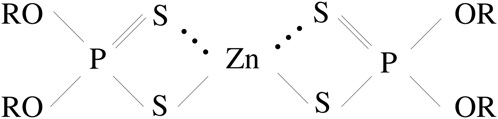
In another investigation, Kalin et al.Reference Kalin, Roman, Ožbolt and Vižintin98 compared the wear characteristics of conventional DLC coatings with Ti-DLC and W-DLC in the presence of formulated lubricants. The highest level of tribochemical interaction with ZDDP and consequently the lowest value of wear coefficient were observed in case of Ti-DLC. This improved wear resistance with titanium doping can be attributed to 25 times increase in P/S ratio due to the formation of ZDDP-derived tribochemical products on the interacting surfaces in large quantities (Fig. 5). Although, some tribochemical reaction was also observed between W-DLC and ZDDP, it did not effectively improve the wear resistance of interacting surfaces resulting in the highest value of wear coefficient. Graphitization also played a key role in accelerating the wear of W-DLC coated surfaces.
Structural formula of ZDDP.Reference Spikes99

G. Lubricant formulation
Modern day industrial applications involve rigorous operating conditions such as high temperatures, extreme pressures and heavier loads. In these scenarios, either lubricant slips out of the contact or only a thin layer of lubricant resides between the interacting surfaces. To avoid metal-to-metal contact and enhance the tribological performance of the contact, lubricants generally contain specially designed additive packages. These additives are capable of interacting with the interacting surfaces and form tribologically beneficial tribofilms. Since, lubricant companies design the lubricants by keeping in mind that their products will only interact with the ferrous surfaces, therefore, a lot of researchers conducted research to investigate how most widely used conventional lubricant additives and fully formulated lubricants interact with various types of DLC coatings in symmetrical and asymmetrical contacts. Some of the lubricant additives which were most widely investigated in combination with various DLC coatings include MoDTC, ZDDP, GMO, and amine phosphates (AP).
In an experimental investigation, de Barros'Bouchet and his teamReference de Barros'Bouchet, Martin, Le-Mogne and Vacher65 investigated the effect of MoDTC on the tribological performance of Ti-DLC/Ti-DLC contact using PAO as a base oil. When PAO + MoDTC was used as a lubricant, tribochemical interaction took place between MoDTC and Ti-DLC coated surfaces resulting in lower coefficient of friction (0.06) compared to nonadditivated PAO (0.07) due to the formation of MoS2. Although, MoDTC is primarily a friction modifier, it was able to further enhance the wear resistance of self-mated Ti-DLC contact when mixed with PAO and wear coefficient was decreased from 0.2 × 10⁻⁸ to 0.01 × 10⁻⁸ mm3/(N m). Similarly, an improvement in friction performance was also observed in case of W-DLC/W-DLC, Si-DLC/Si-DLC and symmetrical tungsten carbide-doped DLC WC-DLC/WC-DLC contacts when MoDTC was used as an additive in A-III base oil.Reference Vengudusamy, Green, Lamb and Spikes96
Effectiveness of ZDDP in reducing the wear coefficient of doped-DLC coatings was studied by Kalin and his team.Reference Kalin, Vižintin, Barriga, Vercammen, Van Acker and Arnšek100 When paraffinic mineral oil (M) was used in nonadditivated form, accelerated wear of W-DLC/W-DLC and Ti-DLC/Ti-DLC contacts was noticed due to delamination and coating spallation. Additivation of ZDDP not only reduced the wear substantially but also helped in improving the service life of DLC coatings by overcoming the surface defects. In case of self-mated Si-DLC coating, an improvement in wear characteristics was realized as a result of ZDDP-derived tribochemical products due to which adhesive wear was replaced by polishing wear. A similar behavior was also observed by Abdullah Tasdemir et al.Reference Abdullah Tasdemir, Tokoroyama, Kousaka, Umehara and Mabuchi97 in Si-DLC/Si-DLC and Cr-DLC/Cr-DLC contacts when ZDDP was used as an additive in PAO due to the formation of ZDDP-derived pad-like tribofilm comprised of zinc, sulfur, and phosphorus.
A reduction in wear coefficient of ta-C/ta-C contact was observed by Abdullah Tasdemir and his team when PAO was additivated with GMO compared to nonadditivated PAO and it was reduced from 4.0 × 10⁻⁸ to 2 × 10⁻⁸ mm3/(N m).Reference Abdullah Tasdemir, Wakayama, Tokoroyama, Kousaka, Umehara, Mabuchi and Higuchi101 This improvement in wear performance can be explained by the interaction of hydroxyl group in the structure of GMO resulting in passivation of dangling carbon atoms. It is mentioned in the literature that passivation of carbon bonds decreases the surface energy of DLC coatings due to which their ability to react with environmental species such as oxygen and moisture also decreases.Reference Al Mahmud, Varman, Kalam, Masjuki, Mobarak and Zulkifli76 As a result, surface deterioration due to oxidation is minimized and service life of the contact increases. GMO also proved to be effective in facilitating the sliding of Cr-DLC coated surfaces and resulted in decreased friction coefficients when used as an additive in A-II base oil.Reference Topolovec-Miklozic, Lockwood and Spikes102 This enhancement in friction characteristics can be attributed to the adsorption of viscous GMO-derived tribofilm on the asperities and extrusions.
AP is also one of the conventional lubricant additives that are widely investigated in combination with DLC coatings. The primary role of AP is to minimize the composite wear of a contact by increasing the surface energy and preventing the material transfer between interacting surfaces. In an experimental investigation, Kalin and his teamReference Kalin and Vižintin103 analyzed the effectiveness of AP in enhancing the tribological properties of various nondoped and doped-DLC coatings in symmetrical and asymmetrical contacts using paraffinic mineral base oil. Detrimental effect of AP additive was observed on the friction performance of all the contacts resulting in 5–25% increase in coefficient of friction. Contrary to that, AP significantly improved the wear characteristics of W-DLC/steel, a-C:H/a-C:H, and W-DLC/W-DLC tribopairs by preventing coating spallation/delamination and replacing adhesive wear by polishing wear.
H. Substrate and counterbody materials
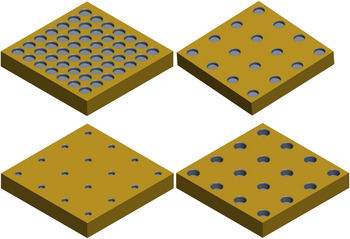
There is a strong dependence of tribological characteristics of DLCs on physical and chemical properties of substrate and counterbody materials. A lot of improvements in adhesion strength between DLC coatings and substrates can be made by using surface alteration techniques such as texturing, hardening and roughening. Texturing emerged as a surface modification technique using which tribological performance of various mechanical components can be improved significantly.Reference Dumitru, Romano, Weber, Pimenov, Kononenko, Sentis, Hermann and Bruneau104–Reference Etsion107 Various techniques such as reactive ion etching, ion beam machining and lasers can be used to make grooves, dimples, patterns or channels of different orientations, sizes, and shapes on DLC-coated surface/substrate.Reference Etsion107,Reference Oksanen, Hakala, Tervakangas, Laakso, Kilpi, Ronkainen and Koskinen108 In Fig. 6, textured substrates with varying dimple diameter, dimple depth and dimple density are shown. These depressions not only act as hydrodynamic bearings to generate additional lift but also serve as reservoirs to continuously supply lubricant and trap wear debris to prevent third-body interaction. Moreover, texturing also obviate surface deterioration by abrasive wear and reduce contact area of mating surface.
Textured substrates with varying dimple diameter, dimple depth, and dimple density.

In an experimental investigation, Amanov and his teamReference Amanov, Watabe, Tsuboi and Sasaki77 compared the tribological performance of Si-DLC coating deposited on textured and untextured bearing steel substrates at various temperatures. In sliding tests, alumina balls were used as counterbodies and PAO as lubricant. An improvement in friction and wear characteristics of Si-DLC coating was observed when textured substrates were used instead of the untextured ones. At 200 °C, untextured Si-DLC coating gave a friction and wear coefficient of 0.1 and 0.024 × 10⁻⁸ mm3/(N m), respectively, whereas, coefficients values of 0.07 and 0.006 × 10⁻⁸ mm3/(N m) were observed in case of textured Si-DLC coating. This enhancement in tribological performance due to texturing can be attributed to enhanced mechanical properties, microstructural alterations, and phase transformation from diamond to nanocrystalline graphite.
The effect of dimple diameter, density, and depth on the tribological performance was studied by Shum and his team.Reference Shum, Zhou and Li109 They found that improvement in tribological performance of DLC coatings can only be achieved with dimples having optimum size and density. They observed a significant reduction in friction and wear coefficients of DLC coating with a dimple diameter of 100 µm, density of 10%, a depth of 10 µm, and a dimple diameter to contact diameter ratio of approximately 0.4. As mentioned earlier, this improvement can be attributed to the beneficial role of dimples in retaining the lubricant and supplying it to the contact in case of starved conditions so that metal-to-metal contact can be avoided. In addition, dimples also remove the wear debris from the interface and trap them inside to refrain sharp-edged hard metal particles from deteriorating the interacting surfaces.
In another study, Masuko et al.Reference Masuko, Kudo and Suzuki110 studied the effect of surface roughened substrates on the delamination strength and tribological performance of a-C:H coating using air, water, and n-decane as lubricants. Roughened substrates were made by wet blast surface finish method in combination with slurries of different hard particles such as alumina (6, 25, and 40 µm), glass (2–20 µm), and zirconia (63 µm) in angular and spherical shapes. Because of their amorphous nature, DLC coatings usually mimic the surface roughness of the substrate.Reference Bubenzer, Dischler and Nyaiesh13 A considerable improvement in the delamination strength and tribological properties of a-C:H coating was experienced using roughened substrates especially when spherical zirconia and glass particles were used in slurries. It was also observed that slight polishing of the substrate material before deposition of DLC coating can significantly improve adhesion strength and composite wear coefficient of a contact due to the removal of hard projections.
In another study, Abdullah Tasdemir et al.Reference Abdullah Tasdemir, Wakayama, Tokoroyama, Kousaka, Umehara, Mabuchi and Higuchi78 used germanium and AISI 52100 chrome steel discs sliding against ta-C coated pins to see the influence of counterbody materials on the friction and wear characteristics of DLC coatings. The tests were conducted at different temperatures using PAO as a lubricant base oil. In case of ta-C/germanium tribopair, low values of friction and wear coefficients were observed irrespective of test temperature. Contrary to that, aggravated wear of ta-C coating was observed at elevated temperatures (80 and 100 °C) due to delamination, which also resulted in higher friction coefficient, when steel disc was used as counterbody. Lower values of wear coefficients achieved with germanium can be attributed to extremely low solubility of carbon in germanium compared with steel.Reference Olesinski and Abbaschian111 In addition to that, only polishing wear was observed in case of germanium, whereas, thermally activated tribochemical wear was the predominant cause of delamination in ta-C/steel tribopair.
Ouyang and his teamReference Ouyang, Sasaki, Murakami, Zhou and Zhang30 used steel and alumina as counterbody materials to see the effect of counterbody material on the tribological performance of Ti-DLC coatings under dry conditions. DLC/alumina showed better friction and wear performance as compared to DLC/steel due to difference in hardness values of two counterbody materials under identical tribotest conditions. In a similar study, Ouyang and SasakiReference Ouyang and Sasaki79 compared the tribological characteristics of Ti-DLC using AISI 52100 chrome steel balls and CrN-coated pins as counterbodies. They found a significant dependence of friction and wear performance of DLC coatings on counterbody material irrespective of the test conditions. DLC/CrN tribopair showed better friction performance, whereas, DLC/steel couple proved to be more wear-resistant.
VI. DISCUSSION
In this article, effects of various intrinsic and extrinsic conditions on tribological characteristics of DLC coatings have been reviewed with a special emphasis on the mechanisms responsible for a particular tribological behavior. To improve the understanding of the reader, the main findings of this study are summarized in tables.
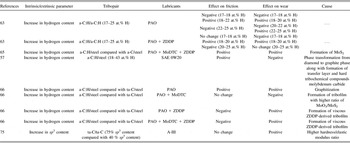
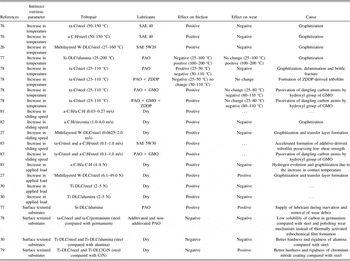
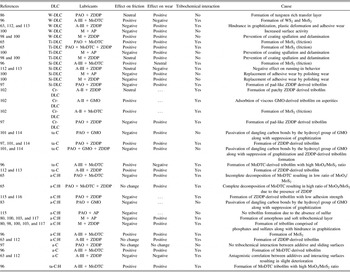
Effects of intrinsic and extrinsic conditions on friction and wear characteristics of DLC coatings are summarized in Table II and III, respectively. A word “positive” is mentioned in “effect on friction” or “effect on wear” column if increase in the value of a particular intrinsic/extrinsic condition resulted in enhanced tribological behavior, whereas, “negative” is stated when the same culminated in deteriorated performance. On the same lines, effects of various lubricant additives on friction and wear coefficients of self-mated DLC coatings are summarized in Table IV. A word “positive” is mentioned in “effect on friction” or “effect on wear” column if additivation of a particular additive in base oil ended up in reduced friction or wear coefficient compared to its nonadditivated version, whereas, “negative” is stated when additivation turned out to be disadvantageous for tribological performance.
Effect of intrinsic conditions on the friction and wear characteristics of DLC coatings.

Effect of extrinsic conditions on the friction and wear characteristics of DLC coatings.

Effect of additives on friction and wear characteristics of DLC coatings.Reference Zahid, Masjuki, Varman, Mufti, Kalam and Gulzar28

Among the intrinsic conditions, hydrogen content plays a vital role in defining the tribological properties of DLC coatings. In case of symmetrical a-C:H contacts, the lowest friction and wear coefficients were observed with a-C:H coatings containing 18–20 at.% of hydrogen in their structure when PAO and PAO + ZDDP were used as lubricants separately (Table II). Increase or decrease in hydrogen content beyond these limits adversely affected the tribological performance of a-C:H/a-C:H contacts. Hydrogenated DLC coatings sliding against steel showed better wear resistance compared to a-C/steel and ta-C/steel tribopairs when PAO, PAO + ZDDP, and PAO + MoDTC + ZDDP were used as lubricants, whereas, opposite behavior was observed with PAO + MoDTC. Inferior wear performance in case of PAO + MoDTC can be attributed to the unavailability of ZDDP and subsequently insufficient supply of sulfur due to which tribochemical decomposition of MoDTC resulted in higher concentration of MoO3 relative to MoS2. When SAE 0W20 was used as lubricant in combination with a-C:H/steel contact, an improvement in friction performance, whereas, deterioration in wear characteristics was realized with an increase in hydrogen concentration. This behavior can be associated with an increase in extent of graphitization in case of hydrogenated DLC coating due to evolution of hydrogen from its structure during sliding and formation of transfer layer. Although, a-C:H/steel tribopairs showed superior friction performance as compared to a-C/steel however, friction coefficients achieved with hydrogenated DLCs were still higher than those of ta-C/steel contacts.
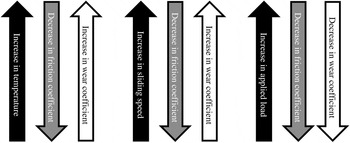
To simulate the real life scenarios, researchers evaluated different types of DLC coatings at wide range of temperatures to see their suitability for various industrial applications. In Fig. 7, effects of increase in value of temperature, applied load and sliding speed on the value of friction and wear coefficients of DLC coatings are shown. In general, an improvement in friction performance of DLC coatings is observed with an increase in temperature especially beyond 100 °C (Table III). This effect can be attributed to the occurrence of graphitization phenomenon at high temperatures which facilitates the sliding of interacting surfaces. It was also observed that graphitization can occur at fairly low temperatures under dry test conditions due to high localized temperatures encountered during sliding. Although, graphitization helps in improving the friction performance, it adversely affects the wear resistance of DLC coatings. The transformation of DLC coatings from diamond to graphite phase weakens the overall structure and amplifies the wearing of interacting surfaces by causing delamination and brittle fracture. These catastrophic implications of graphitization on wear performance of DLC coatings can be mitigated to some extent by using lubricant additives such as ZDDP. Since, there is a threshold temperature under which lubricant additives cannot perform their intended role, it is essential to keep in mind the operating conditions while formulating a lubricant and selecting a DLC coating for a particular industrial application.
Effects of increase in temperature, sliding speed, and applied load on value of friction and wear coefficients of DLC coatings—a general trend.

Relative speed of interacting surfaces also directly influences the friction and wear characteristics of a contact. A decrease in coefficient of friction was observed with an increase in sliding speed and applied load irrespective of the type of DLC coating and lubricant formulation. This improvement in friction coefficient can be attributed to the formation of transfer layer and graphitization of DLC coatings. Another possible reason for this enhanced friction behavior can be accelerated formation of additive-derived tribofilms possessing low-shear strength at high sliding speeds. On the other hand, increase in sliding speed has negative implications on the wear coefficients and increase in wearing rates of DLC coatings was observed due to graphitization especially under dry test condition. When additivated and nonadditivated versions of PAO were used as lubricants, increase in applied loads resulted in reduced wear coefficients irrespective of the type of DLC coatings. This improved wear characteristic at heavier loads can be attributed to accelerated formation of harder and tougher additive-derived tribofilm which strongly adhered to the interacting surfaces.
To avoid starvation conditions and remove hard debris from the interface, surface modification techniques such as laser texturing can prove to be very helpful. Ultralow friction coefficients and high wear resistance can be achieved by using laser-textured substrates in combination with DLC coatings. The dimples of laser-textured substrates not only act as reservoirs to supply the lubricant during the starved conditions but also store hard and sharp wear particles to avoid their interaction with the sliding surfaces. Like other extrinsic parameters, there is a strong dependence of tribological behavior of DLC coatings on the physical and chemical properties of counterbody materials. In an experimental investigation, germanium proved to be more conducive in enhancing tribological performance of ta-C coating compared to steel when additivated and nonadditivated versions of PAO were used as lubricants. The reason being low solubility of carbon in germanium compared to steel. In addition to that, thermally activated tribochemical film formation resulted in high rates of wear in ta-C/steel contact, whereas, only polishing wear was observed in case of ta-C/germanium tribopair. Similarly, high values of friction and wear coefficients were observed when steel was used as counterbody against Ti-DLC under dry test conditions compared to alumina balls and chromium nitride-coated pins. One viable justification for this behavior can be higher hardness and rigidness of alumina and chromium nitride coating compared to steel.
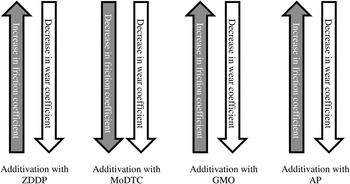
To investigate the compatibility of conventional lubricant additives with different types of DLC coatings, a lot of experimental studies were carried out in last two decades. It was found that lubricants which are formulated for interacting with ferrous surfaces can play their role in further enhancing the tribological characteristics of DLC coatings. Effects of different lubricants additives on the friction and wear performance of doped and nondoped DLC coatings are summarized in Table IV. Moreover, a general trend of effects of conventional lubricant additives on tribological characteristics of self-mated DLC coatings is graphically presented in Fig. 8.
Effects of various lubricant additives on value of friction and wear coefficients of symmetrical DLC contacts—a general trend.

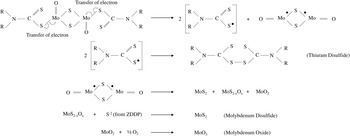
In Table IV, it can be seen that most widely lubricant additives which are optimized for metals can tribochemically interact with both nondoped and doped-DLC coatings as well. ZDDP proved to be helpful in enhancing the wear characteristics of almost all types of DLC coatings irrespective of base oil. The main mechanism behind this improvement is the formation of ZDDP-derived tribofilm, comprised of zinc, phosphorus, and sulfur with pad-like structure. In case of symmetrical W-DLC and Si-DLC contacts, ZDDP helps in reducing the wear coefficient by overcoming the phenomenon of graphitization and replacing adhesive wear by polishing wear. In almost all types of DLC coatings, MoDTC helps in facilitating the sliding of DLC-coated surfaces when formulated with various base oils. This advantageous role of MoDTC in overcoming friction can be attributed to the formation of MoS2. It is widely accepted that MoS2 plays a vital role in diminishing the frictional forces between the interacting surfaces due to its low shear strength. The presence of ZDDP in MoDTC-additivated lubricant further promotes the formation of MoS2 by providing a continuous supply of sulfur resulting in higher ratio of MoS2/MoO3 (Fig. 9).
Formation of MoS2 and MoO3 as a result of tribochemical decomposition of MoDTC in the presence of ZDDP.Reference de Barros'Bouchet, Martin, Le-Mogne and Vacher65,Reference Grossiord, Varlot, Martin, Le Mogne, Esnouf and Inoue118

Apart from ZDDP and MoDTC, other lubricant additives which have been widely investigated in combination with DLC coatings include GMO and AP. Although, GMO is primarily a friction modifier, it also proves to be more advantageous in improving the wear resistance of DLC coatings. Adsorbtion of viscous GMO-derived tribofilm on interacting surfaces, passivation of dangling carbon bonds by hydroxyl group, and suppression of graphitization are some of the mechanisms through which GMO improves the tribological characteristics of DLC coatings. Although, AP improved the wear resistance of self-mated DLC coatings but it has detrimental implications on the friction behavior. This increase in friction levels caused by AP can be attributed to prevention of material transfer between the sliding surfaces and increased surface activity. The main mechanism involved in augmenting the wear resistance of DLC coatings by AP is prevention of coating delamination/spallation and replacement of adhesive wear by polishing wear.
VII. CONCLUSION
In this study, effects of intrinsic and extrinsic conditions on the tribological characteristics of various DLC coatings have been investigated. The main findings of this review paper can be summarized as follows:
(1) Ultralow friction coefficients can be achieved with hydrogenated DLC coatings, whereas, hydrogen-free DLCs are comparatively more wear-resistant due to their high hardness values. The main mechanism responsible for extraordinary friction characteristics of hydrogenated DLC coatings is the occurrence of surface graphitization due to evolution of hydrogen during sliding and the formation of soft graphitic layer.
(2) Interlayers such as chromium, titanium nitride and tungsten can increase the service life and reliability of DLC coatings by promoting the adhesion with the substrate and uniformly distributing the applied load.
(3) Hardness and subsequent wear resistance of DLC coatings can be enhanced by tweaking the deposition parameters in such a way that they result in the coatings with higher sp 3/sp 2 ratio. By doing so, properties of DLC coatings can be made more inclined toward diamond. The only drawback associated with DLC coatings possessing higher sp 3/sp 2 ratios is that they are more vulnerable to surface defects such as delamination and brittle fracture due to higher levels of internal stresses entrapped in their structure during the deposition process.
(4) Friction coefficients of DLC coatings generally decrease with an increase in operating temperature especially beyond 100 °C due to the structural transformation from diamond to graphite phase. Since, there is a threshold temperature under which lubricant additive cannot perform their intended role, therefore, higher test temperatures also play a vital role in the formation of additive-derived tribofilms.
(5) Lower levels of friction in symmetrical and asymmetrical DLC contacts can be achieved at heavier applied loads and increased sliding speeds. This can be attributed to the accelerated formation of harder and tougher tribofilm at extreme test conditions along with pressure induced graphitization of transfer layer. Although, a decrease in wearing rates of DLC coatings was observed at higher contact pressures but opposite behavior was seen with an increase in sliding speed.
(6) Surface modification techniques such as roughening and laser texturing can improve tribological performance of DLC coatings by efficiently lubricating the contact especially under starved conditions. In addition to that, dimples of laser textured substrates can protect the interacting surfaces from deterioration by storing wear debris. Moreover, adhesion strength of DLC coatings can be augmented by polishing the substrates prior to deposition.
(7) Conventional lubricant additives such as ZDDP, MoDTC, GMO, and AP, which are primarily designed for interacting with ferrous surfaces, are also effective on DLC coatings. Tribochemical interactions between lubricant additives and DLC coatings can occur even in the absence of ferrous counterbodies and these interactions do not always necessarily result in enhanced tribological performance.
(8) To design a tribologically-advanced system, there is a need to establish synergistic correlation between various constituents such as formulated lubricants, environmental conditions, DLC-coated surfaces, and tribo-test parameters.
ACKNOWLEDGMENTS
The authors would like to acknowledge the University of Malaya and Ministry of Higher Education (MOHE), Malaysia for funding this research through the High Impact Research Chancellory grant project titled “Development of Alternative and Renewable Energy Carrier,” Grant No. UM.C/HIR/MOHE/ENG/60 and University of Malaya Research Grant No. RP 016-2012A.