INTRODUCTION
Dirivultidae Humes & Dojiri, Reference Humes and Dojiri1980 (Copepoda: Siphonostomatoida) is a diverse family restricted to deep-sea hydrothermal sites of the Pacific and Atlantic Oceans (Humes & Dojiri, Reference Humes and Dojiri1980; Humes & Segonzac, Reference Humes and Segonzac1998; Gollner et al., Reference Gollner, Ivanenko, Arbizu and Bright2010; Ivanenko et al., Reference Ivanenko, Defaye, Segonzac, Khripounoff, Sarrazin and Ferrari2011). Among 13 genera of dirivultids, Stygiopontius Humes, Reference Humes1987 is the most diverse and widespread genus, currently including 21 valid species. Stygiopontius lomonosovi Ivanenko & Martínez Arbizu, Reference Ivanenko, Martínez Arbizu and Stecher2006 from the Logachev hydrothermal field of the Mid-Atlantic Ridge is the most recently described species of the genus (Ivanenko et al., Reference Ivanenko, Martínez Arbizu and Stecher2006). Two species, S. lumiger Humes, 1989 and S. bulbisetiger Humes, 1996, were recognized as juveniles of known species and synonymized with S. sentifer Humes, Reference Humes1987 and S. pectinatus Humes, Reference Humes1987, respectively (Ivanenko & Defaye, Reference Ivanenko, Defaye, Desbruyères, Segonzoc and Bright2006; Ivanenko et al., Reference Ivanenko, Defaye, Segonzac, Khripounoff, Sarrazin and Ferrari2011). The lecithotrophic nauplius of Stygiopontius pectinatus Humes, Reference Humes1987 from specimens associated with alvinocaridid shrimps from the southern Mid-Atlantic Ridge was described (Ivanenko et al., Reference Ivanenko, Martínez Arbizu and Stecher2007). Studies of DNA diversity (partial cytochrome c oxidase subunit I) of S. hispidulus Humes, Reference Humes1987, S. lauensis Humes, 1991, and S. brevispina Humes, 1991 from different geographical areas have shown small molecular distinctions and support the morphological divergence among the species (Gollner et al., Reference Gollner, Fontaneto and Martínez Arbizu2011).
This paper describes males of a new species of Stygiopontius and supports previous studies of the diversity of the type genus Dirivultus Humes, 1980 associated with vestimentiferan worms, as well as harpacticoid diversity from the Edison seamount (Humes, Reference Humes1999; Willen, Reference Willen2004, Reference Willen2006).
MATERIALS AND METHODS
The material was collected by box corer at a raised fault block structure, or horst, south of Edison seamount in the New Ireland Fore-Arc system (Papua New Guinea) during cruise SO-133 (20 July–3 August 1998) of the RV ‘Sonne’, depth of 1610–1625 m, 3°19′S 152°35′E. The copepods were preserved in 5% buffered formalin, rinsed in distilled water and transferred to lactic acid, and studied applying the ‘hanging drop method’ of Humes & Gooding (Reference Humes and Gooding1964) as modified by Ivanenko & Defaye (Reference Ivanenko and Defaye2004). The copepods were dissected under a Leica MZ12 microscope and studied with a Leica DMR compound microscope having bright-field and differential interference contrast optics. Drawings were made with a camera lucida mounted on the microscope. For long-term preservation, the dissected copepods were mounted on slides in glycerol and sealed with paraffin. The material is deposited in the collection of the Senckenberg Museum, Frankfurt am Main, Germany (SMF).
RESULTS
SYSTEMATICS
SIPHONOSTOMATOIDA Burmeister, 1835
DIRIVULTIDAE Humes & Dojiri, Reference Humes and Dojiri1980
Stygiopontius Humes, Reference Humes1987
Stygiopontius senckenbergi sp. nov.
(Figures 1–7)
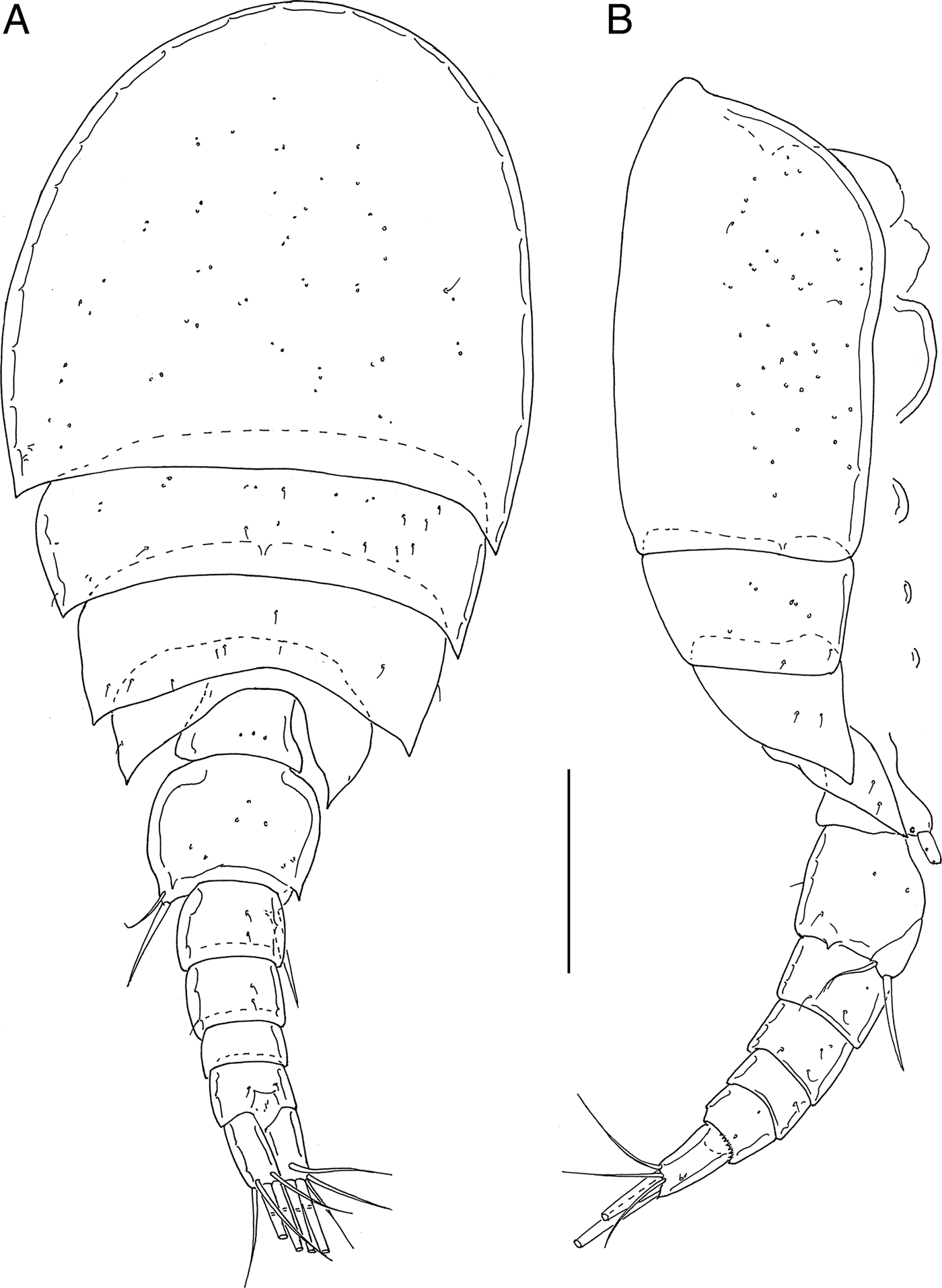
Stygiopontius senckenbergi sp. nov., holotype ♂: (A) habitus, dorsal; (B) habitus, lateral. Scale bar: 0.2 mm.

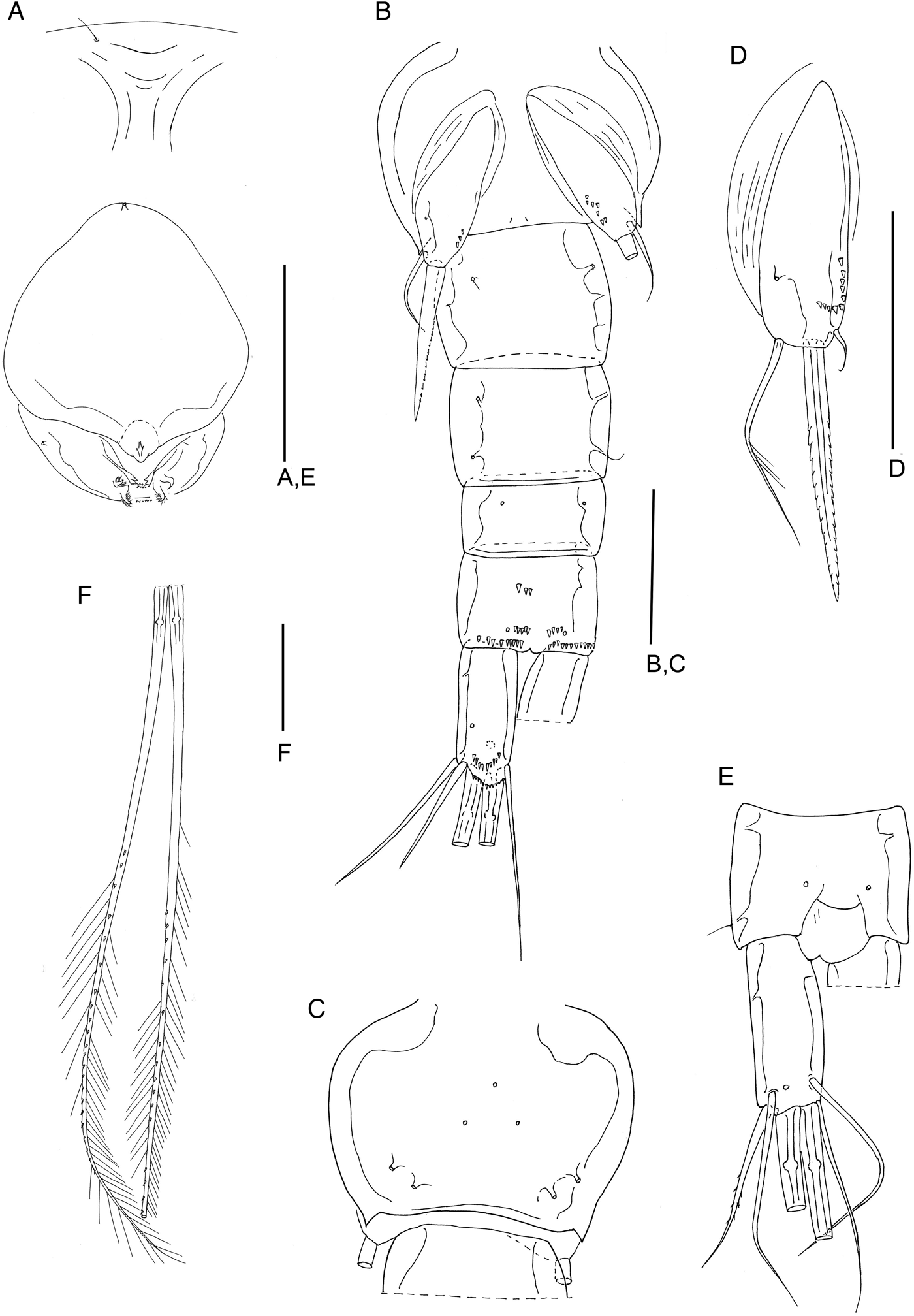
Stygiopontius senckenbergi sp. nov., holotype ♂: (A) rostral area and oral cone, ventral; (B) genital and abdominal somites, caudal ramus, ventral; (C) genital somite, dorsal; (D) right genital flap (leg 6), ventral; (E) anal somite and left caudal ramus, dorsolateral; (F) median terminal setae of caudal ramus, ventral. Scale bar: 0.05 mm.
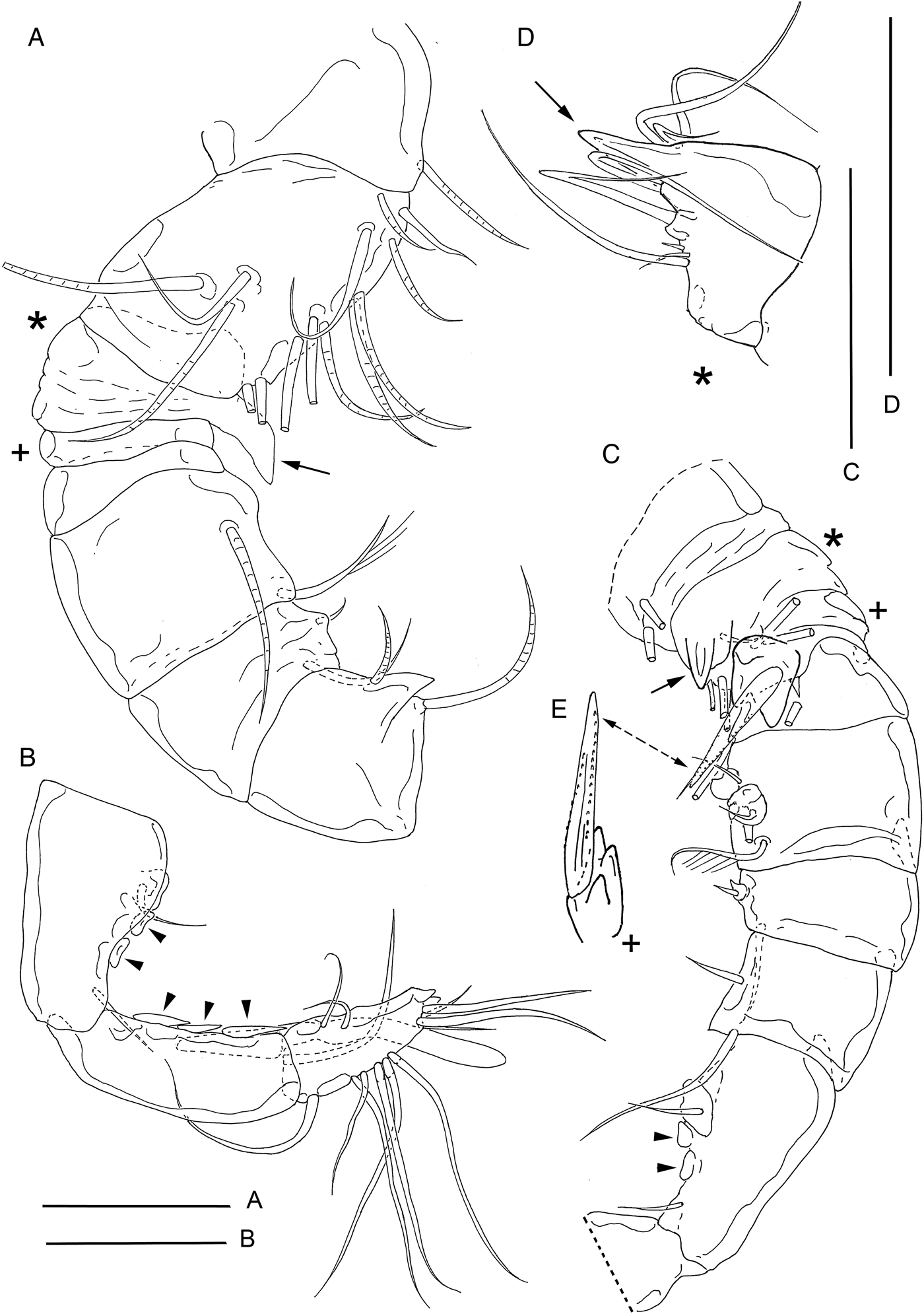
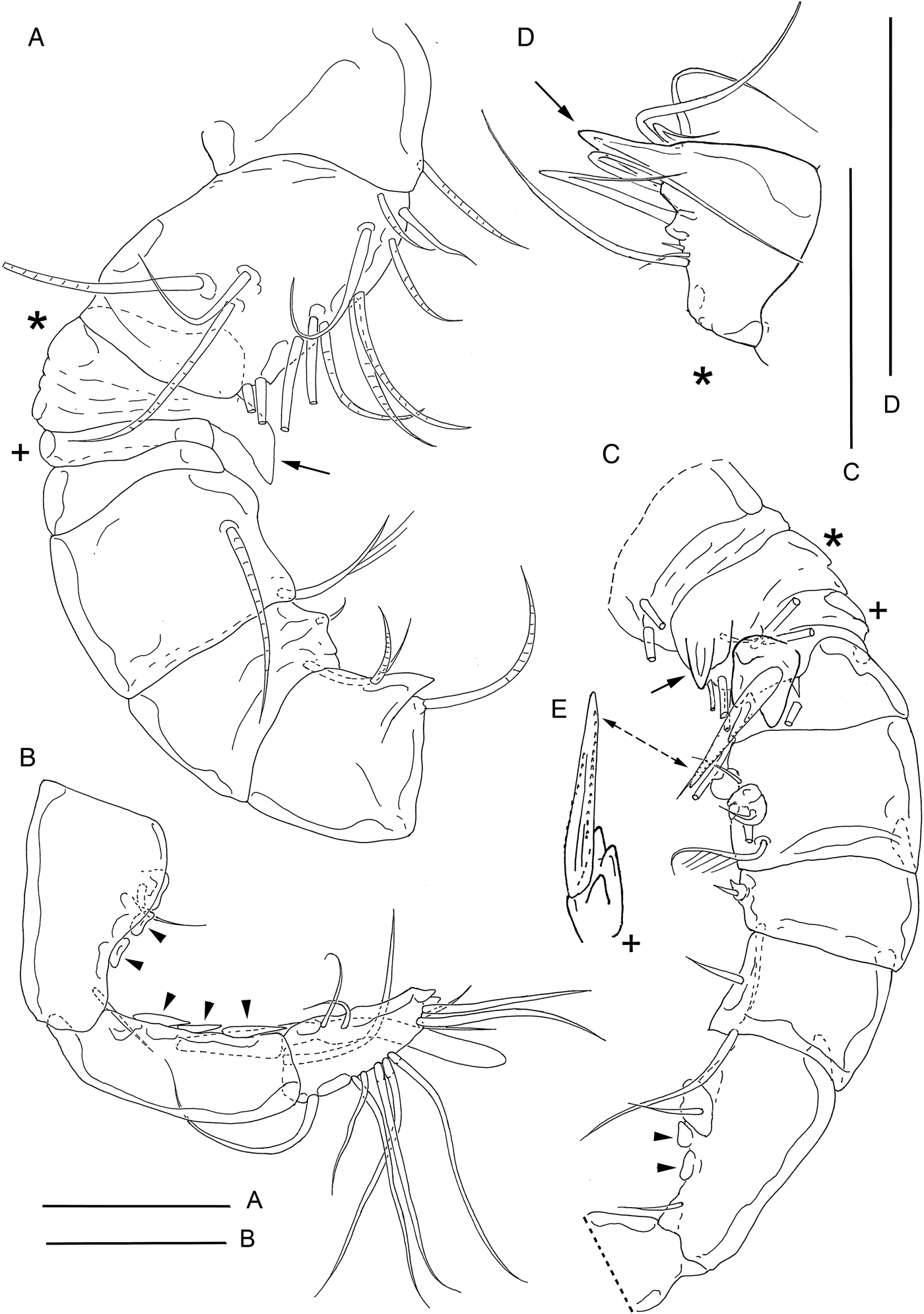
Stygiopontius senckenbergi sp. nov., holotype ♂: (A) proximal part of antennule, segments 1–8 (segment 3 (*) subdivided on four segments; segment 4 (+) with process armed with terminal spine shown on figures C, E); (B) distal part of antennule, segments 9–11; (C) segments 3–9 of antennule, anterior; (D) segments 3 of antennule, ventral; (E) outgrowth of segment 3. Scale bars: A, B, 0.03 mm; C, D, 0.05 mm.
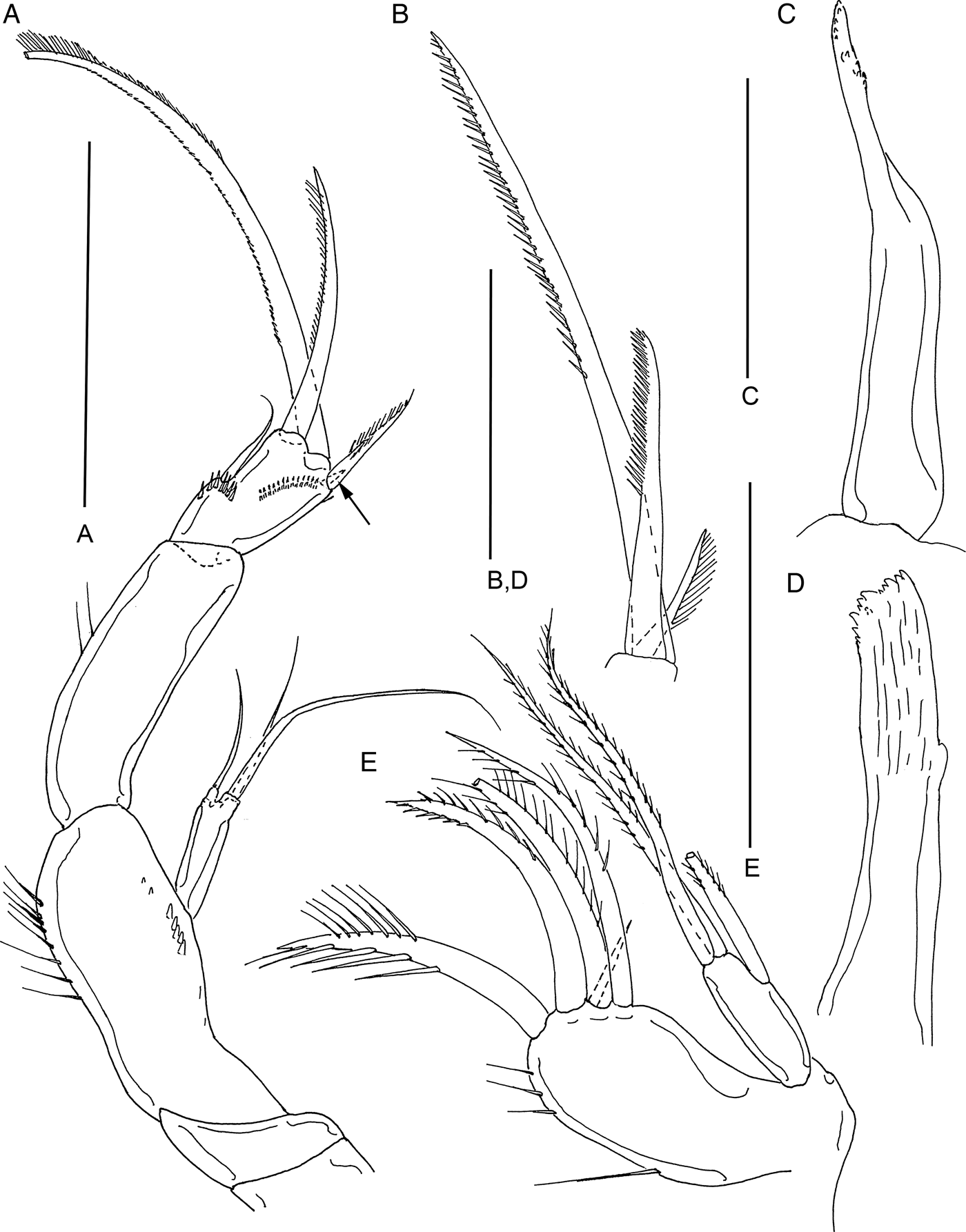
Stygiopontius senckenbergi sp. nov., holotype ♂: (A) antenna; (B) terminal 3 setae of antennal endopod (short seta not shown); (C) mandible; (D) distal part of mandibular gnathobase, lateral; (E) maxillule. Scale bar: 0.05 mm.
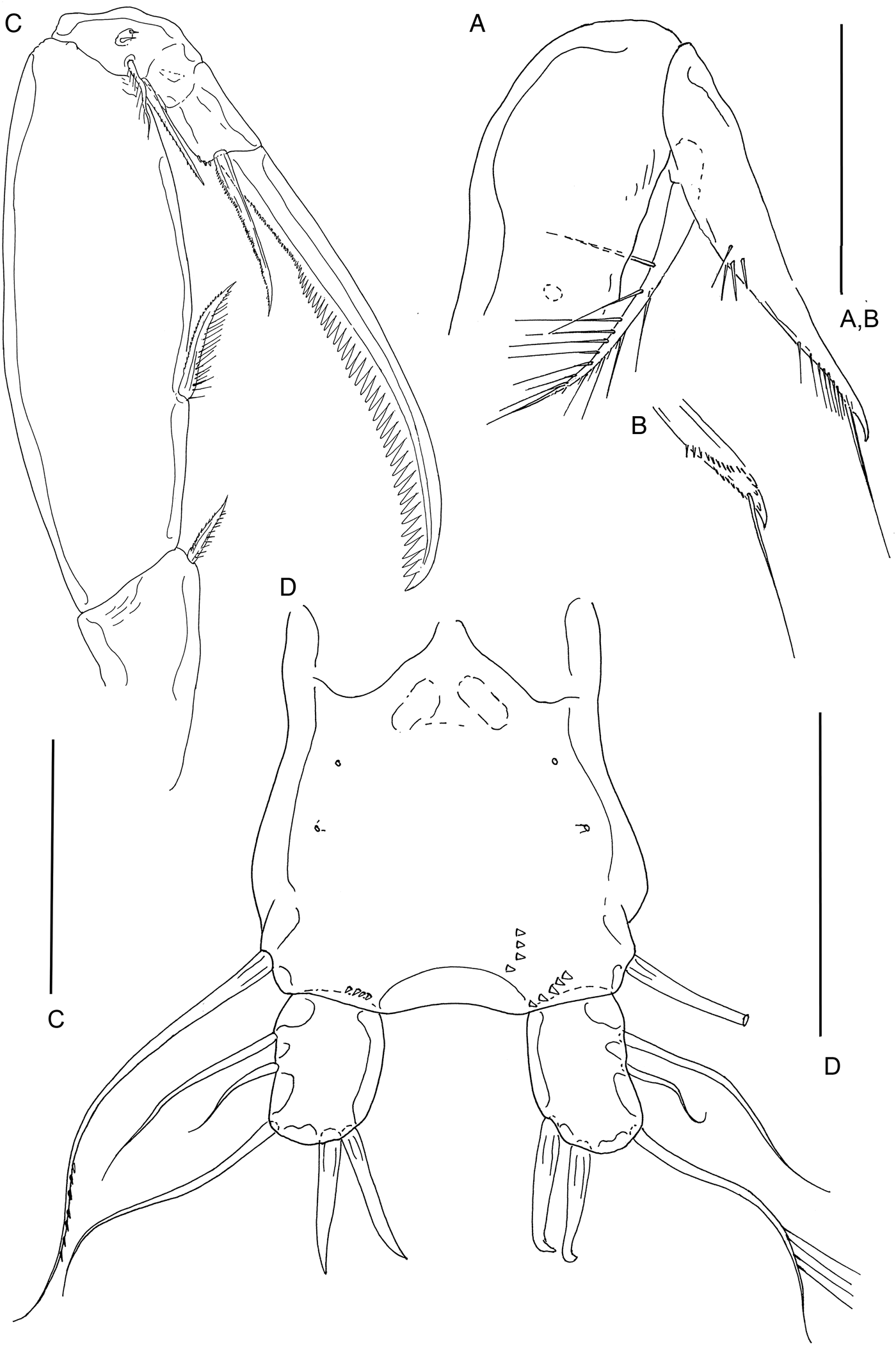
Stygiopontius senckenbergi sp. nov., holotype ♂: (A) right maxilla, posterior; (B) tip of distal segment of maxilla, anterior; (C) right maxilliped, posterior; (D) first somite of urosome and pair of leg 5, ventral. Scale bar: 0.05 mm.
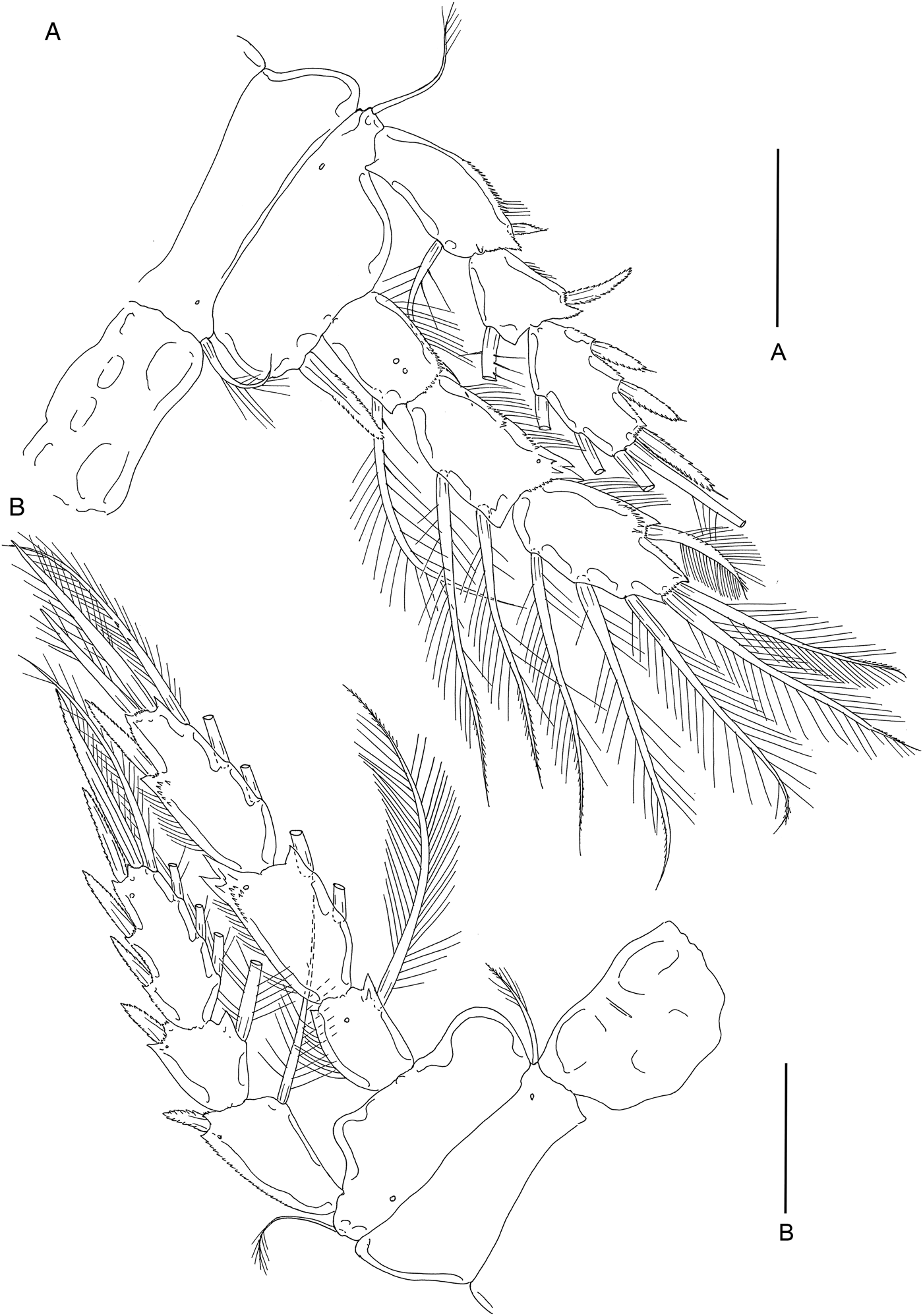
Stygiopontius senckenbergi sp. nov., holotype ♂: (A) left swimming leg 1, anterior; (B) left swimming leg 2, anterior. Scale bar: 0.05 mm.
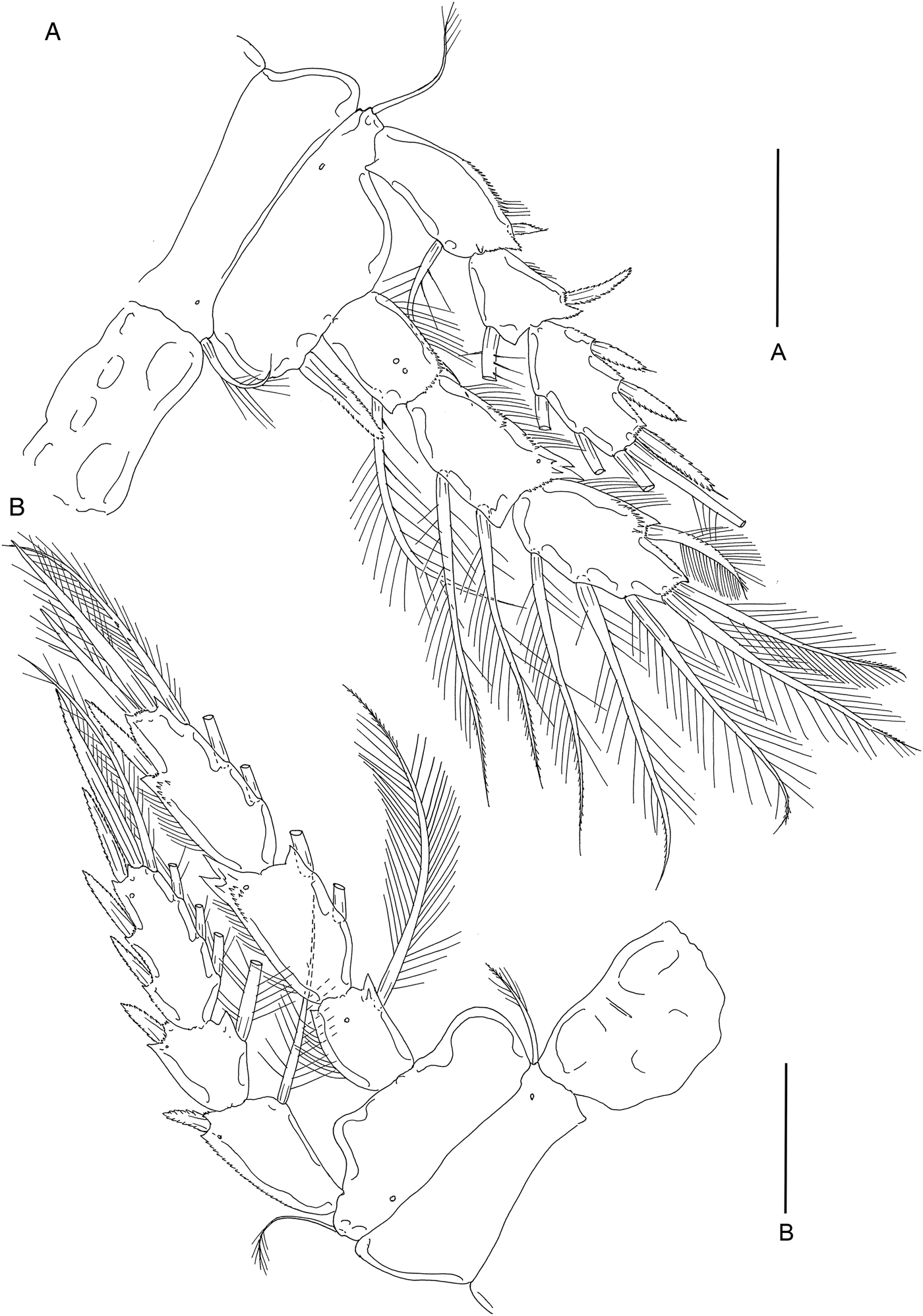
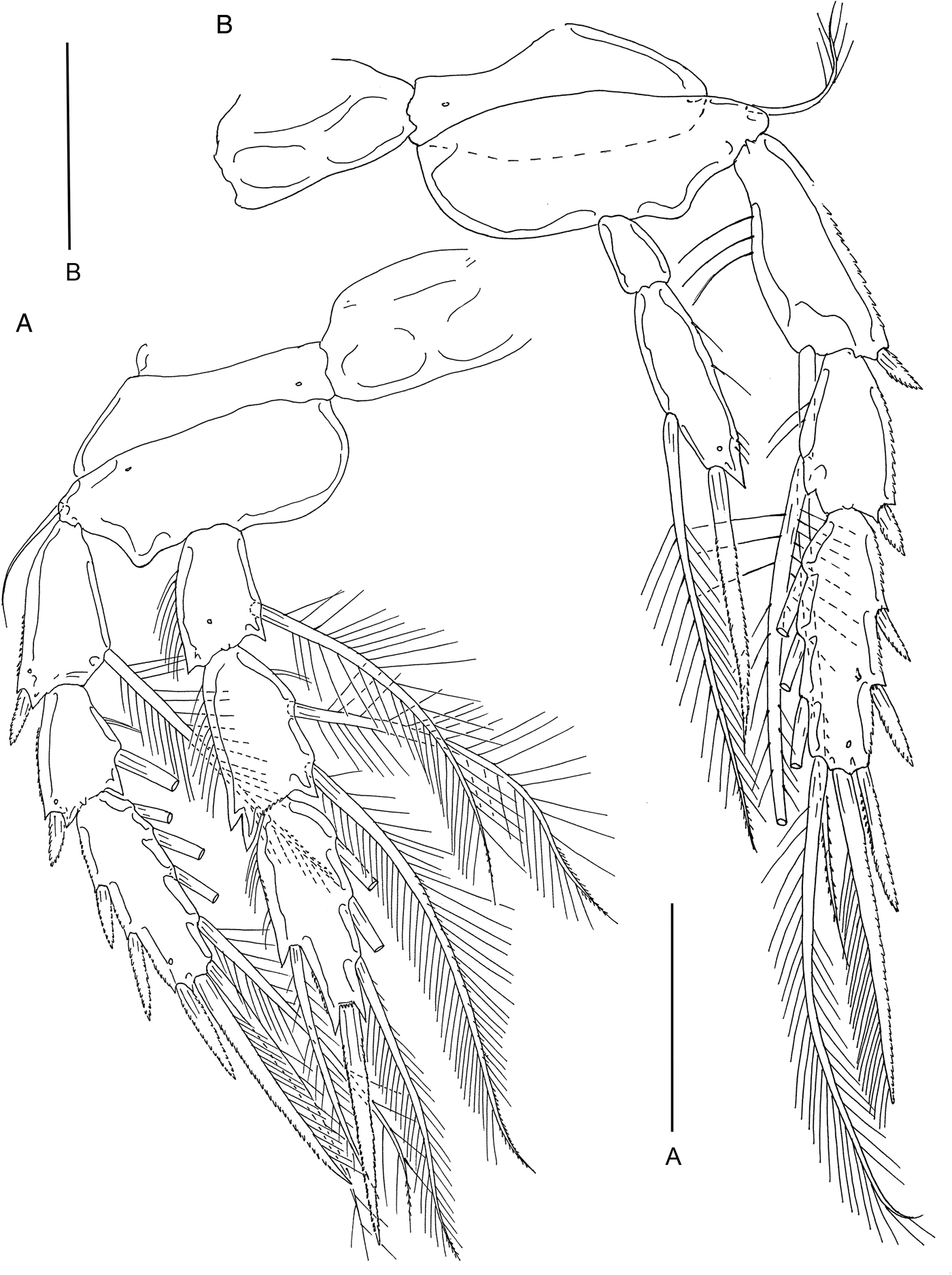
Stygiopontius senckenbergi sp. nov., holotype ♂: A, right swimming leg 3, anterior; B, swimming left leg 4, anterior. Scale bar: 0.05 mm.
TYPE MATERIAL
Holotype: dissected ♂ mounted on three slides (SMF 37052/1-3), Edison seamount, Station 59, vicinity of ‘mussel cliff’ at horst structure south of the seamount, 3°19.357′S 152°35.346′E, depth 1625 m, 27 July 1998.
Paratype: dissected ♂ mounted on one slide (SMF 37053/1), Edison seamount, Station 57, horst structure south of the seamount, 3°19.369′S 152°35.312′E, depth 1610 m, 27 July 1998.
ETYMOLOGY
The specific epithet is derived from the name of the Senckenberg Museum, the research institute and the museum of natural history. Gender masculine.
Holotype male: body (Figure 1), total length, excluding caudal setae, 1.11 mm, greatest width 0.49 mm. Body and appendages with sclerotized cuticle. Prosome 4-segmented, with ovoid anterior half, consisting of cephalothorax and three somite bearing swimming legs 2–4, posterior corners of epimeres pointed. Urosome (Figures 1A & 2B–E) 6-segmented, consisting of fifth pedigerous somite, genital somite, and four abdominal somites. First somite of urosome trapezoidal in dorsal view, with rounded posterior corners. Genital somite with pair of posterior genital flaps on ventral side. Anal opening (Figure 2E) on dorsal side, near the middle of somite.
Rostrum (Figure 2A) a slight ventral process.
Oral cone (Figure 2A): labrum robust, with pointed distal part; labium short, with notch on distal edge bearing curved barbed protuberances.
Caudal ramus (Figure 2E, F) 2.3 times longer than wide, armed with six setae of different lengths, innermost terminal seta and two dorsal setae smooth, two terminal setae with lateral setules and ventral scales.
Antennule (Figure 3) 11-segmented, geniculate between segments 9 and 10; formula of setation as follows: 1, 14, 8, 2, 2, 4, 2, 2, 4, 4 + aesthetasc, 12. Segment 3 (marked by *) with incomplete arthrodial membranes and ventro-distal process (indicated by one-sided arrow); 2 of 8 setae small (Figure 3D). Segment 4 (marked by +) with tricrotic ventral process and a stout barbed spine on it (Figure 3E) (indicated by double-sided arrow); second very small ventral seta near articulation with segments 3 and 4. Two setae on segment 9 and three setae of segment 10 modified to short flattened element.
Antenna (Figure 4A, B): small coxa without ornamentation, elongate basis with long setules on outer and short setules on inner margins. Exopod small, 18 × 6 µm, 1-segmented, with three smooth setae of different lengths: two terminal, one subterminal. Endopod 2-segmented; segment 1 unarmed, as long as basis, with long setules on outer margin; segment 2 short, ornamented with rows of short setules, armed with five setae: four terminal setae (3 setae of different lengths, ornamented with short setules from one side, one seta very short) and one short slender subterminal seta.
Mandible (Figure 4C, D): represented by elongate narrow gnathobase with flattened distal part, longitudinally ribbed on one side; tip blunted, with a row of short slightly curved teeth.
Maxillule (Figure 4E): inner lobe with a few slender setules on inner margin and five terminal setae, one short and four stout long; outer lobe shorter than inner lobe, articulate, with three long setae ornamented with short setules, two terminal and one subterminal. All long setae ornamented with setules of different lengths.
Maxilla (Figure 5A, B) 2-segmented: syncoxa wide, proximal part with pore; basis elongate, distal part ornamented by setules, tip pointed and slightly curved; one needle-like setula situated near the tip, elongate and pointed distally. Long inner seta near juncture of segments (representing distal lobe of coxa); its distal part ornamented from both sides with long setules.
Maxilliped (Figure 5C): syncoxa with one short inner bipinnate seta; basis with longer bipinnate inner seta. Endopod indistinctly 3-segmented: segment 1 with two very short and one long posterior setae; segment 2 with one posterior seta ornamented with spinules; segment 3 bearing one seta, and one large claw with pectinate inner margin.
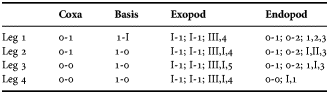
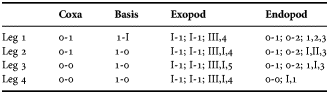
Swimming legs 1–4 (Figures 6 & 7) with 3-segmented rami, except for leg 4, with 2-segmented endopod. Formula for the armature of legs 1–4 in Table 1. Leg 1: inner seta of basis very stout. Leg 2: distal endopodal segment with one outer and two terminal spines. Leg 4: inner seta of exopodal segment 1 smooth in proximal part and with small setules in distal part; distal exopodal segment with three outer spines; second endopodal segment pointed and armed with long serrated spine.
Stygiopontius senckenbergi sp. nov., holotype male, armature formulae of the swimming legs 1–4. Roman numerals indicate spines, Arabic numerals, setae.
Leg 5 (Figures 1A & 5D) located ventrally, articulating segment 1.5 times longer than wide, segment bearing five setae: two flattened and curved inner setae, one long terminal seta; and two slender outer setae of different lengths; long seta joined to segment represents protopodal segment fused with somite.
Leg 6 (Figure 2B, D) represented by genital flap bearing one long stout serrated spine reaching middle of the third abdominal somite and two smooth setae, long and small.
Colour of living specimens unknown.
Female: unknown.
REMARKS
Stygiopontius Humes, Reference Humes1987 is distinguished from other genera of Dirivultidae by the combination of the following characters states: first segment of maxilla with inner sinuous seta; endopod of leg 1 3-segmented on both male and female; and leg 4 with 2-segmented endopod, its first segment unarmed, second segment is armed with terminal spine and inner seta. Like males of many genera of Dirivultidae (except Dirivultus spinigulatus, Ceuthoecetes, Chasmatopontius, Nilva and Rhogobius), males of S. senckenbergi sp. nov. possesses antennules with ventral process having a stout spine on it (see Figure 3, marked by +). The new species belongs to a group of eight species (S. brevispina Humes, 1991; S. flexus Humes, Reference Humes1987, male unknown; S. hispidulus Humes, Reference Humes1987, male unknown; S. lauensis Humes, 1991; S. mirus Humes, 1996, female unknown; S. pectinatus Humes, Reference Humes1987, male unknown; S. senckenbergi sp. nov.; and S. sentifer Humes, Reference Humes1987, male unknown) that are separated from their remaining congeners on the basis of setation of legs 1 and 4: the coxa of leg 1 has an inner seta (absent from the others) and the third exopodal segment of leg 4 has three outer spines (instead of two outer spines). The new species shares with S. pectinatus Humes, Reference Humes1987 (found in the Mid-Atlantic Ridge and Lau Basin) a pectinate maxilliped but differs from it in lacking two pectinate terminal claw-like setae on the endopod of the antenna. Among species of Stygiopontius with known males (S. cladarus Humes, 1996; S. quadrispinosus Humes, Reference Humes1987; S. regius Humes, 1996; S. serratus Humes, 1996; S. lomonosovi Ivanenko & Martínez Arbizu, Reference Ivanenko, Martínez Arbizu and Stecher2006; S. rimivagus Humes 1997; S. verruculatus Humes, Reference Humes1987S. brevispina Humes, 1991; S. lauensis Humes, 1991; and S. mirus Humes, 1996) only S. senckenbergi and S. mirus Humes, 1996 from the Mid-Atlantic Ridge possess a ventro-distal process on the third segment of the antennules (see Figure 3, marked by *). Stygiopontius mirus differs from S. senckenbergi in many details: second segment of antennules (with two setae) articulates with the following segment instead of being fused to it; first segment of maxilliped with extended ventral process; distal endopodal segment of leg 2 with four stout spines and two setae (formula I,II,I,2) instead of three stout spines and three setae (formula I,II,3); middle endopodal segment of leg 2 with two inner spines instead of two setae; and exopodal segment of leg 5 fused with somite and bearing three setae instead of articulating and having five setae.
ACKNOWLEDGEMENTS
We are grateful to the captain and crew of the RV ‘Sonne’ for their expertise and M. Türkay and J. Stecher for sampling the copepods and making them available for study. Pedro Martínez Arbizu hosted V.N.I. during a research visit to Deutsches Zentrum für Marine Biodiversitätsforschung (DZMB) of Senckenberg Research Institute (Wilhelmshaven, Germany). Sabine Gollner commented on a draft of the manuscript.
FINANCIAL SUPPORT
The research of V.N.I. was supported by the Russian Foundation for Basic Research (12-04-01716-а) and the Ministry of Education and Science of the Russian Federation (14.740.11.1049, 8334).