Over 400,000 Syrians lost their lives in the civil war that started in 2011, and millions more were displaced from their homes.Footnote 1 The Assad regime deliberately targeted civilians and used airstrikes, artillery, and chemical weapons to attack urban areas held by rebel groups.Footnote 2 The world's inaction in the face of this humanitarian catastrophe made a mockery of the United Nations’ doctrine of “responsibility to protect,” according to which the international community is supposed to step in to protect civilians from mass killing when their governments fail to do so.
The United States, under President Obama, did not intervene with force to stop atrocities in Syria. Obama's approach was widely criticized—even within the State Department—and many advocated a more forceful role for the US on humanitarian and other grounds.Footnote 3 The Obama administration, however, confronted a fundamental constraint in making policy on Syria: public opinion. After fifteen years of war in Afghanistan and Iraq, the US public was understandably leery of further commitments to conflicts in Middle Eastern nations. As a result, even the harshest critics of the Obama administration ruled out a large commitment of ground troops. An all-out invasion to physically stop the killing was politically off the table.
Could the US have done anything, short of invasion, to limit the humanitarian disaster that unfolded in Syria? Could tens or even hundreds of thousands of lives have been saved at an acceptable cost? More generally, can limited international military intervention reduce the overall civilian death toll in a civil war, or the expected level of atrocities?Footnote 4 The expected level of atrocities is the product of the length of the war and the number of civilians killed per year. The ideal policy would reduce both factors. Doubly bad would be a policy that lengthens the war and causes more civilian deaths per year. Policies that involve shortening the war but increasing the number killed per year or lengthening the war but reducing the number killed per year involve trade-offs that need to be carefully considered.
Military interventions designed to shorten a war usually take the form of helping one side.Footnote 5 If the help is substantial and the recipient is able to absorb it, the result can be a quick victory, such as when NATO helped rebels defeat the Libyan government in 2011. Indeed, international help for civil war participants is usually motivated by a desire that the favored side win, rather than by humanitarian concerns. In the case of Syria, however, with the example of Libya's postconflict instability before them, the Obama administration was uncomfortable with the idea of helping the rebels destroy the Assad regime.Footnote 6 Instead, the interventionists advocated aiding the rebels just enough to “bring Assad to the bargaining table” and so produce a negotiated settlement. The theory was that if the regime could be convinced that it would not win on the battlefield, it would become willing to negotiate. Some scholars have argued that civil wars end through negotiations when the parties arrive at “hurting stalemates” in which they both realize they cannot win.Footnote 7 In effect, the advocates of intervention argued that fostering a balance of power would lead to a hurting stalemate, and a negotiated settlement of the conflict.
The second approach is to try to convince the parties to take more care to avoid targeting civilians. The problem is that regimes often think that killing civilians associated with the rebels will help them win the war.Footnote 8 The primary tack of the international community here has been to try to punish individual leaders who are responsible for atrocities in postconflict tribunals, such as the ad hoc courts set up after the breakup of Yugoslavia and the Rwandan genocide. The goal is to “raise the cost of genocide,” as Samantha Power put it.Footnote 9 Unfortunately, such tribunals can punish only leaders who lose a war, or who agree to a compromise solution that they undoubtedly expect will protect their liberty, only to be subsequently betrayed, apprehended, and extradited. Leaders who have committed crimes, therefore, have incentives to cling to power all the more and prolong conflicts.Footnote 10
It would be better if leaders who commit atrocities could be punished while still in office, and indeed while still fighting the war. Punishment could be inflicted through air strikes that respond to specific atrocities, such as the US airstrikes in April 2017 and 2018 designed to deter the Syrian government from using chemical weapons. Such punishment strikes would ideally be calibrated to respond to the number of people killed, however, rather than the manner in which they were killed. The more civilians the regime kills, the heavier the punitive strikes would be. The strikes could target the regime's military assets, to negate the strategic value to the regime of killing civilians. Conversely, military aid could be given to the rebels conditional on the regime's atrocities. For example, for every hundred civilians killed by the government, one government tank or aircraft could be destroyed, or one tank or artillery piece could be given to the rebels. Punishment could also target the economic assets of the regime and its supporters: kill a hundred civilians, and a crony loses a villa. If the third party is supporting the perpetrator, the third party could reduce that level of support, as the US has been urged to do in the case of Israeli strikes against Gaza that kill civilians. In effect, the international community would be attempting to penalize atrocities as they happen, so that the government would be incentivized to kill fewer civilians.
Which approach has more hope of reducing civilian casualties of war—fostering a balance of power in hopes of shortening the war, or penalizing atrocities to convince the parties to fight more carefully? To address this question, I analyze a formal model of civil war that shows the effects of these two approaches on the likelihood of war (and by implication its length) and the level of atrocities. The implications of the analysis can be summarized in two broad points.
First, fostering a balance of power is a mistake. Weakening the government will encourage it to commit more atrocities, to counteract the loss in relative power. Creating a balance of power is also likely to prolong a conflict rather than shorten it. Fostering a balance of power is therefore a lose-lose proposition as far as humanitarian goals are concerned. Second, penalizing atrocities is more likely to be beneficial. The primary effect is to get the government to commit fewer atrocities. It would also shift the balance of power toward the rebels to some degree, and so encourage them to continue fighting. This sets up a potential dilemma: intervention results in a war with fewer atrocities, but one that might last longer. Whether the benefit outweighs the cost depends on the magnitude of each. If the penalty on atrocities is high enough, however, it will reduce the expected level of atrocities and so be beneficial on net.
A limitation of the analysis is that I focus on the strategic interaction between the government and the rebels, but do not model the third party as an actor in the game. The model serves as a predictor of how the level of atrocities would respond to changes in certain parameters which the third party could manipulate, but does not directly consider the third party's incentives to get involved. As a result, I am unable to directly address the credibility of the third party's threats to intervene. This was certainly an issue in the Syrian case; Assad clearly doubted Obama's “red line” on chemical weapons. In effect, I am asking what kind of expectations the third party would want to create about its actions to minimize the expected level of atrocities, holding aside the question of what it takes to make those expectations credible. I leave the credibility question for future research.
To ground the discussion empirically, I discuss the model's implications in the context of the US policy toward the Syrian Civil War. In brief, the US tried both fostering a balance of power and penalizing atrocities; shifting the balance of power failed, but the penalties worked to some extent. In operation Timber Sycamore, the US covertly aided moderate Syrian rebels against the Assad regime. Worries about what would happen if Assad fell and fears about weapons flowing to more radical groups kept these subsidies limited in scope, with the aim of leading to negotiations. However, the aid hardened the rebels’ resolve without weakening the government's, and the result was a high level of atrocities sustained over many years, the worst possible outcome.Footnote 11 The US also sought to prevent the use of chemical weapons through threats, under Obama, and retaliatory strikes, under Trump. Obama's threats convinced Assad to surrender his arsenal of advanced chemical weapons. Trump's strikes arguably reduced the government's use of improvised agents such as chlorine. The attempt to penalize atrocities caused by chemical weapons was therefore at least partially effective. Whether a more thoroughgoing strategy to punish atrocities in general would have succeeded is a more difficult counterfactual question.
In what follows, I first briefly discuss the emergence of humanitarian intervention, and the literature on the impact of balance of power and intervention on civil wars. Then I present a model of civil war and use it to estimate the effect of fostering a balance of power versus penalizing atrocities. Finally, I discuss US policy toward the Syrian Civil War and, very briefly, Bosnia.
Humanitarian Intervention and the Responsibility to Protect
Atrocities, like war itself, are as old as human history. Humanitarian intervention to save lives is a more recent phenomenon. In 1948, following the Holocaust, the United Nations passed a convention against genocide. Yet, mass killing persisted with no effective international response. Prominent examples include the Khmer Rouge regime in Cambodia from 1975 to 1979 and the Rwandan genocide in 1994.Footnote 12
In the case of the former Yugoslavia, however, despite a far smaller death toll, the international community intervened with force, in part due to the timing of the conflict (after the end of the Cold War) and its location (in Europe). After a delayed intervention in Bosnia, when Kosovo began to show signs of incipient civil war in 1998, the US and NATO promptly sided with the Kosovo rebels, attempted to broker a deal on their behalf, and then bombed Serbia when Serbian leader Milošević rejected the proposal. The bombing campaign eventually produced Serbian agreement to a modified version of the plan and paved the way for the independence of Kosovo.
More broadly, at the United Nations, a campaign was under way to establish a principle of “responsibility to protect” (R2P), by which the international community would have a duty to protect civilians if their government was targeting them for mass killing.Footnote 13 In 2005 the UN World Summit endorsed the principles of R2P, and momentum built behind the idea that the days when brutal leaders could kill their citizens with impunity were over. The 2011 Libyan civil war was seen as a culmination of this evolution. When the Gaddafi regime advanced on the rebels in Bengazi, threatening to exterminate them, UN Security Council Resolution 1973 authorized the use of force against the regime, and NATO began a bombing campaign that continued until Gaddafi was dead and his regime destroyed. To proponents, this intervention ended the debate: R2P had arrived.Footnote 14
The equation of R2P with regime change, however, was deeply problematic and proved to be short lived. Russia and China felt that NATO had been given an inch and taken a mile by overthrowing Gaddafi in a supposedly humanitarian mission. And even advocates of intervention had reason to reconsider as Libya descended into anarchy. The debate therefore shifted to what the effect of much more modest interventions would be. In particular, could aiding the rebels, but not enough to help them win outright, lead to negotiated settlements that shorten the war and thereby reduce civilian casualties? Could some kind of punishment strategy deter atrocities?
The Balance of Power, Intervention, and Civil War
There is a large literature on the impact of the balance of power and intervention on the likelihood and length of civil wars. In contrast, there is little written on the idea of attempting to deter atrocities through punishment strategies.
The relationship between the balance of power and the likelihood of war was first debated in the context of international conflicts.Footnote 15 Kugler and Lemke find that international war is more likely when power is balanced,Footnote 16 as do Moul, Hegre, and Reed.Footnote 17 Bennet and Stam find that international wars are also longer when power is balanced than when it is unbalanced.Footnote 18
Most empirical studies of the impact of the balance of power on the length of civil wars find that parity makes negotiations more likely than asymmetry. Cunningham, Gleditsch, and Salehyan argue that strong rebels who can threaten the government are given concessions, which leads to shorter wars.Footnote 19 Weaker rebels who can resist the government's incursions but are too weak to threaten it tend to linger on without generating concessions or a negotiated settlement. Rebels who have parity with the government are both more likely to win and more likely to secure a negotiated settlement.Footnote 20 Clayton argues that stronger rebel groups are more likely to get the government to agree to mediation, and extract concessions that lead to a negotiated settlement.Footnote 21
However, negotiated solutions often take longer than military victories. In the civil war data set compiled by Toft,Footnote 22 for instance, the average duration of civil wars that end through victory by either the government or rebels is approximately six years. Wars that end in negotiations, by contrast, have an average duration of fifteen years—over twice as long.Footnote 23 Kreutz finds that civil wars that end in victory have a mean duration of 625 days, while those ending in a peace accord have a mean duration of 2,068 days, over three times as long.Footnote 24 Balance of power may lead to negotiations, therefore, but only after a long war.
Intervention itself, however, has not consistently been found to shorten wars or produce negotiations. Balch-Lindsay and Enterline find that intervention on either the government or opposition side lengthens civil war.Footnote 25 Balanced interventions, on both sides, also have a lengthening effect. Balch-Lindsay, Enterline, and Joyce find that intervention on the side of the government makes government victory and negotiated settlements more likely.Footnote 26 Intervention on the side of the rebels makes government victory less likely, and rebel victory and negotiated settlement more likely. Balanced intervention on both sides reduces the likelihood of negotiated settlement. Regan finds that interventions make conflicts last longer, and balanced interventions are the worst of all.Footnote 27 Regan and Aydin find that mediation shortens civil wars while economic intervention lengthens them, and military interventions have no effect.Footnote 28 Collier, Hoeffler, and Soderbom find that military support for the rebels shortens wars, but do not distinguish between rebel victories and negotiated settlements, leaving open the possibility that the wars are shortened because the rebels are aided to the point of victory.Footnote 29 Sullivan and Karreth find that direct military assistance to rebels increases their chance of victory, but not their chance of achieving a negotiated settlement.Footnote 30 Narang finds that even humanitarian aid given during a civil war prolongs the war, especially if the war is a peripheral insurgency.Footnote 31
Scholars have come up with a variety of explanations for why intervention has such inconsistent effects. Cunningham distinguishes between interventions that just want to help one side or resolve the conflict, and those that have independent goals of their own.Footnote 32 He shows that when the intervenors have independent goals, it prolongs civil wars, while other interventions have no effect on war duration. Sawyer, Cunningham, and Reed argue that certain types of aid, particularly financial aid and weapons transfers, are particularly fungible, which means that the rebels may or may not make good use of them, which in turn makes for uncertainty over their relative power.Footnote 33 Empirically, they find that financial and weapons aid leads to longer civil wars, while direct military aid (in the form of troops fighting alongside the rebels) shortens wars. Jones differentiates between indirect aid, direct attacks, and punishment strategies.Footnote 34 He finds that aid to the rebels in the first three years does make a negotiated settlement more likely. However, in contrast to Sawyer, Cunningham, and Reed, attacks on the government do not make negotiated settlement more likely. What he calls unconventional (punishment) interventions have no effect on victory or negotiations.Footnote 35
A few studies have directly addressed the impact of the balance of power and intervention on atrocities. Wood finds that weaker rebel groups are more likely to use violence against civilians than stronger ones.Footnote 36 Wood, Kathman, and Gent find that intervention biased toward one side tends to decrease the level of violence against civilians committed by that side, and increase the level of violence against civilians committed by their adversary.Footnote 37 The model discussed later provides a simple rationale for this result.
On the idea of penalizing atrocities, there has been little relevant discussion in the intervention field, aside from the punishment of leaders in postconflict tribunals discussed before.Footnote 38 It might seem almost trivial that penalizing atrocities would cause warring parties to commit fewer of them, in the same way that price increases reduce demand or taxes on cigarettes discourage smoking. One reason to be cautious, however, is suggested by the literature on “moral hazard” in intervention. Governments engage in mass killing in civil wars because they think it will help them win.Footnote 39 Intervening to stop the government from engaging in mass killing is therefore indirectly helping the rebels. It lowers the cost of rebellion and raises the chance that the rebels will win. Thus, penalizing atrocities could encourage rebellion, thereby paradoxically making atrocities more likely. The historical record shows that in both Bosnia and Kosovo the relevant leaders would not have decided to seek independence through war if they did not expect international intervention on their side,Footnote 40 and the same expectation may have been a factor in Georgia in 2008 and Ukraine in 2014.Footnote 41 A key question for the model, therefore, will be when the direct effect of raising the cost of atrocities reduces their frequency and when the moral hazard effect of encouraging rebellion dominates and reverses this relationship.
A small formal theoretical literature addresses these topics as well. On the connection between balance of power and war, Fearon pointed out that if the two sides in a take-it-or-leave-it bargaining model have risk-neutral preferences, then the balance of power should have no effect on the likelihood of war—a “neutrality” result.Footnote 42 Benson, Meirowitz, and Ramsay argue that if the bargaining parties are risk averse, then balance of power minimizes the chance of war, while imbalances maximize it, which goes against the empirical results cited.Footnote 43 If civil war combatants were risk averse, therefore, fostering a balance of power could promote peace. However, although risk aversion may accurately characterize most states in the international system, there are reasons to believe that the parties to civil wars are more likely to be risk preferring, which leads to the opposite conclusion: power imbalances are more likely to be peaceful.
On intervention, Grigoryan presents a model in which the government can escalate to a high level of atrocities after intervention, but he does not consider interventions in which the third party tries to affect the cost of ongoing atrocities.Footnote 44 Kydd and Straus examine a model in which the government and rebels bargain, and if the bargaining fails, the government chooses a level of atrocities to commit, and then the third party chooses whether or not to intervene.Footnote 45 In their model, however, intervention is conceived of as direct participation in the war that strives to impose a settlement, much as in the Libya campaign. In this model I focus on lesser levels of intervention that merely seek to alter the balance of power or the costs and benefits of committing atrocities.Footnote 46
In sum, despite the extensive literature on these issues, important policy-relevant questions remain. Several studies show that a balance of power fosters negotiations, supporting the limited-interventionists’ position. However, several studies of intervention suggest that it lengthens civil wars rather than shortening them, which would seem hard to reconcile with the previous findings if intervention works through strengthening the rebels to bring them closer to parity with the government side. Theoretically, balanced power may be good, bad, or indifferent to war initiation and duration. Penalizing atrocities seems like a direct way to reduce them, but the moral hazard critique suggests it could actually increase them. With the model offered here I hope to answer some of these questions and help identify the best way to reduce atrocities in civil wars.
A Model of Civil War
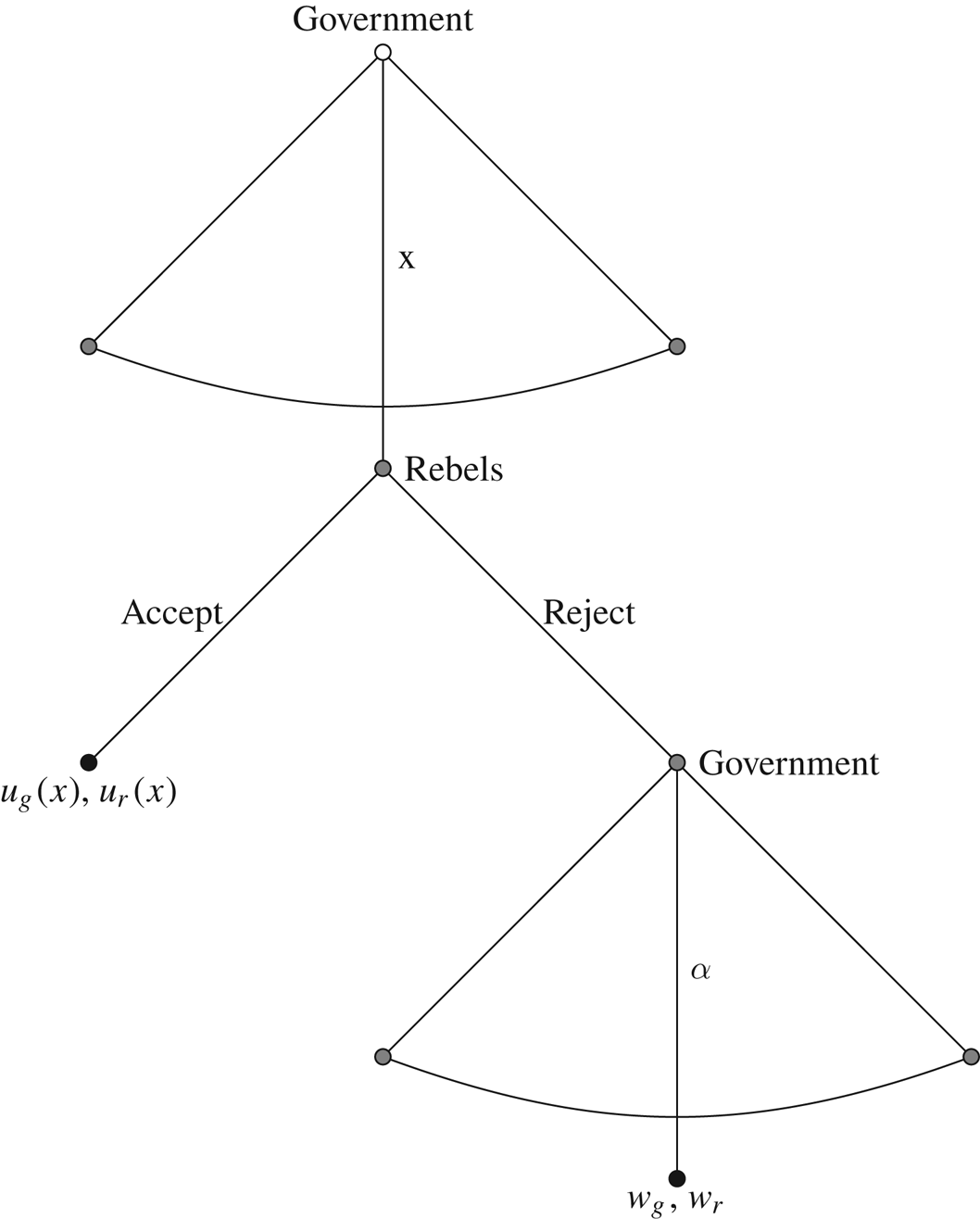
There are two players: the government and the rebels. The two sides play the game illustrated in Figure 1. The government first decides how much to concede to the demands of the rebels in an effort to buy them off. The issue the government and rebels are negotiating over is represented by the variable x ∈ [0, 1]. I take this to be the size of the concession, so that the government likes lower values of x and the rebels like higher values. For instance, x could be the level of autonomy enjoyed by the ethnic group represented by the rebels. The government and rebels each have a utility function over x, denoted u g(x) and u r(x). I normalize the functions so that u g(1) = u r(0) = 0 and u g(0) = u r(1) = 1. If the government offers x and the rebels accept it, the game ends with payoffs u g(x), u r(x).
The civil war game

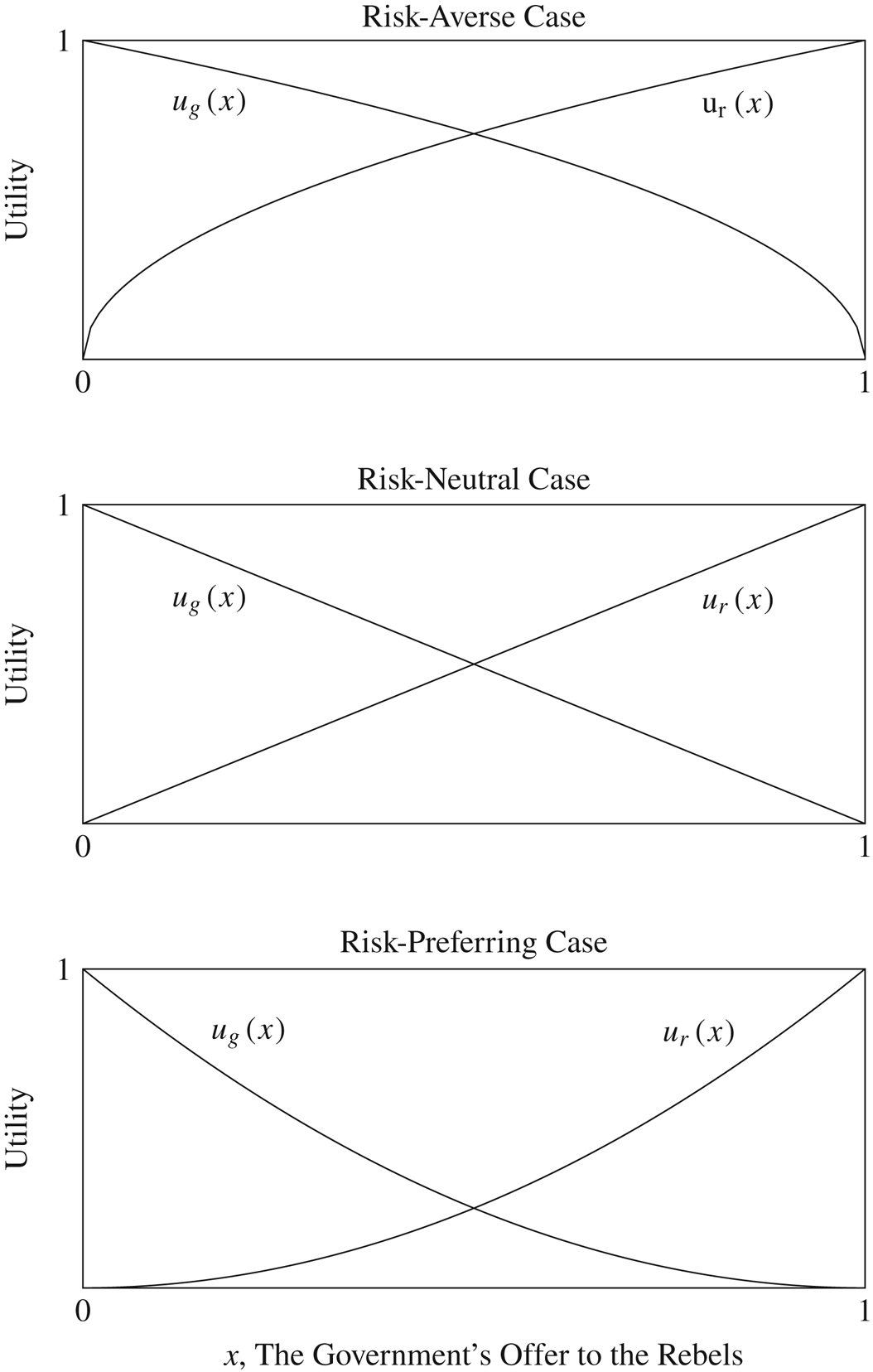
I consider three possible shapes for the utility functions: risk averse, risk neutral, and risk preferring (Figure 2). The horizontal axis is the government's offer to the rebels, and the vertical axis is the parties’ level of utility. In the top panel are risk-averse utility functions,Footnote 47 which feature diminishing returns: the more you have, the less you value an additional increment. The middle panel illustrates risk-neutral, or linear preferences. The bottom panel shows risk-preferring utility functions,Footnote 48 in which small concessions by the government result in a big loss in utility for the government but only a small gain for the rebels. As a result, with risk-preferring utility functions, the government often offers the rebels nothing at all, as we shall see. I believe this to be the most common case in the context of civil wars. People like Fidel Castro and George Washington become rebel leaders in part because they are not afraid of risk.Footnote 49 Since the results of the model depend on the risk attitudes of the players, I will discuss all three cases when presenting the results.
Utility functions

If the rebels reject the government's offer, a war breaks out. The government then chooses the level of atrocities to commit, denoted α ≥ 0. If it sets α = 0, the government scrupulously targets only rebel fighters. Higher α represents more atrocities.Footnote 50 War is conceived of as a costly lottery between victory and defeat. The winner gets to impose its ideal point, worth 1 to it and 0 to the other side.Footnote 51
The government has a p g chance of winning the war; the rebels’ chance is p r = 1 − p g. Each side's probability of winning is a function of the military assets they can bring to bear, denoted m g and m r. In addition, following Downes and Valentino, Huth, and Balch-Lindsay, I assume that the more atrocities the government commits, the more likely they are to win.Footnote 52 However, atrocities may be more or less effective at increasing the government's chance of winning. I call this level of effectiveness ε ≥ 0, so the impact of atrocities is εα. If the effectiveness is small ( ε ≈ 0), then atrocities will have little impact on the war. If it is large, ( ε ≫ 0), they will have a large effect on the government's chance of winning. The probability that each side wins combines these variables in the usual ratio contest success function:Footnote 53
 $$p_g = \displaystyle{{m_g + \epsilon \alpha } \over {m_g + \epsilon \alpha + m_r}}$$
 $$p_r = \displaystyle{{m_r} \over {m_g + \epsilon \alpha + m_r}}$$
The government's chance of winning increases with its power, m g, and with the level of atrocities it commits, α (provided that ε > 0). The rebels’ chance of winning increases with their power, m r.
War is also costly. Each side pays a cost of fighting ( c g and c r), apart from the level of atrocities committed. In addition, I assume that atrocities are costly for both the rebels and the government. Of course the rebels may feel them to be more costly than the government does, since the rebels’ potential supporters are the ones being targeted. Each side has a parameter that represents the marginal cost of atrocities to them (k g and k r). The war payoffs for each side are therefore
 $$w_g = p_g-c_g-k_g\alpha $$
 $$w_r = p_r-c_r-k_r\alpha $$
To introduce some uncertainty into the model and generate a chance of war, I assume that the rebels’ non-atrocity-related cost of war is distributed uniformly over the unit interval, c r ~ [0, 1]. The rebels’ cost, c r, constitutes their “type,” and in equilibrium high-cost types will accept offers that low-cost types will reject. Mattes and Savun find that institutions designed to resolve uncertainty have an effect even after negotiations, indicating that uncertainty remains a real problem throughout the peace process.Footnote 54 An alternative approach would be to focus on commitment problems as the cause of the conflict. Fearon has argued that uncertainty is unpersuasive as a cause of long-running civil wars because the fighting should resolve the uncertainty.Footnote 55 Walter also argues that commitment problems are the “critical barrier” to civil war settlement.Footnote 56 Short-term commitment problems related to the demobilization period can be overcome by international security guarantees, but these are not always sufficient to get the parties to make peace, as in the Syrian example. Long-term commitment problems related to shifts in the balance of power between the groups are harder to address. For instance, in the Syrian case, if the war was motivated by the Alawites not wanting to lose their power, it is hard to see the US guaranteeing Alawite privileges in perpetuity in a postconflict democratic Syria. Reiter argues that international wars caused by commitment problems tend to run their course rather than be settled through negotiations.Footnote 57 It is difficult to envision an international intervention strategy that could indefinitely postpone or otherwise compensate for a long-term shift in the balance of power between groups in a society.Footnote 58 I will therefore focus on the uncertainty mechanism.
I do not model the third-party intervenor's decision directly. However, we can still use the model to predict the effects of intervention by considering how third parties could affect the parameters of the model. To examine the effect of fostering a balance of power, I will look at the relative strength of the rebels and government, m r and m g. I will assume that the rebels start off weaker than the government side: m r < m g. A third party could attempt to alter the balance of power by aiding the rebels or attacking the government to bring them nearer to parity. I will focus on the effect of increasing m r to bring it closer to m g. To examine the effect of penalizing atrocities, I focus on the effectiveness and cost of atrocities, ε and k g. The third party could aid the rebels or attack the government in a conditional manner, in an effort to negate the military effectiveness of atrocities, lowering ε. Or, a third party could seek to raise the government's cost of committing atrocities, k g, by punishing leaders or their supporters for committing them. These punishments could consist of airstrikes on leadership targets, or financial or other economic sanctions.
Equilibrium in the Model
I solve for perfect Bayesian equilibria, starting from the end of the game. The equilibrium level of atrocities, denoted α*, is found by maximizing the government's war payoff, w g, with respect to α. The maximum may be at α = 0, if the effectiveness of atrocities, ε, is low and the costs, k g, are high. Otherwise the government will commit some atrocities if it comes to war. The equilibrium level of atrocities is (the derivation is in the online supplement):
 $$\alpha ^\ast{ = } \max \left\{{0, \;\sqrt {\displaystyle{{m_r} \over {\epsilon k_g}}} -\displaystyle{{m_g + m_r} \over \epsilon }} \right\}$$
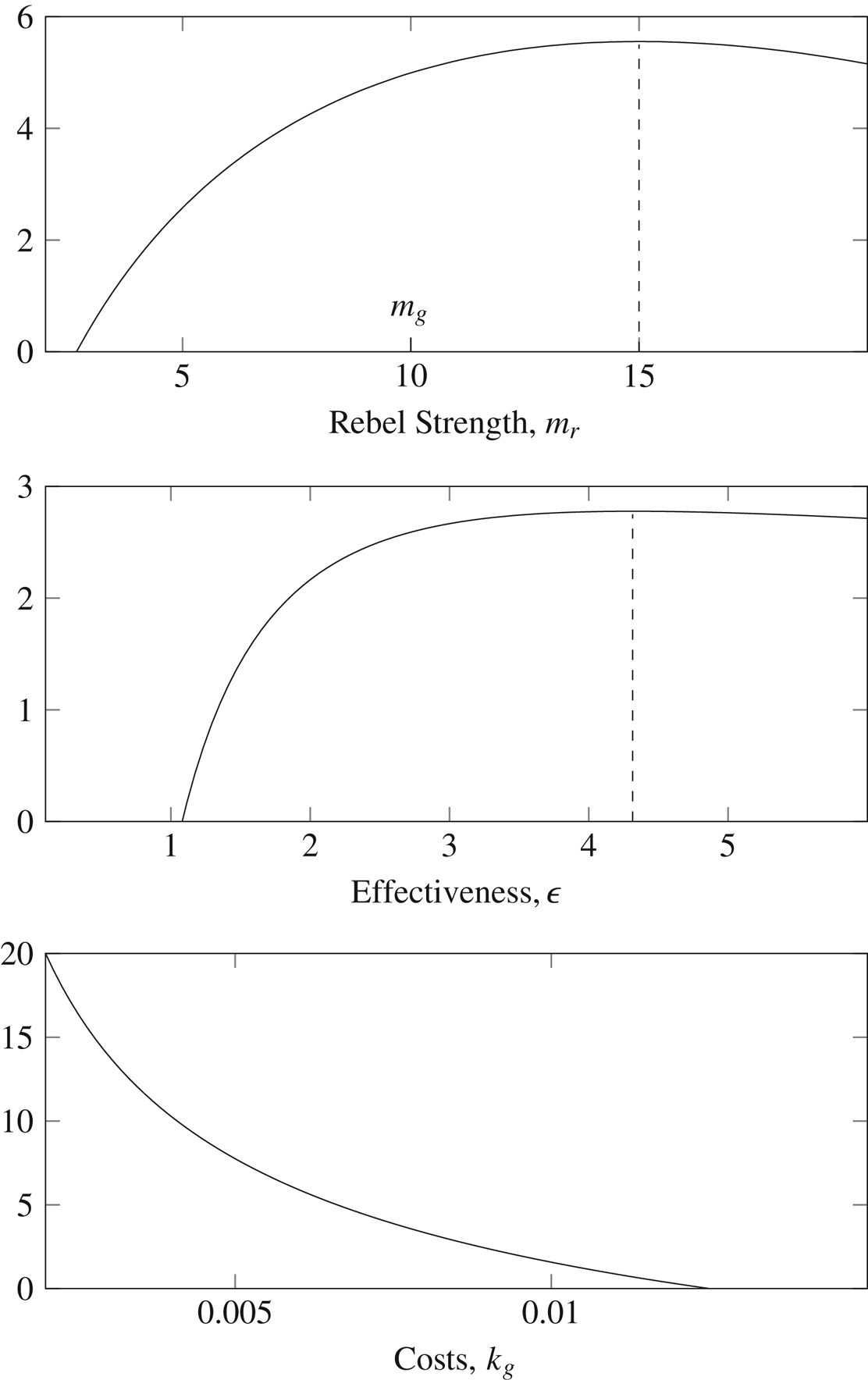
This is illustrated in Figure 3. The effect of the balance of power is shown in the top panel. The government's strength is set at m g = 10. As the rebels grow closer to the government in strength, the government commits more atrocities to compensate for its relative decline. Only when the rebels become significantly stronger than the government side, at the point illustrated by the dotted line,Footnote 59 does the government begin to scale back atrocities because the marginal impact of atrocities begins to decline when the rebels are stronger than the government. In the middle panel is the impact of the effectiveness of atrocities, ε. When the effectiveness of atrocities exceeds a certain threshold, the government starts committing them. As they grow more effective, the government commits more of them. Eventually a peak is reached,Footnote 60 after which atrocities are so effective that the government actually scales back its atrocities if they grow even more effective, because the cost remains the same but the government is so likely to win that marginal improvements in its chances of victory are no longer worth it. Finally, the bottom panel shows the impact of the cost of atrocities, k g. As the cost increases, the level of atrocities goes down.
The equilibrium level of atrocities

Figure 3 shows us the “direct” effect of the balance of power and the effectiveness and cost of atrocities on the equilibrium level of atrocities if there is a war, α*. Fostering a balance of power makes the government commit more atrocities, while penalizing atrocities by decreasing their effectiveness and increasing their cost makes the government commit fewer. If these variables had no impact on the likelihood of war, our work would be done. However, as the moral hazard critique points out, changing the balance of power and penalizing atrocities may make war more likely, which could counteract these direct effects. We therefore need to consider the rebels’ decision to fight, the government's optimal offer to the rebels, and the resulting probability of war.
The war payoffs when the government chooses its equilibrium level of atrocities are denoted  $w_g^\ast $ and
 $w_r^\ast $. From the war payoffs, we can derive the rebels’ strategy. The payoff for accepting an offer is u r(x), and the payoff for rejecting it is
 $w_r^\ast{ = }\; p_r-c_r-k_r\alpha ^\ast $. If the following condition is satisfied, the rebels will accept the offer, otherwise they will reject it.
 $$u_r( x) \ge p_r-c_r-k_r\alpha ^\ast $$
From the rebel strategy, we can deduce the probability of war as a function of the government's offer, denoted L w(x). The rebel type that is indifferent between accepting and rejecting the offer can be found by equating the payoff for accepting with that for fighting, u r(x) = p r − c r − k rα*, and solving for c r, which gives p r − k rα* − u r(x). The probability of war, L w(x), is the likelihood that the rebels’ cost is lower than this cutoff point. It could be zero, if all types accept the offer. If it is not zero it is just equal to the cutoff point, given the uniform distribution.
 $$L_w( x) = \max { 0, \;p_r-k_r\alpha ^\ast{-}u_r( x) } $$
The likelihood of peace (an accepted offer) is just 1 minus the likelihood of war.
Finally, the government's utility for an offer x is the chance it is accepted times the value of the offer, plus the chance that it is rejected times the payoff of war. I call this the government's objective function, O g(x):
 $$O_g( x) = ( 1-L_w( x) ) u_g( x) + L_w( x) w_g^\ast $$
The optimal offer, x*, maximizes this function:
 $$x^\ast{ = } \mathop {argmax}\limits_{x\in [ 0, 1] } O_g( x) $$
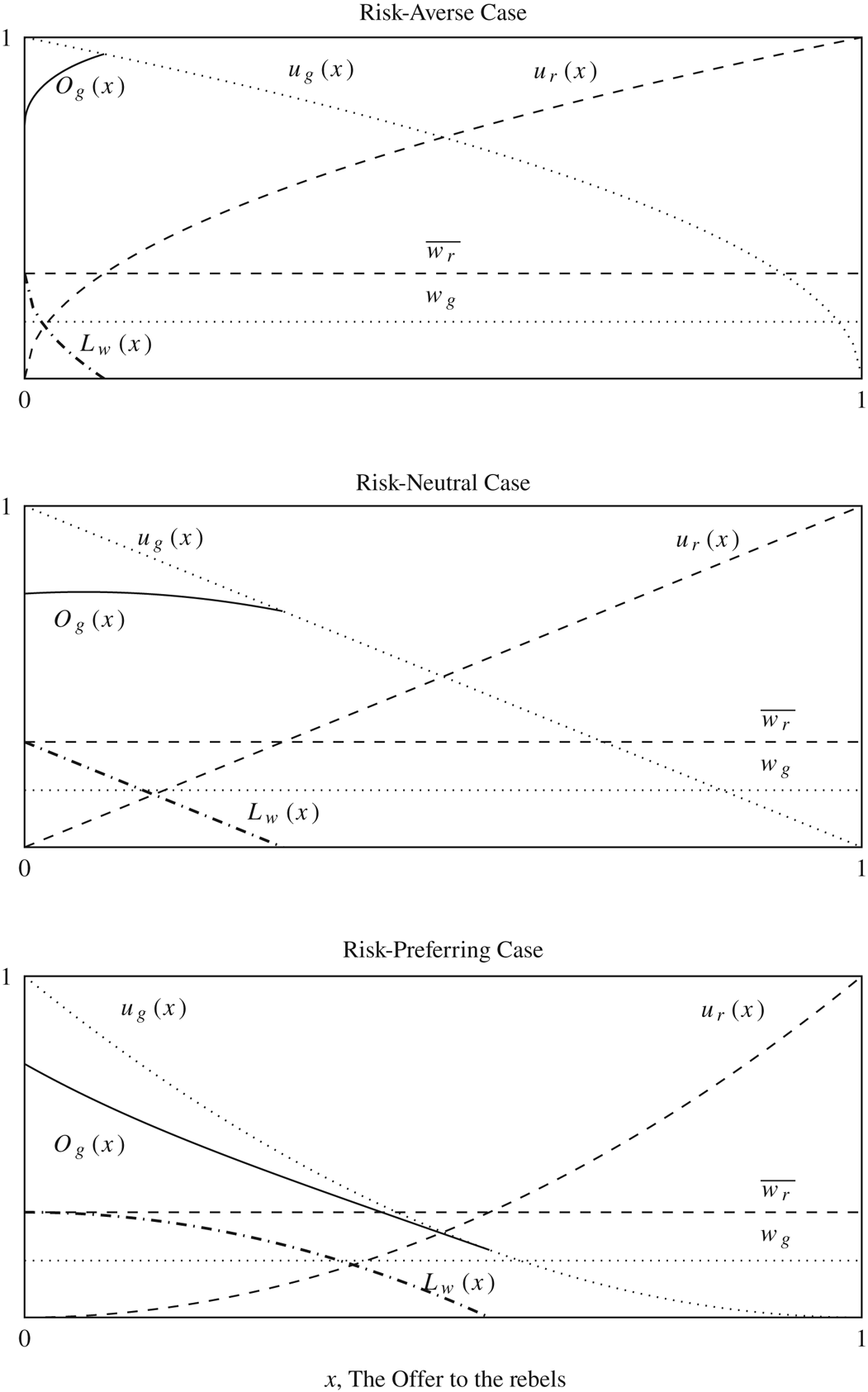
Examples of the government's objective function are illustrated in Figure 4. The top panel shows the case where the actors are risk averse; the middle panel, the risk-neutral case; and the lower panel, the risk-preferring case. The horizontal axis is the government's offer to the rebels, x. The objective function, O g(x), is shown as a solid line, but a number of other curves are shown to provide context and should be considered first. The government's utility function, u g(x), and war payoff, w g, are illustrated as dotted lines. The government need not consider offers greater than the point where these lines cross, since if the rebels accept, the government would be worse off than if they fought.Footnote 61 The rebels’ utility function, u r(x), and the war payoff for the lowest-cost type of rebel, denoted  $\overline {w_r} $, are shown as dashed lines. The government also need not consider offers beyond the intersection of these lines because all rebel types would accept anyway, so it would just lower the government's payoff without reducing the likelihood of war.Footnote 62 The probability of war, L w(x), is shown as a dash-dotted line. It declines as the offer gets more generous and is 0 after the offer becomes generous enough to buy off the lowest-cost rebel type.Footnote 63
The optimal offer

The government's task is to pick the offer, x*, which maximizes the objective function. Where that maximum will be depends on the shape of the objective function, which in turn depends on the risk attitude of the actors. In the top panel, with risk-averse actors, the objective function is positively sloped. Since the rebels gain a lot of utility from small concessions and the government does not lose much, small concessions reduce the likelihood of war substantially while costing the government little. This means that the government's best option is to make an offer sufficient to buy off all types of rebels, and reduce the likelihood of war to 0. Risk aversion leads to peace, therefore, by convincing the government to make a generous offer. In the middle row, the actors are risk neutral. Here, the objective function has an internal maximum. The government makes the rebels an offer which buys off some of them, but not all of them, so there is still a chance of war. Finally, in the bottom row, we have risk-preferring actors, which I argue are more common in civil wars. Here, the objective function is negatively sloped throughout its entire range, so the optimal offer is 0. In equilibrium, the government offers the rebels nothing. Note, this is not because of “indivisible goods.” The government can make any offer it likes—it simply chooses to offer nothing because the loss in utility terms would not be made up for by a sufficient reduction in the likelihood of war.
Figure 4 suggests that as the actors become more risk preferring, the objective function takes on a negative slope, so the optimal offer goes to 0. We can also see this by taking the derivative of the objective function with respect to x.
 $$( 1-L_w( x) ) \displaystyle{{du_g( x) } \over {dx}} + ( u_g( x) -w_g) \displaystyle{{du_r( x) } \over {dx}}$$
The first term is negative, and the second term is positive, so as long as the first outweighs the second, the entire expression is negative. Risk preference with weak rebels ensures that this is the case. With weak rebels, the offer is near 0. With risk-preferring preferences, the government side is losing a lot of utility in this region ( ${{du_g( x) } \over {dx}}$ is large and negative), but the rebels are gaining little (
 ${{du_r( x) } \over {dx}}$ is small and positive). Sufficient risk preference, therefore, ensures that the objective function is negatively sloped and the optimal offer is 0. As we will see next, this has pernicious consequences for efforts to reduce the likelihood of war by strengthening the rebels.
Implications of the Model
The goal of humanitarian intervention under the banner of R2P is to save lives by preventing atrocities. The policy metric we should be trying to minimize is therefore the expected level of atrocities, or the number of civilians expected to die. This is the product of the equilibrium level of atrocities given a war, α*, and the likelihood of war given the equilibrium offer from the government, L w(x*):
 $$E( \alpha ) = L_w( x^\ast ) \alpha ^\ast $$
The expected level of atrocities is a good theoretical yardstick for policy evaluation. If a policy decreases the expected level of atrocities, then on average, fewer people will be harmed and the policy is beneficial. If a policy change increases the expected level of atrocities, then more people on average will suffer, and the policy is harmful.Footnote 64 I will consider the effect on the expected level of atrocities of (1) fostering a balance of power by increasing the rebels’ military power, m r, to match the government's, m g, and (2) penalizing atrocities by reducing their effectiveness, ε, and increasing their cost, k g.
Fostering a Balance of Power
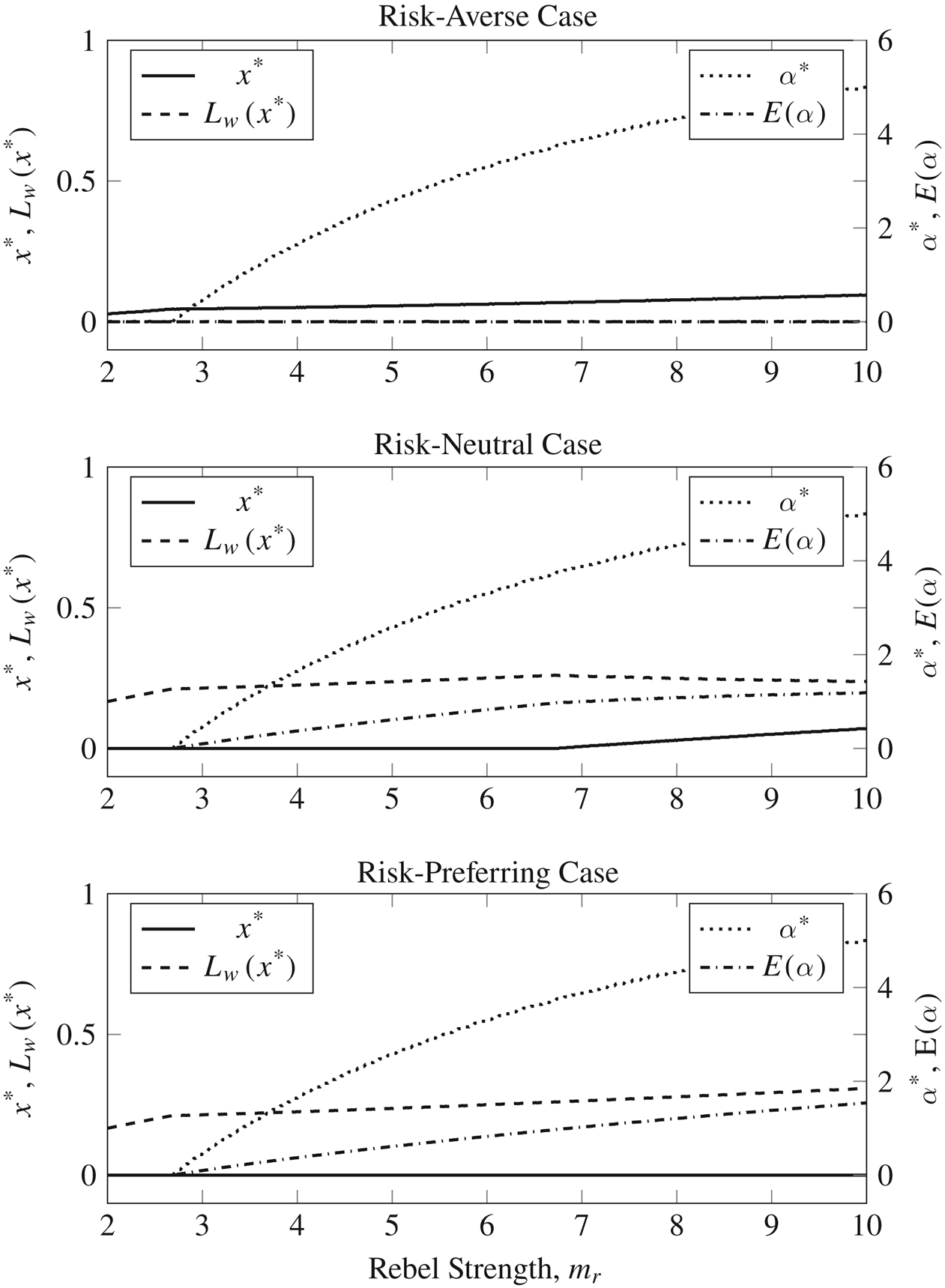
What is the impact of fostering a balance of power, in hopes of ending the war by encouraging a negotiated solution? This question is addressed in Figure 5. Once again, I consider the risk-averse, risk-neutral, and risk-preferring cases. In each panel, the horizontal axis is the military strength of the rebels, m r, ranging from 2 to 10, which is the government's strength.Footnote 65 Power is therefore increasingly balanced toward the right. I show the equilibrium offer, x*, the equilibrium likelihood of war, L w(x*) (measured on the left-hand axis), the equilibrium level of atrocities if a war occurs, α*, and the key policy consideration, the expected level of atrocities, E(α) (on the right-hand axis).
The expected level of atrocities and the balance of power

In the risk-averse case, the offer increases with the strength of the rebels, enough to keep the likelihood of war at 0 throughout. Since the likelihood of war is 0, the expected level of atrocities is also 0. Creating a balance of power with risk-averse actors does not cause atrocities because the parties bargain to a solution and avoid war. However, it also does not prevent them because the war is avoided in any case.
In the risk-neutral case, the likelihood of war is positive, and so is the expected level of atrocities, after the rebels get strong enough. As the rebels get stronger, the government eventually starts conceding. This causes the likelihood of war to flatten out, but unfortunately, the expected level of atrocities continues to increase. Bringing the government to the table by fostering a balance of power does produce a larger concession, but not large enough to eliminate the risk of war. And therefore creating a balance of power, even with risk-neutral actors, raises the expected level of atrocities despite the larger concession from the government.
Finally, in the risk-preferring case, the government's offer remains at 0 regardless of the strength of the rebels. As a result, the likelihood of war and the expected level of atrocities rise continuously as the rebels grow stronger. With risk-accepting actors, fostering a balance of power is unambiguously counterproductive. It increases the equilibrium level of atrocities, α*, generates no concessions, and raises the likelihood of war, L w(x*), so it also raises the expected level of atrocities, E(α).
Summing up, I find that fostering a balance of power increases the equilibrium level of atrocities and makes war more likely. This is the worst possible situation from a humanitarian perspective.
Result 1: If the actors are risk neutral or risk preferring, fostering a balance of power by bringing the rebels’ strength, mr, closer to the government's, mg, will
1. increase the equilibrium level of atrocities, α*,
2. increase the equilibrium likelihood of war, Lw(x*), and therefore
3. increase the expected level of atrocities, E(α).
Penalizing Atrocities: Effectiveness
I turn now to the strategy of penalizing atrocities, starting with lowering their effectiveness. The direct effect of penalizing atrocities is to reduce their expected level. However, this could be overwhelmed by the indirect moral hazard effect of encouraging rebellion. The key question for the model is when the direct effect outweighs the indirect effect, and vice versa.
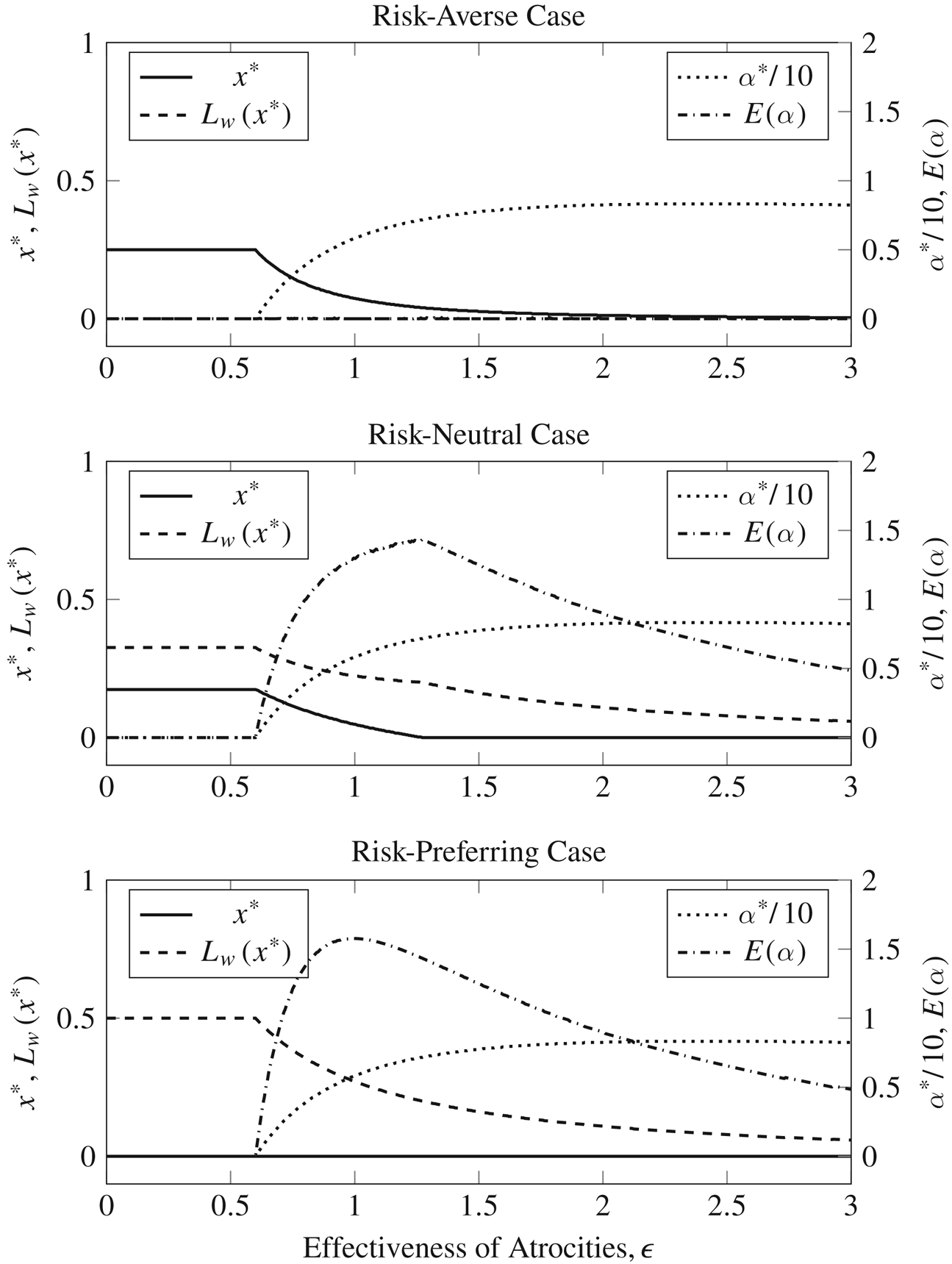
The impact of the effectiveness of atrocities, ε, is shown in Figure 6. The horizontal axis is ε, ranging from 0 to 3. As before there are three panels, corresponding to the risk-averse, risk-neutral, and risk-preferring cases. In this figure I posit that the rebels are as strong as the government, so m r = m g = 10.Footnote 66 In the top panel, with risk-averse actors, for low levels of effectiveness the government would commit no atrocities if a war occurs. As before, they buy off the opposition with a small offer. As atrocities become more effective, the government eventually would start committing them if a war occurred, and as a result they reduce their offer to the rebels. It is always carefully calibrated, however, to ensure that all rebel types accept the offer, so there is no chance of war and so a zero-expected level of atrocities.
The expected level of atrocities and the effectiveness of atrocities

In the risk-neutral case, the government starts out offering the rebels a concession, but not all accept, so the probability of war is positive. If atrocities are ineffective, the government does not commit any. Past a certain threshold, the government starts committing atrocities if there is a war, and the equilibrium offer and likelihood of war decline as a result. The expected level of atrocities rises at first, as they get more effective, but eventually begins to decline as the offer goes to 0, and the reduction in likelihood of war begins to dominate. Finally, in the risk-accepting case, the government makes a 0 offer throughout. The case is otherwise similar to the risk-neutral case: the expected level of atrocities first rises with their effectiveness and then declines as the likelihood of war diminishes.
The policy intervention being considered is reducing the effectiveness of atrocities, or moving from right to left in Figure 6. The direct effect is to reduce the level of atrocities committed if there is a war, α*. The indirect, moral hazard effect is to increase the likelihood of war, L w(x*), in the risk-neutral and risk-preferring cases. Which effect dominates? As we can see from the figure, if atrocities are very effective, reducing their effectiveness pushes up the expected level of atrocities. In this region the moral hazard effect dominates. If the effectiveness of atrocities can be reduced still further, however, the direct effect starts to dominate and the expected level of atrocities declines, eventually to 0. War still occurs in this case, but the government chooses to commit no atrocities, so the damage to civilians is minimized. Reducing the effectiveness of atrocities, therefore, if carried out with sufficient success, can eliminate atrocities, if not war.
I sum up the analysis for the effectiveness of ε in the following result.
Result 2: If the actors are risk neutral or risk preferring, penalizing atrocities by reducing their military effectiveness, ε, will
1. decrease the level atrocities committed if there is a war, α*,
2. increase the likelihood of war, L w(x*),
3. raise the expected level of atrocities, E(α), if atrocities are extremely effective, and
4. eventually reduce the expected level of atrocities to 0 as ε declines further.
Penalizing Atrocities: Cost
I turn now to penalizing atrocities by increasing their cost, k g. I focus on the same question as before: when will the direct effect of making atrocities more costly dominate, and when will the moral hazard effect of increasing the likelihood of war dominate?
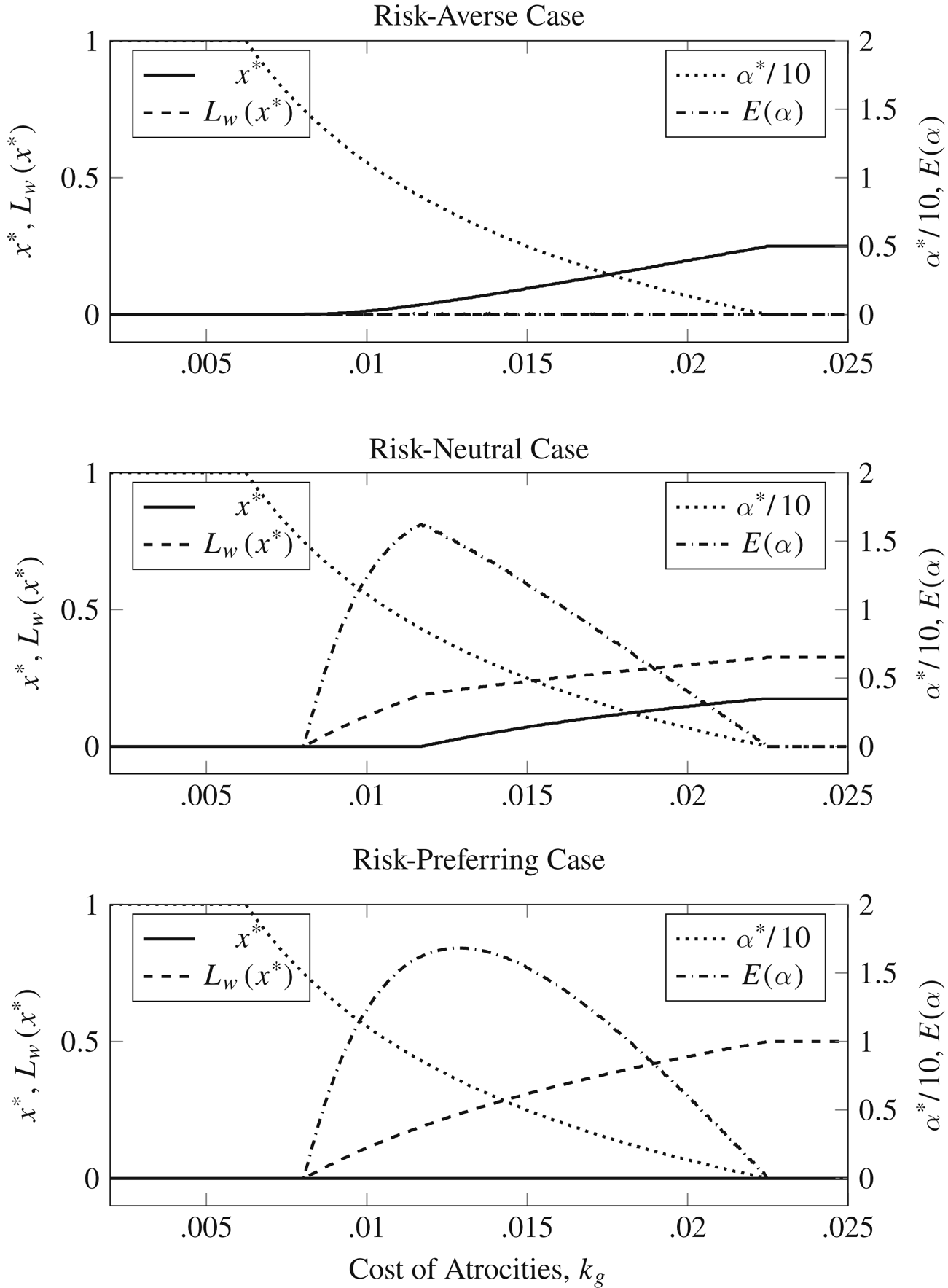
Figure 7 illustrates the effect of k g on the expected level of atrocities. In the top panel, the risk-averse case, once again the government buys off all rebel types so war does not happen. As the cost of atrocities goes up, the government commits fewer of them if there is a war. As war becomes less costly for the rebels, therefore, the government gradually sweetens their offer to make sure all are content. The expected level of atrocities is therefore 0 throughout.
The expected level of atrocities and the cost of atrocities

In the risk-neutral case, when the costs of atrocities are very low, the government would commit a lot of them if a war occurred. This suffices to deter all rebel types, and the likelihood of war is 0. As the cost of atrocities goes up, the government would commit fewer of them if war broke out. Eventually, some rebel types are no longer satisfied with an offer of 0, so the probability of war begins to increase, pushing up the expected level of atrocities. Eventually the government also starts making the rebels a concession. As the cost of atrocities increases, however, the expected level of atrocities hits a maximum and then begins to decline.
In the risk-preferring case, the result is similar except with a 0 offer throughout. As atrocities become more expensive, the government would commit fewer of them if war broke out. This eventually leads to a positive probability of both war and atrocities. Eventually, however, the expected level of atrocities begins to decline, and it goes to 0 as atrocities become prohibitively expensive. War is more likely than before, but it is fought without targeting civilians.
What is the effect of a policy intervention designed to increase the cost of atrocities? As anticipated, making atrocities more costly decreases the amount of atrocities that would be committed if a war broke out, α*. In the risk-neutral and risk-preferring cases it also increases the likelihood of war, L w(x*), supporting the moral hazard argument once more. Which effect dominates? If atrocities cost very little, then increasing their cost slightly will increase the expected level of atrocities, so the moral hazard effect dominates. If they are made more costly, however, the direct effect starts to dominate and the expected level of atrocities declines. Eventually, atrocities become prohibitively expensive, and the government stops committing them. In this region, war still occurs, but the government fights without committing atrocities.
I sum up the analysis for penalizing atrocities by increasing k g in the following result.
Result 3: If the actors are risk neutral or risk preferring, penalizing atrocities by increasing their cost, kg, will
1. decrease the level of atrocities committed if there is a war, α*,
2. increase the likelihood of war, L w(x*),
3. increase the expected level of atrocities, E(α), if the cost is low and the rebels were previously deterred by atrocities, and
4. eventually reduce the expected level of atrocities to 0, as k g becomes high enough.
The Bottom Line
What is the bottom line on intervening to save lives in civil wars? The analysis shows that intervening to foster a balance of power is bad on two counts. It encourages the government side to commit more atrocities to counteract the power shift. It also raises the chance of war, for weak and risk-accepting rebels. The resulting war will therefore see more atrocities per year and last longer, a double loss from a humanitarian point of view. In contrast, intervening to penalize atrocities by reducing their effectiveness and increasing their cost will reduce the level of atrocities committed if there is a war, though it also makes war more likely. Which effect dominates depends on how effective and how costly atrocities are to start with. If they are cheap and highly effective, then increasing the cost and decreasing the effectiveness slightly will be counterproductive. The moral hazard effect will dominate, and the increase in the likelihood of war will push up the expected level of atrocities. If the costs are increased and the effectiveness decreased sufficiently, however, the direct effect dominates and the expected level of atrocities will decline, eventually to 0. The model therefore highlights the importance of pursuing the policy with determination: a half-hearted approach could be counterproductive. Similarly, it could be important to establish the credibility of the policy swiftly. Attempting to implement the policy but in a way that is perceived as only partially credible could be the worst of all possible worlds.Footnote 67
The Case of Syria
Now I turn to a brief discussion of some of the policy choices that were made in dealing with the Syrian Civil War. In sum, the US launched a program of covert aid to the rebels with the aim of strengthening them and bringing about a peace deal. This policy failed to achieve its aim. The US also threatened (under Obama) and used (under Trump) force to punish Assad for using chemical weapons. These actions succeeded in removing Syria's chemical weapons arsenal and deterring most small-scale use of improvised chemical weapons, such as chlorine. Syria, therefore, presents some limited evidence of the downside of fostering a balance of power and the advantages of penalizing atrocities.
Inspired by events in Tunisia, demonstrations in Syria began in March 2011. Initially pressing for democratic reforms and freedom, demonstrators soon began calling for Assad's ouster from power. The regime suppressed the demonstrations with increasing amounts of force, and casualties began to mount. By July, an armed insurgency broke out, fueled by popular discontent and defectors from the Syrian Armed Forces. The Free Syrian Army was formed, and a Syrian National Council attempted to unite the rebels, but they remained divided and diverse in their ideology and goals. In August, President Obama called for democracy in Syria and for Assad to step down. In the fall of 2011 and spring of 2012, the civil war spread, and attacks on civilians using artillery and air power became commonplace.
Fostering a Balance of Power: Operation Timber Sycamore
To this point, US policy had remained relatively hands-off, providing some non-lethal aid and assisting UN diplomatic efforts to broker a ceasefire. When the ceasefire collapsed in summer 2012, secretary of state Hillary Clinton and CIA director David Petraeus began consulting on a plan to engage the US more directly.Footnote 68 The core of the plan was a proposal to arm and train selected rebel forces. It ultimately gained support from defense secretary Leon Panetta and chair of the Joint Chiefs of Staff, General Martin Dempsey.Footnote 69 Reluctant to intervene, Obama commissioned a study of covert aid to rebel groups by the CIA, the results of which were discouraging.Footnote 70 Obama was concerned about a number of downsides, among which were the possibility that US arms might eventually flow to radical groups affiliated with al-Qaeda and be used against the US.
In the end, however, Obama overcame his concerns and in 2013 approved covert aid to the rebels in a program code-named Timber Sycamore. The program was described by sources as a billion-dollar effort, bigger than any secret rebel assistance campaign since the 1980s aid to the Afghan Mujehediin against the Soviets. The program lasted for the remainder of his administration, to be canceled by President Trump in June 2017.Footnote 71 It was separate from the program to aid Kurdish rebels in the north, and the ill-fated program to directly train a rebel force to fight the Islamic State that was canceled by Obama in 2015 after producing only a handful of fighters.Footnote 72
The goal was explicitly not to help the rebels win but to get Assad to the negotiating table. “When it began, the initial objective was to force Mr. Assad to the bargaining table, in a series of negotiations that the secretary of state at the time, John Kerry, took up in earnest in 2015.”Footnote 73 Carson and Poznansky argue that covert action was selected because it minimized the danger of escalation and the reputational costs of attempting to overthrow a government.Footnote 74 Despite its size, therefore, the operation was limited in its ambitions.
Unfortunately, these ambitions remained unfulfilled. In terms of the model, the effect of arming and training the rebels is represented by an increase in m r, the parameter representing the rebels’ strength. In equilibrium, increasing m r for weak rebels increases the chance of war and causes the government side to commit more atrocities, increasing the expected level of atrocities. This is precisely what happened: the war dragged on, and the government committed more and more atrocities in its efforts to wipe out resistance. The hoped-for negotiations were difficult to start and quick to break down, and did not result in a lasting peace.
Penalizing Atrocities: The Chemical Weapons Issue
In August 2012, in one of the key moments for US policy on Syria, President Obama issued a threat intended to deter the Syrian government from using chemical weapons, saying that the movement or use of chemical weapons would be a “red line” that would “change my calculus.”Footnote 75 The Assad regime crossed that line a year later, in August 2013, by using sarin, a nerve agent, against civilians in an attack that killed over a thousand people. That atrocity triggered a crisis in which the US came as close as it ever did to using force against the Syrian government.
In a speech to the nation, President Obama argued in favor of military action designed to “deter” further use of chemical weapons and “degrade” the regime's capabilities.Footnote 76 Although Obama claimed he had the authority to order the use of force on his own, he nonetheless decided to seek congressional approval, putting supporters of intervention, and critics of his former policy, in a position of having to attempt to rally support in a deeply skeptical Congress. The proposed Senate resolution would have authorized the use of force against the Syrian regime for sixty days, subject to renewal. However, in a remarkable diplomatic turnaround, an offhand remark by secretary of state John Kerry—that if the chemical weapons were gone there would be no need to use force—was picked up by Russian foreign minister Sergey Lavrov, and the US and Russia hammered out a deal by which Syrian chemical weapons were to be removed from the country and destroyed.Footnote 77 This plan was then adopted, and President Obama withdrew his request for authorization of the use of force.Footnote 78
When President Trump took office in 2017, his desire to wind down US involvement in the Middle East was well known. However, he surrounded himself with hawkish advisers and was reluctant to look weak. When Assad began to use improvised chemical weapons on civilian targets again, the world looked to see what the US would do. The Trump administration responded with limited punishment strikes in April 2017, and again in April 2018, which seemed to reduce Syrian chemical weapons use.
The use of force in response to chemical weapons attacks, threatened by Obama and implemented by Trump, is in line with the penalizing atrocities concept. Did the Assad regime kill fewer people with chemical weapons than it would have but for international intervention? Although it is impossible to establish such counterfactuals definitively, I would argue that it is plausible in this case. If Assad had faced no international opposition to chemical weapons use, it seems that he would have made more use of his substantial pre-2014 arsenal. Obama's threat of military force brought Russia on board to remove Assad's arsenal, after which his more advanced chemical weapons were no longer available. Subsequent small-scale attacks used chlorine, which is easily improvised, as did the attacks that eventually triggered US retaliation under Trump. After that, chemical weapons use was minimal. The model suggests that this policy was successful because the value to the regime of chemical weapons in prosecuting the war, ε, was low enough that a modest cost imposed by the outside world for their use, k g, was enough to make it not worthwhile.
The problem, of course, is that chemical weapons accounted for only a fraction of civilian deaths in the conflict. It is even more of a speculative leap to ask whether a policy of penalizing atrocities more generally, regardless of how they were committed, would have reduced the death toll. One small piece of evidence in support of such a claim is that the regime was initially quite cautious about inflicting civilian casualties. Only when no international response was forthcoming did the regime gradually ramp up the level of killing. If initial civilian casualties had been met with forceful punitive raids, it is possible the subsequent escalation could have been deterred.
To sum up the Syrian case, operation Timber Sycamore was designed to bring Assad to the negotiating table and end the war. Unfortunately, it failed to do so. On the other hand, threats and limited use of force succeeded in getting Assad to surrender his chemical weapons arsenal and limit use of improvised chemical weapons such as chlorine. Whether a more ambitious policy of limited use of force to target atrocities per se would have succeeded remains an open question.
No Fly Zones and Safe Havens
The US considered other options in Syria that do not map as neatly onto the balance of power / penalizing atrocities dichotomy I have been focusing on.Footnote 79 Two prominent ones are no fly zones and safe havens. No fly zones play to a US strength: US air power enables it to ground flights in most conflict zones. The US imposed them in Iraq and Bosnia and considered them in Syria. No fly zones may increase the cost of atrocities by making them harder to commit if the perpetrator was relying on air power to bomb civilians. However, it would also prevent the government from bombing “legitimate” rebel targets like bases in rural areas. So it would shift the balance of power more than is necessary to penalize atrocities.
Safe havens are areas protected by international forces to which civilians can flee to avoid the war. If they are effective, they raise the cost of atrocities against protected civilians while leaving it the same for others. Safe havens also tend to act as protected rear areas for rebel groups, and so shift the balance of power in a way that is not proportionate to the level of atrocities. Safe havens can also fail completely if the international community lacks the resolve to defend them, as in the case of Srebrenica in the Bosnian conflict. Because they require ground troops, safe havens require a stronger commitment than no fly zones and the other strategies I have been considering.
On balance, I would place no fly zones toward the balance-of-power side of the spectrum and safe havens toward the penalizing-atrocities side, while acknowledging that these policies do not map neatly onto this distinction and could be skewed to either side by adjusting the implementation. No fly zones could be worthwhile if the regime is dependent on air power to commit atrocities (which is rare), and safe havens are valuable to the extent that they cover a large proportion of the civilian population and rebel groups can be prevented from using them as a protected rear base.
Bosnia and the Balance of Power
While fostering a balance of power failed in the Syrian case, it might seem to have succeeded in Bosnia. In that case, the US encouraged the Bosnians to declare independence but was reluctant to get involved in the consequent war. Eventually, however, in 1995, the US intervened with force on the side of the Bosnian–Croat federation, tilting the balance of power in their favor and enabling them to retake territory from the Serbs. The US subsequently negotiated a peace deal at Dayton that remains in effect. Richard Holbrooke, the US envoy, specifically delayed negotiations until the Serbs could be pushed back and weakened, believing that to be a necessary condition for success.Footnote 80 This seems like a case of a balance of power leading to successful negotiations.
However, an alternative interpretation of this case is that it was not the balance of power that led to success, but the fact that the US could by that point credibly threaten to assist the Bosnian–Croat federation to total victory if the Serbs were recalcitrant. The US was essentially presenting the Serbs with a choice between negotiation and defeat. Thus it was the US threat to create an imbalance of power, not the existing balance of power, which led to negotiation success. In the case of Syria, as I discussed, this threat was off the table.
Conclusion
Can the international community do anything, short of ground invasion, to reduce atrocities in civil wars? The answer is more complex than it might appear. The model described here seems to show that strengthening rebels to promote negotiations is a mistake: it will encourage the government to commit more atrocities and lengthen the war. A better approach is to penalize the government for committing atrocities—that is, to lower the benefit and raise the cost of committing atrocities while the government is still fighting, rather than after the conflict is over. If the government can be made to pay a higher cost for atrocities than its own humanitarian scruples dictate, that could convince them to reduce the level of killing. This too will shift the balance of power in favor of the rebels and lower their cost of fighting, increasing the likelihood or duration of war. But if pursued firmly enough, the effectiveness of atrocities can be reduced and the costs raised to the point that the expected level of atrocities declines. Sometimes, getting the parties to stop fighting is beyond reach, and the best one can do is encourage the parties to fight without killing civilians.
Any such argument, however, must contend with the possibility that the best one can do is nothing at all. In the age-old debate between advocates of interventionFootnote 81 and advocates of letting bad enough alone,Footnote 82 the pendulum has, after the wars in Afghanistan and Iraq, swung to the anti-intervention side. “Restraint” is the order of the day,Footnote 83 and there is little public appetite for intervention, especially humanitarian intervention. Indeed, the model highlights the dangers of intervention by altering the balance of power, and even by the more promising strategy, penalizing atrocities. If atrocities are very cheap or very effective, making them only somewhat more expensive or somewhat less effective could cause the government to just commit more of them to compensate. The theory presented here suggests that if they are made sufficiently expensive and sufficiently ineffective, governments will eventually desist. But threatening to do so and then not following up would be worse than useless. And unfortunately, we usually lack detailed information on where these thresholds are in specific cases. We may have the physics, but we lack the engineering needed to apply it safely. As a result, there is an irreducible role for detailed country-specific knowledge and ultimately, judgment under uncertainty.
Supplementary Material
Supplementary material for this article is available at <https://doi.org/10.1017/S0020818322000078>.
Acknowledgments
An earlier draft of this paper was presented at the annual convention of the International Studies Association, April 2018, San Francisco, CA, and at the University of Kentucky in November 2018. The first draft was written during the author's tenure as a consultant with the Simon-Skjodt Center for the Prevention of Genocide, United States Holocaust Memorial Museum, as part of a project on the Syrian Civil War in 2017. I would like to thank Emily Beaulieu, Jillienne Haglund, Yoshiko Herrera, Jesse Johnson, Colin Kael, Daniel Solomon, Scott Straus, Clayton Thyne, Benjamin Valentino, and Lawrence Woocher for helpful comments and feedback.