While conducting a 5-year investigation on the utilization of an emergency room (ER) for musculoskeletal (MSK) health conditions, a significant reduction in ER encounters during the early stages of the coronavirus disease (COVID-19) pandemic in Puerto Rico was observed. This decline in encounters coincided approximately with the March 11, 2020, date, when the World Health Organization (WHO) declared COVID-19 a pandemic. 1 This declaration led many governments and institutions to implement a number of public health measures, including the closing of businesses and schools, prohibition of mass gatherings, and cancellation of elective surgeries and medical appointments.
Several articles looking at the short-term effects of the pandemic and the abovementioned actions on ER utilization in various countries have been published. Reference Hartnett, Kite-Powell and DeVies2,Reference Kuitunen, Ponkilainen and Launonen3 Without exception, these studies demonstrate a significant reduction in the total number of encounters of all causes during the weeks following the implementation of strict restrictions and the prohibition of many activities. The reported reduction in these studies range from 16% to 42% when compared to the same period of time in the calendar year 2019 before the pandemic. In 1 study, Reference Barten, Latten and van Osch4 excluding the COVID-19-related encounters, the reduction was 66% when compared to the same weeks in 2019. However, those studies analyzed data representing the utilization of the ER during short periods of time (4 to 10 weeks). Because the pandemic has included several waves of cases, it is relevant to understand the longer term effects of this emergency during the course of a full calendar year.
In general, the utilization of ERs for the diagnosis and management of MSK health conditions is high. Reference Fontánez, Ramos Guasp and Ramírez5 Some studies have specifically looked at ER encounters related to MSK health conditions during the pandemic and reported a reduction in the total number of encounters. Reference Esteban, Querolt Coll and Xicola Martínez6–Reference Crenn, El Kinani and Pietu8 This decline ranged between 45.4% and 86.1% when compared with the same time period in the calendar year 2019.
The main purpose of the present investigation was to study the effect of the pandemic on the number of MSK encounters and the type of MSK health conditions in an ER of a teaching community hospital during the calendar year 2020. The working hypotheses for this study are that (1) the total number of encounters and the total number of encounters due to MSK health conditions were lower in the calendar year 2020 when compared with the calendar year 2019, (2) the reduction in the number of MSK encounters affected both sexes and all age groups, and (3) patients visiting the ER for MSK conditions in 2020 during the pandemic were older.
Methods
This study is part of a larger research project (described briefly below) looking at the clinical encounters in the ER of a major teaching hospital of the University of Puerto Rico. During the conduct of the initial phase of this project, Reference Fontánez, Ramos Guasp and Ramírez5 a sudden and substantial reduction in ER encounters close to the beginning of the COVID-19 pandemic was observed in March 2020. This report examines that observation by comparing the number of ER encounters during the pandemic in the calendar year 2020 (January 1 to December 31) with those in the calendar year 2019 (pre-pandemic).
Setting
This study was conducted at Dr Federico Trilla Hospital in Carolina, Puerto Rico, with the approval of the Institutional Review Board (Protocol #B1440118). The hospital is a secondary level teaching institution associated with the University of Puerto Rico School of Medicine and is the primary training site for several medical residency training programs, including Emergency Medicine. The ER is staffed by 13 board-certified emergency medicine physicans and 30 residents. It has 42 acute care beds and 8 fast-track exam areas and offers a wide variety of services, including bedside ultrasonography. The hospital has 234 staffed acute beds and provides care to the northeast region of the island with an estimated catchment area of 311 355 inhabitants in the neighboring towns served by the hospital. 9 Adults 60 years and older represent 27.6% of the inhabitants in the region. The hospital offers comprehensive MSK care (physical medicine and rehabilitation, orthopedic surgery, and physical therapy) and radiological services for both sexes and all age groups.
Study Design, Data Source, and Collection
A retrospective analysis of administrative data from all clinical encounters at the ER between January 1, 2019, and December 31, 2020, was conducted. Data were extracted from the ER’s electronic medical record system. These included date of the encounter, age and sex of the patient, as well as the International Classification of Diseases, 10th Revision, Clinical Modification (ICD-10-CM) codes for each encounter. 10,11 For patients with more than 1 clinical encounter in a year, age and sex assigned at their first encounter of the year were used for the description of unique patients by year.
ICD-10-CM Codes
Description of encounter diagnoses was restricted to the primary diagnosis as coded with the ICD-10-CM. Only 18 encounter records (0.02%) had no code on the primary diagnosis field, all for year 2020. An MSK encounter was defined as any encounter with the letters M (musculoskeletal system and connective tissue) or S (injury or certain other consequences of external causes) in the primary diagnosis field of the database. M and S codes in the secondary diagnosis field were present in only 7% of encounters and were not used in the analysis.
Statistical Analysis
Time-series were created after calculating the number of total encounters per day for each date from January 1, 2019, through December 31, 2020. Joinpoint analysis focused on a major drop in both total and MSK encounters in March, 2020, that were evident from inspection of graphical displays of the time-series. Thus, joinpoint regression was restricted to identify up to 3 breakpoints on each of these time-series based on the Bayesian Information Criterion, as well as changes in slope associated to these breakpoints. Reference Muggeo12 This method is widely used to analyze trends in health-related statistics, including cancer rates, Reference Kim, Fay, Feuer and Midthune13 injury hospitalization and mortality rates, Reference Park, Kim and Lee14 and incident cases of COVID-19. Reference Lobo, Cardoso-Dos-Santos and Rocha15,Reference Al Hasan, Saulam and Kanda16 Seven-day moving averages were added to time-series graphs in order to improve visualization of trend.
Most frequency distributions of the daily number of encounters were found to be skewed to the right. Thus, medians and interquartile ranges (IQRs) were used to describe them, and the Wilcoxon-Mann-Whitney test was used to statistically assess group differences in these distributions. Reference Rosner17 Percents were used to describe categorical variables, including distributions by sex, age groups, and diagnostic code groups. The chi-square test was used to test differences in proportions. Reference Rosner18 Data management and a statistical analysis were performed with R (version 4.1.1), 19 RStudio (version 1.4.1717), 20 and the following R packages: zoo (version 1.8.9), Reference Zeileis and Grothendieck21 segmented version (1.3.4), Reference Muggeo12,Reference Muggeo22–Reference Muggeo24 and R Commander (version 2.7-1). Reference Fox25
Results
Encounters from All Causes
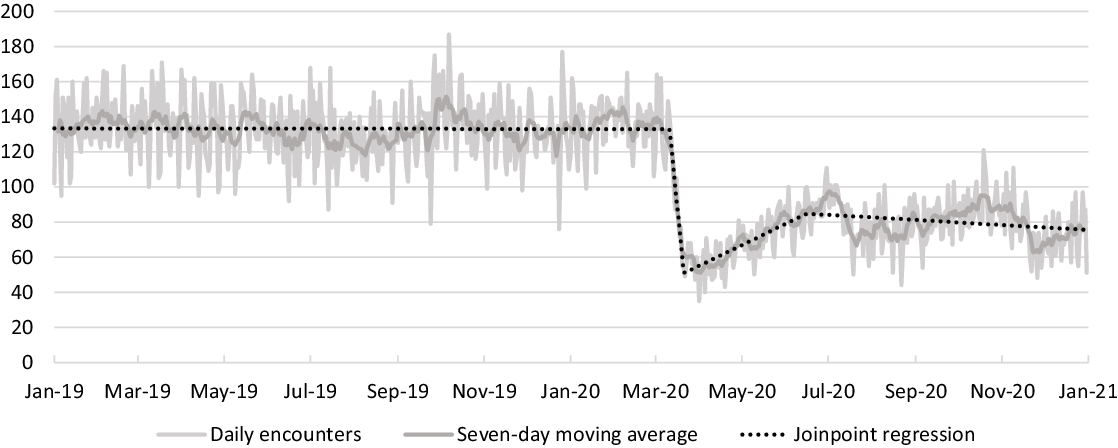
Figure 1 shows the number of daily encounters by date for calendar years 2019 and 2020. Joinpoint analysis detected a drop in total encounters starting on March 11, 2020 (95% CI: March 8–13). This loss occurred at a rate of 8.1 encounters per day (95% CI: 4.8-11.5) until March 21, 2020 (95% CI: March 18–23), for a total loss of 81 daily encounters at the end of the interval. A mild increase in total encounters occurred after that date at a rate of 1 encounter every 2.6 days (95% CI: 1 every 3.8 days–1 every 1.9 days) until June 2, 2020 (95% CI: May 29–July 3). However, for the remainder of the year, a loss of encounters ensued at an average rate of 1 encounter every 21.4 days (95% CI: 1 every 114 days–1 every 11.8 days).
Daily encounters from all causes, moving 7-day average, and joinpoint regression line for the period of January 1, 2019, to December 31, 2020.

These findings resulted in major changes of ER utilization statistics for the calendar year 2020. Total numbers of ER encounters for calendar years 2019 and 2020 were 48 382 and 32 306, respectively—a 33.2% reduction. The median number of all-cause daily encounters was 132.6 (IQR: 121-144) in 2019 and 82 (IQR: 70-99) in 2020 (P < 0.001). The total number of unique patients declined by 28.4% from 30 635 in 2019 to 21 941 in 2020.
A lower number of encounters in 2020 was noted for all ICD-10-CM code groups with the exception of code U07.1, assigned to patients with COVID-19 in year 2020 (218 encounters). The largest reductions were noted in ICD-10 code groups J, M, R, and A-B. The median daily encounters for diseases of the respiratory system (J codes) were 13 (IQR: 10–18) in 2019 and 4 (IQR: 3–9) in 2020 (P < 0.001). Similarly, the median daily encounters for diseases of the musculoskeletal system and connective tissue (M codes) decreased from 10 (IQR: 8–13) to 6 (IQR: 4–9) (P < 0.001). The median daily encounters with symptoms, signs, and abnormal clinical and laboratory findings (R codes) decreased from 28 (IQR: 24–32) to 16 (13–22) (P < 0.001). Finally, a decline in infectious and parasitic diseases (A codes+B codes) from a median of 7 (IQR: 5–9) to 4 (IQR: 2–6) (P < 0.001) was observed.
Musculoskeletal Encounters
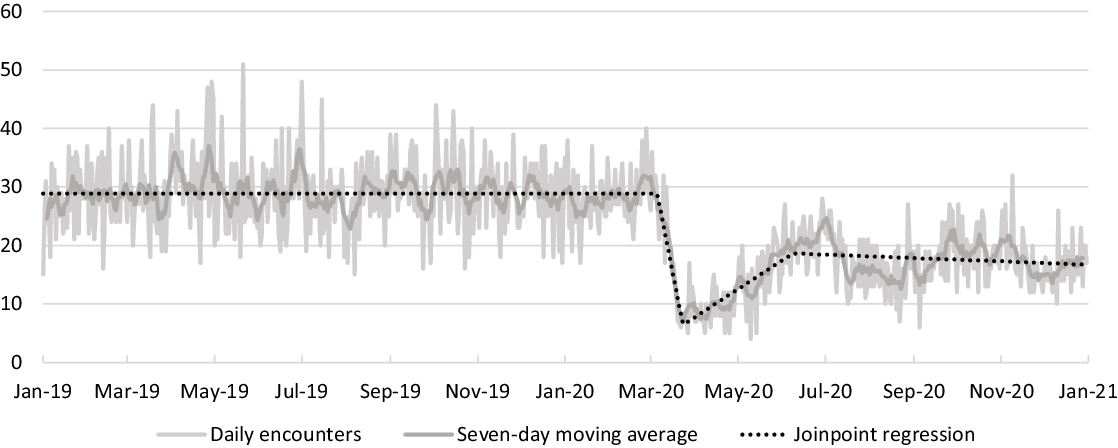
A similar pattern was found for MSK encounters (Figure 2). A loss in MSK encounters started on March 5, 2020 (95% CI: March 1 – March 9). This drop ensued at a rate of 1.2 encounters lost per day (95% CI: 0.8 - 1.7) until March 23, 2020 (95% CI: March 19 – March 27), for a total loss of 22 daily MSK encounters at the end of the interval. A slight increase in total encounters occurred after that date at a rate of 1 additional encounter every 6.3 days (95% CI: 1 every 9.6 days – 1 every 4.7 days) until June 2, 2020 (95% CI: May 29 – Jul 3). The number of MSK encounters then remained stable for the rest of the year, but at at level lower than expected from MSK encounters volume in 2019.
Daily encounters from musculoskeletal (MSK) conditions, moving 7-day average, and joinpoint regression line for the period of January 1, 2019, to December 31, 2020.

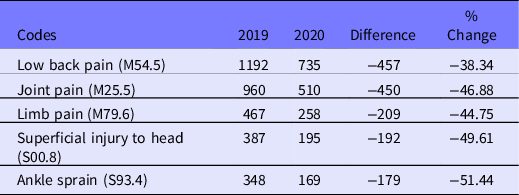
Total MSK encounters for calendar years 2019 and 2020 were 10 567 and 6779, respectively—a decrease of 35.8%. The median of daily MSK encounters (M+S codes) was 29 (IQR: 25-33) in 2019 and 18 (IQR: 13-23) in 2020 (P < 0.001). The total number of unique patients with MSK conditions was 9239 and 6097 (a 34% reduction) in years 2019 and 2020, respectively (a 34% reduction). The most frequent 5 MSK codes showing substantial declines in the number of encounters include low back pain, joint pain, limb pain, superficial injury to the head, and ankle sprain (Table 1).
The top 5 musculoskeletal (MSK) ICD-10-CM codes showing the largest decrease in the number of encounters

Effect on Encounters by Sex and Age
Considering all encounters, most unique patients seen in the ER were women: 57.2% (17 504/30 610) in 2019 and 55.8% (12 225/21 916) in 2020 (P = 0.001). There was no information about sex for 25 unique patients. When comparing the 2 calendar years, the largest reduction in unique patients was also seen among women compared to men, 30.2% and 26.1%, respectively. The median number of all-cause daily encounters for females was 78 (IQR: 69-87) in 2019 and 47 (IQR: 39-58) in 2020 (P < 0.001), whereas statistics for males were 54 (IQR: 48-60) in 2019 and 35 (IQR: 29-44) in 2020 (P < 0.001).
Most unique patients with MSK conditions were women: 53.6% (4951/9231) in 2019 and 51.4% (3128/6086) in 2020 (P = 0.007). No information about sex was available for 19 unique patients with MSK encounters. There was a reduction in unique patients with MSK health conditions in both sexes showing a decline of 36.8% in women and 30.9% in men. The median number of MSK daily encounters for females was 16 (IQR: 13-18) in 2019 and 9 (IQR: 7-12) in 2020 (P < 0.001), whereas statistics for males were 13 (IQR: 11-16) in 2019 and 9 (IQR: 6-12) in 2020 (P < 0.001).
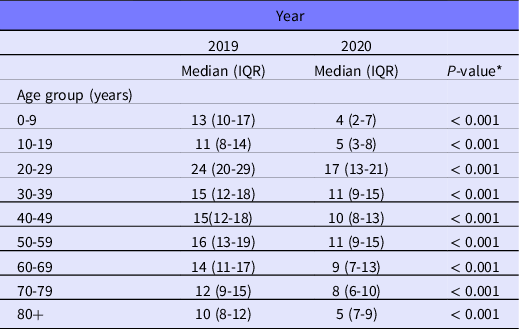
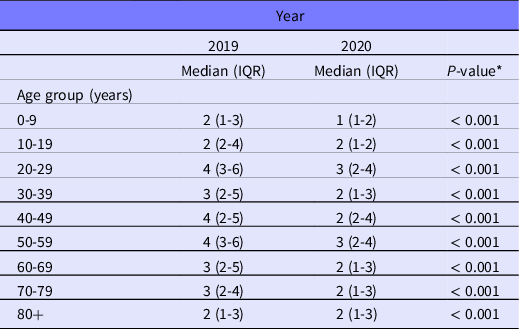
With regard to age, the median number of daily encounters from all causes (Table 2) and daily MSK encounters (Table 3) was lower in 2020 in all age groups. It must be noted that, although the medians are the same for some age groups in both years, there were differences in the overall distributions, which explain the results of statistical tests. The median age for all cause encounters was 3 years higher (P < 0.001) in 2020, but the difference in median age in MSK was minimal.
Median number of daily encounters from all causes by age group and year

* Wilcoxon rank sum test.
Median number of daily musculoskeletal (MSK) encounters by age group and year

* Wilcoxon rank sum test.
Discussion
The most important findings of the present study were (1) a major reductions in daily all-cause encounters occurred in the calendar year 2020, beginning around March 11; (2) a substantial decline in daily MSK encounters happened in 2020, starting around March 5; (3) for both, all-causes and MSK encounters, the decline was observed in men and women, but it was larger in females; and (4) for both, all-causes and MSK encounters, a substantial decline was observed in all age groups.
Encounters from All Causes
To our knowledge, this is the first investigation to compare 2 full calendar years to examine the effect of the pandemic on the number of encounters in an ER. The present investigation confirms the findings of several short-duration studies (weeks) in various countries, documenting a reduction in ER encounters during the COVID-19 pandemic. Most importantly, results from this study show that this was not a short-term effect but a decline that persisted at least for the rest of the calendar year 2020.
The impact of the COVID-19 pandemic on emergency department visits in the United States was reported by Hartnett et al. Reference Hartnett, Kite-Powell and DeVies2 They analyzed data from the National Syndromic Surveillance Program (NSSP) that included 3173 hospitals (66% of all US ER visits) in 2019 and 3267 (73% of all US ER visits) in 2020. The reason for the visit in that study was analyzed from a sample of records that had at least 1 specific ICD-10-CM code. Seven states, as well as the District of Columbia, were totally or partially excluded from the study of diagnostic codes. In addition, among eligible encounters for diagnostic code analysis, 20.3% without a valid ICD-10-CM code were excluded. These methodological issues may explain some differences between that study and the present investigation. The lowest number of encounters reported by that research team occurred during April 12–18, 2020, which is later than the dates of March 21 for all encounters and March 23 for MSK encounters. However, daily encounters reported remained lower than expected for the remaining of the study period, similar to the experience in the present study. In the same study, a comparison of the volume of visits during a 4-week period early in the pandemic (March 29–April 25, 2020) with the same period in 2019 showed a 42% decline in the total number of visits, from 2.1 million per week in 2019 to 1.2 million per week in 2020. This is higher compared to the 33.2% reduction seen in the present study, and the real reduction should be even higher, considering the increased proportion of all US ER visits reported to the NSSP in 2020.
In the study by Hartnett et al., the largest reductions were found in visits for abdominal pain and other digestive signs and symptoms, and for MSK pain (excluding low back pain). Reference Hartnett, Kite-Powell and DeVies2 The number of encounters related to health conditions of the pulmonary system increased. This is a difference from the present study, probably because COVID-19 respiratory encounters were classified under a different ICD-10 code. In fact, the number of encounters with a U code in the setting of the present study for COVID-19 was higher in 2020. Some hospitals in the island developed special wards for COVID-19 patients, and it is possible that patients with respiratory symptoms were diverted to those facilities. This is supported by the relatively small number of encounters with this code in 2020 (n = 218).
Another 2 studies examined the impact of the pandemic on ER utilization. Heppner at al. reported a 14.8% reduction in visits to a Level I trauma center in Kentucky (United States) in 2020 over a period of 4 months (February to May). Reference Heppner, Shreffler and Polies26 Finally, in a study of 3 ERs covering 1/6 of the Finnish population (900 000 persons), the authors compared the number of ER visits 6 weeks before and 6 weeks after a national lockdown on March 16, 2020. A 16% reduction in the total number of ER visits was reported. Reference Kuitunen, Ponkilainen and Launonen3
Musculoskeletal Encounters
A previous article reported that MSK health conditions represent a large number of encounters in the ER of this same hospital. Reference Fontánez, Ramos Guasp and Ramírez5 The present study describes a substantial reduction (35.8%) in the number of MSK encounters. Other studies, of shorter duration, have also reported major reductions, although the percent reduction varies. For example, Esteban et al. Reference Esteban, Querolt Coll and Xicola Martínez6 compared the number of visits to a traumatology ER in Spain during a 4-week period at the beginning of the pandemic with the previous 2 years. They reported a drop in encounters of 86.1% from an annual average of 3212 to 445 during the pandemic in 2020. In their study, Heppner at al. reported a 21.9% reduction in visits due to MSK diagnoses in 2020. Reference Heppner, Shreffler and Polies26 In the Finnish study mentioned above, Reference Kuitunen, Ponkilainen and Launonen3 the number of visits due to back and limb pain (M codes) was reduced by 31%. Larger relative reductions were seen in the present study in several MSK codes, including low back pain, joint pain, and limb pain were noted (see Table 1).
A smaller study conducted in an ER in the United Kingdom showed an overall 45.4% reduction in attendance during the lockdown in 2020 when compared to 2019, including a reduction of 58.9% and 78.5% of patients in patients presenting with back pain and neck pain, respectively. Reference Dowell, Ashwood and Hind7 The mean age of the patients increased by 5 years, and the number of encounters associated with road accidents was reduced from 70 to 8. Another large study conducted in a large trauma center in France also reported a reduction (52.1%) in MSK encounters in the ER. Reference Crenn, El Kinani and Pietu8 Not surprisingly, the reported decline was accompanied by a reduction in the number of surgical procedures for MSK injuries. Interestingly, this decline had started before the first national French lockdown on March 17, 2020. When the authors compared the first 4 weeks of the lockdown with the second 4 weeks, an increase in ER encounters was noted in the second 4 weeks but remained below pre-lockdown levels. This is similar to the findings in the present study (see Figure 2).
Effect of Encounters by Sex and Age
With respect to sex differences, the present investigation showed similar reductions in both men and women for both the total number of encounters and MSK encounters. However, the decline was larger in females. This is similar to the findings reported by Hartnett et al. in the United States where the largest drop was noted in females. Reference Hartnett, Kite-Powell and DeVies2 Other studies limited to trauma and MSK encounters have also reported a larger reduction in encounters from females Reference Esteban, Querolt Coll and Xicola Martínez6,Reference Heppner, Shreffler and Polies26 or no difference between sexes. Reference Crenn, El Kinani and Pietu8
An analysis of the differences among age groups in the present study showed statistically significant reductions in all-cause and MSK encounters in all age groups. Other authors have reported a higher median age of trauma patients in the ER for year 2020 (6-year difference) Reference Esteban, Querolt Coll and Xicola Martínez6 and a significantly higher median age (8-year difference) of patients with MSK encounters during the pandemic. Reference Crenn, El Kinani and Pietu8 This is different than in the present study because only a minimal difference in median age was seen. These authors, however, did not report on the effects by age group.
Possible Reasons for the Decline in Encounters
The reduction in ER encounters can have several explanations, including strict lockdown rules implemented by governments limiting individual mobility and fear of becoming infected.Reference Barten, Latten and van Osch4 In Puerto Rico, severe social and commercial activity restrictions (lockdowns) were implemented in March 12, 2020, a date that coincides with joinpoint regression breakpoints in Figures 1 and 2. In the case of MSK conditions, it is also possible that, during the period of severe restrictions, a reduction in motor vehicle accidents, occupational injuries, and sports participation may have contributed to the decline in encounters. Reference Esteban, Querolt Coll and Xicola Martínez6,Reference Dowell, Ashwood and Hind7 However, in the present study, the reduction in ER encounters, although more dramatic during the period of severe restrictions, did not show complete recovery for the whole calendar year. This decline may have severe negative health consequences if persons ignore symptoms of life-threatening conditions such as chest pain. Those patients who depend on the ER for regular care may decide to postpone their visits, resulting in worsening of chronic conditions. Furthermore, those patients with MSK conditions who do not get the emergency care they need may not be able to return to work, with negative financial consequences for their families and employers.
Finally, a pandemic-related lockdown may require changes in the staffing of an ER, limit MSK educational opportunities for students and residents, and demand a re-direction of patients with MSK emergencies to previously identified centers with resources dedicated to MSK care. This may require an investment to increase the capacity for MSK care of these centers. The possible financial implications of the above include a reduction in ER revenue and a decrease in admissions for MSK-related procedures that represent a significant source of hospital revenue.
Comparison with Natural Disasters
It may be of interest to compare the utilization of ER services during the pandemic with the utilization after a natural disaster because both conditions have the potential to increase demand for health services. A previous article reported that the total number of encounters in the same ER that serves as the setting for the present study was very similar before and after Hurricane María in September 2017. Reference Fontánez, Ramos Guasp and Ramírez5 Similarly, in a study of 7 tropical storms in the United States, only small changes in ER utilization were reported when all encounters were analyzed in aggregate. Reference Heslin, Barrett and Hensche27 In another study also conducted after Hurricane María, an increase in visits was noted, particularly due to injuries, but only for the 4 weeks after the hurricane. Reference Frasqueri-Quintana, Oliveras-Garcia and Adams28 The difference in ER activity between the pandemic and the period after a natural disaster could be explained by the relative short duration of a natural disaster accompanied by a fast recovery of health care and transportation infrastructures. Contrary to the pandemic, patients may not fear a visit to the ER because the natural phenomenon has ended after a short period of time.
Limitations
Some limitations of the present study must be noted. For the analysis of encounter diagnoses, ICD-10-CM codes were used as recorded in the hospital’s administrative database. The selection of the code is therefore dependent on the judgment of physicians and coders. However, the analysis included other variables (age, sex, date of encounter) that are not likely to be confused, as well as codes in 2 groups (M and S) that can be clearly distinguished from other ICD-10-CM categories. Furthermore, specific conditions frequently seen in the ER, such as low back pain, pain in knee, and shoulder and femur fractures, are not likely to be misclassified. However, due to the academic affiliation of the hospital and the availability of many specialized MSK services, it is possible that the pandemic may have had a different effect on other ERs with dissimilar patient mix and/or utilization patterns.
Conclusions
The COVID-19 pandemic was associated with a significant reduction in all-cause and MSK encounters in the ER of an academic hospital. Factors that may explain this reduction include governmental restricions and a change in patient’s behavior due to fear of contagion. The long duration of the observed reduction suggests that patients who regularly visit the ER have delayed seeking care for other health conditions.
Funding statement
Dr Frontera’s research is partially funded by Grant S21 MD001830-04, NIMHD, NIH. Dr Conde’s research activities are partially funded by RCMI Grant U54 MD
007600, NIMHD, NIH. The content of this report is solely the responsibility of the authors and does not necessarily represent the official views of the National Institutes of Health.
Conflict(s) of interest
None.