There is an established literature pointing to the importance of children's systems of self-regulation in deterring the development of externalizing behavior problems such as aggression and delinquency. Children with more difficulties in self-regulation show more externalizing problems concurrently and longitudinally, suggesting a synergy between the two constructs. Yet, the underlying etiology of individual differences in this developmental process is unclear. In the current study, we examined the concurrent and longitudinal associations between externalizing problems and behavioral indicators of attention regulation to estimate additive and interactive genetic and nongenetic influences using a twin behavioral genetic design.
Externalizing Problems and Attention Regulation
There is mounting evidence that good attention regulation plays a central role in a healthy developmental trajectory that is relatively free from behavioral and emotional problems. Difficulties with regulating attention are associated with more aggressive and delinquent behaviors concurrently and longitudinally (Kochanska & Knaack, Reference Kochanska and Knaack2003; Murray & Kochanska, Reference Murray and Kochanska2002; Olson, Sameroff, Kerr, Lopez, & Wellman, Reference Olson, Sameroff, Kerr, Lopez and Wellman2005; Zhou et al., Reference Zhou, Hofer, Eisenberg, Reiser, Spinrad and Fabes2007). Children with better attention regulation are more able and flexible in choosing the “to be attended to” information in the external world and in their internal thought processes. Refocusing attention can be an effective strategy in modulating anger, thereby reducing its contribution to antisocial behavior (Kim & Deater-Deckard, Reference Kim and Deater-Deckard2011; Morris, Silk, Steinberg, Terranova, & Kithakye, Reference Morris, Silk, Steinberg, Terranova and Kithakye2010; Rothbart, Ellis, Rueda, & Posner, Reference Rothbart, Ellis, Rueda and Posner2003). Attention regulation can also be used to inhibit impulsive inappropriate actions (Posner & Rothbart, Reference Posner and Rothbart2006).
Behavioral genetic studies have been conducted to clarify the genetic and nongenetic etiology underlying the link between externalizing problems and attention regulation. Univariate behavioral genetic studies have suggested that individual differences in externalizing problems are attributable to moderate genetic, modest shared environmental (i.e., nongenetic factors that contribute to family member similarity) and moderate nonshared environmental (i.e., nongenetic factors that do not contribute to family member similarity) sources of variance (Miles & Carey, Reference Miles and Carey1997; Rhee & Waldman, Reference Rhee and Waldman2002). The longitudinal stability of individual differences in externalizing problems is mainly accounted for by genetic and shared environmental factors (Bartels et al., Reference Bartels, van Beijsterveldt, Derks, Stroet, Polderman and Hudziak2007). Individual differences in sustained attentive behavior are attributable to moderate genetic variance and moderate nonshared environmental variance (Deater-Deckard & Wang, Reference Deater-Deckard, Wang and Posner2012; Fan, Wu, Fossella, & Posner, Reference Fan, Wu, Fossella and Posner2001). The longitudinal stability of attention is accounted for by stable genetic influences, whereas changes in attention over time appear to be mediated by nonshared environmental influences such as differential parental sensitivity in caregiving behavior (Deater-Deckard, Petrill, Thompson, & DeThorne, Reference Deater-Deckard, Petrill, Thompson and DeThorne2006).
However, what is the etiology of the longitudinal connections between attention and externalizing problems? This question has not been addressed in previous research, and answering it provides the main rationale for the current investigation. To answer this question, multivariate quantitative genetic models are needed to reveal the underlying structure of variance and covariance through which externalizing problems and attention regulation are linked. Using the first wave from the current longitudinal study, we used a multivariate model to conduct a cross-sectional analysis and found a common genetic factor underlying the covariation between poorer attention and more conduct problems above and beyond any underlying genetic influences involving negative affect (Deater-Deckard, Petrill, & Thompson, Reference Deater-Deckard, Petrill and Thompson2007). Other behavioral genetic studies have taken a similar approach, and the results are mixed. Some have suggested a common genetic factor (Dick, Viken, Kaprio, Pulkkinen, & Rose, Reference Dick, Viken, Kaprio, Pulkkinen and Rose2005; Nadder, Rutter, Silberg, Maes, & Eaves, Reference Nadder, Rutter, Silberg, Maes and Eaves2002), but others have pointed to a common underlying shared environmental factor (Burt, Krueger, McGue, & Iacono, Reference Burt, Krueger, McGue and Iacono2001; Burt, McGue, Krueger, & Iacono, Reference Burt, McGue, Krueger and Iacono2005) or nonshared environmental factor (Deater-Deckard et al., Reference Deater-Deckard, Petrill and Thompson2007).
There are several features of the behavioral genetic studies in the literature that could explain the mixed results. First, the samples vary in terms of children's ages. This matters, because there is evidence of growth in heritable variance and dissipation of shared environmental variance in attention over the transition to and through middle childhood (Deater-Deckard & Wang, Reference Deater-Deckard, Wang and Posner2012). By comparison, over the same developmental period, externalizing problems show stable nonshared environmental variance but there are potential fluctuations in levels of heritable and shared environmental variance over time (Bartels et al., Reference Bartels, van Beijsterveldt, Derks, Stroet, Polderman and Hudziak2007). Thus, the mechanism that links externalizing problems and attention regulation may also vary across time. To our knowledge, only one prior study has longitudinally examined the genetic and nongenetic etiology of the link between attention and externalizing; in that case, the emphasis was on attention-deficit/hyperactivity disorder (ADHD) and oppositional defiant disorder symptoms (Nadder et al., Reference Nadder, Rutter, Silberg, Maes and Eaves2002). That study found a genetic factor that captured all the covariation between ADHD and oppositional defiant disorder across two time points. However, the sample spanned a wide age range (8–16 years), resulting in a potential washing out of any discernible developmental shifts that might be evident over smaller age spans and shorter periods of development in middle childhood and adolescence. In the current study, we used a cross-sectional and longitudinal behavioral genetic design that spans a narrower age range (5–8 years old in the first wave) and includes three annual assessments in middle childhood prior to puberty.
Second, another factor that might contribute to the mixed results in the literature lies in the intrinsic limitation of the quasiexperimental twin design, which is relatively underpowered for detecting shared environment effects compared to the higher statistical power for detecting genetic effects (Plomin, DeFries, McClearn, & McGuffin, Reference Plomin, DeFries, McClearn and McGuffin2008). Depending on sample size and whether nontwin siblings were also included in the analysis, prior studies have varied in their ability to detect significant shared environmental variance in, and covariance between, externalizing and attention. Although we used a twin design in the current study, we attempted to partially ameliorate this power limitation by examining correlated constructs (i.e., attention and externalizing) in longitudinal multivariate models, an approach that increases power for detecting shared environment effects (Schmitz, Cherny, & Fulker, Reference Schmitz, Cherny and Fulker1998).
Third, genetic and nongenetic variance and covariance estimates are influenced by the methods that are used to assess attention regulation and externalizing problems, so differences in study methodology can influence results. Typically, larger shared environment effects and smaller genetic effects are obtained when observations are used, but smaller shared environment effects and larger genetic effects are obtained when questionnaires are used (Ghodsian-Carpey & Baker, Reference Ghodsian-Carpey and Baker1987; Leve, Winebarger, Fagot, Reid, & Goldsmith, Reference Leve, Winebarger, Fagot, Reid and Goldsmith1998). Furthermore, evidence of a common shared environmental factor in the covariation between two constructs (such as attention and externalizing) is more likely to be found if the same method and informant is used to assess both constructs, likely reflecting a shared method effect. To our knowledge, nearly all of the prior behavioral genetic studies of attention and externalizing have this monomethod limitation. In the current study we used a multiple-informant multiple-method approach so that the covariation between the two constructs would include minimal amounts of overlapping variance arising from method and informant. Mothers and fathers rated their children's externalizing problems, and observers and teachers rated children's sustained attentive behaviors.
The cognitive neuroscience literature has emphasized measurement of attention regulation using task-based performance, typically in a laboratory setting. However, this is not necessary when the goal is to examine the behavioral manifestations of attention regulation. Observational and questionnaire-based assessments of sustained attentive behavior such as those used in the current study are more feasible in large longitudinal designs compared to laboratory-based task assessments, and they are reliable (though distal) indicators of underlying cognitive mechanisms of attention regulation (Deater-Deckard & Wang, Reference Deater-Deckard, Wang and Posner2012; Rothbart, Reference Rothbart2007; Willcutt, Doyle, Nigg, Faraone, & Pennington, Reference Willcutt, Doyle, Nigg, Faraone and Pennington2005). These broader behavioral measures of attention are suitable when the goal is to examine links with other aspects of behavior (such as externalizing problems), as is the case in the current study. However, the caveat is that these kinds of measures do not precisely specify the subcomponents of attention regulation that can be assessed with task-based laboratory performance measures.
Gene × Environment Interaction: Household Chaos as Context
An assumption that is required in the interpretation of genetic and nongenetic factors in the variance in, and covariance between, attention and externalizing problems is that these effects are additive. However, the soundness of this assumption has been increasingly called into question based on more recent empirical findings and methodological advances. For example, Leve et al. (Reference Leve, Kerr, Shaw, Ge, Neiderhiser and Scaramella2010) used a parent–offspring adoption design and reported a statistical interaction between adoptive parent anxious/depressive symptoms and adopted infants’ genetic risk for externalizing problems in the prediction of those children's subsequent heightened attention to frustrating events (Leve et al., Reference Leve, Kerr, Shaw, Ge, Neiderhiser and Scaramella2010). Traditional behavioral genetic analyses cannot detect this kind of interaction, with the Gene × Environment interaction variance being included in the heritable and nonshared environmental variance estimates. Additive genetic and nongenetic covariation between externalizing problems and attention regulation has been detected in prior studies (Deater-Deckard et al., Reference Deater-Deckard, Petrill and Thompson2007; Dick et al., Reference Dick, Viken, Kaprio, Pulkkinen and Rose2005; Nadder et al., Reference Nadder, Rutter, Silberg, Maes and Eaves2002), but the presence of interactive effects has been untested. Therefore, in the current study we examined this possibility by incorporating household chaos as a candidate environmental factor into the traditional behavioral genetic model.
Household chaos reflects the level of disorganization in the family environment, including noise, crowding, and unpredictability in daily routines. It was chosen in the current study as the environmental attribute of interest because it is one of the most important proximal environment factors through which other environmental factors exert their influence on a variety of socioemotional and psychopathology outcomes (Evans, Gonnella, Marcynyszyn, Gentile, & Salpekar, Reference Evans, Gonnella, Marcynyszyn, Gentile and Salpekar2005). Higher levels of household chaos have been shown to predict children's poorer cognitive performance, more limited attention focusing, and more behavioral and emotional problems concurrently and longitudinally, even after controlling for other confounding environmental factors such as parental education and IQ, parental warmth and negativity, parental stress, and other neighborhood attributes (Deater-Deckard et al., Reference Deater-Deckard, Mullineaux, Beekman, Petrill, Schatschneider and Thompson2009; Dumas et al., Reference Dumas, Nissley, Nordstrom, Smith, Prinz and Levine2005; Pike, Iervolino, Eley, Price, & Plomin, Reference Pike, Iervolino, Eley, Price and Plomin2006). Chaos also functions as a moderator in the link between parenting or classroom environments and children's conduct problems, whereby it exacerbates the effect of poor parenting and classroom environments on children's behavioral problems (Asbury, Dunn, Pike, & Plomin, Reference Asbury, Dunn, Pike and Plomin2003; Coldwell, Pike, & Dunn, Reference Coldwell, Pike and Dunn2006; Oliver, Pike, & Plomin, Reference Oliver, Pike and Plomin2008). In the current study we tested whether household chaos interacted with genetic variance and covariance in explaining the link between attention and externalizing behavior problems over middle childhood. To summarize, advances in theory and empirical research on the development of psychopathology require the examination of multiple levels of analysis, which in the current study is from the home environment (i.e., chaos) to behavioral assessments of siblings to behavioral genetic estimates of heritable and nonheritable factors, to elucidate the developmental processes that cause growth and minimization of antisocial behavior problems in childhood and adolescence (Cicchetti & Valentino, Reference Cicchetti, Valentino and Masten2007). We addressed the following questions:
1. At the “phenotypic” level, are externalizing problems and attention regulation correlated when covariance from shared method and informant effects is minimized? Furthermore, does the correlation differ as a function of household chaos?
2. At the behavioral genetic level, what is the genetic and environmental etiology underlying the phenotypic correlation? Is it attributable to additive genetic and environmental effects or an interactive Gene × Environment interplay involving household chaos?
3. Longitudinally, does the underlying genetic and environmental etiology of the phenotypic correlation change across middle childhood?
Method
Participants
The data were from the first three annual waves of a longitudinal twin study: the Western Reserve Reading Project. Families were recruited from the Cleveland, Columbus, and Cincinnati, Ohio, metropolitan areas. There were 131 pairs of monozygotic (MZ) twins (39% male) and 173 pairs of dizygotic (DZ) twins (44% male). The average age was 6.07 (SD = 0.68, range = 4.33–7.92) in the first wave, 7.15 (SD = 0.67, range = 6.00–8.83) in the second wave, and 8.30 (SD = 0.75, range = 6.50–10.00) in the third wave. Ninety-one percent of the sample was Caucasian, 5% African American, and 2% Asian. Twenty-five percent of the parents had some postgraduate education or degree, 31% had a bachelor's degree, 23% to 27% had some college, and 12% to 17% completed high school or less. Ninety percent of the parents were married and lived together, 2% were unmarried but cohabited, and 6% were single.
Procedure
In each annual assessment wave, informed consent was obtained and parents were informed that they would receive $100 for their participation. Parents and twins completed a series of behavioral and cognitive assessments during a 3-hr home visit. At the end of the home visit, the twins’ behaviors during the cognitive assessments were rated by trained testers. Teachers completed questionnaires via mail.
Measures
Externalizing problems
We used the externalizing problems syndrome score (including delinquent behavior and aggression) from the Child Behavior Checklist (Achenbach, Reference Achenbach1991) to measure child externalizing problems. The items were rated by mothers and fathers on a 3-point Likert-type scale (0 = not true, 1 = somewhat or sometimes true, 2 = very true or often true). Correlations between mother and father reports ranged from .44 to .58, depending on twin and longitudinal wave. Mother and father reports were averaged, when applicable, to obtain a more reliable parent-rated externalizing problem score. When only mother or father report was available, a single parent report was used. Among the 608 children, 554 children had mother reports on externalizing problems in the first wave, 501 in the second wave, and 435 in the third wave. Three hundred seven children had father reports on externalizing problems in the first wave, 274 in the second wave, and 189 in the third wave. Three hundred three children had both parents’ reports in the first wave, 263 in the second wave, and 185 in the third wave. Higher scores represented more externalizing problems.
Attention regulation
Three items were selected from the Teacher Report Form (Achenbach, Reference Achenbach1991). The Teacher Report Form is a widely used teacher ratings of children's behavioral and emotional problems. The items are rated on a 3-point Likert-type scale (0 = not true, 1 = somewhat or sometimes true, 2 = very true or often true). Three items were chosen to assess children's difficulties in attention regulation: 4, fails to finish things; 8, cannot concentrate or pay attention for long; and 78, inattentive, easily distracted. Each child was rated by three different teachers at three different waves. In the first wave, 46.5% of the twin pairs were rated independently by two different teachers, 64.8% in the second wave, and 63.4% in the third wave. The percentage of twin pairs who were rated independently by two different teachers at each wave was the same for MZ and DZ twins.
Two items were selected from Bayley's Behavior Record (BBR; Bayley, Reference Bayley1969). Trained testers rated the child's behavior after observing him/her during a 3-hr cognitive assessment using the BBR. Twin siblings were rated independently by two different testers at each wave. A different tester rated each child at each wave. The BBR includes 26 items rated on a 5-point Likert-type scale. Two items relevant to attention regulation were included: attention to task (1 = constantly off task, does not attend, 3 = off task half the time, 5 = constantly attends) and persistence in attempting to complete task (1 = consistently lacks persistence, 3 = lacks persistence half the time, 5 = consistently persistent).
Attention regulation was tested as a composite score that included the three teacher-rated items and two tester-rated items. In each of the three waves, principal component analyses showed acceptable internal consistency (variance explained from 46% to 55%, loadings from .40 to .86). Therefore, these items were standardized, averaged, and standardized again to obtain an attention regulation composite z score separately for each wave. The composite scores were scaled such that higher scores represented more difficulties in regulating attention.
Household chaos
A shortened version of the Chaos, Hubbub, and Order Scale (Matheny, Wachs, Ludwig, & Philips, Reference Matheny, Wachs, Ludwig and Phillips1995) was used to measure household chaos at all three waves. Items in the short version are rated on a 5-point Likert-type scale (1 = definitely untrue, 3 = neither untrue nor true, 5 = definitely true) instead of the original binary (yes/no) scale. The short version has been used in several previous studies (Coldwell et al., Reference Coldwell, Pike and Dunn2006; α = 0.56; Deater-Deckard et al., Reference Deater-Deckard, Mullineaux, Beekman, Petrill, Schatschneider and Thompson2009, mother–father rater agreement and test–retest reliabilities in the 0.6–0.8 range; Pike et al., Reference Pike, Iervolino, Eley, Price and Plomin2006, α = 0.63). The short version includes six items from the original scale: “I have a regular morning routine” (reverse scored), “You can't hear yourself think in our home,” “It's a real zoo in our home,” “We are usually able to stay on top of things” (reverse scored), “There is usually a television turned on somewhere in our home,” and “The atmosphere in our house is calm” (reverse scored). Mother and father reports were averaged, when applicable, to obtain a more reliable chaotic home environment score, with higher scores indicating more household chaos. When only mother or father report was available, a single parent report was used. Among the 304 families, 276 had mother reports on household chaos in the first wave, 251 in the second wave, and 218 in the third wave. One hundred fifty-one families had father reports on household chaos in the first wave, 137 in the second wave, and 96 in the third wave. One hundred forty-eight families had both mother and father reports on household chaos in the first wave, 132 in the second wave, and 94 in the third wave.
Missing data
Because the current study involved three annual assessments, we examined whether there were mean differences in the initial assessment of the main study variables (i.e., externalizing problems, attention regulation, and household chaos) between children who did and did not have missing values on these variables assessed in the third wave. We used the main study variables assessed in Wave 1 as outcome variables and whether there were missing values on each of the three variables in the third wave (0 = yes, 1 = no for each variable) as predictors in a multivariate analysis of variance separately for each twin. For both twins, there were no mean differences on externalizing problems, attention regulation, and household chaos assessed in the first wave between children who did and did not have missing values on all three variables assessed 2 years later (F = 0.47–2.09, p = .10–.70). Therefore, in the following analyses, full information maximum likelihood was used for all of the model-fitting procedures.
Results
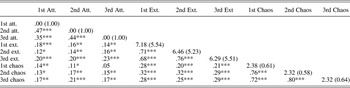
Descriptive statistics are shown in Table 1 on the diagonal. The average level of externalizing problems decreased over the three annual assessments from 7.18 to 6.29. Because attention scores were composite Z scores, they had means of 0 and standard deviations of 1 at each wave, and any potential mean-level changes could not be determined. We used a repeated-measure multivariate analysis of variance to test whether this decrease was significant and whether this pattern differed as a function of sex or zygosity. Neither the interaction between time and sex, F (2, 398) = 0.91, p < .40, nor the interaction between time and zygosity, F (2, 398) = 2.49, p < .10, was significant, suggesting that longitudinal mean-level changes in externalizing problems did not differ by gender or zygosity. Regardless of sex and zygosity, externalizing problems significantly decreased over time, F (2, 398) = 8.18, p < .001. The same analysis was conducted for household chaos, and the results suggested that the average level of household chaos did not significantly decrease over time, F (2, 200) = 2.35, p > .05.
Descriptive statistics and correlations among attention regulation (Att.), externalizing problems (Ext.), and chaos

Note: Numbers on the diagonal are means (standard deviations) of study variables; numbers off diagonal are correlations between study variables. N = 413–600.
*p < .05. **p < .01. ***p < .001.
Question 1: Phenotypic analyses
Question 1: At the phenotypic (i.e., directly observed) level, are externalizing problems and attention regulation correlated when covariance from shared method and informant effects is minimized? Furthermore, does the correlation differ as a function of household chaos?
Bivariate Pearson phenotypic (i.e., directly observed) correlations between study variables were estimated and are provided in Table 1. These correlations were tested for Twin 1 and Twin 2 together, with significance tests adjusted via the equation

to control for bias in standard errors arising from the nonindependence of the twin data within families (Griffin & Gonzalez, Reference Griffin and Gonzalez1995). Attention regulation, externalizing problems, and household chaos all showed moderate to substantial stability. Stability correlations for consecutive assessments were .35 to .47 for attention regulation, .68 to .76 for externalizing problems, and .72 to .80 for household chaos. Concurrent correlations between difficulties in attention and externalizing problems were modest to moderate and significant, ranging from .14 to .23. Difficulties in attention regulation and externalizing problems were both concurrently correlated with household chaos in all three waves (r = .14–.17, p < .05 for attention, and r = .28–.32, p < .001, for externalizing).
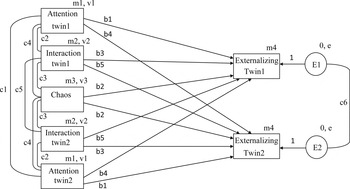
Next, we tested whether household chaos level moderated the phenotypic links between attention regulation and externalizing problems at each wave. We first computed the interaction terms between attention regulation and chaos for each wave by multiplying the standardized (for centering) attention and chaos scores. We then applied the actor–partner interdependence model (APIM; Kenny, Reference Kenny1996; see Figure 1) to test for the additive as well as the interactive effect of attention regulation and chaos on externalizing problems. The APIM is preferred over standard regression for two reasons. First, its structural equation modeling approach allows us to examine the additive and interactive effects of attention regulation and chaos on externalizing problems together for both twins while controlling for biased standard errors arising from twin nonindependence (Olsen & Kenny, Reference Olsen and Kenny2006). Second, the APIM can be estimated in Amos 18.0, which has the added advantage of permitting use of full information maximum likelihood for estimating effects with missing data, an approach that has been shown to be more appropriate than traditional methods (e.g., mean substitution) for handling missing data (Enders & Bandalos, Reference Enders and Bandalos2001).
The actor–partner interdependence model (APIM): additive and interactive effects of attention regulation and chaos on externalizing problems. APIM was used to test for additive and interactive effects of attention regulation and household chaos on externalizing problems phenotypically. C, correlation; B, regression coefficient; M, mean; V, variance; E, error variance.

As shown in Figure 1, the b1 and b2 paths represent the main effects of attention regulation and chaos on externalizing problems, respectively, and the b3 paths represent interactive effects between attention regulation and chaos on externalizing problems, above and beyond the main effects. To test for the significance of the main and interactive effects, constrained models in which main effects or interactive effects were fixed at 0 were compared against the full model using chi-square difference tests. A significant chi-square difference suggested that fixing a certain path at 0 in the constrained model resulted in a decrease in model fit, which in turn indicated that the fixed path made significant contributions in explaining the variance in externalizing problems and therefore should be freely estimated. To test for the main effects of attention regulation, the b1 and b3 paths were both fixed at 0. To test for the main effects of chaos, the b2 and b3 paths were fixed at 0. To test for the interactive effects between attention and chaos, the b3 paths were fixed at 0. Table 2 shows the model fit indices and the standardized path estimates from the full model. For all three waves, dropping the main effects of attention regulation and chaos both led to significant decreases in model fit (Δχ2 = 11.11–68.46, Δdf = 2, p = .004–.000), indicating the statistical significance of the main effects of attention regulation and chaos on externalizing problems. Poorer attention regulation and higher chaos independently predicted more externalizing problems at all three waves.
Actor–partner interdependence model standardized path estimates from the full models and model fit indices

Note: A significant path estimate suggested that fixing that path at 0 resulted in a significant decrease in model fit compared to the full model. b1, main effect of attention regulation on externalizing problems; b2, main effect of chaos on externalizing problems; b3, interactive effect between attention regulation and chaos on externalizing problems. N = 608.
†p = .052. *p < .05. **p < .01. ***p < .001.
Dropping the interactive effect between attention regulation and chaos led to a marginally significant decrease in model fit for Wave 1 (Δχ2 = 3.78, Δdf = 1, p = .052), a significant decrease in model fit for Wave 2 (Δχ2 = 8.44, Δdf = 1, p = .004), and no significant decrease in model fit for Wave 3 (Δχ2 = 1.56, Δdf = 1, p = .211). This suggested that for Wave 2 and possibly Wave 1, attention regulation and chaos also interactively predicted externalizing problems. For Wave 1,
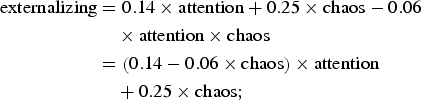
For Wave 2,
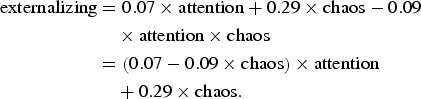
Therefore, for both waves, the higher the level of chaos was, the smaller the effect of attention regulation on externalizing problems was.
Question 2: Cross-sectional behavioral genetic analyses
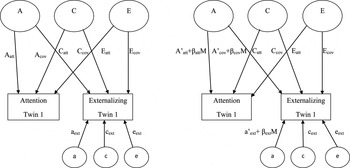
Question 2: At the behavioral genetic level, what is the genetic and environmental etiology underlying the phenotypic correlation? Is it attributable to additive genetic and environmental effects or an interactive Gene × Environment interplay involving household chaos? To examine the etiology of the link between externalizing problems and attention regulation within each of the three annual waves, we applied a bivariate Cholesky decomposition model. The left side of Figure 2 (shown for only one twin in the pair for simplicity) presents a traditional Cholesky decomposition model. In this basic model, the observed phenotypic variance and covariance were decomposed into latent “overlapping” or common additive genetic (A), common shared environmental (C), and common nonshared environmental (E) variance, as well as latent residual or “unique” genetic (a), residual shared environmental (c), and residual nonshared environmental (e) variance. On average, MZ twins share all of their alleles and DZ twins share 50% of their segregating alleles identical by descent. Therefore, the correlation for genetic similarity between twins was set as 1 and 0.5 for MZ and DZ twins, respectively. The correlations for shared environmental (i.e., environmental factors that lead to twin similarity) and nonshared environmental (i.e., environmental factors that do not lead to twin similarity) variance between twins were set as 1 and 0, respectively, for both MZ and DZ twins.
Bivariate ACE Cholesky decomposition: (right) with and (left) without chaos as a moderator. The bivariate ACE Cholesky decomposition model was used to partition the variance of and covariance between attention regulation and externalizing problems and to test for a potential moderation effect of household chaos on the genetic variance of and covariance between attention regulation and externalizing problems at each wave. The left side shows the basic bivariate Cholesky decomposition, where latent variables A, C, and E represent overlapping additive genetic, shared environmental, and nonshared environmental covariance between attention regulation and externalizing problems, respectively. Latent variables a, c, and e represent residual additive genetic, shared environmental, and nonshared environmental variance of externalizing problems, respectively. The right side shows the bivariate Cholesky decomposition with a continuous moderator (i.e., household chaos), where the additive genetic variance and covariance is a function of the moderator A total = A′ + βM. The above figure was only shown for one twin in the pair.

A modified Cholesky decomposition model is provided in the right side of Figure 2 (Dick & York, Reference Dick and York2010; Purcell, Reference Purcell2002), again shown only for one twin in the pair. Chaos was tested as a continuous moderator of the overlapping (A) and unique (a) genetic components. In this modified Cholesky model, the genetic variance was no longer a constant, but a linear function of the moderator (i.e., chaos), expressed as A total = A′ + βM. In this equation, A′ indicates the magnitude of additive genetic influences, the value of M was the measured chaos for each family and thus varied from family to family, and β represents the magnitude of the moderating effect to be estimated from the data. Paths A att, A cov, and a ext represent the total genetic variance for attention regulation, genetic covariance between attention regulation and externalizing problems, and residual genetic variance for externalizing problems, respectively. Accordingly, βatt, βcov, and βext represented the extent to which chaos changed the degree of total genetic influences on attention regulation, genetic covariance between attention regulation and externalizing problems, and unique genetic variance for externalizing problems, respectively.
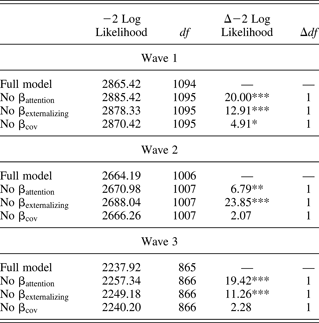
We tested the modified bivariate Cholesky model for each wave separately. All models were fit to raw continuous data using maximum likelihood model-fitting procedures in Mx (Neale, Reference Neale1997). The significance of the moderating effect was tested by dropping the corresponding moderation parameter and examining the change in –2 log likelihood (–2LL) between the full model and the constrained model. The difference in –2LL follows a chi-square distribution. Therefore, a significant difference in –2LL suggested that dropping the moderation parameter led to a significant decrease in model fit, which in turn suggested that the moderation effect on that particular path was statistically significant.
Externalizing problems and chaos scores were standardized (for centering purposes) for the following analyses. Table 3 shows model fit and comparison results. For all three waves, dropping the moderation effect on total genetic variance in attention regulation and unique genetic variance in externalizing problems led to significant decreases in model fit (Δ–2LL = 6.79–23.85, Δdf = 1, p = .009–.000), suggesting a significant moderating effect of chaos on the total genetic variance of attention regulation and unique genetic variance in externalizing problems. The moderation effect of chaos on the genetic covariance between attention regulation and externalizing problems was only significant at the first wave, as suggested by a significant decrease in model fit resulting from constraining this effect (Δ–2LL = 4.91, Δdf = 1, p = .027). This moderation effect on the genetic covariance between attention and externalizing was not significant in the second and third waves (Δ–2LL = 2.07–2.28, Δdf = 1, p = .130–.150).
Bivariate Cholesky decomposition: Fit indices and model comparisons between full models and constraint models
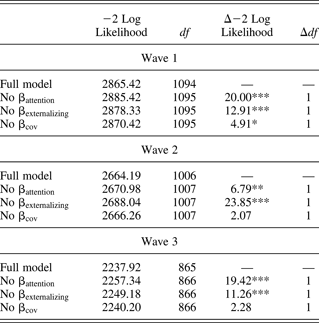
Note: A significant Δ − 2 log likelihood suggested that fixing a particular path at 0 in that model resulted in a significant decrease in model fit compared to the full model. βattention: the coefficient of the moderating effect of chaos on total genetic variance in attention regulation; βexternalizing, the coefficient of the moderating effect of chaos on unique genetic variance in externalizing problems; βcov, the coefficient of the moderating effect of chaos on genetic covariance between attention regulation and externalizing problems.
*p < .05. **p < .01. ***p < .001.
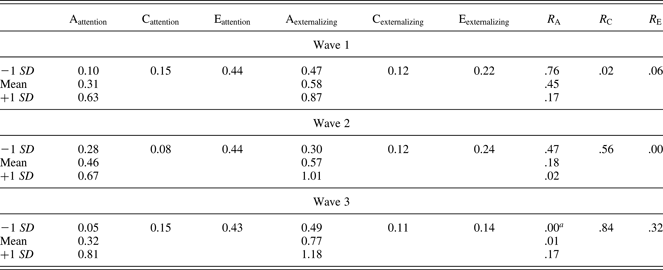
In order to compare models between the three annual waves, we presented the results from the full model for each wave. The unstandardized variance components, as well as genetic and nongenetic correlations at three levels of the moderator (i.e., 1 SD below the mean, the mean, and 1 SD above the mean of chaos scores), are reported in Table 4. In each wave, the genetic variance of both attention regulation and externalizing problems increased as the chaos level increased. The genetic correlation between attention control and externalizing problems became smaller, as chaos scores were higher, only in the first wave.
Bivariate Cholesky decomposition: Unstandardized variance estimates and genetic and nongenetic correlations between attention regulation and externalizing problems at three levels of chaos from the full model
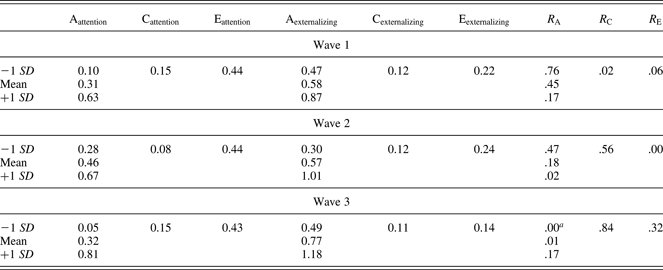
Note: A, genetic variance; C, shared environmental variance; E, nonshared environmental variance; R A, genetic correlation; R C, shared environmental correlation; R E, nonshared environmental correlation; −1 SD and +1 SD, moderator = 1 SD below and above the mean of chaos, respectively; mean, moderator is the mean of chaos. aWe fixed this particular genetic correlation at 0 because computational result suggests a negative value that makes no theoretical sense.
The genetic, shared environmental, and nonshared environmental variance components were all consistent across the three waves. However, the genetic correlation gradually decreased over time from .45 to .01 at average levels of chaos, whereas the shared environmental correlation and the nonshared environmental correlation gradually increased over time from .02 to .84 for shared environment correlation and from .06 to .32 for nonshared environment correlation. Overall, it seems that the mechanisms through which attention regulation and externalizing problems were linked gradually shifted from genetic correlation to nongenetic correlations, independent of any potential moderating effects of household chaos.
Question 3: Longitudinal behavioral genetic analyses
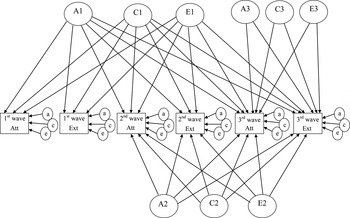
Although the cross-sectional analyses for Question 2 allowed us to examine genetic and nongenetic statistical effects in each of three waves, those analyses did not address longitudinal continuity and change in genetic and nongenetic variance of and covariance between attention and externalizing problems; that is, the analyses did not address whether the genetic and nongenetic factors found in each wave also accounted for stability and change in individual differences over the 3-year period. Therefore, a longitudinal multivariate behavioral genetic analysis was used to address the third and final question of our study. We were especially interested in learning whether there are (a) overlapping genetic, shared environmental, and nonshared environmental factors that would statistically account for the longitudinal phenotypic covariance between attention and externalizing over 3 years; (b) wave-specific genetic, shared environmental and nonshared environmental covariances between attention and externalizing; and (c) unique variances remaining for both constructs at each time point after controlling for all of the overlapping sources of covariance between the two constructs. However, the Cholesky decomposition model used above does not address those important subquestions. Therefore, we instead used a multivariate common-factor independent pathway model. As shown in Figure 3 (shown for one twin in the pair), the phenotypic variance of and covariance between attention regulation and externalizing problems were decomposed into latent genetic (A), shared environmental (C), and nonshared environmental (E) variance and covariance. Latent A1, C1, and E1 represented overlapping additive genetic, shared environmental, and nonshared environmental covariance, respectively, between attention regulation and externalizing problems across all three waves. A2, C2, and E2 represented any temporally emerging additive genetic, shared environmental, and nonshared environmental covariances, respectively, between attention regulation and externalizing problems that overlapped across the second and third waves, and that was independent of the first wave. A3, C3, and E3 represented the additive genetic, shared environmental, and nonshared environmental covariances, respectively, between attention regulation and externalizing problems appearing only in the third wave. Residual genetic, shared environmental, and nonshared environmental variances unique to each variable at each time point were represented by a, c, and e, respectively. The pathways among genetic, shared environmental, and nonshared environmental variance and covariance across twins were set in exactly the same manner as in the modified Cholesky decomposition models used in previous analyses.
The longitudinal common-factor independent-pathway model. The longitudinal common-factor independent-pathway model was used to partition the variance of and covariance between attention regulation and externalizing problems across three waves. Latent variables A1, C1, and E1 represent overlapping additive genetic, shared environmental, and nonshared environmental covariance, respectively, between attention regulation and externalizing problems across all three waves. A2, C2, and E2 represent additive genetic, shared environmental, and nonshared environmental covariance, respectively, between attention regulation and externalizing problems shared across the second and third waves. A3, C3, and E3 represent the additive genetic, shared environmental, and nonshared environmental covariance, respectively, between attention regulation and externalizing problems only at the third wave that is not overlapped with the first and second waves. Residual genetic, shared environmental, and nonshared environmental variance unique to each variable at each time point are represented by a, c, and e, respectively. The above figure was only shown for one twin in the pair. Ext, externalizing problems; Att, attention regulation.

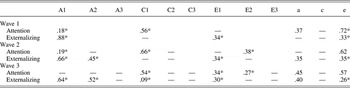
Nested models were systematically tested by fixing certain paths at 0, and the differences in –2LL were used to select the best-fitting models among all competing models to balance the loss in fit with the difference in degrees of freedom. Model trimming continued until no more paths could be fixed at 0 without worsening model fit. Compared to the full model (–2LL = 7324.34, df = 3053), the final trimmed model (–2LL = 7332.71, df = 3080) did not have a significant decrease in fit (Δ–2LL = 8.37, Δdf = 27, p > .05) and therefore was chosen to be interpreted (see Table 5).
Longitudinal common-factor independent-pathway model: Standardized path estimates from the best-fitting model

Note: A1, C1, and E1, common genetic, shared environmental, and nonshared environmental pathways, respectively, between attention regulation and externalizing problems across three waves; A2, C2, E2, are common genetic, shared environmental, and nonshared environmental pathways, respectively, between attention regulation and externalizing problems across Waves 2 and 3; A3, C3, E3, common genetic, shared environmental, and nonshared environmental pathways, respectively, between attention regulation and externalizing problems at Wave 3. a, c, e, residual genetic, shared environmental, and nonshared environmental pathways, respectively, unique to attention regulation and externalizing problems at each wave. (—) path fixed to 0.
*p < .05.
First, we examined this model by focusing on univariate continuity and change. The results suggested that there was a general genetic factor and a general nonshared environmental factor that explained the longitudinal continuity in externalizing problems across all three waves, represented by significant paths from A1 (.88, .66, and .64) and E1 (.34, .34, and .30). Yet, there was also a new set of genetic influences emerging at the second wave that accounted for the continuity in externalizing problems from just Wave 2 to Wave 3 (paths from A2 = .45 and .52). Changes in externalizing problems were mainly attributable to unique genetic variance at the second and third waves (paths from a = .35 and .40), as well as unique nonshared environmental variances at all three waves (paths from e = .33, .35, and .26). A shared environmental variance was only detected at the third wave (paths from C1 = .09). Turning to attention regulation, continuity across three waves was attributable to shared environmental influences, represented by significant path estimates from C1 (.56, .66, and .54). There also was a general genetic factor that explained continuity across the first two waves (paths from A1 = .18 and .19) and a general nonshared environmental factor that explained continuity across the second two waves (paths from E2 = .38 and .27). A unique genetic variance was found for the first and third waves (paths from a = .37 and .45), and unique nonshared environmental variance was found for all three waves (paths from e = .72, .62, and .57), accounting for changes in attention regulation.
Second, we focused on the bivariate longitudinal relations between attention regulation and externalizing problems. The bivariate phenotypic correlation between attention regulation and externalizing problems was accounted for by a general genetic factor across the first two waves, represented by significant path estimates from A1 (.18, .88, .19, and .66). The bivariate phenotypic correlation between attention regulation and externalizing problems at the third wave was attributable to shared and nonshared environmental covariance, represented by significant path estimates from C1 (.54 and .09) and E1 (.34 and .30).
Discussion
There is a growing literature documenting the strong connection between children's difficulties in self-regulation and their externalizing behavioral problems (Kochanska & Knaack, Reference Kochanska and Knaack2003; Pitzer, Esser, Schmidt, & Laucht, Reference Pitzer, Esser, Schmidt and Laucht2009; Prior, Smart, Sanson, & Oberklaid, Reference Prior, Smart, Sanson and Oberklaid2001). Attention regulation is an essential core component of self-regulatory capacity (Posner & Rothbart, Reference Posner and Rothbart2006); and it has been demonstrated to deter the development of behavioral problems through inhibiting impulsive responses, redirecting attention to less negative internal and external stimuli, and dampening other negative environmental influences or facilitating positive environmental influences (Belsky, Fearon, & Bell, Reference Belsky, Fearon and Bell2007; Eisenberg et al., Reference Eisenberg, Zhou, Spinrad, Valiente, Fabes and Liew2005; Kim & Deater-Deckard, Reference Kim and Deater-Deckard2011; Morris et al., Reference Morris, Silk, Steinberg, Terranova and Kithakye2010). The aim of the current study was to extend this literature by applying a multiple-informant multiple-method approach to investigate the underlying genetic and environmental etiologies of the link between attention regulation and externalizing behavior problems as well as any transition in the etiology over 3 years in middle childhood.
Externalizing problems and attention regulation
In addressing our first question, descriptive analyses indicated that both externalizing problems and attention regulation showed considerable stability over time. The correlation between the two constructs was modest and comparable across the three waves. Yet, the magnitude of the correlations (.14–.23) appeared somewhat lower than those found in other studies (e.g., Eisenberg et al., Reference Eisenberg, Zhou, Spinrad, Valiente, Fabes and Liew2005). We argued that this is likely due to the removal of any shared method effect (e.g., instrumental, situational, and informant overlap) between the two constructs in the current study: mothers and fathers provided reports on externalizing problems whereas teachers and observers provided reports on attention regulation. Other studies examining the correlation between effortful sustained attentive behavior and externalizing problems using a multiple-informant multiple-method approach have reported similar effect sizes (Eisenberg et al., Reference Eisenberg, Spinrad, Fabes, Reiser, Cumberland and Shepard2004; Kim & Deater-Deckard, Reference Kim and Deater-Deckard2011).
To address our second question, we investigated the genetic and environmental variance of and covariance between externalizing problems and attention regulation in each of the three waves. Cross-sectional results suggested that the genetic, shared environmental, and nonshared environmental variance components in both attention regulation and externalizing problems were all relatively consistent across the 3 years. However, household chaos moderated the genetic variance in both attention regulation and externalizing problems in all three waves, whereby genetic influences on both externalizing behavior problems and difficulties in attention regulation were more substantial in more chaotic environments.
As early as the 1980s, gene–environment interaction effects had been proposed and initially demonstrated in the etiology of various externalizing behavior problems (Cadoret, Cain, & Crowe, Reference Cadoret, Cain and Crowe1983). Cadoret et al. used an adoption design to show that a genetic “risk” for antisocial behavior statistically interacted with adversity in the adoptive home environment (e.g., parental psychiatric problems, marital discord) to promote higher levels of antisocial behavior in adolescence. This finding was consistent with another study showing a similar effect for antisocial behavior and criminality (Mednick, Gabrielli, & Hutchings, Reference Mednick, Gabrielli and Hutchings1984). More recent research suggests that the predictive effects on externalizing problems of several candidate genes including the dopamine receptor D4 (DRD4) and D5 genes and dopamine transporter 1 gene are enhanced when they are coupled with prenatal risks such as maternal nicotine and alcohol use (Brookes et al., Reference Brookes, Mill, Guindalini, Curran, Xu and Knight2006; Langley et al., Reference Langley, Turic, Rice, Holmans, van den Bree and Craddock2008; Thapar et al., Reference Thapar, Langley, Fowler, Rice, Turic and Whittinger2005). Other research points to growth in genetic variance in attentive behavior over middle childhood, fueled in part by the interaction between DRD4 and maternal sensitivity (Berry, Deater-Deckard, McCartney, Wang, & Petrill, in press; Deater-Deckard & Wang, Reference Deater-Deckard, Wang and Posner2012). The findings from the current study implicate household chaos as another important candidate environmental factor to be considered as a moderator of genetic influences on antisocial behavior and attention regulation.
Turning to the bivariate link between attention regulation and externalizing problems, in the phenotypic analyses (Question 1), we found that both attention regulation and externalizing problems were correlated with chaos, whereby higher levels of chaos were associated with more difficulties in attention regulation and more externalizing problems. This finding is consistent with previous literature (Coldwell et al., Reference Coldwell, Pike and Dunn2006; Deater-Deckard et al., Reference Deater-Deckard, Mullineaux, Beekman, Petrill, Schatschneider and Thompson2009; Pike et al., Reference Pike, Iervolino, Eley, Price and Plomin2006). In addition, chaos also statistically moderated the association between attention regulation and externalizing problems in the second wave and was a marginally significant moderator in the first wave. Poor sustained attentive behavior was a stronger statistical predictor of externalizing problems in less chaotic families. In regard to the behavioral genetic analyses, levels of household chaos also moderated the genetic correlation between externalizing problems and attention regulation in the first wave, whereby the genetic correlation was lower at higher levels of chaos.
When taken together with the phenotypic results, the behavioral genetic findings suggest that higher levels of household chaos overwhelm the regulatory processes involving attention, reflected at the observed phenotypic level of analysis and at the underlying latent behavioral genetic level of analysis. Executive regulation of attention is likely to depend at least in part on the broader family context. Chronic exposure to uncertainty and unpredictability in chaotic households heavily taxes executive regulation capacity (Evans, Hygge, & Bullinger, Reference Evans, Hygge and Bullinger1995) and hence may compromise its development, potentially via the neuroendocrine system (Erickson, Drevets, & Schulkin, Reference Erickson, Drevets and Schulkin2003). In addition, constant distraction in a chaotic household interferes with effortful regulation processes of behavior (Blair et al., Reference Blair, Smith, Mitchell, Morton, Vythilingam and Pessoa2007). These regulatory processes may operate in a relatively automatic and more efficient fashion when no such distracters or stressors are present (Macrae & Bodenhausen, Reference Macrae and Bodenhausen2000). Therefore, the stress and inconsistency of daily life in chaotic households may disrupt the development of self-regulatory capacity and skills that are important to minimizing growth in behavior problems. This idea is consistent with broader theoretical and empirical work implicating chaos as a source of impairment in healthy, normative developmental processes (Evans & Wachs, Reference Evans and Wachs2009).
There are candidate genes and neurological pathways that are thought to account for the association between deficits in attention regulation and conduct problems (Holmes et al., Reference Holmes, Payton, Barrett, Harrington, McGuffin and Owen2002; Raine, Reference Raine2002). However, to our knowledge no theories or empirical research has addressed whether and how environmental adversities, including household chaos, constrain these genetic and neurophysiological links between attention and externalizing behavior problems. The current study suggests that answering these crucial questions is an important next step for future studies.
It is worth emphasizing that the moderating effect of chaos on the genetic correlation between attention and externalizing was only significant in the first wave. This could be partially attributable to the dissipation of the genetic correlation over the three waves (from .45 in Wave 1 to essentially 0 by Wave 3), at the same time that we saw a similar magnitude increase in shared environment correlation across the three waves. We address this interesting developmental pattern in more detail below when interpreting the longitudinal data analyses.
Longitudinal influences on stability and change
To address our third and final question, we tested a longitudinal multivariate common-factor independent pathway model to answer the question by addressing externalizing, then attention, and then the covariation between them.
The stability of individual differences in externalizing problems was mainly accounted for by the same genetic influences over the 3-year period. This is consistent with previous studies of younger and older children (Eley, Lichtenstein, & Moffitt, Reference Eley, Lichtenstein and Moffitt2003; van Beijsterveldt, Bartels, Hudziak, & Boomsma, Reference van Beijsterveldt, Bartels, Hudziak and Boomsma2003). Not all of the variance in externalizing problems was explained by this single underlying “stability” genetic factor; however, the unique residual genetic factors at Waves 2 and 3 were modest in effect size by comparison. The clear implication for longitudinal analysis of candidate genes is that any effects that are found to differentiate individuals at one point in childhood are very likely to continue doing so over childhood and into adolescence.
Although weaker by comparison to genetic influences over time, nonshared environmental influences also contributed to some of the longitudinal stability of individual differences in externalizing problems. This was surprising, given that nonshared environmental variance typically has not been shown to contribute to stability in behavior problems in prior studies (Eley et al., Reference Eley, Lichtenstein and Moffitt2003; van Beijsterveldt et al., Reference van Beijsterveldt, Bartels, Hudziak and Boomsma2003). The idea remains feasible in theory nonetheless: nonshared environmental influences could be stable in their effects over time. Candidate nonshared environment influences have been identified, including sibling differential parental treatment and classroom environments (Asbury et al., Reference Asbury, Dunn, Pike and Plomin2003; Mullineaux, Deater-Deckard, Petrill, & Thompson, Reference Mullineaux, Deater-Deckard, Petrill and Thompson2009; Oliver et al., Reference Oliver, Pike and Plomin2008). However, the field has not yet demonstrated that these nonshared influences persist either at the phenotypic or behavioral genetic level of analysis, which is an important gap in knowledge that should be addressed in future research.
Consistent with the data on externalizing problems, for attentive behavior there was a set of common genetic factors that explained the stability of individual differences over the first two annual waves (a finding originally reported in Deater-Deckard et al., Reference Deater-Deckard, Petrill, Thompson and DeThorne2006, when only two waves of data were available). This result is consistent with a previous twin study (Rietveld, Hudziak, Bartels, van Beijsterveldt, & Boomsma, Reference Rietveld, Hudziak, Bartels, van Beijsterveldt and Boomsma2004). In addition, two other longitudinal studies have implicated the DRD4 candidate gene in explaining some of the temporally stable genetic influence on attention over middle childhood for attention deficit symptoms in boys (El-Faddage, Laucht, Maras, Vohringer, & Schmidt, Reference El-Faddagh, Laucht, Maras, Vohringer and Schmidt2004) as well as the typical variation in sustained attentive behavior in boys and girls (Deater-Deckard & Wang, Reference Deater-Deckard, Wang and Posner2012).
However, there was also a major distinction in the results for attention compared to externalizing problems, in that a substantial portion of the longitudinal stability of attentive behavior was accounted for by stable shared environment influence. This suggests that the nongenetic factors that contribute to sibling similarity in attentive behavior, above and beyond any similarity arising from genetic factors, are stable in their influences over this 3-year period spanning middle childhood. Given that the informants (teachers and observers) were different at each of the three waves, and all twin pairs were rated independently by two different observers at each wave, it is unlikely that this shared environment effect on the stability of attentive behavior could be attributed to a method effect. Therefore, the overlapping shared environment factor that captured the developmental stability of individual differences in attention regulation was more likely to be genuine than reflecting artifacts of measurement. That aside, the results contradict the previous longitudinal study of attention that found that only genetic influences contributed to longitudinal stability (Rietveld et al., Reference Rietveld, Hudziak, Bartels, van Beijsterveldt and Boomsma2004). The differing results between the two studies could be partly attributable to differences in methods and informants; Rietveld et al. used parents’ ratings, and we examined observers’ and teachers’ ratings.
The longitudinal analyses on the link between externalizing and attention produced results that were very similar to those gleaned from the cross-sectional analyses reported for Question 2. The phenotypic correlation between attention regulation and externalizing problems was accounted for by a single underlying genetic correlation in the first and second waves, but through shared and nonshared environmental correlations at the third wave. The emerging evidence from the current cross-sectional and longitudinal analyses points to an important transition in middle childhood that may stem from increased involvement in antisocial activities involving peers and siblings that are close in age (Farrington, Reference Farrington1995; Quinton, Pickles, Maughan, & Rutter, Reference Quinton, Pickles, Maughan and Rutter1993; Rowe, Rodgers, & Meseck-Bushey, Reference Rowe, Rodgers and Meseck-Bushey1992). As children get older, these social experiences serve to reinforce growth in many aspects of aggressive and nonaggressive conduct problems in childhood and adolescence and can reflect socialization and selection mechanisms that emerge as sources of shared environmental variance and longitudinal stability in behavioral genetic models (Gilson, Hunt, & Rowe, Reference Gilson, Hunt and Rowe2001). The current study's results contribute to this literature by demonstrating that the impact of these shared environmental processes may become more important over middle childhood and may operate on self-regulatory process involving attention.
Caveats, future directions, and conclusion
In the current study, we extended the literature on the process linking externalizing problems and difficulties in attention regulation by examining their longitudinal genetic and nongenetic effects, as well as the potential moderating influence of household chaos. However, there are some limitations and new directions that need to be addressed in future research. First, we are confident that the sustained attentive behavior scores in the current study capture the underlying attention regulation mechanisms well, based on the literature on temperament and ADHD (Deater-Deckard & Wang, Reference Deater-Deckard, Wang and Posner2012; Rothbart, Reference Rothbart2007; Willcutt et al., Reference Willcutt, Doyle, Nigg, Faraone and Pennington2005), but we did not directly assess the specific components of attention (e.g., orienting, alerting, controlling) that function in cognitive self-regulation of behavior. We acknowledge that some debate remains about the underlying structure and function of these various subcomponents of attention and their behavioral manifestations (e.g., Watson, Kotov, & Gamez, Reference Watson, Kotov, Gamez, Krueger and Tackett2006). Second, our reliance on parent reports of household chaos was not ideal. Although the brief Chaos, Hubbub, and Order Scale questionnaire is a reliable and valid instrument (Coldwell et al., Reference Coldwell, Pike and Dunn2006; Deater-Deckard et al., Reference Deater-Deckard, Mullineaux, Beekman, Petrill, Schatschneider and Thompson2009), it does not cover the full range of indicators of household chaos. In the future, structured interviews and observations should be used to complement parent reports to assess household chaos more thoroughly and comprehensively. In addition, the same parent provided reports on externalizing problems and chaos across three waves, which may yield potential rater bias and artificially inflate the stability of each construct as well as the correlations between them. This design limitation probably has a minimal impact on the estimation of statistical moderation and bivariate longitudinal effects, given that shared method variance was minimized in the links with attention that was measured using different informants. Third, a community twin sample was used in the current study. Essentially all of the children were below any clinical threshold for conduct problems. This potentially limits the generalizability of the current results to the clinical range of problem behaviors or to families of nontwin children. Fourth, because the statistical effect explaining the link between externalizing problems and attention regulation shifted from genetic correlation to shared and nonshared environmental correlation over middle childhood, future studies should also examine whether Environment × Environment interaction exists. It would also be ideal to integrate moderation into the longitudinal analyses. We were not able to do that, because the current study's sample size was underpowered for such an analysis. A related future direction would be to integrate candidate genes into these behavioral genetic models to examine similar questions. Fifth and finally, because the current study is the first one to examine the longitudinal transition of genetic and nongenetic association between externalizing problems and attention regulation, more studies are needed to test for replication of our results.
In conclusion, the developmental context for children's self-regulation and their behavioral problems is complex. This complex nature automatically calls for a collaborative effort from multiple domains, integrating multiple methods including behavior and molecular genetics, neurobiological, and psychosocial approaches to fully understand the mechanisms through which one can optimize his development. Any study trying to explain the underlying etiology via a snapshot or a simple additive genetic and environmental story would not be conclusive. Despite the limitations, the current study addressed several shortcomings in previous studies and investigated this intricate link by examining the Gene × Environment interplay mechanism from a developmental perspective. The results suggested that these endeavors are necessary and still needed.