Introduction
Peanut (Arachis hypogaea) has high nutritional value and is an important oil and economic crop. China has a large peanut planting area and is one of the world's major peanut producing countries (Liang et al., Reference Liang, Guo, Feng, Zhang, Yang, Meng, Li and Wan2020). Peanut shell is an abundant agricultural byproduct in peanut production, accounting for about 30% of the total pod weight (Perea-Moreno et al., Reference Perea-Moreno, Manzano-Agugliaro, Hernandez-Escobedo and Perea-Moreno2018), and has important roles in the defence against diseases and insect pests during underground growth and later storage (Wee et al., Reference Wee, Moon, Eun, Chung, Kim and Park2007). Peanut shell is rich in biopolymers such as cellulose, lignin and protein, as well as minerals and bioactive substances (Rico et al., Reference Rico, Gullon, Alonso, Parajo and Yanez2018; Adhikari et al., Reference Adhikari, Kumar Dhungana, Waqas Ali, Adhikari, Kim and Shin2019). Until now, studies on peanut shells have focused mainly on industrial applications, but studies on the genetic basis of shell-related traits are rare.
Plant organ growth and development involves a series of complex biological processes. Coordination of cell proliferation, differentiation and expansion is essential for the establishment of plant organs. The pattern of these biological processes has an important influence on the morphological characteristics of the mature organs (Harashima and Schnittger, Reference Harashima and Schnittger2010; Bundy et al., Reference Bundy, Thompson, Sieger, Shpak and Malcolm2012). Although environmental factors affect organ development, genetic control plays a key role in limiting the characteristics of mature organs (Hepworth and Lenhard, Reference Hepworth and Lenhard2014). Various metabolic pathways involving genes that are regulated by transcription factors are necessary for cell growth and organ formation (Ma et al., Reference Ma, Ding and Li2017). Cell walls are central in limiting plant cell growth, and enzymes involved in cell wall synthesis, such as cellulose synthase, play important roles in cell wall formation and remodelling (Arioli et al., Reference Arioli, Peng, Betzner, Burn, Wittke, Herth, Camilleri, Hofte, Plazinski, Birch, Cork, Glover, Redmond and Williamson1998; Wang et al., Reference Wang, Smith and Li2018). Plant growth and development also are regulated by phytohormones (Pacifici et al., Reference Pacifici, Polverari and Sabatini2015).
Mechanical or supporting tissue, which plays a major role in supporting and protecting plants, can be divided into the living collenchyma and the sclerenchyma, which can be found in the endocarp of mature peanut pods (Bercu et al., Reference Bercu, Bavaru and Broască2011; Patil et al., Reference Patil, Chavan and Pokle2012). Sclerenchyma has a uniformly thickened secondary cell wall that originates from primary tissue, and the lignified secondary walls provide mechanical strength (Esau, Reference Esau1960; Vallet et al., Reference Vallet, Chabbert, Czaninski and Monties1996). The secondary cell wall is located between the plasma membrane and primary cell wall, and its principal components are cellulose, hemicellulose and lignin (Zhong and Ye, Reference Zhong, Ye and Alistair2009). Cellulose and hemicellulose cross-link to form the main network in secondary cell walls, and lignin is impregnated to enhance mechanical strength and provide hydrophobicity (Reiter, Reference Reiter2002). Cellulose, an important structural component in both primary and secondary cell walls, is synthesized by the polymerization of β-1,4-glucan catalysed by a series of enzymes. Cellulose is the most widely distributed and abundant polysaccharide in nature, and has a very high application value as an important renewable energy material (Liu et al., Reference Liu, Wang, Chen, Song, Minxiao, Jin, Wang and Yang2012). Lignin is a complex phenolic polymer with abundant distribution in plant secondary cell walls. Lignin is assembled mainly by the polymerization of alcohol monomers, including p-coumaryl alcohol, coniferyl alcohol and sinapyl alcohol, that are synthesized in the cytosol by the phenylpropanoid pathway; however, the process by which alcohol monomers are transported from the cytosol to the cell wall remains unknown (Alejandro et al., Reference Alejandro, Lee, Tohge, Sudre, Osorio, Park, Bovet, Lee, Geldner, Fernie and Martinoia2012; Yi Chou et al., Reference Yi Chou, Schuetz, Hoffmann, Watanabe, Sibout and Samuels2018). Previous studies have confirmed that lignin biosynthesis changes when plants are resistant to biotic or abiotic stresses. A significant increase in lignin accumulation was observed in cultured Cupressus lusitanica cells on the fifth day of fungal and mechanical stresses (Alwis et al., Reference Alwis, Fujita, Ashitani and Ki2014). In maize, analysis of the drought tolerance of different inbred lines showed that leaf lignin content could be used as an evaluation index of drought tolerance (Hu et al., Reference Hu, Li, Xu, Li, Liao and Fu2009). Cellulose and lignin biosynthesis require high synergism among different parts of the cells and various enzymes. Gene expression regulates lignin and cellulose synthesis in sclerenchyma and thus affects the physicochemical properties of plant organs (Wu et al., Reference Wu, Zhang, Ding, Zhang, Cambula, Weng, Liu, Ding, Tang, Chen, Wang and Li2017). Lignin was shown to have a significant effect on the mechanical strength of inflorescence stems in herbaceous peony (Zhao et al., Reference Zhao, Han, Tao, Wang, Hao, Geng and Du2012).
The peanut shell is part of the pod and is an effective protection barrier of the seed. Shell traits can influence the genetic expression of seed characteristics, such as seed size and duration of filling period (de Godoy and Norden, Reference de Godoy and Norden1981). Peanut shell has developed sclerenchymatous supporting tissue that forms the skeleton structure of the shell. One ring of a sclerenchymatous layer with vertical Y-shaped projections is present in cross-sections of peanut shells, and vascular bundles are usually found in the grooves formed by the distal bifurcation of the Y-shaped projections. The Y-shaped projections are also important for the formation of the reticulate exterior surface of peanut shell (Halliburton et al., Reference Halliburton, Glasser and Byrne1975). Mechanical strength and thickness are important physical characters of peanut shell that are closely related to the handling and processing of peanut, and to resistance against diseases and pests. A positive correlation has been found between peanut shell thickness and pod size (Patil, Reference Patil1972; de Godoy and Norden, Reference de Godoy and Norden1981). Many studies have focused on the regulation mechanisms of agronomic traits such as yield and seed quality of peanut, but there is still a lack of information about the regulation of the physical and microstructural characteristics of peanut shell at the molecular level.
The rapid development of next-generation sequencing technologies has promoted the application of genome-wide association studies (GWAS) to map a large number of phenotypic traits across all species including various crop plants. In rice, an association panel with 423 accessions was used in a GWAS of peduncle vascular bundle-related traits and six candidate genes, including one cloned gene (NAL1), were identified (Zhai et al., Reference Zhai, Zheng, Wang, Wang, Chen, Wang, Wang, Xu and Li2018). The genetic basis of 14 agronomic traits in rice was also uncovered by GWAS, and some of the identified peak signals were close to previously identified genes (Huang et al., Reference Huang, Wei, Sang, Zhao, Feng, Zhao, Li, Zhu, Lu, Zhang, Li, Fan, Guo, Wang, Wang, Deng, Li, Lu, Weng, Liu, Huang, Zhou, Jing, Li, Lin, Buckler, Qian, Zhang, Li and Han2010). In maize, the genetic architecture of husk-related traits and resistance to head smut have been preliminarily dissected by GWAS (Wang et al., Reference Wang, Yan, Zhao, Song, Zhang, Xiao and Zheng2012; Cui et al., Reference Cui, Luo, Qi, Ruan, Li, Zhang, Yang and He2016). In spring wheat, marker-trait associations significantly associated with the plant growth stage and yield components were identified by GWAS (Turuspekov et al., Reference Turuspekov, Baibulatova, Yermekbayev, Tokhetova, Chudinov, Sereda, Ganal, Griffiths and Abugalieva2017). Also, the genetic architecture of agronomic traits and disease resistances has been dissected in peanut by GWAS. A panel with 192 peanut accessions was used to determine the genetic basis of seven peanut yield-related traits by GWAS, and a gene (arahy.RI9HIF) influencing yield was identified. This is supported by a homolog of arahy.RI9HIF identified in rice, which encodes a protein that is involved in rice yield (Wang et al., Reference Wang, Yan, Li, Li, Zhao, Yuan, Sun and Shan2019). In another study, genetic factors for 11 agronomic traits of peanut have been dissected by GWAS and candidate genes were predicted (Zhang et al., Reference Zhang, Zhang, He, Wang, Ma and Yin2017). Quantitative trait loci (QTLs) and candidate genes associated with leaf spot resistance in peanut have been identified by GWAS analysis (Zhang et al., Reference Zhang, Chu, Dang, Tang, Jiang, Clevenger, Ozias-Akins, Holbrook, Wang and Campbell2020a).
In the present study, a panel of 320 peanut accessions with extensive genetic diversity was used in the GWAS analysis of two physical (mechanical strength and thickness) and five microstructural characteristics of peanut shell (Y-DBN, Y-PNBN, NYPN, SLCS and VBN), whereas Y-DBN is the number of Y-shaped distal bifurcations, Y-PNBN is the number of Y-shaped proximal ends with no bifurcations, NYPN is the number of non-Y-shaped projections, SLCS is the main cell shape of the sclerenchymatous layer excluding projections, and VBN is the number of vascular bundles. The panel was selected from more than 2000 worldwide germplasm resources stored in the Peanut Research Department of the Henan Academy of Crops Molecular Breeding (Zhengzhou, China). We used tunable genotyping-by-sequencing and selected from primarily 37,128 single nucleotide polymorphisms (SNPs) 10,004 high-quality SNPs (Zheng et al., Reference Zheng, Sun, Fang, Qi, Liu, Miao, Du, Shi, Gao, Han, Dong, Tang, Cheng, Hu, Huang and Zhang2018) with minor allele frequency (MAF) of ⩾0.05. Here, we report the association mapping results related to the peanut shell traits and discuss the relevance of the resulting candidate genes.
Materials and methods
Plant material
A panel of 320 peanut accessions was used in this study, including 100 landraces and 133 breeding lines from China, and 87 accessions from the US mini-core collection (Belamkar et al., Reference Belamkar, Selvaraj, Ayers, Payton, Puppala and Burow2011). The panel comprised four botanical varieties, including 150 var. hypogaea, 104 var. vulgaris, 32 var. fastigiata, 20 var. hirsuta and 14 irregular type accessions (Supplementary Table S1). Detailed information about the 320 peanut accessions is provided in a previous study (Zheng et al., Reference Zheng, Sun, Fang, Qi, Liu, Miao, Du, Shi, Gao, Han, Dong, Tang, Cheng, Hu, Huang and Zhang2018).
Phenotyping
All the accessions were planted at two different locations (Shangqiu and Zhengzhou) in Henan Province, China in May 2018. Each accession was sown with 20 seeds in a 3 m-long and 0.4 m-wide single row plot with two replications using a randomized block design. The fields were managed according to local practices.
Observation and statistical analysis of the microstructure-related traits were conducted only in Shangqiu. Pods with consistent size were selected from each accession about 30 days after flowering. The part of the pod posterior chamber with the largest diameter was preserved in 70% formalin-acetic-alcohol fixative solution. After staining with Safranine O/Fast Green, the microstructure-related traits of peanut shell were captured using a Leika DM2500 microscope. Because the Y-shaped projections of the sclerenchymatous layer are sometimes not completely realized and the function of the distal and proximal ends of the Y-shaped projections in formatting the reticulate exterior surface of peanut shell may follow different purposes, we evaluated the distal and proximal ends separately; the microstructure-related traits included a number of Y-shaped distal bifurcations (Y-DBN), number of Y-shaped proximal ends with no bifurcations (Y-PNBN), number of non-Y-shaped projections (NYPN), main cell shape of the sclerenchymatous layer (SLCS) excluding projections (not elongated (indicated by 1), half elongated (indicated by 1.5) or elongated (indicated by 2)) and the number of vascular bundles (VBN) (Fig. 1).
Cross-section of representative peanut shell showing shell microstructure-related traits. Y, Y-shaped projection; Y-DB, Y-shaped distal bifurcation; Y-PNB, Y-shaped proximal end with no bifurcation; VB, vascular bundle; NYP, non-Y-shaped projection; SL, sclerenchymatous layer.

Ten mature and dried pods of similar size were collected from each accession for each replication in the two environments to measure the two physical characteristics of the peanut shell. Mechanical strength was measured by mechanical compression of the pod posterior chamber with an EZ-test texture analyser, Shimadzu (Tokyo, Japan). The loading speed of the mobile probe was set at 1 mm/s, and the compression distance was set at 2–4 mm according to the pod size and plumpness. The maximum force during this process was recorded and used for subsequent analysis (Ionescu et al., Reference Ionescu, Voicu, Biris, Stefan, Ungureanu and Dincă2016). Shell thickness was measured of the pod posterior chamber using a digital caliper (Terma CDA100). The average value of the traits of each accession was used for the GWAS analysis. The phenotypic data were analysed using GraphPad Prism 7 and SPSS Statistics 25 (Lazareno, Reference Lazareno1994; Field, Reference Field2013).
Genotyping
Detailed information about DNA extraction, library preparation and resequencing are described in a previous study (Zheng et al., Reference Zheng, Sun, Fang, Qi, Liu, Miao, Du, Shi, Gao, Han, Dong, Tang, Cheng, Hu, Huang and Zhang2018). Because the genome of the tetraploid cultivated peanut has not been published at that time, the genomes of two diploid peanut progenitors, A. duranensis and A. ipaensis (Aradu_v1.0.fa and Araip_v1.0.fa), were artificially combined to form a reference genome for sequence alignments with the GSNAP aligner. We used tunable genotyping-by-sequencing (Ott et al., Reference Ott, Liu, Schnable, Yeh, Wang and Schnable2017) and identified 37,128 SNPs of which 10,004 high-quality SNPs with missing rate ⩽30% and MAF of ⩾0.05 were selected for GWAS.
Genome-wide association analysis and identification of candidate genes
GWAS was performed on all seven trait values of the 320 peanut accessions using the mixed linear model K + Q approach in TASSEL 5.2.13 (Bradbury et al., Reference Bradbury, Zhang, Kroon, Casstevens, Ramdoss and Buckler2007). In the K + Q approach, the genetic marker-based kinship matrix (K) is combined with population structure (Q) to avoid false-positive associations. In the present study, the Bonferroni test criterion with a significance level of 0.05 was used as the significance threshold, and a P value of 5.0 × 10⁻⁶ was obtained by calculating 0.05/n (n = 10,004). Manhattan and Q-Q plots were drawn using the R package (Turner, Reference Turner2018). We used the 400 kb genomic regions on each side of SNPs that were significantly associated with the peanut shell traits as the candidate genome regions. All significant SNPs were located on the B genome, and candidate genes were identified by mapping the selected genomic regions to the genome sequence of the diploid progenitor peanut, Arachis ipaensis (https://peanutbase.org/data/public/Arachis_ipaensis/).
Results
Phenotypic variation and correlation
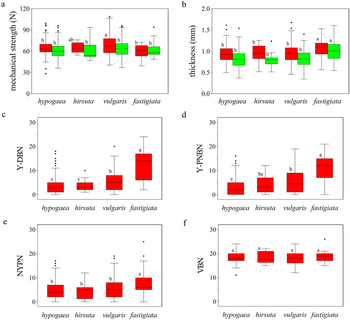
Extensive variation for all traits was observed among the 320 peanut accessions (Supplementary Table S1 and Table S2). The mechanical strength and thickness in the two environments showed continuous variation, but only the mechanical strength in Zhengzhou and thickness in both environments showed normal distribution. Mechanical strength in Shangqiu, the sclerenchymatous layer projection-related traits (Y-DBN, Y-PNBN, NYPN), and VBN were skewed to the right (Fig. 2). The SLCS of most of the accessions were not elongated (Supplementary Fig. S1(a)). Phenotype pairwise correlations between the traits revealed large differences. The mechanical strength and thickness were positively correlated in Shangqiu and Zhengzhou (r = 0.64 and 0.62). Y-DBN and Y-PNBN also were positively correlated (r = 0.64). The other traits showed weak or no correlation (Supplementary Fig. S2).
Frequency distribution of peanut shell-related traits. Y-PNBN, number of Y-shaped proximal ends with no bifurcations; NYPN, number of non-Y-shaped projections; Y-DBN, number of Y-shaped distal bifurcations; VBN, number of vascular bundles. Shangqiu and Zhengzhou are the two trial locations.

The association panel comprised four botanical varieties (var. hypogaea, var. hirsuta, var. vulgaris and var. fastigiata) and some irregular type accessions (Zheng et al., Reference Zheng, Sun, Fang, Qi, Liu, Miao, Du, Shi, Gao, Han, Dong, Tang, Cheng, Hu, Huang and Zhang2018). To investigate the effect of population structure on the seven shell-related traits, phenotypic variation of the four botanical varieties was analysed. Significant differences in mechanical strength in Shangqiu were observed among the four varieties, and var. vulgaris had higher mean values than the other three varieties. However, no significant difference in mechanical strength in Zhengzhou was observed among the four varieties. Var. fastigiata showed significantly higher mean values for thickness than the other three varieties in both environments. The three sclerenchymatous layer projection-related traits (Y-DBN, Y-PNBN, NYPN) also showed highly significant differences among the four varieties (Supplementary Fig. S3). Y-DBN and NYPN showed significant higher values in var. fastigiata, followed by var. vulgaris, var. hypogaea and var. hirsuta with the lowest values. Similarly, Y-PNBN showed significant higher values in var. fastigiata than the other three varieties. The SLCS were significantly stronger elongated in the var. fastigiata and var. vulgaris than var. hypogaea (Supplementary Fig. S1(b)–(e)). No significant differences were observed for VBN among the four botanical varieties (Fig. 3).
Boxplot of shell-related traits in four botanical varieties of peanut. Analysis of variance (ANOVA) was applied to examine the differences of traits among the botanical varieties. Different letters (a, b and c) indicate significant difference at P ⩽ 0.05 (Tukey-HSD). Red and green colours indicate Shangqiu and Zhengzhou, respectively. a: mechanical strength; b: thickness; c: Y-DBN, number of Y-shaped distal bifurcations; d: Y-PNBN, number of Y-shaped proximal ends with no bifurcations; e: NYPN, number of non-Y-shaped projections; f: VBN, number of vascular bundles.

Genome-wide association study and SNP detection
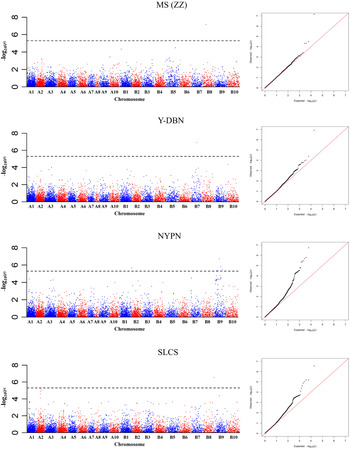
A total of 10 significant SNPs were detected, of which one was associated with mechanical strength in Zhengzhou, one with Y-DBN, seven with NYPN and one with SLCS. No SNP significantly associated with thickness, Y-PNBN or VBN was observed. All 10 SNPs were located on the A. ipaensis B genome (Fig. 4; Supplementary Fig. S4). The SNP associated with mechanical strength in Zhengzhou was located on B08 and explained 12.5% of the phenotypic variation. The SNP for Y-DBN was located on B07 and explained 11.6% of the phenotypic variation. Among the seven SNPs detected for NYPN, six were located on B09 and explained 8.6–15.8% of the phenotypic variation, and one was located on B02 and explained 10.1% of the phenotypic variation. The one SNP for SLCS was detected on B08 and explained 14.2% of the phenotypic variation (Table 1).
Manhattan and Q-Q plots of peanut shell-related traits. Mechanical strength at Zhengzhou (MS (ZZ)), number of Y-shaped distal bifurcations (Y-DBN), number of non-Y-shaped projections (NYPN) and main cell shape of sclerenchymatous layer (SLCS). The dotted black line indicates the genome-wide significance threshold: −log10 (P value) = 5.3.

SNPs significantly associated with four traits identified by GWAS

a MS, mechanical strength; Y-DBN, number of Y-shaped distal bifurcation; NYPN, number of non-Y-shaped projection; SLCS, main cell shape of sclerenchymatous layer; ZZ, Zhengzhou; SQ, Shangqiu.
b Major/minor allele.
c Phenotypic variance explained.
Candidate gene analysis
We defined a 400 kb genomic region of the A. ipaensis genome on each side of the significant SNPs and identified a total of 192 annotated genes; six were associated with mechanical strength, 14 with Y-DBN, 116 with NYPN and 56 were associated with SLCS (Supplementary Table S3). We further investigated the annotations to identify candidate genes with known functional relation to the underlying trait of the association and close proximity to the peak SNP.
For mechanical strength at Zhengzhou, the peak SNP B08-37288956 was about 124 kb away from Araip.PJ60P, which encodes a subtilisin-like serine protease 2. Subtilisin-like serine proteases were found to be present in components of the vascular bundle by in situ hybridization (Golldack et al., Reference Golldack, Vera and Dietz2010). For Y-DBN, the peak SNP B07-65047551 was located 345 kb away from Araip.FG7C9, which encodes an amino acid permease that is involved in the xylogenesis in poplar (Couturier et al., Reference Couturier, Ed, Fitz, Wipf, Blaudez and Chalot2010), and 183 kb away from Araip.G84LS, which encodes a sugar transporter that plays an important role in plant defence (Yamada et al., Reference Yamada, Saijo, Nakagami and Takano2016). For NYPN, 18 genes including Araip.F83CP which encodes a pyruvate kinase family protein were identified in the candidate region centred on the peak SNP B09-105682199. Pyruvate kinases play key roles in the glycolytic pathway and in fatty acid biosynthesis (Ambasht and Kayastha, Reference Ambasht and Kayastha2002). Araip.J3D1X, which was located 137 kb away from SNP B09-72638166, encodes 6-phosphofructo-2-kinase/fructose-2, which is related to sucrose synthesis in leaves and to glycolysis (Furumoto et al., Reference Furumoto, Ito, Teramoto, Izui, Nishida and Watanabe2001). A total of 62 candidate genes were identified in the candidate region centred on peak SNP B02-4772223 for NYPN. Among them, Araip.VH6HT, which was located about 55 kb away from SNP B02-4772223, encodes an MYB transcription factor. The MYB transcription factor family is one of the largest transcription factor families in plants and is closely related to lignin biosynthesis in secondary walls (Zhao et al., Reference Zhao, Xiong, Wang, Zhang and Zhang2019). Another gene, Araip.HWR4Z, which was located 120 kb away from SNP B02-4772223, encodes a bHLH13-like transcription factor. The bHLH transcription factors play regulatory roles in plant development and regulate genes involved in cell wall modification and lignin synthesis (Yan et al., Reference Yan, Xu, Kang, Gu, Wang, Zhao and Xia2013). Araip.Z6UY4, which also was located in the candidate region centred on SNP B02-4772223, encodes a laccase that is involved in lignin biosynthesis (Lichao et al., Reference Lichao, Kebin, Sining, Yongfeng, Chenglei and Zhimin2020). For SLCS, Araip.3H9YN, which encodes brassinosteroid signalling positive regulator (BZR1) family protein, was located 137 kb away from the peak SNP B08-125626766. Brassinosteroid signalling plays a key role in plant growth, and brassinosteroid is related to the formation of cell walls in plants (Sun et al., Reference Sun, Veerabomma, Fokar, Abidi, Hequet, Payton and Allen2015). Another gene, Araip.67S5I, which was located 337 kb away from SNP B08-125626766, encodes a cytochrome P450 superfamily protein. The cytochrome P450 superfamily is the largest enzymatic protein family in plants, and its members are involved in many complex metabolic pathways and regulate various important cellular processes that affect plant growth and development (Jun et al., Reference Jun, Wang and Guo2015). Araip.C9SN6, which was located 394 kb away from SNP B08-125626766, encodes translation elongation factor EF1B, which was reported to be involved in cell wall biosynthesis in Arabidopsis (Hossain et al., Reference Hossain, Amyot, Garvey, Gruber, Jung, Hannoufa and Newbigin2012) (Table 2).
SNPs and candidate genes significantly associated with peanut shell-related traits

a MS, mechanical strength; Y-DBN, number of Y-shaped distal bifurcation; NYPN, number of non-Y-shaped projection; SLCS, main cell shape of sclerenchymatous layer.
Discussion
Peanut shell is an important part of the pod that develops from the ovary wall and can be divided into exocarp, endocarp and mesocarp. The characteristics of peanut shells are important in handling, processing, resistance to pests and diseases, but also affect some seed traits (de Godoy and Norden, Reference de Godoy and Norden1981). Despite the versatile importance of the peanut shell, most studies on peanut shell have focused on industrial utilization to reduce the waste of resources and prevent environmental pollution (Sareena et al., Reference Sareena, Ramesan and Purushothaman2012; Raj et al., Reference Raj, Shanmugapriya and Jeslin2019). The genetic basis and molecular pathways underlying the characteristics of shell morphology and cellular structure are still largely unknown. In the present study, a diverse panel comprising four botanical varieties and some irregular type accessions was used to explore the natural variation of two physical and five microstructural characteristics of peanut shell. Significantly associated SNP loci were detected by GWAS analysis and candidate genes with functional relation to the peanut shell proposed.
Phenotypic correlation and the effect of population structure on phenotypes
The seven shell traits showed wide variation among the accessions in the association panel. Among them, mechanical strength and thickness were highly positively correlated, which indicates that the shell thickness had a significant influence on the shell's load capacity. Y-DBN and Y-PNBN were also highly, positively correlated because they are both parts of the Y-shaped projections, but sometimes they do not occur together. Some vascular bundles were located in the open groove formed by the Y-shaped distal bifurcation (Supplementary Fig. S5). The Y-shaped projections are extensions of the sclerenchymatous layer and are related to the reticulate exterior surface of the peanut shell (Halliburton et al., Reference Halliburton, Glasser and Byrne1975). Vascular bundles also may be crucial in formatting the reticular surface. In this study, mechanical strength showed a weak correlation with the microstructure-related traits, which may be due to the complexity of mechanical strength, which may also be related to other more factors such as pod plumpness and shape. Further studies are needed for a better understanding of the mechanical strength of the peanut shell.
The peanut shell thickness is a complex trait and may be interacting with other characters. Peanut shell thickness is positively correlated with pod size, while pod size is negatively correlated with shelling percentage (Patil, Reference Patil1972; de Godoy and Norden, Reference de Godoy and Norden1981). Therefore, only limited success can be achieved in selecting large pods with higher shelling percentage. At present, there are only a few studies on the correlation between shell thickness and shelling resistance in peanut, but it has been reported in other nuts. Peanuts with large kernels have an undesirable shelling percentage due to thicker shells (Patil, Reference Patil1972). The rupture force increased linearly by increasing shell thickness in hazelnut and walnut (Koyuncu et al., Reference Koyuncu, Ekinci and Savran2004; Kacal and Koyuncu, Reference Kacal and Koyuncu2017). However, the breakage resistance was not significantly affected by shell thickness in cocoa pod (Maduako and Faborode, Reference Maduako and Faborode1994).
Cultivated peanuts can be divided into two subspecies and six botanical varieties (Krapovickas and Gregor, Reference Krapovickas and Gregor1994). The association panel used in the present study can be divided into four botanical varieties and the diversity analysis indicated that the population structure of the panel affected the shell-related traits. Mechanical strength of accessions planted in Shangqiu, thickness in the two environments, three sclerenchymatous layer projection-related traits (Y-DBN, Y-PNBN, NYPN) and SLCS showed significant differences among the four botanical varieties (var. hypogaea, var. hirsuta, var. vulgaris and var. fastigiata). Accessions of the var. fastigiata significantly deviated for thickness at both trial locations, Y-DBN, Y-PNBN, NYPN and SLCS from the other varieties. The var. fastigiata is a botanical type in subsp. fastigiata, which has pods that usually contain three to four seeds; the seeds are sweeter than those of other types, and var. fastigiata has higher quality and better resistance to leaf spot than other botanical varieties (Subrahmanyam et al., Reference Subrahmanyam, Rao, McDonald, Moss and Gibbons1989; Mannivannan et al., Reference Mannivannan, Puppala and Delikostadinov2007). Additionally to these favourable agronomic traits, the observed structural differences may pioneer breeding using var. fastigiata accessions as a plant genetic resource for the improvement of shell characteristics of the cultivated peanut.
Significant SNPs and candidate genes for peanut shell-related traits
Plant organ formation involves many biological processes, including cell proliferation, differentiation and expansion, and a diverse range of genes associated with regulatory processes or pathways (Harashima and Schnittger, Reference Harashima and Schnittger2010; Ma et al., Reference Ma, Ding and Li2017; Peng et al., Reference Peng, Liu, Wang, Zhou, Paudel, Tan, Maku, Gallo and Wang2017). GWAS analysis can help to reveal the genetic basis of complex trait variations and has been widely used in genetic studies of crop traits. In the present study, 10 significant SNPs were detected along with candidate genes for four of the traits (mechanical strength, Y-DBN, NYPN and SLCS). All 10 significant SNPs were only detected on the B genome, which may be caused by the differences between the A and B genomes. Cultivated peanut is an allotetraploid (AABB; 2n = 4x = 40), which was probably derived from a single recent hybridization of two diploid progenitors (Bertioli et al., Reference Bertioli, Cannon, Froenicke, Huang, Farmer, Cannon, Liu, Gao, Clevenger, Dash, Ren, Moretzsohn, Shirasawa, Huang, Vidigal, Abernathy, Chu, Niederhuth, Umale, Araújo, Kozik, Kim, Burow, Varshney, Wang, Zhang, Barkley, Guimarães, Isobe, Guo, Liao, Stalker, Schmitz, Scheffler, Leal-Bertioli, Xun, Jackson, Michelmore and Ozias-Akins2016). Molecular evidence indicates that Arachis duranensis and Arachis ipaensis are the two most likely progenitors that donated the A and B subgenomes, respectively (Moretzsohn et al., Reference Moretzsohn, Gouvea, Inglis, Leal-Bertioli, Valls and Bertioli2013). The cultivated peanut subgenomes have evolved asymmetrically, with the B subgenome resembling the ancestral state and the A subgenome undergoing more gene disruption, loss, conversion, and transposable element proliferation, and lacking genome-wide expression dominance (Chen et al., Reference Chen, Lu, Liu, Zhang, Hong, Lan, Li, Wang, Liu, Li, Pandey, Zhang, Zhou, Yu, Zhang, Yuan, Li, Wen, Meng, Yu, Wang, Siddique, Liu, Paterson, Varshney and Liang2019). The cultivated peanut B subgenome has more genes and general expression dominance (Zhuang et al., Reference Zhuang, Chen, Yang, Wang, Pandey, Zhang, Chang, Zhang, Zhang, Tang, Garg, Wang, Tang, Chow, Wang, Deng, Wang, Khan, Yang, Cai, Bajaj, Wu, Guo, Zhang, Li, Liang, Hu, Liao, Liu, Chitikineni, Yan, Zheng, Shan, Liu, Xie, Wang, Khan, Ali, Zhao, Li, Luo, Zhang, Zhuang, Peng, Wang, Mamadou, Zhuang, Zhao, Yu, Xiong, Quan, Yuan, Li, Zou, Xia, Zha, Fan, Yu, Xie, Yuan, Chen, Zhao, Chu, Chen, Sun, Meng, Zhuo, Zhao, Li, He, Zhao, Wang, Kavikishor, Pan, Paterson, Wang, Ming and Varshney2019). In the present study, the significant SNPs detected need to be further verified and developed into DNA markers for breeders to use. The significant SNPs detected in this study will provide valuable information for molecular breeding of improved peanut shell.
In the candidate region centred on peak SNP B08-37288956, which was significantly associated with mechanical strength, six candidate genes were identified, including Araip.PJ60P, which encodes subtilisin-like serine protease 2. Subtilisin-like serine proteases are an enormous family of enzymes that play many roles in plant development and signalling (Othman and Nuraziyan, Reference Othman and Nuraziyan2010). In Arabidopsis, a subtilisin-like serine protease was co-expressed with a pectin methylesterase that modifies pectin, which is the main component of the cell wall (Fabien et al., Reference Fabien, Lucile, Ogier, Paulo, Catherine, Sophie, Alain, Gregory, Annick and Herman2014). Another subtilisin-like serine protease that was located in the apoplast of Arabidopsis thaliana root, including xylem vessel, was suggested to be related to the stress response (Kuroha et al., Reference Kuroha, Okuda, Arai, Komatsu, Sato, Kato, Tabata and Satoh2010).
Araip.FG7C9, which encodes an amino acid permease, was found in the genomic region around peak SNP B07-65047551 that was significantly related to Y-DBN. As the main transport form of nitrogen, amino acids play fundamental and key roles in plant growth and development, and amino acid permeases are involved in the transport of amino acids. In poplar, an amino acid permease was reported to play an important role in supplying the proline required to synthesize cell wall proteins related to the formation of xylem (Couturier et al., Reference Couturier, Ed, Fitz, Wipf, Blaudez and Chalot2010; Santiago and Tegeder, Reference Santiago and Tegeder2016).
Several candidate genes were in close association with the trait NYPN. Araip.J3D1X encodes 6-phosphofructo-2-kinase/Fructose-2, which is related to sucrose synthesis in leaves and to glycolysis. Sucrose is converted to UDP-glucose by sucrose synthase, and UDP-glucose is a substrate for cellulose synthesis (Furumoto et al., Reference Furumoto, Ito, Teramoto, Izui, Nishida and Watanabe2001; Fujii et al., Reference Fujii, Hayashi and Mizuno2010). Araip.VH6HT, which encodes an MYB transcription factor, was located about 55 kb from peak SNP B02-4772223. The MYB transcription factor family has a large number of members and is involved in the biosynthesis of secondary cell wall lignin in many plants. In A. thaliana, MYB transcription factors related to lignin biosynthesis have been reported, including MYB58 and MYB63 (Zhou et al., Reference Zhou, Lee, Zhong and Yu2009), and MYB46 and MYB83 (McCarthy et al., Reference McCarthy, Zhong and Ye2009). In addition, ZmMYB31 and ZmMYB42 in maize (Fornalé et al., Reference Fornalé, Sonbol, Capellades, Encina, Touriño, Fuguet, Torres, Rovira, Ruel and Puigdomenech2009), the R2R3-MYB transcription factors PtrMYB152 (Li et al., Reference Li, Wang, Lu, Liu, Tian, Sun and Luo2014), PtoMYB216 (Tian et al., Reference Tian, Wang, Li, Lu, Yang, Jiang, Luo and Wu2013) and LTF1 (Gui et al., Reference Gui, Luo, Zhong, Sun, Umezawa and Li2019) in poplar, and CmMYB19 in chrysanthemum (Wang et al., Reference Wang, Sheng, Zhang, Du, Cong, Xia, Chen, Jiang and Chen2017) have been shown to be involved in lignin biosynthesis. Araip.HWR4Z, which encodes a bHLH13-like transcription factor, also was located in the genomic region centred on peak SNP B02-4772223. The bHLH transcription factors play vital roles in many biological processes, including plant growth, stress response and hormone regulation. In maize, bHLH transcription factors were found to be associated with the formation of secondary cell walls based on a QTL study (Courtial et al., Reference Courtial, Thomas, Reymond, Mchin, Grima-Pettenati and Barrire2013). In addition, bHLH transcription factors have been reported to regulate lignin biosynthesis (Yan et al., Reference Yan, Xu, Kang, Gu, Wang, Zhao and Xia2013). Another gene, Araip.Z6UY4, which is in the candidate region centred on peak SNP B02-4772223, encodes a laccase. Laccases are copper-containing oxidases that act on a wide range of phenolic compounds and have long been considered to be closely connected with lignin formation and lignification. An analysis of the role of laccases in lignin formation in A. thaliana showed that not all laccases have the same functions (O'Malley et al., Reference O'Malley, Whetten, Bao, Chen and Sederoff2010). Furthermore, several genes encoding receptor-like kinases were annotated in the genomic region around peak SNP B02-4772223. Receptor-like kinases are involved in maintaining the integrity of cell walls, which is necessary for plant growth and resistance to stress (Timo and Thorsten, Reference Timo and Thorsten2014). MIK2/LRR-KISS is a leucine-rich repeat receptor kinase that belongs to the large receptor-like kinase superfamily and, in Arabidopsis, MIK2/LRR-KISS was reported to be an important regulator of the response to cellulose biosynthesis inhibition (Van der Does et al., Reference Van der Does, Boutrot, Engelsdorf, Rhodes, McKenna, Vernhettes, Koevoets, Tintor, Veerabagu, Miedes, Segonzac, Roux, Breda, Hardtke, Molina, Rep, Testerink, Mouille, Höfte, Hamann and Zipfel2017). Secondary cell wall thickening was inhibited when AtVRLK1, which encodes an Arabidopsis receptor-like kinase, was upregulated (Huang et al., Reference Huang, Zhang, Gui, Zhong and Li2018).
Araip.3H9YN encodes a brassinosteroid signalling positive regulator (BZR1) family protein and was located 137 kb away from the peak SNP B08-125626766 that was significantly related to SLCS. Brassinosteroid is an important steroid hormone that is essential for plant growth, and brassinosteroid signalling has been reported to be involved in the deposition of cellulose in the secondary cell wall of cotton fibres (Sun et al., Reference Sun, Veerabomma, Fokar, Abidi, Hequet, Payton and Allen2015). A transcriptome analysis showed that brassinosteroid regulated cell wall-related genes and contributed to the rapid growth of bamboo shoots (Zhang et al., Reference Zhang, Yang, Cheng, Guo, Huiyuan, Wu, Shin, Zhu, Zheng, Bian, Li, Gu, Zhu, Wang and Wang2020b). Another gene, Araip.67S5I, which was located 337 kb away from SNP B08-125626766, encodes a cytochrome P450 superfamily protein whose members play complex and important roles in plant secondary metabolism by regulating the synthesis of secondary metabolites as signals of plant growth and development or by protecting plants against various stresses (Jun et al., Reference Jun, Wang and Guo2015).
From a total of 192 candidate genes in the genomic intervals centred around the 10 observed significant SNP loci, 11 genes could be referenced to the observed traits. All these genes are located on the B genome demonstrating the biased contribution of the B genome for the phenotypical make-up of peanut. Further studies will be needed to reveal their function and contribution to the general microstructure and resilience of the peanut shell. This study provides phenotypic and genomic key elements and opens new directions to study the molecular mechanism and regulatory network of the peanut shell.
Supplementary material
The supplementary material for this article can be found at https://doi.org/10.1017/S1479262121000460
Acknowledgements
This work was supported by China Agriculture Research System (CARS-13), Henan Provincial Agriculture Research System, China (S2012-5), Science-Technology Foundation for Outstanding Young Scientists of Henan Academy of Agricultural Sciences (Grant no. 2020YQ08), Fund for Distinguished Young Scholars from Henan Academy of Agricultural Sciences (2019JQ02), Henan Provincial Young Talents Supporting Project (2020HYTP044). In addition, we thank partial funding by Major R&D and Promotion Projects in Henan, China (No. 182102110137), and Henan Academy of Agricultural Sciences Special Fund for independent innovation (2020ZC13). The funding agencies played no role in the design of the study and collection, analysis, and interpretation of data and in writing the manuscript. We thank Margaret Biswas, PhD, from Liwen Bianji, Edanz Editing China (www.liwenbianji.cn/ac), for editing the English text of a draft of this manuscript.