Introduction
Gastrointestinal nematodes (GINs) represent a global problem for livestock keepers due to their negative impact on livestock welfare and performance, causing weight loss, anaemia, diarrhoea, gastritis and even the death of small ruminants (González-Garduño et al., Reference González-Garduño, Mendoza-de Gives, López-Arellano, Aguilar-Marcelino, Torres-Hernández, Ojeda-Robertos and Torres-Acosta2018; Rodríguez-Martinez et al., Reference Rodríguez-Martinez, Mendoza-de-Gives, Aguilar-Marcelino, Lopez-Arellano, Gamboa-Angulo, Rosas-Saito, Reyes-Estebanez and Guadalupe Garcia-Rubio2018). In Brazil, the economic losses associated with GIN infection exceed 7.11 million dollars (Grisi et al., Reference Grisi, Cerqueira, de Souza, Madeiros, Andreotti, Duarte, Pérez, Barros and Silva2014), and a recent study conducted in Mexico estimated the economic impact of GIN to be 445.10 million dollars per year (Rodríguez-Vivas et al., Reference Rodríguez-Vivas, Grisi and Pérez2017). Haemonchus contortus has been considered one of the most pathogenic GINs affecting small ruminants (Besier et al., Reference Besier, Kahn, Sargison, Van Wyk, Gasser and Samson-Himmelstjerna2016). For decades, chemical anthelmintics (AHs) have been considered the leading tools for GIN control, mainly due to their wide spectrum (e.g. macrocyclic lactones, benzimidazoles and imidazothiazoles), their relative ease of use and improvement in animal performance (Mendoza-de Gives et al., Reference Mendoza-de Gives, López-Arellano, Aguilar-Marcelino, Olazarán-Jenkins, Reyes-Guerrero, Ramírez-Várgas and Vega-Murillo2018). However, in recent years, an alarming concern has emerged regarding the use of this chemical class and its negative impact on the environment and beneficial organisms present in paddocks (Aparicio-Medina et al., Reference Aparicio-Medina, Paredes-Vanegas, González-López and Navarro-Reyes2011). Furthermore, the irrational use of AHs has resulted in the development of resistance towards these products (Becerra-Nava et al., Reference Becerra-Nava, Alonso-Díaz, Fernández-Salas and Quiroz2014; Ramos et al., Reference Ramos, Pires, de Souza, Zamperete, Pötter, Skrebsky, Sangioni and Flores2016; Chaparro et al., Reference Chaparro, Villar, Zapata, Lopez, Howell, Lopez and Storey2017). Therefore, it is necessary to search for alternative, novel and sustainable control methods against GINs (Torres-Acosta et al., Reference Torres-Acosta, Sandoval-Castro, Cámara-Sarmiento, Aguilar-Caballero, OA, MA, JA, VJ and VC2012; von Son-de Fernex et al., Reference von Son-de Fernex, Alonso-Díaz Miguel, Valles-de la Mora, Mendoza-de Gives, Castillo-Gallegos, Zamilpa and González-Cortazar2018). Different compounds with nematicidal activity have been isolated from Pleurotus spp., mainly fatty acids and aromatic compounds (Li & Zhang, Reference Li, Zhang, Zhang and Hyde2014). In this study, the main objective was to assess the nematocidal activity of five commercial compounds (pentadecanoic acid, palmitic acid, β-sitosterol, stearic acid and linoleic acid) previously identified from a bioactive fraction of the basidiomata of the edible mushroom Pleurotus djamor ECS-123 (Pineda-Alegría et al., Reference Pineda-Alegría, Sánchez-Vázquez, González-Cortazar, Zamilpa, López-Arellano, Cuevas-Padilla, Mendoza-de-Gives and Aguilar-Marcelino2017) against the eggs and infective larvae of H. contortus.
Materials and methods
Commercial compounds
The evaluated compounds, namely pentadecanoic acid (APN; CH3(CH2)13COOH), palmitic acid (APM; CH3(CH2)14COOH), β-sitosterol (BST; C29H50O), stearic acid (AET; CH3(CH2)16COOH) and linoleic acid (ALN; CH3(CH2)4CH = CHCH2CH = CH(CH2)7CO2H), with Chemical Abstract Service registration numbers 1002-84-2, 57-10-3, 83-46-5, 57-11-4, 60-33-3, respectively, were purchased from SIGMA-ALDRICH® (Toluca de Lerdo, Estado de Mexico, Mexico).
Biological material
Haemonchus contortus egg recovery
Haemonchus contortus eggs were recovered from a three-month-old male ovine monospecifically infected with 350 larvae (L3) of H. contortus/kg live weight. At 21 days post-infection, faecal samples were collected directly from the rectum in plastic bags. Fresh faeces were macerated, washed with tap water and sieved through a mesh system with different pore sizes (400, 200, 100 and 35 µm). The filtrate was centrifuged at 3500 rpm for 5 min with 40% sucrose to create density gradients to separate the remains of faecal waste from the eggs. The eggs were then washed four times with distilled water to remove the sucrose and faecal residue. Finally, an egg count per ml of water in the suspension was performed.
Haemonchus contortus infective larvae (L3) recovery
The infective larvae (L3) of the nematode H. contortus were obtained from coprocultures prepared with faecal samples obtained from the infected sheep donor. Coprocultures were generated according to the methodology described by Liébano et al. (Reference Liébano, López-Arellano, Mendoza-de-Gives and Aguilar-Marcelino2011). After seven days of incubation, the larvae were recovered by the Baermann funnel technique, washed with distilled water to eliminate faecal remains and stored at 4°C until use.
Bioassays
Combination of commercial compounds
Pure molecules and all possible combinations between the five compounds were evaluated. The combination and relationships of the compounds were formed as follows: two compounds (1:1), three compounds (1:1:1), four compounds (1:1:1:1) and five compounds (1:1:1:1:1), for a final concentration of 20 mg ml−1.
Egg-hatching inhibition (EHI)
For the EHI bioassay, commercial compounds were evaluated separately, as well as each of the possible combinations. The assays were carried out in microtiter plates with an average of 100 H. contortus eggs per well; additionally, the pure compounds and their combinations were added. The final concentration of each of the treatments was 20 mg ml−1. A negative control, dimethyl sulfoxide (DMSO) at 2.5%, and a positive control, ivermectin at 1.8 mg ml−1, were used. Four replicates were run for each treatment and control. Plates were incubated at 28°C for 48 h, and, after this, the eggs and larvae present in each well were quantified (Pineda-Alegría et al., Reference Pineda-Alegría, Sánchez-Vázquez, González-Cortazar, Zamilpa, López-Arellano, Cuevas-Padilla, Mendoza-de-Gives and Aguilar-Marcelino2017).
Larval mortality
For the mortality assay, unsheathed larvae were used. To achieve L3 exsheathment, L3 were exposed for 9 min to an artificial exsheathment fluid, sodium hypochlorite at 0.187% (6% commercial sodium hypochlorite and 10 ml of distilled water). Four washes were carried out with distilled water by centrifugation for 2 min at 2500 rpm in order to eliminate the sodium hypochlorite; finally, once the larvae were cleaned, the sediment formed in 15 ml tubes was recovered. The larvae were used in the bioassays immediately after being exsheathed and cleaned.
For this bioassay, the mixture of the five commercial compounds was used at different concentrations (1.25, 2.5, 5, 10 and 20 mg ml−1) at a final volume of 100 µl in each well of the microtiter plate. A negative control (DMSO, 2.5%) and a positive control (ivermectin, 1.8 mg ml−1) were used, with four replicates for each treatment and control. The microtiter plates were covered with aluminium foil and incubated at 28°C. Finally, the plates were observed under a microscope at 24, 48 and 72 h post-incubation (Pineda-Alegría et al., Reference Pineda-Alegría, Sánchez-Vázquez, González-Cortazar, Zamilpa, López-Arellano, Cuevas-Padilla, Mendoza-de-Gives and Aguilar-Marcelino2017).
Statistical analysis
The mortality rate was calculated using the following formula (Ahad et al., Reference Ahad, Nahar, Armin, Suh and Kwon2016):

Univariate normal distribution was used to determine the normality of the information generated, and the data were analysed using the Shapiro–Wilk test. Due to the variables, the percent EHI and larvae mortality were not normal. The data were analysed with the non-parametric Kruskal–Wallis test and the NPAR1WAY procedure; posteriori, multiple comparisons were made between the groups with the Bonferroni test in the SAS statistical package (SAS, 2009). Finally, the mean and 90% lethal concentrations (LC50 and LC90) for larval mortality were calculated by probit analysis.
Results
EHI
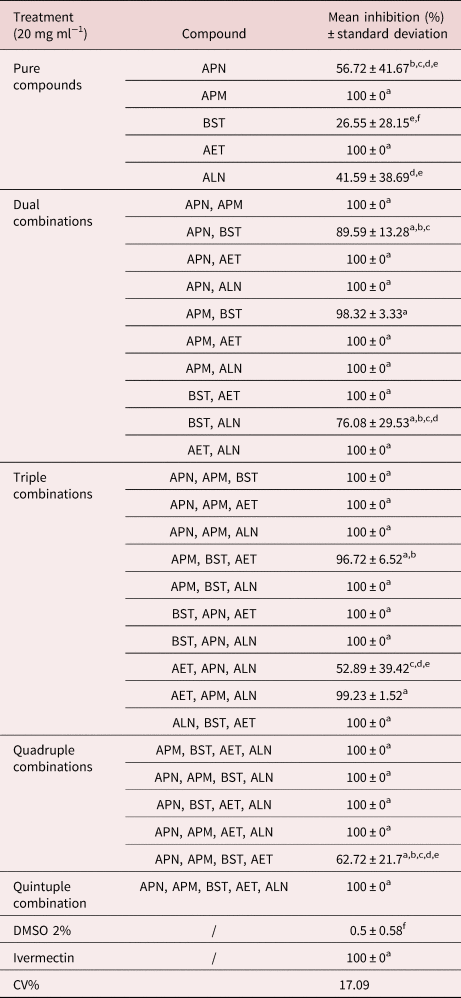
The incubation of H. contortus eggs with pure molecules showed an EHI of 26.5, 41.5 and 56.7% for BST, ALN and APN, respectively. With APM and AET, 100% EHI was obtained. Additionally, the different combinations showed an inhibition rate ranging from 52 to 100% (table 1).
Evaluation of the effects of four fatty acids, β-sitosterol and their combinations on the inhibition of Haemonchus contortus hatching eggs.

P ≤ 0.05; identical letters in the same column indicate that the values do not differ statistically according to Bonferroni's test. N = 4 (four wells); ten aliquots (drops) for each well.
APN, pentadecanoic acid; APM, palmitic acid; BST, β-sitosterol; AET, stearic acid; ALN, linoleic acid; CV, coefficient of variation.
Larval mortality
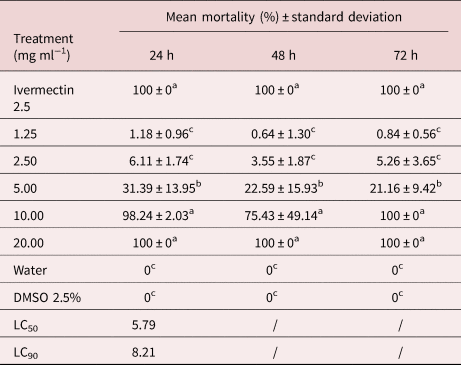
At the highest concentration (20 mg ml−1), the combination of the five compounds showed 100% larval mortality at 24 h (table 2). Dose-dependent behaviour was observed (P < 0.05); the mean lethal concentration and 90% lethal concentration were estimated to be 5.79 and 8.21 mg ml−1, respectively.
Effects of different concentrations of the combination of four commercial fatty acids and β-sitosterol on Haemonchus contortus larval mortality at different incubation times.

P ≤ 0.05; identical letters in the same column indicate that the values do not differ statistically according to Bonferroni's test. N = 4 (four wells); ten aliquots (drops) for each well.
Discussion
In the present study, five commercial compounds (APN, APM, BST, AET and ALN) were evaluated against the eggs and infective larvae of H. contortus, since in a previous work carried out by Pineda-Alegría et al. (Reference Pineda-Alegría, Sánchez-Vázquez, González-Cortazar, Zamilpa, López-Arellano, Cuevas-Padilla, Mendoza-de-Gives and Aguilar-Marcelino2017), all these compounds were found in a bioactive methanolic fraction obtained from the edible mushroom P. djamor ECS-0123. Commercial compounds were evaluated against H. contortus eggs, where all possible combinations of these compounds were tested to determine which combination of compounds or which compound was responsible for the ovicidal activity. The combination of the five compounds against infecting larvae at different concentrations was also evaluated to determine the LC50 and LC90 values.
In the EHI test, the pure compounds APM and AET showed high percent inhibition values, whereas APN, ALN and BST showed inhibition below 56%. Similarly, the combinations evaluated showed high inhibition, except for the triple combination containing AET, APN and ALN, with 52.8% inhibition.
On the other hand, in the larval mortality bioassay, there was a dose-dependent effect, and the values obtained at different times indicated that it was possible to evaluate larvicidal activity 24 h after interaction with the commercial compounds.
The main function of the fatty acids used in the present study, such as BST, is to maintain the bilayer structure of the plasma membrane and its regulation (Mamode et al., Reference Mamode, Gouguet and Gronnier2019). Therefore, exposing the eggs and larvae of H. contortus to these compounds could cause a change in the fatty acid composition (saturated and unsaturated) of the phospholipids. This would cause saturation or unsaturation of the membrane, damaging its fluidity and functionality (de Carvalho & Caramujo, Reference de Carvalho and Caramujo2018).
There are different reports of the AH effects of different fatty acids and β-sitosterol. For example, the fifth fraction of an extract of Picria fel-terrae Lour, containing pentadecanoic acid among other compounds, showed between 85 and 100% mortality against adult worms of Caenorhabditis elegans and a 50% reduction in the motility of H. contortus larvae (Kumarasingha et al., Reference Kumarasingha, Karpe and Preston2016).
In another study, a Carapa guianensis extract presented an EHI of 10% and up to 40% larval development inhibition of H. contortus; this extract contained 39 and 1.7% palmitic acid and stearic acid, respectively (Carvalho et al., Reference Carvalho, Chagas, Cotinguiba, Furlan, Brito, Chaves, Stephan, Bizzo and Amarante2012). Furthermore, Deepak et al. (Reference Deepak, Dipankar, Prashanth, Asha, Amit and Venkataraman2002) isolated β-sitosterol-D-glucoside from the methanolic extract of Tribulus terrestris and reported a mean lethal concentration of 82.5 µg ml−1 against C. elegans larvae. Giovanelli et al. (Reference Giovanelli, Mattellini, Fichi, Flamini and Perrucci2018) reported that 1% β-sitosterol can inhibit 42.2% GIN egg hatching and 80.2% larval paralysis/mortality in a mixed culture of H. contortus, Trichostrongylus sp., Chabertia ovina and Ostertagia ostertagi.
On the other hand, Stadler et al. (Reference Stadler, Mayer, Anke and Sterner1994) isolated six compounds ((S)-coriolic acid, linoleic acid, p-anisaldehyde, p-anisyl alcohol, 1-(4-methoxyphenyl)-1,2-propanediol and 2-hydroxy-(4′-methoxy)-propiophenone) from submerged cultures of Pleurotus pulmonarius and reported nematocidal activity against C. elegans. The compounds (S)-coriolic acid and linoleic acid were most active at concentrations between 5 and 10 ppm. In that same study, a mixture of fatty acids with nematocidal activity obtained from cultures of the edible mushroom Hericium coralloides was reported, which was mainly composed of linoleic acid, oleic acid and palmitic acid.
Some of the extracts or fractions of different plants and fungi with nematicidal activity contain different compounds that were evaluated in this study. In this sense, our study provides significant information on the effects of APN, APM, BST, AET and ALN on the eggs and larvae of H. contortus. High inhibition and mortality percentages were observed, making these compounds potential alternatives for the control of GINs.
Conclusions
Based on our results, APN, APM, BST, AET and ALN are responsible for the inhibition of hatching and larval mortality. The combination of these compounds explains the nematicidal activity reported in previous studies when evaluating the extract and fractions of the edible mushroom P. djamor ECS-0123.
Acknowledgement
We thank Edgar Josué Cuevas Padilla for his technical support during the elaboration of this study.
Financial support
This work was supported by the fiscal projects of the Instituto Nacional de Investigaciones Forestales, Agrícolas y Pecuarias (grant numbers 9442232005 and 834432984).
Conflicts of interest
None.