Introduction
Molecular diagnostic techniques are increasingly used for species identification in economically important fields such as forensic, medical, veterinary and agricultural sciences (e.g. Koekemoer et al., Reference Koekemoer, Kamau, Hunt and Coetzee2002; Zehner et al., Reference Zehner, Amendt, Schütt, Sauer, Krettec and Povolný2004; Harper et al., Reference Harper, Sheppard, Harwood, Read, Glen, Bruford and Symondson2006). Although mealybugs are major pests of horticultural crops world-wide and morphological identification of mealybugs is notoriously difficult, time-consuming and requires a high level of taxonomic expertise (Gullan & Kosztarab, Reference Gullan and Kosztarab1997; Millar, Reference Millar2002; Watson & Kubiriba, Reference Watson and Kubiriba2005), only two DNA-based identification protocols (Beuning et al., Reference Beuning, Murphy, Wu, Batchelor and Morris1999; Demontis et al., Reference Demontis, Ortu, Cocco, Lentini and Migheli2007) have been published, to our knowledge.
Adult female mealybugs are small (1–3 mm in length), ovoid and resemble the nymphal stages. The adult male is winged, non-feeding and short-lived. Identification of mealybugs is problematic, as they may be very similar superficially, with identification relying on cuticular features visible only under a microscope. Identification keys are usually only available for pre-oviposition adult females (Millar, Reference Millar2002; Watson & Kubiriba, Reference Watson and Kubiriba2005). Therefore, males and nymphs can normally not be identified.
Despite these difficulties in mealybug identification, accurate and timely identification is critical. Mealybugs are commercial pests of many agricultural crops and transmit viral plant diseases. Accurate and timely mealybug identification is needed for pest management and is especially crucial to the import and export of fresh produce. When mealybugs are encountered on a consignment of fruit, the produce must be held in quarantine in cold storage until the mealybugs can be identified. This involves rearing any nymphs found and identifying any adult females obtained, a process which can take up to six weeks (Beuning et al., Reference Beuning, Murphy, Wu, Batchelor and Morris1999). If nymphs cannot be reared, or only males are found, no identification can be made; and the consignment must be destroyed, causing severe losses to the exporter/importer.
The study by Beuning et al. (Reference Beuning, Murphy, Wu, Batchelor and Morris1999) developed a PCR-based method to identify four New Zealand mealybug species (Pseudococcus viburni (Signoret), P. calceolariae (Maskell), P. longispinus (Targioni Tozzetti) and P. similans (Lidgett); the last named species was subsequently synonymized with P. calceolariae (Charles et al., Reference Charles, Froud and Henderson2000)), using species-specific PCR primers in separate PCR reactions. Although this process is considerably faster than traditional morphological identification, it is still time-consuming. A faster identification method is that of the multiplex (or cocktail) PCR, in which a number of species-specific primers are used in a single PCR reaction. This method has been used in clinical diagnosis of infections and strains present in a single sample (Bermingham & Luettich, Reference Bermingham and Luettich2003) and has recently been applied to insect identification. For instance, Koekemoer et al. (Reference Koekemoer, Kamau, Hunt and Coetzee2002) developed a multiplex PCR to identify six species of the Anopheles funestus Giles (Diptera: Culicidae) mosquito group in a single PCR reaction. The species-specific primers employed in that study were designed to yield DNA products of different lengths that could be separated by electrophoresis, thus determining the identity of the sample.
In this study, development of a multiplex PCR was undertaken for the identification of the three mealybug species most commonly associated with grapevine in South Africa. These species are the vine mealybug, Planococcus ficus (Signoret); the citrus mealybug, Planococcus citri (Risso); and the longtailed mealybug, P. longispinus. All three species occur on vines in grape-growing areas throughout the world as economically important pests in their own right, as well as vectors of grapevine viruses, although their pest status in different areas may vary (e.g. Engelbrecht & Kasdorf, Reference Engelbrecht and Kasdorf1990; La Notte et al., Reference La Notte, Buzkan, Choueiri, Minafra and Martelli1997; Golino et al., Reference Golino, Sim, Gill and Rowhani2002; Daane et al., Reference Daane, Bentley and Weber2004; de Borbón et al., Reference de Borbón, Gracia and Gómez Talquenca2004). In South Africa, P. ficus is the most abundant mealybug on grapevine and a major pest in vineyards. Pseudococcus longispinus is a highly polyphagous pest also occurring in vineyards. Planococcus citri has historically been reported on South African vines, although the original species identification has been questioned. Planococcus citri and P. ficus are very closely related and are morphologically very similar. Misidentifications of these two species are common (Millar, personal communication).
The aim of this study was to develop a molecular identification method for the most important mealybug species associated with grapevine in South Africa. This technique needed to be fast, accurate, reliable and sensitive enough to identify nymphs yet simple enough to be implemented in any molecular laboratory.
Materials and methods
Mealybugs
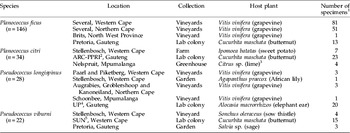
For initial DNA amplification, generation of sequence data, optimization and testing of the multiplex PCR, mealybug specimens of known species were used. Ten, three and four individuals of P. ficus, P. citri and P. longispinus, respectively, from laboratory cultures and field collections were used to obtain sequence data. In addition, mealybugs from various locations in South Africa, as well as laboratory cultures, were used during testing of the multiplex PCR (table 1). To confirm their identity, sub-samples of all mealybug collections were sent to I. Millar of the Biosystematics Division of the ARC-Plant Protection Research Institute (ACR-PPRI), South Africa. Collected mealybugs, to be used for DNA extraction, were stored in absolute ethanol at ambient temperature and transferred to −20°C upon return to the laboratory (Post et al., Reference Post, Flook and Millest1993; Fukatsu, Reference Fukatsu1999; Tayutivutikul et al., Reference Tayutivutikul, Pongprasert, Royce and Ruangrit2003). Both female and male nymphs of all stages and adult female mealybugs were used in analyses.
Collection information for mealybug specimens used during testing of the multiplex PCR.

1 Sample size was limited by availability of mealybugs;
2 ARC-Plant Protection Research Institute;
3 Citrus limonia or C. latifolia or C. limettioides, depending on whether samples supplied were referable to Rangpur lime, Tahiti lime, or Palestine sweet lime;
4 University of Pretoria;
5 Stellenbosch University.
DNA extraction
DNA was extracted from individual mealybugs using the STE buffer method of Koekemoer et al. (Reference Koekemoer, Kamau, Hunt and Coetzee2002) with the adaptation that 50–100 μl STE buffer was used. In subsequent PCRs, 2 μl of the extraction were used.
PCR amplification
The universal primers C1-J-2183 (alias Jerry) and TL2-N-3014 (alias Pat) (Simon et al., Reference Simon, Frati, Beckenbach, Crespi, Liu and Flook1994) were used to amplify 831 bp of the mitochondrial cytochrome c oxidase subunit 1 (CO I) gene. The region was chosen because it is highly conserved and widely used to separate species. In addition, it has been suggested that the CO I gene be used to develop universal barcodes for all organisms and that these be used in identifications (Hebert et al., Reference Hebert, Cywinska, Ball and DeWaard2003a,Reference Hebert, Ratnasingham and DeWaardb). PCR amplification was performed in a 25 μl reaction mix consisting of NH4 Reaction Buffer (final concentration: 16 mM (NH4)2SO4, 67 mM Tris-HCl, 0.01% Tween-20), 4 mM MgCl2, 50 μM each dNTP, 0.4 μM each primer, 1.25 units BIOTAQ™ DNA Polymerase (BioLine, Luckenwalde, Germany) and 1–2 μl extracted DNA.
Thermocycling conditions consisted of an initial denaturation step at 94°C for 1 min, then 35 cycles of 94°C for 45 sec, annealing at 48°C for 45 sec and extension at 72°C for 1 min, with final extension at 72°C for 3 min. PCR products were visualized under UV light on a 1.5% agarose gel stained with ethidium bromide (EtBr).
DNA sequencing and analyses
Products were cycle sequenced with the BigDye™ Terminator v3.1 Cycle Sequencing Kit (Applied Biosystems) using ¼ of the manufacturer's recommended reaction mix. Products were then precipitated and sequenced on an ABI3100 PRISIM™ Genetic Analyzer (Applied Biosystems) at the DNA Sequencing Facility, University of Pretoria. DNA sequences thus obtained were visually edited in Chromas Lite 2.00 (Technelysium Pty. Ltd) and aligned within and between species using Clustal X (Thompson et al., Reference Thompson, Higgins and Gibson1994, Reference Thompson, Gibson, Plewniak, Jeanmougin and Higgins1997; Jeanmougin et al., Reference Jeanmougin, Thompson, Gouy, Higgins and Gibson1998). A consensus sequence was generated for each species, using data from both the forward and reverse primers.
Species-specific primer design
Using the alignment generated by Clustal X, three species-specific forward primers were designed in regions where the mealybug sequences differed. These primers were designed such that they could be complemented in PCR by the universal reverse primer TL2-N-3014. Primers were designed to cover at least 3 bp changes between species, have a unique C- or G-base at the 3′-end, and yield products of a different length that could easily be separated on an agarose gel. Primers were named according to the convention of Simon et al. (Reference Simon, Frati, Beckenbach, Crespi, Liu and Flook1994). Primer names, sequences and other selected parameters are given in table 2.
Details and thermodynamic properties of species-specific primers designed for use in the multiplex PCR.

1 Primers are named according to the convention of Simon et al. (Reference Simon, Frati, Beckenbach, Crespi, Liu and Flook1994) ;
2 product length when used in conjunction with TL2-N-3014 (Simon et al., Reference Simon, Frati, Beckenbach, Crespi, Liu and Flook1994).
Multiplex PCR
The single-step multiplex PCR was designed to allow for the species-specific primers to be used together in a single reaction mix to differentially amplify DNA from each of the three mealybug species. The PCR reaction mix was essentially the same as that used for the universal primers, with the exception that primer C1-J-2427 was used at a concentration of 0.5 μm. All other primer concentrations were at 0.4 μm. Thermocycling conditions consisted of an initial denaturation at 94°C for 3 min, then 35 cycles of 94°C for 40 sec, 64°C for 40 sec and 72°C for 50 sec, with a final extension at 72°C for 2 min. Samples were cooled to at least 10°C before being removed and stored at 4°C until needed. Products from the multiplex PCR were visualized under UV light on a 2.5% agarose gel stained with EtBr.
Multiplex PCR controls
All PCRs were run with an external negative control, which contained all reagents except DNA. During optimization of the multiplex PCR, specimens of known species were used. In further application of the multiplex PCR, a known specimen of each species was used as a positive control. The species-specific primers were tested for cross-reactivity, both separately and in the multiplex reaction mix.
Testing and application of the multiplex PCR
The accuracy of the multiplex PCR was tested using mealybugs from laboratory colonies of P. ficus, P. citri and P. longispinus (n=13, n=23 and n=20, respectively), some of which were tested during blind trials (n=30). PCR specificity was confirmed using specimens of the obscure mealybug Pseudococcus viburni (n=22, table 1). The multiplex PCR was further tested by identifying field-collected mealybugs representing all three species (n=32) stored in absolute ethanol at −20°C. In addition, field-collected samples, stored in absolute ethanol at ambient temperature for approximately five months before being transferred to −20°C, were also tested (n=143) (table 1).
Results
DNA sequence data
A single fragment of approximately 830 bp was amplified by PCR from the three mealybug species. Sequencing of this fragment yielded usable nucleotide sequences of approximately 760 bp. Intraspecific variation in this region was very low (<1%); and a consensus sequence was, therefore, easily generated. A pair-wise comparison of the nucleotide sequence from the three mealybug species showed P. ficus and P. citri to be more similar (92.5% identity) than either P. ficus and P. longispinus (89.1% identity) or P. citri and P. longispinus (88.6% identity). These sequences mapped onto the 3′-end of the mitochondrial CO I gene from positions 2216 to 2986 of the Drosophila yakuba Burla (Diptera: Drosophilidae) mitochondrial genome (Clary & Wolstenholme, Reference Clary and Wolstenholme1983, Reference Clary and Wolstenholme1985). BLAST searches of these sequences on Genbank revealed a high similarity (92–100%) to other mealybug sequences from the CO I gene. The consensus sequences from each of the three mealybug species obtained in the present study were submitted to Genbank: P. ficus accession number DQ238220; P. citri accession number DQ238221; and P. longispinus accession number DQ238222.
Multiplex PCR and primers
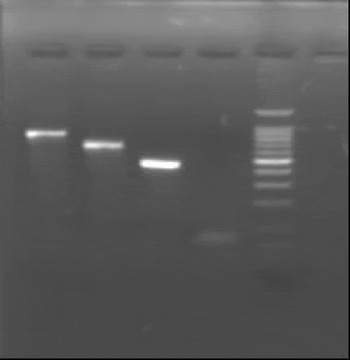
When used in conjunction with primer TL2-N-3014, the species-specific primers yielded amplicons of 754, 587 and 406 bp from P. ficus, P. citri and P. longispinus, respectively (see table 2 and fig. 1). Once optimized at the stated conditions, these primers consistently yielded single amplicons of the specified size from each species. Occasionally, an extra non-specific band was observed in the PCR product. However, this band was always lighter than the specific band and did not occur at the same position as that from one of the other primers. It, therefore, never interfered with interpretation of the results.
Multiplex PCR amplification of mealybug DNA. Lane 1: P. ficus; lane 2: P. citri; lane 3: P. longispinus; lane 4: no template control; lane 5: DNA size marker.

No cross-reactivity of primers was observed at optimum conditions. When each species-specific primer was tested separately for reactivity with other species, none occurred when reactions were near optimum (Ta=64±2°C). Within the multiplex reaction mix, no cross-reactivity of primers close to the optimum annealing temperature (64±1°C) was observed.
Testing and application of the multiplex PCR
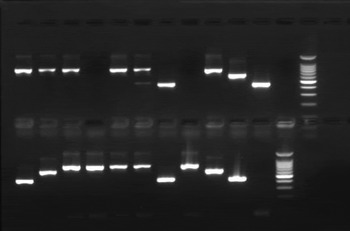
Blind trials using 30 specimens were set up to test the multiplex PCR. Of these, 29 specimens were amplified and all were correctly identified. The specimen which did not amplify was subsequently re-tested using both the multiplex primers and the conserved CO I primers (C-J-2183 and TL2-N-3014). No amplicon could be obtained. Overall amplification success of mealybugs from laboratory cultures and those collected in the field and stored in absolute ethanol at −20°C was 97% (85 out of 88 specimens). All amplified individuals were correctly identified, as verified by results obtained for sub-samples sent for morphological identification (fig. 2). When the multiplex PCR was tested on P. viburni (n=22), no amplification product was obtained.
Multiplex PCR amplification of mealybug DNA to identify unknown specimens. The last five lanes in each row are PCR controls (P. ficus, P. citri and P. longispinus), no template control and DNA size marker. Row 1, lanes 1–3 and 5–6: P. ficus; lane 7: P. longispinus; lanes 4 and 8: unamplified specimens. Row 2, lanes 1 and 7: P. longispinus; lane 2: P. citri; lanes 3–6: P. ficus.

The multiplex PCR was further evaluated for routine use by identifying field-collected mealybugs (n=143). Many specimens were very small (first-instar nymphs, n=23) or heavily parasitized (n=24). However, DNA was extracted and amplified from 84% (120 of 143) of individual mealybugs analyzed, including 61% first-instar nymphs and 71% of parasitized specimens (excluding those where only the dried exoskeleton remained). All individuals were correctly identified; the identifications of these specimens were in agreement with sub-samples sent for morphological identification.
Discussion
In this study, a multiplex PCR has been developed for the identification of three species of mealybug associated with grapevine. When combined with the direct buffer extraction method (Koekemoer et al., Reference Koekemoer, Kamau, Hunt and Coetzee2002), the entire protocol took approximately four hours to complete. Due to the nature of PCR, a large number of samples can be run concurrently, thereby further shortening overall processing time. The method reliably extracted and amplified DNA even from small and damaged specimens. In the blind trials, every specimen that amplified was correctly identified.
However, it should always be borne in mind that no identification method is infallible. Sources of error in any method should be identified, eliminated if possible, and incorporated into further decision-making. Possible sources of error are primer-bias, false negatives due to high intraspecific variation and false positives due to low interspecific variation. These sources of error have been addressed in this study by optimization and thorough testing of the multiplex PCR. Although primer-bias was initially observed, a change in relative primer concentrations eliminated all cross-reactivity. This multiplex PCR is unlikely to yield false negative results for the three species in question due to the conserved nature of the CO I gene used in this study and the observed lack of intraspecific variation, even between different populations. Likewise, false positives are unlikely to occur, since this multiplex PCR has been tested with four different mealybug species and has shown no cross-reactivity. In addition, P. ficus and P. citri, and P. longispinus and P. viburni, respectively, are very closely related to each other (Downie & Gullan, Reference Downie and Gullan2004; I. Millar, personal communication). Thus, the testing of each of these mealybugs pairs serves as a control. Since the species-specific primers showed no cross-reactivity to these closely-related species, they are unlikely to show cross-reactivity to any more distantly-related mealybugs.
In the current study, 85 out of 88 (97%) of specimens stored in absolute ethanol at −20°C could be amplified, and all of these were correctly identified. The accuracy and reliability of the technique is comparable to that obtained in other molecular identification studies. For example, the method developed by Beuning et al. (Reference Beuning, Murphy, Wu, Batchelor and Morris1999) for mealybug identification (employing primers in separate reactions) correctly identified 23 out of 24 (96%) specimens in a blind trial. The remaining specimen was incorrectly identified and was referable to a different species within the species group. The multiplex PCR developed by Koekemoer et al. (Reference Koekemoer, Kamau, Hunt and Coetzee2002) amplified 868 out of 900 (96%) mosquito specimens when tested by Weeto et al. (Reference Weeto, Koekemoer, Kamau, Hunt and Coetzee2004). All amplified specimens were correctly identified. The multiplex PCR developed by Gariepy et al. (Reference Gariepy, Kuhlmann, Haye, Gillott and Erlandson2005) for identification of Peristenus spp. (Hymenoptera: Braconidae) correctly identified all voucher specimens (20 out of 20) and was sensitive enough to detect parasitoid eggs in the host three days post-parasitism. In comparison, in this study the multiplex PCR correctly identified all amplified specimens (29 out of 30 (97%)) in blind trials. One specimen did not amplify. When the multiplex PCR was applied to field-collected samples, it performed well, amplifying and correctly identifying 120 out of 143 (84%) specimens, despite the fact that many individuals had been parasitized. Those from which DNA could not be extracted or amplified were usually parasitized individuals, tiny first-instar nymphs or, in one instance, eggs from which DNA could not be extracted. Overall, the multiplex PCR was able to amplify 89% (205 out of 231) of specimens, regardless of size, sex or condition of the specimen (first-instar nymphs, parasitized specimens). All amplified specimens were correctly identified.
The speed, reliability, sensitivity and accuracy of this technique represent a considerable improvement over currently available identification protocols. In addition, the simple procedure can be implemented in any molecular laboratory and does not require extensive taxonomic or molecular experience. This identification protocol will aid in accurately and rapidly identifying mealybug specimens found on export consignments and in vineyards. Timely and accurate identification is essential to management of these pest species. In addition, it is envisioned that this multiplex PCR will be implemented in scientific research to provide accurate species identification for biological and ecological studies on mealybugs.
Acknowledgements
We wish to thank the following persons and organisations: V. Walton and J. Meyer for kindly providing specimens from field surveys, and of Pseudococcus viburni and Planococcus citri from the laboratory colonies at the University of Stellenbosch and ARC-Plant Protection Research Institute; I. Millar (ARC-Plant Protection Research Institute) for confirmation of species identifications; N. Douglas (University of Pretoria) for assistance with field collections of Planococcus ficus; and Winetech, THRIP (Technology and Human Resources for Industry Programme) the University of Pretoria for project funding.