





1 Introduction
Weak function spaces play an important role in harmonic analysis. For example, in order to show that a linear operator maps
 $L^{p}(\mathbb{R}^{n})$
to itself for any
 $p\in (1,\infty )$
, it is sufficient to show that it maps the (smaller) Lorentz space
 $L^{p,1}(\mathbb{R}^{n})$
into the (larger) weak Lebesgue space
 $WL^{p}(\mathbb{R}^{n})$
for the same range of
 $p$
’s. It is now well known that Hardy space
 $H^{p}(\mathbb{R}^{n})$
is a good substitute of the Lebesgue space
 $L^{p}(\mathbb{R}^{n})$
with
 $p\in (0,1]$
in the study for the boundedness of operators and, moreover, when studying the boundedness of operators in the critical case, the weak Hardy spaces
 $\mathit{WH}^{p}(\mathbb{R}^{n})$
naturally appear and prove to be a good substitute of Hardy spaces
 $H^{p}(\mathbb{R}^{n})$
with
 $p\in (0,1]$
. For example, if
 $\unicode[STIX]{x1D6FF}\in (0,1]$
,
 $T$
is a
 $\unicode[STIX]{x1D6FF}$
-Calderón–Zygmund operator and
 $T^{\ast }(1)=0$
, where
 $T^{\ast }$
denotes the adjoint operator of
 $T$
, it is known that
 $T$
is bounded on
 $H^{p}(\mathbb{R}^{n})$
for any
 $p\in (n/(n+\unicode[STIX]{x1D6FF}),1]$
(see [Reference Álvarez and Milman2]), but
 $T$
may be not bounded on
 $H^{n/(n+\unicode[STIX]{x1D6FF})}(\mathbb{R}^{n})$
; however, Liu [Reference Liu42] proved that
 $T$
is bounded from
 $H^{n/(n+\unicode[STIX]{x1D6FF})}(\mathbb{R}^{n})$
to
 $\mathit{WH}^{n/(n+\unicode[STIX]{x1D6FF})}(\mathbb{R}^{n})$
.
Many fields in analysis require the study of specific function spaces. In harmonic analysis, one soon encounters the Lebesgue spaces, the Hardy spaces, various forms of the Lipschitz spaces, the BMO spaces and the Sobolev spaces. From the original definitions of these spaces, it may not appear that they are very closely related. There exist, however, various unified approaches to their study. The Littlewood–Paley theory, which arises naturally from the consideration of the Dirichlet problem, provides one of the most successful unifying perspectives on these function spaces (see [Reference Frazier, Jawerth and Weiss21] for more details). Recall that the classical Hardy spaces, which is defined via the nontangential grand maximal function, can also be equivalently characterized, respectively, via the Lusin-area function,
 $g$
-function or
 $g_{\unicode[STIX]{x1D706}}^{\ast }$
-function (see, for example, [Reference Grafakos23, Reference Triebel53]).
On the other hand, as a generalization of
 $L^{p}(\mathbb{R}^{n})$
, the Orlicz spaces were introduced by Birnbaum and Orlicz [Reference Birnbaum and Orlicz4] and Orlicz [Reference Orlicz46]. Since then, the theory of Orlicz-type spaces themselves has been well developed and these spaces have been widely used in many branches of analysis (see, for example, [Reference Astala, Iwaniec, Koskela and Martin3, Reference Graversen, Pes̆kir and Weber24, Reference Iwaniec and Onninen26, Reference Kilpeläinen, Koskela and Masaoka31, Reference Martínez and Wolanski43, Reference Nakai and Sawano45]). Moreover, as a development of the theory of Orlicz spaces, the Orlicz–Hardy spaces and their dual spaces were studied by Strömberg [Reference Strömberg50] and Janson [Reference Janson27] and the Orlicz–Hardy spaces associated with divergence form elliptic operators by Jiang and Yang [Reference Jiang and Yang28]. A survey on the real-variable theory of Orlicz-type function spaces associated with operators is recently given in [Reference Chang, Yang and Yang15].
Let
 ${\mathcal{A}}_{q}(\mathbb{R}^{n})$
with
 $q\in [1,\infty ]$
denote the class of classical Muckenhoupt weights (see, for example, [Reference García-Cuerva and Rubio de Francia22, Reference Grafakos23] for their definitions and properties) and let
 $\unicode[STIX]{x1D713}$
be a Musielak–Orlicz function (see [Reference Ky33]) satisfying that
 $\unicode[STIX]{x1D713}(x,\cdot )$
is an Orlicz function uniformly in
 $x\in \mathbb{R}^{n}$
and
 $\unicode[STIX]{x1D713}(\cdot ,t)$
is a Muckenhoupt
 ${\mathcal{A}}_{\infty }(\mathbb{R}^{n})$
weight uniformly in
 $t\in (0,\infty )$
. It is known that, as a natural generalization of Orlicz functions, Musielak–Orlicz functions may vary in the spatial variables (see, for example, [Reference Diening17, Reference Ky33, Reference Liang, Huang and Yang38, Reference Musielak44]). Recently, Ky [Reference Ky33] introduced a new Musielak–Orlicz Hardy space
 $H^{\unicode[STIX]{x1D713}}(\mathbb{R}^{n})$
via the nontangential grand maximal function. It is worth noticing that some special Musielak–Orlicz Hardy spaces appear naturally in the study of the products of functions in
 $\mathit{BMO}(\mathbb{R}^{n})$
and
 $H^{1}(\mathbb{R}^{n})$
(see [Reference Bonami, Grellier and Ky6, Reference Bonami, Iwaniec, Jones and Zinsmeister7, Reference Ky34]), and the endpoint estimates for both the div-curl lemma and the commutators of singular integral operators (see [Reference Bonami, Feuto and Grellier5, Reference Bonami, Grellier and Ky6, Reference Ky32, Reference Ky34]). More applications are referred to [Reference Hou, Yang and Yang25, Reference Lerner35, Reference Liang and Yang39, Reference Liang and Yang40, Reference Tran52, Reference Yang, Liang and Ky54]. We refer the reader to [Reference Yang, Liang and Ky54] for a complete survey of the real-variable theory of Musielak–Orlicz Hardy spaces.
Let
 $A$
be an expansive dilation on
 $\mathbb{R}^{n}$
and
 $\unicode[STIX]{x1D711}$
an anisotropic Musielak–Orlicz function satisfying some growth conditions (see Definition 2.3 below). In order to find an appropriate general space which includes the classical weak Hardy space of Fefferman and Soria [Reference Fefferman and Soria19], the classical weighted weak Hardy space of Quek and Yang [Reference Quek and Yang48], the anisotropic weak Hardy space of Ding and Lan [Reference Ding and Lan18], the classical weak Musielak–Orlicz Hardy space of Liang et al. [Reference Liang, Yang and Jiang41] and the anisotropic weak Musielak–Orlicz Hardy space of Zhang et al. [Reference Zhang, Qi and Li55] and Qi et al. [Reference Qi, Zhang and Li47], we introduce the anisotropic weak Musielak–Orlicz Hardy space
 $\mathit{WH}_{A}^{\unicode[STIX]{x1D711}}(\mathbb{R}^{n})$
which includes all of the above mentioned weak spaces (see Remark 2.8 below for more details). Then the Littlewood–Paley characterizations of
 $\mathit{WH}_{A}^{\unicode[STIX]{x1D711}}(\mathbb{R}^{n})$
are obtained in Theorems 2.10–2.12 below.
Precisely, this article is organized as follows.
In Section 2, we recall some notions concerning expansive dilations, anisotropic Muckenhoupt weights and anisotropic growth functions. Then we introduce anisotropic weak Musielak–Orlicz Hardy spaces
 $\mathit{WH}_{A}^{\unicode[STIX]{x1D711}}(\mathbb{R}^{n})$
via nontangential grand maximal functions and establish their Littlewood–Paley characterizations, respectively, in terms of the anisotropic Lusin-area function,
 $g$
-function or
 $g_{\unicode[STIX]{x1D706}}^{\ast }$
-function in Theorems 2.10–2.12 below, the proofs of which are given in Sections 3 and 4.
Section 3 is devoted to establishing the anisotropic Lusin-area function characterization of
 $\mathit{WH}_{A}^{\unicode[STIX]{x1D711}}(\mathbb{R}^{n})$
. Let
 $q\in (q(\unicode[STIX]{x1D711}),\infty ]$
, where
 $q(\unicode[STIX]{x1D711})$
denotes the critical weight index of
 $\unicode[STIX]{x1D711}$
. Here, we point out that the
 $q$
-atomic characterization of
 $\mathit{WH}_{A}^{\unicode[STIX]{x1D711}}(\mathbb{R}^{n})$
(see Lemma 3.9 below) plays an important role in establishing the anisotropic Lusin-area function characterization of
 $\mathit{WH}_{A}^{\unicode[STIX]{x1D711}}(\mathbb{R}^{n})$
(see Theorem 2.10 below) and the anisotropic
 $q$
-atomic characterization of
 $\mathit{WH}_{A}^{\unicode[STIX]{x1D711}}(\mathbb{R}^{n})$
is an anisotropic extension of Liang et al. [Reference Liang, Yang and Jiang41, Theorem 3.5], which is new even when
 $q\in (1,\infty ]$
and
 $\mathit{WH}_{A}^{\unicode[STIX]{x1D711}}(\mathbb{R}^{n})$
is reduced to the anisotropic weak Hardy space
 $\mathit{WH}_{A}^{p}(\mathbb{R}^{n})$
, where
 $p\in (0,1]$
(see Remark 3.10 below for more details). Zhang et al. [Reference Zhang, Qi and Li55, Theorem 1] obtained the atomic characterization of
 $\mathit{WH}_{A}^{\widetilde{\unicode[STIX]{x1D711}}}(\mathbb{R}^{n})$
with respect to a particular anisotropic growth function, that is, the anisotropic
 $p$
-growth function
 $\widetilde{\unicode[STIX]{x1D711}}$
of uniformly lower type
 $p$
and of uniformly upper type
 $p$
, where
 $p\in (0,1]$
. In this article, motivated by Liang et al. [Reference Liang, Yang and Jiang41, Theorem 3.5], we obtain the atomic characterization of
 $\mathit{WH}_{A}^{\unicode[STIX]{x1D711}}(\mathbb{R}^{n})$
with respect to a general anisotropic growth function
 $\unicode[STIX]{x1D711}$
of uniformly lower type
 $p$
and of uniformly upper type 1. Hence, we cannot directly use the method with respect to the uniformly upper
 $p$
property of
 $\unicode[STIX]{x1D711}$
in [Reference Zhang, Qi and Li55, Theorem 1]. We overcome this difficulty via using a more general superposition principle of weak type estimates (see Lemma 3.2 below) and establishing a more subtle estimate of Schwartz function on weighted anisotropic Campanato space (see Lemma 3.5 below). Next, using some ideas from [Reference Li, Fan and Yang36], the discrete anisotropic Calderón reproducing formula (see Lemma 3.12 below) and the method used in the proof the atomic characterization of
 $\mathit{WH}_{A}^{\unicode[STIX]{x1D711}}(\mathbb{R}^{n})$
, we establish the anisotropic Lusin-area function characterization of
 $\mathit{WH}_{A}^{\unicode[STIX]{x1D711}}(\mathbb{R}^{n})$
(see Theorem 2.10 below). This characterization is new even when
 $\mathit{WH}_{A}^{\unicode[STIX]{x1D711}}(\mathbb{R}^{n})$
is reduced to the anisotropic weak Hardy space
 $\mathit{WH}_{A}^{p}(\mathbb{R}^{n})$
, where
 $p\in (0,1]$
(see Remark 2.13 below for more details). We point out that, since the space variant
 $x$
and the time variant
 $t$
appeared in
 $\unicode[STIX]{x1D711}(x,t)$
are inseparable, the dual method for estimating the atoms in the classical case does not work any more in the present setting. Instead, we use a method from Li et al. (see [Reference Li, Fan and Yang36] for more details).
In Section 4, motivated by [Reference Liang, Yang and Jiang41, Theorems 4.8 and 4.13], Folland and Stein [Reference Folland and Stein20] and Aguilera and Segovia [Reference Aguilera and Segovia1], the anisotropic
 $g$
-function or
 $g_{\unicode[STIX]{x1D706}}^{\ast }$
-function characterizations of
 $\mathit{WH}_{A}^{\unicode[STIX]{x1D711}}(\mathbb{R}^{n})$
is established, respectively, via the above anisotropic Lusin-area function characterization of
 $\mathit{WH}_{A}^{\unicode[STIX]{x1D711}}(\mathbb{R}^{n})$
, the anisotropic weak Musielak–Orlicz Fefferman–Stein vector-valued inequality (see Lemma 4.3 below) and the anisotropic weak Musielak–Orlicz Peetre’s inequality (see Lemma 4.5 below). This method is different from that used by Liang et al. in the proof of [Reference Liang, Yang and Jiang41, Theorem 4.8], in which a subtle pointwise upper estimate (see [Reference Liang, Yang and Jiang41, (4.26)]) via the vector-valued Hardy–Littlewood maximal function was used. However, such a pointwise upper estimate is still unknown and we do not know whether it holds true or not in the present setting due to its anisotropic structure. We point out that the range of
 $\unicode[STIX]{x1D706}$
in the anisotropic
 $g_{\unicode[STIX]{x1D706}}^{\ast }$
-function characterization of
 $\mathit{WH}_{A}^{\unicode[STIX]{x1D711}}(\mathbb{R}^{n})$
coincides with the best known range of the
 $g_{\unicode[STIX]{x1D706}}^{\ast }$
-function characterization of classical Hardy space
 $H^{p}(\mathbb{R}^{n})$
or its weighted variants, where
 $p\in (0,1]$
(see, for example, [Reference Aguilera and Segovia1, Theorem 2] and [Reference Liang, Yang and Jiang41, Theorem 4.13]). The anisotropic
 $g$
-function or
 $g_{\unicode[STIX]{x1D706}}^{\ast }$
-function characterization of
 $\mathit{WH}_{A}^{\unicode[STIX]{x1D711}}(\mathbb{R}^{n})$
is new even when
 $\mathit{WH}_{A}^{\unicode[STIX]{x1D711}}(\mathbb{R}^{n})$
is reduced to the anisotropic weak Hardy space
 $\mathit{WH}_{A}^{p}(\mathbb{R}^{n})$
, where
 $p\in (0,1]$
(see Remark 2.13 below for more details).
Finally, we make some conventions on notation. Let
 $\mathbb{Z}_{+}:=\{1,2,\ldots \}$
and
 $\mathbb{N}:=\{0\}\cup \mathbb{Z}_{+}$
. For any
 $\unicode[STIX]{x1D6FC}:=(\unicode[STIX]{x1D6FC}_{1},\ldots ,\unicode[STIX]{x1D6FC}_{n})\in \mathbb{N}^{n}$
, let
 $|\unicode[STIX]{x1D6FC}|:=\unicode[STIX]{x1D6FC}_{1}+\cdots +\unicode[STIX]{x1D6FC}_{n}$
and
 $\unicode[STIX]{x2202}^{\unicode[STIX]{x1D6FC}}:=(\unicode[STIX]{x2202}/\unicode[STIX]{x2202}x_{1})^{\unicode[STIX]{x1D6FC}_{1}}\cdots (\unicode[STIX]{x2202}/\unicode[STIX]{x2202}x_{n})^{\unicode[STIX]{x1D6FC}_{n}}$
. Throughout the whole paper, we denote by
 $C$
a positive constant which is independent of the main parameters, but it may vary from line to line. The symbol
 $D\lesssim F$
means that
 $D\leqslant CF$
. If
 $D\lesssim F$
and
 $F\lesssim D$
, we then write
 $D\sim F$
. For any sets
 $E,F\subset \mathbb{R}^{n}$
, we use
 $E^{\complement }$
to denote the set
 $\mathbb{R}^{n}\setminus E$
,
 $\unicode[STIX]{x1D712}_{E}$
its characteristic function and
 $E+F$
the algebraic sum
 $\{x+y:~x\in E,y\in F\}$
. For any
 $a\in \mathbb{R}$
,
 $\lfloor a\rfloor$
denotes the maximal integer not larger than
 $a$
. If there are no special instructions, any space
 ${\mathcal{X}}(\mathbb{R}^{n})$
is denoted simply by
 ${\mathcal{X}}$
. For example,
 $L^{p}(\mathbb{R}^{n})$
is simply denoted by
 $L^{p}$
. Denote by
 ${\mathcal{S}}$
the space of all Schwartz functions and
 ${\mathcal{S}}^{\prime }$
the space of all tempered distributions. For any subset
 $E$
of
 $\mathbb{R}^{n}$
,
 $t\in (0,\infty )$
and measurable function
 $f$
, let
 $\unicode[STIX]{x1D711}(E,t):=\int _{E}\unicode[STIX]{x1D711}(x,t)\,dx$
and
 $\{|f|>t\}:=\{x\in \mathbb{R}^{n}:|f(x)|>t\}$
.
2 Notions and main results
In Section 2, we introduce the anisotropic weak Musielak–Orlicz Hardy spaces via the nontangential grand maximal function and then present their Littlewood–Paley characterizations.
First we recall the notion of expansive dilations on
 $\mathbb{R}^{n}$
; see [Reference Bownik8, p. 5]. A real
 $n\times n$
matrix
 $A$
is called an expansive dilation, shortly a dilation, if
 $\min _{\unicode[STIX]{x1D706}\in \unicode[STIX]{x1D70E}(A)}|\unicode[STIX]{x1D706}|>1$
, where
 $\unicode[STIX]{x1D70E}(A)$
denotes the set of all eigenvalues of
 $A$
. Let
 $\unicode[STIX]{x1D706}_{-}$
and
 $\unicode[STIX]{x1D706}_{+}$
be two positive numbers such that
 $$\begin{eqnarray}1<\unicode[STIX]{x1D706}_{-}<\min \{|\unicode[STIX]{x1D706}|:\unicode[STIX]{x1D706}\in \unicode[STIX]{x1D70E}(A)\}\leqslant \max \{|\unicode[STIX]{x1D706}|:\unicode[STIX]{x1D706}\in \unicode[STIX]{x1D70E}(A)\}<\unicode[STIX]{x1D706}_{+}.\end{eqnarray}$$
In the case when
 $A$
is diagonalizable over
 $\mathbb{C}$
, we can even take
 $\unicode[STIX]{x1D706}_{-}:=\min \{|\unicode[STIX]{x1D706}|:~\unicode[STIX]{x1D706}\in \unicode[STIX]{x1D70E}(A)\}$
and
 $\unicode[STIX]{x1D706}_{+}:=\max \{|\unicode[STIX]{x1D706}|:\unicode[STIX]{x1D706}\in \unicode[STIX]{x1D70E}(A)\}$
. Otherwise, we need to choose them sufficiently close to these equalities according to what we need in our arguments.
It was proved in [Reference Bownik8, p. 5, Lemma 2.2] that, for a given dilation
 $A$
, there exist a number
 $r\in (1,\infty )$
and a set
 $\unicode[STIX]{x1D6E5}:=\{x\in \mathbb{R}^{n}:|Px|<1\}$
, where
 $P$
is some nondegenerate
 $n\times n$
matrix, such that
 $\unicode[STIX]{x1D6E5}\subset r\unicode[STIX]{x1D6E5}\subset A\unicode[STIX]{x1D6E5}$
, and by a scaling, one can additionally assume that
 $|\unicode[STIX]{x1D6E5}|=1$
, where
 $|\unicode[STIX]{x1D6E5}|$
denotes the
 $n$
-dimensional Lebesgue measure of the set
 $\unicode[STIX]{x1D6E5}$
. For any
 $k\in \mathbb{Z}$
, let
 $B_{k}:=A^{k}\unicode[STIX]{x1D6E5}$
. Then
 $B_{k}$
is open,
 $B_{k}\subset rB_{k}\subset B_{k+1}$
and
 $|B_{k}|=b^{k}$
, here and hereafter,
 $b:=|\det \,A|$
. Throughout the whole paper, let
 $\unicode[STIX]{x1D70E}$
be the minimum positive integer such that
 $2B_{0}\subset B_{\unicode[STIX]{x1D70E}}$
. Then, for any
 $k,j\in \mathbb{Z}$
with
 $k\leqslant j$
, it holds true that
 $$\begin{eqnarray}\displaystyle & & \displaystyle B_{k}+B_{j}\subset B_{j+\unicode[STIX]{x1D70E}},\end{eqnarray}$$
 $$\begin{eqnarray}\displaystyle & & \displaystyle B_{k}+(B_{k+\unicode[STIX]{x1D70E}})^{\complement }\subset (B_{k})^{\complement }.\end{eqnarray}$$
Definition 2.1. A quasinorm, associated with an expansive dilation
 $A$
, is a Borel measurable mapping
 $\unicode[STIX]{x1D70C}_{A}:\mathbb{R}^{n}\rightarrow [0,\infty )$
, for simplicity, denoted by
 $\unicode[STIX]{x1D70C}$
, satisfying
(i)
 $\unicode[STIX]{x1D70C}(x)>0$
for all
$x\in \mathbb{R}^{n}\setminus \{\mathbf{0}_{n}\}$
, here and hereafter,
$\mathbf{0}_{n}:=(0,\ldots ,0)$
;
(ii)
$\unicode[STIX]{x1D70C}(Ax)=b\unicode[STIX]{x1D70C}(x)$
for all
$x\in \mathbb{R}^{n}$
, where, as above,
$b=|\det \,A|$
;(iii)
$\unicode[STIX]{x1D70C}(x+y)\leqslant H[\unicode[STIX]{x1D70C}(x)+\unicode[STIX]{x1D70C}(y)]$
for all
$x,y\in \mathbb{R}^{n}$
, where
$H\in [1,\infty )$
is a constant independent of
$x$
and
$y$
.








In the standard dyadic case
 $A:=2\text{I}_{n\times n}$
,
 $\unicode[STIX]{x1D70C}(x):=|x|^{n}$
for all
 $x\in \mathbb{R}^{n}$
is an example of quasinorms associated with
 $A$
, here and hereafter,
 $\text{I}_{n\times n}$
always denotes the
 $n\times n$
unit matrix and
 $|\cdot |$
the Euclidean norm in
 $\mathbb{R}^{n}$
.
It was proved in [Reference Bownik8, p. 6, Lemma 2.4] that all quasinorms associated with a given dilation
 $A$
are equivalent. Therefore, for a given expansive dilation
 $A$
, in what follows, for convenience, we always use the step quasinorm
 $\unicode[STIX]{x1D70C}$
defined by setting, for all
 $x\in \mathbb{R}^{n}$
,
 $$\begin{eqnarray}\unicode[STIX]{x1D70C}(x):=\mathop{\sum }_{k\in \mathbb{Z}}b^{k}\unicode[STIX]{x1D712}_{B_{k+1}\setminus B_{k}}(x)\quad \text{if}~x\neq \mathbf{0}_{n},\text{or else}~\unicode[STIX]{x1D70C}(\mathbf{0}_{n}):=0.\end{eqnarray}$$
By (2.1) and (2.2), we know that, for any
 $x,y\in \mathbb{R}^{n}$
,
 $$\begin{eqnarray}\unicode[STIX]{x1D70C}(x+y)\leqslant b^{\unicode[STIX]{x1D70E}}(\max \{\unicode[STIX]{x1D70C}(x),\unicode[STIX]{x1D70C}(y)\})\leqslant b^{\unicode[STIX]{x1D70E}}[\unicode[STIX]{x1D70C}(x)+\unicode[STIX]{x1D70C}(y)].\end{eqnarray}$$
Furthermore,
 $(\mathbb{R}^{n},\unicode[STIX]{x1D70C},dx)$
is a space of homogeneous type in the sense of Coifman and Weiss [Reference Coifman and Weiss16], where
 $dx$
denotes the
 $n$
-dimensional Lebesgue measure.
Definition 2.2. Let
 $q\in [1,\infty )$
. A function
 $\unicode[STIX]{x1D711}(\cdot ,t):\mathbb{R}^{n}\rightarrow [0,\infty )$
is said to satisfy the anisotropic uniform Muckenhoupt condition
 $\mathbb{A}_{q}(A)$
, denoted by
 $\unicode[STIX]{x1D711}\in \mathbb{A}_{q}(A)$
, if there exists a positive constant
 $C$
such that, for all
 $t\in (0,\infty )$
, when
 $q\in (1,\infty )$
,
 $$\begin{eqnarray}\sup _{x\in \mathbb{R}^{n}}\sup _{k\in \mathbb{Z}}\left\{b^{-k}\int _{x+B_{k}}\unicode[STIX]{x1D711}(y,t)\,dy\right\}\left\{b^{-k}\int _{x+B_{k}}[\unicode[STIX]{x1D711}(y,t)]^{-1/(q-1)}\,dy\right\}^{q-1}\leqslant C\end{eqnarray}$$
and, when
 $q=1$
,
 $$\begin{eqnarray}\sup _{x\in \mathbb{R}^{n}}\sup _{k\in \mathbb{Z}}\left\{b^{-k}\int _{x+B_{k}}\unicode[STIX]{x1D711}(y,t)\,dy\right\}\left\{\text{ess sup}_{y\in x+B_{k}}[\unicode[STIX]{x1D711}(y,t)]^{-1}\,dy\right\}\leqslant C.\end{eqnarray}$$
The minimal constant
 $C$
as above is denoted by
 $C_{(q,A,n,\unicode[STIX]{x1D711})}$
.
Define
 $\mathbb{A}_{\infty }(A):=\bigcup _{1\leqslant q<\infty }\mathbb{A}_{q}(A)$
and, for any
 $\unicode[STIX]{x1D711}\in \mathbb{A}_{\infty }(A)$
, let
 $$\begin{eqnarray}\displaystyle q(\unicode[STIX]{x1D711}):=\inf \{q\in [1,\infty ):\unicode[STIX]{x1D711}\in \mathbb{A}_{q}(A)\}. & & \displaystyle\end{eqnarray}$$
If
 $\unicode[STIX]{x1D711}\in \mathbb{A}_{\infty }(A)$
is independent of
 $t\in [0,\infty )$
, then
 $\unicode[STIX]{x1D711}$
is just an anisotropic Muckenhoupt
 ${\mathcal{A}}_{\infty }(A)$
weight in [Reference Bownik and Ho11]. Obviously,
 $q(\unicode[STIX]{x1D711})\in [1,\infty )$
. If
 $q(\unicode[STIX]{x1D711})\in (1,\infty )$
, by a discussion similar to [Reference Bownik, Li, Yang and Zhou12, p. 3072], it is easy to know
 $\unicode[STIX]{x1D711}\notin \mathbb{A}_{q(\unicode[STIX]{x1D711})}(A)$
. Moreover, there exists a
 $\unicode[STIX]{x1D711}\in (\cap _{q>1}\mathbb{A}_{q}(A))\setminus \mathbb{A}_{1}(A)$
such that
 $q(\unicode[STIX]{x1D711})=1$
; see Johnson and Neugebauer [Reference Johnson and Neugebauer29, p. 254, Remark].
Now let us recall some notions for Orlicz functions; see, for example, [Reference Ky33]. A function
 $\unicode[STIX]{x1D719}:[0,\infty )\rightarrow [0,\infty )$
is called an Orlicz function, if it is nondecreasing,
 $\unicode[STIX]{x1D719}(0)=0$
,
 $\unicode[STIX]{x1D719}(t)>0$
for any
 $t\in (0,\infty )$
and
 $\lim _{t\rightarrow \infty }\unicode[STIX]{x1D719}(t)=\infty$
. Observe that, different from the classical Orlicz functions being convex, the Orlicz functions in this article may not be convex. An Orlicz function
 $\unicode[STIX]{x1D719}$
is said to be of lower (resp. upper) type
 $p$
with
 $p\in (-\infty ,\infty )$
, if there exists a positive constant
 $C$
such that, for all
 $t\in [0,\infty )$
and
 $s\in (0,1)$
(resp.
 $s\in [1,\infty )$
),
 $$\begin{eqnarray}\unicode[STIX]{x1D719}(st)\leqslant Cs^{p}\unicode[STIX]{x1D719}(t).\end{eqnarray}$$
Given a function
 $\unicode[STIX]{x1D711}:\mathbb{R}^{n}\times [0,\infty )\rightarrow [0,\infty )$
such that, for any
 $x\in \mathbb{R}^{n}$
,
 $\unicode[STIX]{x1D711}(x,\cdot )$
is an Orlicz function,
 $\unicode[STIX]{x1D711}$
is said to be of uniformly lower (resp. upper) type
 $p$
with
 $p\in (-\infty ,\infty )$
, if there exists a positive constant
 $C$
such that, for all
 $x\in \mathbb{R}^{n}$
,
 $t\in [0,\infty )$
and
 $s\in (0,1)$
(resp.
 $s\in [1,\infty )$
),
 $$\begin{eqnarray}\unicode[STIX]{x1D711}(x,st)\leqslant Cs^{p}\unicode[STIX]{x1D711}(x,t).\end{eqnarray}$$
The critical uniformly lower type index and the critical uniformly upper type index of
 $\unicode[STIX]{x1D711}$
are, respectively, defined by
 $$\begin{eqnarray}i(\unicode[STIX]{x1D711}):=\sup \{p\in (-\infty ,\infty ):\unicode[STIX]{x1D711}~\text{is of uniformly lower type}~p\}\end{eqnarray}$$
and
 $$\begin{eqnarray}I(\unicode[STIX]{x1D711}):=\inf \{p\in (-\infty ,\infty ):\unicode[STIX]{x1D711}~\text{is of uniformly upper type}~p\}.\end{eqnarray}$$
Observe that
 $i(\unicode[STIX]{x1D711})$
and
 $I(\unicode[STIX]{x1D711})$
may not be attainable, namely,
 $\unicode[STIX]{x1D711}$
may not be of uniformly lower type
 $i(\unicode[STIX]{x1D711})$
or of uniformly upper type
 $I(\unicode[STIX]{x1D711})$
(see [Reference Liang, Huang and Yang38]).
Definition 2.3. [Reference Li, Yang and Yuan37, Definition 3]
A function
 $\unicode[STIX]{x1D711}:\mathbb{R}^{n}\times [0,\infty )\rightarrow [0,\infty )$
is called an anisotropic growth function if the following conditions are satisfied:
(i)
$\unicode[STIX]{x1D711}$
is a Musielak–Orlicz function, namely:(a) the function
$\unicode[STIX]{x1D711}(x,\cdot ):[0,\infty )\rightarrow [0,\infty )$
is an Orlicz function for all
$x\in \mathbb{R}^{n}$
;(b) the function
$\unicode[STIX]{x1D711}(\cdot ,t)$
is a Lebesgue measurable function on
$\mathbb{R}^{n}$
for all
$t\in [0,\infty )$
;
(ii)
$\unicode[STIX]{x1D711}\in \mathbb{A}_{\infty }(A)$
;(iii)
$\unicode[STIX]{x1D711}$
is of uniformly lower type
$p$
for some
$p\in (0,1]$
and of uniformly upper type 1.




Clearly,
 $$\begin{eqnarray}\unicode[STIX]{x1D711}(x,t):=w(x)\unicode[STIX]{x1D6F7}(t)\quad \text{for all}~x\in \mathbb{R}^{n}~\text{and}~t\in [0,\infty )\end{eqnarray}$$
is an anisotropic growth function if
 $w$
is a classical or an anisotropic Muckenhoupt
 ${\mathcal{A}}_{\infty }$
weight (see, for example, [Reference Bownik and Ho11]) and
 $\unicode[STIX]{x1D6F7}$
is an Orlicz function of lower type
 $p$
for some
 $p\in (0,1]$
and of upper type 1. More examples of growth functions can be found in [Reference Ky32–Reference Ky34, Reference Liang, Huang and Yang38].
Remark 2.4. By [Reference Li, Yang and Yuan37, Lemma 11] (see also [Reference Ky33, Lemma 4.1]), without loss of generality, we may always assume that an anisotropic growth function
 $\unicode[STIX]{x1D711}$
is of uniformly lower type
 $p$
for some
 $p\in (0,1]$
and of uniformly upper type 1 such that
 $\unicode[STIX]{x1D711}(x,\cdot )$
is continuous and strictly increasing for any given
 $x\in \mathbb{R}^{n}$
.
Denote the space of all Schwartz functions on
 $\mathbb{R}^{n}$
by
 ${\mathcal{S}}$
, namely, the set of all
 $C^{\infty }$
functions
 $\unicode[STIX]{x1D719}$
satisfying that, for any
 $\unicode[STIX]{x1D6FC}\in \mathbb{N}^{n}$
and
 $\ell \in \mathbb{N}$
,
 $$\begin{eqnarray}\Vert \unicode[STIX]{x1D719}\Vert _{\unicode[STIX]{x1D6FC},\ell }:=\sup _{x\in \mathbb{R}^{n}}|\unicode[STIX]{x2202}^{\unicode[STIX]{x1D6FC}}\unicode[STIX]{x1D719}(x)|[1+\unicode[STIX]{x1D70C}(x)]^{\ell }<\infty .\end{eqnarray}$$
The dual space of
 ${\mathcal{S}}$
, namely, the space of all tempered distributions, which equipped with the weak-
 $\ast$
topology, is denoted by
 ${\mathcal{S}}^{\prime }$
.
Remark 2.5. By [Reference Bownik8, p. 11, Lemma 3.2], we know that the Schwartz function space
 ${\mathcal{S}}$
, which equipped with the pseudonorms
 $\{\Vert \cdot \Vert _{\unicode[STIX]{x1D6FC},\ell }\}\text{}_{\unicode[STIX]{x1D6FC}\in \mathbb{N}^{n},\ell \in \mathbb{N}}$
, is equivalent to the classical Schwartz function space, which equipped with the pseudonorms
 $\{\Vert \cdot \Vert _{\unicode[STIX]{x1D6FC},\ell }^{\ast }\}\text{}_{\unicode[STIX]{x1D6FC}\in \mathbb{N}^{n},\ell \in \mathbb{N}}$
, where, for any
 $\unicode[STIX]{x1D6FC}\in \mathbb{N}^{n}$
,
 $\ell \in \mathbb{N}$
and
 $\unicode[STIX]{x1D719}\in {\mathcal{S}}$
,
 $$\begin{eqnarray}\Vert \unicode[STIX]{x1D719}\Vert _{\unicode[STIX]{x1D6FC},\ell }^{\ast }:=\sup _{x\in \mathbb{R}^{n}}|\unicode[STIX]{x2202}^{\unicode[STIX]{x1D6FC}}\unicode[STIX]{x1D719}(x)|(1+|x|^{2})^{\ell /2}.\end{eqnarray}$$
For any
 $m\in \mathbb{N}$
, let
 $$\begin{eqnarray}{\mathcal{S}}_{m}:=\left\{\unicode[STIX]{x1D719}\in {\mathcal{S}}:\sup _{x\in \mathbb{R}^{n},|\unicode[STIX]{x1D6FC}|\leqslant m+1}[1+\unicode[STIX]{x1D70C}(x)]^{m+2}|\unicode[STIX]{x2202}^{\unicode[STIX]{x1D6FC}}\unicode[STIX]{x1D719}(x)|\leqslant 1\right\}.\end{eqnarray}$$
Then, for any
 $m\in \mathbb{N}$
and
 $f\in {\mathcal{S}}^{\prime }$
, the nontangential grand maximal function
 $f_{m}^{\ast }$
of
 $f$
is defined by setting, for all
 $x\in \mathbb{R}^{n}$
,
 $$\begin{eqnarray}f_{m}^{\ast }(x):=\sup _{\unicode[STIX]{x1D719}\in {\mathcal{S}}_{m}}\,\sup _{k\in \mathbb{Z},y\in x+B_{k}}|f\ast \unicode[STIX]{x1D719}_{k}(y)|,\end{eqnarray}$$
where, for any
 $k\in \mathbb{Z}$
,
 $\unicode[STIX]{x1D719}_{k}(\cdot ):=b^{k}\unicode[STIX]{x1D719}(A^{k}\cdot )$
. When
 $$\begin{eqnarray}m=m(\unicode[STIX]{x1D711}):=\left\lfloor \left(\frac{q(\unicode[STIX]{x1D711})}{i(\unicode[STIX]{x1D711})}-1\right)\log _{(\unicode[STIX]{x1D706}_{-})}b\right\rfloor ,\end{eqnarray}$$
where
 $q(\unicode[STIX]{x1D711})$
and
 $i(\unicode[STIX]{x1D711})$
are as in (2.3) and (2.4), respectively, we denote
 $f_{m}^{\ast }$
simply by
 $f^{\ast }$
.
Recall that the weak Musielak–Orlicz space
 $WL^{\unicode[STIX]{x1D711}}$
is defined to be the set of all measurable functions
 $f$
such that, for some
 $\unicode[STIX]{x1D706}\in (0,\infty )$
,
 $$\begin{eqnarray}\sup _{t\in (0,\infty )}\unicode[STIX]{x1D711}(\{|f|>t\},t/\unicode[STIX]{x1D706})<\infty\end{eqnarray}$$
equipped with the quasinorm
 $$\begin{eqnarray}\Vert f\Vert _{WL^{\unicode[STIX]{x1D711}}}:=\inf \left\{\unicode[STIX]{x1D706}\in (0,\infty ):\sup _{t\in (0,\infty )}\unicode[STIX]{x1D711}\left(\{|f|>t\},\frac{t}{\unicode[STIX]{x1D706}}\right)\leqslant 1\right\}.\end{eqnarray}$$
Now, we introduce the anisotropic weak Musielak–Orlicz Hardy space
 $\mathit{WH}_{A,m}^{\unicode[STIX]{x1D711}}$
as follows.
Definition 2.6. For any
 $m\in \mathbb{N}$
and anisotropic growth function
 $\unicode[STIX]{x1D711}$
as in Definition 2.3, the anisotropic weak Musielak–Orlicz Hardy space
 $\mathit{WH}_{A,m}^{\unicode[STIX]{x1D711}}$
is defined as the set of all
 $f\in {\mathcal{S}}^{\prime }$
such that
 $f_{m}^{\ast }\in WL^{\unicode[STIX]{x1D711}}$
equipped with the quasinorm
 $$\begin{eqnarray}\Vert f\Vert _{\mathit{WH}_{A,m}^{\unicode[STIX]{x1D711}}}:=\Vert f_{m}^{\ast }\Vert _{WL^{\unicode[STIX]{x1D711}}}.\end{eqnarray}$$
When
 $m:=m(\unicode[STIX]{x1D711})$
,
 $\mathit{WH}_{A,m}^{\unicode[STIX]{x1D711}}$
is denoted simply by
 $\mathit{WH}_{A}^{\unicode[STIX]{x1D711}}$
.
Remark 2.7. By Lemma 3.9 below, we know that, for any
 $m\in \mathbb{N}\cap [m(\unicode[STIX]{x1D711}),\infty )$
,
 $\mathit{WH}_{A}^{\unicode[STIX]{x1D711}}=\mathit{WH}_{A,m}^{\unicode[STIX]{x1D711}}$
with equivalent quasinorms. For simplicity, from now on, we denote simply by
 $\mathit{WH}_{A}^{\unicode[STIX]{x1D711}}$
the anisotropic weak Musielak–Orlicz Hardy space
 $\mathit{WH}_{A,m}^{\unicode[STIX]{x1D711}}$
with
 $m\in [m(\unicode[STIX]{x1D711}),\infty )\cap \mathbb{N}$
.
Remark 2.8.
(i) Observe that, when
$A:=2\text{I}_{n\times n}$
,
$\unicode[STIX]{x1D70C}(x):=|x|^{n}$
for all
$x\in \mathbb{R}^{n}$
, and
$\unicode[STIX]{x1D711}$
is as in (2.6) with a classical Muckenhoupt
${\mathcal{A}}_{\infty }$
weight
$w$
and an Orlicz function
$\unicode[STIX]{x1D6F7}$
,
$\mathit{WH}_{A}^{\unicode[STIX]{x1D711}}$
is just a weighted weak Orlicz–Hardy space which includes the classical weak Hardy space of Fefferman and Soria [Reference Fefferman and Soria19] (
$\unicode[STIX]{x1D6F7}(t):=t$
for all
$t\in [0,\infty )$
and
$\unicode[STIX]{x1D714}\equiv 1$
in this context) and the classical weighted weak Hardy space of Quek and Yang [Reference Quek and Yang48] (
$\unicode[STIX]{x1D6F7}(t):=t^{p}$
for all
$t\in [0,\infty )$
with
$p\in (0,1]$
in this context).(ii) When
$\unicode[STIX]{x1D711}$
is as in (2.6) with taking
$\unicode[STIX]{x1D714}\equiv 1$
and
$\unicode[STIX]{x1D6F7}(t):=t^{p}$
for all
$t\in [0,\infty )$
, where
$p\in (0,1]$
,
$\mathit{WH}_{A}^{\unicode[STIX]{x1D711}}$
becomes the anisotropic weak Hardy space of Ding and Lan [Reference Ding and Lan18], and more generally, when
$\unicode[STIX]{x1D6F7}$
is an Orlicz function, the space
$\mathit{WH}_{A}^{\unicode[STIX]{x1D711}}$
is probably new.(iii) When
$A:=2\text{I}_{n\times n}$
and
$\unicode[STIX]{x1D70C}(x):=|x|^{n}$
for all
$x\in \mathbb{R}^{n}$
,
$\unicode[STIX]{x1D711}$
is reduced to the isotropic growth function of Liang et al. [Reference Liang, Yang and Jiang41] and
$\mathit{WH}_{A}^{\unicode[STIX]{x1D711}}$
is just the weak Musielak–Orlicz Hardy space of Liang et al. [Reference Liang, Yang and Jiang41].(iv) When
$\unicode[STIX]{x1D711}$
is an anisotropic
$p$
-growth function with
$i(\unicode[STIX]{x1D711})=I(\unicode[STIX]{x1D711})=p$
, where
$p\in (0,1]$
,
$\mathit{WH}_{A}^{\unicode[STIX]{x1D711}}$
is reduced to the anisotropic weak Musielak–Orlicz Hardy space of Zhang et al. [Reference Zhang, Qi and Li55] and Qi et al. [Reference Qi, Zhang and Li47].





Recall that a tempered distribution
 $f$
is said to vanish weakly at infinity if, for any
 $\unicode[STIX]{x1D719}\in {\mathcal{S}}$
,
 $f\ast \unicode[STIX]{x1D719}_{k}\rightarrow 0$
in
 ${\mathcal{S}}^{\prime }$
as
 $k\rightarrow -\infty$
. Denote by
 ${\mathcal{S}}_{0}^{\prime }$
the set of all
 $f\in {\mathcal{S}}^{\prime }$
vanishing weakly at infinity.
Definition 2.9. Let
 $\unicode[STIX]{x1D713}\in {\mathcal{S}}$
such that, for any
 $\unicode[STIX]{x1D6FC}\in \mathbb{N}^{n}$
satisfying
 $|\unicode[STIX]{x1D6FC}|\leqslant m(\unicode[STIX]{x1D711})$
,
 $\int _{\mathbb{R}^{n}}\unicode[STIX]{x1D713}(x)x^{\unicode[STIX]{x1D6FC}}\,dx=0$
, where
 $m(\unicode[STIX]{x1D711})$
is as in (2.8). For any
 $f\in {\mathcal{S}}^{\prime }$
and
 $\unicode[STIX]{x1D706}\in (0,\infty )$
, the anisotropic Littlewood–Paley Lusin-area function
 $S(f)$
,
 $g$
-function
 $g(f)$
and
 $g_{\unicode[STIX]{x1D706}}^{\ast }$
-function
 $g_{\unicode[STIX]{x1D706}}^{\ast }(f)$
of
 $f$
, associated with
 $\unicode[STIX]{x1D713}$
, are defined by setting, respectively, for all
 $x\in \mathbb{R}^{n}$
,
 $$\begin{eqnarray}S(f)(x):=\left\{\mathop{\sum }_{k\in \mathbb{Z}}b^{-k}\int _{x+B_{k}}|f\ast \unicode[STIX]{x1D713}_{-k}(y)|^{2}\,dy\right\}^{1/2},\end{eqnarray}$$
 $$\begin{eqnarray}g(f)(x):=\left\{\mathop{\sum }_{k\in \mathbb{Z}}|f\ast \unicode[STIX]{x1D713}_{-k}(x)|^{2}\right\}^{1/2}\end{eqnarray}$$
and
 $$\begin{eqnarray}g_{\unicode[STIX]{x1D706}}^{\ast }(f)(x):=\left\{\mathop{\sum }_{k\in \mathbb{Z}}b^{-k}\int _{\mathbb{R}^{n}}\left[\frac{b^{k}}{b^{k}+\unicode[STIX]{x1D70C}(x-y)}\right]^{\unicode[STIX]{x1D706}}|f\ast \unicode[STIX]{x1D713}_{-k}(y)|^{2}\,dy\right\}^{1/2}.\end{eqnarray}$$
The anisotropic weak Musielak–Orlicz Hardy space
 $\mathit{WH}_{A,S}^{\unicode[STIX]{x1D711}}$
is defined as the set of all
 $f\in {\mathcal{S}}_{0}^{\prime }$
such that
 $$\begin{eqnarray}\Vert f\Vert _{\mathit{WH}_{A,S}^{\unicode[STIX]{x1D711}}}:=\Vert S(f)\Vert _{WL^{\unicode[STIX]{x1D711}}}<\infty .\end{eqnarray}$$
Similarly, the anisotropic weak Musielak–Orlicz Hardy space
 $\mathit{WH}_{A,g}^{\unicode[STIX]{x1D711}}$
or
 $\mathit{WH}_{A,g_{\unicode[STIX]{x1D706}}^{\ast }}^{\unicode[STIX]{x1D711}}$
can also be defined with
 $S(f)$
replaced by
 $g(f)$
or
 $g_{\unicode[STIX]{x1D706}}^{\ast }(f)$
, respectively.
The main results of this section are the following three theorems.
Theorem 2.10. Let
 $\unicode[STIX]{x1D711}$
be an anisotropic growth function as in Definition 2.3. Then
 $$\begin{eqnarray}\mathit{WH}_{A}^{\unicode[STIX]{x1D711}}=\mathit{WH}_{A,S}^{\unicode[STIX]{x1D711}}\end{eqnarray}$$
with equivalent quasinorms.
Theorem 2.11. Let
 $\unicode[STIX]{x1D711}$
be an anisotropic growth function as in Definition 2.3. Then
 $$\begin{eqnarray}\mathit{WH}_{A}^{\unicode[STIX]{x1D711}}=\mathit{WH}_{A,g}^{\unicode[STIX]{x1D711}}\end{eqnarray}$$
with equivalent quasinorms.
Theorem 2.12. Let
 $\unicode[STIX]{x1D711}$
be an anisotropic growth function as in Definition 2.3,
 $q\in [1,\infty )$
,
 $\unicode[STIX]{x1D711}\in \mathbb{A}_{q}(A)$
and
 $\unicode[STIX]{x1D706}\in (2q/p,\infty )$
. Then there exists a positive constant
 $C:=C_{(\unicode[STIX]{x1D711},q)}$
, depending on
 $\unicode[STIX]{x1D711}$
and
 $q$
, such that, for any
 $f\in {\mathcal{S}}^{\prime }$
,
 $$\begin{eqnarray}\frac{1}{C}\Vert g_{\unicode[STIX]{x1D706}}^{\ast }(f)\Vert _{WL^{\unicode[STIX]{x1D711}}}\leqslant \Vert f\Vert _{\mathit{WH}_{A}^{\unicode[STIX]{x1D711}}}\leqslant C\Vert g_{\unicode[STIX]{x1D706}}^{\ast }(f)\Vert _{WL^{\unicode[STIX]{x1D711}}}\end{eqnarray}$$
and, furthermore,
 $\mathit{WH}_{A}^{\unicode[STIX]{x1D711}}=\mathit{WH}_{A,g_{\unicode[STIX]{x1D706}}^{\ast }}^{\unicode[STIX]{x1D711}}$
with equivalent quasinorms.
Remark 2.13.
(i) When
$A:=2\text{I}_{n\times n}$
and
$\unicode[STIX]{x1D70C}(x):=|x|^{n}$
for all
$x\in \mathbb{R}^{n}$
,
$\unicode[STIX]{x1D711}$
is reduced to the isotropic growth function of Liang et al. [Reference Liang, Yang and Jiang41] and Theorems 2.10, 2.11 and 2.12 are reduced to Theorems 4.5, 4.8 and 4.13 of Liang et al. [Reference Liang, Yang and Jiang41], respectively.(ii) When
$\unicode[STIX]{x1D711}$
is an anisotropic
$p$
-growth function with
$i(\unicode[STIX]{x1D711})=I(\unicode[STIX]{x1D711})=p$
, where
$p\in (0,1]$
, Theorems 2.10, 2.11 and 2.12 contain the corresponding results of Qi et al. [Reference Qi, Zhang and Li47, Theorems 1 and 2].(iii) When
$\unicode[STIX]{x1D711}$
is as in (2.6) with taking
$\unicode[STIX]{x1D714}\equiv 1$
and
$\unicode[STIX]{x1D6F7}(t):=t^{p}$
for all
$t\in [0,\infty )$
, where
$p\in (0,1]$
, Theorems 2.10, 2.11 and 2.12 are also new.





Corollary 2.14. Let
 $\unicode[STIX]{x1D711}$
be an anisotropic growth function as in Definition 2.3. Then
 $\mathit{WH}_{A,S}^{\unicode[STIX]{x1D711}}$
is well defined. Precisely, if
 $\unicode[STIX]{x1D713}_{1},\unicode[STIX]{x1D713}_{2}\in {\mathcal{S}}$
are as in Definition 2.9, then
 $\mathit{WH}_{A,S_{\unicode[STIX]{x1D713}_{1}}}^{\unicode[STIX]{x1D711}}=\mathit{WH}_{A,S_{\unicode[STIX]{x1D713}_{2}}}^{\unicode[STIX]{x1D711}}$
with equivalent quasinorms, where
 $S_{\unicode[STIX]{x1D713}_{1}}$
or
 $S_{\unicode[STIX]{x1D713}_{2}}$
is defined as in (2.9) via replacing
 $\unicode[STIX]{x1D713}$
by
 $\unicode[STIX]{x1D713}_{1}$
or
 $\unicode[STIX]{x1D713}_{2}$
, respectively. The above result also holds true with
 $\mathit{WH}_{A,S}^{\unicode[STIX]{x1D711}}$
replaced by
 $\mathit{WH}_{A,g}^{\unicode[STIX]{x1D711}}$
or
 $\mathit{WH}_{A,g_{\unicode[STIX]{x1D706}}^{\ast }}^{\unicode[STIX]{x1D711}}$
, respectively.
3 Proof of Theorem 2.10
To obtain the anisotropic Lusin-area function characterization of
 $\mathit{WH}_{A}^{\unicode[STIX]{x1D711}}$
, we begin with recalling some notation and establishing several technical lemmas.
Throughout the whole paper, let
 ${\mathcal{B}}:=\{x+B_{k}:x\in \mathbb{R}^{n},k\in \mathbb{Z}\}$
be the collection of all dilated balls.
Lemma 3.1. [Reference Strömberg and Torchinsky51, pp. 7–8]
Let
 $q\in [1,\infty )$
and
 $\unicode[STIX]{x1D711}\in \mathbb{A}_{q}(A)$
. Then there exists a positive constant
 $C$
such that, for any
 $E\subset B\in {\mathcal{B}}$
and
 $t\in (0,\infty )$
,
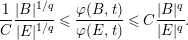 $$\begin{eqnarray}\frac{1}{C}\frac{|B|^{1/q}}{|E|^{1/q}}\leqslant \frac{\unicode[STIX]{x1D711}(B,t)}{\unicode[STIX]{x1D711}(E,t)}\leqslant C\frac{|B|^{q}}{|E|^{q}}.\end{eqnarray}$$
The following lemma is an anisotropic variant of well-known superposition principle of weak type estimates, the proof of which is similar to that of [Reference Bui, Cao, Ky, Yang and Yang14, Lemma 7.13]. When
 $A:=2\text{I}_{n\times n}$
,
 $\unicode[STIX]{x1D70C}(x):=|x|^{n}$
for all
 $x\in \mathbb{R}^{n}$
, and
 $\unicode[STIX]{x1D711}(x,t):=t^{p}$
for all
 $x\in \mathbb{R}^{n}$
and
 $t\in (0,\infty )$
with
 $p\in (0,1)$
, it goes back to the well-known superposition principle of weak type estimates obtained by Stein et al. [Reference Stein, Taibleson and Weiss49, Lemma 1.8] and, independently, by Kalton [Reference Kalton30, Theorem 6.1].
Lemma 3.2. Let
 $\unicode[STIX]{x1D711}$
be an anisotropic growth function as in Definition 2.3 satisfying
 $I(\unicode[STIX]{x1D711})\in (0,1)$
, where
 $I(\unicode[STIX]{x1D711})$
is as in (2.5). Assume that
 $\{a_{j}\}\text{}_{j\in \mathbb{Z}_{+}}$
is a sequence of measurable functions and
 $\{\unicode[STIX]{x1D706}_{j}\}\text{}_{j\in \mathbb{Z}_{+}}\subset \mathbb{C}$
such that there exists a sequence
 $\{x_{j}+B_{l_{j}}\}\text{}_{j\in \mathbb{Z}_{+}}$
of dilated balls, where
 $l_{j}\in \mathbb{Z}$
, it satisfies that
 $$\begin{eqnarray}\mathop{\sum }_{j\in \mathbb{Z}_{+}}\unicode[STIX]{x1D711}\left(x_{j}+B_{l_{j}},\frac{|\unicode[STIX]{x1D706}_{j}|}{\Vert \unicode[STIX]{x1D712}_{x_{j}+B_{l_{j}}}\Vert _{L^{\unicode[STIX]{x1D711}}}}\right)<\infty .\end{eqnarray}$$
Moreover, if there exist positive constants
 $C$
and
 $\unicode[STIX]{x1D702}_{0}$
, where
 $C$
is independent of
 $\unicode[STIX]{x1D702}_{0}$
, such that, for any
 $j\in \mathbb{Z}_{+}$
,
 $$\begin{eqnarray}\unicode[STIX]{x1D711}(\{|\unicode[STIX]{x1D706}_{j}a_{j}|>\unicode[STIX]{x1D702}_{0}\},\unicode[STIX]{x1D702}_{0})\leqslant C\unicode[STIX]{x1D711}\left(x_{j}+B_{l_{j}},\frac{|\unicode[STIX]{x1D706}_{j}|}{\Vert \unicode[STIX]{x1D712}_{x_{j}+B_{l_{j}}}\Vert _{L^{\unicode[STIX]{x1D711}}}}\right),\end{eqnarray}$$
then there exists a positive constant
 $\widetilde{C}$
, independent of
 $\unicode[STIX]{x1D702}_{0}$
, such that
 $$\begin{eqnarray}\unicode[STIX]{x1D711}\left(\left\{\mathop{\sum }_{j\in \mathbb{Z}_{+}}|\unicode[STIX]{x1D706}_{j}a_{j}|>\unicode[STIX]{x1D702}_{0}\right\},\unicode[STIX]{x1D702}_{0}\right)\leqslant \widetilde{C}\mathop{\sum }_{j\in \mathbb{Z}_{+}}\unicode[STIX]{x1D711}\left(x_{j}+B_{l_{j}},\frac{|\unicode[STIX]{x1D706}_{j}|}{\Vert \unicode[STIX]{x1D712}_{x_{j}+B_{l_{j}}}\Vert _{L^{\unicode[STIX]{x1D711}}}}\right).\end{eqnarray}$$
Remark 3.3. It is worth pointing out that the assumption of Lemma 3.2 is weaker than that of [Reference Bui, Cao, Ky, Yang and Yang14, Lemma 7.13] and hence also the conclusion, but it is just enough for later use. Precisely, we only need some constant
 $\unicode[STIX]{x1D702}_{0}\in (0,\infty )$
such that the condition (3.1) holds while, in [Reference Bui, Cao, Ky, Yang and Yang14, Lemma 7.13], the corresponding condition must hold for any
 $\unicode[STIX]{x1D702}\in (0,\infty )$
. Luckily, the proof of Lemma 3.2 is similar to that of [Reference Bui, Cao, Ky, Yang and Yang14, Lemma 7.13], the details being omitted.
The following lemma is a property of anisotropic growth functions, the proof of which is similar to that of [Reference Liang, Yang and Jiang41, Lemma 3.3(ii)], the details being omitted here.
Lemma 3.4. Let
 $\unicode[STIX]{x1D711}$
be an anisotropic growth function as in Definition 2.3. Then, for any
 $f\in WL^{\unicode[STIX]{x1D711}}$
satisfying
 $\Vert f\Vert _{WL^{\unicode[STIX]{x1D711}}}>0$
,
 $$\begin{eqnarray}\sup _{t\in (0,\infty )}\unicode[STIX]{x1D711}\left(\{|f|>t\},\frac{t}{\Vert f\Vert _{WL^{\unicode[STIX]{x1D711}}}}\right)=1.\end{eqnarray}$$
Let
 $s\in \mathbb{N}$
and
 ${\mathcal{P}}_{s}$
denote the linear space of polynomials of degrees not bigger than
 $s$
. Recall that a locally integrable function
 $f$
on
 $\mathbb{R}^{n}$
is said to belong to the weighted anisotropic Campanato space
 ${\mathcal{L}}_{p_{0},\unicode[STIX]{x1D711}(\cdot ,1),s}$
if
 $$\begin{eqnarray}\Vert f\Vert _{{\mathcal{L}}_{p_{0},\unicode[STIX]{x1D711}(\cdot ,1),s}}:=\sup _{B\in {\mathcal{B}}}\frac{1}{[\unicode[STIX]{x1D711}(B,1)]^{1/p_{0}}}\int _{B}|f(x)-P_{B}^{s}f(x)|\,dx<\infty ,\end{eqnarray}$$
where
 $P_{B}^{s}f$
denotes the unique
 $P\in {\mathcal{P}}_{s}$
such that, for any polynomial
 $R$
on
 $\mathbb{R}^{n}$
with order not bigger than
 $s$
,
 $\int _{B}[f(x)-P(x)]R(x)\,dx=0$
.
Lemma 3.5. Let
 $\unicode[STIX]{x1D711}$
be an anisotropic growth function as in Definition 2.3,
 $p_{0}\in (0,i(\unicode[STIX]{x1D711}))$
,
 $q_{0}\in (q(\unicode[STIX]{x1D711}),\infty )$
and
 $s\in \mathbb{N}$
such that
 $s>(q_{0}/p_{0}-1)\log _{(\unicode[STIX]{x1D706}_{-})}b-1$
, where
 $i(\unicode[STIX]{x1D711})$
and
 $q(\unicode[STIX]{x1D711})$
are as in (2.4) and (2.3), respectively. If
 $\unicode[STIX]{x1D719}\in {\mathcal{S}}$
, then
 $\unicode[STIX]{x1D719}\in {\mathcal{L}}_{p_{0},\unicode[STIX]{x1D711}(\cdot ,1),s}$
.
Proof. We show this lemma by borrowing some ideas from the proof of [Reference Liang and Yang40, Proposition 2.3]. For any
 $\unicode[STIX]{x1D719}\in {\mathcal{S}}$
,
 $x\in \mathbb{R}^{n}$
and dilated ball
 $B:=x_{0}+B_{k}\in {\mathcal{B}}$
, where
 $x_{0}\in \mathbb{R}^{n}$
and
 $k\in \mathbb{Z}$
, let
 $$\begin{eqnarray}p_{B}(x):=\mathop{\sum }_{\unicode[STIX]{x1D6FC}\in \mathbb{N}^{n},|\unicode[STIX]{x1D6FC}|\leqslant s}\frac{\unicode[STIX]{x2202}^{\unicode[STIX]{x1D6FC}}\unicode[STIX]{x1D719}(x_{0})}{\unicode[STIX]{x1D6FC}!}(x-x_{0})^{\unicode[STIX]{x1D6FC}}\in {\mathcal{P}}_{s}.\end{eqnarray}$$
Clearly,
 $B\subset B_{k_{0}}$
, where
 $k_{0}:=\unicode[STIX]{x1D70E}+1+\lfloor \log _{b}(b^{k}+\unicode[STIX]{x1D70C}(x_{0}))\rfloor$
. Then, by [Reference Bownik8, p. 51, (8.9)], there exists a positive constant
 $C$
, depending only on
 $s$
, such that, for any
 $\mathbf{B}\in {\mathcal{B}}$
and
 $f\in L^{1}(\mathbf{B})$
,
 $$\begin{eqnarray}\sup _{x\in \mathbf{B}}|P_{\mathbf{B}}^{s}f(x)|\leqslant C\frac{1}{|\mathbf{B}|}\int _{\mathbf{B}}|f(x)|\,dx.\end{eqnarray}$$
From this and Taylor’s theorem, we deduce that, for any
 $x\in B$
, there exists
 $\unicode[STIX]{x1D709}:=\unicode[STIX]{x1D709}(x)\in B$
such that
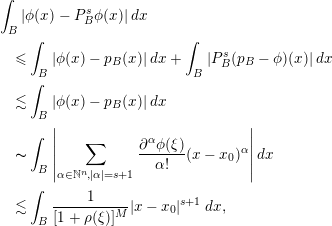 $$\begin{eqnarray}\displaystyle & & \displaystyle \int _{B}|\unicode[STIX]{x1D719}(x)-P_{B}^{s}\unicode[STIX]{x1D719}(x)|\,dx\nonumber\\ \displaystyle & & \displaystyle \quad \leqslant \int _{B}|\unicode[STIX]{x1D719}(x)-p_{B}(x)|\,dx+\int _{B}|P_{B}^{s}(p_{B}-\unicode[STIX]{x1D719})(x)|\,dx\nonumber\\ \displaystyle & & \displaystyle \quad \lesssim \int _{B}|\unicode[STIX]{x1D719}(x)-p_{B}(x)|\,dx\nonumber\\ \displaystyle & & \displaystyle \quad \sim \int _{B}\left|\mathop{\sum }_{\unicode[STIX]{x1D6FC}\in \mathbb{N}^{n},|\unicode[STIX]{x1D6FC}|=s+1}\frac{\unicode[STIX]{x2202}^{\unicode[STIX]{x1D6FC}}\unicode[STIX]{x1D719}(\unicode[STIX]{x1D709})}{\unicode[STIX]{x1D6FC}!}(x-x_{0})^{\unicode[STIX]{x1D6FC}}\right|dx\nonumber\\ \displaystyle & & \displaystyle \quad \lesssim \int _{B}\frac{1}{[1+\unicode[STIX]{x1D70C}(\unicode[STIX]{x1D709})]^{M}}|x-x_{0}|^{s+1}\,dx,\end{eqnarray}$$
where the constant
 $M$
is arbitrary for the moment and will be fixed later.
Now, if
 $k_{0}\leqslant 10\unicode[STIX]{x1D70E}$
, namely,
 $B\subset B_{k_{0}}\subset B_{10\unicode[STIX]{x1D70E}}$
, then, by Lemma 3.1, (3.3) with taking
 $M=0$
,
 $$\begin{eqnarray}\displaystyle |x| & {\lesssim} & \displaystyle [\unicode[STIX]{x1D70C}(x)]^{\log _{b}(\unicode[STIX]{x1D706}_{-})}\unicode[STIX]{x1D712}_{\{y\in \mathbb{R}^{n}:\unicode[STIX]{x1D70C}(y)<1\}}(x)\nonumber\\ \displaystyle & & \displaystyle +\,[\unicode[STIX]{x1D70C}(x)]^{\log _{b}(\unicode[STIX]{x1D706}_{+})}\unicode[STIX]{x1D712}_{\{y\in \mathbb{R}^{n}:\unicode[STIX]{x1D70C}(y)\geqslant 1\}}(x)\quad (\text{see [8, p. 11, Lemma 3.2]})\end{eqnarray}$$
and
 $s>(q_{0}/p_{0}-1)\log _{(\unicode[STIX]{x1D706}_{-})}b-1$
, we see that
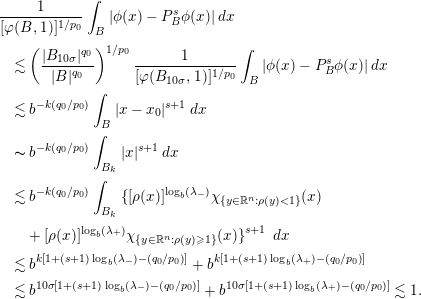 $$\begin{eqnarray}\displaystyle & & \displaystyle \frac{1}{[\unicode[STIX]{x1D711}(B,1)]^{1/p_{0}}}\int _{B}|\unicode[STIX]{x1D719}(x)-P_{B}^{s}\unicode[STIX]{x1D719}(x)|\,dx\nonumber\\ \displaystyle & & \displaystyle \quad \lesssim \left(\frac{|B_{10\unicode[STIX]{x1D70E}}|^{q_{0}}}{|B|^{q_{0}}}\right)^{1/p_{0}}\frac{1}{[\unicode[STIX]{x1D711}(B_{10\unicode[STIX]{x1D70E}},1)]^{1/p_{0}}}\int _{B}|\unicode[STIX]{x1D719}(x)-P_{B}^{s}\unicode[STIX]{x1D719}(x)|\,dx\nonumber\\ \displaystyle & & \displaystyle \quad \lesssim b^{-k(q_{0}/p_{0})}\int _{B}|x-x_{0}|^{s+1}\,dx\nonumber\\ \displaystyle & & \displaystyle \quad \sim b^{-k(q_{0}/p_{0})}\int _{B_{k}}|x|^{s+1}\,dx\nonumber\\ \displaystyle & & \displaystyle \quad \lesssim b^{-k(q_{0}/p_{0})}\int _{B_{k}}\{[\unicode[STIX]{x1D70C}(x)]^{\log _{b}(\unicode[STIX]{x1D706}_{-})}\unicode[STIX]{x1D712}_{\{y\in \mathbb{R}^{n}:\unicode[STIX]{x1D70C}(y)<1\}}(x)\nonumber\\ \displaystyle & & \displaystyle \qquad +\,[\unicode[STIX]{x1D70C}(x)]^{\log _{b}(\unicode[STIX]{x1D706}_{+})}\unicode[STIX]{x1D712}_{\{y\in \mathbb{R}^{n}:\unicode[STIX]{x1D70C}(y)\geqslant 1\}}(x)\!\}^{s+1}\,dx\nonumber\\ \displaystyle & & \displaystyle \quad \lesssim b^{k[1+(s+1)\log _{b}(\unicode[STIX]{x1D706}_{-})-(q_{0}/p_{0})]}+b^{k[1+(s+1)\log _{b}(\unicode[STIX]{x1D706}_{+})-(q_{0}/p_{0})]}\nonumber\\ \displaystyle & & \displaystyle \quad \lesssim b^{10\unicode[STIX]{x1D70E}[1+(s+1)\log _{b}(\unicode[STIX]{x1D706}_{-})-(q_{0}/p_{0})]}+b^{10\unicode[STIX]{x1D70E}[1+(s+1)\log _{b}(\unicode[STIX]{x1D706}_{+})-(q_{0}/p_{0})]}\lesssim 1.\end{eqnarray}$$
If
 $k_{0}>10\unicode[STIX]{x1D70E}$
and
 $\unicode[STIX]{x1D70C}(x_{0})\leqslant b^{k+2\unicode[STIX]{x1D70E}}$
, then
 $|B|\sim |B_{k_{0}}|$
. From this, Lemma 3.1,
 $|B_{10\unicode[STIX]{x1D70E}}|<|B_{k_{0}}|$
, (3.2) and Remark 2.5, we deduce that
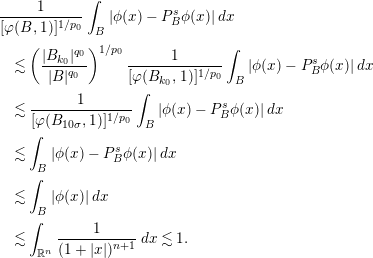 $$\begin{eqnarray}\displaystyle & & \displaystyle \frac{1}{[\unicode[STIX]{x1D711}(B,1)]^{1/p_{0}}}\int _{B}|\unicode[STIX]{x1D719}(x)-P_{B}^{s}\unicode[STIX]{x1D719}(x)|\,dx\nonumber\\ \displaystyle & & \displaystyle \quad \lesssim \left(\frac{|B_{k_{0}}|^{q_{0}}}{|B|^{q_{0}}}\right)^{1/p_{0}}\frac{1}{[\unicode[STIX]{x1D711}(B_{k_{0}},1)]^{1/p_{0}}}\int _{B}|\unicode[STIX]{x1D719}(x)-P_{B}^{s}\unicode[STIX]{x1D719}(x)|\,dx\nonumber\\ \displaystyle & & \displaystyle \quad \lesssim \frac{1}{[\unicode[STIX]{x1D711}(B_{10\unicode[STIX]{x1D70E}},1)]^{1/p_{0}}}\int _{B}|\unicode[STIX]{x1D719}(x)-P_{B}^{s}\unicode[STIX]{x1D719}(x)|\,dx\nonumber\\ \displaystyle & & \displaystyle \quad \lesssim \int _{B}|\unicode[STIX]{x1D719}(x)-P_{B}^{s}\unicode[STIX]{x1D719}(x)|\,dx\nonumber\\ \displaystyle & & \displaystyle \quad \lesssim \int _{B}|\unicode[STIX]{x1D719}(x)|\,dx\nonumber\\ \displaystyle & & \displaystyle \quad \lesssim \int _{\mathbb{R}^{n}}\frac{1}{(1+|x|)^{n+1}}\,dx\lesssim 1.\end{eqnarray}$$
If
 $k_{0}>10\unicode[STIX]{x1D70E}$
and
 $\unicode[STIX]{x1D70C}(x_{0})>b^{k+2\unicode[STIX]{x1D70E}}$
, then, for any
 $x\in B$
, it holds true that
 $b^{k}\lesssim \unicode[STIX]{x1D70C}(x)\sim \unicode[STIX]{x1D70C}(x_{0})$
. From this, Lemma 3.1, (3.3) with taking
 $M=(1/p_{0})(q_{0}-1/q_{0})+[1+(s+1)\log _{b}(\unicode[STIX]{x1D706}_{+})-q_{0}/p_{0}]$
, (3.4) and
 $s>(q_{0}/p_{0}-1)\log _{(\unicode[STIX]{x1D706}_{-})}b-1$
, we deduce that
 $$\begin{eqnarray}\displaystyle \quad & & \displaystyle \frac{1}{[\unicode[STIX]{x1D711}(B,1)]^{1/p_{0}}}\int _{B}|\unicode[STIX]{x1D719}(x)-P_{B}^{s}\unicode[STIX]{x1D719}(x)|\,dx\nonumber\\ \displaystyle & & \displaystyle \quad \lesssim \left(\frac{|B_{k_{0}}|^{q_{0}}}{|B|^{q_{0}}}\right)^{1/p_{0}}\frac{1}{[\unicode[STIX]{x1D711}(B_{k_{0}},1)]^{1/p_{0}}}\int _{B}|\unicode[STIX]{x1D719}(x)-P_{B}^{s}\unicode[STIX]{x1D719}(x)|\,dx\nonumber\\ \displaystyle & & \displaystyle \quad \lesssim \left(\frac{|B_{k_{0}}|^{q_{0}}}{|B|^{q_{0}}}\right)^{1/p_{0}}\left(\frac{|B_{10\unicode[STIX]{x1D70E}}|^{1/q_{0}}}{|B_{k_{0}}|^{1/q_{0}}}\right)^{1/p_{0}}\frac{1}{[\unicode[STIX]{x1D711}(B_{10\unicode[STIX]{x1D70E}},1)]^{1/p_{0}}}\nonumber\\ \displaystyle & & \displaystyle \qquad \times \int _{B}|\unicode[STIX]{x1D719}(x)-P_{B}^{s}\unicode[STIX]{x1D719}(x)|\,dx\nonumber\\ \displaystyle & & \displaystyle \quad \lesssim |B_{k_{0}}|^{(1/p_{0})(q_{0}-1/q_{0})}|B|^{-q_{0}/p_{0}}\int _{B}\frac{1}{[1+\unicode[STIX]{x1D70C}(\unicode[STIX]{x1D709})]^{M}}|x-x_{0}|^{s+1}\,dx\nonumber\\ \displaystyle & & \displaystyle \quad \lesssim |B_{k_{0}}|^{(1/p_{0})(q_{0}-1/q_{0})}|B|^{-q_{0}/p_{0}}\frac{1}{[1+\unicode[STIX]{x1D70C}(x_{0})]^{M}}\int _{B_{k}}|x|^{s+1}\,dx\nonumber\\ \displaystyle & & \displaystyle \quad \lesssim b^{k_{0}(1/p_{0})(q_{0}-1/q_{0})}b^{-k(q_{0}/p_{0})}\frac{1}{[1+\unicode[STIX]{x1D70C}(x_{0})]^{M}}\nonumber\\ \displaystyle & & \displaystyle \qquad \times \,(b^{k+k(s+1)\log _{b}(\unicode[STIX]{x1D706}_{-})}+b^{k+k(s+1)\log _{b}(\unicode[STIX]{x1D706}_{+})})\nonumber\\ \displaystyle & & \displaystyle \quad \lesssim b^{[\unicode[STIX]{x1D70E}+1+\log _{b}(b^{k}+\unicode[STIX]{x1D70C}(x_{0}))](1/p_{0})(q_{0}-1/q_{0})}\frac{1}{[1+\unicode[STIX]{x1D70C}(x_{0})]^{M}}\nonumber\\ \displaystyle & & \displaystyle \qquad \times \,(b^{k[1+(s+1)\log _{b}(\unicode[STIX]{x1D706}_{-})-q_{0}/p_{0}]}+b^{k[1+(s+1)\log _{b}(\unicode[STIX]{x1D706}_{+})-q_{0}/p_{0}]})\nonumber\\ \displaystyle & & \displaystyle \quad \lesssim [\unicode[STIX]{x1D70C}(x_{0})]^{(1/p_{0})(q_{0}-(1/q_{0}))}\frac{1}{[1+\unicode[STIX]{x1D70C}(x_{0})]^{M}}\nonumber\\ \displaystyle & & \displaystyle \qquad \times \,([\unicode[STIX]{x1D70C}(x_{0})]^{(1+(s+1)\log _{b}(\unicode[STIX]{x1D706}_{-})-q_{0}/p_{0})}+[\unicode[STIX]{x1D70C}(x_{0})]^{(1+(s+1)\log _{b}(\unicode[STIX]{x1D706}_{+})-q_{0}/p_{0})})\nonumber\\ \displaystyle & & \displaystyle \quad \lesssim 1.\end{eqnarray}$$
Combining (3.5), (3.6) and (3.7), we see that
 $\Vert \unicode[STIX]{x1D719}\Vert _{{\mathcal{L}}_{p_{0},\unicode[STIX]{x1D711}(\cdot ,1),s}}\lesssim 1$
. This finishes the proof of Lemma 3.5.◻
Definition 3.6. For any measurable subset
 $E$
of
 $\mathbb{R}^{n}$
, the space
 $L_{\unicode[STIX]{x1D711}}^{q}(E)$
for
 $q\in [1,\infty ]$
is defined as the set of all measurable functions
 $f$
on
 $E$
such that
 $$\begin{eqnarray}\Vert f\Vert _{L_{\unicode[STIX]{x1D711}}^{q}(E)}:=\left\{\begin{array}{@{}ll@{}}\displaystyle \sup _{t\in (0,\infty )}\left[\frac{1}{\unicode[STIX]{x1D711}(E,t)}\int _{E}|f(x)|^{q}\unicode[STIX]{x1D711}(x,t)\,dx\right]^{1/q}<\infty , & q\in [1,\infty );\\ \Vert f\Vert _{L^{\infty }(E)}<\infty , & q=\infty .\end{array}\right.\end{eqnarray}$$
Recall that the Musielak–Orlicz space
 $L^{\unicode[STIX]{x1D711}}$
is defined as the set of all measurable functions
 $f$
such that, for some
 $\unicode[STIX]{x1D706}\in (0,\infty )$
,
 $$\begin{eqnarray}\int _{\mathbb{R}^{n}}\unicode[STIX]{x1D711}(x,|f(x)|/\unicode[STIX]{x1D706})\,dx<\infty\end{eqnarray}$$
equipped with the Luxembourg (or called the Luxembourg–Nakano) (quasi-) norm
 $$\begin{eqnarray}\Vert f\Vert _{L^{\unicode[STIX]{x1D711}}}:=\inf \left\{\unicode[STIX]{x1D706}\in (0,\infty ):\int _{\mathbb{R}^{n}}\unicode[STIX]{x1D711}(x,|f(x)|/\unicode[STIX]{x1D706})\,dx\leqslant 1\right\}.\end{eqnarray}$$
Definition 3.7. Let
 $\unicode[STIX]{x1D711}$
be an anisotropic growth function as in Definition 2.3.
(i) An anisotropic triplet
$(\unicode[STIX]{x1D711},q,s)$
is said to be admissible, if
$q\in (q(\unicode[STIX]{x1D711}),\infty ]$
and
$s\in [m(\unicode[STIX]{x1D711}),\infty )\cap \mathbb{N}$
, where
$q(\unicode[STIX]{x1D711})$
and
$m(\unicode[STIX]{x1D711})$
are as in (2.3) and (2.8), respectively.(ii) For an admissible anisotropic triplet
$(\unicode[STIX]{x1D711},q,s)$
, a measurable function
$a$
is called an anisotropic
$(\unicode[STIX]{x1D711},q,s)$
-atom associated with some dilated ball
$B\in {\mathcal{B}}$
if it satisfies the following three conditions:(a)
$\text{supp}\,a\subset B$
;(b)
$\Vert a\Vert _{L_{\unicode[STIX]{x1D711}}^{q}(B)}\leqslant \Vert \unicode[STIX]{x1D712}_{B}\Vert _{L^{\unicode[STIX]{x1D711}}}^{-1}$
;(c)
$\int _{\mathbb{R}^{n}}a(x)x^{\unicode[STIX]{x1D6FC}}\,dx=0$
for any
$\unicode[STIX]{x1D6FC}\in \mathbb{N}^{n}$
with
$|\unicode[STIX]{x1D6FC}|\leqslant s$
.









Now, via anisotropic
 $(\unicode[STIX]{x1D711},q,s)$
-atom as in Definition 3.7, we introduce the definition of anisotropic weak Musielak–Orlicz atomic Hardy space as follows, which is motivated by Liang et al. [Reference Liang, Yang and Jiang41, Definition 3.7].
Definition 3.8. For an admissible anisotropic triplet
 $(\unicode[STIX]{x1D711},q,s)$
as in Definition 3.7, the anisotropic weak Musielak–Orlicz atomic Hardy space
 $\mathit{WH}_{A,\text{at}}^{\unicode[STIX]{x1D711},q,s}$
is defined as the space of all
 $f\in {\mathcal{S}}^{\prime }$
satisfying that there exist a sequence of anisotropic
 $(\unicode[STIX]{x1D711},q,s)$
-atoms,
 $\{a_{i}^{k}\}\text{}_{k\in \mathbb{Z},i}$
, associated with dilated balls
 $\{B_{i}^{k}\}\text{}_{k\in \mathbb{Z},i}$
, and a positive constant
 $C$
such that
 $\sum _{i}\unicode[STIX]{x1D712}_{B_{i}^{k}}(x)\leqslant C$
for any
 $x\in \mathbb{R}^{n}$
and
 $k\in \mathbb{Z}$
, and
 $f=\sum _{k\in \mathbb{Z}}\sum _{i}\unicode[STIX]{x1D706}_{i}^{k}a_{i}^{k}$
in
 ${\mathcal{S}}^{\prime }$
, where
 $\unicode[STIX]{x1D706}_{i}^{k}:=\widetilde{C}2^{k}\Vert \unicode[STIX]{x1D712}_{B_{i}^{k}}\Vert _{L^{\unicode[STIX]{x1D711}}}$
for any
 $k\in \mathbb{Z}$
and
 $i$
with
 $\widetilde{C}$
being a positive constant independent of
 $f$
.
Moreover, define
 $$\begin{eqnarray}\Vert f\Vert _{\mathit{WH}_{A,\text{at}}^{\unicode[STIX]{x1D711},q,s}}:=\inf \left\{\inf \left\{\unicode[STIX]{x1D706}\in (0,\infty ):\sup _{k\in \mathbb{Z}}\left\{\mathop{\sum }_{i}\unicode[STIX]{x1D711}\left(B_{i}^{k},\frac{2^{k}}{\unicode[STIX]{x1D706}}\right)\right\}\leqslant 1\right\}\right\},\end{eqnarray}$$
where the first infimum is taken over all decompositions of
 $f$
as above.
The following is the atomic characterization of
 $\mathit{WH}_{A}^{\unicode[STIX]{x1D711}}$
.
Lemma 3.9. Let
 $(\unicode[STIX]{x1D711},q,s)$
be an admissible anisotropic triplet as in Definition 3.7. If
 $m\in [m(\unicode[STIX]{x1D711}),\infty )\cap \mathbb{N}$
, where
 $m(\unicode[STIX]{x1D711})$
is as in (2.8), then
 $$\begin{eqnarray}\mathit{WH}_{A,m}^{\unicode[STIX]{x1D711}}=\mathit{WH}_{A,\text{at}}^{\unicode[STIX]{x1D711},q,s}\end{eqnarray}$$
with equivalent quasinorms.
Proof.
Step 1. In this step, we prove, for any
 $m\in [m(\unicode[STIX]{x1D711}),\infty )\cap \mathbb{N}$
,
 $\mathit{WH}_{A,\text{at}}^{\unicode[STIX]{x1D711},q,s}\subset \mathit{WH}_{A,m}^{\unicode[STIX]{x1D711}}$
.
The argument presented in this step partly follows the proof of [Reference Liang, Yang and Jiang41, Theorem 3.5]. For any
 $f\in \mathit{WH}_{A,\text{at}}^{\unicode[STIX]{x1D711},q,s}$
, by Definition 3.8, we know that there exist a sequence of multiples of anisotropic
 $(\unicode[STIX]{x1D711},q,s)$
-atoms,
 $\{f_{i}^{k}\}\text{}_{k\in \mathbb{Z},i}$
, associated with dilated balls
 $\{B_{i}^{k}\}\text{}_{k\in \mathbb{Z},i}$
, where
 $B_{i}^{k}\in {\mathcal{B}}$
, such that
 $f=\sum _{k\in \mathbb{Z}}\sum _{i}f_{i}^{k}$
in
 ${\mathcal{S}}^{\prime }$
,
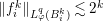 $\Vert f_{i}^{k}\Vert _{L_{\unicode[STIX]{x1D711}}^{q}(B_{i}^{k})}\lesssim 2^{k}$
for any
 $k\in \mathbb{Z}$
and
 $i$
,
 $\sum _{i}\unicode[STIX]{x1D712}_{B_{i}^{k}}(x)\lesssim 1$
for any
 $x\in \mathbb{R}^{n}$
and
 $k\in \mathbb{Z}$
, and
 $$\begin{eqnarray}\Vert f\Vert _{\mathit{WH}_{A,\text{at}}^{\unicode[STIX]{x1D711},q,s}}\sim \inf \left\{\unicode[STIX]{x1D706}\in (0,\infty ):\sup _{k\in \mathbb{Z}}\left\{\mathop{\sum }_{i}\unicode[STIX]{x1D711}\left(B_{i}^{k},\frac{2^{k}}{\unicode[STIX]{x1D706}}\right)\right\}\leqslant 1\right\}.\end{eqnarray}$$
Thus, to show
 $\mathit{WH}_{A,\text{at}}^{\unicode[STIX]{x1D711},q,s}\subset \mathit{WH}_{A,m}^{\unicode[STIX]{x1D711}}$
, it suffices to prove that, for any
 $\unicode[STIX]{x1D6FC},\unicode[STIX]{x1D706}\in (0,\infty )$
and
 $m\in [m(\unicode[STIX]{x1D711}),\infty )\cap \mathbb{N}$
,
 $$\begin{eqnarray}\unicode[STIX]{x1D711}\left(\{f_{m}^{\ast }>\unicode[STIX]{x1D6FC}\},\frac{\unicode[STIX]{x1D6FC}}{\unicode[STIX]{x1D706}}\right)\lesssim \sup _{k\in \mathbb{Z}}\left\{\mathop{\sum }_{i}\unicode[STIX]{x1D711}\left(B_{i}^{k},\frac{2^{k}}{\unicode[STIX]{x1D706}}\right)\right\},\end{eqnarray}$$
where
 $f_{m}^{\ast }$
is as in (2.7).
To show (3.9), we may assume that there exists some
 $k_{0}\in \mathbb{Z}$
such that
 $\unicode[STIX]{x1D6FC}=2^{k_{0}}$
without loss of generality. Write
 $$\begin{eqnarray}f=\mathop{\sum }_{k=-\infty }^{k_{0}-1}\mathop{\sum }_{i}f_{i}^{k}+\mathop{\sum }_{k=k_{0}}^{\infty }\mathop{\sum }_{i}f_{i}^{k}=:F_{1}+F_{2}.\end{eqnarray}$$
For
 $F_{1}$
, by repeating the estimate of
 $F_{1}$
in the proof of [Reference Liang, Yang and Jiang41, Theorem 3.5] with
 $b_{i,j}$
and
 $2^{i_{0}}$
replaced by
 $f_{i}^{k}$
and
 $2^{k_{0}}$
, respectively, we have
 $$\begin{eqnarray}\unicode[STIX]{x1D711}\left(\left\{(F_{1})_{m}^{\ast }>2^{k_{0}}\right\},\frac{2^{k_{0}}}{\unicode[STIX]{x1D706}}\right)\lesssim \sup _{k\in \mathbb{Z}}\left\{\mathop{\sum }_{i}\unicode[STIX]{x1D711}\left(B_{i}^{k},\frac{2^{k}}{\unicode[STIX]{x1D706}}\right)\right\}.\end{eqnarray}$$
Let
 $B_{i}^{k}:=x_{i}^{k}+B_{l_{i}^{k}}$
with
 $x_{i}^{k}\in \mathbb{R}^{n}$
and
 $l_{i}^{k}\in \mathbb{Z}$
, and
 $A_{k_{0}}:=\bigcup _{k=k_{0}}^{\infty }\bigcup _{i}(x_{i}^{k}+B_{l_{i}^{k}+\unicode[STIX]{x1D70E}})$
. Now we are interested in
 $(F_{2})_{m}^{\ast }$
. To show that
 $$\begin{eqnarray}\unicode[STIX]{x1D711}\left(\{(F_{2})_{m}^{\ast }>2^{k_{0}}\},\frac{2^{k_{0}}}{\unicode[STIX]{x1D706}}\right)\lesssim \sup _{k\in \mathbb{Z}}\left\{\mathop{\sum }_{i}\unicode[STIX]{x1D711}\left(B_{i}^{k},\frac{2^{k}}{\unicode[STIX]{x1D706}}\right)\right\},\end{eqnarray}$$
we cut
 $\{(F_{2})_{m}^{\ast }>2^{k_{0}}\}$
into
 $A_{k_{0}}$
and
 $\{x\in (A_{k_{0}})^{\complement }:(F_{2})_{m}^{\ast }(x)>2^{k_{0}}\}$
.
Since
 $\unicode[STIX]{x1D711}$
is of uniformly lower type
 $p$
and, by Lemma 3.1 with
 $\unicode[STIX]{x1D711}\in \mathbb{A}_{\infty }(A)$
,
 $\unicode[STIX]{x1D711}(x_{i}^{k}+B_{l_{i}^{k}+\unicode[STIX]{x1D70E}},2^{k_{0}}/\unicode[STIX]{x1D706})\lesssim \unicode[STIX]{x1D711}(B_{i}^{k},2^{k_{0}}/\unicode[STIX]{x1D706})$
, it follows that, for any
 $\unicode[STIX]{x1D706}\in (0,\infty )$
,
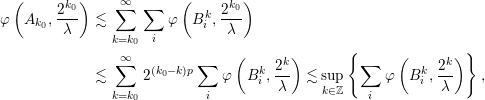 $$\begin{eqnarray}\displaystyle \unicode[STIX]{x1D711}\left(A_{k_{0}},\frac{2^{k_{0}}}{\unicode[STIX]{x1D706}}\right) & {\lesssim} & \displaystyle \mathop{\sum }_{k=k_{0}}^{\infty }\mathop{\sum }_{i}\unicode[STIX]{x1D711}\left(B_{i}^{k},\frac{2^{k_{0}}}{\unicode[STIX]{x1D706}}\right)\nonumber\\ \displaystyle & {\lesssim} & \displaystyle \mathop{\sum }_{k=k_{0}}^{\infty }2^{(k_{0}-k)p}\mathop{\sum }_{i}\unicode[STIX]{x1D711}\left(B_{i}^{k},\frac{2^{k}}{\unicode[STIX]{x1D706}}\right)\lesssim \sup _{k\in \mathbb{Z}}\left\{\mathop{\sum }_{i}\unicode[STIX]{x1D711}\left(B_{i}^{k},\frac{2^{k}}{\unicode[STIX]{x1D706}}\right)\right\},\end{eqnarray}$$
which is wished.
By Definition 3.8, we assume that
 $f_{i}^{k}:=\unicode[STIX]{x1D706}_{i}^{k}a_{i}^{k}$
, where
 $a_{i}^{k}$
for any
 $k\in \mathbb{Z}$
and
 $i$
is an anisotropic
 $(\unicode[STIX]{x1D711},q,s)$
-atom and
 $\unicode[STIX]{x1D706}_{i}^{k}:=\widetilde{C}2^{k}\Vert \unicode[STIX]{x1D712}_{B_{i}^{k}}\Vert _{L^{\unicode[STIX]{x1D711}}}$
. Since
 $x\in (A_{k_{0}})^{\complement }\subset x_{i}^{k}+(B_{l_{i}^{k}+\unicode[STIX]{x1D70E}})^{\complement }$
, it follows that there exists some
 $j\in \mathbb{N}$
such that
 $x\in x_{i}^{k}+B_{l_{i}^{k}+\unicode[STIX]{x1D70E}+j+1}\setminus B_{l_{i}^{k}+\unicode[STIX]{x1D70E}+j}$
. By repeating the estimate of (100) in [Reference Li, Yang and Yuan37, p. 12], we obtain that
 $$\begin{eqnarray}(a_{i}^{k})_{m}^{\ast }(x)\lesssim [b(\unicode[STIX]{x1D706}_{-})^{s+1}]^{-j}\Vert a_{i}^{k}\Vert _{L_{\unicode[STIX]{x1D711}}^{q}(B_{i}^{k})}.\end{eqnarray}$$
From this,
 $\unicode[STIX]{x1D706}_{i}^{k}=\widetilde{C}2^{k}\Vert \unicode[STIX]{x1D712}_{B_{i}^{k}}\Vert _{L^{\unicode[STIX]{x1D711}}}$
, (b) of Definition 3.7(ii) and
 $\unicode[STIX]{x1D70C}(x-x_{i}^{k})=b^{l_{i}^{k}+\unicode[STIX]{x1D70E}+j}$
, we deduce that
 $$\begin{eqnarray}\displaystyle (f_{i}^{k})_{m}^{\ast }(x) & {\lesssim} & \displaystyle [b(\unicode[STIX]{x1D706}_{-})^{s+1}]^{-j}\unicode[STIX]{x1D706}_{i}^{k}\Vert a_{i}^{k}\Vert _{L_{\unicode[STIX]{x1D711}}^{q}(B_{i}^{k})}\nonumber\\ \displaystyle & {\lesssim} & \displaystyle 2^{k}[b(\unicode[STIX]{x1D706}_{-})^{s+1}]^{-j}\lesssim 2^{k}\left[\frac{b^{l_{i}^{k}}}{\unicode[STIX]{x1D70C}(x-x_{i}^{k})}\right]^{M},\end{eqnarray}$$
where
 $M:=(s+1)\log _{b}(\unicode[STIX]{x1D706}_{-})+1$
.
Since
 $s\geqslant m(\unicode[STIX]{x1D711})=\lfloor (q(\unicode[STIX]{x1D711})/i(\unicode[STIX]{x1D711})-1)\log _{(\unicode[STIX]{x1D706}_{-})}b\rfloor$
, it follows that there exist
 $q_{0}\in (q(\unicode[STIX]{x1D711}),\infty )$
and
 $p_{0}\in (0,i(\unicode[STIX]{x1D711}))$
such that
 $s>(q_{0}/p_{0}-1)\log _{(\unicode[STIX]{x1D706}_{-})}b-1$
and hence
 $p_{0}M-q_{0}>0$
. For any
 $k\in \mathbb{Z}$
,
 $i$
and
 $\unicode[STIX]{x1D706}\in (0,\infty )$
, by (3.13) and Lemma 3.1 with
 $\unicode[STIX]{x1D711}\in \mathbb{A}_{q_{0}}(A)$
, we have
 $$\begin{eqnarray}\displaystyle & & \displaystyle \unicode[STIX]{x1D711}\left(\{x\in (A_{k_{0}})^{\complement }:(f_{i}^{k})_{m}^{\ast }(x)>2^{k_{0}}\},\frac{2^{k_{0}}}{\unicode[STIX]{x1D706}}\right)\nonumber\\ \displaystyle & & \displaystyle \quad \lesssim \unicode[STIX]{x1D711}\left(\{x\in \mathbb{R}^{n}:\unicode[STIX]{x1D70C}(x-x_{i}^{k})<2^{(k-k_{0})/M}b^{l_{i}^{k}}\},\frac{2^{k_{0}}}{\unicode[STIX]{x1D706}}\right).\end{eqnarray}$$
Notice that
 $b>1$
, then there exists some
 $\widetilde{k}\in \mathbb{Z}_{+}$
such that
 $b^{\widetilde{k}}\sim 2^{1/M}$
. By Lemma 3.1 with
 $\unicode[STIX]{x1D711}\in \mathbb{A}_{q_{0}}(A)$
and uniformly lower type
 $p_{0}$
property of
 $\unicode[STIX]{x1D711}$
, we see that (3.14) is bounded by a positive constant times
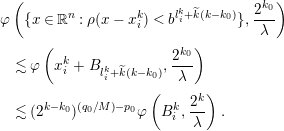 $$\begin{eqnarray}\displaystyle & & \displaystyle \unicode[STIX]{x1D711}\left(\{x\in \mathbb{R}^{n}:\unicode[STIX]{x1D70C}(x-x_{i}^{k})<b^{l_{i}^{k}+\widetilde{k}(k-k_{0})}\},\frac{2^{k_{0}}}{\unicode[STIX]{x1D706}}\right)\nonumber\\ \displaystyle & & \displaystyle \quad \lesssim \unicode[STIX]{x1D711}\left(x_{i}^{k}+B_{l_{i}^{k}+\widetilde{k}(k-k_{0})},\frac{2^{k_{0}}}{\unicode[STIX]{x1D706}}\right)\nonumber\\ \displaystyle & & \displaystyle \quad \lesssim (2^{k-k_{0}})^{(q_{0}/M)-p_{0}}\unicode[STIX]{x1D711}\left(B_{i}^{k},\frac{2^{k}}{\unicode[STIX]{x1D706}}\right).\end{eqnarray}$$
Therefore, we know that, for any
 $\unicode[STIX]{x1D706}\in (0,\infty )$
,
 $$\begin{eqnarray}\unicode[STIX]{x1D711}\left(\{x\in (A_{k_{0}})^{\complement }:(f_{i}^{k})_{m}^{\ast }(x)>2^{k_{0}}\},\frac{2^{k_{0}}}{\unicode[STIX]{x1D706}}\right)\lesssim (2^{k-k_{0}})^{(q_{0}/M)-p_{0}}\unicode[STIX]{x1D711}\left(B_{i}^{k},\frac{2^{k}}{\unicode[STIX]{x1D706}}\right).\end{eqnarray}$$
Because
 $\unicode[STIX]{x1D711}$
is of uniformly upper type 1, we cannot use the superposition principle of weak type estimates directly. Instead, we introduce an auxiliary function
 $\widetilde{\unicode[STIX]{x1D711}}$
. For any
 $x\in \mathbb{R}^{n}$
and
 $t\in (0,\infty )$
, let
 $\widetilde{\unicode[STIX]{x1D711}}(x,t):=\unicode[STIX]{x1D711}(x,t)t^{(q_{0}/M)-p_{0}}$
, then
 $\widetilde{\unicode[STIX]{x1D711}}$
is an anisotropic Musielak–Orlicz function of uniformly lower type
 $q_{0}/M$
and of uniformly upper type
 $1+q_{0}/M-p_{0}$
.
Let
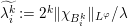 $\widetilde{\unicode[STIX]{x1D706}_{i}^{k}}:=2^{k}\Vert \unicode[STIX]{x1D712}_{B_{i}^{k}}\Vert _{L^{\unicode[STIX]{x1D711}}}/\unicode[STIX]{x1D706}$
,
 $$\begin{eqnarray}\widetilde{a_{i}^{k}}(x):=\frac{1}{\Vert \unicode[STIX]{x1D712}_{B_{i}^{k}}\Vert _{L^{\unicode[STIX]{x1D711}}}}\left[\frac{b^{l_{i}^{k}}}{\unicode[STIX]{x1D70C}(x-x_{i}^{k})}\right]^{M}\qquad \text{and}\qquad \unicode[STIX]{x1D702}_{0}:=\frac{2^{k_{0}}}{\unicode[STIX]{x1D706}}.\end{eqnarray}$$
Then, by (3.14) and (3.15), we have
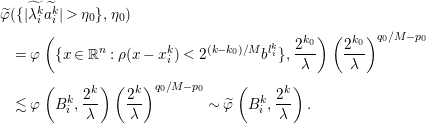 $$\begin{eqnarray}\displaystyle \qquad & & \displaystyle \widetilde{\unicode[STIX]{x1D711}}(\{|\widetilde{\unicode[STIX]{x1D706}_{i}^{k}}\widetilde{a_{i}^{k}}|>\unicode[STIX]{x1D702}_{0}\},\unicode[STIX]{x1D702}_{0})\nonumber\\ \displaystyle & & \displaystyle \quad =\unicode[STIX]{x1D711}\left(\{x\in \mathbb{R}^{n}:\unicode[STIX]{x1D70C}(x-x_{i}^{k})<2^{(k-k_{0})/M}b^{l_{i}^{k}}\},\frac{2^{k_{0}}}{\unicode[STIX]{x1D706}}\right)\left(\frac{2^{k_{0}}}{\unicode[STIX]{x1D706}}\right)^{q_{0}/M-p_{0}}\nonumber\\ \displaystyle & & \displaystyle \quad \lesssim \unicode[STIX]{x1D711}\left(B_{i}^{k},\frac{2^{k}}{\unicode[STIX]{x1D706}}\right)\left(\frac{2^{k}}{\unicode[STIX]{x1D706}}\right)^{q_{0}/M-p_{0}}\sim \widetilde{\unicode[STIX]{x1D711}}\left(B_{i}^{k},\frac{2^{k}}{\unicode[STIX]{x1D706}}\right).\end{eqnarray}$$
By
 $q_{0}/M-p_{0}<0$
and (3.8), we see that
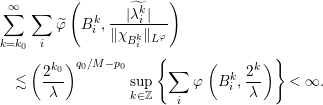 $$\begin{eqnarray}\displaystyle & & \displaystyle \mathop{\sum }_{k=k_{0}}^{\infty }\mathop{\sum }_{i}\widetilde{\unicode[STIX]{x1D711}}\left(B_{i}^{k},\frac{|\widetilde{\unicode[STIX]{x1D706}_{i}^{k}}|}{\Vert \unicode[STIX]{x1D712}_{B_{i}^{k}}\Vert _{L^{\unicode[STIX]{x1D711}}}}\right)\nonumber\\ \displaystyle & & \displaystyle \quad \lesssim \left(\frac{2^{k_{0}}}{\unicode[STIX]{x1D706}}\right)^{q_{0}/M-p_{0}}\sup _{k\in \mathbb{Z}}\left\{\mathop{\sum }_{i}\unicode[STIX]{x1D711}\left(B_{i}^{k},\frac{2^{k}}{\unicode[STIX]{x1D706}}\right)\right\}<\infty .\end{eqnarray}$$
Thus, from (3.13), Lemma 3.2 with (3.16), (3.17) and
 $I(\widetilde{\unicode[STIX]{x1D711}})\in (0,1)$
, and
 $q_{0}/M-p_{0}<0$
, it follows that, for any
 $\unicode[STIX]{x1D706}\in (0,\infty )$
,
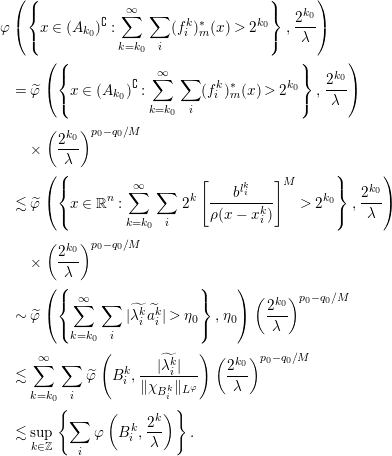 $$\begin{eqnarray}\displaystyle \quad & & \displaystyle \unicode[STIX]{x1D711}\left(\left\{x\in (A_{k_{0}})^{\complement }:\mathop{\sum }_{k=k_{0}}^{\infty }\mathop{\sum }_{i}(f_{i}^{k})_{m}^{\ast }(x)>2^{k_{0}}\right\},\frac{2^{k_{0}}}{\unicode[STIX]{x1D706}}\right)\nonumber\\ \displaystyle & & \displaystyle \quad =\widetilde{\unicode[STIX]{x1D711}}\left(\left\{x\in (A_{k_{0}})^{\complement }:\mathop{\sum }_{k=k_{0}}^{\infty }\mathop{\sum }_{i}(f_{i}^{k})_{m}^{\ast }(x)>2^{k_{0}}\right\},\frac{2^{k_{0}}}{\unicode[STIX]{x1D706}}\right)\nonumber\\ \displaystyle & & \displaystyle \qquad \times \left(\frac{2^{k_{0}}}{\unicode[STIX]{x1D706}}\right)^{p_{0}-q_{0}/M}\nonumber\\ \displaystyle & & \displaystyle \quad \lesssim \widetilde{\unicode[STIX]{x1D711}}\left(\left\{x\in \mathbb{R}^{n}:\mathop{\sum }_{k=k_{0}}^{\infty }\mathop{\sum }_{i}2^{k}\left[\frac{b^{l_{i}^{k}}}{\unicode[STIX]{x1D70C}(x-x_{i}^{k})}\right]^{M}>2^{k_{0}}\right\},\frac{2^{k_{0}}}{\unicode[STIX]{x1D706}}\right)\nonumber\\ \displaystyle & & \displaystyle \qquad \times \left(\frac{2^{k_{0}}}{\unicode[STIX]{x1D706}}\right)^{p_{0}-q_{0}/M}\nonumber\\ \displaystyle & & \displaystyle \quad \sim \widetilde{\unicode[STIX]{x1D711}}\left(\left\{\mathop{\sum }_{k=k_{0}}^{\infty }\mathop{\sum }_{i}|\widetilde{\unicode[STIX]{x1D706}_{i}^{k}}\widetilde{a_{i}^{k}}|>\unicode[STIX]{x1D702}_{0}\right\},\unicode[STIX]{x1D702}_{0}\right)\left(\frac{2^{k_{0}}}{\unicode[STIX]{x1D706}}\right)^{p_{0}-q_{0}/M}\nonumber\\ \displaystyle & & \displaystyle \quad \lesssim \mathop{\sum }_{k=k_{0}}^{\infty }\mathop{\sum }_{i}\widetilde{\unicode[STIX]{x1D711}}\left(B_{i}^{k},\frac{|\widetilde{\unicode[STIX]{x1D706}_{i}^{k}}|}{\Vert \unicode[STIX]{x1D712}_{B_{i}^{k}}\Vert _{L^{\unicode[STIX]{x1D711}}}}\right)\left(\frac{2^{k_{0}}}{\unicode[STIX]{x1D706}}\right)^{p_{0}-q_{0}/M}\nonumber\\ \displaystyle & & \displaystyle \quad \lesssim \sup _{k\in \mathbb{Z}}\left\{\mathop{\sum }_{i}\unicode[STIX]{x1D711}\left(B_{i}^{k},\frac{2^{k}}{\unicode[STIX]{x1D706}}\right)\right\}.\end{eqnarray}$$
Combining (3.10), (3.12) and (3.18), we finally obtain (3.9). This finishes the proof of Step 1.
Step 2. In this step, we prove, for any
 $m\in [m(\unicode[STIX]{x1D711}),\infty )\cap \mathbb{N}$
,
 $\mathit{WH}_{A,m}^{\unicode[STIX]{x1D711}}\subset \mathit{WH}_{A,\text{at}}^{\unicode[STIX]{x1D711},q,s}$
. Since, for any
 $q\in (q(\unicode[STIX]{x1D711}),\infty )$
, an anisotropic
 $(\unicode[STIX]{x1D711},\infty ,s)$
-atom is also an anisotropic
 $(\unicode[STIX]{x1D711},q,s)$
-atom, it follows that
 $\mathit{WH}_{A,\text{at}}^{\unicode[STIX]{x1D711},\infty ,s}\subset \mathit{WH}_{A,\text{at}}^{\unicode[STIX]{x1D711},q,s}$
. To show the desired conclusion, we only need to prove that
 $\mathit{WH}_{A,m}^{\unicode[STIX]{x1D711}}\subset \mathit{WH}_{A,\text{at}}^{\unicode[STIX]{x1D711},\infty ,s}$
. Since the proof of
 $\mathit{WH}_{A,m}^{\unicode[STIX]{x1D711}}\subset \mathit{WH}_{A,\text{at}}^{\unicode[STIX]{x1D711},\infty ,s}$
is similar to that of [Reference Zhang, Qi and Li55, Theorem 1], we use the same notation as in the proof of [Reference Zhang, Qi and Li55, Theorem 1]. In [Reference Zhang, Qi and Li55, Theorem 1],
 $\unicode[STIX]{x1D711}$
is an anisotropic
 $p$
-growth function which is of uniformly lower type
 $p$
and of uniformly upper type
 $p$
, but in our situation,
 $\unicode[STIX]{x1D711}$
is an anisotropic growth function which is of uniformly lower type
 $p$
and of uniformly upper type 1. Here we just give out the necessary modifications with respect to the uniformly upper type
 $p$
property of
 $\unicode[STIX]{x1D711}$
in [Reference Zhang, Qi and Li55, Theorem 1]. Without loss of generality, we may assume
 $\Vert f\Vert _{\mathit{WH}_{A,m}^{\unicode[STIX]{x1D711}}}=1$
and the general case follows at once by the homogeneity of
 $\Vert \cdot \Vert _{\mathit{WH}_{A,m}^{\unicode[STIX]{x1D711}}}$
. By checking the proof of [Reference Zhang, Qi and Li55, Theorem 1], [Reference Zhang, Qi and Li55, (25)] can be replaced by, for any
 $\unicode[STIX]{x1D706}\in (0,\infty )$
,
 $$\begin{eqnarray}\displaystyle \mathop{\sum }_{i}\unicode[STIX]{x1D711}\left(B_{i}^{k},\frac{2^{k}}{\unicode[STIX]{x1D706}}\right) & {\lesssim} & \displaystyle \mathop{\sum }_{i}\unicode[STIX]{x1D711}\left(x_{i}^{k}+B_{l_{i}^{k}-2\unicode[STIX]{x1D70E}},\frac{2^{k}}{\unicode[STIX]{x1D706}}\right)\lesssim \unicode[STIX]{x1D711}\left(\unicode[STIX]{x1D6FA}_{k},\frac{2^{k}}{\unicode[STIX]{x1D706}}\right)\nonumber\\ \displaystyle & {\lesssim} & \displaystyle \sup _{\unicode[STIX]{x1D6FC}\in (0,\infty )}\unicode[STIX]{x1D711}\left(\{f_{m}^{\ast }>\unicode[STIX]{x1D6FC}\},\frac{\unicode[STIX]{x1D6FC}}{\unicode[STIX]{x1D706}}\right),\nonumber\end{eqnarray}$$
which, together with taking
 $\unicode[STIX]{x1D706}=\Vert f\Vert _{\mathit{WH}_{A,m}^{\unicode[STIX]{x1D711}}}$
and using Lemma 3.4, further implies that
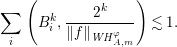 $$\begin{eqnarray}\mathop{\sum }_{i}\left(B_{i}^{k},\frac{2^{k}}{\Vert f\Vert _{\mathit{WH}_{A,m}^{\unicode[STIX]{x1D711}}}}\right)\lesssim 1.\end{eqnarray}$$
Hence, we obtain
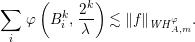 $$\begin{eqnarray}\mathop{\sum }_{i}\unicode[STIX]{x1D711}\left(B_{i}^{k},\frac{2^{k}}{\unicode[STIX]{x1D706}}\right)\lesssim \Vert f\Vert _{\mathit{WH}_{A,m}^{\unicode[STIX]{x1D711}}}.\end{eqnarray}$$
On the other hand, we need to prove that, for any
 $l\in \mathbb{Z}_{+}$
,
 $$\begin{eqnarray}\mathop{\sum }_{|k|>N}f_{k}^{l}\rightarrow 0~(N\rightarrow \infty )\quad \text{in}~{\mathcal{S}}^{\prime }~\text{uniformly},\end{eqnarray}$$
where
 $f_{k}^{l}:=\sum _{i}\unicode[STIX]{x1D6FD}_{i}^{l,k}$
. For any
 $k\in \mathbb{Z}$
, let
 $\unicode[STIX]{x1D6FA}_{k}:=\{f_{m}^{\ast }>2^{k}\}$
. Then
 $\unicode[STIX]{x1D6FA}_{k}$
is open and, by the assumption
 $\Vert f\Vert _{\mathit{WH}_{A,m}^{\unicode[STIX]{x1D711}}}=1$
, we further see that
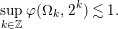 $$\begin{eqnarray}\sup _{k\in \mathbb{Z}}\unicode[STIX]{x1D711}(\unicode[STIX]{x1D6FA}_{k},2^{k})\lesssim 1.\end{eqnarray}$$
Since
 $s\geqslant m(\unicode[STIX]{x1D711})=\lfloor (q(\unicode[STIX]{x1D711})/i(\unicode[STIX]{x1D711})-1)\log _{(\unicode[STIX]{x1D706}_{-})}b\rfloor$
and
 $p\in (0,i(\unicode[STIX]{x1D711}))$
can be chosen close enough to
 $i(\unicode[STIX]{x1D711})$
, then we can choose
 $p_{0}\in (0,p)$
and
 $q_{0}\in (q(\unicode[STIX]{x1D711}),\infty )$
close to
 $p$
and
 $q(\unicode[STIX]{x1D711})$
, respectively, such that
 $s>(q_{0}/p_{0}-1)\log _{(\unicode[STIX]{x1D706}_{-})}b-1$
. By [Reference Zhang, Qi and Li55, (24), (26) and (27)], we see that
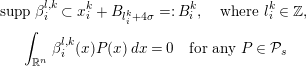 $$\begin{eqnarray}\displaystyle & \displaystyle \text{supp}\,\unicode[STIX]{x1D6FD}_{i}^{l,k}\subset x_{i}^{k}+B_{l_{i}^{k}+4\unicode[STIX]{x1D70E}}=:B_{i}^{k},\quad \text{where}~l_{i}^{k}\in \mathbb{Z}, & \displaystyle \nonumber\\ \displaystyle & \displaystyle \int _{\mathbb{R}^{n}}\unicode[STIX]{x1D6FD}_{i}^{l,k}(x)P(x)\,dx=0\quad \text{for any}~P\in {\mathcal{P}}_{s} & \displaystyle \nonumber\end{eqnarray}$$
and
 $$\begin{eqnarray}\Vert \unicode[STIX]{x1D6FD}_{i}^{l,k}\Vert _{L^{\infty }}\lesssim 2^{k}.\end{eqnarray}$$
From this,
 $\sum _{i}\unicode[STIX]{x1D712}_{B_{i}^{k}}(x)\lesssim 1$
for any
 $k\in \mathbb{Z}$
and
 $x\in \mathbb{R}^{n}$
(see [Reference Zhang, Qi and Li55, (9)]), Lemma 3.5 with
 $s>(q_{0}/p_{0}-1)\log _{(\unicode[STIX]{x1D706}_{-})}b-1$
,
 $\unicode[STIX]{x1D711}(B_{i}^{k},1)\lesssim \unicode[STIX]{x1D711}(x_{i}^{k}+B_{l_{i}^{k}-2\unicode[STIX]{x1D70E}},1)$
(see Lemma 3.1),
 $\sum _{i}\unicode[STIX]{x1D711}(x_{i}^{k}+B_{l_{i}^{k}-2\unicode[STIX]{x1D70E}},1)\leqslant \unicode[STIX]{x1D711}(\unicode[STIX]{x1D6FA}_{k},1)$
(see [Reference Zhang, Qi and Li55, (8)]), the uniformly lower type
 $p$
property of
 $\unicode[STIX]{x1D711}$
and (3.20), we deduce that, for any
 $\unicode[STIX]{x1D719}\in {\mathcal{S}}$
and
 $l\in \mathbb{Z}_{+}$
,
 $$\begin{eqnarray}\displaystyle \left|\left\langle \mathop{\sum }_{|k|>N}f_{k}^{l},\unicode[STIX]{x1D719}\right\rangle \right| & {\leqslant} & \displaystyle \mathop{\sum }_{|k|>N}\mathop{\sum }_{i}|\langle \unicode[STIX]{x1D6FD}_{i}^{l,k},\unicode[STIX]{x1D719}\rangle |\nonumber\\ \displaystyle & = & \displaystyle \mathop{\sum }_{k=-\infty }^{-N-1}\mathop{\sum }_{i}\left|\int _{B_{i}^{k}}\unicode[STIX]{x1D6FD}_{i}^{l,k}(x)\unicode[STIX]{x1D719}(x)\,dx\right|\nonumber\\ \displaystyle & & \displaystyle +\,\mathop{\sum }_{k=N+1}^{\infty }\mathop{\sum }_{i}\left|\int _{B_{i}^{k}}\unicode[STIX]{x1D6FD}_{i}^{l,k}(x)[\unicode[STIX]{x1D719}(x)-P_{B_{i}^{k}}^{s}\unicode[STIX]{x1D719}(x)]\,dx\right|\nonumber\\ \displaystyle & {\lesssim} & \displaystyle \mathop{\sum }_{k=-\infty }^{-N-1}2^{k}\int _{\unicode[STIX]{x1D6FA}_{k}}|\unicode[STIX]{x1D719}(x)|\,dx\nonumber\\ \displaystyle & & \displaystyle +\,\mathop{\sum }_{k=N+1}^{\infty }\mathop{\sum }_{i}2^{k}\int _{B_{i}^{k}}|\unicode[STIX]{x1D719}(x)-P_{B_{i}^{k}}^{s}\unicode[STIX]{x1D719}(x)|\,dx\nonumber\\ \displaystyle & {\lesssim} & \displaystyle 2^{-N}\Vert \unicode[STIX]{x1D719}\Vert _{L^{1}}+\mathop{\sum }_{k=N+1}^{\infty }\mathop{\sum }_{i}2^{k}[\unicode[STIX]{x1D711}(B_{i}^{k},1)]^{1/p_{0}}\Vert \unicode[STIX]{x1D719}\Vert _{{\mathcal{L}}_{p_{0},\unicode[STIX]{x1D711}(\cdot ,1),s}}\nonumber\\ \displaystyle & {\lesssim} & \displaystyle 2^{-N}+\left[\mathop{\sum }_{k=N+1}^{\infty }\mathop{\sum }_{i}2^{kp_{0}}\unicode[STIX]{x1D711}(x_{i}^{k}+B_{l_{i}^{k}-2\unicode[STIX]{x1D70E}},2^{-k}2^{k})\right]^{1/p_{0}}\nonumber\\ \displaystyle & {\lesssim} & \displaystyle 2^{-N}+\left[\mathop{\sum }_{k=N+1}^{\infty }2^{-k(p-p_{0})}\unicode[STIX]{x1D711}(\unicode[STIX]{x1D6FA}_{k},2^{k})\right]^{1/p_{0}}\nonumber\\ \displaystyle & {\lesssim} & \displaystyle 2^{-N}+2^{-N(p-p_{0})/p_{0}}\rightarrow 0~(N\rightarrow \infty ),\nonumber\end{eqnarray}$$
which implies that (3.19) holds true.
Finally, by repeating the rest proof of [Reference Zhang, Qi and Li55, Theorem 1], we can obtain
 $f\in \mathit{WH}_{A,\text{at}}^{\unicode[STIX]{x1D711},\infty ,s}$
and
 $\Vert f\Vert _{\mathit{WH}_{A,\text{at}}^{\unicode[STIX]{x1D711},\infty ,s}}\lesssim \Vert f\Vert _{\mathit{WH}_{A,m}^{\unicode[STIX]{x1D711}}}$
. This finishes the proof of Step 2 and hence Lemma 3.9.◻
Remark 3.10.
(i) Lemma 3.9 is an anisotropic extension of Liang et al. [Reference Liang, Yang and Jiang41, Theorem 3.5], namely, when
$A:=2\text{I}_{n\times n}$
and
$\unicode[STIX]{x1D70C}(x):=|x|^{n}$
for all
$x\in \mathbb{R}^{n}$
, our result is reduced to Liang et al. [Reference Liang, Yang and Jiang41, Theorem 3.5].(ii) When
$\unicode[STIX]{x1D711}$
is an anisotropic
$p$
-growth function with
$i(\unicode[STIX]{x1D711})=I(\unicode[STIX]{x1D711})=p$
, where
$p\in (0,1]$
, Lemma 3.9 gives the
$q$
-atomic characterization of
$\mathit{WH}_{A}^{\unicode[STIX]{x1D711}}$
with
$q\in (q(\unicode[STIX]{x1D711}),\infty ]$
which includes the
$\infty$
-atomic characterization of
$\mathit{WH}_{A}^{\unicode[STIX]{x1D711}}$
in [Reference Zhang, Qi and Li55, Theorem 1].(iii) When
$q\in (1,\infty ]$
and
$\unicode[STIX]{x1D711}$
is as in (2.6) with taking
$\unicode[STIX]{x1D714}\equiv 1$
and
$\unicode[STIX]{x1D6F7}(t):=t^{p}$
for all
$t\in [0,\infty )$
, where
$p\in (0,1]$
, Lemma 3.9 is also new.





Lemma 3.11. [Reference Bownik, Li, Yang and Zhou13, Lemma 2.3]
Let
 $A$
be a dilation on
 $\mathbb{R}^{n}$
. Then there exists a collection
 $$\begin{eqnarray}{\mathcal{Q}}:=\{Q_{\unicode[STIX]{x1D6FC}}^{k}\subset \mathbb{R}^{n}:k\in \mathbb{Z},\unicode[STIX]{x1D6FC}\in \text{I}_{k}\}\end{eqnarray}$$
of open subsets, where
 $\text{I}_{k}$
is some index set, such that:
(i)
$|\mathbb{R}^{n}\setminus \cup _{\unicode[STIX]{x1D6FC}}Q_{\unicode[STIX]{x1D6FC}}^{k}|=0$
for each fixed
$k$
and
$Q_{\unicode[STIX]{x1D6FC}}^{k}\cap Q_{\unicode[STIX]{x1D6FD}}^{k}=\emptyset$
if
$\unicode[STIX]{x1D6FC}\not =\unicode[STIX]{x1D6FD}$
;(ii) for any
$\unicode[STIX]{x1D6FC},\unicode[STIX]{x1D6FD},k,\ell$
with
$\ell \geqslant k$
, either
$Q_{\unicode[STIX]{x1D6FC}}^{k}\cap Q_{\unicode[STIX]{x1D6FD}}^{\ell }=\emptyset$
or
$Q_{\unicode[STIX]{x1D6FC}}^{\ell }\subset Q_{\unicode[STIX]{x1D6FD}}^{k}$
;(iii) for each
$(\ell ,\unicode[STIX]{x1D6FD})$
and each
$k<\ell$
, there exists a unique
$\unicode[STIX]{x1D6FC}$
such that
$Q_{\unicode[STIX]{x1D6FD}}^{\ell }\subset Q_{\unicode[STIX]{x1D6FC}}^{k}$
;(iv) there exist some negative integer
$v$
and positive integer
$u$
such that, for any
$Q_{\unicode[STIX]{x1D6FC}}^{k}$
with
$k\in \mathbb{Z}$
and
$\unicode[STIX]{x1D6FC}\in \text{I}_{k}$
, there exists
$x_{Q_{\unicode[STIX]{x1D6FC}}^{k}}\in Q_{\unicode[STIX]{x1D6FC}}^{k}$
satisfying that, for any
$x\in Q_{\unicode[STIX]{x1D6FC}}^{k}$
, $$\begin{eqnarray}x_{Q_{\unicode[STIX]{x1D6FC}}^{k}}+B_{vk-u}\subset Q_{\unicode[STIX]{x1D6FC}}^{k}\subset x+B_{vk+u}.\end{eqnarray}$$




In what follows, for convenience, we call
 $k$
the level of the dyadic cube
 $Q_{\unicode[STIX]{x1D6FC}}^{k}$
with
 $k\in \mathbb{Z}$
and
 $\unicode[STIX]{x1D6FC}\in \text{I}_{k}$
and denote it by
 $\ell (Q_{\unicode[STIX]{x1D6FC}}^{k})$
, and call
 ${\mathcal{Q}}$
of Lemma 3.11
dyadic cubes.
For any
 $\unicode[STIX]{x1D713}\in L^{1}$
and
 $\unicode[STIX]{x1D709}\in \mathbb{R}^{n}$
, let
 $\widehat{\unicode[STIX]{x1D713}}(\unicode[STIX]{x1D709}):=\int _{\mathbb{R}^{n}}\unicode[STIX]{x1D713}(x)e^{-2\unicode[STIX]{x1D70B}i\unicode[STIX]{x1D709}\cdot x}\,dx$
.
Lemma 3.12. [Reference Bownik, Li, Yang and Zhou13, Proposition 2.14]
Let
 $A$
be a dilation on
 $\mathbb{R}^{n}$
and
 $s\in \mathbb{N}$
. Then there exist
 $\unicode[STIX]{x1D703},\unicode[STIX]{x1D713}\in {\mathcal{S}}$
such that:
(i)
$\text{supp}\,\unicode[STIX]{x1D703}\subset B_{0}\in {\mathcal{B}}$
,
$\int _{\mathbb{R}^{n}}\unicode[STIX]{x1D703}(x)x^{\unicode[STIX]{x1D6FE}}\,dx=0$
for any
$\unicode[STIX]{x1D6FE}\in \mathbb{N}^{n}$
with
$|\unicode[STIX]{x1D6FE}|\leqslant s$
, and
$\widehat{\unicode[STIX]{x1D703}}(\unicode[STIX]{x1D709})\geqslant C>0$
for any
$\unicode[STIX]{x1D709}\in \{x\in \mathbb{R}^{n}:a\leqslant \unicode[STIX]{x1D70C}(x)\leqslant b\}$
, where
$a,b\in (0,1)$
are constants;(ii)
$\text{supp}\,\widehat{\unicode[STIX]{x1D713}}$
is compact and bounded away from the origin;(iii)
$\sum _{j\in \mathbb{Z}}\widehat{\unicode[STIX]{x1D713}}((A^{\ast })^{j}\unicode[STIX]{x1D709})\widehat{\unicode[STIX]{x1D703}}((A^{\ast })^{j}\unicode[STIX]{x1D709})=1$
for any
$\unicode[STIX]{x1D709}\in \mathbb{R}^{n}\setminus \{\mathbf{0}_{n}\}$
, where
$A^{\ast }$
denotes the transpose of
$A$
.










Moreover, for any
 $f\in {\mathcal{S}}_{0}^{\prime }$
,
 $f=\sum _{j\in \mathbb{Z}}f\ast \unicode[STIX]{x1D713}_{j}\ast \unicode[STIX]{x1D703}_{j}$
in
 ${\mathcal{S}}^{\prime }$
.
By Lemmas 3.1 and 3.11, we have the following lemma.
Lemma 3.13. Let
 $q\in [1,\infty )$
and
 $\unicode[STIX]{x1D711}\in \mathbb{A}_{q}(A)$
. Then, for any
 $Q\in {\mathcal{Q}}$
and
 $t\in (0,\infty )$
, it holds true that
 $$\begin{eqnarray}\unicode[STIX]{x1D711}(c_{Q}+B_{v\ell (Q)-u},t)\sim \unicode[STIX]{x1D711}(Q,t)\sim \unicode[STIX]{x1D711}(x_{Q}+B_{v\ell (Q)+u},t),\end{eqnarray}$$
where the implicit constants are independent of
 $Q$
and
 $t$
.
The proof of the following lemma is a slight modification of the proof of [Reference Liang, Yang and Jiang41, Proposition 4.2], the details being omitted.
Lemma 3.14. Let
 $\unicode[STIX]{x1D711}$
be an anisotropic growth function as in Definition 2.3. If
 $f\in \mathit{WH}_{A}^{\unicode[STIX]{x1D711}}$
, then
 $f$
vanishes weakly at infinity.
Lemma 3.15. Let
 $\unicode[STIX]{x1D711}$
be an anisotropic growth function as in Definition 2.3,
 $s\in \mathbb{N}\cap [m(\unicode[STIX]{x1D711}),\infty )$
,
 $q\in (q(\unicode[STIX]{x1D711}),\infty )$
and
 $\widetilde{q}\in (q(\unicode[STIX]{x1D711}),q)$
, where
 $q(\unicode[STIX]{x1D711})$
and
 $m(\unicode[STIX]{x1D711})$
are as in (2.3) and (2.8), respectively. For a sequence of multiples of anisotropic
 $(\unicode[STIX]{x1D711},q,s)$
-atoms,
 $\{a_{i}\}\text{}_{i}$
, associated with dilated balls
 $\{x_{i}+B_{l_{i}}\}\text{}_{i}$
, where
 $\{l_{i}\}\text{}_{i}\subset \mathbb{Z}$
, satisfying that there exists some
 $k\in \mathbb{Z}$
such that, for each
 $i$
,
 $\Vert a_{i}\Vert _{L_{\unicode[STIX]{x1D711}}^{q}(x_{i}+B_{l_{i}})}\lesssim 2^{k}$
and, for any
 $x\in \mathbb{R}^{n}$
,
 $\sum _{i}\unicode[STIX]{x1D712}_{x_{i}+B_{l_{i}}}(x)\lesssim 1$
, then there exists a positive constant C, independent of
 $\{a_{i}\}\text{}_{i}$
, such that, for any
 $t\in (0,\infty )$
,
 $$\begin{eqnarray}\int _{\mathbb{R}^{n}}\left[\mathop{\sum }_{i}S(a_{i})(x)\right]^{\widetilde{q}}\unicode[STIX]{x1D711}(x,t)\,dx\leqslant C\mathop{\sum }_{i}2^{k\widetilde{q}}\unicode[STIX]{x1D711}(x_{i}+B_{l_{i}},t).\end{eqnarray}$$
Proof. For any multiple of anisotropic
 $(\unicode[STIX]{x1D711},q,s)$
-atom,
 $a_{i}$
, associated with some dilated ball
 $x_{i}+B_{l_{i}}$
. Since
 $\unicode[STIX]{x1D711}\in \mathbb{A}_{\infty }(A)$
and
 $q\in (q(\unicode[STIX]{x1D711}),\infty )$
, it follows that
 $\unicode[STIX]{x1D711}\in \mathbb{A}_{q}(A)$
. Let
 $U_{0}(x_{i}+B_{l_{i}+2\unicode[STIX]{x1D70E}}):=x_{i}+B_{l_{i}+2\unicode[STIX]{x1D70E}}$
. By the boundedness on
 $L^{q}(\mathbb{R}^{n},\unicode[STIX]{x1D711}(\cdot ,t))$
, uniformly in
 $t\in (0,\infty )$
, of the anisotropic Lusin-area function
 $S$
(see [Reference Bownik, Li, Yang and Zhou13, Theorem 3.2]), Lemma 3.1 with
 $\unicode[STIX]{x1D711}\in \mathbb{A}_{q}(A)$
, and
 $\Vert a_{i}\Vert _{L_{\unicode[STIX]{x1D711}}^{q}(x_{i}+B_{l_{i}})}\lesssim 2^{k}$
, we see that, for any
 $i$
,
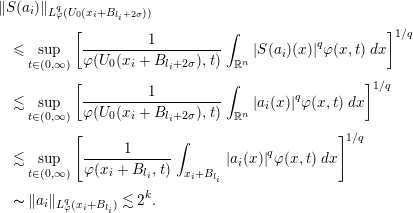 $$\begin{eqnarray}\displaystyle & & \displaystyle \Vert S(a_{i})\Vert _{L_{\unicode[STIX]{x1D711}}^{q}(U_{0}(x_{i}+B_{l_{i}+2\unicode[STIX]{x1D70E}}))}\nonumber\\ \displaystyle & & \displaystyle \quad \leqslant \sup _{t\in (0,\infty )}\left[\frac{1}{\unicode[STIX]{x1D711}(U_{0}(x_{i}+B_{l_{i}+2\unicode[STIX]{x1D70E}}),t)}\int _{\mathbb{R}^{n}}|S(a_{i})(x)|^{q}\unicode[STIX]{x1D711}(x,t)\,dx\right]^{1/q}\nonumber\\ \displaystyle & & \displaystyle \quad \lesssim \sup _{t\in (0,\infty )}\left[\frac{1}{\unicode[STIX]{x1D711}(U_{0}(x_{i}+B_{l_{i}+2\unicode[STIX]{x1D70E}}),t)}\int _{\mathbb{R}^{n}}{|a_{i}(x)|}^{q}\unicode[STIX]{x1D711}(x,t)\,dx\right]^{1/q}\nonumber\\ \displaystyle & & \displaystyle \quad \lesssim \sup _{t\in (0,\infty )}\left[\frac{1}{\unicode[STIX]{x1D711}(x_{i}+B_{l_{i}},t)}\int _{x_{i}+B_{l_{i}}}{|a_{i}(x)|}^{q}\unicode[STIX]{x1D711}(x,t)\,dx\right]^{1/q}\nonumber\\ \displaystyle & & \displaystyle \quad \sim \Vert a_{i}\Vert _{L_{\unicode[STIX]{x1D711}}^{q}(x_{i}+B_{l_{i}})}\lesssim 2^{k}.\end{eqnarray}$$
Let
 $U_{j}(x_{i}+B_{l_{i}+2\unicode[STIX]{x1D70E}}):=x_{i}+(B_{l_{i}+j+2\unicode[STIX]{x1D70E}}\setminus B_{l_{i}+j-1+2\unicode[STIX]{x1D70E}})$
, where
 $j\in \mathbb{Z}_{+}$
. By [Reference Li, Fan and Yang36, (2.11)], we know that, for any
 $j\in \mathbb{Z}_{+}$
,
 $i$
and
 $x\in U_{j}(x_{i}+B_{l_{i}+2\unicode[STIX]{x1D70E}})$
,
 $$\begin{eqnarray}S(a_{i})(x)\lesssim \Vert a_{i}\Vert _{L_{\unicode[STIX]{x1D711}}^{q}(x_{i}+B_{l_{i}})}[b(\unicode[STIX]{x1D706}_{-})^{s+1}]^{-j}.\end{eqnarray}$$
From this and
 $\Vert a_{i}\Vert _{L_{\unicode[STIX]{x1D711}}^{q}(x_{i}+B_{l_{i}})}\lesssim 2^{k}$
, we deduce that, for any
 $j\in \mathbb{Z}_{+}$
and
 $i$
,
 $$\begin{eqnarray}\Vert S(a_{i})\Vert _{L_{\unicode[STIX]{x1D711}}^{q}(U_{j}(x_{i}+B_{l_{i}+2\unicode[STIX]{x1D70E}}))}\lesssim 2^{k}[b(\unicode[STIX]{x1D706}_{-})^{s+1}]^{-j}.\end{eqnarray}$$
By repeating the proof of [Reference Liang, Yang and Jiang41, pp. 660–661] with [Reference Liang, Yang and Jiang41, (4.1)] and [Reference Liang, Yang and Jiang41, (4.6)] replaced by (3.21) and (3.22), respectively, we know that, for any
 $t\in (0,\infty )$
,
 $$\begin{eqnarray}\int _{\mathbb{R}^{n}}\left[\mathop{\sum }_{i}S(a_{i})(x)\right]^{\widetilde{q}}\unicode[STIX]{x1D711}(x,t)\,dx\leqslant C\mathop{\sum }_{i}2^{k\widetilde{q}}\unicode[STIX]{x1D711}(x_{i}+B_{l_{i}},t).\end{eqnarray}$$
This finishes the proof of Lemma 3.15. ◻
Proof of Theorem 2.10.
Suppose
 $(\unicode[STIX]{x1D711},q,s)$
is an admissible anisotropic triplet as in Definition 3.7.
Step 1. In this step, we show
 $\mathit{WH}_{A,S}^{\unicode[STIX]{x1D711}}\subset \mathit{WH}_{A}^{\unicode[STIX]{x1D711}}$
. By Lemma 3.9, it suffices to prove
 $\mathit{WH}_{A,S}^{\unicode[STIX]{x1D711}}\subset \mathit{WH}_{A,\text{at}}^{\unicode[STIX]{x1D711},q,s}$
.
Assuming that
 $f\in {\mathcal{S}}_{0}^{\prime }$
and
 $S(f)\in WL^{\unicode[STIX]{x1D711}}$
, we prove that
 $f\in \mathit{WH}_{A,\text{at}}^{\unicode[STIX]{x1D711},q,s}$
and
 $\Vert f\Vert _{\mathit{WH}_{A,\text{at}}^{\unicode[STIX]{x1D711},q,s}}\lesssim \Vert S(f)\Vert _{WL^{\unicode[STIX]{x1D711}}}$
. For any
 $k\in \mathbb{Z}$
, let
 $\unicode[STIX]{x1D6FA}_{k}:=\{S(f)>2^{k}\}$
and
 $$\begin{eqnarray}{\mathcal{R}}_{k}:=\{Q\in {\mathcal{Q}}:|Q\cap \unicode[STIX]{x1D6FA}_{k}|>|Q|/2,|Q\cap \unicode[STIX]{x1D6FA}_{k+1}|\leqslant |Q|/2\}.\end{eqnarray}$$
Then, for each dyadic cube
 $Q\in {\mathcal{Q}}$
, there exists a unique
 $k\in \mathbb{Z}$
such that
 $Q\in {\mathcal{R}}_{k}$
. For any
 $Q\in {\mathcal{Q}}$
, let
 $$\begin{eqnarray}\widetilde{Q}:=\{(y,m)\in \mathbb{R}^{n}\times \mathbb{R}:y\in Q,m\sim v\ell (Q)+u\},\end{eqnarray}$$
and, here and hereafter,
 $m\sim v\ell (Q)+u$
always means
 $$\begin{eqnarray}v\ell (Q)+u+\unicode[STIX]{x1D70E}\leqslant m<v[\ell (Q)-1]+u+\unicode[STIX]{x1D70E},\end{eqnarray}$$
where
 $\ell (Q),v$
and
 $u$
are the same as in Lemma 3.11.
Let
 $\unicode[STIX]{x1D703}$
and
 $\unicode[STIX]{x1D713}$
be as in Lemma 3.12 and let each
 $\unicode[STIX]{x1D703}$
be of the vanishing moments up to order
 $s$
with
 $s\geqslant m(\unicode[STIX]{x1D711})$
. We use
 $\{Q_{k}^{\ell }\}\text{}_{\ell }$
to denote the set of all maximal dyadic cubes in
 ${\mathcal{R}}_{k}$
. For any
 $Q\in {\mathcal{R}}_{k}$
, by Lemma 3.11(ii), there exists a unique maximal dyadic cube
 $Q_{k}^{\ell }$
such that
 $Q\subset Q_{k}^{\ell }$
.
For any
 $f\in \mathit{WH}_{A,S}^{\unicode[STIX]{x1D711}}$
, by the Step 1 of the proof of [Reference Li, Fan and Yang36, Theorem 2.14], we know that
 $f=\sum _{k\in \mathbb{Z}}\sum _{\ell }a_{k}^{\ell }$
in
 ${\mathcal{S}}^{\prime }$
, where
 $a_{k}^{\ell }:=\sum _{Q\subset Q_{k}^{\ell },Q\in {\mathcal{R}}_{k}}e_{Q}$
, where
 $$\begin{eqnarray}e_{Q}(x):=\int _{\widetilde{Q}}f\ast \unicode[STIX]{x1D713}_{-m}(y)\unicode[STIX]{x1D703}_{-m}(x-y)\,dy\,d\unicode[STIX]{x1D70E}(m)\end{eqnarray}$$
and
 $\unicode[STIX]{x1D70E}(m)$
is the counting measure on
 $\mathbb{R}$
. Notice that
 $$\begin{eqnarray}Q_{k}^{\ell }\subset x_{Q_{k}^{\ell }}+B_{v\ell (Q_{k}^{\ell })+u}\subset B_{k}^{\ell }:=x_{Q_{k}^{\ell }}+B_{v[\ell (Q_{k}^{\ell })-1]+u+3\unicode[STIX]{x1D70E}}.\end{eqnarray}$$
Then, from this and
 $\Vert a_{k}^{\ell }\Vert _{L^{q}(\mathbb{R}^{n},\unicode[STIX]{x1D711}(\cdot ,t))}\lesssim 2^{k}[\unicode[STIX]{x1D711}(Q_{k}^{\ell },t)]^{1/q}$
(see [Reference Li, Fan and Yang36, p. 297]), it follows that, for any
 $t\in (0,\infty )$
,
 $$\begin{eqnarray}\displaystyle & & \displaystyle \left\{\frac{1}{\unicode[STIX]{x1D711}(B_{k}^{\ell },t)}\int _{B_{k}^{\ell }}|a_{k}^{\ell }(x)|^{q}\unicode[STIX]{x1D711}(x,t)\,dx\right\}^{1/q}\nonumber\\ \displaystyle & & \displaystyle \quad \leqslant \left\{\frac{1}{\unicode[STIX]{x1D711}(Q_{k}^{\ell },t)}\int _{\mathbb{R}^{n}}|a_{k}^{\ell }(x)|^{q}\unicode[STIX]{x1D711}(x,t)\,dx\right\}^{1/q}\lesssim 2^{k},\nonumber\end{eqnarray}$$
which implies that
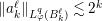 $\Vert a_{k}^{\ell }\Vert _{L_{\unicode[STIX]{x1D711}}^{q}(B_{k}^{\ell })}\lesssim 2^{k}$
. By this and the Steps 3–5 of the proof of [Reference Li, Fan and Yang36, Theorem 2.14], we know that
 $a_{k}^{\ell }$
is a multiple of an anisotropic
 $(\unicode[STIX]{x1D711},q,s)$
-atom associated with
 $B_{k}^{\ell }$
.
By Lemmas 3.13 and 3.1 with
 $\unicode[STIX]{x1D711}\in \mathbb{A}_{q}(A)$
,
 $|Q_{k}^{\ell }\cap \unicode[STIX]{x1D6FA}_{k}|>|Q_{k}^{\ell }|/2$
and the disjointness of
 $\{Q_{k}^{\ell }\}\text{}_{\ell }$
, we conclude that, for any
 $\unicode[STIX]{x1D706}\in (0,\infty )$
,
 $$\begin{eqnarray}\displaystyle \sup _{k\in \mathbb{Z}}\left\{\mathop{\sum }_{\ell }\unicode[STIX]{x1D711}\left(B_{k}^{\ell },\frac{2^{k}}{\unicode[STIX]{x1D706}}\right)\right\} & {\lesssim} & \displaystyle \sup _{k\in \mathbb{Z}}\left\{\mathop{\sum }_{\ell }\unicode[STIX]{x1D711}\left(Q_{k}^{\ell },\frac{2^{k}}{\unicode[STIX]{x1D706}}\right)\right\}\nonumber\\ \displaystyle & {\lesssim} & \displaystyle \sup _{k\in \mathbb{Z}}\left\{\mathop{\sum }_{\ell }\left(\frac{|Q_{k}^{\ell }|}{|Q_{k}^{\ell }\cap \unicode[STIX]{x1D6FA}_{k}|}\right)^{q}\unicode[STIX]{x1D711}\left(Q_{k}^{\ell }\cap \unicode[STIX]{x1D6FA}_{k},\frac{2^{k}}{\unicode[STIX]{x1D706}}\right)\right\}\nonumber\\ \displaystyle & {\lesssim} & \displaystyle \sup _{k\in \mathbb{Z}}\unicode[STIX]{x1D711}\left(\unicode[STIX]{x1D6FA}_{k},\frac{2^{k}}{\unicode[STIX]{x1D706}}\right),\nonumber\end{eqnarray}$$
which implies that
 $\Vert f\Vert _{\mathit{WH}_{A,\text{at}}^{\unicode[STIX]{x1D711},q,s}}\lesssim \Vert S(f)\Vert _{WL^{\unicode[STIX]{x1D711}}}$
. This finishes the proof of Step 1.
Step 2. In this step, we show
 $\mathit{WH}_{A}^{\unicode[STIX]{x1D711}}\subset \mathit{WH}_{A,S}^{\unicode[STIX]{x1D711}}$
. Suppose
 $f\in \mathit{WH}_{A}^{\unicode[STIX]{x1D711}}$
. By Lemma 3.14, we see that
 $f\in {\mathcal{S}}_{0}^{\prime }$
. It remains to show
 $\Vert S(f)\Vert _{WL^{\unicode[STIX]{x1D711}}}\lesssim \Vert f\Vert _{\mathit{WH}_{A}^{\unicode[STIX]{x1D711}}}$
.
By Lemma 3.9, we know that, for any
 $f\in \mathit{WH}_{A}^{\unicode[STIX]{x1D711}}=\mathit{WH}_{A,\text{at}}^{\unicode[STIX]{x1D711},q,s}$
with
 $q\in (q(\unicode[STIX]{x1D711}),\infty )$
and
 $s\in [m(\unicode[STIX]{x1D711}),\infty )\cap \mathbb{N}$
, where
 $q(\unicode[STIX]{x1D711})$
and
 $m(\unicode[STIX]{x1D711})$
are as in (2.3) and (2.8), respectively, there exist a sequence of multiples of anisotropic
 $(\unicode[STIX]{x1D711},q,s)$
-atoms,
 $\{f_{i}^{k}\}\text{}_{k\in \mathbb{Z},i}$
, associated with dilated balls
 $\{B_{i}^{k}\}\text{}_{k\in \mathbb{Z},i}$
, such that
 $f=\sum _{k\in \mathbb{Z}}\sum _{i}f_{i}^{k}$
in
 ${\mathcal{S}}^{\prime }$
,
 $\sum _{i}\unicode[STIX]{x1D712}_{B_{i}^{k}}(x)\lesssim 1$
for any
 $x\in \mathbb{R}^{n}$
and
 $k\in \mathbb{Z}$
,
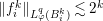 $\Vert f_{i}^{k}\Vert _{L_{\unicode[STIX]{x1D711}}^{q}(B_{i}^{k})}\lesssim 2^{k}$
for any
 $k\in \mathbb{Z}$
and
 $i$
, and
 $$\begin{eqnarray}\Vert f\Vert _{\mathit{WH}_{A,\text{at}}^{\unicode[STIX]{x1D711},q,s}}\sim \inf \left\{\unicode[STIX]{x1D706}\in (0,\infty ):\sup _{k\in \mathbb{Z}}\left\{\mathop{\sum }_{i}\unicode[STIX]{x1D711}\left(B_{i}^{k},\frac{2^{k}}{\unicode[STIX]{x1D706}}\right)\right\}\leqslant 1\right\}.\end{eqnarray}$$
Thus, it suffices to prove that, for any
 $\unicode[STIX]{x1D6FC},\unicode[STIX]{x1D706}\in (0,\infty )$
,
 $$\begin{eqnarray}\unicode[STIX]{x1D711}\left(\{S(f)>\unicode[STIX]{x1D6FC}\},\frac{\unicode[STIX]{x1D6FC}}{\unicode[STIX]{x1D706}}\right)\lesssim \sup _{k\in \mathbb{Z}}\left\{\mathop{\sum }_{i}\unicode[STIX]{x1D711}\left(B_{i}^{k},\frac{2^{k}}{\unicode[STIX]{x1D706}}\right)\right\}.\end{eqnarray}$$
To show (3.23), we may assume that there exists
 $k_{0}\in \mathbb{Z}$
such that
 $\unicode[STIX]{x1D6FC}=2^{k_{0}}$
without loss of generality. Write
 $$\begin{eqnarray}f=\mathop{\sum }_{k=-\infty }^{k_{0}-1}\mathop{\sum }_{i}f_{i}^{k}+\mathop{\sum }_{k=k_{0}}^{\infty }\mathop{\sum }_{i}f_{i}^{k}=:F_{1}+F_{2}.\end{eqnarray}$$
For
 $F_{1}$
, by repeating the estimate of
 $F_{1}$
in the proof of [Reference Liang, Yang and Jiang41, Theorem 4.5] with [Reference Liang, Yang and Jiang41, Lemma 4.4] replaced by Lemma 3.15, we know that, for any
 $\unicode[STIX]{x1D706}\in (0,\infty )$
,
 $$\begin{eqnarray}\unicode[STIX]{x1D711}\left(\{S(F_{1})>2^{k_{0}}\},\frac{2^{k_{0}}}{\unicode[STIX]{x1D706}}\right)\lesssim \sup _{k\in \mathbb{Z}}\left\{\mathop{\sum }_{i}\unicode[STIX]{x1D711}\left(B_{i}^{k},\frac{2^{k}}{\unicode[STIX]{x1D706}}\right)\right\}.\end{eqnarray}$$
Let us now deal with
 $F_{2}$
. By repeating the estimate of (3.11) in the proof of Lemma 3.9 with
 $(F_{2})_{m}^{\ast }$
replaced by
 $S(F_{2})$
, we know that, for any
 $\unicode[STIX]{x1D706}\in (0,\infty )$
,
 $$\begin{eqnarray}\unicode[STIX]{x1D711}\left(\{S(F_{2})>2^{k_{0}}\},\frac{2^{k_{0}}}{\unicode[STIX]{x1D706}}\right)\lesssim \sup _{k\in \mathbb{Z}}\left\{\mathop{\sum }_{i}\unicode[STIX]{x1D711}\left(B_{i}^{k},\frac{2^{k}}{\unicode[STIX]{x1D706}}\right)\right\}.\end{eqnarray}$$
Combining (3.24) and (3.25), we finally obtain (3.23), which implies that
 $\Vert S(f)\Vert _{WL^{\unicode[STIX]{x1D711}}}\lesssim \Vert f\Vert _{\mathit{WH}_{A,\text{at}}^{\unicode[STIX]{x1D711},q,s}}$
. This finishes the proof of Step 2 and hence Theorem 2.10.◻
4 Proofs of Theorems 2.11 and 2.12
To obtain the anisotropic
 $g$
-function characterization of
 $\mathit{WH}_{A}^{\unicode[STIX]{x1D711}}$
, we begin with recalling some notation and establishing several technical lemmas.
For any
 $j\in \mathbb{Z}$
and
 $k\in \mathbb{Z}^{n}$
, let
 $Q_{j,k}:=A^{-j}([0,1)^{n}+k)$
be the dilated cube,
 $x_{Q_{j,k}}:=A^{-j}k$
be its “lower-left” corner,
 ${\mathcal{Q}}_{j}:=\{Q_{j,k}:k\in \mathbb{Z}^{n}\}$
and
 $\widetilde{{\mathcal{Q}}}:=\bigcup _{j\in \mathbb{Z}}{\mathcal{Q}}_{j}$
. Obviously, for any
 $k_{1},k_{2}\in \mathbb{Z}^{n}$
with
 $k_{1}\not =k_{2}$
,
 $Q_{j,k_{1}}\cap Q_{j,k_{2}}=\emptyset$
.
Definition 4.1. Let
 $r,\unicode[STIX]{x1D706}\in (0,\infty )$
. For any sequence
 $\mathbf{s}:=\{s_{Q}\}\text{}_{Q\in \widetilde{{\mathcal{Q}}}}\subset \mathbb{C}$
, its majorant sequence
 $s_{r,\unicode[STIX]{x1D706}}^{\ast }:=\{(s_{r,\unicode[STIX]{x1D706}}^{\ast })_{Q}\}\text{}_{Q\in \widetilde{{\mathcal{Q}}}}$
is defined by setting, for all
 $Q\in \widetilde{{\mathcal{Q}}}$
,
 $$\begin{eqnarray}(s_{r,\unicode[STIX]{x1D706}}^{\ast })_{Q}:=\left[\mathop{\sum }_{P\in \widetilde{{\mathcal{Q}}},|P|=|Q|}\frac{|s_{P}|^{r}}{[1+|Q|^{-1}\unicode[STIX]{x1D70C}(x_{Q}-x_{P})]^{\unicode[STIX]{x1D706}}}\right]^{1/r}.\end{eqnarray}$$
Recall that the anisotropic Hardy–Littlewood maximal function
 ${\mathcal{M}}_{A}(f)$
of any locally integrable function
 $f$
is defined by setting, for all
 $x\in \mathbb{R}^{n}$
,
 $$\begin{eqnarray}{\mathcal{M}}_{A}f(x):=\sup _{x\in B,B\in {\mathcal{B}}}\frac{1}{|B|}\int _{B}|f(y)|\,dy.\end{eqnarray}$$
Lemma 4.2. [Reference Bownik9, Lemma 6.2]
Let
 $j\in \mathbb{Z}$
,
 $a,r\in (0,\infty )$
with
 $a\leqslant r$
and
 $\unicode[STIX]{x1D706}\in (r/a,\infty )$
. Then there exists a positive constant
 $C$
such that, for any sequence
 $\mathbf{s}:=\{s_{Q}\}\text{}_{Q\in \widetilde{{\mathcal{Q}}}}\subset \mathbb{C}$
,
 $$\begin{eqnarray}\mathop{\sum }_{|Q|=b^{-j}}(s_{r,\unicode[STIX]{x1D706}}^{\ast })_{Q}\unicode[STIX]{x1D712}_{Q}\leqslant C\left[{\mathcal{M}}_{A}\left(\mathop{\sum }_{|Q|=b^{-j}}|s_{Q}|^{a}\unicode[STIX]{x1D712}_{Q}\right)\right]^{1/a}.\end{eqnarray}$$
The following lemma is an anisotropic version of the weak Musielak–Orlicz Fefferman–Stein vector-valued inequality, whose proof is also an obvious modification of the proof of [Reference Liang, Yang and Jiang41, Theorem 2.8], the details being omitted.
Lemma 4.3. Let
 $r\in (1,\infty ]$
,
 $\unicode[STIX]{x1D711}$
be a Musielak–Orlicz function of uniformly lower type
 $p_{\unicode[STIX]{x1D711}}^{-}$
and of uniformly upper type
 $p_{\unicode[STIX]{x1D711}}^{+}$
and let
 $q(\unicode[STIX]{x1D711})$
be as in (2.3). If
 $q(\unicode[STIX]{x1D711})<p_{\unicode[STIX]{x1D711}}^{-}\leqslant p_{\unicode[STIX]{x1D711}}^{+}<\infty$
, then there exists a positive constant
 $C$
such that, for any
 $\{f_{j}\}\text{}_{j\in \mathbb{Z}}\in WL^{\unicode[STIX]{x1D711}}(\ell ^{r},\mathbb{R}^{n})$
,
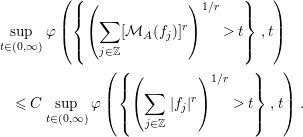 $$\begin{eqnarray}\displaystyle & & \displaystyle \sup _{t\in (0,\infty )}\unicode[STIX]{x1D711}\left(\left\{\left(\mathop{\sum }_{j\in \mathbb{Z}}[{\mathcal{M}}_{A}(f_{j})]^{r}\right)^{1/r}>t\right\},t\right)\nonumber\\ \displaystyle & & \displaystyle \quad \leqslant C\sup _{t\in (0,\infty )}\unicode[STIX]{x1D711}\left(\left\{\left(\mathop{\sum }_{j\in \mathbb{Z}}|f_{j}|^{r}\right)^{1/r}>t\right\},t\right).\nonumber\end{eqnarray}$$
Lemma 4.4. [Reference Bownik10, p. 423]
For any
 $f\in {\mathcal{S}}^{\prime }$
and
 $\unicode[STIX]{x1D6F7}\in {\mathcal{S}}$
satisfying
 $\text{supp}\,\widehat{\unicode[STIX]{x1D6F7}}$
is compact and bounded away from the origin, the sequences
 $\sup (f):=\{\sup (f)_{Q}\}\text{}_{Q\in \widetilde{{\mathcal{Q}}}}$
and
 $\inf (f):=\{\inf (f)_{Q}\}\text{}_{Q\in \widetilde{{\mathcal{Q}}}}$
are defined by setting, respectively, for any
 $Q\in \widetilde{{\mathcal{Q}}}$
with
 $|Q|=b^{-j}$
,
 $$\begin{eqnarray}\sup (f)_{Q}:=\sup _{y\in Q}|f\ast \widetilde{\unicode[STIX]{x1D6F7}}_{j}(y)|\end{eqnarray}$$
and
 $$\begin{eqnarray}\inf (f)_{Q}:=\sup \left\{\inf _{y\in P}|f\ast \widetilde{\unicode[STIX]{x1D6F7}}_{j}(y)|:|P\cap Q|\neq 0,|Q|/|P|=b^{\unicode[STIX]{x1D6FE}}\right\},\end{eqnarray}$$
where
 $\widetilde{\unicode[STIX]{x1D6F7}}(\cdot ):=\overline{\unicode[STIX]{x1D6F7}(-\cdot )}$
and
 $\unicode[STIX]{x1D6FE}\in \mathbb{Z}_{+}$
. Then, for any
 $\unicode[STIX]{x1D706},r\in (0,\infty )$
and sufficient large
 $\unicode[STIX]{x1D6FE}\in \mathbb{Z}_{+}$
, there exists a positive constant
 $C$
such that, for any
 $Q\in \widetilde{{\mathcal{Q}}}$
,
 $$\begin{eqnarray}(\sup (f)_{r,\unicode[STIX]{x1D706}}^{\ast })_{Q}\leqslant C(\inf (f)_{r,\unicode[STIX]{x1D706}}^{\ast })_{Q}.\end{eqnarray}$$
Lemma 4.5. Let
 $\unicode[STIX]{x1D711}$
be an anisotropic growth function as in Definition 2.3. For any
 $r\in (0,\infty )$
and
 $\unicode[STIX]{x1D706}\in (\max \{1,r/2,rq(\unicode[STIX]{x1D711})/i(\unicode[STIX]{x1D711})\},\infty )$
, where
 $q(\unicode[STIX]{x1D711})$
and
 $i(\unicode[STIX]{x1D711})$
are as in (2.3) and (2.4), respectively, then there exists a positive constant
 $C$
such that, for any
 $\mathbf{s}:=\{s_{Q}\}\text{}_{Q\in \widetilde{{\mathcal{Q}}}}$
,
 $$\begin{eqnarray}\displaystyle & & \displaystyle \sup _{t\in (0,\infty )}\unicode[STIX]{x1D711}\left(\left\{\left[\mathop{\sum }_{Q\in \widetilde{{\mathcal{Q}}}}[(s_{r,\unicode[STIX]{x1D706}}^{\ast })_{Q}]^{2}\unicode[STIX]{x1D712}_{Q}\right]^{1/2}>t\right\},t\right)\nonumber\\ \displaystyle & & \displaystyle \quad \leqslant C\sup _{t\in (0,\infty )}\unicode[STIX]{x1D711}\left(\left\{\left[\mathop{\sum }_{Q\in \widetilde{{\mathcal{Q}}}}|s_{Q}|^{2}\unicode[STIX]{x1D712}_{Q}\right]^{1/2}>t\right\},t\right).\nonumber\end{eqnarray}$$
Proof. We show this lemma by borrowing some ideas from the proof of [Reference Li, Fan and Yang36, Lemma 3.7]. Let
 $r\in (0,\infty )$
and
 $\unicode[STIX]{x1D706}\in (\max \{1,r/2,rq(\unicode[STIX]{x1D711})/i(\unicode[STIX]{x1D711})\},\infty )$
. If
 $r<\min \{2,i(\unicode[STIX]{x1D711})/q(\unicode[STIX]{x1D711})\}$
, we choose
 $a:=r$
. Otherwise, we choose
 $a$
such that
 $r/\unicode[STIX]{x1D706}<a<\min \{r,2,i(\unicode[STIX]{x1D711})/q(\unicode[STIX]{x1D711})\}$
. It is possible to choose such an
 $a$
, since
 $\unicode[STIX]{x1D706}>\max \{1,r/2,rq(\unicode[STIX]{x1D711})/i(\unicode[STIX]{x1D711})\}$
implies
 $r/\unicode[STIX]{x1D706}<\min \{r,2,i(\unicode[STIX]{x1D711})/q(\unicode[STIX]{x1D711})\}$
. In both cases, we find that
 $$\begin{eqnarray}0<a\leqslant r<\infty ,\qquad \unicode[STIX]{x1D706}>\frac{r}{a},\qquad \frac{2}{a}>1\qquad \text{and}\qquad \frac{i(\unicode[STIX]{x1D711})}{a}>q(\unicode[STIX]{x1D711}).\end{eqnarray}$$
For the above last inequality, by choosing
 $p\in (0,i(\unicode[STIX]{x1D711}))$
close to
 $i(\unicode[STIX]{x1D711})$
, we further obtain
 $p/a>q(\unicode[STIX]{x1D711})$
. Next, let
 $\widetilde{\unicode[STIX]{x1D711}}(x,t):=\unicode[STIX]{x1D711}(x,t^{1/a})$
for all
 $x\in \mathbb{R}^{n}$
and
 $t\in (0,\infty )$
. From the fact that
 $\unicode[STIX]{x1D711}$
is of uniformly lower type
 $p$
and of uniformly upper type 1, it follows that
 $\widetilde{\unicode[STIX]{x1D711}}$
is of uniformly lower type
 $p/a$
and of uniformly upper type
 $1/a$
. Therefore, since
 $1/a>p/a>q(\unicode[STIX]{x1D711})$
, Lemmas 4.2 and 4.3 yield
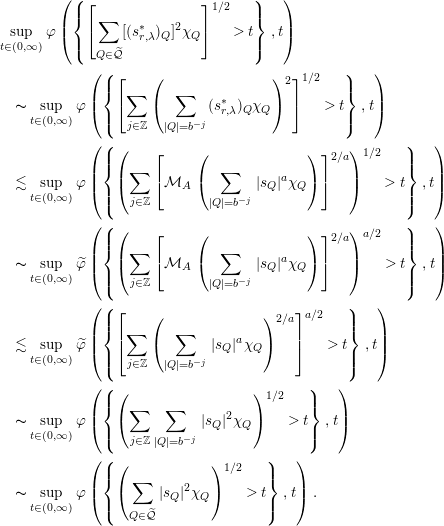 $$\begin{eqnarray}\displaystyle & & \displaystyle \sup _{t\in (0,\infty )}\unicode[STIX]{x1D711}\left(\left\{\left[\mathop{\sum }_{Q\in \widetilde{{\mathcal{Q}}}}[(s_{r,\unicode[STIX]{x1D706}}^{\ast })_{Q}]^{2}\unicode[STIX]{x1D712}_{Q}\right]^{1/2}>t\right\},t\right)\nonumber\\ \displaystyle & & \displaystyle \quad \sim \sup _{t\in (0,\infty )}\unicode[STIX]{x1D711}\left(\left\{\left[\mathop{\sum }_{j\in \mathbb{Z}}\left(\mathop{\sum }_{|Q|=b^{-j}}(s_{r,\unicode[STIX]{x1D706}}^{\ast })_{Q}\unicode[STIX]{x1D712}_{Q}\right)^{2}\right]^{1/2}>t\right\},t\right)\nonumber\\ \displaystyle & & \displaystyle \quad \lesssim \sup _{t\in (0,\infty )}\unicode[STIX]{x1D711}\left(\left\{\left(\mathop{\sum }_{j\in \mathbb{Z}}\left[{\mathcal{M}}_{A}\left(\mathop{\sum }_{|Q|=b^{-j}}|s_{Q}|^{a}\unicode[STIX]{x1D712}_{Q}\right)\right]^{2/a}\right)^{1/2}>t\right\},t\right)\nonumber\\ \displaystyle & & \displaystyle \quad \sim \sup _{t\in (0,\infty )}\widetilde{\unicode[STIX]{x1D711}}\left(\left\{\left(\mathop{\sum }_{j\in \mathbb{Z}}\left[{\mathcal{M}}_{A}\left(\mathop{\sum }_{|Q|=b^{-j}}|s_{Q}|^{a}\unicode[STIX]{x1D712}_{Q}\right)\right]^{2/a}\right)^{a/2}>t\right\},t\right)\nonumber\\ \displaystyle & & \displaystyle \quad \lesssim \sup _{t\in (0,\infty )}\widetilde{\unicode[STIX]{x1D711}}\left(\left\{\left[\mathop{\sum }_{j\in \mathbb{Z}}\left(\mathop{\sum }_{|Q|=b^{-j}}|s_{Q}|^{a}\unicode[STIX]{x1D712}_{Q}\right)^{2/a}\right]^{a/2}>t\right\},t\right)\nonumber\\ \displaystyle & & \displaystyle \quad \sim \sup _{t\in (0,\infty )}\unicode[STIX]{x1D711}\left(\left\{\left(\mathop{\sum }_{j\in \mathbb{Z}}\mathop{\sum }_{|Q|=b^{-j}}|s_{Q}|^{2}\unicode[STIX]{x1D712}_{Q}\right)^{1/2}>t\right\},t\right)\nonumber\\ \displaystyle & & \displaystyle \quad \sim \sup _{t\in (0,\infty )}\unicode[STIX]{x1D711}\left(\left\{\left(\mathop{\sum }_{Q\in \widetilde{{\mathcal{Q}}}}|s_{Q}|^{2}\unicode[STIX]{x1D712}_{Q}\right)^{1/2}>t\right\},t\right).\nonumber\end{eqnarray}$$
This finishes the proof of Lemma 4.5. ◻
Proof of Theorem 2.11.
Suppose
 $(\unicode[STIX]{x1D711},q,s)$
is an admissible anisotropic triplet as in Definition 3.7. By repeating the proof of Theorem 2.10 with a slight modification, we easily obtain
 $\mathit{WH}_{A}^{\unicode[STIX]{x1D711}}\subset \mathit{WH}_{A,g}^{\unicode[STIX]{x1D711}}$
with continuous inclusion, the details beings omitted. Conversely, to prove
 $\mathit{WH}_{A,g}^{\unicode[STIX]{x1D711}}\subset \mathit{WH}_{A}^{\unicode[STIX]{x1D711}}$
, by
 $\Vert \cdot \Vert _{\mathit{WH}_{A}^{\unicode[STIX]{x1D711}}}\sim \Vert \cdot \Vert _{\mathit{WH}_{A,S}^{\unicode[STIX]{x1D711}}}$
, it is sufficient to prove that, for any
 $f\in \mathit{WH}_{A,g}^{\unicode[STIX]{x1D711}}$
,
 $\Vert S(f)\Vert _{WL^{\unicode[STIX]{x1D711}}}\lesssim \Vert g(f)\Vert _{WL^{\unicode[STIX]{x1D711}}}$
.
Since the proof of
 $\mathit{WH}_{A,g}^{\unicode[STIX]{x1D711}}\subset \mathit{WH}_{A}^{\unicode[STIX]{x1D711}}$
is similar to that of [Reference Li, Fan and Yang36, Theorem 3.1], we use the same notation as in the proof of [Reference Li, Fan and Yang36, Theorem 3.1] and here we just give out the necessary modifications.
Let
 $q(\unicode[STIX]{x1D711})$
be as in (2.3). Choose
 $M\in \mathbb{Z}_{+}$
large enough and
 $r\in (0,1]$
such that
 $r\in (1/M,p/q(\unicode[STIX]{x1D711}))$
. Let
 $\widetilde{\unicode[STIX]{x1D711}}(x,t):=\unicode[STIX]{x1D711}(x,t^{1/r})$
for all
 $x\in \mathbb{R}^{n}$
and
 $t\in (0,\infty )$
. From the fact that
 $\unicode[STIX]{x1D711}$
is of uniformly lower type
 $p$
and of uniformly upper type 1, it follows that
 $\widetilde{\unicode[STIX]{x1D711}}$
is of uniformly lower type
 $p/r$
and of uniformly upper type
 $1/r$
. Then, since
 $1/r>p/r>q(\unicode[STIX]{x1D711})$
, Lemma 4.3 gives
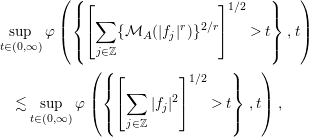 $$\begin{eqnarray}\displaystyle & & \displaystyle \sup _{t\in (0,\infty )}\unicode[STIX]{x1D711}\left(\left\{\left[\mathop{\sum }_{j\in \mathbb{Z}}\{{\mathcal{M}}_{A}(|f_{j}|^{r})\}^{2/r}\right]^{1/2}>t\right\},t\right)\nonumber\\ \displaystyle & & \displaystyle \quad \lesssim \sup _{t\in (0,\infty )}\unicode[STIX]{x1D711}\left(\left\{\left[\mathop{\sum }_{j\in \mathbb{Z}}|f_{j}|^{2}\right]^{1/2}>t\right\},t\right),\nonumber\end{eqnarray}$$
which, together with
 $$\begin{eqnarray}\displaystyle S(f)(x) & {\lesssim} & \displaystyle \left\{\mathop{\sum }_{j\in \mathbb{Z}}\left[{\mathcal{M}}_{A}\left(\left[\mathop{\sum }_{Q\in {\mathcal{Q}}_{j}}|f\ast \widetilde{\unicode[STIX]{x1D6F7}}_{j}(x_{Q})|\unicode[STIX]{x1D712}_{Q}\right]^{r}\right)(x)\right]^{2/r}\right\}^{1/2}\nonumber\\ \displaystyle & & \displaystyle (\text{see [36, (3.7)]}),\nonumber\end{eqnarray}$$
further implies that
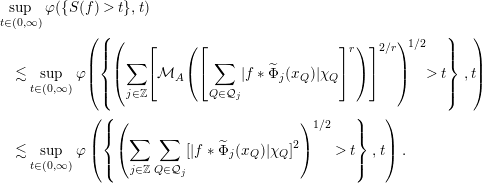 $$\begin{eqnarray}\displaystyle & & \displaystyle \sup _{t\in (0,\infty )}\unicode[STIX]{x1D711}(\{S(f)>t\},t)\nonumber\\ \displaystyle & & \displaystyle \quad \lesssim \sup _{t\in (0,\infty )}\unicode[STIX]{x1D711}\!\left(\left\{\left(\mathop{\sum }_{j\in \mathbb{Z}}\!\left[{\mathcal{M}}_{A}\!\left(\left[\mathop{\sum }_{Q\in {\mathcal{Q}}_{j}}\!|f\ast \widetilde{\unicode[STIX]{x1D6F7}}_{j}(x_{Q})|\unicode[STIX]{x1D712}_{Q}\right]^{r}\right)\right]^{2/r}\right)^{\!1/2}\!>t\right\},t\!\right)\nonumber\\ \displaystyle & & \displaystyle \quad \lesssim \sup _{t\in (0,\infty )}\unicode[STIX]{x1D711}\left(\left\{\left(\mathop{\sum }_{j\in \mathbb{Z}}\mathop{\sum }_{Q\in {\mathcal{Q}}_{j}}[|f\ast \widetilde{\unicode[STIX]{x1D6F7}}_{j}(x_{Q})|\unicode[STIX]{x1D712}_{Q}]^{2}\right)^{1/2}>t\right\},t\right).\nonumber\\ \displaystyle & & \displaystyle\end{eqnarray}$$
Notice that
 $s_{Q}\leqslant (s_{r,\unicode[STIX]{x1D706}}^{\ast })_{Q}$
for any
 $r,\unicode[STIX]{x1D706}\in (0,\infty )$
and
 $Q\in \widetilde{{\mathcal{Q}}}$
. Then, from this, (4.2), Lemmas 4.4 and 4.5 with
 $r\in (0,\infty )$
and
 $\unicode[STIX]{x1D706}\in (\max \{1,r/2,rq(\unicode[STIX]{x1D711})/i(\unicode[STIX]{x1D711})\},\infty )$
, it follows that, for some
 $\unicode[STIX]{x1D6FE}\in \mathbb{Z}_{+}$
large enough,
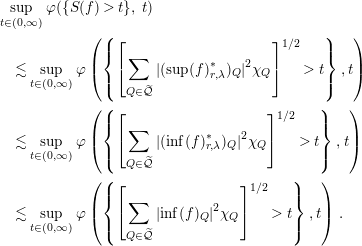 $$\begin{eqnarray}\displaystyle & & \displaystyle \sup _{t\in (0,\infty )}\unicode[STIX]{x1D711}(\{S(f)>t\},\,t)\nonumber\\ \displaystyle & & \displaystyle \quad \lesssim \sup _{t\in (0,\infty )}\unicode[STIX]{x1D711}\left(\left\{\left[\mathop{\sum }_{Q\in \widetilde{{\mathcal{Q}}}}|(\sup (f)_{r,\unicode[STIX]{x1D706}}^{\ast })_{Q}|^{2}\unicode[STIX]{x1D712}_{Q}\right]^{1/2}>t\right\},t\right)\nonumber\\ \displaystyle & & \displaystyle \quad \lesssim \sup _{t\in (0,\infty )}\unicode[STIX]{x1D711}\left(\left\{\left[\mathop{\sum }_{Q\in \widetilde{{\mathcal{Q}}}}|(\inf (f)_{r,\unicode[STIX]{x1D706}}^{\ast })_{Q}|^{2}\unicode[STIX]{x1D712}_{Q}\right]^{1/2}>t\right\},t\right)\nonumber\\ \displaystyle & & \displaystyle \quad \lesssim \sup _{t\in (0,\infty )}\unicode[STIX]{x1D711}\left(\left\{\left[\mathop{\sum }_{Q\in \widetilde{{\mathcal{Q}}}}|\inf (f)_{Q}|^{2}\unicode[STIX]{x1D712}_{Q}\right]^{1/2}>t\right\},t\right).\end{eqnarray}$$
Moreover, for any
 $P\in \widetilde{{\mathcal{Q}}}$
with
 $|P|=b^{-i}$
and
 $s_{P}:=\inf _{y\in P}|f\ast \widetilde{\unicode[STIX]{x1D6F7}}_{i-\unicode[STIX]{x1D6FE}}(y)|$
, by checking the proof of [Reference Bownik10, Lemma 8.4], we find that
 $\inf (f)_{Q}=\sup \{s_{P}:|Q|/|P|=b^{\unicode[STIX]{x1D6FE}},P\in \widetilde{{\mathcal{Q}}}\}$
and, for any
 $x\in \mathbb{R}^{n}$
,
 $$\begin{eqnarray}\mathop{\sum }_{|Q|=b^{-j}}\inf (f)_{Q}\unicode[STIX]{x1D712}_{Q}(x)\lesssim b^{\unicode[STIX]{x1D6FE}\unicode[STIX]{x1D706}/r}\mathop{\sum }_{|P|=b^{-j-\unicode[STIX]{x1D6FE}}}(s_{r,\unicode[STIX]{x1D706}}^{\ast })_{P}\unicode[STIX]{x1D712}_{P}(x).\end{eqnarray}$$
Combining this, (4.3) and Lemma 4.5, we find that
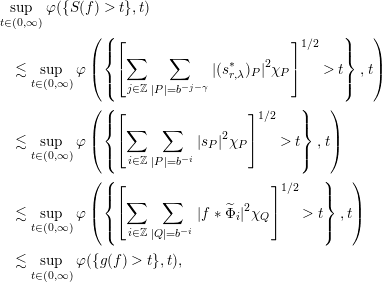 $$\begin{eqnarray}\displaystyle & & \displaystyle \sup _{t\in (0,\infty )}\unicode[STIX]{x1D711}(\{S(f)>t\},t)\nonumber\\ \displaystyle & & \displaystyle \quad \lesssim \sup _{t\in (0,\infty )}\unicode[STIX]{x1D711}\left(\left\{\left[\mathop{\sum }_{j\in \mathbb{Z}}\mathop{\sum }_{|P|=b^{-j-\unicode[STIX]{x1D6FE}}}|(s_{r,\unicode[STIX]{x1D706}}^{\ast })_{P}|^{2}\unicode[STIX]{x1D712}_{P}\right]^{1/2}>t\right\},t\right)\nonumber\\ \displaystyle & & \displaystyle \quad \lesssim \sup _{t\in (0,\infty )}\unicode[STIX]{x1D711}\left(\left\{\left[\mathop{\sum }_{i\in \mathbb{Z}}\mathop{\sum }_{|P|=b^{-i}}|s_{P}|^{2}\unicode[STIX]{x1D712}_{P}\right]^{1/2}>t\right\},t\right)\nonumber\\ \displaystyle & & \displaystyle \quad \lesssim \sup _{t\in (0,\infty )}\unicode[STIX]{x1D711}\left(\left\{\left[\mathop{\sum }_{i\in \mathbb{Z}}\mathop{\sum }_{|Q|=b^{-i}}|f\ast \widetilde{\unicode[STIX]{x1D6F7}}_{i}|^{2}\unicode[STIX]{x1D712}_{Q}\right]^{1/2}>t\right\},t\right)\nonumber\\ \displaystyle & & \displaystyle \quad \lesssim \sup _{t\in (0,\infty )}\unicode[STIX]{x1D711}(\{g(f)>t\},t),\nonumber\end{eqnarray}$$
which implies that
 $\Vert S(f)\Vert _{WL^{\unicode[STIX]{x1D711}}}\lesssim \Vert g(f)\Vert _{WL^{\unicode[STIX]{x1D711}}}$
. This finishes the proof of Theorem 2.11.◻
Next, we consider the anisotropic
 $g_{\unicode[STIX]{x1D706}}^{\ast }$
-function characterization of
 $\mathit{WH}_{A}^{\unicode[STIX]{x1D711}}$
. To this end, we need to introduce the following variant of the anisotropic Lusin-area function
 $S$
. Let
 $\unicode[STIX]{x1D713}\in {\mathcal{S}}$
such that, for any
 $\unicode[STIX]{x1D6FC}\in \mathbb{N}^{n}$
satisfying
 $|\unicode[STIX]{x1D6FC}|\leqslant m(\unicode[STIX]{x1D711})$
,
 $\int _{\mathbb{R}^{n}}\unicode[STIX]{x1D713}(x)x^{\unicode[STIX]{x1D6FC}}\,dx=0$
, where
 $m(\unicode[STIX]{x1D711})$
is as in (2.8). For any
 $k_{0}\in \mathbb{N},f\in {\mathcal{S}}^{\prime }$
and
 $x\in \mathbb{R}^{n}$
, let
 $$\begin{eqnarray}S_{k_{0}}(f)(x):=\left\{\mathop{\sum }_{k\in \mathbb{Z}}b^{-(k_{0}+k)}\int _{x+B_{k_{0}+k}}|f\ast \unicode[STIX]{x1D713}_{-k}(y)|^{2}\,dy\right\}^{1/2}.\end{eqnarray}$$
The following technical lemma plays a key role in establishing the anisotropic
 $g_{\unicode[STIX]{x1D706}}^{\ast }$
-function characterization of
 $\mathit{WH}_{A}^{\unicode[STIX]{x1D711}}$
, whose proof was motivated by Folland and Stein [Reference Folland and Stein20, p. 218, Theorem 7.1], Aguilera and Segovia [Reference Aguilera and Segovia1, Theorem 1] and Liang et al. [Reference Liang, Yang and Jiang41, Lemma 4.11].
Lemma 4.6. Let
 $q\in [1,\infty )$
,
 $\unicode[STIX]{x1D711}$
be an anisotropic growth function as in Definition 2.3 and
 $\unicode[STIX]{x1D711}\in \mathbb{A}_{q}(A)$
. Then there exists a positive constant
 $C$
such that, for any
 $k_{0}\in \mathbb{Z}_{+}$
and
 $f\in {\mathcal{S}}^{\prime }$
,
 $$\begin{eqnarray}\sup _{\unicode[STIX]{x1D706}\in (0,\infty )}\unicode[STIX]{x1D711}(\{S_{k_{0}}(f)>\unicode[STIX]{x1D706}\},\unicode[STIX]{x1D706})\leqslant Cb^{(q-p/2)k_{0}}\sup _{\unicode[STIX]{x1D706}\in (0,\infty )}\unicode[STIX]{x1D711}(\{S(f)>\unicode[STIX]{x1D706}\},\unicode[STIX]{x1D706}).\end{eqnarray}$$
Proof. For any
 $\unicode[STIX]{x1D706}\in (0,\infty )$
,
 $k_{0}\in \mathbb{Z}_{+}$
and
 $f\in {\mathcal{S}}^{\prime }$
, let
 $$\begin{eqnarray}E_{\unicode[STIX]{x1D706},k_{0}}:=\{S(f)>\unicode[STIX]{x1D706}b^{k_{0}/2}\}\end{eqnarray}$$
and
 $$\begin{eqnarray}U_{\unicode[STIX]{x1D706},k_{0}}:=\{{\mathcal{M}}_{A}(\unicode[STIX]{x1D712}_{E_{\unicode[STIX]{x1D706},k_{0}}})>b^{-k_{0}-2\unicode[STIX]{x1D70E}}\},\end{eqnarray}$$
where
 ${\mathcal{M}}_{A}$
is as in (4.1). Since
 $\unicode[STIX]{x1D711}\in \mathbb{A}_{q}(A)$
, from the boundedness on
 $L^{q}(\mathbb{R}^{n},\unicode[STIX]{x1D711}(\cdot ,\unicode[STIX]{x1D706}))$
, uniformly in
 $\unicode[STIX]{x1D706}\in (0,\infty )$
, of
 ${\mathcal{M}}_{A}$
(see, for example, [Reference Bownik and Ho11, Theorem 2.4]), it follows that, for any
 $\unicode[STIX]{x1D706}\in (0,\infty )$
,
 $k_{0}\in \mathbb{Z}_{+}$
and
 $f\in {\mathcal{S}}^{\prime }$
,
 $$\begin{eqnarray}\unicode[STIX]{x1D711}(U_{\unicode[STIX]{x1D706},k_{0}},\unicode[STIX]{x1D706})\lesssim b^{qk_{0}}\Vert \unicode[STIX]{x1D712}_{E_{\unicode[STIX]{x1D706},k_{0}}}\Vert _{L^{q}(\mathbb{R}^{n},\unicode[STIX]{x1D711}(\cdot ,\unicode[STIX]{x1D706}))}^{q}\sim b^{qk_{0}}\unicode[STIX]{x1D711}(E_{\unicode[STIX]{x1D706},k_{0}},\unicode[STIX]{x1D706})\end{eqnarray}$$
and, by [Reference Li, Fan and Yang36, Lemma 3.12], we know that, for any
 $\unicode[STIX]{x1D706}\in (0,\infty )$
,
 $k_{0}\in \mathbb{Z}_{+}$
and
 $f\in {\mathcal{S}}^{\prime }$
,
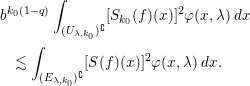 $$\begin{eqnarray}\displaystyle & & \displaystyle b^{k_{0}(1-q)}\int _{(U_{\unicode[STIX]{x1D706},k_{0}})^{\complement }}[S_{k_{0}}(f)(x)]^{2}\unicode[STIX]{x1D711}(x,\unicode[STIX]{x1D706})\,dx\nonumber\\ \displaystyle & & \displaystyle \quad \lesssim \int _{(E_{\unicode[STIX]{x1D706},k_{0}})^{\complement }}[S(f)(x)]^{2}\unicode[STIX]{x1D711}(x,\unicode[STIX]{x1D706})\,dx.\end{eqnarray}$$
Thus, from
 $q\in [1,\infty )$
, the uniformly lower type
 $p$
and the uniformly upper type 1 properties of
 $\unicode[STIX]{x1D711}$
, (4.4) and (4.5), it follows that, for any
 $\unicode[STIX]{x1D706}\in (0,\infty )$
,
 $k_{0}\in \mathbb{Z}_{+}$
and
 $f\in {\mathcal{S}}^{\prime }$
,
 $$\begin{eqnarray}\displaystyle & & \displaystyle \unicode[STIX]{x1D711}(\{S_{k_{0}}(f)>\unicode[STIX]{x1D706}\},\unicode[STIX]{x1D706})\nonumber\\ \displaystyle & & \displaystyle \quad \leqslant \unicode[STIX]{x1D711}(U_{\unicode[STIX]{x1D706},k_{0}},\unicode[STIX]{x1D706})+\unicode[STIX]{x1D711}((U_{\unicode[STIX]{x1D706},k_{0}})^{\complement }\cap \{S_{k_{0}}(f)>\unicode[STIX]{x1D706}\},\unicode[STIX]{x1D706})\nonumber\\ \displaystyle & & \displaystyle \quad \lesssim b^{qk_{0}}\unicode[STIX]{x1D711}(E_{\unicode[STIX]{x1D706},k_{0}},\unicode[STIX]{x1D706})+\unicode[STIX]{x1D706}^{-2}\int _{(U_{\unicode[STIX]{x1D706},k_{0}})^{\complement }}[S_{k_{0}}(f)(x)]^{2}\unicode[STIX]{x1D711}(x,\unicode[STIX]{x1D706})\,dx\nonumber\\ \displaystyle & & \displaystyle \quad \lesssim b^{qk_{0}}\unicode[STIX]{x1D711}(\{S(f)>\unicode[STIX]{x1D706}b^{k_{0}/2}\},\unicode[STIX]{x1D706})\nonumber\\ \displaystyle & & \displaystyle \qquad +\,b^{(q-1)k_{0}}\unicode[STIX]{x1D706}^{-2}\int _{(E_{\unicode[STIX]{x1D706},k_{0}})^{\complement }}[S(f)(x)]^{2}\unicode[STIX]{x1D711}(x,\unicode[STIX]{x1D706})\,dx\nonumber\\ \displaystyle & & \displaystyle \quad \lesssim b^{(q-p/2)k_{0}}\unicode[STIX]{x1D711}(\{S(f)>\unicode[STIX]{x1D706}b^{k_{0}/2}\},\unicode[STIX]{x1D706}b^{k_{0}/2})\nonumber\\ \displaystyle & & \displaystyle \qquad +\,b^{(q-1)k_{0}}\unicode[STIX]{x1D706}^{-2}\int _{0}^{\unicode[STIX]{x1D706}b^{k_{0}/2}}t\unicode[STIX]{x1D711}(\{S(f)>t\},\unicode[STIX]{x1D706})\,dt\nonumber\\ \displaystyle & & \displaystyle \quad \lesssim \left\{b^{(q-p/2)k_{0}}+b^{(q-1)k_{0}}\unicode[STIX]{x1D706}^{-2}\left[\int _{0}^{\unicode[STIX]{x1D706}}\unicode[STIX]{x1D706}\,dt+\int _{\unicode[STIX]{x1D706}}^{\unicode[STIX]{x1D706}b^{k_{0}/2}}t\left(\frac{\unicode[STIX]{x1D706}}{t}\right)^{p}\,dt\right]\right\}\nonumber\\ \displaystyle & & \displaystyle \qquad \times \sup _{t\in (0,\infty )}\unicode[STIX]{x1D711}(\{S(f)>t\},t)\nonumber\\ \displaystyle & & \displaystyle \quad \lesssim b^{(q-p/2)k_{0}}\sup _{t\in (0,\infty )}\unicode[STIX]{x1D711}(\{S(f)>t\},t).\nonumber\end{eqnarray}$$
This finishes the proof of Lemma 4.6. ◻
Proof of Theorem 2.12.
The proof of Theorem 2.12 is similar to that of [Reference Liang, Yang and Jiang41, Proposition 4.12]. To prove Theorem 2.12, by
 $\Vert \cdot \Vert _{\mathit{WH}_{A}^{\unicode[STIX]{x1D711}}}\sim \Vert \cdot \Vert _{\mathit{WH}_{A,S}^{\unicode[STIX]{x1D711}}}$
, it suffices to prove
 $\Vert \cdot \Vert _{\mathit{WH}_{A,S}^{\unicode[STIX]{x1D711}}}\sim \Vert \cdot \Vert _{\mathit{WH}_{A,g_{\unicode[STIX]{x1D706}}^{\ast }}^{\unicode[STIX]{x1D711}}}$
. For any
 $f\in {\mathcal{S}}^{\prime }$
and
 $x\in \mathbb{R}^{n}$
, by
 $S(f)(x)\leqslant g_{\unicode[STIX]{x1D706}}^{\ast }(f)(x)$
, the inequality
 $\Vert S(f)\Vert _{WL^{\unicode[STIX]{x1D711}}}\leqslant \Vert g_{\unicode[STIX]{x1D706}}^{\ast }(f)\Vert _{WL^{\unicode[STIX]{x1D711}}}$
is obvious. It remains to show that, for any
 $f\in {\mathcal{S}}^{\prime }$
,
 $\Vert g_{\unicode[STIX]{x1D706}}^{\ast }(f)\Vert _{WL^{\unicode[STIX]{x1D711}}}\lesssim \Vert S(f)\Vert _{WL^{\unicode[STIX]{x1D711}}}$
.
For any
 $f\in {\mathcal{S}}^{\prime }$
and
 $x\in \mathbb{R}^{n}$
, we have
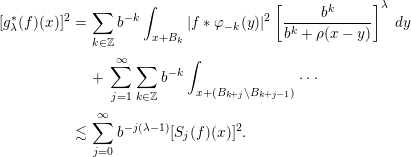 $$\begin{eqnarray}\displaystyle [g_{\unicode[STIX]{x1D706}}^{\ast }(f)(x)]^{2} & = & \displaystyle \mathop{\sum }_{k\in \mathbb{Z}}b^{-k}\int _{x+B_{k}}|f\ast \unicode[STIX]{x1D711}_{-k}(y)|^{2}\left[\frac{b^{k}}{b^{k}+\unicode[STIX]{x1D70C}(x-y)}\right]^{\unicode[STIX]{x1D706}}\,dy\nonumber\\ \displaystyle & & \displaystyle +\,\mathop{\sum }_{j=1}^{\infty }\mathop{\sum }_{k\in \mathbb{Z}}b^{-k}\int _{x+(B_{k+j}\setminus B_{k+j-1})}\cdots \nonumber\\ \displaystyle & {\lesssim} & \displaystyle \mathop{\sum }_{j=0}^{\infty }b^{-j(\unicode[STIX]{x1D706}-1)}[S_{j}(f)(x)]^{2}.\end{eqnarray}$$
Since
 $\unicode[STIX]{x1D706}\in (2q/p,\infty )$
, it follows that there exists
 $\unicode[STIX]{x1D700}\in (0,1)$
such that
 $\unicode[STIX]{x1D706}-2\unicode[STIX]{x1D700}\in (2q/p,\infty )$
. Let
 $C_{(\unicode[STIX]{x1D700})}:=1/(1-b^{-\unicode[STIX]{x1D700}})$
. Then, from (4.6), the uniformly lower type
 $p$
and the uniformly upper type 1 properties of
 $\unicode[STIX]{x1D711}$
, Lemma 4.6, and
 $\unicode[STIX]{x1D706}-2\unicode[STIX]{x1D700}\in (2q/p,\infty )$
, we deduce that, for any
 $\unicode[STIX]{x1D6FC}\in (0,\infty )$
,
 $$\begin{eqnarray}\displaystyle \unicode[STIX]{x1D711}(\{g_{\unicode[STIX]{x1D706}}^{\ast }(f)>\unicode[STIX]{x1D6FC}\},\unicode[STIX]{x1D6FC}) & {\lesssim} & \displaystyle \unicode[STIX]{x1D711}\left(\left\{\mathop{\sum }_{j=0}^{\infty }b^{-j(\unicode[STIX]{x1D706}-1)/2}S_{j}(f)>\frac{1}{C_{(\unicode[STIX]{x1D700})}}\mathop{\sum }_{j=0}^{\infty }b^{-j\unicode[STIX]{x1D700}}\unicode[STIX]{x1D6FC}\right\},\unicode[STIX]{x1D6FC}\right)\nonumber\\ \displaystyle & {\lesssim} & \displaystyle \mathop{\sum }_{j=0}^{\infty }\unicode[STIX]{x1D711}\left(\left\{S_{j}(f)>\frac{1}{C_{(\unicode[STIX]{x1D700})}}b^{j(\unicode[STIX]{x1D706}-1)/2-j\unicode[STIX]{x1D700}}\unicode[STIX]{x1D6FC}\right\},\unicode[STIX]{x1D6FC}\right)\nonumber\\ \displaystyle & {\sim} & \displaystyle \mathop{\sum }_{j=0}^{\infty }\unicode[STIX]{x1D711}(\{S_{j}(f)>\unicode[STIX]{x1D6FD}\},C_{(\unicode[STIX]{x1D700})}b^{j\unicode[STIX]{x1D700}-j(\unicode[STIX]{x1D706}-1)/2}\unicode[STIX]{x1D6FD})\nonumber\\ \displaystyle & {\lesssim} & \displaystyle \mathop{\sum }_{j=0}^{\infty }b^{jp(\unicode[STIX]{x1D700}-\unicode[STIX]{x1D706}/2+1/2)}\unicode[STIX]{x1D711}(\{S_{j}(f)>\unicode[STIX]{x1D6FD}\},\unicode[STIX]{x1D6FD})\nonumber\\ \displaystyle & {\lesssim} & \displaystyle \mathop{\sum }_{j=0}^{\infty }b^{jp(\unicode[STIX]{x1D700}-\unicode[STIX]{x1D706}/2+1/2)}b^{j(q-p/2)}\sup _{\unicode[STIX]{x1D6FD}\in (0,\infty )}\unicode[STIX]{x1D711}(\{S(f)(x)>\unicode[STIX]{x1D6FD}\},\unicode[STIX]{x1D6FD})\nonumber\\ \displaystyle & {\lesssim} & \displaystyle \sup _{\unicode[STIX]{x1D6FD}\in (0,\infty )}\unicode[STIX]{x1D711}(\{S(f)(x)>\unicode[STIX]{x1D6FD}\},\unicode[STIX]{x1D6FD}),\nonumber\end{eqnarray}$$
which implies that
 $\Vert g_{\unicode[STIX]{x1D706}}^{\ast }(f)\Vert _{WL^{\unicode[STIX]{x1D711}}}\lesssim \Vert S(f)\Vert _{WL^{\unicode[STIX]{x1D711}}}$
. This finishes the proof of (2.10) and hence Theorem 2.12.◻
Acknowledgments
The authors would like to thank the referees for their very carefully reading and so many useful remarks which did make this article more readable.


