




No CrossRef data available.
Article contents
Discussion of ‘Olistostromes of the Pieniny Klippen Belt, Northern Carpathians’
Published online by Cambridge University Press: 22 February 2016
Extract
D. Plašienka, J. Michalík, J. Soták & R. Aubrecht comment: In their recent paper, Golonka et al. (2015) described the Cretaceous and Palaeogene olistostromes and other types of mass-transport deposits occurring within the Pieniny Klippen Belt (PKB) of the Western Carpathians. After a short introduction into the olistostrome concept and an overall description of the PKB structure, the authors presented their views on the composition and evolution of the PKB with olistostromes as the leading phenomenon. Although novel in some aspects, the model they present is largely oversimplified and partly erroneous in our opinion. In the following, we shall comment on the several most disputable statements and interpretations offered in the discussed paper.
Information
- Type
- Discussion
- Information
- Copyright
- Copyright © Cambridge University Press 2016
References
Alexandrowicz, S. W. & Birkenmajer, K.
1978. Upper Maastrichtian and Paleocene deposits at Szaflary, Pieniny Klippen Belt, Carpathians, Poland. Rocznik Polskiego Towarzystwa Geologicznego
48, 27–37.Google Scholar
Andrusov, D.
1938. Étude géologique de la zone des Klippes internes des Carpathes Occidentales, IIIe partie: tectonique. Rozpravy Státního Geologického Ústavu ČSR
9, 1–135.Google Scholar
Andrusov, D.
1972. Coupes géologiques à travers la Zone des Klippes piénines de la vallée du Váh (Carpathes Slovaques). Geologický Zborník – Geologica Carpathica
25, 228–34.Google Scholar
Birkenmajer, K.
1977. Jurassic and Cretaceous lithostratigraphic units of the Pieniny Klippen Belt, Carpathians, Poland. Studia Geologica Polonica
45, 1–159.Google Scholar
Golonka, J., Krobicki, M., Waśkowska, A., Cieszkowski, M. & Ślączka, A.
2015. Olistostromes of the Pieniny Klippen Belt, Northern Carpathians. Geological Magazine
152, 269–86.CrossRefGoogle Scholar
Janočko, J. (ed.) 2000. Explanations to Geological Map of the Spišská Magura Region 1: 50,000. Bratislava: State Geological Institute of D. Štúr, 174 pp. (in Slovak with English summary).Google Scholar
Kissová, D., Dunkl, I., Plašienka, D., Frisch, W. & Marschalko, R.
2005. The Pieninic exotic cordillera (Andrusov Ridge) revisited: new zircon FT ages of granite pebbles from Cretaceous flysch conglomerates of the Pieniny Klippen Belt (Western Carpathians, Slovakia). Slovak Geological Magazine
11, 17–28.Google Scholar
Köhler, E. & Buček, S.
2005. Paleocene reef limestones near Veľký Lipník (Pieniny Mts., NE Slovakia): facial environments and biogenic components. Slovak Geological Magazine
11, 249–67.Google Scholar
Köhler, E., Salaj, J. & Buček, S.
1993. Paleogeographical development of the Myjava sedimentary area (western Slovakia) during the existence of the Paleocene reef complex. Geologica Carpathica
44, 373–80.Google Scholar
Maheľ, M.
1980. The Peri-klippen zone: nearer characterization and significance. Mineralia Slovaca
12, 193–207 (in Slovak with English summary).Google Scholar
Maheľ, M.
1983. Krížna nappe, example of polyfacial and polystructural unit. Mineralia Slovaca
12, 193–216 (in Slovak with English summary).Google Scholar
Marschalko, R.
1986. Evolution and Geotectonic Significance of the Klippen Belt Cretaceous Flysch in the Carpathian Megastructure. Bratislava: Veda, 140 pp. (in Slovak with English summary).Google Scholar
Marschalko, R. & Kysela, J.
1980. Geology and sedimentology of the Klippen Belt and Manín Unit between Žilina and Považská Bystrica. Západné Karpaty, sér. Geológia
6, 7–79 (in Slovak with English summary).Google Scholar
Marschalko, R. & Rakús, M.
1997. Development of the Cretaceous flysch in the Klape unit and the recyclicity problem of the clastic material. In Alpine Evolution of the Western Carpathians and Related Areas (eds Plašienka, D., Hók, J., Vozár, J. & Elečko, M.), pp. 71–8. Bratislava: Geological Survey of Slovak Republic.Google Scholar
Mello, J. (ed.) 2005. Geological Map of the Middle Váh Valley 1:50,000. Bratislava: State Geological Institute of D. Stur.Google Scholar
Michalík, J., Lintnerová, O., Reháková, D., Boorová, D. & Šimo, V.
2012. Early Cretaceous sedimentary evolution of a pelagic basin margin (the Manín Unit, central Western Carpathians, Slovakia). Cretaceous Research
38, 68–79.CrossRefGoogle Scholar
Michalík, J. & Vašíček, Z.
1987. Geology and stratigraphy of the Butkov Lower Cretaceous limestone deposits, Manín Unit, Middle Váh Valley (Western Slovakia). Mineralia Slovaca
19, 115–34 (in Slovak with English summary).Google Scholar
Michalík, J., Vašíček, Z., Boorová, D., Golej, M., Halásová, E., Hort, P., Ledvák, P., Lintnerová, O., Měchová, L., Šimo, V., Šimonová, V., Reháková, D., Schlögl, J., Skupien, P., Smrečková, M., Soták, J. & Zahradníková, B.
2013. The Butkov Hill – A Stone Archive of Slovakian Mountains and the Mesozoic Sea Life History. Bratislava: Veda, 164 pp.Google Scholar
Nemčok, J.
1980. Non-traditional view of East-Slovakian Klippen Belt. Geologický Zborník – Geologica Carpathica
31, 563–8.Google Scholar
Nemčok, J., Zakovič, M., Gašpariková, V., Ďurkovič, T., Snopková, P., Vrana, K., & Hanzel, V.
1990. Explanations to the Geological Map of Pieniny, Ľubovnianska vrchovina Highland and Čergov Mts 1:50,000. Bratislava: Geological Institute of D. Štúr, 131 pp. (in Slovak with English summary).Google Scholar
Oszczypko, N. & Oszczypko-Clowes, M.
2014. Geological structure and evolution of the Pieniny Klippen Belt to the east of the Dunajec River – a new approach (Western Outer Carpathians, Poland). Geological Quarterly
58, 737–58.Google Scholar
Plašienka, D.
1995
a. Mesozoic evolution of Tatric units in the Malé Karpaty and Považský Inovec Mts.: implications for the position of the Klape and related units in western Slovakia. Geologica Carpathica
46, 101–12.Google Scholar
Plašienka, D.
1995
b. Passive and active margin history of the northern Tatricum (Western Carpathians, Slovakia). Geologische Rundschau
84, 748–60.CrossRefGoogle Scholar
Plašienka, D.
2012. Jurassic syn-rift and Cretaceous syn-orogenic, coarse-grained deposits related to opening and closure of the Vahic (South Penninic) Ocean in the Western Carpathians – an overview. Geological Quarterly
56, 601–28.Google Scholar
Plašienka, D., Józsa, Š., Gedl, P. & Madzin, J.
2013. Fault contact of the Pieniny Klippen Belt with the Central Carpathian Paleogene Basin (Western Carpathians): new data from a unique temporary exposure in Ľutina village (eastern Slovakia). Geologica Carpathica
64, 165–68.Google Scholar
Plašienka, D. & Mikuš, V.
2010. Geological structure of the Pieniny and Šariš sectors of the Klippen Belt between the Litmanová and Drienica villages in eastern Slovakia. Mineralia Slovaca
42, 155–78 (in Slovak with English summary).Google Scholar
Plašienka, D. & Soták, J.
2015. Evolution of Late Cretaceous–Palaeogene synorogenic basins in the Pieniny Klippen Belt and adjacent zones (Western Carpathians, Slovakia): tectonic controls over a growing orogenic wedge. Annales Societatis Geologorum Poloniae
85, 43–76.Google Scholar
Plašienka, D., Soták, J., Jamrichová, M., Halásová, E., Pivko, D., Józsa, Š., Madzin, J. & Mikuš, V.
2012. Structure and evolution of the Pieniny Klippen Belt demonstrated along a section between Jarabina and Litmanová villages in eastern Slovakia. Mineralia Slovaca
44, 17–38.Google Scholar
Plašienka, D., Sýkora, M., Aubrecht, R., Krobicki, M. & Józsa, Š.
2010. Reinterpretation of the lithostratigraphy and tectonic position of the Mariková Klippen (Middle Váh Valley, western Slovakia). Acta Geologica Slovaca
2, 1–9.Google Scholar
Rakús, M.
1965. Zur biotratigraphie der Jura-Schichten in der Kostelecer Klippe. Geologické Práce, Správy
37, 163–77 (in Slovak with German summary).Google Scholar
Rakús, M. & Hók, J.
2005. The Manín and Klape units: lithostratigraphy, tectonic classification, paleogeographic position and relationship to Váhicum. Mineralia Slovaca
37, 9–26 (in Slovak with English summary).Google Scholar
Rakús, M. & Marschalko, R.
1997. Position of the Manín, Drietoma and Klape units at the boundary of the Central and Outer Carpathians. In Alpine Evolution of the Western Carpathians and Related Areas (eds Plašienka, D., Hók, J., Vozár, J. & Elečko, M.), pp. 79–97. Bratislava: Geological Survey of Slovak Republic.Google Scholar
Scheibner, E.
1968. Contribution to the knowledge of the Palaeogene reef-complexes of the Myjava – Hričov – Haligovka zone (West Carpathians). Mitteilungen der Bayerischen Staatssammlung für Paläontologie und Historische Geologie
8, 67–97.Google Scholar
Sikora, W.
1971. Esquisse de la tectogénèse de la zone des Klippes des Pieniny en Pologne d´après de nouvelles données géologiques. Rocznik Polskiego Towarzystwa Geologicznego
41, 221–39 (in Russian with French summary).Google Scholar
Sikora, W.
1974. The Pieniny Klippen Belt (Polish Carpathians). In Tectonics of the Carpathian–Balkan Regions (ed. Maheľ, M.), pp. 177–80. Bratislava: Geological Institute of D. Štúr.Google Scholar
Stur, D.
1860. Bericht über die geologische Uebersichts-Aufnahme des Wassergebietes der Waag und Neutra. Jahrbuch der k.k. geologischen Reichsanstalt
11, 17–151.Google Scholar
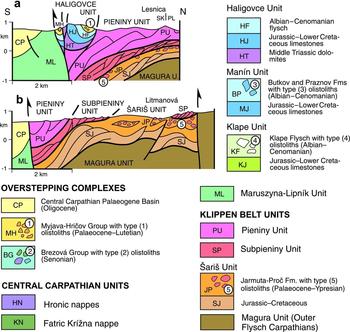
Figure 1. Cross-sections of the northern segment of the Pieniny Klippen Belt, roughly coinciding with those of Golonka et al. (2015, their fig. 5). The section (a) shows the nappe outlier of the Haligovce Unit overthrusting the Upper Cretaceous formations of the Pieniny Unit, affected by the later stage along-strike dextral transpression of the PKB. The Palaeogene deposits with type (1) olistoliths are confined only to the Haligovce Unit. The cross-section (b) illustrates the nappe structure of the principal PKB units – Pieniny, Subpieniny and Šariš from top to bottom – all overriding the Outer Carpathian Magura Unit. Note the olistostrome bodies (Milpoš Breccia) with type (5) olistoliths within the Jarmuta-Proč Formation of the Šariš Unit. For the Maruszyna-Lipník Unit see Plašienka & Soták (2015).
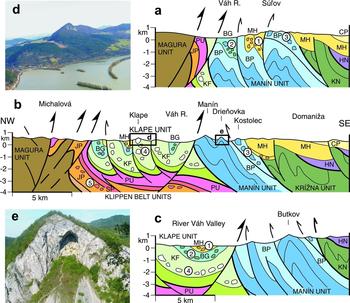
Figure 2. Three subparallel cross-sections (a–c) illustrate the structure of the Pieniny Klippen Belt in the Middle Váh River Valley area for its along-strike distance of approximately 25 km. Positions of all five types of olistoliths, distinguished in the text, are shown. For the legend see Figure 1. Section (b) is modified after Plašienka & Soták (2015). Field photographs: (d) panoramic view from the south on Klape Hill in the centre – one of the largest olistoliths (type 4) in the PKB, surrounded by mid-Cretaceous flysch deposits of the Klape Unit; (e) the Drieňovka anticline of the Manín Unit viewed from the SW; the anticline is framed by a c. 30 m thick layer of competent Urgonian limestones enclosing the well-bedded, disharmonically folded Lower Cretaceous limestones (mostly covered by scree).
 You have
Access
- 11
- Cited by
D. Plašienka, J. Michalík, J. Soták & R. Aubrecht comment: In their recent paper, Golonka et al. (Reference Golonka, Krobicki, Waśkowska, Cieszkowski and Ślączka2015) described the Cretaceous and Palaeogene olistostromes and other types of mass-transport deposits occurring within the Pieniny Klippen Belt (PKB) of the Western Carpathians. After a short introduction into the olistostrome concept and an overall description of the PKB structure, the authors presented their views on the composition and evolution of the PKB with olistostromes as the leading phenomenon. Although novel in some aspects, the model they present is largely oversimplified and partly erroneous in our opinion. In the following, we shall comment on the several most disputable statements and interpretations offered in the discussed paper.
As the authors claim in the section ‘Methods’, they conducted comprehensive field investigations and mapping of olistolith bodies that have well-exposed contacts with surrounding flysch-like deposits, as well as performing in-depth stratigraphical and sedimentological studies. However, the reader can hardly find any results from these, as declared, detailed analyses in the discussed paper.
According to its title, the section ‘Results’ should contain the research outcomes and some documentation of the phenomena described. Regrettably, the reader often meets only unsubstantiated ideas and purpose-made re-interpretations of the results of other authors that are not supported by any new exact data. In the following, we shall discuss in particular two regions in Slovakia where Golonka et al. (Reference Golonka, Krobicki, Waśkowska, Cieszkowski and Ślączka2015) presented their ideas about the structure of the PKB and the position of olistostromes and olistoliths therein. These are the Polish–Slovak Pieniny Mountains at the northernmost segment of the PKB arc, and the Middle Váh River Valley in western Slovakia.
In general, the discussed paper offers an interpretation of the olistostromes/olistoliths occurring in the PKB as being related to compressional deformation and formation of an accretionary wedge accompanied by mass-transport processes which provided coarse-grained material deposited in synorogenic foredeep-trench basins. In the authors’ view, there are two belts rich in olistostromes within the PKB. The southern belt, which they call the ‘Złatne Basin’, ‘Złatne Flysch’ or ‘Złatne Unit’, should rim the southern PKB periphery in the Polish–Slovak Pieniny Mts (their figs 3–5), as well as occupy a wide area in the Middle Váh River Valley in western Slovakia (their fig. 8). According to the authors, this basin contains various deposits of Jurassic up to Oligocene age. However, the existence of such a basin has never been properly documented, at least in the territory of Slovakia. It is merely a misinterpretation made by the mixing of various complexes of different units with different compositions and origins that in no case show a continuous succession throughout this wide time span. For instance, what is shown as the Złatne Basin in their figures 4 and 5 consists of Aptian–Cenomanian variegated hemipelagic marls and Turonian distal turbiditic sequences grading upwards into the Coniacian–Santonian conglomeratic flysch. All these sediments belong to the Pieniny Unit of the PKB in a normal superposition above the Jurassic–Lower Cretaceous strata (cf. Birkenmajer, Reference Birkenmajer1977) and do not contain any olistoliths at all, since the well-rounded conglomerate clasts seldom exceed the cobble size. Moreover, the authors also included in the same unit the Paleocene–Lower Eocene deposits, which in fact form the post-nappe cover complex of the Haligovce Unit (see Fig. 1). The concept of the Złatne Unit, originally introduced by Sikora (Reference Sikora1971, Reference Sikora and Maheľ1974), was criticized also by Alexandrowicz & Birkenmajer (Reference Alexandrowicz and Birkenmajer1978).
Cross-sections of the northern segment of the Pieniny Klippen Belt, roughly coinciding with those of Golonka et al. (2015, their fig. 5). The section (a) shows the nappe outlier of the Haligovce Unit overthrusting the Upper Cretaceous formations of the Pieniny Unit, affected by the later stage along-strike dextral transpression of the PKB. The Palaeogene deposits with type (1) olistoliths are confined only to the Haligovce Unit. The cross-section (b) illustrates the nappe structure of the principal PKB units – Pieniny, Subpieniny and Šariš from top to bottom – all overriding the Outer Carpathian Magura Unit. Note the olistostrome bodies (Milpoš Breccia) with type (5) olistoliths within the Jarmuta-Proč Formation of the Šariš Unit. For the Maruszyna-Lipník Unit see Plašienka & Soták (Reference Plašienka and Soták2015).
The sedimentary succession of the Haligovce klippen area includes Middle Triassic carbonates, various shallow-marine Jurassic and Lower Cretaceous limestones and also Albian–Cenomanian turbiditic sandstones. However, the olistolithic character of these rocks, as supposed by Golonka et al. (Reference Golonka, Krobicki, Waśkowska, Cieszkowski and Ślączka2015), appears to be doubtful. The Haligovce Unit rests in a tectonic superposition above the youngest deposits of the underlying Pieniny Unit (our Fig. 1a) and has usually been excluded from the PKB and considered to be a Central Carpathian element by the majority of Slovak authors (e.g. Nemčok et al. Reference Nemčok, Zakovič, Gašpariková, Ďurkovič, Snopková, Vrana and Hanzel1990; Janočko, Reference Janočko2000). In its composition and tectonic position, the Haligovce Unit is akin to the Manín Unit in the Middle Váh River Valley (see below). Moreover, the Jurassic–Cretaceous formations of the Haligovce Unit are overstepped by the Maastrichtian to Ypresian carbonatic breccias, calcareous sandstones rich in bioclastic material and variegated marls. Only these sediments contain extraneous blocks: short-distance transported solitary endo-olistoliths of Thanetian algal-coral bioherms, but also in situ patch reefs known as the Kambühel limestones (cf. Plašienka & Soták, Reference Plašienka and Soták2015 and references therein). In relation to these, Golonka et al. (Reference Golonka, Krobicki, Waśkowska, Cieszkowski and Ślączka2015) referred only to the current Polish literature as if these reefs were newly recognized, although they were thoroughly described almost half a century ago (e.g. Scheibner, Reference Scheibner1968) and then recently by Köhler & Buček (Reference Köhler and Buček2005).
There are fewer problems with the second, northern olistostrome belt of the PKB, which is described by Golonka et al. (Reference Golonka, Krobicki, Waśkowska, Cieszkowski and Ślączka2015) as belonging to the southern part of the Magura Unit or Basin. In the eastern Slovakian territory, olistostromes – mass-flow breccias and slide blocks – were reported from the Maastrichtian–Ypresian dominantly sandy turbiditic Jarmuta-Proč Formation of the PKB Šariš Unit (Plašienka & Mikuš, Reference Plašienka and Mikuš2010; Plašienka, Reference Plašienka2012; Plašienka et al. Reference Plašienka, Soták, Jamrichová, Halásová, Pivko, Józsa, Madzin and Mikuš2012). The Šariš Unit embraces a tectonically fragmented, but otherwise continuous, deep-marine pelagic succession ranging from the Lower Jurassic up to the Lower Eocene. It is terminated by the thickening- and coarsening-upwards, synorogenic Jarmuta-Proč Fm, which records the thrusting events of the overriding Subpieniny (Czorsztyn) and Pieniny nappes of the PKB. Unlike Golonka et al. (Reference Golonka, Krobicki, Waśkowska, Cieszkowski and Ślączka2015), we do not relate the Šariš Unit to the Outer Carpathian Magura Unit, but we consider it to be a regular constituent of the PKB: its lowermost and outermost structural element, which seems to override the youngest deposits of the Magura Unit proper (cf. Oszczypko & Oszczypko-Clowes, Reference Oszczypko and Oszczypko-Clowes2014). However, in a majority of places it is sharply tectonically separated from the juxtaposed Magura Unit by a large-scale, oblique dextral strike-slip fault (see Fig. 1b).
In summary, for the ‘central PKB’, we can confirm that olistostromes and olistoliths are quite frequent, but not omnipresent. They are confined to certain stratigraphic horizons in certain units, depending on local palaeotectonic circumstances at the time of their formation. They are ubiquitous in synorogenic trench/foredeep settings (Šariš Unit) and common in the Palaeogene deposits of the wedge-top, Gosau-type basin (Haligovce Unit). Golonka et al. (Reference Golonka, Krobicki, Waśkowska, Cieszkowski and Ślączka2015) considered the Haligovce klippen area as having been formed by typical olistoliths, which is at least questionable and not documented by any direct evidence. Unfortunately, it seems that the abovementioned authors have made the same mistake as Nemčok (Reference Nemčok1980) by applying the locally observed phenomena to the structure of the entire PKB.
The above-listed objections against the general olistostrome concept of Golonka et al. (Reference Golonka, Krobicki, Waśkowska, Cieszkowski and Ślączka2015) can also be fully, and even more obviously, applied to the Middle Váh River Valley in western Slovakia (the western PKB of the quoted authors, their fig. 8). The PKB attains its greatest width of up to 20 km there, which is a result of incorporation of some Central Carpathian units and their overstepping cover complexes in the so-called Peri-klippen Zone (Maheľ, Reference Maheľ1980). Along with the Pieniny Mts, this is a classic area of PKB geology, where the early ideas about its structure and evolution were formulated starting in the second half of the nineteenth century (e.g. Stur, Reference Stur1860; Andrusov, Reference Andrusov1938).
Also here, Golonka et al. (Reference Golonka, Krobicki, Waśkowska, Cieszkowski and Ślączka2015) showed two olistostrome belts (their fig. 8) separated by the PKB Czorsztyn, Kysuca and Pieniny units. The real situation is very different, however (compare with our Fig. 2). The discussed authors pay no attention to the results of long-term research in this area, as they mix together various units and complexes with very different tectonic affiliations, ages and provenances of clastic material. What they show as the ‘Złatne, Manín, Klape and Kostolec flysch (Jurassic–Palaeogene)’ is an unacceptable combination of at least three large-scale units with different compositions and geological histories (cf. Plašienka & Soták, Reference Plašienka and Soták2015 and papers quoted there). Olistoliths certainly occur in this area, but in completely different settings and appearances (e.g. Marschalko & Kysela, Reference Marschalko and Kysela1980; Marschalko, Reference Marschalko1986; Rakús & Marschalko, Reference Rakús, Marschalko, Plašienka, Hók, Vozár and Elečko1997; Rakús & Hók, Reference Rakús and Hók2005). In particular, the authors show the huge and famous Manín and Butkov ‘klippen’ as olistoliths floating in a mixture of various flysch complexes. However, it is absolutely clear from every geological map of the area (e.g. Mello, Reference Mello2005) that these are not isolated blocks, but cores of large-scale brachyanticlines with continuous Jurassic to mid-Cretaceous sedimentary successions (Fig. 2). These periclines excellently crop out in several large active quarries and natural exposures, and there are no doubts about their general structure (e.g. Michalík & Vašíček, Reference Michalík and Vašíček1987; Michalík et al. Reference Michalík, Lintnerová, Reháková, Boorová and Šimo2012, Reference Michalík, Vašíček, Boorová, Golej, Halásová, Hort, Ledvák, Lintnerová, Měchová, Šimo, Šimonová, Reháková, Schlögl, Skupien, Smrečková, Soták and Zahradníková2013 and references therein). The macrofold structures can be seen even with the naked eye in the Manín Gorge, where the satellite Drieňovka anticline is beautifully exposed (Fig. 2e). The cross-sectional situation with the upright anticlines of the Manín Unit was more-or-less correctly depicted already by Stur (Reference Stur1860) and has been repeated and improved upon many times since (e.g. Andrusov, Reference Andrusov1938, Reference Andrusov1972; Marschalko & Kysela, Reference Marschalko and Kysela1980; Maheľ, Reference Maheľ1983; Michalík & Vašíček, Reference Michalík and Vašíček1987; Mello, Reference Mello2005; Michalík et al. Reference Michalík, Vašíček, Boorová, Golej, Halásová, Hort, Ledvák, Lintnerová, Měchová, Šimo, Šimonová, Reháková, Schlögl, Skupien, Smrečková, Soták and Zahradníková2013; see also our Fig. 2a–c). Golonka et al. (Reference Golonka, Krobicki, Waśkowska, Cieszkowski and Ślączka2015) could have improved their review by considering and citing at least these key publications for the area.
Three subparallel cross-sections (a–c) illustrate the structure of the Pieniny Klippen Belt in the Middle Váh River Valley area for its along-strike distance of approximately 25 km. Positions of all five types of olistoliths, distinguished in the text, are shown. For the legend see Figure 1. Section (b) is modified after Plašienka & Soták (Reference Plašienka and Soták2015). Field photographs: (d) panoramic view from the south on Klape Hill in the centre – one of the largest olistoliths (type 4) in the PKB, surrounded by mid-Cretaceous flysch deposits of the Klape Unit; (e) the Drieňovka anticline of the Manín Unit viewed from the SW; the anticline is framed by a c. 30 m thick layer of competent Urgonian limestones enclosing the well-bedded, disharmonically folded Lower Cretaceous limestones (mostly covered by scree).
Concerning the northern olistolith-bearing belt in the Middle Váh Valley, the authors discussed the Michalová group of klippen near Mariková village in particular. As a variance of opinion from Plašienka et al. (Reference Plašienka, Sýkora, Aubrecht, Krobicki and Józsa2010), they supposed and depicted (their fig. 8), but not documented, that these klippen represent olistoliths emplaced in the Eocene flysch-type deposits of the Magura Unit. The olistolithic nature of these klippen is not to be excluded, but certainly they are not embedded in the Eocene Magura Flysch as shown by Golonka et al. (Reference Golonka, Krobicki, Waśkowska, Cieszkowski and Ślączka2015). They argued that these klippen are too far from the centre of the flower structure of the PKB to be considered as nappe outliers, but, vice versa, is it not too far for transport of the olistoliths? In fact, the Mariková klippen occur in the centre of the transpressional flower structure that follows the northern PKB margin in western Slovakia (Fig. 2b). Furthermore, there is no piece of carbonate material of possible PKB provenance in the Eocene fine-grained siliciclastic turbidites of the Magura Unit (Zlín Formation of the Bystrica Subunit in this case) and certainly also no carbonate breccias or olistostromes.
When arguing for an olistolithic character of the klippen in the Middle Váh River Valley, indicated by the ‘spotty’ pattern on the geological maps, Golonka et al. (Reference Golonka, Krobicki, Waśkowska, Cieszkowski and Ślączka2015) called for further investigation in this area. However, we point out that this area was studied in detail by numerous authors (see the citations above) who have already performed the necessary investigations and provided a wealth of data documenting continuous Jurassic–Cretaceous stratigraphic successions of the Manín Unit and its fold-thrust structure. This applies to the large-scale Manín, Drieňovka and Butkov antiforms in particular, which are erroneously interpreted by Golonka et al. (Reference Golonka, Krobicki, Waśkowska, Cieszkowski and Ślączka2015) as olistoliths.
Thus, what could be the actual nature of olistostromes and olistoliths in the PKB? Through a combination of data from the two discussed parts of the PKB, we can distinguish five basic types, which differ in their tectonic positions, genesis, sources and/or ages. From structurally higher to lower and predominantly from younger to older, these are as follows:
(i) The first type of olistoliths is represented by blocks of Paleocene, mostly Thanetian, algal-coral reefs (Kambühel limestone) embedded in a coeval or slightly younger matrix of neritic calcareous sandstones and marls associated with tempestites, turbidites and slump bodies (Paleocene–Lutetian Myjava-Hričov Group in Figs 1, 2). They are generally related to shallow-marine environments, where the bioherms were disintegrated by storms or seismic events and transported only for a short distance; partly they correspond to in situ patch reefs. Blocks of Kambühel limestones occur in a narrow, but long strip along the southern boundary of the PKB from Austria up to western Ukraine (see e.g. Marschalko & Kysela, Reference Marschalko and Kysela1980; Köhler, Salaj & Buček, Reference Köhler, Salaj and Buček1993). They are associated with exo-olistoliths of Upper Cretaceous bioherms and Urgonian limestones derived from the adjacent Manín Unit. These olistoliths are designated as type (1) in Figures 1 and 2.
(ii) Type (2) olistoliths are similar to type (1), but they are older: Upper Cretaceous (Coniacian–Santonian and Maastrichtian). They are formed by re-deposited rudist- and orbitolinid-bearing bioherms and biostromes associated with conglomerates, allodapic limestones, tempestites and marlstones of nearly the same age (endo-olistoliths), as well as with exo-olistoliths of Urgonian and Triassic limestones (Senonian Brezová Group in Fig. 2). Type (1) and (2) olistoliths originated within actively deforming piggyback basins in a wedge-top position (Gosau-type; cf. Plašienka & Soták, Reference Plašienka and Soták2015). The Gosau sediments form the post-thrusting cover overstepping the Fatric (Klape, Manín and Krížna) and Hronic nappes of Central Carpathian origin (Fig. 2a–c).
(iii) The third olistolith type (3) is represented by the so-called Kostolec group of limestone klippen resting within the Albian–Cenomanian hemipelagic and turbiditic deposits (Butkov and Praznov fms, respectively) of the southernmost partial subunit of the Manín Unit, just below the overriding Central Carpathian Krížna nappe (Fig. 2). According to Rakús (Reference Rakús1965), Rakús & Marschalko (Reference Rakús, Marschalko, Plašienka, Hók, Vozár and Elečko1997) and Rakús & Hók (Reference Rakús and Hók2005), the Jurassic – Lower Cretaceous sedimentary successions of these klippen are similar to coeval deposits of the Manín Unit. These authors, together with Marschalko & Kysela (Reference Marschalko and Kysela1980), Marschalko (Reference Marschalko1986) and Plašienka & Soták (Reference Plašienka and Soták2015), interpreted the Kostolec klippen as olistoliths, an assumption which was also corroborated by technical works like trenching and drilling.
(iv) The most spectacular olistoliths (type 4) in the Middle Váh Valley occur in the Klape Unit (cross-sections in Fig. 2). These are solitary allochthonous slide blocks measuring tens to hundreds of metres in diameter, the distinctive Mt Klape klippe (Fig. 2d) being the largest one. The Klape Unit is a cover nappe sheet composed of a Jurassic to Lower Cretaceous deep-water pelagic succession terminated by thick prisms of Upper Albian – Cenomanian ‘wildflysch’ (so-called Klape Flysch) complexes with huge masses of ‘exotic’ conglomerates (see e.g. Marschalko, Reference Marschalko1986; Marschalko & Rakús, Reference Marschalko, Rakús, Plašienka, Hók, Vozár and Elečko1997; Kissová et al. Reference Kissová, Dunkl, Plašienka, Frisch and Marschalko2005 and references therein). The Klape and other similar olistoliths are embedded in hemipelagic and distal turbiditic sediments of Aptian – Early Albian age, i.e. their emplacement preceded the climax of coarsening-upward, synorogenic deposition of the Klape Flysch. In contrast to the deep-water Jurassic formations of the Klape Unit itself, these olistoliths are composed of more shallow-water carbonates (reddish sandy-crinoidal and nodular limestones), which were likely derived from the southern margin of the Klape Basin at the earliest stages of its inversion. The original palaeogeographic position of this basin and tectonic affiliation of the Klape Unit is a subject of debate and controversial views. According to Plašienka (Reference Plašienka1995a ,Reference Plašienka b , Reference Plašienka2012), the Klape Unit is a frontal constituent of the Fatric (Krížna) cover nappe system rooted far south in the Central Carpathian zones and emplaced in the present position during late Turonian time. If so, the Klape Flysch originated in a place distant from its present location in the PKB, and has therefore nothing in common with the development of the Upper Cretaceous – Palaeogene (Coniacian–Lutetian) accretionary wedge in front of the Central Western Carpathian units (PKB and adjacent zones), and in addition its olistoliths do not relate to the later PKB evolution.
(v) The fifth type (5) of olistoliths/olistostromes in the PKB is the only one in which we fully share our views with Golonka et al. (Reference Golonka, Krobicki, Waśkowska, Cieszkowski and Ślączka2015), except for their tectonic affiliation (see above). The Paleocene olistostromes of the Šariš Unit (Milpoš Breccia Member of the Jarmuta-Proč Formation; Plašienka & Mikuš, Reference Plašienka and Mikuš2010; Plašienka, Reference Plašienka2012) represent syn-thrusting foredeep-trench, mass-flow deposits composed of material derived from the destructive frontal edges of the overriding Subpieniny and Pieniny thrust sheets of the developing PKB. The olistostromes carry huge olistoliths (sedimentary klippen) of Jurassic – Lower Cretaceous formations. Besides olistoliths in sedimentary breccias, chaotic slide masses and solitary slide sheets are also common. These provide a transition from thrusting-related movements of imbricated allochthonous nappe units within the prograding accretionary wedge towards gravitational sliding of their liberated frontal masses into the foreground trench depression (Fig. 1b).
In conclusion, we would like to emphasize that in zones with extraordinarily complicated structures, such as the PKB, one should be cautious when introducing views which are not in line with previous studies. It may provoke a sharp critique, such as presented in our comments, or more importantly it may bring an unacquainted reader into confusion regarding what is written in articles by other authors. We have tried to show that oversimplified models like the one discussed here will have little value if they are not supported by adequate data and field evidence.
Certainly there are still many unresolved problems in the geology of the PKB and it ought to be said that the co-authors of this discussion do not fully agree with all the interpretations formulated and illustrated by the first author, e.g. concerning the tectonic position and links of the Klape Unit. Nevertheless, this alternative interpretation is at least not in sharp contradiction to the body of geological data from the area, as the majority of the interpretations in the discussed paper are.
Acknowledgements
The authors are indebted to the Slovak Research and Development Agency and Grant Agency for Science, Slovakia, for the financial support of the long-term geological research in the Pieniny Klippen Belt (actual grants APVV-0212–12 to D.P., J.S and R.A.; VEGA 2/0065/12 to J.M. and 2/0042/12 to J.S.). Recommendations of two anonymous reviewers and the handling editor Prof. M. Allen are gratefully acknowledged.