INTRODUCTION
Schistosomiasis remains a major cause of morbidity in the world with approximately 652 million people at risk, and 193 million people infected (Chitsulo et al. 2000). In China, The Philippines and other asian countries, Schistosomiasis japonica continues to be a serious problem despite strong control efforts. This is, in large part, due to schistosomiasis japonica being a zoonotic disease, infecting numerous mammalian hosts including cattle, pigs, sheep and rodents etc. This has permitted maintainence of strong transmission even when endemic patient populations have been involved in control campaigns with widespread use of praziquantel. Thus, these animal reservoirs make it almost impossible to eradicate infection. The impact of animals on transmission was recently demonstrated in China, where Feng Zheng and colleagues (personal communication) showed that water buffalo account for 80% of transmission of schistosomiasis. In addition to the problem of the disease being a zoonosis, recurrent flooding during the last several years has exacerbated the situation around the great lakes in China and along the Yangtze River. Presently, the endemic areas include Hunan, Hubei, Jiangxi, Anhui, Jiangsu, Sichuan and Yunnan provinces (Office of Endemic Disease Control, 1995). It is estimated that there are 762000 infected people and 543000 infected livestock in China (Department of Diseases Control, 2001). For these reasons, the development of a vaccine for schistosomiasis, is considered as a long-term complement to chemotherapy.
The S. mansoni glycolytic enzyme triose-phosphate isomerase (SmTPI) is one of 6 priority S. mansoni vaccine candidates identified by WHO/TDR (Bergquist, 1995). TPI is required and found in each cell of each stage of the parasite's life-cycle. SmTPI was detected by a monoclonal antibody (M1) that was able to adoptively transfer partial protection against challenge in mice (Harn et al. 1985) and inhibit enzyme function (Harn et al. 1992). SmTPI was developed as a schistosomiasis vaccine candidate (Bergquist, 1995). S. japonicum, Chinese strain, TPI (SjCTPI) is 84% identical with SmTPI (Yu et al. 1999) thus a SjCTPI cDNA fragment was cloned from cDNA of S. japonicum, Chinese strain (Yu et al. 1997). Initial studies on vaccination of mice with recombinant SjCTPI vaccine showed that a recombinant vaccine could reduce adult worm burdens by 27·8% but, more significantly in terms of transmission, reduced the number of eggs in the liver by 54·0% (Yu et al. 1999). Based on the success of the recombinant DNA vaccine we switched our focus to development of DNA vaccines due to the numerous advantages in terms of cost, stability and ability to manipulate this type of vaccine compared with subunit vaccines (Robinson and Torres, 1997). An SjCTPI plasmid DNA vaccine was prepared and tested in mice, in which we observed a reduction in adult worm burden of 27·9–31·9% in C57BL/6 mice (Zhu et al. 2002) and worm and egg reduction levels of 30·2–32·7% and 47·0–52·9% in BALB/c mice respectively (Zhu et al. 2004). These studies suggested that the SjCTPI plasmid DNA vaccine was effective in mice and that we needed to perform trials in large animals to determine if the SjCTPI DNA vaccine could impact transmission of this disease.
To examine the protective and anti-transmission potential of the SjCTPI DNA vaccine in large animals, we vaccinated pigs. Here we report the results of these trials and demonstrate that this vaccine induces high levels of protective immunity against challenge infection and, further, has a significant anti-transmission effect by reducing female worms and total liver egg burdens.
MATERIALS AND METHODS
Materials
Restriction enzymes Xho1 and BamH1, T4DNA polymerase, T4DNA ligase, and Wizard PCR Preps Purification System were purchased from Promega Co. Biochemical reagents and culture medium were purchased from Shanghai Sangon Biological Engineering Co. The eukaryotic expression vector (pcDNA3.1-plasmid), XL-1blue and the mouse IL-12 gene (pcDNA1.1-IL-12) were provided by Dr Donald Harn and Dr Akram Da'dara (Harvard School of Public Health, USA). Qiagen plasmid Mega Kit 2500 was obtained from Qiagen Co.
Animals and cercariae
Thirty Chinese Songjiang pigs, approximately 2·5 months old and weighing between 25 and 30 kg were purchased from a livestock farm in Shanghai and subsequently castrated. Infected snails were provided by the Department of Schistosomiasis Control, Jiangsu Institute of Parasitic Diseases.
Construction and preparation of pcDNA3.1-SjCTPI, pcDNA3.1-P35, pcDNA3.1-P40 and pcDNA3.1 DNA vaccines
A pair of primers for SjCTPI was designed and synthesized according to a previous report (Zhu et al. 2004). The SjCTPI cDNA fragment was obtained from pUC19-SjCTPI with the primers by the PCR technique and cloned into the polyclonal region of pcDNA3.1 vectors. The pcDNA3.1-SjCTPI DNA vaccine was constructed according to the same method. The primers for p35 and p40 for mouse IL-12 were designed according to the sequence of mouse IL-12-P35 and IL-12-P40 (Yoshimoto et al. 1996) and synthesized (Shanghai Sangon Biological Engineering Co.). P35 and P40 cDNA fragments of IL-12 were amplified by PCR and cloned into pcDNA3.1. The pcDNA3.1-SjCTPI, pcDNA3.1-P35 and pcDNA3.1-P40 DNA constructs were verified by sequencing and restriction analysis. Large-scale preparation of these DNA vaccines was done according to the manufacturer's instructions (Qiagen Mega 2500 kit). The plasmid DNAs 260/280 optical density (OD) ratio was 1·86~1·90.
Vaccine trials
The 30 pigs were divided into 3 groups of 10; group A (TPI-DNA), group B (TPI+IL-12-DNA), and group C (controls, plasmid DNA only). For Groups A and C, pigs were immunized with a total of 500 μg (500 μg/ml) of pcDNA3.1-SjCTPI DNA or 500 μg of pcDNA3.1 respectively at each vaccination by dividing the volume of the vaccine equally for intramuscular (i.m.) injection in both buttocks. Pigs in group B were immunized i.m. with 500 μg of pcDNA3.1-SjCTPI DNA and 500 μg of pcDNA3.1-P35 DNA, pcDNA3.1-p40 DNA. Booster injections identical to the primer were given twice, 21 days apart (days 21 and 42).
Thirty days after the second boost, each pig was challenged with 600 cercariae of S. japonicum on the back by the glass slide cover method.
Detection of protective effects
Forty-five days post-challenge all pigs were sacrificed and perfused with water injected through the descending aorta, recovering adult worms from the hepatic portal, which had been cut. A small piece (1·5 cm3) of tissue was cut from the right, left and heart leaf of the livers from each pig. After weighing the pieces from each group, they were then placed into 3 tubes containing 20 ml of 5% KOH where they were left to digest for 2 days at 37 °C. Following KOH digestion, the tubes were mixed by inversion then 1 ml of the resulting liver suspension was taken from the middle of each tube and centrifuged at 1600 g for 1 min. Pellets were re-suspended in 200 μl of PBS and the eggs counted. The formula used to calculate reduction rates for worms and eggs were as follows. Worm reduction rate (%)=the average number of worms recovered from control plasmid DNA vaccinated pigs (c) minus the average number of recovered worms from SjCTPI plasmid DNA vaccinated groups (A and B) divided by the average number of recovered worms of the control group (C)×100. The formula for female worm reductions was identical only counting females. Egg reduction rate (%)=the average number of eggs per gram liver tissue for the control group minus the average number of eggs per gram liver tissue for the experimental group divided by the average number of eggs per gram liver tissue of the control group×100.
Effect of vaccination on egg granuloma formation
To measure egg granulomas, another set of 1·5 cm3 pieces of liver tissue were cut as described above, fixed in 10% methanol for 48–72 h, then stepwise dehydrated using 70, 80 and 90% alcohol, embedded in paraffin, cut in sections and stained with haematoxylin/eosin for microscopical observation. Two sections from each position of liver tissue were analysed in a NYD-1000 Imaging Analysis System (provided by Nanjing Medical University). When measuring egg granulomas, we examined only those with visible egg-shells and at least some portion of the miracidia inside the egg-shell had to be visible as well. This criteria was set in an attempt to have some level of uniformity among granulomas that were compared in this study. The square measures and the diameters of all egg granulomas were measured and the means from each group were compared using software provided with the imaging analysis unit.
Detection of antibody
Sera were collected from the ear vein of pigs before immunization, after the second boost and before challenge and at day 45 after challenge (before perfusion) and stored at −30 °C until use. ELISA assays were performed as previously described (Zhu et al. 2002) with ELISA plates coated with 100 μl of 10 μg/ml of purified recombinant SjCTPI protein in carbonate-bicarbonate buffer, pH 9·6, overnight at +4 °C. Plates were then washed in PBS 0·05% Tween 20 (PBST) then blocked with 1%BSA-PBS-0·05% Tween 20 for 30 min. Prior to addition of antisera, plates were washed 3 more times with PBST. Sera were diluted 1[ratio ]50 in PBST then added to wells and incubated at +37 °C for 1 h. Plates were then washed 4 times with PBST. Horseradish peroxidase conjugated-protein A was diluted 1[ratio ]40 in PBST then added to wells for 30 min at 37 °C. Plates were washed 4 times with PBST and colour was developed by addition of TMB substrate and H2O2. The reaction was stopped by addition of 2 M H2SO4 and the ODs read at 450 nm. An OD value [ges ]2·1 times the reference negative serum was considered to be positive. We also looked for correlation of levels of protection with positive antibody response to TPI.
Statistical analysis
Analysis of variance was used in the study. P values <0·05 were considered significant (Jin, 1993).
RESULTS
Adult worm reduction rate
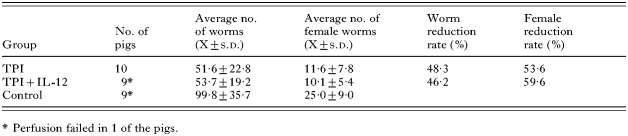
The recovered worms were counted for total worms and total female worms per pig in each group and the reduction rates were calculated using the formula described above. To determine significance in the differences between groups we analysed the data by variance analysis. The data showed that the average number of adult worms in the TPI group (51·6) and TPI+IL-12 group (53·7) were significantly less than those in the control group (99·8) both P<0·001, equaling the percentage reductions in total adult worm burdens of 48·3% and 46·2% respectively. Thus, the addition of IL-12 did not appear to enhance the protective effect of SjCTPI DNA vaccine in regards to total worm burdens. Interestingly, the SjCTPI DNA vaccines had a more pronounced effect on reducing female worm burdens, i.e. 53·6% SjcTPI alone and 59·6% for SjCTPI+IL-12. While the SjCTPI vaccine appears to have a greater impact on reducing female worms than male worms, addition of IL-12 did not augment this effect. The data for male and female worm recoveries in the three groups are summarized in Table 1. These data show that the SjCTPI plasmid DNA vaccine is highly effective in reducing total and female worm burdens.

Reduction in liver egg burdens
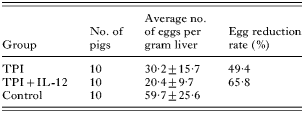
Similar to what we observed for reductions in adult worm burdens, the numbers of eggs that we counted in the mice immunized with the SjCTPI DNA group were reduced by 49·4% compared to control vaccinated mice and when IL-12 was added this reduction increased to 65·8%. The analysis of variance test showed that the number of eggs in the TPI group and the TPI+IL-12 group were significantly less than that in the control group (both P<0·001), but compared to to the standard errors in the TPI group, there was no significant difference (P>0·05) between levels of egg reduction between SjCTPI DNA and SjCTPI DNA+IL-12 groups (Table 2).

Effect of SjcTPI DNA vaccine on hepatic egg granuloma formation
Because it is possible, and even likely, that the numbers of liver eggs can be reduced while having no impact on the size of hepatic granulomas, we decided to perform morphometric measurements of liver egg granulomas using an NYD-1000 Imaging Analysis System (provided by Nanjing Medical University). Using measurements of the squares and diameters of all egg granulomas we calculated mean square and mean diameter measures for each group and then performed analysis of variance for differences. We found that mean square measures were significantly reduced by 42% and 42·5% in the SjCTPI and SjCTPI+IL-12 groups, respectively, compared to the size of liver granulomas from pcDNA control vaccinated pigs. (both P<0·001). Coincident with the mean square measure we also found that the mean diameters of liver granulomas were significantly reduced by 25·1% and 25·7% in the SjCTPI and SjCTPI+IL-12 groups respectively compared to the measurements of granulomas from control vaccinated pigs (both P<0·01) (Table 3).

Antibody response
There were no detectable TPI-specific antibody responses in any of the experimental groups prior to immunization. Sera collected after the last immunization, were tested and showed that all 10 pigs in control group C remained negative for antibody to recombinant TPI. In contrast, 6 of the 10 pigs from group A had anti-TPI antibody responses, while in group B (TPI+IL-12) 5 of 10 pigs had a positive antibody response. On day 45 after challenge, all pigs in the 3 groups showed specific antibody responses. We compared the antibody responses of pigs in groups A and B after the final boost and prior to challenge with the levels of protection seen at the time of perfusion. We were unable to see any correlation, as pigs that were negative for antibodies to TPI were protected as well as pigs which had produced anti-TPI antibodies after the last boost (data not shown).
DISCUSSION
The reservoir hosts play an important effect in transmission of schistosomiasis japonica due to the high number of different animal reservoirs. Further, it has recently been suggested that in some areas of China, water buffalo alone account for 80% of schistosome transmission. Without a vaccine against schistosomiasis japonica for humans, control of the disease must rely on chemotherapy and snail control which, to date, have not been successful in the lakes and marsh regions of China. However, an effective animal vaccine would likely complement drug treatment, leading to longer interruptions in transmission in the endemic areas. In this study we chose the pig as our experimental animal, not only because it is immunologically and physiologically similar to humans but also because it is an important animal reservoir host. The results from our study showed that vaccination with SjCTPI DNA led to a 48·3% reduction in total adult worms, 53·6% reduction in female worms and a 49·4% reduction in hepatic egg reduction. The protective effect we observed here exceeds that which was found at the independent study carried out by WHO/TDR (Bergquist, 1995). While our studies on vaccination with the strong Th1- promoter, IL-12, showed no effect on the ability of SjCTPI vaccine in reductions of total adult or female worms, it did have an effect by reducing hepatic eggs by 65·8%. The egg reduction rate seems to be increased but there was no significance between groups. IL-12 may not increase the protective effects in this study.
The antibody response results showed that in the TPI group and the TPI+IL-12 group 6 out of 10 pigs and 5 of 10 pigs could induce the antibody response to TPI respectively, but in the control group the antibody response to TPI could not be detected. It means that SjCTPI DNA vaccine could stimulate about 50% of pigs to produce anti-TPI antibody. We have reported that the SjCTPI DNA vaccine could stimulate the mouse, inducing CTL activity and a Th1 response (Zhu et al. 2002, 2004). It may indicate that the SjCTPI DNA vaccine could induce not only a cellular immune response but also a humoral response.
This study has shown that the SjCTPI DNA vaccine could induce acceptable protective effects for S. japonicum infection in large animals and should be a good vaccine for schistosomiasis japonica. In addition, the data obtained here and in expanded studies on the SjCTPI vaccines should provide useful data for developing a DNA vaccine for human use.
We thank Dr Ling Jiaojiao, Shi Fuhui, Zhang Zenda, Shi Yaojun, Li Hao (Shanghai Institute of Animal Parasitology, Chinese Academy of Agricultural Sciences) for their kind assistance in the animal experiments. This investigation received financial support from the UNDP/World Bank/WHO special program for Research and Training in Tropical Diseases (TDR) (ID: 991051) and partial financial support from the Jiangsu Previincial Department of Health (No. H9918).