1. Introduction
Over the past decade, several private standard schemes have emerged in a variety of sectors, in particular in the food sector. Private standards differ from public standards in that they have not been drafted by regulatory authorities, but by non-governmental entities, such as, in the food sector, supermarket chains, retail consortia, manufacturers,Footnote 1 producers, and trade cooperatives.Footnote 2 In certain sectors, importers establish Codes of Practice that set out standards which exporters must comply with before importers will buy their products. Self-regulation is another form of private sector standard-setting and is often used to foster consumer confidence.Footnote 3 The contents and aims of private standards vary from sector to sector. Private standards have implications for the market access conditions of exporting countries. The legal status of private standards is subject of debate. The WTO governs public standards under the Agreement on Sanitary and Phytosanitary Measures (SPS Agreement). The question is how wide the scope of application of the SPS Agreement is, and whether and to what extent it covers private standards. The Agreement on Technical Barriers to Trade (TBT Agreement) also covers standards and introduces a Code of Good Practice for the Preparation, Adoption and Application of Private Standards (CGP). This raises the question whether a similar approach could be adopted under the SPS Agreement. Finally, in our conclusion we assess possible ways forward.
2. Private food standards and some concerns they raise
In 2007, UNCTAD estimated the number of private sector standard schemes for the certification of ‘organically’ produced food at 400 and rising.Footnote 4 Taking into account the process of the restructuring of global agricultural and food markets that has taken place over the past few decades, several factors explain the rise in the number of private food standards. First, they constitute a response to the increase in real and/or perceived risks related to food production, transport, and processing caused by a number of high-profile food scandals, such as the BSE-crisis and several dioxin scandals, which have generated a greater distrust in regulatory agencies and stronger consumer anxiety. Second, the increased interest of consumers in food production processes and changes in their conceptions of food safety and quality are reinforced by companies' competitive strategies around environmental and social impact. Third, the responsibility for ensuring food safety has in many cases been transferred from the public to the private sector.Footnote 5 Furthermore, the ‘globalisation’ of supply chains and a trend towards vertical integration through the use of direct contracts between suppliers and retailers can be observed.Footnote 6 Competition among retailers, firm reputation in terms of safety and quality, and the use of private standards as a defence of due diligence with respect to mandatory legislation were all reasons for the increase in the use of these private standards.Footnote 7 Last, but equally important, private standards serve to differentiate between products.Footnote 8 The United Nations Industrial Development Organization (UNIDO) divides private standards in three categories: (i) consortia standards, such as GLOBALG.A.P., which are often developed by a sector-specific consortium; (ii) civil society standards, such as ‘Max Havelaar’ and other fair-trade standards, which are usually established on the initiative of a non-profit organization in response to certain social or environmental concerns; and (iii) company-specific standards, which are developed internally and apply to the whole supply chain of a company (e.g., Tesco's Nature's Choice, Marks & Spencer's Field-to-Fork).
Private standards are in and of themselves not mandatory as a matter of law. There is, as such, no legal obligation for suppliers to comply with these schemes. Nevertheless, the fact that a particular set of standards is used across the board in a certain sector may render the choice of individual producers or suppliers rather limited.Footnote 9 Other trade-related concerns with private standards deal with the content of these standards or the compliance therewith. Issues relating to the content of standards are for example the multiplication of private standard schemes, both within and between markets, the side-lining of public standards by private standards, the relationship of private standards with the international standard-setting bodies referred to by the SPS Agreement, and the scientific justification that is required for SPS measures. Compliance-related issues are the cost of third-party certification (in particular for small- and medium-sized enterprises), the requirement by some private schemes to use only specified certification bodies, the lack of equivalence between schemes leading to a multiplication of certification processes in order to comply with all schemes in use in a defined market, and the lack of recognition of certificates issued. Other issues include the difficulties in adapting to the often more detailed and complex private standards.Footnote 10 Legal issues surrounding private standards revolve in the first place around transparency. Some argue that private standard-setters, when they adopt or modify a standard which will apply at a large scale and may have substantial market access and development implications, do not have to notify these standards in advance, to publish them, or to observe a transition period to allow time for all relevant parties to comply with or switch to the new standard.Footnote 11
Nevertheless, the argument has been made that, under certain conditions, private standards can have trade-enhancing effects.Footnote 12 From this perspective, such standards are not seen as barriers to trade, but rather as catalysts that increase trade as well as development.Footnote 13 Arguably, compliance with private standards can have positive effects, where it acts as a catalyst driving infrastructure improvements and investment in developing countries.Footnote 14 In any event, the exact impact of private standards on global value chains is difficult to ascertain.Footnote 15 The question remains what their status is under the law of the WTO.Footnote 16
3. SPS Agreement
The preamble and Art. 2.1 of the SPS Agreement recognize the right of WTO Members to adopt ‘measures necessary to protect human, animal or plant life or health’. The agreement sets out a number of disciplines to reduce the negative effects on trade that might arise as a result of such measures. Measures must be non-discriminatory and consistent (Art. 2.3 and 5.5), may only be applied to the extent that they are necessary (Art. 2.2 and 5.6), and must be based on scientific principles and may not be maintained without sufficient scientific evidence (Article 2.2). The SPS Agreement further requires measures to be based on a proper risk assessment in order to ensure that they are based on science, take into account the objective of minimizing trade effects, as well as the economic costs associated with the measure.
Article 3 SPS Agreement sets out the goal of ‘the harmonization of sanitary and phytosanitary measures on as wide a basis as possible’. To this end, ‘Members shall base their sanitary and phytosanitary measures on international standards, guidelines and recommendations’. The drafters of the SPS Agreement recognized that diverging international standards can cause market-access-related problems, as it becomes difficult to enter multiple markets when compliance with differing national regulations and standards is required. Annex A of the SPS Agreement states that standards for food safety are ‘the standards, guidelines and recommendations established by the Codex Alimentarius Commission relating to food additives, veterinary drug and pesticide residues, contaminants, methods of analysis and sampling and codes and guidelines of hygienic practice’. The drafters of the SPS Agreement acknowledged the importance of harmonizing international standards: hence the Agreement's reference to public (international) standards set by the Codex Alimentarius Commission (Codex), the World Organisation for Animal Health (OIE), and the International Plant Protection Convention (IPPC). However, they clearly did not foresee the recent proliferation of sector-specific standards elaborated by private actors, such as retailers or supermarket chains. The SPS Agreement remains largely silent on this matter. In Section 4, we explore whether private standards fall within the scope of the Agreement.
In 2005, St. Vincent and the Grenadines launched a – still on-going – debate in the SPS Committee regarding the issue of private standards within the WTO SPS context, after supermarket chains had imposed quality standards for bananas which St. Vincent and the Grenadines claimed were higher than the international standards, thus causing problems for small-scale farmers. The countries asked for support facilities for small-scale farmers, more flexible standards that take into account country specific crops and circumstances, more producer-involvement in the standard-setting process, and a better relation with the SPS Agreement.Footnote 17 In 2009, the SPS Committee asked the WTO Secretariat to prepare an analytical report in which possible actions regarding private standards would be set out. The report contains 12 possible actions, ranging from the development of a working definition of private standards to an examination of the scope SPS Agreement and the possibility of a Code of Good Practice under the SPS Agreement.Footnote 18 These two actions will be discussed below.
4. Scope of application of the SPS Agreement
Pursuant to its Article 1.1, the SPS Agreement ‘applies to all sanitary and phytosanitary measures which may, directly or indirectly, affect international trade. Such measures shall be developed and applied in accordance with the provisions of this Agreement’ (emphasis added). There is no explicit limitation that only measures adopted by governmental authorities fall within the scope of the Agreement. Furthermore, in none of the Annexes to the SPS Agreement can any such explicit limitation be found. Nevertheless, other provisions explicitly refer to the rights and obligations of ‘Members’. Article 3 SPS Agreement, for example, was interpreted by the Appellate Body as follows in the EC–Hormones case: ‘the object and purpose of Article 3 is to promote the harmonization of the SPS measures of Members on as wide a basis as possible, while recognizing and safeguarding, at the same time, the right and duty of Members to protect the life and health of their people’ (emphasis added).Footnote 19 Members can base their SPS measures on these international standards (Article 3.1), they can conform to these standards (Article 3.2), or they may impose SPS measures resulting in a higher level of protection than would be achieved by the relevant international standard in terms of Article 3.3. Article 8 provides: ‘Members shall observe the provisions of Annex C in the operation of control, inspection and approval procedures, including national systems for approving the use of additives or for establishing tolerances for contaminants in foods, beverages or feedstuffs, and otherwise ensure that their procedures are not inconsistent with the provisions of this Agreement.’ The question is whether certain certification requirements, necessary to show compliance with private standards, would fall within the scope of this provision. Article 13 states, in relevant part:
Members shall formulate and implement positive measures and mechanisms in support of the observance of the provisions of this Agreement by other than central government bodies. Members shall take such reasonable measures as may be available to them to ensure that non-governmental entities within their territories, as well as regional bodies in which relevant entities within their territories are members, comply with the relevant provisions of this Agreement. In addition, Members shall not take measures which have the effect of, directly or indirectly, requiring or encouraging such regional or non-governmental entities, or local governmental bodies, to act in a manner inconsistent with the provisions of this Agreement. Members shall ensure that they rely on the services of non-governmental entities for implementing sanitary or phytosanitary measures only if these entities comply with the provisions of this Agreement. (emphasis added)
Most likely, the drafters of the SPS Agreement intended a narrow meaning of non-governmental and regional bodies. Some authors and WTO Members therefore argue that the question arises whether a ‘good faith’ interpretation of these terms, as required by the Vienna Convention on the Law of Treaties, would today require consideration of the changed circumstances in SPS governance.Footnote 20 It is clear from Article 13 that WTO Members must promote the compliance by these bodies with the disciplines of the SPS Agreement. It is not clear, though, how far their responsibility to do so stretches. On the other hand, some authors argue that standards set by ‘non-state market driven governance systems’ should be kept out of the ambit of WTO disciplines altogether. In their view, a ‘transnational regulatory space’ should be preserved for such systems from WTO disciplines.Footnote 21
To this date, there is still no authoritative interpretation of Article 13, rendering it difficult to foresee what the provision entails for governments and private standard-setters. If anything, the discussions in the SPS Committee have highlighted the disagreement among WTO Members concerning the applicability of the SPS Agreement to private standards.Footnote 22 Some authors argue that private standards do not fall within the scope of the SPS Agreement, and as such cannot be disciplined under it, as ‘it is hard to conceive of a situation where an international agreement or treaty can be brought to bear on the private commercial transactions of buyers within agricultural and food supply chains’.Footnote 23 Others, however, submit that the question is not whether private actors can be bound directly by the SPS Agreement but rather in ‘which cases a Member can be held responsible for the actions of private parties in its territory, or of regional bodies in which entities in its territory are members’.Footnote 24 The latter question concerns the attribution of private action to a WTO Member. The WTO Secretariat in its 2007 paper on private standards under the SPS Agreement mentioned two situations in which this question might arise. First, a government authority might decide to incorporate a standard developed by a private body into its SPS regulations. Second, a government might decide to permit the entry of imports that are certified to comply with a private standard that incorporates and exceeds the official requirements.Footnote 25 Analogically, in Japan–Film the Panel noted the risk that if this would be allowed, ‘WTO obligations could be evaded through a Member's delegation of quasi-governmental authority to private bodies’.Footnote 26 Although the case dealt with a possible violation of the General Agreement on Tariffs and Trade 1994 (GATT) rather than an SPS measure, the Panel noted that ‘what may appear on their face to be private actions may nonetheless be attributable to a government because of some governmental connection to or endorsement of those actions’.Footnote 27 Private party action may be deemed governmental in the view of the Panel ‘if there is sufficient government involvement with it’. Nevertheless, it added that this will always have to be examined on a case-by-case basis as ‘it is difficult to establish bright-line rules in this regard’.Footnote 28
Even if private action cannot be directly attributed to a government, as will often be the case, Article 13 SPS Agreement may still play a role, in that it requires Members to ‘take such reasonable measures as may be available to them to ensure that non-governmental entities within their territories … comply with the relevant provisions of this Agreement’ (emphasis added). Given the use of the term ‘reasonable’, it is necessary to look at the limits of the obligations Members bear in this respect. In the first place, it should be noted that this is an obligation of means (a ‘best-endeavours’ obligation) rather than an obligation of result. Members are not required actually to ensure compliance by non-governmental entities and regional bodies, but only to take such reasonable measures as may be available to them to ensure compliance. Therefore, if a non-governmental body does not comply with the rules of the SPS Agreement, this will not necessarily mean that a Member can be held responsible under Article 13. Reasonable measures that governments could take might include the dissemination of information about the SPS Agreement, entering into memoranda of understanding, and the provision of financial incentives to encourage private actors to comply. It has been observed that there would be considerable difficulty in defining the limit of the reasonable measures that national governments might take.Footnote 29 As the drafters of the SPS Agreement did not have private standards in mind, an interpretation of Article 13 that would entail that national governments must ensure compliance by all private actors does not seem warranted.Footnote 30
5. Inspiration from the TBT Agreement?
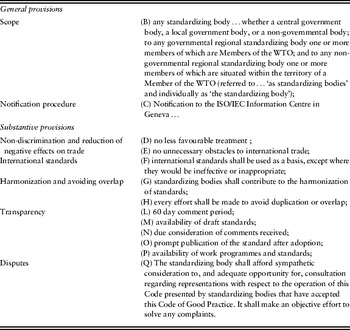
If application of the SPS Agreement is not possible, are there other ways to discipline private standards? One option that has been coined is the adoption of an approach similar to that to private standards under the WTO's TBT Agreement. The WTO Secretariat notes, ‘one difference with respect to the “reasonable measures to ensure compliance” required of Members under the TBT and SPS Agreements is the reference under the TBT Agreement to Members ensuring acceptance and compliance with the Code of Good Practice by non-governmental bodies.’Footnote 31 The TBT Agreement was negotiated in full awareness of the importance of the private sector in setting, applying, and assessing conformity with technical standards.Footnote 32 Annex 3 to the TBT Agreement establishes a ‘Code of Good Practice for the Preparation, Adoption and Application of Standards’ (CGP) (see Table 1).
Code of Good Practice for the Preparation, Adoption and Application of Standards (CGP)

Article 4.1 TBT Agreement obliges WTO Members to take reasonable measures to ensure that non-governmental and regional bodies accept and comply with the CGP. Regardless of whether the standardising body has accepted the CGP, it is upon the Member to take reasonable measures to ensure compliance with the CGP. The question is whether a similar approach, a separate CGP, for the SPS Agreement is viable. It has been suggested that there is merit in such a separate code as ‘these disciplines could target those practices of private bodies that developing-country Members have identified as particularly problematic, such as lack of transparency, absence of prior consultation to allow for input from producers, undue burden from costly and complex conformity assessment procedures, and non-recognition of equivalence’.Footnote 33 Another benefit of creating a CGP for the SPS Agreement would be that the positive effects of private standards would not be neglected. Many authors have argued that the current solution of harmonization through designated (public) international standards is problematic in itself as the legitimacy of the adopted standards is often placed in doubt.Footnote 34 At the same time, it should be noted that the adoption of such a code is subject to the approval of all WTO Members. A CGP could be adopted in two different ways: first, by the SPS Committee, through its competence under Article 12.7 SPS Agreement; or, alternatively, by way of an amendment to the SPS Agreement that could be agreed upon by a Ministerial Conference under Article X of the WTO Agreement.Footnote 35 Given the criticism that they have faced, a number of private standard setters now claim to voluntarily follow the CGP as established under the TBT Agreement, or at least be in a constructive dialogue with the WTO.Footnote 36
6. Conclusion and way forward
Private standards have come to the forefront of the multilateral trading system. The impact of private standards on, in particular, developing country producers and exporters is not undisputed and can vary between products or sectors. Some argue that private standards restrict market access and, although not legally binding, are de facto mandatory, as some standards are used across the board in certain sectors. Others maintain that private standards are better suited to adapt to consumer demands, and hence increase trading opportunities for developing country producers. Whatever the truth may be, the status of private standards under the law of the WTO, in particular the SPS Agreement, remains unclear as of yet. The modest aim of this paper was to shed some light on the question whether the SPS Agreement, originally intended to only deal with public standards, also covers private standards. Particular attention has been paid to the role of Article 13 of the SPS Agreement, which deals with, first, the extent to which non-governmental action can be attributed to a WTO Member, and, second, the extent of the obligation that it places upon Members ‘to ensure that non-governmental entities within their territories … comply with the relevant provisions of this Agreement’. Although there is some effort required from governments, the fact that the SPS Agreement was negotiated at a point in time when the drafters were not aware of the emergence of private standards, renders it difficult, and even undesirable, to interpret the provision in a way that would impose strict obligations on governments to ensure that private standards do not violate the SPS Agreement. Nevertheless, private standards warrant attention, as they can have a large impact on small-scale producers. A CGP for the SPS Agreement, akin to the one incorporated under the TBT Agreement, might have merit. However, the adoption of such a code is subject to the approval of all WTO Members, and is likely to face opposition.Footnote 37 Other proposals have focused on the mitigation of the trade-restrictive effects of private standards, which would include the provision of financial and technical assistance to developing countries.Footnote 38 One of the mechanisms suggested in this respect is the Standards and Trade Development Facility (STDF), which coordinates the activities of donors who provide SPS-related technical assistance.Footnote 39 In any event, the discussion of these proposals in the SPS Committee requires an active role of developed countries.Footnote 40 The second-best option of addressing private standards per analogy under the existing TBT CGP does not seem feasible at this stage.Footnote 41 Only a well-informed dialogue between public and private standard setters could successfully address the challenges posed by private standards without having to resort to long technical debates in the context of the WTO's SPS Committee.