Child neuropsychology is the study of the relationship between the brain and cognition/behaviour of children in the dynamic context of a developing brain (Semrud-Clikeman & Ellison, Reference Semrud-Clikeman and Ellison2009). Early neuropsychological development is a good predictor of long-term neuropsychological development. Tools for neuropsychological assessment of children are used in the fields of education, clinical practice and research. In clinical practice, neuropsychological assessment provides information that is useful for diagnostic, prognostic and treatment purposes (Heffelfinger & Koop, Reference Heffelfinger and Koop2009). Therefore, there is a need to assess the cognitive, psychomotor and socioemotional abilities of children using specific standardised instruments suited to each age range and avoiding cultural bias (Baron, Reference Baron2004; White, Campbell, Echeverria, Knox, & Janulewicz, Reference White, Campbell, Echeverria, Knox and Janulewicz2009). Further, in areas where there are different languages and cultures, the assessments must be adapted to each cultural context (AERA, APA, & NCME, 2014). The adaptation of an instrument to another language and culture must follow a standardised process, in order that the adapted version enables us to measure, without any type of bias, features of people speaking in that language (Balluerka, Gorostiaga, Alonso-Arbiol, & Haranburu, Reference Balluerka, Gorostiaga, Alonso-Arbiol and Haranburu2007).
The Basque Country is a bilingual region, with a population of approximately 2 million of inhabitants, in which the Basque and Spanish languages coexist in daily life (35.2% of the population being Basque speakers; Eustat, 2014). In terms of education, at 4 years of age 99.5% of children are enrolled in school (Eustat, 2014) and the majority of primary school children (72%) receive education in Basque (“model D”, all subjects being taught in Basque except Spanish and foreign languages; Eustat, 2015). Nevertheless, previously, no instrument for child neuropsychological assessment has been developed in or validated for the Basque language and culture.
In this paper, we describe the process of adaptation to Basque and validation of the McCarthy Scales of Children’s Abilities (MSCA; McCarthy, Reference McCarthy2009). The MSCA allows the assessment of cognitive and psychomotor development in children between 2 and a half and 8 and half years old. This instrument was validated for Spanish population in 2006 (McCarthy, Reference McCarthy2009) but it has never been adapted to Basque. The adaptation of the MSCA was carried out in the context of a wider study, the INMA project (Infancia y Medio Ambiente, Childhood and Environment: www.inma.org), focused on assessing the relationship between exposure to environmental pollutants and neurodevelopment in early childhood. In this project, the MSCA was selected for carrying out the neuropsychological follow-up of the cohorts at 4 years of age. The MSCA is one of the few instruments for assessing neuropsychological development in preschool children that shows adequate psychometric properties (White et al., Reference White, Campbell, Echeverria, Knox and Janulewicz2009) and, moreover, it is one of the most widely used instruments in research related to environmental health and neurodevelopment (Forns et al., Reference Forns, Aranbarri, Grellier, Julvez, Vrijheid and Sunyer2012). Given the linguistic nature of the Gipuzkoa cohort, with most children being bilingual (Basque and Spanish) but a high proportion having Basque as their dominant language, we deemed it necessary to adapt the instrument to the Basque language and culture in order to assess the neuropsychological development of each child in their dominant language, and thereby obtain valid/reliable responses that adequately reflect the cognitive and psychomotor skills measured.
The MSCA is composed of 18 independent subtests grouped into 6 scales: Verbal Perceptual-Performance, Quantitative, General Cognitive, Memory and Motor scales. For each scale, an individual’s raw score is converted into an index score, according to his/her chronological age. The content of the tests was designed in order that the instrument was suitable for both sexes and different regional, socio-economic and ethnic groups.
Regarding previous versions of the MSCA, the scales show adequate internal consistency. Factor analyses carried out by different authors have shown that their structure is sensitive to sample characteristics, especially age and socio-economic level (Culbertson & Gyurke, Reference Culbertson and Gyurke1990; Forns-Santacana & Gómez-Benito, 1990; Gómez-Benito, & Forns-Santacana, 1993). There is evidence of convergent validity both with scales for general developmental assessment and with tests to evaluate specific cognitive abilities. Further, it has shown to have predictive validity with regards to reading ability in preschool children, and later academic performance, and language problems (McCarthy, Reference McCarthy2009).
The forward-backward- translation procedure was used in order to adapt the items, instructions and verbal content of the administration and scoring manual (Hambleton & Patsula, Reference Hambleton and Patsula1999; Hambleton & Zenisky, Reference Hambleton, Zenisky, Matsumoto and van de Vijver2011), given that this is one of the best approaches for detecting problems associated with poor translations or adaptations, and hence to ensure the quality of the translation (Balluerka et al., Reference Balluerka, Gorostiaga, Alonso-Arbiol and Haranburu2007). The four members of the translation team were all psychologists who spoke fluent Basque and Spanish and were instructed in the basic psychometric knowledge related to the construction of items. Additionally, three of the four team members were experts in child neuropsychological development and familiar with the characteristics of the target population. First, each of the items, instructions and responses to the verbal subtests of the Spanish version were translated into Basque independently by two of the translators. These translators compared and discussed their translations until they reached a consensus on each of the translated elements. Then, from this version, the other two translators performed the back-translation, independently translating into Spanish all the items, instructions and responses to the verbal subtests of the agreed Basque version, and subsequently, they agreed on a single version in Spanish. Finally, the two translation teams compared the source version and the back-translation of the instrument, and assessed the potential differences in terms of the literal and/or conceptual meaning.
Based on this analysis, necessary modifications were made to the Basque version of the MSCA and a pilot version of the MSCA-E was constructed. Then, a pilot study was carried out (N = 42; 23 boys; mean age = 4.4 years, SD = 1.2), to assess, through qualitative and quantitative analyses, whether children properly understood the items and the instructions, and reformulate any items that did not work as expected. The preliminary analysis of the reliability of the subtests, and of the correlations between subtests, between scales, and between scales and subtests yielded results that lay within expected ranges.
The main objective of this study was to assess the validity of the MSCA-E in a broad sample of Basque preschool children. Specifically, we aimed to assess the dimensionality of the MSCA-E and to validate the executive function scale created and validated in another cohort of the INMA project (Julvez et al., Reference Julvez, Forns, Ribas-Fitó, Torrent and Sunyer2011), and the long-term memory scale, created in order to obtain a broader range of information on memory processes in children. Furthermore, we wanted to evaluate the internal consistency of each of the scales, as well as the relationship between the scales and variables related to neuropsychological development such as sex, parental education and ADHD-like behaviours.
Method
Participants
The study sample was composed of 273 children from the Gipuzkoa cohort of the INMA project, ranging in age between 4 years and 4 months and 4 years and 11 months (52.2% boys). For the recruitment, all the pregnant women who attended to the antenatal care visits in the first trimester of pregnancy to the Regional Hospital of Zumarraga, Gipuzkoa (Spain) between May of 2006 and February of 2008 were invited to participate. There were no statistically significant differences between participants and non participants in the main sociodemographic variables (i.e., age, parental occupation and educational level; p > .05). This is the reference Hospital of the region where 90% of women from the study area attend during their pregnancy. Half of the mothers (52.5%) and a third of the fathers (29%) had university qualifications. All the children lived in the Basque Country and received their education in Basque. Overall, 34.3% of the children spoke only Basque, the rest (65.7%) being bilingual but having Basque as their dominant language. We found no statistically significant differences in any of the subscales except for the Verbal Scale (t(176) = 3.06; p = .003). Monolingual children obtained a higher score (M 53.18; SD 8.6) than bilingual children (M 49.57; SD 6.7).
Inclusion criteria were not have being diagnosed with a psychological or neurodevelopmental disorder and to perform a valid neuropsychological assessment defined as a good collaboration quality. Those children previously diagnosed with a neurodevelopmental disorders (n = 7; Attention-Deficit/Hyperactivity Disorder or Autism Spectrum Disorder) were also assessed and formed the clinical sample. There were no statistically significant differences between general sample and clinical sample in the main sociodemographic variables (i.e., age, parental occupation and educational level; p > .05). The study was approved by the Clinical Research Ethics Committee of the Gipuzkoa Health Region (Donostia Hospital). Data were collected under conditions of anonymity, and children were only included after their parents had given written informed consent.
Measurement instruments
MSCA-E: McCarthy Scales of Children’s Abilities adapted to Basque. This instrument allows the assessment of cognitive and psychomotor development of children aged from 4 years and 4 months to 4 years and 11 months in the Basque language. It is composed of 18 subtests grouped into 9 scales, 7 corresponding to the original source (dividing Motor skills into Fine and Gross): Verbal, Perceptual-Performance, Quantitative, General Cognitive, Memory, and Fine and Gross Motor skills; and additionally, as indicated above, scores for executive function and long-term memory. The long-term memory scale was created based on previous knowledge of how to assess memory in children (Soprano, Reference Soprano2003). It is composed of two subtests: long-term visual memory (Subtest 3) and long-term verbal memory (Subtest 7, Part II), in which participants have to repeat the same tasks as in the original memory subtests of the MSCA 20 minutes after the presentation of the stimuli. We ensured there was no interference between the two memory assessments.
Questionnaires on sociodemographic characteristics: Data on child sex and maternal and paternal levels of education were collected using ad hoc questionnaires that were administered to the families as part of the follow-up for the INMA project (Guxens et al., Reference Guxens, Ballester, Espada, Fernández, Grimalt, Ibarluzea and Sunyer2012).
Attention Deficit Hyperactivity Disorder Criteria of Diagnostic and Statistical Manual of Mental Disorders, Fourth Edition [ADHD-DSM-IV] form list (American Psychiatric Association, 1994): ADHD-DSM-IV is a check list comprised of 18 items and is designed to evaluate attention deficit (1–9), and hyperactivity and impulsivity (10–18) symptoms in children. Each symptom is rated using a 4-point scale, i.e., 0 = ‘‘not at all’’, 1 = ‘‘just a little’’, 2 = ‘‘pretty much’’, and 3 = ‘‘very much’’. In our sample, the Cronbach’s alpha was 0.92 for the complete instrument (0.91 for inattention and 0.91 for hyperactivity/impulsivity).
Bayley Scales of Infant Development (BSID; Bayley, Reference Bayley1977): It is an instrument that allows us to comprehensively assess children’s development from 0 to 3 years of age. It has three scales: the mental scale that assesses cognitive abilities; the psychomotor scale, that assesses the degree of body coordination, laterality, balance, praxic abilities, as well as fine motor skills, as shown by control of hands and fingers; and finally, a behaviour rating scale that, among other aspects, assesses social attitudes and the level of collaboration during the test. The instrument allows us to obtain two indexes: a mental development index (MDI or cognitive index) and a psychomotor development index (PDI). In the study sample, the Cronbach’s alpha for internal consistency was 0.78 for the MDI and 0.73 for the PDI.
Procedure
Neuropsychological assessments were conducted in a cultural centre in Zumarraga (a province in the north of Spain) as part of follow-up of the Gipuzkoa cohort of the INMA project. All the families participated on a voluntary basis and signed corresponding informed consent forms. The MSCA-E was administered individually to each child by a trained neuropsychologist, complying with the requirements for proper assessment. All the assessments were performed in a separate room, avoiding distracting stimulus and respecting the assessment duration (Heffelfinger & Koop, Reference Heffelfinger and Koop2009). In all cases, it took around 1 hour to administer the scales. In addition, the ADHD-DSM-IV was completed by the teacher of each child. The BSID scores were retrieved from previous assessments conducted in the INMA project, when the children were 14 and 26 months of age. The sociodemographic characteristics were obtained using ad hoc questionnaires. The follow-up protocol for the different stages of this project has previously been described by Guxens et al. (Reference Guxens, Ballester, Espada, Fernández, Grimalt, Ibarluzea and Sunyer2012).
Statistical analysis
First, in order to assess the dimensionality of the instrument, confirmatory factor analyses were performed, using the EQS 6.1 software (Bentler, Reference Bentler2006). The robust maximum likelihood estimation method (ML Robust) was applied. The goodness-of-fit of each scale was assessed with the following indexes: the Comparative Fit Index (CFI), the Root Mean Square Error of Approximation (RMSEA) and the Satorra-Bentler scaled chi-square difference test. Given that the factor structure has been found to vary between studies (Culbertson & Gyurke, Reference Culbertson and Gyurke1990; Forns-Santacana & Gómez-Benito, 1990; Gómez-Benito & Forns-Santacana, 1993), we opted to assess the fit for each of the scales of the source instrument as well as for executive function scale. The long-term memory scale was not included in the CFA, given that it is based on two subtests of the original scale. Instead, the correlation between the long-term memory scale and the original memory scale was examined. Further, the correlation between each of the scales of the instrument was analysed, and the reliability of the scales was examined with the Spearman–Brown and Cronbach Alpha reliability indexes.
In order to obtain evidence of validity based on the relationship between the construct assessed with the MSCA-E and other variables reported to be associated with the neuropsychological development in the literature, differences in the MSCA-E scores were analysed regarding sex, maternal education and paternal education. This was done by comparing the means with Student’s t test and estimating the effect size associated with the difference between the means with Cohen’s d statistic (0.2 small, 0.5 medium and 0.8 large; Cohen, Reference Cohen1988). On the other hand, correlation coefficients were calculated between MSCA-E scores and ADHD-DSM-IV indexes, and between MSCA-E scores and the scores obtained previously on the BSID at 14 and 26 months of age. Additionally, in order to obtain evidence about the sensitivity of the MSCA-E, differences in the MSCA-E scores were analyzed between the general sample and the clinical sample. Student’s t test and the associated Cohen’s d statistics were calculated.
Results
Dimensionality of the instrument
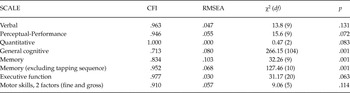
The fit indexes obtained for the MSCA-E scales were satisfactory in all cases except for the General Cognitive and Memory scales. For the memory scale, the fit indexes were found to be more appropriate omitting scores for Subtest 6 (Tapping sequence) (Table 1).
Results of the confirmatory factor analysis

Note: CFI: Comparative Fit Index; RMSEA: Root Mean Square Error of Approximation; χ2: Satorra-Bentler scaled chi-square difference test.
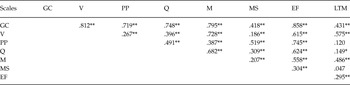
The correlation pattern observed between the different scales of the MSCA-E (Table 2) is consistent with that expected according to the structure considered by the authors in the original instrument. In particular, we found statistically significant moderate-to-strong correlations between scales that share content in the original structure and weaker correlations between the cognitive scales and the Gross Motor scale. Furthermore, the long-term memory scale was moderately correlated with the original memory scale.
Correlations between the scales of the MSCA-E

Note: GC: General Cognitive, V: Verbal, PP: Perceptual-Performance, Q: Quantitative, M: Memory, MS: Motor skills, EF: Executive function, LTM: Long-term memory.
* p ≤ .05; **p < .001; ***p < .0001.
Reliability
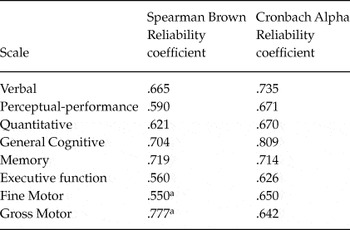
Table 3 lists the split-half coefficients corrected by the Spearman-Brown formula, calculated using raw scores to estimate the internal consistency and the Cronbach Alpha coefficients. Most of the scales presented adequate internal consistency.
Reliability coefficients

a These coefficients were calculated in accordance with the proposal in the source MSCA manual (page 230), to divide the Motor scale into Fine and Gross Motor skills, the former having a greater cognitive component.
Validity based on the relationship between the construct assessed by the MSCA-E and other variables
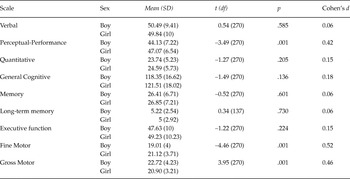
Table 4 presents the means and standard deviations of girls and boys for each MSCA-E scale, as well as the Student’s t test results together with the Cohen’s d effect size. We found statistically significant differences between the mean scores obtained by boys and girls for Perceptual-Performance, Fine Motor skills, and Gross Motor skills. These differences showed moderate effect sizes. As can be observed in the table, boys had better scores in the Gross Motor scale, while girls had better scores in Perceptual-Performance and Fine Motor scales.
Means (standard deviations) of MSCA-E scores by sex and corresponding Student’s t test results and Cohen’s d effect sizes

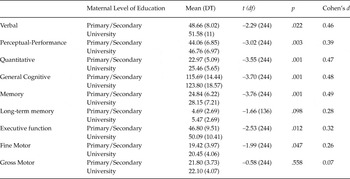
Table 5 shows the means and standard deviations of scores on each of the MSCA-E scales as a function of maternal level of education, together with the Student’s t test results and associated Cohen’s d effect size. We found statistically significant differences between the means for all the scales except for Gross Motor and Long-term memory scales. The effect sizes associated with these differences were moderate for the Verbal, Perceptual-Performance, Quantitative, General Cognitive and Memory scales, and small for the Executive Function and Fine Motor scales. In all the scales, children from mothers with university education had higher scores.
Means (standard deviations) of MSCA-E scores by maternal level of education and corresponding Student’s t test results and Cohen’s d effect sizes

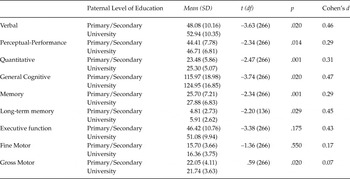
Table 6 shows the means and standard deviations of MSCA-E scores as a function of paternal level of education, together with the Student’s t results and Cohen’s d effect sizes. We found statistically significant differences in Verbal, Perceptual-Performance, Quantitative, General Cognitive, Memory, Long-term memory and Gross Motor skills. These differences were associated with moderate effect sizes in the Verbal, General Cognitive, Long-term memory and Executive function scales. In those scales, children from fathers with university education obtained higher scores.
Means (standard deviations) of the MSCA-E scores by paternal level of education and corresponding Student’s t test p-values and Cohen’s d effect sizes

Table 7 shows the correlations between the MSCA-E scales and the number of ADHD symptoms presented by the children. The results indicate that all the MSCA-E scales were negatively associated with both ADHD-DSM-IV indexes. The correlations between the Inattention index and the MSCA-E scales were statistically significant in all cases, except for Gross Motor skills. The correlation was not high for any of the scales, and was moderate for the General Cognitive and Executive Function scales.
Correlations between the scales of the MSCA-E and ADHD-DSM-IV symptoms

Note: V: Verbal, PP: Perceptual-Performance, Q: Quantitative, GC: General Cognitive, M: Memory, LTM: Long-term memory, EF: Executive function, FMS: Fine Motor skills, GMS: Gross Motor skills.
* p ≤ .05; **p < .001; ***p < .0001.
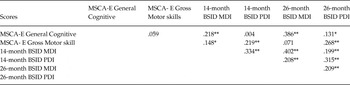
Table 8 shows the correlations between the scores obtained on the General Cognitive and Gross Motor scales of the MSCA-E at 4 years of age and the cognitive and psychomotor indexes (MDI and PDI) of the BSID at 14 and 26 months of age. The results indicate statistically significant positive associations, on the one hand, between the MSCA-E General Cognitive score at 4 years of age and BSID MDI scores at 14 and 26 months of age, and on the other, between the MSCA-E Gross Motor score at 4 years of age and BSID PDI scores at 14 and 26 months of age.
Correlations between the General Cognitive and Gross Motor scores on the MSCA-E at 4 years of age and the mental development index (MDI) and psychomotor development index (PDI) scores of the BSID at 14 and 26 months of age

Note: MSCA-E: McCarthy Scales of Children’s Abilities-Basque Version; BSID: Bayley Scales of Infant Development; MDI: mental development index; PDI: psychomotor development.
* p ≤ .05; **p < .01.
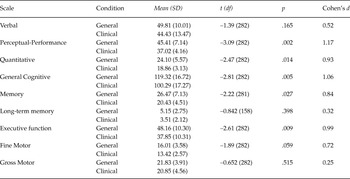
Table 9 shows the means and standard deviations of MSCA-E scores as a function of children condition (General/Clinical), together with the Student’s t results and Cohen’s d effect sizes. We found statistically significant differences in the Perceptual-Performance, Quantitative, General Cognitive, Memory and Executive Function scales. These differences were associated with large effect sizes. Moderate effect sizes were found for the Verbal and Fine Motor scales. In all the scales, children in the general condition obtained higher scores.
Means (standard deviations) of MSCA-E scores by condition (General/Clinical) and corresponding Student’s t test results and Cohen’s d effect sizes

Discussion
The goal of this study was to produce and validate the first Basque version of the MSCA in order to provide an adapted instrument for the neuropsychological assessment for Basque preschool children.
Regarding the dimensionality of the instrument, several studies aiming to identify a stable structure with adequate fit indexes have shown that the structure of the MSCA depends on the characteristics of the sample, in particular, on age and socioeconomic level (Culbertson & Gyurke, Reference Culbertson and Gyurke1990; Forns-Santacana & Gómez-Benito, 1990; Gómez-Benito & Forns-Santacana, 1993). Given the lack of consensus in the aforementioned studies, in our research, we decided to assess the dimensionality of the instrument by calculating the fit indexes for each of the scales separately. It should be pointed out that the validity of each of the scales separately is very useful for performing appropriate neuropsychological assessment, as it makes it possible to specifically assess different cognitive and motor skills (Heffelfinger & Koop, Reference Heffelfinger and Koop2009), which is difficult in preschool children (Baron & Anderson, Reference Baron and Anderson2012). Our results showed satisfactory fit indexes in all cases except for the General Cognitive and Memory scores. In the case of the General Cognitive score, the results may be attributable to the score being derived from the sum of scores on three scales: Verbal, Perceptual-Performance and Quantitative. Though each of these scales has internal coherence, this is not maintained when the items of the three scales are grouped in a larger entity (General Cognitive Index). Regarding the Memory scale, it should be highlighted that this is the scale that has caused the most problems in previous research (McCarthy, Reference McCarthy2009). For this reason, after the first confirmatory factor analysis of the original structure (Subtests 3, 6, 7 and 14), we repeated the analysis without Subtest 6 (Tapping sequence) and we obtained better fit indexes (CFI = 0.952; RMSEA = 0.068). This improvement may be due to the fact that the Subtest 6 relies not only on attention and memory skills, but also on motor skills, these possibly having an influence on the execution of tasks.
With respect to internal consistency of the MSCA-E scales, although the coefficients were slightly lower than those obtained in the Spanish sample in 2006 (McCarhty, 2009), most of them are close to the acceptable cut-off point established (Davis, 1971; George & Mallery, Reference George and Mallery2003) and are similar to those found in other cohorts of the INMA project assessed with the source version (Julvez et al., Reference Julvez, Forns, Ribas-Fitó, Torrent and Sunyer2011). The magnitude of the coefficients could be explained attending to different reasons. On one hand, the MSCA has a complex structure and the number of items that constitute the indexes is different in each case. Besides, the age of the sample, as at age 4 children do not reach to answer all the items of each subscale reducing variability. Finally, the differences in the characteristics of the tasks among the subscales that conform each index could be affecting to the reliability coefficients.
In relation to the evidence of validity based on the association between MSCA-E and other variables described in the literature, results are consistent with previous research. First, we found differences in the neuropsychological development between sexes. Boys had better scores for Gross Motor skills while girls obtained better scores for Perceptual-Performance and Fine Motor skills. It is well known that girls and boys have different neurodevelopment patterns (Lenroot et al., Reference Lenroot, Gogtay, Greenstein, Wells, Wallace, Clasen and Giedd2007), and specifically, our results are consistent with reports from previous studies (Osorio, Torres-Sánchez, Hernández, López-Carrillo, & Schnaas, Reference Osorio, Torres-Sánchez, Hernández, López-Carrillo and Schnaas2010). Sex differences in the perceptual-performance scale were also found in the Spanish adaptation (McCarthy, Reference McCarthy2009). Second, parental level of education has been widely described as an environmental factor that promotes early neurodevelopment (Bradley & Corwyn, Reference Bradley and Corwyn2002; Walker et al., Reference Walker, Wachs, Grantham-McGregor, Black, Nelson, Huffman and Richter2011). Some studies indicate that this association is particularly notable in language and executive function development (Hackman, Farah, & Meaney, Reference Hackman, Farah and Meaney2010). Our results are consistent with this idea, and the differences observed in MSCA-E scores as a function of parental level of education are associated with larger effect sizes for the scales associated with cognitive abilities than for those associated with motor skills. Moreover, within the cognitive scales, the effect sizes were larger in the case of cognitive scales associated with verbal abilities (Verbal and General Cognitive scores).
Third, previous publications have reported cognitive and learning difficulties in ADHD children (Barkley, Reference Barkley2014; Spira & Fischel, Reference Spira and Fischel2005). Prior studies have shown that symptoms associated with ADHD, though insufficient to meet criteria for a clinical diagnosis, tend to be observed together with cognitive difficulties (Ramos et al., Reference Ramos, Freire, Julvez, Fernández, García-Esteban, Torrent and Olea2013). We found significant negative correlations between inattention symptoms and all the cognitive scales, though not with Gross Motor skills. Further, as could be expected, the strongest correlation was found between inattention symptoms and executive function (Barkley, Reference Barkley2001; Furman, Reference Furman2005; Julvez, Forns, Ribas-Fitó, Torrent, & Sunyer, Reference Julvez, Forns, Ribas-Fitó, Torrent and Sunyer2011). These results are in accordance with what was described by Ramos et al. (Reference Ramos, Freire, Julvez, Fernández, García-Esteban, Torrent and Olea2013), who observed an association between inattention symptoms and cognitive abilities but not between hyperactivity symptoms and cognitive development.
Besides, the pattern of correlations observed between the scores on the BSID administered at 14 and 26 months of age, and the MSCA-E General Cognitive and Gross Motor scores also provides evidence of validity, since both scales are used to assess the neuropsychological development in children. Our findings indicate that, on the one hand, the MSCA-E General Cognitive scores are associated with the BSID MDI scores from both earlier follow-up assessments, the correlation being stronger when the two assessments are chronologically closer. On the other hand, the MSCA-E Gross Motor scores are associated with the BSID PDI scores at 14 and 26 months of age, and as with the cognitive scales, the correlation was stronger considering the more recent assessment. Since both instruments assess neuropsychological development, we could have expected even stronger correlations; the fact that the correlations were relatively weak may be due to the time elapsed between the assessments. It also may be due to the characteristics of each of the instruments: whereas BSID provide general cognitive and motor developmental indexes, the MSCA-E scales provide more specific measurements.
Lastly, the differences observed in the MSCA-E scores between the general and the clinical sample indicate that the instruments shows sensitivity to detect neurodevelopmental difficulties in preschool children.
It should be mentioned that though we analysed a large sample of 4 years old children in the Basque Country, we were not able, in this study, to validate the instrument for a wider age range. Therefore, future research should keep improving the evidence of validity of the MSCA-E, analysing its psychometric properties for the full age range for which the original scale was developed.
Taken together, results obtained show that the MSCA-E can be regarded as a useful tool to evaluate cognitive and psychomotor development in Basque children between 4 years and 4 months and 4 years and 11 months.