Introduction
The island of Bornholm (Figure 1) in the Baltic Sea is famous for its Roman gold and the prominent Iron Age central place of Sorte Muld. But Sorte Muld declined in the Viking age, and at some point in the medieval period, at the latest, Bornholm was included in the Danish realm. What happened in between? One component in this discussion is the sudden appearance of runestones in the eleventh century ad, which has been the subject of a longstanding debate. The late arrival of the runestone tradition on Bornholm in the mid-eleventh century ad, when their tradition had already declined in other parts of Denmark (Imer, Reference Imer2016: 282–84), is perplexing. Furthermore, the runestones on Bornholm have several runological and ornamental characteristics in common with Swedish runestones. This raises the question of whether these similarities are due to Swedish influence on Bornholm, perhaps even because Swedish rune carvers visited the island—and, if so, why?—or whether the resemblance is due to chronological trends in the runestone tradition.
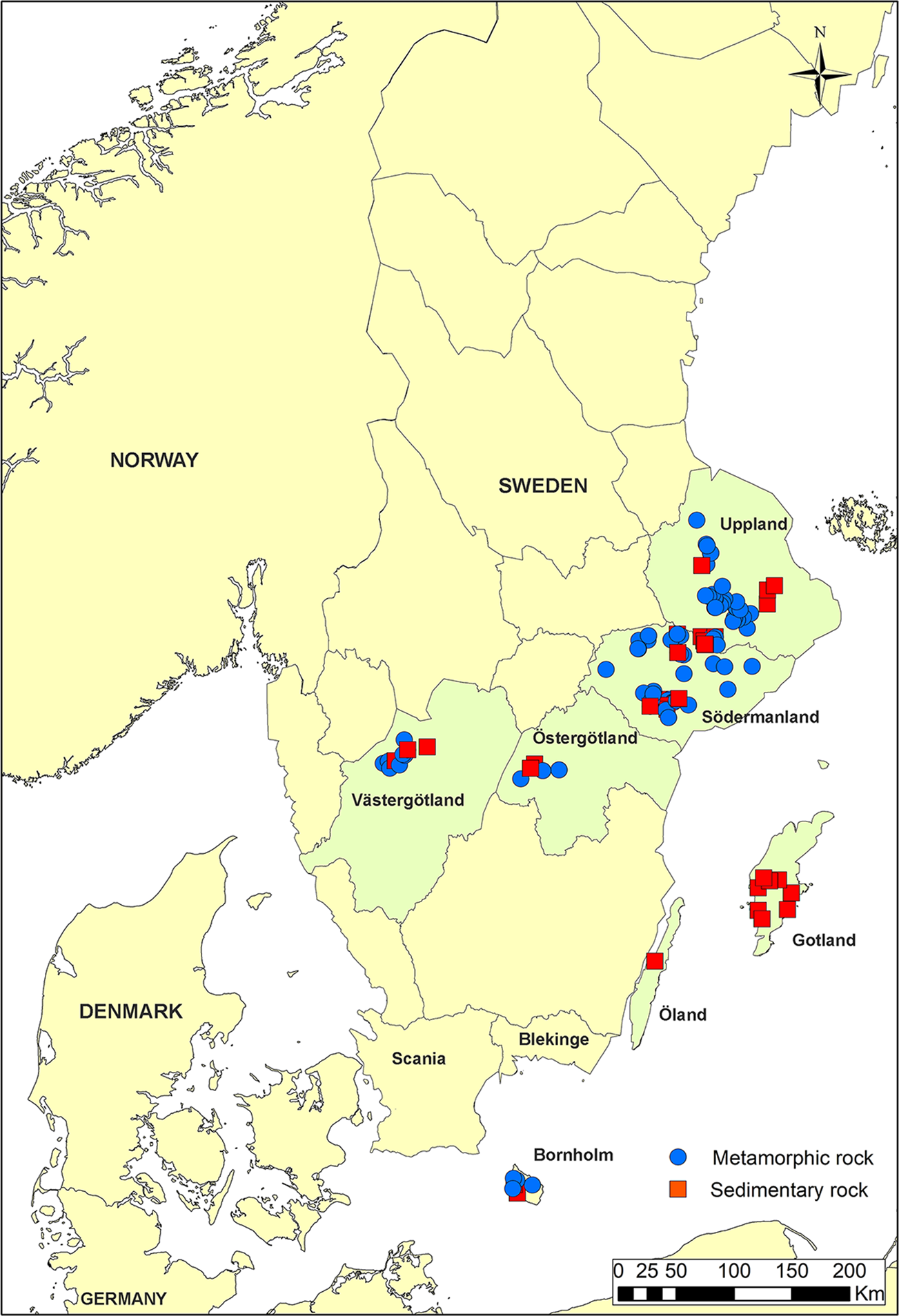
Runestones and provinces in the study.

Runestones have often been discussed in connection with questions relating to political claims, royal power, and Christianization. The rune carvers themselves can be considered the first carriers of literacy in a generally oral society. Moreover, their contacts and travels may tell us something about social interactions and networks. Lengthy travel may point to key functions or know-how that the carvers possessed or indicate their ties to a family involved in expeditions. The rune carvers had a special competence and were probably much sought after. On the local level, the relations between the rune carvers may indicate kinship and friendship among families and households; across regions the presence of rune carvers may indicate networks and alliances on a larger scale. If the carvers came from somewhere outside Bornholm, it may indicate that Bornholm actively sought skills or alliances, or both, outside the island.
Since the question of the runestones on Bornholm is still not resolved after a century of debate, the scientific analysis of the carving techniques presented in this article may offer new insights. The rune carvers’ grooves were analysed by 3D scanning and multivariate statistics, in an attempt to find the closest counterparts to the rune carvers on Bornholm, i.e. the people with whom they may have cooperated at a practical level.
Runestones on Bornholm
Forty runestones are known on Bornholm. As a group, they are generally dated from the middle of the eleventh century to the beginning of the twelfth century ad (Imer, Reference Imer2007: 32; Reference Imer2015; Højgaard Holm, Reference Højgaard Holm2014: 262) and thus are later than the majority of Danish runestones (Imer, Reference Imer2016: 282–84). It was (and still is) considered odd that no runestones were erected on Bornholm at a time when plenty were present in the adjacent province of Scania.
In older research, Swedish influence was advocated as an explanation for the late appearance of the runestone custom on Bornholm. The following presumably Swedish characteristics have been cited: the formula ‘had the stone raised’ (lét reisa stein, i.e. with an auxiliary verb), the common use of prayers (Olsen, Reference Olsen, Kristensen and Olrik1906: 30–31), naming traditions (Kristensen, Reference Kristensen, Knudsen and Kristensen1930: 155–56; Moltke, Reference Moltke, Knudsen and Kristensen1934: 19), similarities in ornament and particular rune shapes (Moltke, Reference Moltke1976: 269), and some linguistic characteristics like the word rétta and the preposition at (Højgaard Holm, Reference Højgaard Holm2014: 269–70, with an overview of the arguments). Although the parallels with Swedish runestones may seem striking, other factors speak against Swedish influence. For example, there may be chronological reasons for the formulation with an auxiliary verb (láta) (Højgaard Holm, Reference Højgaard Holm2014: 269, 296). Some characteristics are not limited to Sweden, as previously thought, since they are found in Schleswig, Lund, and within the Danelaw (Lerche Nielsen, Reference Lerche Nielsen1997: 69; Stoklund, Reference Stoklund, Stoklund, Nielsen, Holmberg and Fellows-Jensen2006: 373).
This discussion is important because the distribution of runestones is often given a political significance. A possible Swedish influence on runestones on Bornholm has been interpreted as a sign of political influence and perhaps Swedish expansion (Højgaard Holm, Reference Højgaard Holm2014: 262, 296, who however is critical to this view). Klavs Randsborg proposes an alternative interpretation, seeing the runestones in the perspective of political centralization and the incorporation of Bornholm into the Danish realm (Randsborg, Reference Randsborg1980: 44). Randsborg has, however, been criticized from a runological perspective for drawing too broad a conclusion from the known geographical distribution of the runestones and for assuming that this reflects the consolidation phase of royal power (Stoklund, Reference Stoklund, Hägg, Gräslund, Jansson, Iversen, Näsman and Mammen1991: 295–96; Lerche Nielsen, Reference Lerche Nielsen1997: 6).
It has been assumed that Bornholm was added to the Danish realm sometime between the ninth century and the end of the eleventh century ad, depending on the viewpoint of different researchers (for summaries, see Lihammer, Reference Lihammer2007: 242; Gelting, Reference Gelting, Borgehammar and Wienberg2012: 107–10). According to Anne Lihammer, there is little evidence for such a dating; in her opinion Bornholm's incorporation into the Danish kingdom does not take place until considerably later, by the end of the twelfth century (Lihammer, Reference Lihammer2007: 262). Michael Gelting finds reasons in the Slesvig Stadsret and Knýtlingasaga, for example, to think that Bornholm was not yet a part of Denmark in Egino's time (Gelting, Reference Gelting, Borgehammar and Wienberg2012: 109–10). There are several arguments against Bornholm being integrated within the Danish realm in the eleventh century: the treasure hoards deposited at the time, the fact that Bornholm never had a mint of its own, that it lacked urban centres, and that the settlement pattern is decentralized, consisting of single farms and small hamlets (Lihammer, Reference Lihammer2007: 260–61; Ingvardson, Reference Ingvardson2010: 334–45). Like the silver hoards, the runestones are scattered all over the island, suggesting a flat power structure and a decentralized trade. Furthermore, the Bornolm runestones mention few titles: for example, there is only one thegn (Imer, Reference Imer2016: 311). Numismatic studies reveal that Bornholm's economic system differed to a high degree from that of the Danish realm and that even in the late Viking age Bornholm was independent as an economic and political unit (von Heijne, Reference von Heijne2004: 166; Lihammer, Reference Lihammer2007: 292; Ingvardson, Reference Ingvardson2010: 20; Reference Ingvardson and Gulløv2014:3 29, 335; Horsnæs, Reference Horsnæs2013: 42).
Bornholm's relationship with Öland and Gotland
Connections other than those Bornholm had with Denmark and Sweden respectively are worth exploring. If we compare Bornholm to two other large islands in the Baltic Sea, namely Öland and Gotland, we find that all three islands continued the custom of erecting runestones for longer than in southern Scandinavia. The runestones of Öland and Gotland are similar in concept, as memorial stones with runic inscriptions, but they have contrasting characteristic shapes: each island has its own type of runestone, with a pointed shape on Öland and a keyhole shape on Gotland. This may reflect a deliberate attempt to address neighbouring islanders and recognition of their existence, at the same time marking their own identity. It may be that Öland, Gotland, and Bornholm acknowledged each other as equal competitors in trade and warfare, judging it more important to mark their position in relation to the other island compared to, for example, the Swedes on the mainland or the Danish realm.
Indeed, instead of relating Bornholm to the Danish realm, the archaeological record, such as late treasure hoards, late runestones and a varied church topography, suggests other connections, that is, to Blekinge, Möre, Öland, and Gotland (Lihammer, Reference Lihammer2007: 21, 292). The similarities and differences between the islands reveal complex patterns of ever-changing relations, where sometimes Öland and sometimes Gotland seems to take precedence in relation to Bornholm. All three islands have in common a pattern of intensive hoarding around and after the middle of the eleventh century (Horsnæs, Reference Horsnæs2013: 42), a large number of forts (Nielsen & Staal, Reference Nielsen, Staal and Olausson2014: 256) and a slow process of Christianization, where the old burial grounds were used alongside Christian cemeteries into the twelfth century (Wagnkilde & Pind, Reference Wagnkilde and Pind1989–1990: 64; Svanberg, Reference Svanberg2003, vol. 2: 77).
Bornholm and Gotland are similar in the composition of their silver hoards containing a large proportion of unminted silver (Horsnæs, Reference Horsnæs2013: 42), and in their settlement pattern, where villages are absent (Lihammer, Reference Lihammer2007: 293). In this context, we should mention that Marius Kristensen believed that Østermarie 1 has rune forms indicating an influence from Gotland (Kristensen, Reference Kristensen, Knudsen and Kristensen1930: 155).
As for the ceramic tradition, Bornholm shows similarities with Öland, Blekinge and eastern parts of Sweden (Roslund, Reference Roslund2001: 169; Lihammer, Reference Lihammer2007: 292). By contrast, a study of strontium focusing on Öland in the Iron Age indicates very little exchange of inhabitants between Bornholm and Öland (Wilhelmson & Ahlström, Reference Wilhelmson and Ahlström2015: 39).
Looking at concepts in the runic inscriptions, the mention of ‘paradise’ on runestones is found on Bornholm and Öland alike, whereas ‘Michael’ (the archangel) is summoned on Bornholm and Gotland. Per Beskow underlines that these runic prayers for the soul have their origin in the Christian missions and have a wide distribution ranging from Denmark to the Mälar basin, even though they are most common in Uppland and on Bornholm (Beskow, Reference Beskow, Beskow and Staats1994: 19).
Altogether, the archaeological record shows similarities between Bornholm and Öland, Gotland, Blekinge, and south-eastern Scania, indicating that the people behind the Bornholm runestones may be sought in places other than Denmark. Here, the relations between the islands will be studied from the perspective of runestone carving.
Question setting
Even though earlier assumptions about Bornholm have been questioned, namely whether the runestones indicate Swedish or Danish influence, the fact remains that changes occurred in the eleventh century. This seems to have been a particularly uneasy time, judging by the many hoards and defensive works found on the island, in a period of religious transition (Ingvardson, Reference Ingvardson and Gulløv2014; Nielsen & Staal, Reference Nielsen, Staal and Olausson2014: 267, 269). Gamleborg in Almindingen, built as a refuge in the tenth century, was reinforced in the eleventh century (Nielsen & Staal, Reference Nielsen, Staal and Olausson2014: 273). Analyses of weights, hoards, and ceramics clearly indicate changes in the organization of settlement and trade on Bornholm around the year 1000 (Ingvardson, Reference Ingvardson and Gulløv2014: 334). Something also happened to the language on Bornholm. Moltke interpreted the situation as one of either dissolution or development, as seen in new runes, language forms, and spelling variants―a mixture between old and new (Moltke, Reference Moltke1976: 279–80).
While some researchers stress that the similarities between the Bornholm runestones and the central Swedish runestones are mainly chronological (Lerche Nielsen, Reference Lerche Nielsen1997; Højgaard Holm, Reference Højgaard Holm2014; Imer, Reference Imer2016: 302), others are not convinced. Some doubt has been expressed because the similarities in ornament may be too great to reflect a wholly independent development (Gräslund, Reference Gräslund2016: 184–85). Another alternative is that there is a common Baltic tradition and, since the Baltic islands form part of the same cultural sphere as eastern Svealand, similarities occur naturally.
In the following, we will see what another, as yet untried, parameter may indicate, i.e. craft traditions within rune carving. By analysing the grooves, I wish to examine whether Bornholm had exchanges with rune carvers on Öland and Gotland or with any of the mainland Swedish regions.
Method
The carving technique has been analysed using 3D scanning and a multivariate statistical analysis undertaken according to a method presented in detail elsewhere (Kitzler Åhfeldt, Reference Kitzler Åhfeldt2002; Reference Kitzler Åhfeldt, Zilmer and Jesch2012: 67–69; Reference Kitzler Åhfeldt2015). The basis for the analysis is that repeated bodily movements become fixed in an individual's motor performance, a phenomenon that can be observed in pursuits such as palaeography, craft, and sports activities. The analytical steps are as follows:
1) Between 2006 and 2015, the runic monuments were 3D-scanned at high resolution, mainly with optical 3D-scanners (ATOS I and ATOS II), with a resolution of 0.2–0.3 mm. For some of the mainland reference material, that part which was collected in 1994–2005, casts of runes and ornament were scanned with an older type of laser scanner (Kitzler Åhfeldt, Reference Kitzler Åhfeldt2002).
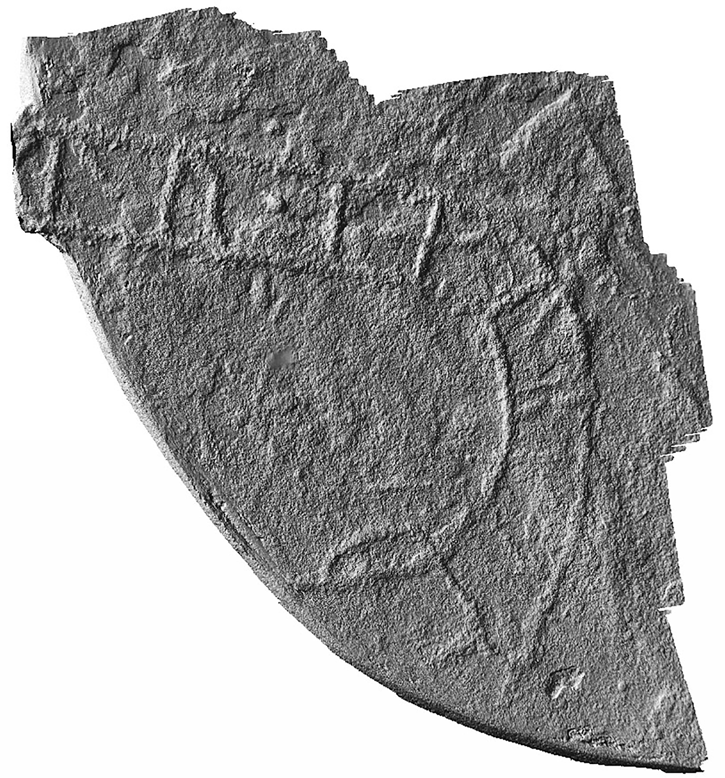
2) In the 3D model (Figure 2), a number of runes and sections of ornament have been selected for analysis (Supplementary Material: Sampling). The carving surfaces were examined in the field as well as in the 3D models, and areas damaged by weathering or trampling avoided, sometimes causing an uneven distribution of the samples.
Figure 2.3D model of the runestone in St Knud on Bornholm (Knudsker). 3D scan by s3di.

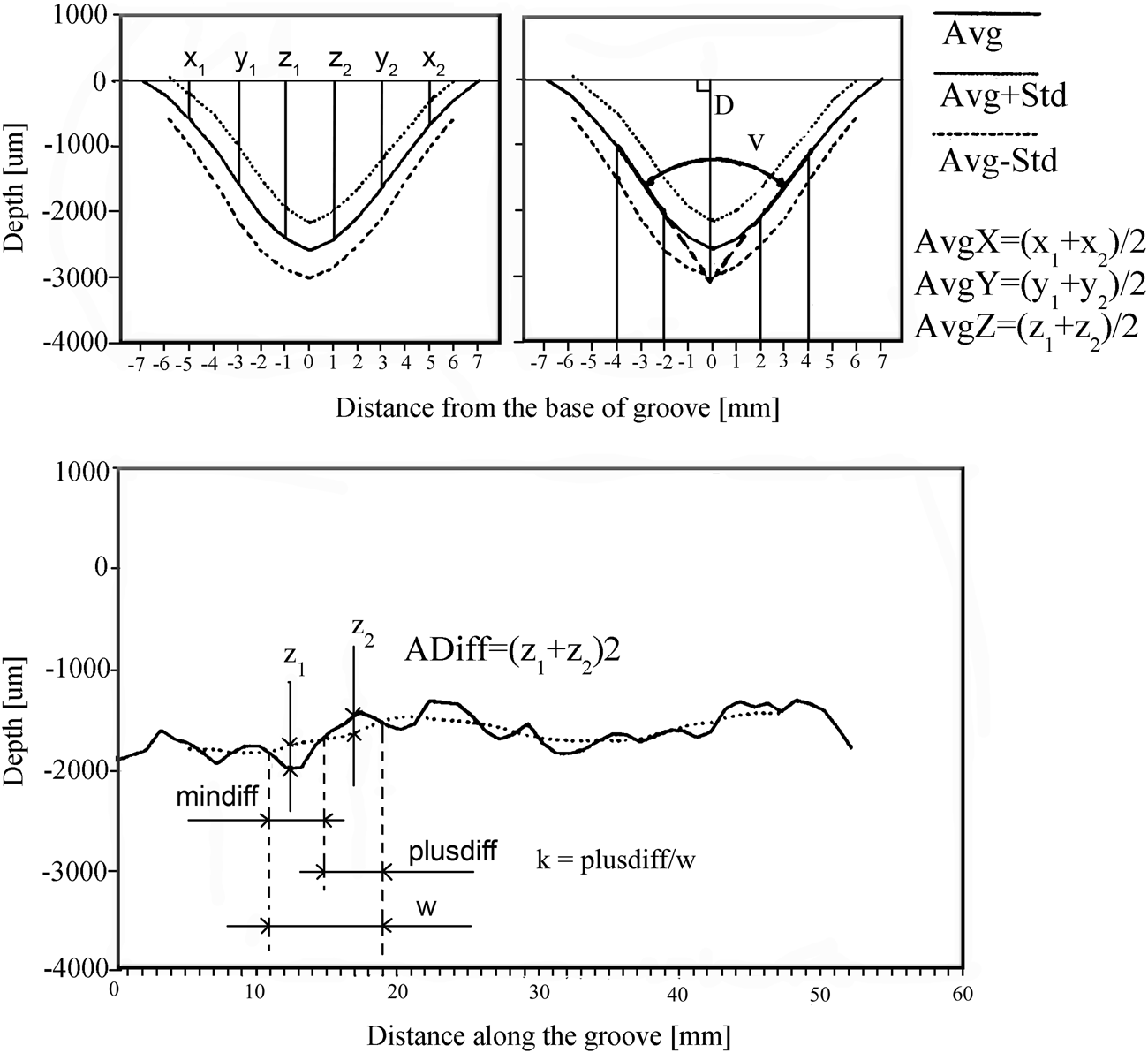
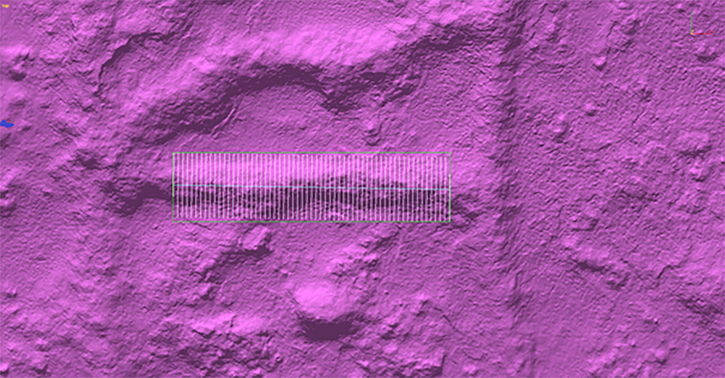
3) The shape of an incised groove was described by a number of mathematical variables (Figure 3). Some variables refer to the cross-section of the groove, while others refer to the cutting rhythm. Depth measurements are measured in the 3D model by a software module constructed for this specific purpose; this is Groove Measure, an optional module in the software Deskartes Design Expert (included in 3Data Expert version 11.1.0.11 since March 2019) (Figure 4), and variables describing the characteristics of the grooves, were calculated in an EXCEL template, based on principles laid down in the author's dissertation (Kitzler Åhfeldt, Reference Kitzler Åhfeldt2002). The often bulging surface of the stones was taken into account, by referring the depth measurements not to a plane but to a flowing mean.
Figure 3.Variables for groove analysis.
Figure 4.The Groove Measure function is applied on a rune, 3D image.


There are several sources of error involved, including individual variation on the part of the rune carver, due, for example, to increasing skills or temporary fatigue. These have been studied in experimental investigations on modern runestones produced by craftsmen working for live re-enactment societies (Kalle Dahlberg and Erik Sandqvist). This made it possible to establish empirically how factors such as skill, tool change, and fatigue influenced the measurable variables of the grooves, and which variables were best for distinguishing between individual carvers. Better results were achieved when runes and ornament were separate, because the carver develops a specialized technique for long, flowing ornamental lines as he gains in experience (Kitzler Åhfeldt, Reference Kitzler Åhfeldt2002).
The data were analysed by multivariate statistical methods in STATISTICA 9. As for methods and algorithms, the choices were based on empirical studies of runestone data. The variables were used in various combinations in order to study similarities and differences between particular runestones, selected parts within the same rune carving, or the relationships between, for example, monument groups or geographical areas. This aspect of the analysis is continuously being developed and applied to new research questions.
The present study makes use of Discriminant Analysis (DIS). In this we introduce known groups, and rules are constructed to classify new cases (runestones here) of unknown origin into these groups (Everitt et al., Reference Everitt, Landau, Leese and Stahl2011: 7). For fundamental reasoning about multivariate analyses and statistics applied to archaeological materials, see Baxter (Reference Baxter1994; Reference Baxter2016), for example.
The results are compared to earlier runological and archaeological studies, sometimes confirming them and sometimes adding new perspectives. This method is still in development, and the results must be discussed in terms of the earlier results, the implications of the new results, and their shortcomings. The results generally conform to earlier outcomes and expectations but add detail and in some cases lead to rethinking the organization of the rune-carving activities.
The runestones in this study
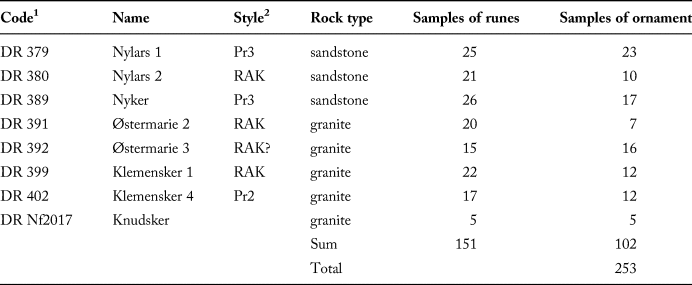
For this particular study, eight eleventh-century runestones on Bornholm were 3D-scanned in September 2017 (Table 1) by the private company s3Di with 3D-scanners ArtecSpider and ArtecEva, together with this author. The selected runestones had been reported as having Swedish features in the inscription or ornament, or were connected by carver or workshop attribution to stones possessing such features (Moltke, Reference Moltke, Knudsen and Kristensen1934: 17; Reference Moltke1976: 274, 277; Jacobsen & Moltke, Reference Jacobsen, Moltke, Bæksted and Nielsen1942: 435, 438, 451–52, 458). Some of the stones (Nylars 1, see Supplementary Material Figure 3; Nyker, Supplementary Material Figure 5; Klemensker 4, Supplementary Material Figure 13) are adorned with runic ornament in styles similar to runestones found in central Sweden. One of the stones in this selection is a new find from the church of St Knud, named Knudsker (Eilsøe, Reference Eilsøe2017; Kitzler Åhfeldt, Reference Kitzler Åhfeldt2017; Imer & Kitzler Åhfeldt, Reference Kitzler Åhfeldt and Imerin prep.).
3D scanned runestones on Bornholm.

1 DR = Danmarks Runeindskrifter (Jacobsen & Moltke, Reference Jacobsen, Moltke, Bæksted and Nielsen1942).
2 Style as reported in SRD, according to Gräslund's (Reference Gräslund and Stoklund2006) chronological system.
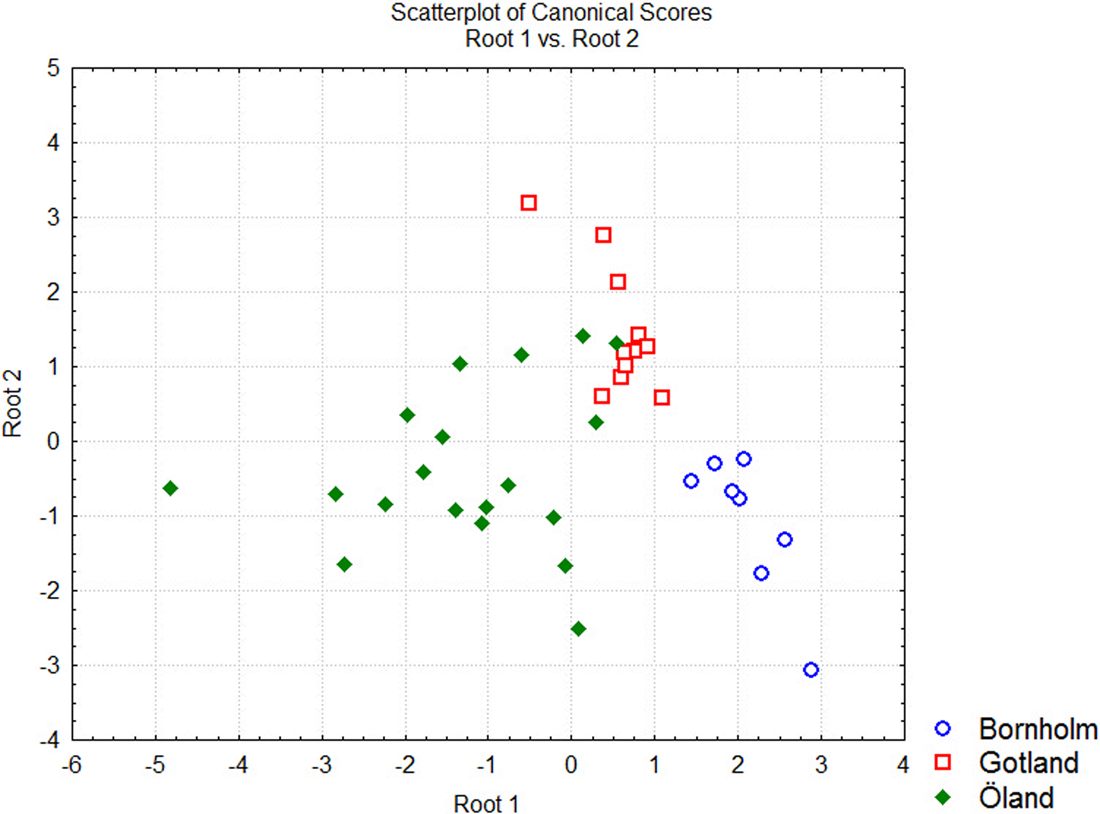
Scatterplot of Canonical Scores: Öland, Gotland, and Bornholm. The grooves of the runestones are of distinctly different character on each of the islands.

A new find from St Knud
In the summer of 2017, Helen Simonsson, a colleague from the Swedish National Heritage Board photographed while on holiday a runestone in the church of St Knud. The creator of the runic database Samnordisk runtextdatabas, Jan Owe, noticed the photograph on Flickr and called attention to the fact that this runestone was unknown to scholars in runology. The stone is visible on a photograph in the publication Danmarks Kirker, signed E. K. 1952 (Norn et al., Reference Norn, Schultz and Skov1954: 183 fig. 3.), but went unnoticed until 2017, most probably because the erroneous painting of the runes gave a wrong impression, they were no longer recognizable as authentic runes. Indeed, it did not appear to be an authentic Viking-age runic inscription, but the photographs alone were not sufficient evidence. Our 3D scan revealed that this is actually a fragment of an eleventh-century runestone (Figure 2; Eilsøe, Reference Eilsøe2017; Kitzler Åhfeldt, Reference Kitzler Åhfeldt2017; Imer & Kitzler Åhfeldt, Reference Imer and Kitzler Åhfeldtforthcoming). The preserved runes seem to constitute part of a prayer: …tr : ialb(i) (:) (s)…, interpreted as … [Kris]tr hialpi s[ialu](?) (May Christ help the soul; see runer.ku.dk and interview with Lisbeth Imer in Eilsøe, Reference Eilsøe2017).
The dataset
The Bornholm runestones have been compared with late Viking-age runic inscriptions (c. ad 980–1100) on stones from the Baltic islands of Öland and Gotland and the Swedish mainland provinces of Uppland, Södermanland, Västergötland, and Östergötland (Figure 1). The data were collected between 1994 and 2017. On each runestone, a number of runes and sections of the ornament have been selected for analysis; from Bornholm the total number of samples is 253, from 151 rune sections and 102 sections of ornament (Table 1; Supplementary Material). The complete dataset in this study includes 2855 samples from 240 runestones. The number of samples from each stone varies between 1 and 40, depending on the size and condition of the stone, since some of the runestones only survive in small fragments. In this study, each runestone is represented by one mean value for the runes and one for the ornament respectively.
Two analyses were undertaken in order to address two questions concerning: (1) the relationships between the rune carvers on the Baltic islands of Bornholm, Öland, and Gotland; and (2) the relationships between rune carvers on Bornholm and some Swedish mainland provinces.
Öland, Gotland, and Bornholm compared
As stated earlier, some archaeological features link Bornholm to the islands of Öland and Gotland. Can it be that their respective rune carvers had contact with each other? The relationships between the runestones in terms of their carving techniques were examined by Discriminant Analysis (DIS) by Forward Stepwise Analysis, with the groove data of existing (or presumed) groups being fed into the analysis. As Baxter puts it, in a DIS, ‘you start with the ‘prejudice’ that there are groups in the data and do your best …to display this’ (Baxter, Reference Baxter2016: 78). The success of the discrimination is presented in a ‘Classification Matrix’, where the result is given as a ‘hit ratio’. Baxter calls it ‘the “confusion” table’, because it also shows how the groups are confused with each other (Baxter, Reference Baxter2016: 82). As will be seen, this can be very informative.
Results and interpretation
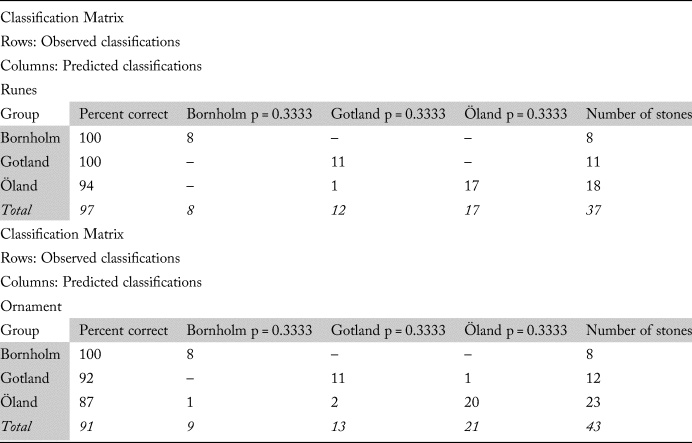
Applying DIS to distinguish between runestones from Öland, Gotland, and Bornholm, the overall hit ratio is 97 per cent, which must be regarded as extremely high (Table 2, Figure 5). This means that without knowing anything about the inscription, the ornament, shape, or material, we would be able to classify a runestone, say a small fragment of unknown provenance, to the right island by analysing its grooves. The drawback of this method is that even if this hypothetic runestone fragment does not originate from any of these islands, it would be classified as belonging to one of the available alternatives.
Result of Discriminant Analysis: Öland, Gotland, and Bornholm.

The results indicate that the grooves, i.e. the carving technique, are distinct on each of the islands. My interpretation is that the rune carvers did not cooperate at the carving level, although it is still possible that they had some intellectual exchange concerning the runic inscriptions. Bornholm and Gotland seem to be totally separate, whereas some exchange between rune carvers may have taken place between Gotland and Öland. This is to be expected for the stone known as Öl 47 (Ölands runinskrifter, Söderberg & Brate, Reference Söderberg and Brate1900–1906) on Öland and its clearly Gotlandic shape.
Bornholm compared to the Swedish mainland provinces
As shown, there is poor concordance in the carving techniques between Bornholm, Öland, and Gotland. Are there closer affinities between Bornholm and any of the mainland Swedish provinces? The Bornholm runestones will now be compared to runestones from the provinces of Uppland, Södermanland, Västergötland, Östergötland and, again, the islands of Öland and Gotland (Figure 1, Table 4 in Supplementary Material).
First, we need to ask whether there are any regional differences at all in the carving techniques used in these provinces. This is a matter of craft tradition, of how rune carvers travelled and moved in the landscape, and of how they met and learnt from each other by working in close company. Again, this will be investigated through DIS. The method worked successfully for the small constellation of three islands, but with more groups involved and no sharp boundaries between them, the issue becomes more complex. The dating of the runestones ranges from the late tenth to the early twelfth century. We also need to acknowledge that the runestones include variants of monument types, that is, traditional runestones located in the landscape near roads, farms, thing sites and burial grounds, as well as Early Christian burial monuments in and around churches.
The analysis was conducted in two steps: in a first step, the DIS, following the Forward Stepwise method, was performed without the object of interest, Bornholm, in order to classify the stones from Bornholm later. The aim was to identify the diagnostic characteristics for the regions and, in the next step, to allocate cases from Bornholm to the most suitable region. The latter step is generally called classification (Baxter, Reference Baxter2016: 7–8). Runes and ornament were analysed separately, for the reasons given above. Sedimentary and metamorphic rock types were also separated. This resulted in four data subsets. Runestones included in each segment of the analysis are listed in Table 4 (Supplementary Material).
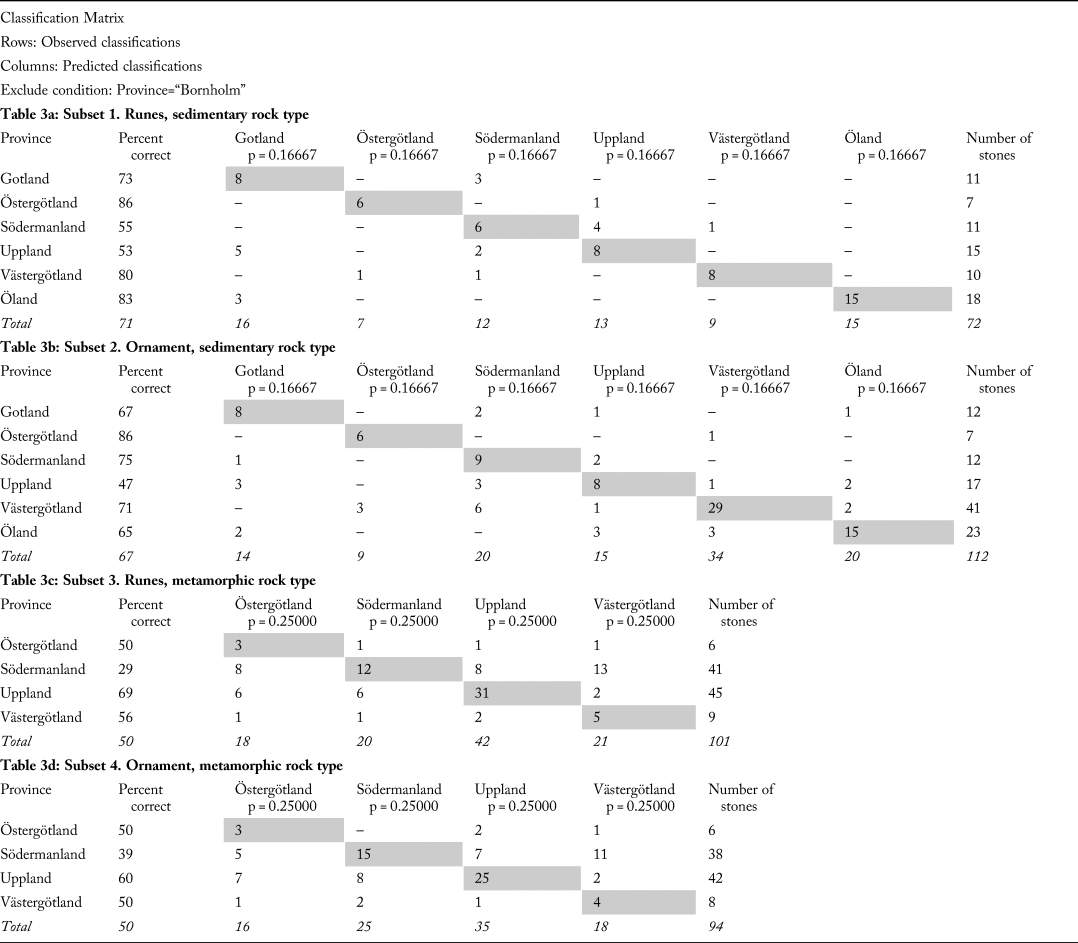
The hit ratio in the classification matrix varies between 50 and 71 per cent in the four analyses (Table 3, Supplementary Material). Öland, Gotland, and Västergötland show the best hit ratio, i.e. the grooves have a more distinct character in these areas. Södermanland and Uppland show considerably less satisfactory results, being mixed up to a very high degree. Possible reasons for this will be discussed below.
Result of Discriminant Analysis: Classification Matrix of provinces.

The best results were achieved for runes on sedimentary rock, where the hit ratio is 71 per cent. Theoretically, this means that if we happen to have a collection of runestone fragments of unknown provenance, we could allocate 71 per cent of these fragments to the right province, guided by the analysis of the groove shapes alone. A hit ratio of 71 per cent may not seem impressive, but this figure should be compared to making the right choice randomly. If among six candidates we assume that each province is just as likely a provenance, we have one chance in six (approximately 17 per cent) to make a correct classification. In this perspective, the DIS gives a roughly fourfold result. However, this presumes that we have no indication whatsoever of provenance, be it in inscription, ornament or shape, which is rarely the case. The use of the analysis is intended more to as a means to see the relationship between the provinces and perhaps get an idea of where the rune carvers had the most intensive contacts.
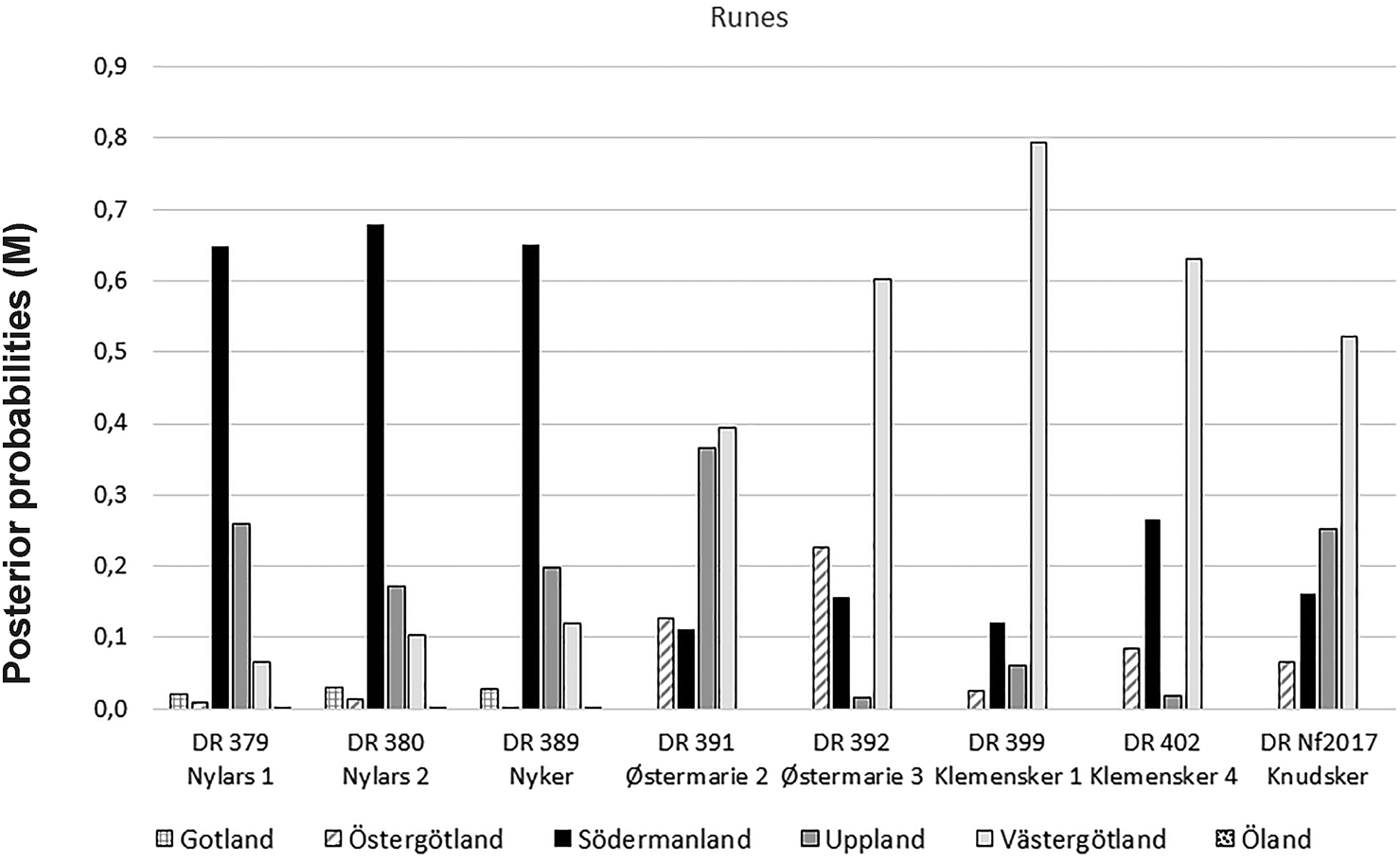
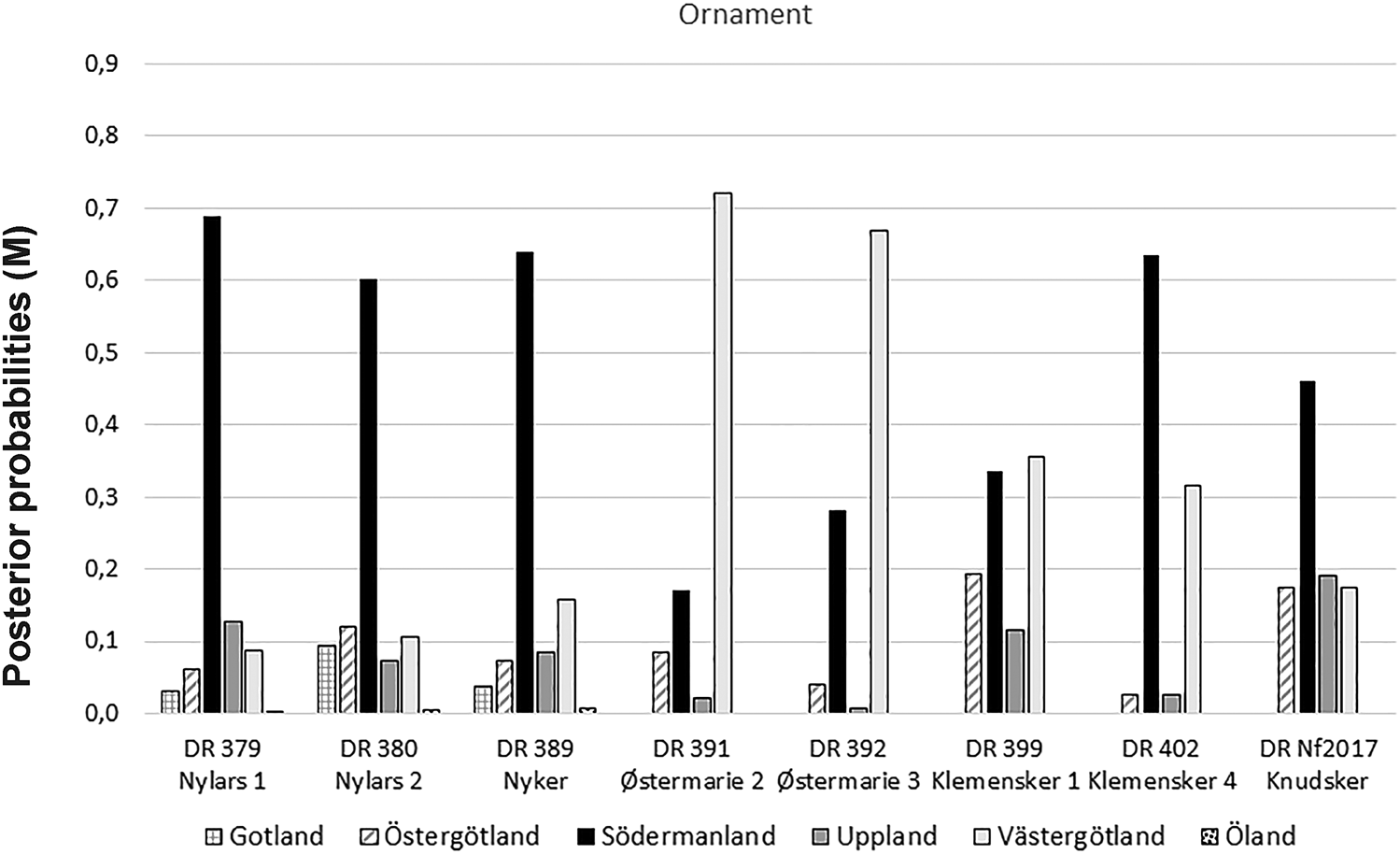
The Bornholm stones were then classified to establish in which region we find the runestones most similar to Bornholm with regard to their carving techniques. The result of the classification is given as posterior probabilities, which express how the relative probability is distributed between the available alternatives. The sum is always 1 (corresponding to the sum of the bars for each runestone in Figures 6 and 7). This value can be interpreted as a ‘membership’ (M) value of the respective group. As an aid to judge the strength of the classification, we may note that if the value of M exceeds 0.5, this alternative is more probable than all the others together (Baxter, Reference Baxter2016).
Result for runes: posterior probabilities.

Result for ornament: posterior probabilities.

Results and interpretation
Three of the runestones are made of a sedimentary rock (Nylars 1, see Supplementary Material Figure 3; Nylars 2, Supplementary Material Figure 4 and Nyker, Supplementary Material Figure 5). The runes on these are most similar to runestones in Södermanland; the posterior probability (M) is above 0.6 for Södermanland for all three Bornholm stones, which makes this the best alternative (Figure 6). Öland and Gotland are included, but the posterior probabilities for these are hardly observable, confirming the analysis above, which indicated that the islands had very little contact with each other in terms of practical rune carving. The analysis of the ornament of the same stones gives the same picture (Figure 7). To conclude, the carving techniques on the runestones Nylars 1, Nylars 2, and Nyker have their closest counterpart, out of the available alternatives, in the province of Södermanland.
Five of the Bornholm runestones are made of metamorphic rock (Klemensker 1, see Supplementary Material Figures 10–12; Klemensker 4, Supplementary Material Figure 13; Østermarie 2, Supplementary Material Figures 6–7; Østermarie 3, Supplementary Material Figures 8–9; Knudsker, Figure 2). Öland and Gotland are not included in this analysis, since the runestones there are generally not of this material (one exception is the Karlevi stone on Öland, which was 3D-scanned in May 2018; its analysis is in progress). The runes on the Bornholm granite stones seem to be most similar to runestones in Västergötland. As for ornament, the results are slightly different. The stones in Østermarie are most similar to stones in Västergötland, while Klemensker 4 and the recent find of Knudsker point to Södermanland. There is no clear indication for Klemensker 1, possibly a signal that all alternatives are unsatisfactory.
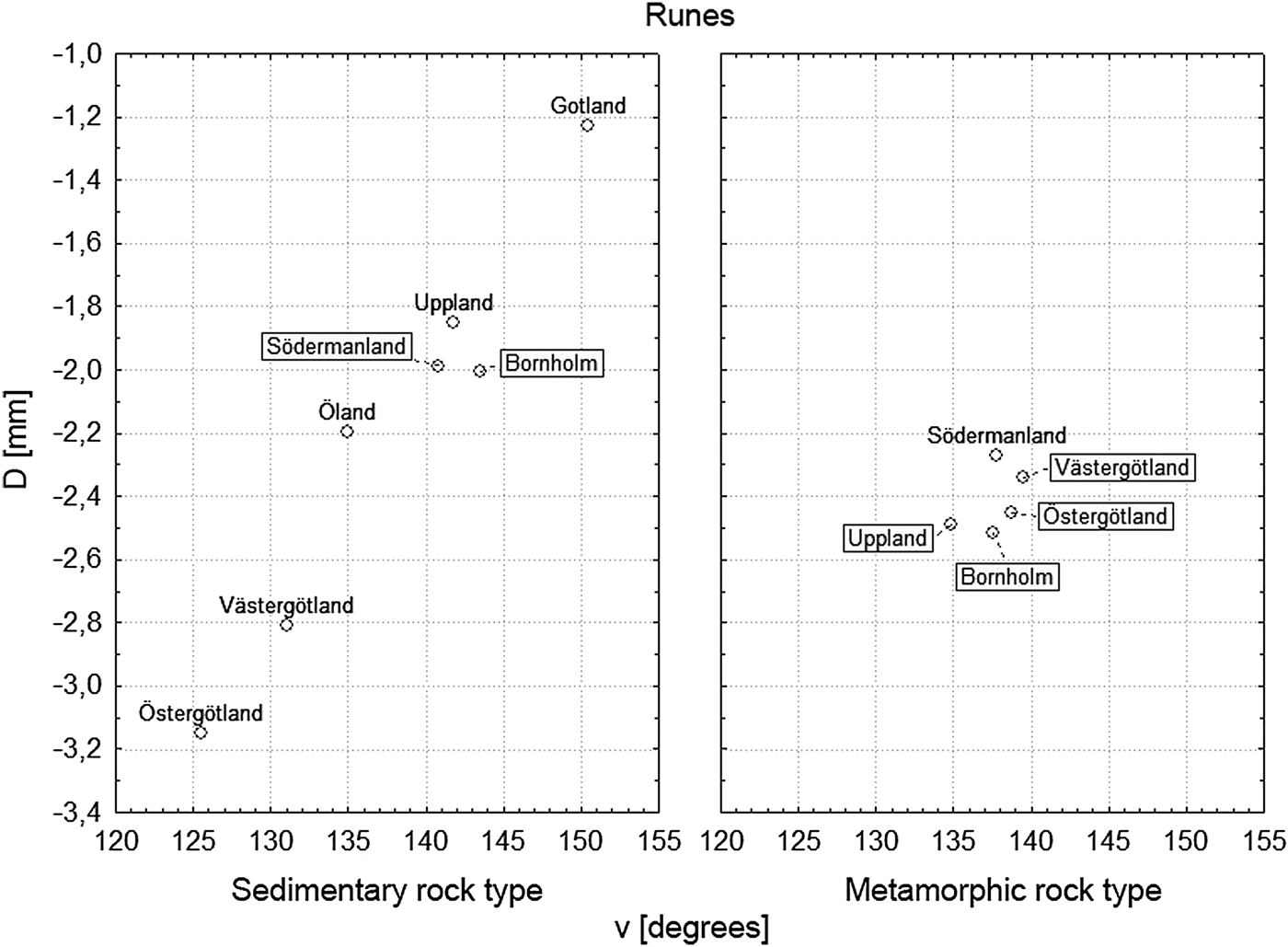
Result expressed in v and D; this is a reflection of the shape of the cross-sections of the runes. Each province is represented by a mean value.

Limitations and sources of error
A specific limitation of the DIS analysis is that an unknown material will be classified to some of the given alternatives fed into the analysis, regardless of any fit. The result ‘none of these’ is not available; the sum of probabilities (=1) will always be distributed among the available groups (Baxter, Reference Baxter2016: 83–84). However, it may be a clue if none of the groups gives a clear signal.
The results are thus dependent on how the groups have been defined. I have chosen the modern provinces as a unit. This may be regarded as anachronistic, but it is motivated by having a critical number of runestones in each group. The Södermanland and Uppland groups were mixed to a very high degree in the DIS. There may be several reasons for this: the number of stones is larger, the material is more heterogeneous and distributed over large geographical areas, and the dating spans longer periods. A high degree of contact between the carvers in these two areas might be suspected, with Lake Mälaren shared between them. Several stones are found on islands in this lake, equally close to either province. We also know that some professional rune carvers covered large distances, for example Asmund Karason and Balle. Simply put, the provinces may be an unsuitable unit for analysis. Nonetheless, they are partly separated by natural boundaries and may thus be of some relevance for ancient contact patterns. Another possibility is to divide the provinces into smaller areas which could be expected to be more homogenous, for example the ‘folk lands’ (Swedish folklanden) in Uppland. In addition, let us recall that the stones have been 3D-scanned and the material sampled on different occasions, from 1994 to 2015. Although efforts have been made to ensure that the data are comparable, it cannot be ruled out that the use of different scanners influence the results.
From this perspective, a hit ratio of 50–71 per cent is perhaps not so bad after all. It provides an indication that there are some distinctions in the carving techniques between different geographical areas, even if using provinces as a grouping criterion may not have been the right unit for analysis. Of course, it is an obvious weakness in this analysis that no Danish runestones are included.
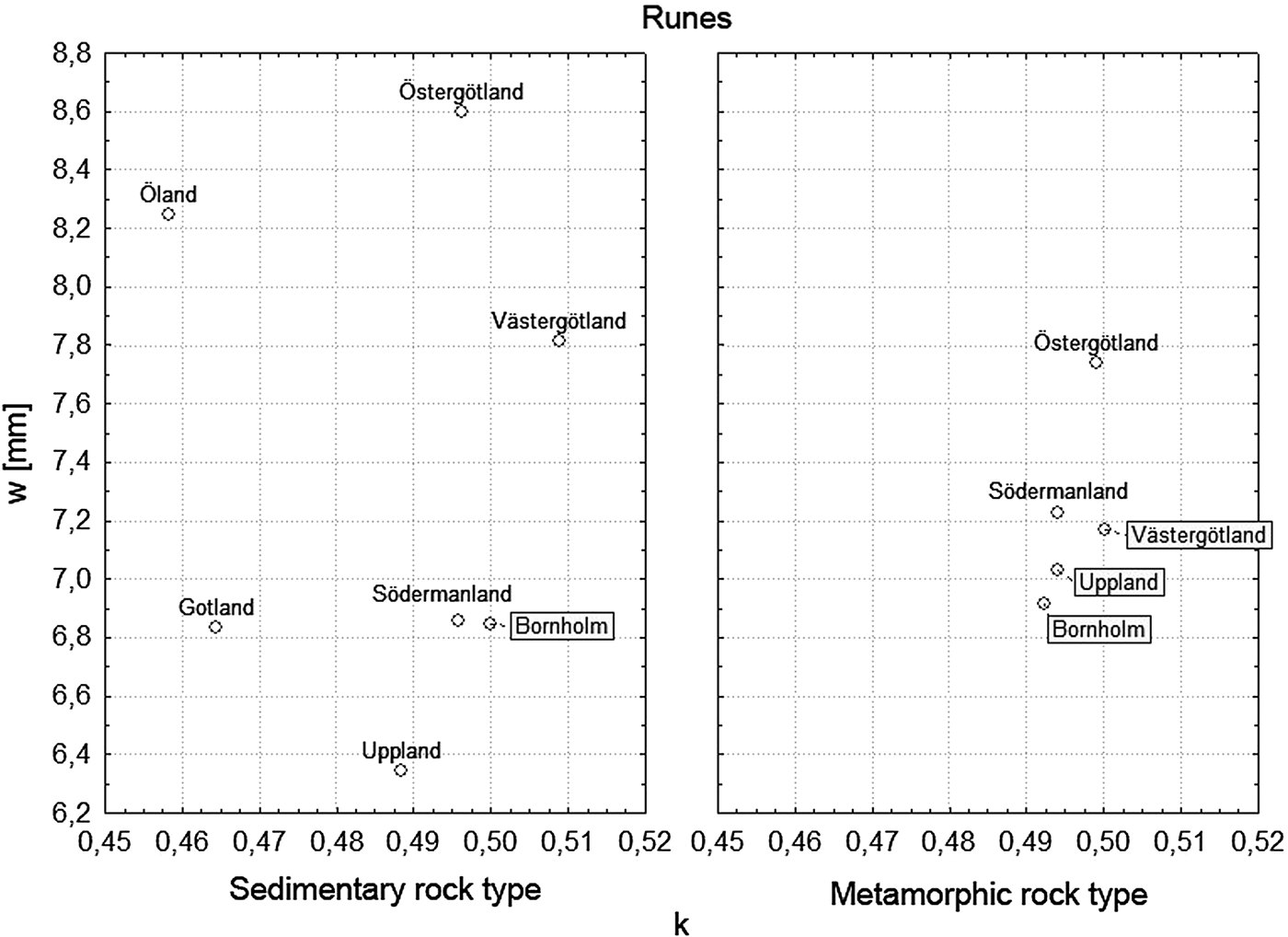
The strength of the multivariate analyses is that it is possible to take into account both the cross-section of the groove and variables referring to the cutting rhythm (in the longitudinal direction of the groove base). The drawback is that the results are harder to show graphically. As a cross-check, the results for the runes are illustrated in two separate diagrams, one for the cross-section (Figure 8) and the other for variables referring to the cutting rhythm (Figure 9). Bornholm is close to Södermanland in both aspects, thus confirming the results of the DIS. We also see that runestones made of sedimentary rock are more stratified than stones consisting of metamorphic rock. This probably reflects a methodological problem. The harder metamorphic rock may not ‘answer’ to the carvers’ cutting techniques as readily as the sedimentary rock types. On the other hand, sedimentary rock is more susceptible to weathering. For runestones of metamorphic rock, Södermanland and Västergötland are close to each other, which may be an explanation for some Bornholm runestones being classified as resembling those of Västergötland.
Result expressed in w and k; this is a reflection of the cutting rhythm and cannot be studied only visually.

In terms of representativity, the map shows that the runestones are not evenly distributed over the provinces in the analysis (Figure 1), the reason being that the data were collected for various other research questions (Supplementary Material).
Discussion
It is evident that the runestones investigated on Bornholm have very little connection with Öland and Gotland with respect to their carving techniques. This is not to say that there was no exchange between the rune carvers at a conceptual level. The rune carvers might possibly have exchanged models with Öland and Gotland, but judging by the similarities in the carving technique it is more likely that relations existed between Bornholm and the Swedish mainland.
Five out of eight Bornholm runestones are most similar to runestones in Södermanland in the carving of their ornament. It is interesting to note that Moltke saw runestones in Södermanland and Östergötland particularly as parallels to the runic art on Bornholm (Moltke, Reference Moltke1976: 269). In this study, Södermanland takes precedence; Östergötland being further down among the alternatives.
The runes on the five runestones made of a metamorphic rock all lie closer to Västergötland than to the provinces of eastern Sweden. This is interesting in view of the well-known Danish traits in the runestones of Västergötland. The classification of some stones to Västergötland might be explained by that alternative being the closest to Denmark in this analysis. No (present-day) Danish area is available as an alternative, but Västergötland's runestones probably have more in common with Danish stones than those of eastern Sweden. Henrik Williams has pointed out that there is a boundary in dialect discernible in runic inscriptions between the south-west and north-east (Williams, Reference Williams, Reinhammar, Eklund, Peterson, Thelander and Åneman1996: 439). This might also be attested in the grooves, since the carving technique reflects the movement patterns of the rune carvers. Thus, my interpretation is not that the rune carvers arrived from Västergötland but that Bornholm's and Västergötland's runestones have a factor in common which is about proximity to Danish areas, or at least something not eastern-Swedish.
There are two cases (Klemensker 4 and Knudsker) where the ornament points to Södermanland whereas the runic inscriptions point to Västergötland. If we follow the reasoning above, the latter should not be seen as an absolute geographical reference but as representative of a more westerly runestone tradition. It must be said that the runographers (knowledgeable in runes) and the artists (skilled in ornament) may well have been different people. This has been shown in other studies, for example of the runestone on the royal site of Hovgården on the island of Adelsö, just opposite to Birka in Lake Mälaren (Kitzler Åhfeldt, Reference Kitzler Åhfeldt2002: 46–48, fig. 18a). Perhaps we see here a team of a Danish-oriented runographer together with an artist from Södermanland.
Conclusion
The runestones on Bornholm have been analysed with respect to their incised grooves, the underlying assumption being that the carving technique reflects the craft of the rune carvers and their cooperation between islands and other regions.
When the runestones on Bornholm are compared with Öland and Gotland, it becomes evident that the islands differ in the carving techniques despite other common characteristics in the archaeological record. We may conclude that the rune carvers on Öland and Gotland had very little to do with carvers on Bornholm, at least at the practical level.
When some Swedish mainland areas are added to the comparison, the majority of the Bornholm runestones in the selection are most similar to stones in Södermanland with respect to the ornament, even though some show greater affinity with Västergötland. We may prefer to interpret this in terms of a distinction between eastern and western Scandinavia in general, or we may understand it as something resembling Danish traits as compared to eastern Swedish characteristics. The absence of clear signals in some cases may be due either to Bornholm having had its own pool of craftspeople or to the lack of runestones from the Danish core area in the reference material.
The fact that the results point in different directions may seem bewildering but we need to bear in mind that the different components of the carvings may simultaneously suggest the presence of networks operating at different levels; for example, runographers may have played a role that was different from that of the artists (see Kitzler Åhfeldt, Reference Kitzler Åhfeldt, Zilmer and Jesch2012: 96). The content of the texts shows relations at the level of planning and prescribed elements: the identity of the sponsors, family relations, local conditions, suitable prayers, the circumstances of death (rarely given), or travels. These conditions existed before the carving was executed, they are the preconditions and reasons for the presence of the runestone. When carving starts, most of the content has already been decided, although the carver may improvise a little if needs be, for example by adding a signature outside the main text (as often attested). The ornament conveys information on dating, art conventions, fashion, artistry, and models and thus provides an additional insight into the sponsor's networks. Models can be transferred via other media, such as drawings on leather or a runic inscription on a piece of wood, but the carving technique cannot.
The carving techniques bring us much closer to the work of the carvers themselves, and the experts on the site. The carving of runes reveals the contacts between people in possession of literacy (runacy) and writing traditions. The carving of ornaments, on the other hand, when it points in a direction that differs from that of the inscription, may reveal the input of helpers and apprentices, or local versus incoming experts (see Kitzler Åhfeldt, Reference Kitzler Åhfeldt2008: 26). To conclude, the carving techniques add a physical dimension: the presence of people. To achieve the similarities in carving technique seen here, providing models would not be enough; actual meetings would have been necessary for the carvers to have the opportunity to observe each other.
How can we interpret the character of the contacts between Bornholm and Södermanland? It does not necessarily have to be linked to political strife, such as the expansion of the Svear much discussed in early twentieth-century research. It would have been difficult, in my opinion, for a carver to travel freely and erect monuments in the ‘wrong’ places during times of conflict (Kitzler Åhfeldt, Reference Kitzler Åhfeldt2015: 149). It takes some time (at least a week) to make a runestone. There would be little point in doing this in a hostile environment, if the stone was to be torn down soon after. The carver needed to be in a friendly setting or at least protected. In sum, runestones were probably not erected in the heat of an acute conflict. On the other hand, it is not totally unthinkable that runestones may have formed part of post-war activities, perhaps linked to consolidation, negotiation, and reconciliation.
To achieve the similarities in the technical execution observed, the rune carvers needed to watch each other working at close quarters. The similarities could not have been achieved by just providing models, for example by bringing a runestone to Bornholm or showing a drawing. A similar question concerning the actual presence of craftspeople has been discussed by Mats Roslund in the context of eleventh-century Slavonic pottery, which he interprets as indicating Slavonic potters being present in person in Scania, Sigtuna, and on Gotland (Roslund, Reference Roslund2001: 251). One possibility is that carvers from Södermanland took up service at the large farms on Bornholm, but an examination of the internal conditions on Bornholm shows that the carvers were closely related to the sponsor families. The carvers seem to be closely tied to the farms and the local families, which suggests that they were inhabitants of Bornholm adopting the custom of carving runestones, rather than outsiders (Kitzler Åhfeldt & Imer, Reference Kitzler Åhfeldt and Imerin prep.).
It may be that rune carvers came together, creating an opportunity to learn from each other. One place that immediately springs to mind is the town Sigtuna, where a large number of runic objects have been found in a settlement context, including a runic syllabary with a teaching purpose (Gustavson, Reference Gustavson2007: 78), as well as many runestones in the town and in its vicinity. Moving south to the heartland of Södermanland, we find the Rönö area with a concentration of runestones interpreted as a centre of runic knowledge (Palm, Reference Palm1992: 98). In fact, several runestones in this study are located in Rönö.
In the light of Viking mobility, it would not be extraordinary that Swedish and Bornholm carvers met and learnt from each other. This is supported by current research on mobility and networks, showing that urban populations and armies were often of mixed origin, as shown, for example, by strontium analyses in Trelleborg (Price et. al., Reference Price, Frei, Dobat, Lynnerup and Bennike2011: 486) and Late Viking-Early Medieval Sigtuna (Krzewinska et. al., Reference Krzewinska, Kjellström, Günther, Hedenstierna-Jonson, Zachrisson and Omrak2018). The mixed population of Sigtuna contrasts with the harbour sites on Gotland, where the burials at the trade post of Fröjel on the west coast had a much more homogenous population (Peschel et. al., Reference Peschel, Carlsson, Bethard and Beaudry2017: 183) despite the evidently prolific volume of trade. Gotland seems to have been much more closed to incomers (Östergren, Reference Östergren1989: 190; Roslund, Reference Roslund2001: 250; Gustafsson, Reference Gustafsson2013: 17–18, 90, 109, 112–13), while Sigtuna appears to have been more welcoming. Competition may have been higher between adjacent islands, whereas relations may have been better with a certain distance. Where the Gotlanders may have been reluctant partners to their island neighbours, the people from Södermanland may have thought there was no threat in cooperating with visitors from Bornholm.
The obvious drawback in this study—that runestones from the core Danish areas are absent from the reference material—may be remedied in a future study. In such a study, it would also be particularly interesting to include the runestone DR 344 (Danmarks Runeindskrifter, Jacobsen & Moltke, Reference Jacobsen, Moltke, Bæksted and Nielsen1942) from Simrishamn in Scania, which most certainly was carved by a Swedish carver, as well as runestones from Haithabu, which have been the subject of a debate concerning a Swedish presence in Haithabu (Kalmring & Holmquist, Reference Kalmring and Holmquist2018: 250–52). What I have shown here is that, if we are to seek Swedish connections for the rune carvers on Bornholm, Södermanland is the most likely candidate.
Supplementary Material
To view supplementary material for this article, please visit https://doi.org/10.1017/eaa.2019.37.
Acknowledgements
I wish to thank the anonymous reviewers and Lisbeth Imer for their useful comments and Finn Ole Nielsen at Bornholm's Museum for kind assistance on Bornholm. This study was financed by the Riksbankens Jubileumsfond (Swedish Foundation for Humanities and Social Sciences), the Royal Swedish Academy of Letters, History and Antiquities, and the Swedish National Heritage Board under Grant SAF16-0359:1.