Advances in early diagnosis and paediatric cardiac surgery during the past few decades have brought dramatic changes in the life expectancy of children with CHD, but have also led to concerns about the quality of long-term survival.Reference Marino, Lipkin and Newburger 1 Although earlier studies have investigated the outcomes from biophysiological aspects such as anatomical and haemodynamic aspects, electrophysiological sequelae, and exercise capacity and neurocognitive aspects, there has been a gradual realisation that quality-of-life issues need to be addressed and viewed from the patient’s perspective. The World Health Organisation defines Quality of Life as “the individuals’ perception of their position in life in the context of the culture and value systems in which they live and in relation to their goals, expectations, standards and concerns. It is a broad ranging concept affected in a complex way by the person’s physical health, psychological state, level of independence, social relationships, personal beliefs, and their relationship to salient features of their environment”. For children, this would reflect their level of satisfaction derived from their role in the family and community. Among those who are too young or immature to grasp these concepts, parents act as proxy to interpret their ability to function and interact within their environmental sphere.
Interest in quality-of-life issues in children, adolescents, and adults with CHD has increased significantly during the past decade. In a recent, systematic review, the authors reported that their initial systematic search on quality of life in children and adolescents with CHD led to an initial selection of 896 articles published in the English literature between 2000 and 2014;Reference Drakouli, Petsios, Giannakopoulou, Patiraki, Voutoufianaki and Matziou 2 nevertheless, the results were not always consistent, partly due to varying conceptual and methodological approaches. Moreover, most of the studies were from Europe and America. For the Asian population, there was only one study published in the English literature on the quality of life of adolescents with CHD in China.Reference Wang 3
Malaysia is a developing country that has a multi-ethnic population, where the healthcare system, social services, and cultural outlook may differ from that of western countries; hence, the data on quality of life of children with CHD cannot be extrapolated from existing studies. Therefore, the objectives of this study were to describe and compare the proxy-report quality-of-life scores of a group of Malaysian children who have CHD with that of healthy siblings, to determine the level of agreement between proxy-reports and child self-reports, and to explore medical and socio-demographic variables that have an impact on proxy quality-of-life scores. Information on quality of life in the local setting will hopefully allow us to gain a better understanding of issues relevant to patients and their families, which is essential for optimising care and planning future strategies.
Materials and methods
Patient population
This cross-sectional study was conducted at the Paediatric Cardiology Clinic of University Malaya Medical Centre, which is a teaching hospital serving an urban population of two million and also acts as a referral centre for complex cases. All children aged 2–18 years who were seen at the clinic between January, 2014 and January, 2015 were screened for enrolment, and those with CHD were identified from the clinic schedule and medical charts.
Exclusion criteria were children with acquired heart disease, those with associated neurodevelopmental disability or non-cardiac conditions that might be expected to impact quality of life, patients who have been hospitalised or have undergone a procedure/surgical intervention in the past 6 months, children from immigrant families, who were not eligible for subsidised healthcare, and families who were unable to read or complete the questionnaires.
As healthy child norms are not available for the local population, healthy siblings were used as controls. If the child with CHD had more than one sibling, the sibling whose age was closest to the patient, matched for sex, was selected as the control.
The present study was approved by the ethics committee of University Malaya Medical Center, and written informed consent was obtained from the participating families.
Measures
The Pediatric Quality of Life Inventory 4.0 core scales was used to assess quality of life, as they have well-documented feasibility, reliability, and validity in the paediatric CHD and healthy populations.Reference Varni, Seid and Kurtin 4 There are 23 items that yield four scales: physical, social, emotional, and school functioning. All answers are based on a five-point Likert scale (0=not a problem; 1=almost never a problem; 2=sometimes a problem; 3=often a problem; 4=almost always a problem). Items are reverse-scored and linearly transformed to a scale of 0–100, with higher transformed scores indicating a better quality of life. The physical health summary score is the same as the physical functioning score. To compute a psychosocial health summary score, the sum of the items is divided by the number of items in the emotional, social, and school functioning subscales. A total score is obtained by dividing the sum of all items by the number of items in all subscales.
The caregiver/proxy was required to complete two sets of the proxy-report Pediatric Quality of Life Inventory – one for the child with CHD and the other for the sibling control. The proxy-report format has four age-group scales: toddler, 2–4 years; young child, 5–7 years; child, 8–12 years; and teenager, 13–18 years. In addition, children with CHD aged 8 years and above completed the self-report format, which yielded two age-group scales – 8–12 years and 13–18 years. An initial attempt at recruiting children to complete the 5–7 age group self-report had to be abandoned, as these younger children did not give assent or were unable to complete the questionnaire without parental assistance. Both the proxy and the child completed the questionnaires using the translated version they felt most comfortable with. Other than the original English version, Malay and Mandarin translations were available.
Basic socio-demographic data such as child’s age and sex, single-parent versus two-parent family situation, ethnicity, and parental age, education, and present employment were obtained via direct interview. Socio-economic status was determined by the method used by Boey et al,Reference Boey and Arul Phillips 5 with graded scores for parental occupation (1–5) and educational attainment scores (1–4). These scores were summated for both parents (with a range from 4 to 18), with higher scores indicating higher socio-economic status. The cardiac diagnosis and relevant medical information – previous surgery or intervention, necessity for further surgery or procedures, medications, and heart failure – were reviewed by the attending paediatric cardiologists on the basis of the medical charts and current clinical state of the patient. The complexity of the cardiac disease was categorisedReference Warnes, Williams and Bashore 6 as simple CHD such as isolated small or repaired septal defect without residua; CHD with moderate complexity – for example, coarctation of the aorta, moderate-to-severe pulmonary valvular disease, or tetralogy of Fallot; and CHD with great complexity, such as double-outlet ventricle or conditions with conduits or after Fontan procedure. The presence and severity of heart failure were graded using the Ross Classification for Heart Failure in Children.Reference Ross, Schwartz, Hannon, Shukla and Kaplan 7 The Ross Classification incorporates feeding difficulties, growth problems, and symptoms of exercise intolerance into a numeric score comparable with the NYHA classification as follows: I – asymptomatic – II – mild tachypnoea or diaphoresis with feeding in infants and dyspnoea on exertion in older children – III – marked tachypnoea or diaphoresis with feeding in infants, marked dyspnoea on exertion, and prolonged feeding times with growth failure – and IV – symptoms such as tachypnoea, retractions, grunting, or diaphoresis at rest.
Statistical analyses
On the basis of an α of 0.05 and a power of 0.8, a sample size of 142 in each group was required to demonstrate a five-point difference in mean Pediatric Quality of Life Inventory scores between the CHD group and the control group. The proxy-report Pediatric Quality of Life Inventory scores for children with CHD and sibling controls were analysed across the four age groups – toddler, 2–4 years; young child, 5–7 years; child, 8–12 years; and teenager, 13–18 years – using independent t tests. Given the multiple comparisons, Bonferroni’s correction was used to control the type 1 error rate, and each comparison was considered statistically significant if the p value was <0.008. Agreement between child self-report and proxy-report was determined through two-way mixed-effect model (absolute agreement, single measure) intra-class correlations. Correlation coefficients were designated as follows: <4=poor-to-fair agreement, 0.41–0.6=moderate, 0.61–0.8=good, and 0.81–1=excellent.Reference Bartko 8 A sample size of 29 was required to demonstrate a correlation coefficient of 0.5, based on an α of 0.05 and a power of 0.8. Multiple regression analysis was used to determine medical variables such as complexity of cardiac disease, heart failure status using Ross classification score, previous surgery, need for further surgery, and on anti-failure medications and socio-demographic variables such as age group and sex of the child, socio-economic status score, and single-parent family, which were significantly associated with higher proxy-report Pediatric Quality of Life Inventory scores among patients with CHD. A p value of <0.05 was considered statistically significant.
Results
A total of 336 patients aged 2–18 years with CHD attended the clinic during the study period. Among them, 136 (40.5%) had significant co-morbidity, one (0.2%) family refused participation, one (0.2%) was a foreigner, and 19 (5.6%) were missed because of logistic reasons. The final sample included 179 children with CHD and 172 sibling controls. For the self-report scores, 27 (67.5%) of the 40 children with CHD aged 8–12 years and 39 (83%) of the 47 children aged 13–18 years completed the questionnaires.
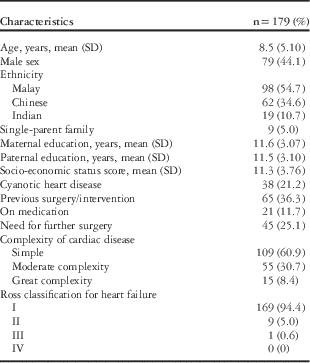
Table 1 shows the socio-demographic and medical characteristics of the children with CHD. Proxy informants consisted of 133 (74.3%) mothers, 44 (24.6%) fathers, and two (1.1%) guardians, with a mean age of 40.3 (SD 7.47) years. By age group, there were 56 toddlers (2–4 years), 36 young children (5–8 years), 40 children (9–12 years), and 47 teenagers (13–18 years). There was no significant difference in sex between children with CHD (44.1% males) and their siblings (47.7% males). Sibling controls were significantly older than children with CHD (difference between means 1.2 years, 95% confidence interval 0.20–2.25). Most of the patients had simple CHD, with no symptoms of heart failure, and were not on anti-failure medication. Of the 45 patients deemed to require further surgery or intervention, 31 (68.9%) would have to undergo corrective surgery and 14 (31.1%) palliative procedures.
Socio-demographic and medical characteristics of children with CHD.

Figures in parentheses indicate percentages unless indicated otherwise
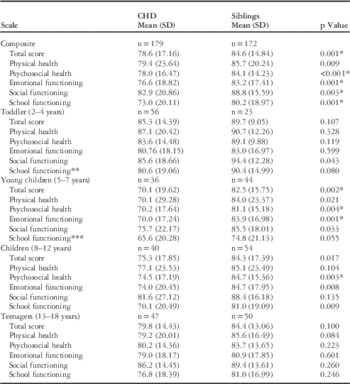
Table 2 shows the proxy-report Pediatric Quality of Life Inventory scores of children with CHD and healthy siblings by age group. As a composite group, children with CHD were reported to have lower scores in all scales compared with their siblings, except for physical health. Sub-analysis by age group, however, revealed that the between-group differences were contributed by the 5–7 years age group, for total, psychosocial health, and emotional functioning, and to a lesser extent by the 8–12 years age group, for psychosocial health. There were no significant differences in Pediatric Quality of Life Inventory scores between patients with CHD and siblings in the extreme age groups – that is, toddlers and teenagers.
Mean proxy-report Pediatric Quality of Life Inventory scores of children with CHD and healthy siblings by age group.

* Level of significance set at p<0.008 based on Bonferroni’s correction
** n of CHD=25, n of siblings=15
*** n of CHD=35, n of siblings=43
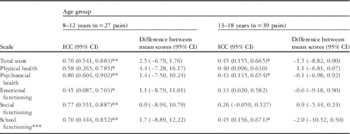
Table 3 shows the level of agreement between proxy and patient scores for the various scales of the Pediatric Quality of Life Inventory. There was better agreement in children aged 8–12 years, with a moderate level of agreement for physical health and emotional functioning scales and a good level of agreement for the rest of the scales including total, psychosocial health, social, and school functioning. In the teenage (13–18 years) group, the level of agreement was lower, with only a poor-to-fair level for emotional and social functioning and a moderate level for the rest of the scales including total, psychosocial health, physical health, and school functioning. As a composite group, the lowest proxy–child agreement was in the domain of emotional functioning (intra-class correlation coefficient 0.374, 95% confidence interval 0.147–0.564).
Agreement between mean child self-report and proxy-report Pediatric Quality of Life Inventory scores within the CHD group.

ICC=intra-class coefficient: ⩽4=poor-to-fair agreement, *0.41–0.6=moderate, **0.61–0.8=good, 0.81–1=excellent, CI=confidence interval
*** n=38 pairs for the 13–18 years age group
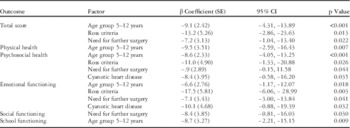
Table 4 shows the factors, using multiple regression analysis, associated with higher quality-of-life scores. There was no association between quality-of-life scores and child sex, ethnicity, single-parent family, socio-economic status score, complexity of cardiac disease, need for anti-failure medications, or a history of previous surgery. The age group of 5–12 years was associated with lower quality-of-life scores in all scales except social functioning. The need for further surgery was associated with lower quality-of-life scores in the total, psychosocial health, emotional, and social functioning scales. Higher Ross classification scores, indicating more symptoms of heart failure, were associated with lower total, psychosocial health, and emotional functioning scores. The presence of cyanotic heart disease was associated with lower psychosocial health and emotional functioning scores. Variances in the equations were low, ranging from 9.1 to 17.9%.
Multiple regression analysis of factors associated with higher Pediatric Quality of Life Inventory scores.

CI=confidence interval
Discussion
Our study showed that parents reported lower quality of life in their children with CHD compared with their healthy siblings. Previous studies have used normative means or healthy children from the population as controls for comparison. A strength of this study was the use of siblings as controls to reduce reporting bias due to factors that may shape parental perception of their child’s quality of life such as ethnicity, culture, environment, and parenting styles. Although some studies have also shown that children with CHD have lower quality of life scores,Reference Mellion, Uzark and Cassedy 9 – Reference Guerra, Robertson and Alton 17 others have shown that there are no differences in the scores of children with CHD and population normsReference Uzark, Jones, Slusher, Limbers, Burwinkle and Varni 18 – Reference Larsen, McCrindle, Jacobsen, Johnsen, Emmertsen and Hjortdal 20 or reported better quality of life among those with CHD than controls.Reference Areias, Pinto and Vieira 21 These varying results may be due to differences in methodology. Although the Pediatric Quality of Life Inventory 4.0 was the most commonly used measure,Reference Mellion, Uzark and Cassedy 9 , Reference Berkes, Varni, Pataki, Kardos, Kemény and Mogyorósy 10 , Reference Mussatto and Tweddell 12 , Reference Knowles, Day, Wade, Bull, Wren and Dezateux 14 , Reference Guerra, Robertson and Alton 17 , Reference Uzark, Jones, Slusher, Limbers, Burwinkle and Varni 18 the various instruments used in other studies precluded direct comparison.Reference Krol, Grootenhuis, DestrÉe-Vonk, Lubbers, Koopman and Last 11 , Reference Spijkerboer, Utens, De Koning, Bogers, Helbing and Verhulst 13 , Reference Landolt, Buechel and Latal 15 , Reference Amedro, Dorka and Moniotte 16 , Reference Walker, Gauvreau and Jenkins 19 – Reference Areias, Pinto and Vieira 21 In contrast to our study and others that recruited only children with CHD of varying severity,Reference Mellion, Uzark and Cassedy 9 , Reference Krol, Grootenhuis, DestrÉe-Vonk, Lubbers, Koopman and Last 11 , Reference Amedro, Dorka and Moniotte 16 , Reference Uzark, Jones, Slusher, Limbers, Burwinkle and Varni 18 there were studies that included children with other cardiac conditionsReference Berkes, Varni, Pataki, Kardos, Kemény and Mogyorósy 10 , Reference Walker, Gauvreau and Jenkins 19 or only recruited children who had undergone surgery.Reference Mussatto and Tweddell 12 – Reference Landolt, Buechel and Latal 15 , Reference Guerra, Robertson and Alton 17 , Reference Larsen, McCrindle, Jacobsen, Johnsen, Emmertsen and Hjortdal 20 , Reference Areias, Pinto and Vieira 21 The age groups were also heterogeneous, and several studies utilised only self-reports of adolescents and young adults.Reference Knowles, Day, Wade, Bull, Wren and Dezateux 14 , Reference Larsen, McCrindle, Jacobsen, Johnsen, Emmertsen and Hjortdal 20 , Reference Areias, Pinto and Vieira 21
We noted that the differences were mainly in the 5–7 and 8–12 years age group, as parents did not report any differences in the toddler and teenager groups. A study on Hungarian children with CHD reported similar findings, with the greatest differences in the 5–7 years age group.Reference Berkes, Varni, Pataki, Kardos, Kemény and Mogyorósy 10 The bimodal age group differences may reflect changing parental perceptions and expectations over time. Following an initial period of uncertainty and anxiety at the time of diagnosis in infancy, the relatively closed environment, lowered expectations, and adaptive coping after surgery in the toddler period may contribute to parental perception that their child is no different from others. The 5–7 years period coincides with the timing of entry into the community, where comparison with peers and stigmatisation come into play. This is also the period of re-operations and may amplify the differences between the child with CHD and their healthy siblings or peers. The lack of differences in the teenager group is not surprising as those with great complexity would not have survived till this age, and the survivors, having overcome the stress and difficulties of surgery in earlier childhood, would have adapted to living with their heart condition. These plausible reasons cannot be confirmed in a cross-sectional study, and a longitudinal study is required to determine whether this process of adaptation does occur. Although our population demographics were similar to the Hungarian study by Berkes et al,Reference Berkes, Varni, Pataki, Kardos, Kemény and Mogyorósy 10 the parental-proxy and self-report scores of our patients were higher than the Hungarian cohort and approximated that of two US studies,Reference Mellion, Uzark and Cassedy 9 , Reference Uzark, Jones, Slusher, Limbers, Burwinkle and Varni 18 highlighting the differences in parental perception across countries. A study on adults with CHD in 15 countries noted inter-country variations in quality-of-life scores, with countries such as Australia, Switzerland, and United States of America having higher scores than Asian countries that were represented by Japan and Taiwan.Reference Apers, Kovacs and Luyckx 22 Contrary to expectations, variation in quality of life was not related to country-specific characteristics such as national happiness level or cultural dimensions, and the authors suggested that healthcare system factors needed to be considered. We postulate that our results approximated that of the US studies as our patients were from an urban setting with access to subsidised healthcare. Although there was no inter-ethnic variation in the quality of life scores of our cohort, there are limitations in generalising our findings from a single-centre setting to the entire multi-ethnic Malaysian population, and further research is required to explore the influence of culture, ethnicity, and healthcare resources on quality of life.
In this study, parents did not report any difference in physical health between children with CHD and their siblings. This may be explained by the large proportion of our cohort who had simple cardiac lesions (60%) and were asymptomatic (94%). Previous studies have found that children with mild disease had similar physical health scores as controls,Reference Amedro, Dorka and Moniotte 16 , Reference Cohen, Mansoor, Langut and Lorber 23 and lower scores were reported in those with complex disease.Reference Mellion, Uzark and Cassedy 9 , Reference Berkes, Varni, Pataki, Kardos, Kemény and Mogyorósy 10 , Reference Amedro, Dorka and Moniotte 16 – Reference Uzark, Jones, Slusher, Limbers, Burwinkle and Varni 18 , Reference Goldbeck and Melches 24 , Reference Wray, Franklin, Brown, Cassedy and Marino 25 Parents also reported that their children with CHD had poorer psychosocial health compared with their siblings, particularly emotional functioning in the 5–7 years age group. As postulated earlier, emotional and behavioural problems may have started in early childhood but could have been overlooked by families dealing with immediate diagnostic and treatment issues, only to become a cause for concern later as the child begins integration into the school and community. The prevalence of “internalising” problems – that is, anxiety, depression, withdrawal, somatisation – and “externalising” problems – that is, attention and aggression – has been reported to range from 15 to 25% by parent report in the CHD population.Reference Marino, Lipkin and Newburger 1 Considering the prevalence across the various CHD physiologies, a scientific statement published by the American Heart Association in 2012 recommended that it can be useful and beneficial to perform behavioural screening for all patients with CHD undergoing scheduled developmental screening or concerns detected in surveillance from early childhood through adolescence.Reference Marino, Lipkin and Newburger 1
Regarding the level of agreement between the parental-proxy and the child self-reports, moderate agreement was observed for all scales except emotional and social functioning in the teenager group. The levels of agreement were even higher in the younger (8–12 years) age group, with good agreement in all scales except for emotional functioning. Other studies have reported fair-to-moderate agreement,Reference Krol, Grootenhuis, DestrÉe-Vonk, Lubbers, Koopman and Last 11 , Reference Spijkerboer, Utens, De Koning, Bogers, Helbing and Verhulst 13 , Reference Uzark, Jones, Slusher, Limbers, Burwinkle and Varni 18 , Reference Wray, Franklin, Brown, Cassedy and Marino 25 , Reference Eagleson, Justo, Ware, Johnson and Boyle 26 and also noted a lower level of agreement or even poor correlation in the teenager group.Reference Mellion, Uzark and Cassedy 9 , Reference Uzark, Jones, Slusher, Limbers, Burwinkle and Varni 18 The lower level of agreement between teenagers and their parents, especially in the areas of social and emotional functioning, reflects the conflict between parental over-protectiveness and the teenager’s efforts to exert control and independence. Limitations in physical functioning of a child may be obvious to the parent, resulting in close agreement between child and proxy reports,Reference Krol, Grootenhuis, DestrÉe-Vonk, Lubbers, Koopman and Last 11 , Reference Spijkerboer, Utens, De Koning, Bogers, Helbing and Verhulst 13 , Reference Uzark, Jones, Slusher, Limbers, Burwinkle and Varni 18 , Reference Wray, Franklin, Brown, Cassedy and Marino 25 , Reference Eagleson, Justo, Ware, Johnson and Boyle 26 but the child’s emotional health is less visible and mediated by factors other than CHD. Hence, it is not surprising that our study and others have noted the relatively lower agreement in the emotional functioning scale.Reference Berkes, Varni, Pataki, Kardos, Kemény and Mogyorósy 10 , Reference Krol, Grootenhuis, DestrÉe-Vonk, Lubbers, Koopman and Last 11 Some studies have reported a tendency for the parents to report lower quality-of-life scores than the children themselves,Reference Mellion, Uzark and Cassedy 9 – Reference Krol, Grootenhuis, DestrÉe-Vonk, Lubbers, Koopman and Last 11 , Reference Landolt, Buechel and Latal 15 , Reference Amedro, Dorka and Moniotte 16 highlighting the pitfalls of relying on proxy-reports alone. This trend was not seen in our study; furthermore, the higher levels of agreement obtained in our study compared with the existing literature may be due to stronger parental influences that still prevail in our society and exert considerable influence in shaping the child’s perception. We also observed that some of the younger eligible children in our study refused participation or were unable to provide an independent opinion, suggesting that the questions may not be entirely appropriate to the level of understanding or maturity. Hence, proxy reports for our local population of children <12 years of age may suffice, especially in a busy clinic setting with limited resources and time. A study found that the level of agreement was better with more severe heart disease.Reference Eagleson, Justo, Ware, Johnson and Boyle 26 There were only four children aged 8–18 years with heart disease of great complexity in our study, which precluded meaningful sub-analysis.
Although some studies found an association between complexity of cardiac disease and quality of life,Reference Mellion, Uzark and Cassedy 9 , Reference Berkes, Varni, Pataki, Kardos, Kemény and Mogyorósy 10 , Reference Knowles, Day, Wade, Bull, Wren and Dezateux 14 , Reference Amedro, Dorka and Moniotte 16 , Reference Uzark, Jones, Slusher, Limbers, Burwinkle and Varni 18 , Reference Areias, Pinto and Vieira 21 , Reference Goldbeck and Melches 24 – Reference Dean, Gillespie and Greene 27 ours was more in keeping with others that did not find a relationship.Reference Krol, Grootenhuis, DestrÉe-Vonk, Lubbers, Koopman and Last 11 – Reference Spijkerboer, Utens, De Koning, Bogers, Helbing and Verhulst 13 , Reference Guerra, Robertson and Alton 17 , Reference Cohen, Mansoor, Langut and Lorber 23 , Reference Bertoletti, Marx, Hattge and Pellanda 28 Instead, the severity of clinical symptoms, as measured by the Ross classification scores in this study, was more important.Reference Mussatto and Tweddell 12 , Reference Bertoletti, Marx, Hattge and Pellanda 28 Unlike some studies that reported an association between previous surgical intervention and quality of life,Reference Knowles, Day, Wade, Bull, Wren and Dezateux 14 , Reference Areias, Pinto and Vieira 21 , Reference Wray, Franklin, Brown, Cassedy and Marino 25 , Reference Bertoletti, Marx, Hattge and Pellanda 28 we found that the need for future surgery was more important. Although the presence of cyanotic heart disease was associated with poorer psychosocial health in this study, data from other studies are conflicting.Reference Areias, Pinto and Vieira 21 , Reference Bertoletti, Marx, Hattge and Pellanda 28 These mixed findings may be due to the lack of uniformity in reporting severity of disease and the heterogeneous complexity of surgery. Unlike others, we did not find an association with socio-economic statusReference Wang 3 , Reference Guerra, Robertson and Alton 17 , Reference Drakouli, Petsios, Giannakopoulou, Patiraki, Voutoufianaki and Matziou 2 , Reference Goldbeck and Melches 24 or need for medications.Reference Knowles, Day, Wade, Bull, Wren and Dezateux 14 , Reference Landolt, Buechel and Latal 15 Our findings are important from the local perspective, as there is a waiting list for surgery due to limited access to the few centres in this country. Appropriate counselling of expectations, optimising timing of surgery, and improving control of symptoms may help improve quality of life.
There are several limitations to this study. Although the use of a generic instrument such as the Pediatric Quality of Life Inventory 4.0 allowed comparison with healthy controls, the concomitant use of a disease-specific cardiac module may have been a better discriminator of factors associated with quality of life within the CHD group. Patients were recruited from a single-centre urban setting, and the results may not be generalisable to the entire Malaysian population. Data on self-reports could have been enhanced by a larger sample size and comparison with self-reports of the siblings. The low variances obtained from the regression analyses suggest that other more important factors associated with quality of life were not studied. Specific child factors such as sense of coherence,Reference Luyckx, Missotten and Goossens 29 self-worth and competence,Reference Wray, Franklin, Brown, Cassedy and Marino 25 depression,Reference Cohen, Mansoor, Langut and Lorber 23 , Reference Wray, Franklin, Brown, Cassedy and Marino 25 , Reference Luyckx, Goossens, Rassart, Apers, Vanhalst and Moons 30 sports participation,Reference Knowles, Day, Wade, Bull, Wren and Dezateux 14 , Reference Cohen, Mansoor, Langut and Lorber 23 and exercise capacityReference Dean, Gillespie and Greene 27 and parental factors such as family function,Reference Landolt, Buechel and Latal 15 parental hope,Reference Wang 3 and supportReference Areias, Pinto and Vieira 21 , Reference Luyckx, Missotten and Goossens 29 , Reference Luyckx, Goossens, Rassart, Apers, Vanhalst and Moons 30 have been identified as important determinants of quality of life. Further research in these areas will enhance our understanding of the quality-of-life issues faced by children with CHD and hopefully lead to appropriate allocation of medical and psychosocial resources.
Conclusions
This study showed that children with CHD have lower quality of life compared with their healthy siblings, based on parental-proxy reports; however, this was not uniform across all age groups, as children aged 5–7 years appeared to be the most vulnerable. The level of agreement between proxy-report and child self-report scores was higher than other studies, reflecting societal differences in the perception of quality of life. Facilitating access to surgery and optimising control of symptoms may help improve quality of life.
Acknowledgements
The authors thank Betty Sheila A/P Subramaniam for her assistance in this study.
Financial Support
This research received no specific grant from any funding agency or from commercial or not-for-profit sectors.
Conflicts of Interest
None.
Ethical Standard
The authors assert that all procedures contributing to this work comply with the ethical standards of the Malaysian national guidelines on human experimentation and with the Helsinki Declaration of 1975, as revised in 2008, and has been approved by the institutional committee of the University Malaya Medical Centre.