The Dimensional Assessment of Personality Pathology-Basic Questionnaire (DAPP-BQ) is a 290-items self-report instrument “designed primarily to assess basic dimensions of personality disorder in clinical populations” (Livesley & Jackson, Reference Livesley and Jackson2002; Reference Livesley and Jackson2009, p. 1). This questionnaire is also appropriate for assessing patients with a wide variety of other psychiatric disorders as anxiety, mood disorders, eating disorders, substance use, and somatization disorders.
The DAPP-BQ shows a robust four-factor structure across different samples and cultures (Bagge & Trull, Reference Bagge and Trull2003; Kushner, Quilty, Tackett, & Bagby, Reference Kushner, Quilty, Tackett and Bagby2011; Livesley & Jackson, Reference Livesley and Jackson2002; Livesley, Jackson, & Schroeder, Reference Livesley, Jackson and Schroeder1989; Livesley, Jang, & Vernon, Reference Livesley, Jang and Vernon1998; Maruta, Yamate, Iimori, Kato, & Livesley, Reference Maruta, Yamate, Iimori, Kato and Livesley2006; Pukrop, Gentil, Steinbring, & Steinmeyer, Reference Pukrop, Gentil, Steinbring and Steinmeyer2001; Simonsen & Simonsen, Reference Simonsen and Simonsen2009; van Kampen, Reference van Kampen2002, Reference van Kampen2006; van Kampen, de Beurs, & Andrea, Reference van Kampen, de Beurs and Andrea2008; Zheng et al., Reference Zheng, Wang, Huang, Sun, Zhu and Livesley2002). The factors were named Emotional Dysregulation, Dissocial Behavior, Social Avoidance and Compulsivity (Livesley & Jackson, Reference Livesley and Jackson2009; van Kampen, Reference van Kampen2002).
The DAPP-BQ demonstrates good convergent validity respect to other dimensional personality tests. In a joint factorial analysis between the Eysenck Personality Questionnaire Revised (EPQ-R), the NEO Personality Inventory Revised (NEO-PI-R) and the DAPP-BQ, Emotional Dysregulation loaded with Neuroticism, Low Affiliation with Extraversion, Social Avoidance with Psychoticism and Agreeableness (–), and Compulsiveness with Conscientiousness (Larstone, Jang, Livesley, Vernon, & Wolf, Reference Larstone, Jang, Livesley, Vernon and Wolf2002). In another study, the DAPP-BQ and the Zuckerman-Kuhlman Personality Questionnaire (ZKPQ) high loadings of Affectivity instability, Anxiousness, Identity problems, Oppositionality, Restricted Expression, Self-Harm, Submissiveness and Suspiciousness were loaded in the Neuroticism factor. Callousness, Conduct Problems, Narcissism, Oppositionality, Rejection, Stimulus Seeking and Suspiciousness loaded in the Aggression-Hostility factor. Compulsivity ( –), Conduct Problems and Self-Harm loaded in Impulsive Sensation-Seeking factor. Finally, Intimacy problems and Restricted Expression loaded in the Sociability ( –) factor while Compulsivity (+) was related to the Activity factor (Wang, Du, Wang, Livesley, & Jang, Reference Wang, Du, Wang, Livesley and Jang2004).
The test–retest reliabilities of the 18 DAPP-BQ scales over a 3-week interval ranged from .81 to .93 (Livesley, Jang, Jackson, & Vernon, Reference Livesley, Jang, Jackson and Vernon1993). The internal consistency of the scales ranged between .84 and .93 in normal and clinical samples (Livesley & Jackson, Reference Livesley and Jackson2009).
Short version of the DAPP-BQ
van Kampen et al. (Reference van Kampen, de Beurs and Andrea2008) proposed a 136 item version (named Dimensional Assessment of Personality Pathology-Short Form; DAPP-SF) that demonstrated good validity and reliability. The factor structure of that version was highly congruent with the structure of the DAPP-BQ. Additionally, the factor structure was replicated in a community sample of patients with personality disorders. The convergent validity of the DAPP-SF was supported by correlating its scales and factors with the van Kampen’s Five Dimensional Personality Test (5DPT: Insensitivity, Extraversion, Neuroticism, Orderliness, and Absorption) (van Kampen, Reference van Kampen2006). The sample included a group of participants of the general population and a sample of patients referred for treatment of personality disorders from six mental health care institutes in the Netherlands.
The procedure to obtain this short version was performed in eight steps (van Kampen et al., Reference van Kampen, de Beurs and Andrea2008). Those scales with a Cronbach's Alpha reliability coefficient equal or above .75 were retained, whereas two additional items were selected and added to the 6–, 8–, and 10-item scales not meeting the previous condition. After inspection of item content, those that used identical or similar words were replaced by items with a different content. The DAPP-SF factors and scales were further correlated with the 5DPT dimensions to establish whether the validity findings obtained for the DAPP-BQ were the same than for the DAPP-SF (van Kampen et al., Reference van Kampen, de Beurs and Andrea2008).
DAPP-BQ/DAPP-SF and Psychopathology
The DAPP-BQ predicts an important part of the variance (29% –63%) of the Personality Disorders (PD’s) of DSM (Bagge & Trull, Reference Bagge and Trull2003). In a recent study carried out by Kushner et al. (Reference Kushner, Quilty, Tackett and Bagby2011), the DAPP-BQ accounted for a considerable amount of variance in the PD’s clusters, ranging from 32% to 39% across levels. Emotional Dysregulation significantly predicted most, but not all, of the PDs. Dissocial Behavior significantly predicted all cluster B PD’s. Social Avoidance (labeled Inhibitedness) predicted all cluster A PD’s, but the variance accounted for borderline, avoidant and obsessive-compulsive PD’s was lower. Compulsivity predicted paranoid, narcissistic, and obsessive-compulsive PD’s (Kushner et al., Reference Kushner, Quilty, Tackett and Bagby2011). All of these results suggest that the DAPP-BQ is especially useful for the evaluation of the personality dimensions potentially related with clinically assessed PD’s. Nevertheless, the high amount of items posits some difficulties for its application in the clinical or hospital environment: a) excessive time to complete the questionnaire; and b) answering the questionnaire in several sessions because of fatigue-related factors. With the purpose of avoiding these difficulties it was necessary to develop a shorter version of the DAPP-BQ.
De Beurs, Rinne, van Kampen, Verheul, and Andrea (Reference de Beurs, Rinne, van Kampen, Verheul and Andrea2009) investigated convergent and discriminant validity of the Dimensional Assessment of Personality Pathology-Shortened Form (DAPP-SF) relating the DAPP scales with the Symptom Checklist-90-Revised (SCL-90-R) (Derogatis, Reference Derogatis1975b) and the Brief Symptom Inventory (BSI) (Derogatis, Reference Derogatis1975a). Both instruments measure similar constructs. This study was carried out in two clinical samples, consisting respectively of patients referred for personality pathology and/or personality disorders (PD and patients with mood-, anxiety-, or somatoform disorders; MAS patients sample). The substantial associations yield support for the convergent validity. All DAPP-SF scales obtained high correlations with the SCL-90-R scales, except Callousness and Rejection. The highest correlations in PD and MAS samples were between Identity Problems and Depression (.69 and .68, respectively). This can be taken as supportive for the discriminant validity of the DAPP-SF dimensions.
The general purpose of the current study was to analyze and replicate the DAPP-BQ and DAPP-SF psychometric properties in a large Spanish sample using a calibration and validation sample. With the aim of obtaining normative data, the participants were selected to ensure in both samples a similar distribution of sex and age. Additionally, we were interested in developing a shorter form of the DAPP-BQ, using a different strategy from that taken by van Kampen et al. (Reference van Kampen, de Beurs and Andrea2008). This shortened version should show acceptable psychometric properties and it could be useful in situations with time constraints such as hospital consultations.
Method
Participants
The data were collected from 1.093 participants from the general population (550 men and 543 females) with a mean age of 42.11 (SD = 16.12). The mean age for men was 42.61 (SD = 16.06) and for females 41.61 (SD = 16.17). The age t-test was non-significant and with a negligible effect size (d = .06; Cohen, Reference Cohen1988).
A group of undergraduate trained students collaborated to collect data from five men and five women between 20 and 80 years from the general population, including friends and relatives. The data was collected during two years (2009–2011). Age ranged within 18–25 (19.16%), 26–40 (26.7%), 41–50 (19.9%) and 51–83 (32.3%) year old. 16 participants did not report their age (1.5%). The percentages of participants in the various age categories are similar to what was found in the Spanish 2011 census.
The participants informed about their occupation in the following percentages: a) higher executives of large concerns, proprietors, and major professionals (25.1%); b) business managers, proprietors of medium-sized businesses, and lesser professionals (35%); c) administrative personnel, owners of small businesses, and minor professionals (7.1%); d) clerical and sales workers, technicians, and owners of little businesses (16.1%); e) skilled manual employees (8.4%); f) machine operators and semiskilled employees (2.9%); and g) unskilled employees (5.5%). We also assessed the education level: a) professional (31.6%); b) four-year college graduate (13.3%); c) one to three years college (also business schools) (10.6%); d) high school graduate (20.7%); e) ten to 11 years of school (part high school) (8.5%); f) seven to nine years of school (9%); and g) less than seven years of school (6.1%).
Instruments
DAPP-BQ. The Dimensional Assessment of Personality Pathology-Basic Questionnaire (Livesley & Jackson, Reference Livesley and Jackson2002, Reference Livesley and Jackson2009; Livesley et al., Reference Livesley, Jackson and Schroeder1989; Livesley, Jackson, & Schroeder, Reference Livesley, Jackson and Schroeder1992) is a 290-item; self-report questionnaire with the items rated on a 5-point scale ranging from 1 (Very unlike me) to 5 (Very like me). The DAPP-BQ is derived from the factorization of 100 personality pathology descriptors, and has 18 traits: Submissiveness (SUB), Affective Instability (AIN; called Affective Lability in previous studies), Anxiousness (ANX), Insecure Attachment (IAT), Cognitive Distortion (COG), Identity Problems (IPR), Low Affiliation (LAF; called Social Avoidance in previous studies), Oppositionality (OPP), Narcissism (NAR), Stimulus Seeking (STS), Callousness (CAL), Rejection (REJ), Conduct Problems (COP), Restricted Expression (REX), Intimacy Problems (INP), Compulsivity (COM), Suspiciousness (SUS), and Self-Harm (SHA). Except for Self-Harm (12) and Suspiciousness (14), the rest of scales have 16 items. A validity scale, not used in this study, has 8 items. This questionnaire shows a factorial structure of four factors with high alpha reliabilities ranging from .75 to .93. The DAPP-BQ was translated and adapted with permission into Spanish and published by Gutiérrez-Zotes et al. (Reference Gutierrez-Zotes, Gutierrez, Valero, Gallego, Bailles, Torres and Livesley2008). The Spanish version of DAPP-BQ was back translated by an English native and compared to the original before the final version was completed (supervised by John Livesley). The Spanish adapters have given us the permission to use the Spanish version of the DAPP-BQ.
DAPP-SF. The short form of DAPP-BQ (Dutch language version), called DAPP-SF, was derived by van Kampen et al. (Reference van Kampen, de Beurs and Andrea2008) and has 136 items. Two scales are composed of ten items, ten of eight items, and six of six items. The internal consistency alpha coefficients range from .78 to .89.
SCL-90-R. The Symptom Check List 90-Revised (Derogatis, Reference Derogatis1994) is a 90-item self-report symptom inventory designed to evaluate patterns of psychological symptomatology of psychiatric and medical patients. Each item is rated on a 5-points scale of severity, ranging from “not at all” to “a lot”. The test has nine dimensions: Somatization (SOM), Obsessive-compulsive attitude (OC), Interpersonal sensitivity (IS), Depression (DEP), Anxiety (ANXI), Hostility (HOS), Phobic anxiety (PHOB), Paranoid ideation (PAR) and Psychoticism (PSY). The test also provides three global indices: the Global severity index (GSI), which represents the best single indicator of the current level of the disorder; the Positive symptoms distress index (PSDI), which is a measure of the patient’s response style that reflects the overestimation or underestimation of symptoms; and the Positive symptoms total (PST), which is simply a count of the number of symptoms referred by the patient.
Equivalence between two independent samples (calibration and validation)
With the purpose of assessing whether both samples are equivalent, the data have been randomly divided in two groups (group 1 and 2) corresponding to a calibration and validation sample respectively. The first group consisted of 551 (50.4%) and the second of 542 (49.6%) participants. There were no significant differences among the two independent groups for the 18 scales, including age. The effect size was negligible. The factorial structure of both samples was analyzed independently with principal components and direct oblimin rotation (structure matrix). The Kaiser-Meyer-Olkin measure of sampling adequacy was .90 for both groups and the variance accounted by the four-factor solution was of 71.02 and 71.22, respectively. Factorial equivalence between groups has been analyzed by the Procrustes rotation and Tucker’s coefficient of congruence. Congruence coefficient was .99.
Data analyses
Structural Equation Modeling (SEM) has been used to assess each DAPP-BQ scale. The procedure consists in removing an item of each pair that shows extreme correlations. These extreme correlations are identified by the Modification Indices (high MI’s values). Items highly correlated tend to be redundant in the content (Aluja & Blanch, Reference Aluja and Blanch2007, Reference Aluja and Blanch2011; Byrne, Reference Byrne1991, Reference Byrne1993, Reference Byrne2001; Cudeck & Browne, Reference Cudeck and Browne1983; Yadama & Drake, Reference Yadama and Drake1995). DAPP-BQ scales mean differences were assessed by Cohen’s d (Cohen, Reference Cohen1988). The full exploratory factor structure of the DAPP-BQ was studied through Principal Components Analysis (PCA). Moreover, direct oblique rotation was carried out with the obliquity parameter set to zero in order to adopt the same procedure used by the original DAPP-BQ authors (Livesley & Jackson, Reference Livesley and Jackson2009). The criterion for extraction factors was Parallel Analysis (O'Connor, Reference O'Connor2000). Tucker’s congruency coefficients after Procrustes rotation were used to compare the factorial solutions. The correlations between long and short forms of the DAPP-BQ were analyzed with Pearson correlation corrected for spurious inflation due to shared error variance (Levy, Reference Levy1967) Footnote 1 . Differences between the 136 and 90-items DAPP-BQ short forms corrected correlations were performed by the effect size index q defined as a difference between two Fisher-z-transformed correlation coefficients Footnote 1 . This procedure was also used to study the correlations differences of the short versions with the SCL-90-R. All statistical analyses were conducted with SPSS 15.0, Shortform 1.1 (See Paul Barret Web page. http://www.pbarrett.net/#software; last view: 05/07/2014), G*Power 3.1 (Faul, Erdfelder, Lang, & Buchner, Reference Faul, Erdfelder, Lang and Buchner2007) and AMOS 4.0 computer software (Arbuckle, Reference Arbuckle1999).
The Structural Equation Modeling (SEM) provides valuable additional information in regard to item analyses, such as the identification of items that are highly intercorrelated and likely to be of a similar content, artificially contributing to the factorial structure and factor reliability. Intercorrelated items are usually responsible of the unsatisfactory goodness-of-fit-indexes in the SEM models (Aluja & Blanch, Reference Aluja and Blanch2007, Reference Aluja and Blanch2011; Aluja, Del Barrio, & Garcia, Reference Aluja, Del Barrio and Garcia2006; Aluja, Garcia, & Garcia, Reference Aluja, Garcia and Garcia2003a, Reference Aluja, Garcia and Garcia2003b; del Barrio, Aluja, & Spielberger, Reference del Barrio, Aluja and Spielberger2004).
A cross-validation method was applied where a hypothetic model obtained from the calibration sample was subsequently tested in a validation sample. This approach has been regarded as especially useful in post hoc model fitting, where the chances of model modification due to the specific characteristics of a single sample are likely to be high (Byrne, Reference Byrne2001). A model for each scale was obtained in the calibration group and validated in the validation group. The procedure used was: a) after analyzing the standardized regression weights and the error covariance between items of the same scale, we deleted an item of each correlated pair identified by the high MI’s with the lower standardized regression weights. One item of each pair was eliminated starting from the highest MI, and so forth. The item with higher MI’s obtained an exaggerated correlation and the semantic content is very similar Footnote 2 . This strategy was performed separately for both groups of participants (1 and 2), and for all participants; b) we intended to obtain a satisfactory fit on SEM adjustment values (TLI > .90 and RMSEA < .05) for each DAPP-BQ scale in both separate groups (calibration and validation), and simultaneously for the whole sample. At this step, we analyzed the content of items to avoid items with excessive wording similitude; c) obtaining a minimum alpha reliability of .70 per scale.
Results
Descriptive statistics and alpha internal consistency
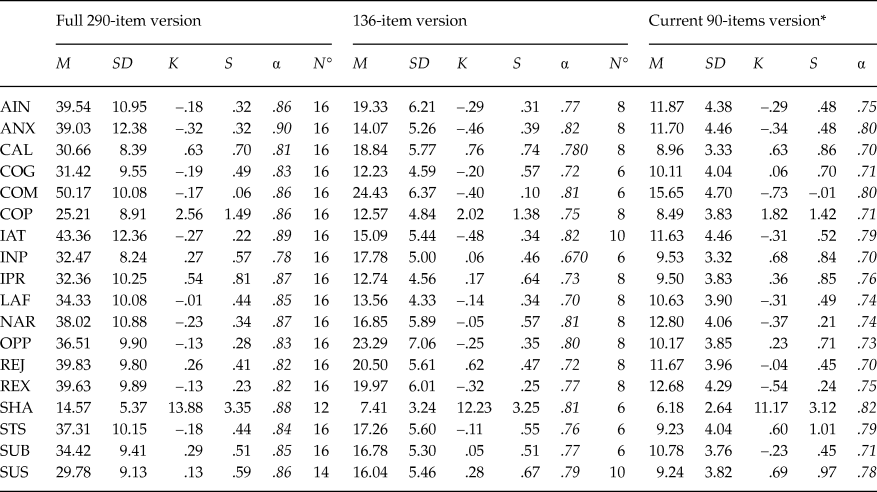
The means, standard deviations, kurtosis, skewness and alphas for the 18 DAPP-BQ Footnote 3 scales including the 290, 136 and 90-items forms are shown in Table 1. All scales obtained kurtosis and skewness distribution values near to zero but for the COP and SHA scales, indicating that these scales were normally distributed. As expected, the 290-item full version obtained standardized alpha values equal or above .80, except for INP (.78). The 136-item version obtained 6 scales with alphas values equal or higher than .80, 11 between .70 and .80 and 1 below that .70. The 90-item Footnote 4 versions obtained alpha values equal or higher than .70. Median alpha values were .85, .77 and .75 respectively.
Descriptive alpha internal consistency and country differences
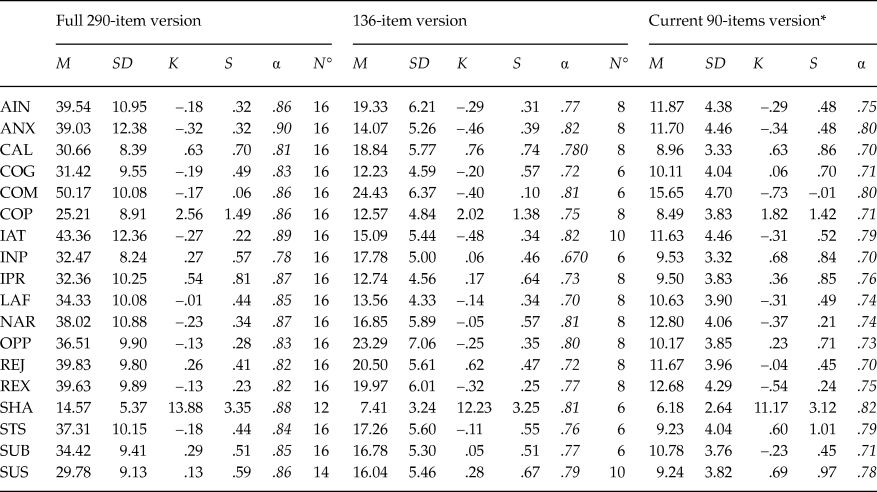
Note: N°: number of items. *5 items in each 90-items version scale. AIN = Affective Instability; ANX = Anxiousness; CAL = Callousness; COG = Cognitive Distortion; COM = Compulsivity; COP = Conduct Problems; IAT = Insecure Attachment; INP = Intimacy Problems; IPR = Identity Problems; LAF = Low Affiliation; NAR = Narcissism; OPP = Oppositionality; REJ = Rejection; REX = Restricted Expression; SHA = Self-Harm; STS = Stimulus Seeking; SUB = Submissiveness; SUS = Suspiciousness. M = Mean; SD = Standard deviation; K = Kurtosis; S = Skewness.
DAPP-BQ and DAPP-SF mean differences between studies
We used the Cohen's d (Cohen, Reference Cohen1988) to assess the mean differences between the sample in the present study and the samples from Livesley and Jackson (2009; n = 2726, p. 16) and van Kampen et al., (2008; n = 478, p. 125). We found similar means compared to the results of Livesley and Jackson (Reference Livesley and Jackson2009) with some exceptions. In the original study, the IAT scale obtained a lower mean compared with our study (34.14 vs 43.36, d = .74), while NAR and SUB were lower in the present research (43.04 vs 38.02, d = –.43; 39.14 vs 34.43, d = –.44; medium effect size). However, these differences were not significant when compared with the data of the general Spanish population provided by Gutierrez-Zotes et al. (Reference Gutierrez-Zotes, Gutierrez, Valero, Gallego, Bailles, Torres and Livesley2008).
Structural Equation Modeling Analysis
Maximum likelihood confirmatory factor analyses were conducted over the variance-covariance matrices of each DAPP-BQ single scales in the three versions of the test for both random groups (1 and 2). The Tucker-Lewis index (TLI) and the root mean square error of approximation (RMSEA) were used as fit indices (Bentler, Reference Bentler1990; Bentler & Bonett, Reference Bentler and Bonett1980; Bollen, Reference Bollen1989; Steiger, Reference Steiger1990; Tucker & Lewis, Reference Tucker and Lewis1973). A well-fitting model should ideally have a non-significant χ2 statistic, a TLI value close to .95 or greater, and a value close to .05 or lower for the RMSEA (Browne & Cudeck, Reference Browne, Cudeck, Bollen and Long1993; Hu & Bentler, Reference Hu and Bentler1999).
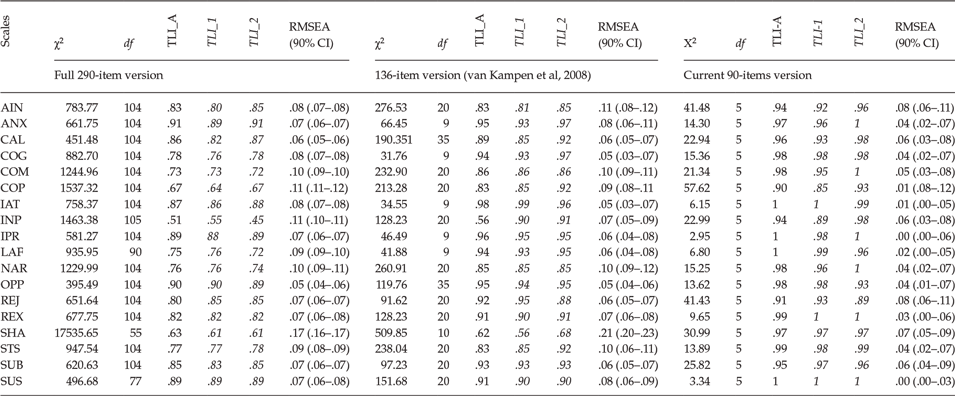
Table 2 compares the goodness-of-fit indices for each DAPP-BQ factors for the full 290-item, 136-item and 90-item forms. The model with 290-items obtained unsatisfactory fit indexes for most scales. Only OPP and ANX scales obtained a TLI higher than .90 and all scales obtained a RMSEA value higher or equal than .05. In the model of 136-items, ten scales obtained a TLI higher of .90, but only three scales a RMSEA lower than .06. The 90-items form obtained satisfactory fit indices for TLI in all scales. In the calibration sample, COP obtained a TLI of .85, and in the validation sample, REJ obtained values of .89. Twelve scales obtained RMSEA values equal or below .05.
Goodness of fit indices for 3 DAPP-BQ versions comparing one-factor models
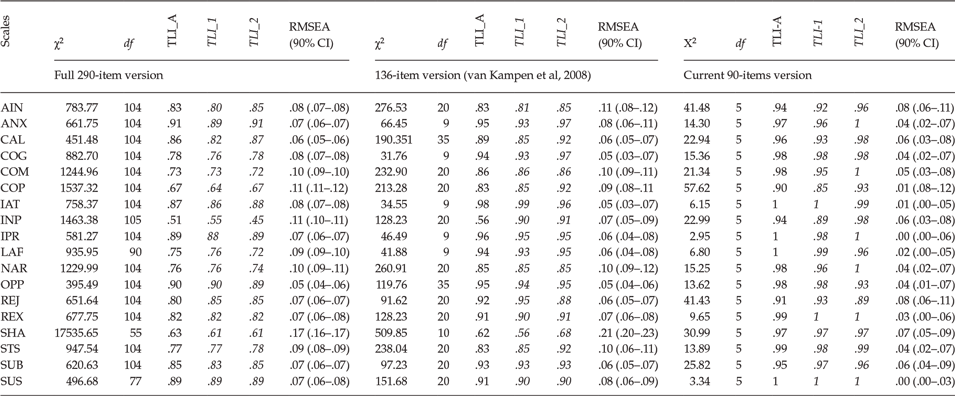
Note: χ2 = Xi squared; d.f. Degree of freedom; TLI_A = Tucker-Lewis Index (both groups); TLI_1 (calibration group, in cursive); TLI_2 (validation group, in cursive); RMSEA = root mean square error of approximation and its 90% confidence interval. AIN = Affective Instability; ANX = Anxiousness; CAL = Callousness; COG = Cognitive Distortion; COM = Compulsivity; COP = Conduct Problems; IAT = Insecure Attachment; INP = Intimacy Problems; IPR = Identity Problems; LAF = Low Affiliation; NAR = Narcissism; OPP = Oppositionality; REJ = Rejection; REX = Restricted Expression; SHA = Self-Harm; STS = Stimulus Seeking; SUB = Submissiveness; SUS = Suspiciousness.
Factorial structure analysis and congruency coefficients
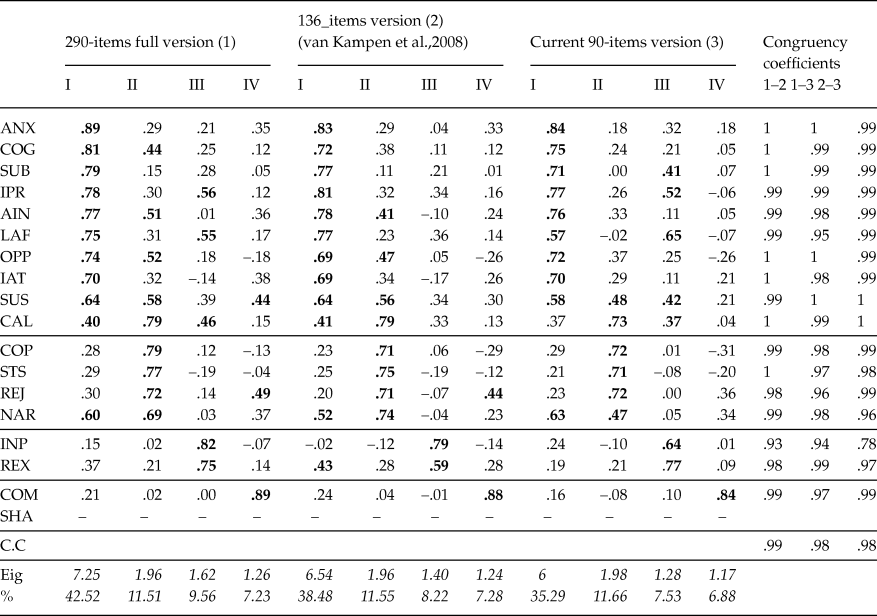
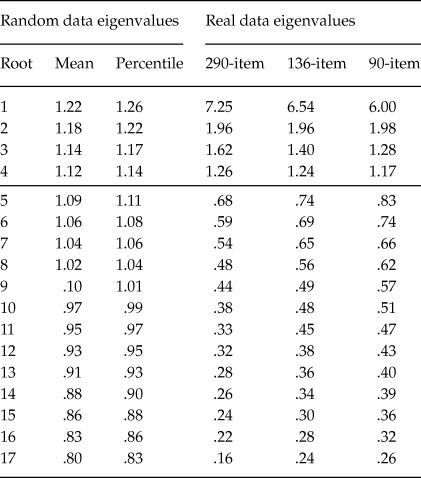
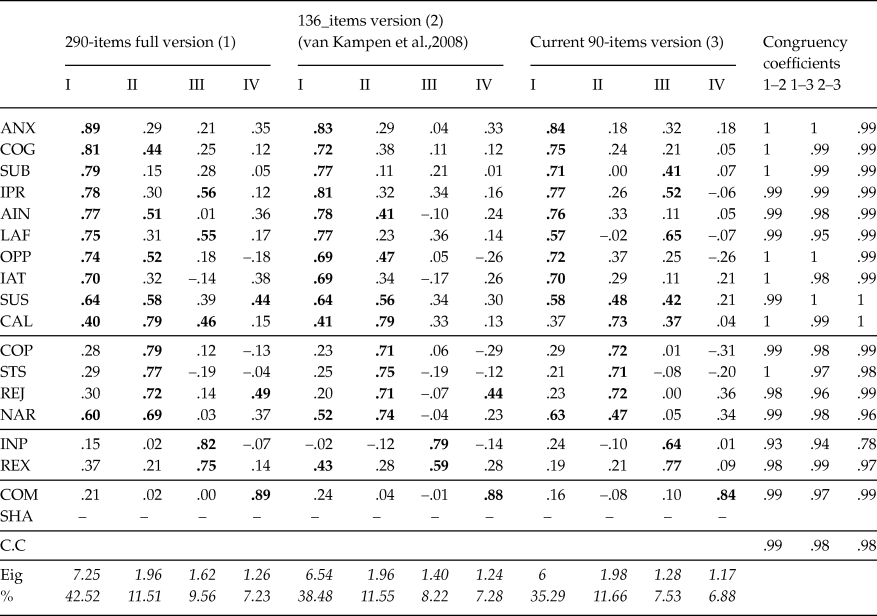
Table 3 shows the factorial structure of the separate scales of the DAPP-BQ, DAPP-SF, and DAPP-90, leaving out of consideration the three Self-Harm scales that were found to have very large kurtosis and skewness values. A PCA with oblimin rotation was used for the calibration and validation samples. The Kaiser-Meyer-Olkin measures of sample adequacy were between .88 and .91. The parallel analysis suggested retaining four factors derived from the corresponding eigenvalues in the actual data that were greater than their counterparts in the random data for the three versions (O'Connor, Reference O'Connor2000) (Table 4).
Principal component analysis (oblimin rotation) structure matrix comparison of full DAPP-BQ and the two short versions
Note: ANX = Anxiety; COG = Cognitive Distortion; SUB = Submissiveness; IPR = Identity Problems; AIN = Affective Instability; LAF = Low Affiliation; OPP = Oppositionality; IAT Insecure Attachment; SUS = Suspiciousness; CAL = Callousness; COP = Conduct Problems; STS = Stimulus Seeking; REJ = Rejection; NAR = Narcissism; INP = Intimacy Problems; REX Restricted Expression; COM = Compulsivity; SHA = Self-Harm.
Parallel analysis extraction factor criteria (Principal Components) comparing 290, 136 and 90 DAPP-BQ item versions
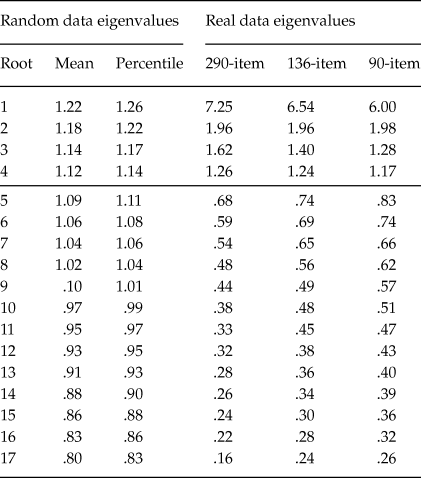
Note: N = 1,093; Variables = 17; Datsets = 1000; Percentile = 95.
The total variance explained by the four factors was 71.02% (290-item version), 65.54% (136-item version) and 61.36% (90-item version). Before rotation, eigenvalues were F-I: 7.25 (42.52%), F-II: 1.96 (11.51%), F-III: 1.62 (9.56%), F-IV: 1.26 (7.23%) for the full 290-items version; F-I: 6.54 (38.48%), F-II: 1.96 (11.55%), F-III: 1.40 (8.22%), F-IV: 1.24 (7.28%) for the 136-items version; and F-I: 6 (35.29%), F-II: 1.98 (11.66%), F-III: 1.28 (7.73%), F-IV: 1.17 (6.88%) for 90-items version.
The Tucker’s coefficient of congruence between structures was analyzed for a) 290-items vs 136-items versions (.99), b) 290-items vs 90-items (.98) and, c) 136-items vs 90-items versions (.98), indicating that the three factorial solutions were very similar (Table 3).
Correlational analysis
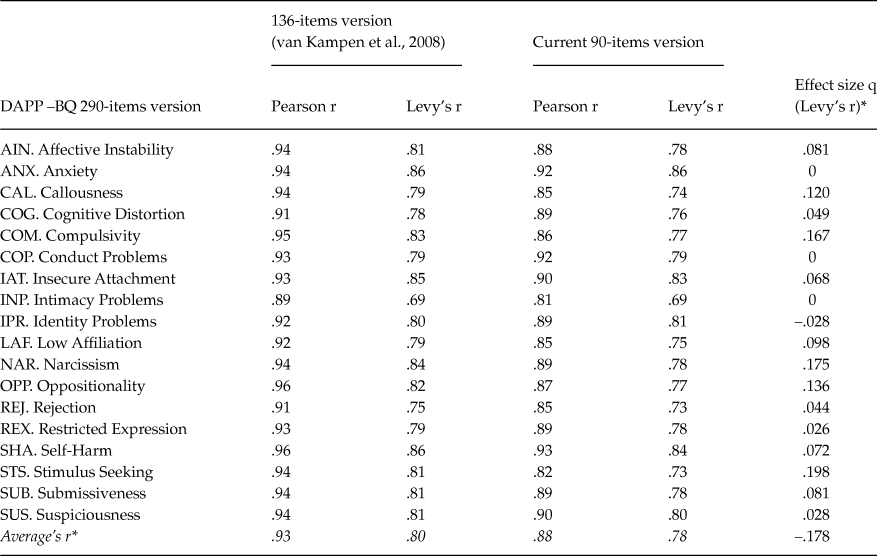
Table 5 offers the correlations between the original scales of the DAPP-BQ and their counterpart versions in the DAPP-SF and DAPP-90. The average correlation between the 290-items and the 136-items versions was .93, which dropped to .80 after a Levy’s correction for spurious variance. The mean correlation between the 290-items and the 90-items forms was .88 and after Levy’s correction was .78. The effect size of the correlation difference was low (–.188) (Cohen, Reference Cohen1988).
Pearson correlation and Levy’s correction for spurious correlation between both short with full DAPP-BQ versions and correlation differences
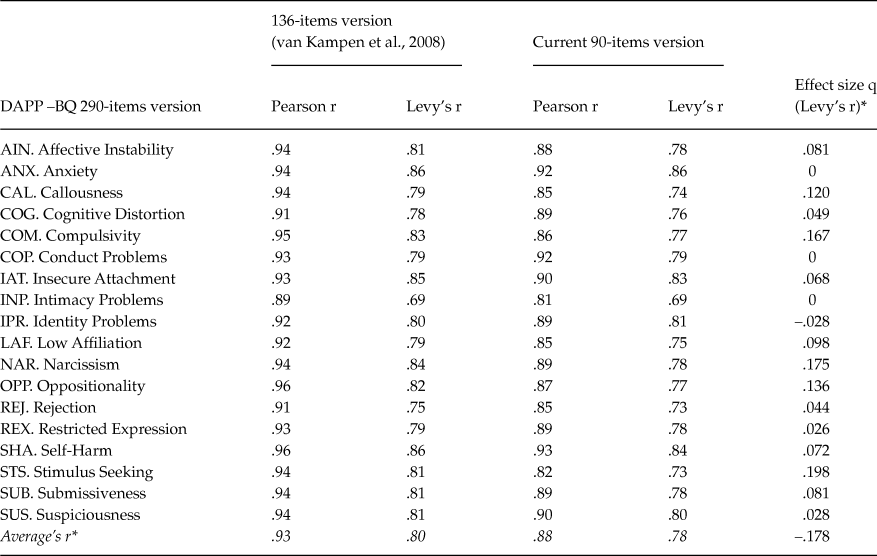
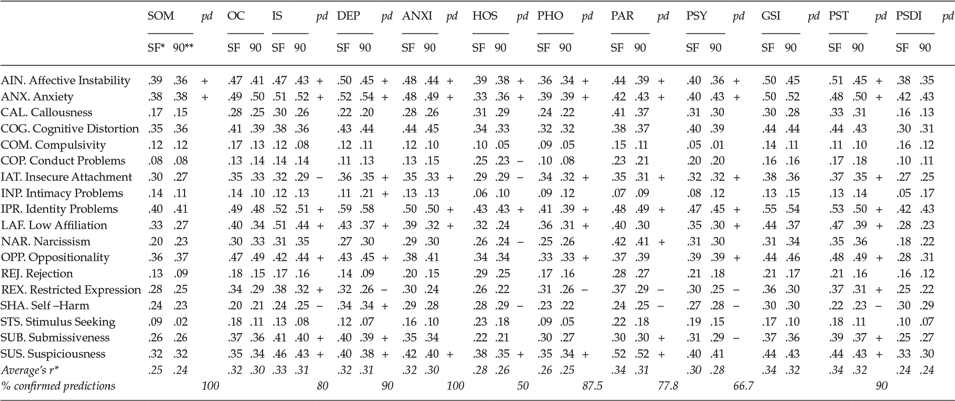
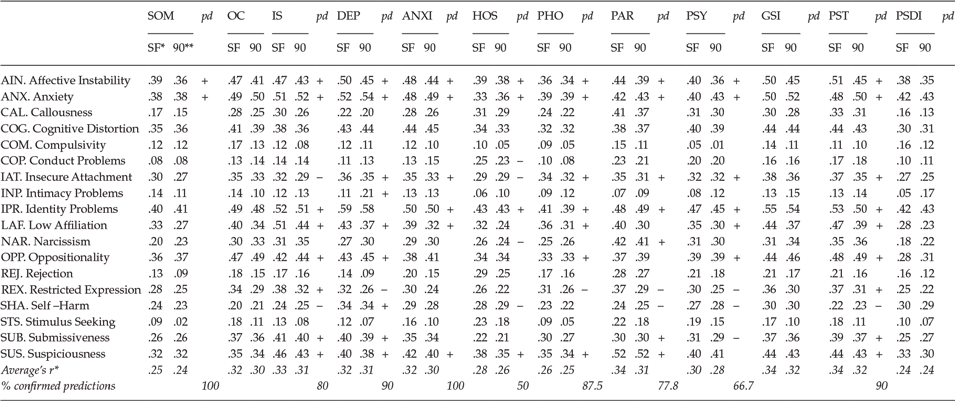
Table 6 shows the product-moment Pearson correlations between the DAPP-SF and DAPP-90 with the SCL-90-R scales. The first and second column show the correlations obtained by the DAPP-SF and DAPP-90 with the SCL-90-R scales and dimensions, and the third column indicates the prediction direction of the expected correlations according to previous research (de Beurs et al., Reference de Beurs, Rinne, van Kampen, Verheul and Andrea2009). Notice that the PD patients in the study by de Beurs et al. (Reference de Beurs, Rinne, van Kampen, Verheul and Andrea2009) completed the SCL-90-R, whereas the MAS patients completed the shortened 53-item version of the SCL-90-R called Brief Symptom Inventory (BSI). In our SCL-90-R version doesn't exist the Cognitive Problems scale. The Paranoia scale of the SCL-90-R is missing in the PD’s sample of de Beurs et al. (Reference de Beurs, Rinne, van Kampen, Verheul and Andrea2009) study. For comparing the correlations obtained by de Beurs et al. (Reference de Beurs, Rinne, van Kampen, Verheul and Andrea2009) between DAPP-SF and SCL-90-R, we performed predictions based in the correlations above .30 in the mood, anxiety and somatoform disorders sample (excluding Cognitive Problems and Obsessive-compulsive scales) because contain eight out of nine SCL-90-R scales.
Pearson correlations between DAPP-SF and DAPP-90 with SCL-90-R and Predictions (Pd) according to de Beurs et al. (Reference de Beurs, Rinne, van Kampen, Verheul and Andrea2009) study mood, anxiety and somatoform disorders sample
Note: SF* = DAPP-SF; 90** = DAPP-90; SOM = Somatization, OC = Obsessive-compulsive, IS = Interpersonal sensitivity (IS), DEP = Depression; ANXI = Anxiety (ANXI); HOS = Hostility; PHOB = Phobic anxiety (PHOB); PAR = Paranoid ideation; PSY = Psychoticism (PSY); GSI = Global Severity Index; PST = The Total Positive Symptoms; PSDI = Positive Symptom Distress Index. Average’s r*: Compared average correlations between DAPP-SF and DAPP-90 versions have a negligible effect size in all cases. Predictions according de Beurs et al. (Reference de Beurs, Rinne, van Kampen, Verheul and Andrea2009) Table 4 results (mood, anxiety and somatoform disorders sample). +: predictions confirmed for both shortened forms; -: prediction none confirmed for both shortened forms. Correlations of .14 or more are significant at the .001 level (two-tailed).
The scales of both short versions of the DAPP-BQ present a very similar pattern of correlations with the symptoms measured by the SCL-90-R, with negligible average effect sizes of both shortened versions. As predicted, the correlations were in line with de Beurs et al. (Reference de Beurs, Rinne, van Kampen, Verheul and Andrea2009) study in both clinical samples, supporting convergent validity for the DAPP-SF and DAPP-90. The correlation between both DAPP versions with the SCL-90-R scales was similar and in some cases the DAPP-90 obtained a lower correlation. According to our cut-off value of .30 or higher, the 90% of the predictions were confirmed using the Total Positive Symptoms scale in respect to mood, anxiety and somatoform disorders sample. The Somatization and Anxiety SCL-90-R scales obtained a higher prediction rate (100%) and Depression and Hostility scales a lower prediction rate (50%) for both short versions.
Discussion
The first objective of the current study was to assess and replicate the psychometric properties of the DAPP-BQ and the DAPP-SF in a sample with comparable characteristics regarding sex and age in the general Spanish population. In the present research, we have evaluated a large sample with a high professional and educative level. The descriptive data of the DAPP-BQ scales are related to that previously informed by Gutiérrez-Zotes et al. (Reference Gutierrez-Zotes, Gutierrez, Valero, Gallego, Bailles, Torres and Livesley2008) in the same cultural context. There are only three scales which present significant mean differences in reference to the original version (Livesley & Jackson, Reference Livesley and Jackson2009). In general, the means and the standard deviations of the DAPP-SF are similar to those reported in the study of van Kampen et al. (Reference van Kampen, de Beurs and Andrea2008) except for higher scores in the Submissiveness scale. All the scales but Conduct Problems and Self-Harm tend to be normal in line with past research. These outcomes are also equivalent with those reported in the manual of the DAPP-BQ for the general population (Livesley & Jackson, Reference Livesley and Jackson2009).
Factor congruence coefficients point that both structures are analogous, with the original four-factor structure being well replicated. The internal consistency of the full DAPP-BQ form is very high with an average value of .85. The mean alpha value for the DAPP-SF is .78. These results confirm the replicability of the psychometric properties of both versions in a Spanish sample. Hence, the first aim of this study has been achieved. The data is stable and consistent: the total sample was randomly divided in two samples. These findings are useful to obtain the normative data for the interpretation of the DAP-BQ and DAP-SF profiles in our socio-cultural context.
The second objective of the present study was to obtain a shorter version of the DAPP-BQ. We performed a different methodology as that used by van Kampen et al. (Reference van Kampen, de Beurs and Andrea2008). The items selection with the highest factorial loading in the non-rotated solution of one factor produced the selection of items with a high correlation among them. A selection of items with higher factorial loads in a single factor has high internal consistency although there may be a high level of content redundancy. This problem was addressed with the MI’s analyses. Usually, the models with an excessive number of items or with highly correlated items show unsatisfactory fit indexes (Byrne, Reference Byrne2001). In that sense, the goodness-of-fit indices obtained with the DAPP-90 are better than the DAPP-BQ and the DAPP-SF for both groups and the total sample. This strategy allows obtaining shorter versions maintaining an acceptable validity and reliability as it has already been shown in past studies (Aluja & Blanch, Reference Aluja and Blanch2007, Reference Aluja and Blanch2011; Aluja, Cuevas, García, & García, Reference Aluja, Cuevas, García and García2007; Aluja et al., Reference Aluja, Garcia and Garcia2003a, Reference Aluja, Garcia and Garcia2003b; Blanch & Aluja, Reference Blanch and Aluja2009; del Barrio et al., Reference del Barrio, Aluja and Spielberger2004).
The shorter 90-item version presents a very similar factorial structure to the 290-item and the 136-item version. The reliability is fair, with all the scales showing an alpha value equal of higher to .70. These values can be considered acceptable for a version with 5 items per scale. The correlations of both short versions with the full form of the DAPP-BQ are statistically comparable, indicating that both shorter versions assess well the constructs of the extended DAPP-BQ. It is noticeable that the DAPP-90 shares 63 items with the DAPP-SF, while 27 items were selected for the full DAPP-BQ. Finally, both short forms obtain similar correlations with the SCL-90-R. Correlations between DAPP-SF and SCL-90-R in personality disorders and mood, anxiety and somatoform disorders patients were also obtained by de Beurs et al. (Reference de Beurs, Rinne, van Kampen, Verheul and Andrea2009). Overall, these data provide convergent validity to the DAPP-SF and the DAPP-90, and point that both versions are quite similar.
The present study shows that the psychometric properties of the DAPP-SF and the DAPP-90 are adequate in different samples and cross-cultural contexts. In addition, the development of a shorter new version results in an instrument with good psychometric properties. The newer DAPP-90 is significantly shorter than the DAPP-SF (136 items), which could allow to save time when used in clinical contexts or when a faster assessment is needed. Therefore, both instruments can be useful when no much time is available to perform an assessment.
This study has strengths and limitations. The sample used is valuable because it includes a similar number of men and women with an age range equivalent to the Spanish population last census. The frequencies distributions of the DAPP and their abbreviated forms are normal, but for the Conduct Problems and Self-Harm scales. The results derived from two randomly generated sub-samples are homogeneous and consistent, allowing for the elaboration of norms for the general Spanish population.
The most relevant population for the administration of the DAPP would be a clinical sample. A minor limitation in this study is the relatively affluent and well-educated nature of the sample. It was unlikely to be much Cognitive Distortion or Self-Harm within the sampled population. However, taking into account other studies that compared the psychometric properties of the DAPP-BQ in samples of general and clinical populations, there should be no significant differences either in the structure or in the reliability of the DAPP-SF (de Beurs et al., Reference de Beurs, Rinne, van Kampen, Verheul and Andrea2009; de Beurs, Rinne, Van Kampen, Verheul, & Andrea, Reference de Beurs, Rinne, van Kampen, Verheul and Andrea2010; Livesley & Jackson, Reference Livesley and Jackson2009). This study would be more complete if the results of the shortened 90-item form could be replicated with a clinical sample. The validation of the DAPP-SF and the DAPP-90 in clinical Spanish samples is part of ongoing work in this field.
We have developed an abbreviated version of the DAPP in Spanish language. It is perhaps possible that item selection is influenced, at least in part, by ease or accuracy of item translation, or perhaps by a particular relevance or meaning for one or more items within this particular culture. Nevertheless, this is not a significant problem, given the repeated success in translating and replicating findings for the DAPP across a variety of languages. Future studies would be helpful to cross-validate the findings with an English language version to facilitate its acceptance and application within other research settings.