“The specialist in the manufacture of models will not be successful unless he is constantly correcting his judgment by intimate and messy acquaintance with the facts to which his model has to be applied.”
(Keynes to Harrod, 16 July 1938, CWK XIV, p. 300)I. INTRODUCTION
In this paper we address the subject of Keynes as a speculator. We look first at the primary sources of information, which, in the main, are in the form of unpublished letters and broker’s statements, by no means easy to interpret. Secondly, we look at the theory Keynes sparingly presented in his writings, but which nevertheless is grounded on his first-hand knowledge of speculative behavior. Thirdly, we examine the focus on speculation in commodities, which had great weight in Keynes’ portfolio, and have chosen a particular commodity—wheat—for our investigation. The sources, and in particular the correspondence with Kahn in 1937–38 and Buckmaster & Moore’s statements, are discussed in section II, within the framework of Keynes’ investment activity, as we know it from Volume XII of The Collected Writings of John Maynard Keynes (hereafter CWK). Rather than reconstructing Keynes’ theory of speculation, we present those elements (and particularly the idea of a “normal backwardation”) that we consider relevant to an understanding of his behavior regarding, and his theory of, commodity futures markets (section III). The scope of this paper is concerned with speculation in commodities, although some remarks may have more general implications. Section IV examines wheat as a commodity, chosen because it was the commodity most traded by Keynes in futures markets and in view of its importance in general. In section V we examine some of his dealings in wheat futures in the period June–October 1937, with the aim of shedding light on the underlying investment strategy.
II. KEYNES’ INVESTMENT ACTIVITY: WHAT WE KNOW AND WHAT PRIMARY SOURCES CAN TELL US
Keynes started his investment activity in financial markets very early, at least around 1905, but already by 1914 he was operating in a more substantial way (Skidelsky Reference Skidelsky1983, pp. 286–288; Mini Reference Mini1994, p. 84, and Reference Mini1995, p. 48). He traded on his own behalf and on behalf of other people and institutions. While in the earlier period his main dealings, apart some speculation in shares, were in foreign exchange markets (especially in the dollar, mark, franc, and lira), after 1920 he became increasingly involved in commodity markets. He dealt heavily in cotton but also in lead, tin, copper, rubber, wheat, and sugar through futures contracts (Harrod Reference Harrod1951, pp. 295–299; CWK XII, pp. 4–8). The employment of commodity futures characterized his financial investment until 1938 (CWK XII, p. 12, Table 4). His dealings in commodities ceased completely at the outbreak of the war, when British commodity markets were closed and transactions in foreign markets became difficult because of exchange controls. During his long career as an investor, Keynes was also interested in holding ordinary and preferred shares as well as securities in his portfolio (see data reported by Moggridge, CWK XII, pp. 12–14).
His experience and competence in speculative markets revolutionized the investment policy of the many institutions he directed, or, in various capacities, participated in; for example, the AD Investment Trust, the PR Finance Company, the Independent Investment Company, and the Provincial Insurance Company (CWK XII, p. 30). An excellent example is the case of King’s College, where Keynes was appointed Second Bursar in 1919, and First Bursar in 1924, a position he kept until his death. Under his influence, the Chest Fund was created in June 1920 and the college began to be involved in riskier activities, including investment in ordinary shares and commodity futures. The Chest was an investment fund not restricted to investing in trustee securities, as was the case for other large portfolio funds of King’s. After Keynes’ appointment as First Bursar, a more active investment policy was adopted and, as a consequence, in addition to conservative and hedged transactions, more speculative positions were assumed (CWK XII, p. 89).
Assessment of Keynes’ capacity as an investor is contradictory in the literature. It is widely held that he was very able in his investment activity, and it is certain that he left a sizable fortune on his death.Footnote 1 Chua and Woodward (Reference Chua and Woodward1983, pp. 233–234), for example, point to his positive results in out-performing the market in various years during the period from 1920 to 1945. Others, such as Moggridge (CWK XII, p. 9), tend not to attribute Keynes with exceptional gifts as a financial investor and point out the congruence between his wealth and the performance of the markets. Yet others underline the substantial amount of privileged information to which he had access in the course of his professional life—not only when charged with official roles—and consider that an important factor in explaining his “beating the market” on many occasions (see, for example, Mini Reference Mini1995, p. 49). It is not our purpose here to discuss Keynes’ ability as an investor on the basis of the results he obtained. The period we examine is too short to serve for an assessment of his investment performance in general. Our aim, on the contrary, is to trace out some features of Keynes’ actual behaviour as an investor, his attitude toward risk in the period considered, how his decisions were taken, and the relationship, if indeed there was any, between his theory of futures markets and his practice as a speculator. We provide a cross-analysis of some primary archival sources: the mostly unpublished letters exchanged between Keynes and Kahn in 1937–38; and the statements of Keynes’ broker, Buckmaster & Moore, as well as the accounts of the Tilton Company, the company created by Keynes in 1926 for the management of part of his own wealth (CWK XII, p. 9), and through which Keynes specifically operated in commodity futures markets.
The entire correspondence between Keynes and Kahn spans from 1928 to 1946 and amounts to more than 600 letters.Footnote 2 Keynes’ heart trouble in May 1937Footnote 3 —especially during the second half of 1937 and the beginning of 1938—obliged him to delegate Kahn to deal with much of his normal work: this circumstance gave rise to an extraordinarily intense exchange between the two—resulting in almost 300 letters—mainly dealing with investment decisions in various activities, ranging from farming and real estate to securities, currencies, and commodities—which give us a glimpse of Keynes’ actual practice during this time.
In the months immediately following Keynes’ illness, he grew to rely on Kahn (who, since 1935, had been assisting Keynes in his capacity as First Bursar of King’s College) for the management of his financial affairs. In particular, Kahn executed Keynes’ instructions on all matters related to college finances and Keynes’ own financial investment; he regularly provided prospects and figures regarding Keynes’ and King’s accounts, especially in relation to the Chest Fund (see, for example, the letter from Kahn to Keynes, 12 September 1937, in Keynes Papers, KC/5/6/104).Footnote 4 He also helped Keynes in keeping up relations with the stockbrokers in London, such as Buckmaster & Moore and Laurence Keen & Gardener (see, for example, the letter from Keynes to Kahn, 25 June 1937, in Kahn Papers, RFK/13/57/167), and in the management of the college properties (estates and farms); Keynes appointed him director of the Tilton Company (letter from Keynes to Kahn, 2 July 1937, in Kahn Papers, RFK/13/57/173).
Examination of their entire exchange yields some additional information on Keynes’ investment activity, the kinds of financial instruments he adopted, and how he used them. In particular, the letters provide information on the types, proportions, places, and characteristics of Keynes’ investments in the period considered.Footnote 5 He operated mainly on the London Stock Exchange and Wall Street, but also on those markets in which different commodities were traded. To give but a few examples of Keynes’ intense investment activity in that period, he was involved in trading in shares (ordinary and preferred) of big companies such as Imperial Airways and General Motors, public utilities such as Electric Powers & Light Common, and US investment trusts such as Atlas Corporation or Tri-Continental, as well as in gilt-edged securities.Footnote 6 He also invested in commodities, particularly agricultural, such as wheat and maize, which earned him some profit, and, on the other hand, lard and cotton oil, which accounted for his substantial losses in that period (see, for example, data contained in the letters from Kahn to Keynes, 21 April 1937 and 6 September 1938; see also CWK XII, pp. 20–21). Keynes was also active in the mineral sector, trading in copper, tin, and lead. He held shares in gold and diamond American mining companies (such as Homestake, Western Reefs, and Selection Trust) but also in refining and mining companies for the production of paraffin oil (such as South African Torbanite and US Smelting). What clearly emerges from the dealings during that period, especially in 1938, is a net sale of British securities and a net purchase of American securities. At the same time, his activity in dollars on the foreign-exchange market was also appreciable.
The correspondence with Kahn provides a rich source of information on Keynes’ investments at that time: the variety and complexity of his speculative activities emerge clearly, as well as Keynes’ competence and experience, to an extent suggesting that these activities were conducted under the influence of his own theories on speculation. However, the letters are difficult to interpret because they are very often written in the form of scattered notes, concise memoranda, and “telegraphic” instructions: very often they consist of only portions of a larger amount of information, which probably was not shared entirely through correspondence, but also through oral communication. The task of analyzing and understanding the letters at times is like trying to guess the whole story of a film but seeing only a few frames at a time.
The second type of archival source—the financial statements—helps to build a more continuous and coherent picture of Keynes’ investments in general, and particularly in commodity markets. Beginning in April 1926, Keynes made his investments in commodities through the Tilton Company. One of the most significant speculative activities carried on by Keynes in his lifelong investment practice was trading in the wheat futures market. He began his dealings in this commodity in 1920 and abandoned them at the end of 1937. In June 1937, approximately one-third of his investment portfolio was represented by commodity futures, and one-third of these was in wheat.Footnote 7
The positions in the various commodities and their relative “cover,” or “margin,” the book profits and losses on each position, and the realized profits on closed positions are recorded in weekly statements provided by Buckmaster & Moore for the years 1933 to 1946, and in fortnightly accounts of J.M. Keynes and Tilton Company Ltd. for the years 1926 to 1939 (in Keynes Papers, TC/4/3 and TC/5/2, respectively).Footnote 8
In the analysis of Keynes’ behavior as a speculator, however, not even these sources are complete, since they do not give information on the actual dealings nor on the reasons behind investment decisions (although these may sometimes be inferred from the letters). We have, therefore, chosen to combine the two types of sources and to concentrate on the period from June to October 1937, for which there is more information about speculation on commodity futures markets.
We have also chosen to focus our attention on one specific commodity—wheat—to reconstruct Keynes’ behavior in this specific market, which accounted for a significant share of his own speculative position as a whole (CWK XII, pp. 12–16; Chua and Woodward Reference Chua and Woodward1983, p. 232). However, before analyzing Keynes’ actual dealings, we review his theoretical account of commodity futures markets.
III. KEYNES’ THEORY OF COMMODITY FUTURES: ASSUMPTIONS AND IMPLICATIONS
Commodity futures are contracts to sell a given commodity at a future date for the price agreed when the contract is stipulated. Such contracts are stipulated in specially organized markets. Specific features of commodity futures exchanges will be described in section IV, with particular reference to the case of wheat in the interwar period. Our purpose in this section is not to provide an account of the functioning of futures markets according to present-day textbooks, but to reconstruct Keynes’ own understanding of these markets, as it evolves throughout his theoretical writings. Keynes did not write an essay specifically devoted to the analysis of futures markets; he did, however, discuss various aspects of their operation in a number of articles, both for the press and for academic journals (Keynes Reference Keynes1923, Reference Keynes1938). Moreover, he referred to these markets in several passages of his major works (Keynes Reference Keynes1930, Reference Keynes1936).
The first notes concerning commodity futures published by Keynes are in an article for the “Reconstruction Supplement” of The Manchester Guardian Commercial, in March 1923.Footnote 9 Keynes begins by observing that for certain producers, particularly of food crops, the circulating capital, in the form of the commodity actually cultivated and stocked, is of very high value compared to the fixed capital required to produce it. This entails not only a demand for short-period loans, but also high risks associated with price change of the commodity over the same period, running from the beginning of the production to the final sale. While the demand for finance is met by banks, the demand for hedging against risk is satisfied through organized forward contract markets; i.e., futures markets.Footnote 10
Keynes describes “forward contracts” as a form of insurance policy against price fluctuations. Here he followed what was probably the common understanding in contemporary literature (see, for example, Emery Reference Emery1896, p. 113). By stipulating these contracts, producers fix in advance the price of a future sale, thereby freeing themselves from the risk of a price decrease. The counter-party to producers is provided by individuals who agree to accept that risk by entering into an obligation to purchase at a pre-fixed price. Keynes assumes that forward purchases are made mostly by professional speculators, who are generally less risk-averse than producers.
This raises the question of the motives that draw professional speculators into futures markets. One possible motive might be the prospect of gaining from price changes, by buying forward in anticipation of a price increase that would eventually allow them to resell at a profit on maturity of the forward contract. Such speculators would be able to earn profits only by anticipating price movements more accurately than other actors. Keynes explicitly rules this out as a possibility, since it appears to rest on the assumption that, on average, speculators can forecast the future better than producers, traders, and consumers.
This leaves the possibility that speculators enter into forward contracts, not in the expectation of price changes and, hence, of windfall profits, but rather to provide an insurance against unexpected price changes, in exchange for a pre-determined remuneration. In Keynes’ words, “the speculator in the great organised ‘futures’ markets […] is not so much a prophet (though it may be a belief in his own gifts of prophecy that tempts him into the business), as a risk-bearer” (Keynes Reference Keynes1923, p. 260, italics in the original).
This hypothesis does not require that buyers and sellers in forward contracts entertain different expectations over prices at the date of maturity. On the contrary, it assumes that, given common expectations, sellers are willing to settle at a forward price lower than the expected price: to swap the prospective, uncertain proceeds of their sales for a lower, but certain, amount. In this interpretation, forward contracts perform the function of insurance policies and futures markets appear as the place where producers seeking to hedge meet speculators willing to insure them. According to Keynes, the systematic remuneration of the speculator in commodity futures arises from the fact that “for the sake of certainty, the producer, not unnaturally, is prepared to accept a somewhat lower price in advance than what, on the balance of probability, he thinks the price is likely to be when the time comes” (Keynes Reference Keynes1923, p. 261).
This statement may be translated in the following equation,Footnote 11 where the risk premium (r) paid by the hedger to the speculator is measured by the difference between the expected price (EP) and the forward price (FP) for the same future date:

This equation, however, cannot calculate the risk premium, since price expectations are not observable. Keynes introduces, therefore, the assumption that the latter are distributed normally around the actual future spot prices:
My method of arriving at the former [the calculation of the risk premium] is to assume that market opinion of the future course of prices, as expressed in current quotations, is as likely to err in one direction as in the other, and [thus] the remuneration of risk-bearing is measured by the average excess of the spot price three or six months hence over the forward price today for three or six months delivery
(Keynes Reference Keynes1923, p. 263).In other words, Keynes assumes that expected prices at the date of stipulation of a forward contract are equal, on average, to spot prices at the date of maturity (FSP):

On this basis it is possible, in turn, to redefine the risk premium in terms of (observable) spot prices, rather than (unobservable) expected prices:Footnote 12

From the interpretation of futures markets as a form of insurance, and, hence, from the existence of a positive and systematic risk premium paid by forward sellers to forward buyers, Keynes infers “that there is a ‘backwardation’ in the price of a commodity, or in other words that the forward price is below the spot price” (Keynes Reference Keynes1923, p. 262). We may thus define backwardation (b), as an excess of the current spot price (SP) over the forward price:

As Keynes suggests, backwardation is not necessarily an indication that the market takes a “bearish” view of the price prospects (Keynes Reference Keynes1923, p. 262). In other words, it is not necessary that there are expectations of declining prices (EP < SP), or that prices actually decline (FSP < SP), for there to be a backwardation. In fact, backwardation is correlated not only (negatively) to the price increase, but also (positively) to the risk premium, according to the following equation:

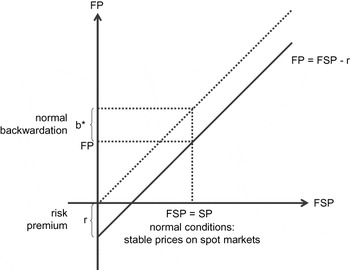
Backwardation, therefore, is not, according to Keynes, a permanent feature of the futures markets, but rather a situation that comes about only if prices do not increase by more than the risk premium (see Figure 1):

Backwardation on the forward market and price variations on the spot market.

The issue was developed, quite consistently with this interpretation, in the Treatise on Money. Here we find an even more explicit indication of the conditions that give rise to backwardation:
If supply and demand are balanced, the spot price must exceed the forward price by the amount the producer is ready to sacrifice in order to ‘hedge’ himself, i.e. to avoid the risk of price fluctuations during his production period. Thus in normal conditions the spot price exceeds the forward price, i.e. there is a backwardation
(Keynes Reference Keynes1930, p. 128).Contrary to prevailing interpretations, such as those reviewed below, Keynes used the expression “normal backwardation” to indicate, not a permanent feature of futures markets, but rather one that is present only “in normal conditions.” And conditions are “normal” when supply and demand are balanced and, therefore, prices are relatively stable.
The need to qualify “normal backwardation” thus is confirmed by the way Keynes broadens his description of futures markets to include situations in which “normal conditions” are not present, and, hence, backwardation must be explicitly ruled out. In particular, Keynes looks to the case of most immediate practical relevance at the time: that of excess supply and redundant stocks.
In this case there cannot exist a backwardation; for if there was one, it would always pay to sell the stocks spot and buy them back forward rather than incur the warehousing and interest charges for carrying them during the intervening period. Indeed the existence of surplus stocks must cause the forward price to rise above the spot price, i.e. to establish, in the language of the market, a ‘contango’; and this contango must be equal to the cost of the warehouse, depreciation and interest charges of carrying the stocks (Keynes Reference Keynes1930, p. 129).
In other words, in a period of excess supply, the forward price will have to cover the carrying costs of the commodity and will, therefore, exceed the current spot price by a corresponding amount. However, as Keynes immediately specifies, this does not imply that the cost of hedging becomes zero (or even negative). On the contrary, the forward seller will continue to pay a risk premium: “the quoted forward price, though above the present spot price, must fall below the anticipated future spot price by at least the amount of the normal backwardation” (Keynes Reference Keynes1930:, p. 129).
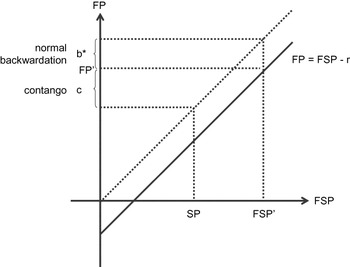
It is worth noting, incidentally, that this is the only passage in Keynes’ works where he uses the expression “normal backwardation”—and with reference to a case in which, as he explicitly stated, backwardation cannot exist. On the contrary, the forward price will exceed the spot price by an amount corresponding to the carrying costs (c), thus resulting in a contango on the futures market:

At the same time, the forward price will continue to fall short of the future spot price by an amount corresponding to the risk premium, and hence to the otherwise normal backwardation (b* = r; see Figure 2):

Contango and normal backwardation.

Even in this case, the speculator will reap systematic gains by selling the commodity previously purchased forward. However, there are two differences with respect to the normal case: 1) due to the imbalanced market and the price fluctuations, it will be more difficult to make predictions, and the speculator will be bearing a higher risk for the same premium; and 2) due to the carrying costs, forward purchases will be more expensive than spot purchases, and will expose the speculator to a loss if spot prices fail to increase according to expectations. Although it may still be possible to earn a systematic positive income simply by bearing risk, the possibility that this may result in a loss due to unexpected price fluctuations is now both more likely and more costly.
This generalization of the theory of the forward market has important practical implications for speculation strategies, since it implies that the speculator will gain only if he is well acquainted with market conditions as to supply, demand, and new production for the relevant commodity. It will not be sufficient for him to pursue a constant strategy of being systematically long, but he will have to engage actively in collecting market information and place his orders accordingly.
Actually, as will be shown in section V, Keynes’ activity as a speculator did not rely on the assumption that, by merely maintaining a long position, a systematic gain would be assured. He did not act upon the assumption that backwardation was “normal” in the sense of being permanent and unconditional. Before turning to a discussion of his practice, we briefly review the empirical tests of Keynes’ hypotheses carried out in a number of subsequent studies.
It has been noted that only in one instance did Keynes use the words “normal” and “backwardation” together, possibly not attaching much importance to it as a theory (Gray and Rutledge Reference Gray and Rutledge1971). Yet the so-called theory of normal backwardation, usually called the Keynes–Hicks theory, has been incorporated in standard presentations of the theory of futures markets (see, for example, Leuthold Reference Leuthold, Junkus and Cordieri1989, pp. 108–111). The empirical relevance of this theory has been the object of many investigations into the existence of a risk premium in futures markets. It is not the purpose of the present paper to assess the extant literature, but rather to examine the main issues that have been addressed.
The first question is to clarify which is the relevant evidence to test Keynes’ conclusion: since expected prices are unknown, normal backwardation is not directly observable and a measure of it must be found in order to test it indirectly.
One type of evidence is the positive excess return to long-only investors in commodity futures, who will reap the risk premium handed over by short hedgers. The theory predicts that long speculation is profitable whenever the expected spot price is greater than the futures price and “vice versa for when speculators are net short” (Radalj Reference Radalj2002, p. 566). The test conducted by Kolb (Reference Kolb1992) showed that only some commodity futures have positive returns, and other studies led to the general conclusion that “proving the existence of normal backwardation for the average individual commodity futures is difficult” (Erb and Harvey Reference Erb and Harvey2006, p. 77).
There is also the difficulty that actual trading records of speculators are often unavailable: Stewart (Reference Stewart1949) reviewed the accounts of approximately 9000 customers of a US broker firm (which then went bankrupt) between 1925 and 1932, held by non-professional traders in grain futures. He found that “nearly 75% of the speculators lost money and that in the entire sample total losses were about six times as large as total gains” (Houthakker Reference Houthakker1957, p. 143). Houthakker questioned the reliability of Stewart’s results and devised an alternative method of estimating profits, based on “monthly figures of open commitments and future prices” (ibid.) in cotton, wheat, and corn for the period 1937 to 1952. Total profits or losses were calculated by multiplying the position in a future by the change in the average price of that future. He showed that a risk premium was indeed produced, although it went to big speculators rather than small traders. He presented this result as confirmation of the “normal backwardation” implication that, in the long run, there is a pay-off in maintaining a long position in commodity futures markets.
Another possibility to test Keynes’ theory is the trend in futures prices: if futures prices are downward-biased estimates of expected prices, then they should be seen to rise as the contracts approach maturity. The excess of the expected spot price over the future price decreases as the futures contract approaches maturity because the risk of unanticipated price changes decreases with time, and so does the risk premium hedgers are willing to pay to speculators. Assuming spot prices to remain constant, futures prices must, therefore, rise. The price increase, which is brought about by hedgers being long in the underlying commodity and short in the futures commodity, provides the inducement to the speculators to be long in commodity futures.
Proofs of the existence of normal backwardation have, then, been sought in testing two behavioral hypotheses: whether long speculators receive profits (and, conversely, short hedgers suffer losses); and whether there is an upward trend in futures prices towards maturity.
Telser (Reference Telser1958) tested the trend in the futures price of cotton and wheat during the period 1926 to 1954 by recording the sign of the month-to-month change in the futures price, and taking the first differences between the monthly averages. For the four wheat futures trading during the period (May, July, September, December), he rejected the hypothesis that there was an upward trend. Cootner was critical of Telser’s results, pointing out statistical and conceptual errors, and concluding that “there is, in fact, a trend in wheat prices” (1960, p. 417). In so doing he agreed with Blau (Reference Blau1944), Kaldor (Reference Kaldor1939), and Houthakker (Reference Houthakker1955, Reference Houthakker1957)—with some qualifications—in accepting Keynes’ backwardation theory, and disagreed with Telser, Brennan (Reference Brennan1958), and Gray (Reference Gray1961), who rejected it.
Kregel (Reference Kregel, Bateman, Hirai and Marcuzzo2010) pointed out that backwardation as a proposition implies there is an excess supply of contracts to deliver the commodity in the future; i.e., there are more producers seeking to sell forward relative to those seeking to buy forward The question, therefore, is whether there are reasons to believe that this is a “normal” market condition. According to this, the burden of proof points to the underlying economic forces leading to this occurrence, rather than to the statistical tests of the sign of futures prices or excess profits.
This is why we now consider the main dynamics of the wheat market in the interwar period, before turning to consider to what extent these were reflected in Keynes’ speculative activity on wheat futures.
IV. WHEAT: SPOT AND FUTURES MARKETS
Wheat was one of the most important world agricultural commodities in the interwar period, largely consumed by the Western countries and grown all over the world. After the First World War and the Great Depression, in particular, wheat production was crucial from a strategic (but also strictly economic) point of view. The difficulty in reaching a stable matching point between world production (highly changeable in relation to weather conditions and other unpredictable factors such as infestations and rusts) and world demand gave rise to huge fluctuations in world wheat prices, which made this market very unstable. During the period from 1926 to 1934, the world produced more wheat than it consumed. The surplus stocks accumulated were responsible for the world wheat crises of these years. Especially after 1928—when an exceptionally abundant world crop was harvested—stocks grew considerably, bringing about a sharp fall in world wheat prices from 1929 until 1933–34. This exceptional accumulation of stocks, and the consequent spectacular fall in prices in 1930 to 1935, was due neither to an increase in production following a rise in the average yields, nor to a reduction in world consumption. The main factor seems to have been an extension of world acreage and a general tendency in many countries to a policy of self-sufficiency. After the First World War, in which many countries experienced serious difficulties in obtaining adequate supplies of wheat, governments tended to support domestic production in order to reduce dependence on the foreign market. At that time, the main importing countries were western Europe (France, Germany, and especially Great Britain), and the main exporting countries were the US, Canada, Argentina, and Australia. From the beginning of the 1930s the USSR, one of the leading producers, drastically reduced its exports and, in general, its presence on the international market. In summer 1935—due to exceptionally unfavorable weather conditions and infestations, which brought about poor crops throughout the world—the carry-overs started to diminish and this tendency lasted through 1936 and 1937, favoring a recovery in wheat prices. But when the unfavorable weather conditions came to an end, in 1938, a new world wheat crisis broke out and lasted until the outbreak of the Second World War (Hevesy Reference Hevesy1940, pp. 1–14).
Keynes addressed the problems of the wheat market (1939) in a note for the Wheat Advisory Committee. According to him, there were two fundamental reasons for the difficulty in matching demand and supply on wheat markets and, hence, to maintain prices stable at a level compatible with the welfare of consumers and producers: 1) the systematic excess of supply relative to demand; and 2) the wide fluctuations in supply. According to Keynes, the former derived from the subsidies and tariffs implemented by governments to support domestic wheat prices and to counteract the fall in the purchasing power of producers and farmers, and from the stimulus to increase production coming from occasional years of high prices (as was the case in 1936 and 1937). The latter could be greatly mitigated, in his view, by government control of wheat storage, which could be exploited as a system for stabilizing prices (CWK XXI, pp. 505–508).Footnote 13
Great Britain was, by far, the most important import country for wheat: no tariff existed on imported wheat, there was little domestic production, and wheat was imported from all over the world. Liverpool was the leading wheat market in Britain, and Liverpool prices could be considered “as fairly representative of world wheat prices” (Timoshenko Reference Timoshenko1928, p. 22). The major factors influencing Liverpool wheat prices were the world production, the distribution of this production in surplus and deficit areas, and carry-overs (stocks from previous years) in exporting and importing countries (ibid., p. 3).Footnote 14
World wheat production was divided into two areas: 1) northern hemisphere production: North America (the US and Canada), eastern Europe (surplus area), western Europe (deficit area), and India; and 2) southern hemisphere production: Argentina, Australia.
These two productions were harvested at different times and influenced the price in different ways. The April and May wheat prices in Liverpool were much influenced by the crops of the southern hemisphere, which were harvested in the previous December and January, and possibly the British India crop, which was harvested in March and April, while they were not influenced by expectations regarding future crops of the northern hemisphere, because it was too early for accurate forecasts in this respect. On the other hand, the changes in Liverpool prices between April and May, and September and October, were mainly due to crop conditions in the northern hemisphere (ibid., p. 26). Another fundamental element in determining the Liverpool price was the carry-over of wheat from previous seasons: the larger the carry-overs, the lower the Liverpool price (ibid., pp. 39–40).
An important characteristic of this market was the huge amount of information at the traders’ disposal, which is not surprising, given the enormous strategic relevance of this commodity for many countries in the world at the time. All statistics and data related to the volumes of production by country, the net imports, the carry-overs, the shipments throughout the world, the different qualities of wheat, even the weather and soil conditions in different areas, as well as reports containing prospects, analyses, and forecasts, were regularly published by many institutions (such as, for example, the US Department of Agriculture, the Food Research Institute of Stanford University, the International Institute of Agriculture in Rome, the Wheat Advisory Committee in London, the Chicago Board of Trade, the Canadian Wheat Board, and the Winnipeg Grain Exchange), and, of course, by specialized journals (for example, the Corn Trade News, the Wheat Studies by Stanford University) or by banks (such as the Federal Reserve Bulletin). Keynes himself contributed to collecting and systematizing information on wheat and other commodities with the memoranda on “Stocks of Staples Commodities,” prepared for the London and Cambridge Economic Service (CWK XII, pp. 267–571). As far as information is concerned, this market was near to being a “perfect” one in the sense that everyone involved in trading—farmers, merchants, owners of grain elevators, speculators, and even consumers—could have access to the information they needed to make their decisions.
The characteristics of this market made it particularly suited to the development of futures contracts. If the progress in distribution and storage of wheat, together with the accessibility of information, made the organization of efficient futures markets viable, the high volatility of wheat prices made it greatly desirable.
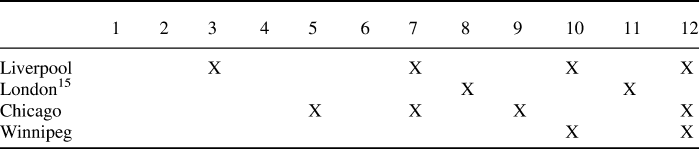
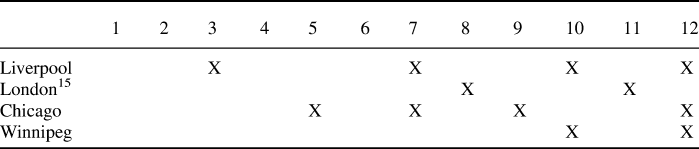
To facilitate the matching of hedgers and speculators, negotiations for futures contracts were highly centralized and standardized (Santos Reference Santos2006, p. 4). The standardization applied, first of all, to the quantities and qualities of commodities and the maturity dates. The commodity involved was graded according to a standardized system (for example, for American wheat: Spring, White Winter, Red Winter) and was traded in even lots (in the US, for example, in lots of 1000 bushels, 5000 bushels, or multiples). Even the dates of delivery were concentrated in certain months, with maturity ranging within eleven months from the stipulation of the contract (see Table 1).
Months of standard maturities for futures contracts on major markets.
The seller was given the option to decide the actual day and grade of delivery, and was free to tender the wheat on any day between the first and the last day of the month of maturity of the futures contract. This is why, holding forward purchases of July wheat on the Liverpool market and wishing to close his position before actual delivery, Keynes began to be concerned about deliveries from the very beginning of the month of maturity: “I wonder what has happened today to the July tenders!” (Keynes to Kahn, 1 July 1937, in Kahn Papers, RFK/13/57/171–2). The seller could also decide the grade of the wheat delivered. The prices set in future contracts referred to a standard basic grade. If the wheat actually delivered was of a better (or poorer) grade, the settlement price would be equal to the contract price plus a premium (or minus a discount) (Hoffman Reference Hoffman1932, pp. 101–103).
Hedgers and speculators operated on the market through licensed brokers. Brokerage firms were endowed with brokerage offices, private telegraph and telephone wires connecting them to the exchanges, and brokers on the trading floor. Brokerage firms also played a crucial role in collecting all sorts of information concerning the production and marketing of wheat and the conditions of markets worldwide. The sources of their information were official and unofficial reports, trade journals, ticker news, and forecasting services. The information collected by the brokers was then made available to their customers.
Brokers could receive orders of various types from their customers.
• “At-the-market orders” were orders to buy or sell at the price currently prevailing on the market. This type of order was to be executed by the broker as soon as possible.
• “Limit orders” were orders to buy or sell at a specified price. In this case, the broker’s obligation was to attempt to buy or sell as soon as the price was reached in the course of negotiations on the market. The directions given by Keynes to Kahn were primarily to place this sort of order; for example, on 30 June 1937: “Could you put on a limit to sell another 1 load July at 9/10 and 1 load at 9/11 ½” (Kahn Papers, RFK/13/57/169–70).
• “Stop-loss orders” were a hybrid of the previous two. They may be described as limit orders that immediately became at-the-market orders as soon as the price limit was reached. In periods of wide fluctuation, the price contracted could be far different from the limit set by the customer.
• “Spreading orders” consisted of two simultaneous orders of buying on one market for a certain maturity and selling on another market (and possibly at another maturity). This type of order was placed in the expectation of profiting from a misalignment of prices between markets (and maturities), with respect to the parity (i.e., the normal price differential to be expected on the basis of transport costs, carrying costs, market conditions, etc.). Keynes and Kahn also often resorted to this type of order for the purpose of operating a “straddle,” an arbitrage between two markets. In the same letter of 30 June, Keynes wrote: “He [Case] still favours the Winnipeg–Chicago straddle; so perhaps we might raise our limit for closing it to 20 pts gain.”
Customers were required by their brokers to advance an amount of money in proportion to the order made: this was called the “margin,” or “cover.” The exact amount of margin requested was fixed by the broker. Buckmaster & Moore debited Keynes’ account for a cover on forward wheat purchases equal to 25% of their current valuation (as found in the statements in Keynes Papers, TC/5/2).
Most future contracts did not eventually give rise to actual delivery of the commodity, but to compensation between short and long positions on equal amounts of wheat bought and sold forward at different prices. In the case of compensation, what was paid was only the price difference. Compensations were performed on each maturity and on each market through the clearing system provided by the exchange. If the position of a trader was not closed by an opposite operation within the date of maturity, then settlement was required through the actual purchase or sale of wheat. In fact, actual deliveries normally represented only a very small percentage of futures trading. This makes it all the more surprising to learn that in 1936, Keynes, having purchased forward “about one month’s supply of wheat for the whole country,” informed his broker, Ian Macpherson, “that he had measured up King’s College Chapel during the weekend and could take half of the wheat” (CWK XII, p. 10).
V. KEYNES’ WHEAT INVESTMENTS, 1937–38: EVIDENCE AND INTERPRETATION
The main markets in which Keynes operated were Liverpool, London, Chicago, and Winnipeg. These markets presented different characteristics, not only in terms of geographical location. Chicago and Winnipeg were close to large wheat-producing and -exporting areas. Hence, futures contracts on these markets, although specified in terms of generic contract wheat, were related to the specific qualities of the wheat produced in North America (in particular, Hard Winter and Spring wheat in Chicago, and Manitoba wheat in Winnipeg). Moreover, both these markets were endowed with a well-developed storage system (Santos Reference Santos2006). As a consequence, carry-over costs had a major role in determining the difference between spot and futures prices on these markets.
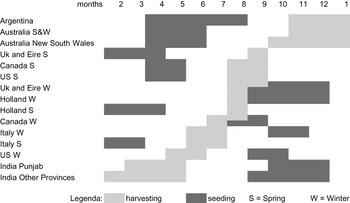
On the other hand, Liverpool and London were the chief ports of arrival for wheat imported from all over the world and bound not only for British but also for Continental markets. These two markets were not equipped with capacious storage facilities, but relied on arrivals from various producers all year round (Working Reference Working1942). The difference between spot and futures prices in these two markets was influenced more by the succession of arrivals, and, hence, by the conditions of production, than by the carrying costs of stocks. The continuity of arrivals was guaranteed by the succession of harvests from the southern to the northern hemispheres along the year, starting from Australia in October to the UK in the following September (see Figure 3). Each market dealt in futures of various maturities, broadly corresponding to the timing of harvest and delivery to the market of tenderable wheat.
Seeding and harvesting calendar
Source: Corn Trade News (1938), Jubilee Issue: 79–81.

The correspondence between Keynes and Kahn also indicates the sources of information they used. The most important was George Broomhall’s Corn Trade News, a specialized journal providing statistics, reports, and forecasts not only on production, shipment, and prices of wheat, but also on futures trading (mentioned in the letter from Keynes to Kahn, 24 August 1937, in Kahn Papers, RFK/13/57/223–24). The second important source of information, particularly for the North American markets, was provided by official reports published by leading American and Canadian institutions.Footnote 16 The third source was information and suggestions from an American correspondent of Keynes, the banker Walter Case (see the letters from the end of June to August 1937).Footnote 17
The most striking characteristic of Keynes’ speculative activity in wheat futures is the systematic prevalence of long positions over the period from 1935 to 1937. In fact, the accounts record forward purchases on most markets and for most maturities, with only occasionally short sales, and only on one market (Chicago). To maintain a long position means to purchase a certain quantity of wheat for a certain maturity and, as the maturity approaches, to put it forward to a later date. It is useful to consider the evolution of Keynes’ positions on one representative market, the Liverpool wheat futures exchange, which is particularly significant, not only globally, as we have seen, but also in Keynes’ portfolio.
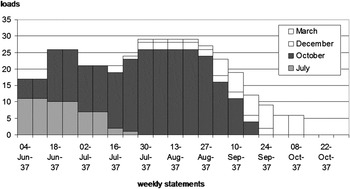
At the start of our observation period, on 4 June 1937, Keynes, as a result of previous dealings, was engaged in forward purchases for eleven loads (corresponding to 52,800 centals) of July Liverpool wheat, at an average price of 8s 8.5313d per cental, implying a total cost of £22,997. The current price of July Liverpool wheat on June 4 was 8s 11.625d. per cental, implying a total value of £23,677. Therefore, Keynes’ long position on July Liverpool wheat gave rise to a book profit of £680 on the date of June 4.
As the maturity date approached, Keynes had two options: either to close his position by selling July Liverpool and thus realizing the corresponding profits (or losses), or to put forward the long position; that is, to switch from the imminent maturity to a later date by selling July Liverpool and at the same time purchasing Liverpool wheat for a later maturity. In this specific case, Keynes decided to sell one load of July Liverpool on June 11, realizing a profit of £66. Another three loads were sold on June 25 for a profit of £638. This left Keynes with an open position of seven loads of July Liverpool at only a week from the beginning of the month of maturity. There was time until the end of the month of maturity to close the position, without having to take actual delivery. Between July 9 and July 16, Keynes sold another five loads, thus reducing his position on July Liverpool to three loads and realizing a further profit of £1320. This time, however, Keynes was not simply closing his position, but, rather, shifting it to further dates. In fact, in the same week, he made forward purchases for an equivalent amount, buying three loads of October Liverpool and two loads of December Liverpool. The connection between the sale of July Liverpool and the purchase of later maturities is proved by two letters, of 6 and 13 July, in which he instructed Kahn to “put forward” three July Liverpool to October and two to December (letter of 13 July, in Kahn Papers, RFK/13/57/191–2; letter of 6 July, in Kahn Papers, RFK/13/57/176). The orders could take some days to be executed, according to the conditions of the market and to the type of order given. We have tabulated Keynes’ positions in Figure 4.
Tilton Company forward purchases of Liverpool wheat futures for various maturities (loads)
Source: Keynes Papers, TC/4/3.
Note: 1 load = 4800 centals; 1 cental = 100 pounds.

This strategy is consistent with the idea of speculation as a form of insurance that earns a gain from backwardation, corresponding to the difference between spot and futures prices, by maintaining a long position over extended periods.
However, this does not mean that such a gain is automatic and is guaranteed by the strategy of repeating indefinitely the same operations, regardless of market conditions. In Keynes’ words in his letter to Kahn: “it is a business which […] does not turn out right over a period of years unless one attends to the details, which cumulatively add up to quite a lot” (letter of 14 July, in Kahn Papers, RFK/13/57/193–4). In fact, Keynes paid constant attention to the details of market conditions in order to judge exactly the best course of action. Indeed, it appears that Keynes carried out alternatively three different types of speculation:
(1) long commodity futures, aimed at earning the normal risk premium;
(2) time-varying long commodity futures, so as to have larger exposures when the premium is large relative to the risk, and smaller exposures when the premium is small relative to risk. (This strategy might also involve closing a position on one specific market and/or commodity if the risk premium was too low compared to other investments, as Keynes eventually did for wheat in October 1937);
(3) outright speculation on future prices or price differentials, when one thinks the market is making a mistake. (This strategy would suggest assuming a short position rather than a long one, or hedging a long with a short position on a different market; i.e., to make a straddle.)Footnote 18
If, at the beginning of 1937, the accounts of Tilton Company show only long positions, by mid-1937 the sources start to provide evidence also of outright speculation. On 18 June there was a short sale of 40,000 bushels of September Chicago, for a book profit of £35. On 25 June the accounts register a further short sale of September Chicago, for a total short position of 60,000 bushels and a book profit of £205. After another week, the price of September Chicago had increased from c108.5 to c125.5, causing a reversal in Keynes’ results, amounting to a book loss of £1835. At the same date, a forward purchase of 15,000 bushels of October Winnipeg is recorded in the accounts. This operation might appear completely independent of the short position on Chicago, but we learn from the letters that this forward purchase was intended as the second leg of a straddle between Chicago and Winnipeg. This represents the third type of operation conducted by Keynes in wheat futures.
One reason for a speculator to engage in a straddle may be the lower volatility in price differentials between two markets as compared with the volatility of prices on either market (Houthakker Reference Houthakker1957, p. 148). This hypothesis seems to be confirmed here. Keynes had assumed a short position on Chicago in the expectation of a decline in prices. In fact, he was now suffering losses due to a sharp and unexpected price increase. At this point, following a suggestion by Walter Case, Keynes made a forward purchase on Winnipeg in the hope that, even if the Chicago prices continued to rise, they would remain below the Winnipeg prices. This expectation did not require foresight regarding the yield of the US crop in absolute terms, but only in relation to the Canadian crop. Accordingly, in his letter Keynes grounds the rationale for the Chicago–Winnipeg straddle in his different expectations concerning the two harvests: “I feel quite happy to be short of Chicago [and long of Winnipeg]—for USA will surely have a fair crop; whilst Canada cannot anyhow have a decent one.” Keynes expects that different volumes of supply will result in different prices on the two markets. This expectation implies that the two markets were not integrated and this, in turn, may have depended on three factors. The first concerns the quality of wheat, which was not the same on the two markets: since Canadian wheat (Manitoba) was much better than US wheat, “they are not perfect substitutes so that Manitoba will command a premium if it is in relatively short supply.” The second consideration has to do with the timing of harvests, first in the US and subsequently in Canada (letter of 1 July 1937, in Kahn Papers, RFK/13/57/171–2). The third factor has to do with the institutional features of grain markets and public wheat policies in Canada and the US (Santos Reference Santos2006, pp. 18–19).
Keynes’ behavior as a speculator in wheat futures in the second half of 1937 seems consistent with the hypothesis suggested by a reading of his theoretical writings: backwardation may be regarded as “normal” only under certain conditions. Keynes did, in fact, operate according to the idea that gains could be made in the long run by simply taking and keeping a long position. However, he knew that the normal, long-run outcomes occur only under certain conditions, and that the corresponding optimal behavior pays only to the extent that those conditions hold. Therefore, his speculative position was not limited to purchasing forward and continuously shifting ahead the maturity on the futures contracts, but also included different types of operations such as short sales and straddles, as the case might have been, according to expectations regarding the movements of absolute and relative prices on different markets and over different time-spans.
VI. CONCLUSION
Speculation in commodities was a “business” that required “hard work”—as Keynes wrote to Kahn on 14 July 1937 (in Kahn Papers, RFK/13/57/193–4)—and a thorough, constantly updated knowledge of the market conditions for each commodity traded. This comment also applies to any scholar wishing to study speculative activity behavior in any particular commodity, to grasp fully what is peculiar to that particular commodity and market.
Our purpose with this paper was to make some contribution towards an understanding both of wheat futures in the 1930s and of Keynes’ trading in them by examining original and unpublished sources, and presenting his scattered and often shorthand instructions in a more coherent and comprehensible form; this is just a preliminary inquiry since more “hard work” is needed to expand the scope and the time period under consideration.
As for the relation between Keynes’ actual behavior as speculator and his theory of speculation, we claim neither that his behavior proved his theory, nor even that he followed his own theory in his speculative activities. We have seen that normal backwardation applies only to well-specified circumstances and, moreover, our sample is too narrow to make the test feasible. For the same reasons, we have not attempted to evaluate how successful Keynes was as a speculator in wheat futures; we have tried, rather, to provide a means to assay a material drawn from an ore that is rich and potentially rewarding for those willing to invest in it, but hitherto very costly to dig out. By providing a sample of it, we hope to attract other scholars into the venture and thus to enlarge our knowledge of commodity futures in general and wheat futures in particular in the 1930s. This, in turn, will better equip us to interpret the evidence.
However, we can conclude that, within the extant literature, our investigation affords a clearer understanding of another trait of Keynes’ multifaceted mind, and further substantiates his remark to Hawtrey, quoted above: “I do speak on this matter, not merely as a theorist, but from an extremely wide practical acquaintance with commodity markets and their habits” (Keynes to Hawtrey, 6 January 1936, in CWK XIII, pp. 627–628). Investigation into this “practical acquaintance” is the task we have undertaken here.