Seventeenth- and eighteenth-century women can no longer be studied exclusively, as once they were, in the context of the private and intimate sphere of the nuclear family. Under the influence of Jan de Vries’ industrious revolution,Footnote 1 among others, social and economic historians have modified the notion that the role of women within the confines of the private household was purely passive.Footnote 2 Their focus on female economic activities outside the households has contributed considerably to our understanding of women's roles within late medieval and early modern city life. In the same vein, women's roles in cultural urban networks have been subject to innovative research, regarding religious female actors among others. This strand of research also studies women's positions beyond the nuclear family, but mostly focuses on female agency within informal social and cultural circuits.Footnote 3 The role of women in associational life remains under-explored, as if social, cultural and religious organizations are still to be considered as part of an exclusively male public sphere or civil society.
In this article, I will provide a comprehensive in-depth analysis of female agency within early modern religious confraternities. Religious brotherhoods, a widespread form of association in the late medieval and early modern times, have been ascribed an important role in the moulding of the (early) modern political and social culture.Footnote 4 No longer are they approached as associations with a purely devotional and spiritual function, but as large and widespread social institutions. Recent debates on early modern confraternal life are under the spell of the question of the nature and extent of the supposed social effects of confraternity life.Footnote 5 Historians who tend to follow a rather positive view on the social effects of civil society maintain that confraternities, among other forms of associational life, should be considered a part of civil society in the sense that they stimulate social interaction which created shared values and norms. In this way, confraternities stimulated a sense of a shared identity. Of crucial importance in this respect is the recent study of Katherine Lynch. Her research on the interrelationships between the early modern family and civil society shows that confraternities can be seen as a form of extra-familial network which provided households and individuals with a solidarity which protected them in times of personal and/or social crisis.Footnote 6 In this way, associations could complement or even substitute identities, and the protection and solidarity that extended kinship ties usually provided.Footnote 7
Other scholars have been more sceptical about the positive effects of confraternal membership.Footnote 8 They first of all argue that not every formal network generates social capital. In addition, it has been noted that formal associations tend to redefine existing social and economic boundaries within social space, rather than overcome them. Focusing on female membership and participation may shed an interesting light on these debates. Case-studies have detected a significant number of female members in many confraternities in different cities and centuries.Footnote 9 This makes the lack of interest in female agency within the confraternities and thus beyond the familial sphere not only untenable, but a lack of insight into women's participation in religious associations is also problematic in the sense that it generates a diffuse image of both women's role within early modern city life and the social capital generated in associations. This problem is even more urgent in the early modern period, where women are thought to have been increasingly limited to the private sphere of the nuclear family.Footnote 10
As the highly urbanized region of the Southern Netherlands is renowned for its lively and important associational life, it may prove to be an excellent case-study to bring early modern associational life in north-western Europe more into the picture. I will focus on Aalst, a small but not atypical city in the county of Flanders. Corporative and social organizations of this region appear to have been and to have stayed strong and active during the early modern period. What is more, the decreasing importance of traditional organizations such as guilds and chambers of rhetoric was possibly compensated by religious brotherhoods which became quite numerous and important under the influence of the counter-reformation.
In this article, religious confraternities will thus be addressed from a gender perspective. I will first examine the extent to which women had access to the local religious brotherhoods and, if so, how the number and distribution of female members developed during the period 1530–1820. Next, I will try to determine whether the different confraternities of early modern Aalst can be seen as a public form of associational activity and, if so, to what degree women could participate in the private and (semi-) public activities of these associations. As female members did not necessarily have the same rights as their male counterparts, it remains to be seen whether female members could and did make use of these institutions as a kind of gateway to the public urban space of Aalst. I will address this issue via an in-depth analysis of available statutes, lists of registration and account books. Finally, I will briefly explore the relations between familial ties and confraternal membership according to gender in order to gain insight into the role of familial and marital bonds in female confraternal membership.
In and of itself, this article will serve as a step towards a more elaborate study of the significance and role of women in early modern religious brotherhoods and of formal associations in the lives of female actors.
Counting sisters: numeric domination of female members
With no more than 5,000 inhabitants, early modern Aalst, situated in between the two larger cities Ghent and Brussels, was of only regional importance.Footnote 11 The town consisted of a single parish: the parish of Saint Martin. Until 1868, this parish counted only one church. However, ten different confraternities were active within this parish during the period 1530–1800. Due to the availability of source material, eight of them will be incorporated into the analysis. Only one, the confraternity of Saint Catherine, was in existence before the Council of Trent.Footnote 12 The religious confraternities of the Holy Altar, Saint Barbara, the Faithful Souls, the Holy Rosary, the Holy Deathstruggle, the confraternity of the Holy Trinity (as well as the Holy Mother of Halle)Footnote 13 were all established in the course of the seventeenth or eighteenth century and thus in a post-Tridentine climate.Footnote 14
The analysis of these seven confraternities shows clearly that the religious associations differed from each other both in size and gender composition.Footnote 15 Because of the fact that only fragmentary evidence of confraternity membership has been preserved for the seventeenth and eighteenth centuries, the actual extent of membership is rather difficult to assess. Nevertheless, it seems safe to say that membership was widespread. More than half of the population of Aalst was involved with at least one of the religious urban associations.
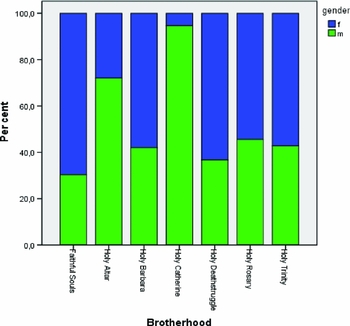
Women were not under-represented; rather, the contrary was true. Women dominated the majority of religious associations and in all made up 64 per cent of all confraternity members.Footnote 16 In the statutes of the confraternity of the Holy Altar, drawn up in 1743, it is stated that ‘all believers who are able to receive Holy Communion, women as well as men, are welcomed into this confraternity and will enjoy the same privileges’.Footnote 17 This openness towards both sexes can be detected in the statutes of other post-Tridentine confraternities as well. There was no exclusively male or female religious confraternity in early modern Aalst.
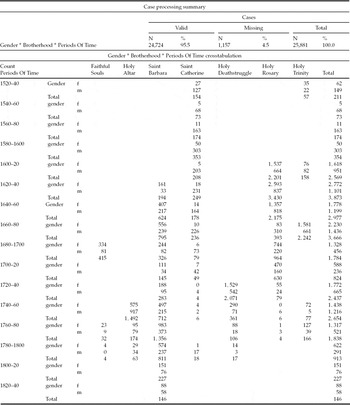
The confraternity of the Holy Altar was the only post-Tridentine confraternity which counted fewer female than male members (Figure 2 and Table 1 in the appendix). In contrast, female members were over-represented in the religious brotherhood of Saint Barbara.Footnote 18 In their book of resolutions of the year 1632, this brotherhood made it very clear that ‘the devout brotherhood of Saint Barbara consists of spiritual exercise as well as monthly services and processions, that the devout brotherhood welcomes all kinds of people, men and women, independent of other guilds. In contrast, the chambers [of rhetoric] are devoted to honest worldly recreation and thereby consist of the gathering of men and young men alone.’Footnote 19 The religious confraternity of Saint Barbara thus set out a very clear normative framework: chambers of rhetoric were considered to be a manly (and worldly) form of sociability while religious devotional groups were perceived as an open space in which all Christians should be united. The religious brotherhood of Saint Barbara and the chamber of the ‘Barbaristen’ were thus considered to be two strictly separate associations.
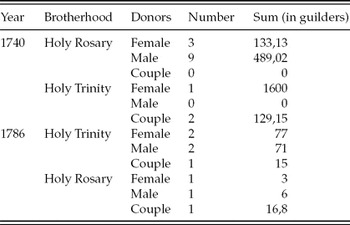
Number of donors per confraternity (1740/1786)

Sources: MAA, CA, brotherhoods, nos. 638, 639, 642, 690.
Total number of members of seven confraternities in Aalst (1530–1820) Source: MAA, CA, Brotherhoods, nos. 627, 634, 652, 657, 672, 673, 706.

Overview of gender composition of seven confraternities of Aalst (1530–1820) Source: MAA, CA, Brotherhoods, nos. 627, 634, 652, 657, 672, 673, 706.

In comparison with other early modern forms of association like the chambers of rhetoric and guilds, which were very restrictive regarding female participation, the confraternities show a relatively high degree of tolerance towards female membership.Footnote 20 In this respect, the under-representation of women in the confraternity of Saint Catherine may also be explained by its connections with the ‘Catharinisten’ chamber of rhetoric. Moreover, the confraternity of Saint Catherine was not only the sole religious association established before the Council of Trent, the brotherhood shared its patron saint with the ‘Catharinisten’, the royal chamber of rhetoric.Footnote 21 Although it remains hard to detect whether, how and to what degree the parish, local clerics and inhabitants of early modern Aalst appropriated the religious framework set out by the Council of Trent, it is clear that post-Tridentine confraternities were more accessible to women than the pre-Tridentine religious association of Saint Catherine. It is possible that the strategy of post-Tridentine confraternities to recruit as many members as possible stimulated a greater openness towards female actors as well. Women had a prominent role in the running and maintenance of an organized and honourable household and could have been important mediators between family and public life.Footnote 22 However, Paul Trio's work on pre-Reformation confraternities in Flanders shows that some of pre-Tridentine brotherhoods were also female dominated.Footnote 23 Consequently, the fact that the Saint Catherine confraternity was strongly connected with the rhetorician chamber – which, as stated before, was male-dominated and orientated towards public life – may be more significant for explaining the anomaly of the Saint Catherine confraternity than any change over time.
Generally speaking, between 30 per cent and 50 per cent of the total number of households of early modern Aalst could, with certainty, be identified as members of a confraternity in the years 1672, 1705 and 1742.Footnote 24 Although lists of memberships were fragmentary and lists of registration do not give access to the actual number of members in a certain period, it is clear that the urban confraternities of Aalst were especially popular during the seventeenth and the first half of the eighteenth centuries.Footnote 25 The confraternity of the Holy Trinity experienced an enormous rise in registrations during the second half of the seventeenth century while the confraternity of the Holy Deathstruggle as well as the confraternity of the Holy Rosary attracted the greatest number of members during the second half of the eighteenth century (see Table 1 in the appendix). The confraternity of the Faithful Souls was among the smallest during this period. The confraternity of Saint Catherine, the only pre-Tridentine confraternity, remained a rather small-scale but prestigious confraternity as well.
From the second half of the eighteenth century onwards, the majority of the confraternities seemed to lose their popularity, at least in a quantitative sense. The registration of new male members declined more rapidly than that of new female members. Only the confraternity of Saint Barbara followed a converse pattern. As the period 1750–1830 was a period of strong religious transitions in the wake of secularization, it seems plausible to ascribe the declining trend in new members to shifts in religious sensibility which affected male Catholics more rapidly than female Catholics.Footnote 26
To sum up, although the confraternity of Saint Catherine was a rather ‘male’ religious association, it can be stated with certainty that women dominated the great majority of the other early modern confraternities quantitatively. But, what role did women play in these organizations? To what extent can their membership be taken as evidence for the presence of women in the public sphere as opposed to merely an extension of their role in the private sphere of the household’? In what follows, an in-depth analysis of statutes and account books will offer a fresh insight into the way such factors as gender determined the meaning of confraternal membership.
Sisters and brothers in social praxis: united as equals?
In theory, all the confraternities studied here were open to every social class. In exchange for membership it was expected that every member would make a financial contribution on the day of their registration as well as an annual financial gift to the confraternity and in proportion to their own devotion and capacity.Footnote 27 However, poor people were exempt from this financial obligation. The confraternity of Saint Barbara was the only confraternity which demanded a strict entrance fee of 6d.Footnote 28 Research by Wouter Ryckbosch and myself has shown that all the confraternities were socially diverse. Not one of the seven confraternities examined here was restricted in membership to one social stratum alone. Each and every confraternity included female and male members from all socio-economic strata.Footnote 29 Of course, this openness towards women and men of all social classes, both in theory and practice, did not automatically imply that all members enjoyed the same actual and figurative freedom of movement within confraternal bonds. For one thing, sisters were excluded from holding confraternal offices. While most of the confraternities studied were erected by the pastors of the parish of Aalst who often held the office of director,Footnote 30 the rest of the boards consisted exclusively of men from the better-off parts of the society of Aalst.Footnote 31 In short, exclusion from active leadership was not only based on gender but also on class. Neither women nor men from lower social strata could become board members.Footnote 32 On the other hand, it seems that widows of board members were occasionally allowed to perform a temporary role in relation to the board of the confraternity of the Holy Rosary.Footnote 33 In 1674, Petrus Carité died some months before his term as ‘collector’ of the confraternity of the Holy Rosary ended. His wife Joanna Boone, also a member of the brotherhood of the Holy Rosary, presented the account book to the board of the confraternity of the Holy Rosary by herself in the name of her husband.Footnote 34 This may indicate that the role of ‘sister’ was indeed an extension of the role as ‘wife’.
Female members were not always allowed to participate in the election of the board members either. In the regulations of the confraternity of the Holy Altar, it is clearly stated that only the brothers were permitted to elect a new board on a yearly basis.Footnote 35 In the regulations of the other confraternities, however, the election procedure seems to concern all members regardless of gender.
The religious associations had a disciplinary and thus social function which exceeded what we would today think of as ‘religious’.Footnote 36 One important requirement for entry was that new members, men or women, should be of good reputation and behaviour. Drunkenness, gossiping, swearing and the use of indecent language was absolutely forbidden during the activities of the confraternities and sisters and brothers guilty of indecent language or dishonourable actions were fined. When a member brought shame on himself or herself and thus on the confraternity for a second time, they were excluded from the association.Footnote 37 No member was allowed to dispute the words, actions or decisions of the board, and they had to approach the board members with great respect and love. From this perspective, brothers and sisters appear to have been subject to the very same demands (at least on a normative level). The fact that the account books do not leave any trace of the actual enforcement of these regulations leads to questions about the frequency and importance of social interaction between confraternal members. Were socio-religious meetings so rare that it was not necessary to enforce restrictions on the social behaviour of members?
The religious associations stipulated a well-defined devotional programme, characterized by a strong focus on the religious responsibilities of the individual. While most forms of overt sociability within the context of the confraternities, such as confraternal banquets, were under attack by clerical authorities from the late sixteenth century onwards, the importance of private, individualized devotion was stressed.Footnote 38 According to Maarten van Dijck, the post-Tridentine religious confraternities in Brabant had no social activities at all.Footnote 39 The seven post-Tridentine confraternities in Aalst for which account books and written statutes have been preserved indicate something similar. The confraternity of the Holy Rosary was the only post-Tridentine association which did not confine itself to devotional practices alone but invested in activities with a preponderantly social character as well. Both lay and clerical deans of the confraternity of the Holy Rosary organized annual confraternal banquets until 1756. The banquets consisted of at least three fixed courses and were consistently held from 1701 until 1756. From 1757 onwards, the collective dinners were mostly cancelled.Footnote 40 Given the splendour of the fixed menu and the extremely high number of confraternal members, it may be the case that these banquets were reserved for a very select gathering of confraternal (board-)members alone and did not involve the broader groups of male and female members. Due to the fact that account books of this confraternity do not give information on the actual number and profile of the guests, it remains unclear to what extent wives of board members were invited.
To what extent, then, were these activities public at all? All the statutes studied contain very detailed guidelines for individual as well as collective devotional practices both at home and at the altar of the confraternity in the parochial church. A common feature, naturally, was devotion to the patron saint of each confraternity. However, the quotidian worshipping of the patron saint could not compete with the immense concern about the commemoration of deceased members and the salvation of the souls of individual members as well as the souls of family members, close friends and fellow members, by funding masses and requiems.Footnote 41 Both sisters and brothers often contributed significant sums in order to organize requiems. Funeral rites and prayers for departed souls were the most important activity of the confraternities. In theory, all members, men and women, were obliged to attend all religious gatherings. As for the requiems, ‘knapen’ or messengers were paid to summon close friends, neighbours and family members of the deceased to attend their requiems. There are no indications that female members were excluded from active participation during these religious services held in the church of Saint Martin. In contrast to the sisters of the early modern confraternities in many Italian cities, the sisters of the early modern confraternities of Aalst were allowed to take part in prayers and religious observances.Footnote 42 In addition to the care for the souls of others, male as well as female members had to fulfil the same stipulated programmes of inner devotional rituals such as praying, reading of the psalms and fasting.Footnote 43
The intensity of the formal programme of devotional practices was exceptionally high for the confraternity of the Faithful Souls. Every Monday, all brothers and sisters of the confraternity of the Faithful Souls were obliged to be present at the altar of their confraternity to attend a solemn requiem mass.Footnote 44 Brothers and sisters were obliged to read the psalms every day. Those members who could not read had to say the Lord's prayer and five Hail Marys.Footnote 45 Every time a member walked near the church or graveyard, a prayer for all deceased co-members had to be said. How these normative prescriptions found their way into the actual confraternal practice of the different members remains impossible to establish since the confraternity of the Faithful Souls did not leave account books. Nonetheless, the unusual level of obligatory activity of this confraternity remains interesting. This brotherhood was among the smallest post-Tridentine confraternities in early modern Aalst and comprised the largest proportion of female members.
Interestingly, the confraternity of the Holy Altar seems to have been the reverse image of the confraternity of the Faithful Souls. Not only did this association recruit the greatest number of members compared with all other confraternities during the first half of the eighteenth century, but the demands made by this brotherhood were rather low in comparison to that of the confraternity of the Faithful Souls. If one goes by the statutes, members only met on a monthly basis for a requiem mass, followed by a procession.Footnote 46 Account books of the Holy Altar for the years of 1744–45 and 1766–75 also suggest a rather low level of activity.Footnote 47 The money collected was almost entirely used to buy wax. No traces of other expenses except for the annual payment of the ‘knaap’ and the bell-ringer were found. Moreover, the confraternity of the Holy Altar was the only post-Tridentine confraternity which counted more male than female members. In relative terms, the small-scale but active confraternity of the Faithful Souls thus attracted the largest proportion of women while the confraternity of the Holy Altar, a massive but rather passive confraternity, attracted a minority of women. It is, thus, plausible to argue that women were in search of a more active form of religious devotion while men were more inclined to favour a more passive form.
Women were thus allowed to join religious activities within the semi-public arena of the parochial church, but they appear to have had a less active role within more public events.Footnote 48 Processions were an important medium to broadcast the hierarchy within and between the confraternities in the broader urban space. Since statutes and account books of the pre-Tridentine confraternity of Saint Catherine are not available, it is not possible to focus on the changing meaning and importance of procession for religious confraternities before and after the Council of Trent, but Christopher Black has argued that post-Tridentine confraternities were more concerned with a more public expression of their devotion and processions were thus an important way for confraternities to present and display their devotion within the civic space.Footnote 49 Nevertheless, in our case-study, processions appear to have been important and regularly held public events in post-Tridentine brotherhoods. As we turn to the account books, it becomes clear that a considerable number of expenses were made for embroidered banners, candles and the special care of the requiems.
While the processions of the Faithful Souls and the Holy Altar seem to have been confined to the civic space around the parochial church of Aalst, account books of Saint Barbara indicate that a great annual procession was organized which probably even took in a larger part of the city space.Footnote 50
Every first Monday of the month, the confraternity of the Faithful Souls sponsored an extra mass in the morning and a sermon in the evening, followed by a procession.Footnote 51 The confraternity of the Holy Altar held a procession every last Sunday of the month. On that occasion, everyone gathered at the house of the first dean and walked to the church of Saint Martin while singing psalms. Male members carried the torches and candles. While most rules were directed at ‘the brothers and sisters of the confraternity’, the regulation of the processions explicitly referred to ‘brothers’ alone.Footnote 52 In contrast, sisters of the confraternity of Our Holy Mother of Halle were allowed to join their male co-members on the yearly pilgrimage from Aalst to Halle. What is more, female members were obligated to appoint a second person, male or female, who could join the pilgrimage if they were unable to undertake the journey themselves. The evidence of women's participation in public confraternal activities thus suggests diversity: while at least some female members of the confraternity of Our Holy Mother of Halle seem to have participated in public events, female members did not do so as much in other confraternities.
So although women dominated the confraternity in a quantitative way, this did not automatically imply that female members enjoyed the same rights and privileges as their male co-members.Footnote 53 There are indications that the role of women was to be situated, as it were, back-stage. A sample of account books of the Holy Rosary and Holy Trinity for the year 1740 and 1786 indicates that sisters seem to have been rather important benefactors (see Table 1). Although the vast majority of the female donors could be identified as wives or daughters of (deceased) male members, female members who had the financial resources could donate and/or fund requiems as individuals, entirely independently of male relatives or husbands. Via the funding of requiem masses these female members put their stamp upon the religious services of the confraternity and thereby promoted themselves within their confraternal group. Funding masses definitely bestowed on female benefactors a more prominent position within the confraternity.
Catharina Claessens, member of the confraternity of the Holy Rosary, went further than funding masses alone. She paid for the restoration of lamps and windows as well as the general upkeep of the altar, and this during the entire period 1730–37.Footnote 54 In addition, she embroidered altar cloths, one of them out of a dress of her deceased co-sister Catharine Beeckman. The account books of Saint Barbara (fragmented accounts for the years 1650–1701), the Holy Trinity (1740/1786) and the Holy Rosary (1740/1786) reveal traces of other ‘hidden’ female activity.Footnote 55 Although the account books give very fragmentary information on this subject, it does seem that at least some of the sisters officiated as housekeepers of the confraternal altars and chapels. Via the cleaning of chapels and the embroidering of altar clothes and banners, female members transferred and integrated their prescribed role and tasks within their own household into their confraternal membership and in this way created their own identity within confraternal life.
In sum, female members did play a key role in the devotional, individual and thus most important level of confraternal life. Female actors became housekeepers and benefactors in order to enlarge the impact of their individual devotion within their own confraternal group. What is more, women felt especially attracted to the confraternity with the most strenuous devotional programme. The following analysis will show that this female choice of confraternity was an individual choice, independent of familial and marital bonds, and based on religious aspirations. Female actors did have ‘agency’ in the practice of their religious preferences.
Brothers, sisters and the family
It has become clear that female members dominated post-Tridentine confraternities quantitatively and, while participation in social, more public events was not gender neutral, sisters did exert spiritual agency through the high activity levels of the devotional life of confraternities. What is more, women felt especially attracted to the confraternity of the Faithful Souls, an association with a strict and demanding religious programme. However, in order to grasp fully the actual roles that membership afforded women, it is important to answer the question if and to what degree the choice of these women to join a particular confraternity was a deliberate one. Did pressures of family life influence the choice of confraternity made by women? To what extent did both extended and nuclear family ties and marital bonds overlap with confraternal bonds and what does this tell us about female freedom of choice?
By linking registration lists to probate inventories,Footnote 56 I have tried to uncover familial bonds as well as marital bonds of confraternity members for two sample periods: 1672–79 and 1745–49. In this way, I attempt to grasp at least a part of the complex relationship between the formal associational life and the family in the urban context of Aalst. Since the total number of confraternity members is so large, I have only traced familial and marital ties for a random sample group of 350 members which generated a total group of 8,757 relatives.Footnote 57 To detect familial bonds within and between the different confraternities, I have screened the registration lists for the presence or absence of identical family names across the two sample periods. This methodology is somewhat hazardous for several reasons. First of all, the vast majority of the identifiable familial bonds are those between (blood) relatives while the existence of bonds with the family-in-law mainly remain hidden due to the limited information on conjugal bonds (though where possible I have included these ties within the analysis). Secondly, ‘what's in a name’? I was forced to base my analysis on the existence of identical family names which makes it rather difficult to distinguish nuclear family ties from extended family ties. Furthermore, the analysis of marital ties within the confraternities are not conclusive since only 2 per cent of the total number of confraternal members could be traced. Of these married partners traced, 45 per cent were members of the confraternity of Saint Catherine, which creates a serious bias. Nevertheless, if we keep these limitations in mind, the analysis may help us grasp at least a part of the intricate relationship between confraternal and familial ties.
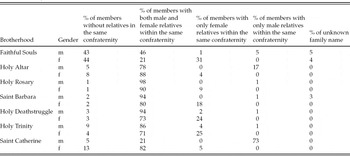
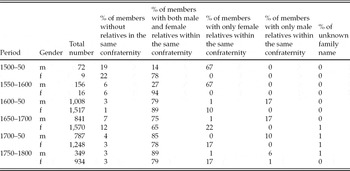
The most important result is that the majority of confraternal members shared membership with both female and male relatives. The second most important is that gender differences in the relation between family ties and membership were virtually absent (see Table 2). Obviously, family ties more rarely intertwined with the confraternity of the Faithful Souls. Less than half of the total number of both male members (43 per cent) and female members (44 per cent) did not have relatives within the brotherhood. However, it does not seem that the brotherhood of the Faithful Souls functioned as a substitute for (missing) family ties within the city of Aalst: 93 per cent of the total number of members without family ties did have family members in other confraternities. What is more, for the vast majority of sisters and brothers of this brotherhood family ties within the city of Aalst can be traced in house taxes for the years 1672, 1705, 1742 and 1792.Footnote 58 This suggests that for the majority of female members of the confraternity of the Faithful Souls their choice to join such a demanding religious association was a deliberate and individual one. They were not simply following a family member into the group.
Family ties within the brotherhood (1530–1800)

Sources: Probate inventories: MAA, OAA, nos. 1790–801 and 1861–6; confraternity membership lists: MAA, CA, nos. 627, 633, 634, 652, 657, 672.
Parental ties were also studied in order to gain a partial insight into the relationship between nuclear families and confraternal bonds. We can identify 116 members as sons or daughters. Of the daughters traced, 58 per cent did not join the same confraternity as their fathers while this was true for 64 per cent of the sons. Due to the fact that the group of children traced is very limited and that the identity of members’ mothers remains hidden from view, few definite conclusions can be drawn from these data. Nevertheless, it is clear that male and female members of post-Tridentine confraternities, married or not, did not necessarily join the same confraternity as did their parents or their father at least. This pattern can be observed for all post-Tridentine confraternities except one throughout the entire period under consideration.Footnote 59 The exception is the female members of the confraternity of Saint Catherine. The majority of sisters of Saint Catherine for whom we could trace the father in the lists of registration or in the selected probate inventories did join the same confraternity as their father. This was not the case for male members however: 94 per cent of the children traced for the confraternity of the Holy Catherine who chose to join a different confraternity from that of their parents (42 actors) were male.
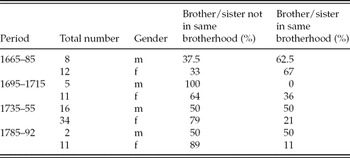
Attempts were also made to trace ties of brotherhood and sisterhood (blood ties) within the different confraternities. A group of 98 members could be identified as brothers and sisters (see Table 3). Although only a relatively limited number of sibling ties could be found, preliminary results indicate that sisters and brothers did not necessarily join the same confraternity either. Therefore, we can cautiously argue that female actors, including daughters and sisters, could join a post-Tridentine confraternity independent of their nuclear family members.
Share of ties traced between brothers and sisters (1665–1792)

Sources: Probate inventories: MAA, OAA, nos. 1790–801 and 1861–6; confraternity membership lists: MAA, CA, nos. 627, 633, 634, 652, 657, 672.
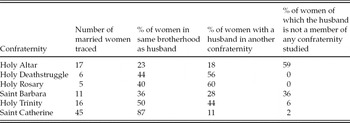
Let us turn to the question as to how membership in a confraternity related to marital ties. Were women sharing membership with their husbands or joining a confraternity on their own? Although preliminary, the results are highly revealing. First of all, married partners did not necessarily join the same confraternity. Via a combination of indications in the lists of registration and an analysis of the samples of probate inventories, 100 couples could be identified. Almost half of all married actors traced were members of the pre-Tridentine confraternity of Saint Catherine (see Table 4). This confraternity was not only more socially select than the others, it was also more select in gender terms: in contrast to post-Tridentine confraternities, the names of the (deceased) husbands or fathers of the female members of the confraternity of Saint Catherine were often mentioned. So, while the pre-Tridentine confraternity was much more restrictive regarding the involvement of women, the latter's familial relations and/or marriages with brothers of the confraternity may have been a more important prerequisite to becoming a member.
Marital ties of female members of seven confraternities, Aalst (1530–1800)

Sources: Probate inventories: MAA, OAA, nos. 1790–801 and 1861–6; confraternity membership lists: MAA, CA, nos. 627, 633, 634, 652, 657, 672.
As for the post-Tridentine confraternities, it was difficult to ascertain whether sisters joined confraternities together with their husbands. The great majority of the sisters of the post-Tridentine confraternities appear in the registration lists as individuals. In addition, only a minority of sisters and brothers could be traced in the probate inventories (see results Table 4). Based on these highly limited data, it is only possible to create an impression of the effect of marriage on female membership in post-Tridentine confraternities. However, with caution it can be stated that the majority of married sisters traced did not automatically follow their husbands in their choice of confraternity. The pre-Tridentine confraternity of Saint Catherine followed a divergent path. Of the married sisters traced, 87 per cent joined the confraternity together with their husband. As stated above, the practices of this brotherhood were dominated by worldly, public performances. Hence, my hypothesis is that the public character of the confraternal activities imposed greater restrictions on female participation. For most women, it was only as the wife and thus as an extension of a male member that admittance was acceptable. While sisters of the confraternity of Saint Catherine clearly needed marriage as a gateway to confraternal membership, sisters of the majority of post-Tridentine confraternities seemed to be able to join a confraternity independently of their husbands. This was especially the case for married sisters of the confraternity of the Holy Altar. Only 23 per cent of the total number of married female members traced joined the same confraternity as their husband.
In sum, the confraternities studied were a legitimate way for female actors to organize their lives independently of men. Extended familial networks often overlapped with the religious formal networks but a considerable number of female and male members used the confraternity as an ‘alternative’ network, outside the family. As for the nuclear family ties of both male and female members, it can be stated that household members did not necessarily meet each other within confraternal contexts except in the pre-Tridentine confraternity of Saint Catherine. The overlap of parental and marital ties was not very strong in comparison with the overlap of extended familial ties.
Conclusion
Women were allowed to enter religious confraternities. Female members were even over-represented in most of the post-Tridentine confraternities, the exception being the brotherhood of Saint Catherine which included only a small number of female members. The gender ratio of the pre-Tridentine confraternity of Saint Catherine in fact differed significantly from the general gender ratio of the post-Tridentine confraternities. The post-Tridentine strategy of inclusion created an openness towards both sexes and made the confraternities a popular channel for women to practise their devotion. The registration of new members decreased during the eighteenth century but even so new female members outnumbered their male counterparts. It is plausible that religious transformations in the wake of Laicism were partly behind the decline in membership of the confraternities in the second half of the eighteenth century. Male members seem to have abandoned confraternities more readily and rapidly than sisters who would soon be deprived of one of the few opportunities for women to gain a place within formal networks.
Although women dominated most confraternities quantitatively, this did not automatically imply that female members enjoyed the same rights and privileges as their male co-members. The findings do seem, in the end, to confirm the established view that women's roles in public life arose largely as an extension of the roles prescribed for them in the household. Confraternities do not seem to have provided women with opportunities to develop a significant public role within the town. The religious organizations studied offered little scope for women outside spiritual matters. However, there are some qualifications that can be made to this rather pessimistic view on women's role within the studied associations: the argument can be made that many of these women were active agents in their own spiritual lives. While there is little evidence that early modern religious confraternities functioned as social networks, they were of crucial importance to the urban religious life. When we focus on this religious dimension of confraternal activity, the essence of early modern confraternal activity, it becomes clear that female agency on this religious level of confraternal life did exist. Female financial benefactors appropriated the funded masses as a way to enhance their reputation within their own religious groups before and after death. Secondly, women chose to join confraternities independently of their husbands and they were active in the devotional life of confraternities. A considerable number of women seemed deliberately to join confraternities where they did not have close relatives. Women felt especially attracted to confraternities with a strict and demanding religious programme. In this respect, it might be possible that some of these women's way of exerting spiritual agency (especially for the Faithful Souls) was precisely to pick a confraternity where they could escape their (nuclear) families, if only temporarily and spiritually.
Appendix
Overview of the number of members according to gender and brotherhood (1520–1840)

Family ties within the brotherhoods per time frame (1500–1800)