In his Croonian Lecture in 1900, the renowned immunologist Paul Ehrlich proposed that ‘immunisations such as these which are of great theoretic interest may come to be available for clinical application attacking epithelium new formations, particularly carcinoma by means of specific anti-epithelial sera’ (Ref. Reference Ehrlich1). Unfortunately, Erlich's dream of the ‘magic bullet’ of antibodies as a cancer treatment remained elusive until the groundbreaking work of Köhler and Milestein in the mid-1970s in which they developed techniques for generating specific monoclonal antibodies (Ref. Reference Köhler and Milstein2). Despite the enthusiasm for antibodies as an anticancer therapy, early clinical results were discouraging. A number of improvements in understanding and biotechnology were required before the promise could be kept. Only now at the beginning of the twenty-first century have monoclonal antibodies come into their own as a treatment for cancer.
Currently, the US Food and Drug Administration (FDA) has approved nine monoclonal antibodies for the treatment of cancer. Of these, only two, alemtuzumab and gemtuzumab ozogamicin, have indications in leukaemia. Rituximab approved for the treatment of B cell non-Hodgkin's lymphoma (NHL), has demonstrated activity in B cell chronic lymphocytic leukaemia (CLL) and hairy cell leukaemia (HCL) (Refs Reference Byrd3, Reference Hagberg4). In addition, a number of antibodies directed against novel antigens, or that have been engineered to improve effector function, or armed with toxins or radioisotopes to increase killing ability are currently being studied in various leukaemias.
The vast majority of early therapeutic monoclonal antibodies were of rodent origin, and therefore exhibited a number of unfavorable characteristics. Most notably, the nonhuman framework was immunogenic and frequently induced human antirodent antibody responses after very few treatments. This resulted in the loss of therapeutic effect, and increased the risk of infusional reactions and toxicity. In addition, nonhuman antibodies exhibit unfavorable pharmacokinetics with shorter half-lives and reduced Fc receptor binding that is required for antibody-dependent cellular cytotoxicity (ADCC) (Refs Reference Swann5, Reference Liu, Pop and Vitetta6). To overcome these problems, most approved therapeutic monoclonal antibodies have been modified using recombinant DNA technology to express human framework sequences to reduce immunogenicity and improve pharmacokinetics (Ref. Reference Nissim, Chernajovsky, Chernajovsky and Nissim7). ‘Chimeric’ antibodies have undergone substitution of up to 70% of the nonhuman framework sequences. In ‘humanised’ antibodies, up to 90% of nonhuman sequences have been replaced, leaving only the original nonhuman complementary determining regions, further reducing immunogenicity. Advancements in transgenic technology have allowed the generation of monoclonal antibodies with fully ‘human’ sequences, high antigen affinities and little or no immunogenicity (Ref. Reference Lonberg, Chernajovsky and Nissim8). Further efforts have focused on engineering the effector function of antibodies by Fc subtype switching to improve the antibody's ability to activate complement to lyse target cells, and to enhance antibody–Fc-receptor binding on macrophages and other effector cells to increase ADCC (Ref. Reference Veri9).
The ideal leukaemia antigen for antibody therapy should exhibit certain characteristics: (1) its expression should be restricted to the leukaemic cells. If the antigen is expressed on normal cells, the loss of these cells should not result in serious complications such as life-threatening cytopaenias or prolonged immunosuppression; (2) the target should be expressed at high density on the leukaemic cells to provide an adequate number of antibody binding sites. Studies suggest that tumour responses correlate with target density. The lower responsiveness of CD20-expressing CLL to rituximab compared with follicular B cell NHL appears to be due to the lower level of CD20 expressed in CLL (Ref. Reference Perz, Topaly, Fruehauf, Hensel and Ho10). Escape mutants that lose antigen expression are unaffected because there is no target for the antibody to bind; (3) for unmodified or unarmed monoclonal antibodies, target antigens should not undergo internalisation (downmodulation). Internalisation of the antigen–antibody complex reduces the number of targets available for binding; however, antigen–antibody internalisation can be an advantage with immunotoxins. In addition, enhancement of antitumour activity is often seen when monoclonal antibodies are used in combination with cytotoxic chemotherapy (Refs Reference Coiffier11, Reference Sehn12, Reference Marcus13).
Monoclonal antibodies targeting myeloid leukaemia
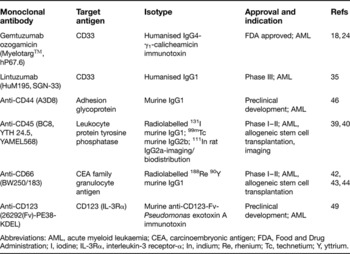
Acute myeloid leukaemia (AML) is the most common acute leukaemia of adults and it accounts for about 15% of childhood leukaemias (Ref. Reference Kantarjian14). At diagnosis, 55% of AML patients are age 65 or older. Between 50% and 80% of previously untreated patients achieve a complete remission with combinations of cytarabine and an anthracycline. For patients achieving a remission, up to 40% will survive for 5 years; however, these outcomes are worse for older patients. Therapeutic options are limited in relapsed patients over the age of 60 because of lower response rates, increased toxicity of treatment, and the frequent comorbidities present in this population. For older patients who failed to respond or relapsed after first-line therapy, the prognosis is often limited. The introduction of the CD33-targeted immunotoxin, gemtuzumab ozogamicin, as well as a number of novel monoclonal antibodies directed against other myeloid antigens currently in clinical development, offer new promise to these patients (Table 1).
Monoclonal antibodies for the treatment of myeloid leukaemia

Abbreviations: AML, acute myeloid leukaemia; CEA, carcinoembryonic antigen; FDA, Food and Drug Administration; I, iodine; IL-3Rα, interleukin-3 receptor-α; In, indium; Re, rhenium; Tc, technetium; Y, yttrium.
CD33-targeted antibodies
CD33 is a 67 kDa glycoprotein sialoadhesin receptor (Ref. Reference Freeman, Kelm, Barber and Crocker15). Its intracytoplasmic domain expresses two immunoreceptor tyrosine-based inhibitory motifs (ITIMs). CD33 is believed to have an important role in modulating leuko- cyte function, inhibiting cellular activation and proliferation, inducing apoptosis, and modulating cytokine secretion (Ref. Reference Crocker and Redelinghuys16). It is expressed on normal and maturing myeloid progenitor cells, but not on early normal haematopoietic stem cells. Over 90% of acute myeloid leukaemia blast cells express CD33, but it is not found on nonhaematopoietic tissues (Ref. Reference Dinndorf, Andrews, Benjamin, Ridgway, Wolff and Bernstein17).
Gemtuzumab ozogamicin
Gemtuzumab ozogamicin (Mylotarg™, Wyeth, Madison, NJ) is an immunotoxin composed of a humanised IgG4κ monoclonal antibody (hP67.6) that recognises CD33 conjugated to the antitumour antibiotic γ1-calicheamicin, which is active against a broad spectrum of leukaemic and solid tumour cell lines. Gemtuzumab is derived from the murine anti-CD33 antibody p67.6 (Ref. Reference Hamann18) and it is linked to N-acetyl-γ1-calicheamicin (Ref. Reference Zein, Sinha, McGahren and Ellestad19). It is approved for the treatment of CD33-positive AML in patients 60 years of age or older in first relapse.
Upon binding to CD33, the antibody–receptor complex is internalised and γ1-calicheamicin is released through hydrolysis of the N-acetyl linker (Ref. Reference van Der Velden20). Calicheamicin binds to the minor groove of DNA and results in site-specific double-stranded DNA breaks. Given that CD33 stimulation is normally inhibitory, gentuzumab may also exert effects through receptor binding. In vitro, gemtuzumab ozogamicin is almost 105 times more toxic to CD33-expressing cells than to cells lacking CD33 (Ref. Reference Naito21).
At least 85% saturation of CD33 on leukaemic blasts is achieved with an initial dose of 9 mg/m2. Saturating levels of the antibody are believed to enhance efficacy. After a 9 mg/m2 dose, gentuzumab achieves a mean peak plasma concentration (Cmax) of 2.86 ± 1.35 µg/ml and has a plasma half-life of 72.4 ± 42.0 hours (Ref. Reference Dowell, Korth-Bradley, Liu, King and Berger22). Higher concentrations are observed with second doses. This is thought to be due to reduced tumour burden and lower availability of CD33 to bind gemtuzumab following the initial dose. The area under the curve (AUC) for γ1-calicheamicin tracks with that of gemtuzumab, indicating that γ1-calicheamicin remains conjugated to the antibody in the plasma.
A Phase I trial defined the maximum tolerated dose of gemtuzumab ozogamicin administered as a 2 hour infusion as 9 mg/m2 (Ref. Reference Sievers23). The recommended treatment course is a total of two doses with at least 14 days between doses. A combined analysis of three open-label Phase II studies in 277 adults with recurrent CD33-positive AML reported an overall response rate of 26% (Ref. Reference Larson24). The response rate for patients ≥60 years of age was 24% compared with 28% for those less than 60 years old. Gemtuzumab ozogamicin has also demonstrated activity as first-line single-agent therapy, as well as when used as consolidation therapy after remission-induction with chemotherapy, or used in combination with chemotherapy in CD33-postive AML (Refs Reference Kell25, 26, Reference Amadori27, Reference Nabhan28). Improved results were achieved when it was combined with chemotherapy at relapse over treatment with salvage chemotherapy alone (Refs Reference Chevallier29, Reference Chevallier30). Gemtuzumab ozogamicin combined with arsenic trioxide and all-trans-retinoic acid has also shown promise in recurrent acute promyelocytic leukaemia (Ref. Reference Aribi31).
Toxicity includes chills, fever, nausea, vomiting, tachycardia, headaches, labile blood pressure, myelosuppression, stomatitis, elevation of liver transaminases and bilirubin, and rarely, hepatic veno-occlusive disease. Tumour lysis syndrome and acute adult respiratory distress syndrome have also been reported. Resistance to gemtuzumab ozogamicin has been correlated with expression of the multidrug resistance (MDR-1) p-glycoprotein and increased serum soluble CD33 antigen levels (Refs Reference Linenberger32, Reference van Der Velden33, Reference Chevallier34).
Lintuzumab
Lintuzumab (SGN-33, HuM195, Seattle Genetics, Bothell, WA) is a humanised IgG1 anti-CD33 monoclonal antibody derived from the murine M195 antibody that exhibits a high affinity for CD33. Since it is humanised, lintuzumab is less immunogenic than M195. Unlike the IgG4-based gentuzumab, lintuzumab exhibits ADCC and CMC. Similarly to gentuzumab, lintuzumab undergoes internalisation. In a Phase III trial in 191 adults with refractory AML or AML at first relapse, lintuzumab in combination with mitoxantrone, etoposide and cytosine arabinoside was compared with chemotherapy alone (Ref. Reference Feldman35). A response rate of 36% was observed in the combined antibody and chemotherapy group compared with 28% in those undergoing chemotherapy alone, with no difference in overall survival noted between the two groups. Both M195 and lintuzumab conjugated to α- or β-particle-emitting isotopes have been used to purge bone marrow of leukaemic blasts in patients undergoing stem cell transplantation (Refs Reference Schwartz36, Reference Sgouros37).
CD45-targeted antibodies
CD45, also known as common leukocyte antigen, is a 200 kDa protein tyrosine phosphatase expressed at high levels on leukocytes and leukocyte precursors, including AML blasts (Ref. Reference Mustelin, Vang and Bottini38). CD45 functions as a regulator of T- and B-cell-receptor signalling. CD45 does not undergo internalisation. Anti-CD45 labeled with 131I has been studied in Phase I and Phase II trials in AML patients as part of an allogeneic bone marrow transplant conditioning regimen in combination with cyclophosphamide and total body irradiation, or with busulfan and cyclophosphamide (Refs Reference Matthews39, Reference Pagel40). The 3 year disease-free survival rate was 61% in 46 treated patients. After adjusting for differences in risk, the hazard of mortality of the treatment group was 0.65 (95% CI, 0.39–1.08) compared with 509 similar patients from the International Bone Marrow Transplant Registry, suggesting benefit from this approach (Ref. Reference Pagel40).
CD66-targeted antibodies
CD66 is a heavily glycosylated carcinoembryonic antigen (CEA)-related glycoprotein that is involved in adhesion to E-selectin surface glycoprotein. CD66 is expressed at high levels on granulocytes and it does not appear to be shed or internalised (Ref. Reference Stocks, Ruchaud-Sparagano, Kerr, Grunert, Haslett and Dransfield41). Radiolabeled anti-CD66 with stem cell transplantation has been studied in AML (Refs Reference Bunjes42, Reference Ringhoffer43, Reference Zenz44). One trial compared the biodistribution of 99 mTc-anti-CD66 versus 99 mTc-anti-CD45 monoclonal antibodies in 12 AML patients undergoing stem cell transplantation and found that the anti-CD66 antibody (BW250/183) showed a favorable biodistribution and pharmacokinetics compared with the anti-CD45 antibody (Ref. Reference Buchmann45). Zenz and colleagues treated 20 adults with allogeneic stem cell transplantation and Rhenium-188 (188Re)-labeled anti-CD66 for Philadelphia-chromosome-positive acute lymphoblastic leukaemia or advanced chronic myeloid leukaemia with acceptable toxicity; however, no reduction in the incidence of leukaemic relapse was observed (Ref. Reference Zenz44).
Antibodies targeted against myeloid leukaemia stem cell antigen (CD44 and CD123)
CD44 (phagocytic glycoprotein I) and CD123 (interleukin-3 receptor α) represent potential targets for antibody-based therapy of myeloid leukaemia (Refs Reference Jin, Hope, Zhai, Smadja-Joffe and Dick46, Reference Graf, Hecht, Reif, Pelka-Fleischer, Pfister and Schmetzer47). Cancer stem cells are increasingly recognised as a specialised population of selfrenewing tumour cells (Ref. Reference Misaghian48). Ultimate success might lie in our ability to effectively target leukaemia stem cells. CD123, the α-subunit of the interleukin-3 receptor (IL-3Rα) is highly expressed on various blasts and leukaemic stem cells. Du and co-workers studied the activity of a series of single-chain Fv antibody fragments fused to a 38 kDa fragment of Pseudomonas exotoxin A (Ref. Reference Du, Ho and Pastan49). One of these, 26292(Fv)-PE38-KDEL was cytotoxic to several CD123-expressing cell lines in vitro.
Monoclonal antibodies targeting lymphoid leukaemia: B cell leukaemia antigens
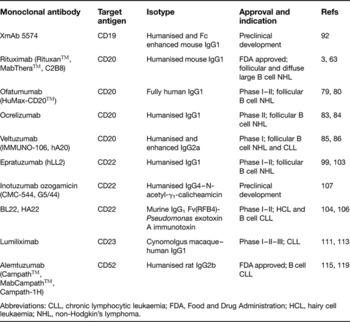
A list of antibodies currently in development or clinical trial for the treatment of B cell leukaemia is provided in Table 2. The various antibodies are considered in detail within their respective groups below.
Monoclonal antibodies for the treatment of B cell leukaemia

Abbreviations: CLL, chronic lymphocytic leukaemia; FDA, Food and Drug Administration; HCL, hairy cell leukaemia; NHL, non-Hodgkin's lymphoma.
CD20-targeted antibodies
CD20 is a 31–37 kDa antigen expressed on almost all normal B cells and most B cell malignancies (Ref. Reference Nadler, Ritz, Hardy, Pesando, Schlossman and Stashenko50). It is a nonglycosylated phosphoprotein member of the membrane-spanning 4A gene family. Its function is unclear, but CD20 is believed to have a role in B cell activation and regulation of B cell growth, as well as acting as a cell membrane calcium channel (Ref. Reference Riley and Sliwkowski51). CD20 is expressed at almost all stages of B cell development, except in pro-B cells and terminally differentiated plasma cells. CD20 is expressed on the malignant B cells of NHL, CLL and HCL. The number of targets varies with the underlying disease; it is greatest in follicular and diffuse large B cell lymphoma and lower in CLL and HCL. CD20 is nonmodulating and it is not shed, making it an ideal target for antibody therapy (Ref. Reference Press, Howell-Clark, Anderson and Bernstein52).
Rituximab
Rituximab (Rituxan™, MabThera™, Genentech, South San Francisco, CA) is a chimeric anti-CD20 monoclonal antibody. It was generated from the murine anti-human CD20 antibody 2B8 by cloning the light- and heavy-chain comple-mentary determining regions (CDR) on to a human IgG1 heavy-chain and kappa light-chain constant region (Ref. Reference Reff53). In 1997, Rituximab became the first monoclonal antibody to be licensed for the treatment of cancer. Since then, it has revolutionised the treatment of B cell malignancies. Rituximab is approved by the FDA for: (1) the treatment of relapsed or refractory, low-grade or follicular, CD20-positive, B cell NHL as a single agent; (2) previously untreated follicular, CD20-positive, B cell NHL in combination with chemotherapy; (3) nonprogressing low-grade, CD20-positive B cell NHL, as a single agent, after first-line chemotherapy, and (4) previously untreated diffuse large B cell, CD20-positive NHL in combination with CHOP (cyclophosphamide, doxorubicin, vincristine, prednisone) or other anthracycline-based chemotherapy regimens.
Rituximab exhibits powerful B-cell-depleting properties. The mechanism of action is complex and may vary by disease (Ref. Reference Smith54). Its mechanism includes induction of apoptosis, inhibition of cell growth, complement-mediated cytotoxicity (CMC), sensitisation to both chemotherapy and radiation, and ADCC. Rituximab enhances sensitivity to chemotherapy by downregulating expression of Bcl-2 (Ref. Reference Stolz55). Some preclinical work suggested that full cytotoxic activity could only be achieved in mice expressing the stimulatory γ-chain of the FcγRIII receptor (Ref. Reference Clynes, Towers, Presta and Ravetch56). Activation of allelic variants of the FcγRIIIα gene correlates with an improved response to rituximab in patients with follicular NHL, but not in patients with CLL (Refs Reference Cartron57, Reference Farag, Flinn, Modali, Lehman, Young and Byrd58). Rituximab enhances caspase-9, caspase-3 and poly(ADP-ribose) polymerase (PARP) cleavage in CLL cells, suggesting that induction of apoptosis is the dominant mechanism of action in CLL, whereas CMC and ADCC appear to be the dominant effects in NHL (Ref. Reference Byrd59). Mechanisms of resistance to rituximab are unclear, but might involve alterations in CD20 expression, reduced antibody penetration of tumour masses, increased expression of complement inhibitors, enhanced prosurvival pathways and inhibition of ADCC.
Phase I studies failed to identify a maximum tolerated dose and established rituximab 375 mg/m2/week for 4 weeks as standard (Refs Reference Maloney60, Reference Maloney61). Pharmacokinetic studies showed a plasma half-life of 76.3 hours achieved with the first infusion that increased to 205.8 hours after the fourth infusion (Ref. Reference Berinstein62). The efficacy of rituximab was established in a pivotal Phase II trial in 166 patients with relapsed NHL (Ref. Reference McLaughlin63). In low-grade and follicular B cell NHL patients who relapsed or failed primary therapy, extending treatment to eight weekly doses appeared to increase the number of responses, improve complete response rate, time to progression and the duration of response (Ref. Reference Piro64). The 8 week course is often used for the treatment of bulky or resistant disease, or for patients undergoing retreatment.
Rituximab is not approved for the treatment of CLL or other B cell leukaemias; however, a substantial number of studies demonstrated its activity in previously treated and untreated CLL (Refs Reference Byrd3, Reference Nguyen, Amess, Doughty, Hendry and Diamond65, Reference Ladetto, Bergui, Ricca, Campana, Pileri and Tarella66, Reference Hainsworth67). One early trial treated a variety of malignant B cell disorders including 15 patients with small lymphocytic lymphoma or chronic lymphocytic leukaemia (SLL/CLL) and mantle cell lymphoma (MCL) in leukaemic phase with rituximab 375 mg/m2/week for 4 weeks, and concluded that the efficacy of rituximab against SLL/CLL and MCL was limited (Ref. Reference Foran68). O'Brien and colleagues examined the efficacy of higher doses rituximab in CLL (Ref. Reference O'Brien69). Forty patients with CLL and ten with other mature B cell leukaemias were treated with four weekly infusions of rituximab. The initial dose was 375 mg/m2 in all patients, with the subsequent doses escalated in groups of patients from 500 to 2250 mg/m2. Toxicity with the first dose was significantly more common in patients with non-CLL B cell leukaemias, occurring in 5 out of 10 patients, versus 1 out of 40 patients with CLL. The overall response rate was 36% in CLL and 60% in the other B cell leukaemias. The lower responsiveness of CLL to rituximab was attributed to the lower density of CD20 targets on CLL cells compared with other B cell malignancies (Ref. Reference Perz, Topaly, Fruehauf, Hensel and Ho70). Similarly to follicular and diffuse large B cell NHL, combinations of rituximab and chemotherapy demonstrated improved responses and progression-free survival compared with treatment with either chemotherapy or rituximab alone in CLL. The CALGB 9712 clinical trial randomised concurrent treatment with fludarabine and rituximab versus sequential treatment in 104 symptomatic CLL patients (Ref. Reference Byrd71). Patients receiving concurrent treatment experienced greater haematological toxicity and infusional reactions compared with the sequential treatment group; however, the response rate of the concurrent group was 90% compared with 77% in the sequential treatment group. In a retrospective analysis, these data were combined with that of a second multicenter clinical trial of fludarabine in CLL (CALGB 9011) (Ref. Reference Byrd72). In multivariate analyses controlling for pretreatment characteristics, patients receiving fludarabine and rituximab had a significantly better progression-free survival (P < 0.0001) and overall survival (P = 0.0006) than patients receiving fludarabine alone. The number of infectious events was similar between the two treatments. A number of clinical trials in CLL of rituximab in combination with fludarabine and cyclophosphamide at varying drug doses, or sequential or concurrent treatment, demonstrated molecular responses in excess of 85% (Refs Reference Lamanna73, Reference Foon74). Rituximab has also demonstrated activity in a number of other B cell leukaemias including hairy cell leukaemia (HCL), where response rates of 25–80% have been reported (Refs Reference Lauria75, Reference Nieva, Bethel and Saven76).
Rituximab toxicities include acute infusional reactions, fever, chills, nausea, vomiting, bronchospasm and hypotension, most often with the initial infusion. Other serious adverse events include the potentially fatal cytokine release syndrome (Ref. Reference Winkler, Jensen, Manzke, Schulz, Diehl and Engert77). B cell counts nadir 24–72 hours after the initial rituximab infusion and begin to return to normal values at an average of 9 months after therapy. The risk of serious infection is marginally increased in the months following rituximab treatment.
Ofatumumab
Ofatumumab (Arzzera™, GlaxoSmithKline, Philadelphia, PA; HuMax-CD20™, Genmab, Copenhagen, Denmark) is a second-generation anti-CD20 monoclonal antibody (Ref. Reference Robak78). The lower levels of CD20 expression in CLL and other B cell malignancies suggest that an antibody designed with enhanced Fc effector function may be required. Based on this, a number of CD20-targeted monoclonal antibodies have been generated with enhanced effector function using the IgG1κ immunoglobulin framework. These enhanced antibodies strongly bind to CD20-positive cells, efficiently recruit mononuclear cells (ADCC) and lyse even rituximab-resistant targets (Ref. Reference Teeling79). Ofatumumab exhibits a higher affinity for CD20 than rituximab; it attaches to a different epitope closer to the cell surface, which makes it easier for effector cells to kill the target cell and activate complement.
Ofatumumab has shown activity in low-grade follicular B cell NHL and is currently in clinical trials for CLL (Refs Reference Hagenbeek80, Reference Coiffier81). One hundred and thirty-eight patients with fludarabine and alemtuzumab refractory (double refractory, DR) or bulky (>5 cm lymph nodes) fludarabine-refractory (BFR) CLL received eight weekly infusions of ofatumumab followed by four monthly infusions (Ref. Reference Osterborg82). The overall response rate was 51% for the DR group and 44% for the BFR group, with one patient achieving a complete response. Serious toxicities included infections, granulocytopaenia and anaemia. An FDA Oncologic Drugs Advisory Committee has recommended accelerated approval of ofatumumab for the treatment of fludarabine and alemtuzumab-refractory CLL.
Ocrelizumab
Ocrelizumab (rhumAb 2H7v.16, Biogen-IDEC, Cambridge, MA) is a recombinant humanised anti-human CD20 antibody (Ref. Reference Liu, Robinson, Murray, Ledbetter, Hellström and Hellström83). Ocrelizumab can induce apoptosis in several human lymphoma cell lines in vitro, and has been studied in a multicenter, open-label, dose-escalation Phase I–II trial in relapsed and refractory follicular NHL with an overall response rate of 36%, with 13% in complete remission (Ref. Reference Morschhauser84). Ocrelizumab is now in a Phase II trial in CLL.
Veltuzumab
Veltuzumab (IMMU-106, Immunomedics, Morris Plains, NJ) is a humanised anti-CD20 (hA20) monoclonal antibody with identical complementary determining regions (CDR) to rituximab except for a single residue in the variable heavy chain, and contains the framework regions of a humanised anti-CD22 antibody, epratuzumab (see CD22-targeted antibodies) (Ref. Reference Stein85). Compared with rituximab, veltuzumab demonstrated significantly lower off-rates in three human lymphoma cell lines studied, as well as increased CMC. A multicentre open-label, dose-escalation study demonstrated safety and efficacy in patients with NHL. At 80 mg/m2 veltuzumab depleted peripheral blood B cells after a single infusion and five out of eight patients had objective responses, including two complete remissions (Ref. Reference Morschhauser86). Veltuzumab is currently in a phase II trial in CLL.
CD19-targeted antibodies
CD19 is a pan-B-cell antigen expressed at the pro-B-cell stage up to the level of mature B cells. CD19 is downregulated during the terminal differentiation of plasma cells. It is also expressed in a subset of acute myeloid leukaemias (Refs Reference Dorshkind and Montecino-Rodriguez87, Reference Ball88, Reference Bradstock, Matthews, Benson, Page and Bishop89). CD19 functions as a co-receptor in a multimeric complex that includes CD21 and CD81, which activates a Src-family protein tyrosine kinase system that regulates thresholds and intensifies signalling following B cell receptor (BCR) activation (Refs Reference Carter and Fearon90, Reference Bobbitt and Justement91). CD19 is expressed in the majority of NHL and B cell CLL and it undergoes internalisation when bound to antibody.
XmAb 5574
XmAb 5574 (Xencor, Monrovia, CA) is a humanised anti-CD19 monoclonal antibody that has an engineered Fc domain to increase binding to Fcγ receptors and enhance Fc-mediated effector function. In vitro, XmAb 5574 enhanced ADCC ~1000-fold relative to an anti-CD19 IgG1 analogue against a broad range of B cell lymphoma and leukaemia cell lines including primary ALL and mantle cell lymphoma (Ref. Reference Horton92). XmAb 5574 increased effector cell phagocytosis and target cell apoptosis. In vivo, XmAb 5574 inhibited tumour growth in established lymphoma mouse xenograft models, and demonstrated more potent antitumour activity than its IgG1 analogue. Comparison with a variant antibody incapable of Fcγ-receptor binding showed that engagement of these receptors was critical for efficacy. In a nonhuman primate model, XmAb 5574 depleted B cells from the peripheral blood, lymph nodes and spleen (Ref. Reference Zalevsky93). XmAb 5574 has not yet entered clinical trials.
Anti-CD19 antibodies and immunomagnetic separation have been used to deplete B cells from the bone marrow in CLL patients undergoing autologous transplants (Refs Reference Khouri94, Reference Paulus, Schmitz, Viehmann, von Neuhoff and Dreger95, Reference Dreger96). In one study, 20 patients with poor-risk CLL underwent stem-cell mobilisation with chemotherapy and granulocyte-colony stimulating factor (Ref. Reference Dreger96). B cell depletion was performed using selection for CD34+ cells and selection against B cells with anti-CD19, -CD20, -CD23 and -CD37 immuno- magnetic beads. With a median follow-up of 20 months, 17 patients were in complete remission.
Anti-CD19 immunotoxins
The internalisation of CD19 after antibody binding suggests that an immunotoxin might be an effective strategy for treatment of CD19-expressing leukaemias. One study examined the use of an anti-CD19-based immunotoxin in acute lymphocytic leukaemia (ALL) for eradication of residual disease after treatment (Ref. Reference Szatrowski97). After initial chemotherapy, 46 adults with previously untreated CD19-positive ALL received an immunotoxin composed of the murine B4 anti-CD19 antibody linked to modified ricin. The most frequent toxicities were transient elevation of liver transaminases and lymphopaenia. Molecular studies, however, failed to show a consistent decrease in the residual number of leukaemic cells with the immunotoxin treatment.
CD22-targeted antibodies
CD22 is a 140 kDa membrane protein associated with the BCR that possesses seven extracellular immunoglobulin-like domains and is responsible for binding ligands with α(2,6) sialic acid residues (Ref. Reference Walker and Smith98). CD22 has three intracellular immunoreceptor tyrosine inhibitory motifs (ITIMs) and functions as an inhibitory coreceptor. Upon antigen crosslinking of the BCR, the ITIMs are phosphorylated, which in turn activates protein tyrosine phosphatases, including SHP-1, that dephosphorylate BCR components attenuating signalling. CD22 is highly expressed on mature B cells, but is expressed at low levels on immature B cells and on plasma cells. CD22 is expressed in more than 90% of childhood B cell precursor ALL, as well as adult HCL and CLL.
Epratuzumab
Epratuzumab is a humanised IgG1 monoclonal antibody that binds to the extracellular domain of CD22. It was generated from the mouse IgG2a antibody LL2 (HPB-2) (Ref. Reference Leung99). Epratuzumab was developed in an effort to reduce antibody immunogenicity, prolong half-life, and to increase effector function. After binding, the CD22–epratuzumab complex is rapidly internalised. In vitro studies suggest a role for ADCC, activation of CD22 and inhibition of proliferation as possible mechanisms of action. Unlike rituximab, which appears to be directly cytotoxic to B cells, epratuzumab seems to predominantly modulate B cell activation and signalling (Ref. Reference Carnahan100).
Epratuzumab has demonstrated antitumour activity as a single agent and in combination with chemotherapy in patients with relapsed and refractory indolent and high-grade NHL, including rituximab-refractory disease (Refs Reference Leonard101, Reference Micallef102). Epratuzumab was assessed in a Children's Oncology Group study alone and in combination with chemotherapy in 15 children with relapsed B cell ALL (Ref. Reference Raetz103). Patients received intravenous epratuzumab twice weekly for 2 weeks followed by four weekly doses in combination with reinduction chemotherapy. At the doses used (350 mg/m2), epratuzumab was able to achieve saturation of surface CD22 on the leukaemic cells in all but one patient. Nine patients achieved a complete remission. Epratuzumab treatment with reinduction chemotherapy was feasible and tolerated in relapsed ALL; however, this trial could not assess whether the addition of epratuzumab enhanced the response rate over that achieved with reinduction chemotherapy alone.
BL22 and HA22 immunotoxins
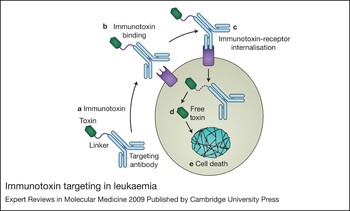
Antibody-bound CD22 undergoes internalisation, suggesting that anti-CD22-based immunotoxins might be more therapeutically effective than unmodified antibodies in CD22-expressing leukaemias (Fig. 1). BL22, a single chain anti-CD22 variable region antibody fragment (scFv) coexpressed as a fusion protein with truncated Pseudomonas exotoxin A has been studied in 46 patients with CD22-expressing B cell malignancies including 31 patients with HCL and 11 CLL patients (Ref. Reference Kreitman104). Serious toxicities included haemolytic uraemic syndrome in four patients and cytokine release syndrome in one patient. Vascular leak syndrome and increases in serum transaminases were frequent, but were not considered dose limiting. Responses were seen in 25 HCL patients, with complete remissions observed in 61% of these. Responses were rapid: 99% of circulating hairy cells were cleared within one week. Development of neutralising serum antibodies against the immunotoxin was demonstrated in 11 patients and appeared to have a variable impact on tumour response. A follow-up trial showed that cladribine-resistant HCL responded to BL22 (Ref. Reference Kreitman105). HA22 is a similar immunotoxin that has had its CDR sequence modified to increase its affinity for the CD22 antigen. It is currently being evaluated in a Phase I trial (Ref. Reference Bang, Nagata, Onda, Kreitman and Pastan106).
Immunotoxin targeting in leukaemia. (a) Immunotoxins are therapeutic molecules composed of a monoclonal antibody or antibody fragment linked to a cellular toxin. (b) The antibody directs the toxin to a cell expressing a specific receptor for that antibody. Once bound to the target cell, the immunotoxin–receptor complex is internalised (downmodulated) (c), and the toxin is released intracellularly (d) to kill the targeted leukaemia cell (e).

Inotuzumab ozogamicin
Inotuzumab ozogamicin (CMC-544, Wyeth BioPharma, Andover, MA) is an immunotoxin composed of an IgG4 humanised anti-CD22 monoclonal antibody (G5/44) and the antitumour antibiotic γ1-calicheamicin (Ref. Reference DiJoseph107). The G5/44 antibody binds to CD22 with nanomolar affinity and is rapidly internalised. After internalisation, γ1-calicheamicin is released and causes double-stranded DNA breaks that result in apoptosis. Inotuzumab ozogamicin inhibited the growth of a panel of human ALL cell lines in vitro and reduced the leukaemic cell load, reduced hind limb paralysis and prolonged the survival of nude mice injected with REH ALL cells (Ref. Reference DiJoseph, Dougher, Armellino, Evans and Damle108). Inotuzumab ozogamicin is currently in Phase I clinical trials.
CD23-targeted antibodies
CD23, the low-affinity receptor for IgE (FcεRII), is the only Fc receptor that does not belong to the immunoglobulin gene superfamily (Ref. Reference Delespesse109). CD23 functions as a B cell activation antigen and as an adhesion molecule (Ref. Reference Bonnefoy110). CD23 is expressed on the majority of CLL cells. Lumiliximab (Biogen-IDEC, Cambridge, MA), a macaque–human primatised monoclonal antibody, targets CD23 (Ref. Reference Reichert111). Preclinical studies demonstrated that lumiliximab induced the apoptosis of CD23-expressing lymphoid cell lines in vitro and prolonged the survival of immunodeficient mice inoculated with CD23-positive lymphoblastic cell lines (Ref. Reference Pathan, Chu, Hariharan, Cheney, Molina and Byrd112). In a Phase I trial, 46 patients with refractory CLL were treated with doses of lumiliximab up to 500 mg/m2 three times a week for 4 weeks (Ref. Reference Byrd113). No partial or complete responses were observed and toxicity was limited. A randomised registration trial comparing treatment with lumiliximab in combination with fludarabine, cyclophosphamide and rituximab (FCR) to FCR alone has been initiated in patients with CLL.
CD52-targeted antibodies
CD52 is a highly glycosylated 12 amino acid glycospingoinositol (GPI)-anchored surface antigen expressed on B and T cells, monocytes, macrophages and certain epithelial cells of the male genital tract (Ref. Reference Treumann, Lifely, Schneider and Ferguson114). CD52 is expressed at higher levels on T cells than on B cells, and is thought to have a role in lymphocyte activation. It is a noninternalising antigen, which makes it a potentially ideal target for antibody therapy.
Alemtuzumab
Alemtuzumab (Campath-1H, Campath™, MabCampath™, Bayer Healthcare Pharmaceuticals, Pittsburgh, PA) is a humanised antibody derived from the rat monoclonal antibody that defined the CD52 antigen. The Campath series of antibodies were originally developed for T cell depletion of bone marrow to prevent graft-versus-host disease (GvHD). The original antibody, Campath-1M (YTH66.9), which is a rat IgM, proved difficult to manufacture and was replaced by Campath-1G, a rat IgG2b that also exhibited ADCC and CMC (Ref. Reference Hale115). Alemtuzumab (Campath-1H), the humanised form, recognises the C-terminal region and GPI-anchor of CD52.
Alemtuzumab exhibits a powerful lymphodepleting activity and was approved as a single agent for treatment of alkylating agent and fludarabine-resistant B cell CLL. As such, it is currently the only monoclonal antibody approved for the treatment of a lymphoid leukaemia. Its indication was recently extended to first-line use in CLL. Alemtuzumab exerts its antileukaemic activity through CMC, ADCC and induction of apoptosis (Ref. Reference Nückel, Frey, Röth, Dührsen and Siffert116).
Early clinical studies of alemtuzumab showed modest single-agent activity in NHL, with few complete responses (Ref. Reference Hale117). Subsequent trials demonstrated more meaningful single-agent activity in previously treated, relapsed or chemotherapy-refractory CLL, with responses reported in 33–50% of patients (Refs Reference Osterborg118, Reference Keating119, Reference Rai120, Reference Ferrajoli121, Reference Cortelezzi122). In 93 CLL patients who were refractory to alkylating agents and fludarabine and received intravenous alemtuzumab 30 mg three times per week, an overall response rate of 33% with two complete remissions was observed. An additional 59% of patients achieved disease stabilisation. Median survival for the entire group was 16 months, which compared very favorably with other salvage treatments. Complete resolution of lymphadenopathy was seen in 64% of patients with lymph nodes less than 2 cm in diameter; however, there was little effect in patients with nodes larger than 5 cm. It is hypothesised that the lower activity of alemtuzumab in bulky disease was the result of the lower concentrations of antibody achieved in large tumours, or decreased ADCC as a result of inhibition or exclusion of effector cells from the tumour environment.
Alemtuzumab response rates in untreated patients with CLL are reported to be as high as 87%, with complete remission seen in up to one third of patients (Ref. Reference Lundin123). In a randomised Phase III trial, previously untreated CLL patients receiving 30 mg alemtuzumab three times a week for up to 12 weeks were compared with patients treated with chlorambucil 40 mg/m2 administered every 28 days for a maximum of 12 months (Ref. Reference Hillmen124). The overall response rate was 83% for alemtuzumab compared with 55% for chlorambucil (P < 0.0001), with a complete remission rate of 24% for alemtuzumab versus 2% for chlorambucil (P < 0.0001).
The activity of alemtuzumab is enhanced when it is combined with chemotherapy (Ref. Reference Elter125). One study investigated the combination of fludarabine and alemtuzumab in refractory CLL patients previously treated with fludarabine, and reported an 83% response rate (Ref. Reference Kennedy126). Alemtuzumab in combination with cyclophosphamide, fludarabine and rituximab (CFAR) achieved an overall complete remission rate of 69% in 48 high-risk CLL patients (Ref. Reference Wierda127). Alemtuzumab has also been shown to eliminate minimal residual disease (MRD) from the bone marrow after chemotherapy (Ref. Reference O'Brien128). CLL patients who cleared their MRD had longer survival rates than MRD-positive responders (Ref. Reference Moreton129). This was true even for those patients with high-risk CLL with del(17p13) or p53 mutations (Ref. Reference Lozanski130). Alemtuzumab can also be subcutaneously administered with a reduced incidence of acute systemic reactions.
In addition, alemtuzumab demonstrated antitumour activity in a number of T cell leukaemias. These are a heterogeneous group of leukaemias that have historically been treated with similar chemotherapy regimens to that used to treat aggressive B cell leukaemias (Ref. Reference Morris, Waldmann and Janik131). With few exceptions, the outcomes have been poor compared with the B cell leukaemias.
Alemtuzumab has been studied in a number of T cell leukaemias, both as a single agent and in combination. Single-agent activity has been shown in T cell prolymphocytic leukaemia (T-PLL), with response rates of 51–76% depending on prior treatment (Refs Reference Pawson132, Reference Dearden133, Reference Keating134). Response rates of 55–100% have also been reported in CTCL and Sézary syndrome (Refs Reference Lundin135, Reference Kennedy136, Reference Alinari, Geskin, Grady, Baiocchi, Bechtel and Porcu137). In a preclinical study and two case reports, alemtuzumab demonstrated antitumour activity in HTLV-1-associated adult T cell leukaemia/lymphoma (ATL) (Refs Reference Zhang, Zhang, Goldman, Ravetch and Waldmann138, Reference Mone139, Reference Ravandi and Faderl140). In a Phase II trial, 24 ATL patients were treated with 30 mg alemtuzumab three times per week for up to 12 weeks (Ref. Reference Sharma141). The overall response rate in the 23 evaluable patients was 43.5%. The antibody produced responses in patients with the leukaemic subtype of ATL, but with a short progression-free survival. An ongoing trial is examining alemtuzumab in combination with dose-adjusted EPOCH (etoposide, prednisone, vincristine, cyclophosphamide and doxorubicin) chemotherapy in patients with a variety of T cell neoplasms (Ref. Reference Janik142).
Alemtuzumab is associated with infusional reactions, fevers, chills, rash, myelosuppression, lymphopaenia and increased risk of opportunistic infection, especially cytomegalovirus (CMV) reactivation. Patients receiving this antibody should also receive prophylaxis against Pneumocystis and CMV.
Monoclonal antibodies targeting lymphoid leukaemia: T cell leukaemia antigens
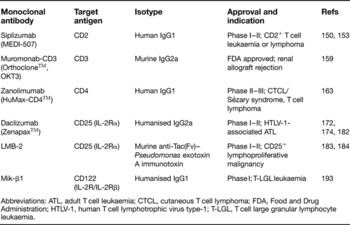
When combined, T cell leukaemias and lymphomas account for less than 15% of malignant lymphoproliferative diseases (Refs 143, Reference Armitage and Weisenburger144, Reference Groves, Linet, Travis and Devesa145). Although the expression of certain antigens is associated with a particular disorder, this association is usually not disease specific. The same antigen may be expressed across several different T cell leukaemias or lymphomas. Historically, T cell leukaemias were treated with the same chemotherapy regimens that were used to treat high-grade B cell malignancies. With few exceptions, the outcomes were poorer, with lower response rates, shorter time to progression and shorter median survivals than that seen with B cell leukaemias (Ref. Reference Gisselbrecht146). To date, no monoclonal antibody has received approval for the treatment of T cell leukaemia; however, a number of novel antibodies are under investigation for the treatment of these diseases (Table 3).
Monoclonal antibodies for treatment of T cell lymphoid leukaemia

Abbreviations: ATL, adult T cell leukaemia; CTCL, cutaneous T cell lymphoma; FDA, Food and Drug Administration; HTLV-1, human T cell lymphotrophic virus type-1; T-LGL, T cell large granular lymphocyte leukaemia.
CD2-targeted antibodies
CD2 (LFA-2, T11) is a 50 kDa glycoprotein whose extracellular region consists of two immunoglobulin-like domains (Refs Reference Moingeon147, Reference Moingeon148). It is highly expressed on thymocytes, and on T and NK cells. CD2, whose ligand is LFA-3, is involved in T cell activation and cell adhesion. CD2 enhances the physical interaction between T cells and antigen-presenting cells, as well as between T cells and NK cells, and their targets. CD2 associates with the T cell receptor (TCR) and enhances CD3 signalling during low-affinity interactions with the major histocompatibility complex (MHC) molecules, thereby enhancing MHC class I- and class II-restricted antigen recognition (Ref. Reference van der Merwe and Davis149). CD2 is highly expressed on T cells throughout most of their development and thus represents a pan-T-cell antigen.
Siplizumab
Siplizumab (MEDI-507; MedImmune, Gaithersburg, MD) is a humanised rat monoclonal antibody that recognises human CD2 (Ref. Reference Xu150). It has been studied as a treatment for psoriasis and for prophylaxis of GvHD (Ref. Reference Shaffer151). It demonstrated antitumour activity in a preclinical T cell leukaemia model (Ref. Reference Zhang, Zhang, Ravetch, Goldman and Waldmann152). In a Phase I trial, 29 patients with various T cell leukaemias and lymphomas were treated with this antibody (Ref. Reference O'Mahony153). In the original trial design, 23 patients received siplizumab on two or three consecutive days every 2 weeks. Flow cytometry demonstrated saturation and downmodulation of CD2 on the surface of peripheral blood T cells. In an attempt to increase antibody delivery, additional cohorts of patients received a single dose of siplizumab on days 0 and 14, and once a week thereafter. All except one patient experienced a decline in circulating CD4+ and CD8+ cells, as well as decreases in the numbers of NK cells. Two complete and nine partial responses were reported. CMV reactivation was common, but was not associated with disease; however, four patients developed Epstein–Barr-virus-related B cell lymphoproliferative disease (EBV-LPD) (Ref. Reference O'Mahony154). EBV-LPD primarily occurred in patients treated on the weekly schedule, which also produced a marked downmodulation in CD2 on residual T and NK cells.
CD3-, CD4- and CD5-targeted antibodies
CD3 represents a series of intermediate molecular weight polypeptides (CD3γ, CD3δ, CD3ε and CDζ) associated with the α- and β-subunits of the TCR (Ref. Reference Garcia and Adams155). The intracellular regions of the CD3 subunits are the signalling domains of the TCR complex that mediate T cell activation. CD3 is expressed on most T cells throughout their development and represents a pan-T-cell antigen.
Muromonab-CD3 (Orthoclone™, OKT3; Ortho Biotech Products, Bidgewater, NJ), a murine IgG2a monoclonal antibody directed against the 20 kDa CD3ζ-subunit, is approved for the treatment of acute renal allograft rejection (Ref. Reference Kirk156). It has also been used to deplete T cells from bone marrow allografts to treat or reduce the risk of GvHD (Ref. Reference Knop157). Muromonab-CD3 results in the rapid clearing of T cells from the peripheral blood and lymphoid tissue through CMC, ADCC, induced apoptosis and the redirection of T cells into other compartments (Ref. Reference Chatenoud158). Anti-CD3 has been used to treat acute T cell lymphoblastic leukaemia with limited benefit (Ref. Reference Gramatzki159). Muromonab-CD3 treatment is associated with cytokine release syndrome, suppression of cell-mediated immunity and an increased risk of opportunistic infections and secondary malignancies.
CD4 is a 55 kDa glycoprotein with four immunoglobulin-like domains, a hydrophobic transmembrane domain and a long cytoplasmic tail (Ref. Reference Leahy160). CD4 acts as a coreceptor for the TCR complex and it is expressed on helper and regulatory T cells, where it recognises antigens presented by MHC class II molecules in association with the TCR. Several trials studied the chimeric anti-CD4 antibodies anti-Leu3a (Becton-Dickinson, San Jose, CA) and cM-T412 (Centocor, Horsham, PA) in patients with CTCL or Sézary syndrome and found that these antibodies demonstrated in vivo binding and suppressed peripheral blood CD4+ cell counts (Refs Reference Knox161, Reference Knox162). Seven of eight patients receiving cM-T412 responded with a median duration of 25 weeks. Toxicities included infusional reactions, myalgias and rash.
Zanolimumab (HuMax-CD4™; Genmab, Copenhagen, Denmark), a fully human IgG1κ anti-CD4 monoclonal antibody was evaluated in two separate Phase II trials in patients with CTCL or Sézary syndrome (Ref. Reference Kim163). This antibody inhibits CD4+ T cells through blockade of CD4–TCR signalling and Fc-dependent ADCC (Ref. Reference Rider164). Patients received zanolimumab weekly for 17 weeks and 13 of 38 (34.2%) previously treated CTCL patients and 2 of 9 (22.2%) Sézary syndrome patients responded. Zanolimumab produces a dose-dependent CD4+ lymphocytopaenia and adverse events were mainly infectious complications. A pivotal study of zanolimumab in CTCL and Sézary syndrome is currently underway.
CD5 (Leu-1) is a 67 kDa cysteine-rich scavenger receptor glycoprotein expressed on T cells and the B1a subset of B cells (Ref. Reference Lozano165), where it acts as a coreceptor and regulates the strength of the TCR signal. It has a similar role in B cells where it modulates BCR signalling. CD5 appears to be a key regulator of immune tolerance. Two trials examined murine anti-CD5 monoclonal antibodies in patients with a variety of malignant T cell disorders including Sézary syndrome (Refs Reference Miller, Oseroff, Stratte and Levy166, Reference Dillman, Shawler, Dillman and Royston167). Rapid, short-lived decreases in circulating T cells were observed. A radioimmunoconjugate of the anti-CD5 antibody T101 was studied in a Phase I trial in ten patients with advanced or refractory CLL or CTCL (Ref. Reference Foss168). Imaging demonstrated targeting of skin lesions and involved lymph nodes in the CTCL patients. Toxicity was predominantly bone marrow suppression. All but one of the CTCL patients developed human anti-mouse antibodies (HAMAs) after a single treatment and were not able to be retreated. Partial responses were observed in two patients with CLL and in three with CTCL.
CD25-targeted antibodies
Less than 5% of unstimulated peripheral blood T cells express the 55 kDa α-subunit of the IL-2 receptor (CD25, IL-2Rα, Tac). CD25, however, is highly expressed on activated T and B cells, as well as on many B and T cell neoplasms (Ref. Reference Robb, Munck and Smith169). Three different IL-2 receptors are recognised, including a high-affinity heterotrimer composed of a 55 kDa α-subunit, a 75 kDa β-subunit (CD122) that is shared with the IL-15 receptor, and a 64 kDa common γ-chain (CD132) shared with the IL-4, IL-7, IL-9, IL-15 and IL-21 receptors. There is an intermediate-affinity heterodimeric IL-2 receptor composed of the 75 kDa β-subunit and the 64 kDa common γ-chain, and a nonsignalling low-affinity receptor composed solely of the 55 kDa IL-2Rα (Ref. Reference Morris and Waldmann170). The α-subunit confers the specific binding of IL-2 and upregulates receptor sensitivity; the β-subunit also has a role in IL-2 binding, and the β-subunit and common γ-subunits mediate signal transduction. Overexpression of IL-2Rα has been reported in CLL, ATL, CTCL and Sézary syndrome, HCL, some acute and chronic myeloid leukaemias, and T cell acute lymphocytic leukaemia (Ref. Reference Waldmann171).
Daclizumab
In 1981, the murine anti-Tac monoclonal antibody that defined the human IL-2Rα was generated (Ref. Reference Uchiyama, Broder and Waldmann172). Anti-Tac binds IL-2Rα and inhibits its interaction with IL-2 and blocks IL-2 stimulation of T cells (Ref. Reference Uchiyama, Nelson, Fleisher and Waldmann173). Murine antibodies are clinically limited because of their immunogenicity and induction of neutralising HAMAs. They also exhibit reduced effector function as a result of limited binding to human Fc receptors. In daclizumab (Zenapax™; Hoffmann-La Roche, Nutley, NJ), approximately 90% of the murine IgG2a has been replaced with a human IgG1κ sequence (Refs Reference Queen174, Reference Zhang175). It is approved for the prophylaxis of renal allograft rejection in combination with other immuno- suppressive agents (Ref. Reference Nashan, Light, Hardie, Lin and Johnson176).
ATL is an aggressive lymphoproliferative disorder resulting from chronic infection with the human retrovirus HTLV-1 (Ref. Reference Poiesz, Ruscetti, Gazdar, Bunn, Minna and Gallo177). Chemotherapy has had little impact on survival (Ref. Reference Matutes178). ATL cells express 10,000–40,000 CD25 molecules per cell, whereas normal resting T cells express fewer than 500. Murine anti-Tac and daclizumab inhibit the ex vivo proliferation of primary ATL cells (Ref. Reference Tendler179).
A series of trials studying these antibodies as therapy for HTLV-1-associated ATL have been carried out. In an early study, 19 patients were treated with murine anti-Tac (Ref. Reference Waldmann180). Two patients achieved complete remission and four patients had partial responses. The short serum half-life and the development of HAMAs limited the clinical usefulness of the murine antibody. To enhance the killing ability of the antibody, murine anti-Tac was chelated to the β-emitting radioisotope yttrium-90 (Ref. Reference Waldmann181). Eighteen ATL patients were treated with this radiolabeled antibody. Two complete and seven partial responses were observed. Toxicity was primarily granulocytopaenia and thrombocytopaenia; however, a significant fraction of patients still developed HAMAs, which limited the treatment.
In an effort to overcome the immunogenicity, a humanised anti-CD25 monclonal antibody daclizumab was studied. In a Phase I trial, up to 8 mg/kg of daclizumab was administered to 14 ATL patients (Ref. Reference Morris182) to determine the maximum tolerated dose, the dose required to achieve ≥95% saturation of CD25 on circulating ATL cells and ATL cells in lymph nodes, and to estimate the response rate. Flow cytometry showed that ≥95% saturation of CD25 on circulating ATL cells could be achieved; however, in patients that underwent fine needle aspiration of a lymph node, saturation was documented in only half, suggesting that the impeded access of large antibody molecules into solid tumour is a potential issue. Two partial responses were seen.
Others have studied CD25-targeted immunotoxins in the treatment of T cell leukaemias. An immunotoxin composed of truncated Pseudomonas exotoxin A and a single chain (sc) anti-CD25 Fv-fragment fusion protein (LMB-2) demonstrated activity against CD25-expressing lymphoid malignancies, including HCL, ATL and CTCL (Refs Reference Kreitman, Bailon, Chaudhary, FitzGerald and Pastan183, Reference Kreitman184). LMB-2 was administered to 35 patients; one HCL patient achieved complete remission and seven others demonstrated a partial response. Toxicity included transient serum transaminase elevations and fever.
CD122-targeted antibodies
CD122 (IL-2R/IL-15Rβ) is the 75 kDa β-subunit shared by the heteromeric IL-2 and IL-15 receptors (Refs Reference Tsudo, Kozak, Goldman and Waldmann185, Reference Tsudo, Kitamura and Miyasaka186). CD122 functions during receptor signalling by dimerising with CD132. This leads to activation of JAK1 bound to CD122 and JAK3 bound to CD132. These in turn activate the signal transducer and activator of transcription-3 (STAT3) and STAT5. Phosphorylated STAT proteins translocate to the nucleus where they activate gene expression.
IL-15 induces maturation and enhances the survival of T and NK cells, enhances survival of CD8+ memory T cells, and stimulates expression of TNF-α, IL-1β and other proinflammatory cytokines (Ref. Reference Shanmugham187). Unlike IL-2, IL-15 is not expressed by lymphocytes, but rather it is produced by macrophages and dendritic cells. IL-2 promotes tolerance through the activation-induced cell death (AICD) of T-lymphocytes. Conversely, IL-15 inhibits self-tolerance (Refs Reference Waldmann188, Reference Kanegane and Tosato189). Abnormalities in expression of IL-15 and its receptor have been reported in a number of malignant lymphoproliferative disorders, including ALL, ATL, CTCL and T cell large granular lymphocyte (T-LGL) leukaemia.
Mik-β1
The Mik-β1 antibody directed against the shared IL-2R/IL-15Rβ chain (CD122), inhibits transpresentation of IL-15 by its receptor to NK and T cells (Refs Reference Guex-Crosier190, Reference Alileche, Goldman and Waldmann191, Reference Giri, Anderson, Kumaki, Park, Grabstein and Cosman192). T-LGL leukaemia is a rare lymphoproliferative disorder characterised by elevated numbers of CD3+ CD8+ CD57+ large granular lymphocytes in the peripheral blood, spleen and bone marrow, and is often associated with haemocytopaenias. Both IL-2 and IL-15 are known to induce lymphokine-activated killer (LAK) cell activity in LGLs. Resting NK cells and LGLs lack the IL-2Rα subunit; however, its expression can be induced by interaction of IL-2 with CD122 (Ref. Reference Kanegane and Tosato189). LGLs may also be stimulated by IL-15 through the same receptor. It is hypothesised that the haemocytopaenias in T-LGL leukaemia are a result of enhanced NK and LAK activity.
In a Phase I trial, 12 patients with T-LGL leukaemia received four doses of the murine Mik-β1 antibody 4 days apart (Ref. Reference Morris193). Surprisingly, none of the patients developed a neutralising antibodies to the murine antibody. Greater than 95% saturation of CD122 was achieved in all patients, and downmodulation of surface CD122 on the LGL cells was observed in some patients. Side effects were minor; however, no responses were seen. The lack of response may be the result of the short half-life of the murine antibody. Humanised Mik-β1 is currently being studied in a Phase I trial in T-LGL.
Summary
The introduction of monoclonal antibodies into clinical practice has changed the treatment paradigm for haematological malignancies, as illustrated by the impact of rituximab on the treatment response and survival of patients with follicular lymphoma and diffuse large B cell NHL. Currently only two monoclonal antibodies are approved for the treatment of leukaemia. These include the CD33-directed immunotoxin gemtuzumab ozogamicin, which is approved for the treatment of older patients with acute myeloid leukaemia in relapse; and alemtuzumab, which is approved for single-agent treatment of CLL. Although not approved for the treatment of leukaemia, rituximab has demonstrated activity in CLL and HCL. Alemtuzumab is also active against T-PLL and CTCL and Sézary syndrome, and to a lesser degree, HTLV-1-associated ATL. To date, no monoclonal antibody has received approval for the treatment of T cell leukaemia. As a general observation, tumour response, duration of response and outcome are often improved when monoclonal antibodies are used in combination with chemotherapy. The optimal timing and doses of these antibody–chemotherapy combinations is an area of ongoing study.
In an effort to improve therapeutic activity and reduce side effects, monoclonal antibodies are being engineered: (1) to bind to their targets with higher affinity through amino acid substitutions made in their antigen-binding regions; (2) to target more effective surface antigens and epitopes; (3) to reduce their immunogenicity using recombinant and transgenic technologies to produce fully human antibodies; and (4) to increase interaction of the antibody Fc region with selected effector cell receptors to enhance ADCC and CMC, and thus target cell killing. One example is the anti-CD20 antibody ofatumumab, which has shown activity in rituximab-resistant disease. A number of monoclonal antibodies and immunotoxins that target novel leukaemia antigens are in various stages of preclinical development and clinical trials. These include antibodies targeting CD2, CD4, CD19, CD20, CD22, CD23, CD25, CD44, CD45, CD66, CD122 and CD123. The future continues to be bright for further improvements in monoclonal antibody therapy of leukaemia.
Acknowledgements and funding
This work was supported by the Intramural Research Program of the NIH, National Cancer Institute, Center for Cancer Research. The authors wish to thank the reviewers for their thoughtful and helpful comments on this article.