Meyoucycle, a Musical about Semiocapitalism
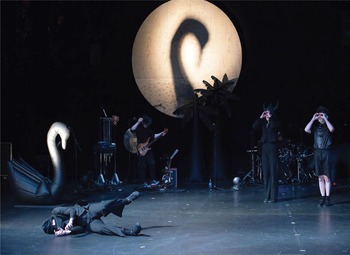
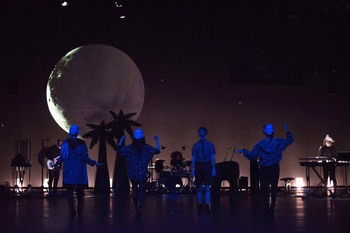
Pitch-black. A wigged figure, head and hands overexposed to blue light, natters in the dark while scrolling and swiping purposelessly on a smartphone. The prattle continues while the audience walks in and takes a seat. This looped opening monologue about technological acceleration, the info-sphere, and the attention economy transitions into song as soon as everyone is seated. Four characters sing along onstage, although they are difficult to distinguish as they are barely visible in the dark. As the stage lights up slowly, we notice several musicians in the back. Just like the dancers, they remain anonymous as they hide their faces under wigs, behind masks, or under cover of makeup. The dancing foursome is particularly good with words: their poetic lyrics — spoken, whispered, sung, or shouted — give us an account of the unsettling relationship between cyberspace and cybertime that has given rise to a semiocapitalistic epidemic of panic, to paraphrase Franco “Bifo” Berardi (Reference Berardi2009a). Against the back wall upstage, a giant moon is projected onto a large circular wooden disk. Black blow-up palm trees and a black blow-up swan are set among the musicians toward the back of the stage; at times their shadows are cast upon the giant pale moon. The dark universe created onstage brightens as the moon follows its cycle. It seems important that these characters, spreading their words of wisdom, remain anonymous. They are hackers: in order for them to maintain freedom of expression, they dispose of their identities and drop into anonymity. They do so by continuously transforming themselves using wigs, masks, and costume changes, always dwelling in the dark.
A dark scene with both dancers downstage, the musicians in the back wearing different hats, and a black blow-up swan casting a shadow upon the giant pale moon. From left: Tarek Halaby, Eleanor Bauer, and Gaël Santisteva in Meyoucycle, by Eleanor Bauer and Chris Peck. Kaaitheater Brussels, 2016. (Photo by Anne Van Aerschot)

Meyoucycle (2016) tells a gloomy story set in the near future: as the program booklet announces, the quartet of “poetic terrorists” attempts to “escape the all-pervasive system of communications media that expropriates expressions between people and transforms it into profit” (Bauer and Peck Reference Bauer and Peck2016a:14). The transdisciplinary performance was the result of a collaboration between Eleanor Bauer and Chris Peck, performed by contemporary dance artists Eleanor Bauer, Inga Huld Hákonardóttir, Tarek Halaby, and Gaël Santisteva, together with the Ictus music ensemble. Originally from Santa Fe, New Mexico, Eleanor Bauer is a performer and choreographer working at the intersections of dance, writing, and music. Between 2007 and 2019, she was based in Brussels where she set up her own production company, GoodMove vzw. She has worked as a performer with Anne Teresa De Keersmaeker and her company Rosas, Xavier Le Roy, Boris Charmatz, Trisha Brown, and Matthew Barney, among others. She is currently based in Stockholm where she is a PhD candidate in choreography at Stockholm University of the Arts. Her work is versatile by nature, ranging from large group pieces (like the triangle-tent-time trilogy, 2011–2013) to solos (ELEANOR!, 2005; [BIG GIRLS DO BIG THINGS], 2009), and even talk shows (Bauer Hour 2013–2015). She regularly draws on different performative genres and media, almost always deploying clever wit and a twisted sense of irony to question the mechanisms of performance itself. Since 2003, she has been closely collaborating with composer, (computer) musician, programmer, and improviser Chris Peck on numerous projects and commissions in the United States and Europe, with their most recent achievement being New Joy (2019). American-born Peck, who is currently based in Berlin, often engages with contemporary dance and theatre, including collaborations with artists such as John Jasperse, Beth Gill, and Abby Yager, among others.
Meyoucycle premiered at the Festival Rencontres Chorégraphiques at Nouveau Théâtre de Montreuil, Paris, in 2016. The piece went on to tour to Brussels (Belgium), Essen (Germany), Roubaix (France), and Vienna (Austria), but it did not travel to the United States. It was Bauer’s most ambitious piece to date: “Pronounced with a strange accent in English, the title Meyoucycle sounds like ‘musical,’ which is to say that Meyoucycle creates something foreign to what can be identified as a musical, but with familiar ingredients” (Bauer and Peck Reference Bauer and Peck2016a:14).
The political science fiction fantasy musical that is Meyoucycle lends itself to the theoretical insights that are largely indebted to the work that Franco “Bifo” Berardi produced in the aftermath of the 2008 financial crisis — Precarious Rhapsody (2009a) and The Soul at Work (2009b) — on the pathologies caused by semiocapitalism. Not semi-, but semiocapitalism — a term that could easily be confused with but does not at all mean quasi-capitalism. It denotes a form of capitalism that occurs when informational technologies enable a full integration of linguistic labor — what Berardi designates as info-labor — with capital valorization, signifying that industrial society has given way to a form of “capitalism founded on immaterial labor and the explosion of the info-sphere” with a kind of overproduction that is specifically semiotic. As Berardi puts it: “an infinite excess of signs circulates in the info-sphere and saturates individual and collective attention” (2009a:108).
The conditions under which info-labor is performed are technological and cultural in nature, and can be understood in the context of social acceleration. Sociologist Hartmut Rosa posits that modernization is not only a multileveled process, but also signifies a structural (and, significantly, a cultural) transformation of time structures and horizons, which he captures with the concept of “social acceleration” (2003:4). According to Rosa, social acceleration comprises three spheres: technological acceleration, acceleration of social change, and acceleration of the pace of life. Paradoxically, technological acceleration — which logically ought to decrease the time needed to carry out everyday processes of (re)production, communication, and transport — seems to have caused a scarcity of time instead of slowing down the pace of life. Rather than enjoying an increase of free time enabled by technological acceleration, we seem to be reducing our breaks from work and doing more things simultaneously, or in a word: multitasking (10). Contemporary info-workers, like performing artists and scholars, maneuver in this acceleratory society between projects and operate in a post-Fordist and neoliberal economy of work that — at least in Western society — has been dominated by semiocapitalism since the turn of the 21st century. We increasingly feel “that we have run out of time; that we must accelerate,” as Berardi observes, “and we feel simultaneously that acceleration leads to a loss of life, of pleasure and of understanding” (2009a:46).
Is there an escape? In Precarious Rhapsody, Berardi asks, “What strategies will the collective organism follow in order to escape this fabric of unhappiness? Is a strategy of deceleration, of the reduction of complexity possible and able to be hypothesized?” (43). Art theorist Bojana Kunst calls for doing less for the sake of art and enabling life, because only then can we create a more sustainable future: “do less, precisely when confronted with the demand to do more” (Reference Kunst2015:193). Sociologist Ulrich Bröckling at first proposes “laziness (or idleness)” as a model for a practice of desubjectification that could eliminate the accelerating Entrepreneurial Self (Reference Bröckling2016:203). Berardi, however, does not believe that deceleration is the way to go. This is a standpoint I can agree with, because slowing down is losing its subversive edge as it has come to be highly commodified and ultimately serves the purpose of being able to accelerate more efficiently afterward. Returning to Hartmut Rosa, we are more often than not dealing with accelerating forms of deceleration, meant to recharge one’s battery to be more productive afterward (2003:16). Exactly therein lies the double paradox of slowing down to overthrow neoliberal semiocapitalism: as such, deceleration gets folded into our capacity to work and it is camouflaged as self-care, a very hot and marketable commodity as testified by the countless retreat offers advertised through media communications on my Facebook feed.
Instead, Berardi envisions the possibility of a strategy towards an upgrade of the human organism, namely a posthuman strategy of “the mechanical adjustment of the human body and brain to a hyperfast info-sphere” (2009a:43). Alternatively, he proposes a strategy of subtraction in the sense of “distancing from the vortex” (43). While he posits that this latter strategy is only likely to succeed in “small communities that constitute a sphere of existential, economic, and informatic autonomy with respect to the economic world” (43), we can witness such an attempt among the poetic terrorists in Meyoucycle (2016), who distance themselves from the vortex, or as expressed in the program, “avoid the seemingly inevitable exploitation of our private and public lives, personal and psychic capacities, by switching the cables, diving into the dark, swerving with the times” (Bauer and Peck Reference Bauer and Peck2016a:14).
The four dancers with their white masks backwards over different wigs while Santisteva faces the audience and sings “Tomorrow.” From left: Eleanor Bauer, Inga Huld Hákonardóttir, Gaël Santisteva, and Tarek Halaby in Meyoucycle, by Eleanor Bauer and Chris Peck. Kaaitheater Brussels, 2016. (Photo by Anne Van Aerschot)

The characters in Meyoucycle have developed tactics in the fictional plot to do more than merely withstand the exploitative demands of semiocapitalism and the forces of neoliberalism; on the metalevel, the artists instrumentalized performative and dramaturgical tactics for the same purpose. Can exposing the mechanisms of neoliberal exploitation through performance be an alternative form of resilience and/or resistance? As a choreographer, Eleanor Bauer regularly draws on the transdisciplinary cabaret genre as a performative tool, using irony and wit as activist and restorative devices. As such, the black-box production of Meyoucycle consists of a combination of different dance, theatrical, textual, and musical ingredients and cynically deals with several sociopolitical themes related to our modern but precarious times. How might performance reveal the possible ways out of this adverse semiocapitalism and the routes we can follow to repair contemporary social, political, and economic crises? Or put differently, what is the efficacy of tactical frivolity within the semi-public theatre space? To answer these questions, I approached the almost two-hour-long performance from three angles of -isms: its themes through the notion of cruel optimism, its messages through ironic pessimism, and its tactics as poetic terrorism.
#somuchtodo and #victoria
As the audience enters the space, performer Tarek Halaby is standing off the stage in front of the first row in the dark. The blue light from his smartphone is the only light source illuminating his face. He recounts:
You know, I wish I would read more books. But I don’t read enough because I’m always at the theatre, seeing shows. I feel like I should see more performances, like, it’s my professional obligation, but honestly, I prefer films. But I don’t have enough time for all the films I want to see because they’re so long, you know, like two hours for a film is a big-time commitment, and I need to be spending more time on my own work, like, making my own pieces. But I don’t have enough time for my art, because I’m always at the gym — sculpting the piece of art that is my body […]. (Bauer and Peck Reference Bauer and Peck2016b:1)Footnote 1
It does not come as a surprise that this monologue is titled “So Much to Do.” Just reading these first few lines, many people would no doubt recognize themselves in what he is saying. Meanwhile, Halaby is multitasking: he is scrolling and swiping on his smartphone as he is complaining about the lack of time for all the things he wants to do. This somewhat narcissistic rant about his first-world problems combined with his phone scrolling is certainly a reference to the present-day attention economy in which people are increasingly incapable of maintaining concentrated attention on one object or task due to overstimulation (Davenport and Beck Reference Davenport and Beck2001). Halaby’s opening monologue alludes to our limited capability of processing cybertime as he narrates a story from the acceleratory society that overproduces semiotic capital. The mobile phone is the tool par excellence that, as Berardi also notes, “makes possible the connection between the needs of semiocapital and the mobilization of the living labor of cyberspace” (2009a:33). The opening act thus leads with a provocative statement: in semiocapitalism, the subject is free to do whatever, but, as Berardi puts it, their “time is enslaved” (2009a:33). On the one hand, we are hypersaturated by the overflow of information available in cyberspace and have no time to process all the input. On the other hand, our output enters the productive cycle as soon as we make use of digital technologies to communicate and, as such, everything we do and say becomes a commodity turning subjects into permanent info-laborers generating nothing but profit for tech giants since most of this labor is unwaged.
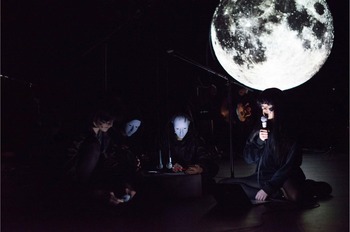
This disturbing condition is addressed in a subsequent scene: the monologue “Dark Letters” performed by the Icelandic dancer Hákonardóttir tackles how social media cruelly manipulates the human desire for self-expression and thus constitutes a constant risk of capture by capitalism. Due to technological acceleration, we experience a shift in focus from the production of material goods for consumption towards the production of semiotic (intellectual, mental, informational) goods produced infinitely in cyberspace. The scene opens with a full moon and a dim light on Bauer sitting frontstage-left and whispering her poem “Into the Dark.” A soundscape of otherworldly and robotic computer sounds joins in. Occupied with their smartphones, two performers sit right beside Bauer and are seemingly generating some of the sounds. They wear white masks, which, in this setting — although they are simple white and not the infamous Guy Fawkes masks — are somewhat reminiscent of those worn by the hackers in the Anonymous movement during their media appearances. Still in the same corner, the fourth character performed by Hákonardóttir is wearing a long black wig and is typing on a laptop (just like Bauer is). After Bauer concludes her whispered poem, Hákonardóttir’s character shares the story of how she went from writing epic letters to sharing hashtags for Victoria’s Secret. While scrolling and typing on her device, she recounts how her letters were soon replaced by emails, which in turn became “too long Facebook posts” (9) that eventually turned into 140-character tweets. When she was offered payment for every #victoria, she realized that everything she was reading on social media was some form of “deep-micro product placement” (10). In semiocapitalism, it thus seems that we are permanently performing immaterial labor by simply communicating through language and other signs. In doing so, we are permanently performing (a version of) ourselves. In other words, subjectivity has become a commodity that is very much in demand.
Berardi’s fellow Italian autonomous workerists, such as Paolo Virno and Maurizio Lazzarato, have been of major importance for the discourse on the production of subjectivity. While Lazzarato is mostly known for his take on immaterial labor (or info-labor as Berardi would rather have it), he was also the first to point out that “subjectivity is capitalism’s biggest output. It’s the single largest commodity we produce, because it goes into the production of all other commodities” (Reference Lazzarato2010:14). In the scene, the more Hákonardóttir’s character is manipulated through the type of advatarsement Footnote 2 that social media encourages, the more her voice is manipulated with voice-altering sound effects. She recounts that she eventually committed “representational suicide and moved into the dark” when she realized that “the only freedom of speech left was to remain silent.” As she amusingly concludes her tale, “telepathy just might be the only way left to communicate with anyone on the outside of the dark, without being at risk of capture” (10). After this, the song “Arches” plays, creating an old-time dark country ambiance, to which Hákonardóttir dances a solo in the dark. Her movement vocabulary is quirky, like a Harawayan critter (see Haraway Reference Haraway2016) dwelling in the dark web, but also somewhat like a marionette being controlled from above.
In this early scene, the performers are sitting closely together downstage-left with smartphones and laptops. Hákonardóttir, in a long black wig, recounts the story of “Dark Letters.” From left: Eleanor Bauer, Gaël Santisteva, Tarek Halaby, and Inga Huld Hákonardóttir in Meyoucycle, by Eleanor Bauer and Chris Peck. Kaaitheater Brussels, 2016. (Photo by Anne Van Aerschot)

Cruel Optimism and the False Promise of Freedom
This first half hour of Meyoucycle already shares an important lesson about the cruel optimism in neoliberal semiocapitalism: in this regime, the proclaimed and acclaimed freedom is an illusion. Lauren Berlant describes our historical present through the dynamic of “cruel optimism”: her term for a relation that exists when “something you desire is actually an obstacle to your flourishing” (Reference Berlant2011:1). She applies the term to consider how our relations toward, for example, work or food function as clusters of promises of the good life and what happens when these promises fade away. An optimistic relation to a desired something is not inherently cruel, she posits, but can become cruel when what draws your attachment actually impedes the aim that brought you to it in the first place. Analogously, the optimistic promise of freedom in neoliberal semiocapitalism is a cruel one because it is “a condition of apparent freedom,” as Berardi puts it (2009b:192). As the story in “Dark Letters” testifies, as soon as the freedom of self-expression and autonomy is unmasked as only apparent, the excitement fizzles out. As such, Hákonardóttir’s character ultimately could not “like, dislike, post, share, comment on or say anything without potentially working for someone” (10).
From the late 1960s onwards, the idea of autonomy stands for having “the soul at work” — to quote Berardi’s book title (2009b), which means that the immaterial factory of semiocapitalism asks us to place our very souls at its disposal (meaning our intelligence, sensibility, creativity, and language), while industrial factories force the body to leave the soul outside of the assembly line (Berardi Reference Berardi, Cadel and Mecchia2009b:192). Today, as Berardi declares, “the dark side of the soul has finally surfaced after looming for a decade in the shadow of the much-touted victory and the promised eternity of capitalism” (2009b:207). Sociologist Rudi Laermans insightfully observes of this same context that “in essence, the self becomes depressive due to the weariness of being oneself, particularly when the surrounding conditions regularly subvert, complicate, or obstruct the process of acting in a truly personal way” (Reference Laermans and Sickle2018:101). As such, the character reciting “Dark Letters” reasons that the only freedom of speech left was to remain silent. The concluding lines echo the resulting depression that Laermans alludes to when the character proclaims having “committed representational suicide” and “moved into the dark.” As her freedom of expression is revealed to be illusory, her optimism is exposed as cruel and devolves into pessimism.
When this occurs, Berlant talks about a general “slow death,” which in her work refers to the typically physical wearing out of a population, a phenomenon that coincides with precarization and the resulting diminution of future prospects under late capitalism (2011). Yet once again Hákonardóttir’s representational suicide, by moving into the dark, resonates with Berlant’s “slow death” to a certain extent. Burnout and depression seem to be indicative of today’s slow death in neoliberal semiocapitalism: on the one hand, we are increasingly consuming the time we do not have; and, on the other hand, people are increasingly confronted with a false sense of liberty. The wearing out of today’s population is marked by a burning out of energy; a euphoria that exhausts as the promise of a good and free life does not seem to hold. In this respect, two scenes portray a society where a subject’s control over time and freedom of expression are in fact very much enslaved: the opening monologue in which Halaby manically swipes and scrolls on his smartphone while ranting about all the things he wants to do but does not seem to find the time for; and the scene when Hákonardóttir recounts how social media is exploiting people’s private lives for capital gain while she is also typing and scrolling on her device. The marionette-like dance sequence performed by Hákonardóttir, as if her movements are being controlled from above, certainly evokes this subjection.
Byung-Chul Han tellingly writes in the introduction to his book Psychopolitics that “although the achievement-subject deems itself free, in reality it is a slave. In so far as it willingly exploits itself without a master, it is an absolute slave” (Reference Han and Butler2017:2). Psychic maladies such as depression and burnout, as he puts it, “represent pathological signs that freedom is now switching over into manifold forms of compulsion” (2017:2). To return to Hartmut Rosa’s notion of social acceleration: burnout and depression are part of the dysfunctional and pathological forms of deceleration, which are unintended consequences of the accelerated time regime (Reference Rosa2003:15). As Berardi puts it quite dramatically, the overproduction of semiocapital engenders pathologies for the individual as well as the collective mind that are “spreading epidemically.” The generalized compulsion toward (hyper)expression that is brought forward by the characters in this first half of the performance causes “a panic-depressive cycle” (Reference Berardi2009a:113): the more the characters realize that everything is commodified and the more the impossibility of separating life from work becomes apparent, the more they panic. As such, an “epidemic of panic” is spreading “in the fabric of everyday life” (39) as “the speed and complexity of the flows of information overwhelm the capacities of the ‘social brain’ to manage these flows, inducing a panic that concludes, shortly thereafter, with a depressive plunge” (Reference Berardi, Cadel and Mecchia2009b:10).
In response to the panic, the characters in Meyoucycle move into the dark. From a pessimistic viewpoint, this dark web can stand for the depressive plunge that Berardi refers to, although on a more (cruelly) optimistic note it may also stand for the survival tactics deployed by the characters in distancing themselves from the vortex by dropping into anonymity. Depression should be understood as “a general shape of the global crisis that is darkening the historical horizon of our time” (Reference Berardi, Cadel and Mecchia2009b:207). Burnout and depression are too often treated as individual pathologies, a phenomenon that is reflected in the boom of medications designed to cushion the symptoms, whereas the problem is actually structural. Berardi characterizes panic depression as the “collateral damage of the soul at work” (209), confirming Ann Cvetkovich’s (Reference Cvetkovich2012) thesis that feeling bad constitutes the lived experience of neoliberal capitalism and is therefore structural rather than personal: a collective depression of society.
Is everything in Meyoucycle this dark? Has the dark side of the soul surfaced on the stage? I would argue that the answer is no. The characters want to elude capture by neoliberal semiocapitalism by dwelling in the dark, by eschewing their identities, and by dropping into anonymity and distancing themselves from the vortex; a tactic of subtraction, as Berardi proposed to “escape this fabric of unhappiness” (Reference Berardi2009a:43). This is reflected in a number of visual tactics, such as the extreme darkness onstage that renders it almost impossible to recognize and distinguish the characters; the constant shapeshifting that likewise causes ambiguity about the characters’ identities; and the voice-altering sound effects. While the performance texts of the mentioned scenes quite befittingly describe the characters’ intentions to escape capture by neoliberal semiocapitalism, Meyoucycle goes on to explore this tactic of subtraction in the song “A New Factory,” with its catchy melancholic chorus “it’s so nice to be powerless” (11).
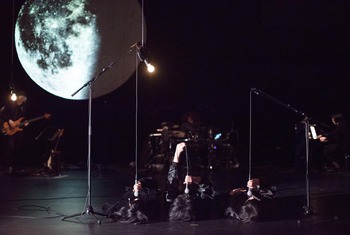
In the scene, three mic stands are set up midstage, but the mics are hanging down from them pointing towards the floorboard. Three performers are lying on their backs below them. They make the mics swing at different paces as they sing “ah” sounds, creating a trippy harmony as the mics swing past their mouths at divergent intervals. Santisteva, with his magnificent voice, sings the lead while he moves around onstage and swings the various lightbulbs that have descended from the ceiling. Both light and sound sources as such become part of the choreography.Footnote 3 Immediately after this, Halaby sings the song “Say It” about the modes of expression — writing, speaking, and singing — and their respective intentions, to which Santisteva and Bauer perform a synchronized choreographic sequence reminiscent of Hákonardóttir’s solo after “Dark Letters.” In the way that Santisteva sang “I get sick when I realize the whole thing’s a joke” in the prior song, Halaby now chants that “the ground beneath your feet’s a joke.” Definitely, this dark poetry unmasks the promise of freedom as a false one, as nothing but a joke. Cruel optimism is expressed here through a form of (song-)writing that I would describe as ironic pessimism.
Ironic Pessimism and Poetic Terrorism
Throughout her oeuvre, Eleanor Bauer has frequently made use of irony and wit — in Meyoucycle especially in song — as activist and restorative devices, and in doing so, deploys the transdisciplinary cabaret genre as a performative political tool. In these dark and pessimistic moments, ironic distance, or tragic joy as Gavin Grindon would have it, becomes a tool for cultural activism (Reference Grindon, Özden Fırat and Kuryel2011:28). The effect is “a joyful, subversive tragic beyond what might otherwise be recognized only negatively” (28). In a form of capitalism that “now subsumes all of society under its domineering extraction of surplus value,” Grindon posits, “capitalist subsumption undoes the relation between the private and public sphere” (29). The cultural activist under semiocapitalism does not use irony from a safe, informed point of critique, but creates an ironic transversal relation in which they themselves are bound up (31). In Meyoucycle, irony is omnipresent. The pessimistic dark tone of the piece is compensated by the use of black comedy throughout the performance. As Berardi argues in The Soul at Work, “if depression, exhaustion and addiction are the dark side of the entrepreneurial self, irony is its compensatory other”:
The ironist is well aware of the laws governing the market and the inherently paradoxical demands it makes. She knows what is being imposed upon her and she says it, pushing the facts of the matter to their illogical conclusion, exposing as absurd what she cannot otherwise change. (Reference Berardi, Cadel and Mecchia2009b:202)
In “A New Factory” three performers lie below hanging mics, swinging them as they sing backup vocals. Santisteva sings the lead as he moves around to push the various hanging lightbulbs. From left: Inga Huld Hákonardóttir, Tarek Halaby, and Eleanor Bauer in Meyoucycle, by Eleanor Bauer and Chris Peck. Kaaitheater Brussels, 2016. (Photo by Anne Van Aerschot)

While Meyoucycle questions the perverse link between semiocapitalism and self-expression, this message is spread through a variety of expressive forms of communication developed for the performance. The quartet comes prepared with a set of expressive tactics of frivolityFootnote 4 that assemble under the header of “poetic terrorism” — a term coined by Hakim Bey (Reference Bey1985) referring to an array of anarchist tactics for creating “Temporary Autonomous Zones,” mostly random thought-provoking, poetic, and subversive acts that evade formal structures of control. “Sliding through different genres of performance and music, inhabiting different forms of speech and physical appearance,” as the program booklet reads, “they generate a constantly shifting horizon of possible meanings” (Bauer and Peck Reference Bauer and Peck2016a:14). For example, multilingualism is subtly integrated into the performance. A song entitled “Several Days Later” shifts smoothly from English into Icelandic. Amusingly, this Icelandic text is not translated in the surtitles projected on the screen; rather the text is projected in Icelandic, which is of no use for (the majority of) the audience. The three non-Icelandic performers have learned how to sing these lyrics in a language that is foreign to them, but we have no idea what they are singing.
Irony, cynicism, and black comedy are at their best in the witty wordplay that emerges in the use of neologisms (such as the earlier mentioned Advatarsement, and compostition, to add another example); in the intertextual references such as to T.S. Eliot’s most pessimistic poem, written at the onset of WWII, “East Coker”; in the song “Dark Dark Dark”; and in the general poetry of the song lyrics, spoken word, and monologue texts. As the characters constantly shift appearances to avoid the identity market that is characteristic of contemporary capitalism in which social media platforms make money out of shaping our identities, they remain anonymous chameleons. They declare: “we are anonymous, but we do not forget, because we remember to change” (14). In poetic terrorism, what is communicated trumps who is communicating. The lines of Bauer’s most preachy shamanistic and anarchist monologue sum it up quite aptly:
“The less you own the more you give”
If I told you that’s a quote from a Yogi tea bag, would you believe me?
“The less you own the more you give”
What if I told you a noted economist wrote it?
What difference does it make? (13)
Furthermore, style choices of specific songs are certainly not innocent ones. For example, “Garbage” is a catchy upbeat tune about the twisted dynamics on which online dating apps prosper, done in the style of the 1990s band. “Garbage” is also another word for waste, one of the most concrete signs of capitalism and its productive cycle generating overproduction.
Songwriting is certainly the domineering tactic in the piece. Bauer and Peck have been collaborating with a special interest in songwriting since 2003. As they explain in the program, they share a curiosity about “the tension between the poetics of language and the affective qualities of music, dance and singing”:
Thinking about the song as opposed to other kinds of musical composition as a relatively short and isolated piece often written to communicate a particular feeling, idea, or agenda, Meyoucycle emphasizes this direct communication style and its relationship to feeling and intuition as a tool for expressing both explicit and implicit, overt and subverted messages. (Reference Bauer and Peck2016a:15)
When interpreting the tactical frivolity and poetic terrorism through semiotics, the irony in the piece becomes all the more apparent. Nonetheless, herein lies the ultimate paradox of Meyoucycle: through performing this critique on neoliberal semiocapitalism, the artists actually conform to it. The adaptive and transformative tools the characters invent in order to elude capture by contemporary semiocapitalism are communicated by the artists precisely with the semiotic tools the characters try to avoid. Furthermore, communicating a critique on “communication as a basic human faculty constantly under threat of expropriation and manipulation in the information age” (14) through the song-cycle — a largescale black-box production, I may add — actually requires marketing tools and ticket sales, so the artists are thereby commodifying this communication themselves. As such, exposing the forces of neoliberal semiocapitalism to critique them, using the same tools to communicate this critique, immediately undermines the intention. Hence, no matter how much one tries to avoid succumbing to the forces of neoliberal semiocapitalism, ultimately, we are stuck in a cycle — or at an impasse — from which there is no escape. The song-cycle, the series of songs treating the same theme and performed following the onstage moon’s cycle, may stand for these ironic paradoxes. This sentiment seems to be reflected at least in the final words of the last song “In The End” that remain projected on a karaoke screen at the closing of the performance: “and how there is no escape…” (26).
But, Is There No Escape?
The overarching message of Meyoucycle seems to be that, no matter how much we try to resist the forces of neoliberal semiocapitalism by seeking all kinds of freedoms, there is no escaping them. As Bröckling puts it quite insightfully: “it became apparent how market mechanisms either absorb or marginalize opposing tendencies, recasting non-conformism itself as a measure of successful conformity to the entrepreneurial self” (2016:xviii). In that respect, an equilibrium between cynicism and irony as poetic terrorism can be an activist device, yet it seems to fail in this context. However, it can also be a restorative device. Towards the end of Meyoucycle, the performers have all left the stage. The lights are on. The moon is red. A catchy sing-a-long tune begins. Song lyrics appear on the moon like karaoke subtitles running on a screen accompanied by a microphone that moves like a cursor to indicate the rhythm. We are all encouraged to sing along, and some of us cannot help but do so. What can we learn from this ending?
As the wordplay in the title Meyoucycle acknowledges, any performance happens somewhere between the me’s onstage and the you’s in the audience. As Erika Fischer-Lichte has argued, performances symbolize the state of in-betweenness that performances bring about because they take place through the bodily copresence of those who perform and those who observe (Reference Fischer-Lichte and Jain2008:38). That is to say that whatever the performers do affects the participating spectators and, to a different degree, vice versa. In this respect, in a French monologue almost at the end of the performance, Santisteva affirms that the only thing that digital technology cannot replace is the presence of an audience and their gaze — a statement that certainly takes on a whole new dimension in times of Covid-19 when we can only stream performances online. Additionally, the wordplay of Meyoucycle recognizes that what is being said onstage is understood by the audience because they can relate to these issues. In this vein, the performance finishes with an ironic karaoke song, implying that the issues Meyoucycle brings forward in fact concern us all; the me’s onstage and the you’s in the audience. The collective act of finishing together as a “we” singing the grand finale appears to symbolize the universality of the problems dealt with. Simultaneously, I must add, a hint of positivity can be distinguished in this particular style choice: this tactical frivolity can serve as a mechanism for creating social cohesion within the group of me’s and you’s, or its more popular synonym: solidarity. If we come to realize that we are not alone in this pan(dem)ic but we are singing these lyrics together, we can start to overcome the impasse and break the cycle. This is precisely what theorist Ann Cvetkovich implies when she proposes that we engage in forms of activism that address negative feelings rather than banish them. In her book Depression: A Public Feeling she calls for making these feelings public because only then can they be recognized as collective (Reference Cvetkovich2012:110). Much like Berardi, Cvetkovich argues that feeling bad constitutes the lived experience of neoliberal capitalism. However, as Berardi puts it more positively, if depression can be defined as a lack of sense, “what circulates in the sphere of friendship, of love, of social solidarity is what allows us to find sense” (Reference Berardi2009a:117). Just like in Berardi’s “Manifesto of Post-Futurism” (Reference Berardi2009a:136–37), tiny messages of tenderness and togetherness pierce through the performance as the stage brightens. In “Endurance,” the catchy tunes echo: “we came here to serve each other, a chorus playing to the team” and “love your aliens as your neighbors and expand your vocabulary” (13). Shortly after, the shaman character preaches “I DARE YOU TO LOVE. To love ALL of us, NOT just sisters and neighbors” (15). It is almost as though both the characters and performers of Meyoucycle live up to Berardi’s rendition of the manifesto when, unlike Marinetti’s 11th bullet point in his Futurist manifesto and its call to “sing of great crowds excited by work, by pleasure, and by riot” (Marinetti [1909] in Berardi Reference Berardi2009a:138), the four poetic terrorists actually cheer about solidarity, as if to “sing of the great crowds who can finally free themselves from the slavery of wage labor and through solidarity revolt against exploitation” (Berardi Reference Berardi2009a:137).
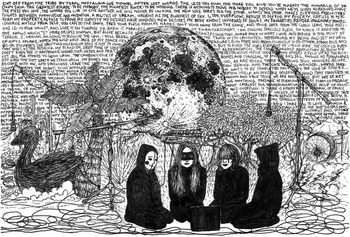
A drawing by Eleanor Bauer captures the mood of Meyoucycle, with the four performers as in “Dark Letters,” the blow-up palm trees and swan, the hanging mics from “A New Factory,” the giant moon, and the lines from “The Less You Own the More You Give.” Kaaittheater Brussels, 2016. (Courtesy of Eleanor Bauer)

As such, Meyoucycle does contain a noteworthy dose of humor and messages of love and cohesion: the dark is counterweighted by the light. In the light, karaoke is employed to bring people together, to actively engage the audience to work through negative feelings together, encouraging solidarity by acknowledging that these are in fact not individual issues. Rather, they are structural problems that can and should be dealt with on a collective level; sharing these feelings publicly is potentially a starting point for creating new forms of unity, as Cvetkovich claims. So perhaps, well aware that combatting neoliberal semiocapitalism through performing it (and thus commodifying it) conforms to neoliberal semiocapitalist ideals, Bauer and Peck deploy the weapons they have at hand to spread a message of love and social cohesion, to restore a sense of community among the me’s onstage and the you’s in the audience.
Still and all, the question remains: Who receives these messages if the performance occurs only a few times within the walls of a theatre venue? If the performance does not get to tour much because theatres cannot afford the performance fee that covers, among other things, the salaries of the dancers, musicians, and technicians? If the ticket price is rather high for the very same reasons? If theatre remains out of reach for most people and is therefore only a semi-public space? What is the efficacy of performing Meyoucycle if all it is doing is preaching to a select choir that can understand the codes of this poetry? With this, the moon continues its cycle.
But while she does, maybe ponder this: Ending the performance with karaoke reminds us (the you’s and me’s combined) of our seemingly merciless fate but also of our shared capacities to overcome that common fate together by forming an embodied human alliance. Ultimately, we need each other. And the experience of going to see this show offers just that: total pleasure in a social context. Meyoucycle does not just send the spectator home with an uneasy feeling, but with joy and a heightened sense of sociability. The latter ties back to the cabaret concept, because the genre presumes close contact with the audience and in fact demands a nimble intelligence, critical reflection, and a sense of humor from them. Most importantly, cabaret is always a good night out. And this is what Berardi cannot offer: the embodied experience of sociability in the here and now. Despite the dystopian poetry, I left the theatre energized with renewed hope while sharing a beer in the foyer with fellow spectators, neighbors, and strangers alike. Even though the heightened sense of social cohesion might only have been temporary and in small community, just reading Berardi, I did not experience anything like this.
The essential elements of our poetry will be irony, tenderness and rebellion.
— Franco “Bifo” Berardi, “Manifesto of Post-Futurism” ( Reference Berardi2009a:136)