INTRODUCTION
Contracts are unusually important in international sovereign debt markets, which suffer frequent crises, but have no bankruptcy institutions capable of overriding contracts and brokering a debt restructuring. A single word in a defaulted bond contract, fifty-five pages long and twenty years old, led a nation of forty-one million people to default on $29 billion in new debt (Gilsinan Reference Gilsinan2014). An audacious debt collection lawsuit against Argentina hinged on the word “payment” in a clause named “pari passu” (“equal step” in Latin). The suit cut the government off from the international financial markets until it paid up. Long after most of the other creditors had reduced their claims on Argentina, a small group of free-riders reaped spectacular returns.
Governments could have deleted the word “payment,” or even the whole pari passu clause in new debt, when its offensive potential first became apparent in a lawsuit against Peru in 2000 (IMF 2013). Yet it took almost fifteen years to begin shifting market standard formulations of the clause (Choi et al. Reference Choi, Gulati and Scott2018).
Two explanations for the slow pace of sovereign debt contract change dominate the literature. The first maintains that change is undesirable in light of limited contract enforcement, a fact of life in sovereign debt (Eaton and Gersovitz Reference Eaton and Gersovitz1981). Rigid modification and strict enforcement terms respond to creditors’ worries about inability or unwillingness to pay: by making default more painful for the debtor, they function as a commitment device (Bratton Reference Bratton2006; Bolton and Jeanne Reference Bolton and Jeanne2009; Kahan and Leshem Reference Kahan and Leshem2017). The second explanation points to the “stickiness” of contract terms (Financial Markets Law Committee 2005; Gulati and Scott Reference Gulati and Scott2013). Here change is genuinely desirable, including from the collective perspective of sovereigns and their creditors, but does not happen for reasons that remain to be explored.
If stickiness is a factor in sovereign debt contracting, understanding how it works could help manage debt crises. However, research on stickiness is far from consensus. Any or all of the following theories—as well as commitment—could explain governments’ reluctance to change their contracts. Learning externalities encourage waiting until the meaning of the term is settled in the markets and the courts. Network externalities require coordination of contract changes across the relevant market. Fear of signaling adverse information may deter first movers. Poor lawyering and similar agency problems may foist ill-fitting boilerplate on unsuspecting parties. Meanwhile, the high cost of switching to new terms might make an imperfect contract good enough for a long time.
Empirical work so far does not help predict which terms might be sticky, in which contracts, and why. An early account of learning and network externalities surveyed twenty-seven covenants in 101 corporate bonds, and found that underwriters, but not lawyers, diffused learning and coordinated market-standard contract terms (Kahan and Klausner Reference Kahan and Klausner1997). A quantitative study of eight corporate bond terms found stickiness when the same lawyers and underwriters were involved in the primary offering (De Franco et al. Reference De Franco, Vasvari, Vyas and Wittenberg-Moerman2014). Gulati and Scott (Reference Gulati and Scott2013) used data on the pari passu clause in sovereign bonds, alongside interviews with lawyers, to test learning, network, negative signaling, transaction cost, and a handful of behavioral theories, among others, and cast doubt on all of them. However, their study did not settle on an alternative theory of stickiness. They suggested lawyer-client agency problems as the most likely explanation, but their results were incomplete because they did not interview principals (clients). No empirical study investigates how parties to the contract—debtors and creditors—approach standard terms—an odd omission, since so many theories imply divergent views of contracts among principals and agents.
Research on contract stickiness is grounded in law and economics scholarship, and does not stray far beyond it. Socio-legal contract theorists traditionally have paid scant attention to standard-form contract change, perhaps because they focused on the contract relationship to the near-exclusion of the contract document (Suchman Reference Suchman2003). Foundational work by Macaulay (Reference Macaulay1963) and Macneil (Reference Macneil1974) nonetheless holds useful insights for the stickiness puzzle. By separating the relationship from the document, relational contract theorists make it plausible for contract relationships to vary across a market and change over time, while the documents stay the same. However, this insight fails to account for the resources invested in the production of contract documents, and the fact that standard terms do change, if rarely and slowly.
A more recent intervention by Suchman (Reference Suchman2003) addresses this gap in socio-legal theory by interpreting contract documents as “social artifacts,” which perform both the “technical” function of ordering relationships, and the “symbolic” function of communicating ideas. This dual functionality broadly resembles commitment and signaling in economics. A critical difference, however, is that the technical and symbolic functions of contract-as-artifact need not be linkedFootnote 1—whereas in economics, the signal is intended to reveal information that is directly relevant to the parties’ commitment. If the technical and the symbolic can “work at cross-purposes,” standard terms in sovereign debt contracts can effectively convey ideas about the structure and legitimacy of the sovereign bond market, borrower status, the nature of the underlying transaction, or all of the above—without necessarily altering the debtor-creditor relationship (Suchman Reference Suchman2003, 114, 132). Contracting parties adopting a new term therefore must weigh its technical and symbolic aspects separately, and may have to make tradeoffs between the two.
We depart from the existing literature on stickiness in several ways. We shift the focus from agents to principals—sovereign debt managers and buy-side investors—and use interviews and participant observation to get a fuller understanding of the tradeoffs embedded in the parties’ choice of standard terms. We asked debtors and creditors how they went about choosing contract terms and how they dealt with contract change. We report on interviews with debt managers in twenty-eight low-, middle- and high-income countries. We also interviewed their contract counterparties, investors in sovereign debt at thirty firms, ranging from global financial conglomerates to very small specialized funds based in the United States, Europe, and Asia. In this article, investor interviews help contextualize our findings with respect to the debt managers; we leave a fuller examination of investor views for a companion project.
We do not claim that our interlocutors’ stated reasons for choosing their contract terms are necessarily the “real” reasons. As we point out in the text (and sometimes in the interviews), many of the explanations they offered did not hold up to scrutiny. None of what we heard about contracting motives need be taken at the extreme, the reader can proceed with the assumption that everyone tried to spin us. Even so, what we heard on multiple occasions was plainly inconsistent with some, but not all, economic theories’ predictions of what our interlocutors might say—or how they might try to spin us—under the circumstances.
Asking debtors and creditors to describe in their own words the categories, hierarchies, and practices of the sovereign debt ecosystem shed light on how they sought to be perceived in relation to them. We could then examine the symbolic (communicative) function of contract terms side by side with their known technical function (Ho Reference Ho2009, 30–31; Dezalay and Garth Reference Dezalay and Garth1996, 17).
Three themes emerged: (1) Debt managers and investors alike expressed a preference for standard-form contracts, a preference so strong that the form’s content often came across as secondary. In some cases, adherence to a “market standard” was the stated reason for resisting change even when there was no clearly defined standard, or more than one market standard, for a given term. (2) Very few debt managers listed contingency planning for restructuring as a factor in selecting non-financial contract terms. Contract design had to reflect the imperative of steady market access for the sovereign and in many cases, for other borrowers in the country, who relied on government debt as a benchmark. (3) Debt managers explained their choice among market standards by reference to their issuer cohort, citing other countries targeting similar investors and facing broadly similar challenges.
Our findings are open both to economic and socio-legal interpretations of slow contract change. Debt manager accounts echo the stickiness hypothesis and a subset of signaling explanations in economics. They also comport with the socio-legal notion that contract documents are distinct from contractual relationships, and perform multiple functions in them. In line with economic theories that emphasize information asymmetries (Johnston Reference Johnston1990; Spier Reference Spier1992; Ben-Shahar and Pottow Reference Ben Shahar and Pottow2006), debt managers for the most part attributed their reluctance to deviate from suboptimal “standard” terms to the risk that investors might draw negative inferences about their governments in particular. Despite our prodding, agency problems, network, and learning externalities barely came up. Debt managers and investors also rejected the view that non-financial contract terms could reduce borrowing costs or attract more investors at the margin by reducing debtor moral hazard or signaling the debtor’s ability and willingness to pay (cf. Shleifer Reference Shleifer2003; Kahan and Leshem Reference Kahan and Leshem2017; Demiroglu and James Reference Demiroglu and James2010). In line with socio-legal theories, debt managers used standard terms to communicate membership in a cohort of sovereign borrowers, and were reluctant to adopt new terms for fear of inadvertently associating with a lower-status cohort. In economic terms, contract standardization supported a pooling equilibrium, where all issuers within the cohort send the same signal to conceal private information.
Standardization as such communicates public meanings (Suchman Reference Suchman2003): continuity of the debtor-creditor relationship and consensus on market practices, including not using “legal” (non-financial) terms to reveal private information. Debt managers moreover conveyed the sense that non-financial contract terms were singularly unsuited to revealing private information to investors. They characterized the stakes in the information game as exceptionally high: market disruption from a negative inference could damage the country’s and the debt manager’s reputation, and have spillover effects beyond government finances. The risk of current disruption came across as more salient than any conceivable fallout from having fewer options in a hypothetical future debt restructuring. Another way to characterize standard terms, then, is as “placeholders” (Riles Reference Riles2011) that allow government debt managers to borrow, and the market to function, without a fully articulated mechanism for handling debt distress.
Our study also suggests how non-financial terms in sovereign debt contracts change when they do. Debt managers are most receptive to contract reform when it would convey no private information or change of status to the market. One option is for politicians (debt managers’ bosses) to coordinate a market-wide boilerplate shift that maintains everyone’s relative position. High-profile changes in sovereign debt contracts discussed in this article all resulted from coordination at the highest political levels. Another is tinkering under the cloak of standardization. If debt managers convince investors that non-financial terms are uninformative, they can experiment with technical innovations, even those that could have substantive implications for the debtor-creditor relationship. Here the narrative and appearance of standardization is more important than actual conformity to any particular standard.
BACKGROUND
We usually began our interviews with questions about two kinds of non-financial terms in sovereign bond contracts. Collective action clauses (CACs) permit bondholder majorities to bind dissenting minorities in a restructuring vote. The pari passu clause puts a subset of claims against the sovereign on equal footing, but its practical application is perennially in dispute. Small groups of investors in defaulted sovereign debt have used pari passu several times since 2000 as a collection tool, disrupting payments on new or restructured sovereign bonds. Governments paid off the free-riders to avoid metastasizing default.
Policymakers and market participants came to rely on CACs and pari passu clauses to fill gaps in sovereign debt restructuring and enforcement institutions, respectively (Gelpern and Gulati Reference Gelpern and Gulati2006). These clauses were at the center of three recent waves of policy intervention in sovereign debt contracts: 2001–2003, 2010–2013, and 2012–2015. Each wave responded to different market, policy, and judicial interpretation shocks; however, they shared a broad objective—to make it harder for creditor minorities to disrupt a bond restructuring (Gelpern et al. Reference Gelpern, Heller, Setser, Martin, Antonio Ocampo and Stiglitz2016). Each wave brought new model CACs; only the third wave also addressed pari passu.
The first wave followed a string of emerging market crises. It targeted nearly $300 billion in emerging market bonds governed by New York law, where drafting custom had required unanimous consent to amend bond terms. Beginning with a February 2003 issue by Mexico, most new sovereign bonds issued in New York adopted CACs. This change from unanimity to majority vote was the most contentious and the most symbolically important of the three, but it was modest in substance (Gelpern and Gulati Reference Gelpern and Gulati2006). The CACs introduced in New York had long been customary in London. They operated at the level of a single bond series (identical bonds usually issued together), and remained vulnerable to free-riding. An investor could buy a blocking position of 15–25 percent in a small series for pennies on the dollar, force that series out of the restructuring, and sue for full principal, plus past-due interest, while others settled for a fraction of their claims.Footnote 2
The second wave of policy intervention was part of Europe’s early response to the Greek crisis, first mooted in 2010. It took effect beginning in 2013 under the treaty establishing the European Stability Mechanism (ESM), and was by far the largest in scope. If implemented as planned, the change would eventually cover all medium- and long-term Euro area government debt securities, more than $10 trillion in stock, mostly issued under each debtor’s domestic law. The second wave included the possibility of “aggregation,” a bankruptcy-style voting procedure where multiple bond series vote together. This version of aggregation still required two steps: each series’ vote would be counted, alongside the aggregated stock vote. However, the threshold for a single series to escape restructuring rose above 50–55 percent.
Motivation for third-wave reforms came from the Greek debt restructuring in March of 2012 and scorched-earth enforcement litigation against Argentina, which escalated throughout that year. New model clauses for foreign-law bonds were published by the International Capital Market Association (ICMA) in August 2014 as an update of its 2004 model. The new “ICMA CACs” were launched in a working group convened by the US Treasury, in consultation with the International Monetary Fund (IMF), European and emerging market governments, investors, investment bankers, lawyers, and academics (including two of the authors). ICMA CACs made it possible to dispense with votes by individual series. If the debtor followed certain safeguards, only the aggregated vote would count. There was no room for free-riding: if 75 percent of the polled stock agreed, all would restructure; if the vote fell short, none would. ICMA also broke new ground with a revised pari passu clause, which disavowed Argentina-style enforcement. This third and most robust wave of policy-driven contract change drew little public controversy (Gelpern et al. Reference Gelpern, Heller, Setser, Martin, Antonio Ocampo and Stiglitz2016).
According to the IMF, 87 percent of all foreign sovereign bonds (by volume) issued between October 2014 and end-September 2017 had adopted third-wave ICMA CACs (IMF 2017). By the end of this period, ICMA CACs represented 27 percent of the trillion-dollar stock of outstanding foreign-law bonds, issued by 65 sovereign governments. Most of the remainder contained first- and second-wave CACs and unmodified pari passu clauses. Less than five percent of outstanding bonds had no CACs at all, and had not altered the pari passu clause.
Countries that issued foreign-law bonds during the IMF survey period, but did not use ICMA CACs, fell into two groups. First, Euro area countries that had adopted two-step aggregated voting in 2013 were loath to switch again so soon, for reasons we explore below. The second group had nine mostly middle-income issuers, down dramatically from twenty-seven countries only a year earlier. Nonetheless, some non-adopters were important emerging market borrowers, including Lebanon, Korea, the Philippines, Poland, and Hungary.
In sum, bond contract reform proceeded in fits and starts, and took a long time even after problems with the old contracts had been identified and consensus alternatives were put forward.Footnote 3 This history is consistent with stickiness, although it does not foreclose the possibility that debtors and creditors had other motives for resisting new CACs and pari passu.
We opened our interviews with CACs and pari passu because we could be confident that all our interlocutors had heard of these clauses and the theoretical case for reform. Most had had to decide whether to adopt or reject the latest version of CACs and pari passu, to consider how the adoption process might work in their countries, and to ask whether and how the new clauses might be priced.
We knew from prior research that officials involved in all three waves of reform worried that new terms would raise borrowing costs for sovereigns. Expectations of a price penalty could have justified resistance, and found ample support in economic theory. Lower amendment thresholds in CACs give debtors more restructuring options in distress, while looser pari passu clauses could make default less painful. The specter of debtor moral hazard, a temptation to default strategically or to take policy risks when losses fall on the creditors, should lead creditors to stop lending or charge a higher interest rate for new clauses (Shleifer Reference Shleifer2003). Yet, studies find scant and contradictory evidence of price penalties for new clauses, and no study has found an impact on market access (Häseler Reference Häseler2009).
In our interviews, we sought to flesh out the range of contracting parties’ explanations for embracing and rejecting change and to understand whether and how stickiness fit in. In Part III we begin by describing our approach to the interviews and the sovereign debt market. We then discuss key themes in our findings.
INTERVIEWS
This section draws primarily on conversations with representatives of twenty-eight sovereign debt management offices (DMOs), thirty buy-side investment firms active in the sovereign debt market, and sell-side researchers at six investment banks. Debt managers interviewed for this project came from countries with per capita GDP from $10,000 to over $60,000, sovereign debt stocks from $60 billion to over $15 trillion, and sovereign debt ratings from speculative to top-notch at the time of our meetings.Footnote 4 Eighteen countries were part of the European Union, including thirteen members of the Euro area; six were non-European emerging market economies; four were non-European high-income countries.Footnote 5 Buy-side investors ranged from small, highly specialized funds that focus on distressed sovereign debt, to some of the largest asset managers in the world, overseeing multi-trillion dollar client portfolios.
Most of our interviews with debt managers took place between November 2014 and February 2018; interviews with sell-side analysts and buy-side investors began in November 2015, but were concentrated in 2017. Forty-one of the interviews were conducted jointly by two of the three co-authors; the remainder were conducted by one.Footnote 6 We typically requested meetings by email using our academic affiliations and a reference from a mutual professional acquaintance. We promised not to identify our interviewees or attribute their remarks owing to the combination of market and political sensitivity of the subject matter at the time. Most of the interviews took between one and two hours, with two to ten people participating. We took contemporaneous notes, and later transcribed and compared them.
With debt managers and investors alike, we introduced our interest in contracts, contract change, and contract pricing, citing examples from current events we thought might be of interest to them, such as crises in particular countries, high-profile litigation, or the latest contract reform initiative. We did not follow a fixed script, so as to let our interlocutors identify issues that were important to them and organize their accounts using their own terms and categories. We sought to maintain consistency by asking each time what had driven contract change in the past, what it would take for the country in question to change its contracts going forward (or, for investors, to buy bonds with new terms), how the parties implemented contract change, and their views on the relationship between contract terms and pricing. In many cases, we followed up on the interviews by email, by phone, and in person. We supplemented interviews with participant observation in drafting groups, outreach meetings, and policy fora, and interviews with rating agency researchers, lawyers, civil society activists, current and former policymakers, and bankers.
The interviews shed light on the organization of the sovereign debt contracting ecosystem and cultural and political conflicts within it (cf. Smith and King Reference Smith and King2009). Even if we take none of the parties’ explanations of stasis and change at face value, reporting on how they talk about contracts helps identify shared practices in the sovereign debt market and formulate testable hypotheses for further study.
Conversations with Debt Managers
We sought to find government actors who made decisions about the form and content of sovereign bond contracts in the ordinary course. Legislatures tend to delegate debt policy to cabinet-level officials, such as finance ministers. Ministers tend to have a good grasp of their countries’ long-term borrowing strategies and near-term issuance programs, but are uninvolved in the daily market life of sovereign debt contracts (Gelpern and Gulati Reference Gelpern and Gulati2006, Reference Gelpern and Gulati2013). Debt managers straddle policy development and day-to-day operations. They often enjoy significant operational autonomy and make routine decisions about contract design. Debt managers are the presumptive point of contact with outside bankers and lawyers, and a conduit for information about the markets.
Finance ministries have traditionally performed debt management functions throughout the world, and continue to do so in countries as diverse as Brazil, Finland, France, Israel, Italy, and Mexico. Beginning in the late 1990s, more DMOs gained independence in policy implementation; some separated from finance ministries altogether (Datz Reference Datz2008). Sweden lays claim to the world’s oldest independent DMO, established as a distinct legal entity in 1789; Ireland’s National Treasury Management Agency is more typical, reorganized as a separate entity outside the finance ministry in 2014. In a handful of countries, such as Denmark, central banks implement debt policy for the government. Debt management may also be divided among the finance ministry, the central bank, and an administrative agency or bureau. Canada, Germany, Slovakia, the United Kingdom, and the United States all have debt management functions in two or more government offices.
DMOs range in size from less than twenty to more than a hundred staff members. Some perform multiple services for the government, such as fiscal agency and asset management; others focus narrowly on government borrowing. DMOs have front, middle, and back-office functions, mirroring the organization of financial institutions with which they interact. The front office is responsible for investor relations; the middle office designs transactions and risk-management strategies; the back office effects settlement. Where dedicated research and legal functions exist, they reside in the middle office.
Debt managers’ status varies by country. In some countries, a management-level DMO appointment can be a stepping stone on the way to becoming a finance minister or central bank governor; elsewhere, it is a bureaucratic rotation. DMO heads are usually sub-cabinet-level officials, with status ranging from office director to assistant secretary-equivalent in the United States. Most come either from economic or financial policy positions within the government, central banks, or financial firms dealing in government securities. The drive to greater institutional independence at the turn of the century also emphasized professionalization. DMOs have sought to attract more staff with market experience, pay more competitive salaries, and reshape their communications and investor relations functions to reflect market practice (Datz Reference Datz2008). Nonetheless, it is still common to hear debt managers stereotyped as unimaginative and chronically inflexible, in contrast to the image of cutting-edge, research-driven central bank staff.
In most cases, our initial DMO meeting request was addressed to the senior official in the office. We interviewed debt managers for twenty-six countries in person at their offices; we met with debt managers for two other countries on the margins of international gatherings. In all cases, our principal interlocutors worked either in the front or middle office. The DMO head or deputy head took part in all but three interviews. Up to ten people participated in the office meetings; usually at least one had a graduate degree in economics. In four cases, our interlocutors had specialized training in econometrics. In-house lawyers joined approximately half of the meetings; in a handful of cases, we spoke with them separately.
In each case, we asked our hosts about specific terms in their debt contracts. We also mentioned the results of recent pricing studies of CACs and pari passu clauses. We made no attempt to hide our own views of these studies: one of us was invested in their validity, while the other was skeptical of their findings.
Debt managers come across as a cohesive community.Footnote 7 They gather several times a year in regional subgroups and at broader conferences hosted by the IMF and the World Bank. Many know one another in person and by reputation; this holds especially for debt managers from the same region. Our interlocutors often said unprompted that meeting their counterparts from other countries helped them solve common problems and keep abreast of market developments. The sentiment was not limited to debt managers from poor or crisis-stricken countries.
“We Think of Ourselves as Standard”
Neglect is a common explanation for stickiness in the literature. The lawyers’ “copy and paste” description of contract drafting (e.g., Gulati and Scott Reference Gulati and Scott2013) and market participants’ “nobody reads contracts” description of investing (e.g., Gelpern and Gulati Reference Gelpern and Gulati2006) both suggest agency problems. The principals (here, debt managers) rely on outside lawyers to change their contracts as appropriate. If debt managers wanted to adopt new CACs and pari passu right away, stickiness would be the lawyers’ fault (Gulati and Scott Reference Gulati and Scott2013). We tried to tease out whether debt managers had views on contract change apart from their lawyers’ views on the desirability of any particular term.
Everyone we interviewed knew about recent CAC and pari passu debates, although their familiarity with the operation of these and other contract terms varied. Once we established a threshold level of comfort with the contents of their respective governments’ contracts, we asked about recent shifts and variations, especially if they appeared unusual next to those of similarly situated issuers.
In one exchange with debt managers for a top-rated European issuer, we asked why the government’s English-law contract contained detailed commitments to recognize and compensate creditor committees in the event of default and barred the government from offering differential inducements to bondholders in a restructuring vote. The same contract lacked such basic investor protections as cross-default and negative pledge covenants.Footnote 8 Without cross-default, creditors must sit helplessly while others seize the debtor’s scant assets. Without negative pledge, creditors cannot stop the government from signing away its tax revenues as collateral for new borrowing. On the other hand, creditors can form a committee with or without specific contract terms to that effect. If this government’s creditors sought to bolster its commitment to repay, they had chosen an odd way to go about it.
Neither the DMO head nor the in-house lawyer who met with us could remember negotiating the terms that had stumped us. They recalled that the government first introduced them in its contracts around 2004, when the European Union had made a “political decision” to include first-wave CACs in foreign-law bonds.Footnote 9 At the time, ICMA produced a model CAC, including a committee clause to address creditor concerns with recent emerging market restructurings. On the other hand, cross-default and negative pledge clauses were beyond the scope of the model clause project. Our hosts speculated that their government adopted ICMA’s 2004 model on the understanding that it was the new market standard, but left the rest of its contract untouched. The debt managers might have gotten a question or two from investors about negative pledge over the years (no one remembered for sure), but felt no pressure to change contracts in response.
Market standard explained some, but not all of the contract. For example, publicly available data showed that the committee clause had indeed become common for English-law emerging market bonds, which also included cross-default and negative pledge. They were uncommon for top-rated European sovereigns, which continued to issue under their own law with minimal investor protections. In the New York market, the clause was rare even among the poorest issuers. In other words, the right London market standard for this wealthy country was far from settled. It also turned out that our hosts had not adopted the 2004 ICMA model wholesale. They rejected the model’s requirement of unanimous creditor consent to change governing law, but added a bespoke term promising not to pay bondholders to vote for a restructuring.
While their contract text suggested creative lawyering, customization, and complex tradeoffs, these debt managers’ rhetoric was all about simplicity and standardization: “We must follow the market practice.… The bottom line for me, what do we want to create—something simple.… We think of ourselves as standard.”
Other debt managers voiced a similar sentiment. Officials with one government, so popular with investors that it was struggling not to borrow, nevertheless stressed the need for its contracts “not to stick out.” Debt managers for an emerging market that had the opposite problem, borrowing continuously in half a dozen markets to keep refinancing risk at bay, described their goal as “international standard, language accepted for an issuer like us.”
Being seen as using standard-form contracts apparently brought a sense of legitimacy to the government’s debt management practices. At a debt policy forum, one European official offered an analogy:
If it is a car, it has to have four wheels; if it has three wheels, it is not a car and no one wants it even if it works better—at least not until everyone begins to understand that cars now have three wheels.
Debt managers’ apprehension about using deviant boilerplate evoked Zuckerman’s (Reference Zuckerman1999) study of analyst coverage and stock prices. He showed that firms falling outside established industry categories faced what he described as a legitimacy gap, which in turn depressed their market valuations. We sensed that our interlocutors similarly valued perceptions of conformity to recognized standards. Whether actual conformity mattered to them was hard to tell. Some of the terms they described as simple and standard came across as neither to us.
In two cases, we complimented our hosts on their contract innovations. Our overtures were met with quizzical looks around the table: DMO officials said that they had not intended to innovate, and did not think they had. After one meeting, the official escorting us out of the building said with a smile that all the talk of standard brought to mind a musical analogy: “Tradition… is the last badly played concert you remember.”Footnote 10 The quote seemed to cast a new light on his earlier observation that “one can be standard in different ways—with the market, with one’s prior issuance… our investors have not complained… so there is no need to change.” The imperative was to appear standard to investors. Being standard was another matter. Between the two, there was room to maneuver.
In theory, everyone was willing to vary contracts to manage risk and lower borrowing costs; however, debt managers without exception said that giving covenants a prominent place in a government’s debt strategy was a bad idea. Even if it saved money now or added hypothetical restructuring options later, shining a spotlight on contracts was bound to backfire. If they became salient, contract terms would have to be managed as signals and symbols each time the government tapped the market, complicating DMOs’ funding strategies.
We asked several debt managers whether they would consider hiring lawyers for their skill in designing contracts to manage sovereign debt distress. All rejected this possibility, although none professed special loyalty to their counsel, and some had recently switched law firms. We suspect that appearance matters here as well: no one would be seen hiring skilled restructuring lawyers to draft their contracts; by the same token, no one would signal commitment by dispensing with lawyers altogether, or hiring lawyers visibly lacking relevant experience.
A well-regarded former debt manager for a large Latin American government in the 1990s summarized the practice in retrospect: “There is strawberry flavor. You might like chocolate [or] plain vanilla… but…. ” In his experience, government bond reality was a Soviet ice cream cart, which bore little resemblance to contract theory’s vision of a California ice cream parlor.
What to make of this dogged invocation of “standard” as a binding constraint against the background of ambiguous and shifting standards, and evidence of occasional idiosyncratic deviation, perhaps even creative lawyering? In public, officials owned up to innovating only when it led to a shift in standard: then deviance became “market leadership.” On the flipside, there was room for quiet innovation, so long as it did not upset the “standard” narrative. Debt managers readily used contract standardization to blend in (pool) with sovereign borrowers in the same cohort. No one would argue that creditor-friendly contracts would help the sovereign stand out as uniquely virtuous in its cohort.
What Would It Take for You to Change…?
The fact that debt managers expressed reluctance to deviate from established contract standard indicated that, at best, agency problems did not fully explain slow change. Governments hired lawyers in important part to identify and adapt standard terms. Drafting creativity either had to be squelched, or hidden behind a drab curtain. This did not preclude change: individual governments altered their contracts in major ways (e.g., Gelpern 2013), and our own project followed on the heels of salient, market-wide shifts. If we found out what made debt managers embrace change, we could shed light on additional stickiness theories and policy prescriptions.
A New Adoption Puzzle
Beginning in October 2014, IMF shareholders charged its staff with promoting ICMA CACs and model pari passu clauses in foreign-law bonds. As part of this mandate, staff collected data on new issuances and surveyed debt managers in member countries (IMF 2015, 2016, 2017). They found that the pattern of adoption in this third wave of contract reform differed from the first two waves, which it claimed for inspiration. Above all, there appeared to be no first-mover problem. After CACs were mooted in a 1996 official report, it took seven years of cajoling, another crisis, a new and intense drafting-cum-arm-twisting campaign, and the threat of a sovereign bankruptcy treaty for Mexico to lead a market-wide shift in New York. In 2014, the ink had barely dried on the IMF executive board endorsement of ICMA CACs before adoptions began in countries as different as Kazakhstan, Vietnam, and Mexico. The speed of these early adoptions made pockets of resistance more notable.
IMF surveys revealed a mix of switching cost-consciousness and ill-defined apprehension among non-adopters. Governments with established borrowing programs, where a single umbrella contract governs multiple bond issues for five years or more, would not amend it ahead of schedule to keep up with the ICMA model. They were reluctant to pay lawyers, slow down the issuance process, and risk hurting the fungibility (hence liquidity) of securities with identical financial but different legal terms—to insure against what they described as a remote contingency. On the other hand, most of the governments that launched new issues or established new continuous borrowing programs did change their contracts (IMF 2016). The rate of adoption was slightly higher in New York than in London, an effect IMF staff had attributed to the prevalence of Latin American issuers in the New York market and their tendency “to move together as a group” (IMF 2016). Different interpretations of Sharia law explained the absence of ICMA CACs in some but not all sukuk bonds issued in London. Officials in some poor countries came across to IMF staff as unfamiliar with the new clauses and foggy on their functions. A few small and infrequent sovereign borrowers in the London market said that they had no use for the principal innovation of ICMA CACs, the single aggregated voting pool, because they had too few bonds to aggregate. Outreach and training seminars targeted poor countries in Africa, investment bankers in New York and London, and everyone in between.
We visited a handful of DMOs for non-adopting countries in the IMF surveys, as well as several governments that had not borrowed in the survey time frame. Officials told us that they were not rushing to embrace the latest model clauses. They highlighted uncertainty about the path of standardization in general, and choosing a standard that would be appropriate for them in particular. One debt manager, a seasoned professional with a highly-rated, high-income borrower outside the Euro area, wanted to wait for market practice to solidify: “Let them fight their fights. When the lawyers settle … they have the fights, we copy.” Debt managers for countries in line for Euro accession struggled with its potential implications for their contract choices: if they decided to join the monetary union, they might have to switch to Euro area model CACs (Euro-CACs) later. One such debt manager speculated that in the worst case, they could end up with three different versions of CACs in their bonds, sowing confusion and impairing fungibility.Footnote 11 In 2015, both debt managers chose to stick with a mish-mash of old standards while waiting for a new one to take hold.Footnote 12 By the 2017 IMF survey, the richer country had shifted to ICMA CACs.
None of the reasons cited by non-adopters went to the capacity of the clauses, old or new, to facilitate a debt restructuring. They could have worried about the merits privately, consistent with the commitment theorists’ admonition against making default less painful. However, the wonky, technical reasons they gave us for rejecting change as such tracked the reasons cited in the IMF surveys, and suggested stickiness: debtors would consider revising non-financial terms as part of routine housekeeping (new shelf registration), and if they were convinced that the market standard had settled sufficiently.Footnote 13 If non-adopters had been motivated by their desire to signal commitment to repay, they might be expected to advertise it, or at least not to dismiss and obscure the subject of commitment by citing transaction costs and disagreements over the standard.
A New iPhone
As international officials began to contemplate the third wave of contract reform in 2012, Euro area representatives were dead set against revisiting the Euro-CACs, due to launch at the start of 2013. Debt managers fumed about having sunken countless hours and euros into their clauses at the politicians’ behest, even enacting new legislation, only to face the prospect of a new market standard. “Reopening the grave” was not in the cards, they said.
Officials with responsibilities beyond the Euro area found themselves in a politically awkward place. Their participation in what became the ICMA CACs initiative implied that Euro-CACs were inferior to ICMA CACs, even though they ostensibly targeted different kinds of debt. Euro-CACs applied to local- and foreign-law debt, while ICMA CACs steered clear of local-law debt that made up nearly all of Europe’s debt stock. A Latin American official privately quipped that Europeans griping about the latest CACs sounded like the fellow who had paid a fortune for the last iPhone model, only to see a new one come out the next day.
Official talking points swerved from arguing that different issuers should have different contract terms, to the seemingly contradictory view that investors did not differentiate among different flavors of CACs. A Euro area official insisted to one of us on the margins of a debtor-creditor forum,
The markets want to see that we have the latest standard forms. Aggregated CACs are now part of the standard; but it does not matter whether those are Euro-CACs or ICMA CACs or Greek CACs or Bolivian CACs.
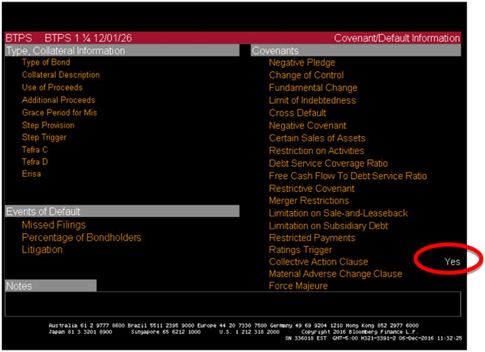
This view finds some support in market practice. For example, a Bloomberg bond covenant screen used by many investors simply reports whether a bond issue has any CACs; it ignores voting thresholds and aggregation (Fig. 1 below). A buy-side investor and a trade group representative reportedly tried but failed to get a covenant service to distinguish between different kinds of CACs (for example, specifying “ICMA CACs” or “Euro-CACs”). A person who participated in the call told us that the service provider declined: it did not foresee sufficient demand for the information to warrant additional investment.Footnote 14
A Bloomberg Covenant Screen
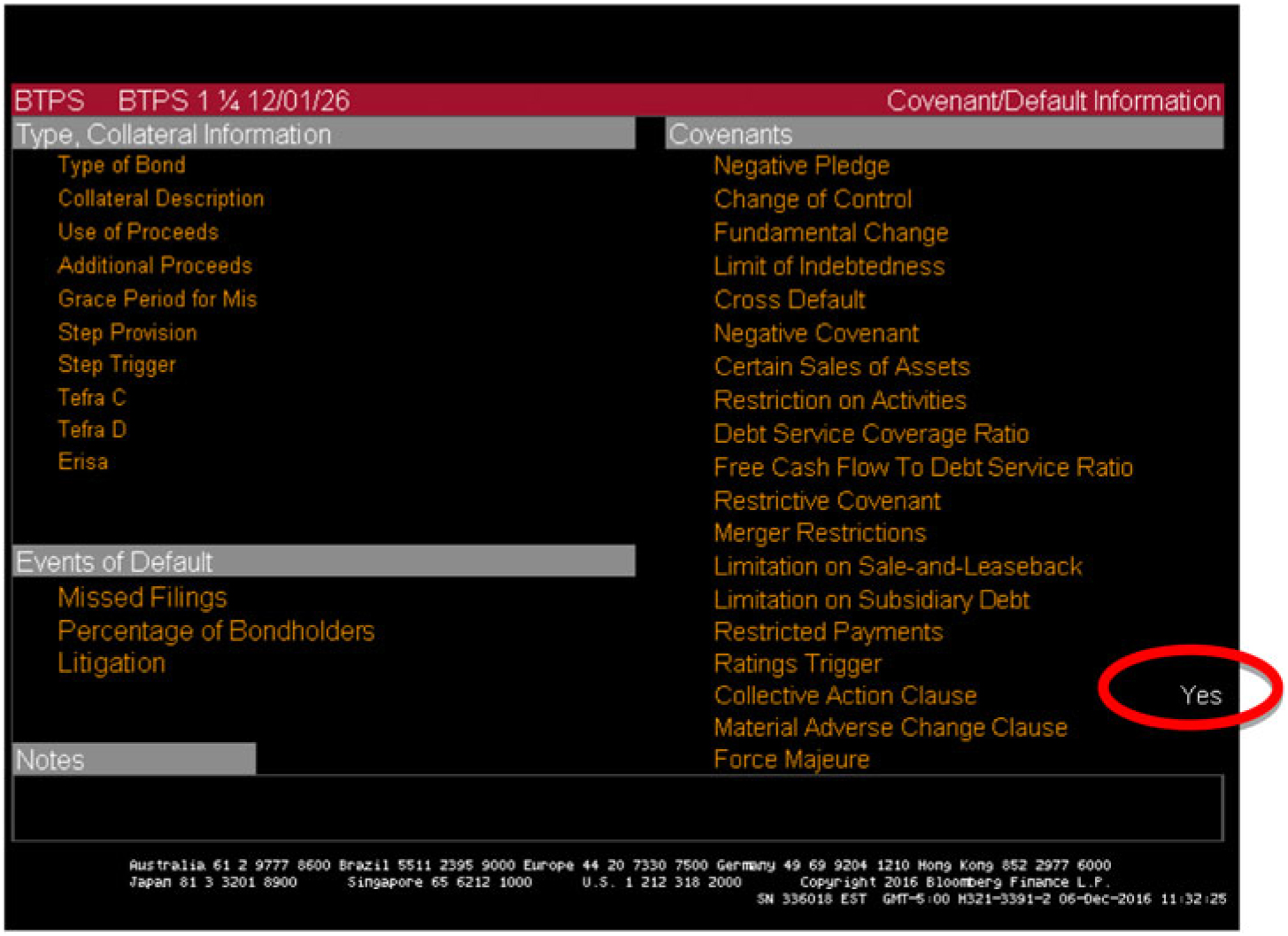
If investors cannot tell the difference, why should issuers not adopt the latest state-of-the-art CACs and pari passu clauses, or the most debtor-friendly clauses available, quickly and quietly? Under the ESM treaty, Euro area sovereigns were committed to having substantively identical CAC; so long as they moved in tandem, they could change their CACs as often as they wanted, at least in theory. And the treaty said nothing about pari passu, leaving member states free to adopt any form of the clause (or none). To that end, several Euro area officials had asked us for updates on ICMA’s new pari passu language. Nonetheless, no one rushed to take advantage of investor inattention.
Some European officials’ initial expressed aversion to revisiting the Euro-CACs suggests a transaction costs explanation: endless meetings, costly lawyers, and legislative activity could add up to a formidable barrier. At least one finance ministry official made a compelling case that for his country, national legislative barriers were insurmountable just then. However, by late 2016, Euro area policymakers were openly discussing a shift to ICMA CACs (Mersch Reference Mersch2016). By 2017, the debt manager for one of the biggest sovereign borrowers in the Euro area shrugged and said “Maybe” to the idea of adopting ICMA CACs. In June 2018, France and Germany publicly came out in favor of adoption; soon after, other Euro area countries agreed to consider it. Had the transaction costs dropped?
Apparently, not all change is toxic, and not all change that starts out as toxic remains toxic forever. Transaction costs, uncertainty, and unfamiliarity might have receded between 2012 and 2018 thanks to intensive official and industry coordination work. As learning set in, the new standard came to look more useful than scary. This begs the question—what would it take for debt managers to change boilerplate without official and industry coordination?
Helmet Head
It was axiomatic among our interlocutors that a country like Germany would suffer no penalty for using ICMA CACs in place of Euro-CACs. At the time of our interviews, people paid to lend money to Germany; it could borrow with dead ferrets for contracts. People shook their heads and rolled their eyes at the suggestion that non-financial covenants could impact Germany’s willingness to pay. This implied that adopting ICMA model clauses would be costless for top-rated issuers. If they were a functional improvement on the status quo, why not adopt them? Was the benefit so meager that it could not offset the transaction costs of reopening the boilerplate?
A debt manager for one small, highly rated Euro area sovereign offered the following comment on the IMF’s CAC outreach session:
They posed the question—would you add CACs? “Would you add a seatbelt to your car?” But for a very safe driver, it is like saying “wear seatbelts and a helmet.” … Would you buy a bond from a very strange guy, sitting in a building wearing a helmet?
This debt manager was already paying lawyers to redraft the pari passu clause as part of his government’s periodic documentation review, so that transaction costs were not an issue. He was under no immediate pressure to adopt ICMA CACs, since his government used Euro-CACs. Yet IMF advocacy had touched a nerve. His helmet analogy highlighted the risk of an adverse inference (Spier Reference Spier1992) from looking out of place. As one central banker observed, would an airline advertise its pilots’ superior crash-landing skills?
There were still-deeper worries behind the indignant reaction. Politicians and the IMF made non-financial contract terms salient for the sake of riskier borrowers. What if investors associated CACs with inferior credit quality? They might imagine that our host’s country had moved down the credit ladder when it adopted the latest CACs. With another inflection of the euro crisis looming in the summer of 2015, this was not the time to experiment.
Meanwhile, small, poor, and poorly rated countries had a distinct set of worries. No drafting genius could cause their contracts to get lumped together with German bunds and UK gilts. Their reluctance to embrace the ICMA model came from a slightly different place. A lawyer for Ivory Coast, which kept its first-wave CACs in a new $1 billion, thirteen-year bond, told a trade magazine that ICMA’s standard would not suit his client:
This is obviously a constructive proposal from an important market player, but it isn’t a standard that has to be followed by everyone. … The CACs in this new deal were based on those in [Ivory Coast’s] first transaction, which in our experience with past transactions worked pretty well (Myles Reference Myles2015).
After observing that “there were no holdouts in Ivory Coast’s previous restructures,” the lawyer said that the new bond issue “demonstrates the need to customize CACs for any particular deal and issuer, and that ICMA’s proposal is a model rather than a template” (ibid.).
For the international policy establishment, Ivory Coast was the core target audience of ICMA CACs. The government borrowed under foreign law, restructured recently and repeatedly, and could hardly see debt distress as a remote contingency. The government’s lawyer—a partner with an international firm who had been involved in designing model CACs and knew exactly how they worked—had barely tried to defend the old CACs on the merits.
Perhaps Ivory Coast was trying to show extraordinary commitment to pay, contrary to stickiness theories. The record-setting tenor of the issue for Sub-Saharan Africa suggests a possible tradeoff consistent with commitment theories: investors gave the government a generous thirteen-year refinancing window in exchange for relatively rigid, modification-proof contracts.
Yet the public explanation in the trade press did not flaunt Ivory Coast’s rigid contracts or superior commitment. Instead, it tried to minimize the importance of its contract choice by arguing continuity (it worked well enough before). As the lawyers explained to us privately, their only consideration was a desire to “keep the prior standard documentation because the deal needed to go through without those involved getting distracted with arguments about legal terms.”
“Legal” terms could be a distraction—like the goofy helmet—and had to be made invisible as market standard, boilerplate continuity, or both. The European debt manager and the lawyer for Ivory Coast seemed to say that governments would rather limit their crisis management options than risk having their debt offering “stick out.”
The helmet analogy moreover suggests that using the “wrong” standard could reveal (or be misunderstood to reveal) inferior borrower type, raising the government’s borrowing costs even when there are no extra transaction costs. Bikers and race car drivers needed helmets; our interlocutors did not because they drove nondescript family sedans. Departing from cohort-standard documentation, or from past drafting practice, might be (mis)read as signaling a change in the country’s circumstances.
In both cases, the transaction costs of adopting ICMA clauses were likely minimal. Instead, resistance to change might be interpreted as signaling: if idiosyncratic terms would produce a separating equilibrium, then sticking to standard terms (however defined) would ensure that a pooling equilibrium prevailed. The helmet story is also about status, and not wanting to look foolish for fear of being demoted in creditors’ eyes.
Four Words
Although they often describe their colleagues as passive and powerless when it comes to sovereign debt documentation, buy-side investors did pay attention to the precise wording of ICMA CACs as adopted; some of them even demanded and got change. A 2015 incident involving Mexico is notable both for countering the stereotype of investors as sheep, and for investors’ insistence that their rebellion against Mexico was not about Mexico.
When it launched its ICMA clauses in November 2014, Mexico won praise as market leader—much as it had in the first wave of CAC reform (Sobel Reference Sobel2016). Back in 2003, Mexico deliberately made it hard to detect the price effects of its CACs by choosing an idiosyncratic maturity, with no benchmark to compare (Salmon Reference Salmon2001).Footnote 15 Mexico’s debt manager at the time later claimed that it had taken “three days working the phones” to fill the order book that would normally be oversubscribed in six hours. Yet in 2014, Mexico threw caution to the winds and put ICMA CACs and pari passu clauses in a $2 billion benchmark bond. The gamble paid off: the offering was more than twice oversubscribed, and broke the record for the lowest interest rate on a ten-year Mexican government bond (Diaz de Leon Carrillo Reference Diaz de Leon Carrillo2016).
More audaciously still, Mexico’s 2014 contracts did not simply mimic the published ICMA CACs, but sought to set a new standard for CACs and pari passu in the New York market. One of Mexico’s lawyers, who had been involved in the ICMA working group, described the difference as purely stylistic: London contracts were “woolly”; New York contracts were “homespun.” The two were supposed to be the same in substance.Footnote 16
After the bonds had been trading for several months, an in-house lawyer with the giant bond investor PIMCO pointed out in a public forum that Mexico’s riff on ICMA CACs was missing four words, which could make the clause vulnerable to abuse by the debtor (Scigliuzzo Reference Scigliuzzo2015). A former investment banker who attended the forum described a dramatic moment as the panel and the audience scrambled to explain the omission, and the market’s apparent failure to detect it earlier. Investors and commentators later bent over backwards to clarify that they were not worried about Mexico’s bona fides, but rather about the lesser credits that would surely copy its contracts. This was reasonable: by the time of PIMCO’s complaint, four other Latin American sovereigns had already adopted Mexico’s model;Footnote 17 in late spring of 2015, it became the basis for ICMA’s New York model CAC.
We heard later that a smaller fund manager had urged PIMCO to intervene at the forum, leveraging its market clout to draw attention to the issue. Mexico initially brushed off the concern as a drafting detail, and maintained its commitment to the substance of ICMA’s model. But within months, it amended the contract to insert the four words and “resolve the ambiguity.”
We pressed debt managers and investors to specify what abuse market participants had in mind when they raised concerns about Mexico’s contracts. There was consensus that no version of CACs would make default more likely; instead, investors said that lawyers might abuse CACs to reduce their recovery in default. For Mexico at the time, default seemed improbable, and loss given default was too remote to project. However, Mexico’s boilerplate had become something of a public good imbued with public meaning, at least in the Western Hemisphere (Gelpern and Gulati Reference Gelpern and Gulati2006). For riskier borrowers, recovery values mattered, and so did CACs. If the omission had been intentional and blessed by the multilateral establishment, it would have marked a shift in the power balance between debtors and creditors.
Three aspects of this incident are significant. First, it shows that investors know how to read their contracts even when the language is novel, and know how to change the terms when they care. On the other hand, the backstage maneuvering that reportedly preceded PIMCO’s intervention implies that asking for change can be costly, and investors choose their battles.
Second, it was evidently impolitic to say in public that contracts determined sovereign behavior vis-à-vis its creditors. At least for upstanding sovereigns like Mexico, contracts should not matter, evoking the classic account of Midwestern businessmen in Macaulay (Reference Macaulay1963).
Third and related, no one suggested that Mexico’s bond prices would have been affected had it refused to fix its ICMA CAC after discovering the four missing words. Nonetheless, Mexican debt managers saw the November 2014 contract as a big investment—like a home renovation that might happen, at most, once a decade—where the omission looked more and more like a chip in a prominently placed window. Mexican officials insisted in private and in public that the omission was substantively unimportant to them, but highly distracting and a bit embarrassing. These officials would not compromise Mexico’s status as a standard-setter for the sake of a bargaining advantage in the remote case of default. Fixing the chip communicated market leadership as well as commitment and willingness to repay, and—more importantly—shut off the chatter about legal terms. It allowed debt managers to return to debt management, which was not about contracts. In the words of a former debt manager and a leading figure in Mexico’s 2003 contract shift:
Both debtors and creditors like having a set of contracts, and proceed to issue. Impractical to make the issue of contracts.… [Having procedural contract language settled] allows [us] to focus on the substantive issues of the transaction—issues, rights, options—this is what the market participants want.Footnote 18
Here CACs were not merely non-financial terms, they were non-substantive. A European debt manager told us in 2014 that when the European DMO group was first charged with implementing Euro-CACs, everyone worried that they would be read to imply a higher probability of default. Debt managers came around when they realized that CACs “were just a procedure—like many of the procedures already in the documentation—and therefore should have zero price effect.” Procedural terms were by definition “too remote” to matter at contract time. As long as investors saw CACs the same way, contract change was possible.
The Mexican model imbroglio potentially illuminates another facet of signaling as an explanation for stickiness and change. Mexico was clearly and self-consciously innovating, and reaping reputational benefits for being a market leader. It did so under the banner of implementing a new consensus standard, and even took the extraordinary step of retroactively amending its contracts to maintain the integrity of the standard and, presumably, its influence over it. Investors seemed to respect sovereigns’ desire to blend in (hide their borrower type), and refrained from tying contract terms to particular sovereign malfeasance, at least in public. Their stated priority, like Mexico’s, was to get the standard right.
How Much Is this Clause?
Neither the debt managers nor the investors we interviewed could recall a single instance where price overtly figured into the choice of non-financial contract terms. DMO staff and officials kept in constant touch with a network of trusted market contacts, met with investors, and continuously weighed tradeoffs between near-term costs and long-term debt management objectives. Such tradeoffs excluded CACs and pari passu, and, for that matter, negative pledge, cross-default, and creditor committee clauses. Both sides said that investors either bought the debt or they did not; they did not charge a penny here, a penny there for individual covenants. One investor with a firm known to read contracts and engage with the official sector, observed: “I have never seen price come into a conversation about clauses. The price is the price. Either you take it, or you don’t.” Debt managers said the same: “Investors see credit and yield, and they either like it or don’t like it. If they like it, they will buy it.”Footnote 19
Debt managers seemed both interested in and deeply skeptical of academic pricing studies. When one of us pointed out to debt managers for a top-tier European issuer that studies of Euro-CACs had shown roughly a ten basis-point benefit for this country, everyone in the room found this utterly implausible—shrugs and eyerolls ensued. Our hosts asked methodological questions, such as whether the study compared sufficiently similar bonds. Our answers did not dispel their skepticism.
The officials in this meeting and many similar ones made clear to us that ten basis points was a significant, action-forcing price difference to them, more so in the prevailing low-interest environment. Yet the idea that a rich country could reap a durable benefit of this magnitude by changing a CAC had to be wrong, so surely wrong that it was not even worth checking the numbers. The results we cited apparently said more about academic studies than about CACs.Footnote 20 We got a softer version of this sentiment from an emerging market debt manager and former central bank researcher: “The quantitative techniques we have today do not allow us to identify the impact on price” when default is remote. This official was no stranger to quantitative methods, and had no shortage of interest in the subject: he had a doctorate in economics, and his government had been following the price implications of CACs for years. If he thought he could get useful information out of academic pricing studies, he would have invested in them.
In Europe, the treaty commitment to Euro-CACs arguably made the price question academic: member states had to adopt the clauses no matter what. Nonetheless, three debt managers in the Euro area identified palpable if indirect costs of adopting CACs. These had nothing to do with debtor incentives or payouts in default; they were all about liquidity and operational arcana.
Some governments’ bonds trade in separate (stripped) principal and interest components. For technical reasons—as opposed to any market preference for bonds with or without CACs, we were told—stripped interest components from otherwise identical bonds with and without CACs might not be considered fungible in the market. To the extent this view prevailed, the shift to CACs broke up what had been big and liquid issues into smaller ones, which traders found less desirable. To restore market liquidity, governments adjusted their interest payment schedules, which in turn required them to keep more cash on hand, not invested and generating income. Debt managers described the cost of holding cash as an immediate, tangible cost of CACs.Footnote 21 It could be described more precisely as a cost of fragmentation or change, independent of contract substance.
Both debt managers who said that CACs could not possibly affect debt prices, and those who complained about diminished liquidity, often described CACs as a current irritant of limited future utility. Neither group voiced any of the high-minded theoretical concerns about chaotic default and debtor opportunism that fill the literature. On the other hand, the liquidity costs of contract change described by some DMOs, costs they tried to offset or mask, were not the sort that academic pricing studies would investigate.
Another twist on cost estimates came in 2015–2016, when countries began considering how to address the outstanding stock of debt, which for some contained three different formulations of CACs and additional variations on the pari passu clause. At least one government considered a market offer to exchange its old bonds for new ones with ICMA CACs, and was prepared to pay a fee. The debt manager stressed to us that it was essential for the fee to be understood as an administrative charge (to get investors “to pay attention”), not a price penalty. The fee sent a message; the value of the message was more important over the long term than the up-front cost. The administrative fee proposition has not been tested; the exchange was shelved for unrelated reasons.
Just because debt managers and investors told us that they did not expressly negotiate the price of individual clauses does not mean that the clauses were not priced. Each time we heard that non-financial terms were not priced, we made sure to ask both debtors and creditors how much they would pay (or charge) for a given formulation. We asked this question about covenants in general, about CACs and pari passu, and about a brand-new clause adopted by two poor countries to address investor expectations of US sanctions. We asked rich countries, poor countries, and countries emerging from an IMF program. The usual answer from debt managers and investors was that dialing non-financial clause stringency up or down would not change the price at issue—as long as the language stayed within a vaguely defined market-standard range. The trade would not take place outside that range. In other words, non-financial terms were priced in a highly discontinuous fashion; deviant documentation sold at a discernible premium (or penalty) in the primary market was a null set. A debt manager for one post-IMF program country speculated that to make a deviant term acceptable, the debtor might have to offer a different financial instrument, for example, one denominated in a different currency, or seen as part of an entirely different market, belonging on a different yield curve. This would be an affirmative attempt to make the price of non-financial terms undetectable, similar to Mexico’s strategy in February 2003.
Stepping further back from crises and official contract reform campaigns, we wanted to know more about the ordinary life of sovereign bond contracts. What role do contracts play in debt management strategies and operations? How do they change when international officials are not looking? To begin answering such questions, we return to the way in which debt managers described their mandate.
The idea of government debt as a public good is old. Much of what we heard on our DMO pilgrimage were variations on Alexander Hamilton’s statement in his 1790 Report on Public Credit, that properly managed public debt would be a blessing to the country. In many of the interviews, we heard a version of the following observation, made in response to a question about a debt manager’s decision to borrow in foreign currency:
We are a sovereign. We have a responsibility—we are not the only one [affected] by this choice. It was wrong for the United States to abandon the 30-year bond.Footnote 22 As a sovereign, we have an obligation, a moral obligation to support the local market.
The speaker was an experienced debt manager for a vulnerable European economy. He described his mission as a mix of financing the budget, refinancing and long-term risk-management, developing domestic financial markets, and helping domestic firms gain access to capital at home and abroad. Halfway across the world, debt managers for a smaller and much poorer country in Asia echoed the sentiment:
We often will issue locally even if it is cheaper abroad.… We also try to build a yield curve in the local bond market and try to set benchmarks for others to issue. Also, it depends on the corporates. Sometimes, there is the reverse effect; we have to go foreign even though we have arranged for low rates locally through regulation. If corporates need to borrow locally, we will go foreign even if we can get a good rate locally—because we don’t want to crowd out the ability of domestic corporates to raise funds on the local market.
In the richest countries with highly developed financial systems, many of whose debts served as pricing benchmarks at home and abroad, debt managers were more likely to distance themselves from the idea that they borrowed for other borrowers’ sake. They insisted that their sole focus was on stable, low-cost market access for the government.
A simple yield curve is a plot of interest rates against residual maturities. At any given time, the debt manager’s goal is to have a large enough stock of bonds at key points on the curve, so that their prices are easy to find and relatively stable. It is especially important to have large and successful “benchmark” issues at key maturities, such as 10-year bonds. A proper yield curve allows the government to diversify its investor base, which might include short-term, opportunistic buyers and traders alongside banks, pension funds and insurance firms, which have longer time horizons.
At least one European debt manager we interviewed sought to maintain a yield curve in each of twelve currencies. Committing to maintain a yield curve in multiple currencies is a big undertaking. At any given time, the government must issue enough debt to support active trading. If it does not, its debt prices might become volatile, which would backfire and harm private borrowers as well—with no stable benchmark, they might have to pay more to borrow, or might not be able to borrow at all.
Governments occasionally design instruments to mobilize a segment of local savings, manage specific risks (such as inflation), or feed particular risk appetites at home or abroad.Footnote 23 Apart from domestic regulated investors subject to reporting requirements, it is hard to know who holds government bonds at any given time, because they trade actively. Managed issues, which are more common among smaller and weaker credits, convey more information about primary buyers (recorded in “the order book”); however, secondary market buyers may be different. Debt managers with uncertain market access also try harder to identify their audience, using a mix of surveys and informal market soundings. This information helps them design opportunistic issues tailored for particular buyers.
Debt managers from across the credit spectrum were preoccupied with tapping public sector savings in Asia at the time of our interviews. They told us about Asian reserve managers’ preference for US dollar assets (a function of the creditors’ savings and currency policies); several cited this investor preference as the sole reason they borrowed in dollars. We also heard about reserve managers’ asset allocation rules, and, curiously, their preference for meeting issuer representatives in person, which put the debt managers on the road for much of the time.
Most of the institutional features we describe here are consistent with textbook guidelines for public debt management (IMF 2014). However, what goes without saying among debt managers can have unexpected implications for the study of sovereign bond contracts. For example, if the borrower’s priority is to populate a segment of its yield curve, the decision to borrow, the form of borrowing, and even the price might precede contract design. The government and its advisers might decide what it needs to do to achieve this objective, including the target price range, and only then go to the lawyers to document the deal. Similarly, if a sovereign sells its debt to an Asian central bank, it might design an entire issue to appeal to a single buy-and-hold investor, and combine it with a risk management strategy, such as currency swaps, whose cost would not be reflected in the price of the bond. In both cases, covenant packages may reveal little about market appetite for any given clause. In the words of one lawyer, the mandate was to ensure that innovations were “market-neutral,” not (discernibly) priced.
A group of sell-side bankers who helped Latin American governments design and market bonds explained the problem of deviant contracts for building and maintaining a yield curve. They said that if market participants perceived ICMA clauses as clearly debtor-friendly, then any new bonds containing the package would be viewed as subordinate to otherwise identical old bonds. In the extreme case, it may not belong on the same yield curve. The net result, the bankers said, was market disruption and no cost savings for the sovereign.
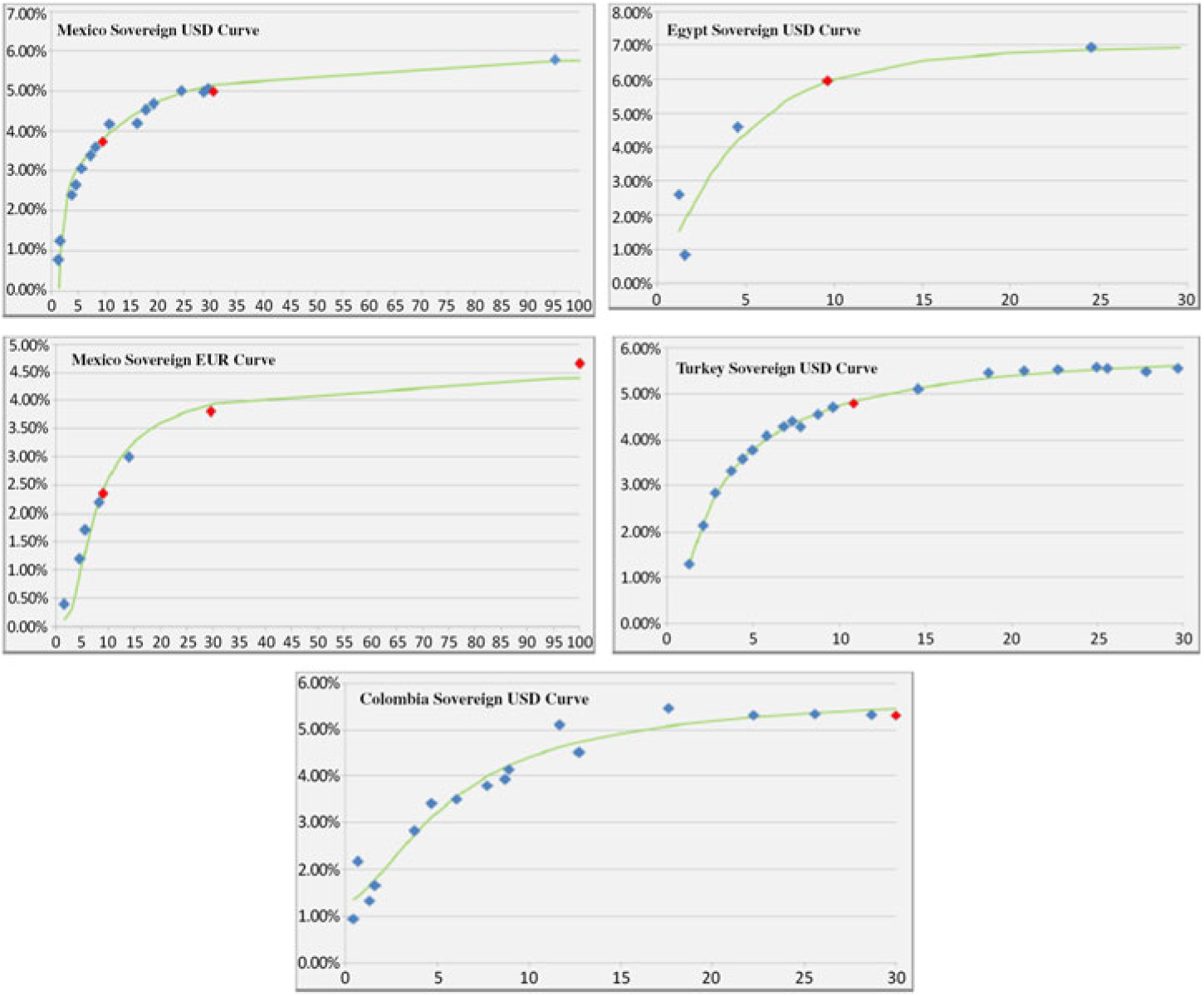
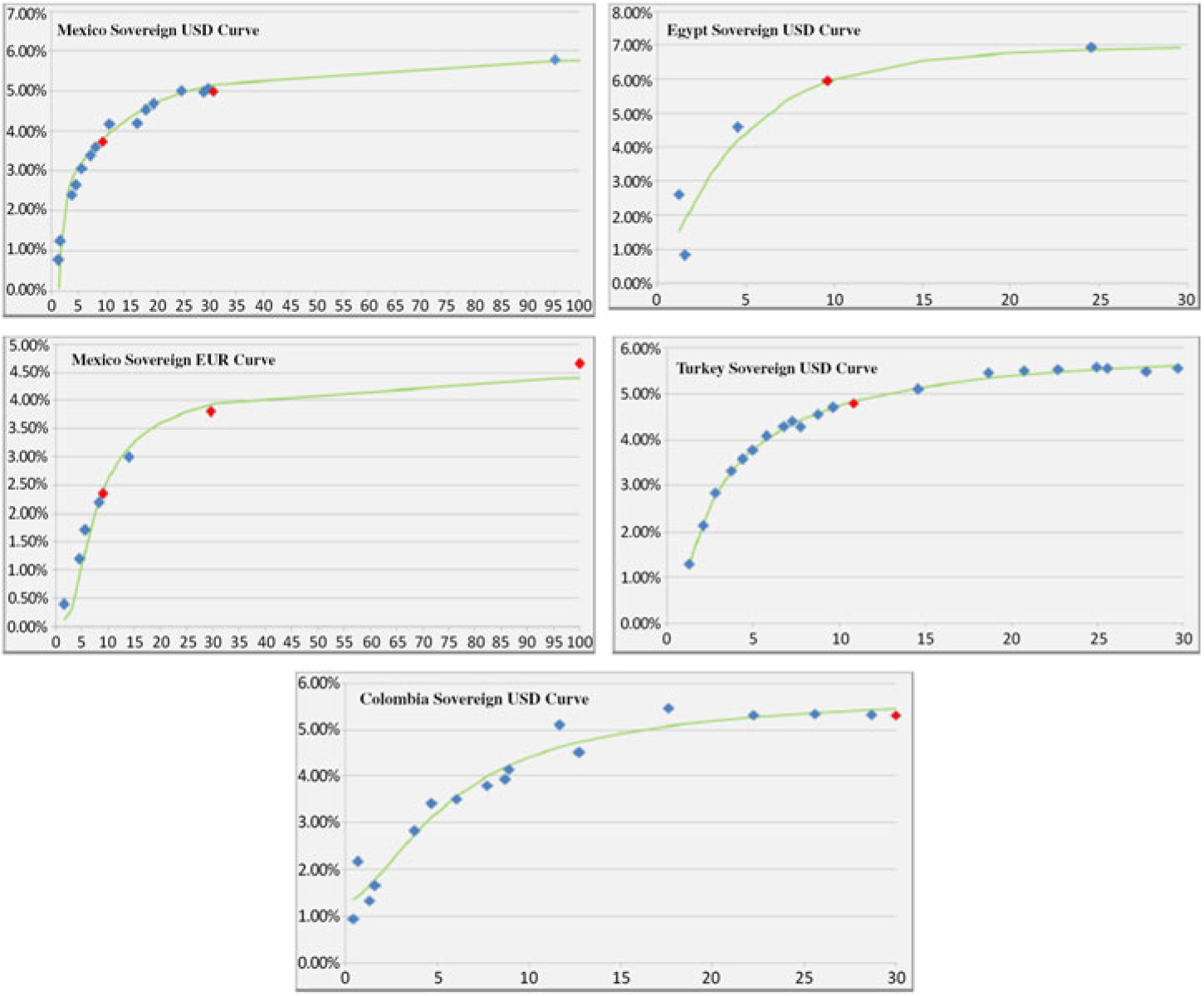
In one telling exchange, we were shown slides prepared by international officials to help persuade reluctant debt managers to adopt ICMA CACs and pari passu clauses. The presentation comprised yield curves for half a dozen countries, with ICMA clause issues marked in red (Fig. 2). In each case, the red dot was clearly positioned on the curve, showing skeptics that issuing with CACs would not affect their borrowing costs or disrupt market access for the sovereign and other actors in the country’s economy, whose debt was priced relative to the government’s. To reach its target audience, the argument had to be presented in yield curve terms.
Marketing ICMA CACs
All the debt managers we met took a long view of risk management, and prioritized market risks, such as interest rate, currency, and liquidity. They went to great lengths, and paid money to preserve options for refinancing—hence the effort to keep multiple investor groups fed and watered at all times—but would not do the same for restructuring. Debt managers also invested heavily in their relationships with primary dealers, firms contractually obligated to buy and sell their bonds and maintain market liquidity (Sadeh and Porath Reference Sadeh and Porath2017). Their investment in bond terms to manage remote contingencies was limited by comparison.
One explanation for the DMOs’ approach to risk management might be that sovereign default inevitably triggers a political crisis, which sidelines technocrats and brings a new cast of political characters onstage (Borensztein and Panizza Reference Borensztein and Panizza2009). Debt managers may reasonably feel reluctant to pre-commit their future bosses to a particular restructuring process. Another interpretation of the same facts would point to an agency problem: debt managers are sacrificing their future bosses’ options in crisis for the sake of near-term liquidity.
Friends and Rivals
Sovereign borrowers compete for investor funds. This was most visible when they mentioned their efforts to borrow from public asset managers in Asia. Small, infrequent issuers put tremendous effort into making sure that sovereign wealth funds would not confuse them with their peers, would know where to find them on the map, and would appreciate their sterling policy mix and investor relations.
We were surprised that issuer size came up more often than any other factor as a status marker and a debt management constraint. This is not to suggest that credit ratings did not matter—they did. However, size affected liquidity, investor interest, and market access at all times. When we asked our interviewees to name their peers, they usually named economies of comparable size and credit quality and often, though not always, regional neighbors. These were also their closest competitors, vying for the same investment fund or central bank dollar.
The size and sophistication of domestic financial markets relative to a government’s borrowing needs also helped determine its place in the ecosystem. A debt manager for a country with a small foreign-owned banking sector drew a contrast with countries that had big domestic banks, insurance and pension firms, and deep capital markets. He implied that, when all else failed, other governments had a captive domestic audience for their debt. In contrast, our host had few options in crisis: “We saw a storm was coming. We were on top of the hill, no tree, no house… whom do we call when [markets close]? Do we lean out the window and scream for help?” Governments that must rely on foreign capital or borrow in foreign currency to meet their ordinary financing needs work especially hard to cultivate investors; however, even they would not acknowledge using non-financial terms to attract potential buyers.
Debt managers acknowledge competing on price and other “financial” terms, such as issue size, maturity, and currency of denomination. One described learning that a peer country paid five basis points more than expected, and changing his country’s issuance parameters in response. He too insisted that non-financial contract terms would not figure into his competition strategy. Here and in other interviews, we got the message that competing on “legal” terms would be detrimental in the long run: potentially fragmenting the debt stock and drawing investor attention to contingencies that were supposed to be too remote to matter.
Many issuers described their baseline contract objective as having the same covenants as their peers and competitors, or at least being perceived as having the same covenants. Such a strategy preempts potential questions about content and mutes the signaling power of any given covenant. Traveling up the status ladder meant having covenants matter less. At the top of the ladder sat big, rich borrowers like Germany and the United States, which could sell debt in their own currencies at auctions to foreign and domestic residents alike, with hardly any terms at all. Their debt was “information-insensitive,” or immune to adverse selection problems (Dang et al. Reference Dang, Gorton and Holmström2015). Contract irrelevance was an element of information-insensitivity, and a widely shared aspiration for borrowers across the credit spectrum. According to a Euro area debt manager, “We try to make sure investors do not care.”
A Word from Investors
Debt managers consistently told us that a key part of their job was gauging and responding to investor preferences, and that their contract choices reflected investor preferences. We reached out to investors for the other side of the contracting story.
We visited with thirty asset management firms and spoke to more than fifty investors there. The firms ranged from big global institutions with diversified portfolios betting on macroeconomic trends to tiny specialists who only bought distressed debt and devised exotic collection strategies. Some were buy-and-hold investors; others traded actively. As with debt managers, we asked about contract change, contract pricing, and the role that bond contracts played in their work. The answers mirrored the debt managers’, but went a step further.
Even famously aggressive hedge funds told us that outside distress scenarios, they never bought or sold bonds as a function of particular contract terms. Several pointed out that in most primary offerings, they had no opportunity to bargain over terms because there was simply not enough time to get and read the contracts. Except during periods of ferment (official intervention, interpretation shock, financial crisis), they checked whether the bonds roughly followed the “standard form” for non-financial terms and proceeded to focus on the financial terms and the country’s macroeconomic prospects (“the economics”).Footnote 24
We shared charts with bond prices for Greece, Argentina, and Venezuela, which showed that the markets distinguished between bond terms in the months leading up to a restructuring. In response, investors cited discontinuity and market fragmentation. Portfolio managers might buy sovereign bonds to meet regulatory requirements, hedge risk, or track an index. These uses are normally insensitive to non-financial contract terms. However, if a country gets in trouble, the same mandates and regulations can trigger widespread selling of its bonds. A different set of actors, distressed debt specialists, would buy the debt. Although they care deeply about contract terms, they arrive on the scene long after the terms had been decided. We suggested that such specialist preferences should affect the price that hedgers and index investors would pay in good times, and therefore the price at issuance. Again, the answer was “no” because, according to one distressed debt specialist, the volume of bonds that a fund like his was willing to hold was small—small enough to convince the others to pay him to go away. An institutional investor was unlikely to be able to sell all its creditor-friendly bonds to a litigious specialist by the time a broad swath of the market got hip to the terms.
It is possible that we were being spun. Distressed debt investors do not like to reveal their methods; they might try to mislead, especially if they thought we were talking to competition. On the other hand, the fragmented, discontinuous market story sounded plausible to us because we heard it repeatedly from big and small investors espousing different strategies, as well as debt managers, all of whom described it in similar terms. At a minimum, it came across as a widely shared narrative in this market.
CONCLUSION
Sovereign borrowers hesitate to adopt terms that make their debt contracts more restructuring-friendly, even when these initiatives are backed by a broad consensus among policymakers, international organizations, and academics. A leading hypothesis in economics and law explains borrower hesitation as a rational—and quite possibly efficient—response to moral hazard created by the lack of hard enforcement of sovereign debt contracts (Dooley Reference Dooley2000; Shleifer Reference Shleifer2003; Bratton Reference Bratton2006; Bolton and Jeanne Reference Bolton and Jeanne2009; Kahan and Leshem Reference Kahan and Leshem2017). By designing contracts that make debt restructuring costly, debtors show commitment to repay, and are rewarded with better financial terms.
None of our interviews with debt managers, buy-side or sell-side firms supported this hypothesis. Using non-financial terms to make or signal commitment to repay was described as short-sighted and ultimately self-defeating. Without taking such descriptions on faith, we could observe debt managers and investors acting inconsistently with the commitment hypothesis.
Reluctance to change contracts appeared to follow from the need to have—or be seen as having—”standard” contracts, for two reasons. First, non-standard terms could be (mis)read as a signal revealing adverse private information, or associating the issuer with an inferior cohort. For most debt managers, the objective was to blend in (pool) with their cohort.
Second, contracts were bad at signaling. Non-financial contract terms are too arcane, too complicated and, paradoxically, not standardized enough (Gelpern Reference Gelpern2017) to send anything but the noisiest signals. Debt managers must rely on lawyers (agents) to formulate their signals, but have limited control over them (Gulati and Scott Reference Gulati and Scott2013). Meanwhile, investors claim not to read contracts in good times, when debt is issued, but read too much into them in bad times, when debt becomes distressed and exit opportunities are scant. Such discontinuity, usually attributed to differences among investor groups, can lead to financial instability. All these faults could support a preference for no contract change, and for pooling over separating equilibria.
Debt managers’ reluctance to change could also be interpreted as protecting the safe asset function of government debt, including its role as a benchmark. If market participants decided that non-financial terms mattered, the debt would not be information-insensitive (Dang et al. Reference Dang, Gorton and Holmström2015) and could not function properly as a safe asset. This rationale is mostly limited to government debt contracts; the rest could apply to other kinds of contracts.
Most debt managers appeared to attach overwhelming importance to the liquidity of primary and secondary debt markets, but not to contract flexibility in crisis. Liquidity lowers borrowing costs and supports steady market access. It also increases the information content and stability of bond prices at various maturities. Many debt managers described it as part of their job to supply benchmarks for pricing other financial contracts in the economy. Changing non-financial contract terms can lead to market fragmentation, reduce liquidity, and raise costs for important economic actors beyond the government.
Agency problems could help explain debt managers’ emphasis on market liquidity over crisis performance in choosing debt contract terms. Crises are the province of politicians and senior policymakers. Debt managers may not feel compelled (or empowered) to design contract terms to help others manage a crisis. This set of agency problems is distinct from the lawyer-client variety proposed by Gulati and Scott (Reference Gulati and Scott2013).
From a socio-legal perspective, the halting pace of change in contract documents is unsurprising, since contract relationships can evolve apart from the document. The policy focus and the resources expended on slow and minor-looking changes to sovereign bond documentation are the bigger puzzle. Considering sovereign debt contracts as artifacts suggests an explanation. First, contract formalities—and standardization as such—acquire independent significance in the socio-legal frame. The fact that a term is perceived to be standard, and that the standard is appropriate for a given issuer type, conveys stability, continuity, and conformity to market norms, which in turn are conducive to market liquidity. Beyond a given debtor-creditor relationship, standard terms serve as repositories of knowledge and public meaning (cf. Suchman Reference Suchman2003) and convey information about sovereign debt market structure and hierarchy. As placeholders (Riles Reference Riles2011), standard terms create the space for governments and market participants to coordinate approaches to debt distress—preserving market access in the meantime.
The policy lessons from our study are relatively straightforward. Contract boilerplate is more likely to change when changes (1) carry no signal about an individual issuer’s ability or willingness to pay; and (2) are believed to be durable, so that the fragmentation of the bond market induced by the contract change lasts only as long as it takes to roll over (or refinance) the debt stock. The first condition implies that contract reforms should be coordinated across issuers and preceded by a highly visible public policy debate that minimizes ambiguity as to why the proposed change is occurring. The second condition is unlikely to be met if contract reform becomes the go-to policy deliverable. If each crisis brings a new sovereign debt contract initiative, no one would believe that change was permanent. It could exacerbate fragmentation and backfire on debt management institutions.