Conservation Science in the Anthropocene
The field of conservation science is continuously changing as its practitioners strive to understand and provide data on long-known (e.g., climate change, deforestation, invasive species) and newly recognized (e.g., consequences of gene editing, mercury release from thawing permafrost, microplastics) threats to biodiversity and ecosystem services (Kareiva and Marvier Reference Kareiva and Marvier2012; Bennett et al. Reference Bennett, Cramer, Begossi, Cundill, Díaz, Egoh, Geijzendorffer, Krug, Lavorel, Lazos, Lebel, Martín-López, Meyfroidt, Mooney, Nel, Pascual, Payet, Harguindeguy, Peterson, Prieur-Richard, Reyers, Roebeling, Seppelt, Solan, Tschakert, Tscharntke, Turner, Verburg, Viglizzo, White and Woodward2015; Brodie et al. Reference Brodie, Redford and Doak2018; Phelps et al. Reference Phelps, Seeb and Seeb2019; Sutherland et al. Reference Sutherland, Broad, Butchart, Clarke, Collins, Dicks, Doran, Esmail, Fleishman, Frost, Gaston, Gibbons, Hughes, Jiang, Kelman, LeAnstey, le Roux, Lickorish, Monk, Mortimer, Pearce-Higgins, Peck, Pettorelli, Pretty, Seymour, Spalding, Wentworth and Ockendon2019). Among those changes has been a shift in thinking on the place of humans in conservation science (e.g., Marris Reference Marris2011; Kareiva and Marvier Reference Kareiva and Marvier2012; Naeem et al. Reference Naeem, Chazdon, Duffy, Prager and Worm2016). Humans and their needs now figure more prominently—as demonstrated by an increasing emphasis on human-facing goals (e.g., maintaining useful resources for present and future generations, providing durable opportunities for nonconsumptive environmental experiences) in conservation (Camacho et al. Reference Camacho, Doremus, MacLachlan and Minteer2010; Bennett et al. Reference Bennett, Cramer, Begossi, Cundill, Díaz, Egoh, Geijzendorffer, Krug, Lavorel, Lazos, Lebel, Martín-López, Meyfroidt, Mooney, Nel, Pascual, Payet, Harguindeguy, Peterson, Prieur-Richard, Reyers, Roebeling, Seppelt, Solan, Tschakert, Tscharntke, Turner, Verburg, Viglizzo, White and Woodward2015; Naeem et al. Reference Naeem, Chazdon, Duffy, Prager and Worm2016; Barnosky et al. Reference Barnosky, Hadly, Gonzalez, Head, Polly, Lawing, Eronen, Ackerly, Alex, Biber, Blois, Brashares, Ceballos, Davis, Dietl, Dirzo, Doremus, Fortelius, Greene, Hellmann, Hickler, Jackson, Kemp, Koch, Kremen, Lindsey, Looy, Marshall, Mendenhall, Mulch, Mychajliw, Nowak, Ramakrishnan, Schnitzler, Shrestha, Solari, Stegner, Stegner, Stenseth, Wake and Zhang2017; Hevia et al. Reference Hevia, Martín-López, Palomo, García-Llorente, de Bello and González2017; Watson et al. Reference Watson, Galford, Sonter, Koh and Ricketts2019)—even as outcomes from human actions lead us toward an uncertain future with novel ecosystems (Marris Reference Marris2011; Corlett Reference Corlett2015; Collier and Devitt Reference Collier and Devitt2016).
Recognizing that future ecosystems will be made up of novel combinations of species, the methods and metrics being applied in conservation are becoming less species-centric (e.g., Borja et al. Reference Borja, Franco and Perez2000; Simboura and Zenetos Reference Simboura and Zenetos2002; de Bello et al. Reference Bello, Lavorel, Díaz, Harrington, Cornelissen, Bardgett, Berg, Cipriotti, Feld and Hering2010; Mouillot et al. Reference Mouillot, Graham, Villéger, Mason and Bellwood2013; Barnosky et al. Reference Barnosky, Hadly, Gonzalez, Head, Polly, Lawing, Eronen, Ackerly, Alex, Biber, Blois, Brashares, Ceballos, Davis, Dietl, Dirzo, Doremus, Fortelius, Greene, Hellmann, Hickler, Jackson, Kemp, Koch, Kremen, Lindsey, Looy, Marshall, Mendenhall, Mulch, Mychajliw, Nowak, Ramakrishnan, Schnitzler, Shrestha, Solari, Stegner, Stegner, Stenseth, Wake and Zhang2017; Brodie et al. Reference Brodie, Redford and Doak2018). Where approaches to conserving and restoring the composition and abundance of species to some ideal, “natural” state of the past has long been the focus, efforts have expanded to include approaches that can more readily evaluate changing ecosystems, and changing combinations of species in those ecosystems, that inevitably lie ahead as the climate changes in the coming decades (Camacho et al. Reference Camacho, Doremus, MacLachlan and Minteer2010; Marris Reference Marris2011; Hobbs et al. Reference Hobbs, Higgs, Hall, Bridgewater, Chapin, Ellis, Ewel, Hallett, Harris, Hulvey, Jackson, Kennedy, Kueffer, Lach, Lantz, Lugo, Mascaro, Murphy, Nelson, Perring, Richardson, Seastedt, Standish, Starzomski, Suding, Tognetti, Yakob and Yung2014; Stein et al. Reference Stein, Glick, Edelson and Staudt2014; Lawler et al. Reference Lawler, Ackerly, Albano, Anderson, Dobrowski, Gill, Heller, Pressey, Sanderson and Weiss2015). For instance, reflecting on the intertwined futures of humans, climate, and terrestrial ecosystems in the Anthropocene, Barnosky et al. (Reference Barnosky, Hadly, Gonzalez, Head, Polly, Lawing, Eronen, Ackerly, Alex, Biber, Blois, Brashares, Ceballos, Davis, Dietl, Dirzo, Doremus, Fortelius, Greene, Hellmann, Hickler, Jackson, Kemp, Koch, Kremen, Lindsey, Looy, Marshall, Mendenhall, Mulch, Mychajliw, Nowak, Ramakrishnan, Schnitzler, Shrestha, Solari, Stegner, Stegner, Stenseth, Wake and Zhang2017) advocated for increased use of taxon-free, along with—and often in place of—traditional species-centric conservation approaches (see also Bremner et al. Reference Bremner, Frid and Rogers2003; Caswell and Frid Reference Caswell and Frid2013). Here, we extend Barnosky et al.'s (Reference Bello, Lavorel, Díaz, Harrington, Cornelissen, Bardgett, Berg, Cipriotti, Feld and Hering2017) advocacy to marine conservation paleobiology (CPB). We focus on how the application of geohistorical data to established benthic indices can both add new taxon-free options to the traditional live–dead analysis tool kit and potentially increase the salience of geohistorical data in the eyes of resource managers and other stakeholders.
Live–Dead Studies in Marine Conservation Paleobiology
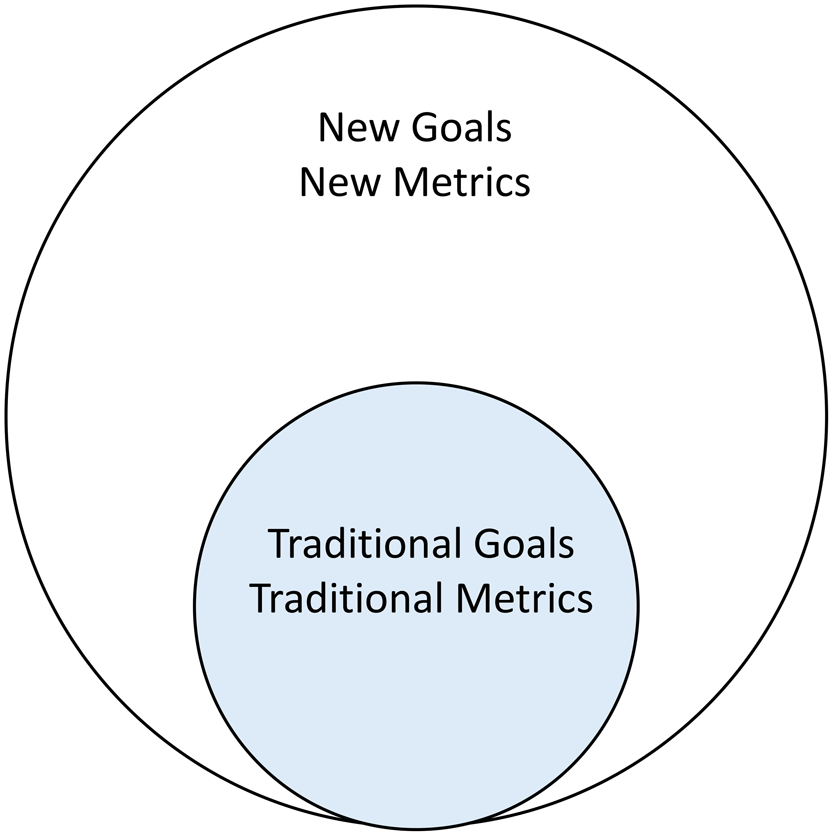
CPB has the potential to provide data that are salient—relevant to the needs of decision makers and timely (Cash et al. Reference Cash, Clark, Alcock, Dickson, Eckley, Guston, Jäger and Mitchell2003)—through its unique long-term perspective (e.g., Jackson et al. Reference Jackson, Kirby, Berger, Bjorndal, Botsford, Bourque, Bradbury, Cooke, Erlandson and Estes2001; Volety et al. Reference Volety, Savarese, Hoye and Loh2009; Rick and Lockwood Reference Rick and Lockwood2013; Wingard and Lorenz Reference Wingard and Lorenz2014; Dietl et al. Reference Dietl, Kidwell, Brenner, Burney, Flessa, Jackson and Koch2015; Durham and Dietl Reference Durham and Dietl2015; Smith et al. Reference Smith, Durham, Dietl, Tyler and Schneider2018; Leonard-Pingel et al. Reference Leonard-Pingel, Kidwell, Alexander and Cadien2019; Powell et al. Reference Powell, Ewing and Kuykendall2020). To date, the contributions of marine CPB have mainly consisted of providing geohistorical baselines of past species’ composition and abundance in communities (Kowalewski et al. Reference Kowalewski, Serrano, Flessa and Goodfriend2000; Jackson et al. Reference Jackson, Kirby, Berger, Bjorndal, Botsford, Bourque, Bradbury, Cooke, Erlandson and Estes2001; Dietl and Flessa Reference Dietl and Flessa2011, Reference Dietl and Flessa2017; Louys et al. Reference Louys, Wilkinson and Bishop2012; Rick and Lockwood Reference Rick and Lockwood2013; Dietl et al. Reference Dietl, Kidwell, Brenner, Burney, Flessa, Jackson and Koch2015; Tyler and Schneider Reference Tyler and Schneider2018). Although this focus on the historical fidelity of communities (i.e., “maintaining the same ecosystem”; sensu Barnosky et al. Reference Barnosky, Hadly, Gonzalez, Head, Polly, Lawing, Eronen, Ackerly, Alex, Biber, Blois, Brashares, Ceballos, Davis, Dietl, Dirzo, Doremus, Fortelius, Greene, Hellmann, Hickler, Jackson, Kemp, Koch, Kremen, Lindsey, Looy, Marshall, Mendenhall, Mulch, Mychajliw, Nowak, Ramakrishnan, Schnitzler, Shrestha, Solari, Stegner, Stegner, Stenseth, Wake and Zhang2017) has mirrored the broader field of conservation science, now, just as the broader field has expanded its focus and is developing tools for assessing and managing today's rapidly changing ecosystems, so too must marine CPB (Fig. 1; Barnosky et al. Reference Barnosky, Hadly, Gonzalez, Head, Polly, Lawing, Eronen, Ackerly, Alex, Biber, Blois, Brashares, Ceballos, Davis, Dietl, Dirzo, Doremus, Fortelius, Greene, Hellmann, Hickler, Jackson, Kemp, Koch, Kremen, Lindsey, Looy, Marshall, Mendenhall, Mulch, Mychajliw, Nowak, Ramakrishnan, Schnitzler, Shrestha, Solari, Stegner, Stegner, Stenseth, Wake and Zhang2017; Dietl and Flessa Reference Dietl and Flessa2017).
Expanding circle of conservation goals and metrics in the rapidly changing Anthropocene. If the environment has changed (outer circle), business-as-usual goals (e.g., restore or retain the same ecosystem state) may no longer be possible. In such cases, it may be more appropriate to set other goals, such as mimicking the structure of the past ecosystem or maximizing ecological quality status. Adaptable taxon-free metrics with the capacity to detect changes based on species’ tolerances and sensitivities to human disturbance (e.g., AZTI Marine Biotic Index [AMBI], multivariate AMBI [M-AMBI]) are more suited to addressing these new goals than more traditional metrics (e.g., Jaccard-Chao, richness). If, however, the environment has remained relatively stable (shaded, inner circle) and the goal is to maintain the ecosystem, traditional metrics are also useful.

During the short tenure of CPB, live–dead comparisons—considered here, generally, to be quantitative analyses of differences and similarities between an assemblage of living individuals and the corresponding time-averaged assemblage of biological remains accumulated through turnover of individuals in the local community—have been, arguably, the most commonly applied approach in studies of human impacts on marine ecosystems (e.g., Kidwell Reference Kidwell2002; Lockwood and Chastant Reference Lockwood and Chastant2006; Weber and Zuschin Reference Weber and Zuschin2013; Casey et al. Reference Casey, Dietl, Post and Briggs2014; Korpanty and Kelley Reference Korpanty and Kelley2014; Albano et al. Reference Albano, Filippova, Steger, Kaufman, Tomašových, Stachowitsch and Zuschin2015; Leshno et al. Reference Leshno, Edelman-Furstenberg, Mienis and Benjamini2015; Dietl and Smith Reference Dietl and Smith2017; Martinelli et al. Reference Martinelli, Soto, González and Rivadeneira2017; Wingard Reference Wingard2017). Building on earlier efforts (e.g., Davis Reference Davis1923; Johnson Reference Johnson1965; Warme Reference Warme1969), Kidwell (Reference Kidwell2001, Reference Kidwell2007) demonstrated that communities preserved in time-averaged death assemblages can reasonably be expected to match their associated living assemblages when evaluated with abundance-based metrics (e.g., taxonomic similarity, rank-order abundance) unless human actions (e.g., eutrophication, dredging) have impacted the community. Subsequent live–dead comparisons in CPB have often employed the analytical approach developed by Kidwell (Reference Kidwell2001, Reference Kidwell2007), plotting Jaccard-Chao taxonomic similarity (Chao et al. Reference Chao, Chazdon, Colwell and Shen2005) against Spearman's rank-order abundance to evaluate whether species’ compositions and abundances in communities have changed. High values for both metrics indicate agreement between living and death assemblages, signaling fidelity with historical conditions and limited anthropogenic effects—though false negatives are not uncommon (Kidwell Reference Kidwell2007), as the approach is relatively conservative (Casey et al. Reference Casey, Dietl, Post and Briggs2014; Dietl and Smith Reference Dietl and Smith2017). Low values for either metric are expected when the community has experienced recent human impacts and suggest that action may be required to restore a community that is consistent with historical baseline conditions (Kidwell Reference Kidwell2009). The purpose of this approach is, largely, to detect change and establish targets for restoration (Kidwell Reference Kidwell2009). As such, the approach is best suited to inform the traditional conservation goal of “maintaining the same ecosystem” (Fig. 1), reflecting the inherent assumption that natural systems fluctuate within an unchanging envelope of variability (Milly et al. Reference Milly, Betancourt, Falkenmark, Hirsch, Kundzewicz, Lettenmaier and Stouffer2008).
The live–dead approach developed by Kidwell (Reference Kidwell2001, Reference Kidwell2007) for the purpose of evaluating community composition with respect to anthropogenic eutrophication implicitly requires as a prerequisite that the environment in which the community lives did not change appreciably across the duration of time (e.g., decades, centuries) represented by the living and death assemblages (Kidwell Reference Kidwell2013). Before eutrophication—or another agent of change—can be accepted as a causal factor driving differences between living and death assemblages, all other possible explanations must be considered, whether by collecting additional data or making a priori assumptions. In the rapidly changing Anthropocene world, however, change is the new norm (Halpern et al. Reference Halpern, Walbridge, Selkoe, Kappel, Micheli, D'Agrosa, Bruno, Casey, Ebert and Fox2008; Stein et al. Reference Stein, Glick, Edelson and Staudt2014). As species move in response to, and because of, human actions and multiple environmental stressors (e.g., Aronson et al. Reference Aronson, Thatje, Clarke, Peck, Blake, Wilga and Seibel2007; Greenstein and Pandolfi Reference Greenstein and Pandolfi2008; Sunday et al. Reference Sunday, Bates and Dulvy2012; Pinsky et al. Reference Pinsky, Worm, Fogarty, Sarmiento and Levin2013; Smith and Dietl Reference Smith and Dietl2016; Morley et al. Reference Morley, Selden, Latour, Frölicher, Seagraves and Pinsky2018; Saupe et al. Reference Saupe, Farnsworth, Lunt, Sagoo, Pham and Field2019; Powell et al. Reference Powell, Ewing and Kuykendall2020), the underlying assumption of environmental (i.e., climatic) stability inherent to Kidwell's approach becomes increasingly untenable for establishing restoration targets (Wolkovich et al. Reference Wolkovich, Cook, McLauchlan and Davies2014; Corlett Reference Corlett2015; Kopf et al. Reference Kopf, Finlayson, Humphries, Sims and Hladyz2015).
An Adaptable Live–Dead Approach for a Changing World
If marine CPB is to contribute salient data to the conservation and restoration of biodiversity and ecosystem services, the set of tools used to conduct live–dead analyses must include methods and metrics with the capacity to evaluate novel, changing communities in the Anthropocene world. Without such methods and metrics, the invaluable long-term perspective of live–dead CPB studies is at risk of being relegated to the wrong (i.e., academic) side of the research-implementation gap (Arlettaz et al. Reference Arlettaz, Schaub, Fournier, Reichlin, Sierro, Watson and Braunisch2010). Taxon-free approaches (e.g., trait-based approaches, benthic indices), which focus on ecosystem structure and function (i.e., natural processes) as conservation targets rather than the abundance of particular species, can help bridge the gap, because they are a means for consistently comparing data from different times and places (Eronen et al. Reference Eronen, Polly, Fred, Damuth, Frank, Mosbrugger, Scheidegger, Stenseth and Fortelius2010; Polly et al. Reference Polly, Eronen, Fred, Dietl, Mosbrugger, Scheidegger, Frank, Damuth, Stenseth and Fortelius2011; Dietl et al. Reference Dietl, Durham, Smith and Tweitmann2016; Barnosky et al. Reference Barnosky, Hadly, Gonzalez, Head, Polly, Lawing, Eronen, Ackerly, Alex, Biber, Blois, Brashares, Ceballos, Davis, Dietl, Dirzo, Doremus, Fortelius, Greene, Hellmann, Hickler, Jackson, Kemp, Koch, Kremen, Lindsey, Looy, Marshall, Mendenhall, Mulch, Mychajliw, Nowak, Ramakrishnan, Schnitzler, Shrestha, Solari, Stegner, Stegner, Stenseth, Wake and Zhang2017; Dietl and Flessa Reference Dietl and Flessa2017). Inherently taxon-free metrics, such as richness and evenness (i.e., probability of interspecific encounter; Hurlbert Reference Hurlbert1971), have been applied in live–dead studies to evaluate ecosystem structure (e.g., Olszewski and Kidwell Reference Olszewski and Kidwell2007; Casey et al. Reference Casey, Dietl, Post and Briggs2014; Dietl and Smith Reference Dietl and Smith2017); however, the diagnostic power of the information conveyed by these measures is limited, because, as discussed by Kröncke and Reiss (Reference Kröncke and Reiss2010), these metrics will respond to any change in species’ presence and abundance no matter the ecological role of those species. In contrast, taxon-free benthic indices (e.g., Karr Reference Karr1981, Reference Karr1991; Kerans and Karr Reference Kerans and Karr1994; Borja et al. Reference Borja, Franco and Perez2000; Simboura and Zenetos Reference Simboura and Zenetos2002) are based in organismal biology (e.g., life histories and sensitivities to environmental factors; Schaeffer et al. Reference Schaeffer, Ettinger, Tucker and Kerster1985; Borja et al. Reference Borja, Franco and Perez2000; Simboura and Zenetos Reference Simboura and Zenetos2002; Adakole and Anunne Reference Adakole and Anunne2003; Bellinger et al. Reference Bellinger, Cocquyt and O'Reilly2006; Sutherland et al. Reference Sutherland, Levings, Petersen, Poon and Piercey2007; Hess et al. Reference Hess, Alve, Andersen and Joranger2020), leading to a more direct stressor–response relationship and a corresponding increase in the power to detect eutrophication (or other types of disturbances; Borja et al. Reference Borja, Marín, Muxika, Pino and Rodríguez2015). As such, integrating geohistorical data with taxon-free benthic indices (e.g., Dietl et al. Reference Dietl, Durham, Smith and Tweitmann2016) may be a fruitful opportunity to increase the salience of geohistorical data in a rapidly changing Anthropocene world (Dietl et al. Reference Dietl, Durham, Smith and Tweitmann2016; Leshno et al. Reference Leshno, Benjamini and Edelman-Furstenberg2016; Tweitmann and Dietl Reference Tweitmann and Dietl2018; Caswell et al. Reference Caswell, Frid and Borja2019).
For the last two decades, taxon-free benthic indices have been used in Europe to assess the effects of eutrophication after the European Union (European Commission 2000, 2008) mandated an ecological quality status (EcoQS) assessment of all European coastal and estuarine waters. Among the many metrics that have been developed, the AZTI Marine Biotic Index (AMBI; Borja et al. Reference Borja, Franco and Perez2000) has been one of the most widely used, including in the United States (e.g., Gillett et al. Reference Gillett, Weisberg, Grayson, Hamilton, Hansen, Leppo, Pelletier, Borja, Cadien, Dauer, Diaz, Dutch, Hyland, Kellogg, Larsen, Levinton, Llansó, Lovell, Montagna, Pasko, Phillips, Rakocinski, Ranasinghe, Sanger, Teixeira, Dolah, Velarde and Welch2015; Pelletier et al. Reference Pelletier, Gillett, Hamilton, Grayson, Hansen, Leppo, Weisberg and Borja2018; Tweitmann and Dietl Reference Tweitmann and Dietl2018)—now facilitated more readily by the expansion of the software's species list to include species of North and South America. Dietl et al. (Reference Dietl, Durham, Smith and Tweitmann2016) demonstrated that the results of AMBI for the entirety of the living benthic community (i.e., annelids, arthropods, mollusks) can frequently be reproduced using solely the molluscan component of the community. Examining the benthic community data from 12 studies, Dietl et al. (Reference Dietl, Durham, Smith and Tweitmann2016) calculated AMBI with only mollusks, emulating the type of data expected to be found in a death assemblage, and compared the results with AMBI values calculated from the whole macrobenthic invertebrate community. They developed a correction based on the relationship between whole-community and mollusk-only values that, when applied to the mollusk-only data, successfully recovered whole-community EcoQS for 78% of stations (n = 45), validating the use of AMBI for the evaluation of the effects of eutrophication with the geohistorical record (e.g., Leshno et al. Reference Leshno, Benjamini and Edelman-Furstenberg2016; Tweitmann and Dietl Reference Tweitmann and Dietl2018; Caswell et al. Reference Caswell, Frid and Borja2019).
Using the mollusk-only approach, AMBI can be applied in live–dead comparisons using sampling methods and data collection identical to those traditionally applied in live–dead studies. With AMBI, benthic species are assigned to one of five ecological groups, and the relative abundances of individuals in these five groups are used to calculate a single AMBI value for the community according to:
 $$\eqalign{{\rm AMBI} = \;& \lsqb {\lpar 0 \times \percnt {\rm GI} \rpar + \lpar 1.5 \times \percnt {\rm GII} \rpar }\cr &+ \lpar 3 \times \percnt {\rm GIII} \rpar + \lpar 4.5 \times \percnt {\rm GIV} \rpar \cr &+ \lpar 6 \times \percnt {\rm GV} \rpar \rsqb /100\comma \;}$$
where GI through GV are ecological groups with increasing tolerance for disturbance (especially eutrophication; Borja et al. Reference Borja, Franco and Perez2000). Although species’ identities are used, interpretations and assessments are made on the basis of the community's AMBI value. Output values for AMBI range from zero to seven, and these values map to EcoQS categories of High (0 < AMBI < 1.2), Good (1.2 < AMBI < 3.3), Moderate (3.3 < AMBI < 4.3), Poor (4.3 < AMBI < 5.5), and Bad (5.5 < AMBI 7.0; Borja et al. Reference Borja, Franco, Valencia, Bald, Muxika, Jesús Belzunce and Solaun2004). Unlike any other metric applied in marine live–dead studies, samples with AMBI values indicating Moderate, Poor, and Bad EcoQS require remediation in the European Union (European Commission 2000)—though there are no regulatory implications for this benthic index outside the European Union at this time.
The subsequent development of multivariate AMBI (M-AMBI; Muxika et al. Reference Muxika, Borja and Bald2007) offers additional potential to improve the salience of geohistorical data (e.g., Tweitmann and Dietl Reference Tweitmann and Dietl2018). Building on the AMBI framework, the M-AMBI calculation includes richness and Shannon-Wiener diversity and, of particular relevance to CPB, a reference condition (Muxika et al. Reference Muxika, Borja and Bald2007). M-AMBI, as with all indices developed under the Water Framework Directive (European Commission 2000) and Marine Strategy Framework Directive (European Commission 2008), is calibrated to the same five EcoQS categories as AMBI, though its output values vary between 0 and 1 instead of 0 and 7. There is a clear opportunity to integrate live–dead data as reference conditions in M-AMBI, particularly as identifying appropriate reference conditions can be challenging (Borja et al. Reference Borja, Franco, Valencia, Bald, Muxika, Jesús Belzunce and Solaun2004; Halpern et al. Reference Halpern, Walbridge, Selkoe, Kappel, Micheli, D'Agrosa, Bruno, Casey, Ebert and Fox2008; Van Hoey et al. Reference Van Hoey, Borja, Birchenough, Buhl-Mortensen, Degraer, Fleischer, Kerckhof, Magni, Muxika, Reiss, Schröder and Zettler2010).
The AMBI and M-AMBI indices can readily accommodate the inclusion of geohistorical data (e.g., Dietl et al. Reference Dietl, Durham, Smith and Tweitmann2016; Leshno et al. Reference Leshno, Benjamini and Edelman-Furstenberg2016; Tweitmann and Dietl Reference Tweitmann and Dietl2018; Caswell et al. Reference Caswell, Frid and Borja2019) and, because they are calculated based on relative proportions of ecological groups that are independent of particular species’ identities, they do not require the assumption that the environment has remained stable (Kröncke and Reiss Reference Kröncke and Reiss2010; Van Hoey et al. Reference Van Hoey, Borja, Birchenough, Buhl-Mortensen, Degraer, Fleischer, Kerckhof, Magni, Muxika, Reiss, Schröder and Zettler2010). This feature, combined with the grounding of ecological group assignments in species’ tolerances and sensitivities to human disturbance (Kröncke and Reiss Reference Kröncke and Reiss2010; Borja et al. Reference Borja, Elliott, Andersen, Cardoso, Carstensen, Ferreira, Heiskanen, Marques, Neto, Teixeira, Uusitalo, Uyarra and Zampoukas2013; Elliott et al. Reference Elliott, Borja, McQuatters-Gollop, Mazik, Birchenough, Andersen, Painting and Peck2015), makes both AMBI metrics useful tools for assessing EcoQS, irrespective of environmental changes. These benthic indices also distill a complex suite of biological information into a single EcoQS score that is easily interpretable and readily translatable (e.g., as required by law in the European Union; Muxika et al. Reference Muxika, Borja and Bald2007; Borja et al. Reference Borja, Dauer and Grémare2012, Reference Borja, Elliott, Andersen, Cardoso, Carstensen, Ferreira, Heiskanen, Marques, Neto, Teixeira, Uusitalo, Uyarra and Zampoukas2013), which is an advantage for managers and decision makers over other metrics whose interpretation requires additional data and/or assumptions. As described by Borja et al. (Reference Borja, Dauer and Grémare2012): “Politicians and managers need information derived from simple and pragmatic, but scientifically sound methodologies, to show clearly to society the change in the ecological quality of a given geographical zone (estuary, coastal area, etc.) reflective of human pressures or recovery processes” (p. 1).
Moving Forward
Though there will still be cases where historical fidelity (i.e., maintaining the same ecosystem) is the primary conservation goal, methods and metrics that can be more broadly applied in the Anthropocene and that address human-facing goals (e.g., maximizing potential resource use; Camacho et al. Reference Camacho, Doremus, MacLachlan and Minteer2010) are becoming more prominent in conservation science (Fig. 1). Live–dead studies in CPB have unrealized potential to address the expanding set of goals (e.g., Marris Reference Marris2011; Barnosky et al. Reference Barnosky, Hadly, Gonzalez, Head, Polly, Lawing, Eronen, Ackerly, Alex, Biber, Blois, Brashares, Ceballos, Davis, Dietl, Dirzo, Doremus, Fortelius, Greene, Hellmann, Hickler, Jackson, Kemp, Koch, Kremen, Lindsey, Looy, Marshall, Mendenhall, Mulch, Mychajliw, Nowak, Ramakrishnan, Schnitzler, Shrestha, Solari, Stegner, Stegner, Stenseth, Wake and Zhang2017) associated with this trend. To do so, marine CPB must expand the live–dead tool kit to include assessment approaches capable of handling rapidly changing environments.
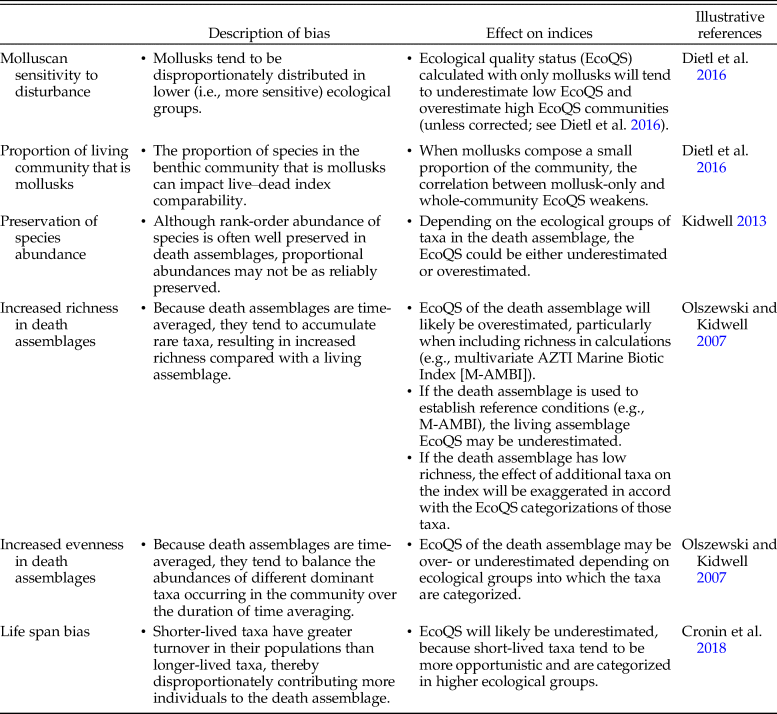
For the field of marine CPB, the application of geohistorical data with taxon-free benthic indices is a promising avenue for both academic research and real-world application. If this integration is to be effective and impactful, several potentially biasing factors must be addressed (Table 1). For instance, issues related to time averaging (e.g., increased evenness and richness in death assemblages; Olszewski and Kidwell Reference Olszewski and Kidwell2007), preservation (e.g., life span bias; Cronin et al. Reference Cronin, Dietl, Kelley and Edie2018), and sensitivity to disturbance (e.g., the majority of mollusks are categorized into the more sensitive ecological groups; Dietl et al. Reference Dietl, Durham, Smith and Tweitmann2016) have the potential to either increase or decrease the EcoQS that is calculated. Furthermore, although Dietl et al. (Reference Dietl, Durham, Smith and Tweitmann2016) evaluated the prospect of integrating geohistorical data with two commonly used indices, AMBI (Borja et al. Reference Borja, Franco and Perez2000) and Bentix (Simboura and Zenetos Reference Simboura and Zenetos2002), it remains to be seen whether these indices or other indices will perform best in marine CPB. At the very least, it will be informative to understand differences in the applicability of different benthic indices (e.g., Benthic Index based on Taxonomic Sufficiency [BITS], which uses family- instead of species-level identifications; Mistri and Munari Reference Mistri and Munari2008) with death assemblage data, as differences in the performance of indices may provide insight on where more research is needed.
Examples of potentially biasing factors introduced to benthic indices when using data from molluscan death assemblages.

Benthic indices for EcoQS are well established, have clear policy implications, and can be applied using the data already collected by marine conservation paleobiologists. By integrating geohistorical data with these established indices, CPB can add new taxon-free options to the traditional live–dead analysis tool kit and increase its salience in the eyes of resource managers and other stakeholders.
Acknowledgments
We thank the editor, Wolfgang Kiessling, and three anonymous reviewers for their comments, which improved the quality of this manuscript.