Introduction
The Falkland Islands mullet Eleginops maclovinus is a primitive notothenioid of the monotypic family Eleginopidae (Balushkin, Reference Balushkin1992). This species is unusual among the notothenioids in that it is only one of two species in the entire suborder that are euryhaline. It is found in estuaries and rivers along the South American coast as far north as Uruguay on the east coast and Valparaiso, Chile, on the west coast, and in the creeks and coastal waters of the Falkland Islands (Regan, Reference Regan1913; Norman, Reference Norman1937; Andriashev, Reference Andriashev, Carrick, Holdgate and Prevost1964; Licandeo et al., Reference Licandeo, Barrientos and González2006). It is also unusual in that it has high growth rates and is a protandrous hermaphrodite; it has the highest fecundity among the notothenioids (Brickle et al., Reference Brickle, Arkhipkin and Shcherbich2005, Reference Brickle, Laptihovsky, Arkhipkin and Portela2006b).
This is the first study of the parasite fauna of E. maclovinus in the Falkland Islands. In a wider area, Szidat (Reference Szidat1950) examined the viscera of 40 E. maclovinus caught in Patagonian Argentina, ranging in total length from 28 to 47 cm, and found 10 parasite taxa within which he described four new species. Gosztonyi (Reference Gozstonyi1980) examined the parasite fauna of E. maclovinus in southern Argentina and investigated the effect of fish length on the parasite fauna. Latterly Riffo (Reference Riffo1994) studied its parasites in the Gulf of Arauco, Chile (37°S) and recovered six parasite taxa from 64 fish. Despite the fact that there are small-scale fisheries for this species in Chile, Argentina and the Falkland Islands, very little is known about its stock structure. This study was therefore undertaken in order to catalogue the parasite fauna of E. maclovinus to provide a baseline for future studies and to examine whether parasites might be used to provide information on population structure.
Parasites have been used widely as biological tags, to provide information for fisheries managers on the movements and population structure of their hosts (see MacKenzie, Reference MacKenzie1983; Lester, Reference Lester1990; Moser, Reference Moser1991; Williams et al., Reference Williams, MacKenzie and McCarthy1992; MacKenzie, Reference MacKenzie2002). There are two main approaches to the use of parasites as biological tags (MacKenzie & Abaunza, Reference MacKenzie, Abaunza, Cadrin, Friedland and Waldman2005). The first involves the selection of a small number of parasite species according to specific criteria, as suggested by Kabata (Reference Kabata1963), Sindermann (Reference Sindermann1983), MacKenzie (Reference MacKenzie1983, Reference MacKenzie1987) and Williams et al. (Reference Williams, MacKenzie and McCarthy1992), and a large number of host species are examined specifically for these parasite species. In the second approach entire parasite assemblages are analysed using more sophisticated statistical techniques. Examples of the latter include the studies of Lester et al. (Reference Lester, Barnes and Habib1986, Reference Lester, Sewell, Barnes and Evans1988), George-Nascimento & Arancibia (Reference George-Nascimento and Arancibia1992), Speare (Reference Speare1994, Reference Speare1995), Arthur & Albert (Reference Arthur and Albert1993) and Blaylock et al. (Reference Blaylock, Margolis and Holmes2003). In this study we used both approaches.
Materials and methods
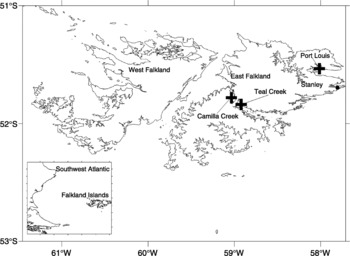
Between 21 January and 17 March 2002 a total of 70 fish were collected and examined from three areas around East Falkland: Port Louis, Teal Creek and Camilla Creek (fig. 1).
Sampling positions in East Falkland for Eleginops maclovinus. Note: one degree of latitude = 60 nautical miles.

The skin surface of each fish was examined by eye under a strong light. Squash preparations were made from any cysts or lesions observed and examined under a compound microscope at magnifications of up to × 400. Total length (L T), weight, sex and maturity were recorded. The fins were removed and examined under the dissecting microscope and any lesions or cysts observed were examined more thoroughly. The fish was washed in a tray of water by hand and then removed. The remaining water and mucus in the tray were poured through a fine-meshed sieve to collect any parasites that were missed by the visual inspection. The fish were opened by making an incision from the anus up to the heart so that the viscera could be removed. The internal organs were examined for parasites, free or encapsulated on their external surfaces, then separated and examined individually. The stomach, pyloric caeca and intestine were separated and opened longitudinally. The walls of the stomach, pyloric caeca and intestine, and the liver, spleen, kidney and heart were compressed between glass plates and examined for encapsulated parasites. The body cavity was rinsed and the rinse collected and examined. Squash preparations were made from the liver, spleen, kidney, gonads, intestine, muscle and brain, and scrapings from the urinary and gall bladders were examined for protozoan and myxozoan parasites using a compound microscope at a magnification of × 400 under bright field, phase contrast and Nomarski interference contrast illumination. Preparations not found to harbour parasites within 5 min were considered to be uninfected. The gills were removed and rinsed, and the arches were examined individually. The buccal cavity was rinsed and the opercula and eyes were examined. The body musculature was removed from the vertebral column, the skin removed from the fillets and the flaps were thinly sliced and inspected for helminths and myxozoan cysts. All parasites were sorted into major taxonomic groups, cleaned and counted for each organ, noted on an examination sheet and the data subsequently entered into a database. Representative specimens of all parasite species encountered were collected and stored in the reference collection of the Falkland Islands Fisheries Department (FIFD).
Summary statistics for the parasite taxa recovered during the study include prevalence, abundance and intensity, plus and minus the standard deviation followed by a range, as recommended by Bush et al. (Reference Bush, Lafferty, Lotz and Shostak1997). The small sample of 10 fish from Camilla Creek were all males ranging from 17 to 28 cm L T. Because of the small number of fish in this sample it was excluded from further analysis. Initially, parasite species encountered in Port Louis and Teal Creek were tested for differences in prevalence using Fisher's Exact test.
E. maclovinus is a protandrous hermaphrodite (Calvo et al., Reference Calvo, Morriconi, Rae and San Roman1992; Brickle et al., Reference Brickle, Laptihovsky, Arkhipkin and Portela2006b). Differences in parasitic infections between host sexes were tested using the non-parameteric Mann–Whitney test. Because the parasites showed an overdispersed frequency distribution in their hosts (high variance to mean ratio), the raw parasite numbers were transformed as log(n+1) to reduce the variance (Elliot, Reference Elliot1971) before any further analysis. Initially, exploratory analysis was used to see if the parasite data contained any structure through classification. This analysis used an agglomerative hierarchical cluster analysis using an average linkage and a Jaccard measure of similarity which treats the data as presence/absence data. After this, a linear discriminant function analysis (LDA) was performed which classifies observations into two or more groups if you have a sample with known groups. It can also be used to investigate how variables contribute to group separation. The results of the LDA are presented as matrices showing the numbers and percentages correctly and incorrectly assigned to the two areas sampled. Cross-validation was not used as it is said to have limited value because it is based on the same data to which the LDA is fitted; there is therefore a tendency to overestimate the discrimination power relative to a different set of data (Venables & Ripley, Reference Venables and Ripley1998).
Results
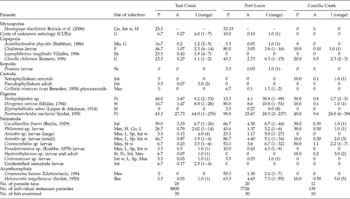
A total of 16,673 individual metazoan parasites of 24 taxa were recovered. The summary statistics for each parasite species by area are presented in table 1.
Summary statistics for the parasites recorded from Eleginops maclovinus from three sites in the Falkland Islands. F, fins; G, gills; Go, gonad; H, heart; Int, intestine; Int w, intestine wall; L, liver; Mes, mesenteries; Mo, mouth; Pc, pyloric caeca; Rec, rectum; Sk, skin; Sp, spleen; St, stomach; P, prevalence (%); A, mean abundance; I, mean intensity.

Of the parasites recorded, Henneguya shackletoni is a new species (Brickle et al., Reference Brickle, Kalavati and MacKenzie2006a), as are Philonema sp. and possibly Neolepidapedon sp. Acanthochondria phycidis, Clavella chiloensis, Lepeophtheirus mugiloidis, Corynosoma hannae and Heterosentis magellanicus represent new geographical records, while C. hannae and Cosmocephalus sp. are new host records.
Thirty E. maclovinus were examined from Teal Creek, ranging in size from 16 to 76 cm L T. A total of 8808 parasites of 20 taxa were recovered, comprising one myxozoan, three digeneans, one cestode, one acanthocephalan, four copepods, nine nematodes and cysts of unknown aetiology (CUEs). Thirty fish were also examined from Port Louis, ranging in length from 24 to 51 cm L T. A total of 7726 individual parasites of 20 taxa were recovered from the Teal Creek and Port Louis samples, comprising one myxozoan, four digeneans, seven nematodes, two acanthocephalans, three copepods, one isopod and CUEs. A total of 139 individual parasites of 12 taxa were recovered, comprising three digeneans, one cestode, five nematodes, one acanthocephalan, and two copepods.
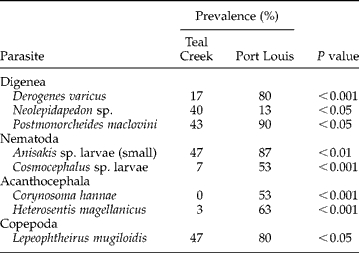
Preliminary analyses identified eight parasites that showed significant differences between Teal Creek and Port Louis (table 2). The selection criteria for tag parasites can be summarized as in MacKenzie & Abaunza (Reference MacKenzie, Abaunza, Cadrin, Friedland and Waldman2005). A suitable tag parasite should have:
1 significantly different levels of infection in different parts of the study area;
Table 2Parasites showing significant differences in prevalence in samples taken from Teal Creek and Port Louis.

2 a long life span;
3 infection levels that are stable with time;
4 features that make it easily detected and identified;
5 no serious pathogenicity.
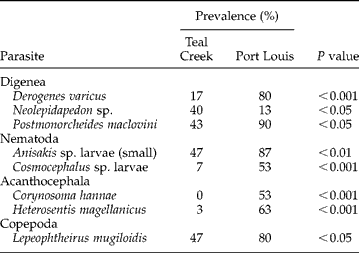
The parasites that most clearly fit these criteria are the nematode Cosmocephalus sp. and the acanthocephalan C. hannae. Despite their relatively short life spans (probably less than 1 year) in E. maclovinus, the digeneans Derogenes varicus and Postmonorcheides maclovini and the acanthocephalan H. magellanicus may prove useful for following seasonal migrations.
The abundance of parasites was significantly different between sexes and in many cases was a function of length. Male and female percentages were equal at 53 cm L T, but at lengths greater than this females dominated. This could be seen throughout the year (Brickle et al., Reference Brickle, Laptikhovsky, MacKenzie and Arkhipkin2003) as well as for the pooled data from the dataset over the study period. As the larger fish were all females (this species is a protandrous hermaphrodite) and had significantly more parasites (P < 0.01, Mann–Whitney U = 82.50), females were removed from the dataset for further analysis.
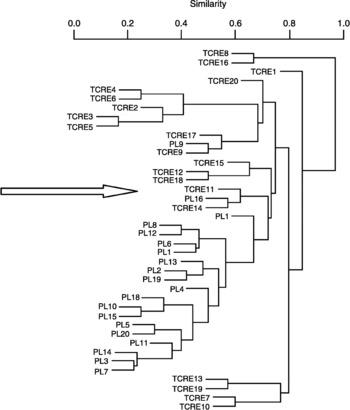
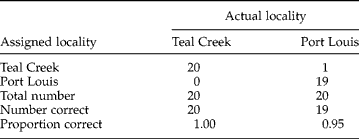
The results of the cluster analysis on log transformed data are illustrated as a dendogram (fig. 2). Individuals from the same locations tended to cluster together, suggesting that the parasite assemblages in individuals from one site were different to those from the other site. Only one individual from Port Louis (PL 16) was clustered with those from Teal Creek. The results of the LDA on all of the parasite fauna for male fish from Port Louis and Teal Creek are presented in table 3 and show a high level of separation (overall correct classification of 97.5% (39/40)). Teal Creek had the highest rate of correct classification with 100% of the sample (20/20) being correctly assigned to Teal Creek. Port Louis also had a high rate of correct classification (95%, 1/19) although one was misclassified to Teal Creek. In both analyses this individual was a 50 cm L T male at maturity stage II.
Results of the cluster analysis of male Eleginops maclovinus using the whole parasite fauna [log (n+1)] with the Jaccard measure of similarity. TCRE, Teal Creek; PL, Port Louis. The arrow illustrates the position of PL 16.

Results of a discriminant function analysis (LDA) for the separation of Eleginops maclovinus caught at Teal Creek and Port Louis in the Falkland Islands. Overall correct classification =95.3% (39/40).
Discussion
The new records from this study contribute to the knowledge of the biogeography and host specificity of the parasites on the Patagonian Shelf. The diversity of the parasite fauna of E. maclovinus in the Falkland Islands is high in comparison to studies of the same host from other localities. Gosztonyi (Reference Gozstonyi1980) found 16 species in southern Argentina, Szidat (Reference Szidat1950) found 10 parasite species from 40 eviscerated fish in Patagonian Argentina and Riffo (Reference Riffo1994) found six species infecting 64 individuals from the Gulf of Arauco, Chile. One of the reasons for the reduced parasite fauna in Chile and southern Argentina may be that E. maclovinus is at the edge of its species range in those two areas.
Because the samples were collected at approximately the same time of year, any seasonal variation within the respective communities was assumed not to interfere with the analyses. The results showed very clear differences between sites. Praniza isopod larvae were only found at Port Louis, as were Grillotia erinaceus, Elytrophalloides oatsei and C. hannae, whereas an adult pseudophyllidean cestode, the nematode Hysterothylacium sp. and an unidentified nematode were only found at Teal Creek. Other species occurred at both sites but with different prevalences and abundances (table 2).
Examining the entire parasite communities from both sites using multivariate techniques proved to be very useful. In the cluster analyses only one fish (PL 16) from Port Louis was clustered with the individuals from Teal Creek. There was also only one misclassification in the LDA – the same fish that had been classified as coming from Teal Creek. It is possible that this particular individual had migrated from the Port Louis area to Teal Creak recently. The fact that individuals from different sites clustered together and were classified together suggests that the males in the two populations do not mix. Evidence from a mechanical tagging study supports this conclusion (Brickle et al., Reference Brickle, Laptikhovsky, MacKenzie and Arkhipkin2003). These authors' data showed that smaller fish were resident in the creeks they were caught in and did not move any great distances. Conversely, large fish were found to migrate over larger distances. One fish travelled as far as 28 nm from Port Howard, West Falkland to Camilla Creek, and large fish are regularly caught as far south as Beauchene Island, some 60 nm south of the islands.
Discriminating between stocks is important to fisheries management because different stocks may be of different sizes and may exhibit different growth rates. On this basis they will react differently to exploitation. The ability to differentiate stocks on the basis of their parasites reflects the variations in ecological and environmental conditions in the regions that the hosts inhabit, resulting in non-uniform distributions and abundances of the parasites' final and intermediate hosts. Differences in feeding habits may also account for the observed differences in infection between regions (Boje et al., Reference Boje, Riget and Køie1997).
The pattern of residence in male E. maclovinus also seems to occur in Chile and is highlighted by very different parasite faunas between sampling positions close to one another (Dr M. George-Nascimento, personal communication). Further studies in the Falkland Islands should include a wider sampling area with larger sampling sizes in order to determine whether this phenomenon is island-wide.
Acknowledgements
We are grateful to the Shackleton Scholarship Fund for funding Ken MacKenzie's visit and to John Barton, Director of the Falkland Islands Government Fisheries Department for the use of their facilities. We are also grateful to Professor Chris Secombes, School of Biological Sciences (Zoology), University of Aberdeen, for laboratory space in Aberdeen. Finally we are grateful to Falklands Fresh Ltd and Simon Hardcastle for all of their help in the field.