Introduction
The Chernobyl nuclear power plant accident in April 1986 was one of the world's most devastating and complex disasters. About 600 000 people, locally referred to as ‘liquidators’, were sent in as emergency or clean-up personnel (The Chernobyl Forum, 2006). In the immediate aftermath, 134 emergency workers were treated for radiation sickness (Hatch et al. Reference Hatch, Ron, Bouville, Zablotska and Howe2005), and 31 died; by 2005, there were 19 additional deaths (The Chernobyl Forum, 2006). Although the incidence of cancers is being monitored in this population (Hatch et al. Reference Hatch, Ron, Bouville, Zablotska and Howe2005), the psychological effects of the stress unleashed by working under high exposure conditions without adequate protective gear have not been studied systematically.
Three studies in Ukraine reported elevated rates of psychiatric and neurocognitive problems in samples of former clean-up workers compared to controls, but each of these studies was compromised by design limitations, such as convenience sampling and non-blind assessments (Loganovsky & Loganovskaja, Reference Loganovsky and Loganovskaja2000; Polyukhov et al. Reference Polyukhov, Kobsar, Grebelnik and Voitenko2000; Gamache et al. Reference Gamache, Levinson, Reeves, Bidyuk and Brantley2005). Other evidence that clean-up workers might indeed constitute a high-risk group comes from a clinical cohort of Latvian clean-up workers (Viel et al. Reference Viel, Curbakova, Dzerve, Eglite, Zvagule and Vincent1997) and a mortality study of Estonian clean-up workers that found a significant excess mortality from suicide 17 years after the explosion (Rahu et al. Reference Rahu, Rahu, Tekkel and Bromet2006). Thus, the current study provides the first direct, comprehensive evaluation of the mental health of clean-up workers. Specifically, having conducted a national survey of mental health in Ukraine in 2002 (Bromet et al. Reference Bromet, Gluzman, Paniotto, Webb, Tintle, Zakhozha, Havenaar, Gutkovich, Kostyuchenko and Schwartz2005), we administered the same diagnostic tool to assess psychiatric and alcohol disorders, suicide ideation, and headaches in Ukrainian clean-up workers. We then compared their mental health to that of geographically matched controls from the national survey who did not participate in the clean-up effort, adjusting for mental health prior to 1986 (e.g. the healthy worker effect). We further examined whether clean-up workers with psychiatric conditions reported more days out of work than affected controls. Among clean-up workers, we also considered the relationship of severity of exposure to psychiatric disorders and current stress-related symptomatology.
Method
The sample of clean-up workers was selected from the State Registry of Ukraine. Eligibility criteria were being male, working at Chernobyl between 1986 and 1990, residing in or near Dnipropetrovsk, Donetsk, Kyiv or Kharkiv at the time (nearly half of Ukrainian clean-up workers were from these areas), and not being treated for acute radiation syndrome at the Research Center for Radiation Medicine (RCRM) in Kyiv. The goal was to interview 150 workers sent to Chernobyl in 1986–1987, when exposure levels were greatest, and 150 first sent there in 1988–1990. To obtain this goal, a multi-step process was used. First, an initial sample of 1000 clean-up workers was selected with probability proportional to the number from each region working at Chernobyl in the two time periods. Letters were mailed to all 1000 individuals in the sample pool with brief information about the study. Interviewers were then given randomized lists of names and addresses. Starting at the beginning of their randomized lists, interviewers attempted to contact and recruit clean-up workers to participate in the study. After attempting to contact 759 workers, the target sample (295 workers) had been recruited. At that point, the field work ceased. Of the 759 workers for whom contact was attempted, valid addresses were available for only 503 (66.3%) workers, 85 (16.9%) of whom were deceased. Of the 418 surviving workers, 295 (70.6%) agreed to participate (63.6% from the 1986–87 group and 83.3% from the 1988–90 group).
The controls were drawn from the Ukraine World Mental Health (WMH) Survey, a nationwide survey conducted as part of the WMH Survey Consortium (Bromet et al. Reference Bromet, Gluzman, Paniotto, Webb, Tintle, Zakhozha, Havenaar, Gutkovich, Kostyuchenko and Schwartz2005; WHO, 2004). The selection criteria were: being male, residing in the same geographic region as the clean-up workers, not recruited as a clean-up worker, and in the age range of the clean-up workers in 1986. The selection was based on current residence as we were unable to match on residence in 1986. The control group was thus composed of 397 men.
The assessments were conducted by specially trained interviewers from the Kiev International Institute of Sociology (KIIS). The clean-up workers were interviewed between December 2003 and June 2004, approximately 18 years after the accident. The controls were interviewed from March to December 2002, 16 years after the accident. Recruitment and consent procedures were approved by RCRM, KIIS and Stony Brook University. Written informed consent was obtained prior to interview.
Measures
Mental health
We translated the paper–pencil version of the Composite International Diagnostic Interview (CIDI) version 3.0 (Kessler & Üstün, Reference Kessler and Üstün2004), developed by the WMH Survey Consortium, into Russian and Ukrainian following standard World Health Organization (WHO) guidelines. The Ukraine CIDI incorporated minor refinements to the alcohol, trauma and demographic modules (Bromet et al. Reference Bromet, Gluzman, Paniotto, Webb, Tintle, Zakhozha, Havenaar, Gutkovich, Kostyuchenko and Schwartz2005). The following DSM-IV categories were analyzed: depressive disorders (major depression and dysthymia); anxiety disorders (social phobia, agoraphobia, generalized anxiety disorder, panic disorder); post-traumatic stress disorder (PTSD); alcohol abuse with or without dependence; and intermittent explosive disorder (IED). We also examined suicide ideation (‘you seriously thought about committing suicide’) and endorsement of severe or frequent headaches in the past 12 months.
The clean-up workers also completed self-report scales assessing PTSD and somatic symptoms. PTSD symptom severity was measured using the 22-item version of the Impact of Events Scale (IES; Weiss & Marmar, Reference Weiss, Marmar, Wilson and Keane1997), which rated intrusion, avoidance and hyperarousal symptoms in the past month as a result of Chernobyl [1=not at all, 5=very much; Cronbach's α ranged from 0.86 (intrusion) to 0.95 (overall score)]. The somatization subscale of the Symptom Checklist-90 (SCL-90; Deragotis, 1983) contains 12 distress-related physical symptoms rated on a five-point severity scale (0=not at all, 4=extremely) for the past 2 weeks (α=0.91). Mean severity scores were computed for these measures.
Days lost from work
The WHO Disability Assessment Scale (WHO-DAS; Buist-Bouwman et al. Reference Buist-Bouwman, De Graaf, Vollebergh, Alonso, Bruffaerts and Ormel2006) was used to determine days lost from work, defined as the number of days in the past 30 days that respondents were fully unable to work because of problems with physical or mental health or use of alcohol or drugs (weighted 1.0) plus the number of (other) days they had to cut back on what they typically would get done (weighted 0.5) plus the number of (other) days they had to cut back on the quality of their work or needed extreme effort to perform normal levels of activity because of the aforementioned problems (weighted 0.25).
Exposure
A three-level exposure variable was created. High exposure was defined as working on the roof or in the industrial site between April and October 1986 when radiation exposure was greatest (n=45). The remaining clean-up workers in the 1986–87 cohort worked in less contaminated areas and were classified as having moderate exposure (n=100). The 1988–90 group (n=150) had lower radiation exposure (Hatch et al. Reference Hatch, Ron, Bouville, Zablotska and Howe2005; The Chernobyl Forum, 2006).
Analyses
The clean-up workers were administered all parts of the CIDI included in this report. The controls (n=397) were administered the depression, anxiety, alcohol and suicide modules of the CIDI (Part I). Controls having a Part I diagnosis and a random subsample of respondents with no disorder were administered Part II of the CIDI, which included modules assessing PTSD, severe/frequent headaches in the past year, and work-loss days (n=163 of controls). When analyzing variables from Part II, weights were used to account for the non-random selection of controls into the subsample. All analyses were conducted using SUDAAN version 8.0.2 (Research Triangle Institute, Research Triangle Park, NC, USA), which uses the Taylor series linearization method to adjust standard errors for the stratified sampling design and the sample weights.
The occurrence (incidence or recurrence) of each disorder except headaches was examined for the periods before and after the accident and in the 12 months prior to interview. Given the potential healthy worker effect (tendency for workers to have better health than the general population), we used logistic regression to compute odds ratios comparing post-Chernobyl mental health in workers and controls adjusting for onset before 1986. We also adjusted for age in 1986. Incidence since 1986 was examined using logistic regression to compare onsets among individuals who were healthy in 1986 while adjusting for age in 1986. We examined whether workers with 12-month disorders had a greater than expected amount of work loss using two (worker versus control)×2 (disorder versus no disorder) analysis of variance for disorders on which the two groups differed significantly (p<0.05). Among workers, we examined differences by level of exposure using χ2 for categorical variables, analysis of variance for the scale scores, and the Wald F statistic to test for trend.
Results
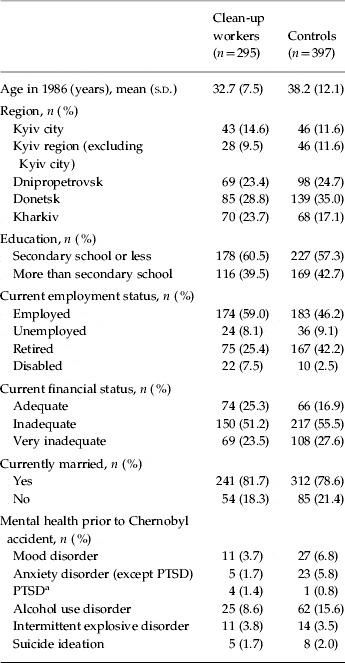
As shown in Table 1, in 1986 the clean-up workers were on average 5 years younger than the controls (F=53.3, df=1, 691, p<0.001). Slightly more than half of each group received education beyond high school. Most were currently married, and most reported that their financial situation was inadequate. After controlling for age in 1986, only current employment status was significantly different between workers and controls (p=0.024).
Descriptive characteristics of Chernobyl clean-up workers and controls

PTSD, Post-traumatic stress disorder; s.d., standard deviation.
a Determined for all clean-up workers and estimated from a subsample of controls.
Consistent with the healthy worker effect, Table 1 also shows that, before 1986, the clean-up workers had lower rates of some disorders. However, after adjusting for age in 1986, only anxiety disorders [adjusted odds ratio (aOR) 0.3, 95% confidence interval (CI) 0.1–0.9, p=0.03] and alcohol use disorders (aOR 0.6, 95% CI 0.3–0.9, p=0.02) were significantly different between the workers and controls before the accident.
Post-Chernobyl mental health
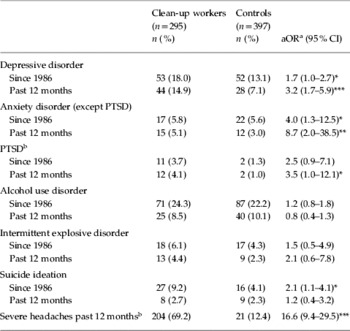
Table 2 shows that in the period since the accident, the clean-up workers had significantly higher rates of depressive disorder, anxiety disorder (without PTSD), and suicide ideation than the controls after adjusting for age in 1986 and onset of disorder prior to 1986. These rates are, in part, explained by the significantly increased incidence rates (percentage of new-onset cases in men who were healthy prior to Chernobyl) for anxiety disorder (4.1% v. 1.1%, aOR 3.6, 95% CI 1.1–11.2, p=0.03) and suicide ideation (8.6% v. 3.9%, aOR 2.0, 95% CI 1.0–3.9, p=0.04), for clean-up workers and controls respectively. Incidence rates for mood disorder were 14.8% v. 9.2%, a borderline significant difference (aOR 1.6, 95% CI 1.0–2.6, p=0.08).
Post-Chernobyl prevalence of mental health problems in Chernobyl clean-up workers and controls

aOR, Adjusted odds ratio; CI, confidence interval.
a Adjusted for age in 1986 and onset of disorder prior to Chernobyl; odds ratio for headaches adjusted for age in 1986 only.
b Determined for all clean-up workers and estimated from a subsample of controls.
* p<0.05, ** p<0.01, *** p<0.001.
Table 2 also shows that the 12-month prevalence rates of depressive disorder, anxiety disorder, PTSD and headache were significantly higher in clean-up workers compared to controls after adjusting for age in 1986 and illness onset prior to Chernobyl. The difference in headache was particularly striking (69.2% of clean-up workers versus 12.4% of controls). To address the potential confounding effect of exposure to Chernobyl among the controls, the results in Table 2 were reanalyzed eliminating 34 controls and 28 clean-up workers who stated during the interview that they had once lived in a region contaminated by radiation from the Chernobyl accident; the results were comparable.
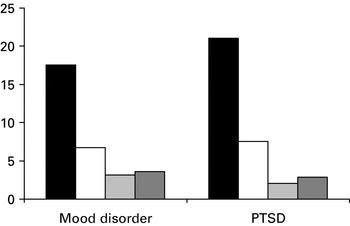
We next examined whether clean-up workers with 12-month disorders had significantly more work-loss days than controls. As illustrated in Fig. 1, for depressive disorder and PTSD the interaction effects of group×disorder in the analysis of variance tests were highly significant (p<0.001), indicating that clean-up workers with these two disorders had significantly greater work loss than either affected controls or non-affected individuals.
Days lost from work among clean-up workers and controls with (+) and without (−) mood disorders and post-traumatic stress disorder (PTSD) in the past 12 months. ■, Clean-up worker (+); □, clean-up worker (−);  control (+);
 , control (−).

Exposure and mental health among clean-up workers
We first examined whether the post-Chernobyl and 12-month prevalence rates of diagnosable disorders and headache differed by exposure level. For the most part, the rates were in the expected direction (e.g. 6.7% of the high, 4.0% of the moderate, and 3.3% of the low exposure groups had 12-month PTSD). However, only severe headache, reported by 82.2% of the most exposed, 62.0% of the moderately exposed, and 70.0% of the least exposed, was statistically significant (high versus moderate versus low exposure group: χ2=6.9, df=2, p<0.05; most exposed versus moderate/low exposed group: χ2=3.39, df=1, p<0.05).
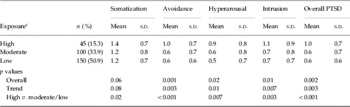
By contrast, the most highly exposed clean-up workers were significantly more symptomatic on the somatization and PTSD symptom scales. As shown in Table 3, the workers with the greatest exposure reported more impairment than the two less-exposed groups, especially on the PTSD measures. The resulting effect size for somatization was modest (Cohen's d=0.38), whereas the effect sizes for the PTSD scales were in the ‘medium’ range (d=0.66 for avoidance, 0.48 for hyperarousal, 0.54 for intrusion, and 0.62 for the overall IES score).
Relationship of exposure to somatizationFootnote a and PTSD symptomsFootnote b

PTSD, Post-traumatic stress disorder; s.d., standard deviation.
a Symptom Checklist-90 somatization subscale.
b Impact of Events Scale.
c High exposed included workers on the roof or in the industrial site during April–October 1986; moderate included other workers in the 1986–87 cohort; low included workers first sent to Chernobyl between 1988 and 1990.
Discussion
This study is the first systematic investigation into the mental health of clean-up workers who participated in salvage activities after the Chernobyl disaster of 1986. After adjusting for differences in age and onset of disorder prior to 1986, we found that significantly more clean-up workers developed mood and anxiety disorders, but not alcoholism or IED. They also had higher rates of suicide ideation and severe headaches. Clean-up workers with recent episodes of mood disorders and PTSD lost more days from work than affected controls and unaffected respondents. Among the clean-up workers, level of exposure to radiation (or radiation-associated stressors) was associated with severe headache, current somatic complaints, and especially PTSD symptoms as measured by the IES. This seems to suggest an increased vulnerability among the workers and greater concerns about health among the most exposed workers. Our investigation therefore confirms the earlier suggestion of an impact on mental health in this group and also provides evidence on suicide ideation that is consistent with the mortality findings of Rahu et al. (Reference Rahu, Rahu, Tekkel and Bromet2006).
Studies of clean-up workers of other types of large-scale events often find high rates of psychological impairment (e.g. CDC, 2004; Benedek et al. Reference Benedek, Fullerton and Ursano2007). In the case of the Chernobyl clean-up workers, five previous mental health studies suggested that their experience had an adverse effect on their mental health (Viel et al. Reference Viel, Curbakova, Dzerve, Eglite, Zvagule and Vincent1997; Loganovsky & Loganovskaja, Reference Loganovsky and Loganovskaja2000; Polyukhov et al. Reference Polyukhov, Kobsar, Grebelnik and Voitenko2000; Gamache et al. Reference Gamache, Levinson, Reeves, Bidyuk and Brantley2005; Rahu et al. Reference Rahu, Rahu, Tekkel and Bromet2006). However, except for Rahu et al. (Reference Rahu, Rahu, Tekkel and Bromet2006), each study had serious methodological limitations that precluded firm conclusions, including sampling bias, non-judicious choice of the control groups, non-blind assessment procedures, lack of independent verification of the diagnoses, and analyses that failed to control for confounding factors. A study of workers following the Three Mile Island accident did not find higher rates of disorder compared to controls at another nuclear power plant or at a coal-fired plant, but the exposure and risk perceptions were much smaller (Parkinson & Bromet, Reference Parkinson and Bromet1983). The present results using a more rigorous methodology confirm previous suggestions of a significant mental health impact of Chernobyl and extend previous work by demonstrating an association of disorder with work-loss days.
Of note, our study focused on psychiatric conditions. Several physical health outcomes have also been suggested (The Chernobyl Forum, 2006), including cataracts (Worgul et al. Reference Worgul, Kundiyev, Sergiyenko, Chumak, Vitte, Medvedovsky, Bakhanova, Junk, Kyrychenko, Musijachenko, Shylo, Vitte, Xu, Xue and Shore2007) and cardiovascular disorders (Trivedi & Hannan, Reference Trivedi and Hannan2004; Ivanov et al. Reference Ivanov, Maksioutov, Chekin, Petrov, Biryukov, Kruglova, Matyash, Tsyb, Manton and Kravchenko2006). However, mortality has not increased significantly (The Chernobyl Forum, 2006). If physical health problems are more prevalent in the clean-up workers, they might account for the elevated rates of disability in this group overall. The unanswered question is whether the clean-up workers with psychiatric disorder had more health problems than clean-up workers without psychiatric disorder or controls, given their elevated average number of work-loss days. Another potential issue to be examined in future studies of clean-up workers is the presence of co-morbid somatoform disorders. Research on Gulf War veterans who were at risk for stress and/or exposure to toxic substances has shown that non-specific somatoform complaints, particularly pain, are elevated (Wessely, Reference Wessely, M Havenaar, Cwikel and Bromet2002; Stimpson et al. Reference Stimpson, Unwin, Hull, David, Wessely and Lewis2006). Our findings on the somatization symptom scale provide marginal support for this hypothesis, but the very high rate of headaches among the clean-up workers seems to support it.
It is important to be clear about the limitations of the current study. First, the sample of clean-up workers was drawn from the official state register of the population directly affected by Chernobyl, which is incomplete. Moreover, it was difficult to locate the sample, and the final response rate was lower than we had expected. The main factors contributing to sample loss were moves within Ukraine and emigration outside Ukraine following the collapse of the Soviet Union. We were also unable to obtain objective information about activities at the reactor site other than by retrospective reports. The Chernobyl Forum (2006, p. 25) recommends that the exposure data from the official state registries be treated with caution. Second, the sample of clean-up workers excluded the most severely exposed group, that is the men who were hospitalized with symptoms of acute radiation sickness. It is likely that this group, which had to work under extremely hazardous circumstances, also experienced the most severe psychological stress. Our estimates of the impact are therefore likely to be conservative. Third, the control group was recruited from a general population sample, whereas the men who were summoned to perform clean-up activities in the aftermath of the disaster were a selection of relatively young and healthy personnel from military and civil services. We have been partly able to control for the healthy worker effect resulting from such selection bias by controlling for onset of disorder before 1986. However, we were unable to control for other relevant variables, such as occupational status or education at the time of the event. Moreover, some of the controls may not have been living in the same geographic area in 1986–90 when the clean-up workers were recruited, and others may have moved away in the interim. Fourth, the interviews with the clean-up workers were conducted 1.5–2 years after the interviews with the control group. Thus, although we controlled for age, the clean-up workers had a longer risk period for developing a disorder. However, the age of onset of the disorders we considered was late twenties to late thirties, and thus the interviews took place well after the period of risk for first onsets (Bromet et al. Reference Bromet, Gluzman, Paniotto, Webb, Tintle, Zakhozha, Havenaar, Gutkovich, Kostyuchenko and Schwartz2005). Nevertheless, this difference could have influenced the period prevalences. Fifth, the interviewers in our study were not blind to exposure status. In a similar vein, the clean-up workers were aware of the fact that the study aim was to assess the impact of their experience in the aftermath of the disaster. This may have led to response bias and observational bias in the exposed sample. Sixth, our study examined common disorders using a structured interview given by lay interviewers, and some conditions, such as suicide ideation, were based on a single item. Thus we did not assess the presence of other potentially relevant forms of psychopathology. Three studies conducted in Ukraine reported increased rates of schizophrenia (Loganovsky & Loganovskaja, Reference Loganovsky and Loganovskaja2000) and cognitive impairment (Polyukhov et al. Reference Polyukhov, Kobsar, Grebelnik and Voitenko2000; Gamache et al. Reference Gamache, Levinson, Reeves, Bidyuk and Brantley2005). Our investigation can neither confirm nor refute these findings.
In conclusion, the study presented in this paper fills a gap in the existing literature about the mental health effects of the Chernobyl disaster on the men recruited as clean-up workers after the accident. Consistent with the findings of The Chernobyl Forum (2006) and with findings from other disasters involving radiation (e.g. Yamada & Izumi, Reference Yamada and Izumi2002), the results show that the accident had a deleterious effect on mental health. Considering the size of the psychological impact of the event and the ongoing debate about physical health effects among these clean-up workers, further study of this group is needed. Such studies should endeavor to collect objective measures of exposure and physical health, consider cognitive impairment and psychotic symptoms, and use mental health professionals to conduct more rigorous psychiatric evaluations.
Acknowledgments
This study was supported by NIMH Grant MH51947 (to E.J.B.) and three grants to the Research Center for Radiation Medicine (RCRM): subproject 3.8.1 ‘Database on Psychological Disorders in the Ukrainian Liquidators of the Chernobyl Accident’, Project No. 3 ‘Health Effects on the Chernobyl Accident’ and the French–German Initiative for Chernobyl. We thank Dr Pierre Verger and Professor Margot Tirmarche (Institut de Protection et de Institut de Radioprotection et de SÛreté Nucléaire, IRSN, France), Academician Anatoly Romanenko and Professor Angelina Nygau (RCRM), and Professor Vlodomyr Paniotto, Victoria Zakhozha, and the Kyiv International Institute of Sociology interviewers.
Declaration of Interest
None.