INTRODUCTION
As women's representation has increased worldwide, scholars have devoted significant attention to the effects of women's representation on voter turnout, feelings about government, and public policy. Recent research has demonstrated a correlation between women's representation and levels of political engagement, political information, and satisfaction with the system (Barnes and Burchard Reference Barnes and Burchard2013; Burns, Schlozman, and Verba Reference Burns, Schlozman and Verba2001; Karp and Banducci Reference Karp and Banducci2008). Additionally, multiple scholars have found that citizens view women in government as more trustworthy or have found a correlation between women's representation and citizen satisfaction with democracy (Dollar, Fisman, and Gatti Reference Dollar, Fisman and Gatti1999; Swamy, Knack, Lee, and Azfar Reference Swamy, Knack, Lee, Axfar and Knack2000; Treisman Reference Treisman2007). Others have suggested that the link between gender and corruption is dependent upon regime type (Sung Reference Sung2003).
However, many studies linking women's representation and corruption were published prior to the expansion of women's representation and widespread adoption of gender quotas. Additionally, most studies on women and corruption focus on the effects of women's descriptive representation for citizens' perceptions of government. Fewer works have explored how the integrated dynamics of women's representation, including women's formal representation and substantive representation, shape perceptions of corruption.Footnote 1
We argue that the relationship between women's representation and perceptions of corruption can be better understood through an integrated model of women's representation, which explores the effects of women's formal and substantive representation in addition to women's descriptive representation (Schwindt-Bayer and Mishler Reference Schwindt-Bayer and Mishler2005). Using a time-series analysis of 140 countries from 1998–2011, this analysis finds that both the descriptive presence of women in the legislature and the presence of substantive legislation related to women's rights are highly correlated with lower perceptions of corruption. Additionally, after accounting for the different dimensions of women's representation, the relationship between legislated or constitutionally mandated gender quotas and perceptions of corruption is also significant, but in the opposite direction.
This paper proceeds as follows: First, we review the existing literature on the dynamics of women's representation and perceptions of corruption. Next, we will build on the existing literature to argue that perceptions of corruption may be correlated with women's descriptive, formal, and substantive representation. Then, we will use the broader literature on perceptions of corruption in government to design a time-series analysis of the effect of women's representation in 140 countries from 1998–2011. The final section will provide a discussion of the findings and a summary of the potential implications of this study.
THE DIMENSIONS OF WOMEN'S REPRESENTATION
Research on women in government frequently relies on Pitkin's (Reference Pitkin1967) classification of the dimensions of representation: descriptive, formal, substantive, and symbolic representation. A large body of research examines women's formal and descriptive representation, or the means by which women rise to power and the extent to which officeholders resemble their constituents. Additionally, a growing number of studies address women's substantive representation, or how officeholders represent the interests of women constituents. Rather than focusing on the number of women legislators, research on substantive representation proposes questions about the conditions under which officeholders will promote policies related to the interests of women constituents. A smaller but important body of literature focuses on women's symbolic representation, or the attitudes that are produced by women's representation and the ways that women legislators are perceived and evaluated (Schwindt-Bayer and Mishler Reference Schwindt-Bayer and Mishler2005).
However, few pieces of the existing literature analyze the integrated relationship between the dimensions of representation. According to Schwindt-Bayer (Reference Schwindt-Bayer2010), the rules through which women come to power and the presence of women in government can influence attitudes or perceptions about representation. Additionally, the formal and descriptive representation of women can influence the substantive policy output of government, which can in turn provoke responses or evaluations about women in government.
LITERATURE REVIEW
Women's Representation and Perceptions of Corruption
Research about the effects of women's representation on perceptions of corruption provides an example of the link between descriptive and symbolic representation. However, previous studies on the relationship between women's representation and corruption in government have produced mixed results. While some works have found that women in legislatures may be more likely to promote honest government (Dollar, Fisman, and Gatti Reference Dollar, Fisman and Gatti1999; Esarey and Chirillo Reference Esarey and Chirillo2013; Goetz Reference Goetz2007; Swamy, Knack, Lee, and Azfar Reference Swamy, Knack, Lee, Axfar and Knack2000; Treisman Reference Treisman2007; Tripp Reference Tripp2000), others have suggested that the link between gender and corruption is spurious or based on biased definitions of corruption (Sung Reference Sung2003).
Additionally, previous research linking women's descriptive representation to perceptions of corruption has argued that women's increased presence in government may lead to lower levels of corruption because women behave essentially differently than men. According to Dollar, Fisman, and Gatti (Reference Dollar, Fisman and Gatti1999), the correlation between women and perceptions of corruption results from the fact that women politicians are less individually oriented or more likely to vote based on ethical concerns. Similarly, according to Swamy, Knack, Lee, and Azfar (Reference Swamy, Knack, Lee, Axfar and Knack2000), women may be more honest and risk averse than their male counterparts. Finally, Goetz (Reference Goetz2007) argued that women might be less likely to engage in corruption because of a lack of opportunities or access, not a lack of corruptibility.
Arguments about the effect of women's representation on corruption have also struggled to account for the effect of women's formal representation, or the processes and institutions that influence how women rise to political power. One measure of women's formal representation, candidate gender quotas, has received a significant amount of attention in the gender politics literature, although few studies have analyzed the effects of quotas on wider political attitudes or outcomes, especially in a cross-national context (Dahlerup Reference Dahlerup2006; Krook Reference Krook2007). Quotas are expected to affect women's engagement with the political system and women's attitudes toward women in government (Bhavnani Reference Bhavnani2009; Zetterberg Reference Zetterberg2009), but only a small handful of works have analyzed the effects of quotas on citizens' general attitudes toward government or on government outcomes that are less directly related to women's issues.Footnote 2
Finally, the literature linking women's substantive representation with perceptions of corruption is less developed than the literature on descriptive and formal representation. However, Schwindt-Bayer (Reference Schwindt-Bayer2010) found that women's substantive representation in Latin America is correlated with citizens' satisfaction with democracy, perceptions of corruption, and trust in government. Specifically, citizens perceived lower levels of corruption in countries where legislatures passed more laws about women's issues, suggesting a link between women's substantive representation and attitudes toward government.
Regime Type and Perceptions of Corruption
Existing works on women's representation and perceptions of corruption have also struggled to account for the effects of regime type. First, Sung (Reference Sung2003) argues that the relationship between women and perceptions of corruption may be spurious. According to this argument, women's representation is highest in liberal democracies, which are otherwise less likely to experience or tolerate corruption. Therefore, according to Sung, it is regime type, not the presence of women, that explains these findings. More recently, Esarey and Chirillo (Reference Esarey and Chirillo2013) argue that women's propensity to engage in corruption is conditional upon the norms of democracies and nondemocracies. In democracies, where corruption is less tolerated, women may be more severely punished for engaging in corruption. In nondemocracies, where corruption is more likely to be tolerated, Esarey and Chirillo find that women's descriptive representation is unrelated to corruption.
However, the adoption of gender quotas in less democratic places may create questions about the relationship between regime type and perceptions of corruption. For example, Dahlerup and Fridenvall (Reference Dahlerup and Fridenvall2005) draw a distinction between incremental increases in women's representation (where parties gradually recruit women and trends in women's representation align with other modernization trends) and fast-track methods of women's representation (where formal legal quotas are applied quickly without waiting for cultural change). In countries that adopt fast-track methods (adopting quotas to quickly increase women's representation), the number of women in power may increase independently of other measures of liberal democracy. In fact, four of the ten countries with the highest level of women's representation in 2013 are classified as “Not Free” or “Partly Free” by Freedom House: Rwanda, Cuba, Seychelles, Nicaragua (Inter-Parliamentary Union 2013). Additionally, according to Bush (Reference Bush2011), some less democratic countries, like Iraq, Afghanistan, and Sudan, have adopted gender quotas strategically in order to gain international legitimacy. Therefore, the argument that women's descriptive representation is correlated with corruption because of regime type is contestable since women's representation has risen in democratic and undemocratic countries.
THEORETICAL FOUNDATIONS
The existing literature suggests a need to reevaluate the relationship between women's representation and perceptions of corruption. While the previous research has primarily focused on the effects of women's numerical representation, we argue that it is also essential to fully account for the dynamics of women's representation, including formal and substantive measures of women's representation.
Women's Descriptive Representation and Corruption
As Dollar, Fisman, and Gatti (Reference Dollar, Fisman and Gatti1999) and others have suggested, the descriptive representation of women legislators is generally associated with a decrease in the levels of perceived corruption. However, the causal mechanism for this association seems to vary considerably across the literature. Dollar, Fisman, and Gatti (Reference Dollar, Fisman and Gatti1999) underline the gendered characteristics of women legislators, while Swamy, Knack, Lee and Azfar (Reference Swamy, Knack, Lee, Axfar and Knack2000) argue that this association is based on women's resources and opportunities, not gender. Junior women legislators might be excluded from social groupings and patronage networks that often lead to corrupt behavior, so an increase in descriptive representation should be associated with a decrease in corruption.
On the other hand, Goetz (Reference Goetz2007) suggested that women's opportunities to engage in corrupt behavior might increase as women's descriptive representation increases. This possibility is especially relevant, given the significant increase in the number of women elected to legislative offices in the past 15 years. Much of the existing research relies on data from the 1990s, when women's descriptive representation was significantly lower in several regions of the world. In 1998, women held 12% of legislative seats in lower houses; however, by 2011 women comprised 20% of lower-house legislative seats worldwide. In sub-Saharan Africa, the percentage of women legislators nearly doubled from 1998 to 2012; in the Arab world the percentage of women legislators almost tripled (Inter-Parliamentary Union 2013). As women's descriptive representation reaches higher levels and women officeholders are integrated into political parties or institutions, opportunities to engage in corrupt behavior may change (Goetz Reference Goetz2007). Additionally, perceptions of women in government may change when women officeholders rise to positions of power or increase in number enough to threaten traditional male-dominated power structures.
However, the existing literature produces inconsistent expectations about the relationship between women's numerical representation and perceptions of corruption. While some literature predicts that women in government will be perceived as less corrupt, the causal mechanism is often unclear. Moreover, other work suggests that perceptions of women and corruption may change as women officeholders are integrated into traditional power structures. However, we argue that this relationship cannot be fully understood until the multiple dimensions of women's representation are considered, including formal and substantive representation.
Women's Formal Representation and Corruption
Since the early 1990s, more than 50 countries have adopted legislative or constitutionally mandated electoral gender quotas, which require that parties nominate a particular number or proportion of women candidates (Franceschet, Krook, and Piscopo Reference Franceschet, Krook and Piscopo2012; IDEA Global Database of Quotas for Women 2013). Even in countries without official legal quotas, a growing number of political parties have adopted voluntary gender quotas, through which parties set targets for the nomination of women. A smaller group of countries has adopted reforms that mandate reserved seats for women in legislatures or make party funding conditional upon the nomination of women.
There are several reasons to expect that gender quotas may influence citizens' attitudes about government. However, there is no consensus about the effects of quotas on levels of corruption. Just as with descriptive representation, the existing literature linking formal representation and perceptions of corruption produces mixed expectations. First, the rapid diffusion of gender quotas over the past two decades could be perceived negatively by citizens or elites. Gender quotas, like any systemic alteration that intervenes in the usual political process, could also be interpreted as a signal of government inefficiencies, or even corruption. Existing research, including Dahlerup and Fridenvall (Reference Dahlerup and Fridenvall2005), has noted a common criticism of quota opponents. According to quota critics, gender quotas can create supply-side problems, in which the demand for women candidates exceeds the pool of potential quality candidates. Some critics of gender quotas have suggested that women nominated under quotas will simply be delegates for their husbands and fathers (Bird Reference Bird2003), which may limit the ability of women to act as outsiders to affect levels of corruption. Additionally, others have suggested that gender quotas actually increase the control of powerful male party leaders over the candidate selection process and that women nominated under quotas are often chosen based on their loyalty to the party leaders (Baldez Reference Baldez2004; Bauer Reference Bauer2008; Krook 2006). According to Tripp and Kang (Reference Tripp and Kang2008), some argue that, gender quotas “counter the illusion that all people have equal access if they are qualified, that institutions are gender neutral, and that fair representation is possible without particular interventions” (Tripp and Kang Reference Tripp and Kang2008, 340). In these cases, the presence of gender quotas may actually have a negative impact on levels of confidence in government.
On the other hand, existing literature demonstrates that quotas positively affect women's engagement with the political system and attitudes toward women in government (Bhavnani Reference Bhavnani2009; Zetterberg Reference Zetterberg2009). Only a small handful of works have analyzed the effects of quotas on citizens' attitudes toward government, but there are several reasons to expect that gender quotas may positively influence the perceived level of corruption in government. According to Schwindt-Bayer (Reference Schwindt-Bayer2010), citizens in Latin American countries with gender quotas viewed government as less corrupt. Quotas may also serve as a signal of a party or country's commitment to fairness or the opening of the political system (Dahlerup Reference Dahlerup2006; Dahlerup and Friedenvall Reference Dahlerup and Fridenvall2010; Kittilson Reference Kittilson2005; Nanivadekar Reference Nanivadekar2006; Zetterberg Reference Zetterberg2009).
Although a rich line of inquiry has focused on the determinants of gender quotas, not all gender quotas are created equally or for the same reasons (Schwindt-Bayer Reference Schwindt-Bayer2009). Some quotas were adopted through constitutional amendments or formal legislation while others are voluntary party initiatives. The party quotas would appear to be the weakest, since the passage of constitutional amendments or formal legislation would generally require a majority or super-majority vote and would presumably be enforced by law. Party quotas, on the other hand, might be adopted as a signal by party leaders to show constituents their support for gender issues or even used strategically to expand or mobilize a base of support. Therefore, formal legal quotas may affect perceptions of corruption differently than voluntary party quotas, since party quotas are also presumably less enforceable and the result of a different political process.
Regardless of whether an increased presence for women in government actually leads to a reduction in the incidence of corruption, previous work suggests that quota laws certainly might affect the perceptions of corruption. However, as Nanivadekar (Reference Nanivadekar2006) pointed out, the adoption of reserved seats in India resulted in a significant lack of consensus about the predicted effects of women's representation on levels of corruption: “There is no consensus regarding what is to be expected from women elected through reserved seats. Some believed that women would purify politics, while others held that it would feminize corruption” (Nanivadekar Reference Nanivadekar2006, 123).
Women's Substantive Representation and Perceptions of Corruption
Finally, the changes in perception of corruption brought about by the presence of women legislators could be an indirect result of substantive legislation. Women legislators might focus on issues of particular interest to women constituents, including increases in social spending. However, as the resources allocated to social programs increase, the possibility of corrupting influences between the elected officials and the beneficiaries similarly increases. Furthermore, passing laws about gender issues may influence perceptions of government, especially if those laws are designed to protect underrepresented groups or address minority concerns. Based on Schwindt-Bayer's (Reference Schwindt-Bayer2010) study of attitudes in Latin America, perceptions of corruption should be lower in countries where legislatures pass laws about gender issues. However, the literature linking women's substantive representation to perceptions of corruption is very limited.
Summary of Argument
The existing findings suggest a need to reexamine the relationship between women's representation and perceptions of corruption in government in order to account for the multiple dimensions of women's representation. In particular, the rapid increase in women's representation, the widespread diffusion of candidate gender quotas, and the substantive representation of women indicate that we must rethink how women's representation influences perceptions of government transparency. Much of the research that points to a connection between women's representation and decreases in perceptions of corruption relies primarily on data prior to the significant increases in women's representation around the world after 1998. Additionally, previous works often overlook the rapid diffusion of candidate gender quotas and the effects of increased attention to women's issues. The analysis below will attempt to address these problems by using recent, cross-national data about perceptions of corruption and by applying an integrated model of descriptive, formal, substantive, and symbolic representation.
DATA AND METHODS
To test the relationship between women's representation and perceptions of corruption, we designed a cross-national, time-series Tobit model, which includes all of the countries in the world for which there is relevant data.Footnote 3 This method allows us to analyze 140 countries from 1998 and 2011. (The Appendix lists the countries that are included in the analysis.)
The dependent variable measures the perceptions of corruption in government using Transparency International's Corruption Perceptions Index (CPI), which measures perceptions of corruption through public opinion surveys of citizens and state bureaucrats.Footnote 4 The index ranges from 0 to 10, and higher scores on the corruption index indicate lower levels of perceived corruption.Footnote 5
Previous research typically measures corruption through one of two measures: objective, direct measures of corruption, or surveys of the perception of corruption by citizens or political elites. Measures of perceived corruption have several advantages and are more common in cross-national studies. First, since corruption is, by design, difficult to identify or discover, the direct, objective attempts to measure corruption must rely on data about criminal prosecutions, malfeasance, or budgetary irregularities (Kaufman, Kraay, and Mastruzzi Reference Kaufmann, Kraay and Mastruzzi1999). However, since not all countries regulate or enforce laws about corruption similarly, research that utilizes objective measures is rare and generally confined to single-country case studies. Second, indirect measures of corruption, based on surveys of citizens or political elites, help to measure the effects of changing economic and political conditions on perceptions of government.
Modeling Perceptions of Corruption
To address the effects of women's representation on perceptions of corruption, we include measures of women's descriptive, formal, and substantive representation. Research about descriptive representation predicts that perceptions of corruption will decrease as women's numerical presence increases. Therefore, we account for the presence of women in the legislature, measured as the percentage of seats held by women in the lower house of the legislature during each year (Inter-Parliamentary Union 2013). Although other measures of women's descriptive representation could be employed, data on women's representation in national legislatures is more easily incorporated in cross-national, time-series studies, compared to data on women's presence in executive office, cabinets, or regional offices.
Next, research about women's formal representation predicts that the rules by which women come to power may be correlated with perceived corruption. In this analysis, we measure formal representation through the dichotomous measure of legislative quotas (IDEA Global Database of Quotas for Women 2013). Cases are coded as 1 for each year in which constitutionally or legally mandated electoral quotas for women exist for a country and as 0 in years where no legal quota requirement existed.Footnote 6
Finally, we argue that women's substantive representation may be correlated with perceptions of corruption. Measuring women's substantive representation in a large cross-national context is difficult. Popular measures of the number of bills targeted toward women's issues often fail to account for differences in legislative rules, and static measures that focus on the presence of particular policies related to women's issues do not account fully for changes in women's substantive representation over time. Therefore, we measure substantive representation, or the extent to which government addresses the interests of women constituents, in two ways. First, we include a measure of health expenditures as a proportion of government spending, as an indirect measure of government's attention to the issue of health, which is frequently cited as an issue tangentially related to women's interests (Htun and Power Reference Htun and Power2006; Jones Reference Jones1997; Schwindt-Bayer Reference Schwindt-Bayer2006). This measure allows us to account indirectly for attention to an issue related to women's interest over time (World Bank 2012). Second, we include a measure of a policy related to women's rights, through the inclusion of a dichotomous measure of pregnancy protections. Cases are coded as 1 for each year in which national law prohibited employers from firing a woman due to pregnancy and 0 in years where no prohibition existed (International Labour Organization 2013).
The existing literature also proposes a combination of economic and political factors that correlate with the perceived level of corruption in government, including concepts related to regulatory capacity, federalism, income inequality, trade, and political liberty (Seldadyo and de Haan Reference Seldadyo and de Haan2006). First, the existing literature finds that corruption may be influenced by economic factors. To account for effects of economic development, we control for each country's annual GDP growth, level of urbanization, annual inflation rate, and level of Internet use (Braun and Di Tella Reference Braun and Di Tella2004; Fisman and Galti Reference Fisman and Gatti2002; Knack and Azfar Reference Knack and Azfar2003; Tavares Reference Tavares2003). To account for the influence of property rights and the rule of law, a control for foreign direct investment (net FDI inflows as a percentage of GDP) in the previous year is also included (Damania, Fredriksson, and Mani Reference Damania, Fredriksson and Mani2004; Kaufmann, Kraay, and Mastruzzi Reference Kaufmann, Kraay and Mastruzzi1999).
Beyond these economic variables, the existing literature identifies several political variables that may influence perceptions of corruption (Brunetti and Weder Reference Brunetti and Weder2003; Chang and Golden Reference Chang and Golden2007; Kunicova and Rose-Ackerman Reference Kunicova and Rose-Ackerman2005; Persson, Tabellini, and Trebbi Reference Persson, Tabellini and Trebbi2003). To account for the differences in laws based on regime type or ideology, we include Polity scores as a measure of regime type and a dichotomous control measure for left-leaning governing party ideology (Database of Political Institutions 2012; Jagger and Gurr Reference Jagger and Gurr2013).Footnote 7 Next, based on previous literature, we also include the number of years in office for the executive and a dichotomous measure of federalism (Seldadyo and de Haan Reference Seldadyo and de Haan2006). And, finally, a dichotomous measure for closed-list proportional representation is included since electoral rules are expected to be correlated with corruption (Chang and Golden Reference Chang and Golden2007) and women's representation (Caul Kittilson Reference Caul Kittilson2006; Krook Reference Krook2008; Matland and Studlar Reference Matland and Studlar1998).
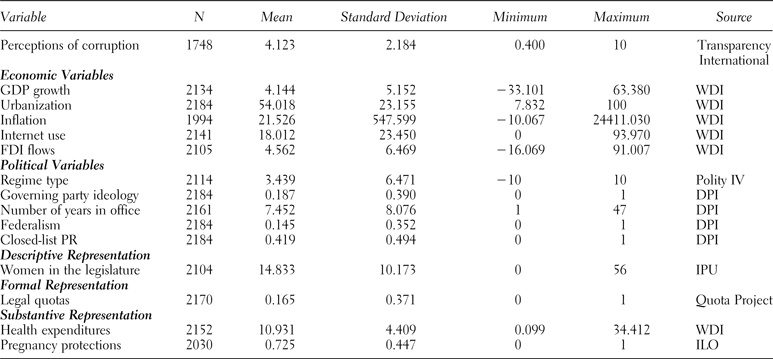
Finally, when estimating the relationship between women's representation and perceptions of corruption, we include the dependent variable, lagged by one year, and regional dummy variables. These measures allow us to minimize many of the traditional or regional explanations and focus on marginal changes in perceived corruption from year to year. A summary of all of the independent variables is included in Table 1.
Summary Statistics

RESULTS
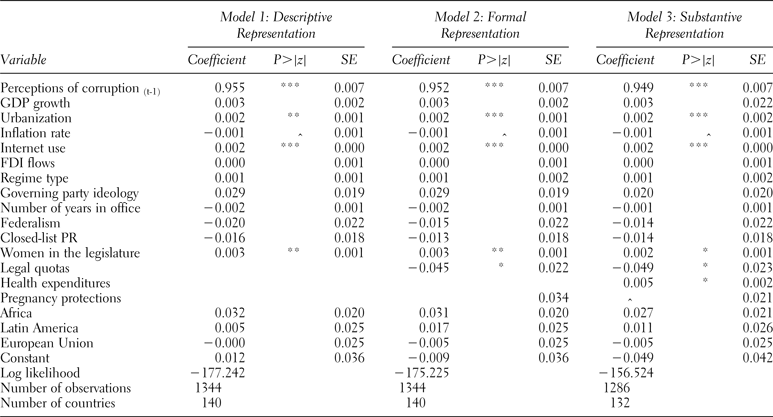
Table 2 reports the results of the Tobit analysis of perceptions of corruption. This table presents coefficients from three models. A positive and significant coefficient indicates that a variable is correlated with lower levels of perceived corruption, since the dependent variable is coded so that higher values indicate less perceived corruption.
Women's Representation and Perceptions of Corruption, 1998–2011
Notes: Time-series analysis with Tobit estimates.
Two-tailed tests: ^significant at <.10; *significant at <.05; **significant at <.01; ***significant at <.001
Dependent variable: CPI Index of Corruption (Higher scores indicate lower perceived levels of corruption.)
Model 1 of Table 2 presents a baseline model, which includes the political and economic control variables and the traditional measure of women's descriptive representation. In this model, the number of women in the legislature is positively and significantly correlated with perceptions of corruption, indicating that perceptions of corruption decrease as women's representation increases.
Model 2 of Table 2 begins to unpack the dynamics of women's representation by including legal quotas as a measure of women's formal representation, along with the measure of women's descriptive representation. In this model, the dichotomous measure for legal quotas is negative and significant, indicating that perceptions of corruption are higher in the presence of legal quotas. After the inclusion of the measure of legal quotas, however, the measure of women's descriptive representation remains positive and significant.
Model 3 of Table 2 reports the results of a fully specified model, which includes the two substantive measures of women's representation, health-care expenditures, and the rights of pregnant women not to be fired, along with the measures of women's descriptive and formal representation.Footnote 8 In this model, health expenditures and pregnancy protections are both positive and marginally significant, indicating that perceptions of corruption are lower in countries with higher levels of substantive representation for women. The effects of women's numerical presence and quota laws remain the same, even after the inclusion of the substantive measures.
Throughout each of the three models, control variables for urbanization, inflation, and Internet use are consistently significant, along with the lagged dependent variable. The economic control of GDP growth proves to be positive but not significant in predicting perceptions of corruption.
The control variable for inflation is negative and marginally significant. This relationship suggests that an inflating currency is associated with an increase in the perception of corruption. Interestingly, none of the other control variables (FDI, the number of years in office of the current regime, the ideological placement of the governing party, democratization, closed PR, and regional controls) achieve statistical significance in the model, suggesting that the determinants of corruption perception are difficult to ascertain.
DISCUSSION
The theory developed from existing research suggests that we must take into account the full dynamics of women's representation. While previous research has produced inconsistent results regarding the effects of women's political presence on perceptions of corruption, this analysis suggests that multiple measures of women's representation are correlated with perceived levels of government transparency.
The substantive measure of pregnancy employment rights proves to be positive and marginally significant. This suggests that the adoption of more stringent protective legislation toward women or progressive gender issues is correlated with decreased levels of perceived corruption. This is particularly interesting since the measure was dichotomous and does not gauge whether these laws are enforced. The measure of health expenditures is also positive and at a higher significance level than the pregnancy protections measure.Footnote 9 Combined, we find strong support for the idea that substantive representation is correlated with a decrease in perceptions of corruption.
The measure of formal representation—legally mandated gender quotas—is negative and significant. This finding indicates that perceptions of corruption are higher in countries with quota laws. This finding is distinct, but is not surprising given the mixed predictions of the existing literature. For example, Baldez (Reference Baldez2004) suggested that quotas are adopted strategically within political parties in lieu of other attempts to open the nomination process.
Finally, the descriptive measure of women's representation proves to be positive and significant, even after controlling for the other political and economic factors and the multiple dimensions of women's representation. The numerical presence of women legislators appears to have an independent relationship with corruption perceptions, even after the formal and substantive representation of women are taken into account.
CONCLUSIONS AND IMPLICATIONS
After considering multiple facets of women's representation, we find that the descriptive presence of women legislators, the substantive policies related to traditional women's interests, and the presence of legal quotas are correlated with the perception of corruption in government. However, the adoption of gender quotas appears to be correlated with increased perceptions of corruption, while the other measures of women's representation are associated with lower levels of perceived corruption.
Perceptions of government corruption are important indicators of democratic performance, and research on the determinants of corruption is essential. However, this analysis also suggests a great need for additional research on the relationship between the dynamics of women's representation and attitudes toward government. While this study demonstrates that multiple measures of women's representation are correlated with perceived corruption, additional work is needed to explain the causal link between women's representation and corruption. The inconsistent results of previous research may be partially explained by the lack of attention to the various ways that women's representation can be understood and how women's representation has changed in the past two decades. In particular, the increase in women's representation, the diffusion of candidate gender quotas, and the substantive representation of women indicate that we must rethink how women's representation influences perceptions of government transparency.
APPENDIX
Countries included in the analysis and CPI score in 2011
Albania 3.1
Algeria 2.9
Angola 2
Armenia 2.6
Australia 8.8
Austria 7.8
Azerbaijan 2.4
Bahrain 5.1
Bangladesh 2.7
Belarus 2.4
Belgium 7.5
Benin 3
Bolivia 2.8
Bosnia and Herzegovina 3.2
Botswana 6.1
Brazil 3.8
Bulgaria 3.3
Burkina Faso 3
Burundi 1.9
Cambodia 2.1
Cameroon 2.5
Canada 8.7
Cape Verde 5.5
Central African Republic 2.2
Chad 2
Chile 7.2
Colombia 3.4
Comoros 2.4
Congo, Republic 2.2
Congo, Democratic Republic 2
Costa Rica 4.8
Croatia 4
Cyprus 6.3
Czech Republic 4.4
Denmark 9.4
Djibouti 3
Dominican Republic 2.6
Ecuador 2.7
Egypt 2.9
El Salvador 3.4
Equatorial Guinea 1.9
Estonia 6.4
Ethiopia 2.7
Finland 9.4
France 7
Gabon 3
Gambia 3.5
Georgia 4.1
Germany 8
Ghana 3.9
Greece 3.4
Guatemala 2.7
Guinea 2.1
Guinea-Bissau 2.2
Guyana 2.5
Haiti 1.8
Honduras 2.6
Hungary 4.6
India 3.1
Indonesia 3
Iran 2.7
Ireland 7.5
Israel 5.8
Italy 3.9
Jamaica 3.3
Japan 8
Jordan 4.5
Kazakhstan 2.7
Kenya 2.2
Korea, South 5.4
Kuwait 4.6
Kyrgyzstan 2.1
Laos 2.2
Latvia 4.2
Lesotho 3.5
Liberia 3.2
Lithuania 4.8
Madagascar 3
Malawi 3
Malaysia 4.3
Mali 2.8
Mauritania 2.4
Mauritius 5.1
Mexico 3
Moldova 2.9
Mongolia 2.7
Morocco 3.4
Mozambique 2.7
Namibia 4.4
Nepal 2.2
Netherlands 8.9
New Zealand 9.5
Nicaragua 2.5
Niger 2.5
Nigeria 2.4
Norway 9
Oman 4.8
Pakistan 2.5
Panama 3.3
Papua New Guinea 2.2
Paraguay 2.2
Peru 3.4
Philippines 2.6
Poland 5.5
Portugal 6.1
Qatar 7.2
Romania 3.6
Russia 2.4
Rwanda 5
Saudi Arabia 4.4
Senegal 2.9
Sierra Leone 2.5
Singapore 9.2
Slovakia 4
Slovenia 5.9
Solomon Islands 2.7
South Africa 4.1
Spain 6.2
Sri Lanka 3.3
Sudan 1.6
Swaziland 3.1
Sweden 9.3
Switzerland 8.8
Syria 2.6
Tanzania 3
Thailand 3.4
Togo 2.4
Trinidad and Tobago 3.2
Tunisia 3.8
Turkey 4.2
Uganda 2.4
Ukraine 2.3
United Arab Emirates 6.8
United Kingdom 7.8
United States 7.1
Uruguay 7
Venezuela 1.9
Vietnam 2.9
Yemen 2.1
Zambia 3.2