When Heinrich Berlin (1958) first discovered the so-called emblem glyph in the inscriptions of the central and southern lowlands, he made a breakthrough in understanding Maya political organization. Since then, dozens of emblem glyphs have been recognized in inscriptions of the Classic period (a.d. 300–1000). As a title used exclusively by rulers, the glyphs render the particular “emblem” believed to be the reference name of a political entity. Thus, they ultimately provide some idea of the number of Maya kingdoms, as well as of their relationships, when used in statements about rulers and noblemen and noblewomen. No complete list of emblem glyphs has yet been published, but more than forty are recognized (Martin and Grube 2000:19; Mathews 1991: 20–21), and as many as one hundred may exist in the entire hieroglyphic record of the central and southern lowlands.
Early claims of having identified emblem glyphs in the inscriptions of northwestern Yucatan, however, rested on isolated expressions such as ajaw or k'uhul ajaw (Dunning 1979; Kelley 1976:218, 1982:8, Figure 6; Kowalski 1985a:236–244, 1985b:51; Mathews 1991:21–22). Suggested emblem glyphs for Xcalumkin, Itzimte, Pixoy, Tzum, and Uxmal were presumably based on this principle, but additional discussion of the merits of these possible emblems was lacking (cf. Mathews 1988:364). Although these claims were pioneering work, they are problematic insofar as their hieroglyphic evidence did not match the established definition of emblem glyphs. Consequently, they can be recognized not as emblem glyphs but as simple titles of lords (Stuart 1993:326, Stuart and Houston 1994:5). Whereas in the central and southern lowlands such ajaw titles are not considered emblem glyphs, in northwestern Yucatan the issue is much more difficult issue because even the rulers remain unidentified. How, then, can we separate such ajaw titles worn by common noblemen from those of the presumed ruler? The research strategy must be to use structural analogy, where each combination of ajaw and a further expression should initially be considered a potential emblem glyph in northwestern Yucatan. Furthermore, the k'uhul ajaw title, as the highest title reserved for rulers in the central and southern lowlands, should be another clue to identifying rulers in the inscriptions of northwestern Yucatan (cf. García Campillo 1995:1:91) and thus should allow us to detect references to their polity within their title phrase.
Until now, only three emblem glyphs—those for Dzibilchaltun, Jaina, and Ek' Balam—have been identified within the inscriptions of northwestern Yucatan (García Campillo 1995, 1998; Maldonado et al. 2002; Vargas de la Peña et al. 1998, Voss and Eberl 1999). The questions of how to recognize further emblem glyphs in those inscriptions or why only these were detected, however, are intimately linked with our conception of what emblem glyphs are. Before turning to northwestern Yucatan, its particular cultural traits, and the search for explicit references for polities in its inscriptions, we must first return to our understanding of emblem glyphs gained from the inscriptions farther south.
THE EMBLEM GLYPH AS DEFINED BY THE INSCRIPTIONS FROM THE CENTRAL AND SOUTHERN LOWLANDS
The emblem glyph is a compound of invariable signs structured around one or more variable signs. The invariable signs are the so-called water group T35 to T41, rendering the expression k'uhul ‘divine’ along with one or several others, most commonly T168, T747a, or T1000d, and sometimes suffixed by T130 /wa/ for ajaw ‘ruler, lord.’ The group of variable signs, also called “main sign,” refers to the “emblem” and is hence the distinguishable feature of a polity or kingdom (Barthel 1968:120; Berlin 1958:111; Kelley 1976:213–219; Mathews 1991:23–25). Thus, the expressions k'uhul plus “main sign” and ajaw constitute the full form of an emblem glyph. Sometimes the corresponding glyphs are distributed over several blocks, providing a sure reading order, whereas they are usually pressed into one single hieroglyphic block. However, the allocation ultimately seems to be a matter of space or taste of the artisan (Mathews and Justeson 1984:217–218).
The meaning of the “water group” prefix for k'uhul as well as the ajaw expression, the two constant parts of an emblem glyph, is well known. K'uhul refers to the sacredness or the holiness of the entitled person—for example, the ruler (Houston and Stuart 1996:295; Jackson and Stuart 2001:217, 225; Ringle 1988:11; Stuart 1995:233–240). It may refer to blood as the most valuable liquid a human being can offer to gods or to his godlike status, thus separating him from other noblemen (Houston and Stuart 1996:295; Mathews 1988:353; Stuart 1988, 1993:326). The term ajaw stands for “ruler and lord,” thus giving the person who wears the emblem glyph the highest rank within the polity (Lounsbury 1973:135–137; Mathews and Justeson 1984:203–212). The emblem glyph thus translates as “divine ruler/lord from x,” with the lord or ruler, not the place, attested as holy (Mathews 1991:25; Stuart 1993:326; Stuart and Houston 1994:7). Grammatically, then, k'uhul must be an adjectival or nominal glyph that as an attribute modifies the title ajaw, not the “main sign” (cf. Bricker 1986:123). Therefore, some rulers in the central and southern lowlands are occasionally also referred to as k'uhul ajaw ‘divine/holy lord or ruler,’ as, for example, in Yaxchilan (the spelling rules for archaeological sites are from Bell et al. 2004:) on Lintel 41 (E3)—that is, they appear thus without the main sign of their usual emblem glyph.
There are two well-known instances in which the emblem glyph lacks the invariable “water group” sign and is reduced to the expression ajaw and the “emblem.” This can be found when a ruler is mentioned as a prisoner in a foreign text, indicating that he might have lost his dignity or divine status (cf. Mathews and Justeson 1984:217). It also occurs when it is used as a woman's title when a female head appears instead of, or overlaps, the “water group” sign where it indicates her dynastic origin (Houston 1986:1). In all other instances when a male ruler is named and k'uhul is absent, it becomes questionable whether the compound should still be considered an emblem glyph (Kelley 1976:215). This also includes such aberrant forms from Caracol and Río Azul that are even lacking the expression ajaw ‘ruler.’ Nevertheless, functional analogy takes them as emblem glyphs (Houston 1986:2). In the central and southern lowlands during the Late Classic period, these forms coexisted with the full variants for other polities. It is suggested that individuals designated by such a compound had a somewhat different or inferior status from that of people with regular emblem glyphs or that it relates to local or archaic titles (Houston 1986:10). Another explanation I suggest is that this “emblem” title without k'uhul and ajaw is the original or archaic formula of the Early Classic period (a.d. 300–600), representing a place name or even a territorial unit (cf. Stuart 2004:219). These forms were retained during the entire Classic period, whereas in most other places the corresponding early forms underwent a gradual transformation in concept, and perhaps in meaning, to become the expression today known as full Emblem Glyph—for example, with k'uhul prefixed to the “main sign” and ajaw in name-tagging phrases. This change is thought to have been politically motivated to control the growth of titles that were often shared by rulers and other noblemen (Houston 1986:1; Houston and Stuart 2001:59–60; Riese 1988:79–80). However, with this change, the full variant of the emblem glyph represented the usual reference to the polity in the central and southern lowlands, whereas only some aberrant or reminiscent forms without k'uhul and/or ajaw were retained in sites such as Río Azul and Caracol.
The ancient conception of emblem glyphs is still ambiguous, and the idea behind the compound of variable signs that are unique for each polity or kingdom has not been solved. Several possible interpretations can be considered. These include a lineage or dynastic name, a place name, or the name of the kingdom itself (Barthel 1968:120; Kelley 1976:215; Mathews and Justeson 1984:216; Proskouriakoff 1950:147). Scholars are now inclined toward the place-name interpretation—that is, the emblem glyph refers to a polity in a wider sense, yet basically, only its function as royal or noble title is secure (Martin and Grube 2000:17; Mathews 1988:352, 1991:24; Stuart and Houston 1994:3 ff.). The appearance of double emblem glyphs in the inscriptions of some sites of the southern lowlands is another feature that is still not very well understood or analyzed in detail (Berlin 1958:113; Kelley 1976:215; Schüren 1991). My analysis has shown that their circumstances of origin vary (Graña-Behrens 1997). It could be either that the emblem glyph of another polity, by conquest or for other political reasons, was attached to the local one, as is the case of Yaxchilan or Sak Tz'i, or that a mythological place evolved to become the second emblem glyph, as, for example, in Palenque.
The “place-name” theory receives further support from the fact that, besides royal women, men other than rulers use the “title of origin.” In these cases, the main sign from the emblem glyph is combined with the agentive prefix aj, rendering “he of … ,” and is believed to be coming from the same polity (Stuart and Houston 1994:19). Finally, inscriptions from sites with a documented emblem glyph can refer to additional place names that are also used as part of the title of origin for noblemen or noblewomen (Stuart and Houston 1994:19–42). In these cases, then, it is necessary that the emblem glyph is already firmly recognized to distinguish between a title of origin derived from the emblem glyph itself and from other titles of origin.
Several approaches have been taken to reconstructing Classic Maya political organization that are based on the concept of emblem glyphs (Barthel 1968; Marcus 1976; Mathews 1991). The questions addressed have included, first, whether polities were hierarchically structured because certain emblem glyphs were cited more often than others in the inscriptions; and second, whether those polities included still other sites with emblem glyphs in their territory. An affirmative answer to these questions led to the “regional state model,” which saw larger states dominating other sites within their territory (Adams 1986:437; Adams and Jones 1981:308; Marcus 1993:150). Other scholars questioned this hierarchical interpretation, paving the way for the “city-state model,” where much smaller polities were considered not only equal in rank but also autonomous (Houston 1992:67; Mathews 1991:29; Stuart 1993:327). Today, the second approach is widely accepted for the central and southern lowlands, together with an inclination toward a decentralized internal organization in the form of a so-called segmentary state (Ball and Taschek 1991:161; Grube 2000:553; Houston 1993:142–148). At the same time, political hierarchies are now measured in terms of power, expressed in the inscriptions by statements of political subordination and war (Houston 1993; Houston and Mathews 1985; Martin and Grube 1994, 2000; Schele and Freidel 1990). Hierarchies are not solely discernible by the use of emblem glyphs but rest on more subtle information. While emblem glyphs underpin the existence of polities and hint at a kind of royal or state self-representation, interpolity relationships must be inferred from other information within the inscriptions.
The described sign cluster as detected by Berlin (1958) remains crucial to recognizing emblem glyphs in the inscriptions. Ideally, the emblem glyphs should appear several times in the inscriptions of one site and preferably as titles of different rulers and over a long period of time. It is the repetitiveness that to some extent guarantees the emblem glyph's secure identification and prompts us to distinguish it from other titles worn by noblemen or rulers. Furthermore, foreign texts can help in recognizing emblem glyphs when a visiting ruler is mentioned with this title or where a captured ruler is mentioned with his emblem glyph, although it lacks the k'uhul prefix.
EMBLEM GLYPHS IN NORTHWESTERN YUCATAN
When taking the concept described by Berlin (1958) as a base for further research, only the three emblem glyphs attributed to Dzibilchaltun, Ek' Balam, and Jaina have been recognized conclusively in the inscriptions of northwestern Yucatan. Furthermore, the mostly fruitless attempts to identify emblem glyphs have been made more difficult by fewer and less well-understood hieroglyphic texts. The interpretation of political organization in northwestern Yucatan for the Classic period depends equally on the concepts outlined for the central and southern lowlands. Nevertheless, when it comes to the evidence to be drawn from inscribed monuments, the “city-state model” remains largely a theoretical approach for northwestern Yucatan (cf. Mathews 1988: Figure 11–10). This is why some scholars have even relied on information on political organization from colonial sources (Lincoln 1990:65, 77; Marcus 1993:117–153). Such a procedure, however, is not always helpful, especially when the colonial information has not previously been evaluated.
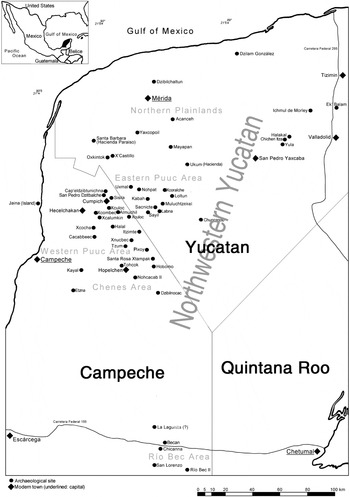
As a region defined by its cultural features and historical development since the Late Classic period (after a.d. 600), northwestern Yucatan is set apart from the central and southern lowlands, as well from the east coast of Yucatan because of its shared architectural tradition (Río Bec, Chenes, and Puuc) (Gendrop 1983; Pollock 1980), unique iconography (Proskouriakoff 1950), distinctive ceramic complexes (Brainerd 1958; Smith 1971), and the style and content of its hieroglyphic writing (Graña-Behrens 2002; Grube 1994; Thompson 1977). Plotting these cultural elements on a map, northwestern Yucatan extends roughly from Ek' Balam in the north to Río Bec in the south (Figure 1). Within this region, hieroglyphic texts are typically short rather than long, and the signs are stylistically different from those of the rest of the lowlands (Grube 1994). Texts are sometimes written exclusively with glyphs that represent syllables rather than using logograms mixed with syllables. There are relatively few carved monuments; painting may have been more the norm. Thus far, no birth or accession statements have been found. Dates employing the Long Count are also rare, and Period Ending dates not marked. Instead, time is measured based on the “Yucatecan Method” (Thompson 1937, 1950) and what I term the “Ajaw-Count.” This is an independent unit counting the periods of Tun and K'atun. It shares the name and some features of the same day Tzolk'in Ajaw but relies on distinctive additional glyphs and on a different syntax (Graña-Behrens 2002:243–248). The political organization of northwestern Yucatan was also thought to be different, with interpretations ranging from “joint government” to “regional states” (Andrews and Robles Castellanos 1985; Dunning 1992, 2000; Dunning and Kowalski 1994; Grube 1994; Krochock 1988; Schele and Freidel 1990). However, a growing number of available inscriptions and recent advances in understanding the inscriptions of northwestern Yucatan (Graña-Behrens 2002; Grube 2003; Lacadena García-Gallo 2000) make it worthwhile to reexamine the three known emblem glyphs and to isolate others.

Map of northwestern Yucatan.
In the following, I will argue that, apart from the full form of emblem glyphs, other references to polities appear occasionally in the inscriptions of northwestern Yucatan, with these statements lacking the expected k'uhul and ajaw expression from the emblem glyphs in the central and southern lowlands. Due to the emblem glyph's supposed origin, I take these statements as the archaic formula for the polity. During the Late Classic period (a.d. 600–1000), such references became the “main sign” of a full-form emblem glyph by incorporating the k'uhul and ajaw statement from the central and southern lowlands. However, contrary to the southern part, where the full emblem glyph becomes the crucial title reference for the polity—with the exception of those cases in Río Azul or Caracol, for example, where the archaic form continued to be used exclusively instead of a full-form emblem glyph—in the northern part, both the archaic formula and the newly styled emblem glyph are found in equal measure as polity reference in the title phrase of its rulers. This sheds further light on the political organization and on the ruler's self-understanding in northwestern Yucatan. Nevertheless, this report is not intended to give a comprehensive or synthetic review of all information (archaeological and ethnohistoric, as well as epigraphic) relating to the pre-Hispanic political organization of this region. Rather, it is designed as a research report on advances in the identification of northwestern emblem glyphs.
DZIBILCHALTUN, EK'BALAM, AND JAINA
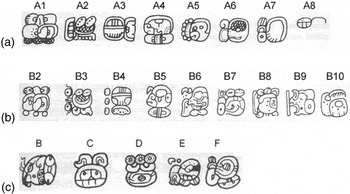
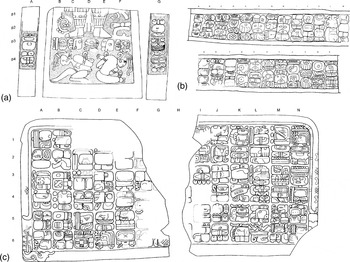
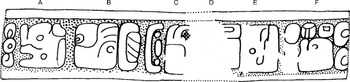
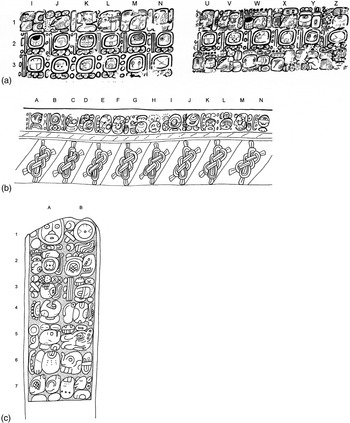
Three different inscriptions depict the emblem glyph of Dzibilchaltun, two of them found at the site (Figure 2a–c). The clearest example comes from Dzibilchaltun Stela 19, where the emblem glyph appears after the rulers name in its full form in block A5-A8, k'uhul ?- kaan ti jo ajaw (García Campillo 1995:I:215; Maldonado et al. 2002:95; Schele et al. 1997:114). In the colonial period, the place name for Mérida, not far from Dzibilchaltun, was Ichkaantijo. This makes it likely that the complete reading of the emblem glyph is Ichkaantijo (Schele et al. 1997:414).

Emblem glyph of Dzibilchaltun. (a) Dzibilchaltun, Stele 19 (from Maldonado et al. 2002:97, Figure 12); (b) Dzibilchaltun, bone from Structure 42 (Maldonado et al. 2002:97); (c) Vase, K4333 (Maldonado et al. 2002:97).
The same emblem glyph was recently found written on an animal bone (block B4-B5), excavated from a building where it served as a companion text to a dead person, believed to be the ruler also named on Stela 19 (Maldonado et al. 2002:90–91). In this case, however, the emblem glyph lacks the k'uhul expression. In a third case, on a vase of unknown provenience, assigned to northwestern Yucatan because of its so-called Chochola style (Grube 1990:320–322), not only the k'uhul but also the ajaw expression is missing (block E-F). This “truncated version” clearly demonstrates that the elements k'uhul and ajaw are only optional parts of emblem glyphs in the inscriptions of northwestern Yucatan, which makes them more closely resemble the aberrant forms (as in Río Azul) found in the central and southern lowlands. Nevertheless, without these elements it would have been hard to accept the glyphic statement ?-kan ti jo from the vase text as the “main sign” of the Dzibilchaltun emblem glyph. Therefore, the “invariable elements” k'uhul and ajaw, with either both or only the last one present, heuristically still represent the first approach of how to detect emblem glyphs.
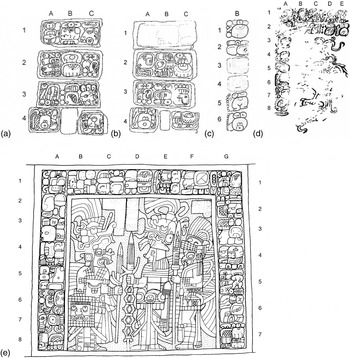
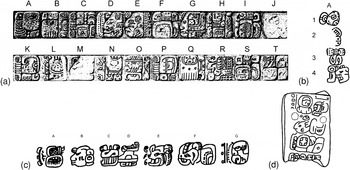
The emblem glyph of Ek' Balam, just like the one of Dzibilchaltun, is also depicted in various ways, either with or without k'uhul. (Figure 3a–d). On two hieroglyphic serpent balustrades mounted on a stairway of recently excavated Structure 1 (the Acropolis), the emblem glyph appears twice associated with the same ruler (Vargas de la Peña and Castillo Borges 1999:176; Voss and Eberl 1999:125). Whereas on the western hieroglyphic serpent balustrade the emblem glyph of Ek' Balam reads k'uhul tal ajaw, the inscription on the eastern balustrade just mentions tal ajaw, excluding once again the k'uhul expression (both block A4). Furthermore, there are other inscriptions from Ek' Balam where the k'uhul prefix is present, as on Stela 1 (block B6), or omitted, as on Capstone 19 (block E2). This underpins the assumption that the k'uhul prefix is just a facultative element in emblem glyphs in northwestern Yucatan and thus can be omitted even in the local inscriptions of a polity, something that never happened elsewhere in the Maya Lowlands.

Emblem Glyph of Ek' Balam. (a) West Hieroglyphic Serpent Balustrades (from Lacadena García-Gallo 2003); (b) East Hieroglyphic Serpent Balustrades (from Lacadena García-Gallo 2003); (c) Stela 1 (from Lacadena García-Gallo 2003); (d) Capstone 19 (from Lacadena García-Gallo 2003); (e) Halakal Lintel (from Voss and Kremer 2000:159, Figure 7).
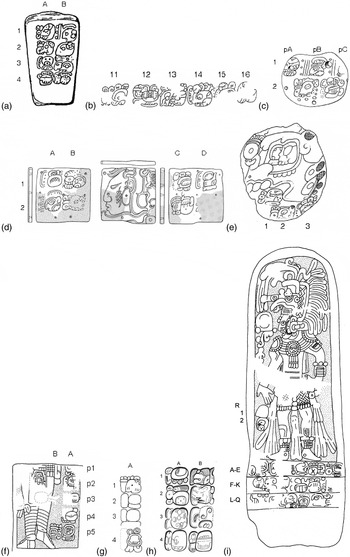
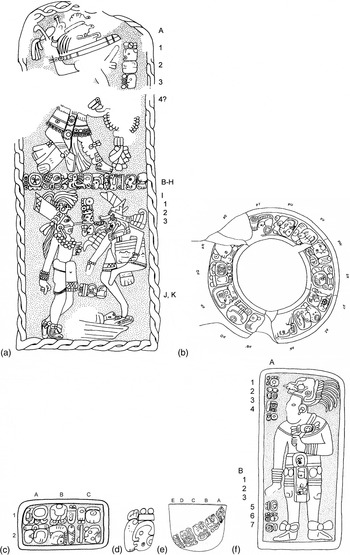
Another clearly identified emblem glyph from northwestern Yucatan consists of the formula k'uhul kaan ajaw appearing after the names of different rulers (Figure 4a–g). However, there is one example, on the so-called Grolier 53 vase, where the ajaw expression is omitted and aj is prefixed instead, rendering the title of origin—a formula again never used by rulers in the central or southern lowlands, where only the full emblem glyph is expected (Figure 4h, block B4). All together, the emblem glyph appears almost a dozen times in different inscriptions, but mostly on portable objects such as jade pendants and vases, some of them presumed to have been found at Jaina and therefore alleged to stand for this site (García Campillo 1995:I:213–214, 1998). Other objects bearing this emblem were discovered at Chichen Itza and Uaymil or are of unknown or unsure provenience. Until recently, the emblem glyph was not known to appear on a single stone inscription from the island of Jaina itself but was recorded on a doorjamb from Xcalumkin and on a stone monument of unknown provenience, now housed at the Museo del Camino Real in Hecelchakan (Figure 4g). Therefore, linking the emblem glyph to Jaina, as originally proposed by José Miguel García Campillo, was still a hypothesis until a new piece of evidence of emerged—a fragmented stone inscription found at Jaina (Antonio Benavides, personal communication 2004)—that strongly supports this idea. The new inscription refers not only to the same ruler as on several known inscriptions, but it also links immediately to the “main sign” of the discussed emblem glyph, although it does not include k'uhul and ajaw. A heavily eroded space in front of the main sign allows the assumption that it was originally preceded by aj, yielding the same title of origin as on the “Grolier 53 vase.” In addition, the same emblem glyphs (with ajaw but without k'uhul) and the name of the same ruler might be have been intended on Stela 2 from Santa Rosa Xtampak (Figure 4i, blocks J and O), which would thus suggest an existing political relationship between the sites in Late Classic times. The appearance of the Jaina emblem glyph outside the island in its hinterland at sites such as Uaymil, Xcalumkin, and Santa Rosa Xtampak uncovers a vast political activity among sites in northwestern Yucatan that might even suggest that Jaina maintained a strong political influence over this area.

Emblem glyph of Jaina. (a) Jadeite amulet, probably from Jaina (from Spinden 1975:144, Figure 196); (b) “Jaina Vase” (K4340; from García Campillo 1998:59, Figure 3a); (c) Jade pendant, probably from Uaymil (from Proskouriakoff 1974:207, Figure 13); (d) Chichen Itza, jade paired rectangular from the Great Cenote (from Proskouriakoff 1974:118, Figure 49b, Figure 12, 15–16); (e) Conch-shell pendants of unknown provenience (from Stuart and Houston 1994:48, Figure 55b); (f) Xcalumkin, Jamb 3 (from Graham and Von Euw 1992:4:165); (g) Monument of unknown provenience (Museo Camino Real, Hecelchakan; drawing by the author); (h) Vase “Grolier 53” (from Coe 1973:113); (i) Santa Rosa Xtampak, Stele 2 (from Graña-Behrens 2002:Plate 130).
ICHMUL DE MORLEY
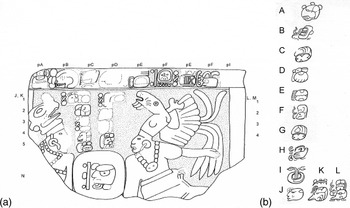
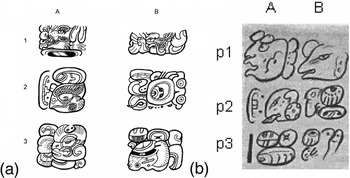
On a panel attributed to Ichmul de Morley (Panel 2), up to two emblem glyphs clearly appear associated with different individuals (Graña-Behrens 2002:252; Figure 5a). It is probable that the same people and emblem glyphs appear on the similar, but badly eroded, Panel 1 from the same site. Both individuals, presumed to be rulers, are depicted on the monument in a ballplaying pose. The one with an unidentified animal headdress on the left is associated with an emblem glyph very similar or identical to the one used in Tikal and Dos Pilas in the central and southern lowlands, which therefore can be read as k'uhul mut(ul) ajaw (block K5). Interestingly, the same “main sign” mut or mutul appears preceded by the agentive aj as a title of origin for a captive on Dzilam González Stela 1 (Figure 6a, block A). Although this might be the emblem glyph for Ichmul de Morley, the second emblem glyph on the panel might also stand for the site, as associated with the individual on the right side wearing a deer headdress. The main sign here consists of T575 /BAH/, yielding k'uhul bah ajaw (block M4). In all likelihood, the same emblem glyph is written again on a carved human femur found at Jaina and mentioned as part of the phrase for a captured ruler, although here T501 /ba/ appears instead of T575 /BAH/, a well-known substitution from other hieroglyphic contexts (Figure 5b). Although the emblem glyphs on the Ichmul de Morley Panel cannot be linked definitively to a polity or a site until more evidence is available, the carved bone from Jaina makes it likely that the k'uhul mut(ul) ajaw is the emblem glyph for Ichmul de Morley, whereas k'uhul ba(h) ajaw seems to be from another site or polity (possibly Kayal). These examples clearly further underpin the importance of emblem glyphs in northwestern Yucatan and indicate an interesting political relationship between these sites.

Emblem glyphs in Ichmul de Morley. (a) Ichmul de Morley, Panel 2 (from Graña-Behrens 2002:Plate 73); (b) Carved human femur from Jaina (from Coe 1973:146).

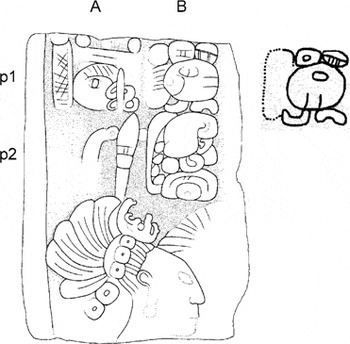
Emblem glyphs of Dzilam González. (a) Dzilam González, Stela 1 (from Graña-Behrens 2002:252, Figure 114); (b) Chichen Itza, “Caracol” Round stone (drawing by Alexander W. Voss); (c) Chichen Itza, Stela 1 (from Voss and Kremer 2000:167, Figure 15).
DZILAM GONZÁLEZ
On the stela from Dzilam González on which the mentioned captive to the Mut(ul)/ Ichmul de Morley site is depicted, another emblem glyph can be found on one of the side panels (Figure 6a). This emblem glyph seems to be part of the local ruler's title phrase and consists of its “main sign” of the hieroglyphs T60 /hi/, T699 /tza/ and T683 /ja/, thus rendering hitzaj, and complemented by glyphs for ajaw (block Ap3-Ap4). Together this yields the emblem glyph hitzaj ajaw (Graña-Behrens 2002:253). Nikolai Grube argues that there is no “knot” (T60) sign and thus does not accept a hi reading. Instead, he considers the element more likely to be part of one single sign to be read as tza (Grube 2003:361–362). However, in the author's view, the “knot” sign is clearly present as stated in an earlier publication (Graña-Behrens 2002) and thus a hi reading is appropriate.
Although the expression lacks the k'uhul prefix, it fits perfectly into the pattern of emblem glyphs as employed in northwestern Yucatan. That the ruler's name Uk'uuw Chaan, or more likely Uk'uuw Chanaw, reported on the second side panel of the monument is identical or very similar to the one known from Dzibilchaltun might be a mere coincidence (cf. Grube 2003:362). Furthermore, the same emblem glyph hitzaj ajaw and the title of origin aj hitzaj are also used by individuals mentioned in two texts from Chichen Itza (Figure 6b–c). These individuals were formerly linked to the Peten area in the central lowlands (Boot 1997; Schele et al. 1997:410). However, striking epigraphic differences as well as the new link to Dzilam González make it more probable that they are from this last site. Looking at hieroglyphs, the emblem glyph found on a monument from Motul de San José in central Peten reads k'uhul itza ajaw (Boot 1997:334). Here, instead of using T60 /hi/ as superfix, as is the case of the Dzilam González Stela T679, /i/ is infixed into T699 /tza/. The two examples from Chichen Itza, however—and this is crucial—show only T60 /hi/ as superfix and never T679 /i/ as infix. Therefore, it is more likely that the individuals mentioned in Chichen Itza were from Dzilam González rather than from central Peten. The relatively local origin of these individuals thus would appear not to support the idea of migrations from the central and southern lowlands to northwestern Yucatan, as has been suggested by problematic passages in the Books of Chilam Balam, questioned in another study only recently (cf. Gunsenheimer 2001).
IKIL
The highest standing building at the site of Ikil has two lintels with a hieroglyphic text that runs continuously from Lintel 1 to Lintel 2. Lintel 2 refers to an emblem glyph in block S that likewise also shows up in inscriptions from other sites (Figure 7a–d). It consists of the signs T75 /ma/, T676 /TAL/, and T580 /lo/, yielding matal or ma-tal, plus an eroded sign and T130 /wa/, both for ajaw. Thus, the presumed emblem glyph could be read as matal ajaw. It is associated with a male individual who accordingly must be considered the local ruler (block P-Q). In addition, he might even wear another emblem glyph in the preceding hieroglyphic block of the just mentioned emblem glyph (block Q). This one consists of the superfix T168 /ajaw/ and the postfix T130 /wa/ as phonetic complement for ajaw. The “main sign” is not quite clear and could be the full variant for ajaw (T518) or another sign, yielding another or second emblem glyph. The matal expression is also depicted on a jade piece from the Sacred Cenote in Chichen Itza (Figure 7b). In block C, the short text, probably naming an individual, contains the signs rendering matal, this time without the lo sign, complementing tal. It is followed by the agentive aj and an animal head, possibly a jaguar. Although the matal expression lacks the ajaw statement, it could nevertheless be the same emblem glyph if the previously elaborated pattern is followed. Another matal expression appears on an ear ornament (Figure 7c) found in a tomb in Altun Ha, Belize (Mathews 2001:474). It belongs to the name of a woman and hints at a possible relationship between Ikil and Altun Ha in the late Early Classic period.

Emblem glyph of Ikil. (a) Ikil, Lintel 1 and 2 (from Andrews IV and Stuart 1968, figure 1); (b) Chichen Itza, jade from the Cenote (from Proskouriakoff 1974:125, Plate 52c); (c) Altun Ha, ear ornament (from Mathews 2001:471, Fig. 46.1); (d) Ek' Balam, conch shell (from Lacadena García-Gallo 2003).
HALAKAL
On the Halakal Lintel there is an emblem glyph that, because of its similarity, is considered to be that of Ek' Balam (Lacadena García-Gallo 2003; Voss and Eberl 1999; Figure 3e, block G5-G6). However, one striking difference has been recognized. It consists of a headless man with a glyph underneath his feet between k'uhul and the usual tal ajaw (Voss and Eberl 1999:126–127). “Main signs” of emblem glyphs are generally written in the same fashion when representing a logogram. While syllables are only occasionally substituted by different signs, there are never additional elements such as the headless man, as in the present case. The only explanation may be that the headless man and the glyph underneath his feet (not clearly identified, but probably T89 /te/) inserted between the k'uhul and the tal ajaw expression corresponds to the glyphs found immediately in front of the emblem glyph on Stela 1 of Ek' Balam (Figure 3c, block G5; Markus Eberl, personal communication 2004). Nevertheless, the headless man on the Halakal lintel and the sign on Stela 1 from Ek' Balam, a body consisting only of legs (T702v), are not identical. The same holds true for the glyph underneath his feet, probably T87 in contrast to T86 /nal/ used in the latter inscriptions as an upperfix. Finally, the glyphic compound in question from the Ek' Balam stela comes close to the glyphs employed for a dancing object, as reported for instance on Yaxchilan Lintel 32 (block E1) or even more to a specific title of a goodness on the Tablet of the Foliated Cross from Palenque (block L17), suggesting that this could be referring to this object or could be such a title. The alteration of signs, then, makes it somewhat questionable to accept the emblem glyph on the Halakal lintel to be the same as for Ek' Balam, even if the name of the ruler is similar to the one known from Ek' Balam (cf. Lacadena García-Gallo 2003). Thus, although it cannot be proved, the emblem glyph on the Halakal Lintel may stand for Halakal itself.
UXMAL
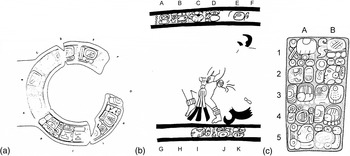
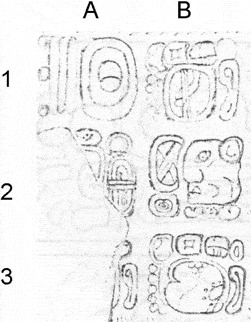
For some time now, the name of one ruler, now known as Chan Chaak, has been recognized in the inscriptions of Uxmal. In at least two varying inscriptions, his name is accompanied by the presumed emblem glyph for Uxmal (Riese and Mayer 1984:72, Kowalski 1985a:240 and 1985b:51). The clearest example can be seen on the north side of Ballcourt 1 (Ballcourt Ring 1), where the statement k'ak'nal ajaw follows his name (block K), whereas in the same position the title k'ak'nal ajaw (block J-K) appears on capstone 2 (cf. García Campillo 1995:I:193; Stuart and Houston 1994:23, Figure 22a–b; Figure 8a–b). However, in a third inscription, on Altar 10, a different title follows his name phrase (Figure 8c). It consists of k'uhul as prefix and ajaw as superfix, whereas the “main sign” is a human head that cannot be clearly recognized as one of the usual signs T1000c–g employed for the head to be read ajaw (block B2). In addition, at the bottom of the head sign is an unusual element that might be the sign T130 /wa/, the phonetic complement for ajaw. If the head sign in question indeed stands for ajaw, then the full expression would render the title k'uhul ajaw, thus underpinning the status of Chan Chaak as ruler and providing the argument for k'ak'nal ajaw as the emblem glyph of Uxmal. Otherwise, it remains open whether the last title is or is not the emblem glyph of Uxmal. The same title k'a'k'nal ajaw is also found in the inscriptions of Chichen Itza, on Lintel 1 of Structure 4C1 (block A), with an unknown subject due to the badly preserved glyphs (García Campillo 1995:I:194). However, if this is the emblem glyph for Uxmal, then some kind of relationship between the sites is documented here.

Emblem glyphs in Uxmal. (a) Uxmal Ballcourt Sculpture 1 (from Graham 1992:4:119); (b) Uxmal, Capstone 2 (from Graham and Von Euw 1992:4:141); (c) Uxmal, Altar 10 (from Graham 1992:4:115).
On Altar 10, two more ajaw titles were considered emblem glyphs (Kowalski 1985a:236). However, the first of them, deciphered as e witz ajaw, refers semantically to an individual following the yitaj expression, “his companion,” in reference to Chan Chaak (block B3-A4) (Grube 1994:323). It is therefore awkward to decide whether this statement is a title of a common nobleman or an emblem glyph used in substitution for the ruler's name. The second presumed emblem glyph follows yet another yitaj statement in reference to the former individual (block A5-B5). Although the first part of it can be only partially read, as ko-?, it is followed by the signs T168:518, the full variant for ajaw, with T130 /wa/ as phonetic complement and T38v /K'UHUL/K'U/ as postfix. This then renders ko-?-ajaw k'uhul, where k'uhul constitutes the final part of the title. Such a composition is also known from the central and southern lowlands when referring not to an individual but to a deity. Thus, the preceding expression functions as an adjectival modification of the god's name (Houston 2000:177; Houston and Stuart 1996:295). From this, one can deduce that it is not an emblem glyph that is intended but a deity or deified companion accompanying Chan Chaak and the second individual, E Witz Ajaw.
XCULOC
The frontal inscription of a lintel from the middle entrance of the center room of the so-called Building of the Sculptured Columns in Xculoc refers to the sculpture of a richly dressed figure on the underside (Figure 9). He bears a title that could be the emblem glyph of the site (block pE). The “main glyph” strongly resembles T756 /sotz'/, although it is difficult to identify clearly, accompanied by T168 /ajaw/ and T130 /wa/, its phonetic complement and preceded by a badly eroded glyph that could be from the “water group,” thus rendering k'uhul. The association with the nobleman makes it likely that this is the emblem glyph of Xculoc.

Xculoc, Lintel (drawing by the author).
ACANCEH
A specific title, part of a longer inscription on a vessel said to be from Acanceh, has been suggested as the emblem glyph of this site (Kelley 1982:8; Figure 10a). It consists of the usual T168 /ajaw/ as superfix and T130 /wa/ as its phonetic complement, while the main sign is a combination of the head sign T1042 /AKAN/ and a deer head to be read kej (block B3), yielding Akankej (Grube 2004). Interestingly, the same head sign of the emblem glyph T1042 and the deer head (block A-B) is painted on the wall of a tomb uncovered in front of the building with the stucco facade in Acanceh (Seler 1911; Grube 2004; Figure 10b). Although without the k'uhul and ajaw reference, the reference could be an early formula standing for the polity name. The “main sign” thus renders the same place name as it is still known today (Grube 2003:357), supporting evidence from the central and southern lowlands where the polity name either became the later place name or was the original place name.

Emblem Glyph of Acanceh. (a) Vase (drawing Alexander W. Voss); (b) Acanceh, Painting (from Seler 1911:404, Figure 8).
DZEHKABTUN
The large but hardly known site of Dzehkabtun may have had its own emblem glyph carved on a columnar altar, as suggested some time ago (Dunning 1979; Figure 11). It consists again of the usual T168 /ajaw/ and T130 /wa/ signs enclosing the “main sign” T528 /TUN/ while being introduced by k'uhul (block B3), yielding the emblem glyph k'uhul tun ajaw (García Campillo 1995:I:214–215). One can tentatively assume that tuun ‘stone’ could be the original or abbreviated name for the site known today as Dzehkabtun (mano or grinding stone). However, it could as easily be a relatively modern place name.

Dzehkabtun, Columnar Altar (from Dunning 1979).
KAYAL
A stone fragment recently found at Kayal shows the possible emblem glyph of this site (Mayer 1998:92, 1999:3; Figure 12). It consists of T168 /ajaw/ complemented by T130 /wa/, as well as two other glyphs, T1 /u/ or T43 /K'UHUL/ as a prefix and presumably T501 /ba/ as its “main sign” (block Bp1). Together, this would render ub ajaw or u ba[h] ajaw or k'uhul ba ajaw. As the barely visible prefixed sign could well be T43 /K'UHUL/ instead of T1 /u/, one could draw the conclusion that the same emblem glyph might be intended here as on Ichmul de Morley Panel 2 and on a human femur from Jaina (see Figure 5). In this context, the k'uhul bah ajaw-statement on the Ichmul de Morley Panel and on the carved human femur from Jaina could be seen as a reference to Kayal.

Kayal, Stone (from Mayer 1999:3; drawing Christian Prager, with additions).
UNKNOWN SITES
Four other emblem glyphs from northwestern Yucatan cannot be related to a determined site or polity. One of them appears in the “Mural de los 96 Glifos” at Ek' Balam (Figure 13a). The main sign consists of an unidentified animal head, while on one occasion the accompanying glyphs can be read as k'ujul and ajaw, and on a second occasion only as ajaw (cf. Lacadena García-Gallo 2003; blocks J1 and V3). Again the presence or absence of k'uhul reflects the pattern already found in the case of Dzibilchaltun or Ek' Balam.

Unknown sites. (a) Animal head (EKB; from Lacadena García-Gallo 2003); (b) Vase, K4732 (from Graña-Behrens 2002:Plate 195); (c) Stela (from Graña-Behrens 2002:Plate 201).
Another emblem glyph appears on a vase of unknown provenience but that is related to northwestern Yucatan because of its calendar formula (Graña-Behrens 2002:356; Figure 13b). The emblem glyph states, without doubt, k'uhul ibil ajaw (block I-J), although ajaw is written syllabically as aj-ja-wa. (This is unusual, but this form can also be found on Yaxchilan Lintel 3, block J1.)
The third emblem glyph is from a Stela of unknown provenience again linked to northwestern Yucatan by its calendar formula (Graña-Behrens 2002:398; Figure 13c). The supposed emblem glyph spreads over two blocks (Ap5–Bp5). In the first one, the so-called main sign appears represented by various signs that are difficult to decipher but that begin with T229 /aj/. The glyph in the second block reads ajaw, written with T168 and probably T747, a form also found in the central and southern lowlands. In addition, the information is provided that the ruler associated with this emblem glyph is the eighteenth in the official dynasty (block Bp3).
The last emblem glyph appears on the same carved human femur found at Jaina that also depicts the emblem glyph k'uhul ba(h) ajaw (Figure 5b). The second emblem glyph in question is mentioned together with the name of the ruler's father or grandfather to whom the bone was dedicated (block Lb). The “main sign” is still not deciphered, but it is a bird head complemented by T126 /ya/.
OXKINTOK
Although no emblem glyph (in the narrowly defined sense) can be seen in the inscriptions of Oxkintok, there is a specific glyphic compound that appears more than ten times in different name phrases in Early to Terminal Classic (a.d. 300–1000) inscriptions, just after the part believed to represent the ruler's name. It consists of the number seven attached either to a human head or to a sign resembling T511 with a suggested reading of (w)ukpet or (w)uknal (García Campillo 1995:I:210; Figure 14a, d). However, there are more indications that could help to decipher and understand this compound. On a Ballcourt Sculpture for instance, the number seven is not written in bars and dots as usual but with the corresponding head sign for that number (Figure 14b, block pU). Therefore, it may indeed be intended as the number seven (wuk in Maya) and not as an archaism where bar and dots served as fixed elements. Furthermore, the head sign of the compound is similar to T1000c /ajaw/, although it does not seem to be intended as ajaw and is never complemented, for instance, by T130 /wa/. This points to the conclusion that the sign must be a logogram. It is found on the Hieroglyphic Stairway 2, step 1, and has T501 /ba/ infixed (block C2), while on an unpublished doorjamb found in Oxkintok (Ricardo Velazquez, personal communication 1998) this last one precedes the head sign and the number (Figure 14c). However, the ba sign itself is still accompanied by another, currently unidentified sign on top of it. It is very similar to the sign tentatively read as t'a by Elisabeth Wagner (personal communication 1998) and David Stuart (1998:417) independently of one another, yielding possibly t'ab. This combination of the proposed t'a sign only accompanied by ba and with the head sign replaced by T511 also appears on a Chochola-style vase (Figure 14e). This example supports the proposed reading t'ab, which in colonial Yucatec Maya means “calvo o frente del hombre, caspa” (Acuña 1984:Folio 431r), perhaps an allusion to the illustrated head itself. Altogether, therefore, the glyphic compound could possibly read (w)uk t'ab. Its precise function remains elusive, yet it could be an emblem glyph, even though the word ajaw never appears on—or, at least, has not yet been detected in—the inscriptions of Oxkintok. However, Miscellaneous Text 30 (in reality a lintel) depicts a person whose loincloth has a “name-tagging phrase” that begins with the statement ajaw using T1000g /ajaw/ (Figure 14f, block B1). Normally, the personal name is used first. It is an interesting and unusual feature when the ajaw title is used at the beginning of a name phrase, paralleling the case of the title kalomte and bakab detected in the inscriptions of northwestern Yucatan and thus named “Yucatec syntax” (Lacadena García-Gallo 2000:115–123). One can add to these the ajaw title, especially as it repeats in other inscriptions, as for instance on a column from Cansacbe. The same pattern was recognized earlier by Ralph Roys for colonial-period texts written in Yucatec Maya (cf. Thompson 1990:16). The associated person, who is mentioned together with the enigmatic compound described earlier on another portion of this monument, is thus the first one explicitly called ajaw “lord or ruler” in Oxkintok. Nevertheless, here and in several other cases the compound in question clearly appears not before but after the title bakab, which never happens in the central and southern lowlands. It therefore remains unclear whether this glyphic compound is an emblem glyph. However, its constant presence since the Early Classic on one of the stuccoes from Structure MA-1 (García Campillo and Lacadena García-Gallo 1987:100, Figure 3) and on Altar 15 (Graña-Behrens 2002:206, Figure 94) may indicate its function as “archaic formula” referring to the polity or to the ancient name of the dynasty that ruled over the site. In some way, this seems to parallel those examples from Acanceh, Dzibilchaltun, and Ikil, where k'uhul and ajaw are also missing. Interestingly, the Acanceh wall painting with the glyphs to be read akankej is also dated to the Early Classic period (Andrews 1995:247), whereas the other inscriptions may date to the Late Classic period.

Oxkintok. (a) Oxkintok, Stela 9 (from Graña-Behrens 2002:Plate 112); (b) Oxkintok, Ballcourt Sculpture, side B (from Lacadena García-Gallo 1992:179–181); (c) Oxkintok, Hieroglyphic Stairway 2, Step 1 (from Graña-Behrens 2002:Plate 108); (d) Oxkintok, glyphs from unpublished lintel, Structure 3A11 (drawing by the author); (e) Vase “Chocholá” (from Tate 1985:Figure 15); (f) Oxkintok, Miscellaneous Text 30 (drawing by the author).
CHICHEN ITZA AND YULA
Currently, there is no evidence for an emblem glyph for Chichen Itza or Yula. Nevertheless, the inscriptions of these sites reveal several repetitive ajaw titles—for instance, bolon ti kab ajaw or bate ajaw—but in contexts that are still problematic in terms of structure and semantics (García Campillo 1995:I:191–193; Grube 1994:331; Krochock 1988:61). Several other k'uhul titles can be ruled out as equivalent to an emblem glyph because they occur in patterns unlike any established for emblem glyphs either in the central and southern lowlands or in northwestern Yucatan. They are considered to be patronyms or even office titles (Grube 1994:327–331; Ringle 1990:235; Voss and Kremer 2000:151–152). The so-called penis title once deemed an emblem glyph is now deciphered and better understood to be merely a special title (Voss and Kremer 2000:153). Furthermore, no ruler's name has been detected convincingly in the inscriptions of Chichen Itza. Although K'ak'upakal, or “Captain Sun Disk,” is named most often (Kelley 1968; Lincoln 1990), it is unclear whether this refers to an actual ruler, a title, or a mythical character. There are several other k'uhul ajaw references, none of which clearly refers to an individual who might be considered the local ruler. Finally, three titles offer the full structure of emblem glyphs. They are the same bolon ti kab ajaw mentioned earlier, but this time preceded by k'uhul on a lintel from Structure 5C4 in Chichen Itza (front, block H2-I2); the expression k'uhul bolon [T269] ajaw on Lintel 1 from Structure 7B4 (block A7-B7); and k'uhul-he?-?-?-ajaw on Yula Lintel 2 (underside, block B4-A5). Although their contexts elude full structural and semantic understanding, it seems to be clear even at this point that there is no general structural analogy with emblem glyphs. Hence, the inscriptions from Chichen Itza and Yula either do not contain emblem glyphs or are solely represented by the “archaic formula”—that is, they consist only of what later would have been the “main sign” and are thus still undetected.
There are several more glyphic compounds in the inscriptions of Itzimte, Pixoy, Tzum, Dzibilnocac, and Edzna, and of unknown provenience that are likely candidates for emblem glyphs, but none can be determined securely and hence are not discussed here.
CONCLUSIONS
Compared with the pattern used in the central and southern lowlands, emblem glyphs in northwestern Yucatan appear less standardized. Beyond the traditional definition, the attribute k'uhul is sometimes dropped even in local inscriptions and with regard to the same ruler. In addition, the “main sign” is sometimes employed without an accompanying k'uhul and ajaw in examples from Acanceh, Dzibilchaltun, Ikil, and Oxkintok. Thus, the author considers these to be either an archaic place name or a territorial unit that equals the aberrant forms known from Río Azul or Caracol in the central and southern lowlands. At least in the case of Acanceh, the same name has survived into the present, whereas Ichkanntijo, the ancient name for Dzibilchaltun, was preserved until the colonial period. In northwestern Yucatan during the Late Classic period (after a.d. 600), however, these archaic expressions served as the same “main sign” for the emblem glyphs, with the k'uhul or ajaw statement being added. In contrast to the southern parts, where emblem glyphs usually are written in the same constant form in the inscriptions of one site—either in full form or without k'uhul, as in the case of some secondary-tier polities—in northwestern Yucatan both the archaic expression and the emblem glyph were still used at the same time. Finally, in three instances, rulers of northwestern Yucatan even accepted the “title of origin” by taking the “main sign” of the emblem glyph attached to the agentive aj, whereas in the southern part such “title of origin” is applied to other noblemen but not to rulers.
The inconsistent form in which emblem glyphs in northwestern Yucatan were written in the Late and Terminal Classic period (a.d. 600–1000) may indicate that the concept of full-form emblem glyphs was more likely adopted from the southern parts than inherent in the region. At least, this flexibility contrasts with calendar inscriptions that rigidly adhere, for instance, to the “Yucatecan Method,” which supposedly originated in the northern region no later than in the Late Classic period (Graña-Behrens 2002:27–29, 242; Thompson 1950:197). Thus, the rulers in northwestern Yucatan continued to use the archaic polity reference along with the full-form emblem glyphs, the concept of which was copied from the central and southern lowlands. This suggested historical origin may also explain why the appearance of the emblem glyph was applied very inconsistently in the inscriptions of northwestern Yucatan.
Emblem glyphs were seemingly of less importance for the official representation of rulers in northwestern Yucatan than for their counterparts in the central and southern lowlands and could thus be depicted in various ways. This flexibility is also evident in the erection of fewer stelae—monuments par excellence of royal self-portraiture—and the scarcity of references to rulers and dynastic sequences in the inscriptions, despite recent advances in the deciphering and understanding of the inscriptions of northwestern Yucatan (cf. Grube 2003). However, we can speculate that the adoption of the full emblem-glyph form, originally designed in the central and southern lowlands perhaps to reflect limitations in the ruler's authority, does not mean that the power of rulers in northwestern Yucatan was declining or became competitive, as it was in the central and southern lowlands. To the contrary, their position within their society and the political landscape might have even been stronger, not really requiring such wordy rhetoric, leaving precious space for other forms of text and literacy, even the preference to paint rather than to carve texts. This suggests less competition for prestige within the society and among the different political units addressed by emblem glyphs. Nevertheless, no convincing answer can be given as to why emblem glyphs were ultimately adopted in the Late Classic period (after a.d. 600). It may be that a new phase of literacy and stylistic experimentation spread from the western Puuc region into the northern plains, including calendar formulae such as the “Yucatecan Method” and the so-called Ajaw Count (Graña-Behrens 2002:242–246), as well as the use of certain titles for secondary people (Grube 1994:321). These changes may have opened the way for the use of full-form emblem glyphs as a distinctive feature among the rulers in northwestern Yucatan for the first time, perhaps more because of fashion than political necessity. Nevertheless, by continuing to mention the polity by its archaic name—that is, excluding the statements k'uhul and/or ajaw—the local elite manifested a traditionalist attitude. Oxkintok and Chichen Itza were two exceptions among the northern polities. In the case of Oxkintok, the title has not yet been fully deciphered and is presumed to be the archaic and only reference for Oxkintok until the Terminal Classic period (a.d. 300–1000). Chichen Itza is represented by extremely conservative inscriptions that lack any evidence of an emblem glyph, even though it may refer to expressions representing such an idea. If emblem glyphs were thus adopted in northwestern Yucatan, although not entirely for the same reason as in the central and southern lowlands, we can expect that the political organization was very similar—that is, consisting primarily of “city-states,” some of which were autonomous, and others were not.
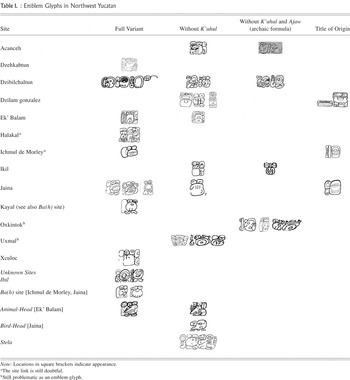
Fifteen emblem glyphs in total are now firmly recognized for northwestern Yucatan: ten “full-form” examples with the “main sign” enclosed by k'uhul and ajaw, and five without the k'uhul attribute (Table 1). Several more glyphic compounds with or without k'uhul and ajaw await further evidence before they can be verified as emblem glyphs. Thus, a small but convincing number of emblem glyphs for northwestern Yucatan allow for further interpretation of regional political organization. The emblem glyphs attest to previously unrecognized political interactions, as, for example, the presence of individuals from Dzilam González (hitzaj site) at Chichen Itza or between Ek' Balam and Ichmul de Morley, as well as possibly between Ichmul de Morley and Dzilam González, all occurring in the Late and Terminal Classic periods (a.d. 600–1000). The western Puuc region, formerly thought of as a zone with perhaps only one collective form of political organization because of the absence of emblem glyphs and the k'uhul ajaw title, as well as a general scarcity of stelae (Dunning 2000; Grube 1994, 2003), is now known to share more political similarities with sites in eastern Puuc. Dzehkabtun, Xculoc, and Kayal, for example, have their own emblem glyphs. A political relationship is even suggested between one site from the northern plains (Ichmul de Morley) and one from the western Puuc region (Kayal), if indeed the bah site is identical to Kayal. Furthermore, Jaina and Xcalumkin, as well as Santa Rosa Xtampak, were engaged in mutual political affairs, although of a still unknown nature, but pointing to broader political intersite activity than known previously.
Emblem Glyphs in Northwest Yucatan

In sum, it can be established that in northwestern Yucatan the later emblem glyphs were preceded in time and concept by an archaic name, a development that may resemble early conceptions for place names or territorial units in the central or southern lowlands. These archaic names still appeared unchanged in the ruler's title in northwestern Yucatan, even though the conceptions of the full emblem glyph from the southern parts—an added k'uhul and ajaw reference to the archaic name—had also been adopted. The inconsistent way in which a ruler in the northern part refers to its polity and to himself as supreme lord might reflect a different idea of royal self-understanding as of those in the central and southern lowlands. The fact, however, that both archaic names and full emblem glyphs were used in northwestern Yucatan points to similar conceptions of polities in both regions.
RESUMEN
El jeroglífico emblema servía a los gobernantes como un título estandarizado y se refería ultimamente también al nombre de la unidad política. Fue utilizado especialmente a partir del clásico temprano final (después de 500 d.C.) y durante el clásico tardío (hasta 900 d.C.) en las tierras bajas del centro y del sur por los gobernantes para distinguirse en rango y prestigio de otros nobles. Para la región del noroeste de Yucatán con sus elementos culturales distinctivos presentes también en las inscripciones, se conocían, en cambio, solo unos cuantos heroglíficos emblemas. La revisión del concepto “jeroglífico emblema” y el analisis exhaustivo de las inscripciones, no obstante, reveló aunque bién los gobernantes de esta región hacían uso de este título, lo utilizaron con menor frecuencia y en distintas formas. Aparentemente en el noroeste de Yucatán se adoptó el título que ya estaba en uso en las demás partes de las tierras bajas no antes del clásico tardío (después de 600 d.C.), al agregar a una “formula archaica” que representaba el nombre de la unidad política los elementos fijos que precisamente caracterizan el concepto del jeroglífico emblema: k'uhul ‘divino, sagrado’ y ajaw ‘señor, rey.’ De allí resulta que un gobernante en el noroeste de Yucatán se adornaba arbitrariamente con el Jeroglífico Emblema completo o con la “forma archaica,” faltandole k'uhul y ajaw. En algunas casos al nombre del gobernante sigue nada más el llamado “título de origen” que reune el elemento archaico y el prefijo aj para decir “el de … ,” una formula que en las demás regiones se usaba solo para referir a personas de la nobleza comun. Ello hace pensar que los gobernantes en el noroeste de Yucatan, aunque bien estaban al frente de unidades políticas similares como se supone que existían en las tierras bajas del sur y del centro, no requerían y recurían al jeroglífico emblema como instrumento de competencia por prestigio y poder. Tal vez esto es reflejo de una sociedad menos competetiva y con el gobernante en una posición políticamente más estable. Ultimamente, la adopción del concepto jeroglífico emblema en el noroeste de Yucatan pudo haber sido más que una necesidad política un experimento literario junto con otros cambios como la introducción de formulas de computo (“Método Yucateco,” “Cuenta Ajaw”) en las inscripciones.
ACKNOWLEDGMENTS
I thank Berthold Riese for commenting on an earlier version of this article and Nicholas Dunning and Markus Eberl for their critical remarks while turning it into what I believed to be English. I also thank Alexander Voss, who repeatedly encouraged me to submit this paper forward for publication.