

Introduction
In order to be sustainable, suckler cow farming must be profitable. The main objectives for a profitable suckler cow enterprise are to produce as near as possible to one well conformed, weaned calf of good growth potential, per cow in the herd per year at lowest cost (Steen, Reference Steen2014). The aim of this 3 year study was to compare two suckler cow genotypes, namely Limousin×Holstein (LH) and Stabiliser (ST), in terms performance at calving. The LH cow is sourced from the dairy herd, where a proportion of the dairy cows are mated with a Limousin bull. Murphy et al. (Reference Murphy, Drennan, O’Mara and McGee2008) highlighted a high milk yield and pre-weaning growth of the progeny of LH–Friesian cows compared with other common cow genotypes in Ireland. In an evaluation of the most common breeds of suckler cows throughout 43 farms in Northern Ireland, Keady et al. (Reference Keady, Kirkland, Ingram, Steen, Comerford, Patterson and Mayne2004) concluded that LH compared favourably to other suckler cow breeds, in terms of carcass value. The main issue in the industry with the LH is concerns over biosecurity, because of the risk of bringing in disease from a dairy herd. The ST is a composite breed which has specifically bred as a suckler cow; originally researched and developed by the US Department of Agriculture (USDA) Meat Animal Research Centre (MARC) in Nesbraska. The Leachman ST (www.leachman.com) is a composite breed made of Angus, Gelvieh, Simmental and Hereford. Composite cows are an alternative to cross-breeding, while still maintaining the hybrid vigour. Stabiliser is marketed as an ideal suckler cow in both maternal traits like fertility, milking ability and also terminal traits of growth rates and carcass grades.
Material and methods
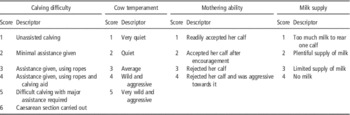
The established suckler cow breeding herd of the Agri-Food and Biosciences Institute (AFBI) was used in the current study. Measurements were taken in these cows from calving in year 1 to calving in year 3. In the first 2 years of the experiment a total of 83 cows calved (50 LH, 33 ST in year 1 and 46 LH, 37 ST in year 2). In year 3 a total of 84 cows calved in the herd (40 LH, 44 ST). Since the aim was to evaluate the dam genotype in the current study all cows were bred with a ST sire. Cows of both genotypes were grazed together under lowland conditions at AFBI Hillsborough, under similar management conditions. The cows were transferred to another AFBI site (AFBI, Loughgall which is ~30 miles away) for winter housing. They were penned according to breed and body condition score (BCS) and offered grass silage-based diets. Grass silage offered in the first winter housing period had an average dry matter (DM) of 325 g/kg; CP of 136 g/kg DM and an metabolisable energy (ME) of 68 MJ/kg DM, while grass silage offered in the second winter housing period of the study had an average DM of 232 g/kg; CP of 115 g/kg DM and an ME of 69 MJ/kg DM. Cows with a BCS greater than 2.5 had their intake restricted between weaning and calving, whilst cows weaned below BCS of 2.5 were offered ad lib silage. Cow live weights and BCS was assessed at monthly intervals and at calving and weaning during the study. The BCS of each animal was assessed from 1 (extremely thin) to 5 (extremely fat), to the nearest 0.25, by trained technicians according to the method described by DEFRA (2013). The cows calved in spring through to early summer. At calving in each of the 3 years the cows were scored subjectively as soon as possible after calving for calving difficultly, mothering ability, cow temperament and milk supply. Calving difficulty score was on a range of 1 to 6; cow temperament was scored from 1 to 5 and the assessment of mothering ability and milk supply were both scored on a 4-point scale, as detailed in Table 1.
Description of scores assessed at calving

Colostrum was also collected in year 1 and 2 of the study and analysed for concentrations of protein, fat, lactose, casein and urea nitrogen. Samples were taken before the calves had a chance to suck. The four quarters of the cow’s udder were cleaned before sample collection. The samples were analysed in the laboratory at AFBI, Hillsborough, using a commercial Fourier Transform Infrared (FTIR) Spectrometer (FossMilkoscan™ FT 120 Instrument).
Statistical analysis
All analysis was carried out using GenStat release 18 statistical package (Payne et al., Reference Payne, Harding, Murray, Soutar, Baird, Glaser, Channing, Welham, Gilmour, Thompson and Webster2015). Cow live weights, BSCs and chemical composition of the colostrum were analysed using linear mixed model methodology with repeated measures. Cow was fitted as a random effect in the analyses and the correlation between years was accounted for by using an autoregressive model of order 1. Linear and quadratic effects of parity and a factorial arrangement of year and dam breed were fitted as fixed effects. The significance of the fixed effects was assessed by comparing Wald statistics against an appropriate χ 2 or F distribution. The scoring variables were fitted in turn with breed as a two-dimensional contingency table using a random permutation test.
Results
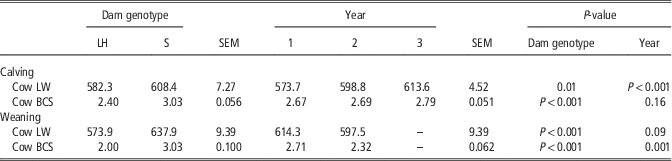
Results of the live weights and BCS of the two suckler cow genotypes at calving and weaning are presented in Table 2. There were no significant dam genotype×year interactions, so only the main effects are presented. Generally speaking ST cows had higher live weights than LH cows, both at calving (P=0.01) and at weaning (P<0.001). BCS of ST cows were consistently statistically higher than LH cows (P<0.001), both at calving and at weaning.
Cow live weight (LW) and body condition scores (BCS) at calving (over 3 years) and weaning (over 2 years)Footnote †

LH=Limousin×Holstein; S=Stabiliser.
† Results adjusted for linear and quadratic effects of cow parity.
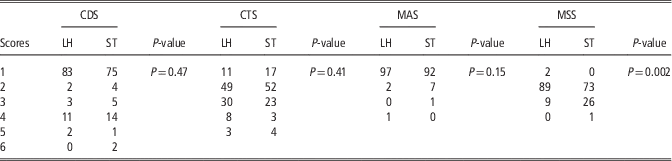
Dam genotype had no significant effect on incidence of calving difficulty, in any of the 3 years that they were assessed in this study and the combined 3 years of the project are presented in Table 3. The majority of cows of both breeds had a calving difficulty score of 1, meaning they were able to calve themselves without any assistance. Similarly, there was no significant effect of dam genotype on cow temperament score, but it is interesting that 93% of ST and 90% of LH cows were scored as either very quiet, quiet or of average temperament. Likewise for the assessment of mothering ability, while there was no effect of dam genotype, there was evidence of excellent mothering ability in both breeds (Table 3). There was a significant difference in milk supply scores between the two breeds of cows when the 3 years of data were combined (P=0.002), with a higher percentage of LH cows having a plentiful supply of milk compared to ST cows and conversely a higher percentage of ST having limited milk compared with LH cows. However this was not a consistent effect over the 3 years (P=0.09 in year 1; P<0.001 in year 2; ns in year 3). It should be noted however in year 3 a high percentage of all cows had a plentiful milk supply (95% of LH and 85% of ST).
The percentage of each dam genotype classified into each scores category for calving difficulty, cow temperament, mothering ability and milk supply scores, combined for the 3 years of the study

CDS=calving difficulty score; CTS=cow temperament score; MAS=mothering ability score; MSS=milk supply score; LH=Limousin×Holstein; ST=Stabiliser.
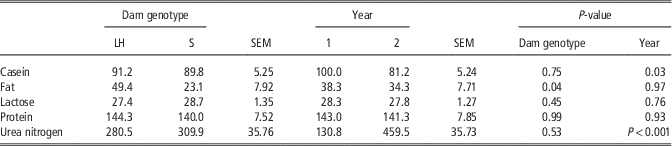
Data from the 2 years of composition of colostrum were combined and are presented in Table 4. There were no significant dam genotype×year interactions, so only the main effects are presented. There was no significant effect of dam genotype on concentrations of casein, lactose, protein or urea nitrogen in the colostrum at calving over the 2 years of the study. Colostrum from LH dams had significantly higher fat content than the colostrum from ST cows (P<0.05). Urea nitrogen was significantly higher (P<0.001) and casein was significantly lower (P<0.05) in year 2 of the study, compared with year 1.
The effect of dam breed on colostrum composition (g/kg) over 2 years of the studyFootnote †

LH=Limousin×Holstein; S=Stabiliser.
† Results adjusted for linear and quadratic effects of cow parity.
Discussion
Calving difficulty is a major consideration in suckler cow production, particularly when farmers operate on a part-time basis. However, as well as higher labour and veterinary costs, difficult calvings are also linked to higher calf mortality and lower subsequent conception rates (Lasteret al., Reference Laster, Glimp, Cundiff and Gregory1973). Differences in calving difficulty between breeds of cows have been mainly attributed to factors which affect calf birth weight and the size of the pelvic area of the cow. BCS of cows could feasibly contribute to both the calf birth weight and to the amount of fat deposition within the pelvic area. Steen (Reference Steen2014) concluded from a review of the literature that different breeds of cattle may differ in terms of their pelvic area relative to their size. Current DEFRA (2013) recommendations for BCS at calving for spring-calving cows are 2 to 2.5, since cows calving at higher BCS have more incidences of calving difficulties. However, results from the current study suggest that this may not be applicable to all cow genotypes. Even though the BCS at calving for ST cows was higher than current recommendations, there was no significant difference in the incidence of calving difficulty compared with LH cows.
Good cow temperament is an important attribute in a suckler cow in terms of health and safety of the stockman. In addition, there is evidence of beef cattle with an aggressive temperament having impaired reproductive performance (Cooke et al., Reference Cooke, Bohnert, Cappellozza, Mueller and DelCurto2012). Kasimanickam et al. (Reference Kasimanickam, Asay, Schroeder, Kasimanickam, Gay, Kastelic, Hall and Whittier2014) reported that cows with an excitable temperament took 24 more days to become pregnant than cows which had a calm temperament. Kasimanickam et al. (Reference Kasimanickam, Asay, Schroeder, Kasimanickam, Gay, Kastelic, Hall and Whittier2014) also reported higher embryonic and foetal losses in pregnancy in excited v. calm cows (5.5% v. 3.2%) and thus the evidence in the current study of both cow genotypes having good temperament is very positive in terms of their suitability as a suckler cow. The heritability of beef cattle temperament is relatively high (Le Neindre et al., Reference Le Neindre, Trillat, Sapa, Menissier, Bonnet and Chupin1995; Burrow, Reference Burrow1997), so temperament should be readily included in selection criteria when breeding heifer replacements. Behaviour of cows towards their calves at birth (or mothering ability) may be linked to the cow temperament, as seen in the current study where both cow genotype had good temperament and excellent mothering abilities. Phocas et al. (Reference Phocas, Boivin, Sapa, Trillat, Boissy and Le Neindre2006) estimated genetic correlations between Limousin heifer temperament and breeding traits and concluded that non-aggressive heifers would be more productive than aggressive heifers because of increased fertility, would calve more easily and to a lesser extent have a higher milk supply and better mothering ability.
In comparison of the two cow genotypes ST cows had higher live weights and BCS than LH cows. In a concurrent study carried out by Zou et al. (Reference Zou, Lively, Wylie and Yan2016), short-term measurement of silage dry intake of these two cow genotypes during an energy metabolism study revealed no differences in intake. In addition, no effect of cow genotype was found when measuring intake of grazed grass intake using n-alkanes techniques (Lively, F., personal communication). In the current study, any cows that were housed with a BCS>2.5 were offered restricted amounts of silage, while those <2.5 were offered silage ad libitum. This allowed potential savings in winter feeding costs; in the winter feeding from weaning year 2 to calving year 3, 87% of ST cows were able to be fed restricted amounts of good quality silage (D value=69), compared with 22% of LH cows during this winter housing period. It is estimated that restricting silage intake over a 180 day winter could offer real savings in winter feeding costs of a saving of £52/cow (at silage at £25/t).
The importance of a good colostrum supply in the first few hours of life on the health of the neonatal calf is well established (Besser and Gay, Reference Besser and Gay1994). It is postulated that the plentiful supply of milk and the higher fat concentration in the colostrum from LH cows would give rise to heavier calves at weaning than those from ST cows. Murphy et al. (Reference Murphy, Drennan, O’Mara and McGee2008) concluded, in a comparison of five beef suckler cow genotypes in Ireland, that calf pre-weaning growth was higher for cow genotypes with higher milk yield. If this was indeed the case, it could potentially offset any financial saving in winter feeding in ST cows. Although there was no effect of dam genotype on concentrations of urea nitrogen in the colostrum, large differences was noted between the 2 years of the study. Urea nitrogen concentration of the colostrum is dependent on both energy and protein metabolism in the rumen and has been used as a good indicator of the protein-energy balance in the ration for dairy cows (Kirchgessner et al., Reference Kirchgessner, Kreuzer and Roth-Maier1986). This would merit further investigation in suckler cows.
In conclusion, the high genetic merit cows of both breeds in this study had good maternal attributes at calving and results to-date suggest that the ST is a potential alternative to sourcing suckler replacements from the dairy herd, with respect to traits at calving. Although evidence indicates that both genotypes have similar intakes, the partitioning of energy may differ between the two genotypes. ST cows lay down more body condition than LH cows. Good farming practice had identified lower winter feeding costs could be achieved via increasing cow BCS at grass and subsequently mobilising these reserves over the winter period and this practice allowed a high proportion of ST cows to be restricted during the winter months, thus saving on winter feeding costs. On the other hand, LH cows direct more energy into milk supply, which had potential to increase pre-weaning growth of the progeny.
Acknowledgements
The authors wish to thank the staff of the Sustainable Beef Unit for collection of data and care of animals. This study was fundedby DARD (currently DAERA) commissioned Evidence and Innovation Project Number 12-1-15 and AgriSearch.