INTRODUCTION
Vestibular schwannomas (VS)—also called acoustic neuromas—develop from the Schwann cells of the vestibular section of the vestibulocochlear nerve at the border of central and peripheral myelin, typically slightly lateral to the rim of the internal auditory meatus. Generally, these benign tumours grow slowly with cross-dimensional measurements increasing on average 1–2 mm/year.Reference Smouha, Yoo, Mohr and Davis 1 – Reference Nikolopoulos, Fortnum, O’Donoghue and Baguley 4 If tumours grow, the rate in the 1st year is on average 5–10 mm.Reference Stangerup, Caye-Thomasen, Tos and Thomsen 5 Eventually, they may be associated with significant neurologic symptoms related to compression of cranial nerves, cerebellar peduncle and brain stem. VS accounts for about 6–8% of all intracranial tumours.Reference Lanser, Sussman and Frazer 6 The incidence is about 17/million/year.Reference Tos, Stangerup, Caye-Thomasen, Tos and Thomsen 7 Owing to its benign nature the prevalence accumulates to 200/million.Reference Lin, Hegarty, Fischbein and Jackler 8 The diagnosis can be made without histological verification when combining specific symptoms, such as asymmetric hearing loss, tinnitus, vertigo or imbalance and the characteristic features on magnetic resonance imaging (MRI). Apart from a wait-and-scan policy, the various treatment options for VS are microsurgery, radiosurgery and fractionated stereotactic radiotherapy (FSRT). Due to the good results without disabling complications radiosurgery has overtaken microsurgical excision as first-choice treatment, especially for smaller VS.Reference Wolbers, Dallenga, Mendez Romero and van Linge 9 This leaves excision only for VS of substantial size. Some patients, however, have comorbidities that preclude surgery or refuse surgery. In those patients with larger tumours FSRT is an alternative.Reference Murphy and Suh 10 , Reference Jian, Kaur, Sayegh, Bloch, Parsa and Barani 11 In this study, we compared long-term clinical and radiological outcome in patients with smaller- and larger-sized tumours after conventional FSRT.
MATERIALS AND METHODS
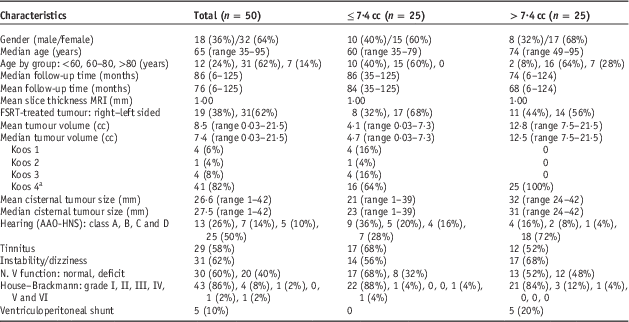
In our practice the first choice is radiosurgery for (MRI-proven) growing VS and for VS that already at diagnostic MRI touch or impress the cerebellar peduncle. Then, FSRT was indicated because of larger tumours not suitable for radiosurgery in patients unwilling or not fit for surgery. These are predominantly elderly patients (Table 1). In the past and based on publications supporting FSRT as more favourable than radiosurgery to preserve hearing, we also offered FSRT to patients with serviceable hearing. These are the patients with the smallest tumours in this series.
Summary of patients pre-fractionated stereotactic radiotherapy (FSRT) characteristics

Note: aAffecting the 4th ventricle.
Abbreviations: AAO-HNS, American Academy of Otolaryngology-Head and Neck Surgery.
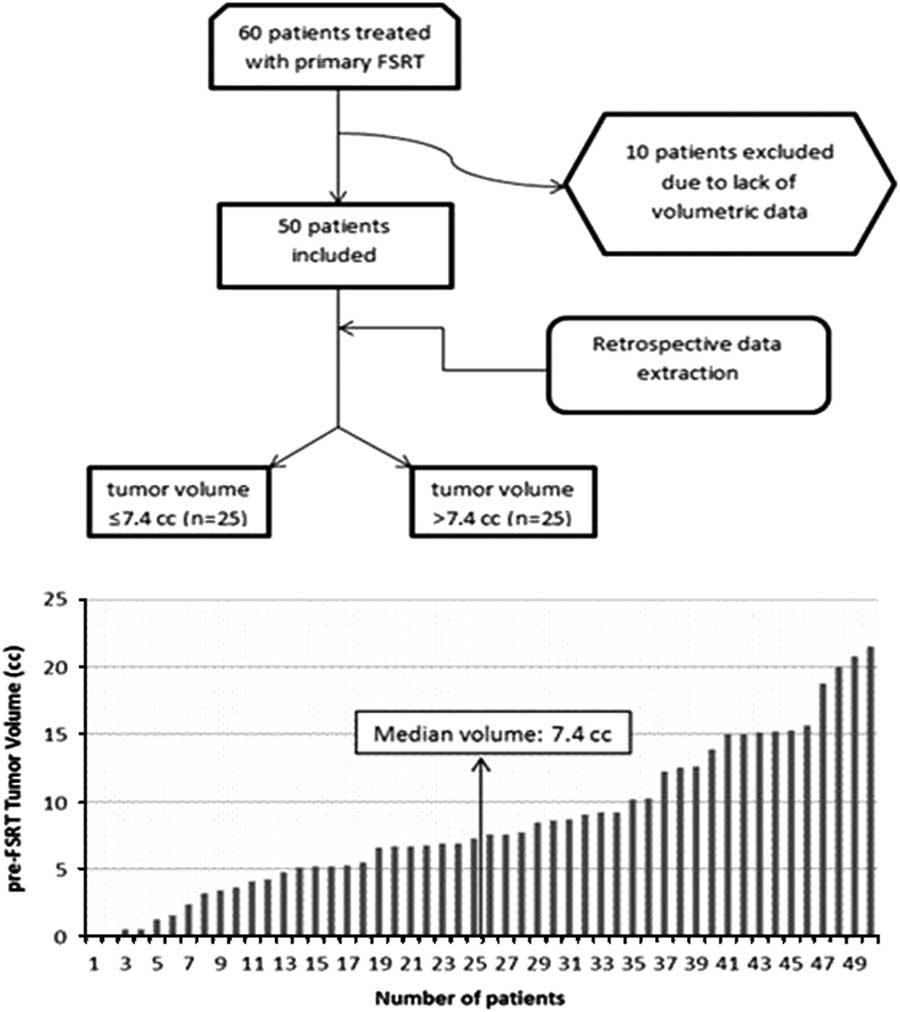
Between November 2002 and December 2012, we treated 60 patients for solitary VS by FSRT as primary treatment. The dates of planning MRI defined inception. All patients got their regular follow-up (FU) examinations in our institution. Ten cases had to be excluded, because the diagnostic MRI’s were not digitally available prohibiting volumetric measurements (Figure 1). Electronic hospital records, including clinical notes, doctors’ letters, audiograms, MRI reports and demographic data, were reviewed and data were extracted for analysis. Facial nerve function was scored according to the House–Brackmann grading system.Reference House and Brackmann 12 Hearing was classified according to the American Academy of Otolaryngology-Head and Neck Surgery classification; class A and B is considered useful hearing.Reference Monsell, Balkany, Gates, Goldenberg, Meyerhoff and House 13 We used a two-tiered scoring for the trigeminal nerve function: no deficit or unchanged versus new or worsened facial pain or numbness. Tinnitus and imbalance/dizziness were similarly two-tiered scored. Tumour volumes were assessed by delineation of the tumour slice-by-slice using Brainlab (iPlan 3.0 Cranial). Tumour size was also measured by its largest cisternal diameter following the Tokyo consensus.Reference Kanzaki, Tos, Sanna, Moffat, Monsell and Berliner 14 Furthermore, relative tumour extension was classified according to the slightly modified qualitative part of the Koos staging.Reference Koos and Bock 15 Our modification consists of ignoring the absolute size criteria in the classification and of specifying the brain stem compression in Koos stage 4 more distinct as affecting the 4th ventricle (J.G. Wolbers, personal communication). This is according to our working party practice, where anatomical tumour extension plays a decisive role and absolute size not. Thus the four qualitative (non-metrical) stages are as follows: Stage I: tumour confined to internal auditory canal; Stage II: tumour extension into cerebellopontine cistern; Stage III: tumour affecting the brain stem/cerebellar peduncle without effect on 4th ventricle; Stage IV: tumour causing substantial brain stem compression with effect on the 4th ventricle.
Flow chart, study design. Abbreviation: FSRT, fractionated stereotactic radiotherapy.

As the literature provides no convincing threshold, we divided the population equally into smaller and larger volume groups of 25 patients each based on the volumetric measurements (‘gold standard’). The Tumor Measurement Working Group of the Response Evaluation in Neurofibromatosis and Schwannomatosis committee recommended a ≥20% volume change as progression or regression of tumour size.Reference Dombi, Ardern-Holmes and Babovic-Vuksanovic 16 We adopted this recommendation to define our reference category for the statistical calculations. In the linear cisternal measurements the cut-off point for definitive radiological tumour progression was 2 mm, being a usual, though arbitrarily, cut-off point in most previous studies.Reference Harris, Plotkin and Maccollin 17 – Reference Walz, Bush, Robinett, Kirsch and Welling 19
A clinical failure was defined as the need for a second treatment of the tumour. Tumour stabilisation and decrease was considered one (successful) category for analysis. For ease of understanding and comparison four outcome classes were defined: outcome 1: tumour control and no new deficit; outcome 2: tumour control but new deficit; outcome 3: tumour progression and no new deficit; outcome 4: tumour progression plus new deficit.
Statistics
Multinomial regression analysis, logistic regression analysis and linear regression analysis were applied using IBM SPSS statistics version 21. Kaplan–Meier curves were plotted with log-rank tests and Cox’s regression analysis. A p value<0·05 was considered significant.
Ethical considerations
This is a retrospective cohort study in a tertiary academic referral hospital. All data are provided from an anonymised database. As no ethical issues arise as regards to the analysis of this kind of study no approval of the hospital’s ethical committee is required.
Treatment
We used the non-invasive relocatable Gill–Thomas–Cosman stereotactic head frame for immobilisation, a depth helmet to verify frame position before scanning and radiation sessions and the X-Knife (Radionics, Burlington, MA, USA) radiotherapy planning system. The planning target volume (PTV) was the gross tumour volume plus margins of 2 mm. Patients were treated with arcs or static fields, depending on individual patient and tumour factors. Requested PTV coverage was at least 98%. All patients received the prescribed dose of 54 Gy in 30 fractions given daily for 5 days/week at 1·8 Gy/fraction. Treatment was delivered using a linear accelerator with 6 MV photons. An MRI scan was performed 6 months or 1 year after FSRT followed by doctors’ consultation. In case of intercurrent complaints an earlier visit and possible MRI was carried out. As a rule, after year 2 and 3 the FU visits (including MRI) were at 5, 7, 10 and 15 years.
RESULTS
The median FU for the 50 patients was 86 months (range 6–125). There were no patients lost to FU. Three patients had short FU, because they died early unrelated to the schwannoma at 9, 13 and 14 months, respectively, after FRST. One of them died within a year due to myocardial infarction and had only one FU visit at 6 months. The pre-treatment characteristics are summarised in Table 1. The median largest cisternal diameter before FSRT was 27·5 mm (range 1–42). The median tumour volume was 7·4 cc (range 0·03–21·5) (Figure 1). Ten patients had tumours of ≥15 cc and 82% of the patients had large tumours affecting the 4th ventricle (modified Koos stage 4). No secondary malignancy occurred in our study population during this FU.
Clinical and radiological tumour control
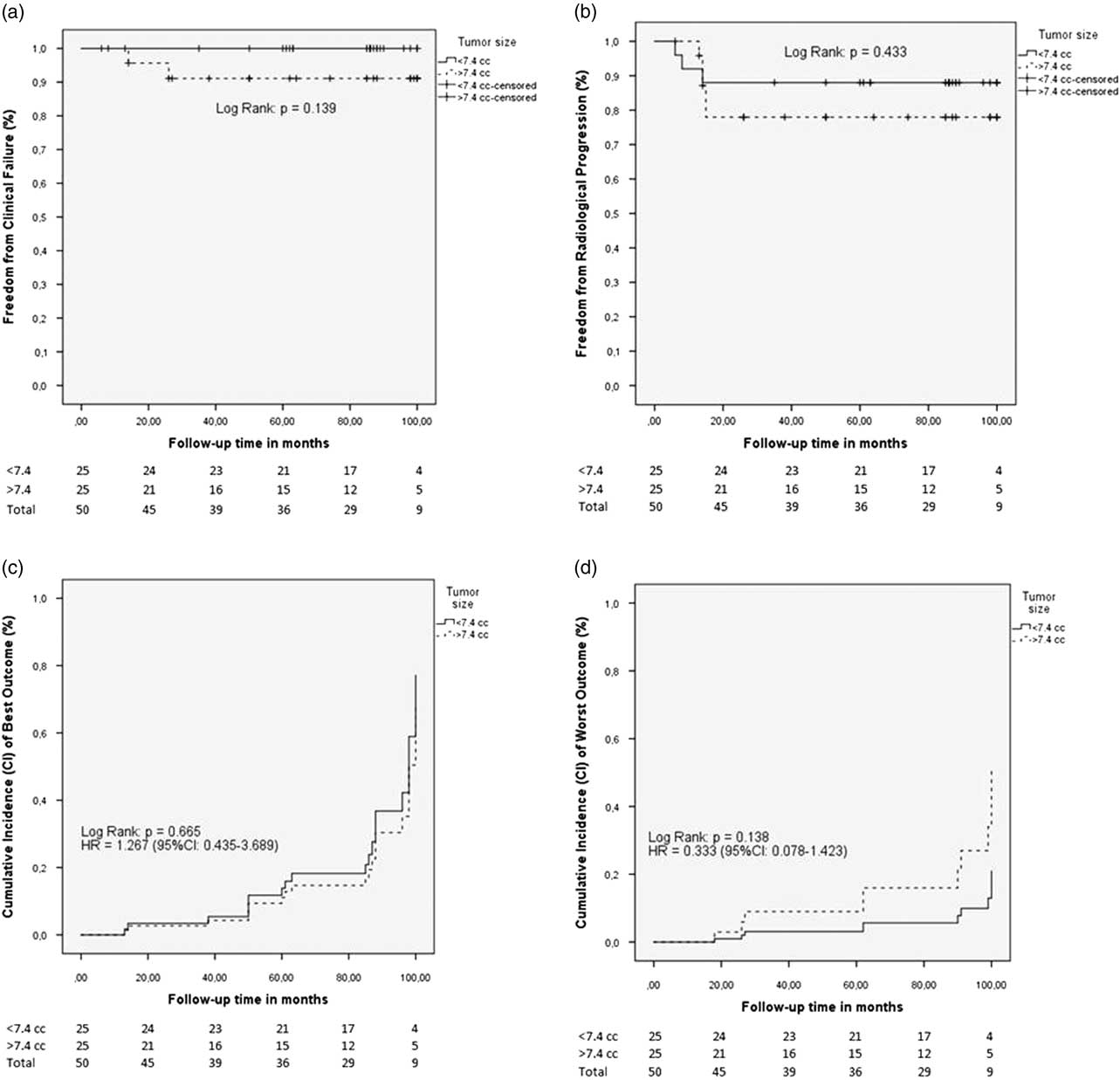
The overall freedom from clinical failure was 96%; 100% for those 25 patients with smaller tumours ≤7·4 cc and 92% for the other 25 patients with larger tumours >7·4 cc (Figure 2a). Two patients needed surgical excision after 22 and 31 months, because of disabling deterioration of walking and the need of a walking aid. Both had tumours of just over 15 cc and both increased, but in only one of them the tumour grew more than 20%. Both had a functioning CSF shunt.
(a) Kaplan–Meier showing freedom from clinical failure for patients with smaller and larger tumours. (b) Kaplan–Meier showing freedom from radiological progression for patients with smaller and larger tumours. (c) Cox’s regression curve of the cumulative incidence of best outcome (class 1) according to tumour volume. (d) Cox’s regression curve of the cumulative incidence of worst outcome (class 4) according to tumour volume.Abbreviation: HR, hazard ratio.
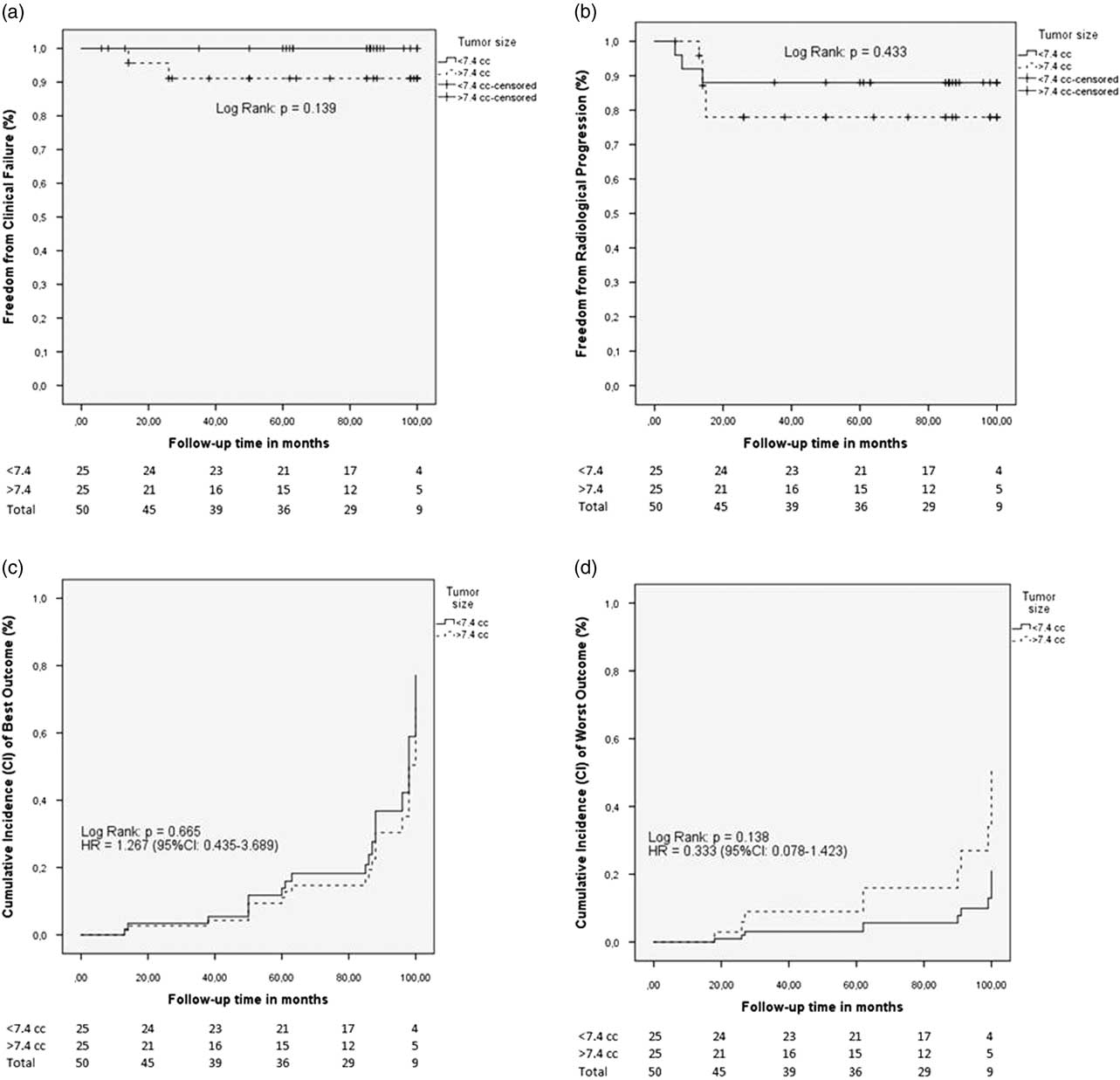
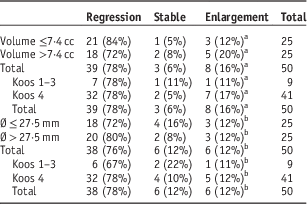
In all, 39 patients (78%) experienced decrease in tumour volume, three (6%) remained stable and in eight (16%) tumour volume increased (Table 2). Therefore, the overall radiological control was 84%; 89% for smaller and 80% for larger tumours, which was not significantly different (Figure 2b). Obviously, slice-by-slice volumetric measurements are more sensitive to detect tumour expansion than a simple linear measurement. As shown in Table 2 the differences, however, are small and not of clinical relevance. In qualitative Koos stages 1–3 only one patient showed definitive tumour expansion after FSRT; the other seven patients enlarged tumours were large stage 4 tumours that already at inception affected the 4th ventricle (Table 2).
Tumour size related to radiological outcome

Notes: aBased on ≥20% cut-off point.
b Based on >2 mm cut-off point.
Abbreviation: Ø, diameter.
Preservation of cranial nerves
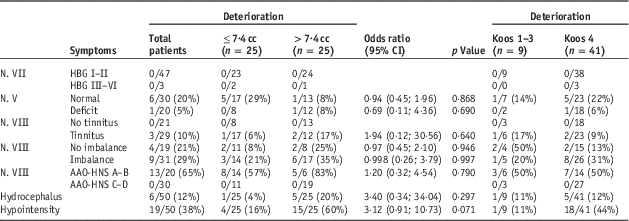
Seven out of 20 patients (35%) retained useful hearing. Hearing preservation was poorer for class B than class A, 14 versus 46%, respectively. Useful hearing preservation for smaller tumours was 43% and for larger tumours 17% (Table 3). None of the class C–D patients recovered to useful hearing after FSRT. The difference between smaller and larger tumours was not significant, although only one out of six from the larger tumour group preserved useful hearing. The overall rate of freedom from new or worsening tinnitus was 94%; 96 and 92% for smaller and larger tumours, respectively. None of the patients developed new tinnitus after FSRT.
Treatment-related toxicity

Abbreviations: 95% CI, 95% confidence interval; HBG, House–Brackmann grade; AAO-HNS, American Academy of Otolaryngology-Head and Neck Surgery.
In all, 31 of the 50 patients (62%) complained of imbalance pre-FSRT. Four out of the remaining 19 patients (21%) deteriorated after FSRT.
The overall rate of freedom from worsening of trigeminal nerve function was 86% for the total group; 80 and 92% for smaller and larger tumours, respectively. Six out of 30 cases (20%) without trigeminal complaints before experienced new deficit after FSRT.
Facial nerve preservation was 100% for smaller and larger tumours.
The differences between smaller and larger schwannomas for any cranial nerve deterioration did not reach significance (Table 3).
Hydrocephalus
Six patients (12%) developed hydrocephalus and needed a ventriculoperitoneal shunt at 5–37 months after FSRT; one patient (4%) from the group of smaller tumours and five (20%) of the tumours over 7·4 cc (Table 3). All six were modified Koos 4 tumours; only two showed tumour enlargement, while the other four minimised in size after FSRT.
All eight patients with more than 20% volume increase had shown a remarkable loss of contrast enhancement on the early MRI scans (range 6–15 months). Of the 42 patients without definitive radiological expansion only 13 (31%) showed loss of central enhancement. Nevertheless, this relation between post-FSRT central hypointensity (and possible necrosis and swelling) and worsening of symptoms or new deficit proved not to be significant (logistic regression analysis: odds ratio=0·70; p=0·548).
Outcome classes
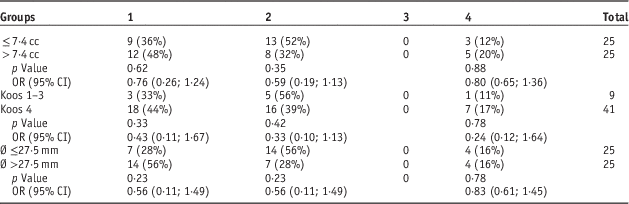
Outcome classes 1–2 applied to 42 out of 50 patients (84%); 20 were larger tumours and 22 smaller (Table 4). None of the patients scored in outcome 3. So, all eight tumour enlargements over 20% were in outcome class 4, which is progression and also new or worsened cranial nerve deficit. A total of 29 patients (58%) experienced new or worsened cranial nerve deficit. In a vast majority, the 8th nerve was involved. Cox’s regression analysis also showed no significant relation between outcome class and tumour size (Table 4). The cumulative incidence of best outcome is the same for both groups (Figure 2c). The cumulative incidence of worst outcome showed a trend of being higher in the group with larger tumours compared with the group with smaller tumours (Figure 2d), although the difference again was not significant. Seven out of eight patients with class 4 outcome had at inception large tumours affecting the 4th ventricle (modified Koos 4 tumours).
Outcome per group

Abbreviations: 1, regression/stable and no new deficit; 2, regression/stable and new deficit; 3, progression and no new deficit; 4, progression and new deficit; Ø, diameter; OR, odds ratio; 95% CI, 95% confidence interval.
DISCUSSION
In our practice radiosurgery is the first-choice treatment for VS smaller than 25–30 mm. This choice finds support in our earlier systematic review of controlled studies comparing radiosurgery and microsurgical excision.Reference Wolbers, Dallenga, Mendez Romero and van Linge 9 Then, FSRT emerged when tumours were considered to be too big for single high dose radiosurgery and microsurgery was contraindicated or refused by the mostly elderly patients. In addition, some patients choose FSRT in the hope to improve their chance to preserve their useful hearing. Prudently, in our series with patients having rather large tumour volumes or keen to preserve useful hearing, we choose the conventional fractionated scheme. In a comprehensive review, modern fractionated radiation therapy series using various hypo-fractionated protocols as well as intensity-modulated radiation therapy (IMRT) next to conventional fractioned schemes are summarised. These FSRT studies have reported a tumour local control rate ranging from 86 to 100% after a median FU of 1·6–4 years.Reference Jian, Kaur, Sayegh, Bloch, Parsa and Barani 11 In the current study, after a median FU of 7·2 years radiological control existed in 88% following the 2 mm cisternal progression criterion and in 84% after volumetric measurements following a cut-off value of 20% increase. From literature it is expected that the 2-mm criteria is less precise than the volumetric one (see interpretation of tumour measurements after irradiation section). Indeed, in smaller tumours like VS one might expect a distinct underestimation of a possible tumour enlargement resulting in a higher control rate. Our minimal difference might be explained by the relatively larger tumour sizes in our study. As discussed below, larger tumours are less prone to an underestimation and the one-dimensional measurements might be approximately correct.
Our clinical control rate was 100% for the smaller VS and 92% for the larger ones. As far as we know, two other studies compared outcome after FSRT related to size. Chan et al.Reference Chan, Black and Ojemann 20 reported worse outcome after FSRT for VS sized over 8 cc. The mean tumour size in their 70 patients was just 3·22 cc. The 5-year actuarial rate of freedom from surgical resection was 97% for smaller tumours and only 61% for the 14 tumours over 8 cc. Tumour volume at the time of FSRT was predictive for any neurosurgical intervention (resection and shunt placement). The tumours in their three clinical failures sized 18, 16 and 10 cc and got excision after 40, 37 and 29 months, respectively. Two patients with tumours of 8·1 and 21 cc, that is 14% of their tumours over 8 cc, needed a shunt. In our patients, the mean volume was 8·5 cc; 23 tumours in our series were over 8 cc and their outcome is similar to the 25 patients with tumours over 7·4 cc.
Sawamura et al.Reference Sawamura, Shirato and Sakamoto 21 reported after a median FU of 45 months, that three of their 101 patients (clinical control of 97%) needed tumour removal at 14, 34 and 44 months after FSRT having an initial size of 30, 20 and 27 mm, respectively. In their series (median longest diameter 19 mm) no difference in clinical failure was seen between smaller (1/74) and larger tumours (2/27, being ≥25 mm maximum diameter). A CSF shunt was needed in 12% and only one patient—after earlier tumour removal—had tumour progression. The mean maximum diameter of tumours needing a shunt was significantly larger with a mean of 26 versus 18 mm for the other tumours. In our series, the mean largest diameter was 26·6 mm. In our group of larger schwannomas (mean diameter 32 mm) 20% needed a CSF shunt.
Not surprisingly, size is important and large VS are inclined to need a CSF shunt. Hydrocephalus is a common adverse effect, but probably not specific to FSRT for VS. In the literature, 4–15% of patients with VS experience hydrocephalus before FSRT.Reference Sawamura, Shirato and Sakamoto 21 Tumour removal does not always resolve the hydrocephalus and installing a CSF shunt is efficacious.
On cranial nerve outcome, trigeminal nerve preservation of 84–100%, facial nerve of 96–100% and hearing preservation 53–100% were reported.Reference Jian, Kaur, Sayegh, Bloch, Parsa and Barani 11 Our preservation of trigeminal and facial nerve function is within these ranges. New cranial nerve damage typically involved the 8th nerve. No significant differences between smaller and larger schwannomas were shown for any cranial nerve deterioration. Overall, our useful hearing preservation of only 35% was disappointing. Unexpectedly, we were not able in the long term to minimise tissue toxicity by fractionation and to achieve better hearing preservation rates than reported previously with radiosurgery and FSRT. In mid-term FSRT studies, the rates vary from 53 to 98%Reference Jian, Kaur, Sayegh, Bloch, Parsa and Barani 11 and after radiosurgery from 32 to 71%.Reference Murphy and Suh 10 Our result, however, is in agreement with outcome in recent case series with also a long-term FU. After 10 years of FU in small series, much less favourable hearing preservation rates of 0% after FSRT and 23% after radiosurgery have been reported.Reference Rasmussen, Claesson and Stangerup 22 , Reference Carlson, Jacob and Pollock 23 One should keep in mind that our study largely involves patients having tumours too large for radiosurgery and usually advised for microsurgical excision. These were predominantly elderly patients. As no good-sized, long-term studies are available, it seems too early for an authoritative conclusion on this matter.
Interpretation of tumour measurements after irradiation
The measurement method and the definition of progressive disease are relevant, as some neurosurgeons consider an undeniable radiological progression as a treatment failure and an indication for further treatment, mostly excision. Consensus, however, is lacking on the measurement method, cut-off value and on the interpretation of a possible tumour enlargement, whether it is due to measurement errors, reactive swelling or true tumour growth.
Several studies have demonstrated a poor correlation of the method of maximum linear measurement of a schwannoma with volumetric measurement.Reference Vokurka, Herwadkar, Thacker, Ramsden and Jackson 18 , Reference Walz, Bush, Robinett, Kirsch and Welling 19 Tumour increase was identified in 75% more patients using volumetric measurements and diameter measurement is more than twice as inaccurate as volume measurement.Reference Walz, Bush, Robinett, Kirsch and Welling 19 A 5 mm tumour would have to grow 2·8 times its original volume for growth to be confidently detected with use of maximum diameter measurement.Reference Vokurka, Herwadkar, Thacker, Ramsden and Jackson 18 Assuming spherical shapes, a 20% diameter increase corresponds to a 73% increase in tumour volume, as when cubed 1·23 gives 1·73.Reference Harris, Plotkin and Maccollin 17 This kind of calculation is not correct for an irregular-shaped VS and in general overestimate tumour size; conversely, smaller tumours might be underestimated.Reference Walz, Bush, Robinett, Kirsch and Welling 19 In comparison with other tumours VS are usually quite small. Sawamura et al.Reference Sawamura, Shirato and Sakamoto 21 reported smaller posterior fossa’s in the Japanese population and signalled difficulties to balance the quantitative (mm) and qualitative (anatomical extension) features of the various Koos stages.
To anticipate on possible adverse outcome, we prefer the qualitative part of the Koos staging, as modified and described in materials and methods section, better than any absolute measurement, be it diameters or volume, as the first provide easy available, qualified information on (depleted) cisternal space in the posterior fossa of each individual patient. Notably, 100% of our larger tumours, but also 64% of our ‘smaller’ tumours were modified Koos 4 affecting the 4th ventricle. All our neurosurgical interventions (resection and shunt placement) involved such large tumours that affected the 4th ventricle. Indeed, good outcome after FSRT seems a matter of remaining (CSF) space in the posterior fossa.
In our practice, no patient was advised to have further treatment solely because of radiological expansion. Two of the 50 patients (4%) got second treatment for their schwannoma, that is microsurgical excision, and essentially on clinical judgement involving deterioration of walking. The limited relevance of tumour expansion after irradiation for decisionmaking is underappreciated. Transient enlargement is reported to exist in 17–74% within 2 years after radiosurgery depending on MRI interval times, measurement methods and cut-off values.Reference Yu, Cheung, Leung and Ho 24 – Reference Pollock 26 Indeed, the highest number was obtained following three-dimensional measurement at 3-month interval and a 10% increase cut-off; in Nagano’s series 16% even more than doubled in volume.Reference Nagano, Higuchi and Serizawa 25 Various possible patterns of volume change have been illustratively reported by Pollock et al. in 2006. One pattern is early increase and remaining stable thereafter without shrinkage; no less than 29% of their expanded schwannomas remained enlarged and did not need further treatment.Reference Pollock 26 In our series 16% tumours permanently enlarged and only one patient needed surgery. As VS is a benign tumour, a cut-off value of 20% increase after FSRT to define failure is arbitrary, especially if no difference is made between small and larger tumours. Therefore, in our practice the decision on a second treatment is always a clinical one depending on relevant clinical complaints, tumour size and its continuing evolution, brain stem shift and remaining contralateral CSF space, age, comorbidity and more. It is never a matter of just volume. And possible new cranial nerve deficits cannot be changed and consequently have no role in decisionmaking. We do advocate that disabling (and tumour-related) clinical symptoms, particularly walking difficulties, will be the dominating factor in advising a patient a second treatment after FSRT (and radiosurgery).
In our series, post-treatment central hypointensity—interpreted as tumour necrosis—seems a prognostic sign for clinical tumour control. It seems to indicate an evolution towards reactive expansion rather than to tumour growth. After an initial central tumour hypointensity at FU MRI’s one is more reluctant for a second treatment even if the expansion is impressive, assuming the clinical signs and symptoms allow it.
In conclusion, FSRT is highly effective in both smaller and larger VS without causing permanent disabling complications. The outcome is beneficial even in large tumours that affect the 4th ventricle. No mortality and full preservation of facial nerve function is a major advantage of FSRT for large VS.
Acknowledgement
None.