


1 Introduction
The purpose of the paper is to study piecewise quasiconformal covering maps of the unit circle. The main theorem provides sufficient conditions so that a homeomorphism conjugating two such maps admits a quasiconformal or David extension to the unit disk. Due to the technicalities of the results, we give rough formulations in the introduction and defer the full statements to later sections.
1.1 Main extension theorem
Let
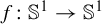
$f\colon \mathbb S^1\to \mathbb S^1$
 be a covering map and let
$\{a_0,\ldots ,a_r\}$
 be a Markov partition associated to f. For
$k\in \{0,\ldots ,r\}$
 , we define
$A_k$
 to be the closed arc from
$a_k$
 to
$a_{k+1}$
 , where
$a_{r+1}=a_0$
 . We consider three basic assumptions that will be described in more detail in §§3 and 4.
-
(1) (Endpoint behavior) Each point $a\in \{a_0,\ldots ,a_r\}$
 is either symmetrically hyperbolic or symmetrically parabolic, as defined in §3.6. See condition (M1).
-
(2) (Extension to neighborhood of the circle) For each $k\in \{0,\ldots ,r\}$
, there exist open neighborhoods
$U_k$
of
$\operatorname {\mathrm {int}}{A_k}$
and
$V_k$
of
$f(\operatorname {\mathrm {int}}{A_k})$
in
${\mathbb {C}}$
such that f has an extension to a homeomorphism from
$U_k$
onto
$V_k$
. Furthermore, we assume that
${U_j\subset V_k=f(U_k)}$
whenever
$A_j\subset f(A_k)$
and that the regions
$U_k$
,
$k\in \{0,\ldots ,r\}$
, are pairwise disjoint; see Figure 1. We still denote the extension to
$\bigcup _{k=0}^r (U_k\cup \{a_k,a_{k+1}\})$
by f. See condition (M2). -
(3) (Quasiconformality) The iterates of f on preimages of $U_k$
,
$k\in \{0,\ldots ,r\}$
, are uniformly quasiconformal. See condition (M3).


We now state the main results. See Theorem 4.1 for more detailed statements.
Theorem 1.1. (QC extension)
Let
$f,g\colon \mathbb S^1\to \mathbb S^1$
 be expansive covering maps with the same orientation and
$\{a_0,\ldots ,a_r\}$
 ,
$\{b_0,\ldots ,b_r\}$
 be Markov partitions associated to
$f,g$
 , respectively, satisfying conditions (1), (2), and (3). Let
$h\colon \mathbb S^1\to \mathbb S^1$
 be a homeomorphism that conjugates f to g such that, for each
$k\in \{0,\ldots ,r\}$
 ,
$h(a_k)=b_k$
 and
-
(h/p→h/p) if $a_k$
is symmetrically hyperbolic (respectively parabolic), then
$b_k$
is symmetrically hyperbolic (respectively parabolic).


Then, the map h has a quasiconformal extension to the unit disk.
Condition (h/p
${\rightarrow }$
 h/p) states that the conjugacy h does not alter the hyperbolic or parabolic nature of points. If we allow the possibility that hyperbolic points are mapped to parabolic ones, then we cannot obtain a quasiconformal extension to the unit disk. Instead, in that case, we prove that the conjugacy h has an extension to a David homeomorphism (also known as mapping of exponentially integrable distortion). To prove this result, we need to add a modification of condition (3).
Illustration of condition (2). Here,
$U_1$
 and
$U_2$
 are contained in
$V_0=f(U_0)$
 (color online).

-
(3*) (Asymptotic conformality) The iterates of f on preimages of $U_k$
,
$k\in \{0,\ldots ,r\}$
, are
$(1+o(1))$
-quasiconformal. See condition (M
$3^\ast $
).


This condition essentially compensates for the unavailability of Koebe’s distortion theorem in the theory of quasiconformal maps.
Theorem 1.2. (David extension)
Let
$f,g,h$
 be as in Theorem 1.1 and suppose that g satisfies condition (3*). Suppose that each pair
$a_k,b_k$
 ,
$k\in \{0,\ldots ,r\}$
 , satisfies either condition (h/p
${\rightarrow }$
 h/p) or
-
(h→p) $a_k$
is symmetrically hyperbolic and
$b_k$
is symmetrically parabolic.


Then, h has a David extension to the unit disk.
These two results generalize the main result of [Reference Lyubich, Merenkov, Mukherjee and NtalampekosLMMN25] in two directions. First, in [Reference Lyubich, Merenkov, Mukherjee and NtalampekosLMMN25], the maps
$f,g$
 are assumed to be piecewise analytic rather than piecewise quasiconformal. Second, the definition of symmetrically hyperbolic and parabolic points is much less restrictive here (see §3.6) compared with [Reference Lyubich, Merenkov, Mukherjee and NtalampekosLMMN25]. There,
$f|_{A_k}$
 is required to have an analytic extension in neighborhoods of the endpoints
$a_k$
 and
$a_{k+1}$
 , so hyperbolicity and parabolicity are defined in the natural way, by studying the power series expansion of f. Here, we do not assume any extension to neighborhoods of the endpoints, but instead we distinguish between hyperbolic and parabolic points based on how f distorts lengths of circular arcs near the endpoints.
The main motivation for extending the results of [Reference Lyubich, Merenkov, Mukherjee and NtalampekosLMMN25] to the piecewise quasiconformal setting is due to an application in the problem of uniformization of gasket Julia sets. In [Reference Luo and NtalampekosLN], we use the present results to provide a characterization of gasket Julia sets that can be uniformized by a round gasket using a quasiconformal or David homeomorphism of the sphere.
Using Theorem 1.1, we obtain a classification of piecewise quasiconformal circle maps up to quasisymmetries. See Theorem 5.1 and Remark 5.2. We formulate a simplified version here.
Theorem 1.3. (QS classification)
Let
$f\colon \mathbb S^1\to \mathbb S^1$
 be an expansive covering map with a sufficiently fine Markov partition satisfying conditions (1), (2), and (3). Then, f is quasisymmetrically conjugate to a piecewise (anti-)Möbius map of the unit circle.
1.2 Blaschke products and mating
We remark that, in practice, condition (2) is not always easy to verify and the its validity depends on the choice of the Markov partition. Let B be a Blaschke product whose Julia set is the unit circle. We say that B is hyperbolic if it has an attracting fixed point in
${\mathbb {D}}$
 . Otherwise,
${\mathbb {D}}$
 is the basin of a parabolic fixed point and we say that B is parabolic. In [Reference Lyubich, Merenkov, Mukherjee and NtalampekosLMMN25, Example 4.2], condition (2) is verified for a specific Markov partition associated to a certain Blaschke product. We verify condition (2) for essentially every Markov partition associated to any Blaschke product.
Theorem 1.4. Let
$f\colon \mathbb S^1 \to \mathbb S^1$
 be a parabolic (respectively hyperbolic) Blaschke product and
$\{a_0,\ldots ,a_r\}$
 be a Markov partition associated to f that contains the parabolic fixed point. Then, conditions (1), (2), (3), and (3*) are satisfied.
We use this in combination with Theorem 1.2 to show the next mating result, which can also be obtained using deformation techniques in [Reference Haïssinsky and TanHT04, Reference LuoLuo22, Reference LuoLuo24].
Theorem 1.5. (Blaschke mating)
Let
$f,g$
 be hyperbolic or parabolic Blaschke products of the same degree whose Julia set is the unit circle. Then, f and g are conformally mateable along any conjugacy h from
$f|_{\mathbb S^1}$
 to
$g|_{\mathbb S^1}$
 .
Specifically, there exist a Jordan curve J with complementary regions
$A,B\subset \widehat {\mathbb {C}}\setminus J$
 , a rational map R, and conformal maps
$\phi \colon \overline {\mathbb {D}}\to \overline A$
 ,
$\psi \colon \overline {\mathbb {D}}\to \overline B$
 such that
$\phi $
 conjugates f to R,
$\psi $
 conjugates g to R, and
$\phi =\psi \circ h$
 on
$\mathbb S^1$
 . Moreover, J is a David circle and R is unique up to Möbius conjugacies.
An instance of Theorem 1.5 was proved in [Reference Lyubich, Merenkov, Mukherjee and NtalampekosLMMN25, Example 5.3], where the Blaschke product
$B(z)=({2z^3+1})/({z^3+2})$
 was mated with itself so that the parabolic point
$1$
 is mated with the repelling point
$-1$
 and the repelling point
$-1$
 is mated with the parabolic point
$1$
 . The Julia set of the resulting rational map is shown in Figure 2.
The pine tree Julia set, resulting from mating
$B(z)=({2z^3+1})/({z^3+2})$
 with itself. Cusps are generated because parabolic points are mated with repelling points (color online).

Figure 2 Long description
At the center is a large, solid teal region forming the core of the fractal. Moving outward, the boundary of this teal region is highly intricate and self-similar, featuring numerous smaller bulbous protrusions and sharp, needle-like points. These points, or cusps, are marked by dark blue or black dots where parabolic and repelling points meet. The overall shape is roughly triangular but with deeply recessed bays and jagged, pine-tree-like edges. The outermost layer is a solid, flat yellow background that provides high contrast to the teal fractal structure. The fractal exhibits three main branches extending toward the West, Northeast, and Southeast, with the West branch being the most elongated and tapering to a fine point.
It is elementary to show that the converse of Theorem 1.5 holds. Namely, if R is a rational map whose Julia set is a Jordan curve, then the second iterate
$R^{\circ 2}$
 arises as the mating, in the sense of Theorem 1.5, of two Blaschke products of the same degree whose Julia set is the unit circle. Thus, this observation and Theorem 1.5 provide a complete description of Julia sets that are Jordan curves. Moreover, since David circles are conformally removable (in the sense of Theorem 2.5), we obtain the following corollary.
Corollary 1.6. All Jordan curve Julia sets are conformally removable.
1.3 Geometry of parabolic basins
The Jordan curve J in Theorem 1.5 is the image of the unit circle under a David homeomorphism H of the sphere. If f is hyperbolic and g is parabolic, then the rational map R has a parabolic fixed point with multiplicity
$2$
 . Hence, in that case, the David homeomorphism H maps
${\mathbb {D}}$
 onto a parabolic basin of multiplicity
$2$
 . Note that the inverse of a David homeomorphism is not always a David homeomorphism. In §§6 and 7, we study the question whether an arbitrary parabolic basin can be mapped to the unit disk with a David or quasiconformal homeomorphism of the sphere. Below, we state our results in this direction. The proof is based on our main extension theorem, Theorem 4.1.
Theorem 1.7. Let R be a rational map, a be a fixed point with
$R'(a) = 1$
 that has parabolic multiplicity
$\nu \geq 2$
 , and
$\Omega $
 be an immediate basin of a.
-
(1) If $\nu =2$
, then there exists no David homeomorphism
$\phi $
of the sphere with
$\phi (\Omega )={\mathbb {D}}$
.


Suppose, in addition, that
$\Omega $
 is a Jordan region, and the critical and post-critical sets intersect
$\partial \Omega $
 only at the point a.
-
(2) If $\nu =2$
, then there exists a David homeomorphism
$\phi $
of the sphere with
$\phi ({\mathbb {D}})=\Omega $
. -
(3) If $\nu \geq 3$
, then there exists a quasiconformal homeomorphism
$\phi $
of the sphere with
$\phi ({\mathbb {D}})=\Omega $
.


Here, the post-critical set of a rational map is the closure of the post-critical orbit. We remark that in the last part, the condition that the post-critical set intersects
$\partial \Omega $
 only at the parabolic point a is necessary. Consider the example of a geometrically finite polynomial
$f(z) = z-({1}/{b(3b-2)})(z-1)^3(z-b)^2$
 , where
$b=-1-\sqrt {2/3}$
 . It has two parabolic fixed points at
$a=1$
 with multiplicity
$3$
 and at b with multiplicity
$2$
 . There is a Fatou component
$\Omega $
 that is an immediate basin of a such that
$b\in \partial \Omega $
 . The component
$\Omega $
 is not a quasidisk or a John domain as it has an outward cusp at b; see Figure 3. We remark that this condition follows from [Reference Carleson, Jones and YoccozCJY94, condition (6.2), Theorem 6.1], which proves an analog of condition (3) for the polynomial case.
The Julia set of the polynomial
$f(z) = z-({1}/{b(3b-2)})(z-1)^3(z-b)^2$
 . The parabolic basin in the center is not a quasidisk (color online).

2 Preliminaries
2.1 Quasiconformal and quasisymmetric maps
Let
$(X,d_X),(Y,d_Y)$
 be metric spaces. A homeomorphism
$f\colon X\to Y$
 is quasisymmetric if there exists a homeomorphism
$\eta \colon [0,\infty )\to [0,\infty )$
 such that for all triples of distinct points
$x_1,x_2,x_3\in X$
 , we have

In that case, we say that f is
$\eta $
 -quasisymmetric. The homeomorphism
$\eta $
 is called the distortion function associated to f. It is an elementary property (see [Reference HeinonenHei01, Proposition 10.8]) that if
$A\subset B\subset X$
 and
$0<\operatorname {\mathrm {diam}} A\leq \operatorname {\mathrm {diam}} B <\infty $
 , then

Let
$U,V\subset {\mathbb {C}}$
 be open sets and
$f\colon U\to V$
 be an orientation-preserving homeomorphism. We say that f is quasiconformal if
$f\in W^{1,2}_{{\mathrm {loc}}}(U)$
 and there exists
$K\geq 1$
 such that
$\|Df(z)\|^2 \leq K J_f(z)$
 for almost every (a.e.)
$z\in U$
 . Here,
$Df(z)$
 is the differential of f, which exists at a.e.
$z\in U$
 ,
$\|Df(z)\|$
 denotes its operator norm, and
$J_f(z)$
 is the Jacobian determinant of
$Df(z)$
 . In that case, we say that f is K-quasiconformal. One can define quasiconformal homeomorphisms between domains in the Riemann sphere
$\widehat {\mathbb {C}}$
 via local coordinates.
It is a fundamental result that quasisymmetric maps between planar domains are also quasiconformal, quantitatively. We will need a refined version of the converse of that statement, as stated below. Actually, this is a sharp version of Koebe’s distortion theorem for quasiconformal maps.
Theorem 2.1. (Distortion theorem)
Let
$K\geq 1$
 ,
$\delta>0$
 , and
$U,V\subset {\mathbb {C}}$
 be topological disks with
$\overline {U}\subset V$
 and
$\mathrm{Mod} (V\setminus \overline {U})\geq \delta $
 . If
$f\colon V\to {\mathbb {C}}$
 is a K-quasiconformal embedding, then
$f|_{U}$
 and
$f^{-1}|_{f(U)}$
 are
$\eta $
 -quasisymmetric for

Here, if
$A\subset {\mathbb {C}}$
 is an annulus, we denote by
$\mathrm{Mod}\ A$
 its modulus, that is, the quantity
$(2\pi )^{-1}\log ({1}/{r})$
 , where
$r\in (0,1)$
 is the unique number with the property that
${\mathbb {D}}\!\setminus \!\overline {B}(0,r)$
 is conformally equivalent to A.
Proof. Consider a conformal map
$\phi \colon {\mathbb {D}} \to V$
 . Since
$\mathrm{Mod} (V\setminus \overline {U})\geq \delta $
 , we have
$\phi ^{-1}(U)\subset B(0,r)$
 for some
$r=r(\delta )\in (0,1)$
 , as a consequence of the Grötzsch modulus theorem [Reference Lehto and VirtanenLV73, p. 54]. Let
$r'=(1+r)/(2\in (r,1))$
 . We now apply [Reference Astala, Iwaniec and MartinAIM09, Lemma 3.6.1], which implies that there exists a conformal map
$\psi $
 on
$B(0,r')$
 and a K-quasiconformal map
$g\colon {\mathbb {C}}\to {\mathbb {C}}$
 such that
$g(B(0,r'))=B(0,r')$
 and
$f\circ \phi = \psi \circ g$
 on
$B(0,r')$
 . By Koebe’s distortion theorem, the map
$\phi |_{B(0,r)}$
 satisfies

for all triples of distinct points
$z_1,z_2,z_3\in B(0,r)$
 . The map
$\psi |_{B(0,r)}$
 also satisfies this condition; see [Reference Astala, Iwaniec and MartinAIM09, Theorem 2.10.9]. Also, by [Reference Astala, Iwaniec and MartinAIM09, Corollary 3.10.4], g is
$\eta "$
 -quasisymmetric on
${\mathbb {C}}$
 for

The desired conclusion for
$f= \psi \circ g\circ \phi ^{-1}$
 , restricted to U, follows. For
$f^{-1}|_{f(U)}$
 , it suffices to note that if a map is
$\eta $
 -quasisymmetric, then its inverse is
$\widetilde \eta $
 -quasisymmetric for
$\widetilde \eta (t)=1/\eta ^{-1}(t^{-1})$
 .
2.2 David maps
An orientation-preserving homeomorphism
$H\colon U\to V$
 between domains in the Riemann sphere
$\widehat {{\mathbb {C}}}$
 is called a David homeomorphism or else mapping of exponentially integrable distortion if it lies in the Sobolev space
$W^{1,1}_{{\mathrm {loc}}}(U)$
 (defined via local coordinates) and there exists
$p>0$
 such that

where
$\sigma $
 is the spherical measure and
$K_H$
 is the distortion function of H, given by

here,

is the Beltrami coefficient of H. Condition (2.2) is equivalent to the existence of constants
$C,\alpha>0$
 such that

for all
$\varepsilon \in (0,1)$
 . We direct the reader to [Reference Astala, Iwaniec and MartinAIM09, Ch. 20] for more background.
The main result in the theory of David homeomorphisms is the following integrability theorem. If U is an open subset of
$\widehat {{\mathbb {C}}}$
 and
$\mu \colon U \to {\mathbb {D}}$
 is a measurable function such that
$K=(1+|\mu |)/(1-|\mu |)$
 is exponentially integrable in U (that is, it satisfies (2.2)), then we say that
$\mu $
 is a David coefficient (in U).
Theorem 2.2. (David integrability; [Reference Astala, Iwaniec and MartinAIM09, Theorem 20.6.2])
Let
$\mu \colon \widehat {{\mathbb {C}}} \to {\mathbb {D}}$
 be a David coefficient. Then, there exists a homeomorphism
$H\colon \widehat {{\mathbb {C}}} \to \widehat {{\mathbb {C}}}$
 of class
$ W^{1,1}(\widehat {\mathbb {C}})$
 that solves the Beltrami equation

Moreover, H is unique up to postcomposition with Möbius transformations.
The David integrability theorem is a generalization of the measurable Riemann mapping theorem [Reference Astala, Iwaniec and MartinAIM09, Theorem 5.3.4, p. 170], which states that if
$\|\mu \|_\infty <1$
 , then there exists a quasiconformal homeomorphism
$H\colon \widehat {{\mathbb {C}}} \to \widehat {{\mathbb {C}}}$
 that solves the Beltrami equation (2.3).
Theorem 2.3. (Uniqueness; [Reference Astala, Iwaniec and MartinAIM09, Theorem 20.4.19])
Let
$\Omega \subset \widehat {{\mathbb {C}}}$
 be an open set and
$f,g\colon \Omega \to \widehat {{\mathbb {C}}}$
 be David maps with

almost everywhere. Then,
$f\circ g^{-1}$
 is a conformal map on
$g(\Omega )$
 .
Proposition 2.4. [Reference Lyubich, Merenkov, Mukherjee and NtalampekosLMMN25, Proposition 2.5]
Let
$f\colon U\to V$
 be a David homeomorphism between open sets
$U,V\subset \widehat {{\mathbb {C}}}$
 and
$g\colon V\to \widehat {\mathbb {C}}$
 be a quasiconformal embedding. Then,
$g\circ f$
 is a David map.
Theorem 2.5. [Reference Lyubich, Merenkov, Mukherjee and NtalampekosLMMN25, Theorem 2.8]
Let
$H\colon \widehat {\mathbb {C}}\to \widehat {\mathbb {C}}$
 be a David homeomorphism. Then, the set
$E=H(\mathbb S^1)$
 is locally conformally removable in the following sense. For every open set
$U\subset \widehat {\mathbb {C}}$
 and each topological embedding
$f\colon U\to \widehat {\mathbb {C}}$
 that is conformal in
$U\setminus E$
 , we have that f is conformal on U.
2.3 Extensions of circle homeomorphisms
We will need an extension result for David maps, which is a generalization of the well-known extension of Beurling and Ahlfors [Reference Beurling and AhlforsBA56]. Let
$h\colon \mathbb S^1\to \mathbb S^1$
 be an orientation-preserving homeomorphism. We define the symmetric distortion function of h to be

where
$z\in \mathbb S^1$
 and
$0<t<1/2$
 . The distortion function
$\rho _h(z,t)$
 measures whether h maps adjacent arcs of equal length t to adjacent arcs of equal length and how far it is from that behavior. We define the scalewise distortion function of h to be

where
$0<t<1/2$
 . If
$\varrho _h(t)$
 is bounded above, then the function h is a quasisymmetry and has a quasiconformal extension on
${\mathbb {D}}$
 , by the theorem of Beurling and Ahlfors [Reference Beurling and AhlforsBA56]. Zakeri observed in [Reference ZakeriZak08, Theorem 3.1], by applying a result of [Reference Chen, Chen and HeCCH96], that there is a growth condition on
$\varrho _h(t)$
 that is sufficient for a homeomorphism h of the circle to have a David extension in the disk.
Theorem 2.6. (David extension; [Reference Chen, Chen and HeCCH96, Theorem 3] and [Reference ZakeriZak08, Theorem 3.1])
Let
$h\colon \mathbb S^1\to \mathbb S^1$
 be an orientation-preserving homeomorphism and suppose that

Then, h has an extension to a homeomorphism
$\widetilde h\colon \overline {\mathbb {D}}\to \overline {\mathbb {D}}$
 such that
$\widetilde h|_{{\mathbb {D}}}$
 is a David map.
See also the recent work [Reference Karafyllia and NtalampekosKN22] for a stronger extension result, which asserts that the weaker condition

is sufficient for an extension.
3 Markov partitions and expansive circle maps
If
$a,b\in \mathbb {S}^1$
 , we denote by
 and
 the closed and open arcs, respectively, from a to b in the positive orientation. The arc
 , for example, is the complementary arc of
 . We also denote the arc
 by
 . We say that two non-overlapping arcs
$I,J\subset \mathbb {S}^1$
 are adjacent if they share an endpoint.
Definition 3.1. (Markov partition)
A Markov partition associated to a covering map
$f\colon \mathbb {S}^1\to \mathbb {S}^1$
 is a covering of the unit circle by closed arcs
 ,
$k\in \{0,\ldots , r\}$
 ,
$r\geq 1$
 , where
$a_{r+1}=a_0$
 , that have disjoint interiors and satisfy the following conditions.
-
(i) The map $f_k=f|_{\operatorname {\mathrm {int}}{A_k}}$
is injective for
$k\in \{0,\ldots ,r\}$
. -
(ii) If $f(\operatorname {\mathrm {int}}{A_k})\cap \operatorname {\mathrm {int}}{A_j}\neq \emptyset $
for some
$k,j\in \{0,\ldots ,r\}$
, then
$\operatorname {\mathrm {int}}{A_j}\subset f(\operatorname {\mathrm {int}}{A_k})$
. -
(iii) The set $\{a_0,\ldots ,a_r\}$
is invariant under f.


We denote the above Markov partition by
$\mathcal P(f;\{a_0,\ldots ,a_r\})$
 .
Note that by definition, the points
$a_0,\ldots ,a_r$
 are ordered in the positive orientation if
$r\geq 2$
 ; if
$r=1$
 , there is no natural order. Moreover, conditions (ii) and (iii) are equivalent under condition (i).
3.1 Admissible words
Let
$f\colon \mathbb {S}^1\to \mathbb {S}^1$
 be a covering map and consider a Markov partition
$\mathcal P=\mathcal P(f;\{a_0,\ldots ,a_r\})$
 . We can associate a matrix
$B=(b_{kj})_{k,j=0}^r$
 to
$\mathcal P$
 so that
$b_{kj}=1$
 if
$f_k(A_k)\supset A_j$
 and
$b_{kj}=0$
 otherwise. In the case
$b_{kj}=1$
 , we define
$A_{kj}$
 to be the closure of
$f_k^{-1}(\operatorname {\mathrm {int}} A_j)$
 . If
$w=(j_1,\ldots ,j_n)\in \{0,\ldots ,r\}^n$
 ,
$n\in {\mathbb {N}}$
 ,
${k\in \{0,\ldots ,r\}}$
 , and once
$A_w$
 has been defined, we define
$A_{kw}$
 to be the closure of
$f_k^{-1}(\operatorname {\mathrm {int}} A_w)$
 whenever
$b_{kj_1}=1$
 . A word
$w=(j_1,\ldots ,j_n)\in \{0,\ldots ,r\}^n$
 ,
$n\in {\mathbb {N}}$
 , is admissible (for the Markov partition
$\mathcal P$
 ) if
$b_{j_1j_2} =\cdots =b_{j_{n-1}j_n}=1$
 . The empty word w is considered to be admissible and we define
$A_w=\mathbb S^1$
 . We also define
$A_w=\emptyset $
 if w is not admissible. The length of a word
$w=(j_1,\ldots ,j_n)\in \{0,\ldots ,r\}^n$
 is defined to be
$|w|=n$
 and the length of the empty word is
$0$
 . It follows from properties (i) and (ii) that for each
$n\in {\mathbb {N}}$
 , the arcs
$A_w$
 , where
$|w|=n$
 , have disjoint interiors and their union is equal to
$\mathbb {S}^1$
 .
Inductively, we have
$A_{wj}\subset A_w$
 for all admissible words w and
$j\in \{0,\ldots ,r\}$
 . If
$A_{wj}$
 is non-empty, we say that
$A_{wj}$
 is a child of
$A_w$
 and
$A_w$
 is the parent of
$A_{wj}$
 . Thus,
$A_w$
 has at most
$r+1$
 children. Also, if
$k\in \{0,\ldots ,r\}$
 , w is a non-empty word, and
$(k,w)$
 is admissible, then f maps
$\operatorname {\mathrm {int}} A_{kw}$
 homeomorphically onto
$\operatorname {\mathrm {int}} A_w$
 . Thus, f acts as a subshift on the space of admissible words.
3.2 Levels and complementary arcs
Let
$f\colon \mathbb S^1\to \mathbb S^1$
 be a covering map and
$\mathcal P(f; \{a_0,\ldots ,a_r\})$
 be a Markov partition. We let
$F_n$
 be the preimages of
$F_1= \{a_0,\ldots ,a_r\}$
 under
$n-1$
 iterations of f and
$F_{0}=\emptyset $
 . Observe that
$F_{n}\supset F_{n-1}$
 for each
$n\in {\mathbb {N}}$
 . Indeed,
$F_1\supset f(F_1)$
 by condition (iii) in Definition 3.1; hence,
$F_2=f^{-1}(F_1)\supset f^{-1}(f(F_1)) \supset F_1$
 , so the conclusion follows by induction. We define the level of a point
$c\in \bigcup _{n\geq 1}F_n$
 to be the unique
$n\in {\mathbb {N}}$
 such that
$c\in F_n\setminus F_{n-1}$
 .
For each
$n\in {\mathbb {N}}$
 , the set
$\mathbb S^1\setminus F_n$
 consists of open arcs. For practical purposes, we will use the terminology complementary arcs of
$F_n$
 to indicate the family of the closures of the components of
$\mathbb S^1 \setminus F_n.$
 Hence, all complementary arcs of
$F_n$
 are closed arcs. Note that the complementary arcs of
$F_n$
 are the arcs
$A_w$
 , where w is an admissible word with
$|w|=n$
 .
3.3 Canonical splitting
We continue to assume that
$\mathcal P(f; \{a_0,\ldots ,a_r\})$
 is a Markov partition associated to f. Let
$l\in {\mathbb {N}}$
 and
$w=(j_1,\ldots ,j_l)$
 be an admissible word. Let
${m\in \{0,\ldots ,l-1\}}$
 be such that
$m+1$
 is the minimum of the levels of the endpoints of
$A_w$
 . We set
$v=(j_1,\ldots ,j_m)$
 and
$u=(j_{m+1},\ldots ,j_l)$
 . We call
$(v,u)$
 the canonical splitting of the admissible word w and we write
$w=(v,u)$
 . Note v can be the empty word if
$m=0$
 . Also, since
$A_w$
 is a complementary arc of
$F_l$
 , we have
$m+1\leq l$
 , so
$|u|\geq 1$
 and u is not the empty word. Finally, note that
$A_u$
 has a point of
$F_1$
 as an endpoint, since it is the image of
$A_w$
 under
$f^{\circ m}$
 . We define the canonical splitting
$(v,u)$
 of the empty word to consist of empty words.
Lemma 3.2. Let
$f\colon \mathbb {S}^1\to \mathbb {S}^1$
 be a covering map and consider a Markov partition
$\mathcal P(f; \{a_0,\ldots ,a_r\})$
 . For each admissible word w with canonical splitting
$w= (v,u)$
 , we have
$A_w\subset \operatorname {\mathrm {int}} A_v$
 .
Proof. If v is the empty word, we have nothing to show, so suppose that
$|v|\geq 1$
 . Since
$w = (v,u)$
 , we have
$A_w \subset A_v$
 . Since the endpoints of
$A_v$
 have level at most m and both endpoints of
$A_w$
 have level at least
$m+1$
 , we conclude that
$A_w$
 and
$A_v$
 have no common endpoint. Hence,
$A_w\subset \operatorname {\mathrm {int}} A_v$
 .
3.4 Expansive maps
We give the definition of an expansive map of
$\mathbb S^1$
 .
Definition 3.3. (Expansive map)
Let
$f\colon \mathbb {S}^1\to \mathbb {S}^1$
 be a continuous map.
-
(a) For a point $a\in \mathbb S^1$
, we say that f is expansive at a if there exists
$\delta>0$
such that for every
$b\in \mathbb S^1$
with
$a\neq b$
, we have
$|f^{\circ n}(a)-f^{\circ n}(b)|>\delta $
for some
$n\in {\mathbb {N}}\cup \{0\}$
. -
(b) We say that f is expansive if there exists $\delta>0$
such that for every
$a,b\in \mathbb {S}^1$
with
$a\neq b$
, we have
$|f^{\circ n}(a)-f^{\circ n}(b)|>\delta $
for some
$n\in {\mathbb {N}}\cup \{0\}$
.


An expansive map of
$\mathbb S^1$
 is necessarily a covering map of degree
$d\geq 2$
 [Reference Hemmingsen and ReddyHR69, Theorem 2]. We now list some important properties of expansive maps.
-
(E1) Let $f\colon \mathbb S^1\to \mathbb S^1$
be a continuous map and
$\mathcal P(f;\{a_0,\ldots ,a_r\})$
be a Markov partition. Then, f is expansive if and only if $$ \begin{align*} \lim_{n\to\infty}\max\{\operatorname{\mathrm{diam}}{A_w}: |w|=n \} =0. \end{align*} $$This can be proved easily using [Reference Przytycki and UrbańskiPU10, Theorem 3.6.1, p. 143].
-
(E2) Let $f\colon \mathbb S^1\to \mathbb S^1$
be an expansive covering map of degree d. Then, there exists an orientation-preserving homeomorphism
$h\colon \mathbb {S}^1\to \mathbb {S}^1$
that conjugates f to either the map
$g(z)=\overline {z}^d$
or the map
$g(z)=z^d$
, depending on whether f is orientation-reversing or orientation-preserving, respectively. Moreover, h is unique up to rotation by a
$(d+1)$
st root of unity if
$g(z)=\overline {z}^d$
or a
$(d-1)$
st root of unity if
$g(z)=z^d$
. This property is a consequence of property (E1). A more general statement for expansive self-maps of a compact manifold can be found in [Reference Coven and ReddyCR80, Property (2′), p. 99]. -
(E3) A map $f\colon \mathbb S^1\to \mathbb S^1$
is expansive if and only if
$f^{\circ p}$
is expansive for each
$p\in {\mathbb {N}}$
. This is also a consequence of property (E1). -
(E4) If $f\colon \mathbb S^1\to \mathbb S^1$
is expansive at
$z_0$
and
$f(z_0)=z_0$
, then there exists a neighborhood of
$z_0$
in which f has no other fixed points. -
(E5) If $f\colon \mathbb S^1\to \mathbb S^1$
is expansive at
$z_0$
and
$p\in {\mathbb {N}}$
, then
$f^{\circ p}$
is also expansive at
$z_0$
. This is a consequence of the uniform continuity of f.


A refined version of property (E2) that we will need for our considerations is the following lemma. Its proof is straightforward, based on property (E1), and is omitted.
Lemma 3.4. Let
$f,g\colon \mathbb S^1\to \mathbb S^1 $
 be expansive covering maps with the same orientation and
$\mathcal P(f;\{a_0,\ldots ,a_r\})$
 ,
$\mathcal P(g;\{b_0,\ldots ,b_r\})$
 be Markov partitions. Consider the map
$h\colon \{a_0,\ldots ,a_r\} \to \{b_0,\ldots ,b_r\}$
 defined by
$h(a_k)=b_k$
 for
$k\in \{0,\ldots ,r\}$
 and suppose that h conjugates the map f to g on the set
$\{a_0,\ldots ,a_r\}$
 , that is,

for
$k\in \{0,\ldots ,r\}$
 . Then, h has an extension to an orientation-preserving homeomorphism of
$\mathbb S^1$
 that conjugates f to g on
$\mathbb S^1$
 .
Lemma 3.5. Let
$f\colon \mathbb S^1\to \mathbb S^1$
 be a covering map and let
$z_0\in \mathbb S^1$
 be a fixed point of f. Then, f is expansive at
$z_0\in \mathbb S^1$
 if and only if the following statement is true.
There exist closed arcs
$I,J$
 with
$z_0\in \operatorname {\mathrm {int}} I\subset I \subset \operatorname {\mathrm {int}} J$
 such that
$f|_I\colon I\to J$
 is bijective, and if we set
$g=(f|_I)^{-1}\colon J\to I$
 , then
$\{g^{\circ n}\}_{n\in {\mathbb {N}}}$
 converges uniformly in J to the constant function
$z\mapsto z_0$
 .
Proof. Suppose that f is expansive at
$z_0$
 . This assumption and the fact that f is locally injective imply that there exist closed arcs
$I,J$
 with
$z_0\in \operatorname {\mathrm {int}} I\subset I\subset \operatorname {\mathrm {int}} J$
 such that
$f|_I \colon I\to J$
 is bijective. By shrinking I, we may assume that it does not contain any fixed points of f and
$f\circ f$
 other than
$z_0$
 . Let
$g=(f|_{I})^{-1}$
 , and define
 and
 ,
$n\in {\mathbb {N}}$
 . Note that
$I_{n+1}\subset I_n$
 ,
$n\in {\mathbb {N}}$
 . We claim that
$\bigcap _{n=1}^\infty I_n=\{z_0\}$
 . If not, there exists a non-degenerate arc
$[a,b]\subset \bigcap _{n=1}^\infty I_n$
 that contains
$z_0$
 . Without loss of generality, suppose that
$b\neq z_0$
 . Note that
$b_n\to b$
 as
$n\to \infty $
 . If f is orientation-preserving, we have
$f(b_{n+1})= b_n$
 ,
$n\in {\mathbb {N}}$
 , so
$f(b)=b$
 ; otherwise, we have
$(f\circ f)(b_{2n+2})=b_{2n}$
 ,
$n\in {\mathbb {N}}$
 , so
$(f\circ f)(b)=b$
 . This is a contradiction.
For the converse, it suffices to show that for each point
$w_0\in I\setminus \{z_0\}$
 , there exists
$n\in {\mathbb {N}}$
 such that
$f^{\circ n}(w_0)\notin J$
 . Suppose that a point
$w_0\in I$
 has the property that
${w_n=f^{\circ n}(w_0)\in J}$
 for each
$n\in {\mathbb {N}}$
 . Then,
$w_0=g^{\circ n}(w_n)$
 . Since
$\{g^{\circ n}\}_{n\in {\mathbb {N}}}$
 converges uniformly to the constant function
$z\mapsto z_0$
 , we conclude that
$g^{\circ n}(w_n)$
 converges to
$z_0$
 as
$n\to \infty $
 . Therefore,
$w_0=z_0$
 .
3.5 Primitive Markov partitions
Let
$f\colon \mathbb S^1\to \mathbb S^1$
 be a covering map with a Markov partition
$\mathcal P=\mathcal P(f;\{a_0,\ldots ,a_r\})$
 . We say that
$\mathcal P$
 is primitive if for each
$k\in \{0,\ldots ,r\}$
 , there exists
$n\in {\mathbb {N}}$
 such that
$f^{\circ n}(A_k)=\mathbb S^1$
 . Equivalently, the matrix B associated to the Markov partition is primitive, that is, there exists
$n\in {\mathbb {N}}$
 so that each entry in
$B^n$
 is positive.
Recall that if f is expansive, then it is conjugate to
$z\mapsto z^d$
 or
$z\mapsto \overline z^d$
 ; see property (E2). Hence, in that case, every Markov partition is primitive. However, not every covering map with a primitive Markov partition is expansive.
Lemma 3.6. Let
$f\colon \mathbb S^1\to \mathbb S^1$
 be a covering map and
$\mathcal P(f;\{a_0,\ldots ,a_r\})$
 be a Markov partition. The Markov partition is primitive if and only if there exists
$p\in {\mathbb {N}}$
 such that each complementary arc of
$F_n$
 , where
$n\in {\mathbb {N}}$
 , contains at least two complementary arcs of
$F_{n+p}$
 . In that case, one may take
$p=r$
 .
Proof. Suppose that the Markov partition is primitive. It suffices to prove that each complementary arc A of
$F_1$
 contains at least two complementary arcs of
$F_{r+1}$
 . Let A be a complementary arc of
$F_1$
 . We show that one of the arcs
$f(A),\ldots ,f^{\circ r}(A)$
 contains at least two complementary arcs of
$F_1$
 . If not, then each of
$A,f(A),\ldots ,f^{\circ r}(A)$
 is a complementary arc of
$F_1$
 . Consider two cases.
Case 1. Two of the arcs
$A,f(A),\ldots ,f^{\circ r}(A), f^{\circ (r+1)}(A)$
 are identical. Then, there exists a complementary arc B of
$F_1$
 and
$p\in {\mathbb {N}}$
 such that
$f^{\circ p}$
 maps B onto itself and is injective in the interior of B. In particular,
$f^{\circ (np)}$
 maps B onto itself for each
$n\in {\mathbb {N}}$
 . This contradicts the assumption that the Markov partition is primitive.
Case 2. The arcs
$A,f(A),\ldots ,f^{\circ r}(A), f^{\circ (r+1)}(A)$
 are distinct. Then, the complementary arcs of
$F_1$
 are precisely the arcs
$A,f(A),\ldots ,f^{\circ r}(A)$
 . By the above and the properties of a Markov partition, f maps injectively
$\mathbb S^1\setminus f^{\circ r}(A)$
 onto
$\mathbb S^1\setminus A$
 and f is injective in the interior of
$f^{\circ r}(A)$
 . Thus,
$f(f^{\circ r}(A))\supset A$
 . By the assumption of Case 2, we have
$f^{\circ (r+1)}(A)\neq A$
 , so
$f(f^{\circ r}(A))\supsetneq A$
 . Therefore, each point of
$\operatorname {\mathrm {int}} A$
 has a unique preimage under f, but there exist points outside A with at least two preimages, one in
$\mathbb S^1\setminus f^{\circ r}(A)$
 and one in
$f^{\circ r}(A)$
 . This is a contradiction to the fact that f is a covering map.
Conversely, suppose that there exists
$p\in {\mathbb {N}}$
 such that each complementary arc of
$F_n$
 , where
$n\in {\mathbb {N}}$
 , contains at least two complementary arcs of
$F_{n+p}$
 . Let A be a complementary arc of
$F_1$
 . For each
$k\in {\mathbb {N}}$
 , A contains at least
$2^k$
 complementary arcs of
$F_{kp+1}$
 . Each of those arcs is mapped by
$f^{\circ (kp)}$
 to a complementary arc of
$F_1$
 . Hence, if
$2^k\geq r+1$
 , then, given that f is a covering map, we see that
$f^{\circ (kp)}(A)$
 covers at least
$r+1$
 complementary arcs of
$F_1$
 , so it is equal to
$\mathbb S^1$
 .
3.6 Hyperbolic and parabolic points
We say that a finite collection of non-overlapping arcs
$I_1,\ldots ,I_m\subset \mathbb {S}^1$
 ,
$m\in {\mathbb {N}}$
 , consists of consecutive arcs if every arc
$I_i$
 shares one endpoint with another arc
$I_j$
 ,
$j\neq i$
 . After renumbering if necessary, we will use the convention that
$I_i$
 has a common endpoint with
$I_{i+1}$
 for
$i=1,\ldots ,m-1$
 .
Let
$f\colon \mathbb S^1\to \mathbb S^1$
 be a covering map and
$\mathcal P(f;\{a_0,\ldots ,a_r\})$
 be a Markov partition.
Definition 3.7. (Hyperbolic points)
Let
$a {\kern-1pt}\in{\kern-1pt} \{a_0,\ldots ,a_r\}$
 . We say that
$a^+$
 (respectively
$a^-$
 ) is hyperbolic if there exist
$\unicode{x3bb}>1$
 and
$L\geq 1$
 such that the following statement is true.
If
$I_1,I_2$
 are consecutive complementary arcs of
$F_n$
 ,
$n\geq 1$
 , a is an endpoint of
$I_1$
 , and
 (respectively
 ) for some
$z_0\neq a$
 , then for each
$i\in \{1,2\}$
 , we have

In that case, we set
$\unicode{x3bb} (a^+)=\unicode{x3bb} $
 (respectively
$\unicode{x3bb} (a^-)=\unicode{x3bb} $
 ) and call this number the multiplier of
$a^+$
 (respectively
$a^-$
 ).
Definition 3.8. (Parabolic points)
Let
$a \in \{a_0,\ldots ,a_r\}$
 . We say that
$a^+$
 (respectively
$a^-$
 ) is parabolic if there exist
$N\in {\mathbb {N}}$
 and
$L\geq 1$
 such that the following statement is true.
If
$I_1,I_2$
 are consecutive complementary arcs of
$F_n$
 ,
$n\geq 1$
 , a is an endpoint of
$I_1$
 , and
 (respectively
 ) for some
$z_0\neq a$
 , then we have

In that case, we set
$N(a^+)=N$
 (respectively
$N(a^-)=N$
 ) and call the number
${N(a^+)+1}$
 (respectively
$N(a^-)+1$
 ) the multiplicity of
$a^+$
 (respectively
$a^-$
 ).
Note that the first inequality in (3.2) is standard in parabolic dynamics; see [Reference MilnorMil06, §10].
Definition 3.9. Let
$a\in \{a_0,\ldots ,a_r\}$
 . We say that a is symmetrically hyperbolic if
$a^+$
 and
$a^-$
 are hyperbolic with
$\unicode{x3bb} (a^+)=\unicode{x3bb} (a^-)$
 . In this case, we denote by
$\unicode{x3bb} (a)$
 the common multiplier. We say that a is symmetrically parabolic if
$a^{+}$
 and
$a^-$
 are parabolic with
$N(a^+)=N(a^-)$
 . In this case, we denote this common number by
$N(a)$
 .
Remark 3.10. Let
$a\in \{a_0,\ldots ,a_r\}$
 be a periodic point. If each of
$a^+$
 and
$a^-$
 is either hyperbolic or parabolic, then by Lemma 3.5, f is expansive at a.
Remark 3.11. If
$f\colon \mathbb S^1\to \mathbb S^1$
 is analytic and expansive, it is shown in [Reference Lyubich, Merenkov, Mukherjee and NtalampekosLMMN25, Lemmas 4.17 and 4.18] that each point
$a\in \{a_0,\ldots ,a_r\}$
 is either symmetrically hyperbolic or symmetrically parabolic. In that case, if a is periodic and q is its period, then
$\unicode{x3bb} (a)^q$
 (respectively
$N(a)+1$
 ) is the usual multiplier (respectively multiplicity) of the analytic map
$f^{\circ q}$
 .
4 Main extension theorem
Our main extension theorem provides conditions so that a homeomorphism
${h\colon \mathbb S^1\to \mathbb S^1}$
 that conjugates two covering maps of
$\mathbb S^1$
 extends to a quasiconformal or David homeomorphism of
$\mathbb D$
 .
Let
$f,g\colon \mathbb S^1\to \mathbb S^1$
 be covering maps with corresponding Markov partitions
$\mathcal P(f;\{a_0,\ldots ,a_r\})$
 ,
$\mathcal P(g;\{b_0,\ldots ,b_r\})$
 . We give the definitions below using the notation associated to the map f. First, we require the following condition.
-
(M1) For each $a\in \{a_0,\ldots ,a_r\}$
, each of
$a^+$
and
$a^-$
is either hyperbolic or parabolic, as defined in §3.6.


Define
 for
$k\in \{0,\ldots ,r\}$
 and recall that
$f_k=f|_{\operatorname {\mathrm {int}}{A_k}}$
 is injective by the definition of a Markov partition. We impose the following condition.
-
(M2) For each $k\in \{0,\ldots ,r\}$
, there exist open neighborhoods
$U_k$
of
$\operatorname {\mathrm {int}}{A_k}$
and
$V_k$
of
$f_k(\operatorname {\mathrm {int}}{A_k})$
in
${\mathbb {C}}$
such that
$f_k$
has an extension to a homeomorphism from
$U_k$
onto
$V_k$
. We denote the extension by
$f_k$
. Furthermore, we assume that $$ \begin{align*} \bigcup_{\substack{0\leq j\leq r\\(k,j) \,\, \text{admissible}}}U_j \subset V_k \end{align*} $$for all $k\in \{0,\ldots ,r\}$
and that the regions
$U_k$
,
$k\in \{0,\ldots ,r\}$
, are pairwise disjoint.


We denote by f the map that is equal to
$f_k$
 on
$U_k$
 ,
$k\in \{0,\ldots ,r\}$
 . Using condition (M2), we can define
$U_{kj}=f_k^{-1}(U_j)$
 for
$k,j\in \{0,\ldots ,r\}$
 , whenever
$(k,j)$
 is admissible; recall the definitions given after Definition 3.1. Note that
$U_{kj}\subset U_k$
 and
$f_k$
 maps
$U_{kj}$
 onto
$U_j$
 . Inductively, for each admissible word w, we can find open regions
$U_w$
 with the following properties:
-
(i) $U_{wj} \subset U_w$
if
$(w,j)$
is admissible; and -
(ii) $f_k$
maps
$U_{kw}$
homeomorphically onto
$U_w$
if
$(k,w)$
is admissible.


If
$w=(k_1,\ldots , k_n)$
 is admissible, we define
$f_w=f_{k_n}\circ \cdots \circ f_{k_1}=f^{\circ n}$
 on the set
$\bigcup \{U_{wj}: 0\leq j\leq r,\, (w,j)\,\, \text {admissible}\}$
 . It follows that
$f_w$
 maps homeomorphically
$U_{wj}$
 onto
$U_j$
 . Observe that for each admissible word w, the open arc
$\operatorname {\mathrm {int}}{A_w}$
 is contained in
$U_w$
 . Next, we impose the following condition.
-
(M3) There exists $K\geq 1$
such that for each
$m\in {\mathbb {N}}\cup \{0\}$
and each admissible word w with
$|w|\geq m$
, the map
$f^{\circ m}|_{U_w}$
is K-quasiconformal.


Finally, we consider a technical condition that is a refinement of condition (M3) and compensates for the unavailability of Koebe’s distortion theorem in our setting. Recall the definition of the canonical splitting of a word from §3.3.
-
(M3*) There exists $C>0$
such that for each admissible word w with canonical splitting
$w=(v,u)$
, if
$|v|=m$
and
$|u|=n$
, then the map
$f^{\circ m}|_{U_w}$
is
$K_n$
-quasiconformal for
$K_n=1+C(1+\log (n+1))^{-1}$
.


We now state the main extension theorem.
Theorem 4.1. (Main extension theorem)
Let
$f,g\colon \mathbb {S}^1\to \mathbb {S}^1$
 be expansive covering maps with the same orientation and
$\mathcal P(f;\{a_0,\ldots ,a_r\})$
 ,
$\mathcal P(g;\{b_0,\ldots ,b_r\})$
 be Markov partitions satisfying conditions (M1), (M2), and (M3). Suppose that the map
$h\colon \{a_0,\ldots ,a_r\} \to \{b_0,\ldots ,b_r\}$
 defined by
$h(a_k)=b_k$
 ,
$k\in \{0,\ldots ,r\}$
 , conjugates f to g on the set
$\{a_0,\ldots ,a_r\}$
 and assume that for each point
$a\in \{a_0,\ldots ,a_r\}$
 and for
$b=h(a)$
 , one of the following alternatives occurs.
-
(h/p→h/p) There exists $\mu =\mu (a)>0$
such that if
$a^{\pm }$
is parabolic, then
$b^{\pm }$
is parabolic with
$\mu ^{-1} N(a^{\pm })=N(b^{\pm })$
, and if
$a^{\pm }$
is hyperbolic, then
$b^{\pm }$
is hyperbolic with
$\unicode{x3bb} (a^{\pm })^{\mu }=\unicode{x3bb} (b^{\pm })$
. -
(h→p) a is symmetrically hyperbolic and b is symmetrically parabolic.


If the alternative (h
$\to $
 p) does not occur, then the map h extends to a homeomorphism
$\widetilde h$
 of
$\overline {\mathbb {D}}$
 such that
$\widetilde h|_{\mathbb S^1}$
 conjugates f to g and
$\widetilde h|_{{\mathbb {D}}}$
 is quasiconformal.
If g satisfies condition (M
$3^\ast $
 ), then the map h extends to a homeomorphism
$\widetilde h$
 of
$\overline {\mathbb {D}}$
 such that
$\widetilde h|_{\mathbb S^1}$
 conjugates f to g and
$\widetilde h|_{{\mathbb {D}}}$
 is a David map.
Remark 4.2. We note that alternative (H/P
${\rightarrow }$
 H/P) covers the following cases:
-
• $a^-,b^-$
are hyperbolic and
$a^+,b^+$
are hyperbolic with
$\unicode{x3bb} (a^{\pm })^{\mu }=\unicode{x3bb} (b^{\pm })$
; -
• $a^-,b^-$
are hyperbolic and
$a^+,b^+$
are parabolic with
$\unicode{x3bb} (a^-)^{\mu }=\unicode{x3bb} (b^-)$
and
$\mu ^{-1}N(a^+)=N(b^+)$
; -
• $a^-,b^-$
are parabolic and
$a^+,b^+$
are hyperbolic with
$\mu ^{-1}N(a^-)=N(b^-)$
and
$\unicode{x3bb} (a^+)^{\mu }=\unicode{x3bb} (b^+)$
; -
• $a^-,b^-$
are parabolic and
$a^+,b^+$
are parabolic with
$\mu ^{-1}N(a^{\pm })=N(b^{\pm })$
.


The only restriction is that the multiplicities and multipliers of the points
$a^+,a^-$
 and
$b^+,b^-$
 have to be related by the same number
$\mu $
 , which depends only on the point a.
Remark 4.3. We can relax the assumption that f and g are expansive to the weaker conditions that f and g are covering maps and the the associated Markov partitions are primitive. Condition (M1) implies that
$f,g$
 are expansive at each periodic point of the Markov partition; see Remark 3.10. Upon imposing conditions (M2) and (M3), we see that f and g satisfy the assumptions of Theorem 5.3. Therefore, they are expansive.
The theorem generalizes the recent result of [Reference Lyubich, Merenkov, Mukherjee and NtalampekosLMMN25], which instead assumes that f and g are piecewise analytic. One of the main technicalities here is that we do not have Koebe’s distortion theorem available, since the maps f and g are piecewise quasiconformal. The other technical difficulty is that our definition of hyperbolic and parabolic points (§3.6) is much weaker than the corresponding definitions in the case of analytic maps.
We initiate the proof of Theorem 4.1, which occupies the rest of the section. We formulate most of the statements using the notation associated to the map f and the Markov partition
$\mathcal P(f;\{a_0,\ldots ,a_r\})$
 . The maps
$f,g$
 are assumed, throughout, to be covering maps of
$\mathbb S^1$
 with the same orientation. At the moment, we do not assume that they are expansive, unless otherwise stated. We formulate a series of lemmas, indicating each time which of the conditions (M1), (M2), (M3), and (M
$3^\ast $
 ) are assumed.
4.1 Quasiconformal elevator
Let
$I\subset \mathbb S^1$
 be a closed non-degenerate arc and suppose that there exists an admissible word w with the property that
$I\subset A_w$
 and I is not contained in any child of
$A_w$
 . We say that w is the word associated to I. If f is expansive, then each non-degenerate closed arc has a unique associated word by property (E1). Note that w could be the empty word, in which case,
$A_w=\mathbb S^1$
 . We start with a combinatorial lemma.
Lemma 4.4. Suppose that
$\mathcal P(f;\{a_0,\ldots ,a_r\})$
 is a primitive Markov partition. Let
$I\subset \mathbb S^1$
 be a non-degenerate closed arc. Let w be the word associated to I and set
$l=|w|\in {\mathbb {N}}\cup \{0\}$
 .
-
(I) If I contains a complementary arc of $F_{l+r+1}$
, then it also contains a complementary arc of
$F_{l+r+1}$
that is disjoint from the endpoints of
$A_w$
. -
(II) If I does not contain any complementary arc of $F_{l+r+1}$
, then the following statements are true.-
(1) There exists a unique point $c\in I\cap F_{l+1}$
. Moreover,
$c\in \operatorname {\mathrm {int}} I$
and c splits I into two closed arcs
$I^-$
and
$I^+$
. -
(2) There exist two complementary arcs of $F_{l+r+1}$
containing the endpoints of
$A_w$
that are disjoint from I. -
(3) If $w^{\pm }$
is the word associated to
$I^{\pm }$
, then the minimum of the levels of the endpoints of
$A_{w^{\pm }}$
is
$l+1$
. In particular, the canonical splitting of
$w^{\pm }$
has the form
$w^{\pm }=(w,u^{\pm })$
. -
(4) The arc $I^{\pm }$
contains a complementary arc of
$F_{|w^{\pm }|+1}$
that has c as an endpoint.
-


Proof. Recall that
$A_w$
 is a complementary arc of
$F_l$
 and
$A_w\supset I$
 . The children of
$A_w$
 are complementary arcs of
$F_{l+1}$
 . Since I is not contained in any child of
$A_w$
 , there exists a point
$c\in \operatorname {\mathrm {int}} I \cap F_{l+1}$
 . In particular,
$A_w$
 contains two complementary arcs
$A^{+},A^{-}$
 of
$F_{l+1}$
 having c as an endpoint. By Lemma 3.6,
$A^{+}$
 (respectively
$A^-$
 ) contains two complementary arcs
$B^{+}_{i}$
 (respectively
$B^-_i$
 ),
$i=1,2$
 , of
$F_{l+r+1}$
 , such that c is an endpoint of
$B_1^+$
 (respectively
$B^-_1$
 ). See the bottom part of Figure 4.
Illustration of the proof of Lemma 4.4.

Suppose that I contains a complementary arc of
$F_{l+r+1}$
 , as in condition (I). Then, it must contain either
$B_{1}^-$
 or
$B_1^+$
 . None of these arcs contains the endpoints of
$A_w$
 , so the proof of this case is completed.
Next, suppose that I does not contain any complementary arc of
$F_{l+r+1}$
 as in condition (II). Thus, the same holds for complementary arcs of
$F_{l+1}$
 . As a consequence, there exists a unique point in
$I\cap F_{l+1}$
 , namely the point
$c\in \operatorname {\mathrm {int}} I\cap F_{l+1}$
 chosen above. Denote by
$I^{\pm }$
 the closures of the components of
$I\setminus \{c\}$
 , so that
$I^{\pm }\cap A^{\pm }$
 has non-empty interior. We have completed the proof of statement (1).
By assumption, none of the complementary arcs
$B_{i}^{\pm }$
 ,
$i=1,2$
 , of
$F_{l+r+1}$
 is contained in
$I^{\pm }$
 . Hence,
$B_2^{\pm }$
 is disjoint from I. This completes the proof of statement (2).
Since
$B^{\pm }_1$
 is not a complementary arc of
$F_{l+1}$
 , the endpoint of
$B^{\pm }_1$
 that is different from c has a level larger than
$l+1$
 . Therefore, the minimum of the levels of the endpoints of
$B^{\pm }_1$
 is
$l+1$
 . Now, if
$w^{\pm }$
 is the word associated to
$I^{\pm }$
 , we have
$A_{w^{\pm }}\subset B^{\pm }_1$
 . Hence, the minimum of the levels of the endpoints of
$A_{w^{\pm }}$
 is also
$l+1$
 . Consider the canonical splitting
$w^{\pm }=(v^{\pm }, u^{\pm })$
 , where
$|v^{\pm }|=l=|w|$
 ; see §3.3. Since
$A_{w^{\pm }}\subset A_w$
 , the first l letters of
$w^{\pm }$
 coincide with those of w. We conclude that
$v^{\pm }=w$
 . This proves statement (3).
Finally, since
$I^{+}\subset A_{w^{+}}$
 and c is an endpoint of
$A_{w^{+}}$
 , the definition of
$w^{+}$
 implies that the child of
$A_{w^+}$
 that has c as an endpoint is contained in
$I^+$
 . The analog of this statement is true for
$I^-$
 , as required in statement (4).
For the proof of Theorem 4.1, we have to study the behavior of the conjugating homeomorphism h in small arcs
$I\subset \mathbb S^1$
 . Starting with an arbitrary non-degenerate arc
$I\subset \mathbb S^1$
 , we map it quasisymmetrically by applying a suitable iterate of f to an arc
$I'$
 that is located near a point
$a\in F_1$
 . This procedure is referred to as the quasiconformal elevator and is described more precisely in Lemma 4.5. Note that there is a fundamental dichotomy: either
$I'$
 contains the point a (as in alternative (A-ii) below), or
$I'$
 lies only on one side of a (as in alternative (A-i) below). We remark that the presence of parabolic points does not allow us to blow up the arc I quasisymmetrically to an arc of large diameter, comparable to
$1$
 .
Lemma 4.5. (Quasiconformal elevator)
Suppose that
$\mathcal P(f;\{a_0,\ldots ,a_r\})$
 is a primitive Markov partition that satisfies conditions (M2) and (M3). There exist
$M,\gamma \geq 1$
 and a distortion function
$\eta $
 such that for any non-degenerate closed arc
$I\subset \mathbb S^1$
 , one of the following alternatives holds. Let w be the word associated to I.
-
(A-i) The arc I contains a complementary arc of $F_{|w|+r+1}$
. Then, there exist consecutive complementary arcs
$I_1,\ldots ,I_p$
of
$F_{|w|+r+1}$
, where
$p\leq M$
, with $$ \begin{align*} I_{i_0} \subset I \subset A_w= \bigcup_{i=1}^{p} I_i \quad \text{for some } i_0\in \{2,\ldots,p-1\}. \end{align*} $$Let $w=(v,u)$
be the canonical splitting of w, and set
$m=|v|$
and
$n=|u|$
. Then,
$A_u$
has a point
$a\in F_1$
as an endpoint and:
-
(a) $f^{\circ m}|_{A_w}\colon A_w\to A_u$
is
$\eta $
-quasisymmetric; or -
(b) $f^{\circ m}|_{A_w}\colon A_w\to A_u$
is
$\eta _n$
-quasisymmetric under condition (M
$3^\ast $
), where
$\eta _n(t)=M \max \{t^{K_n}, t^{1/K_n} \}$
for
$K_n=1+M(1+\log (n+1))^{-1}$
.
-
-
(A-ii) The arc I does not contain any complementary arc of $F_{|w|+r+1}$
. Then, there exist non-overlapping arcs
$I^-,I^+$
such that
$I=I^-\cup I^+$
and if
$w^{\pm }$
is the word associated to
$I^{\pm }$
, then the canonical splitting is of the form
$w^{\pm }=(w, u^{\pm })$
. Moreover, for
$m=|w|$
,
$f^{\circ m}$
maps the common endpoint of
$I^-$
and
$I^+$
to a point
$a\in F_1$
, and
$I^{\pm }$
contains a complementary arc of
$F_{|w^{\pm }|+r+1}$
, so the first alternative (A-i) is applicable to each of
$I^{\pm }$
. Finally,
$f^{\circ m}|_I$
is
$\eta $
-quasisymmetric.


In both cases, we have

Proof. For each
$j\in \{0,\ldots ,r\}$
 , let
$B_j$
 be the union of all complementary arcs of
$F_{r+1}$
 that are (compactly) contained in the open arc
$f(\operatorname {\mathrm {int}} A_j)\subset V_j$
 . Let
$B_j',V_j'$
 be topological disks such that
$B_j\subset B_j'\subset \overline {B_j'}\subset V_j'\subset V_j$
 . We set

Suppose that I satisfies alternative (A-i). The arc
$A_w$
 is the union of at most
$(r+1)^{r+1}$
 consecutive complementary arcs of
$F_{|w|+r+1}$
 . By Lemma 4.4(I), one of these arcs that is disjoint from the endpoints of
$A_w$
 is contained in I. This completes the proof of the first part of alternative (A-i) regarding the inclusions.
Consider the canonical splitting
$w=(v,u)$
 , and set
$m=|v|$
 and
$n=|u|$
 . Observe that the case
$m=0$
 is trivial, since then,
$f^{\circ m}$
 is the identity map. Suppose that
$m\geq 1$
 , in which case we must have
$n\geq 1$
 ; see §3.3.
By condition (M2),
$f^{\circ m}$
 is a homeomorphism from
$U_v$
 onto a region
$V_j$
 ,
$j\in \{0,\ldots ,r\}$
 . By Lemma 3.2, we have
$A_w\subset \operatorname {\mathrm {int}} A_v\subset U_v$
 . Thus,
$A_w$
 is mapped under
$f^{\circ m}$
 onto
$A_u\subset f(\operatorname {\mathrm {int}} A_j)\subset V_j$
 . In addition, since
$m+1$
 is the minimum of the levels of the endpoints of
$A_w$
 , the arc
$A_u$
 has a point of
$F_1$
 as an endpoint. Since
$B_j$
 contains the union of complementary arcs of
$F_{r+1}$
 that are contained in the open arc
$f(\operatorname {\mathrm {int}} A_j)\subset V_j$
 , we conclude that
$A_u\subset B_j$
 . Under condition (M3),
$f^{\circ m}|_{U_v}$
 is K-quasiconformal for some uniform
$K\geq 1$
 . Denote by
$\omega $
 the inverse of
$f^{\circ m}|_{U_v}$
 , restricted to
$B_j$
 . By Theorem 2.1,
$\omega $
 and its inverse are
$\eta $
 -quasisymmetric, where

In particular,
$f^{\circ m}|_{A_w}$
 is
$\eta $
 -quasisymmetric. If condition (M
$3^\ast $
 ) is assumed instead, the same argument as above gives the desired conclusion with
$\eta _n$
 in place of
$\eta $
 .
Next, assume that I satisfies alternative (A-ii). By Lemma 4.4(1), there exist non-degenerate and non-overlapping arcs
$I^-,I^+$
 such that
$I=I^-\cup I^+$
 , so that the common endpoint c of
$I^-$
 and
$I^+$
 lies in
$F_{m+1}$
 , where
$m=|w|$
 . By Lemma 4.4(3), the canonical splitting of
$w^{\pm }$
 has the form
$w^{\pm }=(w, u^{\pm })$
 . Note that
$f^{\circ m}$
 maps c to a point of
$F_1$
 . By Lemma 4.4(4),
$I^{\pm }$
 contains a complementary arc of
$F_{|w^{\pm }|+r+1}$
 , so the first alternative is applicable to each of
$I^{\pm }$
 .
Next, we justify that
$f^{\circ m}|_I$
 is quasisymmetric. By condition (M2),
$f^{\circ m}$
 is a homeomorphism from
$U_w$
 onto a region
$V_j$
 ,
$j\in \{0,\ldots ,r\}$
 . By Lemma 4.4(2), I is contained in a compact subset of
$A_w$
 that is separated from the endpoints of
$A_w$
 by two complementary arcs of
$F_{|w|+r+1}$
 . Thus,
$f^{\circ m}$
 maps I homeomorphically onto an arc
$I'$
 that is separated from the endpoints of the arc
$f^{\circ m} (\operatorname {\mathrm {int}} A_w)=f(\operatorname {\mathrm {int}} A_j)$
 by two complementary arcs of
$F_{r+1}$
 . In particular,
$I'\subset B_j$
 . By condition (M3),
$f^{\circ m}|_{U_w}$
 is K-quasiconformal. Denote by
$\omega $
 the inverse of
$f^{\circ m}|_{U_w}$
 , restricted to
$B_j$
 . Using Theorem 2.1 as above, we conclude that
$\omega $
 and its inverse are
$\eta $
 -quasisymmetric with
$\eta $
 as in (4.2). In particular,
$f^{\circ m}|_{I}$
 is
$\eta $
 -quasisymmetric.
We finally show (4.1). In both alternatives (A-i) and (A-ii), the map
$\omega $
 is
$\eta $
 -quasisymmetric on
$B_j$
 and
$\omega (B_j)\supset I$
 . By (2.1), we have

Note that
$\operatorname {\mathrm {diam}} \omega (B_j) \lesssim 1$
 ,
$\operatorname {\mathrm {diam}} B_j \simeq 1$
 , and
$\operatorname {\mathrm {diam}} \omega ^{-1}(I) \lesssim 1$
 , where
$\omega ^{-1}(I)=f^{\circ m}(I)$
 . Hence,

This completes the proof.
4.2 Diameters of dynamical and non-dynamical arcs
The next lemma supplements the properties of hyperbolic and parabolic points; see §3.6.
Lemma 4.6. (Diameters of consecutive arcs)
Suppose that
$\mathcal P(f;\{a_0,\ldots ,a_r\})$
 is a primitive Markov partition that satisfies conditions (M2) and (M3). For each
$a\in F_1$
 ,
$p\in {\mathbb {N}}$
 with
$p\geq 2$
 , and for all sufficiently large
$N_0\in {\mathbb {N}}$
 , there exists a distortion function
$\eta $
 and a constant
$L\geq 1$
 with the following properties. If
$I_1,\ldots ,I_p$
 are consecutive complementary arcs of
$F_n$
 ,
$n\geq 1$
 , such that a is an endpoint of
$I_1$
 , then

for
$i,j\in \{2,\ldots ,p\}$
 . Furthermore, if
$n\geq N_0$
 , then the map
$f^{\circ (n-N_0)}$
 is
$\eta $
 -quasisymmetric on
$\bigcup _{i=2}^p I_i$
 .
In essence, this lemma allows us to blow up quasisymmetrically the arcs
$I_2,\ldots ,I_p$
 to large complementary arcs of
$F_{N_0}$
 ; this type of conclusion is not provided by the quasiconformal elevator in Lemma 4.5. Also, observe that the arc
$I_1$
 is intentionally excluded. In fact, we cannot guarantee that
$I_1$
 can be blown up quasisymmetrically to a large arc due to the presence of parabolic points.
Proof. Let
$p\in {\mathbb {N}}$
 ,
$p\geq 2$
 , and consider
$N_0\in {\mathbb {N}}$
 so that

Also, let
$n\geq N_0$
 and
$I_1,\ldots ,I_p,I_{p+1}$
 be consecutive complementary arcs of
$F_n$
 so that
$a\in F_1$
 is an endpoint of
$I_1$
 . Suppose first that
$\bigcup _{i=1}^{p+1} I_i$
 is not a strict subset of a complementary arc of
$F_1$
 . Then, the number of complementary arcs of
$F_n$
 that are contained in a complementary arc of
$F_1$
 is at most
$p+1$
 . Hence,
$(r+1)^{n-1} \leq p+1$
 and
$n\leq 1+\log (p+1) /\log (r+1)<N_0$
 . This is a contradiction.
Thus,
$I=\bigcup _{i=1}^{p+1} I_i$
 is a strict subset of a complementary arc of
$F_1$
 having a as an endpoint. Let w be the word associated to I and write
$w=(j_1,\ldots ,j_l)$
 . Note that
$n> l$
 and there exists a complementary arc A of
$F_{l+1}$
 that is contained in I and has a as an endpoint. By Lemma 3.6, for
$i\in {\mathbb {N}}\cup \{0\}$
 , A contains at least
$2^i$
 complementary arcs of
$F_{l+1+ir}$
 . If i is the largest index with
$l+1+ir\leq n$
 , then A contains at least
$2^{(n-l-1)/r-1}$
 complementary arcs of
$F_n$
 . However, A contains at most
$p+1$
 complementary arcs of
$F_n$
 . We conclude that
$n-l<1+r(\log _2(p+1)+1)$
 . In particular,
$n-N_0<l<n$
 .
By condition (M3), there exists a uniform constant
$K\geq 1$
 such that
$f^{\circ (n-N_0)}|_{U_w}$
 is a K-quasiconformal map onto
$U_{j_{k}\cdots j_l}$
 , where
$k=n-N_0+1$
 . Note that
$f^{\circ (n-N_0)}$
 maps
${J=\bigcup _{i=2}^p I_i}$
 into a fixed compact subset of
$U_{j_{k}\cdots j_l}$
 , namely into the union of all complementary arcs of
$F_{N_0}$
 that are contained in
$\operatorname {\mathrm {int}} A_{j_k\cdots j_l}$
 . It is important here that we exclude the first and last arcs
$I_1$
 and
$I_{p+1}$
 . By Theorem 2.1,
$f^{\circ (n-N_0)}|_J$
 is
$\eta $
 -quasisymmetric for some distortion function
$\eta $
 , depending on
$U_{j_k\cdots j_l}$
 . Since
$l-k< N_0-1$
 , there is a bounded number of possibilities for the region
$U_{j_{k}\cdots j_l}$
 , so
$\eta $
 may be chosen to be a uniform distortion function. This proves the second conclusion of the lemma.
The first conclusion of the lemma follows the fact that
$f^{\circ (n-N_0)}|_J$
 is quasisymmetric when
$n\geq N_0$
 , combined with (2.1), and the fact that there are finitely many complementary arcs of
$F_n$
 when
$n\leq N_0$
 .
The definitions of hyperbolic and parabolic points provide diameter bounds for dynamical arcs, that is, complementary arcs of
$F_n$
 . The next technical lemma provides diameter estimates for a non-dynamical arc I that is located near a point
$a\in F_1$
 .
Lemma 4.7. (Diameters of non-dynamical arcs)
Suppose that
$\mathcal P(f;\{a_0,\ldots ,a_r\})$
 is a primitive Markov partition that satisfies conditions (M1), (M2), and (M3). For each
${a\in F_1}$
 ,
$p\in {\mathbb {N}}$
 with
$p\geq 2$
 , and
$M\geq 1$
 , there exists
$L\geq 1$
 such that the following statement is true. If
$I_1,\ldots ,I_p$
 are consecutive complementary arcs of
$F_n$
 ,
$n\geq 1$
 , a is an endpoint of
$I_1$
 , and
 for some
$z_0\neq a$
 , then for each closed arc
$I\subset \mathbb S^1$
 with

one of the following alternatives holds.
-
• If $a^+$
is parabolic and
$\alpha =1/N(a^+)$
, then $$ \begin{align*} L^{-1} n^{-\alpha-1}\leq \frac{\operatorname{\mathrm{diam}}{I}}{\min \{l+1,n\}}\leq L n^{-\alpha-1}, \end{align*} $$where $l\in {\mathbb {N}}\cup \{0\}$
is the smallest integer, if there exists one, such that there exists a complementary arc of
$F_{n+l}$
contained in
that has a as an endpoint and does not intersect I; if no such integer exists, we set
$l=\infty $
.
-
• If $a^+$
is hyperbolic, then $$ \begin{align*}L^{-1}\unicode{x3bb}(a^+)^{-n}\leq \operatorname{\mathrm{diam}}{I} \leq L\unicode{x3bb}(a^+)^{-n}.\end{align*} $$


The corresponding estimates hold for
$a^-$
 if
 for some
$z_0\neq a$
 .
The proof of Lemma 4.7 is identical to the proof of [Reference Lyubich, Merenkov, Mukherjee and NtalampekosLMMN25, Lemma 4.20] and we omit it. Conditions (M2) and (M3) are only used to apply Lemma 4.6, which guarantees that
$\operatorname {\mathrm {diam}} I_i\simeq \operatorname {\mathrm {diam}} I_2$
 for
$i\in \{2,\ldots ,p\}$
 . The initial assumptions about the relative position of I and the relative size of I imply that the diameter of I can be estimated using the dynamical complementary arcs of
$F_n$
 . Specifically, the estimates for
$\operatorname {\mathrm {diam}} I$
 follow from the hyperbolic and parabolic estimates for the point
$a\in F_1$
 , as provided by Definitions 3.7 and 3.8.
The next lemma guarantees that if Lemma 4.7 is applicable to an arc I, then it is also applicable to the image
$h(I)$
 under a homeomorphism conjugating f to g.
Lemma 4.8. Suppose that f and g are expansive and satisfy conditions (M2) and (M3). Let
$h\colon \mathbb S^1\to \mathbb S^1$
 be a homeomorphism that conjugates f to g and satisfies
$h(a_k)=b_k$
 ,
$k\in \{0,\ldots ,r\}$
 . For each
$a\in F_1$
 ,
$p\in {\mathbb {N}}$
 with
$p\geq 2$
 , and
$M\geq 1$
 , there exists
$L\geq 1$
 such that the following statement is true. If
$I_1,\ldots ,I_p$
 are consecutive complementary arcs of
$F_n$
 ,
$n\geq 1$
 , and a is an endpoint of
$I_1$
 , then for each closed arc
$I\subset \mathbb S^1$
 with

we have
$\operatorname {\mathrm {diam}}{h(I)} \geq L^{-1} \operatorname {\mathrm {diam}}{h(I_2)}$
 .
Proof. By Lemma 3.6, each of
$I_1,\ldots ,I_p$
 contains at least two complementary arcs of
$F_{n+r}$
 . Denote by
$J_i$
 ,
$i\in \{1,\ldots ,p'\}$
 , the family of consecutive complementary arcs of
$F_{n+r}$
 that are contained in
$\bigcup _{i=1}^{p}I_i$
 , where a is an endpoint of
$J_1$
 and
$J_1\cup J_2\subset I_1$
 . Also, let
$i_0\in \{3,\ldots ,p'\}$
 such that
$J_{i_0}\subset I_2$
 . Note that
$p'\leq p(r+1)^{r-1}$
 . By Lemma 4.6, we have

The same is true for the images under h, and hence,

Let
$I\subset \mathbb S^1$
 be a closed arc as in the statement, in particular, satisfying
$\operatorname {\mathrm {diam}}{I} \geq M^{-1} \operatorname {\mathrm {diam}}{I_2}$
 . If
$I\cap J_1\neq \emptyset $
 , then we have
$J_2\subset I$
 , since
$I\cap \bigcup _{i=2}^p I_i\neq \emptyset $
 . If
$I\cap J_1=\emptyset $
 , then
$I\subset \bigcup _{i=2}^{p'}J_i$
 . In both cases, we have

By Lemma 4.6, there exists
$N_0\in {\mathbb {N}}$
 and a distortion function
$\eta $
 such that if
${n+r\geq N_0}$
 , then
$f^{\circ (n+r-N_0)}$
 and
$g^{\circ (n+r-N_0)}$
 are
$\eta $
 -quasisymmetric on
$\bigcup _{i=2}^{p'}J_i$
 and
$h(\bigcup _{i=2}^{p'}J_i)$
 , respectively. Therefore, by (4.4) and (2.1), we have

Since
$f^{\circ (n+r-N_0)}(J_2)$
 is a complementary arc of
$F_{N_0}$
 , its diameter is comparable to
$1$
 . The fact that h is a homeomorphism conjugating f to g implies that

Since
$g^{\circ (n+r-N_0)}$
 is
$\eta $
 -quasisymmetric on J,
$\operatorname {\mathrm {diam}} h(J) \simeq \operatorname {\mathrm {diam}} h(J_2)$
 . As
$I\supset J$
 , we have
$\operatorname {\mathrm {diam}} h(I) \gtrsim \operatorname {\mathrm {diam}} h(J_2)$
 . Finally, by (4.3), we have
$\operatorname {\mathrm {diam}} h(J_2) \simeq \operatorname {\mathrm {diam}} h(I_2)$
 . This completes the proof in the case that
$n+r\geq N_0$
 . If
$n+r<N_0$
 , then the desired conclusion follows immediately from the uniform continuity of h.
4.3 Distortion estimates and proof of Theorem 4.1
Let
$f,g$
 be as in Theorem 4.1. The expansivity and Lemma 3.4 imply that the map
$h\colon \{a_0,\ldots ,a_r\}\to \{b_0,\ldots ,b_r\}$
 from the statement of Theorem 4.1 extends to an orientation-preserving homeomorphism h of
$\mathbb S^1$
 that conjugates f to g.
Let
$I,J\subset \mathbb S^1$
 be adjacent closed arcs each of which has length
$t\in (0,1/2)$
 . Consider points
$a\in F_1$
 and
$b=h(a)$
 arising by applying Lemma 4.5 to the arc
$I\cup J$
 . We will show that

for the points
$a,b$
 and that

for
$a,b$
 . The above estimates, when combined with the Beurling–Ahlfors extension theorem [Reference Beurling and AhlforsBA56], which provides a quasiconformal extension, or with Theorem 2.6, which provides a David extension, complete the proof of Theorem 4.1.
Let m be as in Lemma 4.5, so that
$f^{\circ m}|_{I\cup J}$
 and
$g^{\circ m}|_{h(I\cup J)}$
 are
$\eta $
 -quasisymmetric for some uniform distortion function
$\eta $
 . We let
$I'=f^{\circ m}(I)$
 and
$J'=f^{\circ m}(J)$
 . Since
$\operatorname {\mathrm {diam}} I=\operatorname {\mathrm {diam}} J$
 , we have
$\operatorname {\mathrm {diam}}{I'}\simeq \operatorname {\mathrm {diam}}{J'}$
 . We consider two main cases for the proof, depending on which of the two alternatives of Lemma 4.5 applies to
$I\cup J$
 .
4.3.1 Alternative (A-i)
Suppose that alternative (A-i) holds for
$I\cup J$
 . Then, there exists
$p\in {\mathbb {N}}$
 that is uniformly bounded above,
$n\in {\mathbb {N}}\cup \{0\}$
 , and consecutive complementary arcs
$I_1',\ldots ,I_p'$
 of
$F_{s}$
 , where
$s=n+r+1$
 , such that a is an endpoint of
$I_1'$
 and

for some
$i_0\in \{2,\ldots ,p-1\}$
 . Without loss of generality, suppose that
 for some
$z_0\neq a$
 , and that
$I^{\prime }$
 is closer to a than
$J'$
 within
$\bigcup _{i=1}^p I_i^{\prime }$
 . The relative positions of
$I^{\prime }$
 and
$J^{\prime }$
 imply that
$J^{\prime }\cap \bigcup _{i=2}^p I_i^{\prime }\neq \emptyset $
 ; see Figure 5.
Relative positions of arcs in the case of alternative (A-i).

Let
$k\in {\mathbb {N}}\cup \{0\}$
 be the smallest integer such that a complementary arc of
$F_{s+k}$
 not having a as an endpoint intersects
$I'$
 . By the definition of k, there exist consecutive complementary arcs
$J_1^{\prime },\ldots ,J_{p^{\prime }}^{\prime }$
 of
$F_{s+k}$
 , where
$p'\leq \max \{r+1,p\}$
 , such that
${I'\subset \bigcup _{i=1}^{p^{\prime }}J_i^{\prime }}$
 and
$I^{\prime }\cap \bigcup _{i=2}^{p^{\prime }}J_i^{\prime }\neq \emptyset $
 ; see Figure 5. Also, let
$l_1\in {\mathbb {N}}\cup \{0,\infty \}$
 (respectively
$l_2\in {\mathbb {N}}\cup \{0\}$
 ) be the smallest number such that there exists a complementary arc of
$F_{s+k+l_1}$
 (respectively
$F_{s+l_2}$
 ) contained in
 that has a as an endpoint and does not intersect
$I'$
 (respectively
$J^{\prime }$
 ). Observe that
$k\leq l_2\leq k+1$
 .
Case H.
$a^+$
 is hyperbolic. By Lemma 4.7,
$\operatorname {\mathrm {diam}} J' \simeq \unicode{x3bb} (a^+)^{-s}$
 and
$\operatorname {\mathrm {diam}} I'\simeq \unicode{x3bb} (a^+)^{-s-k}$
 . Since
$\operatorname {\mathrm {diam}} I'\simeq \operatorname {\mathrm {diam}} J'$
 , we conclude that
$k\lesssim 1$
 . Therefore,

By Definition 3.7, we have
$\operatorname {\mathrm {diam}} J_2' \simeq \unicode{x3bb} (a^+)^{-s-k} \simeq \operatorname {\mathrm {diam}} I'$
 . Therefore, Lemma 4.8 is applicable, and

These inequalities imply that Lemma 4.7 is applicable to the images
$h(I')$
 ,
$h(J')$
 .
Case H
$\to $
 H.
$b^+$
 is hyperbolic. By Lemma 4.7,

Since
$g^{\circ m}|_{h(I\cup J)}$
 is quasisymmetric, (4.5) follows.
Case H
$\to $
 P.
$b^+$
 is parabolic. By (4.1) in Lemma 4.5, we have

Combined with (4.8) and the assumption that
$t\in (0,1/2)$
 , this gives
${\log (1/t)\gtrsim s\simeq n+1}$
 . By Lemma 4.7, combined with the facts that
$k\lesssim 1$
 and
$k\leq l_2\leq k+1$
 , we have

here,
$\beta =1/N(b^+)$
 . Thus,

By the final part of alternative (A-i) and assuming condition (M
$3^\ast $
 ) for the map g, we see that
$g^{\circ m}|_{h(I\cup J)}$
 is
$\eta _n$
 -quasisymmetric. By (2.1), we conclude that, for
$K_n=1+M(1+\log (n+1))^{-1}$
 , we have

Thus, (4.6) is true.
Case P
$\to $
 P.
$a^+$
 and
$b^+$
 are parabolic. Let
$\alpha =1/N(a^+)$
 and
$\beta =1/N(b^+)$
 . By Lemma 4.7, since
$k\leq l_2\leq k+1$
 , we have

If
$k+1\geq s$
 , we obtain

We conclude that
$k+1\lesssim s$
 . In any case,
$0\leq k\lesssim s$
 .
By Lemma 4.7 and Definition 3.8,

Therefore, Lemma 4.8 can be applied to
$I'$
 , so
$\operatorname {\mathrm {diam}} h(I')\gtrsim \operatorname {\mathrm {diam}} h(J_2')$
 . The relative position of
$I',J'$
 and (4.7) imply that Lemma 4.8 applies to
$J'$
 as well, so
$\operatorname {\mathrm {diam}} h(J')\gtrsim \operatorname {\mathrm {diam}} h(I_2')$
 . We now apply Lemma 4.7 to
$h(I')$
 and
$h(J')$
 , and obtain

Altogether, since
$\operatorname {\mathrm {diam}} I'\simeq \operatorname {\mathrm {diam}} J'$
 , we have
$\operatorname {\mathrm {diam}} h(I')\simeq \operatorname {\mathrm {diam}} h(J')$
 . The fact that
$g^{\circ m}|_{h(I\cup J)}$
 is quasisymmetric implies (4.5).
4.3.2 Alternative (A-ii)
Suppose that alternative (A-ii) holds for
$I\cup J$
 . Without loss of generality, assume that
 for some
$z_0\neq a$
 and
$I'=I_1'\cup I_2'$
 , where
 and
 . According to alternative (A-ii),
$I_2'\cup J'$
 satisfies the conclusions of alternative (A-i). In particular, there exist
$p\in {\mathbb {N}}$
 , uniformly bounded above,
$n \in {\mathbb {N}}\cup \{0\}$
 , and consecutive complementary arcs
$J_1',\ldots , J_p'$
 of
$F_s$
 , where
$s=n+r+1$
 , such that a is an endpoint of
$J_1'$
 and

See Figure 6 for an illustration. For
$i=1,2$
 , denote by
$w_i$
 the word associated to
$I_i'$
 and set
$s_i=|w_i|+1$
 . Let
$l\in {\mathbb {N}}\cup \{0\}$
 be the smallest integer such that there exists a complementary arc of
$F_{s+l}$
 contained in
 that has a as an endpoint and does not intersect
$J'$
 . Observe that
$s_2=s+l$
 .
Relative positions of arcs in the case of alternative (A-ii).

Case (H/P
${\rightarrow }$
 H/P). There exists
$\mu>0$
 such that if
$a^{\pm }$
 is hyperbolic, then
$b^{\pm }$
 is also hyperbolic with
$\unicode{x3bb} (a^\pm )^{\mu } =\unicode{x3bb} (b^{\pm })$
 and if
$a^{\pm }$
 is parabolic, then
$b^{\pm }$
 is also parabolic with
$\mu ^{-1}N(a^{\pm })=N(b^{\pm })$
 . Our goal is to show that in all of these cases, we have

for
$i=1,2$
 . These conditions imply that
$\operatorname {\mathrm {diam}} h(I')\simeq \operatorname {\mathrm {diam}} h(J')$
 , so (4.5) follows since the map
$g^{\circ m}|_{h(I\cup J)}$
 is a quasisymmetry.
Case H
$\to $
 H.
$a^+$
 and
$b^+$
 are hyperbolic. By Definition 3.7, we have

so
$\operatorname {\mathrm {diam}} h(I_2')\simeq (\operatorname {\mathrm {diam}} I_2')^{\mu }$
 . Moreover, by Lemma 4.7, we have

Thus, we apply Lemma 4.8 to
$J'$
 and obtain
$\operatorname {\mathrm {diam}} h(J') \gtrsim \operatorname {\mathrm {diam}} h(J_2')$
 . By Lemma 4.7, we now have

If
$a^-$
 and
$b^-$
 are hyperbolic, then with the same argument, we have
$\operatorname {\mathrm {diam}} h(I_1') \simeq \operatorname {\mathrm {diam}} (I_1')^{\mu }$
 .
Case P
$\to $
 P.
$a^+$
 and
$b^+$
 are parabolic. Let
$\alpha ^+=1/N(a^+)$
 and
$\beta ^+=1/N(b^+)$
 , so
$\mu \alpha ^+=\beta ^+$
 . By Definition 3.8,

Hence,
$\operatorname {\mathrm {diam}} h(I_2')\simeq (\operatorname {\mathrm {diam}} I_2')^{\mu }$
 . By Lemma 4.7, we have

Given that
$s_2=s+l$
 , by (4.11), we obtain

which implies that
$l+1\gtrsim s$
 . Therefore,

which give the desired
$\operatorname {\mathrm {diam}} h(J')\simeq (\operatorname {\mathrm {diam}} J')^{\mu }$
 . If
$a^-$
 and
$a^-$
 are parabolic, then with the same argument as in
$I_2'$
 , we obtain
$\operatorname {\mathrm {diam}} h(I_1')\simeq (\operatorname {\mathrm {diam}} I_1')^{\mu }$
 . We have completed the verification of (4.10).
Case (H
$\to $
 P). a is symmetrically hyperbolic and b is symmetrically parabolic. We set
$\unicode{x3bb} =\unicode{x3bb} (a)$
 and
$\beta =1/N(b)$
 . We can apply Lemma 4.7 and obtain

By (4.1) in Lemma 4.5, we have

Combined with the above and the assumption that
$t\in (0,1/2)$
 , this gives
$\log (1/t)\gtrsim s\simeq n+1$
 .
If
$\operatorname {\mathrm {diam}} I_2'\leq \operatorname {\mathrm {diam}} I_1'$
 , then
$\operatorname {\mathrm {diam}} I_1'\simeq \operatorname {\mathrm {diam}} J'$
 . Hence,
$s_2\gtrsim s_1$
 and
$s_1\simeq s$
 . These conditions give
$\operatorname {\mathrm {diam}} h(I') \simeq s_1^{-\beta }\simeq s^{-\beta }$
 . If, instead,
$\operatorname {\mathrm {diam}} I_1'\leq \operatorname {\mathrm {diam}} I_2'$
 , the same analysis gives
$\operatorname {\mathrm {diam}} h(I') \simeq s_2^{-\beta }\simeq s^{-\beta }$
 . In both cases, we have

We conclude that

Under condition (M
$3^\ast $
 ), the map
$g^{\circ m}|_{h(J_1'\cup J')}$
 is
$\eta _n$
 -quasisymmetric, so by (2.1),

Finally,
$g^{\circ m}|_{h(I\cup J)}$
 is quasisymmetric, so (4.12) gives
$\operatorname {\mathrm {diam}} h(J_1)\simeq \operatorname {\mathrm {diam}} h(I)$
 . Thus,

as desired in (4.6). This completes the proof.
5 Classification of piecewise quasiconformal circle maps
In this section, we formulate in detail and prove Theorem 1.3, which provides a classification of piecewise quasiconformal circle maps. Essentially, the next result allows us to find a piecewise Möbius model for a given piecewise quasiconformal map of the circle.
Theorem 5.1. Let
$f\colon \mathbb S^1\to \mathbb S^1$
 be an expansive covering map with a Markov partition
$\mathcal P(f;\{a_0,\ldots ,a_r\})$
 such that:
-
(i) conditions (M1), (M2), and (M3) are satisfied;
-
(ii) the restriction of f to the arc
is injective and at most one of the endpoints of
$A_k$
is periodic for each
$k\in \{0,\ldots ,r\}$
; and -
(iii) each point of $\{a_0,\ldots ,a_r\}$
is either symmetrically hyperbolic or symmetrically parabolic.


Then, there exists an expansive covering map
$g\colon \mathbb S^1\to \mathbb S^1$
 with a Markov partition
$\mathcal P(g;\{b_0,\ldots ,b_r\})$
 and an orientation-preserving homeomorphism
$h\colon \mathbb S^1\to \mathbb S^1$
 that conjugates f to g with
$h(a_k)=b_k$
 for each
$k\in \{0,\ldots ,r\}$
 and such that:
-
(I) conditions (M1), (M2), and (M3) are satisfied by $\mathcal P(g;\{b_0,\ldots ,b_r\})$
; -
(II) the restriction of g to the arc
is the restriction of a Möbius or anti-Möbius transformation
$M_k$
(depending on the orientation of f) of the unit disk for each
$k\in \{0,\ldots ,r\}$
; and -
(III) for each $a\in \{a_0,\ldots ,a_r\}$
and for
$b=h(a)$
, we can prescribe whether b is symmetrically hyperbolic or symmetrically parabolic.


Recall that the indices are taken in modulo
$r+1$
 ; e.g.
$a_{r+1}=a_0$
 and
$a_{-1}=a_r$
 .
Remark 5.2. If in part (III) we prescribe that
$b=h(a)$
 is symmetrically hyperbolic (respectively parabolic) if and only if a is symmetrically hyperbolic (respectively parabolic) for each
$a\in \{a_0,\ldots ,a_r\}$
 , then by Theorem 4.1, the conjugacy h is quasisymmetric. Hence, Theorem 5.1 implies Theorem 1.3 and provides a classification of piecewise quasiconformal circle maps up to quasisymmetric conjugacy.
As an application, Theorem 1.4 implies that any Blaschke product
$f: \mathbb {S}^1 \rightarrow \mathbb {S}^1$
 admits a Markov partition satisfying conditions (i), (ii), (iii) that appear in the assumptions of Theorem 5.1. Therefore, by Theorem 5.1, there exists a piecewise Möbius map, quasisymmetrically conjugate to f, that satisfies the same three conditions.
Before proving the theorem, we establish a general criterion for the expansivity of a map.
Theorem 5.3. Let
$f\colon \mathbb S^1\to \mathbb S^1$
 be a covering map and
$\mathcal P(f;\{a_0,\ldots ,a_r\})$
 be a primitive Markov partition satisfying conditions (M2) and (M3). Suppose that f is expansive at each periodic point of
$\{a_0,\ldots ,a_r\}$
 . Then, f is expansive.
Proof. By replacing f with
$f\circ f$
 and changing appropriately the Markov partition, we may assume that f is orientation-preserving; see property (E3).
Suppose that f is not expansive. By property (E1), there exists
$\delta>0$
 ,
$j_i\in \{0,\ldots ,r\}$
 ,
$i\in {\mathbb {N}}$
 , and
$w(n)=(j_1,\ldots ,j_n)$
 such that
$\operatorname {\mathrm {diam}} A_{w(n)}\to \delta $
 as
$n\to \infty $
 . We will first reduce to the case that there exists a point
$a\in F_1$
 and a nested sequence of complementary arcs of
$F_n$
 that have a as an endpoint and have large diameter.
Since the Markov partition is primitive, by Lemma 3.6, there exists a subsequence
$\{w(k_n)\}_{n\in {\mathbb {N}}}$
 of
$\{w(n)\}_{n\in {\mathbb {N}}}$
 such that
$J_n=A_{w(k_n)}$
 is a complementary arc of
$F_{|w(k_n)|}$
 , but not of
$F_{|w(k_n)|+1}$
 ,
$n\in {\mathbb {N}}$
 . Thus,
$w(k_n)$
 is the word associated to
$J_n$
 . By Lemma 4.5(A-i) applied to
$J_n$
 , if we consider the canonical splitting
$w(k_n)=(v(n),u(n))$
 and
${m(n)=|v(n)|}$
 , then
$A_{u(n)}$
 has a point
$a(n)$
 of
$F_1$
 as an endpoint and
$f^{\circ m(n)}|_{J_n}\colon J_n\to A_{u(n)}$
 is
$\eta $
 -quasisymmetric for some uniform distortion function
$\eta $
 . Moreover, there exist consecutive complementary arcs
$I_1(n),\ldots ,I_{p_n}(n)$
 ,
$3\leq p_n\leq M$
 , of
$F_{|w(k_n)|+r+1}$
 such that
$J_n=\bigcup _{i=1}^{p_n} I_i(n)$
 . The notation is such that
$I_1(n)$
 is the arc whose image
$I_1'(n)$
 under
$f^{\circ m(n)}$
 has
$a(n)$
 as an endpoint. We also denote by
$I(n)$
 the arc among
$I_1(n),\ldots ,I_{p_n}(n)$
 that contains all but finitely many arcs
$J_l$
 ,
$l\in {\mathbb {N}}$
 , and hence,
$\operatorname {\mathrm {diam}} I(n)\to \delta $
 as
$n\to \infty $
 . In addition, by (4.1) in Lemma 4.5, there exists
$\delta '>0$
 such that
$\operatorname {\mathrm {diam}} A_{u(n)} \geq \delta '$
 for all
$n\in {\mathbb {N}}$
 .
By Lemma 4.6, the images of
$I_2(n),\ldots ,I_{p_n}(n)$
 under
$f^{\circ m(n)}$
 have comparable diameters. Since
$f^{\circ m(n)}|_{J_n}$
 is
$\eta $
 -quasisymmetric, by (2.1), we conclude that
$I_2(n),\ldots ,I_{p_n}(n)$
 have comparable diameters. Given that
$\operatorname {\mathrm {diam}} I(n)\to \delta $
 and
${\operatorname {\mathrm {diam}} J_n\to \delta }$
 as
${n\to \infty }$
 , we conclude that
$I_1(n)=I(n)$
 for all sufficiently large
$n\in {\mathbb {N}}$
 . Moreover,
${\operatorname {\mathrm {diam}} (J_n\setminus I_1(n))\to 0}$
 as
$n\to \infty $
 . Hence, by (2.1), we have
$\operatorname {\mathrm {diam}} ( A_{u(n)}\setminus I_1'(n)) \to 0$
 . This shows that
$|u(n)|\to \infty $
 as
$n\to \infty $
 .
Thus, there exists
$a\in F_1$
 and for each
$n\in {\mathbb {N}}$
 , a complementary arc
$B_n$
 of
$F_n$
 having a as an endpoint such that
$B_{n+1}\subset B_n$
 and
$\operatorname {\mathrm {diam}} B_n \geq \delta '$
 for each
$n\in {\mathbb {N}}$
 . By applying finitely many iterates of f and using the uniform continuity of
$(f|_{B_n})^{-1}$
 , we may assume that a is a periodic point with period p. Let
$C_1=B_1$
 and
$C_{n}=B_{np+1}$
 so that
$f^{\circ p}$
 maps
$C_{n+1}$
 onto
$C_{n}$
 .
By conditions (M2) and (M3), for each
$n\in {\mathbb {N}}$
 , there exists a region
$W_{n}$
 containing
$\operatorname {\mathrm {int}} C_n$
 such that
$W_{n+1}\subset W_n$
 and
$f^{\circ p}|_{W_{n+1}}\colon W_{n+1}\to W_n$
 is K-quasiconformal for a uniform constant
$K\geq 1$
 . Consider the inverse map
$g_n\colon W_{n}\to W_{n+1}$
 . We also define
$G_n=g_n\circ \cdots \circ g_1\colon W_{1}\to W_{n+1}$
 , which is K-quasiconformal by condition (M3). Since
$W_{n}\subset W_1$
 for each
$n\in {\mathbb {N}}$
 ,
$G_n$
 omits all values in the complement of
$W_1$
 . By [Reference Lehto and VirtanenLV73, Theorem II.5.2],
$G_n$
 converges locally uniformly, after passing to a subsequence, to a constant map or to a K-quasiconformal embedding
$G\colon W_1\to {\mathbb {C}}$
 . By Lemma 3.5, we conclude that G is the constant map
$z\mapsto a$
 .
For
$n\in {\mathbb {N}}$
 , let
$b_n$
 be the endpoint of
$C_n$
 that is different from a and observe that
$f^{\circ p}(b_{n+1})=b_n$
 ,
$n\in {\mathbb {N}}$
 . Since
$\operatorname {\mathrm {diam}} C_n\geq \delta '$
 for each
$n\in {\mathbb {N}}$
 ,
$b_n$
 converges to a point
$b\neq a$
 . Since the Markov partition is primitive, by Lemma 3.6, we conclude that
$b_{k_0}\in W_1$
 for some
$k_0\in {\mathbb {N}}$
 . Note that as
$n\to \infty $
 , the points
$G_n(b_{k_0})= b_{k_0+n}$
 converge to
$G(b_{k_0})=a$
 . Thus,
$a=b$
 , which is a contradiction.
Proof of Theorem 5.1.
Suppose that
$a_k$
 is a periodic point of f. By assumption (ii),
$f|_{A_k}$
 is injective and the points
$a_{k-1},a_{k+1}$
 are not periodic. If
$a_{k-1}=a_{k+1}$
 , then we necessarily have
$f(a_{k+1})=a_k$
 , which contradicts injectivity. Thus,
$a_{k-1}\neq a_{k+1}$
 . This implies that there are at least 3 points in the Markov partition
$\{a_0,\ldots ,a_r\}$
 .
Consider points
$b_0,\ldots ,b_r\in \mathbb S^1$
 with the same cyclic order as the points
$a_0,\ldots ,a_r$
 . We require that the length of
$B_k$
 is less than
$\pi $
 for
$i\in \{0,\ldots ,r\}$
 ; this is possible since there are at least 3 arcs. Define
$g(b_i)=b_j$
 whenever
$f(a_i)=a_j$
 ,
$i,j\in \{0,\ldots ,r\}$
 . For each
$k\in \{0,\ldots ,r\}$
 , we will define
$g|_{B_k}$
 to be an appropriate (anti-)Möbius transformation such that
$B_i\subset g(B_k)$
 if and only
$A_i\subset f(A_k)$
 .
For simplicity, suppose that f is orientation-preserving. Let
$k\in \{0,\ldots ,r\}$
 and suppose that f maps the arc
$A_k$
 onto an arc
 . By assumption,
$f|_{A_k}$
 is injective, so
$a_i\neq a_j$
 . We consider two cases.
Case 1. The endpoints of
$A_k$
 are not periodic. We define
$g|_{B_k}$
 to be the restriction of a Möbius transformation
$M_k$
 of the unit disk that maps the arc
$B_k$
 onto
 .
Case 2. One of the endpoints of
$A_k$
 , say
$a_k$
 , is periodic. By assumption,
$a_{k+1}$
 is not periodic. If
$b_k$
 is prescribed in condition (III) to be symmetrically hyperbolic, we define
$g|_{B_k}$
 to be the restriction of a Möbius transformation
$M_k$
 of the unit disk that maps
$B_k$
 to
 and such that
$(g|_{B_k})'(b_k)=2>1$
 . If, instead,
$b_k$
 is prescribed to be symmetrically parabolic, then we require that
$g|_{B_k}$
 is a Möbius transformation
$M_k$
 of the unit disk that maps
$B_k$
 to
 such that
$(g|_{B_k})'(b_k)=1$
 and
$B_k$
 defines a repelling direction.
By construction, g is a covering map that is expansive at each periodic point of
$\{b_0,\ldots ,b_r\}$
 . Consider the Markov partition
$\mathcal P(g;\{b_0,\ldots ,b_r\})$
 . Since the corresponding Markov partition for f is primitive, we conclude that the same is true for g. By Theorem 5.3, we conclude that g is expansive on
$\mathbb S^1$
 , once we verify conditions (M2) and (M3). Assuming this, the fact that f and g have the same Markov matrix, and Lemma 3.4, imply the existence of the conjugacy h. We now focus on proving conditions (M1), (M2), (M3).
Let
$D\subset {\mathbb {C}}$
 be an open disk that contains for each
$k\in \{0,\ldots ,r\}$
 the planar disk that is orthogonal to the unit circle at the points
$b_k$
 and
$b_{k+1}$
 ; here, we use the assumption that the length of
$B_k$
 is less than
$\pi $
 . For
$k\in \{0,\ldots , r\}$
 , let
$V_k\subset {\mathbb {C}}$
 be the intersection of D with a disk in the sphere
$\widehat {\mathbb {C}}$
 that is orthogonal to the unit circle at the points
$M_k(b_k)$
 and
$M_k(b_{k+1})$
 , and such that
$M_k(B_k) \subset \overline {V_k}$
 . Then, define
$U_k=M_k^{-1}(V_k)$
 , which is contained in the planar disk that is orthogonal to the unit circle at
$b_k$
 and
$b_{k+1}$
 . Observe that
$U_k\subset D$
 by the choice of D. Moreover, if
$B_i\subset g(B_k)$
 , then, by construction,
$U_i$
 is contained in
$V_k$
 , so condition (M2) holds. Condition (M3) is automatic.
Finally, we verify condition (M1) and show that each point of
$\{b_0,\ldots ,b_r\}$
 is symmetrically hyperbolic or symmetrically parabolic. Since
$g\colon \mathbb S^1\to \mathbb S^1$
 is bi-Lipschitz, it suffices to consider periodic points. Let
$b_k$
 be a periodic point with period p. Suppose that
$b_k$
 is prescribed in condition (III) to be symmetrically hyperbolic. Then, there exists a neighborhood W of
$b_k$
 such that
$g^{\circ p}|_{B_k\cap W}$
 and
$g^{\circ p}|_{B_{k-1}\cap W}$
 are restrictions of two hyperbolic Möbius transformations with a repelling point at
$b_k$
 and with the same multiplier, equal to
$2^p$
 . We now use [Reference Lyubich, Merenkov, Mukherjee and NtalampekosLMMN25, Lemma 4.17], which implies that
$b_k$
 is indeed symmetrically hyperbolic.
Suppose that
$b_k$
 is prescribed to be symmetrically parabolic. By construction, there exists a neighborhood W of
$b_k$
 such that
$g^{\circ p}|_{B_k\cap W}$
 (respectively
$g^{\circ p}|_{B_{k-1}\cap W}$
 ) is the restriction of a parabolic Möbius transformation such that
$B_k$
 (respectively
$B_{k-1}$
 ) defines a repelling direction for the fixed point
$b_k$
 . The parabolic multiplicity for both transformations is
$2$
 . We now use [Reference Lyubich, Merenkov, Mukherjee and NtalampekosLMMN25, Lemma 4.18], which implies that
$b_k$
 is indeed symmetrically parabolic.
6 Cusps and obstructions for David homeomorphisms
In this section, we prove the first part of Theorem 1.7. The main result in [Reference Iwaniec, Onninen and ZhuIOZ21] implies that there exists no David homeomorphism of the sphere that maps a Jordan region that is smooth except at a quadratic cusp to the unit disk. This result does not apply immediately in our setting because the boundary of a parabolic basin is not necessarily smooth. Our proof is by contradiction and follows similar length-area estimates as in [Reference Iwaniec, Onninen and ZhuIOZ21].
6.1 Parabolic estimates
Let R be a rational map. Let
$\Omega $
 be an immediate basin of a parabolic fixed point a of multiplicity
$2$
 such that
$R'(a)=1$
 . After normalizing, we assume that
$\overline \Omega \subset {\mathbb {C}}$
 ,
$a = 0$
 is a fixed point, and
$R(z) = z+z^2+O(z^3)$
 in a neighborhood of
$0$
 . We also assume that
$\Omega $
 is a Jordan region.
We introduce a coordinate change
$w= M(z) = z^{-1}$
 , which sends the fixed point
$0$
 to
$\infty $
 . We fix a large
$C>0$
 and real values
$y^-<y^+$
 to be specified later. Let
$V = M^{-1}(\{w \colon \mathrm{Re} (w)> C\})$
 ,
$\alpha ^\pm = M^{-1}(\{x+iy^\pm \colon x>C\})$
 , and
$W \subset V$
 be the region bounded by
$\alpha ^\pm $
 . Note that
$\alpha ^{\pm }$
 are parabolas meeting at
$0$
 . Also, for
$t>0$
 , define
${\widetilde J_t= \{({1}/{t})+iy: y\in {\mathbb {R}}\}}$
 and
$J_t=M^{-1}(\widetilde J_t)$
 . See Figure 7 for an illustration. The next lemma is independent of the dynamics.
Lemma 6.1. For each Borel function
$\rho \colon W\to [0,\infty ]$
 , we have

Proof. Consider the projection map
$G\colon V \to (0, C^{-1})$
 defined by sending a point
$z \in J_t$
 to t. Note that
$G(z) = {1}/(\mathrm{Re} ({1}/{z})) = x + ({y^2}/{x})$
 , where
$z = x+iy$
 . Since W is bounded by the parabolas
$\alpha ^\pm $
 , we have
$y = O(x^2)$
 on W. Thus,

Thus,
$|\nabla G|$
 is comparable to
$1$
 on W. By the coarea formula [Reference FedererFed69, Theorem 3.2.11], for each Borel function
$\rho \colon W\to [0,\infty ]$
 , we have

This completes the proof.
The map R is conjugate to
$F(w) = w - 1 + cw^{-1} + O(w^{-2})$
 near
$\infty $
 for some constant
$c\in {\mathbb {C}}$
 via a conjugacy that takes the parabolic fixed point
$0$
 of R to the point at
$\infty $
 . Let
$\widetilde \Omega $
 be the Fatou component
$\Omega $
 in this coordinate. Consider the right half-plane
$\{w \colon \mathrm{Re} (w)> C\}$
 for some constant
$C>0$
 sufficiently large.

Figure 7 Long description
The diagram consists of two panels connected by a horizontal arrow labeled M super minus 1 pointing from left to right.
Left Panel: A rectangular region in the complex w-plane.
- Two horizontal blue lines define the boundaries I m (w) = y super plus at the top and I m (w) = y super minus at the bottom.
- Two vertical black lines are present, with the leftmost labeled R e (w) = C and the rightmost labeled J tilde sub t.
- Two wavy black curves, gamma tilde super plus and gamma tilde super minus, run horizontally between the blue lines, enclosing a region labeled U tilde sub t.
- A thick red vertical line segment, labeled double-struck I tilde sub t, connects the two wavy curves along the vertical line J tilde sub t.
Right Panel: A circular domain V in the complex z-plane.
- A large outer circle V contains a smaller circle J sub t that is tangent to the outer circle at a point labeled 0 on the far left.
- Two blue arcs, alpha super minus (top) and alpha super plus (bottom), originate from point 0 and curve outward toward the right.
- Two wavy black curves, gamma super minus (top) and gamma super plus (bottom), also originate from point 0, staying between the blue arcs and enclosing a region labeled U sub t.
- A thick red arc, labeled double-struck I sub t, connects the two wavy curves, forming a boundary on the right side of the region U sub t.
Lemma 6.2. The following statements are true for a sufficiently large
$C>0$
 .
-
(1) There exist two disjoint arcs $\widetilde {\gamma }^\pm $
in
$ \partial \widetilde \Omega \cap \{w \colon \mathrm{Re} (w)> C \}$
each having one endpoint at
$\infty $
and one endpoint at
$\{w:\mathrm{Re} (w)=C\}$
that are backward invariant under F. -
(2) There exist values $y^\pm \in {\mathbb {R}}$
so that
$\widetilde {\gamma }^\pm \subset \{w: \mathrm{Im} (w)\in (y^-, y^+)\}$
.


For
$t\in (0,C^{-1})$
 , let
$\widetilde U_t$
 be the unbounded component of
$\{w:\mathrm{Re} (w)> {1}/{t}\}\setminus \overline {\widetilde \Omega }$
 and
$\widetilde {\mathbb I}_t$
 be the interior of the linear set
$\widetilde J_t\cap \partial \widetilde U_t$
 . For all
$t\in (0,C^{-1})$
 , we have:
-
(3) $\widetilde U_t\cup {\widetilde {\mathbb I}_t}\subset \{w: \mathrm{Im} (w)\in (y^-,y^+)\}$
and
$l(\widetilde {\mathbb I}_t) \simeq 1$
.


Let
$\mathbb {I}_t = M^{-1}(\widetilde {\mathbb {I}}_t)$
 ,
$\gamma ^\pm = M^{-1}(\widetilde {\gamma }^\pm )$
 , and
$U_t = M^{-1}(\widetilde {U}_t)$
 . For
$t\in (0,C^{-1})$
 , we have:
-
(4) $l(\mathbb {I}_t) \simeq l(J_t\cap W)\simeq t^2$
; and -
(5) $|U_t| \simeq t^{3}.$


Here, the length l is measured by means of the Hausdorff
$1$
 -measure and
$|U_t|$
 is the area of
$U_t$
 . See Figure 7 for an illustration of the conclusions of the lemma.
Proof. Since the parabolic multiplicity of R at
$0$
 is equal to
$2$
 , for each
$\delta>0$
 , there exists a neighborhood N of
$0$
 such that
$\partial \Omega \cap N$
 is contained in the cone
$\{re^{i\theta }\colon |\theta | < \delta \}$
 . Thus, if C is sufficiently large, there exist two disjoint arcs
$\widetilde {\gamma }^\pm $
 in
$ \partial \widetilde {\Omega } \cap \{w \colon \mathrm{Re} (w)> C\}$
 with an endpoint at
$\infty $
 and an endpoint at
$\{w:\mathrm{Re} (w)=C\}$
 that are backward invariant under F. This justifies part (1). We assume that
$\widetilde {\gamma }^-$
 lies below
$\widetilde {\gamma }^+$
 , as in Figure 7.
We consider the Fatou coordinate. Specifically, by [Reference ShishikuraShi00, Proposition 2.2.1], if C is sufficiently large, there exists an injective holomorphic function
${\Phi \colon \{w: \mathrm{Re} (w)>C\}\to {\mathbb {C}}}$
 so that
$\Phi (F(w)) = \Phi (w) - 1$
 and
$\Phi $
 has asymptotic expansion
$w + O(\log w)$
 as
$w\to \infty $
 within a sector
$\{x+iy: x>b-k|y|\}$
 . Since the arcs
$\Phi (\widetilde {\gamma }^\pm )$
 are backward invariant under
$z\mapsto z-1$
 , it is easy to check that they are contained in a horizontal strip and
$l(\Phi (\widetilde {\mathbb {I}}_t))$
 is uniformly bounded from below for
$t\in (0,C^{-1})$
 . Note that
$\mathrm{Im} (\log w)$
 is bounded, so
$\widetilde {\gamma }^\pm $
 are contained in some horizontal strip
$\{w: \mathrm{Im} (w)\in (y^-, y^+)\}$
 . This justifies part (2), which also implies the first claim in part (3). Since on a horizontal strip we have
$\mathrm{Im} (\log w) \to 0$
 as
$\mathrm{Re} (w) \to \infty $
 , we see that
$l(\widetilde {\mathbb {I}}_t)$
 is uniformly bounded from below for
$t\in (0,C^{-1})$
 . This justifies part (3).
Part (4) follows from part (3) and the observation that
$|(M^{-1})'(z)|\simeq t^2$
 when
${z\in \widetilde J_t\cap \{w: \mathrm{Im} (w)\in (y^-,y^+)\}}$
 . For part (5), note that
$J_s\cap W \supset U_t\cap J_s \supset \mathbb I_s$
 for
$0<s<t<C^{-1}$
 . By part (4), we have
$l(U_t\cap J_s) \simeq t^2$
 . Now, Lemma 6.1, applied to the characteristic function
$\rho =\chi _{U_t}$
 , gives

This completes the proof.
6.2
$L^p$
-distortion and
$L^p$
-quasidisks


We first introduce some notation and basic properties of maps of finite
$L^p$
 -distortion. We refer the readers to [Reference Iwaniec, Onninen and ZhuIOZ21] for more details. A homeomorphism
$f\colon {\mathbb {C}}\to {\mathbb {C}}$
 in the Sobolev class
$W^{1,1}_{{\mathrm {loc}}}({\mathbb {C}})$
 is said to have finite distortion if there exists a measurable function
$K\colon {\mathbb {C}}\to [1,\infty )$
 such that
$|Df(z)|^2\leq K(z)J_f(z)$
 for a.e.
$z\in {\mathbb {C}}$
 . The smallest function
$K(z)\geq 1$
 with the above property is denoted by
$K_f(z)$
 .
Definition 6.3. Let
$1\leq p\leq \infty $
 . A homeomorphism
$f\colon {\mathbb {C}}\to {\mathbb {C}}$
 is said to be a map of
$L^p$
 -distortion if f is a map of finite distortion and
$K_f \in L^p_{{\mathrm {loc}}}({\mathbb {C}})$
 . A domain
$\mathbb {X} \subset {\mathbb {C}}$
 is called an
$L^p$
 -quasidisk if there exists a homeomorphism
$f\colon {\mathbb {C}} \to {\mathbb {C}}$
 of
$L^p$
 -distortion such that
$f(\mathbb {X}) = {\mathbb {D}}$
 .
Note that a homeomorphism
$f\colon {\mathbb {C}}\to {\mathbb {C}}$
 of class
$W^{1,1}_\mathrm{loc}({\mathbb {C}})$
 is quasiconformal if and only if it is a map of
$L^\infty $
 -distortion. Moreover, a David homeomorphism is a map of
$L^p$
 -distortion for all
$1\leq p < \infty $
 , as a consequence of (2.2).
Suppose
$\mathbb {X} \subset {\mathbb {C}}$
 is an
$L^p$
 -quasidisk. Let
$f\colon {\mathbb {C}} \to {\mathbb {C}}$
 be a homeomorphism of
$L^p$
 -distortion. We extend f to
$\widehat {\mathbb {C}}$
 so that
$f(\infty )=\infty $
 . Let
$\Psi (z) = {1}/{\overline {z}}$
 be the reflection along the unit circle. Then, the map

is a reflection in the boundary
$\partial \mathbb {X}$
 , that is:
-
• $g(\mathbb {X}) = \widehat {\mathbb {C}} \setminus \overline {\mathbb {X}}$
; and -
• $g(z) = z$
for
$z \in \mathbb {X}$
.


The following result is a consequence of [Reference Iwaniec, Onninen and ZhuIOZ21, Theorem 3.2 and (5.7)].
Lemma 6.4. Let
$\mathbb {X} \subset {\mathbb {C}}$
 be an
$L^p$
 -quasidisk and let g be the reflection in
$\partial \mathbb {X}$
 given by (6.1). Then, for any bounded domain
$U \subset {\mathbb {C}}$
 so that
$f^{-1}(0) \notin \overline {U}$
 , we have
$g \in W^{1,1}(U)$
 and

Here, integration is with respect to Lebesgue measure in the plane; also, at the end of the line,
$|\cdot |$
 denotes the area of a planar set.
Lemma 6.5. Let
$\{a_n\}_{n\in {\mathbb {N}}}$
 be a sequence of positive real numbers and
$r>0$
 . Then, one of the following alternatives hold.
-
(1) We have $a_{n}\leq r^{n}$
for all but finitely many
$n\in {\mathbb {N}}$
. -
(2) There exists a subsequence $\{a_{k_n}\}_{n\in {\mathbb {N}}}$
of
$\{a_n\}_{n\in {\mathbb {N}}}$
and a constant
$M>0$
such that
$r^{k_n}< a_{k_n}\leq M a_{k_n+1}$
for each
$n\in {\mathbb {N}}$
.


Proof. Suppose
$a_n>r^{n}$
 for infinitely many
$n\in {\mathbb {N}}$
 . By passing to a subsequence, we assume that this is the case for all
$n\in {\mathbb {N}}$
 . If
$\lim _{n\to \infty }a_n/a_{n+1}=\infty $
 , then
$\lim _{n\to \infty }a_{n+1}/a_n=0$
 , so
$a_{n}\leq r^{n}$
 for all sufficiently large
$n\in {\mathbb {N}}$
 . This is a contradiction. Therefore,
$\liminf _{n\to \infty }a_n/a_{n+1}<\infty $
 , and there exists a constant
$M>0$
 and a subsequence
$\{a_{k_n}\}_{n\in {\mathbb {N}}}$
 of
$\{a_n\}_{n\in {\mathbb {N}}}$
 such that
$a_{k_n}\leq Ma_{k_n+1}$
 .
We are ready to prove the following more precise statement which immediately implies Theorem 1.7(1).
Theorem 6.6. Let R be a rational map, a be a parabolic fixed point with
$R'(a)=1$
 that has parabolic multiplicity
$2$
 , and
$\Omega $
 be an immediate basin of a. Then,
$\Omega $
 is not an
$L^p$
 -quasidisk for
$p \geq 5$
 .
In the proof, we use the notation introduced above.
Proof. Suppose, for the sake of contradiction, that
$\Omega $
 is an
$L^p$
 -quasidisk for some
$p \geq 5$
 . Let
$\epsilon \in (0,C^{-1})$
 and
$t\in (0,\epsilon )$
 . Consider the reflection g defined above. The closure of the set
$\mathbb I_t\cup g(\mathbb I_t)$
 contains a Jordan curve that bounds the set
$U_t\cup g(U_t)$
 and the point
$0$
 . We have
$\operatorname {\mathrm {dist}} (0, \mathbb {I}_t) \simeq t$
 because
$\widetilde {\mathbb I}_t\subset \{w: \mathrm{Re} (w)=1/t, \, \mathrm{Im} (w)\in (y^-,y^+)\}$
 . Thus,

By Lemma 6.2(4), we have
$l(\mathbb {I}_t) \simeq t^2$
 , so
$l(g(\mathbb {I}_t)) \geq l (\mathbb {I}_t)$
 and
$l(g(\mathbb I_t)) \gtrsim t$
 for all sufficiently small
$t>0$
 . This implies that
$t \lesssim l(g(\mathbb {I}_{t})) \lesssim l(g(U_\epsilon \cap J_t))$
 , given that
${\mathbb I_t\subset U_\epsilon \cap J_t}$
 . Therefore, for all sufficiently small
$\epsilon>0$
 and for
$t\in (0,\epsilon )$
 , we have

Next, by the isoperimetric inequality,
$|g(U_t)|^{\frac{1}{2}} \lesssim l(g(\mathbb {I}_t))\lesssim l(g(U_\epsilon \cap J_t))$
 . Integrating this from
$\epsilon /2$
 to
$\epsilon $
 , we obtain

Combining (6.2) and (6.3), we obtain

By Hölder’s inequality (see [Reference Iwaniec, Onninen and ZhuIOZ21, Lemma 5.2]), we have the following length estimate for a.e.
$t\in (0,C^{-1})$
 :

Combining (6.4), (6.5), and Hölder’s inequality, we obtain

By Lemma 6.1, we have

Therefore, by the area estimate in Lemma 6.4, we have

Combined with Lemma 6.2(5), this gives

where
$C(\epsilon )= \| K_f \|^{p}_{L^p(U_{\epsilon })}\| K_f \|^{p}_{L^p(g(U_{\epsilon }))}$
 , which satisfies
$\lim _{\epsilon \to 0}C(\epsilon )=0$
 .
We apply (6.6) for
$\epsilon _n=2^{-n}$
 , where
$n\in {\mathbb {N}}$
 , and we set
$a_n=|g(U_{2^{-n}})|$
 . Then, for each
$n\in {\mathbb {N}}$
 , we have

We apply Lemma 6.5 with
$r=1/4$
 . If the first alternative of the lemma holds, then
$a_n\leq \epsilon _n^2$
 for all but finitely many
$n\in {\mathbb {N}}$
 . Therefore, by (6.7), for all large
$n\in {\mathbb {N}}$
 , we have

Since
$p\geq 5$
 , this leads to a contradiction. Thus, the second alternative of Lemma 6.5 holds and there exists a subsequence
$\{a_{k_n}\}_{n\in {\mathbb {N}}}$
 of
$\{a_n\}_{n\in {\mathbb {N}}}$
 such that
$\epsilon _{k_n}^2\lesssim a_{k_n}\lesssim a_{k_n+1}$
 for all
$n\in {\mathbb {N}}$
 . By (6.7), we conclude that

so

for all
$n\in {\mathbb {N}}$
 . Since
$p\geq 5$
 , this leads again to a contradiction.
7 Uniformization of parabolic basins
In this section, we prove parts (2) and (3) of Theorem 1.7. We first prove the following preliminary statement.
Lemma 7.1. Let R be a rational map, a be a fixed point with
$R'(a) = 1$
 that has parabolic multiplicity
$\nu \geq 2$
 , and
$\Omega $
 be an immediate basin of a. Suppose that
$\Omega $
 is a Jordan region, and the critical and post-critical sets intersect
$\partial \Omega $
 only at the point a. For
$\epsilon>0$
 , let
$N_\epsilon $
 be the
$\epsilon $
 -neighborhood of
$\gamma {:=}q \partial \Omega \setminus \{a\}$
 in the hyperbolic metric
$d_X$
 of
$X{:=}q \widehat {\mathbb {C}} \setminus P_R$
 .
-
(1) For all sufficiently small $\epsilon>0$
and for each component I of
$R^{-1}(\gamma ) \cap \gamma $
, the component
$N_{\epsilon , I}$
of
$R^{-1}(N_\epsilon )$
containing I is a subset of
$N_\epsilon $
. -
(2) Suppose that $\nu \geq 3$
. Then, for all sufficiently small
$\epsilon>0$
,
$N_\epsilon $
is contained in a simply connected domain in
$\widehat {\mathbb {C}} \setminus \mathcal {V}$
, where
$\mathcal {V}$
is the set of critical values of R. In particular, the map
$R\colon N_{\epsilon , I} \to N_\epsilon $
is a conformal isomorphism.


Here,
$P_R$
 denotes the post-critical set of R.
Proof. To prove statement (1), by choosing an appropriate normalization, we may assume that
$X \subset {\mathbb {C}}$
 , that is,
$\infty \in P_R$
 . We set
${Y=R^{-1}(X)}$
 and note that
$R\colon Y \to X$
 is a covering map.
Since R has no critical point on
$\partial \Omega $
 , if
$\gamma '$
 is a component of
$R^{-1}(\gamma )$
 that is disjoint from
$\gamma $
 , then
$\overline {\gamma '}$
 is disjoint from
$\partial \Omega $
 . Thus, we can choose
$\epsilon>0$
 small enough so that for any component
$\gamma '$
 of
$R^{-1}(\gamma )$
 that is disjoint from
$\gamma $
 , we have

Let U be the
$\epsilon $
 -neighborhood of
$R^{-1}(\gamma )$
 in the hyperbolic metric of Y. Note that U may be disconnected as
$R^{-1}(\gamma )$
 may be disconnected. Since
$R\colon Y \to X$
 is a local isometry, we have
$U=R^{-1}(N_\epsilon )$
 , so
$N_{\epsilon , I}$
 is the component of U that contains I. Let
$\gamma '$
 be a component of
$R^{-1}(\gamma )$
 that is disjoint from
$\gamma $
 . By (7.1), the
$\epsilon $
 -neighborhood of
$\gamma '$
 in Y is disjoint from the
$\epsilon $
 -neighborhood of
$R^{-1}(\gamma ) \cap \gamma $
 in Y. Thus, we have
$N_{\epsilon , I} \cap R^{-1}(\gamma ) = N_{\epsilon , I} \cap \gamma $
 .
Let
$x \in N_{\epsilon , I}$
 , so
$R(x)\in N_\epsilon $
 . Let
$\alpha $
 be a geodesic in X that connects
$R(x)$
 and
$\gamma $
 so that the hyperbolic length
$l_X(\alpha )$
 is equal to
$d_X(R(x), \gamma )<\epsilon $
 and
$\alpha $
 lies in
$N_\epsilon $
 . Let
$\widetilde {\alpha }$
 be the lift of
$\alpha $
 starting at x. Then,
$\widetilde \alpha $
 lies in a component of
$R^{-1}(N_\epsilon )$
 , so it must lie in
$N_{\epsilon , I}$
 . Moreover,
$\widetilde \alpha $
 is a geodesic in Y connecting x and
$R^{-1}(\gamma )$
 , and
$l_Y(\widetilde {\alpha }) = l_X(\alpha )$
 . Since
$N_{\epsilon , I} \cap R^{-1}(\gamma ) = N_{\epsilon , I} \cap \gamma $
 ,
$\widetilde \alpha $
 connects x and
$R^{-1}(\gamma ) \cap \gamma $
 . Thus,
$d_{X}(x, \gamma )\leq l_X(\widetilde \alpha )$
 . Note that
$Y \subset X$
 , so by the Schwarz–Pick lemma [Reference Beardon and MindaBM07, Theorem 10.5], the inclusion map decreases distances. Thus,
$l_X(\widetilde {\alpha }) \leq l_Y(\widetilde {\alpha })$
 (cf. the argument in [Reference McMullenMcM94, Theorem 3.5]). Therefore, we have

Thus,
$x\in N_\epsilon $
 . This proves part (1).
To prove part (2), we note that by the theory of parabolic points, there exist
$2(\nu -1)$
 vectors at a corresponding to the attracting and repelling directions. For a small
$\delta>0$
 , we consider, for each attracting and repelling direction v, an open cone centered at a of radius
$1$
 and total angle
$\delta $
 that is symmetric with respect to the vector v. Then, there exists a small
$r>0$
 such that the union
$D_\delta $
 of these cones contains the part of the Julia set that lies inside
$B(a,r)$
 , except for the point a, and also contains the tail of the orbit of each critical point that is attracted to a; see Figure 8. In particular, the post-critical set in
$B(a,r)$
 lies in
$D_\delta \cup \{a\}$
 . By choosing r sufficiently small, we may assume that
$B(a, r)$
 contains no critical value of R, except possibly for a.
(a) An immediate basin
$\Omega $
 of a parabolic point a with multiplicity
$\nu =4$
 . Shown are the six cones
$D_\delta $
 (with black and red stripes) containing
$P_R\setminus \{a\}$
 and the two cones
$E^\pm $
 containing the segments
$L^\pm $
 . (b) The segments
$L^\pm $
 and the simply connected region W that contains
$N_\epsilon $
 (color online).

Figure 8 Long description
Panel a shows a central point labeled ‘a’ within a grey region. Radiating from point ‘a’ are six striped cones labeled D sub delta. Three cones have red diagonal stripes and three have black diagonal stripes, alternating around the point. Two blue striped cones, labeled E super plus and E super minus, contain segments L super plus and L super minus respectively. A large grey region is labeled with the Greek letter Omega. Green fractal-like shapes appear at the periphery of the grey background. Panel b focuses on the geometric relationship between point ‘a’ and a simply connected region W. Point ‘a’ is connected by straight lines to two points labeled L super minus and L super plus. L super plus lies on the boundary of a central circle. The region W is indicated by a red-hatched area enclosed by a black boundary line, which encompasses the points and the circle. The same green fractal patterns from panel a are visible in the background.
Consider a line segment
$L^+$
 (respectively
$L^-$
 ) of length
$r/2$
 in
$\Omega \cap X$
 (respectively in
$X\setminus \overline \Omega $
 ) with an endpoint at a so that
$L^+$
 (respectively
$L^-$
 ) is disjoint from
$D_\delta $
 ; see Figure 8. The existence of
$L^-$
 is precisely what requires that the multiplicity
$\nu $
 satisfies
$\nu \geq 3$
 . Consider cones
$E^{\pm }$
 centered at a, of radius
$1$
 and angle
$\delta $
 , in the direction of
$L^\pm $
 and symmetric with respect to
$L^\pm $
 . If
$\delta $
 is small, we can ensure that the cones
$E^\pm $
 are disjoint from
$D_\delta $
 . For
$z\in X$
 , let
$\delta _X(z)$
 be the Euclidean distance between z and
$\partial X = P_R$
 . Then,
$\delta _X(z)$
 is proportional to
$|z-a|$
 for
$z \in E^{\pm }\cap B(a,r)$
 . Let
$x_z \in \partial X$
 be a point so that
$|z-x_z| = \delta _X(z)$
 . By the parabolic dynamics near a, we can find a point
$y_z \in \partial X$
 so that
$|y_z - x_z|$
 is proportional to
$|z-x_z|$
 for
$z \in E^\pm \cap B(a,r)$
 (in fact, for any point y that is attracted to the parabolic point a, we have
$|a-R^k(y)| \simeq k^{-\nu +1}$
 for all
$k\in {\mathbb {N}}$
 ). Therefore, the quantity

is uniformly bounded from above in
$E^\pm \cap B(a,r)$
 . By [Reference Beardon and PommerenkeBP78, Theorem 1], there exists
$M>0$
 such that the hyperbolic density
$\rho _X$
 satisfies
$\rho _X(z) \geq M^{-1}\delta _X(z)^{-1}$
 for
$z\in E^\pm \cap B(a,r)$
 . This implies that the hyperbolic distance in X between
$\gamma $
 and
$L^\pm $
 is uniformly bounded from below. As a consequence, we have
$N_\epsilon \subset X\setminus (L^+\cup L^-)$
 provided that
$\epsilon $
 is small enough. We consider a Jordan curve that surrounds
$\overline \Omega \cup L^-$
 and passes through the endpoint of
$L^-$
 that is different from a. We also consider a Jordan curve inside
$\Omega \setminus L^+$
 that passes through the endpoint of
$L^+$
 that is different from a. Let W be the simply connected region that is bounded by these two Jordan curves and
$L^+\cup L^-\cup \{a\}$
 ; see Figure 8. Then, we may ensure (by choosing the above Jordan curves very close to
$\partial \Omega $
 ) that W does not contain any critical value of R; this uses the assumption that
$P_R\cap \partial \Omega =\{a\}$
 . Finally, if we choose
$\epsilon $
 to be small enough, we can ensure that
$N_\epsilon \subset W$
 . This proves part (2).
Proof of Theorem 1.7: conditions (2) and (3).
Note that
$\Omega $
 is invariant under R. Let
$\phi \colon {\mathbb {D}} \to \Omega $
 be a conformal map, so that its continuous extension to the boundaries satisfies
$\phi (1) = a$
 . Then,
$f{:=}q \phi ^{-1} \circ R \circ \phi $
 is a Blaschke product with a parabolic fixed point at
$1$
 . We denote its degree by
$r+1$
 . Similarly, let
$\Omega ^{*}{:=}q \widehat {\mathbb {C}} \setminus \overline {\Omega }$
 . Let
$\psi \colon \widehat {\mathbb {C}}\setminus \overline {\mathbb {D}} \to \Omega ^{*}$
 be a conformal map so that
$\psi (1) = a$
 . Since R leaves
$\Omega $
 invariant and has no critical points on
$\partial \Omega $
 , for every point
$x\in \partial \Omega $
 , there exists a neighborhood
$U_x$
 so that
$R(U_x \cap \Omega ^{*}) \subset \Omega ^{*}$
 . Thus,
$g{:=}q \psi ^{-1} \circ R \circ \psi $
 is defined in a neighborhood of
$\mathbb S^1$
 in
$\widehat {\mathbb {C}} \setminus \overline {\mathbb {D}}$
 . By the Schwarz reflection principle, g defines an analytic covering map on
$\mathbb S^1$
 of degree
$r+1$
 . Note that the preimages
$f^{-1}(1) = \{a_0 = 1,a_1,\ldots , a_r\}$
 and
$g^{-1}(1) = \{b_0 = 1,b_1,\ldots , b_r\}$
 , written in cyclic order, define Markov partitions for f and g, respectively. The map
$h=\psi ^{-1}\circ \phi $
 on
$\mathbb S^1$
 is a topological conjugacy between f and g that maps
$a_k$
 to
$b_k$
 ,
$k\in \{0,\ldots ,r\}$
 .
Lemma 7.2. If a has parabolic multiplicity
$\nu \geq 3$
 , then g has a parabolic fixed point at
$1$
 . If
$\nu =2$
 , then g has a repelling fixed point at
$1$
 .
Proof. Suppose that
$\nu \geq 3$
 . Since g maps the circle
$\mathbb S^1$
 to itself and g is analytic at
$1$
 , we see that
$g'(1)$
 is a real number. Suppose that
$|g'(1)|\neq 1$
 , so
$1$
 is either a repelling or an attracting fixed point for g. In the first case, there exists some neighborhood U of a so that
$U \cap \Omega ^{*} \subset R(U \cap \Omega ^{*})$
 , while in the second case, there exists some neighborhood V of a so that
$R(V \cap \Omega ^{*}) \subset V \cap \Omega ^{*}$
 . Either is not possible, as a has both attracting and repelling petals in
$\Omega ^{*}$
 . Thus, g has a parabolic fixed point at
$1$
 . The proof for the other case is similar.
We verify that f satisfies conditions (M1), (M2), and (M3). As remarked, f is a Blaschke product with a parabolic fixed point at
$1$
 and
$f|_{\overline {\mathbb {D}}}$
 is conjugate to
$R|_{\overline \Omega }$
 . Points in the unit disk and its exterior lie in the Fatou set of f and are attracted to
$1$
 . Thus, the Julia set is contained in
$\mathbb S^1$
 . By the conjugacy, we see that the Julia set of f is all of
$\mathbb S^1$
 . This implies that the multiplicity of the parabolic point
$1$
 of f is equal to
$3$
 . Moreover,
$f|_{\mathbb S^1}$
 is expansive; see the discussion in [Reference Lyubich, Merenkov, Mukherjee and NtalampekosLMMN25, Example 3.5]. We apply Lemma 7.1 to f to find a neighborhood Y of
$\mathbb S^1\setminus \{1\}$
 so that
$f^{-1}(Y)\subset Y$
 . For
$k\in \{0,\ldots ,r\}$
 , let
$X_k$
 be the component of
$f^{-1}(Y)$
 that contains the arc
 . Then, by Lemma 7.1,
$X_k \subset Y$
 and
$f\colon X_k \to Y$
 is a conformal map. Therefore,
$\mathcal {P}(f; \{a_0,\ldots , a_r\})$
 satisfies condition (M2). Conditions (M1) and (M3) are satisfied as f is analytic and expansive; see Remark 3.11. Since f is conjugate to g on
$\mathbb S^1$
 , we conclude that g is also expansive.
To prove part (3) of the theorem, by the fundamental theorem of conformal welding [Reference Astala, Iwaniec and MartinAIM09, Theorem 5.10.1], it suffices to show that the conjugacy h is a quasisymmetry. We choose
$\epsilon $
 small enough so that Lemma 7.1 applies to the map R and let
$\widetilde {V}{:=}q \psi ^{-1}(N_\epsilon \cap \Omega ^{*})$
 . Let
$V{:=}q \widetilde {V}\cup (\mathbb S^1\setminus \{1\}) \cup \sigma (\widetilde {V})$
 , where
$\sigma $
 is the reflection along the circle
$\mathbb S^1$
 . For
$k\in \{0,\ldots ,r\}$
 , let
$U_k$
 be the component of
$g^{-1}(V)$
 that contains the arc
 . Then, by Lemma 7.1,
$U_k \subset V$
 and
$g\colon U_k \to V$
 is a conformal map. Therefore,
$\mathcal {P}(g; \{b_0,\ldots , b_r\})$
 satisfies condition (M2). Conditions (M1) and (M3) are satisfied as g is analytic and expansive on
$\mathbb S^1$
 . Finally, note that the conjugacy h maps the parabolic point
$1$
 of f to the parabolic point
$1$
 of g. By Theorem 4.1, the map h is quasisymmetric. This completes the proof of part (3).
Next, we prove part (2). Since R is locally univalent on
$\partial \Omega $
 , we conclude that g is locally univalent on
$\mathbb S^1$
 , so it has no critical points on
$\mathbb S^1$
 . For a small
$\delta>0$
 , consider two circles
$C^{\pm }$
 centered at
$0$
 and of radii
$1\pm \delta $
 , so that the annular region
$A_\delta $
 between
$C^{\pm }$
 lies in the range of g. Since g has no critical points on
$\mathbb S^1$
 , we may choose a smaller
$\delta>0$
 so that the component
$A_\delta '$
 of
$g^{-1}(A_\delta )$
 that contains
$\mathbb S^1$
 has no critical points. Thus,
$g\colon A_\delta ' \to A_\delta $
 is a covering map. We use the local dynamics at the repelling point
$1$
 of g and choose a smaller
$\delta $
 if necessary to find a Jordan arc
$\mathcal L$
 passing through the point
$1$
 , so that
$\mathcal {L} \subset g(\mathcal {L})$
 and the endpoints of
$\mathcal L$
 are on
$C^{\pm }$
 , but otherwise,
$\mathcal L$
 is disjoint from
$C^{\pm }$
 . Then,
$C^{\pm }$
 and
$\mathcal L$
 bound a simply connected region Z. By applying Lemma 7.1(1) to R, upon choosing a small
$\epsilon $
 , we can find a neighborhood
$V'$
 of
$\mathbb S^1\setminus \{1\}$
 so that
$g^{-1}(V') \subset V'$
 and
$V'\setminus \mathcal L\subset Z$
 . We define
$V{:=}q V'\setminus \mathcal {L}$
 . For
$k\in \{0,\ldots ,r\}$
 , let
$U_k$
 be the component of
$g^{-1}(V)$
 that contains the arc
 . Then, by construction,
$U_k \subset V$
 , and
$g\colon U_k \to V$
 is a conformal map, because Z is simply connected. So,
$\mathcal {P}(g; \{b_0,\ldots , b_r\})$
 satisfies conditions (M1), (M2), and (M3). Note that the conjugacy
$h^{-1}$
 maps the hyperbolic point
$1$
 of g to the parabolic point
$1$
 of f. By Theorem 4.1, the map
$h^{-1}$
 extends to a David map on the disk, which we denote by
$h^{-1}$
 .
Define a Beltrami coefficient
$\mu $
 as follows. In
${\mathbb {D}}$
 , we let
$\mu $
 be the pullback of the standard complex structure under
$h^{-1}$
 . In
$\widehat {\mathbb {C}}\setminus \overline {\mathbb {D}}$
 , we define
$\mu $
 to be the standard complex structure. By the David integrability theorem (Theorem 2.2), there exists a David homeomorphism H of
$\widehat {\mathbb {C}}$
 with
$\mu _H=\mu $
 . Consider the map

The two definitions agree on
$J=H(\mathbb S^1)$
 because
$h=\psi ^{-1}\circ \phi $
 , so
$\alpha $
 is a homeomorphism of
$\widehat {\mathbb {C}}$
 . By Theorem 2.3,
$h^{-1}\circ H^{-1}$
 is a conformal map, so
$\alpha $
 maps conformally
$H({\mathbb {D}})$
 onto
$\Omega $
 . Also,
$H^{-1}$
 is conformal in
$H(\widehat {\mathbb {C}}\setminus \overline {\mathbb {D}})$
 , so
$\alpha $
 maps conformally
$H(\widehat {\mathbb {C}}\setminus \overline {\mathbb {D}})$
 onto
$\Omega ^*$
 . By Theorem 2.5,
$\alpha $
 is conformal on
$\widehat {\mathbb {C}}$
 and, thus, it is a Möbius transformation. The map
$\alpha \circ H$
 is a David homeomorphism (e.g. by Proposition 2.4) that maps the unit disk onto
$\Omega $
 . This proves part (2).
8 Blaschke products
Proof of Theorem 1.4.
We will verify condition (M2). Assume that conditions (M1), (M3), and (M
$3^\ast $
 ) are trivially satisfied; see Remark 3.11. To verify the condition (M2), we consider the hyperbolic and parabolic cases separately.
8.1 Hyperbolic case
Choose
$r_0 < 1$
 , and let
$C_{r_0}$
 be the circle centered at the origin with radius
$r_0$
 . Let
$A_{r_0}$
 be the annulus bounded by
$C_{r_0}$
 and
$\mathbb S^1$
 . Since f is hyperbolic, f is expanding near
$\mathbb S^1$
 . Thus, for
$r_0$
 sufficiently close to
$1$
 , we have
$A^{\prime }_{r_0}{:=}q f^{-1}(A_{r_0}) \subset A_{r_0}$
 . Since
$a_k$
 is either a repelling periodic point or is eventually mapped to some repelling periodic point, we can inductively construct proper arcs
$\mathcal {L}_k \subseteq A^{\prime }_{r_0}$
 connecting
$a_k$
 and
$\partial A^{\prime }_{r_0}$
 so that
$\mathcal {L}_j \subset f(\mathcal {L}_k)$
 if
$f(a_k) = a_j$
 . These proper arcs cut
$A^{\prime }_{r_0}$
 into
$r+1$
 regions
$\widetilde {U_k}$
 , where
 ,
$k=0,\ldots ,r$
 . Let
$U_k{:=}q \widetilde {U_k} \cup \operatorname {\mathrm {int}}(A_k) \cup r(\widetilde {U_k})$
 , where r is the reflection along
$\mathbb {S}^1$
 , and
$V_k{:=}q f(U_k)$
 . Then, it is easy to check that condition (M2) is satisfied in this case.
8.2 Parabolic case
Note that
$a_0$
 has parabolic multiplicity
$3$
 ; see the discussion in [Reference Lyubich, Merenkov, Mukherjee and NtalampekosLMMN25, Example 3.5]. By Lemma 7.1, there exists a neighborhood
$V'$
 of
$\mathbb {S}^1\setminus \{a_0\}$
 so that for each component
$U'$
 of
$f^{-1}(V')$
 , we have
$f: U' \to V'$
 is conformal and
$U' \subset V'$
 . Note that
$a_0 \in \partial V'$
 , as otherwise,
$V'$
 contains
$\mathbb S^1$
 , and the map
$f\colon U' \to V'$
 has degree at least
$2$
 . Let l be the smallest number so that for any
$a_k \in \{a_0,\ldots , a_r\}$
 in the grand orbit of the parabolic fixed point
$a_0$
 , we have
$f^l(a_k) = a_0$
 . Let
$U^{\prime }_0,\ldots , U^{\prime }_m$
 be the components of
$f^{-l}(V')$
 in cyclic order. Observe that
$f\colon U_i' \to f(U_i')$
 is conformal and
$f(U_i')$
 contains
$U_j'$
 whenever
$U_j' \cap f(U_i') \neq \emptyset $
 .
We take a small round disk
$D_{a_0}$
 centered at
$a_0$
 of radius
$\delta $
 . Let
$a \in f^{-l}(a_0)$
 with pre-period q. Denote by
$D_a$
 the component of
$f^{-q}(D_{a_0})$
 that contains a. By choosing
$\delta $
 small, we may assume that:
-
• if $a \in f(U_i')$
, then
$D_a \subset f(U_i')$
; and -
• if $a \neq a_0$
, then
$f: D_a \to D_{f(a)}$
is a conformal isomorphism.


Let
$U_0",\ldots , U_n"$
 be the components of the open set

Then, by construction, we have that:
-
• $\partial U_i" \cap \mathbb {S}^1 \subset \{a_0,\ldots , a_r\}$
; -
• $f\colon U_i" \to f(U_i")$
is conformal (because this is a proper map onto a subset of
$V'$
); and -
• $f(U_i")$
contains
$U_j"$
whenever
$U_j" \cap f(U_i") \neq \emptyset $
.


Let
$a_k \in \{a_0,\ldots , a_r\}$
 be a point not in the grand orbit of the parabolic fixed point
$a_0$
 . Then,
$a_k$
 is eventually mapped to a repelling periodic point. We have
$a_k \in U^{\prime \prime }_i$
 for some unique
$i\in \{0,\ldots ,n\}$
 . We can inductively construct proper arcs
$\mathcal {L}_k \subset U_i"$
 passing through
$a_k$
 so that
$\mathcal {L}_j \subset f(\mathcal {L}_k)$
 if
$f(a_k) = a_j$
 . By cutting each
$U^{\prime \prime }_i$
 into finitely many pieces using these proper arcs
$\mathcal {L}_k$
 , we obtain a collection of
$r+1$
 open neighborhoods
$U_k$
 of
 ,
$k \in \{ 0, \ldots , r\}$
 . Let
$V_k= f(U_k)$
 . Then, one can verify that condition (M2) is satisfied.
Proof of Theorem 1.5.
We follow closely the steps of the proof of [Reference Lyubich, Merenkov, Mukherjee and NtalampekosLMMN25, Theorem 5.2]. Let d be the degree of f and g, and let
$P(z)=z^d$
 . By property (E2), there exist homeomorphisms
$h_1,h_2\colon \mathbb S^1\to \mathbb S^1$
 that conjugate P to
$f,g$
 , respectively. Note that both
$h_2$
 and
$h\circ h_1$
 conjugate P to g. By the uniqueness part in property (E2), we may precompose
$h_2$
 with a rotation so that it agrees with
$h\circ h_1$
 . See the diagram in Figure 9.
The conjugacies in the proof of Theorem 1.5.

We claim that
$h_1$
 has a David extension to the disk. Consider a Markov partition associated to P that contains all fixed points. Then,
$h_1$
 induces a Markov partition associated to f that contains the parabolic fixed point, if any. Both Markov partitions of P and f satisfy conditions (M1), (M2), (M3), and (M
$3^\ast $
 ) by Theorem 1.4. Moreover, each point of the Markov partition of P is symmetrically hyperbolic. By Theorem 4.1,
$h_1$
 has a David extension to
$\overline {\mathbb {D}}$
 , which we still denote by
$h_1$
 . With the same argument,
$h_2$
 has a David extension to
$\widehat {\mathbb {C}}\setminus {\mathbb {D}}$
 .
We define a Beltrami coefficient
$\mu $
 as follows. In
${\mathbb {D}}$
 , we let
$\mu $
 be the pullback of the standard complex structure under
$h_1$
 . In
$\widehat {\mathbb {C}}\setminus \overline {\mathbb {D}}$
 ,
$\mu $
 is defined to be the pullback of the standard complex structure under
$h_2$
 . By the David integrability theorem (Theorem 2.2), there exists a David homeomorphism H of
$\widehat {\mathbb {C}}$
 with
$\mu _H=\mu $
 . Consider the map

Note that the two definitions agree on
$J=H(\mathbb S^1)$
 because h conjugates f to g and
$h_2= h\circ h_1$
 on
$\mathbb S^1$
 .
By Theorem 2.3,
$h_1\circ H^{-1}$
 is a conformal map from
$H({\mathbb {D}})$
 onto
${\mathbb {D}}$
 . Let
$\phi $
 be the inverse of that map. Similarly,
$h_2\circ H^{-1}$
 is a conformal map from
$H(\widehat {\mathbb {C}}\setminus \overline {\mathbb {D}})$
 onto
$\widehat {\mathbb {C}}\setminus \overline {\mathbb {D}}$
 , and we let
$\psi $
 be its inverse. By Carathéodory’s theorem,
$\phi $
 and
$\psi $
 extend homeomorphically to the closures of their domains, and conjugate f and g to R, respectively. Therefore, R is holomorphic outside
$H(\mathbb S^1)$
 . Moreover,
$\phi =\psi \circ h$
 on
$\mathbb S^1$
 .
It remains to show that R is holomorphic on
$H(\mathbb S^1)$
 , which will imply that R is rational. Note that R is a branched cover with no critical points on
$H(\mathbb S^1)$
 . Thus, each point of
$H(\mathbb S^1)$
 has a neighborhood in which R is conformal. By Theorem 2.5,
$H(\mathbb S^1)$
 is locally conformally removable, so R is holomorphic on
$H(\mathbb S^1)$
 .
Finally, we show the ultimate uniqueness statement in Theorem 1.5. Suppose that there exist another Jordan curve
$J_0$
 with complementary regions
$A_0,B_0\subset \widehat {\mathbb {C}}\setminus J_0$
 , a rational map
$R_0$
 , and conformal maps
$\phi _0\colon \overline {\mathbb {D}}\to \overline A_0$
 ,
$\psi \colon \overline {\mathbb {D}}\to \overline B_0$
 such that
$\phi _0$
 conjugates f to
$ R_0$
 ,
$\psi _0$
 conjugates g to
$R_0$
 , and
$\phi =\psi \circ h$
 on
$\mathbb S^1$
 . We define

and note that the two definitions agree on
$J=\partial A=\partial B$
 . The map G is a homeomorphism of
$\widehat {\mathbb {C}}$
 that is conformal in
$\widehat {\mathbb {C}}\setminus J$
 and conjugates R to
$R_0$
 . By Theorem 2.5, J is conformally removable, so G is conformal in
$\widehat {\mathbb {C}}$
 and, thus, it is a Möbius transformation.
Acknowledgements
The authors thank the anonymous referee for carefully reading the paper and providing thoughtful comments and corrections. Y.L. is partially supported by NSF Grant DMS-2349929. D.N. was partially supported by NSF Grant DMS-2246485.


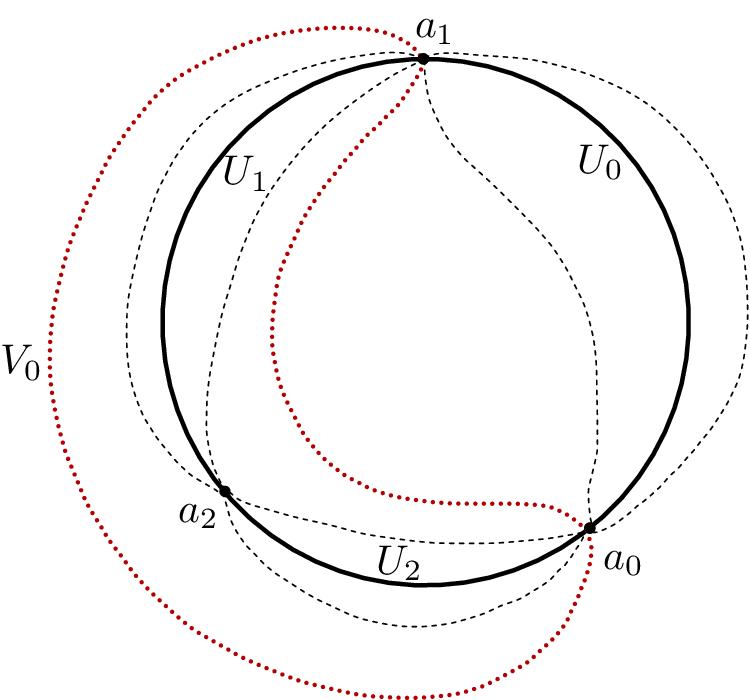


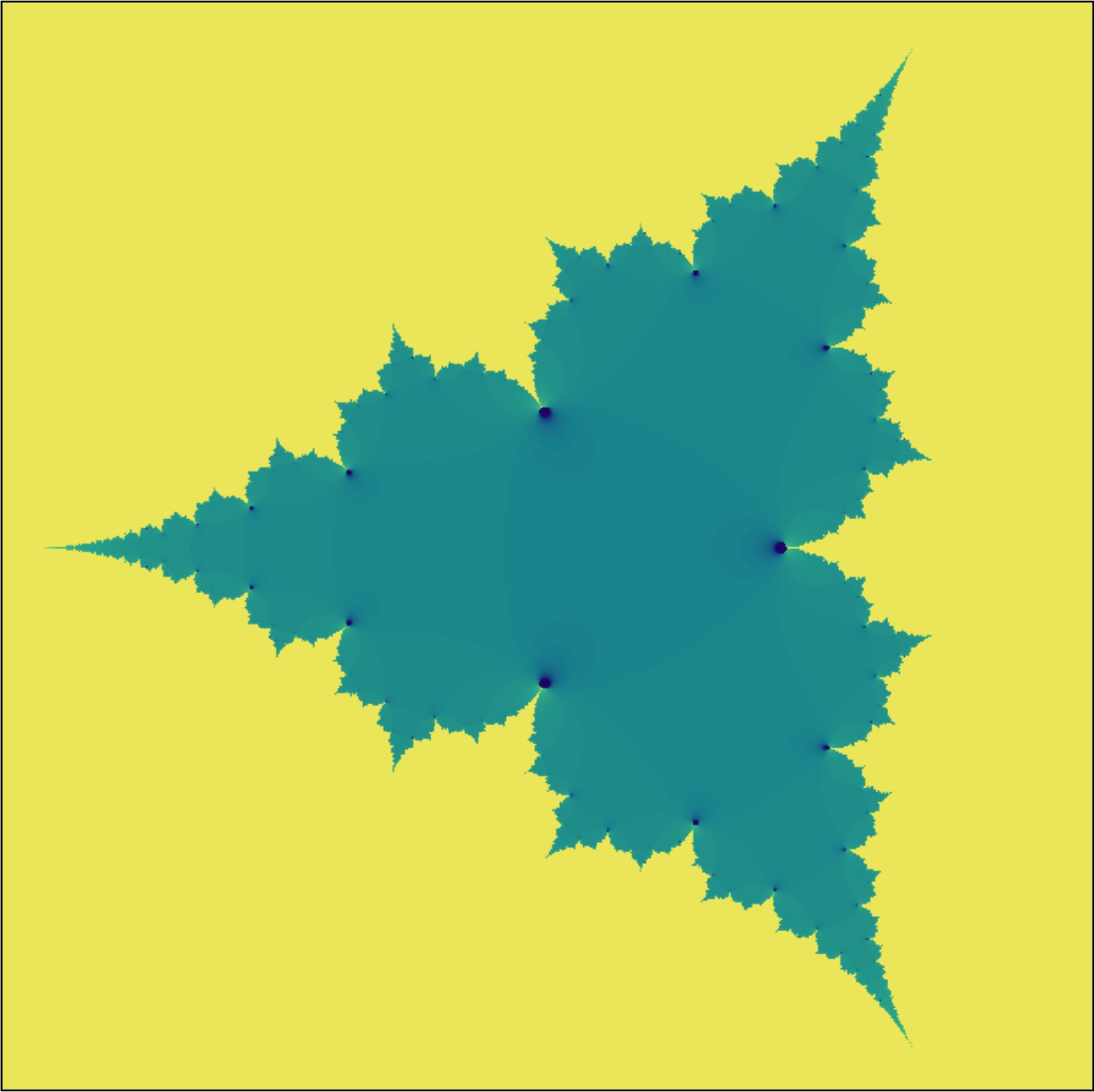

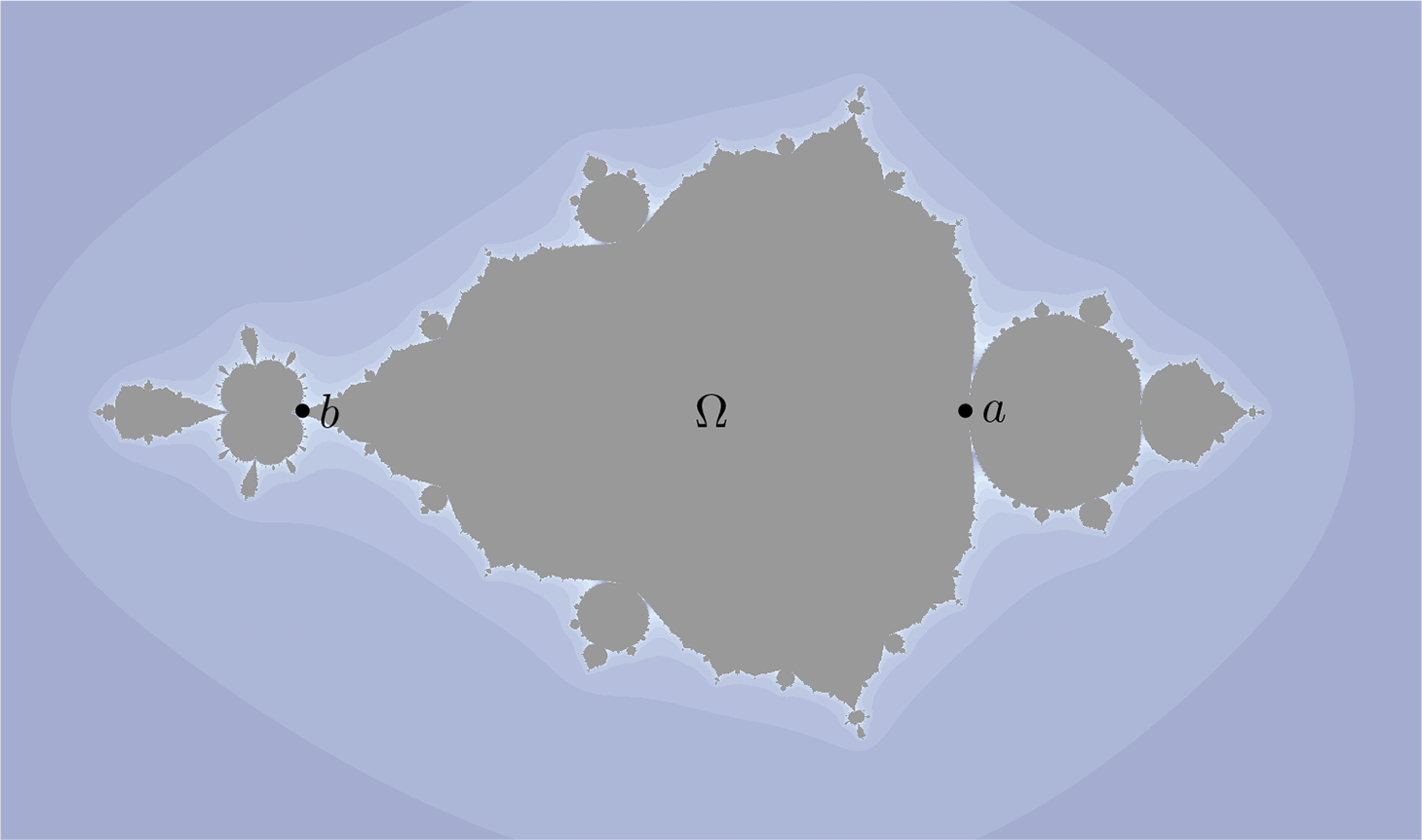

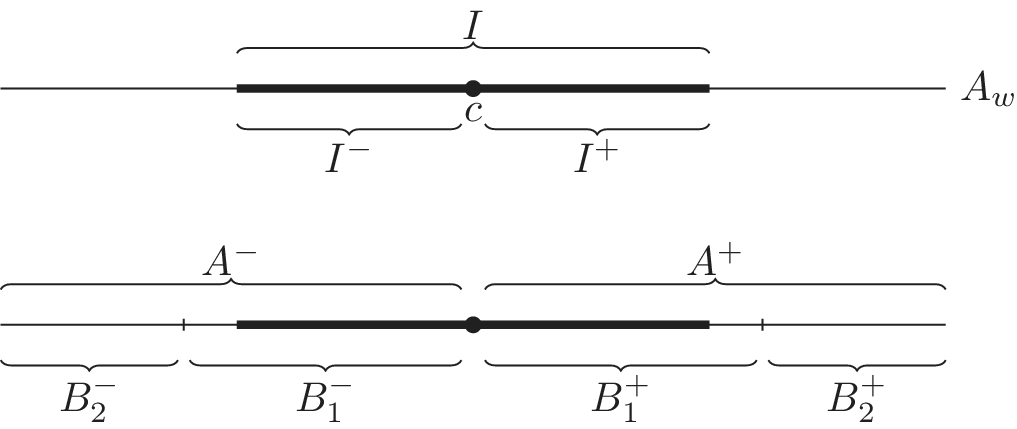
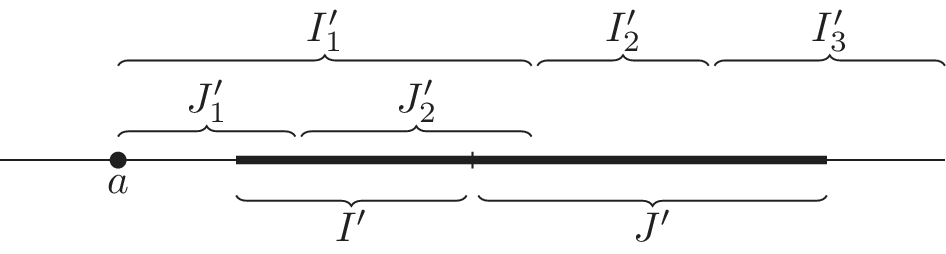

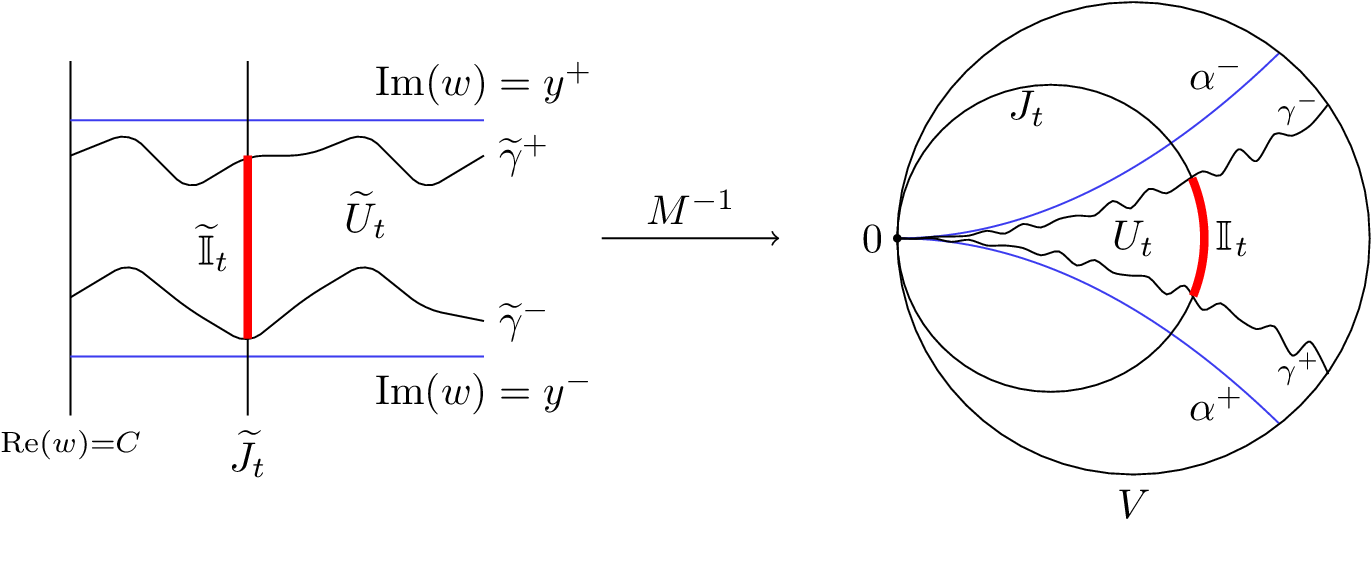
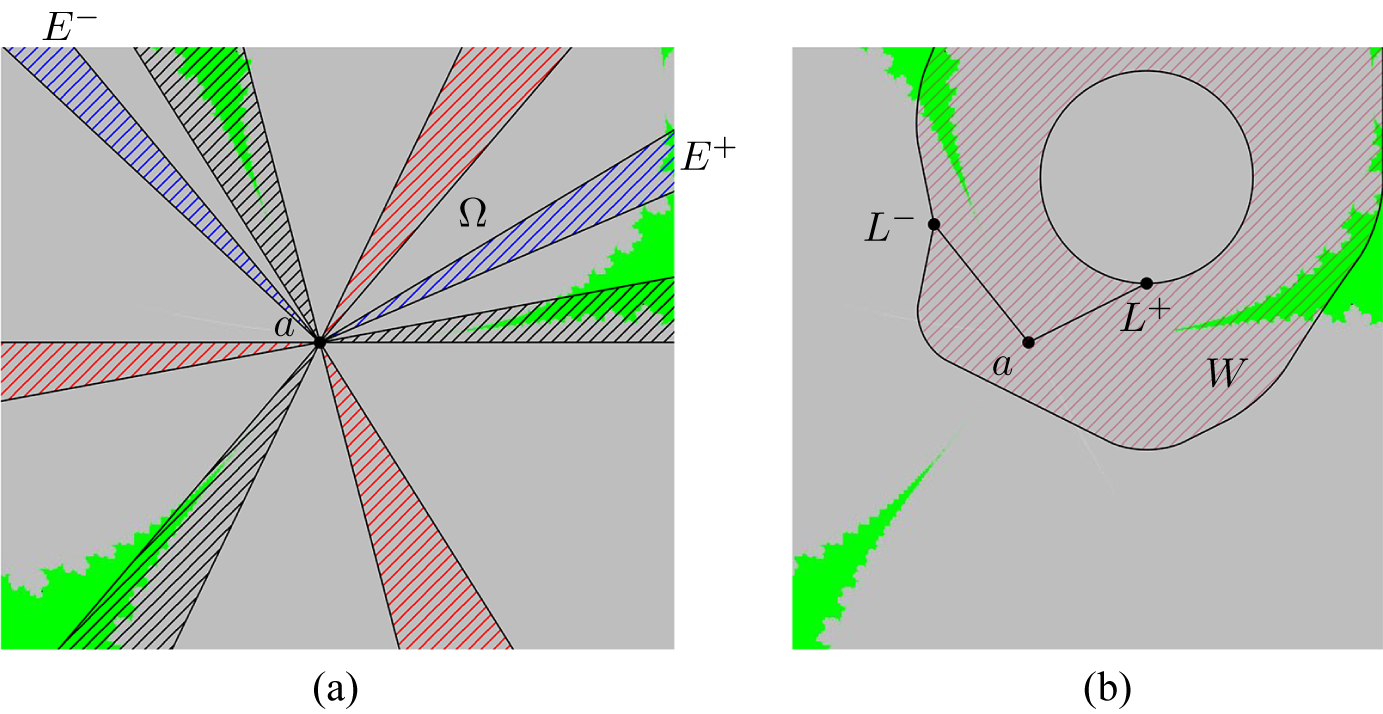


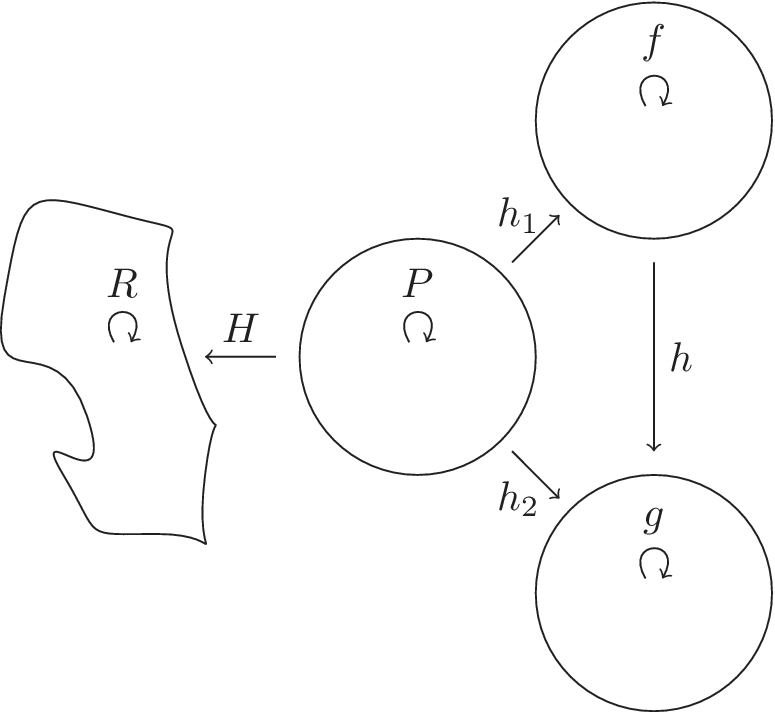

 Open access

