When adults in many cultures speak to young children they use higher pitch and more exaggerated intonation contours than when they speak to adults (Garnica, Reference Garnica, Snow and Ferguson1977; Fernald, Taeschner, Dunn, Papousek, de Boysson-Bardies & Fukuki, Reference Fernald, Taeschner, Dunn, Papousek, de Boysson-Bardies and Fukuki1989). Young infants prefer to listen to such child-directed speech (CDS) (Fernald, Reference Fernald1985) and they make use of the prosodic cues in CDS, but not adult-directed speech (ADS), to segment the speech stream (Thiessen, Hill & Saffran, Reference Thiessen, Hill and Saffran2005). In terms of learning, Aslin, Woodward, LaMendola & Bever (Reference Aslin, Woodward, LaMendola, Bever, Morgan and Demuth1996) reported that when English and Turkish mothers teach new words to their 12-month-olds, they highlight them using higher pitch and duration. And Golinkoff & Alioto (Reference Golinkoff and Alioto1995) found that prosodic highlighting of new words in this way facilitated word learning in adults (i.e. monolingual English-speaking adults trying to learn a Chinese word). However, to our knowledge there is no published study showing that any prosodic characteristics of CDS actually facilitate children's word learning.
In many languages prosodic salience is a marker of contrastive and/or new information in adult speech (Chafe, Reference Chafe1994). Fernald & Mazzie (Reference Fernald and Mazzie1991) found that this is also the case in CDS, as American mothers who read picture books to their 14-month-olds tend to accent words for new referents and, moreover, that such prosodic highlighting of words for new elements is more consistent and salient in CDS than in ADS. However, again, it remains uninvestigated whether young children use the connection between prosodic highlighting and novel referents to learn new words.
A prerequisite for making a connection between prosodic highlighting and novel referents is that children attend to the distribution of given and new elements in a referential scene in word learning situation. There is much evidence that they do. For example, in the study of Tomasello & Akthar (Reference Tomasello and Akhtar1995) 25-month-olds saw a novel object engaged in a novel action, accompanied by the excited one word expression modi. Children who had previously seen several objects engaged in the same novel action assigned modi to the novel object. If, on the other hand, the lead-in was such that the action was the new element, children assigned modi to the novel action. In another study, Akhtar, Carpenter & Tomasello (Reference Akhtar, Carpenter and Tomasello1996) found that when an adult played with a child and one toy, but left the room while the child played with another toy (with another adult), and then re-entered the room and excitedly said to the child Look there's a modi. A modi. Give me the modi, 24-month-olds assigned the novel word modi to the new object. Similar results were found by Moll & Tomasello (Reference Moll and Tomaselloin press) for 14-month-olds who interpreted the expression Wow! That's so cool! Can you give it to me! as referring to the element that was new to the adult. But in none of these studies was prosodic highlighting manipulated, and so we do not know whether children are just learning the novel word for the novel referent, or whether the prosodic highlighting of the novel word plays any role at all.
We thus know that adults learn strongly accented words more easily than unaccented words, and that young children use referential newness as a cue to identify the referent of a novel word. But we do not know if children use accent in word learning and if they make a connection between accent and newness, that is, we do not know if they learn accented words preferentially for contextually new elements. In the current word learning study, therefore, we systematically manipulated these two factors in a 2×2 design. Some children heard an appropriate pairing of sentence accent and referential newness – either the noun accented when the object in the referential situation was the new element (Object New – Noun Accent) or the verb accented when the action was new (Action New – Verb Accent). Another group of children heard an inappropriate pairing of sentence accent and referential newness – either the noun accented when the action was new (Action New – Noun Accent) or the verb accented when the object was new (Object New – Verb Accent). Each child was also exposed to a second novel object and a second novel action in a similar situation with neutral language (to serve as distracters in the comprehension tests). Children were then tested for their learning of both the nonce noun feks and the nonce verb miekt. The hypothesis of the study was that 25-month-old children will preferentially learn accented words for contextually new elements in the case of both nouns and verbs.
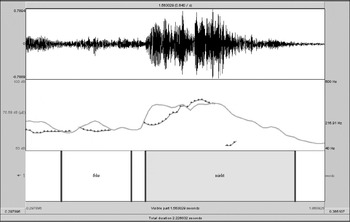
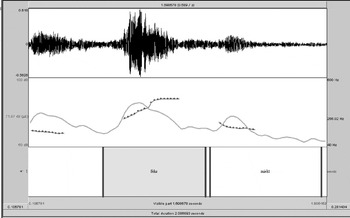
The study was conducted with German-speaking children. In German ADS new and contrastive information is accented. The acoustic characteristics of accent information are basically the same as in English: longer duration, higher intensity and pitch (Gibbon, Reference Gibbon, Hirst and Christo1998). To date there are no studies of the characteristics of German CDS with respect to information structure and its prosodic marking. However, a reasonable assumption is that contrastive and new information receives accent in German CDS just as in ADS. In the study we thus presented children a novel object engaged in a novel action while they heard the utterance Der Feks miekt with either Feks or miekt accented (see Figures 1 and 2 for detailed acoustic characteristics). Feks and miekt are phonotactically correct nonce words in German.
Pitch, intensity and duration of words in a typical verb-stressed sentence.

Pitch, intensity and duration of words in a typical noun-stressed sentence.

Method
Participants
Ninety-six monolingual German-speaking children aged 2 ; 0·1–2 ; 2·0 (mean=2 ; 0·22) took part in the study. The children's parents had previously volunteered to participate in studies of child development, and the children received a small gift for participating. Twenty-five additional children were dropped from the study: 5 because they used their own name for the novel object or action; 10 because of experimenter error; and 10 because they did not cooperate. Children were randomly assigned to one of the four experimental conditions (see below), with 24 children (12 girls and 12 boys) in each condition.
Materials and design
Two apparatuses were built to perform novel actions (see Figure 3). Each apparatus measured approximately 15 cm×15 cm×15 cm. The apparatuses were used for word training and neutral language training in counterbalanced fashion within condition across children. Order of word training and neutral language training was counterbalanced within condition across children as well.
Novel actions and objects.

Two novel nameless toys were used: a blue plastic oval and an orange U-shaped door stopper. One of the toys was used for word training, the other one for neutral language training in counterbalanced fashion within condition across children. Two replacement toys were available if a child named one of these toys: an orange plastic pencil sharpener and a purple fleece ring with bars. The replacements were used three times.
The words used in word training were both phonotactically correct monosyllabic German pseudo-words. The children heard these words in the sentence Der Feks miekt. In the neutral language training, the object and action were treated in the same way as the object and action in the word training. The only difference was that the experimenter (E) said Da guck mal ‘Look there!’. Sentence accent was realized by increasing pitch, intensity and duration of the accented words as is usual in German (Gibbon, Reference Gibbon, Hirst and Christo1998). The audio recordings of the training sentences were extracted and digitized. An independent coder who was blind for conditions judged all word training sentences and agreed 100% with the accent that was assigned to each sentence by experimental condition.
Procedure
Children came to a child laboratory for approximately thirty minutes. During the study the children sat at a table on the parent's lap, E sat directly across the table. All sessions were videotaped.
Warm-up
The warm-up phase was identical for all children. It was designed to familiarize children with the setting and tests, and in particular the unusual action request in the verb comprehension test. E and the child played with four toys in succession. E performed simple familiar actions with each of them accompanied by a verbal description (e.g. Guck mal! Die Ente fliegt ‘Look, the duck is flying’. The child was encouraged to imitate the action by utterances like Du bist dran. Die Ente fliegt ‘It's your turn. The duck is flying’. Child and E took turns several times for each of the toys. These toys and actions served to set up the newness of the novel target object or action.
Word training
During word training, all children were presented with a novel nameless toy engaged in a novel nameless action. The four experimental conditions determined a given child's experience before she was presented with the novel nameless toy–action pair and determined the accented word in the sentence Der Feks miekt.
Object New – Noun Accent. The assigned apparatus was placed on the table and E performed the novel action with a familiar toy – without any comments except for the child's name or attention getters. After two presentations E moved the apparatus toward the child and said Du bist dran ‘It's your turn’. If the child did not perform the action, E assisted her. The child and E took turns several times. Then E took a second familiar toy and performed the novel action. Again the child and E took turns several times without any comments. Then E took the novel toy and performed the novel action with it twice. These presentations were accompanied by the utterance Der FEKS miekt – with Feks accented. E and child took turns performing the action with the novel toy for a total of ten times. At each performance E said Der FEKS miekt – always with the same sentence accent. Each child heard the sentence sometimes before and sometimes during the action.
Object New – Verb Accent. This condition was identical to the previous one, except that the target sentence was Der feks MIEKT, with the accent on miekt.
Action New – Verb Accent. In this condition E demonstrated a familiar action with the novel toy, i.e. rolling or hopping, without comments. After two presentations E handed the toy to the child and said Du bist dran ‘It's your turn’. E assisted the child if necessary. The child and E took turns performing the action several times. Then E placed the target apparatus on the table and demonstrated an action with the novel toy involving the apparatus, i.e. throwing the toy at the apparatus. This was repeated several times by child and E. Then E took the novel toy and performed the novel action with it twice. Now the presentations were accompanied by the utterance Der feks MIEKT, with the accent on miekt. E and child took turns performing the action with the novel toy for a total of ten times. At each performance E said Der Feks MIEKT – always with the same sentence accent. Each child heart the sentence sometimes before and sometimes during the action.
Action New – Noun Accent. This condition was identical to the previous one, except that the target sentence was Der FEKS miekt – with Feks accented.
Neutral language training
All children received neutral language training in the same manner as their word training. The only difference was that E said Da guck mal instead of Der Feks miekt. This was done so that during the test, children could be presented with a distracter object or action that had been highlighted by E in a similar manner as the target object or action, only without any to-be-learned language. The toys and actions used in this training were different from the ones used in word training.
Testing
After the word training and the neutral language training, children were distracted from the novel toys and apparatuses by playing with a ball for approximately one minute. Then children were tested for their comprehension of the novel words in two separate comprehension tests in counterbalanced order. During the tests E looked straight at the child.
Noun comprehension test
The two novel toys from the word training and neutral language training were put on the table about 20 cm from the child. E placed the target toy randomly either left or right. Then E said Oh, da ist der Feks. Guck mal der Feks. Gib mir mal bitte den Feks ‚Oh, the feks. Look, the feks. Give me the feks, please‘ as a request to force the child to select one of the two available toys. E held her hand centered between the toys. If the child did not respond, E repeated her request. The toy the child handed to the experimenter counted as the toy that matched the word. If they handed both toys in succession, the first one counted. A blind and independent coder recoded 20% of the videotapes and agreed 100% with the first coder on which toy children selected.
Verb comprehension test
The verb comprehension test was an act-out task. The same verb form was used as the children had heard during word training to provide no additional cue from inflection whether miekt referred to an object or action. E put the two apparatuses on the table. The target apparatus was placed randomly either left or right in front of E. Then E handed a small ball to the child and said Hier ist der Ball. Du bist dran. Der Ball miekt. Der Ball miekt ‘Here's a ball. It's your turn. The ball is meeking. The ball is meeking' as a request to perform the meek action with the ball. Then E moved both apparatuses simultaneously towards the child until they were approximately 20 cm away from the child. If the child did not respond, E repeated the request. As an action response we counted children's positioning of the ball or performance of one of the actions without the ball. A blind and independent coder recoded 20% of the videotapes and agreed 100% as to which action was performed by the child in the act-out task.
RESULTS
Noun learning
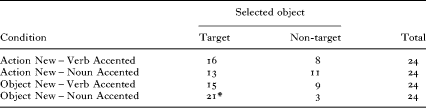
Table 1 shows the number of children in each condition who selected the target object correctly in the noun comprehension test. Chi-square tests were conducted on these data. No significant effects were found for test order (χ2=0·048, df=1, p=0·827), the order of word training and neutral language training (χ2=0·904, df=1, p=0·342). There was no preference for either the blue or the orange toy, and there was no significant preference for side. Binomial tests were calculated for each condition to test whether the number of correct object selections was above chance (50%) in the noun comprehension test. Children chose the target toy at above-chance levels (21/24) in the Object New – Noun Accent condition (p<0·001). Thus, children assigned an accented noun to an object that was newly introduced into a scene, but did not map an unaccented noun to a given or a new object nor did they map an accented noun to a given object.
Number of children in each condition who selected the target in the noun comprehension test

* p<0·01.
Verb learning
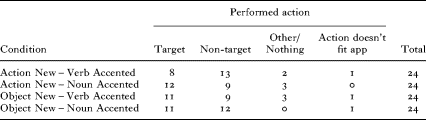
Table 2 shows the number of children in each condition who went for the correct apparatus in the verb comprehension test. There were no effects of test order (χ2=2·05, df=1, p=0·22), the order of word and neutral language training (χ2=1·538, df=1, p=0·15) or the position of the target apparatus (p=0·236, binomial test). In none of the conditions children performed the target action at above-chance levels, and there was no difference between the conditions (χ2=6·50, df=6, p=0·176).
Number of children in each condition who performed the target action in the verb comprehension test

FOLLOW-UP STUDY
Twenty-four children aged 2 ; 6 (2 ; 6·2–2 ; 8·0; mean 2 ; 7·1) were tested in the Action New – Verb Accent condition to see whether slightly older children would be able to learn either the novel noun or the novel verb. The results showed that 15 out of 24 children selected the target toy (p=0·307, binomial test), and 13 out of 24 children performed the target action (p=0·839, binomial test). This suggests that even the older children learned neither the verb nor the noun in the Action New – Verb Accented condition.
DISCUSSION
These results suggest that from early in linguistic development, young children understand that prosodic salience in a sentence indicates referential newness. Twenty-one out of 24 two-year-olds identified the referent of a novel noun correctly in the Object New – Noun Accented condition. However, children did not learn the new noun if the verb was accented in the sentence (object still referentially new) or the noun was accented but the object was referentially old.
It is well established that even prelinguistic children attend to contextually new elements, and also that they interpret adults' linguistic and non-linguistic referential expressions as referring to these new elements (Tomasello & Akhtar, Reference Tomasello and Akhtar1995; Akhtar et al., Reference Akhtar, Carpenter and Tomasello1996; Moll & Tomasello, Reference Moll and Tomaselloin press). Sentence accent is a means to direct others' attention to the referents of the accented linguistic item(s), prototypically when those referents are new to the situation in some way (see Chafe, Reference Chafe1994). Thus, if a mother says Look, the boy has a nice DOGGIE, she probably wants her child to attend primarily to the dog, while if she says Look, the BOY has a nice doggie she probably wants her child to attend primarily to the boy.
Now, what happens when a novel word is accented, since the child does not know the referent? Assuming that the child infers that the adult wants to direct her attention to some particular element of the scene, then the child should search for cues to infer the intended referent. The cue that is available in our setting is one that commonly co-occurs with prosodic salience: contextual newness. The fact that children learned the novel noun when it was accented and the object was new in the situation thus suggests that children actually use adults' intentional highlighting of words to infer that the adult's focus of attention is on the new element in the situation.
In theory, the children in our study should also have learned the novel verb in the Action New – Verb Accented condition, but they did not (nor in any other condition). Although it was not our primary interest to compare noun and verb learning, the question arises as to why our children did not learn the verb. First of all, it is a common finding that verb learning is harder than noun learning (see Childers & Tomasello, Reference Childers, Tomasello, Hirsh-Pasek and Golinkoff2006, for a review). In addition, in the current study the children heard only a single verb form, and they heard the verb in a sentence containing two novel words simultaneously. We are not aware of any word learning study trying to teach children two words simultaneously, and so it is unclear whether, compared with other verb learning studies, our subjects' verb learning performance is particularly poor or not (though clearly poorer than their noun learning under similar conditions). Nevertheless, given the findings of Tomasello & Akhtar (Reference Tomasello and Akhtar1995), one would expect children to assign an accented verb to a contrastively new action. But in that study it is not clear whether children in the Action New condition assigned the single novel word modi to the new part in the scene (i.e. the action) or to the whole scene (i.e. the new action with a particular object), since children were counted as correct if they performed the target action with either object, including the object from the target training. In our comprehension tests, in contrast, children were forced to divide the scene into object and action, since in the verb comprehension test children were asked to perform the target action with another object. Finally, it must be noted that in the current study – as in all other word learning studies – the tests for verb and noun comprehension are not equivalent. Arguably, the act-out task typically used for verbs is more demanding than the forced choice task typically used for nouns. Thus, it is unclear what significance to give to the finding of no verb learning.
With respect to verb learning, a study reported in Naigles (Reference Naigles, Rovee-Collier, Lipsitt and Haynes1998) should be mentioned. Naigles found that 15-month-olds interpreted a novel word as a name of an action only if the familiar objects that were engaged in a novel action were introduced in an utterance and then the novel word was uttered in a separate intonation unit. If the novel word and the familiar words were uttered in one intonation unit, the children assigned the novel word to a novel character rather than to the novel action of the familiar objects. Naigles interpreted the finding as evidence that verb learning depends on commenting about linguistically established topics. Given that accenting is a means of comment-marking, further research is necessary to examine the learning of accented and unaccented verbs in the context of given or new but familiar objects. According to Naigles' (Reference Naigles, Rovee-Collier, Lipsitt and Haynes1998) findings one would expect verb learning at least in the Action New – Verb Accented condition if a familiar noun and object are used during word training.
Sentence accent is a means to direct others' attention to the referent of the accented linguistic item. The current study showed that 25-month-old children preferentially learnt a novel noun when it was accented and the object referent was new in the situation. We interpret this finding as evidence that by their second birthday children know that a speaker intends to refer to a new element in the scene by accenting the corresponding word in her utterance. Thus, the current study provides the first experimental evidence that by two years of age young children use intentional prosodic highlighting to identify the intended referents of unknown words.