Introduction
Pycnogonids (Chelicerata, Arthropoda) from Antarctic and sub-Antarctic waters have been studied more extensively than those from any other ocean of a similar size. Exploration of this area began with the American expedition of Nathaniel Palmer whose naturalist, James Eights (Reference Eights1835), described and drew the first Antarctic pycnogonid Decolopoda australis on a serolid and some fossils. Pycnogonids have been collected by many scientists but the main monographs are by Hoek (Reference Hoek1881), Möbius (Reference Möbius1902), Hodgson (Reference Hodgson1907, Reference Hodgson1927), Bouvier (Reference Bouvier1913), Calman (Reference Calman1915), Gordon (Reference Gordon1932, Reference Gordon1938, Reference Gordon1944), Fry & Hedgpeth (Reference Fry and Hedgpeth1969), Pushkin (Reference Pushkin1993) and Child (Reference Child1994a, Reference Child1994b, Reference Child1995a, Reference Child1995b, Reference Child1995c). The most detailed information about the historical background of several families is contained in the Child papers, whilst the Pushkin monograph shows the geographical distribution of many species. The two latest Antarctic species to be described are Ammothe bigibossa Munilla, Reference Munilla2005 and Ammothea victoriae Cano & López-Gonzalez, Reference Cano and López-González2007 from the Antarctic Peninsula and the Ross Sea respectively. The aim of this paper is to provide a complete up-to-date list of austral pycnogonids and, using zoogeographical information consider hypotheses describing their geographical distribution.
Material and methods
This paper is an analysis of published data. The works mentioned above, as well as the Müller catalogue (1993) and many others (Hoek Reference Hoek1898, Hodgson Reference Hodgson1902, Reference Hodgson1904, Reference Hodgson1908, Reference Hodgson1914, Reference Hodgson1915, Bouvier Reference Bouvier1905, Reference Bouvier1906, Loman Reference Loman1923, Calman Reference Calman1933, Stephensen Reference Stephensen1947, Hedgpeth Reference Hedgpeth1950, Fage Reference Fage1952a, Reference Fage1952b, Utinomi Reference Utinomi1959, Stock Reference Stock1965, Arnaud Reference Arnaud1972a, Reference Arnaud1972b, Pushkin Reference Pushkin1974, Reference Pushkin1975a, Reference Pushkin1975b, Reference Pushkin1976, Reference Pushkin1977, Reference Pushkin1982, Reference Pushkin1984a, Reference Pushkin1984b, Reference Pushkin1990, Turpaeva Reference Turpaeva1974, Reference Turpaeva1990, Reference Turpaeva1998, Reference Turpaeva2000, Krapp Reference Krapp1980, Child Reference Child1987, Reference Child1998, Pushkin Reference Pushkin1988, Munilla Reference Munilla1989, Reference Munilla1991, Reference Munilla2000, Reference Munilla2001b, Reference Munilla2002, Reference Munilla2005, Stiboy-Risch Reference Stiboy-Risch1992, Reference Stiboy-Risch1993, Reference Stiboy-Risch1994, Bamber Reference Bamber1995, Reference Bamber2007, Bamber et al. Reference Bamber, Mitchell and Ferrero2001, Chimenz & Gravina Reference Chimenz and Gravina2001), were used to compile the species list. The main zoogeographical works about pycnogonids are those of Fry (Reference Fry, Carrick, Holdgate and Provost1964), Fry & Hedgpeth (Reference Fry and Hedgpeth1969), Hedgpeth (Reference Hedgpeth1969a, Reference Hedgpeth1969b, Reference Hedgpeth and Quam1971) and Munilla Reference Munilla2001a. Other works (Clarke & Crame Reference Clarke, Crame and Crame1989, Reference Clarke, Crame, Ormond, Gage and Angel1997, Barnes & De Grave Reference Barnes and De Grave2000, Clarke & Johnston Reference Clarke and Johonston2003, Arntz et al. Reference Arntz, Thatje, Gerdes, Gili, Gut, Jacob, Montiel, Orejas and Teixidó2005, Reference Arntz, Thatje, Linse, Avila, Ballesterros, Barnes, Cope, Cristobo, De Broyer, Gut, Isla, Lopez Gonzalez, Montiel, Munilla, Ramos Esplá, Raupach, Rauschert, Rodriguez and Teixidó2006, Barnes Reference Barnes2005, Reference Barnes2006, Clarke et al. Reference Clarke, Barnes and Hodgson2005, Moyano Reference Moyano2005, Thatje et al. Reference Thatje, Hillebrant and Larter2005, Gili et al. Reference Gili, Arntz, Palanques, Orejas, Clarke, Dayton, Isla, Teixidó, Rossi and López-González2006, Linse et al. Reference Linse, Griffiths, Barnes and Clarke2006), contain particular zoogeographical reviews of some zoological groups or global and evolutionary reviews of benthos. A total of 98 papers were consulted.
Results and discussion
Historical research and specific richness
This analysis of the austral pycnogonids covers 172 years, 16 countries and more than 42 ships or expeditions. So far 40 000 specimens have been found in the Antarctic and sub-Antarctic waters, (termed the Austral Ocean by Jacques & Treguer Reference Jacques and Treguer1986, p. 133) at about 2100 sampled stations. The Southern Ocean usually contains the Antarctic waters south of the Polar Front and does not include sub-Antarctic localities between this front and the Subtropical Convergence (D. Barnes, personal communication 2007). This sub-Antarctic zone contains many islands with pycnogonids (see legend, Table I) and the South American zone (Magellan and Falkland zones). Bouvet Island is just south of the Polar Front, but given its isolation and that it acts as a link between sub-Antarctic and Antarctic fauna (Arntz et al. Reference Arntz, Thatje, Linse, Avila, Ballesterros, Barnes, Cope, Cristobo, De Broyer, Gut, Isla, Lopez Gonzalez, Montiel, Munilla, Ramos Esplá, Raupach, Rauschert, Rodriguez and Teixidó2006), I consider it as another sub-Antarctic island. Moreover, the general composition of the actual Bouvet fauna is more similar to the Magellan area than the high Antarctic region (Arntz et al. Reference Arntz, Thatje, Linse, Avila, Ballesterros, Barnes, Cope, Cristobo, De Broyer, Gut, Isla, Lopez Gonzalez, Montiel, Munilla, Ramos Esplá, Raupach, Rauschert, Rodriguez and Teixidó2006).
Genera and species recorded in Antarctic (A) and sub-Antarctic (S) waters with regard to their depth and various geographical zones. W.sp = number of world species. Antarctic waters: C = circumpolar, Sc = Scotia Sea, p = Antarctic Peninsula, a = Amundsen Sea, b = Bellingshausen Sea, r = Ross Sea, w = Weddell Sea, e = East Antarctic zone. sub-Antarctic waters: s = South America, k = Iles Kerguelen, c = Ile Crozet, n = New Zealand Plateau, t = Tristan da Cunha, b = Bouvet Is., M + PE = Marion & Prince Edwards Is., St.P + A = Saint Paul & Amsterdam Is.

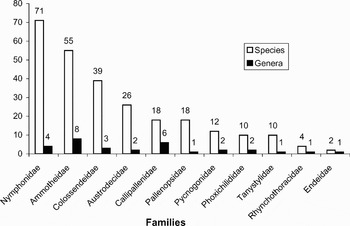
These individuals belong to 31 genera and 264 different species of pycnogonids (Table I), out of a total number of species worldwide of 1344. They thus represent 19.6% of the actual world species that have been recorded in 21% of the ocean areas (Jacques & Treguer Reference Jacques and Treguer1986). Figure 1 shows the richness of species and genera for each family. Nymphonidae is the most abundant family (71 species), with Nymphon the major genus (67 species), and N. australe the most frequently recorded species. Of these 264 species, 108 are endemic in the Antarctic area, 62 are present only in the sub-Antarctic zone and 63 are common to both. Table I shows the current list of the Antarctic and sub-Antarctic species, their synonyms (47), the percentage of species per genus with respect to their number worldwide, their geographical distribution and bathymetric range. The majority of synonyms have been proposed or recorded in the Child (Reference Child1994a, Reference Child1994b, Reference Child1995a, Reference Child1995b, Reference Child1995c), Pushkin (Reference Pushkin1993) and Müller (Reference Müller1993) papers. The richest zone, with 89 recorded non-circumpolar species, is the Scotia Sea, followed by the sub-Antarctic islands with 64 species. The circumpolarity criterion is that a species was recorded on one or more occasions in each of the waters to the north, south, east and west of the Antarctic continent, with the east zone the largest one and least sampled (it contains 24 species of which only four are endemic).
Richness of species and genera from austral pycnogonid families.

Zoogeography
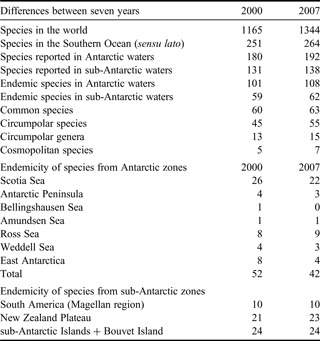
The Antarctic benthos has evolved as a consequence both of the abiotic environmental conditions in the past and of biotic interactions (Arntz et al. Reference Arntz, Brey and Gallardo1994). The distribution of most of the benthic Antarctic fauna is considered as circumpolar (Hedgpeth Reference Hedgpeth and Quam1971, Arntz & Gallardo Reference Arntz, Gallardo and Hempel1994, Clarke & Crame Reference Clarke, Crame, Ormond, Gage and Angel1997), almost certainly due to the powerful Antarctic Circumpolar Current (Clarke & Johnston Reference Clarke and Johonston2003). The circumantarctic element is also the most frequent pattern for pycnogonids (Fry & Hegdpeth 1969, Hegdpeth 1969a, Munilla Reference Munilla2001a), since at present 55 of the 192 (28.7%) Antarctic recorded species are circumpolar.
The comparative data in Table II, based on cruise data and literature dealing with austral pycnogonids over a period of seven years, shows that the number of endemic species for each Antarctic zone is low, with the exception of the Scotia Sea, which could be considered as a sub-centre of speciation. Moreover, this table shows that the circumantarctic pattern for the pycnogonid species has increased over the seven years, and the endemicity of the species from each zone has consequently decreased. In other words, increased sampling has shown more circumpolarity and less zonal endemicity.
Variation in the austral pycnogonid species between 2000 and 2007.

Only 10 genera are exclusively from austral waters and four of them (Dodecolopoda, Pentanymphon, Sexanymphon, Austroraptus) are endemic to Antarctic waters. Other genera (Decolopoda, Austropallene) which were considered by Hegdpeth (1969b) as typically Antarctic, have already been found in sub-Antarctic waters, including in the Kuril Islands (Austropallene likinii Turpaeva, Reference Turpaeva2002); the same is true for some species. The genera with the most species in austral waters are: Ammothea (25 species out of 40 in the world; 62.5%), Colossendeis (36 out of 75; 48%), Austrodecus (22 out of 42; 52.4%), Nymphon (67 out of 268; 25.0%) and Pallenopsis (18 out of 86; 20.9%). There are not endemic families.
The sub-Antarctic pycnogonid fauna shows origins in the Antarctic fauna at genus level (Arnaud & Bamber Reference Arnaud and Bamber1987). For example, this is true of Colossendeis and Ammothea, two genera with more than half of their species in the Austral Ocean. Like other genera with abundant species, both have more species in Antarctic than in sub-Antarctic waters. We therefore view the Southern Ocean as a centre of speciation (suggested by Hedgpeth Reference Hedgpeth1969b, and Munilla Reference Munilla2001a) but also of geographic dispersion and evolutive radiation, because of its high relative endemicity (108 Antarctic species versus 62 of sub-Antarctic ones).
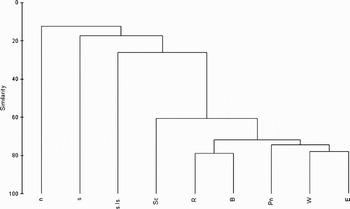
The dendrogram (Fig. 2), based on the presence-absence data of the 264 austral species, shows that the Antarctic species form a large zoogeographic group linked to circumpolarity (55 species). Three trends are clear:
Similarity of Antarctic and sub-Antarctic zones (Bray-Curtis Index, complete linkage), based in presence-absence data. CircumAntarctic species are included. n = New Zealand Plateau, s = South America, s.Is = sub-Antarctic islands, Sc = Scotia Sea, R = Ross Sea, B = Bellingshausen Sea, Pn = Antarctic Peninsula, W = Weddell Sea, E = East zone.

a) The Scotia Sea is closely linked to other southern zones (60.75% of similarity), indicating some peculiarity of the former.
b) Two branches of the Circumpolar Current (with 71% of similarity) have been differentiated: the north-eastern (Antarctic Peninsula–Weddell-East zones) and the southern (Bellingshausen–Ross zones). This supports the geographical proximity of the species distribution to the direction of the Circumpolar Current.
c) Each sub-Antarctic zone is separate, and the three zones (Magellan region, New Zealand and sub-Antarctic islands), present low levels of similarity (< 30%, Fig. 2) to Antarctic waters. The suites of organisms in the seas surrounding the sub-Antarctic islands, have long been considered sufficiently dissimilar to constitute a different zone (Hedgepth 1969a), with 63 species at present. Recent multivariate analysis of the bryozoan component of benthos south of 47ºS supports the categorization of Patagonia, the sub-Antarctic islands and Antarctica into separate zones (Barnes & De Grave Reference Barnes and De Grave2000).
Two complementary hypotheses (Clarke & Johnston Reference Clarke and Johonston2003) may explain the possible origin of today's Antarctic benthic fauna:
1. It comes from an in situ stock in Cretaceous waters (141–65 Ma), from the coastal fauna of Gondwana, when the present Antarctic continent was part of the supercontinent. This is supported by the Gasteropoda (Clarke Reference Clarke, Kerry and Hempel1990), two Isopoda families (Brandt Reference Brandt1992) and some sessile groups (Alcyonarians and sponges, Gili et al. Reference Gili, Arntz, Palanques, Orejas, Clarke, Dayton, Isla, Teixidó, Rossi and López-González2006) among others.
2. There was subsequent interchange with the deep fauna of the contiguous oceans, as is the case with Tanaidacea and Amphypoda (Brandt Reference Brandt1999). One possibility is that the Magellan region provided Antarctic benthic fauna across the Drake Passage or the Scotia Arc. This may be the case in some groups such as Serolidae (Held Reference Held2000), Polychaeta (Montiel et al. Reference Montiel, Rios, Mutschke and Rozbaczylo2004) and Bryozoa (Moyano Reference Moyano2005, Barnes Reference Barnes2006). The Scotia Arc and Bouvet Island are clearly undersampled, if they are considered as transitory areas between the Magellan region and the Antarctic Peninsula or the Weddell Sea (Arntz et al. Reference Arntz, Thatje, Gerdes, Gili, Gut, Jacob, Montiel, Orejas and Teixidó2005). Modern Antarctic communities are thus composed of a mixture of Palaeozoic taxa, which migrated from the deep ocean during interglacial periods, and a component of fauna that evolved from common Gondwana Cretaceous ancestors (Gili et al. Reference Gili, Arntz, Palanques, Orejas, Clarke, Dayton, Isla, Teixidó, Rossi and López-González2006).
The final connection between South America and the Antarctica was broken just over 25 Ma ago. The result was the formation of the Circumpolar Current, causing the oceanographic and geographical isolation of the Antarctic continent. The continental remains of the ancient isthmus today form many of the islands adjacent to the Antarctic Peninsula, but the main topographical obstacle between South America and Antarctica is the Scotia Arc, through which the Circumpolar Current passes.
Two main probable dispersion routes of pycnogonids are proposed, coming from the ancient Cretaceous fauna and principally along the bottom (since they have benthic larvae):
1. From Western Antarctica to the Eastern zone by means of the Circumpolar Current. In support of this, there are 15 common non-circumpolar species between the Scotia Arc–Antarctic Peninsula couplet and the Eastern Antarctic zone. Moreover, a branch of the dendrogram (Pn–W–E, Fig. 2) also supports this suggestion.
2. From South America to western Antarctica going along the route from the Scotia Arc. This is supported by 17 common non-circumpolar species between the Scotia Arc–Antarctic Peninsula couplet and the Magellan zone; moreover, 13 of 48 austral species recorded in other waters have been also found in the Argentine and Brazilian zones (the Brazil current versus circumpolar one).
The benthic insular refuge hypothesis
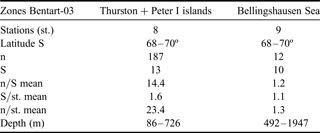
The submerged zones of the Peter I and Thurston islands in the Bellingshausen Sea are sheltered areas and optimal zones for the settlement and protection of pycnogonid fauna from the surrounding open seas, similar to oases in the desert. They are species rich and the densities of animals are here higher than on open bottoms (Table III), probably because of more feeding possibilities. Animals can be transported from them by deep currents, including by hitchhiking on a moving animal or debris or by simply drifting to other waters. This trend, observed in the Bellingshausen Sea, is extensive in other waters, and occurs in Bouvet Island, which act as stepping stones (Arntz et al. Reference Arntz, Thatje, Linse, Avila, Ballesterros, Barnes, Cope, Cristobo, De Broyer, Gut, Isla, Lopez Gonzalez, Montiel, Munilla, Ramos Esplá, Raupach, Rauschert, Rodriguez and Teixidó2006) to Antarctic waters.
Specimens and species of pycnogonids from islands and the open Bellingshausen Sea, in the Bentart-03 Cruise.
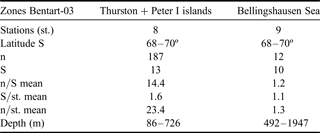
n = number of specimens, S = number of species
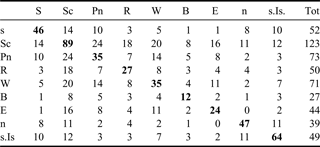
The benthic insular refuge hypothesis suggests that the islands serve as a home, accumulating a rich benthic fauna, and subsequently acting as migration points. This is similar to the reserve effect of a marine protected zone. This theory needs to be confirmed using more quantitative data about species richness, densities and biomass in pycnogonids and many other zoological groups. Far from any island, deep waters of under 1000 m, have few species and specimens (Munilla Reference Munilla2001a). Moreover, no circumpolar species have been recorded (Table IV) and the number of endemic species (Table II) in each austral zone is much more important at islands (Scotia Sea, New Zealand Plateau and sub-Antarctic ones) than at the benthic bottoms of the open seas. There also seems to be no decreasing latitudinal decline of species richness if the sub-Antarctic islands are included (Table II and IV), because there are more species in Antarctic waters than in sub-Antarctic ones.
Number of species recorded in each zone (in bold) and common species between different zones. Circumpolar species are excluded.
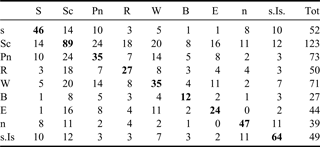
s = South America, Sc = Scotia Sea, Pn = Antarctic Peninsula, R = Ross Sea, W = Weddell Sea, B = Bellingshausen Sea, E = East zone, n = New Zealand Plateau, s.Is = sub-Antarctic islands. Tot = sum of the common species for each zone and the remaining ones.
Possible stages in the origin and dispersion of the Antarctic pycnogonids
1. In situ origin (Munilla Reference Munilla2001a), from the Cretaceous Gondwana fauna (141–65 Ma). This possibility is supported by the two most ancient families of the sea spiders (Colossendeidae and Austrodecidae, (Arango & Wheeler Reference Arango and Wheeler2007, Bamber 2007), morphological and molecular data, having 48% and 42% respectively of their species in southern waters. This hypothesis has been suggested previously for Austrodecidae genera (Stock Reference Stock1957, Child Reference Child1995b).
2. Many archipelagos in the Scotia Arc are the tips of an almost continuous subsurface mountain chain linking the Andes and the Antarctic Peninsula (Barnes Reference Barnes2005). All the Scotia Sea islands sheltered the existing fauna at the time of its creation and they still retain the ancient Cretaceous fauna that the Antarctic Circumpolar Current (ACC) subsequently carries, because the Scotia Arc is the only major barrier to the circulation of this current. Many more species remain on its islands than in other waters, as shown by the large number of species that have been captured in this zone (Table IV): 89 non-circumpolar species plus 55 circumpolar ones, that is the 75% of the 192 recorded Antarctic species.
3. From the Scotia Arc waters, the fauna was, and today still is, actually exported towards the East Antarctic zone thanks to the Circumpolar Current, which also distributes some species to the sub-Antarctic islands. A similar trend happens with the benthic larvae of cheilostome bryozoa (Bouvet Island, Barnes Reference Barnes2006). Moreover, the Scotia Arc pycnogonid fauna also arrive at the southern branch of the Circumpolar Current (Bellinghausen–Ross Sea, Fig 2). This link is shown in the cluster in Fig. 2, where the Scotia Sea branch is closely related to other Antarctic zones. The large number of common species between the Scotia Sea Arc and remaining zones (123, Table IV) support this movement of pycnogonids.
The low water temperature is the main factor that isolates the Antarctic species, leading to high endemism in various groups (108 of 192, 56.3% in pycnogonids). With the warming of global oceans, the colonization of the Antarctic waters will be greater in the future. The number of species will increase and the relative Antarctic endemicity will decrease. This trend will be favoured by the increasing passive transport of animals or algae on various ships, swimming animals and floating debris. Eddies and currents are factors that also contribute to passive transport (Barnes et al. Reference Barnes, Hodgson, Convey, Allen and Clarke2006).
Acknowledgements
This work was carried out under the auspices of two MEC grants (CGL 2004 01856/ANT, REN 2001-1074/ANT) of the Spanish Council of Scientific and Technical research. I would like to express my gratitude to the scientific colleagues of the Bentart cruises aboard the Hesperides oceanographic Spanish vessel. Likewise, we are grateful to the reviewers and the Editor for their constructive suggestions which improved the paper.