

In this article, we begin to outline the idea of Critical Neuroscience: a reflexive scientific practice that responds to the social and cultural challenges posed both to the field of science and to society in general by recent advances in the behavioural and brain sciences. By sketching a multidisciplinary form of critique, we suggest a framework of analysis and practice that could help to provide a theoretical foundation for projects aiming at critical reflection on new developments in neuroscience and the cognitive sciences more broadly. This project creates a space for knowledge to be shared and used to inform critique and practice across disciplines and domains including the media and policy. These critical activities include: historical contextualization of the development of the neurosciences; the study of socio-economic drivers of research programmes; ethnographic analysis of laboratory practices, conceptual and technical scrutiny of methodologies, including the paradigms, data analysis and interpretive frameworks; media representations and their interaction with processes of research; engagement with the mechanisms of agenda setting in the neurosciences; and, most importantly, the implementation of alternative approaches, methods, designs and interpretations in neuroscientific research. Our aim is to develop a more thorough self-understanding and awareness of the social implications of research and its uses, among neuroscientific practitioners, which can then be fed back into the practice of neuroscience. This text provides a general overview of the project's concerns and serves as a springboard to develop the conceptual framework and potential applications.Footnote 1
Cognitive neuroscience: new advances create new kinds of concerns
The project of Critical Neuroscience is driven by the recent and increasing emphasis on the brain, in scholarly and popular discourses. Since the Decade of the Brain, this has included the emergence of a constellation of neuro-disciplines and neuro-cultures (see Ortega and Vidal, Reference Ortega and Vidal2007) which have given a new primacy to the brain in knowledge about behaviour ranging from love (Bartels and Zeki, Reference Bartels and Zeki2000, Reference Bartels and Zeki2004) and hate (Zeki and Romaya, Reference Zeki and Romaya2008) to empathy (Lamm et al., Reference Lamm, Batson and Decety2007) and experiences from psychoanalysis (Solms and Lechevalier, Reference Skolnick Weisberg, Keil, Goodstein, Rawson and Gray2002) to shopping (Greenslit, Reference Greenslit2002), while at the same time highlighting the ethical dangers and societal threats in doing so (Fukuyama, Reference Fukuyama2002; Illes, Reference Illes2006). In particular, this project responds to the recent focus on the question of neural distinctions between ‘kinds’ or categories of people and, more broadly, the complementarity with cultural shifts in advanced capitalist and highly medicalized societies through which citizenship and personhood are increasingly constituted by notions of individual choice and autonomy. Neuroscientific explanations of behaviour fit well with this cultural focus on the individual and interiority, and as such have many uses (Martin, Reference Martin2000; Rose, Reference Rose2006). Given that technical and scientific expertise is highly valued in such societies, knowledge from neuroscience is thought to be assuming the role of guidance in many people's lives, both practically and through being incorporated into their self-understanding.Footnote 2 Research in social neuroscience, affective neuroscience, cultural neuroscience and neuroeconomics is in the process of uncovering the brain mechanisms underlying cognition (Parker et al., Reference Parker, Derrington and Blakemore2002), perception (Mather, Reference Mather2006; Wolfe et al., Reference Wolfe, Kluender, Levi, Bartoshuk, Herz and Klatzky2006), emotion (Dalgleish, Reference Dalgleish2004; Damasio, Reference Damasio1999; Davidson, Reference Davidson2001), decision-making (Moll et al., Reference Moreno2008; Pfaff, Reference Pfaff2007), social understanding (Frith and Frith, Reference Frith and Frith2003) and trust (Krueger et al., Reference Krueger, Grafman and McCabe2008); neuroscientific practitioners promise to find better ways to treat mental disorders; and neurotechnologies have opened up new ways to interact with, enhance, predict, monitor and alter human capabilities. From the recent rhetoric both within and outside of the scientific literature, the prospects for applications of such findings seem tremendous. As such, the dynamics in and around neuroscience seem to warrant particular critical analysis. The field of neuroethics deals with the growing concern among many that cognitive neuroscience might have negative consequences for individuals and society at large (see e.g. Fukuyama, Reference Fukuyama2002; President's Council on Bioethics, 2003; Rees and Rose, Reference Rees and Rose2004). To what extent is this anxiety about the potentials of neuroscience warranted? Does the science itself give rise to radical changes to epistemologies of personhood? Or are we seeing old questions reappearing in new contexts (Borck and Hagner, Reference Borck and Hagner2001)? Most likely, much of the concern and revolutionary language about the radical changes imposed by neuroscience on society arise from the gap between actual findings in research and the representations of the findings.
We propose a variety of methods to analyse how neuroscience does actually influence society by viewing neuroscience itself as a cultural activity. We examine the ways in which brain-based models of behaviours are deployed in everyday life, focusing on the social structure of the discipline of neuroscience and its relationship to the science. We suggest integrating approaches from neuroscience and philosophy, analysing how ideas from neuroscience are taken up by various audiences using methods from anthropology and placing this in context using history of science. While sociologists, anthropologists and historians have begun to tackle many of these questions, there is currently little dialogue with experimental neuroscience in the lab about how the social structure of neuroscience affects practices, findings and applications. Neuroscience research spans a multitude of laboratories with differing methodologies, levels of inquiry and theoretical assumptions. These research programmes operate through many forms of funding and regulation, with a variety of possibilities for the application of research. What are the economic drivers for the dominant research programmes within neuroscience? Which political climates favour certain lines of inquiry and certain forms of explanation? Are the research agendas suited to the cultural context in which they are applied? What are the limitations of the methodological approaches? How do the data and interpretations fit with those from different paradigms or different laboratories? How are the findings disseminated? In the space between science studies and empirical neuroscience, Critical Neuroscience finds its task. We put forward an interdisciplinary approach and a combination of critical tools, which we later begin to illustrate through brief sketches of some Zeitgeist topics in neuroscience.
Theoretical background of the critical agenda: what do we mean by ‘critical’?
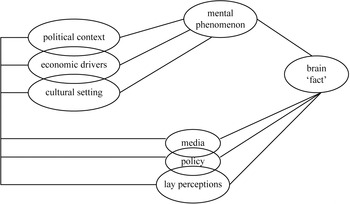
There is no single way to ‘do’ Critical Neuroscience. One way to conceptualize ‘critique’ is to use the metaphor of the looping journey of a given piece of information about the brain, or that which is taken to be a ‘brain fact’, whether it is the neural basis of gender, criminality, morality or culture, from the point of its entry into the lab to its treatment in the lab through various technical and knowledge practices to interaction with the media and policy and its reception by the public. ‘Brain facts’, as we refer to them here, are not objectively given things-in-themselves but emerge from communities of scientists working collectively at a given time in a given context. Biologist and sociologist of science Ludwig Fleck theorized that a scientific fact represents a ‘stylized signal of resistance in thinking … by a thought collective’ (Fleck, Reference Fleck1981 [1935]: 98). Communities of scientists, he observed, demonstrate a readiness to direct their cognition in a particular ‘thought style’ predicated on thought constraints, during the process of doing research. Fleck described the ‘tenacity’ of systems of thought that govern scientific practices and explanatory styles, and that ultimately give rise to what, from then on, will count as facts. What makes those facts ‘push back’? By studying the journey of a phenomenon in and around the neuroscience lab, we can study how the methods, concept and theories involved in the development of a fact of neuroscience may be culturally conditioned, as well as the ‘refractory’ effects of the thought collective and the wider culture in which it functions, that sustain it.Footnote 3
This journey or loop depicted in Figure 1 demonstrates various ‘sites of critique’, each of which may place constraints on the thought style used to develop the fact. Studying how certain social, political and economic factors push a particular topic under the scientific gaze, and support certain explanatory narratives, allows us to understand why a certain question about the brain gains significance over others at any one time. Contextualizing this in history provides clues about why this occurs and may repeat itself through various guises. The meta-analysis of different experimental data and paradigms allows us to follow how data are drawn together to develop theories about the brain, and to identify discrepancies between what the science directly demonstrates and what the representations of science tell us. Similarly, the study of how information about the brain is reported in various literatures, taken up by media, policy and in everyday life provides insights into how this knowledge is understood and used. This process itself may influence what becomes or stays significant as an object of study.
The journey of the ‘brain fact’

Every one of these ‘sites of critique’—in governmental, commercial, laboratory, media, policy and other public spheres—provides a point of contribution for the Critical Neuroscience project by helping to piece together the social, political, economic and cultural factors involved in the development of neuroscientific insights and their practical applications. In this project, each of these critical activities is bound together by a shared agenda to detect ‘social pathologies of reason’ (Honneth, Reference Honneth2007) in the cognitive neurosciences and their social contexts, and, where possible, to make these apparent in order to correct them and reshape parts of the scientific process (Hartmann, Reference Hartmann2009). Informed by critical theories of various kinds,Footnote 4 we employ a notion of critique that combines self-reflexivity in human practices—here, those making up the activity of neuroscientific research and those surrounding it—with an exploration of emancipatory potentials that could enable those affected by current developments to participate in the relevant processes and practices in order to improve them or replace them with better ones. The critique we propose thus necessitates a reflexive turn: neuroscientists need to critically examine scientific practices and institutions, as well as the wider social contexts within which they work. The aim of this reflexivity is to reveal the contingent foundations of particular disciplinary perspectives, tacit presuppositions, and also their entanglement with the social dynamics operative in capitalist societies at large. This idea of critique relevant to Critical Neuroscience concerns ways to institute self-critical practices, which aim to achieve reflective awareness of the standpoint-specific biases and constraints that enter into the production, interpretive framing and subsequent application of neuroscientific knowledge.
Steps towards a Critical Neuroscience: contributing activities
Central to the core activity of Critical Neuroscience is the idea that analysis of the social and cultural structure of the neurosciences may inform the design of experiments in a meaningful way, particularly studies of the ‘social’ or ‘cultural brain’. Importantly, Critical Neuroscience stands orthogonal to the constructivism versus realism debate in science studies (cf. Daston, Reference Daston2000). It holds that while neuroscience potentially discloses facts about behaviour and its instantiation in the brain, the cultural context of science interacts with these knowledge claims, adds new meaning to them and influences the experience of the people to whom they pertain (Hacking, Reference Hacking, Sperber, Premack and Premack1995). Ultimately, our hope is to help bridge the gap between sociological, philosophical and anthropological analyses of neuroscience and experimental neuroscience, in order to scrutinize the way in which behavioural and social phenomena are studied in the lab, especially when the result is to reify them in biological terms, and to analyse the social and cultural conditions which sustain this reification. Alternative experimental designs would draw together insights from the former fields in order to consider more appropriate conceptual or diagnostic categories, ways of dividing subjects, measures of cognitive processes and interpretive frameworks. The project's motivation is therefore in the service of maintaining good neuroscience, improving representations of neuroscience, and in creating an awareness of its social and historical context in order to assess its implications. To achieve this, Critical Neuroscience draws on a variety of disciplines that contribute to the following core activities:
(1) Historical analysis of how particular problems become questions for the neurosciences, such as the criminal brain, post-traumatic stress disorder, the risky teen or the empathic female, and how particular methodologies are valued over others as more objective. Critical Neuroscience would yield important insights from the history of concepts, practices and objects of scientific inquiry, to understand how technologies, political and moral contexts converge to give rise to diagnostic categories (Foucault, Reference Foucault1973; Young, Reference Young1995), how aspects of the self have come to be objectified and considered in certain contexts as clearly reducible to the brain (Vidal, Reference Vidal2002, Reference Vidal2009) and how scientific objectivity itself developed as an epistemic virtue (Daston and Galison, Reference Daston and Galison2007). The objects of study and ways of seeing them in contemporary neuroscience have important historical trajectories, equally pertaining to their conceptual construals, interpretive contexts and experimental set-ups (Foucault, Reference Foucault1973; Hacking, Reference Hacking2002; Young, Reference Young1995). A historical awareness of the developments in his or her field can help the critical neuroscientist to evaluate the contextual contingencies of the experimental concepts, clinical categories and methodologies, and consider new ways to study, apply or interpret them. In terms of public portrayals of science, it can also act as a counter-force to the ‘hype’ surrounding many themes in the neurosciences and contribute to more cautious portrayals and realistic expectations.
(2) Technical and conceptual analysis of research processes, including methodological assessments. Are scientific standards met, and are the results and their implications judged appropriately? What are the potentials and limits of specific methodologies or tools, such as functional magnetic resonance imaging (fMRI), and to what extent are these clear or made clear in different venues (Logothetis, Reference Logothetis2008)? This area also includes the mapping between cultural, psychological, functional and genetic models of cognitive phenomena. Once a phenomenon enters the neuroscience lab, how do scientists break it into constituents that they are able to study within the constraints of their methodology? What efforts are involved in setting up experimental apparatuses and stabilizing the phenomena under study? Do researchers employ concepts that are sufficiently precise and that fully encompass the relevant dimensions of the phenomenon under study? How are the results analysed and evaluated in comparison to other data from different experiments? In addition, is relevant knowledge and expertise from other disciplines, including social and humanities disciplines, brought to bear on the concepts when appropriate? This area of technical and scientific analyses is heterogeneous and needs to draw upon scientific expertise from various fields, especially from neuroscience itself. It also includes philosophical analyses of concepts and phenomena, particularly those that have traditionally been dealt with by the humanities but those which many neuroscientists expect to redefine (for example: What are emotions? What are moral decisions? What is free will and responsibility?). This critical analysis of the data and concepts demonstrates how part of the motivation of Critical Neuroscience is to uphold good standards, and representations, of science.
(3) Ethnographic analysis of research settings, technical practices, concepts, professional activities, practitioners and their backgrounds/worldviews, methodologies, thought styles and thought collectives. This includes anthropological and sociological studies of neuroscientific practices (e.g. Dumit, Reference Dumit2004; Joyce, Reference Joyce2008). It involves a detailed examination of the scientific community and the ways in which the ‘collective eye’ is trained to see and to determine what counts as ‘real’, and what as an artefact. It analyses the ways in which practitioners negotiate the various influences they and their work are subject to, and also investigates the extent to which the ‘users’ of neuroscientific knowledge incorporate these ideas into their own explanatory frameworks and experience themselves neurologically (Cohn, Reference Cohn2008).
(4) Studying ‘public engagement’ in science in terms of the interplay of neuroscience, the media, industry and policy. How are results and research developments communicated to the public? In what ways do distortions take place, and in which contexts are data from neuroscience called upon and presented? Moreover, what impacts on popular vocabularies of personhood can be traced back to the public portrayal of neuroscience? How do the media represent commercial interests in neuroscience?
With regard to the distorting representations of neuroscience in the media in particular, Critical Neuroscience aims to gather the expertise needed to perform this intricate brokerage of scientific information. This might include the training of selected scientists and commentators as informed ‘middle men’ communicating between neuroscience and the public.Footnote 5 It could include, for instance, setting up a professional review system specifically for journalistic articles, which would allow the assessment of articles ahead of publication by scientists or other relevant insiders. The establishment of web-based databases and organized discussions with relevant experts could be among the further activities initiated by this proposed Critical Neuroscience/media interface. Additionally, the detection of alliances between popular science and commercial or industrial interests is central to countering inaccurate representations of neuroscience.
(5) Identifying and tracking economic influences. It has been emphasized that scientists are working at a time of unprecedented politicization through commercialization of research (Wise, Reference Wise2006). As research in neuroscience and biological psychiatry has tremendous potential for profitable applications, powerful commercial influences are to be expected and, indeed, are seen to be forcefully in play already. For example, what pressures do commercial, pharmaceutical and military interests place on neuroscience (Greenslit, Reference Greenslit2002; Healy, Reference Healy2004; McGoey, Reference McGoey2008; Moreno, Reference Moriarty2007)? Critical Neuroscience aims at highlighting these influences on the everyday decision-making, ways of thinking and implicit routines of neuroscientists, as well as analysing dissemination of results and public perception of the neurosciences, and the effect of increasing industry-funded research on the production and perception of knowledge within the university.
(6) Social and cultural analysis of the socio-political contexts relevant to current science, and the wider context in which it is practised. Which broader social, political, ideological forces are woven into the research agendas, the research processes, the construal of significant phenomena and their interpretations, openly or tacitly? How do these feed into decisions about what counts as questions for neuroscience and the focus on certain Zeitgeist topics in the lab? Conversely, how does neuroscientific research create new issues of concern within society at large? This area spans a heterogeneous field that can include work from sociology, cultural studies, history and (social) philosophy, including ethics.
(7) Critical Neuroscience in the lab. Crucially, the contextual understanding of the social life of the neurosciences needs to be integrated into the actual scientific practice. Ideally, the awareness generated through items (1)–(6) in this list feeds back to the way we do science, so that alternative study designs and different (or combined) methodologies are established, and different approaches to participants, research questions and interpretation of results will set in. Historical and cultural insights provide reasons to be careful about methodological issues, such as the way we categorize subjects, how we conceive of human traits and abilities, what we deem pathological and for what reasons.
To nurture a critical approach among scientists, it is important to introduce the teaching of basic social and historical studies of neuroscience as part of the main neuroscience training. This would involve brief introductions to the various areas of expertise relevant to Critical Neuroscience, such as anthropology of science, history and sociology of science and philosophy. It would also include media training, analysis of case-based materials that illustrate the problematic dimension of current research and methods of ethical risk assessment. It would introduce practitioners, at a basic level, to a range of critical tools such as ethnography, basic philosophical theory and conceptual analysis, and, additionally, would aim to present neuroscience in its social context, familiarizing students with the intricacies of funding systems prevalent in current neuroscience. Overall, a course like this would significantly enrich scientific training and enable future neuroscientists to approach their subject matter with the tools for a broader contextual understanding and to engage in dialogues with media and politicians as well as with bioethicists and sociologists.Footnote 6
We envision Critical Neuroscience to be a collaborative activity shared by those working within the neurosciences, and those who study the field or work with its findings. Certainly, the suggestion that the individual ‘critical neuroscientist’ should do all of the seven activities described is unrealistic. On the one hand, we suggest that all practitioners of neuroscience achieve more of a contextual understanding and critical insight of the field, for example, through graduate courses alongside doctoral research. However, beyond that, Critical Neuroscience would function as a collective and collaborative activity, opening up channels for dialogue between a range of disciplines but with the shared critical agenda we describe above. The ‘critical tools’ for this can be used in multiple ways that would collectively add to the shared objective. Practitioners of Critical Neuroscience might temporarily form specific project groups to collaborate for a certain time on specific topics, thereby applying all the relevant tools to trace the trajectory of a given theme or brain ‘fact’ and to plan new experiments where relevant. The development and dissemination of such projects and their findings are dependent on the organization of interdisciplinary workshops and conferences.
Applications
Neuropharmacological interventions
Recent developments in the neurosciences open the door to advances in psychopharmacology that can potentially take any brain mechanism as a target. From basic neurodegenerative disorders, cognitive deficits in the elderly or attention deficits in children, to processes that influence our emotional system—there seems to be no limit to what can be the target of a neuronal intervention. The last few years have seen a tremendous increase in the development and marketing of new drugs that target various brain processes. These interventions in the nervous system are special as they might impact upon the very basis of personality. It is not difficult, therefore, to see why the production and the use of neuropharmacological drugs raise deep concerns across a wide range of people and institutions. Moreover, today it has become increasingly common to use psychopharmacological drugs for enhancement purposes. Even though the distinction between treatment and enhancement is notoriously difficult to draw precisely (Illes, Reference Illes2006; Marcus, Reference Marcus2002; Parens, Reference Parens1998; Wolpe, Reference Wolpe2002), there are notable forms of application that go beyond medical treatment. A better understanding of how specific mental and behavioural changes can be achieved by using neurochemicals is thus not only important for therapeutic applications, but also for the manipulation of the healthy brain.
People have sought to enhance their capacities by drugs for thousands of years. However, in recent decades the extension, the quality of the drugs, the assumed selectivity and the values associated with the goals require special attention. Stimulant drug treatments, for example Ritalin, designed to treat attention-deficit hyperactivity disorder (ADHD) are increasingly used to treat active or energetic childhood behaviour (McCabe et al., Reference McCabe, Knight, Teter and Wechsler2005; Rapoport and Inoff-Germain, Reference Rapoport and Inoff-Germain2002; Singh, Reference Singh2005, Reference Solms and Lechevalier2008). Antidepressants like Prozac are increasingly used, even in moderate cases of low mood (Kramer, Reference Kramer1993)—people seek to feel ‘better than well’ in their pursuit of happiness (Elliott, Reference Elliott2003; Harmer et al., Reference Harmer, Shelley, Cowen and Goodwin2004; Healy, Reference Healy2004). The hormone oxytocin serves to manipulate social interaction capacities. As it is supposed to increase trust and generosity (Kirsch et al., Reference Kirsch, Esslinger, Chen, Mier, Lis, Siddhanti and Gruppe2005; Kosfeld et al., Reference Kosfeld, Heinrichs, Zak, Fischbacher and Fehr2005; Zak et al., Reference Zak, Stanton and Ahmadi2007), it is marketed as nasal spray to help establish trust between people. Some other drugs aim to promote wakefulness (Caldwell et al., Reference Caldwell, Caldwell, Smythe and Hall2000; Turner et al., Reference Turner, Clark, Dowson, Robbins and Sahakian2004), others to increase memory performance. There is interest from healthy people in profiting from a drug that provides a means to boost synaptic plasticity, and evidence for enhanced memory encoding and increased retention in normal humans exists (Arai and Kessler, Reference Arai and Kessler2007; Ingvar et al., Reference Ingvar, Ambros-Ingerson, Davis, Granger, Kessler and Rogers1997; Wezenberg et al., Reference Wezenberg, Verkes, Ruigt, Hulstijn and Sabbe2006; Yesavage et al., Reference Yesavage, Mumenthaler, Taylor, Friedman, O'Hara and Sheikh2002).
Certainly, the very idea of dividing people into categories of healthy and unhealthy, typical and atypical, by standardized diagnostic sets, is problematic. Evaluating mental states as ‘normal’ or not is a task that relies on fragile assumptions and contested criteria. This has to be considered in the process of assessing impacts of these developments—a careful analysis of social and cultural influences is a necessary activity to better understand the developments. Further, the fifth activity proposed above is particularly important in this field where there is a high potential for extremely profitable applications. There are strong commercial interests in effective neuro-enhancement, as is impressively demonstrated by the scope of Direct to Consumer Advertising (Illes et al., Reference Illes2004; Mintzes et al., Reference Moll, De Oliveira-Souza and Zahn2003; Rosenthal et al., Reference Rosenthal, Berndt, Donohue, Frank and Epstein2002). The role of the pharmaceutical industry and its influence on the research process, as well as on public perception of new treatment possibilities, cannot be overestimated (Healy, Reference Healy2004; Horwitz and Wakefield, Reference Horwitz and Wakefield2007; Lacasse and Leo, Reference Lacasse and Leo2005). Pharmaceutical companies fund science and they gear communication of scientific results to their marketing strategies. Pointing out the economic influences at work within and around neuroscience is a task for Critical Neuroscience. Other crucial aspects that need serious consideration are the effects of medicalization (Illich, Reference Illich1976; cf. Lane, Reference Lane2007), direct and indirect coercion, and just distribution. Evidently, this task implements several of the activities outlined above as it includes ethnographic as well as social and cultural analyses of practices and developments.
Critical Neuroscience raises questions about what it is that we seek when using these interventions, and what we have to consider as a society when there is an increase in demand and supply in this area. Which underlying dynamics in present-day work environments, for example, make it tempting for employees to enhance their capacities through drug use? Critical Neuroscience includes the attempt to place these current trends in a larger socio-economic and cultural context, and it offers the concrete tools needed to do so. It also helps competently to address moral dilemmas emerging in this area, which challenge the (often simply presupposed) clear boundary between treatment and enhancement (Parens, Reference Parens1998).
The approach proposed here allows classification of the interventions, as well as assessment and evaluation of the consequences at the individual and collective level (Nagel, 2008). It provides a cross-disciplinary perspective that, at the same time, is situated at the level of research in neuroscience (for example: How specific are these drugs? What system do they target and what side effects can be expected?) as well as at the level of the social context of neuroscience developments (What are the economic and political drivers behind these drug developments? Who in society is targeted and how? What are the users' perceptions of the drug and of its effects on themselves?) In addition, it offers a meta-scientific view on how specific trends develop—for example, why are certain drugs for certain uses being developed at a certain place and time?
Biological reductionism in psychiatry and social neuroscience and the role of culture
Biological approaches to psychiatry, which have been equated with ‘clinical neuroscience’ (Insel and Quirion, Reference Insel and Quirion2005), situates mental distress in the brain and looks to solutions in terms of neurochemical interventions, where possible. While psychological distress no doubt has manifestations at the level of the brain, the biological claims free the person from the social and cultural complexities surrounding her. While this can sometimes be experienced as positive by patients, the reduction of psychiatry to neurobiology tends to neglect phenomenological insights, biographical accounts of the person and the meaning—that is, the social, cultural, moral or spiritual significances—of mental illness or interventions. Critical Neuroscience resonates with cultural psychiatry in emphasizing that the most fundamental level, using neuroscience in its current form, is not necessarily the most appropriate either for explaining or intervening in psychopathology. These kinds of reductionistic models confine the roots of mental distress to the individual, minimizing the role of social, cultural or political contexts surrounding the person (Kirmayer, Reference Kirmayer2006; Patel, Reference Patel2003). While neuroscientists and medical practitioners increasingly invoke the use of neuroscience in psychiatric nosology and clinical practice (Hyman, Reference Hyman2007; Insel and Quirion, Reference Insel and Quirion2005), the success of neuroscience in explaining psychiatric phenomena so far has been questioned (e.g. Gold and Stoljar, Reference Gold and Stoljar1999). The rhetoric within neuroscience and biological psychiatry, however, reflects the conviction that future advancements in neuroscience will ensure the displacement of several psychiatric practices—including psychodynamic, social and cultural psychiatry—by biological approaches. How can neuroscience acknowledge the role of experience and meaning without essentializing complex phenomena such as culture?
The new subfields of social and cultural neuroscience have indeed just begun to investigate how aspects of cultural background may influence cognition, such as the expression and regulation of emotions and understanding of others (Chiao et al., Reference Chiao, Iidaka, Gordon, Nogawa, Bar and Aminoff2008; Han and Northoff, Reference Han and Northoff2008; Zhu et al., Reference Zhu, Zhang, Fan and Han2007). As this area of neuroscience burgeons, we suggest careful consideration of the conceptualization of culture in experimental design and interpretation, especially in view of the history of comparative psychiatry and its role in colonialism (Bhugra and Littlewood, Reference Bhugra and Littlewood2001; McCulloch, Reference McCulloch1995). One way to avoid thinking of culture as inscribed in the brain, but to acknowledge social and cultural context, is to break down the dichotomy between nature and culture often apparent in neuroscience, and to incorporate findings about cortical plasticity to view the brain as in constant interaction with culture and consider how ‘meaning and mechanism’ intersect via the brain (Seligman and Kirmayer, Reference Seligman and Kirmayer2008; Wexler, Reference Wexler2006). A task for Critical Neuroscience would be to explore how environmental factors, including culture, shape or interact with the development of the structure and function of the healthy nervous system, and the complex interplay between the environment and the brain in many psychiatric conditions in a way that still leaves room for social and environmental explanations and interventions. A further objective for Critical Neuroscience is to use a cross-disciplinary approach to critically examine categories such as race, culture, gender and clinical diagnoses currently (mis)used in experiments that aim to ‘objectively’ measure biological differences between (and thus reifying) human ‘types’ (Braun et al., Reference Braun, Fausto-Sterling, Fullwiley, Hammonds, Nelson and Quivers2007; Hunt-Grubbe, Reference Hunt-Grubbe2007; Nature, Reference Mintzes, Barer, Kravitz, Bassett, Lexchin and Kazanjian2007). Here, ethnography of laboratory practices would be useful to understand ways in which styles of reasoning maintain neuropsychiatric classifications and their brain-based correlates, which in turn may create spaces for kinds of people to be experienced, discussed and acted upon as such. The goal of re-analysis of categories deployed in experiments would be to avoid committing a kind of ‘category fallacy’ (Kleinman, Reference Kleinman1977) and to provide alternative proxies that are not only more meaningful but also measurable in experimental contexts.
Addressing the role of culture both in and of psychiatry and social neuroscience provides a framework for several levels of explanation, and several vocabularies of description—social, cultural, psychological and biological—to coexist (Kirmayer, Reference Kirmayer2006). As such, explanations of behaviour, and particularly the roots of mental distress, are not solely located in the brain or the body of the person, but can rather be understood as having several sources, such as one's relation to the family, social or political structures.
Functional imaging and the brain as the locus of criminal intent
There is a rapidly growing literature in cognitive neuroscience about the neural basis of violent and aggressive behaviour which has signalled the possibility of using fMRI data in order to contribute to a diagnosis of criminally violent acts. The use of brain imaging data in the law—and the debate around ‘neuro-law’ (e.g. Eagleman, Reference Eagleman2008; Eastman and Campbell, Reference Eastman and Campbell2006; Moriarty, Reference Nagel2008; Wolf, Reference Wolf2008; Yang and Raine, Reference Yang and Raine2008)—is new, and a number of questions about what these data reveal about the mind and what relevance they have to forensic questions regarding violent individuals are currently the subject of intense debate among philosophers, neuroscientists and legal experts. The debate in the academic literatures and media attention (even though fMRI has not yet been extensively used in court) reflect a trend to explain violent offences in terms of pathological behaviour written in the perpetrator's brain and manifest in an image of a scan (cf. Rosen, Reference Rosen2007). In spite of much controversy surrounding the science, private companies No Lie MRI Inc. and Cephos Corp. have marketed lie detectors that promise to ‘protect the innocent and convict the guilty’Footnote 7 based on neuroimaging technology. At the same time, huge amounts of funding have been directed towards new university-based centres for research in neuroscience and law. What is driving the resurgence of enthusiasm for attributing criminal behaviour to a diseased or malfunctioning brain?
Critical Neuroscience provides a framework for interdisciplinary assessment of ‘neuro-law’, grounded in critical engagement with the theoretical frameworks, data, methods, media representation and the history of the science of the criminal mind as an epistemic object (Alder, Reference Alder2007; Roskies, Reference Roskies2007). In the first place, it asks whether neuroimaging can be used to diagnose a brain condition that disposes one to antisocial behaviour. What does a critical assessment of the neuroimaging literature tell us about a consensus model of psychopathy or antisocial behaviour? Second, do the data demonstrate that a neural disposition is causally significant in a particular violent act? Third, what role, if any, can neuroimaging play in the debate about the normative question of responsibility? In particular, is its contribution unique or in some way better than what psychological techniques can offer?
Neuroimaging studies of violence and criminality have been critiqued to some extent (e.g. Kulynych, Reference Kulynych1997), and the explanatory power of functional MRI studies has been challenged (Cacioppo et al., Reference Cacioppo, Berntson, Lorig, Norris, Rickett and Nussbaum2003; Coltheart, Reference Coltheart2006; Van Orden and Paap, Reference Van Orden and Paap1997; Vul et al., in press). If critical assessment of available neuroimaging data gives rise to methodological and interpretive problems, why is it that so much attention is being given to neuroimaging evidence in the law, and why are so many in the field inclined to place a great deal of weight on this evidence? One possible reason is the widely assumed truth of reductionism in cognitive neuroscience (Gold and Stoljar, Reference Gold and Stoljar1999), perceived to be represented by authoritative brain scans (Beaulieu, Reference Beaulieu2002; Dumit, Reference Dumit2004; Joyce, Reference Joyce2008). Critical Neuroscience can be used to scrutinize evidence that psychological theories of violence, criminality, deception or general antisocial behaviour can be mapped to cognitive constructs and neurobiological bases in order to test the assumption that social and psychological approaches to explanations of crime can be superseded by neuroscience.
A second reason is that neuroimaging for detection of biological correlates of criminality and deception, and pre-emptive identification of potential offenders, has reached this potential at a time that is ripe for its rapid advancement into social arenas such as the law. It has entered at a point when crime is seen as ‘epidemic’ (Rose, Reference Rose2006) and there is ‘zero tolerance of risk’. The recent advances in neuroimaging studies have made it possible to see that there are brain networks dedicated to certain types of reasoning and social interaction (Frith, Reference Frith2008), that the brain is much more malleable than previously thought and that cognitive remodelling can occur (Toga et al., Reference Toga, Thompson and Sowell2006; Wall et al., Reference Wall, Xu and Wang2002). The implication therefore is that deviations from the norm can be detected and that the cortex can be re-wired in certain conditions. As such, the themes of early identification, intervention and remediation pervade contemporary cognitive neuroscience discourses and their popular representations, with regard to real-world applications of the research (see Doidge, Reference Doidge2007, for a popular account). What are the scientific bases for brain-based intervention programmes or therapies being developed or offered to ‘high risk’ or antisocial children and adults? To what extent is the history of biological investigations of the criminal mind discussed among neuroscientists producing the knowledge? To what extent have the questions and the scientific rationale changed using neuroimaging approaches? How do neuroscientists themselves view the possible applications of their research?
Such questions draw together histories of forensics, scrutiny of neuroimaging data, ethnography of laboratory practices, analysis of intellectual exchange between neuroscientists, psychiatrists, lawyers and private companies as well as the study of cultural values fuelling the growth of neuro-law. They form the basis of a critical assessment of the potential application of neuroimaging in the law, which can contribute to the neuroscientific literature and provide a countervoice in other venues, such as the popular media, where hype about its potential or its threats continues unabated.
Outlook
As the field of the neurosciences develops, the echoes of its advancement are increasingly felt in the humanities and social sciences, medicine, commercial arenas and in popular culture. Critical Neuroscience brings together a number of approaches to analyse the interplay between all of these domains in shaping the progress and products of this research. In this article, we have provided a possible framework for critical reflections upon, and critical engagements within, the neurosciences. Grounded in a framework of critical theorizing and in view of the social and cultural factors that shape research agendas and theories, Critical Neuroscience suggests ways to equip neuroscientific research with basic tools of critical practice. We propose a model of a socially aware, context-sensitive and interdisciplinary scientific practice that is closely engaged with the science itself and can drive new ideas for experiments in neuroscience. Finally, we have sketched three exemplary areas of recent research in the neurosciences with implications in everyday life. Through this article, we hope to have encouraged some neuroscientists to take on a more critical, that is, reflexive, approach towards their own research. We also hope to have persuaded social scientists, historians of science and anthropologists of the potential benefits of linking critique with lab practice to influence the shape of future research in neuroscience.
Acknowledgements
This text is the result of collaborative work as part of the interdisciplinary project ‘Neuroscience in Context’, funded by the German Volkswagen Foundation within the Initiative ‘European Platform for Life Sciences, Mind Sciences, and the Humanities’ (see www.nic-online.eu). We thank the participants of the Critical Neuroscience workshop at McGill University and the audience of the philosophy staff colloquium at the University of Osnabrück for many helpful suggestions in developing the agenda of the project. We are grateful to Peggy DesAutels, Lutz Fricke, Alessandra Miklavcic, Robert C. Richardson and Fernando Vidal for useful comments on earlier versions of the article, and we thank Ian Gold for helpful discussion and suggestions along the way.