Introduction
Severe domestic squalor is an epiphenomenon characterized by failure to conform to societal standards of personal and environmental hygiene. It describes cases where a person's home is so unclean, messy, and unhygienic that people of a similar culture and background would consider extensive clearing and cleaning to be essential (Snowdon et al., Reference Snowdon, Halliday, Banerjee, Snowdon, Halliday and Banerjee2012). In developed countries, at least one in 1,000 elderly people is believed to live in severe squalor (Snowdon and Halliday, Reference Snowdon and Halliday2011). Alcohol misuse occurs in roughly a quarter of cases in most studies (Macmillan and Shaw, Reference Macmillan and Shaw1966; Snowdon, Reference Snowdon1987; Wrigley and Cooney, Reference Wrigley and Cooney1992; Halliday et al., Reference Halliday, Banerjee, Philpot and Macdonald2000; Chan et al., Reference Chan, Leung and Chiu2007; Snowdon and Halliday, Reference Snowdon and Halliday2011), and despite this observation, it has not been explored in detail. This report is a subgroup analysis of a neuropsychological case series of people living in domestic squalor (Lee et al., Reference Lee, Lewis, Leighton, Harris, Long and Macfarlane2014). It seeks to compare cognitive profiles and hoarding status of people in severe domestic squalor with a history of alcohol misuse to those without.
Two main bodies of literature describe living conditions where the accumulation of refuse or useless possessions makes intervention from health and social services desirable. The first focuses on elderly people who passively decline into squalor, and the other focuses on those who hoard, typically in association with obsessive compulsive disorder (Snowdon et al., Reference Snowdon, Shah and Halliday2007). Early work is difficult to interpret as it fails to distinguish between the two types of squalor, conflating the two as a single entity (i.e. Clark et al., Reference Clark, Mankikar and Gray1975) rather than recognizing that while squalor and hoarding are distinct, they can co-exist. Although hoarding has been found in up to 40% of people living in squalor, it is unclear whether squalor is a common accompaniment to hoarding, since reports on compulsive hoarding tend to give little data on the uncleanliness of peoples’ dwellings (Snowdon and Halliday, Reference Snowdon and Halliday2011). Compulsive hoarding may be etiologically distinct and its presentation may differ from the type of squalor that leads to referral to community services, in that a compulsive drive towards acquisition with a strong urge to keep objects may be different to a passive degeneration into squalor due to failure to maintain one's environment (Snowdon and Halliday, Reference Snowdon and Halliday2011). Hoarding Disorder is now included in DSM-5, and is diagnosed on the basis of persistent difficulty discarding or parting with possessions regardless of their actual value, that leads to clutter and can be considered distressing (American Psychiatric Association, 2013).
Why people live in domestic squalor has intrigued researchers and clinicians for decades. At least half of the cases in the literature had psychiatric disorders, the most common of which were dementia, alcohol abuse, affective disorders, paraphrenia, and schizophrenia (Macmillan and Shaw, Reference Macmillan and Shaw1966; Clark et al., Reference Clark, Mankikar and Gray1975; Snowdon, Reference Snowdon1987; Wrigley and Cooney, Reference Wrigley and Cooney1992; Halliday et al., Reference Halliday, Banerjee, Philpot and Macdonald2000; Chan et al., Reference Chan, Leung and Chiu2007; Snowdon et al., Reference Snowdon, Shah and Halliday2007). A growing body of work suggests that squalor is associated with impairments in executive function (Orrell et al., Reference Orrell, Sahakian and Bergmann1989; Orrell and Sahakian, Reference Orrell and Sahakian1991; Lebert, Reference Lebert2005; Gregory et al., Reference Gregory, Halliday, Hodges and Snowdon2011; Lee et al., Reference Lee, Lewis, Leighton, Harris, Long and Macfarlane2014) which lead to problems in planning, organization, abstract reasoning, problem solving, insight, and decision making (Lezak et al., Reference Lezak, Howieson and Loring2004) and predict a decline in functional living skills and instrumental activities of daily living in older people, which could lead to domestic squalor (Jurado and Rosselli, Reference Jurado and Rosselli2007). Intriguingly, executive impairment has also been found in studies of younger people who hoard, most of whom have obsessive–compulsive disorder (Grisham and Norberg, Reference Grisham and Norberg2010; Ayers et al., Reference Ayers, Wetherell, Schiehser, Almklov, Golshan and Saxena2013) suggesting that both hoarding and squalor may arise from a frontal dysexecutive process. The accumulating data that executive dysfunction is almost invariable in domestic squalor, and the consistent finding of executive dysfunction in people with alcohol-related cognitive impairment, suggests that executive dysfunction could be a contributing factor to domestic squalor amongst alcohol misusers (Moselhy et al., Reference Moselhy, Georgiou and Kahn2001; Lee et al., Reference Lee, Lewis, Leighton, Harris, Long and Macfarlane2014).
Whether alcohol misuse is more strongly associated with squalor, with or without hoarding is not clear. To our knowledge, there is only one study that has examined the relationship between squalor and hoarding according to drinking status (Snowdon and Halliday, Reference Snowdon and Halliday2011). This study found that substance or alcohol abuse was inversely related to the severity of hoarding behavior in people with moderate to severe squalor. Substance use or alcohol-related brain damage were found in 10% of those with a major degree of hoarding, 24% of those with moderate hoarding, and 38% of those with minimal or no hoarding (ibid.). This finding suggests that alcohol misusers were less likely to have hoarding behavior comorbid with squalor and may represent a distinct subset of people living in squalor.
In this study, we examine whether demographics, hoarding behavior, and neuropsychological profiles differ between people living in squalor who misuse alcohol and those with no documented history of alcohol misuse. On the basis of existing work, it is posited that alcohol misusers will be more likely to show squalor without hoarding.
Methods
Sample
This is a secondary analysis of a cohort described in detail elsewhere (Lee et al., Reference Lee, Lewis, Leighton, Harris, Long and Macfarlane2014). Clinicians and neuropsychologists were invited to submit neuropsychological reports of patients living in squalor.
Reports were included in this study if there was a sufficiently detailed description of the home environment to enable the premises to be characterized as “squalid.” The reports also needed to include assessment of basic attention, visuospatial reasoning, information processing speed, memory, and executive function as a minimum, in order to ensure that there were sufficient data on different cognitive domains for analysis. Sixty-nine reports were included. The mean age was 72.3 years (SD = 11.3) and 47.8% of the sample was male.
This study had institutional ethics approval.
Procedure
Data from the neuropsychology reports were extracted independently by two authors (SML and AG), and cross-referenced to ensure consistency in data extraction. Access to further more detailed information, such as the complete medical record of participants or photographs of their dwellings, was not available. Basic demographic details were recorded, including age and sex. Performance on individual cognitive domains was dichotomously coded as either impaired or not impaired based on the neuropsychologist's written report. Information on the precise methods individual neuropsychologists used for determining the boundary between impaired and not impaired was not available. MMSE scores were recorded where available (Folstein et al., Reference Folstein, Folstein and McHugh1975). Squalor and hoarding were each coded dichotomously as present or not present based on whether it was recorded in the neuropsychological reports. Alcohol use was not consistently recorded in the neuropsychology reports and there was inadequate information to determine if participants met standardized diagnostic criteria, such as for a DSM-5 alcohol-related disorder (American Psychiatric Association, 2013). Given the variable way that alcohol use was reported, “alcohol misuse” was recorded as a dichotomous variable: an alcohol misuse group and a no alcohol misuse group. Participants were included in the alcohol misuse group when any mention of perceived excessive alcohol use appeared in the neuropsychological report, for example, where terms such as “alcohol dependence” or “chronic alcohol abuse” appeared. Participants who had no mention of perceived excessive alcohol use in the neuropsychological report were included in the no-alcohol misuse category. Of the 69 individuals, 25 had a documented history of alcohol misuse (alcohol group). The remaining 44 (no alcohol group) had no recorded history of alcohol misuse.
Data analysis
The data were analyzed in SPSS v18 (SPSS Inc., 2009). Age and MMSE were analyzed using ANOVA. Squalor, sex, hoarding status, and estimated premorbid cognitive functioning for alcohol versus no alcohol groups were analyzed using Pearson's χ 2 test. Two-domain (impaired and not impaired) performance on neuropsychological testing was also analyzed using Pearson's χ 2 test, and odds ratios were computed. Cronbach's α was maintained at 0.05.
Results
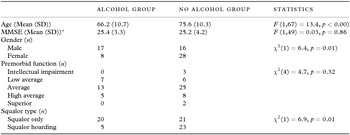
Demographic information, premorbid cognitive function, MMSE scores, and squalor type can be seen in Table 1. Participants with a history of alcohol misuse were significantly younger (n = 69, F (1,67) = 13.4, p < 0.00) and more likely to be male (n = 69, χ
2(1) = 6.4, p = 0.01) than those without. There was no significant difference in estimated premorbid level of cognitive functioning (n = 69, χ
2(4) = 4.7, p = 0.32). MMSE data were available for 51 of the 69 individuals in the study. MMSE scores were not significantly different for the alcohol verses no alcohol groups (F (1,49) = 0.03, p = .86). The group with complete MMSE data was significantly older than the group with no MMSE (
 $\bar x$
= 74.5, SD = 9.2 vs.
 $\bar x$
= 66.2, SD = 14.6; Brown-Forsythe (1,22) = 5.1, p = 0.03). Participants with a history of alcohol misuse were more likely to be living in squalor without hoarding rather than squalor with hoarding (n = 69, χ
2(1) = 6.9, p = 0.01).
Demographic details for the alcohol (n = 25) and no-alcohol (n = 44) groups

*MMSE data were only available for 51 cases (n = 16 alcohol group; n = 35 no-alcohol group).
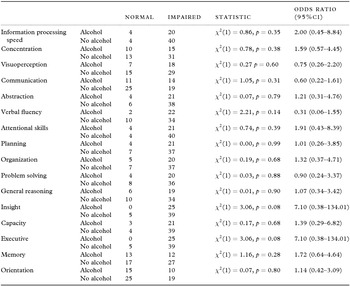
Neuropsychological performance for different cognitive domains according to alcohol history appears in Table 2 (n = 69). Performance appears as a categorical variable (impaired or not impaired). No significant difference at the p ≤ 0.05 level was found for any cognitive domain.
Neuropsychological performance for participants with and without a history of alcohol misuse for different cognitive domains. Cells contain the number of subjects with normal or impaired performance for that cognitive domain

Discussion
The results indicate that people with a history of alcohol misuse were more likely to be living in squalor without hoarding compared to people with no history of alcohol misuse. Alcohol misusers were also more likely to be male. These findings accord with existing work whereby alcohol misuse occurred in a greater number of squalor patients as hoarding decreased (Snowdon & Halliday, Reference Snowdon and Halliday2011) and the finding that males tend to drink more than women (Ridley et al., Reference Ridley, Draper and Withall2013). Cognitive impairments were equivalent for the alcohol misuse and no alcohol misuse groups, with no significant differences observed for individual cognitive domains or MMSE scores of people living in domestic squalor.
The findings suggest that executive impairment, and performance in other cognitive domains is equivalent between those with a history of alcohol misuse and those who have no history of alcohol misuse. Previous work has shown that alcohol dependence is associated with decreased neuron density and volume loss in the frontal lobes, and dose-related executive deficits (Moselhy et al., Reference Moselhy, Georgiou and Kahn2001; Crews et al., Reference Crews2005; Ridley et al., Reference Ridley, Draper and Withall2013) that may predispose alcohol misusers to an inability to adequately maintain their environments, making them susceptible to squalor via passive degeneration (Maier, Reference Maier2004; Lee et al., Reference Lee, Lewis, Leighton, Harris, Long and Macfarlane2014). It is possible that treatment of underlying alcohol use disorders could lead to improved living conditions and reduced squalor given that abstinence is associated with partial reversal of cognitive deficits (Ridley et al., Reference Ridley, Draper and Withall2013).
This study has a number of limitations, which predominantly stem from its retrospective opportunistic observational design and reliance on neuropsychological reports. At the commencement of data collection, there was no standardized definition or systematic method of recording squalor and hoarding, such as the Environmental Cleanliness and Clutter Scale, a tool for assessing the severity and pattern of uncleanliness in cases of domestic squalor (Halliday and Snowdon, Reference Halliday and Snowdon2009). In most cases, the neuropsychologist would not have seen the dwelling but would have recorded a version of what was written in the medical record or described to them by others. Alcohol consumption was not recorded in a detailed or systematic fashion and may have been under-reported. The decision to code alcohol misuse, cognitive performance, and hoarding data dichotomously was based on necessity and did not allow for any indication of the quantity of alcohol consumption or the severity of hoarding and squalor. The lack of quantitative data for these variables meant that it was not possible to assess for a dose effect, which could possibly have provided stronger evidence for a relationship between alcohol misuse and squalor without hoarding.
The finding that alcohol misusers tended to be younger and were more likely to be male could reflect sampling bias. On the other hand, it is possible that people who misuse alcohol end up in squalor earlier than those with other underlying causes for executive impairment. It would have been informative to use age and sex as covariates in the analyses of cognitive profile and hoarding status between the alcohol and no-alcohol groups, however the limited sample size of this study meant that this was not possible.
The provision of data to this study depended on the cooperation of invited clinicians. Participants were referred to specialist healthcare services, so data are likely to be subject to ascertainment and referral bias. Since most of the assessments were conducted during inpatient admissions, the results may not be applicable to people living in squalor in the community. Neuropsychological reports were requested on clinical grounds, so some patient groups are likely to be under-represented, such as those who agreed to intervention or individuals who were so impaired that formal neuropsychology assessment would not have been indicated.
In future studies, a prospective design would allow standardization of data collection, including a structured diagnostic interview and the use of a control group. In addition to alleviating some of the limitations mentioned above, this would permit the comparison of neuropsychological profiles of alcohol misusers who live in squalor versus those who do not, which could reveal more about the cognitive characteristics that predispose to squalor.
In spite of the above limitations, this study provides some potential insights into the nature of squalor in those with a history of alcohol misuse. Further work in this area will continue to advance our understanding and will likely contribute to improvements in the assessment and treatment of those affected by domestic squalor.
Conflict of interest
None.
Description of the authors’ roles
AG wrote the paper. AG and SML transcribed data from neuropsychology reports, and analyzed the data. ML assisted with statistical analysis and in preparing the paper for publication. SM initiated and designed the study, supervised data collection, and co-wrote the paper.
Acknowledgments
We would like to thank Inna Brodsky, Asawari Henderson, Jo-Anne Buchanan, Jennifer McDowall, Jane Khoo, Chris Hutchinson, Natalie Genardini, and Lina Forlano for submitting neuropsychology reports. We would also like to thank Melissa Lin and Remina Doh for compiling case notes for the Caulfield Hospital sample.