Introduction
Rigid oesophagoscopy is a widely used diagnostic and therapeutic procedure in otolaryngology. The main indications are: assessment of head and neck cancer, removal of foreign bodies, and investigation of dysphagia. Subsequently, many of the patients undergoing this procedure are edentulous, because of age-related loss, poor dental hygiene or dental extraction prior to radiotherapy.
Complications of rigid oesophagoscopy include perforation, mediastinitis, bleeding, dental injury and soft tissue injury. Although dental injuries are a well-recognised risk (most commonly, the maxillary incisorsReference Domanski, Lee and Sadeghi1), the rates of injury reported in the literature are variable, ranging from 0.06 per centReference Skeie and Schwartz2 to 12 per cent.Reference Hey, Harrison and MacKenzie3 Oral mucosa injuries are more common and have been found to occur in up to 75 per cent of patients.Reference Klussmann, Knoedgen, Damm, Wittekindt and Eckel4 These complications can all cause pain, bleeding and a delayed return to a normal diet.
Protection appliances such as gum guards are useful adjuncts for cushioning teeth whilst performing rigid oesophagoscopy. However, these fit poorly in the edentulous patient, and often a wet or dry gauze is used instead. We conducted an experiment to investigate how different protective materials affect the force applied to the oesophagoscope, with the aim of identifying the best adjunct to protect edentulous patients from injury during this procedure.
Materials and methods
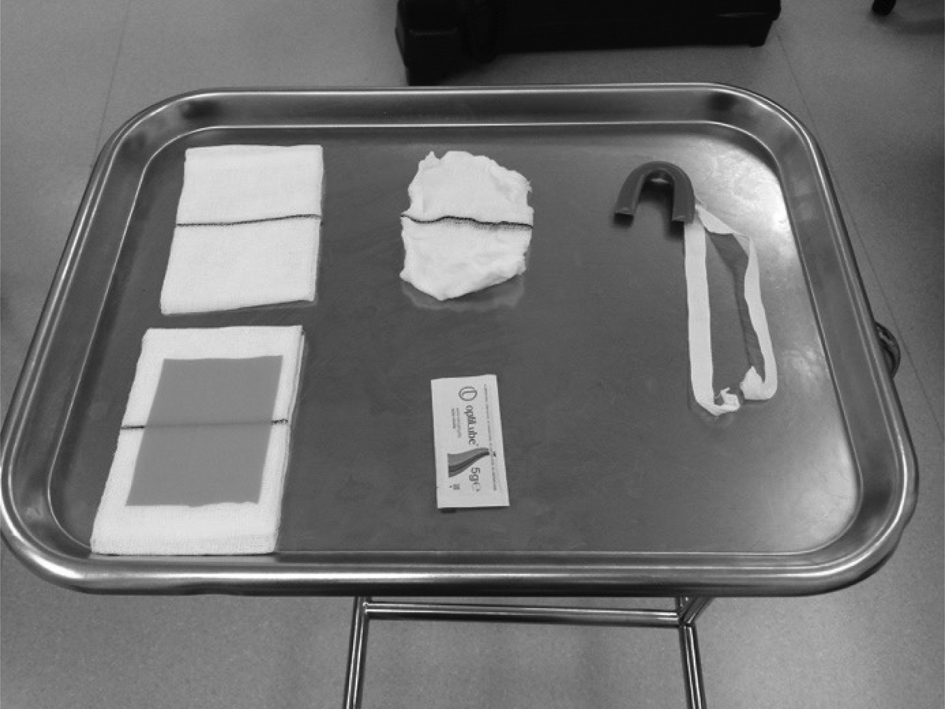
We recorded the force required to pull a standard adult rigid oesophagoscope from a metal clamp whilst enclosed in dry gauze, wet gauze, a gum guard or sleek on dry gauze (Figure 1).
Materials tested. Top row, from left: dry gauze, wet gauze and silicone mouth guard. Bottom row, from left: sleek on gauze and lubricating gel.

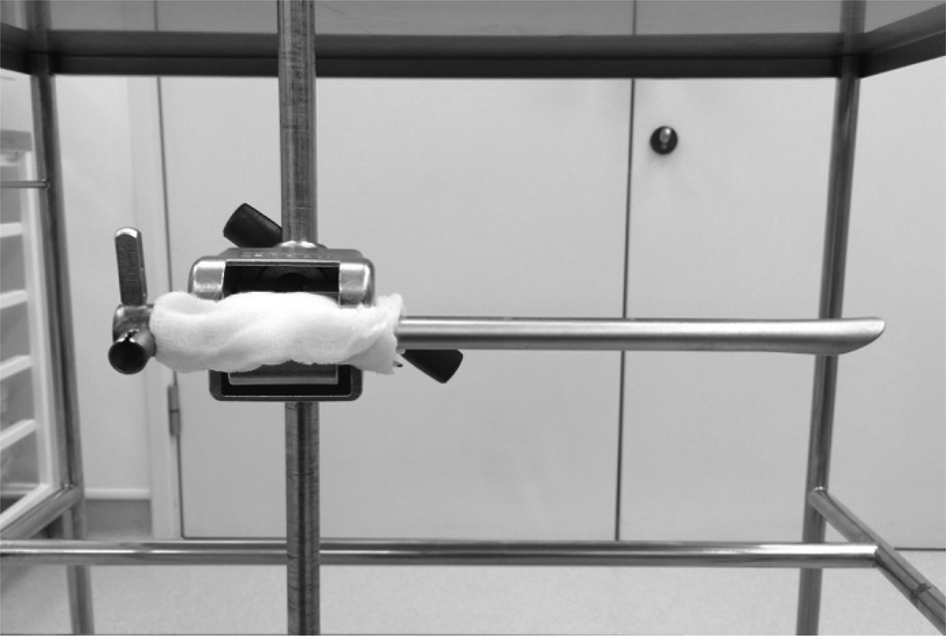
Once the clamp was secured, there was no option to tighten or loosen the hold around the scope, and so the grip around each material was the same (Figure 2). The scope was brushed with lubricant and pulled using a digital weight recorder. This procedure was repeated three times for each material. Based on the average recording (in kilograms), the force required (in newtons) to create movement of the scope was calculated (Table 1). This was directly proportional to the relative friction co-efficient.
Clamp holding the rigid oesophagoscope, with wet gauze wrapped around it. Each material was tested in the same manner.

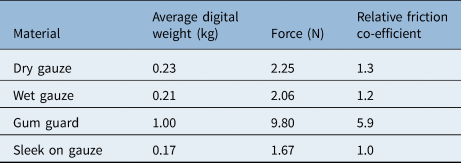
Relative friction co-efficient for each material*

* For example, ×5.9 more force is required to create movement against the gum guard when compared to sleek on gauze
As sleek on gauze was being used in rigid endoscopy procedures in our Trust, we prospectively audited oral trauma in elective patients who underwent a rigid oesophagoscopy between 1 February and 1 October 2018. These procedures were performed by an otolaryngology consultant or registrar. Patients were examined for oral trauma by the anaesthetist whilst extubated and on the ward prior to discharge. Oral trauma was defined by visible trauma to the oral cavity, or patient symptoms including pain on inserting dentures or difficulty returning to an oral diet.
Results
The average weight recorded by the digital scale when pulling out the endoscope was 170 g when enclosed in sleek on gauze, compared to 210 g in wet gauze, 230 g in dry gauze and 1000 g in the gum shield. The acceleration was also considerably lower in sleek on gauze, resulting in a lower force exertion (measured in newtons).
Therefore, because of friction, more force is required to move the scope against the gum guard when compared to all the other materials, and 20 per cent more force is required to move the scope against wet gauze when compared to sleek on gauze.
Thirty-eight patients were examined after rigid oesophagoscopy where sleek on gauze was used as the adjunct. Minor oral trauma was noted in 8 per cent (n = 3) of these patients. This trauma was evaluated as an abrasion seen on oral examination, but was not a complaint from the patients.
Discussion
Rigid oesophagoscopy complications can arise as a result of patient factors such as mouth opening, poor dentition and tissue viability, as well as being a result of controllable independent variables that include mouth guard use, operator skill and the force applied against the scope.
There has been little evidence reported regarding the best type of oral adjunct for rigid oesophagoscopy. Some studies have suggested the use of ‘boil and bite’ mouth guards;Reference Crossland and Pfleiderer5 however, this requires patient preparation and cost prior to surgery, and these may still not be suitable for edentulous patients. Others have suggested the use of nasal splints to use as mouth guards,Reference Domanski, Lee and Sadeghi1 but there is no evidence regarding how well they reduce dental or oral mucosal injuries.
In our experiment, sleek on gauze required the least amount of force (1.67 N) to create movement of the scope. This suggests that sleek on gauze is the safer adjunct when performing rigid oesophagoscopy. In contrast, it took 9.80 N to move the scope against the conventional silicone mouth guard, representing 5.9 times more required force when compared to the sleek on gauze. Wet gauze was a good alternative to sleek on gauze in terms of the relative friction co-efficient; however, this material was not audited.
Although all operators were of registrar level or above in this study, we cannot eliminate user skill as a contributor to injury rate. However, when auditing the oral trauma rate associated with using sleek on gauze in patients, we found a comparatively lower rate of oral trauma than that reported in the literature.Reference Klussmann, Knoedgen, Damm, Wittekindt and Eckel4 It would be useful to repeat this audit with a larger sample size, and to compare the oral trauma rate for sleek on gauze with that for alternative protective materials in patients with similar demographics.
Conclusion
Based on the findings of this study, we recommend using sleek on gauze when performing rigid oesophagoscopy on edentulous patients. This is an inexpensive and readily available material, and less force is required to create scope movement than with other oral adjuncts. We believe that this adjunct also helps create smooth, friction-free movement, and prevents any sudden forceful slips which may cause injury to the oesophageal mucosa.
Competing interests
None declared