I. INTRODUCTION
Aluminum alloy matrix composites reinforced with micrometer-sized ceramic particles are widely used for high performance applications such, as in military, aerospace, and automobile industries due to their improved physical and mechanical properties. Reference Curle and Ivanchev1–Reference Su, Yan, Chen, Shi, Chen and Zeng3 And yet, the composites relate to hitting a wall at the applications since built of thermal stresses at the interface between larger particles and matrix can prematurely lead to de-bonding of the particle interface, Reference Wang, Chen, Sun, Shu, Li and Zhang4,Reference Chen, Yan and Jie5 which indicates that the improvement in the mechanical properties of composites is limited. Again, the ductility of the composites deteriorates significantly with the high particle concentration. Reference Vencl, Bobic, Arostegui and Bobic6
In the recent years, some researches have studied the fabrication of the composites reinforced with nanosized particles. They found that the improvement in the mechanical properties of composites was considerable even with low content of particles. Reference Sajjadi, Ezatpour and Parizi Torabi7–Reference Su, Gao, Feng and Lu10 Mechanical properties of composites such as strength and ductility may be significantly improved, simultaneously if nanosized particles are uniformly dispersed in the matrix. The particle reinforced composites which are fabricated via mechanical alloying with high energy milling, powder metallurgy, spray deposition, infiltration of metal alloy into a particle preform, etc., represent improved mechanical properties and homogeneous microstructures. Reference Khakbiz and Akhlaghi11–Reference Centeno, Rocha, Borrell, Blanco and Fernández15 For mechanical alloying, it normally involves mechanical mixing (e.g., ball milling) of metallic and ceramic particles for the fabrication of composites. During the ball milling, it is easily led to the sintering and oxidation of metallic particles. Meanwhile, the mixing of nanosized particles is lengthy, expensive, and energy consuming. With the other fabrication processes, they suffer from limitations in size and complexity of the products.
Stir casting, as an alternative and relatively simple route, can be used to produce metal matrix composites with complex shape. Although the vortex induced by stirring can successfully incorporate microsized particles into the melt, Reference Sajjadi, Ezatpour and Parizi Torabi7,Reference Yar, Montazerian, Abdizadeh and Baharvandi9 the application of this technique for producing the composites reinforced with nanosized particles is much hampered due to poor wettability and a large surface-to-volume ratio. In the liquid metallurgy process, high-intensity ultrasonic vibration can be used to disperse nanosized particles into the matrix effectively. Reference Yang, Lan and Li8,Reference Yang and Li16–Reference Chen, Peng, Xu, Choia and Li18 It was reported that the transient cavitation induced by ultrasonic vibration could generate transient microhot spots that could reach temperatures of about 5000 °C, pressures above 1000 MPa, and cumulative jets above 100 m/s. Reference Eskin19 The high temperatures and pressures are enough to overcome the attractive van der Waals forces between nanoparticles and can clean the surface of particles, enhancing the wettability between metal melts and particles, thus making the uniform dispersion of particles in the matrix possible. Reference Su, Gao, Feng and Lu10,Reference Sauter, Emin, Schuchmann and Tavman20 Nevertheless, the effective ultrasonic cavitation only processes a localized volume under the ultrasonic probe due to ultrasonic attenuation and low flow-ability of the melt due to high viscosity. Reference Li, Yang and Cheng21
The development of new methods for a more effective dispersion and more uniform distribution of reinforcement particles into the matrix would therefore be valuable and make the production of as-cast composites with high properties more possible. The aim of this study is to produce nanosized Al2O3 (Al2O3np) reinforced Al7075 composites with effective particle dispersion and superior mechanical properties by a new and simple nanoparticle dispersion method. The process involved adding specially made Al2O3np containing Mg powder into melt and particle dispersing implemented by subtype multifrequency ultrasonic vibration.
II. EXPERIMENTAL PROCEDURE
A. Materials
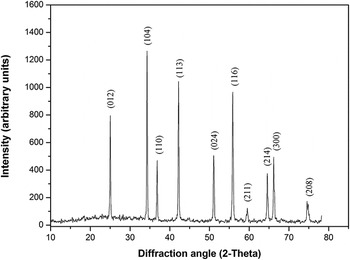
Mg powder (purity 99.9%, average particle size of 58–75 μm) was used as wetting agent. Nanosized α-Al2O3 powders (purity 99.9%, average particle diameter of 80 nm) were used as reinforcement of the composites. Commercial 7075 aluminum alloy (Chinalco), with chemical composition presented in Table I, was selected as the matrix material. The XRD pattern of the raw Al2O3 nanoparticles is shown in Fig. 2. The result of x-ray diffraction (XRD) analysis revealed that Al2O3, in this research, is a hexagonal crystal structure with lattice parameters a = b = 0.4758 nm, c = 1.2991 nm.
Chemical composition of 7075 aluminum alloy.

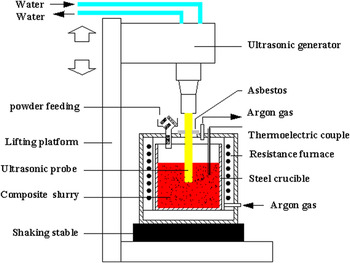
Experimental setup for fabricating Al2O3np reinforced aluminum matrix composites.

B. Preparation of Al2O3np containing Mg powder
Al2O3np was specially made before the fabrication of composites. The slurry of ethanol and Al2O3np was firstly processed in an ultrasonic bath for 25 min, and kept for 6 h to remove the remaining ethanol. Secondly, the Al2O3 particles were dried at 200 °C for 3 h, and calcined at 540 °C for 3 h. After calcining, particulate composite powders of Mg and calcined Al2O3np [(Al2O3np-Mg)cp] were produced by ball milling. The milling was performed in a planetary ball milling machine, partly filled by alumina balls at a constant rotation speed of 100 rpm for 30 min, in an argon gas situation. The amount of Mg in the composite powder would result in the addition of 1.0 wt% Mg to the melt.
C. Fabrication of the composites
The Al7075 in clay-graphite crucible was melted using resistance furnace under a protective gas of argon. After smelting of aluminum ingots, the specially made Al2O3np containing Mg powder was wrapped in aluminum foils and then dipped into the melt at a rate of 0.3 g/min while the ultrasonic vibration was introduced into the melt with a power level of 1000 Watt and frequency of 10 kHz. After completion of the introduction, the ultrasonic process was carried out at a power of 1000 Watt and frequency of 20 kHz for 5, 10, and 15 min. The casting was performed at 700, 750, and 800 °C. The composite slurry was cast into a steel mold and then the sample was taken out of the mold. The mechanical vibration was also carried out during ultrasonic treatment. The ultrasonic probe was coated with zirconia to avoid titanium contamination and adhesion of molten metal. The schematic experimental setup for fabrication of composites is shown in Fig. 1.
XRD pattern of raw Al2O3np.

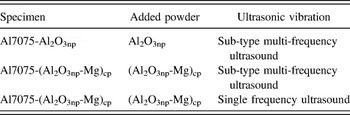
Specimens with various weight percentages of Al2O3np were fabricated, including 0.5, 1.0, 1.5, and 2.5 wt%. For comparison, Al2O3np without Mg powder and single frequency vibration of 20 kHz were used for fabrication of composites by a similar processing path. Table II shows the experimental conditions used in the different experiments.
Experimental conditions used in different experiment.

D. Microstructural characterization
Microstructural examination was performed by optical microscopy, scanning electron microscope (SEM), and transmission electron microscope (TEM). Optical microstructures of the as-received composites were examined using a metallographic microscope (Nikon eclipse, MA-200) after being etched by a 0.5 vol% hydrofluoric acid water. Field emission SEM (JEOL, JSM-6701F, Japan), equipped with x-ray mapping system, was used to verify the presence and distribution of Al2O3np.
E. Mechanical properties
A hydraulic mechanical testing machine, model Sansi JXYA105 (Netherlands), was used to measure the tensile properties of as-cast composites. The tension test specimens with a diameter of 10 mm and a gage length of 50 mm were prepared in accordance with China's National Standard GB/T228-2002. The crosshead speed was set at 0.5 mm/min. To determine mechanical behavior of composites under the state of toughness, the compression test was carried out according to China's National Standard GB/T7314-2005 on a testing machine (Mts YAW6206) with a crosshead speed set at 3 mm/min. The diameter of compression test specimens was 10 mm and ratio of length to diameter for the samples was 2:1. To obtain a precise average value, at least five specimens were tested for each casting condition. The fractured samples of as-cast composites from the tensile and compression tests were analyzed using an environment SEM (Fei, QUANTA-200) to understand the fracture behavior under tensile and compression loading.
Vickers microhardness measurements were made on polished samples by applying a load of 0.3 kg and this load was applied for 15 s. To eliminate the possibility of error, at least seven randomly hardness readings were taken for each sample.
III. RESULTS AND DISCUSSION
A. Effect of presence of Mg powder on particle dispersion in composites
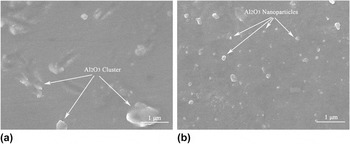
For comparison, Al2O3np with and without Mg powder was used to fabricate two different composites containing 1.5 wt% Al2O3np by subtype multifrequency ultrasonic vibration. After the completion of powder addition, the ultrasonic process was carried out for 10 min. Figure 3 shows field emission scanning electron microscope (FESEM) micrographs of the above two different composites. Dark Al matrix and bright particles of Al2O3 can be clearly observed. As can be seen in Fig. 3(a), Al2O3 particles of about 200–1000 nm existed in the composite fabricated with pure Al2O3 particles, which suggest the incomplete dispersion of Al2O3np. On the contrary, the distribution of nanoparticles is uniform in the composite fabricated with specially made Al2O3np containing Mg powder [Fig. 3(b)].
FESEM micrographs of the different as-cast composites fabricated by sub-type multifrequency ultrasonic vibration: (a) Al7075-Al2O3np and (b) Al7075-(Al2O3np-Mg)cp.

The use of specially made Al2O3np containing Mg powder could enhance the dispersion of nanoparticles in the melt. The conglomerates of Al2O3np in raw powders were broken by ultrasonic vibration during the disperse process, which enhances the uniform distribution of reinforcement in the matrix. In addition, the impurities on the surface of nanoparticles were removed by the calcining process, which improves the wettability between Al2O3np and matrix. Figure 3(b) demonstrates a uniform distribution of Al2O3np in the matrix of the as-cast composite. Unlike the as-cast specimen fabricated by pure Al2O3np [Fig. 3(a)], for this specimen the Mg powder was added to the introduced composite powder. The idea was that the Mg particles on the surface of (Al2O3np+Mg)cp would result in the weakening and early rupturing of nanoparticle surface, replacing it by a porous magnesia layer according to Eq. (1) thus promoting wettability or reacted with alumina directly, resulting in the formation of a spinel according to Eq. (2).
 $${\rm{A}}{{\rm{l}}_{\rm{2}}}{{\rm{O}}_{\rm{3}}}_{\left( {\rm{s}} \right)}{\rm{\ }} + {\rm{\ 3M}}{{\rm{g}}_{\left( {\rm{l}} \right)}}{\rm{\ }} = {\rm{\ }}3{\rm{Mg}}{{\rm{O}}_{\left( {\rm{s}} \right)}}{\rm{\ }} + {\rm{\ }}2{\rm{A}}{{\rm{l}}_{{\rm{(l)}}}}{\rm{\ \Delta }}{G_T}{\rm{\ }} = {\rm{\ }} - 128449{\rm{\ }} + {\rm{\ }}11.49T{\rm{\ }} \lt {\rm{\ }}0\quad ,$$
 $${\rm{3M}}{{\rm{g}}_{{\rm{(l)}}}}{\rm{\ }} + {\rm{\ }}4{\rm{A}}{{\rm{l}}_{\rm{2}}}{{\rm{O}}_{\rm{3}}}_{{\rm{(s)}}}{\rm{\ }} = {\rm{\ }}3{\rm{MgA}}{{\rm{l}}_{\rm{2}}}{{\rm{O}}_{\rm{4}}}_{{\rm{(s)}}}{\rm{\ }} + {\rm{\ }}2{\rm{A}}{{\rm{l}}_{{\rm{(l)}}}}{\rm{\ }}\Delta {G_T}{\rm{\ }} = {\rm{\ }} - 230119{\rm{\ }} + {\rm{\ }}3.507T{\rm{\ }} \lt {\rm{\ }}0\quad ,$$
where, ΔG T is the Gibbs free energy change of the reaction, J; T is the absolute temperature (973–1073 K).
It is also believed that a magnesium rich zone exists around each Al2O3 particle. As explained by Schultz et al., Reference Schultz, Ferguson and Rohatgi22 magnesium in these regions can scavenge oxygen from the surface of Al2O3 particles according to Eq. (3), resulting in the elimination of the gas layer and decreasing the surface tension of the liquid aluminum, thus promoting the wettability and reducing the agglomeration tendency of Al2O3 particles.
 $${\rm{2M}}{{\rm{g}}_{\left( {\rm{l}} \right)}}{\rm{\ }} + {\rm{\ }}{{\rm{O}}_{\rm{2}}}{\rm{\ }} = {\rm{\ }}2{\rm{Mg}}{{\rm{O}}_{\left( {\rm{s}} \right)}}\quad .$$
B. Subtype multifrequency ultrasonic dispersion
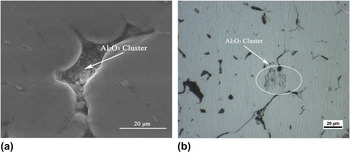
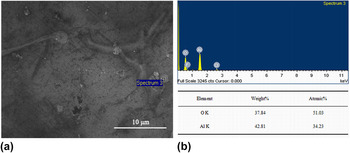
Figure 4 shows the microstructure of as-cast composite with 1.5 wt% Al2O3np fabricated by single frequency vibration of 20 kHz. After completion of powder addition, ultrasonic vibration of 10 min was carried out in the melt. The agglomerates of Al2O3np could be found in the interdendrite as shown in Fig. 4(a), which leads to the difficulty in feeding and generates shrinkage porosity. This results in decreasing of mechanical properties of composites. Again, there were large agglomerates of Al2O3np distributing inside the grain [Fig. 4(b)]. This suggests that single frequency ultrasonic vibration cannot make large agglomerates of Al2O3np disperse completely, leading to the limitation of improvement of properties. To further verify the agglomerates of Al2O3np in Al matrix, energy dispersive spectrometer (EDS) analysis was used. The result is shown in Fig. 5. It indicates that the atomic ratio of Al and O accords with the stoichiometric ratio of between Al and O in the Al2O3 phase, i.e., Al: O = 2: 3.
Microstructure of the as-cast composite fabricated by single frequency ultrasonic vibration: (a) interdendrite; (b) grain inside.

Images (FESEM) (a) and EDS analysis (b) of the as-cast composite fabricated by single frequency ultrasonic vibration.

Compared to single frequency ultrasonic vibration, Al2O3np was effectively dispersed in the matrix by subtype multifrequency ultrasonic vibration [Fig. 3]. Acoustic pressure attenuates exponentially with increasing ultrasonic wave propagation path due to impedance of the melt Reference Li, Yang and Cheng21 so that effective ultrasonic cavitation only develops in a limited zone close to the ultrasonic probe. The using of lifting platform and shaking table in the experiment could overcome the problem above as seen in Fig. 1. The vortex induced by shaking table could make more of liquid alloy into effective ultrasonic zone. At a constant acoustic pressure, ultrasonic frequency is inversely proportional to the vibrational displacement amplitude. Reference Komarov, Oda, Ishiwata and Dezhkunov23 Sauter et al. Reference Sauter, Emin, Schuchmann and Tavman20 and Komarov et al. Reference Komarov, Oda, Ishiwata and Dezhkunov23 reported that ultrasonic wave with low frequency and high amplitude could promote dispersion of micrometer particles in the melt. When the powders were added into the melt, ultrasonic vibration of 10 kHz destroyed the weak bonds in large aggregates of Al2O3np due to the alternating shear stress induced by ultrasonic vibration, leading to dispersion of particles at the macroscale. After completion of the powder addition, the nonlinear effect induced by ultrasonic vibration of 20 kHz caused fatigue rupture to the attraction forces among nanoparticles. And then individual nanoparticles and/or small nanoparticle aggregates could be peeled off from conglomerates of nanoparticles. Finally, these nanoparticles were distributed and dispersed uniformly in the melt with the aid of acoustic streaming.
C. Effect of processing parameters on the microstructure of the composites
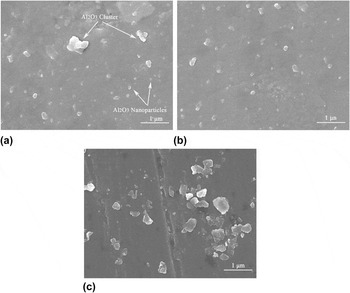
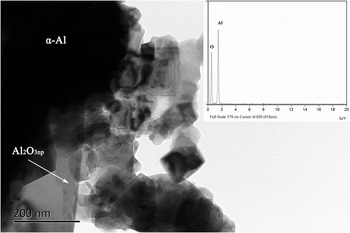
Figure 6 shows FESEM micrographs of as-cast composites with 1.5 wt% Al2O3np fabricated by different ultrasonic time. Figure 6(a) shows FESEM micrograph of the as-cast composite fabricated by ultrasonic time of 5 min after the completion of powder addition at 800 °C. In Fig. 6(a), the Al2O3 particles are uniformly distributed in the composite. In addition, the nanoparticle aggregates of about 0.3–0.8 μm can be found in the matrix. By comparison, it can be seen from Fig. 6(b) that the Al2O3 particles are more uniformly dispersed by increasing ultrasonic time up to 10 min. Nevertheless, the Al2O3 particles have a re-agglomerating trend in dispersion as ultrasonic time further increasing [Fig. 6(c)]. Similar microstructures were also observed for composites fabricated under other casting conditions. This can be attributed to the fact that when particle dispersion is complete, it is likely that continued ultrasonic vibration would assist in creating larger and larger aggregates by frequent collisions that result in re-aggregating of particles. TEM examination was conducted to further verify the presence and dispersion of individual nanoparticles in composites. Figure 7 is a bright field TEM micrograph showing a dispersion of individual nanoparticles in the as-cast composite with 1.5 wt% Al2O3np fabricated by ultrasonic time of 10 min after completion of powder addition at 800 °C. It is clearly seen in Fig. 7 that individual nanoparticles are uniformly dispersed in the matrix. Extensive EDX analysis of the near-spherical nanoparticles revealed that the particles contain Al and O in proportions corresponding to a Al2O3 stoichiometry (see insert in Fig. 7).
FESEM micrographs of as-cast composites with 1.5 wt% Al2O3np fabricated by ultrasonic time of (a) 5 min, (b) 10 min, and (c) 15 min, respectively after completion of powder addition at 800 °C.

TEM micrograph and EDX analysis (see inserted EDX trace) of the as-cast composite with 1.5 wt% Al2O3np fabricated by ultrasonic time of 10 min after completion of powder addition at 800 °C.

In summary, if particle dispersion is complete before solidification occurs, clustering will significantly increase with increasing ultrasonic time, and the ultrasonic time of 10 min is enough to uniformly disperse Al2O3np in the matrix after completion of the Al2O3np addition.
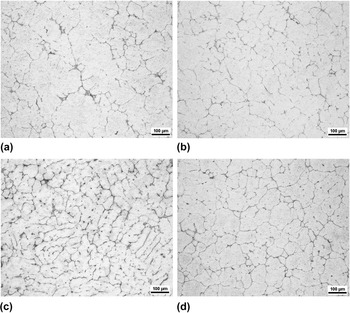
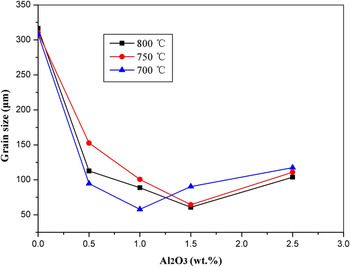
Figure 8 shows optical micrographs of as-cast composites with different Al2O3np contents fabricated at 800 °C. It can be seen that the grain sizes of composites decrease with the increase of addition amount of Al2O3np. When the addition amount of Al2O3np was greater than 1.5 wt%, the microstructure of composites coarsened, as shown in Fig. 8(d). Figure 9 shows the mean grain sizes of as-cast composites fabricated under various casting conditions. As seen in Fig. 9, the microstructure of composites was refined when the right amount of Al2O3np was added. And yet, if the addition amount has occurred beyond this level, this will result in a course grained microstructure. Compared to the matrix alloy, the grain sizes of the composites with 2.5 wt% Al2O3np fabricated at different temperatures were still decreased by 67.2%, 64.3%, and 61.9%, respectively.
Optical micrographs of as-cast composites containing: (a) 0 wt%; (b) 1.0 wt%; (c) 1.5 wt%; (d) 2.5 wt% Al2O3np fabricated at 800 °C.

Mean grain size of the as-cast composites fabricated at different temperatures versus the Al2O3np content.

The variation of microstructural feature of composites with added amount of Al2O3np is related to the dominant size and degree of particle clustering in the matrix. There exist three forms for nanoparticles in the grains, which are individual or small aggregates, medium sized aggregates, and large aggregates of nanoparticles. Schultz et al. Reference Schultz, Ferguson and Rohatgi22 reported that the particles, whose sizes are below 80% and/or beyond 200% of the critical radius, were easily engulfed by solidifying matrix, but other particles were pushed ahead of the solidification front and then segregated to the grain boundaries. Individual or small aggregates of nanoparticles are mainly controlled by Brownian motion. The pinning effect of Brownian motion makes the particles a little settlement velocity. As a result, they can be easily engulfed by the growing grains. Prolonging ultrasonic time or increasing the added amount of Al2O3np contributes to the clustering of particles. When the aggregates are large enough, their motions are no longer restricted by Brownian motion, finally they are pushed ahead of the solidification front. Due to low thermal conductivity of Al2O3np (7.5 W/mK, 800 °C; 10 W/mK, 700 °C), Reference Parchovianský, Galusek, Švančárek, Sedláček and Šajgalík24 these particles extensively reduce the temperature and concentration gradients in the solidification front and act as a barrier for a dendrite to grow further, leading to refinement of grains.
In Fig. 9, it is obvious that the grain size of composites with low Al2O3np content fabricated at 700 °C is smaller than that of composites under other casting conditions, which suggests that ultrasonic vibration temperature exerts an influence on the microstructure of composites. The alternate force induced by acoustic streaming and the implosive impact due to transient cavitation could break up the dendrites, providing an artificial source of sufficient nuclei, thus leading to the grain refinement. Reference Yang and Li16,Reference Li, Yang and Cheng21 Nevertheless, with increasing in the temperature of ultrasonic treatment, the remelting of primary α-Al phases significantly decreases the refining effect of ultrasonic vibration on the microstructure of composites. This is why the grain size of composites with low particle concentration is smaller than that of other composites.
Thus the resultant microstructures of composites depend on the dominant size and degree of Al2O3np clustering, and the grain refinement can be mainly attributed to particle pushing mechanisms.
D. Mechanical properties
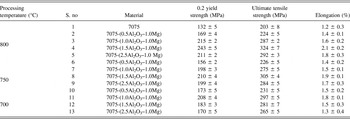
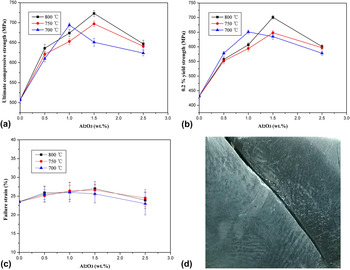
The results of tensile properties of as-cast composites at room temperature are listed in Table III. Figure 10 shows the results of compressive properties of as-cast composites at room temperature. In Table III and Fig. 10, it can be clearly seen that an increase in the added amount of Al2O3np leads to a significant increase in the strength and addition above a limit deteriorates the strength. Whereas, the strength of composites with 2.5 wt% Al2O3np fabricated at different temperatures still has been improved obviously compared to that of matrix alloy. The reduction in strength of composites is probably attributed to the effect of the formation of high porosity induced by agglomeration at high particle concentration.
Results of room temperature tensile testing of as-cast composites.

Results of room temperature compression testing of as-cast composites: (a) ultimate compressive strength; (b) 0.2% yield strength; (c) failure strain and (d) crushed sample.

When 1.5 wt% Al2O3np was added, the composites fabricated at 800 and 750 °C had excellent integrated mechanical properties. Meanwhile, for the composite fabricated at 700 °C, adding 1.0 wt% Al2O3np allowed it to obtain maximum performance. The effect of processing temperature on mechanical properties is related to the viscosity of composite slurry which increases with reducing processing temperature. The viscosity of composite slurry is high at 700 °C. This contributes to the stabilizing of particle distribution in the molten alloy when the low content of Al2O3np is added, which leads to low porosity and in turn to improvement of mechanical properties. Results revealed that among the developed composites, the composite with 1.5 wt% Al2O3np fabricated at 800 °C obtained best mechanical properties, i.e., compared to the matrix alloy, its ultimate tensile strength and 0.2 yield strength were increased by 59.6% and 84.1%, respectively and its ultimate compressive strength and 0.2 compressive yield strength were increased by 42.6% and 62.2%, respectively. Also, it can be seen from Table III and Fig. 10(c) that the failure strain of composites is slightly improved with increasing Al2O3np wt%.
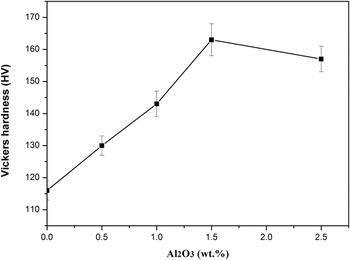
The hardness of the as-cast composites fabricated at 800 °C versus Al2O3np (wt%) is illustrated in Fig. 11. It can be observed that the hardness of the composites is higher than that of the non-reinforced alloy due to the addition of Al2O3np. Compared to the matrix alloy, the microhardness of the composites with 1.5 wt% Al2O3np was increased by 40.5%. In spite of increasing trend of hardness versus added amount of Al2O3np, the composite with 2.5 wt% Al2O3np represents lower hardness than the sample with 1.5 wt% Al2O3np. This may be arisen from the formation of more porosity in composites with higher content of particles.
Hardness of as-cast composites fabricated at 800 °C versus Al2O3np content.

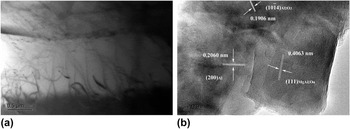
Mechanical property results of the composites indicate that presence of Al2O3np has a pronounced effect. Grain refinement due to particle pushing, geometrically necessary dislocations and thermally induced residual stresses due to the difference between the coefficient thermal expansion (CTE) values of matrix alloy and reinforcement, Reference Sajjadi, Ezatpour and Parizi Torabi7 and pinning effect of nanoparticles led to the improvement of mechanical properties of composites, that is, dislocation-type strengthening. Under the applied stress, grain boundaries act as a obstacle to dislocation movement. Increasing the amount of grain boundaries due to grain refinement leads to the reduction of dislocation pileups length within grain so that the degree of stress concentration is not enough to drive dislocations in neighboring grains to glide. Thus, to get dislocations in more neighboring grains started, higher extra shear stress needs to be conducted on the samples. Figure 12 shows TEM images of as-cast composite with 1.5 wt% Al2O3np. It can be seen from Fig. 12(a) that high density dislocations were formed in a crystal during solidification due to the difference between the CTE values of Al2O3np (7.8 μm/mK) and that of the matrix (24.5 μm/mK). Reference Lei, Zhao, Wang and An25 And then the interaction of these dislocations with moving dislocations would produce dislocation complexes under the applied stress. In addition, the thermal stresses in the interface of matrix alloy and nanoparticles neutralized the effective effect of stresses on grains. Due to the presence of the hard and uniformly dispersed nanoparticles in the matrix, dislocation loops are formed around nano-particles when dislocation lines pass the particles. Reference Hertzberg Richard26 When subsequent dislocations pass the particles again, these loops will increase the flow resistance of dislocation movement. Furthermore, the medium sized aggregates of nanoparticles located in the grain boundary play an important role in grain boundary pinning. The coupled effect of these obstacles leads to increase in the strength of the composites.
TEM micrographs of as-cast composite: (a) dislocations in crystal; (b) HRTEM image showing Al2O3np interface and MgAl2O4 formation at the interface of Al7075 alloy with 1.5 wt% Al2O3np.

Figure 12(b) shows high resolution transmission electron microscopy (HRTEM) image of the composite. Clean interfaces between matrix and nanoparticles indicate that no injurious interfacial reaction has taken place. This confirms the improvement in the wettability by addition of Mg powder mentioned above. According to the crystal structure of Al2O3, MgAl2O4, and the α-Al matrix, it is confirmed that there are the well-defined crystallographic orientation relationships among the three phases in light of the Turnbull–Vonnegut equation as shown in Fig. 12(b):
 $(10\bar1 4){[40\bar41]_{{\rm{A}}{{\rm{l}}_{\rm{2}}}{{\rm{O}}_{\rm{3}}}}}//(200){[010]_{\rm{Al}}},(111){[110]_{\rm{MgA{l_2}{O_4}}}}//(111){[110]_{\rm{Al}}}$
, which suggests that there is a good interfacial integrity between particles and matrix. So the clear interfaces and nanosized MgAl2O4 formation help in load transfer to hard particles by pinning the particles to the matrix and accordingly improvement of the mechanical properties.
It can be found from Table III and Fig. 10 that the tensile and compression properties of the samples present the great difference. This is dependent upon the state and value of stress. Under applied axial compressive load, the reduction in casting defects, the breakage of the secondary phases located at grain boundaries and large grains, and the change in distribution of large aggregates of nanoparticles from an aggregated type to a dispersed type can contribute to the significant increase in mechanical properties. Meanwhile, the principal shear stress on fracture surface is lower than axial load so that higher extra shear stress needs to be conducted on the composites to obtain further plastic deformation.
Finally, compared to the matrix alloy, the ultimate tensile (324 MPa) and compressive strength (723 MPa) of the as-cast composite with 1.5 wt% fabricated at 800 °C were increased by 59.6% and 42.6%, respectively. Also, the composites represent a significant improvement in the hardness. This superior improvement of mechanical properties can be attributed to dislocation-type strengthening of matrix alloy induced by addition of Al2O3np and load transfer from matrix to hard Al2O3np. And the ductility of the composites is slightly improved.
E. Fractography
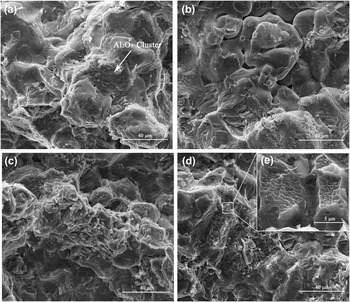
Representative fracture features of as-cast composites under tensile loading are shown in Figs. 13(a)–13(e). Figure 13(a) shows SEM fractograph of the composite with pure Al2O3np fabricated at 800 °C. Fracture of the deformed tensile sample revealed a microscopical cleavage appearance, with evidence of few tearing ridges and Al2O3np agglomerates on the fracture surface. Due to poor bonding between agglomerate and matrix, even a low stress easily leads to the fragmentation of Al2O3np agglomerates and then induces microcracks which offer channels for crack propagation. The SEM fractographs of the as-cast composites with specially made Al2O3np containing Mg powder fabricated at different temperatures are shown in Figs. 13(b)–13(e). It can be seen from Fig. 13(b) that the fracture surface of the composite fabricated at 700 °C reveals predominantly ductility intergranular rupture. During solidification, there were many large precipitates at the grain boundaries due to low solubility of alloy element and low velocity of solidification, which suggests the reduction in grain-boundary strength. The cleavage steps also can be observed on the fracture surface due to the presence of Al2O3np agglomerates induced by high viscosity. With processing temperatures increasing, fractography of the developed composites revealed the increase of tearing ridges in addition to shallow dimples. When the precessing temperature was 800 °C, the fracture surface revealed predominantly quasi-cleavage rupture, including numerous tearing ridges and uniformly distributed ductile dimples [Figs. 13(d) and 13(e)]. The sample showed evidence of having undergone a higher amount of plastic deformation during cracking, which is in accordance with uniform microstructures [Fig. 6(b)] and superior tensile strength and ductility of the composite (Table III). According to the dislocation theory, Reference Hertzberg Richard26 when the applied load is strong enough to make dislocation loops around nanoparticles move toward them, stress concentration will be formed at the interface between the particles and matrix, that is, dislocation pileups. When the elastic strain energy on the leading dislocation produced by the pileup can overcome interfacial strength between the particles and matrix, void nucleation and subsequent coalescence and fracture process will occur, followed by the formation of dimples.
SEM fractographs of as-cast composites containing 1.5 wt% Al2O3np fabricated by (a) using pure Al2O3np and (b–e) using specially made Al2O3np containing Mg powder at different processing temperatures: (b) 700 °C; (c) 750 °C; (d, e) 800 °C after tensile loading.

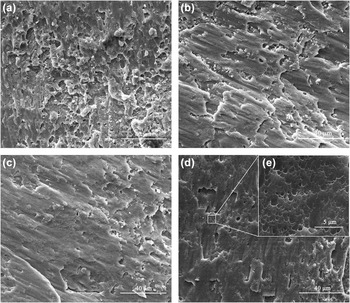
The fracture surfaces of as-cast composites after compressive loading are shown in Figs. 14(a)–14(e). Figure 14(a) shows SEM fractograph of the as-cast composite with pure Al2O3np fabricated at 800 °C. Figures 14(b)–14(e) shows SEM fractographs of as-cast composites with specially made Al2O3np containing Mg powder fabricated at different temperatures. It can be seen from Fig. 14 that the developed composites exhibit rough fracture surfaces with mixed mode of shear and brittle features. Micropores and de-bonding Al2O3np agglomerates from matrix could be found on the fracture surface of the composite with pure Al2O3np [Fig. 14(a)], which are caused by the incompletely dispersed Al2O3np. It is noted that an increase in processing temperature leads to a significant increase in shear bands [Figs. 14(b)–14(e)]. Also, the fracture surface of the composite fabricated at 800 °C by specially made Al2O3np containing Mg powder revealed the presence of many shear bands and parabolic dimples [Figs. 14(d) and14(e)]. The dimples of 200–500 nm distributed uniformly throughout the fracture surface are the result of the presence of nano-particles. The presence of shear bands can be attributed to the heterogeneous deformation and the work hardening behavior. Reference Sankaranarayanan, Jayalakshmi and Gupta27 Generally, pure Al7075 undergoes relatively homogeneous deformation under compressive loading. Nevertheless, the presence of nanoparticles in the case of as-cast composites is expected to influence the heterogeneous deformation of grains and the localized deformation of grain boundaries. Meanwhile, the high dislocation density produced by uniformly distributed Al2O3np in the matrix led to the faster work hardening rate in the case of samples fractured by shear bands. Thus, the increased shear bands as observed from Figs. 14(b)–14(e) are mainly related to the uniform distribution and dispersion of Al2O3np in the matrix, consistent with the enhanced compressive strength and ductility of composites.
SEM fractographs of as-cast composites fabricated containing 1.5 wt% Al2O3np by (a) using pure Al2O3np and (b–e) using specially made Al2O3np containing Mg powder at different processing temperatures: (b) 700 °C; (c) 750 °C; (d, e) 800 °C after compressive loading.

The above fracture surface analysis proves further that the composites can be successfully fabricated by using specially made Al2O3np containing Mg powder and subtype multifrequency ultrasonic vibration with effective dispersion of Al2O3np and superior mechanical properties of composites. Since Al7075 alloy is a high strength wrought alloy, the mechanical properties can be improved by hot deformation and/or heat treatment. For the subsequent studies, it is of interest to study the influence of presence of nano-particles on the hot deformation and heat treatment of composites, and the related investigations are in progress.
IV. CONCLUSIONS
Al7075 reinforced with Al2O3np was successfully fabricated by using specially made Al2O3np containing Mg powder and subtype multifrequency ultrasonic vibration. The main conclusions can be drawn as follows:
-
(1) The specially made Al2O3np containing Mg powder was successfully used for fabrication of composites to improve the wettability between Al2O3 and matrix alloy, which contributes to uniform distribution of nano-particles in the melt and therefore improvement in mechanical properties of the composites.
-
(2) Compared to single frequency ultrasonic vibration, Al2O3np was effectively dispersed in the matrix by subtype multifrequency ultrasonic vibration. The ultrasonic time of 10 min is enough to uniformly disperse Al2O3np in the matrix after completion of the Al2O3np addition.
-
(3) Based on microstructure analysis, it was found that the addition of Al2O3np caused the grain refinement and that the resultant microstructures of composites depended on the dominant size and degree of Al2O3np clustering. The grain refinement could be mainly attributed to particle pushing mechanisms.
-
(4) Compared to the matrix alloy, the ultimate tensile (324 MPa), ultimate compressive strength (723 MPa), and microhardness (163 HV) of the as-cast composite with 1.5 wt% Al2O3np fabricated at 800 °C were increased by 59.6%, 42.6%, and 40.5%, respectively. This superior improvement of mechanical properties was attributed to dislocation-type strengthening of matrix alloy and load transfer from matrix to hard nanoparticles.
-
(5) Fractography analysis revealed that the nanosized dimples distributed uniformly throughout the fracture surface were in accordance with homogeneous microstructures and superior mechanical properties.
ACKNOWLEDGMENTS
Authors express their gratitude to the National Science Foundation of China (51364035, 51165032), Ministry of Education Tied up with the Special Research Fund for the Doctoral Program for Higher School (20133601110001), Innovative Group of Science and Technology of College of Jiangxi Province (00008713), Production and Teaching and Research Cooperation Plan of Nanchang Non–party Experts and Doctor (2012–CYH–DW–XCL–002), and Innovation Program of Postgraduate of Jiangxi Province (YC2014-B003) for financial support.