In 1996, Nicki R. Crick and Jennifer K. Grotpeter introduced a new subtype of peer victimization in their seminal research published in Development and Psychopathology. This work introduced the construct of relational victimization, which is the receipt of relational aggression from peers. Relational aggression is a construct Crick and Grotpeter (Reference Crick and Grotpeter1995) coined to describe aggressive behavior (i.e., acts intended to hurt, harm, or injure another; Dodge, Coie, & Lynam, Reference Dodge, Coie, Lynam, Damon and Damon2006) that uses the relationship or the threat of the removal of the relationship as the means or vehicle of harm. Prototypical exemplars of relational aggression include friendship withdrawal threats (e.g., “I won't be your friend anymore”), social exclusion (e.g., “You can't come to my birthday party”), spreading malicious rumor/gossip/lies, and giving someone the silent treatment (Crick, Ostrov, & Kawabata, Reference Crick, Ostrov, Kawabata, Flannery, Waldman and Vazsonyi2007). The present study will expand on this seminal work to further examine the prospective associations between relational aggression and relational victimization.
Unlike other nonphysical forms of aggression such as indirect aggression (Lagerspetz, Björkqvist, & Peltonen, Reference Lagerspetz, Björkqvist and Peltonen1988), relational aggression may manifest in both overt and covert ways, and may be displayed as both verbal and nonverbal behaviors (Crick et al., Reference Crick, Ostrov, Kawabata, Flannery, Waldman and Vazsonyi2007). In addition, there are documented developmental differences in the expression of relational aggression. For example, in early childhood (ages 3–5 years old) children may display relatively sophisticated forms of relational aggression (e.g., malicious secret spreading), but these behaviors tend to be rather direct such that the identity of the aggressor is known to the victim and the aggression is based on the here and now or recent events (Ostrov, Woods, Jansen, Casas, & Crick, Reference Ostrov, Woods, Jansen, Casas and Crick2004). In contrast, in later developmental periods, relational aggression may be more covert or indirect in nature (Crick et al., Reference Crick, Ostrov, Kawabata, Flannery, Waldman and Vazsonyi2007).
Relational Victimization, Maladjustment, and Gender
Crick and colleagues initially demonstrated that both relational victimization and relational aggression added uniquely in the prediction of maladjustment (e.g., Crick, Reference Crick1996; Crick, Ostrov, & Werner, Reference Crick, Ostrov and Werner2006). For example, relational victimization predicts internalizing symptomatology, such as depressed affect (e.g., Crick & Bigbee, Reference Crick and Bigbee1998; Prinstein, Boergers, & Vernberg, Reference Prinstein, Boergers and Vernberg2001). Moreover, failure to include assessments of relational aggression results in situations in which large percentages of aggressive girls are not identified (Crick, Ostrov, & Werner, Reference Crick, Ostrov and Werner2006; Henington, Hughes, Cavell, & Thompson, Reference Henington, Hughes, Cavell and Thompson1998). The potential for these large percentages of unidentified aggressors is a concern given associations between relational aggression/victimization and several psychological and adjustment problems (e.g., depressive symptoms, eating pathology, personality pathology, conduct problems, attention problems, substance disorders, and peer rejection; Crick, Reference Crick and Grotpeter1996; Crick, Ostrov, & Werner, Reference Crick, Ostrov and Werner2006; Murray-Close, Ostrov, & Crick, Reference Murray-Close, Ostrov and Crick2007; Sullivan, Farrell, & Kliewer, Reference Sullivan, Farrell and Kliewer2006). Given these and other findings suggesting the added predictive utility of relational aggression/victimization, the field now recognizes the importance of assessing both physical and relational subtypes of aggression and peer victimization.
Developmental theory also recognizes the important role that gender may have in moderating these links between peer victimization and psychopathology outcomes (Ostrov & Godleski, Reference Ostrov and Godleski2010; Rose & Rudolph, Reference Rose and Rudolph2006). Specifically, relational victimization seems to be more predictive of problematic outcomes for girls relative to boys (e.g., Crick & Bigbee, Reference Crick and Bigbee1998). Furthermore, the literature has reported on between- and within-group gender differences. Despite some inconsistencies across methodology, culture, and developmental period, the overall mean level rates of relational aggression are relatively similar for boys and girls (Card, Stucky, Sawalani, & Little, Reference Card, Stucky, Sawalani and Little2008). However, the within-group gender differences appear to be robust. That is, the modal form of aggression that girls display and receive is relational relative to physical aggression/victimization (e.g., Putallaz et al., Reference Putallaz, Grimes, Foster, Kupersmidt, Coie and Dearing2007; for review see Ostrov & Godleski, Reference Ostrov and Godleski2010). In addition, the modal form of aggression and peer victimization for boys is believed to be physical relative to relational (see Ostrov & Godleski, Reference Ostrov and Godleski2010). However, within-gender effects have rarely been reported on in prior early childhood studies, and tests of these predictions are needed with young children whose gender identity may still be developing (see Ostrov & Godleski, Reference Ostrov and Godleski2010).
A few prior longitudinal studies have been conducted that have included assessments of relational and physical peer victimization. These studies have demonstrated important prospective links between peer victimization subtypes and the various aforementioned adjustment outcomes, which points to the importance of intervention for peer victimization (e.g., Crick & Bigbee, Reference Crick and Bigbee1998; Prinstein et al., Reference Prinstein, Boergers and Vernberg2001). Given these robust associations, intervention programs have been developed to reduce relational victimization (e.g., the WITS Program; Leadbeater, Hoglund, & Woods, Reference Leadbeater, Hoglund and Woods2003; Ostrov et al., Reference Ostrov, Massetti, Stauffacher, Godleski, Hart and Karch2009). We, however, do not have many studies that have focused on the predictors of relational victimization, and that is an important omission. Those that have been conducted have shown great promise at uncovering the developmental precursors to relational victimization. For example, emotional dysregulation has been shown to predict increases in relational victimization (Giesbrecht, Leadbeater, & MacDonald, Reference Giesbrecht, Leadbeater and Macdonald2011). In addition, peer rejection has also been shown to predict future relational victimization among young children (Ostrov, Reference Ostrov2008). The more we can understand the individual and contextual factors that predict relational victimization, the better we can modify our intervention procedures to best reduce relational victimization. Ultimately, studying predictors of relational victimization is important because peer victimization is harmful and is associated with maladaptive trajectories for children and adolescents (e.g., Giesbrecht et al., Reference Giesbrecht, Leadbeater and Macdonald2011; Ostrov, Reference Ostrov2010; Sullivan et al., Reference Sullivan, Farrell and Kliewer2006).
The sequential social process model of the causes of peer harassment suggests that aggression is an individual difference variable that predicts future victimization (Boivin, Hymel, & Hodges, Reference Boivin, Hymel, Hodges, Putallaz and Bierman2001; Ostrov, Reference Ostrov2008). Aggression may place children at risk for peer victimization, given the associated behavioral dysregulation, hostile attribution biases, and peer rejection that may co-occur with aggressive behavior among some children (Hoglund & Leadbeater, Reference Hoglund and Leadbeater2007; Ostrov, Reference Ostrov2008). This may be especially the case for children that tend to be “provocative” or aggressive victims rather than “passive” or withdrawn/submissive victims (Hanish & Guerra, Reference Hanish and Guerra2000; Hodges & Perry, Reference Hodges and Perry1996). That is, because other children find their aggressive behavior to be objectionable or inappropriate, they may have diminished positive peer interactions and less social support, which makes them an easy target for peer victimization. Similarly, they may socialize primarily with other rejected aggressive children, which may increase the opportunity for experiencing victimization (Bierman, Reference Bierman2004). Evidence from the Quebec Longitudinal Study of Children confirmed these direct (i.e., from aggression to victimization) pathways between physical aggression and physical peer victimization (Boivin & Hymel, Reference Boivin and Hymel1997). These models have been confirmed in studies that assessed relational aggression and relational victimization in early childhood (Ostrov, Reference Ostrov2008), middle childhood (Ostrov & Godleski, Reference Ostrov and Godleski2013), and emerging adulthood (Ostrov, Hart, Kamper, & Godleski, Reference Ostrov, Hart, Kamper and Godleski2011). Despite past work that supports aggression serving as a predictor of peer victimization (e.g., Buhs & Ladd, Reference Buhs and Ladd2001; Dhami, Hoglund, Leadbeater, & Boone, Reference Dhami, Hoglund, Leadbeater and Boone2005; Hanish & Guerra, Reference Hanish and Guerra2000; Hodges & Perry, Reference Hodges and Perry1999; Hoglund & Leadbeater, Reference Hoglund and Leadbeater2007; Schwartz, McFadyen-Ketchum, Dodge, Pettit, & Bates, Reference Schwartz, McFadyen-Ketchum, Dodge, Pettit and Bates1999), no known studies have tested links between forms and functions of aggression and peer victimization subtypes. Moreover, past theory and studies suggest bidirectional associations between aggression and peer victimization (e.g., Ostrov & Godleski, Reference Ostrov and Godleski2013). Hanish and Guerra (Reference Hanish and Guerra2000) proposed that peer victimization might be a risk factor for subsequent externalizing problems like aggression because children who are victimized may have reduced opportunity for sustained peer interactions. Thus, there is utility in examining both directions of effect (e.g., Ostrov & Godleski, Reference Ostrov and Godleski2013).
Forms and Functions of Aggression
Several researchers have recognized the importance of delineating form (i.e., physical and relational) from function (i.e., proactive and reactive) when investigating aggressive behavior (e.g., Little, Jones, Henrich, & Hawley, Reference Little, Jones, Henrich and Hawley2003; Prinstein & Cillessen, Reference Prinstein and Cillessen2003). Proactive functions of aggression refer to behaviors that are goal oriented, instrumental, and premeditated in nature (Dodge, Reference Dodge, Pepler and Rubin1991). Reactive functions of aggression are emotionally dysregulated, hostile, retaliatory, and displayed in response to a provocation or a perceived provocation (Dodge, Reference Dodge, Pepler and Rubin1991). Past work on forms and functions of aggression have shown the utility of this two-dimensional conceptualization (i.e., proactive physical aggression, reactive physical aggression, proactive relational aggression, and reactive relational aggression; Bailey & Ostrov, Reference Bailey and Ostrov2008; Murray-Close & Rellini, Reference Murray-Close and Rellini2012; Ostrov & Crick, Reference Ostrov and Crick2007; Prinstein & Cillessen, Reference Prinstein and Cillessen2003). Moreover, past factor analytic work has supported the utility of a conceptualization that delineates proactive and reactive relational aggression (Murray-Close, Ostrov, Nelson, Crick, & Coccaro, Reference Murray-Close, Ostrov, Nelson, Crick and Coccaro2010), which is similar to prior factor analyses on proactive and reactive physical aggression (Poulin & Boivin, Reference Poulin and Boivin2000).
It is surprising that few studies have been conducted on links between functions of aggression and peer victimization (see Card & Little, Reference Card and Little2006). In one of the first known examinations of the links between functions of physical aggression and physical victimization, Salmivalli and Helteenvuori (Reference Salmivalli and Helteenvuori2007) found that boys' reactive physical aggression predicted higher levels of future peer victimization (i.e., three items that included physical, verbal, and relational victimization). In addition, proactive physical aggression predicted lower levels of future peer victimization. However, no effects were found for girls. The authors posited that the lack of findings for girls might have been due to the reliance on a measure of physical aggression rather than including an assessment of relational forms of aggression (Salmivalli & Helteenvuori, Reference Salmivalli and Helteenvuori2007). These researchers further argued for the importance of taking gender into account when examining associations between aggression and peer victimization (Salmivalli & Helteenvuori, Reference Salmivalli and Helteenvuori2007).
Past studies have documented prospective bidirectional associations between peer rejection as well as emotion dysregulation and reactive functions of aggression (e.g., Ostrov et al., Reference Ostrov, Murray-Close, Godleski and Hart2013). In contrast, proactive functions of aggression have been associated with social dominance, leadership, and social skills among children (e.g., Dodge & Coie, Reference Dodge and Coie1987; see Card & Little, Reference Card and Little2006). Proactive functions of aggression have been recently shown to predict increases in emotion regulation skills among young children (Ostrov, Murray-Close, Godleski, & Hart, Reference Ostrov, Murray-Close, Godleski and Hart2013). Theoretically, reactive functions of aggression should predict future peer victimization because reactively aggressive children are by definition impulsive and emotionally dysregulated, which may be irritating, disturbing, or obnoxious to others (Salmivalli & Helteenvuori, Reference Salmivalli and Helteenvuori2007). Moreover, past scholars have argued that reactively aggressive children frequently vent emotion (e.g., crying), and these displays, coupled with associated emotional outbursts (i.e., reactive aggression is typically marked by hostility), might be reinforcing for bullies or aggressors (Salmivalli & Helteenvuori, Reference Salmivalli and Helteenvuori2007). Finally, seeking revenge, which is a component of reactive functions of aggression (i.e., reactive aggression is typically in response to a provocation or perceived provocation) has been shown to perpetuate peer victimization (e.g., Kochenderfer-Ladd, Reference Kochenderfer-Ladd2004; see Salmivalli & Helteenvuori, Reference Salmivalli and Helteenvuori2007). In contrast, proactive physical aggression has been shown to be uniquely and negatively associated with peer victimization, and scholars have argued that proactive functions of aggression might be protective against peer victimization because proactive aggressors are often bullies (Prinstein & Cillessen, Reference Prinstein and Cillessen2003) or socially dominant (Pellegrini et al., Reference Pellegrini, Van Ryzin, Roseth, Bohn-Gettler, Dupuis and Hickey2011) and may be feared by others, which makes them poor targets (Salmivalli & Helteenvuori, Reference Salmivalli and Helteenvuori2007). Thus, past research and theory suggests that reactive functions of aggression should predict increases in peer victimization, whereas proactive functions of aggression should be associated with either no change or decreases in peer victimization. However, this prior work has not included a gender-balanced perspective with regard to both forms of aggression/victimization, and this is a key limitation of this past work.
Early Childhood
The majority of prior research on the present topic has been addressed in middle childhood and adolescence, and only a few known studies have addressed the temporal associations between aggression and peer victimization during early childhood. This is surprising given that Crick, Casas, and Ku first introduced the study of relational victimization during early childhood in 1999. This past work during early childhood has shown support for what has been called the specificity hypothesis of aggression (Crick, Casas, & Mosher, Reference Crick, Casas and Mosher1997; Ostrov, Reference Ostrov2008, Reference Ostrov2010). As initially proposed, children should receive the same type of behavior they display to others in kind (e.g., “You can't come to my birthday party” is followed by similar social exclusion tactics, and hitting or kicking is not the means of retaliation). This hypothesis argues that each form of aggression should be positively associated prospectively only with the same form of victimization (i.e., physical aggression with physical victimization, relational aggression with relational victimization). The mechanism that is theorized to account for these links is a social learning process, which was supported in a past study in which researchers found that preschoolers' rates of physical victimization were uniquely associated with increases in physical aggression (Ostrov, Reference Ostrov2010). Moreover, children who were relationally victimized increased only in their rates of relational aggression (Ostrov, Reference Ostrov2010). It is believed that the initial victims learn about aggression from these victimization experiences. That is, they are being socialized by the victimization experiences they have with their peers and in turn model only those specific forms of aggression in the future. This explanatory model seems better equipped to address how victims become aggressors over time. It is not surprising that the alternative model and reverse direction of effect (i.e., aggression predicting victimization) has not shown the same clear patterns of specificity. For example, physical aggression (in addition to relational aggression for girls only) was found to predict changes in relational victimization during early childhood (Ostrov, Reference Ostrov2008). The inclusion of functions of aggression could conceivably help to further elucidate these prospective associations among young children. In addition, the inclusion of functions of aggression would allow for replication and extension of these prior findings during early childhood. For these reasons, the present study will examine both directions of effect.
Hypotheses
The present study has several preliminary study goals and key hypotheses. As one of the largest known observational studies of forms and functions of aggression during early childhood, the present study has an opportunity to contribute data on both within-group and between-group gender differences. To this end, we hypothesize that girls will display more relational relative to physical aggression and that this pattern will hold regardless of function type. Further, across the function types, we predict that boys will display more physical compared to relational aggression. With regard to the between-group gender differences, we anticipate that girls would display more proactive and reactive relational aggression when compared to boys, whereas we predict boys would display more proactive and reactive physical aggression relative to girls. Even though overall between-group gender differences are relatively small, meta-analytic findings also indicate that developmental period and methodology may impact the size of these gender differences (Card et al., Reference Card, Stucky, Sawalani and Little2008). That is, prior research in this developmental period (i.e., early childhood) with the adopted methodology (e.g., teacher reports and observations) in the present study provides some justification for the a priori prediction of between-group gender differences (e.g., Crick, Ostrov, Burr, et al., Reference Crick, Ostrov, Burr, Jansen, Cullerton-Sen and Ralston2006; Ostrov, Reference Ostrov2006; Ostrov & Keating, Reference Ostrov and Keating2004).
A central question in the present study concerned the prospective association between forms and functions of aggression and peer victimization. Based on the aforementioned theory and past empirical support, we hypothesize that reactive relational aggression will predict increases in relational victimization. In contrast, we anticipate that proactive relational aggression will predict decreases in relational victimization. Further, we hypothesize that reactive physical aggression will uniquely predict increases in physical victimization. Finally, we predict that proactive physical aggression will uniquely predict decreases in physical victimization. We will also explore the possible moderating role of gender (see Ostrov & Godleski, Reference Ostrov and Godleski2010). Prior literature has shown robust links between forms of aggression and peer victimization in early childhood (Ostrov, Reference Ostrov2008). However, studies with preschoolers (Ostrov, Reference Ostrov2010) and older children did reveal the utility of examining the reverse direction of effect or models testing if peer victimization predicts changes in aggressive behavior (Ostrov & Godleski, Reference Ostrov and Godleski2013), which is supported by the specificity hypothesis of aggression. Given the relatively limited past research, the alternative models testing peer victimization subtypes as the predictors and aggressive behavior subtypes as the respective outcomes are exploratory.
Method
Participants
Three hundred and one children (155 girls; 51.5%) participated in the study at Time 1 and were an average of 44.76 months old (SD = 8.20) at the beginning of data collection. The ethnic composition of the participating sample was as follows: 9.3% African American, 9.6% Asian/Asian American, 7.0% Hispanic/Latino, 1.3% Native American, 59.8% Caucasian, 5.6% multiracial, 3.3% other ethnicities, and 4.1% unknown. Based on parental occupations and reported family income, the overall sample was primarily middle class (Ostrov & Bishop, Reference Ostrov and Bishop2008; Ostrov et al., Reference Ostrov, Murray-Close, Godleski and Hart2013). The children were recruited in three large cohorts from the same schools and classrooms. There were no significant cohort effects for the key study variables, so the cohorts were included into an overall sample to maximize statistical power. Prior data from the first two individual cohorts has been previously published (e.g., Ostrov et al., Reference Ostrov, Murray-Close, Godleski and Hart2013; Ostrov, Ries, Stauffacher, Godleski, & Mullins, Reference Ostrov, Ries, Stauffacher, Godleski and Mullins2008), but these articles did not address the specific questions in the current study and had no overlap with the key measures or data used in the present study.
Children were recruited from seven urban and suburban schools, and 28 participating mixed-age classrooms within those schools, in the Buffalo, New York, and Amherst, New York, area. Of the participating schools, four were university/college/community college affiliated and three were community-based schools. Each of the schools had a similar educational philosophy and was either currently or recently accredited by the National Association for the Education of Young Children. Within the 28 classrooms, the teachers had known the participating child for an average of 10.64 months at Time 1 (SD = 10.18). Across the two time points, attrition was small (10.6%; 16 girls, 16 boys) and was due to children changing schools or families moving out of the area. The final sample with prospective data from Time 1 to Time 2 was 269 children (139 girls). Attrition analyses indicated that there were no significant differences on most of the key study variables between the 32 children (10.6%) who left the study after Time 1 compared to the 269 children who remained in the study (ts < 1.28, ns). The only exception was that those children who left the study were less relationally victimized at Time 1 (M = 0.18, SD = 0.44) relative to their peers (M = 0.49, SD = 0.66), t (297) = 2.16, p = .032, d = 0.55. This difference made it more difficult to confirm the predicted effects and thus was not addressed.
Measures
Observations of peer victimization
Focal child sampling with continuous recording (see Ostrov & Hart, Reference Ostrov, Hart and Little2012; Pellegrini, Reference Pellegrini2004) of children's relational and physical victimization was conducted, and these observations occurred during free-play sessions using revised procedures (Crick, Ostrov, Burr, et al., Reference Crick, Ostrov, Burr, Jansen, Cullerton-Sen and Ralston2006) originally developed by Ostrov and Keating (Reference Ostrov and Keating2004; for a review, see Leff & Lakin, Reference Leff and Lakin2005). In keeping with the past procedures, each child was observed for exactly 10 min (using a stopwatch) for each of the eight assessments by a trained observer over a 2-month period. That is, each child was observed for 80 min at each of the two overall time points, or 160 min of total observation time per child across the study. Observers (26 female undergraduate as well as 7 female and 2 male graduate students/professional staff who were used primarily for training and reliability purposes) were trained via discussion, watched past DVDs from prior studies, conducted live practice coding, and completed a coding examination. Observers always conducted observations within earshot of the focal child in order to hear and see the full peer interactions. Therefore, observers were trained to reduce reactivity and maintained a “minimally responsive manner” in the classroom (i.e., monitoring nonverbals, posture, sitting position, eye contact, and movement around the classroom or playground; Pellegrini, Reference Pellegrini2004). Observers spent a minimum of 2 days sitting in the classrooms learning the names of the participants and working to diminish participant reactivity. Reactivity (i.e., frequency of comments, direct eye contact from the focal child, and questions from the focal child to the observer) was low over the course of the study (M < 2.60, SD < 2.77; Crick, Ostrov, Burr, et al., Reference Crick, Ostrov, Burr, Jansen, Cullerton-Sen and Ralston2006). Focal children were only observed one time per day. The observation order was typically random, although efforts were made to maintain a similar number of current observation sessions per each child (i.e., attempts were made so that all children received two sessions before a third session was completed). If a child went out of range for more than 30 s during an observation, the session was discontinued and redone either later on the same day or on the next available day.
For the current study, observers recorded the focal child's display of relational victimization (e.g., being told “You can't play with us”) and physical victimization (e.g., being hit or shoved). Observers recorded physical aggression, relational aggression, and additional behaviors for purposes of different study goals (see Ostrov, Reference Ostrov2008, Reference Ostrov2010). The observers always recorded a written description of what occurred and the gender of all children involved. A paper and pencil approach was used, and observers were trained to briefly record the behaviors on an observational form in order to avoid missing details while writing (for more details see Ostrov & Keating, Reference Ostrov and Keating2004). In keeping with past procedures, each separate independent behavior, based on a temporal break in the interaction, was recorded as a new behavior. Behaviors were summed to yield total scores.
Reliability was assessed for approximately 15% of the time and was conducted across the study to avoid observer drift concerns, a threat to the validity of the study (Ostrov & Hart, Reference Ostrov, Hart and Little2012; Pellegrini, Reference Pellegrini2004). As the authors of this system have noted before (see Crick, Ostrov, Burr, et al., Reference Crick, Ostrov, Burr, Jansen, Cullerton-Sen and Ralston2006; Ostrov & Keating, Reference Ostrov and Keating2004), the means by which the observations are collected was not amenable to kappa coefficients, because observers did not indicate intervals when victimization behaviors were absent (see Ostrov & Hart, Reference Ostrov, Hart and Little2012; Pellegrini, Reference Pellegrini2004). The use of intraclass correlation coefficients (ICCs) has been suggested in similar situations (see McGraw & Wong, Reference McGraw and Wong1996) and used by past authors (e.g., Arnold, Homrock, Ortiz, & Stowe, Reference Arnold, Homrock, Ortiz and Stowe1999; Crick, Ostrov, Burr, et al., Reference Crick, Ostrov, Burr, Jansen, Cullerton-Sen and Ralston2006; NICHD Early Child Care Research Network, 2004; Ostrov & Keating, Reference Ostrov and Keating2004). Past studies have supported the favorable reliability of the observation system (i.e., ICCs > 0.70; Ostrov & Keating, Reference Ostrov and Keating2004). In the present investigation, reliability was acceptable for observations of relational and physical victimization (ICCs > 0.70) at both time points. This observational system has also demonstrated appropriate validity in the past with moderate correlations between teachers and observers (see Leff & Lakin, Reference Leff and Lakin2005).
Forms and functions of aggression
Teacher ratings of each child's aggressive behavior were obtained with the Preschool Proactive and Reactive Aggression—Teacher Report (Ostrov & Crick, Reference Ostrov and Crick2007). This measure includes 12 items, 3 for each type of aggressive behavior: proactive physical aggression (e.g., “This child often hits, kicks, or pushes to get what s/he wants”), reactive physical aggression (e.g., “If other children anger this child, s/he will often hit, kick, or punch them”), proactive relational aggression (“To get what s/he wants, this child will often ignore or stop talking to them”), and reactive relational aggression (e.g., “When this child is upset with others, s/he will often ignore or stop talking to them”). Teachers responded on a 5-point scale (1 = never or almost never true, 5 = always or almost always true). The Cronbach alphas have been acceptable (>0.70) in the past, and significant moderate correlations between teachers and observers have been found (rs > .34) for all four subtypes of aggression (Ostrov & Crick, Reference Ostrov and Crick2007). In the present study, we removed two items: one for proactive relational aggression (i.e., Item 10, “To get what this child wants, s/he often tells others that s/he won't be their friend anymore) and one for reactive relational aggression (i.e., Item 8, “When s/he is angry at others, this child will often tell them that s/he won't be their friend anymore”), to reduce the correlation between these constructs. Two positively toned filler items were also included to avoid negative response bias. In the present study, the Cronbach alphas at Time 1 and Time 2 were internally consistent: proactive relational aggression (α = 0.76), reactive relational aggression (α = 0.69), proactive physical aggression (α = 0.85), and reactive physical aggression (α = 0.86). At Time 2 the Cronbach alphas were also acceptable for proactive relational aggression (α = 0.82), reactive relational aggression (α = 0.80), proactive physical aggression (α = 0.90), and reactive physical aggression (α = 0.93).
Procedure
The study was approved by our university's social and behavioral sciences institutional review board, and parents provided written consent prior to participation. Children's head teachers also provided written informed consent prior to completing reports. In order to permit time for children to establish peer relationships and for teachers to get to know the children, observations were started approximately 8 weeks after the children began attending school (i.e., most began school in August) for that year (i.e., observations began roughly in mid-October). Observations typically took 8 weeks to collect at each of the time points. The second time point was approximately 4 months after the conclusion of Time 1 observations (i.e., late March depending on school vacations). Teacher reports were always distributed when approximately half of the observations were completed. Teachers were provided an honorarium ($10–$25 gift certificate depending on class size) after completing packets at each time point. Participants and school personnel received newsletters summarizing the major results of the project.
Results
First, preliminary analyses (i.e., descriptive statistics, mean-level differences, stability, and correlations between study variables) were conducted. Second, using hierarchical regression models, we tested the prospective associations between forms and functions of aggression, and changes in peer victimization subtypes, when controlling for gender, age, and initial levels of behavior. We also examined moderation by gender. As part of this goal, we tested both directions of effects between aggressive behavior and peer victimization.
Attrition, descriptive statistics, and correlations
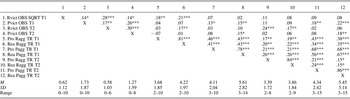
First, descriptive statistics were calculated and are found in Table 1. Skew was less than 3 (range = 0.67 to 2.27) and kurtosis less than 8 (range = –0.07 to 7.5), suggesting that nonnormality of the data was not a concern (Kline, Reference Kline2011) for all variables except for observations of relational victimization at Time 1. A square root transformation was conducted and normalized the skew (1.08) and kurtosis (0.30) of this variable.
Descriptive statistics and correlations between key study variables

Note: Rvict, Relational victimization; Pvict, physical victimization; Pro Ragg, proactive relational aggression; Rea Ragg, reactive relational aggression; Pro Pagg, proactive physical aggression; Rea Pagg, reactive physical aggression; OBS, observations; TR, teacher report; SQRT, square root transformed; T1, Time 1; T2, Time 2. Untransformed descriptive statistics for Rvict OBS SQRT T1 are reported for ease of communication; proactive and reactive relational aggression subscales comprised two items and proactive and reactive physical aggression subscales comprised three items, respectively.
*p < .05. **p < .01. ***p < .001.
Second, correlations between study variables were conducted and are presented in Table 1. Age was also correlated with each study variable and revealed significant associations with observations of relational victimization at Time 1 (r = .16, p = .006), and thus age was controlled in the subsequent regression models. The bivariate associations showed that observations of physical and relational victimization were significantly correlated at Time 1 (r = .14, p = .02) and Time 2 (r = .30, p < .001), and consistent with similar studies (e.g., Ostrov, Reference Ostrov2008; Sullivan et al., Reference Sullivan, Farrell and Kliewer2006) the magnitude of these associations was low to moderate. Each form of behavior was significantly stable across the study (see Table 1). As expected, the overlap between proactive and reactive physical aggression as well as proactive and reactive relational aggression was high, which has been found with this measure in the past (Ostrov & Crick, Reference Ostrov and Crick2007; Ostrov et al., Reference Ostrov, Murray-Close, Godleski and Hart2013). However, the variance inflation factor (VIF) estimates for each predictor in the regression models reported below suggested that multicollinearity was not a concern (VIF values in the current analyses ranged from 1.03 to 3.16, which are well below the established threshold of 10).
Within-group and between-group gender differences
Third, preliminary analyses were also conducted to test both within- and between-group gender differences. Prior to running the within-group tests, the eight aggression variables were rescored by calculating the respective averages in order to make the variables comparable because the variables had different numbers of items (i.e., physical aggression subscales had one more item than the relational aggression subscales).
For girls, the anticipated within-group differences were significant at both time points but are only reported at the initial time point for ease of communication. That is, girls displayed more proactive relational (M = 1.88, SD = 0.96) than proactive physical (M = 1.26, SD = 1.25) aggression, t (148) = 9.04, p < .001, d = 0.56. Similarly, girls also displayed more reactive relational (M = 2.16, SD = 1.05) than reactive physical (M = 1.72, SD = 0.78) aggression, t (147) = 5.54, p < .001, d = 0.48. These findings confirmed our predictions and add to the current literature (e.g., Putallaz et al., Reference Putallaz, Grimes, Foster, Kupersmidt, Coie and Dearing2007), suggesting these effects are also present for young children.
For boys, an unanticipated pattern emerged when examining the within-group effects. According to teachers, at Time 1, boys displayed more proactive relational (M = 1.78, SD = 0.88) than proactive physical (M = 1.50, SD = 0.78) aggression, t (147) = 5.54, p < .001, d = 0.34, but showed similar levels of the two forms of proactive aggression at Time 2. Given the current lack of replication at Time 2, future work will be needed to replicate this effect. Boys did not show a significant difference in levels of reactive relational aggression or reactive physical aggression at either time point.
The between-group gender differences indicated that girls (M = 3.66, SD = 1.89) displayed more proactive relational aggression compared to boys (M = 3.07, SD = 1.50), but only at Time 2, t (241) = –2.72, p = .001, d = 0.35. According to teachers, girls (M = 4.10, SD = 1.98) also displayed more reactive relational aggression compared to boys (M = 3.60, SD = 1.65), but also only at Time 2, t (241) = –2.12, p = .016, d = 0.27. Thus, despite obtaining these predicted and moderate effects at Time 2, there were no significant gender effects for either function of relational aggression at Time 1.
Boys (M = 4.49, SD = 2.31) displayed more proactive physical aggression than did girls (M = 3.76, SD = 1.68) at Time 1, t (294) = 3.09, p < .001, d = 0.36. Boys (M = 6.11; SD = 3.19) also displayed more reactive physical aggression than did girls (M = 5.14, SD = 2.33) at Time 1, t (293) = 2.99, p < .001, d = 0.35. At Time 2, boys (M = 6.02, SD = 3.42) displayed more reactive physical aggression than girls (M = 4.90, SD = 2.75) displayed, t (262) = 2.92, p = .001, d = 0.36, but there was no significant gender difference (p = .10) in rates of teacher-reported proactive physical aggression at Time 2. Thus, the overall pattern of findings is consistent with a myriad of studies documenting that young boys are more physically aggressive than are young girls.
Regression models
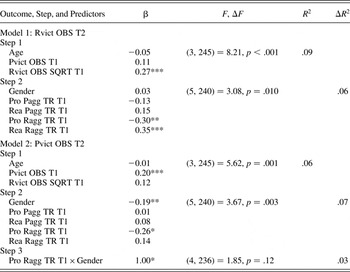
Fourth, to test the key study goals a series of hierarchical regression models were conducted. The first two models were designed to test aggression subtypes as predictors of change in peer victimization subtypes. In the first model, observations of relational victimization at Time 2 was the outcome variable, and in the second model observations of physical victimization at Time 2 was the outcome variable. At Step 1, age (in months) as well as initial levels of relational and physical victimization was entered. At Step 2, gender and the four aggression subtypes (i.e., proactive and reactive functions of physical and relational aggression) were entered. At Step 3, the two-way interactions with gender were included. For ease of communication, these interactions are only presented (see Tables 2 and 3) when significant. Variables were mean centered prior to running the interactions. In the first model, teacher-reported proactive relational aggression predicted decreases in observed relational victimization over time. In contrast, in keeping with predictions, teacher-reported reactive relational aggression predicted increases in observed relational victimization over time. In the second model, proactive relational aggression predicted decreases in physical victimization, although this effect was qualified by a significant two-way interaction with gender at Step 3. For boys only, proactive relational aggression was a significant negative predictor (β = –2.93, p = .004) of observed physical victimization controlling for all the other variables in the model, ΔF (4, 112) = 2.58, p = .041, ΔR 2 = .081. For girls, proactive relational aggression was not a significant predictor (β = –0.01, ns) of changes in physical victimization.
Regression models testing prospective relations between aggression and peer victimization subtypes

Note: OBS, Observations; TR, teacher report; SQRT, square root transformation; T1, Time 1; T2, Time 2; Pvict, physical victimization; Rvict, relational victimization; Pro, proactive; Rea, reactive; Ragg, relational aggression; Pagg, physical aggression. All two-way interactions from Step 2 with gender (boys = 1, girls = 2) were run in each model and are only shown when significant for ease of communication.
*p < .05. **p < .01. ***p < .001.
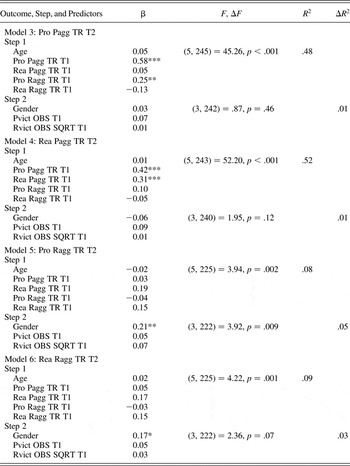
Regression models testing prospective relations between peer victimization and aggression subtypes

Note: OBS, Observations; TR, teacher report; SQRT, square root transformation; T1, Time 1; T2, Time 2; Pvict, physical victimization; Rvict, relational victimization; Pro, proactive; Rea, reactive; Ragg, relational aggression; Pagg, physical aggression; All two-way interactions from Step 2 with gender (boys = 1, girls = 2) were run in each model, were all nonsignificant, and are not shown for ease of communication.
*p < .05. **p < .01. ***p < .001.
The final four regression models examined the reverse direction of effect (see Table 3). Each of the four aggression subtypes at Time 2 served as the outcome variable in the respective models. In each model, the four initial subtypes of aggression and age (in months) were entered at Step 1. At Step 2, the key predictors of gender and initial observed physical and relational victimization were entered. At Step 3, the two-way interactions between gender and the victimization subtypes were entered. These interactions were not significant in any of the models and are therefore not presented for ease of communication. The models reveal some evidence for gender differences (see above section) as well as stability in some of the behaviors even when controlling for the influence of the other aggressive behaviors. However, no support was found for the alternative hypothesis that peer victimization subtypes would predict changes in forms and functions of aggression.
Discussion
The present study had several preliminary and key study objectives. First, we tested the within- and between-group gender differences. Second, we examined the prospective associations between aggression subtypes and peer victimization subtypes. Regarding within-group differences, we found that girls tended to engage in higher levels of both proactive and reactive relational aggression compared to both functions of physical aggression across time points. This indicates that even in early childhood, relational aggression appears to be the modal type of aggression for girls. However, boys showed a different pattern of effects. At Time 1, boys were engaging in higher levels of proactive relational aggression than physical aggression, although all other analyses indicated that boys displayed similar levels of both relational and physical aggression. Between-group differences emerged for both functions of relational aggression, but only at Time 2. It is possible that these effects represent developmental change in that girls' rates of relational aggression may be increasing over the course of the academic year relative to boys. However, prior observational research during this developmental period has not demonstrated these timing effects when assessing overall rates of relational aggression (Crick, Ostrov, Burr, et al., Reference Crick, Ostrov, Burr, Jansen, Cullerton-Sen and Ralston2006) or when adopting a similar forms and functions approach (Ostrov & Crick, Reference Ostrov and Crick2007). Thus, future longitudinal work is needed to further examine and replicate this effect. When comparing between-group gender differences in physically aggressive behavior, boys engaged in higher levels of both proactive and reactive physical aggression than did girls. The current findings indicate that although boys are engaging in higher levels of physical aggression than are girls, they are also displaying similar levels of relational aggression in early childhood. In line with Ostrov and Godleski's (Reference Ostrov and Godleski2010) gender-linked model of aggressive behavior, this suggests that gender identity may still be developing for boys during this developmental timeframe, leading them to display both forms of aggression during early childhood.
The prospective findings seem to suggest that both functions of physical aggression may be more stable than functions of relational aggression during early childhood. However, prior studies using this measure and similar designs have not found differential levels of stability between these subtypes of aggression (Ostrov & Crick, Reference Ostrov and Crick2007; Ostrov et al., Reference Ostrov, Murray-Close, Godleski and Hart2013). Given that we modified the scale in order to reduce the overlap between the functions of relational aggression (but did not reduce the scale for physical aggression subtypes), it is difficult to compare across the forms of aggression in the present study and perhaps inappropriate to make comparisons between the present findings and prior studies. Therefore, future research with a more comprehensive assessment of forms and functions of aggression will be needed to examine these questions. However, there are some indirect indications that levels of physical aggression/victimization may have been more common than relational aggression/victimization (i.e., comparison of mean levels of observations of physical and relational victimization). It is conceivable that functions of physical aggression did not predict changes in peer victimization because experiences with physical aggression were more normative or acceptable during this developmental period (Dodge et al., Reference Dodge, Coie, Lynam, Damon and Damon2006). Future research is needed to further test these hypotheses and ascertain how normative physical aggression/victimization is relative to relational aggression/victimization during early childhood.
This study was conducted to test the sequential social process model of the causes of peer harassment (Boivin & Hymel, Reference Boivin and Hymel1997; Hanish & Guerra, Reference Hanish and Guerra2000; Ostrov, Reference Ostrov2008; Ostrov & Godleski, Reference Ostrov and Godleski2013) and associated specificity hypothesis of aggression (Crick et al., Reference Crick, Casas and Ku1999; Ostrov, Reference Ostrov2010). We found some evidence in support of the social process model. That is, we found some evidence that the predicted direction of effect from aggression to peer victimization was supported. For example, regression models revealed that only aggression constructs predicted changes in peer victimization and the reverse direction of effect was not supported. Aggressive children are often rejected by their peers or have few social supports, which may put them at risk for peer victimization (Hanish & Guerra, Reference Hanish and Guerra2000; Ostrov, Reference Ostrov2008; Ostrov & Godleski, Reference Ostrov and Godleski2013). The alternative model was not supported in the present study (although see Ostrov, Reference Ostrov2010; Ostrov & Godleski, Reference Ostrov and Godleski2013) and suggests that when both forms and functions of aggression are considered and simultaneously controlled, the overall direction of effect seems to be relatively clear. Given past evidence and the specificity hypothesis of aggression, which posits that forms of victimization predict changes in respective forms of aggression (e.g., Ostrov, Reference Ostrov2010), future research is needed to replicate the present pattern of effects with functions of aggression and with a more comprehensive measure of proactive and reactive functions of physical and relational aggression. We did find that only relational aggression subtypes were predictive of increases in relational victimization. However, similar effects were not found for physical aggression subtypes and physical victimization, which was surprising given the prior literature with older children (e.g., Dhami et al., Reference Dhami, Hoglund, Leadbeater and Boone2005; Hanish & Guerra, Reference Hanish and Guerra2000; Hodges & Perry, Reference Hodges and Perry1999; Schwartz et al., Reference Schwartz, McFadyen-Ketchum, Dodge, Pettit and Bates1999), and thus future research is needed to continue to examine this hypothesis.
The present test of the social process model adds important information to the literature by examining if the functions of aggressive behavior were uniquely related to peer victimization subtypes. Theoretically, reactive functions of aggression should predict future peer victimization because reactively aggressive children are by definition dysregulated. The associated revenge seeking, emotional venting, or impulsive behavior may be triggers leading to others victimizing them (Kochenderfer-Ladd, Reference Kochenderfer-Ladd2004; Salmivalli & Helteenvuori, Reference Salmivalli and Helteenvuori2007). In contrast, scholars have posited that proactive physical aggression should be uniquely and negatively associated with peer victimization because proactive aggressors have qualities (e.g., social dominance; Pellegrini et al., Reference Pellegrini, Van Ryzin, Roseth, Bohn-Gettler, Dupuis and Hickey2011), which make them poor targets (Salmivalli & Helteenvuori, Reference Salmivalli and Helteenvuori2007). Moreover, these children by definition instigate aggressive acts, causing them to be feared by their peers (Salmivalli & Helteenvuori, Reference Salmivalli and Helteenvuori2007). The present study found evidence in support of these theoretical assertions. That is, reactive relational aggression was associated with increases in relational victimization. In keeping with predictions, proactive relational aggression was associated with decreases in relational victimization for boys and girls as well as with physical victimization among boys only.
In general, the present results support prior published findings (e.g., Salmivalli & Helteenvuori, Reference Salmivalli and Helteenvuori2007) and extend this work to relational aggression in a younger sample. Moreover, they suggest that future tests of the sequential social process model of the causes of peer harassment should continue to include assessments of the functions of aggressive behavior in order to further delineate these important developmental mechanisms. The finding that gender moderated the association between proactive relational aggression and physical victimization is potentially interesting. Certainly replication is needed, but it may be that knowing to whom the behavior is directed may impact the pattern of findings. Perhaps boys who are proactive relational aggressors are spending most of their social time with other-sex peers and directing any aggressive behavior to these girls whom do not retaliate in kind when male perpetrators use physical force. These findings have implications for the specificity hypothesis of aggression, and it may be that a match or mismatch in the gender of the dyad (i.e., focal child's gender and the recipient peer's gender) may impact the degree to which behaviors mirror the displayed behavior in kind or not. Future work that more carefully examines these specific questions would help to further elucidate these possible patterns.
The present study has several strengths and addresses novel empirical questions. The study relied on multiple informants (i.e., teacher reports and time-intensive systematic observations) and a short-term longitudinal design with one of the largest sample sizes for observational studies of this type (Crick, Ostrov, Burr, et al., Reference Crick, Ostrov, Burr, Jansen, Cullerton-Sen and Ralston2006, N = 91; Juliano, Werner, & Cassidy, Reference Juliano, Werner and Cassidy2006, N = 67; Keating & Heltman, Reference Keating and Heltman1994, N = 57; McEvoy, Estrem, Rodriguez, & Olson, Reference McEvoy, Estrem, Rodriguez and Olson2003, N = 56; Ostrov & Keating, Reference Ostrov and Keating2004, N = 48; Pellegrini, Long, Roseth, Bohn, & Van Ryzin, Reference Pellegrini, Long, Roseth, Bohn and Van Ryzin2007, N = 73; Pellegrini, Roseth, et al., Reference Pellegrini, Roseth, Mliner, Bohn and Vance2007, N = 65; Roseth et al., Reference Roseth, Pellegrini, Dupuis, Bohn, Hickey and Hilk2011, N = 88). We also tested novel theoretically informed empirical questions among young children in a particularly important developmental period for future social emotional development. More specifically, this study adds significantly to our knowledge of the interrelations between the forms and functions of aggression and victimization (e.g., Salmivalli & Heleteenvuori, Reference Salmivalli and Helteenvuori2007). In particular, demonstrating important gender differences in the associations with proactive relational aggression is a particular strength of the current study and accounts for limitations in past research in which relational aggression was not included (Salmivalli & Heleteenvuori, Reference Salmivalli and Helteenvuori2007).
Limitations and future directions
Despite the various strengths, there are several limitations that must be addressed in future research. First, the demographics of the sample limit the external validity and generalizability of the findings. The childcare centers that were used are open to the community and the sample was ethnically and socioeconomically diverse, but the schools comprised children who attend high-quality childcare centers in an urban or suburban area. The decision to use these high-quality childcare centers, which generally share an educational philosophy and have similar school climates, was motivated by a desire to eliminate as many confounding variables as possible. However, future research should be conducted to replicate the present findings in a more diverse sample and with children attending schools that have greater range in quality.
Second, the time interval between the two time points was brief, given the amount of time it took to collect the observational methods. This interval is consistent with prior short-term longitudinal studies (e.g., Crick, Ostrov, Burr, et al., Reference Crick, Ostrov, Burr, Jansen, Cullerton-Sen and Ralston2006; Hay, Castle, Davies, Demetriou, & Stimson, Reference Hay, Castle, Davies, Demetriou and Stimson1999) and may be an appropriate design for testing the proposed mechanisms that likely occur over short intervals, but additional prospective longitudinal work is needed that examines these associations across a longer time period and especially as children make the transition from early to middle childhood.
Third, much like past studies (e.g., Ostrov & Crick, Reference Ostrov and Crick2007), given the high overlap between teacher-reported proactive and reactive relational aggression, we reduced the number of items on the teacher-report form such that only two items were included. This procedure resulted in the possibility of a reduced range of responses for these subscales, and the final overlap although reduced was still rather high. The diagnostic statistics (i.e., VIF) did not indicate that multicollinearity was an issue, but future work must attempt to reduce this overlap by adding in additional items and using alternative methods.
Fourth, our findings are limited to early childhood, and future research is needed to replicate these effects in later developmental periods. Prior research on physical aggression and victimization (Hoglund & Leadbeater, Reference Hoglund and Leadbeater2007) has demonstrated the value of examining similar questions in a later developmental period. However, it is possible that a different pattern of results would emerge in later developmental periods. When particular aggressive behaviors are considered atypical/nonnormative or generally are viewed as inappropriate and trigger more severe sanctions (i.e., physical aggression becomes less normative when it is labeled as “assault” in later developmental periods), it is plausible that the display of those behaviors will likely promote peer maltreatment, which are assertions generally in the spirit of Crick's (Reference Crick1997) nonnormative model of aggression. Thus, it is conceivable that physical aggression will predict increases in peer victimization in late adolescence when the peer group and society begins to view physical aggression as unacceptable and aberrant.
Fifth, we must continue to examine predictors and outcomes of relational victimization with an eye toward the importance of multiple levels of influence (from cells and neurons to neighborhoods and cultures) and domains (i.e., social, cognitive, and biological) of functioning. That is, a developmental psychopathology perspective would continue to search for the theoretically driven dynamic bidirectional prospective associations between relational victimization and various predictors and outcomes. Nicki R. Crick always maintained this theoretical orientation and framework in her work (e.g., Crick & Zahn-Waxler, Reference Crick and Zahn-Waxler2003), and future studies must continue this important programmatic research within the same multidisciplinary developmental perspective.
Implications
In this study, an analysis of the functions of aggression enabled a key distinction to be made as to whether aggressive behavior predicted increases or decreases in peer victimization. Our findings imply that children who react impulsively to slights or perceived slights may benefit from being taught coping skills in order to reduce the risk that they will endure long-term social difficulties. Moreover, the vast array of gender differences found in this study suggests that intervention programs should be sensitive to the types of aggression and victimization that are salient for each gender. Although in need of replication, the effects suggested that, according to teachers, boys may display more proactive relational aggression relative to proactive physical aggression. This finding indicates that young boys may also display relationally aggressive behavior, especially in the service of instrumental goals, and we should be mindful of both girls and boys when designing our prevention and intervention efforts regarding relational aggression. In addition to informing prevention and intervention programs designed to reduce aggression and victimization in young children (e.g., Ostrov et al., Reference Ostrov, Massetti, Stauffacher, Godleski, Hart and Karch2009), our findings suggest that future studies should integrate multiple approaches to the conceptualization of aggression (i.e., form, function, and gender) in order to develop a nuanced picture of risk factors for victimization.
Conclusions
In conclusion, it was revealed that teacher-reported proactive relational aggression predicted a decrease in observed relational victimization over time. Conversely, teacher-reported reactive relational aggression predicted an increase in observed relational victimization over time. These findings demonstrate the discriminant validity of the forms and functions of aggression approach (see also Ostrov & Crick, Reference Ostrov and Crick2007; Ostrov et al., Reference Ostrov, Murray-Close, Godleski and Hart2013). The present study relied on theory, methods, and an overall empirical approach that was in keeping with the research program of Crick and her colleagues. Nicki R. Crick's seminal work expanded aggression research to include a more gender-balanced approach to the study of aggression and peer victimization as well as our overall conceptualizations of psychopathology (see Crick & Zahn-Waxler, Reference Crick and Zahn-Waxler2003). Her vast theoretical, empirical, and applied contributions will continue to shape and influence the aggression literature and the field of developmental psychopathology for generations to come.