Investment in mass-level surveys, and exploitation of the data they produce, has led to substantial advances in our understanding of public attitudes and political behaviour in Taiwan.Footnote 1 The availability of high quality data has created bountiful research opportunities on the contours and dynamics of national identity, voting behaviour, support for democracy, and many other theoretically and substantively important issues at the level of the individual. Cottage industries have grown up around data collection projects like the Taiwan Election and Democratization Study (TEDS), which, since its inception in 2001, has formed the empirical basis for 17 books, 139 journal articles, 329 conference papers, and 92 MA and PhD dissertations.Footnote 2 Such developments are undoubtedly beneficial for research at the mass level, and the successful implementation of TEDS and other initiatives are an indication of the professionalization of Taiwanese political science. Yet, the abundance of mass-level data throws into sharp relief the lack of similar data on political elites, where the majority of studies on political behaviour rely heavily on interviews with protagonists or close observers. There is a good reason for using this method, as the insights derived from interviewing those close to the action, particularly when it comes to examining the nuances of complex political situations, are often invaluable. My argument is not that we should abandon and replace the practice of interviewing subjects but that we should supplement existing methods with better use of available electronic resources.
Broad research areas on elite political behaviour, for example those pertaining to strategy, governance, campaigning, cooperation and conflict, and political communications, could all be advanced by access to systematic data on political preferences, policy positions, salience, conflict scores, etc. If such data could be generated for national and subnational governments, and for different parties and individual political actors at various levels and over time, it would open up the intriguing prospect of multi-level, time series analyses of elite political behaviour. As has happened in other contexts, access to valid, reliable, replicable and publically available data could stimulate research on elite politics in the same way that TEDS and other surveys have advanced the understanding of attitudes and behaviour at the mass level. Interviews clearly have advantages in what they can tell us about elites, but they can also be costly and difficult to arrange, are subject to selection and other biases, and are less amenable to sharing. The benefits of information collected in this way are usually restricted to whatever is selectively reported by the author in published matter. One way to supplement the information gathered from interviewing political actors is to analyse the ‘texts’ that they create. Texts include all manner of spoken and written materials, from speeches, debates, legislative addresses, manifestos, white papers, advertisements, campaign literature, and even blog posts and tweets. As the “concrete by-products of strategic political activity,” political texts are widely recognized as legitimate and practical sources for generating data on the behaviour, preferences and interactions of political actors.Footnote 3
The objective of this article is to show that there is an abundance of primary source electronic data, and appropriate methods, which could potentially advance the study of elite politics in Taiwan. In terms of the quantity and quality of electronic data sources, there has never been a more fruitful time to conduct empirical research on Taiwanese politics. However, outstanding resources are being underutilized in the field.Footnote 4 Based on the informal interviews I conducted with Taiwan specialists prior to writing this article, it appears that a lack of awareness of both the available resources and the tools required to analyse them is to blame, rather than antagonism towards electronic data or methods. This is not surprising given the lack of published work addressing data and methods (electronic or otherwise) in Taiwanese political research.Footnote 5 It is hoped that by providing a survey of relevant electronic data and some of the methods available for making use of them, this article will draw attention to these underexploited resources.Footnote 6
Electronic Resources
This article focuses on electronic resources created by different levels of governmental institutions, political parties and individual politicians. It does not survey the many online media resources available since I am interested in the data created by political actors themselves and what this can tell us about elite political behaviour, preferences and attitudes. Access to elite-generated texts benefits from two trends. First, political parties and politicians in Taiwan have long demonstrated their enthusiasm for adopting various means of communicating with citizens and voters, most obviously as part of their campaign communications. Since the mid-1990s, this has taken the form of online communications, a practice that accelerated after the 2000 presidential campaign, and again after the popularization of Web 2.0 applications in the middle of the same decade.Footnote 7 Secondly, since the Electronic Government Program was enacted in April 2001, governmental institutions at all levels have developed online infrastructures for improving internal efficiency, transparency and public services.Footnote 8 Thousands of government agency websites have been created, and by November 2003, “all government organizations were connected online.”Footnote 9 This progress established Taiwan as one of the world's top-performing e-democracies,Footnote 10 with the “my e-gov” portal being cited as an example of global best practice.Footnote 11 This laudable achievement is a boon for citizens and researchers alike. In the following sections, I will survey electronic data sources for a selection of major governmental institutions, parties and individual political actors.Footnote 12
Office of the president
As the highest profile political actor, particularly in terms of foreign and cross-Strait relations, the behaviour of the ROC president has naturally been a focal point of research on Taiwan. Under the constrained strategic conditions prevailing in the Strait, and in the absence of open communication channels between the two sides, presidential rhetoric has taken on added significance, as the president's public pronouncements have been interpreted as indicating Taipei's underlying policy positions.Footnote 13 Despite the high level of interest, little effort has been made to measure the president's political preferences over time,Footnote 14 perhaps because of the perceived lack of data. The presidential website, however, provides many valuable resources, including a large database of speeches that holds the promise of generating numerical estimates of presidential preferences.Footnote 15 The searchable database holds close to 17,000 texts, of which the majority are verbatim, first-person transcripts of speeches made by Lee Teng-hui 李登輝, Chen Shui-bian 陳水扁 and Ma Ying-jeou 馬英九.Footnote 16 The database is regularly updated and covers the period from 1993 to the present day. Although coverage of the earlier period is less consistent and older texts require greater effort to render them machine readable, this resource represents an almost unbroken record of presidential pronouncements during the last three decades.
A second searchable database contains more than 8,000 presidential decrees, public announcements and other official business going back to 1948.Footnote 17 The Ma administration has put together a useful multimedia record of presidential activities, including videos of the president and vice-president's policy views. A further innovation collates the president's most salient speeches on important topics such as cross-Strait relations, law and order, the economy, social and cultural issues.Footnote 18 Although this is a subset of the full presidential speech set described above, the organization of speeches in this way is a useful shortcut for researchers. Another feature on the presidential website, indicative of the enthusiastic embrace of new and social media by Taiwanese politicians, is the provision of links to the president's social media accounts. Among these, the president's YouTube channel hosts almost 200 videos, the majority of which feature Ma Ying-jeou directly addressing the audience to discuss his activities and political views.Footnote 19 According to statistics provided by YouTube, the president's channel is regularly in the top 20 most viewed channels each week in Taiwan.Footnote 20 Far from the expected sound bites and news clips, the channel provides a relatively candid window into the president's views. Finally, Ma's Facebook page contains frequently updated information on his activities and opinions, with links to video and other materials and a surprisingly robust question and answer page.Footnote 21 Ma's view (expressed on his Facebook page, naturally) is that “it is the government's responsibility to let the people clearly understand their policy ideas […thus] wherever the people are, the government should be there too.”Footnote 22
Legislative Yuan
There is much interest (globally) in legislative behaviour, centred on the political preferences and subsequent behaviour of legislators. As the legislative branch in Taiwan has gradually gained greater independence, relatively speaking,Footnote 23 this research agenda has become more salient, especially in light of the experience of the divided government and institutional gridlock that characterized Chen Shui-bian's first term.Footnote 24 Until recently, researchers in the US and Europe have generally focused on voting behaviour, rather than legislative speeches, as a way of studying ideology and policy positions in legislatures. Since the former is not an option for Taiwan specialists due to the absence of roll-call voting data, it is welcome news that advances in computer-based content analysis have opened up the possibility of treating written or spoken texts as data to study ideology.Footnote 25 Furthermore, those researching the legislative branch in Taiwan can access legislative speeches and other data through the Legislative Yuan's online infrastructure. The portal features multiple searchable databases (and service points) and is an exemplary source of information on the legislative process and legislative behaviour.Footnote 26 The website provides comprehensive searchable records of legislators speaking in the Yuan, including meta-data on the context of the address. This resource is updated daily and complete records can be downloaded for analysis.Footnote 27 Another searchable database contains news, questions, legislative proposals, provisional proposals, comments on other proposals, and details of committee memberships and activities for every legislator.Footnote 28 Searchable by individual legislator, one can immediately access and download the full official record of a legislator's behaviour in the Yuan.Footnote 29 A linked database contains multimedia news items for each legislator, supplementing the official records.Footnote 30 The parliamentary library database of bills allows those conducting research on the legislative process to read, search and follow the progress of legislative proposals and bills through the Yuan, both current and historical.Footnote 31
Mainland Affairs Council (MAC)
The MAC (Xingzhengyuan dalu weiyuanhui 行政院大陸委員會) is the cabinet level institution responsible for dealing with cross-Strait relations, and its website contains an abundant collection of related information,Footnote 32 including all presidential speeches relating to China (i.e. a subset of the speech set available on the presidential website) and a set of salient statements and reports made by members of all governmental institutions relating to interactions with China or mainland policies.Footnote 33 Searchable by institution, (for example, foreign affairs, economy, hygiene, transport, education, etc.), this database contains around 2,600 items dating from 2005 to the present. There is an additional archive of official documents related to interactions with the mainland and mainland policy.Footnote 34 Policy information is separated by sector (for example, the economy, social issues, education, etc.) and then further divided into smaller issues like mainland brides, PRC students, etc. The MAC conducts regular press conferences and the website contains transcripts of 550 routine press conferences and 1,600 press releases, all going back to 1999.Footnote 35 These resources are supplemented by around 300 “explanations and clarifications” dating from 2001 to the present. Through a link on the MAC website, researchers can access the Cross-Straits Information Network which has a searchable database of documents on cross-Strait relations from 1950 to the present.Footnote 36 It contains, for example, the texts and details of all of the official cross-Strait dialogues.Footnote 37
Other government institutions
The Executive Yuan (Xingzhengyuan 行政院) website systematically compiles news items for its members and provides transcripts of the head of the Executive Yuan's weekly addresses between 2005 and the present day.Footnote 38 There is also a searchable record of resolutions going back to 1999,Footnote 39 and access to the informative Executive Yuan Gazette.Footnote 40 The Judicial Yuan (Sifayuan 司法院) website has a database of laws and regulations going back to 1947, searchable by sector and linked to information on how the law came into being.Footnote 41 Another database holds thousands of formal and informal items (for example, media releases) relating to laws and regulations. There is also access to the Judicial Gazette.Footnote 42 The Ministry of Foreign Affairs (MOFA, Waijiaobu 外交部) website provides a database of policy information and news reports.Footnote 43 The Government Information Office (GIO, Xingzhengyuan xinwenju 行政院新聞局) provides news about all the different heads of government institutions.Footnote 44
Subnational governments
Following redistricting, five major municipal governments were created (Taipei City 台北市, Sinbei City 新北市, Greater Taichung 大台中, Greater Tainan 大台南 and Greater Kaohsiung 大高雄), and it is likely that interest in these institutions and their leaders will increase. Prior research on these subnational institutions has focused mainly on elections and campaigns and within this framework has concentrated on Taipei and Kaohsiung. However, with the availability of appropriate data, these institutions offer useful within-case comparisons. It is good news then, that all five major municipal governments maintain excellent resources on their websites. In Taipei City, for example, there are records of all weekly meetings from 2003 to the present.Footnote 45 The website also provides a database of around 16,000 news and other items about City Hall and the mayor's activities, speeches and sayings from January 2001 to the present.Footnote 46 The website links to Taipei City Council where, among other resources, there are close to 1,700 policy and governance related texts.Footnote 47 The websites for the Greater Tainan, Kaohsiung and Taichung municipal governments provide governance and policy information, the political views of incumbent mayors, and transcripts of major speeches.Footnote 48 The new municipality of Sinbei City has inherited the old Taipei County online architecture and, among other useful information, provides the minutes of official meetings.Footnote 49
In addition to the major municipal governments, smaller county and city government websites also provide some useful resources. The majority provide news items going back several years, and some contain a treasure trove of information for research at the local level. Penghu County government (Penghu xianzhengfu澎湖縣政府) for example, provides an unbroken record of activities during the past decade, currently numbering around 40,000 documents and texts from January 2001 to the present.Footnote 50 Nantou County government (Nantou xianzhengfu 南投縣政府) provides news and announcements, white papers, information on policies, and a searchable “research section.”Footnote 51 Hualien County government (Hualian xianzhengfu 花蓮縣政府) provides access to more than 4,000 searchable documents pertaining to policy, reports and official announcements between 2001 and the present day.Footnote 52 Both Pingtung (Pingdong xianzhengfu屏東縣政府) and Taitung County governments (Taidong xianzhengfu 台東縣政府) link to the blogs of their respective heads of administration.Footnote 53
Parties
Political parties have played a dominant role in structuring politics in Taiwan, in both the one-party and democratic eras,Footnote 54 and interest in many issues relating to party positions and behaviour is high. Taiwanese parties and politicians have long been willing to experiment with different modes of communication, particularly as part of their election campaigns.Footnote 55 As persistent political communication innovators, they have adopted and adapted multiple tools for communicating with citizens and voters, and in the process have created an abundance of primary electronic data. These resources are particularly useful for analyses of issue salience, policy positions and campaign behaviour. In addition to their user-friendly and highly informative websites, the major parties maintain YouTube channels, social media accounts and microblogs. This enthusiastic embrace of social media is hardly surprising given Taiwan's tech-based economy, tech-savvy populace and the high concentration of internet users in the youth demographic that has an increasingly important effect on the outcome of Taiwanese elections.Footnote 56
The Democratic Progressive Party (DPP) website has a record of news and multimedia items, including a collection of campaign advertisements.Footnote 57 It also provides a collection of party announcements.Footnote 58 Linking from the website is the DPP's official policy blog, which has numerous resources on policy debates within the party as well as finalized policy directions.Footnote 59 The DPP is represented on Facebook, Plurk, Google Buzz and YouTube.Footnote 60 Twitter users can receive tweets direct from the party and Chairperson Tsai Ing-wen 蔡英文.Footnote 61 The Kuomintang (KMT) website provides an almost identical set of resources, albeit with fuller multimedia archives. The KMT also provides notes from its regular weekly meetings from 2005 until the present,Footnote 62 and a large collection of news reports on its activities from 2006 to the present.Footnote 63 The party is on Facebook and Plurk, and has its own YouTube channel.Footnote 64 Reflecting its decline as a major (if temporary) force, the People First Party (PFP) website is comparatively lean, but does provide a selection of policy documents, including white papers and manifestos.Footnote 65 Like the other parties, the Taiwan Solidarity Union (TSU) website has a collection of multimedia news reports and interactive features, in addition to party policy documents, a collection on Lee Teng-hui Thought, and campaign advertisements.Footnote 66
Individual politicians
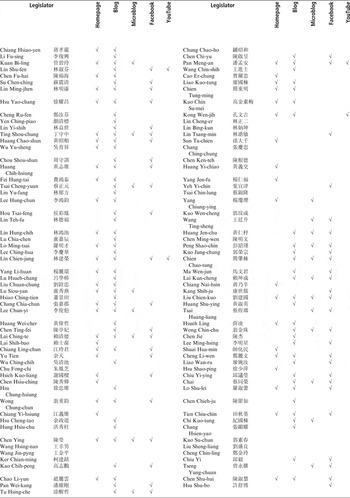
Perhaps even more so than their parties, individual politicians in Taiwan have frequently sought competitive advantages by adopting different means of communication with their constituents and, in particular, voters. As early as 1994, Taipei mayoral candidates were incorporating bulletin board systems (BBS) into their campaign communications. By the time of the 2000 presidential campaign, candidates were running sophisticated multimedia content on their websites.Footnote 67 As president in 2002, Chen Shui-bian held online discussions directly with netizens.Footnote 68 Over time, more and more new media tools have become regular features of politicians' communications arsenal. Many politicians have progressed from homepages to more interactive Web 2.0 tools, for example blogs and social media. Indeed, the level of take-up among Taiwanese politicians is extraordinary compared with other democracies.Footnote 69 Consider, for instance, that 88 of the 126 members (70 per cent) who served during the Seventh Legislative Yuan tried their hand at blogging.Footnote 70 Legislators' online tools at the time of writing in February 2011, are shown in Table 1.
Seventh Yuan Legislators' Online Presence.

Source: Information collected by author. For tables using pinyin, see http://bit.ly/RpI0hA.
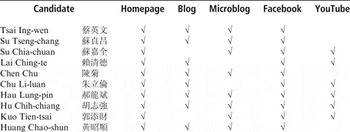
The effects that these methods of communication may be having on representative–constituent relationships is not the focus of this article, but of relevance here is that legislators are generating huge quantities of electronic texts for researchers to analyse. Political actors in Taiwan are using blogs, status updates and tweets to address substantive political (among other) issues. Despite their brevity, researchers should take these communications seriously.Footnote 71 Indeed, brevity is no reason to discriminate against micro-blogs and other short communications, as Frank Hsieh 謝長廷 demonstrated when he published a book (translated as Frank's Plurk Diary) based on the messages he posted on the social network site, Plurk.Footnote 72 The sheer scale of up-take in Taiwan, as illustrated in Table 2, demands that we take social media-generated ‘texts’ seriously as a primary data source.Footnote 73 As recently as five years ago, primary access to the thoughts of politicians was via journalists' reports, mediated sound bites or occasional face-to-face interviews. Today, new means of communication allow access to an almost continuous stream of thoughts, comments, musings and reflections.
Online Tools of Candidates in the Five Major Municipality Elections 2010.

Source: Information collected by author in December 2010. Links available at http://bit.ly/eWNwj5.
Methods for Generating Data from Electronic Texts
The resources discussed above provide interesting information for those following developments in Taiwanese politics. However, if they are to be used to generate systematic data on elite political actors, appropriate tools and techniques are needed. Since the focus of this article is on texts created by political actors in Taiwan, the most appropriate and useful tools are text analytical. Systematic analyses of textual sources have delivered valid and reliable quantitative data for numerous applications across political science, particularly in terms of estimating political preferences, issue salience, measures of cooperation and conflict in political interaction, and the framing of communication with citizens and voters.Footnote 74 Researchers have developed numerous methods that have yet to be fully exploited in studies on political behaviour in Taiwan. This is in part owing to earlier difficulties (now mostly overcome) in developing software for analysing Chinese language texts. It also reflects the situation where, until relatively recently, primary data has not been available in such abundance, in either Taiwan or on the mainland.
Content analysis is a flexible data generation method used for various ends throughout the social sciences, particularly since the rise of computer-assisted content analysis (CCA) software.Footnote 75 The content analysis method assumes that theoretically relevant categories are not directly observed (for example, we cannot “see” concepts like sovereignty or Taiwan identity), but particular words and phrases reflect this content in a systematic way. Specifically, the choice of particular words and the frequency of their use provide an indication of unseen, latent content. Although any single word or phrase is an unreliable indicator of a complex concept like democracy (for example, any one phrase may have different meanings or implications, depending on the context), combining numerous indicators in a theoretically-informed dictionary can produce a reliable mechanism for measuring content.Footnote 76 For instance, in their analysis of 2,236 of Chen Shui-bian's presidential speeches, Sullivan and Lowe developed 120 separate indicators for the concepts “sovereignty,” “Taiwan identity,” and “pro-democracy.”Footnote 77 Developed through a close reading of the literature, these indicators were collectively able to pick up and measure the nuances of Chen's discourse.
Although CCA is as accurate as the dictionaries that researchers develop, it cannot attain the same level of sensitivity as interpretative discourse analyses. Since content analysis deals with manifest content, it does not directly enable researchers to “read between the lines” or deal with questions about how or why texts were produced. In many cases, therefore, it will not be the most appropriate tool. However, where researchers are interested in policy positions, issue salience, framing, or the many other purposes for which content analysis is used, CCA has several advantages. Dictionaries are transparent and are easily updated to take into account changes in meaning. They can also be shared and used to replicate studies. CCA can be applied to vast numbers of texts, increasing the size of the “word universes” researchers can bring to bear in their analyses of political elites. Developing valid content dictionaries is time consuming, but the costs in time and money are low compared to other methods, particularly as most software is open source. Finally, many forms of CCA software can now be reliably applied to Chinese texts (in both traditional and simplified characters) and many other languages, facilitating comparative applications.Footnote 78 One such package is the Yoshikoder, an open source desktop application that runs on any operating system.Footnote 79 Yoshikoder can analyse text documents in any natural language and has already been successfully applied to a variety of Chinese contexts.Footnote 80
Conclusion
Research on public attitudes and voting behaviour has benefited enormously from open scholarly access to systematically collected, reliable data resources. Research on elite political behaviour in Taiwan could also benefit from the creation of supplementary datasets derived from electronic primary sources, for instance quantitative estimates of the policy preferences and ideological positions of parties and individual political actors over time. Moreover, the primary resources and methods needed are already in place. A variety of political texts created by political actors at all levels of office (and indeed, in opposition) are readily accessible online. With a small degree of processing, these electronic texts can easily be rendered in machine-readable format for analysis by means of computer-assisted content analysis software.Footnote 81 The increasing sophistication and sensitivity of this software has enabled political scientists around the world to analyse huge quantities of text reliably and to answer important research questions about elite political behaviour. Software that can analyse any natural language, that never gets tired and that does not refuse requests for interviews, combined with the hundreds of thousands of pages of text created by Taiwanese political actors and made instantly available online, are out there and ready for exploitation by the research community.