Introduction
Soybean (Glycine max (L.) Merr.) is one of the major oilseed and protein crops in the world (Masuda and Goldsmith, Reference Masuda and Goldsmith2009). The total acreage in 2014 was 117.7 million ha, with <0.04 of this grown in Europe (FAOSTAT 2017). Within Europe, soybean cultivation is mainly situated in eastern and southern Europe (3.9 and 0.4 million ha, respectively). In western Europe, soybean acreage is limited to 0.13 million ha, whereas in northern Europe no soybeans are produced (FAOSTAT 2017). The demand for locally produced, non-genetically modified protein crops within the European Union is growing, mainly due to a policy-driven desire to reduce reliance on imports. Reintroduction of protein crops in arable rotations may help to improve the sustainability of European agricultural systems (Schreuder and De Visser, Reference Schreuder and De Visser2014). Cropping systems with legumes have been reported to contribute to a reduction of nitrous oxide emissions with comparable or slightly lower nitrate-N leaching compared with cropping systems without legumes and may have positive effects on soil quality and agrobiodiversity (Reckling et al., Reference Reckling2016; Zander et al., Reference Zander2016).
Despite the range of positive effects on agroecosystems, in Belgium in 2016, <0.01 of the total agricultural acreage was cultivated with a legume crop (FOD 2017). Policy makers, as well as Belgian farmers, are expressing a growing interest in protein crops, especially in soybean and Vicia faba. Despite this growing interest, cultivation of soybeans is still non-existent in Belgium. Expansion of soybean cultivation from eastern and southern Europe to north-western regions such as Belgium requires adaptation of soybean and specialized breeding programmes for more northern latitudes (Aper et al., Reference Aper, De Clercq and Baert2016; Kurasch et al., Reference Kurasch2017a). Recently, Kurasch et al. (Reference Kurasch2017b) identified six mega-environments that follow a latitudinal gradient within Europe in which soybean varieties with the different maturity traits cluster. The most northern and hence coolest mega-environment comprises Belgium, the Netherlands and northern Germany, where only varieties of the maturity group (MG) 000 reached maturity. Reaching maturity is an obvious prerequisite for a soybean variety within a certain environment but yield potential and quality of the harvested product are also key factors for the success of a variety within a given region. In Belgium, it is assumed that soybean cultivation starts to be of agronomic interest when soybean maturity is achieved not too late in the growing season, with grain yields around 2900 kg dry soybeans per hectare (Engwerda, Reference Engwerda2015; Aper et al., Reference Aper, De Clercq and Baert2016). Screening of soybean varieties suited to Belgian growing conditions will help to answer the questions of policymakers and farmers about the feasibility of soybean cultivation in Belgium. This screening thus represents the first step towards potential soybean production in Belgium.
Growing soybean in Belgium will be a challenge. Belgium has a relatively short and cold growing season with an average of 925 mm of precipitation per year of which more than 400 mm falls between May and October (KMI 2017). These humid and cool summer conditions favour the development of two major fungal pathogens, Sclerotinia sclerotiorum (Lib.) de Bary and Rhizoctonia solani Kühn (teleomorph: Thanatephorus cucumeris Donk) (Hartman et al., Reference Hartman, West and Herman2011, Reference Hartman2015). During cool and humid growing seasons, Sclerotinia stem rot of soybean becomes one of the most important diseases in the northern regions of the USA, resulting in severe yield losses (Wrather and Koenning, Reference Wrather and Koenning2006). Rhizoctonia solani causes seed rot, damping-off and root and stem rot of soybean. For R. solani, anastomosis group (AG) 2-2IIIB has been characterized as the predominant and most aggressive AG in soybean fields in North America and Canada (Zhao et al., Reference Zhao2005; Melzer et al., Reference Melzer2016; Ajayi-Oyetunde and Bradley, Reference Ajayi-Oyetunde and Bradley2017). Isolates of AG 2-2IIIB are widespread in north-western Europe (including Belgium) in maize and sugar beet fields (Büttner et al., Reference Büttner, Ithurrart and Buddemeyer2002; Buddemeyer et al., Reference Buddemeyer2004). This implies that caution should be taken when rotating these crops with soybean (Büttner et al., Reference Büttner, Pfähler and Märländer2004; González García et al., Reference González García, Portal Onco and Rubio Susan2006; Boine et al., Reference Boine2014). The control of both diseases poses a challenge for farmers because of the wide host range and the production of sclerotia that persist in soil for extended periods of time. A sustainable management strategy to minimize economic losses caused by both pathogens is to grow resistant or tolerant varieties. For S. sclerotiorum, no completely resistant soybean varieties have been reported but differences in susceptibility have been found (Kim et al., Reference Kim2000). In breeding programmes and variety performance trials, screening for tolerance to S. sclerotiorum is assessed systematically (Bastien et al., Reference Bastien2012). For R. solani, less information about tolerant and/or resistant varieties is available and only few sources of partial resistance have been reported (Bradley et al., Reference Bradley2001; Zhao et al., Reference Zhao2005).
The objectives of the current study were (1) to evaluate suitability of early maturing soybean varieties for cultivation under Belgian growing conditions based on maturity and yield components at harvest and (2) to screen early maturing soybean varieties for their tolerance and/or resistance to S. sclerotiorum and R. solani AG 2-2IIIB after optimizing bio-assays for both pathogens.
Materials and methods
Variety selection
Fourteen very early maturing soybean varieties (MG00-000-0000) were selected from the European plant variety catalogue and/or based on information from breeding companies and official variety trials. The major selection criterion was early ripening of the varieties under short and cold growing conditions similar to Belgian circumstances. For Sclerotinia bioassays, variety Dong Nong 37 was added as a resistant reference (Saharan and Mehta, Reference Saharan and Mehta2008). For Rhizoctonia bioassays, seeds of a resistant reference were not available.
Field trials
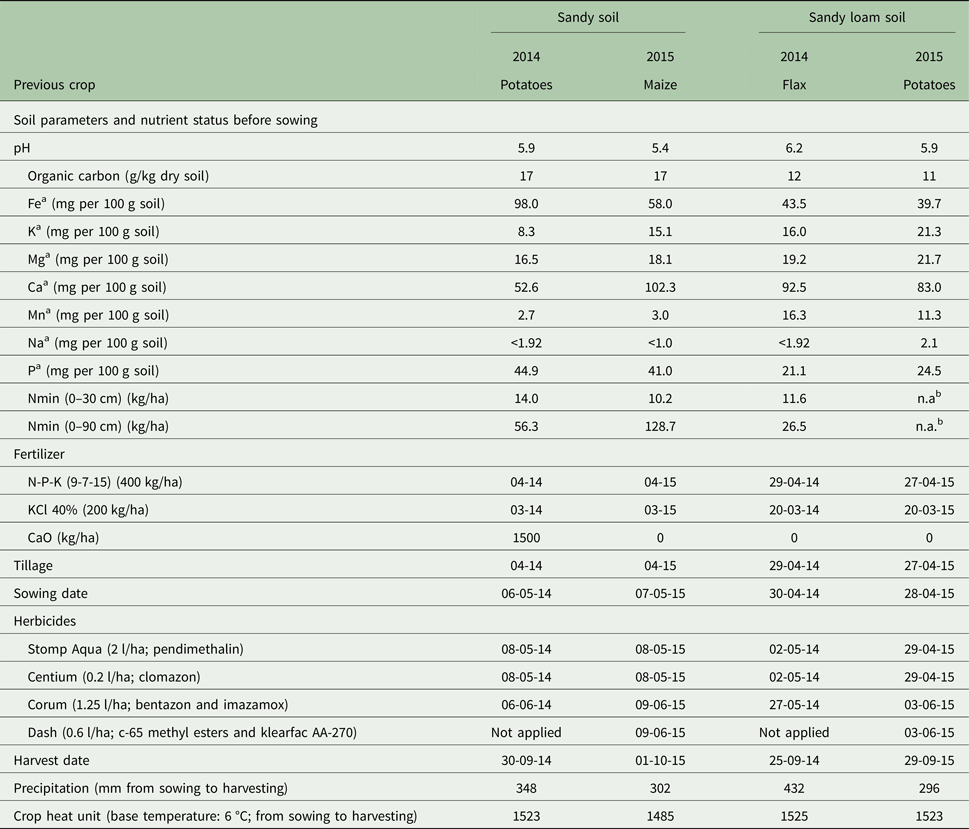
Field trials were conducted during two consecutive years (2014 and 2015) in two agricultural zones in Flanders (the northern region of Belgium) on sandy soil (Geel: 51°10′N, 4°48′E, 22 m a.s.l.) and sandy loam soil (Merelbeke: 50° 59′N, 3°46′E, 29 m a.s.l.). Plots were arranged in a completely randomized block design with four replicates (each plot with an area of 20.9 m2). The dimensions of the plots were 1.25 × 16.7 m2 with 0.25 m between rows. Soybean was sown at a density of 75 seeds/m2. Detailed descriptions of soil characteristics, fertilization, herbicides, sowing and harvesting dates are listed in Table 1. Trials were not irrigated; total natural precipitation from sowing to harvest ranged from 296 to 432 mm. All seeds were inoculated with Bradyrhizobium japonicum product Histick manufactured by BASF. No other seed treatments or pre-planting soil treatments were applied. Presence of pathogens was not tested before planting, but no disease symptoms were observed during the trials.
Description of the field trials conducted on two soil types: sandy soil (Geel) and sandy loam soil (Merelbeke) during two years (2014 and 2015) including soil fertility, fertilization, sowing date, herbicides, harvesting date and soil parameters

Fe, iron; K, potassium; Mg, magnesium; Ca, calcium; Mn, manganese; Na, sodium; P, phosphorus; Nmin, mineral nitrogen; KCl, potassium chloride; CaO, calcium oxide.
a Extraction in ammonium lactate and acetic acid (Egnér et al., Reference Egnér, Riehm and Domingo1960).
b n.a. Data not available.
The following parameters were determined: plant length (cm), height of the first pod (cm), internode number, leaf immaturity at harvest (1: completely mature, all leaves have fallen; 9: completely immature, green leaves), tolerance to lodging (1: completely lodged; 9: no lodging), moisture content at harvest (%), seed yield (kg/ha at dry matter content of 100%), thousand kernel weight (g). All varieties within individual trials were harvested on the same day during the optimal harvest period for soybeans in Belgium, previously determined by Aper et al. (Reference Aper, De Clercq and Baert2016).
Chemical analysis
Analyses of protein and oil content were done on dry seed material milled over a 1-mm screen using a cutting mill (Peppink Type 200AN, Olst, the Netherlands). Protein and oil content were estimated using near-infrared reflectance spectroscopy (NIRS). Calibration was based on soybean samples from 2014 and 2015 from different soybean trials in Belgium, including the four trials described in the current study. A total of 616 samples were scanned with a FOSS XDS monochromator instrument with ISIscan v2.85.1 software. The inverse reflectance (log (1/R) was collected from 400 to 2500 nm in steps of 2 nm. Principal component analysis was used to select a reduced number of samples covering the spectral variation of the sample set (Shenk and Westerhaus, Reference Shenk and Westerhaus1991a). Samples from two years (n = 110 from 2014 and n = 100 from 2015) were selected for the chemical reference analyses of crude protein (ISO 5983-2) and oil content (ISO 659:2009). The calibration development was executed with WINSI v4.9.0. software using modified partial least squares (PLS) regression (Shenk and Westerhaus, Reference Shenk and Westerhaus1991b). Cross-validation was used to select the optimum number of PLS terms. The standard error of calibration and cross-validation were 2.5 and 3.0 g/kg for crude protein, respectively, and 6.8 and 7.3 g/kg for oil content, respectively. The determination coefficient (R 2) of the simple linear regression between reference values and NIRS predicted values of the calibration set was 0.99 for crude protein and 0.81 for oil content. Finally, all 224 samples of the current study (=14 varieties × 4 blocks × 2 locations × 2 years) were predicted for crude protein and oil content on the basis of the developed calibrations. Protein yield (kg dry matter/ha) was obtained by multiplication of seed yield (kg dry matter/ha) and protein content (%).
Sclerotinia bioassay
Tolerance to Sclerotinia root rot was screened in a growth chamber using the spray-mycelium technique developed by Chen and Wang (Reference Chen and Wang2005). The experimental design was a complete randomized block design with three replicates and five plants per replicate. Sclerotinia bioassays were repeated four times. Isolates of S. sclerotiorum were grown in 500 ml Erlenmeyer flasks containing 100 ml of liquid Potato Dextrose medium for 5 days at room temperature (18–21 °C) with shaking on a SM25 orbital shaker (Edmond Bühler, Bodelshausen, Germany) at a speed of 125 rpm. Before inoculation, mycelia were homogenized in a 5% glucose solution by blending for 3 s with an IKA T18 basic blender (Ultra-Turrax, Boutersem, Belgium). The mixed suspension was filtered over a 850 µm sieve. Mycelial fragments were counted in a Bürker chamber (Marienfeld, München, Germany) and adjusted to 4000 fragments/ml.
Soybean plants at the V4-V5 growth stage (Fehr et al., Reference Fehr1971) were sprayed with 5 ml spraying suspension consisting of a mixture of mycelium fragments from five Belgian isolates of S. sclerotiorum, isolated from infected plants from five different crops, including soybeans in experimental fields. Plants were placed in a growth chamber in plastic tunnels in order to maintain relative humidity above 80%. The temperature of the growth chamber was set at 21 °C with a photoperiod of 14 h. Control plants were sprayed with 5 ml 5% glucose solution. The moment varieties showed greatest wilting differences, plants were rated for disease severity on a scale of 0–5, with 0 = no symptoms, 1 = lesions < 0.1 of leaf and stem surface, 2 = lesions <0.5 of leaf and stem surface, 3 = lesions >0.5 of leaf and stem surface, 4 = lesions on most leaf and stem surface but crown is healthy, 5 = dead plant. All varieties were rated on the same day. However, among the bioassays the moment of greatest wilting differences ranged from 11 to 17 days post-inoculation.
Rhizoctonia bioassay
Rhizoctonia bioassays, based on the protocol described by D'aes et al. (Reference D'aes2011), were carried out in a growth chamber (20 °C, approximately 70% relative humidity, 14 h photoperiod). The experimental design was a complete randomized block design with three replicates and 12 soybean plants per replicate. An isolate of Rhizoctonia solani AG 2-2IIIB isolated from fodder beet in Belgium in 2014 was used to perform Rhizoctonia bioassays. An inoculum of R. solani AG 2-2IIIB was produced on sterile wheat kernels according to the protocol described by Scholten et al. (Reference Scholten2001) with minor modifications.
Wheat kernels were soaked overnight, and Erlenmeyer flasks filled with 400 ml soaked wheat kernels and 50 ml water were autoclaved (1 h at 120 °C) twice on two consecutive days and inoculated with 15 Potato Dextrose Agar mycelial discs (diameter = 5 mm) cut at the margin of a 3-day-old R. solani culture. Inoculated wheat kernels were incubated at 21 °C for 12 days. Every 3–4 days wheat kernels were shaken to avoid clumping. Plastic trays containing 2-day-old germinated soybean seeds were sown and inoculated after 5 days. A row of 40 infected wheat kernels was placed in the middle of the tray at a depth of approximately 2 cm and a distance of 4 cm from the soybean seedlings. Thirteen days after inoculation, disease symptoms on the roots were evaluated using the following severity scale: 0 = no symptoms; 1 = small black or brown lesions < 1 mm in diameter; 2 = lesions on lateral roots, no lesions on tap root; 3 = lesions on lateral roots and <0.75 of tap root girdled; 4 = lesions on lateral roots and >0.75 of tap root girdled; 5 = tap root completely girdled, seedling dead. In addition, the fresh biomass of the above-ground plant parts was weighed. Per variety, relative fresh biomass of inoculated plants was calculated by dividing the fresh biomass of inoculated plants by the fresh biomass of non-inoculated plants.
In each assay a control treatment using uninoculated wheat kernels was included. Assays were repeated three times.
Statistical analysis
Normality was checked with a quantile-quantile-plot of the residuals. Field trials were analysed using ANOVA at P < 0.05. The model used included variety as a fixed factor and year, location, block × year × location, variety × year, variety × location and variety × year × location as random factors. Bioassays were analysed using ANOVA linear model with variety, bioassay and variety × bioassay as fixed factors. Multiple comparisons of treatment means were performed using Tukey's test at P < 0.05. Pearson's correlation coefficients and corresponding t-tests were used to determine the significance of the relationship between parameters. All analyses were performed using R (version 3.3.1).
Results
Agronomic performances
At both locations, total growing degree days (GDD, a measure of heat accumulation above a base temperature of 6 °C) from sowing to harvesting were comparable in 2014 and 2015 ranging from 1485 (Geel, 2015) to 1525 (Merelbeke, 2014), meeting the minimum requirements of 1435 GDD for MG000 varieties to mature (Schori et al., Reference Schori, Charles and Peter2003). Total precipitation was higher in 2014 compared with 2015, ranging from 296 mm in 2015 to 432 mm in 2014 (Table 1).
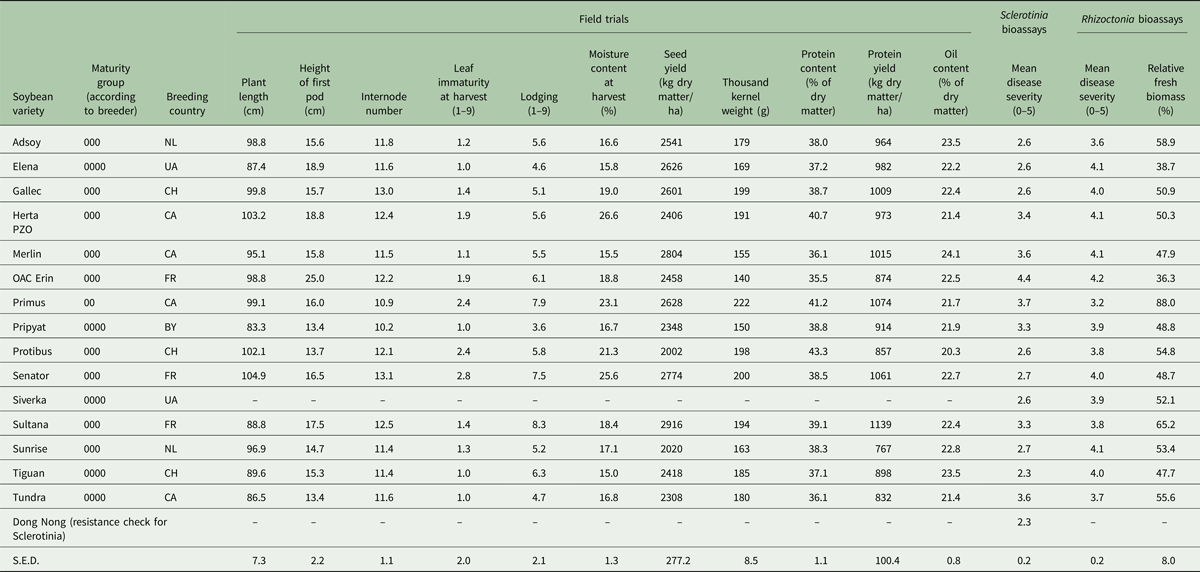
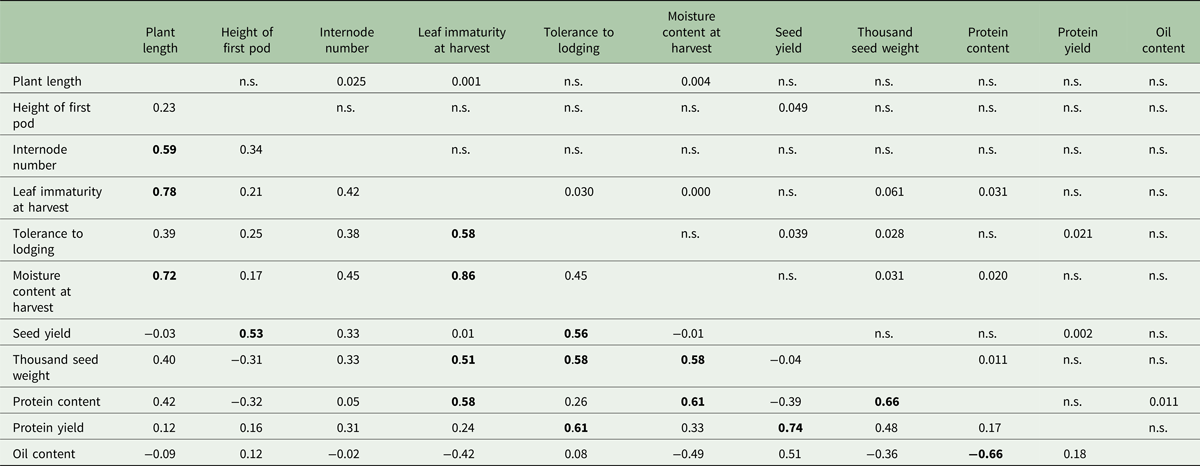
In general, soybean plants started to flower (stage R1) 46 days after sowing and reached the beginning of maturity (stage R7) 127 days after sowing. Among measured parameters, significant differences were observed for the 14 varieties studied (Table 2). Plant length varied between 83.3 cm for variety Pripyat to 104.9 cm for variety Senator, although differences were not significant. Plant length was correlated with a number of internodes (r = 0.59; P = 0.025), but not with a height of the first pod, nor with tolerance to lodging (Table 3). Plant length showed a significant positive correlation with leaf immaturity at harvest (r = 0.78, P = 0.001) and with a moisture content of seeds at harvest (r = 0.72, P = 0.004), indicating that within the subset of early maturing varieties, taller varieties ripened later compared with shorter varieties.
Agronomic characteristics and tolerance to Sclerotinia sclerotiorum and Rhizoctonia solani AG 2-2IIIB of selected early maturing soybean varieties

NL, the Netherlands; UA, Ukraine; CH, Switzerland; CA, Canada; FR, France; BY, Belarus; S.E.D., standard error of difference.
Correlation matrix of the observed agronomic characteristics of field trials with 14 early maturing varieties (above diagonal: P-values; below diagonal: r-values)

n.s., not significant at P < 0.05; r-values in bold are significant at P < 0.05.
Mean height of the first pod reached a maximum at 25.0 cm for variety OAC Erin. Mean number of internodes ranged from 10 for variety Pripyat to 13 for varieties Senator, Gallec and Sultana. At harvest, differences in leaf immaturity were visually observed, although differences were not significant at P < 0.05. Leaf immaturity at harvest showed a strong positive correlation with a moisture content of seeds at harvest (r = 0.86, P ⩽ 0.001), indicating that both parameters are good estimators of the maturity of soybean varieties. The mean moisture content of seeds at harvest varied from 15.0% (Tiguan) to 26.6% (Herta PZO). Leaf immaturity at harvest as well as moisture content of seeds at harvest showed a positive correlation with protein content of seeds (r = 0.58, P = 0.031 and r = 0.61, P = 0.020, respectively), highlighting that within the subset of early maturing varieties, the later ripening varieties possess the highest protein contents. Observations of lodging showed a trend (P = 0.010) to discriminate varieties into susceptible to lodging (Pripyat) and less susceptible to lodging (Sultana). A positive correlation was found between tolerance to lodging and seed yield (r = 0.56, P = 0.039). In other words, lodging can cause significant yield reduction. Positive correlations were also found between tolerance to lodging and thousand seed weight (r = 0.58, P = 0.028) and between tolerance to lodging and protein yield (r = 0.61, P = 0.021), indicating that lodging negatively influences both parameters. Seed yield ranged from 2002 (Protibus) to 2916 kg dry beans/ha (Sultana). Mean thousand kernel weight reached a maximum of 222 g (Primus) and a minimum of 140 g (OAC Erin). A positive correlation between thousand kernel weight and protein content (r = 0.66, P = 0.011) indicates that within the early maturing varieties of the current study, large seeds correspond with a high protein content. Mean protein content differed by almost 8% between varieties Protibus (43.3% protein) and OAC Erin (35.5% protein). Protein yield varied from 767 kg/ha (Sunrise) to 1139 kg/ha (Sultana) and correlated positively with seed yield (r = 0.74, P = 0.002). This was expected since protein yield is calculated as seed yield × protein content. Differences in mean oil content were at the magnitude of 4%, where 24.1% oil was the highest value (Merlin). A significant negative correlation (r = −0.66, P = 0.011) was found between mean protein content and mean oil content.
Sclerotinia
A total of 16 soybean varieties were tested for tolerance to Sclerotinia stem rot. All infected plants showed typical symptoms of Sclerotinia stem rot, starting with brown spots on the leaves, expanding to white fluffy mycelia on leaves, stem and apical meristem at a later stage. Greatest differences in wilting were observed between 11 and 17 days post inoculation, depending on the bioassay. This variation in disease development is probably linked with the growing conditions under the plastic foil where relative humidity could vary between 80% and nearly 100%. No significant interaction effect between soybean variety and bioassay was detected, thus data from the four bioassays could be combined to study the effect of soybean variety. Significant differences in disease severity were found among varieties (P < 0.001) (Table 2). Lowest disease severities were observed for varieties Tiguan (2.27) and resistant check Dong Nong 37 (2.28); highest disease severity was observed for OAC Erin (4.42) of which half of the plants died and the other half showed severe symptoms on most leaves and stems.
Rhizoctonia
Statistical analysis indicated no significant interaction between soybean variety and bio-assay. Therefore, data of the three Rhizoctonia bioassays were analysed together. Significant differences in disease severity among 14 early maturing soybean varieties were detected (P = 0.012) (Table 2). Disease severity ranged from 3.24 to 4.21, with the most tolerant variety Primus and the most susceptible variety OAC Erin, respectively. Relative fresh biomass of inoculated plants ranged from 36.3% for the most susceptible variety OAC Erin to 88.0% for the most tolerant variety Primus. A significant negative correlation between disease severity and relative fresh biomass of inoculated plants was found (r = −0.57, P < 0.001), indicating that symptom development on roots corresponds well with the reduction of above-ground biomass formation.
Discussion
Based on the agronomical performances observed in the current study, it can be concluded that soybean is suited for cultivation in Belgium and that among the earliest maturing varieties currently available in the market, several varieties are able to fulfil agricultural requirements for successful cultivation of soybean in Belgium.
Under Belgian growing conditions, the optimal period for harvesting soybeans is around the end of September to the beginning of October (Aper et al., Reference Aper, De Clercq and Baert2016). After mid-October, further maturation will be slowed by dew in the morning and insufficient drying hours during the day. The current trial results confirm that by harvesting at the end of September/beginning of October, several varieties have reached optimal harvesting conditions corresponding with complete leaf maturity and a moisture content of the seeds below 20%. Yield levels of several varieties approached 2900 kg dry soybeans/ha, considered profitable for soybean in the Netherlands (Engwerda, Reference Engwerda2015). In Europe, the main interest in growing soybean is to achieve a high protein yield, whereas most of the global soybean production is geared toward maximizing oil yield (Sato et al., Reference Sato2014). Kurasch et al. (Reference Kurasch2017a) distinguished two types of European soybean varieties that maximize protein yield. The first type produces high grain yields per hectare with protein contents around 39–42% and is intended as animal feed; the second type provides slightly lower protein yields than the first type but is characterized by very high protein contents above 42% (the threshold required by Belgian's largest processor of soybean for human consumption) (Kurasch et al., Reference Kurasch2017a). The current results show that only one variety out of 14 met that protein threshold. In the subset of varieties, a positive correlation between moisture content at harvest and protein content was found, suggesting that high-protein varieties matured later. Breeding for high-protein varieties in the MG000 group will improve opportunities for growing food-grade soybeans in north-western Europe (Sato et al., Reference Sato2014). Protein content is not only determined by genetic factors; environmental influences also play a major role in protein content (Song et al., Reference Song2016). Climatic conditions in north-west Europe, characterized by relatively low temperatures and high amounts of precipitation, turn this region into a challenging environment for obtaining stable and high-protein content (Vollmann et al., Reference Vollmann2000). Worldwide, soybean production for the food industry accounts for a small fraction of the soybean market, but the soyfood industry is growing. In Europe, this implies a growing demand for non-genetically modified soybeans (Chevalier et al., Reference Chevalier2016). Whether Belgian farmers will grow soybean for fodder or human consumption will depend mainly on differences in farm economic returns.
In European cropping, legumes including soybean are considered a valuable supplement in farmers’ rotations to increase resource efficiency and environmental performance (e.g. by improving soil quality and health, nitrogen management, agro-biodiversity and reduction of greenhouse gas emissions) (Schreuder and De Visser, Reference Schreuder and De Visser2014). Within the framework of the European Common Agricultural Policy, crop diversity is stimulated by direct payments to farmers who fulfil the greening requirements (European Commission, 2017). In Belgian agriculture, soybean has potential as an additional crop to fulfil the greening requirements and to reduce the dependency of protein imports.
Before introducing a new crop into a narrow rotation, attention should be given to possible pests and diseases. In the current study, two major wide-spread fungal diseases were investigated, namely S. sclerotiorum and R. solani. Within a narrow rotation of maize, grass and soybean, R. solani may cause important losses since all three crops are hosts for the highly aggressive AG 2-2IIIB isolates (Zhao et al., Reference Zhao2005; González García et al., Reference González García, Portal Onco and Rubio Susan2006). Bio-assays were optimized and a subset of very early maturing soybean varieties was screened for susceptibility towards both pathogens. Partial resistance or tolerance against both pathogens is present among soybean varieties, although complete resistance has not yet been developed commercially (Kim et al., Reference Kim2000; Bradley et al., Reference Bradley2001). Even within the small subset of early maturing soybean varieties tested in the current study, significant differences in tolerance for both S. sclerotiorum and R. solani AG 2-2IIIB were detected. In breeding programmes, Sclerotinia is often incorporated as a selection factor (Kim et al., Reference Kim2000). This has contributed to clear levels of resistance towards this pathogen, as also observed in the current bioassays. In contrast, up to now, Rhizoctonia has received less attention within breeding programmes, which might be reflected by the narrow range of tolerance among the screened varieties in the current research. Optimal disease management of both pathogens will consist of several strategies, such as chemical control, crop rotation and growing resistant varieties. Information of resistance towards Sclerotinia and Rhizoctonia within the very early maturing variety segment will be essential to successfully introduce soybean into north-western European agricultural practices.
Acknowledgements
We thank Stefan Dubois for his dedicated work in the field trials and Miriam Levenson for English-language editing.
Financial support
Financial support for this project was provided by Flanders Innovation & Entrepreneurship (VLAIO) (project number 120765).
Conflicts of interest
None.
Ethical standards
Not applicable.