INTRODUCTION
Concepts of kinds (e.g. dogs in general) are important in human reasoning. They permit children to make broad generalizations about the world around them, and are also implicated in children's capacity to make predictions, form explanations and develop mature concepts of number and identity (for review see Prasada, Reference Prasada2000; Gelman, Reference Gelman, Hall and Waxman2004). The primary means of referring to kind concepts in language is with generic noun phrases (also referred to hereafter as ‘generics’). For example, the word dogs in the sentence Dogs have four legs is a generic NP.
From a learning standpoint, generics pose a daunting challenge to children. They provide an extreme version of the problem of induction (Chomsky, Reference Chomsky1975; Quine, Reference Quine1960). Researchers studying early semantic development have noted that learning a single word requires an inductive leap beyond the available evidence. When hearing, ‘This is a tapir,’ the child cannot know a priori whether the word tapir refers to the entire animal, a part (e.g. nose), property (e.g. size), movement and so on. For generics, this inductive problem is intensified, because the referent of a generic (e.g. the category of dogs) is never instantiated in the world, as contrasted with more specific concepts (e.g. my dog). Nonetheless, English-speaking children understand generics from a young age (Gelman, Reference Gelman2003; Reference Gelman, Hall and Waxman2004), implying that generic concepts may be foundational in human thought. However, examination of a single language does not provide a good test of the strength of generic concepts, particularly given that English possesses markers that may draw children's attention to the contrast between generics and other noun phrases. Other languages have different linguistic devices and employ them in ways such that the boundaries between generics and other types of noun phrases may appear fuzzier and more prone to overlap, ambiguity and inconsistencies of use. Mandarin Chinese, for example, does not mark plurality, lacks determiners, and only inconsistently marks aspect. Thus, in addition to using bare forms for both indefinite and generic statements, Mandarin can also use bare forms for definite statements (see Cheng & Sybesma, Reference Cheng and Sybesma1999; Erbaugh, Reference Erbaugh and Li2006). This has led some researchers (e.g. Bloom, Reference Bloom1981) to suggest that Chinese speakers have difficulty thinking about generic kinds.
Nonetheless, Gelman and Tardif (Reference Gelman and Tardif1998) found that not only do Chinese-speaking adults produce generic statements in everyday conversations that could be reliably coded by native speakers (Study 1, 2), but they also interpret generics as kind-referring (Study 3). In that study, Mandarin-speaking participants received a set of sixteen sentences, and judged each as referring to ‘one’, ‘a few’ or ‘most or any’ members of the relevant category. On the whole, Mandarin speakers were highly sensitive to the same distinctions as English speakers. For example, sentence (1) below was consistently interpreted as referring to most or any rabbits, whereas sentence (2) was consistently interpreted as referring to one chair.Footnote 1
(1) Xiao3 bai2tu4 bu4 jiao4huan4, shi4 bu2 shi4?Little white-rabbit NEG cry/bark COP NEG COP‘Bunny rabbits don't make noises, do they?’
(2) Guo4-lai2 zuo4 zai4 ni3 de yi3zi shang4.Cross-come sit is at 2PS DE-POSS chair on‘Come and sit in your chair.’
Moreover, both groups of speakers were most consistent across the non-generic sentences, which tended to have more explicit markers such as adjectives, vocative sentence frames or locative phrases, even in Mandarin, indicating that a particular individual or set of individuals might be referred to.
However, as reported in Gelman and Tardif (Reference Gelman and Tardif1998), English speakers were more consistent in their interpretations of these sentences, with 85% agreement across participants on 12 of the 16 sentences (all 8 non-generic and 4 of the 8 generic), whereas Mandarin speakers had 85% agreement for only 6 of these sentences (5 non-generic and 1 generic). Furthermore, the 4 sentences that did not reach 85% agreement in English were all of a particular syntactic form – singular noun phrases with the indefinite article a (e.g. A horse says neigh.). Thus, although both groups of speakers performed above chance on these sentences, they appeared to be just as ambiguous as to whether they should be indefinite or generic in English as they are in Mandarin (49% generic judgments for Mandarin and 53% for English). In contrast, English speakers were more consistent than Mandarin speakers on generic sentences that were plural in English. Thus, both within and across languages, ambiguity of marking generics as distinct from non-generics leads to decreases in the extent to which generics are assumed, and also, potentially, to increased difficulty for acquisition. The ambiguity appears to be greater in Mandarin than in English for plural nouns, but it is a challenge for speakers of both languages.
To date, however, nothing is known about Chinese children's understanding of generics, or their developmental trajectories. Developmental processes can be revealing in ways one cannot see just by looking at the adult endpoint (Slobin, Reference Slobin1985). Child learners presented with greater ambiguity in the input language may take longer to acquire this distinction than children presented with less ambiguous input (see Yu & Smith, Reference Yu and Smith2007, with adults). Thus, children learning Mandarin may take longer to distinguish generic from non-generic NPs, because the referent-to-form mappings for both generics and non-generics in Mandarin are less consistently marked and contain greater levels of ambiguity. In this sense, an examination of how children come to understand generic (as opposed to quantified) NPs will be informative not just about whether Chinese-speakers understand generics, but about how they come to distinguish them from other forms and, more generally, about the role of ambiguous marking systems for acquisition.
The question of whether linguistic input is required for the use of generics has been examined previously in one highly relevant study by Goldin-Meadow, Gelman and Mylander (Reference Goldin-Meadow, Gelman and Mylander2005), which found that both American and Chinese deaf children who had not been exposed to conventional language (hearing or signed) developed gestural systems which they used to produce utterances that appeared to be kind-referring. These findings would seem to suggest that language input is not required for learning kind concepts or generic NPs. However, even if we can conclude from the Goldin-Meadow et al. study that language is not required for production of generic NPs, different forms of language may nonetheless influence the acquisition and developmental course of generics as opposed to non-generics. In order to acquire the conventional means of expressing generic NPs, a hearing child needs to map generics onto particular linguistic forms, and to discover how generic forms differ from non-generic forms in the language she is learning.
One of the issues in trying to assess an understanding of generics is methodological. Commonly used measures of semantic understanding (e.g. having children point to a picture or object exemplifying the concept denoted by the word) are not useable when studying generics, for the simple reason that generics are abstractions that cannot be captured in a picture. However, one can obtain an indirect assessment of the ability to distinguish generic from non-generic NPs by contrasting generics with quantified NPs (e.g. all, some). Certain semantic aspects of generics distinguish them from these quantified expressions. First, for properties that are generally (but not universally) true, generics should differ from ‘all’: for example, ‘dogs are four-legged’ is true, even though ‘all dogs are four-legged’ is false. Second, for properties that are occasionally true, generics should differ from ‘some’: for example, ‘some flowers are yellow’ is true, whereas ‘flowers are yellow’ is false (on a generic reading). In our study, we use a relatively conservative method of providing noun phrases which are either marked explicitly with the quantifiers ‘some’ or ‘all’ or presented in bare form (i.e. generic). We then ask participants to confirm or disconfirm the statements without access to other cues, in order to assess Chinese children's and adults' interpretation of generics. We examine specifically how well they distinguish these three forms of NP. Although it is interesting to consider how these three types of noun phrases are helpful in interpreting properties that range from very broad to completely irrelevant, the linguistic cues should be most informative for properties that are only inconsistently true, as in the ‘flowers are yellow’ example. Thus, in these studies we focus on the properties and statements with relatively narrow scope. Nonetheless, an important point to note is that any failure to distinguish generics, ‘all’ and ‘some’ could be due either to difficulties with generics, or to difficulties with ‘all’ and ‘some’. We will return to this point later on.
Quantifiers are of interest for another reason as well: one debate in the semantic literature concerns the relationship between generics and quantified NPs. Although some have proposed that generics are themselves a kind of quantifier (e.g. Dahl, Reference Dahl and Kennan1975; see Leslie, in press, for a review), others have argued that generics are in principle distinct from quantifiers (Leslie, Reference Leslie2007). For example, the quantified question ‘How many tigers have stripes?’ can be answered with any quantifier (‘Some tigers have stripes’, ‘All tigers have stripes’, ‘Most tigers have stripes’, ‘50% of tigers have stripes’), but cannot be answered with a generic (*'Tigers have stripes') (Carlson, Reference Carlson1977). Observations such as these suggest that generics operate in a distinct manner from quantifiers. Thus, it is of particular interest to discover whether children are sensitive to the distinction between quantifiers and generics and whether Chinese children, in particular, develop this sensitivity at the same rate as English-speaking children, given the differences in syntactic markings. It is important to note here that we are interested not in children's understanding of number words (such as ‘three’), as even two-year-old children understand the distinction between specific numerosities (e.g. ‘three tigers’) and quantified sets (e.g. ‘some tigers’; Hurewitz, Papafragou, Gleitman & Gelman, Reference Hurewitz, Papafragou, Gleitman and Gelman2006; Sarnecka & Gelman, Reference Gelman, Hall and Waxman2004). Of greater interest is when and how children distinguish between generics and quantifiers, as these are semantically more closely related. Generics share semantic properties with ‘all’, in that both generics and ‘all’ refer to a kind as a whole. At the same time, generics share semantic properties with ‘some’, in that both generics and ‘some’ express an indefinite amount. Moreover, in both English and Mandarin Chinese, the same form of the noun phrase can be used to express either a generic, as in (3) below, or an indefinite quantity, as in (4).Footnote 2 Thus, children may at first fail to distinguish generics from either ‘all’ or ‘some’ (see Hollander, Gelma & Star, Reference Hollander, Gelman and Star2002).
(3) Dogs are four-legged.gou3 you3 si4-tiao2 tui3. Dog(s) have four-CL leg(s)
(4) Dogs were running in the park yesterday.Zuo2tian1 gou3 zai4 gong1yuan2 li3 pao3.Yesterday dog(s) is-at park in run
Moreover, although we are framing children's interpretation of generics in terms of how generics compare to the quantifiers ‘all’ and ‘some’ in terms of scope, we stress that the semantics of generics are more complex than an analysis of scope of quantification alone would suggest. As noted above, generics do not reduce to any particular quantity or quantifier (Cimpian, Gelman & Brandone, Reference Cimpian, Gelman and Brandone2010). For example, ‘Ticks carry Lyme Disease’ is judged to be true by adult speakers of English, even though only a small percentage of ticks actually do so, and ‘Ticks do NOT carry Lyme Disease’ is judged to be false, even though this property is true of most ticks. In contrast, ‘Some ticks do not carry Lyme Disease’ would be judged to be true. For adults, generics also imply that a property is more likely to be inherent (Gelman & Bloom, Reference Gelman and Bloom2007; Prasada & Dillingham, Reference Prasada and Dillingham2006). Thus, although in the present investigation we make use of a set of tasks that assess property scope, we do not mean to imply that scope is the full extent of how generics differ from quantified expressions.
The present studies were thus designed as a first step in investigating these issues, with the goal of obtaining data that could be rigorously compared to prior findings in English and other languages (e.g. Quechua), to answer the question: When in development do Chinese children start to understand generic NPs, as distinct from ‘all’ or ‘some’ (also known as quantified NPs)? There are at least three hypotheses: (1) from an early age, Chinese children may understand generic NPs as distinct from quantified NPs, suggesting that the generic/quantifier distinction is easily acquired despite variation in the input; (2) Chinese children may at first have difficulty distinguishing generic NPs from quantified noun phrases, because of difficulty interpreting generic NPs. This would provide some partial support for a weaker version of Bloom's (Reference Bloom1981) position. (3) Chinese children may at first have difficulty distinguishing generic NPs from quantified noun phrases, because of difficulty interpreting quantified NPs. This third possibility would be consistent with the suggestion that generics may be a default interpretation for young children (Hollander et al., Reference Hollander, Gelman and Star2002; Leslie, Reference Leslie2007). In a study of English speakers, Hollander et al. (Reference Hollander, Gelman and Star2002) found that the youngest children in their sample, three-year-olds, treated generics, ‘all’ and ‘some’ as equivalent to one another, and as equivalent to older children's interpretation of generics. In other words, the young English-speaking children seemed to treat generics as a default, with non-generic quantified NPs (‘all’ and ‘some’) emerging only later in development.
We study this question with two distinct tasks to obtain converging evidence, testing first Mandarin-speaking adults' (Study 1) then children's (Study 2) comprehension of generic and non-generic, quantified questions, and finally testing children's and adults' production of properties when prompted with generic or quantified noun phrases (Study 3). It is important to note, however, that the tasks we have chosen for testing these hypotheses are quite difficult and thus provide a strict test of the first hypothesis – that the generic/quantified distinction is easily acquired despite variation in how it is marked across languages. These experiments provide a conservative test of the hypothesis, in that they provide minimal contextual cues, and they focus exclusively on the presence versus absence of quantifiers. The advantages of this approach are twofold. First, it permits a direct comparison with prior research in English, which used this method. And second, it provides a baseline against which other cues (such as tense, number or interpretive context) could be compared in the future.
STUDY 1: CONFIRMATION OF GENERIC NOUN PHRASES IN MANDARIN-SPEAKING ADULTS
An important question, given the lack of obligatory marking of generic phrases in Mandarin and the possibility of alternative interpretations for generic utterances (i.e. see Cheng & Sybesma, Reference Cheng and Sybesma1999; Erbaugh, Reference Erbaugh and Li2006; Yang, Reference Yang2001), is to what extent Chinese-speaking adults make generic interpretations of bare noun phrases vs. NPs that are marked with ‘all’ or ‘some’. Complicating this is the fact that the quantifiers ‘some’ and ‘all’ are more variable and dependent on context in Mandarin than in English (Yang, Reference Yang2001). Thus, in order to frame our understanding of the developmental characteristics of Chinese-speaking children's understanding of generics, it is essential first to obtain a baseline of adult performance, as compared to English, with each of the ‘some,’ ‘all’ and generic phrasings that we intend to use with children. Importantly, we are looking to see whether Mandarin-speaking adults distinguish not just generic from non-generic noun phrases, but additionally whether they distinguish between generic and ‘all’ (on the one hand) and between generic and ‘some’ (on the other hand). For example, do they distinguish between ‘Some flowers are yellow’ (to which English-speakers say ‘yes’), ‘Flowers are yellow’ (‘yes’, but there is not as high agreement for the generic phrasing vs. ‘some’), and ‘All flowers are yellow’ (resulting in distinctly ‘no’ answers). Bloom's understanding of how Chinese marks generics would suggest a lack of distinction here between the generic and non-generic reads and would predict no differences between a generic vs. ‘some’ phrasing.
Our hypothesis, based on previous data presented by Gelman and Tardif (Reference Gelman and Tardif1998), is that Chinese-speaking adults would in fact be sensitive to these cues. Nonetheless, it is not clear when Chinese-learning children would also show this sensitivity.
METHOD
Participants
Eighteen undergraduate students (half female) at Beijing Aerospace University participated in Study 1. An additional 18 undergraduate students participated in a pretest of alternative linguistic forms (see footnote 3). All participants were paid RMB10 for their participation in the study and filled out consent forms before participating, as required by IRB procedures at the University of Michigan and the Chinese University of Hong Kong.
Items
Participants each received three blocks of questions (generic, ‘all’ and ‘some’), in one of three orders (all-some-generic, some-generic-all or generic-all-some). For all participants, each block consisted of 12 questions (Appendix A lists all items in English and Mandarin): 4 concerning properties that apply broadly to all or nearly all members of the category, henceforth called ‘broad-scope’ properties (e.g. ‘Do crocodiles have mouths?’), 4 concerning properties that apply to just a subset of the category, henceforth called ‘narrow-scope’ properties (e.g. ‘Do books have colored pictures?’), and 4 concerning properties that do not apply to the category at all, henceforth called ‘irrelevant’ properties (e.g. ‘Do pigs fly?’). Note that ‘scope’ here is used in a narrow sense to refer strictly to the relationship between a property and the target category in the design of this experiment, and is not meant to imply the linguistic sense of scope.
The truth value of these questions varies as a function of property scope and linguistic form condition. A ‘yes’ response to broad-scope items (e.g. ‘Does (all, some) ice cream melt in the sun?’) could be seen as ‘correct’ in all three linguistic form conditions, but that same ‘yes’ response to irrelevant items (e.g. ‘Do (all, some) monkeys have wings?’) is always incorrect. For narrow-scope items (e.g. ‘Do (all, some) girls have curly hair?’), ‘yes’ is clearly correct for ‘some’ questions, possibly correct for generic questions and clearly incorrect for ‘all’ questions.
Because we wanted to be able to compare across languages, many of the questions were derived from Smith (Reference Smith1980) and had been used in prior studies conducted in English (Hollander et al., Reference Hollander, Gelman and Star2002) and Quechua (Mannheim, Gelman, Escalante, Huayhua & Puma, Reference Mannheim, Gelman, Escalante, Huayhua and Puma2011), with minor changes made to adapt to Chinese cultural and social issues. For example, ‘Do people have blonde hair’ was changed to ‘Do people wear glasses’, because Chinese people generally do not have blonde hair, whereas some, but not all, Chinese people wear glasses. See Appendix A for the full list of properties.
Each property was rotated through each of the three linguistic forms, so that the specific content was not confounded with a particular condition. Thus, across participants, a given question would be ‘Are fires hot?’; ‘Are all fires hot?’; or ‘Are some fires hot?’ (see below and Appendix A for Chinese sentences). In addition, each participant received one-third of the items in each of the three conditions, with blocked presentation of 12 items for each linguistic form. Order of condition blocks and assignment of specific items to condition were counterbalanced across participants.
Wording of ‘some’, ‘all’ and generic conditions in Chinese
Because the particular ways in which Mandarin marks both generic and quantified noun phrases can vary, and direct comparisons between an indefinite, unmarked generic NP in English vs. an NP marked with ‘some’ or ‘all’ can be translated in a number of ways, we spent considerable effort coming up with wording that would be familiar to children (regardless of whether it was understood as generic or quantified) and that had the simplest possible syntax. In addition, there is ambiguity with respect to whether one of the possible quantifier morphemes (dou1) refers to either generic or ‘all’ readings (different contexts can preference different readings of it – see also Cheng, Reference Cheng1995; Huang, Reference Huang1996), and thus we excluded this morpheme from our final stimulus sets.Footnote 3 Finally, although ‘all’ is commonly marked in at least three different ways (using sou3you3, dou1 or sou3you3 … dou1), we decided not to use the syntactically more complex and semantically redundant marking of suo3you3 … NP … dou1. Thus, participants heard sentences marked as follows, using ‘pigs fly’ (zhu1 hui4 fei1) as an example:
(5) GENERIC (bare NP)Zhu1 hui4 fei1 ma?Pig(s) can fly SFP-QUES‘Do pigs fly?’
(6) SOME (you3 de+NP)
You3 de zhu1 hui4 fei1 ma?Some pig(s) can fly SFP-QUES‘Do SOME pigs fly?’
(7) ALL (suo3you3 de+NP)
Suo3you3 de zhu1 hui4 fei1 ma?All pig(s) can fly SFP-QUES‘Do ALL pigs fly?’
In addition, consistent with the English sentences used by previous researchers, all of the Mandarin sentences examine both children's and adults' interpretations for nouns used in the subject position of a yes/no question, which in Mandarin, as in English, appears before the main verb of the sentence. Although generic interpretations vary according to where the target noun appears relative to the verb in declarative sentences for Mandarin-speaking adults (Cheng & Sybesma, Reference Cheng and Sybesma1999), we are interested primarily in how interpretations vary as a function of syntactic markings and the scope of the properties involved – neither of which has been examined systematically for Mandarin speakers. Moreover, we acknowledge that the focus on short sentences with minimal marking of the distinction between quantified vs. generic NPs might underestimate Chinese speakers' sensitivity to the generic/non-generic distinction in Chinese. However, as mentioned above, we were interested in making comparisons both across languages and across ages. Thus, as with the study conducted by Hollander et al. (Reference Hollander, Gelman and Star2002), we held constant the position of the target noun phrase, although future studies might also consider the role of sentence position in further influencing generic interpretations in both English- and Mandarin-speaking children and adults. Nonetheless, Study 1 is important in examining the extent to which native Mandarin-speaking adults make use of both general quantifiers (‘some’, ‘all’ or the absence of a quantifier) and property scope in making generic judgments for yes/no questions. If adults are found to use these cues in Mandarin, it then becomes important to ask when and how child speakers of Mandarin develop the sensitivity to these same cues.
Procedure
Adults were tested in groups and given 36 questions (4 in each of the property and linguistic form conditions) to which they were asked to reply ‘yes’ or ‘no’.
RESULTS
Although qualified responses could be considered neither a ‘yes’ nor a ‘no’ response, we adopted a conservative coding strategy, in which participants had to demonstrate positive evidence for a ‘yes’ response in order to obtain a ‘1’. Thus, responses were scored 1 for each ‘yes’ response, and 0 for all other responses (e.g. ‘no,’ ‘none’ or qualified response such as (8), below):
(8) Zhu1ba1jie hui4 fei1.
Zhubajie [a famous pig in the Chinese epic, Journey to the West] can fly/flies
‘Zhubajie can fly.’
For each participant, we summed the scores separately for each of the 9 cells in the study design (3 linguistic form conditions [all, generic, some]×3 types of properties [broad-scope, narrow-scope, irrelevant]). Thus, each participant received 9 scores, each of which could range from 0 to 4.
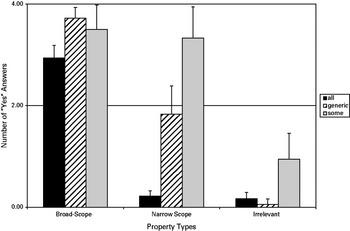
Recall that the truth value of these questions varies as a function of property scope and linguistic form condition (‘yes’ is always appropriate for broad-scope items, ‘yes’ is always inappropriate for irrelevant items, and ‘yes’ should vary as a function of linguistic form condition for narrow-scope items). Clearly, then, analyses cannot focus on condition alone, and narrow-scope items are particularly crucial in distinguishing among the linguistic form conditions. Thus, the scores were entered into a 3 (linguistic form: all, generic, some)×3 (property: broad-scope, narrow-scope, irrelevant) repeated measures ANOVA. Consistent with Tabachnick and Fidell's (Reference Tabachnick and Fidell1989) suggestion that partial η2 is an appropriate alternate computation of η2, all eta-squared (η2) results reported here use the partial eta-squared formula (SSeffect/(SSeffect+SSerror)). As can be seen from Figure 1, there was a large effect of Property (F(2, 34)=124·83, p<0·001, η2=0·88), with broad-scope properties generating the highest number of ‘yes’ responses, irrelevant properties generating very few ‘yes’ responses, and narrow-scope properties intermediate and highly variable, depending on the linguistic form condition. In addition there was a main effect of Linguistic form (F(2, 34)=33·77, p<0·001, η2=0·70), and a 2-way interaction between Property and Linguistic form (F(4, 68)=20·57, p<0·001, η2=0·60). Most importantly, Mandarin-speaking adults showed clear distinctions between ‘all’ (suo3you3), generic (bare NP) and ‘some’ (you3de) linguistic form conditions when asked about narrow-scope properties, thus replicating the results found for English by Hollander et al. (Reference Hollander, Gelman and Star2002). In addition, the Mandarin-speaking adults in our study were more likely to limit the scope when asked about suo3you3 ‘all’ vs. bare NP generics or you3de ‘some’ for broad-scope properties (even though they were true) and more likely to agree when given irrelevant properties if qualified by you3de ‘some’ vs. bare NP generics, Bonferonni ps<0·05 and 0·01, respectively, for post-hoc tests of means. These results also parallel those found for English-speaking adults and strongly contradict Bloom's assertion (Reference Bloom1981: 36) that English and Chinese speakers' understanding of generics, as opposed to quantified noun phrases, is different because Chinese does not have an unambiguously marked way to distinguish generic noun phrases. However, it is not clear when child speakers of Mandarin might develop this sensitivity, given the relatively early productive use but inconsistency of quantifier marking in Mandarin. Study 2 was designed to address this issue.
Study 1, Mandarin-speaking adults' mean # ‘yes’ responses (/4) to ‘all’ (suo3you3), bare NP generic or ‘some’ (you3de) linguistic form conditions for Broad-Scope, Narrow-Scope and Irrelevant Properties, with standard error bars.

STUDY 2: CONFIRMATION OF GENERIC NOUN PHRASES IN CHILDREN
METHOD
Participants
Three-year-olds (N=13; age range 3 ; 2–3 ; 10; mean age 3 ; 6), four-year-olds (N=18; age range 4 ; 0–4 ; 11; mean age 4 ; 6), five-year-olds (N=18; age range 5 ; 1–5 ; 11; mean age 5 ; 4), and seven-year-olds (N=18; age range 7 ; 0–7 ; 11; mean age 7 ; 4) participated, with roughly half males and half females at each age. The children attended local preschools in Beijing, China, and parents and preschools consented to their participation. An additional five three-year-olds were tested but their data not further analyzed due to response biases (4 who responded ‘yes’ to all questions, and 1 who responded ‘no’ to all questions).
Items
As with the adults in Study 1, child participants each received three blocks of questions (generic, ‘all’ and ‘some’), in one of three orders (all-some-generic, some-generic-all or generic-all-some), with order counterbalanced across participants. For all but the three-year-olds, each block consisted of 12 questions (see Appendix A for English and Mandarin): 4 concerning broad-scope properties (e.g. ‘Do crocodiles have mouths?’), 4 concerning narrow-scope properties (e.g. ‘Do books have colored pictures?’), and 4 concerning irrelevant properties (e.g. ‘Do pigs fly?’), with each property again rotated through each of the three linguistic form conditions. Three-year-olds received half as many items, equally distributed across conditions, as the older participants. As with the adults in Study 1, the target sentences were the ‘narrow scope’ properties for which the generic interpretation might be confused with an indefinite and for which quantified phrases are most informative.
Procedure
Children were tested individually in a quiet room at their schools. Before the testing session, each child was told that she would be playing a special game in which she could pick a card and place it on a Velcro board (see Hollander et al., Reference Hollander, Gelman and Star2002: Study 2). Specifically, the children were given the instructions listed in (9) below:
(9) wo3 zhe4li3 you3 yi2ge zhan1tie1ban3, hai2you3 yi1xie1 cai3se4 de ka3pian4.1PS here have one-CL stickyboard, also(have) one-CL(few) color DE-DESC cards‘I have a sticky board and some colored cards.’… zhe4xie1 ka3pian4 ke3yi3 zhan1 zai4 zhei4 tie1ban3 shang4.… DEIC-CL(few) card(s) can stick is at DEIC stickyboard on… ‘The cards can stick onto the board.’… mei3zhang1 ka3 shang4 dou1 you3 yi1ge wen4ti3.Each-CL(flat) card on all have one-CL question/problem… ‘Each card has a question on it.’… wo3 ba3 wen4ti3 nian4 gei3 ni3 ting1, ni3 jiu4 ke3yi3 hui2da2, hao3 ma?… 1PS BA-obj question read BENEF 2PS hear, 2PS just/then can respond, good SFP-QUES?… ‘I'll read the question to you and then you can answer it, ok?’
The Velcro board allowing the children to choose and stick the cards onto the board was included in order to heighten children's interest and involvement in the task. The experimenter both audiotaped and wrote down the child's response.
The three- and four-year-olds also received a post-test designed to test their comprehension of ‘all’ and ‘some’ with concrete and immediately perceptible referents (modeled on a task developed by Smith, Reference Smith1979: 439, and used as a post-test by Hollander et al., Reference Hollander, Gelman and Star2002). This task was included in order to determine if children understood the basic semantic implications of the two quantifiers, in a context that is minimally demanding. The post-test requires only that children consider quantification of a small set of individual objects placed directly in front of them, in contrast to the primary experiments, which require the more difficult computation of extending the quantifiers to kinds or subsets of kinds. We predicted that even these preschool-aged children would honor a distinction between ‘some’ and ‘all’ when the referents are concrete and small in number, indicating a basic capacity to understand and reason about these expressions. Success on the post-test would then license the inclusion of preschool children in the studies proper.
For the post-test, the experimenter produced a small container and 4 crayons. There were 8 trials, 4 with ‘all’ and 4 with ‘some’. For each trial, the experimenter placed 0, 2, 3 or 4 of the crayons into the box, and then asked: ‘Are all (suo3you3de) of the crayons in the box?’ or ‘Are some (you3de) of the crayons in the box?’ The questions were presented in two blocks (‘all’ and ‘some’), with order of the blocks counterbalanced. The order of the questions within a block (0, 2, 3 or 4 crayons in the box) was randomized separately for each participant, with the constraint that the potentially ambiguous questions (0 for ‘all’ crayons; 4 for ‘some’ crayons were always presented last in the block).
RESULTS AND DISCUSSION
Post-test interpretations of ‘some’ and ‘all’
We scored responses of ‘yes’ as ‘1’ and responses of ‘no’ as ‘0.’ See Table 1 for results. We conducted a 2 (linguistic form: ‘all’ (suo3you3) vs. ‘some’ (you3de)×4 (number: 0, 2, 3, 4) ANOVA. Results indicated clear effects of linguistic form (F(1, 34)=7·03, p=0·012, η2=0·17), number (F(3, 102)=27·55, p<0·001, η2=0·46), and linguistic form×number (F(3, 102)=3·19, p=0·027, η2=0·09). A planned comparison analysis of linguistic form confirmed that three- and four-year-old children's interpretations of ‘some’ (you3de) differed significantly from ‘all’ (suo3you3de), and a comparison of the different number conditions also confirmed that children's interpretations when 0, 2 or 3 crayons were in the box each differed significantly from when all 4 crayons were placed in the box (F(1, 34)=25·14 to 33·26, ps<0·005 to 0·0001).
Study 2, three- and four-year-olds' responses on the ‘all’/'some' post-test. Scores indicate the mean number of ‘yes’ responses out of 1

ab Numbers in a row with different superscripts are significantly different from each other in a post-hoc comparison of means for trials with ‘some’ or ‘all’ wording (performed separately for 0, 2, 3 or 4 crayons in the box, with Bonferroni corrections).
Most important is the question of how children performed on the interaction between linguistic form and number. Post-hoc comparisons of the means from this interaction reveals that ‘some’ and ‘all’ differed from one another for the quantities 2 and 3, as appropriate, and as shown in Table 1. In other words, children consistently rejected both quantifiers when 0 crayons were in the box, and consistently accepted both quantifiers when 4 crayons were in the box, but were more likely to say that ‘some’ (vs. ‘all’) crayons were in the box when the quantity was 3 (p=0·012).
Thus, it is clear that by preschool age, Mandarin-speaking children are beginning to show sensitivity to the differences between the terms suo3you3 ‘all’ and you3de ‘some’ and that they take into account both the linguistic form and the actual number of items involved in the task, with a non-demanding task in which the quantifiers are applied to a small set of individual objects placed directly in front of them. Interestingly, however, the results are strikingly different from those of English-speaking three-year-olds, only 6% of whom agreed that ‘all’ of the crayons were in the box when 3 out of 4 crayons were in the box (as reported by Hollander et al., Reference Hollander, Gelman and Star2002). There are a number of possibilities that could explain this discrepancy, including differences in frequency, slight differences in the scope of the terms cross-linguistically (although Mandarin-speaking adults in Study 1 showed understandings of these terms that were almost identical to English-speakers), or the phonological overlap between the terms for ‘some’ and ‘all’ in Mandarin – all of which could lead to differences in performance between preschool-aged speakers of English vs. Mandarin.
‘some,’ ‘all’ and generic interpretations in confirmation task
We turn now to the results of the primary task, namely, the confirmation task. Responses were scored in the same manner as that used for the adults: 1 for each ‘yes’ response, and 0 for all other responses (e.g. ‘no’ or qualified response). For each participant, we summed the scores, separately for each of the 9 cells in the study design (3 linguistic form conditions [all, generic, some]×3 types of properties [broad-scope, narrow-scope, irrelevant]). Thus, each participant received 9 scores, each of which could range from 0 to 2 (for three-year-olds) or from 0 to 4 (for older children and adults). The scores of the three-year-olds were then transformed by multiplying each score by 2, thereby rendering them on the same scale as the two older age groups.
These scores were then entered into a 4 (age: 3, 4, 5, 7)×3 (linguistic form: all, generic, some)×3 (property: broad-scope, narrow-scope, irrelevant) repeated measures ANOVA. As with the adult data, there was a large effect of Property (F(2, 126)=317·47, p<0·001, η2=0·83), with broad-scope properties generating the highest number of ‘yes’ responses (M=3·56 out of 4, SE= 0·06), irrelevant properties generating very few ‘yes’ responses (M=0·81 out of 4, SE=0·12), and narrow-scope properties intermediate (M=2·43 out of 4, SE=0·12) but highly variable, depending on the linguistic form condition, particularly for the older age groups. (Each of these means are provided out of 4, as they were averaged across the three linguistic form conditions rather than summed across these conditions.) In addition to age and linguistic form main effects, all 2-way interactions were significant, and the 3-way interaction between property, linguistic form and age was also significant (F(12, 252)=4·08, p<0·001, η2=0·16). For the child speakers, it was also important to ensure that any differences in the sensitivity shown across wording types by the older children were not a function of any metalinguistic strategies accessible to older, but not younger, children that could have been used as a result of our block design. Thus, we also examined these data for only the first block of items received by each child. As with the overall analysis which examined linguistic form within subjects, there was a main effect of Property (F(2, 110)=158·79, η2=0·74, p<0·0001), and a linguistic form by property by age interaction (F(12, 110)=2·34, η2=0·20, p=0·01), with means in each property and linguistic form condition nearly identical to the within-subject comparisons across blocks with different linguistic forms.
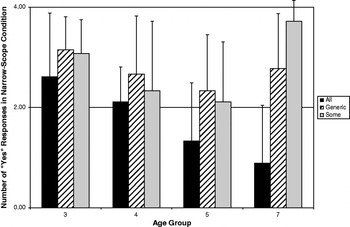
Given the complicated nature of the interactions and the fact that our target sentences were those with Narrow-Scope properties, Figure 2 focuses only on these target sentences, as these were also the items for which linguistic form effects in the adults were most apparent, both in Mandarin and in English (Hollander et al., Reference Hollander, Gelman and Star2002). (For a fuller examination of the means in each condition by age group and comparisons of these means to chance responding, see Appendix B.) As shown in Figure 2, Mandarin-speaking children make greater distinctions among generic, ‘some’ and ‘all’ at older ages than younger. Interestingly, it was not until age five that the Mandarin-speaking children began to differentiate across linguistic form conditions, endorsing statements of narrow-scope more when they received ‘some’ or generic wordings than when they were explicitly asked if ‘all’ of the members of the category had the property, by Bonferroni's post-hoc test of means (ps<0·001). This result is comparable to that found in English (reported in Hollander et al., Reference Hollander, Gelman and Star2002), in which children first differentiated ‘some’/generic from ‘all,’ though at age four instead of five. By age seven, Mandarin-speaking children showed the adult pattern of endorsing these narrow-scope statements most often when given the ‘some’ wording, followed by the generic wording, and least often with the ‘all’ wording, Bonferroni's post-hoc test of means, p<0·001 for each of these comparisons. Unlike the adults in Study 1, however, not even the seven-year-olds showed differential endorsement rates across the linguistic form conditions for the broad-scope and irrelevant properties, even though performance in these conditions clearly differed from chance, as shown in Appendix B. Taken together, these results suggest that the timeline for development of sensitivity to the specific distinction between generic NPs and non-generic quantifiers is more prolonged in Mandarin relative to English. Nonetheless, the particular pattern of differentiation first of ‘some’ vs. ‘all’ and later of generic as less than ‘all’ but more than ‘some’ is identical to that shown in English (Hollander et al., Reference Hollander, Gelman and Star2002).
Study 2 results, mean # ‘yes’ responses (/4) to ‘all’ (suo3you3), bare NP generic or ‘some’ (you3de) linguistic form conditions for Narrow-Scope Properties with standard error bars, by Age.

Interestingly, age differences were also found in both the ‘some’ and the ‘all’ conditions, but not in the generic, even when only the narrow-scope properties were considered. Specifically, Bonferroni-corrected post-hoc tests of means revealed that three-year-olds were more likely (incorrectly) to endorse ‘all’ wordings than both five- and seven-year-olds, and four-year-olds were also more likely (incorrectly) to endorse them than seven-year-olds, even in this narrow-scope property condition. Similarly, both four- and five-year-olds were less likely (again, incorrectly) to endorse ‘some’ wordings than seven-year-olds in the narrow-scope condition. In contrast, there were no significant age differences in the likelihood that children endorsed the generic form in this condition.
As noted in the ‘Introduction’, there are at least two distinct interpretations for why a prolonged generic/non-generic differentiation is found. One possibility is that generics are slow to emerge, an interpretation one might expect given the inconsistencies of marking and ambiguities inherent in the generic form (Bloom, Reference Bloom1981). A second possibility is that non-generics are slow to emerge, an interpretation that is consistent with the proposal that generics are a default interpretation for children. We believe the data are more consistent with the latter interpretation, as the generics show no change with age in their interpretation. Rather, developmental change can be seen most clearly in the differentiation of ‘some’ and ‘all’.
However, a third possibility is that children's poorer performance with ‘some’ and ‘all’ may reflect information-processing difficulties with these quantifiers, rather than a more general tendency to interpret not-yet-acquired expressions as generic. For example, children may have difficulty with the requisite cognitive steps (recalling representative exemplars of the category in question, computing the relative frequency of different subtypes [e.g. flowers that are yellow vs. flowers that are not yellow], and comparing this amount to that implied by the quantifier). In the face of such challenges, younger children may simply ignore the words ‘some’ and ‘all’, thereby interpreting ‘some flowers’ and ‘all flowers’ as if they were ‘flowers’. Although this would lead to the same patterns of performance obtained here, it would stop short of demonstrating more generally that generics are a default interpretation. Converging evidence from other linguistic expressions would be needed to provide a fuller understanding of children's interpretation.
Alternatively, a fourth possibility is that the Chinese-speaking children in our study had particular difficulty with the specific forms selected for marking ‘some’ (you3de) and ‘all’ (suo3you3), given that there is overlap between these expressions (i.e. the syllable you3 appears in both, and a more common but syntactically complex and semantically redundant phrasing of ‘suo3you3 de NP dou …’ may have facilitated performance somewhat for the ‘all’ interpretations). However, it is more parsimonious to posit the same developmental mechanism as in English, where the items and the developmental trajectory were identical (i.e. generics interpreted in adult-like fashion throughout the age range, but quantified expressions undergoing developmental change), albeit with the forms differentiated at a later age in Chinese. Moreover, although there are many alternative forms for marking ‘some’ and ‘all’ in Chinese, it is difficult to find ‘child-friendly’ forms for these terms that do not overlap phonologically (see also Brooks, Jia, Braine & DaGraca Dias, Reference Brooks, Jia, Braine and DaGraca Dias1998). Thus, while not discarding the possibility that children may perform better if alternative forms of ‘all’ and ‘some’ were to be used, and while noting that this hypothesis deserves empirical test, we believe it is possible that the source of the difficulty lies not with the forms per se, but rather in the inconsistencies with which they are marked in typically occurring speech (Yang, Reference Yang2001; Yu & Smith, Reference Yu and Smith2007).
STUDY 3: ELICITED PRODUCTION TASK
Study 3 was similar in logic to Studies 1 and 2 but differed in design. Here, children were asked to produce their own utterances, under the guise of telling a puppet named Guai4Guai4 (‘Strange-Strange’) about the category (a method based on Hollander et al., Reference Hollander, Gelman and Star2002: Study 2). Specifically, we were interested in how the scope of the properties would vary depending on the linguistic cue provided. In addition, having children generate their own properties and their own sentences allows us to examine their understanding of generic vs. quantified NPs with a more naturalistic task. The prompts employed one of three kinds of cues: generic (bare NP), ‘all’ (suo3you3) or ‘some’ (you3de). An analogous paper-and-pencil version of the task was developed for adults. We predicted that properties generated under ‘all’ prompts would be broadest in scope, properties generated under ‘some’ prompts would be narrowest in scope, and properties generated under generic prompts would be intermediate in scope. However, we were also interested in examining developmental changes, given the relatively poor performance on the confirmation tasks by even the five-year-olds in Study 2.
METHODS
Participants
Sixty five-year-olds (range=5 ; 0 to 5 ; 11), 60 seven-year-olds (range=7 ; 0 to 7 ; 11), and 35 adults participated. In addition, a second group of 92 adults rated the properties by the first group of adult and child participants. The adults were undergraduates at Beijing Aerospace University; the children attended local preschools in the same vicinity as the university. Parents of children and adult participants consented to participation and IRB guidelines for the collection of human subjects data were followed with all participants.
Items
There were twelve categories: birds, cats, dogs, fish, boys, girls, smart people, shy people, tables, shirts, cars and either computers (for adults) or houses (for children). The items included a variety of natural kinds, social categories and artifacts in order to provide a broad sample.
Procedure
Each participant was randomly assigned to one of three conditions: generic (bare NP), ‘all’ (suo3you3) or ‘some’ (you3de). Adults were tested in small groups. Participants received a page of written instructions, using the category ‘trees’ (or ‘all trees’ or ‘some trees’, depending on the linguistic form condition) as a warm-up example. Participants were asked to list five things that were true of each category. The items were presented in randomized order, with the constraint that every three items included one animal category, one artifact category and one social category. Participants worked through the booklet at their own pace.
Children were asked to give information to Guai4Guai4, a puppet from a foreign country who didn't understand much about how things work in China. The prompts children heard employed one of three kinds of cues, as presented in sentences (10)–(12), below:
(10) GENERIC
ni3 neng2 bu4 neng2 jiao1 Guai4Guai4 nü3hai2zi zen3me yang4?2PS can NEG can teach GuaiGuai girl(s) how/what like(ness)‘Can you tell GuaiGuai what girls are like?’
(11) ALL
ni3 neng2 bu4 neng2 jiao1 Guai4Guai4 suo3you3 denü3hai2zi zen3me yang4?2PS can NEG can teach GuaiGuai all girl(s) how/what like(ness)‘Can you tell GuaiGuai what all girls are like?’
(12) SOME
ni3 neng2 bu4 neng2 jiao1 Guai4Guai4 you3denü3hai2zi zen3me yang4?2PS can NEG can teach GuaiGuai some girl(s) how/what like(ness)‘Can you tell GuaiGuai what some girls are like?’
After the initial prompt, we also asked a set of three additional prompts for each item, in order to elicit as much talk as possible. Examples are provided in (13)–(17):
(13) X gan4 shen2me?X do what‘What do Xs do?’ (for animals and people)
(14) ren2men yong4 X zuo4 shen2me?People use X do what?‘What are Xs used for?’ (for artifacts)
(15) X you3 shen2me?X have what‘What do Xs have?’
(16) X chuan1 shen2me?X wear what‘What do Xs wear?’ (for people)
(17) X shi4 shen2me yan2se4 de?X COP what color DE-EMPH‘What color are Xs?’ (for non-people)
Coding
Children's responses were transcribed, and responses from the children and the adults were broken down into propositions. For example, when responding to what ‘girls’ are like, one child said mei3li4, shan4liang2 ‘pretty, kind’ which we divided into two separate responses – ‘pretty’ (mei3li4) and ‘kind’ (shan4liang2). We then formed two lists: (1) all the unique propositions produced by the children, and (2) all the unique propositions produced by the adults.
A separate set of adults then rated the properties for scope. Specifically, they were asked to indicate how often (using a scale ranging from 0%–100%, in 10% increments) each property in the list was true for the category as a whole. Adult raters were blind to the purpose of the ratings, to the linguistic prompts that were provided by the experimenter and to the linguistic format in which the property was expressed. So, for example, you3 wei3ba (‘have tails’) would be rendered the same – regardless of whether it was preceded by ‘some,’ ‘all’ or nothing – for the adult raters.
Due to the large number of properties that were generated, each adult rated properties from only 3 of the 12 categories (1 animal kind, 1 social kind and 1 artifact category) and was given the full set of either child-generated or adult-generated properties for each of these 3 categories. Altogether, there were 38 raters for adult properties (N=9 to 10 raters per category) and 54 raters for child properties (N=13 to 14 raters per category).
We then averaged the adult ratings for each property. For example, the ratings for the property listed in (18), below, which had been generated by one of our child subjects for dogs, were averaged across the fourteen adults who provided ratings for that property. We then went back and assigned this mean score for the trial on which the child provided this particular property (e.g. dogs, but in the ‘all’ condition for this child) and calculated, across all categories and properties, the mean ratings assigned to the properties generated (see Hollander et al., Reference Hollander, Gelman and Star2002, for more detail).
(18) you3 bo2zi shang4 tao4 de dong1xi1.Have neck on encase(d)/wrapped DE-NOM thing‘Have things wrapped around their neck.’
RESULTS AND DISCUSSION
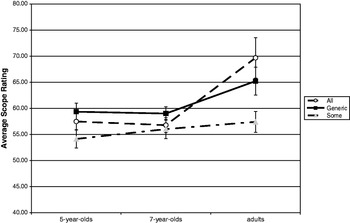
A 3 (age: 5, 7, adult)×3 (condition: ‘all’, generic, ‘some’) ANOVA was conducted; see Figure 3. There was a significant main effect of linguistic form (F(2, 147)=29·74, η2=0·29), a main effect of age group (F(2, 147)=41·43, η2=0·36), and a linguistic form×age interaction (F(4, 147)=8·04, η2=0·18, all ps<0·0001). Importantly, both children and adults were sensitive to the linguistic prompts provided by the experimenter. However, the adults provided properties that were broader in scope than those provided by the children, as would be expected if their responses, in general, were more conventionalized. Post-hoc tests of means for the interaction term revealed that for all ages, ‘some’ (you3de) elicited properties of lesser scope than bare NP generic, and for both the five-year-olds and adults, ‘some’ also elicited properties of lesser scope than ‘all’ (suo3you3). Seven-year-olds also produced properties of lesser scope for ‘some’ than for the bare NP generic, but did not show significant differences for ‘some’ vs. ‘all.’ In contrast, adults produced clear differences in the properties elicited for all three conditions, with ‘all’ consistently generating broader properties than generics, which were broader than ‘some’. These results complement those for the confirmation studies (Study 1 and 2) in which bare NP generics were interpreted to have narrower scope than those with the universal quantifier suo3you3 ‘all’ and broader scope than those quantified with you3de ‘some’.
Study 3, mean scope ratings as a function of age group and linguistic form condition (on a scale from 0–100%).

GENERAL DISCUSSION
The present set of studies is the first to examine interpretation and production of generic nouns in Chinese-speaking children, and makes three contributions to the literature on early concepts and language. (1) Contrary to suggestions by Bloom (Reference Bloom1981), both adult and child speakers of Mandarin Chinese possess distinct kind concepts, honoring a distinction between generics and quantified noun phrases. Although prior research demonstrates this capacity with adults (Gelman & Tardif, Reference Gelman and Tardif1998: Study 3), the present studies are the first to investigate the issue with children, and the first to find that generics are understood by speakers of a Chinese language in early childhood. (2) Nonetheless, despite the cross-cultural significance of generic concepts, the developmental trajectory of the distinction between quantifiers such as ‘all’ and ‘some’ vs. generics appears prolonged for Chinese-speaking children, relative to English, as can be seen when the present data are compared to those of Hollander et al. (Reference Hollander, Gelman and Star2002), which used similar cues and an identical methodology. Whereas four-year-old English speakers distinguished generics from other quantified noun phrases, Mandarin speakers did not begin to do so until five years of age and did not show adult patterns for broad scope or irrelevant properties even at seven years of age. This finding indicates that the probabilistic nature of the linguistic evidence in Mandarin affects the developmental course of talking about generics and quantified sets. (Note that these results do not imply that Mandarin-speaking children have any difficulty acquiring language to express quantification in the form of specific numbers, such as ‘two’ or ‘three’, or in distinguishing between NPs that are quantified with numeral-classifier compounds vs. generics; Hurewitz et al., Reference Hurewitz, Papafragou, Gleitman and Gelman2006. Furthermore, they comprehended the quantifiers ‘some’ and ‘all’ on the simple crayon post-test included in Study 2.) (3) The present data also provide indirect support for the proposal that during acquisition, generic meaning is a default – an interpretation reached in the absence of indications that a specific referent is intended. In this way, the acquisition of generics runs counter to the usual developmental story in which words are acquired by means of associating a set of morphosyntactic cues with a set of perceptual features (e.g. Smith, Jones & Landau, Reference Smith, Jones and Landau1996). We elaborate on this point below.
The question of how Chinese-speaking children learn to distinguish generics from the quantifiers ‘all’ and ‘some’ is initially puzzling, for both conceptual and linguistic reasons. Conceptually, the distinction between generic NPs and NPs with ‘all’ or ‘some’ is subtle. On the one hand, generics are often characterized as being generally true, yet there is a distinction between generics and the more inclusive ‘all’. On the other hand, generics make use of the same form of the noun phrase as indefinites (bare plural in English or just bare noun in Mandarin is used for both generics [e.g. ‘Dogs are furry’] and indefinites [e.g. ‘Dogs bit him’]), yet there is a distinction between generics and the indefinite ‘some’. Thus, the semantics of generics, as neither reducible to ‘all’ nor reducible to indefinite ‘some’, are appreciated by adults in both languages.
This difficulty in distinguishing generics from quantifiers (or indeed, of distinguishing generics from any non-generics) would face children learning any language (Carlson & Pelletier, Reference Carlson and Pelletier1995). What is particularly striking in the case of Mandarin, is that so few overt markers indicate that an utterance is generic and that indefinite NPs can overlap, thus introducing potentially greater levels of ambiguity than is the case for English and many other languages. For example, in English morphosyntactic cues can be decisive in interpreting an utterance. Goldin-Meadow et al. (Reference Goldin-Meadow, Gelman and Mylander2005) give the example of ‘Tigger’ from Winnie-the-Pooh (e.g. Milne, Reference Milne1928). Although there is only a single Tigger, conversations often refer to Tiggers as a class: ‘Tiggers don't like haycorns’ (p. 25); ‘Thistles is what Tiggers like best’ (p. 25); ‘Don't you know what Tiggers like?’ (p. 31), etc. The point here is that, in English, morphosyntactic cues (e.g. plural noun, non-progressive verb) are decisive, yielding a generic interpretation despite competing world knowledge. Without such cues, these utterances would be assumed to be specific (‘Tigger doesn't like haycorns’ implies a singular Tigger). In contrast, we suggest that Mandarin does not possess such decisive cues regarding genericity, even though it possesses clear clues to quantified NPs such as ‘some’ and ‘all’, to specific or indefinite numbers through the use of numeral-classifier compounds preceding a NP, and to indefiniteness through the use of preverbal adverbs.
Given these features of Mandarin, and that markings of the quantifiers ‘some’ and ‘all’ are more variable and dependent on context in Mandarin than in English (Brooks et al., Reference Brooks, Jia, Braine and DaGraca Dias1998; Yang, Reference Yang2001), it is all the more impressive that children do disentangle these different meanings. One possible way to explain these results is to propose that children identify generics not by looking for markers of genericity, but rather by assuming that an utterance is generic when it lacks markers of specificity (Gelman, Reference Gelman, Hall and Waxman2004). In other words, generics may be a default semantic interpretation. To be clear, this view suggests that generic concepts are universal, and assumed in the absence of specifying markers. However, language learning also has an important role to play, in informing children how and when specific concepts are marked.
Another possibility is that information-processing difficulties may contribute to children's errors on ‘all’ and ‘some’ (as noted in the ‘Results and discussion’ to Study 2). If this is so, then generics are not necessarily a default interpretation; instead, children may simply ignore the quantifiers when the task of interpreting them is too overwhelming. Although possible, it does not fully explain the cross-linguistic differences that were found for children but not adults.
Thus, we next turn to the converse puzzle: Why is the distinction between generics and quantifiers acquired later in Mandarin, relative to English? As noted earlier, this developmental change could reflect either difficulties acquiring generics, or difficulties with the non-generic quantifiers ‘all’ and ‘some’. We believe the latter interpretation is more likely, given that generic interpretations remain fairly unchanging over development, and it is the non-generic interpretations which change with age. But why are ‘all’ and ‘some’ so difficult for early speakers of Mandarin? Here we propose that amount and type of input may play a role. The optionality of marking specific quantifiers in Mandarin could make it somewhat harder for children to learn them. Certainly, variation in input is known to have effects on language learning (Huttenlocher, Vasilyeva & Cymerman, Reference Huttenlocher, Vasilyeva and Cymerman2002; Yoshida & Smith, Reference Yoshida and Smith2001; Yu & Smith, Reference Yu and Smith2007). In this respect, it would appear that Bloom (Reference Bloom1981) may have had it backwards in his argument for cross-linguistic variation. Rather than generics being particularly difficult for speakers of Mandarin, we suggest that generics are the default for speakers of Mandarin – as in English. However, we do not mean to imply that children at first understand only generics. Clearly children can produce and understand non-generic utterances (including specific utterances) from a very early age. Rather, we propose that generics are a linguistic default – they are not a developmental default. A further qualification is that the task used in the present research is not the only method one could use to examine the distinction between generics and quantifiers, and may underestimate children's ability to distinguish generic and non-generic language. In future research, other types of tasks and, indeed, other ways of examining the contrast between generics and non-generics should also be considered. Our studies are but initial forays into this interesting developmental and cross-linguistic question.
One further point is that the Chinese-speaking children in our Study 2, as the English speakers in Hollander et al. (Reference Hollander, Gelman and Star2002), performed somewhat better on the ‘all’/'some' post-test, which used a small set of concrete, available objects, than on the main task, in which ‘all’ and ‘some’ were applied to abstract kinds. We cannot know why this is the case from the present data. Perhaps the main task poses harsher information-processing demands, by requiring children to hold in mind abstract sets and subsets (e.g. the set of books and the subset of books with colored pictures), in addition to the scope of the quantifier per se. Nonetheless, it is also important to point out that even on the post-test, children did not perform well. Mandarin-speaking preschoolers said ‘yes’ to ‘all’ questions on over 70% of trials when only 2 or 3 crayons were in the box, in contrast to English-speaking preschoolers, who said ‘yes’ on less than 15% of such trials. These findings again support the suggestion that the primary difficulty that Mandarin speakers face lies in acquiring the meanings of the non-generic quantifiers.
It is also important to emphasize that this set of studies examined only one aspect of generic noun understanding, namely, how generics are distinguished from the quantifiers ‘all’ and ‘some’. These studies did not constitute a full examination of how generics differ from non-generics more generally, and indeed other tasks of English-speaking children have revealed earlier understanding using tasks that do not include quantifiers (e.g. Cimpian & Markman, Reference Cimpian and Markman2008; Gelman & Raman, Reference Gelman and Raman2003). Moreover, it did not examine other ways in which generics might be more readily identified in Chinese – such as the use of classifiers, sentence position or additional features at the discourse level. It will be interesting in future research to make use of other measures to provide further evidence regarding the developmental trajectory of generics in Mandarin and in other languages.
We conclude by returning to the question with which we began this report: Do children acquiring Chinese understand the distinction between generics and non-generic quantifiers from a young age, or does this linguistic distinction emerge with some difficulty? Our data provide partial support for both possibilities. By about five years of age, Mandarin-speaking children clearly distinguish generics from the quantifier ‘some’, whether tested in comprehension or production, and this distinction comes in earlier than the distinction between ‘all’ and generics, as is the case for English. Nonetheless, the developmental trajectory is more prolonged in Mandarin relative to English. These data suggest there are both universals and particulars in young children's acquisition of the distinction between generics and non-generic forms. Overall, Chinese children show patterns of interpretation, use and developmental progressions that are remarkably similar to those of English speakers. At the same time, both the rate of acquiring the distinction between quantifiers and generics and the cues to which children are sensitive may differ across languages, providing some support for subtle influences of language structure on the development of particular linguistic expressions.
APPENDIX A
Study 1 items (in generic form). Items which differ from Hollander et al. (Reference Hollander, Gelman and Star2002) have original phrasings in parentheses following English translations.
Broad-scope Items
(1) Bing1qi2lin2 zai4 tai4yang2 di3xia4 hui4 rong2hua4 ma?Ice cream is at sun under can melt SFP-QUES‘Does ice cream melt in the sun?’
(2) E4yu2 you3 zui3ba ma?Crocodile(s) have lips/mouth SFP-QUES‘Do crocodiles have lips (mouths)?’
(3) Zhi2wu4 hui4 sheng1zhang3 ma?Plant(s) can grow SFP-QUES‘Do/can plants grow?’
(4) Chui2zi you3 shou3ba ma?Hammer(s) have handle(s) SFP-QUES‘Do hammers have handles?’
(5) Dong4wu4 chi1 dong1xi ma?Animal(s) eat thing(s) SFP-QUES‘Do animals eat (things)?’
(6) Chang2jing3lu4 you3 chang2 bo2zi ma?Giraffe(s) have long neck(s) SFP-QUES‘Do giraffes have long necks?’
(7) Tang2guo3 shi4 tian2 de ma?Candy COP sweet DE-EMPH SFP-QUES‘Is candy sweet?’
(8) Qi4che1 you3 fa1dong4ji1 ma?Car(s) have engine(s)-DIALECT SFP-QUES‘Do cars have engines?’
(9) Qing1wa1 you3 yan3jing1 ma?Frog(s) have eye(s) SFP-QUES‘Do frogs have eyes?’
(10) Huo3 shi4 tang4 de ma?Fire(s) COP hot DE-EMPH SFP-QUES‘Are fires hot?’
(11) Bing1xiang1 you3 men2 ma?Refrigerator(s) have door(s) SFP-QUES‘Do refrigerators have doors?’
(12) Da4xiang4 you3 chang2 bi2zi ma?Elephant(s) have long nose(s) SFP-QUES‘Do elephants have long noses? (trunks)’
Narrow-Scope Items
(1) Nü3hai2zi you3 juan3 tou2fa ma?Girl(s) have curl(y) hair SFP-QUES‘Do girls have curly hair?’
(2) Shu1 you3 cai3se4 de tu2hua4 ma?Book(s) have color(s/ed) DE-DESC picture(s) SFP-QUES‘Do books have colored pictures?’
(3) Xiao3 gou3 you3 zong1se4 de ban1dian3 ma?Little dog(s) have brown DE-DESC spot(s/ed) SFP-QUES‘Do small dogs have brown spots?’
(4) Gong1ju4 shi4 mu4tou2 zuo4 de ma?Tool(s) COP wood do/make/made DE-EMPH SFP-QUES‘Are tools made out of wood?’
(5) Xiong2 you3 bai2se4 de pi2mao2 ma?Bear(s) have white-color(ed) DE-DESC fur SFP-QUES‘Do bears have white fur?’
(6) Yi1fu you3 la1suo3 ma?Clothing have zipper(s) SFP-QUES‘Do clothes have zippers?’
(7) Chen4san you3 tiao2tiao ma?Shirt(s) have line-line SFP-QUES‘Do shirts have stripes?’
(8) Ren2 dai4 yan3jing4 ma?Person/people wear glasses SFP-QUES‘Do people wear glasses?’ (have blonde hair)
(9) Xiao3 niao3 zhu4 zai4 long2zi li3 ma?Little bird(s) live at cage in SFP-QUES‘Do little birds live in cages?’
(10) Niu2nai3 li3mian4 you3 qiao3ke3li4 ma?Milk inside have chocolate SFP-QUES‘Does milk have chocolate in it?’
(11) Huar1 shi4 huang2se4 de ma?Flower COP yellow-color(ed) DE-DESC SFP-QUES‘Are flowers yellow?’
(12) Qun2zi you3 kou3dai4 ma?Skirt(s) have pocket(s) SFP-QUES‘Do skirts have pockets?’ (Do dresses have pockets?)
Irrelevant Items
(1) Zhu1 hui4 fei1 ma?Pig(s) can fly SFP-QUES‘Do/can pigs fly?’
(2) Shui3guo3 you3 fang1xiang1pan2 ma?Fruit have steering-wheel SFP-QUES‘Does fruit have a steering wheel?’ (gas tanks?)
(3) Qian1bi3 you3 bi2zi ma?Pencil(s) have nose(s) SFP-QUES‘Do pencils have noses?’
(4) Xiao3hai2zi shi4 yu3mao2 zuo4 de ma?Child(ren) COP feather(s) make/made DE-EMPH SFP-QUES‘Are children made out of feathers?’
(5) Za2zhi4 chui1 pao4pao ma?Magazine(s) blow bubble(s) SFP-QUES‘Do magazines blow bubbles?’
(6) Qi3e2 you3 dian4hua4 ma?Penguin(s) have telephone(s) SFP-QUES‘Do penguins have phones?’
(7) Ju4 hui4 ya2 teng2 ma?Saw(s) can tooth/teeth sore SFP-QUES‘Do/can saws get toothaches?’
(8) Yu2 you3 ye4zi ma?Fish have leaf/leaves SFP-QUES‘Do fish have leaves?’ (branches)
(9) Hou2zi you3 chi4bang3 ma?Monkey(s) have wing(s) SFP-QUES‘Do monkeys have wings?’
(10) Lou2fang2 chang4 ge1 ma?Building(s) sing song(s) SFP-QUES‘Do buildings sing?’ (Do garages sing?)
(11) Sha1fa1 you3 chuang2hu ma?Couch(es) have window(s) SFP-QUES‘Do sofas have windows?’ (Do couches have windows?)
(12) Ban1ma3 dai4 shou3biao3 ma?Zebra(s) wear watch(es) SFP-QUES‘Do zebras wear watches?’
APPENDIX B
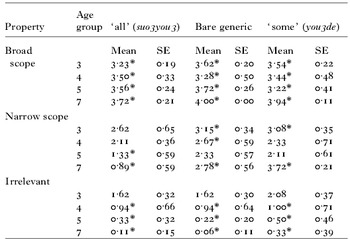
Means and standard errors for Mandarin-speaking children's # ‘yes’ responses (/4) to ‘all’ (suo3you3), bare NP generic or ‘some’ (you3de) linguistic form conditions for all property conditions.

* Mean is either higher or lower than chance (2·0) responding at p<0·05 or better.