Introduction
Sugarcane is an economically important crop in Louisiana and raw sugar sales contributed more than US$1.1 billion to the state’s economy in 2021 (Gravois Reference Gravois2022). In the United States, sugarcane is also commercially produced in Florida and Texas. While sugarcane is considered a minor crop in the United States, it is grown on more than 27 million ha worldwide in 92 different countries (FAO 2020). Sugarcane is a tropical C4 grass and is vegetatively propagated. A single planting often yields four or more crops, each of which is harvested annually and processed into sucrose (table sugar). In Louisiana, fields are typically allowed to fallow for at least 6 mo when production levels become unprofitable. Many factors jointly play a role in decreased production over the course of a cycle and include increased weed pressure, increased disease pressure, increased insect pressure, poor harvest conditions, and varietal intolerance to repeated ripener applications throughout the crop cycle.
Managing weeds in a sugarcane system is a complex task. Unlike other crops such as corn (Zea mays L.), soybean [Glycine max (L.) Merr.], and cotton (Gossypium hirsutum L.), which have been bioengineered to tolerate herbicides that otherwise would have caused death to the desired crop, no such technology is available for domestic sugarcane production. Perennial grass and sedge weeds are highly problematic and are difficult to control once they become established within the planting area. Bermudagrass (Cynodon dactylon (L.) Pers.), johnsongrass (Sorghum halepense (L.) Pers.), vaseygrass (Paspalum urvillei Steud.), and purple nutsedge (Cyperus rotundus L.) can commonly be found in sugarcane fields throughout Louisiana (Etheredge Reference Etheredge2007; Etheredge et al. Reference Etheredge, Griffin and Boudreaux2010; Fontenot et al. Reference Fontenot, Griffin and Bauerle2016; Millhollon Reference Millhollon1970; Orgeron Reference Orgeron2015; Richard Reference Richard1997).
The fallow period provides an ideal time to manage perennial weed pests in sugarcane systems (Griffin et al. Reference Griffin, Viator, Clay, Ellis, Miller, Bruff, Lanie and Lencse2001). Multiple applications of glyphosate during the fallow period along with interspersed deep tillage operations provides a high degree of control of rhizomatous grass weeds (Griffin et al. Reference Griffin, Viator, Clay, Ellis, Miller, Bruff, Lanie and Lencse2001; Orgeron Reference Orgeron2019). Likewise, the use of glyphosate-tolerant soybeans during the fallow period in combination with glyphosate can be an effective strategy for managing rhizome johnsongrass and other weed pests (Boudreaux and Griffin Reference Boudreaux and Griffin2009; Griffin et al. Reference Griffin, Miller and Salassi2006).
While numerous preemergence (PRE) herbicides are labeled for use in sugarcane, the persistence of biologically effective doses to sustain suitable weed control is contingent on many factors including herbicide rate, soil type, activation, microbial degradation, temperature, etc. Rainfall is common in the Louisiana sugarcane production region with Gravois (Reference Gravois2022) reporting that rainfall totaled 203, 219, and 202 cm for the Baton Rouge, New Orleans, and Lafayette airports, respectively, in 2021. Excessive and intense rainfall can quickly reduce herbicide persistence and residual weed control.
Effective in-crop postemergence (POST) herbicide options for controlling grass weeds in sugarcane are limited to asulam or the combination of asulam and trifloxysulfuron-sodium (Dalley and Richard Reference Dalley and Richard2008; Millhollon Reference Millhollon1976; Orgeron and Griffin Reference Orgeron and Griffin2014). Greater control of rhizome johnsongrass resulted when asulam was applied in combination with trifloxysulfuron-sodium compared to asulam applied alone (Dalley and Richard Reference Dalley and Richard2008). Likewise, asulam or a combination of asulam and trifloxysulfuron-sodium can provide partial control of vaseygrass less than 20 cm tall. Itchgrass (Rottboellia chochinchinensis), an annual grass weed, can be managed with POST applications of asulam, a combination of asulam and trifloxysulfuron-sodium, or trifloxysulfuron-sodium (Anonymous 2022; Fontenot and Sanders Reference Fontenot and Sanders1984).
Broadcast application of these herbicides is costly, and producers often selectively band-apply or spot-treat emerged grass weeds. While these measures may reduce weed management costs, some weeds are inevitably missed. Manual identification of grass weeds is a challenging task because the weeds are often interspersed with sugarcane and become difficult to distinguish in the vegetative canopy. Researchers have started to investigate the use of passive and active sensors as tools to improve weed control decisions. Thorp and Tian (Reference Thorp and Tian2004) reviewed the status of remote detection of weeds in agricultural fields and concluded that, at the time of their review, the technology available was not adequately developed to support the remote detection of weeds. Since that review, substantial progress has been made. Barrero and Perdomo (Reference Barrero and Perdomo2018) used red-green-blue (RGB) sensors and multispectral image fusion combined with neural network analysis to detect weeds in rice fields. They reported that the best weed detection performance was obtained with the fused imagery. Fletcher et al. (Reference Fletcher, Reddy and Turley2016) also used hyperspectral reflectance data to discriminate pigweed from cotton in Mississippi. The authors were able to refine their hyperspectral measurements to identify several wavelength ranges that could be used to effectively identify Palmer amaranth (Amaranthus palmeri) and redroot pigweed (Amaranthus retroflexus) in cotton production systems (Fletcher et al. Reference Fletcher, Reddy and Turley2016). Huang et al. (Reference Huang, Lee, Thomson and Reddy2016) used ground-based hyperspectral remote sensing to identify crop injury from dicamba and to identify weeds that were sensitive or resistant to glyphosate. Che’Ya (Reference Che’Ya, Dunwoody and Gupta2021) used discriminant analysis of hyperspectral reflectance data to identify weeds within sorghum (Sorghum bicolor) fields and reported a significant separation accuracy for the weeds evaluated.
Several researchers have used hyperspectral imagery to characterize different aspects of the sugarcane production cycle. Johnson et al. (Reference Johnson, Viator, Veremis, Richard and Zimba2008) used hyperspectral reflectance measurements to discriminate between commercial sugarcane varieties and wild sugarcane. The authors reported that varieties could be discerned with an accuracy of 86% using vegetative indices, and the accuracy could be increased to 95% to 100% correct classification using multivariate analysis (Johnson et al. Reference Johnson, Viator, Veremis, Richard and Zimba2008). Grisham et al. (Reference Grisham, Johnson and Zimba2010) used hyperspectral reflectance measurements to identify sugarcane infected with Sugarcane yellow leaf virus prior to visual symptoms being apparent. The authors reported an accuracy of up to 73% using discriminant analysis. Johnson and Richard (Reference Johnson and Richard2011) predicted sugarcane sucrose with an accuracy ranging from 60% to 100% for individual sugarcane varieties using hyperspectral leaf reflectance measurements and discriminant analysis. Two recent articles have reported results related to the detection of weeds in sugarcane crops. Sujaritha et al. (Reference Sujaritha, Annadurai, Satheeshkumar, Kowshik Sharan and Mahesh2017) described a weed-detecting robot that used RGB imagery combined with a fuzzy real-time classifier to detect weeds in sugarcane fields in India. The authors reported that the system detected weeds with an accuracy of 92.9% with a processing time of 0.02 s (Sujaritha et al. Reference Sujaritha, Annadurai, Satheeshkumar, Kowshik Sharan and Mahesh2017). Souza et al. (Reference Souza, Amaral, Oliveira, Coutinho and Netto2020) used hyperspectral imagery combined with two modeling approaches (soft independent modeling by class analogy and random forest) to detect weeds in sugarcane fields. Using those methods, the authors found that the visible–near-infrared spectrum could be divided into four distinct regions that could be used to discriminate weeds in sugarcane fields (Souza et al. Reference Souza, Amaral, Oliveira, Coutinho and Netto2020). Although some progress has been made in the discrimination of weeds in sugarcane, significant challenges remain. The objectives of this study were 1) to determine whether hyperspectral leaf reflectance measurements could be used to discriminate between sugarcane varieties and weed species commonly found in commercial sugarcane fields in Louisiana, and 2) to determine whether differences in plant pigment content of the weed species and sugarcane varieties investigated in this study could explain the observed differences in reflectance.
Materials and Methods
Sample Collection
Leaf samples for hyperspectral reflectance measurements were collected from plants at the Ardoyne Research Farm, located at the U.S. Department–Agricultural Research Service Sugarcane Research Unit, in Schriever, LA (29.6371°N, 90.84028°W) from field plots of four sugarcane commercial cultivars: ‘L 01-299’, ‘HoCP 96-540’, ‘L 01-283’, and ‘HoCP 04-838’. Leaf samples of nine weed species that are problematic in commercial sugarcane fields in Louisiana were collected from the same location: Bermudagrass, johnsongrass, vaseygrass, purple nutsedge, itchgrass, browntop millet (Urochloa ramosa), divine nightshade (Solanum nigrescens), Italian ryegrass (Lolium multiflorum), and timothy canarygrass (Phalaris angusta). Four leaves were collected from six sugarcane plants or weeds, for a total of 24 leaves per variety or species. Leaf samples were collected between April 12 and April 23, 2018, and analyzed immediately after sampling.
Reflectance Analysis
Leaves were transported to an on-site laboratory for processing using a method similar to that described by Johnson et al. (Reference Johnson, Viator, Veremis, Richard and Zimba2008). High-resolution, hyperspectral reflectance data for all studies were collected using a single-input USB-2000+ VIS-NIR fiber optic spectrometer (Ocean Optics, Dunedin, FL) with a CCD-array detector (2048-element, 350 to 1,000 nm at 0.4-nm intervals). The system used a 25° field-of-view optical fiber that collected upwelling radiation from the leaf. The spectrometer was controlled using CDAP software (Center for Advanced Land Management Information Technologies, University of Nebraska, Lincoln, NE). Reflectance measurements were taken at three locations on each leaf (non-midrib) under a 500-W halogen light source. Midrib tissue was not used because it would have an unrealistically high influence on leaf reflectance values in the laboratory (due to the smaller field of view), compared with remotely sensed field samples (Johnson et al. Reference Johnson, Viator, Veremis, Richard and Zimba2008). The upwelling fiber optic cable was mounted 3 cm above the leaf sample. A white Spectralon reference target (Labsphere, Inc., North Sutton, NH) was used to calibrate the spectrometer. The reflectance measurements were made in a laboratory setting to standardize experimental conditions and to validate that the method could be used to accomplish the goal of discriminating weeds from sugarcane. Additional experiments will be required to verify the approach under field conditions. The instruments used in these experiments are portable, and reflectance measurements can be made in the field without equipment modifications (Johnson et al. Reference Johnson, Viator, Veremis, Richard and Zimba2008).
Pigment Analysis
After reflectance measurements were completed, the same leaf was sampled for plant pigment analysis by boring three 0.5-cm discs about 10 cm from the leaf tip that did not include mid-rib tissue. Leaf discs were immediately frozen (−80 C) until analysis. Samples were ground using a mortar and pestle in 2 ml of 100% acetone and extracted in the dark at 4 C for 4 h. Extracts were then filtered and analyzed for chlorophylls and carotenoids using high-performance liquid chromatography (HPLC) (Zimba et al. Reference Zimba, Grimm, Dionigi and Weirich2001). Filtered extracts from each leaf were directly injected in an HP1100 HPLC system (Agilent Technologies, Santa Clara, CA) equipped with one ODS-Hypersil C18 column (200 × 4.6 mm, 4 μm; Hewlett-Packard, Spring, TX) and two 201TP C18 columns (250 × 4.6 mm, 5 μm; Vydac, Columbia, MD) in series. Samples were analyzed by diode array detection at 436 nm. Pigments were identified and quantified using authentic commercial standards (VKI, Hørsholm, Denmark).
Data Analysis
Reflectance data were condensed to 10-nm wavelength bands to simplify analysis. Canonical discrimination analysis was performed using the CANDISC procedure with SAS software (version 9.4; SAS Institute, Inc., Cary, NC) on the reflectance data set to determine whether this technique could be used to discriminate between sugarcane varieties and weed species alone, and in combination. Discriminant analysis with resubstitution and cross-validation using the DISCRIM procedure with SAS software was also performed to further quantify the degree of separation using both resubstitution and cross-validation techniques. The resubstitution method uses the same data to define and evaluate the classification criterion, which yields an error count estimate that has an optimistic bias. In the cross-validation technique, an observation in the data set is removed and the remaining observations are used to develop the discriminant function. The function is then used to evaluate the observation that was removed from the data. This procedure is repeated for all observations in the data set. The resulting discriminant function removes most bias from the analysis. As a final step, the data set was divided into a training set (two-thirds of total data) and a validation set (one-third of total data). Discriminate analysis was then performed on the training data set using cross-validation, and the resultant discriminant function was used to predict the validation data set. Finally, we performed the Mixed procedure with SAS software to analyze the pigment data. Differences between treatment least-squares means were compared using the PDIFF option (Saxton Reference Saxton1998) at the 0.05 probability level.
Results and Discussion
Reflectance Data
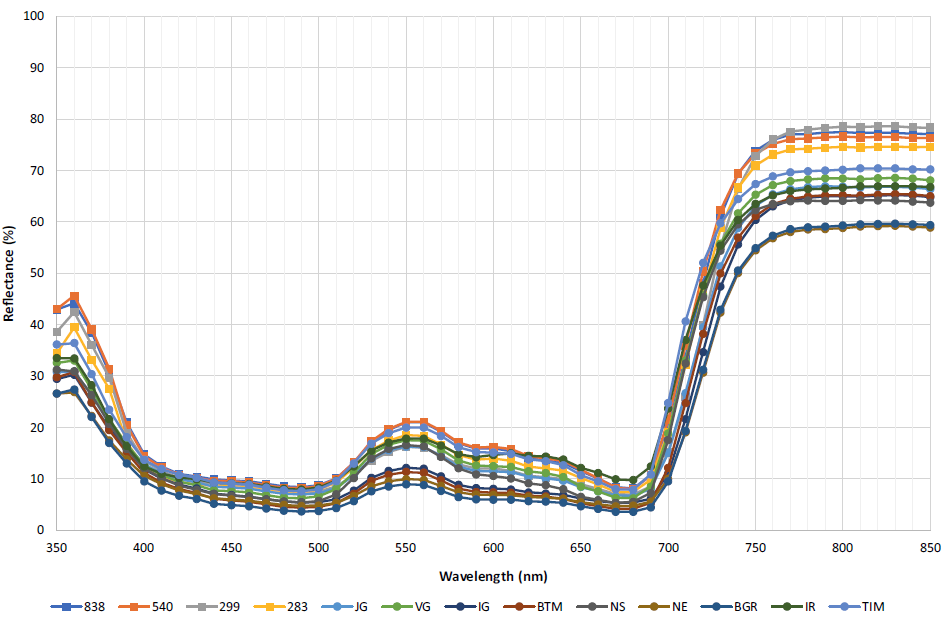
Leaf reflectance data showed clear differences between sugarcane and weed species in several distinct areas (Figure 1). All sugarcane varieties exhibited higher reflectance values than any of the weed species in the ultraviolet region from 350 to 400 nm. These differences tended to remain (with sugarcane having higher reflectance), although they were less pronounced, throughout the violet, indigo, and blue regions from 400 to 490 nm (Figure 1). In the green region (490 to 570 nm), two distinct groups emerged in the data. The first group, which exhibited higher reflectance, consisted of all the sugarcane varieties and johnsongrass, vaseygrass, Italian ryegrass, timothy canarygrass, and divine nightshade (Figure 1). The second group in the green region, which had distinctly lower reflectance values, consisted of bermudagrass, purple nutsedge, browntop millet, and itchgrass. The same groups remained throughout the red region (680 to 780 nm), although they were somewhat less distinct (Figure 1). The final area where clear differences were observed was the near-infrared region from 780 to 850 nm, where three distinct groups were apparent. The first group, with the highest reflectance, consisted of the four sugarcane varieties (Figure 1). The second group consisted of johnsongrass, itchgrass, vaseygrass, Italian ryegrass, brown top millet, timothy canarygrass, and divine nightshade. The final group contained bermudagrass and purple nutsedge. It is clear from these data that several regions in the spectrum offer opportunities to discriminate between sugarcane varieties and the weed species present in commercial fields.
Leaf reflectance for Louisiana sugarcane and common weed species. 838 = HoCP 04-838, 540 = HoCP 96-540, 299 = L 01-200, 283 = L01-283, JG = johnsongrass, VG = vaseygrass, IG = itchgrass, BTM = browntop millet, NS = divine nightshade, NE = purple nutsedge, BGR = bermudagrass, IR = Italian ryegrass, TIM = timothy canarygrass.

Canonical Discrimination
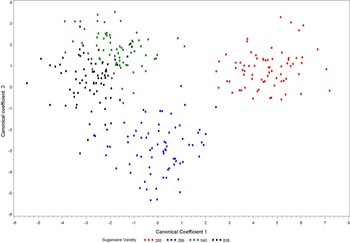
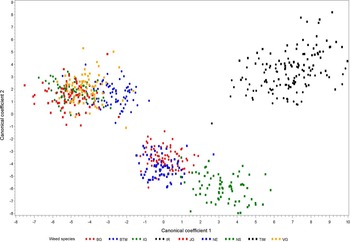
Canonical discrimination analysis was performed on the sugarcane varieties alone, the weed species alone, and on the combined data set. For the sugarcane varieties alone, canonical axis 1 described 59% of the observed variability with canonical axis 2 increasing the variability described to 81% (data not shown). A plot of canonical coefficients 1 and 2 show that two of the four sugarcane varieties (L 01-283 and L 01-299) were clearly separated from other varieties, while the remaining two varieties (HoCP 96-540 and HoCP 04-838) exhibited some overlap with each other (Figure 2). For the data set with weeds alone, canonical axis 1 explained 46% of the observed variability and the addition of canonical axis 2 increased the variability explained to 72% (data not shown). When canonical coefficient 1 is plotted against coefficient 2, three groups of weeds were identified (Figure 3). The first group contained timothy canarygrass and Italian ryegrass with the two species exhibiting a degree of overlap but showing good separation from the remaining weed species (Figure 3). The second group contained divine nightshade, purple nutsedge, and bermudagrass. As in the first group, these species exhibited some overlap but were well separated from the remaining species. Finally, the third group contained itchgrass, johnsongrass, vaseygrass, and brown top millet (Figure 3). Considerable overlap was observed for these species, but they were well separated from the species in groups 1 and 2.
Sugarcane variety discrimination with leaf reflectance. 838 = HoCP 04-838, 540 = HoCP 96-540, 299 = L 01-200, 283 = L01-283.

Weed species discrimination with leaf reflectance. JG = johnsongrass, VG = vaseygrass, IG = itchgrass, BTM = browntop millet, NS = divine nightshade, NE = purple nutsedge, BG = bermudagrass, IR = Italian ryegrass, TIM = timothy canarygrass.

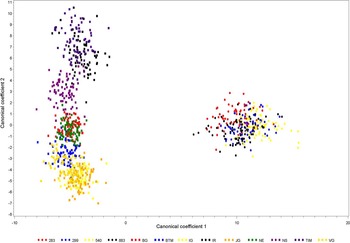
When the reflectance of both sugarcane and weed species were considered together, canonical axis 1 described 62% of the observed variability with canonical axis 2 increasing the variability described to 77% (data not shown). When canonical coefficient 1 is plotted against canonical coefficient 2, two distinct groups appear. The first group contains all the sugarcane varieties, and the second group contains all of the weed species (Figure 4). Sugarcane varieties exhibited considerable overlap but were clearly separated from the weed species. The weed species also showed some overlap but could be grouped into the same categories as were described when weeds were considered alone. It is clear from the canonical discriminate analysis that leaf reflectance data show considerable promise in helping to delineate between sugarcane varieties and weed species.
Weed species and sugarcane variety discrimination with leaf reflectance. 838 = HoCP 04-838, 540 = HoCP 96-540, 299 = L 01-200, 283 = L01-283, JG = johnsongrass, VG = vaseygrass, IG = itchgrass, BTM = browntop millet, NS=divine nightshade, NE = purple nutsedge, BG = bermudagrass, IR = Italian ryegrass, TIM = timothy canarygrass.

Linear Discriminant Analysis
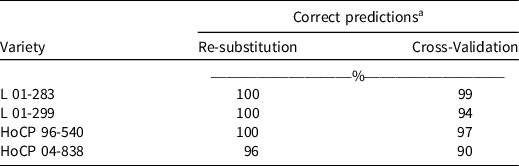
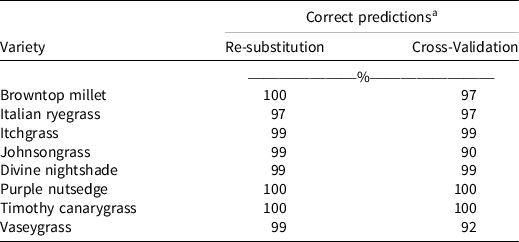
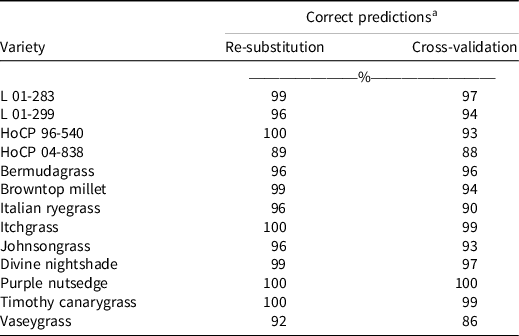
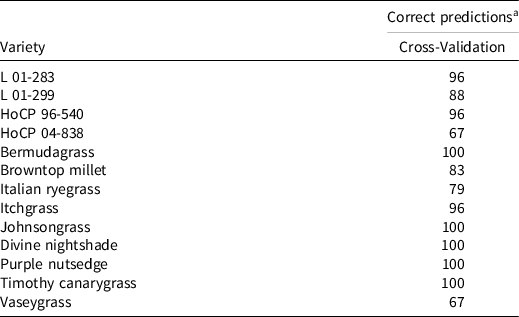
Linear discriminant analysis was performed on the sugarcane varieties alone, the weed species alone, and on the combined data set. Discriminant analysis was performed initially by resubstitution and then by cross-validation to reduce bias. When varieties were considered alone L 01-283, L 01-299, and HoCP 96-540 were correctly predicted in 100% of the cases, while HoCP 04-838 was correctly predicted in 95.8% of the cases (Table 1). When cross-validation was implemented, the accuracy was reduced slightly to 98.6%, 94.9%, 97.2%, and 90.0% for L 01-283, L 01-299, HoCP 96-540, and HoCP 04-838, respectively. When weeds were considered alone the range of correct predictions varied from 97.2% to 100.0% for discriminant analysis with resubstitution and from 91.7% to 100.0% for cross-validation (Table 2). The lowest accuracy was produced with johnsongrass and vaseygrass, although the successful prediction rate was still greater than 90% (Table 2). Finally, when both sugarcane varieties and weed species were considered together, the range of correct predictions varied from 91.7% to 100% for resubstitution and from 81.1% to 100.0% for cross-validation (Table 3). In this case, the lowest accuracy was observed with vaseygrass, Italian ryegrass, and HoCP 04-838 (Table 3). To further remove bias in the modeling procedure the combined data set (sugarcane and weeds) was divided into a training set (two-thirds of the data) and a validation set (one-third of the data). Linear discriminant analysis with cross-validation was then performed on the training data set and the resultant model was used to predict the validation set. For this analysis, the range of correct predictions varied from 67% to 100%. The lowest accuracies were observed with vaseygrass and HoCP 04-838 with 67% each, and Italian ryegrass with 79% (Table 4). The remaining varieties and species showed accuracies greater than 80% (Table 4).
Discrimination of commercial sugarcane varieties using leaf reflectance, 2018.

a Percentage of sugarcane varieties correctly predicted from linear discriminant models of reflectance data using resubstitution or cross-validation techniques.
Discrimination of weed species using leaf reflectance, 2018.

a Percentage of weed species correctly predicted from linear discriminant models of reflectance data using resubstitution or cross-validation techniques.
Discrimination of commercial sugarcane varieties from weed species using leaf reflectance, 2018.

a Percentage of commercial sugarcane varieties and weed species correctly predicted from linear discriminant models of reflectance data using resubstitution or cross-validation techniques.
Discrimination of Commercial sugarcane varieties from weed species using leaf reflectance based on a training data set to predict test data.

a Percentage of commercial sugarcane varieties and weed species correctly predicted from linear discriminant models of reflectance data using cross-validation techniques based on a training data set composed of two-thirds of the original data set used to predict the remaining one-third of data.
Plant Pigments
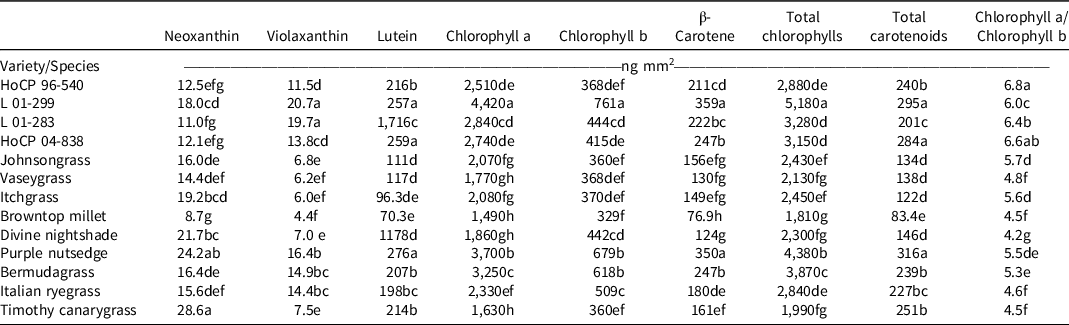
Plant pigment analysis was performed on all sugarcane varieties and weed species to determine whether variation in the pigment levels can help explain the observed variation in leaf reflectance. Significant variation was apparent in both chlorophyll and carotenoid levels for both sugarcane varieties and weed species (Table 5). Sugarcane variety L 01-299 exhibited the highest level of total chlorophyll and the second highest levels of total carotenoids (Table 5). The remaining sugarcane varieties were fourth, fifth, and sixth in terms of total chlorophyll and third, fifth, and eighth in terms of total carotenoids. The weeds purple nutsedge and bermudagrass were ranked second and third in terms of total chlorophylls and total carotenoids (Table 5). Browntop millet exhibited the lowest levels for all pigments evaluated (Table 5). If the sugarcane varieties and weed species are ranked for each pigment and resultant values are totaled and averaged, an index of total pigment content is obtained. Sugarcane variety L 01-299 and purple nutsedge had the highest pigment levels after this procedure was accomplished, followed by bermudagrass, HoCP 04-838, L01-283, Italian ryegrass, and HoCP 96-540. The four sugarcane varieties occupied four of the top seven spots in terms of total pigment content. The remaining six spots were occupied by weed species in descending order with timothy canarygrass, divine nightshade, itchgrass, johnsongrass, vaseygrass, and browntop millet at the bottom. When the ratio of chlorophyll a and chlorophyll b were calculated, a separation of sugarcane and all weed species was evident, with all sugarcane varieties having a higher ratio (Table 5).
Plant pigment contents of four sugarcane varieties and nine weed species from leaf reflectance study in Louisiana, 2018.

The discrimination of weeds from sugarcane in commercial sugarcane fields has important economic implications. The cost of many herbicides used for weed control in sugarcane has increased, particularly when used in a broadcast application. Developing a system that could more effectively target weeds in the emerging and growing crop would decrease both costs and environmental impacts. An examination of the leaf reflectance data from the combined data set that contained both sugarcane varieties and weeds (Figure 1) shows that several areas of the electromagnetic spectrum may be useful in their discrimination. The areas where the greatest differences were observed between weeds and sugarcane include the ultraviolet (350 to 400 nm); violet, indigo, and blue (400 to 490 nm); green (490 to 570 nm); and infrared regions (780 to 850 nm). These regions have been previously identified as being important in the discrimination of sugarcane varieties (Johnson et al. Reference Johnson, Viator, Veremis, Richard and Zimba2008), sugarcane infected with yellow leaf disease (Grisham et al. Reference Grisham, Johnson and Zimba2010), and sugarcane sucrose levels (Johnson and Richard Reference Johnson and Richard2011).
In the ultraviolet and blue regions, all four sugarcane varieties exhibited higher reflectance than any of the weed species (Figure 1). Johnson and Richard (Reference Johnson and Richard2011) speculated on the potential influence of anthocyanins and other flavonoids on the reflectance response of sugarcane in the ultraviolet and blue regions. The presence of flavonoids has been documented in sugarcane leaves, bagasse, and juice (Columbo et al. Reference Columbo, Lancas and Yariwake2006), and their levels have been documented to increase in response to sugar accumulation in sugarcane leaves (McCormick et al. Reference McCormick, Cramer and Watt2008). Dahiya et al. (Reference Dahiya, Kumar, Khedwal and Jakhar2017) discussed the allelopathic properties of many weed species, including johnsongrass, bermudagrass, and sedges, and indicated that many allelochemicals are flavonoids. The blue region has been associated with the absorption of the carotenoids violaxanthin, neoxanthin, lutein, and β-carotene (Sims and Gamon Reference Sims and Gamon2002), and there were distinct differences in carotenoid levels between sugarcane varieties and many weed species; in this study, particularly neoxanthin (Table 5). In addition, chlorophyll a and chlorophyll b also absorb strongly in both the blue and red regions (Barragán et al. Reference Barragán Campos, Strojnik, Rodríguez, Garcia-Torales and Contreras2018) and significant variation occurred in chlorophyll levels between sugarcane and weed species. The observed variation in the green region between sugarcane varieties and weeds (Figure 1) may also be related to the differential absorbance of flavonoids; specifically, anthocyanin, which has an absorption peak near 550 nm (Barragán et al. Reference Barragán Campos, Strojnik, Rodríguez, Garcia-Torales and Contreras2018). The differences in the infrared region are not related to pigment levels and are instead primarily determined by the properties of the leaf itself, including leaf thickness, water content, and light scattering (Merzlyak et al. Reference Merzlyak, Gitelson, Chivkunova, Solovchenko and Pogosyan2003). When the ratio of chlorophyll a to chlorophyll b was calculated, all the sugarcane varieties had higher ratios than all weed species (Table 5). The ratio of chlorophyll a to chlorophyll b is associated with the antenna size of photosystem II (Dinç et al Reference Dinç, Ceppi, Tóth, Bottka and Schansker2012) and is higher in C4 plants (Lichtenthaler and Babani Reference Lichtenthaler and Babani2021), so it is not surprising that all sugarcane varieties showed the highest ratios. Sugarcane is a C4 plant and is also known as one of the most photosynthetically efficient plants (Irvine Reference Irvine1983; Sage et al. Reference Sage, Peixoto, Sage, Moore and Both2013). This was also evident from examining the chlorophyll ratio data for the weed species. The lowest chlorophyll ratio was observed for divine nightshade, with Italian ryegrass and timothy canarygrass ranked third and fourth lowest, respectively. Future research will focus on developing reflectance models that can predict this ratio.
It was possible to discriminate sugarcane varieties from weeds in virtually all cases using hyperspectral leaf reflectance data and canonical discrimination or linear discrimination analysis (Figure 4; Tables 3 and 4). In cases where the prediction accuracy was less than 100% for a given sugarcane variety, the error was due to the sample being classified as another sugarcane variety, not a weed (Figure 4). This was most evident for the sugarcane variety HoCP 04-838, which has a prediction accuracy of 66.7% when the function was based on training data and cross-validation (Table 4). In this case, HoCP 04-838 was misclassified as L 01-299 in 29.2% of the cases, and HoCP 96-540 in 4.1% of the cases (data not shown). This error would still result in the correct decision to not spray a sugarcane plant. Also, the HoCP 04-838 variety is on the decline and currently accounts for less than 5% of the planted hectares (Kimbeng Reference Kimbeng2022). There were similar but smaller errors associated with the classification of the other sugarcane varieties (Table 4), but sugarcane was not incorrectly classified as a weed in any case. There were similar misclassifications among weed species by both canonical discrimination and linear discriminant analysis (Figures 3 and 4; Tables 2, 3, and 4). For weed species, they could be delineated into three groups based on their canonical coefficients and their pigment levels: 1) timothy canarygrass and Italian ryegrass; 2) bermudagrass, purple nutsedge, and divine nightshade; and 3) itchgrass, johnsongrass, vaseygrass, and browntop millet. It may be possible to target these weeds more effectively due to their reflectance behavior.
Some of the systems that have been developed to identify and target weeds in sugarcane production systems use image analysis for the classification process (Sujaritha et al. Reference Sujaritha, Annadurai, Satheeshkumar, Kowshik Sharan and Mahesh2017), which may have more difficulty detecting grass weeds in a grass crop. This issue was the principal motivation for our work to use hyperspectral leaf reflectance data and multivariate analysis for the discrimination process. Souza et al. (Reference Souza, Amaral, Oliveira, Coutinho and Netto2020) used hyperspectral imagery to classify weeds in Brazil and indicated that the spectrum could be divided into four regions of interest to simplify the discrimination process. The goal of our study was to develop hyperspectral, leaf reflectance data that could be used to identify weeds quickly and accurately in an emerged sugarcane crop so that weeds can be targeted for control. The sensing system could either be airborne or tractor-based to allow for flexibility in the spray system that is ultimately employed.
Canonical discrimination analysis of the leaf reflectance data demonstrated that sugarcane varieties could be successfully differentiated from weeds in all cases. Linear discriminant analysis showed that the accuracy of the classification varied from 67% to 100% for individual sugarcane varieties and weed species. In all cases, sugarcane was not misclassified as a weed. Plant pigment levels exhibited marked differences between sugarcane varieties and weed species with differences in chlorophylls and carotenoids explaining much of the observed variation in reflectance. The successful implementation of this technology as either an airborne system to scout and map weeds or a tractor-based system to identify and spray weeds in real time would offer sugarcane growers a valuable tool for managing their crops. By accurately targeting weeds in an emerged and growing sugarcane field, the total amount of herbicide applied could be decreased, resulting in cost savings for the grower and reduced environmental impacts.
Practical Implications
Managing weeds in a sugarcane system is a complex task. Perennial grass and sedge weeds are highly problematic and are difficult to control once they are established within the planting area. Bermudagrass (Cynodon dactylon), johnsongrass (Sorghum halepense), vaseygrass (Paspalum urvillei), and purple nutsedge (Cyperus rotundus) can commonly be found in sugarcane fields throughout Louisiana, and severe infestations can result in significant yield losses. While numerous PRE herbicides are labeled for use with sugarcane, the persistence of biologically effective doses to sustain suitable weed control is contingent on many factors including herbicide rate, soil type, activation, microbial degradation, temperature, etc. Effective in-crop POST herbicide options for controlling grass weeds in sugarcane are limited to asulam or the combination of asulam and trifloxysulfuron-sodium. Broadcast application of these herbicides is costly, and producers often selectively band-apply or spot-treat emerged grass weeds. While these measures are used to reduce weed management costs, some weeds are inevitably missed. Manual identification of grass weeds is a challenging task because these grass weeds are often interspersed with sugarcane and become difficult to distinguish in the vegetative canopy. The hyperspectral leaf reflectance technology described in this paper could be used in an airborne system (i.e., an unmanned aerial vehicle or an airplane) to scout and map weeds on a large scale. These maps could then be used in variable-rate herbicide application systems. The technology could also be used in a tractor-based system to identify and spray weeds in real time. In either case, by accurately targeting weeds in an emerged and growing sugarcane field, the total amount of herbicide applied could be decreased, resulting in cost savings for the grower and reduced environmental impacts.
Acknowledgments
We thank Katie Richard, Brenda King, and Eric Petrie from the U.S. Department of Agriculture–Agricultural Research Service (USDA-ARS) Sugarcane Research Unit in Houma, for assistance in collecting leaf samples and analysis of leaf reflectance and plant pigment levels. This research was funded by the USDA-ARS Sugarcane Research Unit. Mention of trade names or commercial products in this publication is solely for the purpose of providing specific information and does not imply recommendation or endorsement by the U.S. Department of Agriculture. USDA is an equal opportunity provider and employer. No conflicts of interest have been declared.