The pages of Volume 13 of this journal, for 1982, contain a report on the excavations at St Oswald's Priory, Gloucester, by C.M. Heighway and A.J. Parker.Footnote 286 The site is located outside the north-west corner of the Roman city, close to an ancient channel of the river Severn, or possibly on an island within it.Footnote 287 The spreads of over-fired bricks, tiles and kiln waste recorded during the excavation suggest that this was the site of the tilery supplying, in all probability, both the legionary fortress and the succeeding colonia.
The report includes a detailed analysis of the Roman pottery by Cherry Goudge,Footnote 288 and it is one of these vessels that is the subject of this note. The item (fig. 8, no. 17 on p. 53 of the report) is illustrated as a lid or cover with a thick horizontal flange, though with the outer edge missing. The fabric is described as reddish brown in colour with abundant temper of quartz, feldspar, gold mica and unidentified rock fragments. It is classified on p. 46 as an ‘Exotic’ import, and Goudge suggested that the vessel may be from a continental source and residual from the early military occupation.
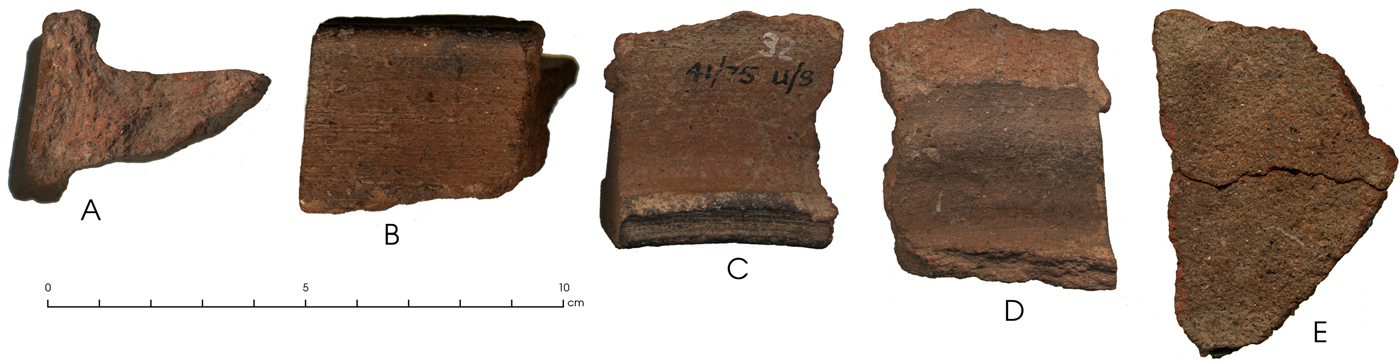
This vessel was re-examined during a recent joint project by the author and Jane Timby to produce a digital archive of the Gloucester Roman and Medieval Pottery Type Series, which is currently housed in Gloucester City Museum.Footnote 289 The sherds now bear the label TF214Footnote 290 and the type series holds all the material noted in the original report — two large flat sherds c. 6 mm thick, and the illustrated rim and flange;Footnote 291 these seem to be the only sherds in this fabric currently recorded from Gloucester.
IDENTIFICATION
The Gloucester vessel (fig. 40, 1 and fig. 41; online fig. 2)Footnote 292 can now be identified — when the illustration is reversed — as an example of an unusual class of large flanged dish that is nevertheless widely distributed across the western provinces during the early Roman period.
Flanged dishes and clibani (scale 1:4). 1: Gloucester TF214; 2: Fos-sur Mer; 3: London; 4, 5: Ambrussum; 6: Pompeii; 7: Calahorra (after Marty, Pitt, Raynaud, Di Giovanni, Pascual).

Gloucester TF214 sherds (scale 1:2). A: section; B: inner surface; C–D: flange (upper and lower); E: base sherds (see also online fig. 2). (Photos: Paul Tyers)

The general type is discussed by Olcese in her survey of Central Italian coarsewares as tegame type 9, where she lists examples of the late first to mid-second century a.d. from Ostia and Rome.Footnote 293 The wider distribution of the form is demonstrated by a pair of vessels from the port site at Fos-sur-Mer in southern France (fig. 40, 2),Footnote 294 and there are single examples from Lyon and Angers.Footnote 295 The Gloucester specimen may not be the only example of the type from Britain. A recent publication from the City of London (41 Eastcheap) includes an illustration of a large flanged dish that is probably related to this series (fig. 40, 3).Footnote 296
More revealingly there are a few specimens of this type of dish paired with a domed lid that has a somewhat similar broad flange, of the form normally labelled as a clibanus. The background and interpretation of the clibanus form has been discussed in a paper by Cubberley, Lloyd and Roberts.Footnote 297 In brief, the domed lid was probably placed on a pre-heated surface over the items to be cooked, and charcoal and ashes were heaped over and around it to provide heat from above as well as below. However, when combined with a flanged dish of the Gloucester type it may have performed rather more like a small portable oven.
The dish/clibanus combination is recorded from Ambrussum, in southern France (fig. 40, 4–5),Footnote 298 and a very similar pair from Herculaneum was exhibited in a temporary exhibition at the British Museum in 2013.Footnote 299 Reaching further back into the archaeological literature, this would seem to be the explanation for Ritterling's types 96A and B from the fort at Hofheim,Footnote 300 and both forms feature among the products of a small kiln operating outside the legionary fortress at Mainz.Footnote 301
The clibanus style of domed lid has been identified somewhat more widely than the flanged dish. There are a number of examples from Italy, including the Rome/Lazio area, Pompeii (fig. 40, 6) and Herculaneum.Footnote 302 In the provinces there are examples from Reims, Angers and Lyon,Footnote 303 and a single specimen from Calahorra, in Spain (fig. 40, 7).Footnote 304 What is not clear at present is whether the flanged dishes had any specialised function when they were not associated with the domed clibanus lid. However, both types are exceedingly rare, and the (current) absence of the lids from, for instance, Gloucester and London need not detain us.
It should be noted that some of these vessels are exceptionally large. Several have a diameter (at the flange) between 45 and 50 cm, though others, such as the Gloucester dish, are smaller. They would have needed particular skill in manufacture, with the attachment of the flanges to the body of the vessels needing special attention. They may have been the products of specialist workshops, and examples of both forms occasionally bear potters’ stamps.Footnote 305
SOURCE
Many of the published descriptions of these flanged lids and dishes highlight the highly micaceous character of the fabric, and sometimes list other notable inclusions such as feldspars and composite rock fragments. Where a source is suggested it is invariably Italy. Further to this, a detailed petrological analysis of the clibanus from Calahorra (Spain) published by Pascual suggests a Campanian source.Footnote 306
The Gloucester dish can now add something more to this picture. Two of the TF214 sherds in the fabric type series have flat sawn edges where samples have been removed. An accompanying finds label from the Department of Urban Archaeology (DUA) of the Museum of London, dated 25.1.1985, records that samples were taken for thin-section analysis. This would have been arranged by Alan Vince, who was working at the DUA at that time, but had contributed to the original St Oswald's Priory report. The Gloucester thin-sections are currently held in the archaeological archives of the Museum of London where they are RTS (Roman thin-section) samples nos 211 (base sherd) and 212 (rim and flange).Footnote 307 They have been examined by Claudio Capelli of the University of Genoa, who reports as follows.
PETROLOGY By Claudio Capelli
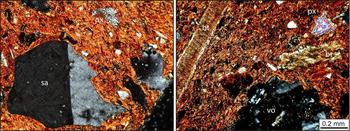
When observed in thin-section under a polarising microscope, the two samples share the same fabric. It is composed of an iron-rich clay matrix (completely oxidised in the cross-section of no. 211 and oxidised only close to the surfaces of no. 212) and moderately abundant, moderately sorted, angular inclusions, whose origin is essentially volcanic (fig. 42; online figs 1 and 3). Sanidine and rarer plagioclase feldspars, up to 2.2 mm across, and biotite, up to 0.8 mm in length, predominate over uncoloured clinopyroxene and fragments of volcanic glass, tuff and basaltic/trachytic rocks. Uncoloured garnet is occasional as well as quartz.
Microphotographs of Gloucester TF214, sample RTS-211 (crossed polars); bt = biotite, px = clinopyroxene, sa = sanidine feldspar, vo = volcanic rock (see also online figs 1 and 3). (Photo: Claudio Capelli)

The fabric seems to be similar to one of an analogous clibanus (fig. 40, 7) from Calahorra described by Luezas Pascual,Footnote 308 undoubtedly attributed to a Campanian workshop. The source of the (possibly alluvial/colluvial) raw materials can be located relatively close to volcanic outcrops. A potassium-rich alkaline composition of the mother-rock is suggested by the frequency of biotite and sanidine feldspar.
These features allow us to exclude production in the Gloucester area, characterised by sedimentary and alluvial deposits, whereas they are compatible with the geology of the Tyrrhenian (Latium-Campania) volcanic region. On the other hand, the lack of melanitic garnet, which is a discriminant provenance marker for that region, as well as the high percentage of mica, which is quite unusual in the Italian fabrics available on the thin-section database of the DISTAV,Footnote 309 cannot completely exclude an origin from other volcanic areas. However, taking into account the archaeological data, Campania should be considered as the most probable source.
DATING
Despite their rather sparse distribution, several of these flanged lids and dishes are from reasonably well dated contexts. The examples from the Vesuvian cities were presumably in use at the moment of their destruction in a.d. 79. The dish from 41 Eastcheap, London, is from a context dated a.d. 60/61–85 and assigned to post-Boudiccan military activity.Footnote 310 At Hofheim, the type 96 pair was recovered from the vicinity of the commanding-officer's house assigned to the secondary, and brief, Vespasianic activity rather than the main Claudio-Neronian phase.Footnote 311 Somewhat later is the Reims clibanus, which is associated with pottery of the Hadrianic-Antonine period,Footnote 312 and other examples from France are broadly dated from the mid-first to mid-second century.
The Gloucester dish fits within this pattern. Two of the TF214 sherds were recovered from the fill of a shallow feature (F560, in phase R20) which produced pottery of the later first century a.d., including the local Gloucester fabrics TF7 and TF11A which are regularly associated with the legionary fortress.Footnote 313 Nevertheless, given the uncertainties that surround the histories of the fortress and colonia at Gloucester,Footnote 314 and the inevitable limitations of ceramic dating, it would be unwise to assign the dish to one phase of activity rather than the other.
This class of ware can now be added to Roman Britain's inventory of early ceramic imports, though it was evidently never more than an occasional arrival. However, what can be said is that someone, perhaps associated in some way with Gloucester's legionary or civilian tilery, felt the need for this rather unusual imported cooking vessel, had the means to acquire and transport it, and presumably they (or their cook) had the skills necessary to make some use of it. It demonstrates how important original cooking vessels (as well as cooking techniques, recipes and original ingredients) are to those seeking to keep in touch with their cultural roots.
SUPPLEMENTARY MATERIAL
For Supplementary Material for this article please visit https://doi.org/10.1017/S0068113X19000126.
Note the Supplementary Material includes online figs 1–3.
ACKNOWLEDGEMENTS
I would like to thank the following: David Rice (Gloucester City Museum) for making the Gloucester type series available for study and providing facilities; Carolyn Heighway, for information on the context of the Gloucester vessel; Cecile Batigne-Vallet (Maison de l'Orient et de la Méditerranée, Université de Lyon), Maxime Mortreau (INRAP) and other colleagues at the SFECAG meeting in Narbonne in 2017 for further information on examples of the clibanus and related dishes from France and elsewhere; Dr Paul Roberts (Ashmolean Museum, Oxford) for his observations on the Herculaneum vessels; Beth Richardson (MoLA) for retrieving the TF214 thin-sections from the ex-DUA petrological reference collection in the Museum of London; Roberta Tomber (British Museum) for her preliminary observations on the thin-sections; Claudio Capelli (Università degli Studi di Genova) for his petrological report; and finally, Jane Timby, for her invaluable insights into all aspects of Gloucester's Roman pottery.