



1. Introduction
In February 2008 a new episode was added to the ever-exciting developments in Dutch politics. In a Sunday morning television show, former prime minister Jan Peter Balkenende uttered the following sentence:
(1) Zonder geloof kun je niet functioneren.Footnote 2
without faith can you not function
‘You cannot function without faith.’
This led to a debate in the Dutch Parliament and the press about what was actually meant by this sentence, most notably about the interpretation of the second-person singular pronoun je. Three readings were available in principle, described in (2):
- (2)
(a) Je refers to the interviewer (referring to the addressee).
(b) Je receives a generic/impersonal reading (comparable to the impersonal pronoun one.
(c) Je refers to the prime minister only (referring to the speaker).
Reading (2a) was immediately excluded. Only in a sequence of utterances describing the addressee could the pronoun in (1) receive interpretation (2a); this was clearly not the case in the interview. Moreover, in the interview, the more formal second-person pronoun u was used to address the hearer. Hence, the debate focused on interpretations (2b) and (2c).
Public statements by government members officially reflect the position of the entire government. Therefore, if (1) were to be interpreted as (2b), the government would be publically stating that one could not function without any faith, which would violate the general policy that government does not make religious claims. This interpretation resulted in an attack against the former prime minister by some of his opponents.
But defenders of the prime minister, backed by a parliamentarian majority, contended that (1) should be interpreted in a Cruijff-like fashion, i.e. like (2c), where je referred to the speaker only. This method of reference has been named after the famous soccer player, as it is Johan Cruijff as well as many other soccer players who constantly use je to refer to themselves. The following example is from Bennis, Cornips & van Oostendorp (Reference Bennis, Cornips and van Oostendorp2004: 28):
(3) Je kreeg de bal van Huntelaar en toen schoot je op het doel.
you got the ball from Huntelaar and then shot you on the goal
‘I got the ball from Huntelaar and then I shot on the goal.’
Example (3) was also uttered in an interview and has a clear episodic past-tense interpretation; it refers to a single event only. Given the context of the utterance, neither a generic/impersonal interpretation for je in (3) nor a reading where je refers to the hearer is possible. Thus, in (3), the pronoun je can only refer to the speaker.
The facts described above illustrate that the weak second-person singular pronoun je in Dutch may refer to the speaker only, a phenomenon known as the speaker-referring je. The observation that Dutch exhibits speaker-referring je is not new. The first description, to the best of my knowledge, is Appel (Reference Appel and Thije1993), followed by Van Wassenaar (Reference Van Wassenaar1994), Onrust (Reference Onrust1995), Van Hout (Reference Van Hout and Stroop2003), Bennis et al. (Reference Bennis, Cornips and van Oostendorp2004), and Klaasse (Reference Klaasse2005). A recent corpus-study investigation of speaker-referring je is presented in Tarenskeen (Reference Tarenskeen2010), indicating that its use is a recent development but has already been fairly widespread in the spoken language.
Since Dutch also has a regular first-person singular pronoun ik ‘I’, a question that immediately arises is this: To what extent do these utterances with speaker-referring je differ from utterances where ik would have been used, as in (4) and (5)?
(4) Zonder geloof kan ik niet functioneren.
without faith can I not function
‘I cannot function without faith.’
(5) Ik kreeg de bal van Huntelaar en toen schoot ik op het doel.
I got the ball from Huntelaar and then shot I on the goal
‘I got the ball from Huntelaar and then I shot on the goal.’
The readings in (4) and (5) are indeed similar to the ones with speaker-referring je, but these examples differ decidedly in their pragmatics. The examples in (1) and (3) above include a (cancellable) inference that the hearer would do/have done the same thing as the speaker in such a situation. Crucially, examples (4) and (5) lack such an inference; they do not convey any message about what the speaker would do/have done.
At the same time, the generic/impersonal readings that would follow from the use of the impersonal pronoun are different from the readings in (1) and (3) as well. The sentences in (6) and (7) receive only a generic/impersonal interpretation that involves reference to multiple agents and/or events.
(6) Zonder geloof kan men niet functioneren.
without faith can one not function
‘Onecannot function without faith.’
(7) Men kreeg de bal van Huntelaar en toen schoot men op het doel.
one got the ball from Huntelaar and then shot one on the goal
‘One got the ball from Huntelaar and then one shot on the goal.’
Examples (6) and (7) cannot be uttered to refer to a single person or a single event, whereas examples (1) and (3) crucially can do so. This already indicates that (1) and (3) must have different readings from (4)–(5) and (6)–(7), but more arguments for this distinction will be presented. The question then arises as to what the exact readings of sentences such as (1) and (3) are, and how they differ from their counterparts that have a first-person singular or an impersonal pronoun instead of the speaker-referring je.
Klaasse (Reference Klaasse2005), following Van Wassenaar (Reference Van Wassenaar1994) and Onrust (Reference Onrust1995), states that by using speaker-referring je, the speaker always suggests that what goes for him goes for anybody else who is in the same situation. For this reason, speaker-referring je is particularly suitable in cases of self-defense, modesty (regardless of whether it is true or false modesty), or other cases in which the speaker invokes empathy to the hearer (see Tarenskeen Reference Tarenskeen2010).
This leads to the following two questions: Why is it the case that a second-person singular pronoun may refer to the speaker only? Why is it that when speaker-referring je is used, it always comes along with an inference of the kind described above?
I address these questions by arguing that this behavior of Dutch je is a consequence of its semantically unmarked status with respect to the first-person singular pronoun ik. Following the mechanics behind semantic markedness proposed in Sauerland (Reference Sauerland and Harbour2008), I propose that Dutch je only carries one semantic feature, [PARTICIPANT], whereas ik carries two features: [SPEAKER] and [PARTICIPANT]. Consequently, je in principle presupposes reference to any participant in the conversation, enabling it to refer to the speaker as well.
The fact that je does not normally refer to the speaker but refers to the hearer only must then follow as some kind of blocking effect, which I take to stem from the principle of Maximize Presupposition, first proposed by Heim (Reference Heim, von Stechow and Wunderlich1991). I will furthermore demonstrate that this principle allows such blocking effects to be overridden in exactly those conversational contexts where speaker-referring je occurs, namely those contexts in which the speaker wants to convey that what goes for him would also go for the hearer if s/he were in the situation described by the speaker.
Moreover, I argue, on the basis of both language-internal and cross-linguistic evidence, that je's possibility of referring to the speaker only should not be seen as a special subcase of the generic/impersonal reading to which second-person pronouns in many languages may give rise. I additionally spell out the predictions that this analysis makes for the cross-linguistic variation with respect to the readings that participant and other pronouns may yield.
This paper is organized as follows. In Section 2, I discuss the notion of semantic markedness and demonstrate that Dutch je and ik stand in exactly the same kind of semantic markedness relation as e.g. the Dutch third-person masculine and feminine pronouns hij ‘he’ and zij ‘she’, thus indicating that whatever underlies the differences between Dutch hij and zij must also underlie the differences between Dutch ik and je. In Section 3, I follow Sauerland (Reference Sauerland and Harbour2008), who, within Harley & Ritter's (Reference Harley and Ritter2002) feature hierarchy, takes semantic markedness to be a reflection of an underlying asymmetric feature–entailment relation; I show that this analysis naturally extends to the Dutch first- and second-person pronouns. In this section, I also establish that speaker-referring je is actually different from je's generic/impersonal use, as it can be shown that the former but not the latter gives rise to true episodic, non-generic/impersonal readings. In Section 4, I illustrate that the markedness relations that underlie both the Dutch masculine and feminine pronouns and the Dutch first- and second-person pronouns do not necessarily extend to similar pronouns in other languages. Focusing on English and German, I argue, however, that the fact that languages may vary with respect to the presence or absence of such markedness relations actually follows from the feature system that can distinguish different pronominal forms and therefore speaks in favor of the proposal rather than against it. Section 5 concludes.
2. Semantic markedness in the Dutch pronominal system
In this section I argue that the Dutch first-person pronouns (ik ‘I’, mij/me ‘me’, mijn ‘my’) and the weak second-person pronoun (je in all forms) stand in a semantic markedness relation, where semantic markedness is understood as a difference in terms of semantic-feature specificity between two opposite elements, with the most specific one being the marked one. Semantic markedness must be distinguished from other types of markedness, such as morphosyntactic markedness, which instead involves specificity relations of underlying morphosyntactic features.Footnote 3
Sauerland (Reference Sauerland and Harbour2008) describes four diagnostics to determine semantic markedness. One of them, the dominance test, dates back to Greenberg (Reference Greenberg1966), while the other three were first proposed by Sauerland himself. However, because the dominance test does not apply to weak pronouns, it cannot be applied to our data though it will be discussed (see Section 2.4 below). Sauerland's other tests are applicable.
I briefly discuss the tests below, demonstrating how they apply to cases of uncontroversial semantic markedness in Dutch (namely the Dutch gender pronouns hij ‘he’ and zij ‘she’) and that they provide similar results when applied to the first- and second-person pronouns ik and je: all tests indicate that Dutch je is semantically unmarked with respect to Dutch ik in the same way as the Dutch masculine singular pronouns are with respect to their feminine counterparts. This, then, shows that the same semantic markedness relation that underlies Dutch gender pronouns also applies to Dutch participant pronouns and that, therefore, the semantic behavior of Dutch je should also be accounted for in terms of an asymmetric specificity relation between the semantic contents of ik and je.
One cautionary note: The purpose of this section is to show that Dutch participant pronouns stand in the same kind of semantic markedness relation as Dutch gender pronouns and that the explanation for the referential properties of Dutch je should be sought in its feature underspecification with respect to Dutch ik. It is by no means claimed that these markedness relations are universal. In fact, as will be discussed in detail in Section 4 below, the semantic markedness relations that Dutch gender pronouns manifest are not attested in the neighboring English language (though they are the same in German). Similarly, the semantic markedness relation between Dutch ik and je will be shown to be absent between English you and I and German ich ‘I’ and du ‘you’. The cross-linguistic comparison of the presence or absence of such markedness relations, as well as the explanation for this range of cross-linguistic variation, is provided in Section 4.
2.1 Quantification
The first test for semantic markedness is adopted from Sauerland (Reference Sauerland and Harbour2008) and involves quantification. It builds on the observation that the references of pronominal DPs may vary under the scope of a quantifier. Then markedness determines to what extent the referential domain of such a pronominal DP may vary. To illustrate this, let us focus on the third-person singular pronominal reference in Dutch. Since Dutch third-person singular pronouns are specified for gender, a quantifier can bind the masculine, the feminine, or the neutral pronoun (albeit if the first argument of the quantifier is restricted to humans, the neuter pronoun is no longer an option). However, when such pronouns are bound, they differ in their referential restrictions. Take examples (8) and (9):
- (8)
(a) Als iemand de telefoon wil gebruiken, moet hij eerst betalen.
if somebody thetelephone wants use must he first pay
‘If somebody wants to use the telephone, they'll have to pay first.’
(b) Als iemand de telefoon wil gebruiken, moet zij eerst betalen.
if somebodythe telephone wants use must she first pay
‘If somebody wants to use the telephone, she'll have to pay first.’
- (9)
(a) Iedereen die zijn creditcard heeft verloren,moet deze blokkeren.
everybody who his credit.card has lost must this block
‘Everybody who lost their credit card must block it.’
(b) Iedereen die haar creditcard heeft verloren moetdeze blokkeren.
everybody who her credit card has lost must this block
‘Everybody who lost her credit card must block it.’
All the Dutch examples in (8) and (9) have a bound-variable reading (in addition to a reading in which the pronoun is interpreted deictically). In (8b) and (9b), under the bound-variable reading, the domain of quantification is restricted to females, which is a consequence of using the female pronoun zij/haar ‘she/her’. Interestingly, if the masculine pronouns are used, no such restriction appears. In (8a) and (9a) hij/zijn ‘he/his’ may refer to both males and females. This renders masculine pronouns in Dutch semantically unmarked with respect to feminine pronouns: feminine pronouns mark gender restrictions on the set of possible referents; masculine pronouns lack such marking.
The question then arises as to whether this test indicates that Dutch je is unmarked with respect to ik. However, this is not as straightforward as the application to gender pronouns, as it is well known that, of all person features, the third person is the least marked (both semantically and morphosyntactically) and can therefore block first- or second-person pronouns from appearing in bound-variable readings in the first place. This is why only the bound-variable readings with a third-person pronoun do not impose any (gender or person) restrictions on the domain of quantification. Examples (10b, c), in contrast to (10a), do in fact impose person restrictions on the bound-variable reading.Footnote 4
- (10)
(a) Iedereen die zijn huiswerk heeft gedaan, krijgt een voldoende.
everybody who his homework has done gets a sufficient.mark
‘Everybody who did his homework gets a sufficient mark.’
(b) Iedereen die je huiswerk heeft gedaan, krijgt een voldoende.
everybody who your homework has done gets a sufficient.mark
‘Everybody who did your homework gets a sufficient mark.’
(c) Iedereen die mijn huiswerk heeft gedaan, krijgt een voldoende.
everybody who my homework has done gets a sufficient.mark
‘Everybody who did my homework gets a sufficient mark.’
Therefore, in order to successfully apply the quantification test to determine the markedness relation between ik and je, interference of third-person pronouns should be avoided, and contexts that do not allow for inclusion of third-person plural pronouns must be provided. Note that this is not possible by simply replacing the quantifier with something such as ‘one of us’. ‘One of us’, despite its denotation, still behaves like a third-person singular pronoun. The third person is therefore still the most salient pronoun to include, thus ruling out instances of the first or second person. Only (11a) receives an unrestricted bound-variable reading.Footnote 5
- (11)
(a) Een van ons moet zijn huiswerk doen.
one of us must his homework do
‘One of us must do his homework.’
(b) Een van ons moet je huiswerk doen.
one of us must your homework do
‘One of us must do your homework.’
(c) Een van ons moet mijn huiswerk doen.
one of us must my homework do
‘One of us must do my homework.’
Exclusion of a third-person pronoun to participate in a bound variable reading requires that the antecedent lack any formal and/or semantic third-person features, which could be the case if it is a pronoun bound by the coordination of the first and second person. Such examples indeed yield bound-variable readings with the second- but not with the first-person pronoun, as illustrated below.Footnote 6
(12) Heb jij of ik je examen gehaald?
have you.emph or I your exam passed
‘Did you or I pass the exam?’
(13) Alle andere logenin die tijd, maar toen iemand aan jou of mij vroeg
all others lied in that time, but when someone to you or me asked
of je het leuk vond, gaf je een eerlijk antwoord.
whether you it nice found, gave you an honest answer
‘All others lied at that time, but when someone asked you or me whether you liked it,
you gave an honest answer.’
In (12), je can be interpreted as a pronoun bound by jij of ik ‘you or I’. Further, one of the most salient readings of (13) is also a bound-variable reading. These readings are unavailable once je is replaced by a first-person singular pronoun, as seen in (14) and (15), respectively.
(14) Heb jij of ik mijn examen gehaald?
have you.emph or I my exam passed
‘Did you or I pass my exam?’
(15) Alle andere logen in die tijd, maar toen iemand aan jou of mij vroeg
all others lied in that time, but when someone to you or me asked
of ik het leuk vond, gafik een eerlijk antwoord.
whether I it nice found, gave I an honest answer
‘All others lied at that time, but when someone asked you or me whether I liked it, I
gave an honest answer.’
This clearly shows that even though masculine third-person singular pronouns are more unmarked than first-/second-person pronouns, je is still semantically unmarked with respect to first-person singular pronouns.
2.2 Epistemic status
Another test for semantic markedness involves the epistemic status of the semantic properties of the referent. Again, it turns out that opposite elements may differ in terms of epistemic speaker commitments. In order to demonstrate this, suppose somebody comes home from holiday and finds out that there has been a burglary.
- (16)
(a) Hij heeft mijn moeders juwelen gestolen.
he has my mother's jewels stolen
‘He stole my mother's jewels.’
(b) Zij heeft mijn moeders juwelen gestolen.
she has my mother's jewelsstolen
‘She stole my mother's jewels.’
In Dutch, the speaker could utter (16a) without being committed to the claim that the thief is male. However, (16b) can only be uttered if the speaker is certain that the thief is female. This asymmetric relation in terms of speaker commitment, again, reflects that the masculine gender in Dutch is unmarked with respect to the feminine.
Note that the preference for the use of hij when the sex of the burglar is unknown is not due to some connotation that burglars tend to be men. The same effects show up with female-dominated professions, as illustrated below for au pair; the most salient reading of (17a) is a generic reading, whereas the most salient reading of (17b) is a specific one.Footnote 7
- (17)
(a) Een au pair moet zijn paspoortlaten zien.
an au pair must his passport let see
‘An au pair must show his passport.’
(b) Een au pair moet haar paspoort laten zien.
an au pair must her passport let see
‘An au pair must show her passport.’
The same applies to je and ik. Suppose two friends are playing cards and the game is tied. The situation is such that, at this particular stage of the game, for both speakers the only way to win is to get a red ace, and there is only one red ace still in play. It is not generally the case that one can win the game by getting a red ace. In such contexts one can utter (18a), indicating that this is the case for either the speaker or the hearer.Footnote 8
- (18)
(a) Als je een rode aas trekt, win je.
if you a red ace get, win you
‘Whoever gets the red ace will win the game.’
(b) Als jij een rode aas trekt, win jij.
if you.emph a red ace get, win you.emph
‘If you get the red ace, you'll win the game.’
(c) Als ik een rode aas trek,win ik.
if I a red ace get, win I
‘If I get the red ace, I'll win the game.’
Uttering (18b) would only mean that the hearer will win the game by getting a red ace (a reading that (18a) can also yield under proper intonation), and uttering (18c) only makes a statement about how the speaker can win this game. The crucial difference here is that (18c), containing the first-person pronoun ik, makes a statement about the speaker only, whereas (18a), while containing the second-person pronoun je, does not make a (non-generic) statement about the hearer only. This also demonstrates that je is less marked than ik.Footnote 9
2.3 Emergence after pragmatic blocking
The third of Saurelanger's (Reference Sauerland and Harbour2008) tests for semantic markedness concerns emergence after pragmatic blocking and reflects another asymmetry between two opposite elements: it shows that in cases where, for whatever reason, a true statement containing one member of an opposite pair should be weakened, one can sometimes select the other member of the pair. When this is the case, these opposite elements must stand in a semantic markedness relation.
For instance, if for some reason a speaker wants to be less specific about the gender of a referent, s/he may choose an unmarked alternative. This is exemplified in (19).
- (19)
(a) Een student heb ik betrapt op spieken. Hij heeft een 1 gekregen.
one student have I caught on cheating he has a1 got
‘I caught one student cheating. He got a 1.’ (i.e. the lowest grade possible)
(b) Een student heb ik betrapt op spieken. Zij heeft een 1 gekregen.
one student haveI caught on cheating she has a 1 got
‘I caught one student cheating. She got a 1.’ (i.e. the lowest grade possible)
Suppose a teacher caught a female student on cheating and informed the class that the cheating student received the lowest grade possible. Suppose further that the teacher did not want reveal the identity of this student, not even by disclosing whether it was a male or female student. Then, in Dutch, the teacher could utter (19a). The use of the masculine pronoun does not entail that the referent be male. Uttering (19b), in contrast, does reveal the gender of the cheating student; (19b) can never be used to conceal the gender of the cheating student.
Pragmatic blocking does not emerge only when the speaker deliberately aims at being less informative. Blocking strategies also apply if, for whatever reason, the speaker wants to convey a less direct expression strategy, which can be a general strategy for expressing politeness. In many languages, the honorific pronoun emerged from a third-person singular (e.g. German Sie) or a second-person plural form (e.g. French vous), all unmarked forms with respect to the second-person singular.
Additionally, alternative pronouns can sometimes be selected to avoid rude language or sexual connotations, as is illustrated by the following Dutch idiomatic expression:
- (20)
(a) Ik werk niet voor de kat zijn kut.
I work not for the cat his cunt
‘I don't work for free.’ (no sexual connotation)
(b) Ik werk niet voor de kat haar kut.
I work not for the cat her cunt
‘I don't work for free.’ (strong sexual connotation)
Even though the idiomatic expression voor de kat zijn kut werken contains the pejorative word kut ‘cunt’, the example – albeit slightly rude – lacks a sexual connotation, due to the use of the masculine possessive zijn ‘his’. If instead the feminine possessive pronoun haar ‘her’ were used – normally used when talking about a female cat – the example would suddenly take on a very strong sexual connotation.
Hence, if the speaker has some reason not to use a marked form, an unmarked replacement form can be used instead. It is indeed this fact that is behind the use of the speaker-referring je. Let me illustrate this with two examples. Both (21a) and (21b) could be uttered in response to the question of why somebody looked very unfit and sleepy in the morning.
- (21)
(a) Andrew vroeg of je nog meeging naar de bar en toen
Andrew asked whether you still prt went to the pub and then
heb je ja gezegd ook al wist je dat je morgen vroeg op
have you yes said prtprt knew you that you tomorrow early up
moest.
must
‘Andrew asked whether I'd go with him to the pub, and then I said yes, although I knew I had to get up early tomorrow.’
(b) Andrew vroeg of ik nog mee ging naar de bar en toen
Andrew asked whether I still prt went to the pub and then
heb ik ja gezegd ook al wist ik dat ik morgen vroeg op
have I yes said prtprt knewI that I tomorrow early up
moest.
must
‘Andrew asked whether I'd go with him to the pub, and then I said yes, although I knew I had to get up early tomorrow.’
The two answers have the same readings: the speaker went to the bar the evening before fully aware that s/he had to get up early the following morning. At first sight, (21b) should be the only appropriate answer, as the statement is only about the speaker; it is not a generic claim. However, there may be reasons for the speaker not to use this answer, as it says that this was solely his or her particular choice. Instead, the speaker may prefer (21a), which is felt to be weaker. As already discussed in Section 1, an example such as (21a) weakens the speaker's choice by implying that the hearer would probably have done the same thing in that situation. However, this is only possible if je is indeed semantically unmarked with respect to ik.
The same applies to the examples in (22).
- (22)
(a) Ja, je bent er mee geboren en dan kun je die derde hand
yes you are prt with born and then can you thatthird hand
net zo goed gebruiken.
just as well use
‘Well, you were born with it, so you may just as well use it.’
(b) Ja, ik ben er mee geboren en dan kan ik die derde hand
yesI am prt with born and then can you that third hand
net zo goed gebruiken.
just as well use
‘Well, I was born with it, so I may just as well use it.’
Suppose I were the only person in the world to have ever been born with three hands, and I was asked about it in an interview. Then I could utter either (22a) or (22b). Again, (22b) would be the most straightforward example: the speaker uses the first-person pronoun ik, as s/he is the only person in the world with three hands. However, in order to weaken his/her special status, the speaker might utter (22a), whose subject, again, can only refer to the speaker, but is still felt to be more hearer-emphatic: it infers that the hearer would probably also use his or her third hand if s/he were born with it.
Thus, in both (21a) and (22a) there is some reason for the speaker not to use the first-person singular, even though the speaker can fully expect that his words will be interpreted as if s/he said (21b) or (22b) instead. Note that this could not work the other way around. It is not possible to use a first-person pronoun to actually convey a second-person reading: the subject ik in (21b) and (22b) can never be understood to refer to the hearer.
These facts thus demonstrate, again, that ik is semantically marked with respect to je, in the same way that zij is semantically marked with respect to hij.
2.4 Dominance
The fourth test discussed by Sauerland (Reference Sauerland and Harbour2008) is taken from Greenberg (Reference Greenberg1966) and concerns dominance effects. Dominance tests usually involve verbal agreement with coordinated arguments. In Czech, verbs agree for third-person gender. Coordination of a male and female subject triggers only masculine and not feminine inflection on the finite verb:
- (23)
(a) Jan a Vera šl-i do biografu. (Czech)
Jan and Vera went-masc.plur to the.movies
‘Jan and Vera went to the movies.’
(b) *Jan a Vera šl-y do biografu.
Jan and Vera went-fem.plur to the.movies
‘Jan and Vera went to the movies.’
(Sauerland Reference Sauerland and Harbour2008: 63)
This would then indicate that masculine is unmarked with respect to feminine, as masculine inflection may still agree with a partly feminine subject, but not the other way around.Footnote 10
Unfortunately, Dutch je, being a weak pronoun and therefore necessarily unfocused, may never appear in a coordinated structure, as already noted in footnote 6 in connection with examples (12)–(15) above, and illustrated in (24) below. Therefore, the dominance test is inapplicable for determining the semantic markedness status of je:
(24) *Je of ik …
you or I
However, even if the dominance test were applicable, it is still doubtful whether the test would diagnose semantic markedness. Looking again at (23), what is shown there is that the verb agrees with the masculine DP, but it is not clear that this agreement relates to semantic markedness. It could just as well be the result of a morphosyntactic markedness relation between masculine and feminine features. Since there is no reason to assume that gender morphosyntactic and semantic markedness relations are reversed for Czech, the dominance test may indicate the semantic unmarkedness of masculine as well. However, in the domain of Dutch first- and second-person pronouns, these markedness relations are in fact reversed: most scholars take Dutch second-person morphology to be marked with respect to its first-person morphology (see Aalberse Reference Aalberse2009). This renders the dominance test inconclusive for the first- and second-person singular in the first place.
3. Analysis
Now that it has been established that the Dutch second-person pronoun je is unmarked with respect to the first-person singular pronoun ik, the question arises as to what underlies this markedness relation. I adopt Sauerland's proposal that categorical markedness reflects asymmetric feature composition. In Section 3.1, I outline how an analysis along the lines of Sauerland's proposal accounts for the semantic markedness effects described above. In Section 3.2, I demonstrate how this proposal applies to the Dutch first- and second-person pronouns, and I explain why je can be used to refer to the speaker only and how, consequently, the usage conditions for this speaker-referring je arise. As this proposal takes the speaker-referring reading of je to not be a special case of a generic/impersonal interpretation, in Section 3.3, I provide a number of examples proving that several cases containing speaker-referring je have readings that are indeed episodic as well as non-generic/impersonal and should therefore be taken to be independent readings.
3.1 Markedness, feature geometry, and Maximize Presupposition
Harley & Ritter (Reference Harley and Ritter2002) argue that pronominal features stand in a feature-geometric relation as in (25).
(25) Harley & Ritter's (Reference Harley and Ritter2002: 486) proposal for the feature geometry underlying pronouns


According to this hierarchy, both speaker- and addressee-related pronouns share a particular feature: [PARTICIPANT] ([PART] henceforth). Note that these features stand in an entailment relation. If some element carries a feature [SPEAKER], it also carries a feature [PART], but not necessarily the other way around.
Whereas Harley & Ritter take markedness relations to be specified by UG (indicated by the underscore in (25)), for Sauerland, it is this entailment relation that underlies semantic markedness. In short, his account of semantic markedness amounts to the following criterion:
(26) A Lexical Item A is marked with respect to Lexical Item B iff
{f | f is a semantic feature of B} {g | g is a semantic feature of A}
That is, two elements stand in a semantic markedness relation if the set of semantic features that one element is composed of forms a strict subset of the set of features that the other element carries. For Dutch gender pronouns, which stand in a semantic markedness relation, this entails that both elements carry some shared features ([INDIVIDUATION], [CLASS], and [ANIMATE]). On top of that, zij ‘she’ contains an additional feature ([FEMININE]), whereas hij ‘he’ lacks corresponding feature ([MASCULINE]).
These assumptions already naturally capture the observations made above for Dutch feminine pronouns. Under the assumption that semantic ϕ-features are interpreted as presuppositions on their reference sets (following Heim Reference Heim and Harbour2008), Dutch zij presupposes that its referent is always female. This analysis also accounts for the observation that a masculine pronoun such as hij does not presuppose that its referent is always masculine. If Dutch hij lacks a feature [MASCULINE], it is predicted to not refer only to males.
However, the analysis thus far is too weak, since Dutch masculine pronouns (the name is actually is misnomer now) are still felt to refer to males only. To demonstrate this, suppose that somebody overhears a conversation like (27).
- (27)
Q. Waarom is Anne niet hier?
why is Anne not here
‘Why isn't Anne here?’
A. Hij is ziek.
he is ill
‘He's ill.’
Although the Dutch name Anne can be used for both males and females, the (over)hearer will immediately infer that this Anne is a male. This does not follow from the analysis presented above.
In order to solve such problems, Sauerland (Reference Sauerland and Harbour2008) alludes to the principle of Maximize Presupposition (see e.g. Heim Reference Heim, von Stechow and Wunderlich1991; Ippolito Reference Ippolito2003; Sauerland Reference Sauerland, Young and Zhou2003, Reference Sauerland and Harbour2008; Percus Reference Percus and Ueyama2006), which informally states that speakers presuppose as much as possible in their contribution to the conversation. There are several formal versions of this principle, two of which I list below:
(28) Maximize Presupposition (see Heim Reference Heim, von Stechow and Wunderlich1991; see also Sauerland Reference Sauerland and Harbour2008)
If domain(ψ) entails domain(φ), ψ is a scalar alternative of φ, and ψ and φ are equivalent; assertion of φ entails that the speaker does not believe domain(ψ) to be entailed by the common ground.
(29) Implicated Presupposition (after Ippolito Reference Ippolito2003)
If a scalar alternative Y of X has more or stronger inherent presuppositions than X, X presupposes that the inherent presuppositions of Y are not satisfied.
Both versions state that, by not choosing a stronger alternative, it can be inferred that the speaker does not believe that the sentence containing the stronger alternative is true. In the example in (27), it can thus be inferred that the presuppositions of the stronger alternative (30) are not met.
(30) Zij is ziek.
she is ill
‘She's ill.’
In order to meet the presupposition of (30), the speaker must take zij to refer to a female pronoun. Since it follows that the speaker in (27) does not believe that Anne is a female and at the same time knows who Anne is, it can safely be inferred that Anne is a male.
Note that this naturally extends to cases in which the speaker chooses not to be maximally informative. Take example (19) discussed in Section 2.3 above, repeated here as (31):
- (31)
(a) Een student heb ik betrapt op spieken. Hij heeft een 1 gekregen.
one student have I caught on cheating he has a1 got
‘I caught one student cheating. He got a 1.’ (i.e. the lowest grade possible)
(b) Een student heb ik betrapt op spieken. Zij heeft een 1 gekregen
one student haveI caught on cheating she has a 1 got
‘I caught one student cheating. She got a 1.’ (i.e. the lowest grade possible)
The speaker may choose to utter (31a) to avoid revealing that the cheating student was a female. Since the hearer does not know that the referent of een student ‘a student’ is a female (and this should not be accommodated either), the speaker can take the presupposition of (31b) to not be entailed by the common ground. The utterance must always be taken to be the strongest utterance possible with respect to the common ground.
3.2 An account of speaker-referring je
Under the analysis outlined above, semantic markedness relations between two elements are taken to reflect asymmetries in featural composition, and underspecified semantics may be enriched as a result of Maximized Presupposition. Since Dutch ik and je also stand in a semantic markedness relation (je being the semantically unmarked one), this should reflect some asymmetric feature composition as well. Since both ik and je refer to participants in the conversation, I argue that both contain a feature [PART], while ik, which can only refer to the speaker, contains an additional feature [SPEAKER].Footnote 11Je, in contrast, lacks a feature [ADDRESSEE], as it does not always refer to the speaker. This already guarantees that je is semantically unmarked with respect to ik.Footnote 12
Following Heim in taking semantic ϕ-features to be interpreted as presuppositions on their reference sets, the presuppositions of [SPEAKER] and [PART] are as listed here:
(32) [SPEAKER]: Presupposes that the referent is the speaker.
[PART]: Presupposes that the referent is a participant of the
conversation (i.e. either the speaker or the hearer).
It already follows that ik always refers to the speaker; this is a direct consequence of its [SPEAKER] feature. Things are less clear, however, when je is used. Since je lacks a feature [ADRESSEE], in all cases where je clearly refers to the hearer, this can only follow from Maximize Presupposition. In these cases the speaker takes the alternative with ik to be too strong. To illustrate this, take (33). If the speaker utters (33), it is understood that je refers to the hearer. Only ik (34) can refer to the speaker.
(33) Je drinkt koffie.
you drink coffee
‘You drink coffee.’
(34) Ik drink koffie.
I drink coffee
‘I drink coffee.’
This is because it can be inferred that the speaker takes (34) to be too strong. Therefore, it cannot be presupposed for (33) that the subject refers to the speaker. However, as it can be presupposed that the coffee drinker is a participant and not the speaker, it follows that je should refer to the hearer.
Nevertheless, it should be noted that, in principle, it is possible that the speaker has him/herself as a potential referent in mind when uttering je. Given Maximize Presupposition, this is the case when it is not part of both the speaker's and the hearer's background knowledge that je refers to either the hearer (otherwise only a hearer-referring reading of je would emerge) or the speaker (otherwise the first-person pronoun ik should have been used), but it is part of the common ground that je must refer to some participant of the conversation.
This already accounts for all sentences discussed in Section 2 above, where je is quantificationally bound or the epistemic status of the referent of je is unclear with respect to the speaker/hearer. In these cases, use of ik gives rise to too strong readings, and at the same time, a hearer-referring reading of je is ruled out as well.
However, as mentioned in Sections 1 and 2.3, these are not the only cases in which je can refer to the speaker. In fact, instances of speaker-referring je generally occur in cases where both the speaker and the hearer know that the referent of je is the speaker and not the hearer. Take again the examples introduced in (3) and (21) above, repeated here in (35a) and (36), with a counterpart of (3) with ik in (35b):
- (35)
(a) Je kreeg de bal van Huntelaar en toen schoot je op het doel.
you got the ball from Huntelaar and then shot you on the goal
‘I got the ball from Huntelaar and then I shot on the goal.’
(b) Ik kreeg de bal van Huntelaar en toen schoot ik op het doel.
I got theball from Huntelaar and then shot I on the goal
‘I got the ball from Huntelaar and then I shot on the goal.’
- (36)
(a) Andrew vroeg of je nog mee ging naar de bar en toen
Andrew asked whether you still prt went to the pub and then
heb je ja gezegd ook al wist je dat je morgen vroeg op
have you yes said prtprt knew you that you tomorrow early up
moest.
must
‘Andrew asked whether I'd go with him to the pub, and then I said yes, although I knew I had to get up early tomorrow.’
(b) Andrew vroeg of ik nog mee ging naar de bar en toen
Andrewasked whether I still prt went to the pub and then
heb ik ja gezegd ook al wist ik dat ik morgen vroeg op
have I yes said prtprtknew I that I tomorrow earlyup
moest.
must
‘Andrew asked whether I'd go with him to the pub, and then I said yes, although I knew I had to get up early tomorrow.’
In both cases the speaker must be committed to the truth of the (b) examples, but still prefers the (a) examples. The question thus arises of how, according to the analysis described above, the (a) examples can be understood to be about the speaker only.
Maximize Presupposition requires that by uttering an (a) example, the speaker does not believe that the presupposition of the alternative (b) example is met (along the lines of (28)–(29)). However, since the referent of both je in the (a) examples and ik in the (b) examples is identical (i.e. the speaker), and this is entailed by the common ground, it is at face value unclear why the (b) example could not make a felicitous contribution to the conversation. Yet this is only the case when the sentences are taken to hold for the actual world. Once counterfactual interpretations are taken into account, things differ radically.
The (b) examples presuppose that the referent of the subject is the speaker, regardless of whether this applies to the real world or any other accessible possible world. The only worlds that can be taken into consideration are those in which ik refers to the speaker as well, i.e. alternative situations where the speaker still acts as the referent of the sentence. This is demonstrated in (37) for a small toy model consisting of four possible worlds.
(37) Evaluation of the reference of ik against a set of possible worlds w0– w3
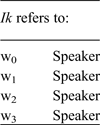
However, for the (a) examples, it is only presupposed that the referent of je is a participant of the conversation. This means that even though je refers to the speaker in the actual world, in counterfactual interpretations the referent of je can be both the speaker and the hearer. This is shown in the toy model in (38).
(38) Evaluation of the reference of je against a set of possible worlds w0– w3′
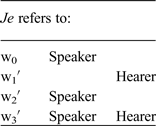
Applying this model to (36a), this indicates that in all worlds where Andrew invited the speaker or the hearer for a drink, this participant accepted the invitation. From the context it follows that in the actual world it was the speaker, but that in all situations where the hearer would be in the same situation, the hearer would do the same thing. This is exactly the message that the (a) examples, but crucially not the (b) examples, convey. In the (b) examples it would still be the speaker who was the willing invitee in other worlds as well.
The question of course arises as to why in these cases involving speaker-referring je counterfactual evaluation is invoked in the first place. In the usual case, non-modal utterances are evaluated against the real world. However, it follows from neo-Gricean reasoning that a speaker can be assumed to make a felicitous contribution to the conversation if the speaker deliberately utters a sentence. If such a sentence, when evaluated against the actual world only, were to give rise to a violation of Maximize Presupposition (in the case of speaker-referring je when the stronger alternative with ik instead of je is actually entailed by the common ground), it can be then assumed that the speaker does not make a claim about the actual world only. Since the reason that a particular utterance violates Maximize Presupposition is that it is, as some kind of default procedure, evaluated against the actual world, it follows that if it is still deliberately uttered, the procedure that restricts evaluation of stronger alternatives against the actual world must be overruled. Because evaluation of alternative worlds follows by virtue of the neo-Gricean assumption that the speaker does want to make a felicitous contribution to the conversation, this effect must be taken as an implicature. Therefore, the use of speaker-referring je can be taken to be the result of an implicature that states that the hearer would do the same if s/he were in the speaker's situation.
This additional implicature must therefore always show up, even in episodic sentences. Accordingly, even in clearly episodic examples such as (35a) and (36a), the utterance conveys that the addressee would have done the same thing on the football field/in the bar, which is exactly the interpretation that such sentences are felt to have. Deictic je can thus be used in two ways: either it refers to the hearer only, or it refers to the speaker, but in the latter case, by implicature, evaluation against alternative worlds must have taken place.
Evidence for the existence of such an implicature comes from two facts. First, conversational implicatures are known to be cancellable; this is indeed the case here. Suppose a football player uttered (35a) to a rather clumsy person. The football player could add a continuation such as the one in (39), indicating that je in (35a) cannot refer to the hearer, even in counterfactual situations, and is therefore incorrect.
(39) Nou, jij zou zoiets nooit gedaan hebben.
prt you.emph would such.a.thing never done have
‘Well, you wouldn't have done such a thing.’
Second, as an anonymous JL referee points out, predicates of personal taste should not give rise to such an implicature, as personal taste varies amongst people and would therefore not allow such an implicature to arise. Indeed, Dutch je, with its speaker-only reference, cannot be used in expressions of personal taste:
(40) Je houdt van spinazie.
you like of spinach
#‘I like spinach.’
I take these two pieces of evidence to speak in favor of the analysis. However, one question remains open. Thus far we have only looked at (intended) episodic contexts where je would lack a generic/impersonal interpretation and therefore be only two-way ambiguous (speaker-referring and hearer-referring). However, as noted in the introduction, outside episodic contexts second-person je (as well as many second-person pronouns in other languages) can also give rise to generic/impersonal readings. Example (1), repeated here in (41), next to its speaker-referring and hearer-referring readings, also has a generic/impersonal reading (as has the English translation):
(41) Zonder geloof kun je niet functioneren.
without faith can you not function
‘You cannot function without faith.’
How do we know that the speaker-referring reading of je is truly different from generic/impersonal readings? This question will be addressed in the following subsection.
3.3 (Non-)episodic readings and speaker-referring je
The question as to how we can establish that the speaker-referring reading of je is truly different from its generic/impersonal reading becomes more important once the behavior of Dutch je in non-episodic contexts (where alternative worlds or situations are obligatorily quantified over) is taken into consideration. Such contexts can be induced, for instance, by modal auxiliaries and conditionals.
Let us focus first on modal auxiliaries. Take (42) when uttered by a parent to a child:
- (42)
(a) Je mag een koekje pakken.
you maya cookie take
‘You may take a cookie.’
(b) Je moet nu gaan.
you must now go
‘You must go now.’
Both sentences in (42) are three-way ambiguous between a (preferred) hearer-only interpretation (i.e. the hearer is allowed to take a cookie/forced to leave), a generic/impersonal interpretation, and an interpretation with speaker-referring je.
All three readings are expected to arise. The hearer-only reading of (42a) is expected to surface because (42a) states that in at least one possible world accessible from the real world, the participant takes a cookie. The generic/impersonal interpretation of (42a) arises if it is contextually clear that the permission to take a cookie applies to at least both the speaker and the hearer. The speaker-only reading of (42a) is also available in the contexts where it can be inferred that only the speaker has the right to take a cookie in the actual world (for instance, if only the speaker played some sports and finds that only after having played sports one can legitimately take a cookie). Fully analogously to the examples discussed in Section 3.2 above, in the actual world of this reading, the speaker is allowed to take a cookie, provided that in all alternative worlds, there is an accessible world where the participant takes a cookie as well, be it the hearer or the speaker (if they have done some sports). Note that this is already different from the generic/impersonal reading that allows both participants to take a cookie. Mutatis mutandis, the same applies to (42b).
Similar things take place in conditionals, as illustrated in (43).
(43) Als je ziek bent, moet je thuisblijven.
if you ill are must you home.stay
‘If you are ill, you must stay home.’
Again, under the proper circumstances, the conditional in (43) can receive both a hearer- and a speaker-referring interpretation, and, just like its English translation (or perhaps even more saliently), it also has a generic/impersonal reading, relatively similar to the example with an impersonal pronoun in (44).
(44) If one is ill, one must stay home.
That second-person pronouns may give rise to a generic/impersonal interpretation is not a new observation and certainly not specific to Dutch. As already noted in the introduction, use of the second person may very easily give rise to generic/impersonal readings in most other languages as well. Furthermore, use of the second-person pronoun to yield a generic/impersonal reading in non-episodic contexts, such as conditionals, is very common across languages. In fact, most Germanic, Romance, and Slavic languages, as well as many languages outside the Indo-European language family, exhibit this phenomenon.Footnote 13
Therefore, one might wonder whether the speaker-only reading is different from the generic/impersonal reading that a second-person pronoun may yield or whether it is rather a special use of this generic/impersonal reading, as has been suggested in Tarenskeen (Reference Tarenskeen2010). There are two ways in which it can be shown that these readings are indeed different.
First, it can be shown that in contexts that are clearly episodic, and where a generic/impersonal reading is hard if not impossible to yield, the speaker-only reading can still surface. Second, it can be demonstrated that in languages where second-person pronouns can give rise to generic/impersonal readings, these pronouns cannot be used to refer to the speaker the way they can in Dutch.
As for the first argument, let us look again at the earlier example (3)/(35a), presented here again for convenience:
(45) Je kreeg de bal van Huntelaar en toen schoot je op het doel.
you got the ball from Huntelaar and then shot you on the goal
‘I got the ball from Huntelaar and then I shot on the goal.’
The context in which this sentence was uttered was one in which a particular player answered the question as to why in a particular situation he made the goal. This interpretation, made even more salient by the use of the past tense, is only episodic. A generic/impersonal interpretation would involve a series of events where in all (or most) cases in which the speaker gets the ball from Huntelaar, s/he targets the goal. Even though this reading cannot be excluded, it could not have emerged in this particular context. This already indicates that speaker-referring je is different from generically/impersonally used je.
But this first argument can be made even stronger. Generic/impersonal interpretations of coordinated constructions can always be paraphrased as conditionals. This is also the case for the present-tense counterpart of (45), which indeed allows a generic/impersonal reading:
(46) Je krijgt de bal van Huntelaar en dan schiet je op het doel.
you get the ball from Huntelaar and then shot you on the goal
‘I get the ball from Huntelaar and then you shot on the goal.’
Example (46) can be easily interpreted as a generic/impersonal construction, meaning something like ‘If Huntelaar gives you the ball, you shoot on the goal’.
But, as Cullicover & Jackendoff (Reference Culicover and Jackendoff1997) have shown, conjunctions that receive a conditional interpretation exhibit particular syntactic properties that non-conditionally used conjunctions lack. For instance, in the conditional interpretation, a pronoun in the first conjunct can be bound by a quantifier in the second one, and anaphoric pronouns in the first conjunct can be bound by antecedents in the second conjunct. Non-conditionally used conjunctions lack these properties.
To illustrate this, the examples in (47), with no pronoun in the first conjunct bound by an antecedent in the second conjunct, are ambiguous between a temporal, consecutive interpretation and a conditional interpretation.
- (47)
(a) Another picture appears in the paper, and Susan thinks that John will definitely go out and get a lawyer.
(b) You give himj enough opportunity and [every senator]i, no matter how honest, will succumb to corruption.
In contrast, the examples in (48), where these pronouns are bound, only allow a conditional interpretation; the temporal, consecutive interpretation is absent.
- (48)
(a) Another picture of himselfi appears in the paper, and Susan thinks that Johni will definitely go out and get a lawyer.
(b) You give himi enough opportunity and [every senator]i, no matter how honest, will succumb to corruption.
This predicts that for a generic/impersonal reading, binding across the conjunction (from right to left) should be possible.Footnote 14 This is indeed the case, as is evidenced below.
- (49)
(a) (?)Je krijgt hemi van Huntelaar en dan schiet je [iedere bal]i
you get it from Huntelaar and then shot you every ball
op het doel.
on thegoal
‘You get it from Huntelaar and then you shot every ball on the goal.’
(b) (?)Nog één goal van zichzelfi tegen je en Huntelaari verslaat
yet a goal from himself against you and Huntelaar defeats
je voorgoed.
you definitely
‘Another goal from himself against you and Huntelaar defeats you definitely.’
However, in the past-tense counterparts of (49), given in (50) below, such binding effects are suddenly impossible. This is because je cannot be interpreted in a generic/impersonal way; therefore, the coordination lacks the specific syntactic properties of coordinations that allow for a generic/impersonal interpretation (i.e. that allow a conditional-like interpretation).
- (50)
(a) *Je kreeg hemi van Huntelaar en dan schoot je [iedere bal]i
you got it from Huntelaar and then shot you every ball
op het doel.
on the goal
Intended: ‘You'd get it from Huntelaar and then you'd shot every ball
on the goal.’
(b) *Nog één goal van zichzelfitegen je en Huntelaari versloeg je
yet a goal from himself against you and Huntelaar defeats you
voorgoed.
definitely
Intended: ‘Another goal from himself against you and Huntelaar would defeat you definitely.’
This shows that at least certain cases of speaker-referring je cannot be taken to be instances of a generic/impersonal use of je, and that, therefore, speaker-referring je exists as a special reading of je in its own right.
As for the second piece of evidence, since this concerns a cross-linguistic comparison between Dutch and other languages, we should first consider the exact predictions that the analysis makes with respect to cross-linguistic variation. Subsequently, we will see that languages that do allow generic/impersonal readings of second-person pronouns still lack the kind of readings that Dutch speaker-referring je can yield.
4. Cross-linguistic variation
The analysis pursued for Dutch in Sections 3.1–3.2 states that both gender and participant pronouns stand in an asymmetric feature relation, as illustrated in (51) (where ⇔ marks which semantic features constitute which pronoun):
- (51)
(a)
(b)

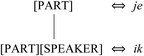
Dutch hij and je can be seen as realizations of higher nodes in a feature hierarchy than zij and ik, respectively.
However, there is nothing universal about this asymmetric feature distribution behind gender or participant pronouns. It may very well be the case that other languages exhibit gender pronouns that stand in a symmetric feature relation, with the feminine pronoun carrying a feature [FEM] and the masculine pronoun carrying a designated feature [MASC(ULINE)], as illustrated in (52a) below. Likewise, nothing excludes languages that have participant pronouns where both first- and second-person pronouns carry [PART] and where the first-person pronoun carries [SPEAKER] and the second-person pronoun [ADDRESSEE], as illustrated in (52b). In such languages the participant and/or gender pronouns are realizations of sister nodes in a feature hierarchy.
- (52)
(a)
(b)

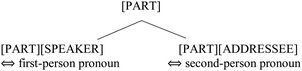
In the following subsection I demonstrate that neighboring languages of Dutch exhibit the cross-linguistic variation shown above. Whereas gender pronouns in German behave identically to the gender pronouns in Dutch, English gender pronouns reflect a symmetric feature relation, as in (52a). As for participant pronouns, both German and English behave similarly but deviate from Dutch; their underlying feature distribution is as in (52b). Such pronouns do not stand in a markedness relation.
4.1 Cross-linguistic variation with respect to gender pronouns
Let us consider gender features first. The examples presented in Section 2 above demonstrating that Dutch gender pronouns stand in a markedness relation naturally extend to German. This is illustrated below.
- (53)
(a) Wenn jemand das Telefon benutzen will, muss er erst bezahlen.
if somebody the telephone use wants must he first pay
‘If somebody wants to use the telephone, they'll have to pay first.’
(b) Wenn jemand das Telefon benutzen will, muss er erst bezahlen.
if somebody the telephone use wants must she first pay
‘If somebody wants to use the telephone, she'll have to pay first.’
- (54)
(a) Jeder,der seine Kreditkarte verloren hat, muss sie sperren.
everybody who his credit.card lost has must it block
‘Everybody who lost their credit card must block it.’
(b) Jeder, der ihre Kreditkarte verloren hat, muss sie sperren.
everybody who her credit.card lost has must it block
‘Everybody who lost her credit card must block it.’
In (53) and (54), the (a) examples give rise to a gender-neutral bound variable reading, whereas the (b) examples do not (there the domain of quantification of jeder ‘everybody’ subsumes female referents only). Furthermore, in (55a) the burglar may be female according to the speaker, but in (55b) the burglar cannot be a male.
- (55)
(a) Er hat die Juwelen meiner Mutter gestohlen.
he has the jewels my mother stlen
‘He stole my mother's jewels.’
(b) Sie hat die Juwelen meiner Mutter gestohlen.
she has the jewels my mother stolen
‘She stole my mother's jewels.’
Finally, whereas in (56a) the speaker might know that the child is a girl but deliberately not disclose the gender by using the masculine pronoun. In German (56b) this is impossible; the child must be a girl.
- (56)
(a) Einen kind heb ik betrapt op spieken. Hij heeft een 1 gekregen.
one kid have I caught on cheating he has a 1 got
‘I caught one kid cheating. He got a 1.’ (i.e. the lowest grade possible)
(b) Einen Kind heb ik betrapt op spieken. Zij heeft een 1 gekregen.
onekid have I caught on cheating she has a 1 got
‘I caught one kid cheating. She got a 1.’ (i.e. the lowest grade possible)
All the semantic/pragmatic effects with respect to gender pronouns are the same as in Dutch.
However, things are different in English. Here, masculine pronouns cannot give rise to gender-neutral bound variable readings. The examples in (57) enforce reference to males only.
- (57)
(a) If somebody wants to use the telephone, he'll have to pay first.
(b) Everybody who lost his credit card must block it.
As is also indicated by the different translations in (53)–(54) above, in order to express a gender-neutral reading that does not presuppose any gender restrictions, the third-person plural pronoun they/their must be used. Furthermore, uttering the translations of (55a) and (56a) presupposes that the speaker knows and wants to convey that the burglar or the child is male. If the speaker does not want to convey this, no masculine pronoun can be used. This shows that English fails all the diagnostic tests for gender markedness, showing that the underlying feature distributions cannot be asymmetric as in Dutch or German, but must be symmetric instead: masculine and feminine pronouns are semantically equally strong in English.
4.2 Cross-linguistic variation with respect to participant pronouns
It has already been mentioned several times in this article that second-person pronouns in many languages may give rise to generic/impersonal readings. However, for these languages, to the extent that it has been investigated, the semantic behavior of impersonal second-person pronouns and plain impersonals is deviant. For example, Malamud (Reference Malamud2005, Reference Malamud2006) lists a number of differences between English one and impersonal you. For instance, the impersonal you invokes some kind of empathy that one lacks. This is demonstrated in (58), where empathy is felt with the jailed one, not with the jailer:
(58) In those days, one could throw you in jail for this kind of thing.
(Malamud Reference Malamud2006: 9)
Another difference between the impersonal use of the second-person pronoun you and the impersonal pronoun one concerns speaker inclusion in the set of possible referents. Take (59):
- (59)
(a) One may not smoke in here, but of course YOU may.
(b) *You may not smoke in here, but of course YOU may.
In (59a) the hearer may be an exception to the general rule that smoking is prohibited; in (59b) this is impossible. Note that these facts naturally extend to Dutch (where the emphatic pronoun jij is used for the second occurrence of ‘you’):
(60) In die dagen kon men je in de gevangenis gooien voor zoiets.
in those days could one you in the prison throw for such.thing
‘In those days, one could throw you in jail for this kind of thing.’
- (61)
(a) Men mag hier niet roken, maar jij natuurlijk wel.
one may here not smoke but you.emph of.course prt
‘One may not smoke in here, but of course you may.’
(b) *Je mag hier niet roken, maar jij natuurlijk wel.
you may here not smoke but you.emph of.course prt
‘You may not smoke in here, but of course you may.’
The English and Dutch examples demonstrate that the generic/impersonal use of you/je always seems to involve some (indirect) reference to the hearer, which the plain impersonal pronouns lack. This entails that the generic/impersonal use of you/je should follow from its second-person properties (thus ruling out a treatment of the generic/impersonal use of you/je in terms of lexical ambiguity). Several attempts to do so have been made. Malamud (Reference Malamud2006: Section 4.4) argues for a ‘body and soul’ analysis of the generic/impersonal you, where it refers to an individual ‘whose shell is inhabited by the addressee's self’. Others take the second-person singular to be upward entailing, so that its set of reference includes at least the hearer (see Sauerland Reference Sauerland and Harbour2008: Section 3.3.1).
Focusing on the generic/impersonal use of second-person pronouns, a contextually restricted set of individuals is quantified over. Crucially, the generic/impersonal examples above do not apply to every human in a given context. In fact, the set of reference of an impersonal pronoun can be contextually restricted to smaller sets – even to a singleton set – so that the sentence is understood to apply to the speaker. As has been shown by Kratzer (Reference Kratzer1997), Egerland (Reference Egerland2003), and Moltmann (Reference Moltmann2006), impersonal pronouns such as German man, Swedish man, and English one may be used in a situation where they clearly refer to the speaker, the hearer, or a third person. Their examples are presented in (62).
- (62)
(a) Es war völlig klar dass man sich nie mehr
it was completely clear that one himself never anymore
wiedersehen würde.
again.see would
‘It was completely clear that one wouldn't see each other again.’
(Kratzer Reference Kratzer1997: 3)
(b) Man blir besviken.
one was disppointed
‘One was disappointed.’
(Tarenskeen 2012: 64)
(c) The tailor knows what to wear at one's own wedding.
(Moltmann Reference Moltmann2006: 273)
However, this is not the case for second-person pronouns: English you and German du, if they receive an impersonal reading, must always involve reference to the hearer as well, contrary to the examples in (62). The examples in (63) cannot refer to the speaker only.
- (63)
(a) Es war völlig klar dass du dich nie mehr
it was completely clear that you yourself never anymore
höhren würdest.
hear would
‘It was completely clear that you wouldn't hear yourself again.’
(b) The tailor knows what to wear at your own wedding.
A requirement for impersonally used second-person pronouns in German and English is that the contextually restricted set of references of the pronoun bound by the generic quantifier minimally involves the hearer.
It has been proposed by Tarenskeen (Reference Tarenskeen2010) that the speaker-referring je in Dutch is also an instance of a generic/impersonal second-person pronoun that is contextually restricted in its referential properties. For her, je presupposes reference to at least an imaginary hearer, and if this imaginary hearer is present, je can be used generically/impersonally in such a way that the domain of generic quantification is contextually restricted to the speaker and this imaginary reader only. The pronoun then refers to the speaker, and the imaginary hearer is then invited to sympathize with the speaker.
Tarenskeen's analysis thus takes the minimal contribution of je to be either presupposing reference to the hearer (in its deictic use) or referencing a contextually restricted set that minimally involves an imaginary addressee (in its impersonal use). Apart from the problems discussed in Section 3.3 above (which shows that the speaker-referring reading of je is independent from its generic/impersonal reading), there are two additional problems with this approach.
First, it is unclear what the exact semantic representation of je is, such that it can presuppose an imaginary hearer, except for just postulating it. The way the two uses are defined in Tarenskeen's account is that they must be the result of the lexical ambiguity of Dutch je: the semantic representation of the deictic je must be different from the impersonal je. Further, it remains unclear how this alleged imaginary hearer makes sentences containing speaker-referring je to be interpreted as conveying the message that the real hearer would have done something similar were the hearer the speaker.
Second, if speaker-referring je is indeed a special instance of the generic/impersonal je, in principle, every impersonally referring second-person pronoun should then be able to invoke speaker-referring readings. This, however, turns out not to be the case. Both English and German ban instances of speaker-referring second-person pronouns.
For English, the reader can confirm this by looking at all translations of the Dutch examples presented in Section 2 containing the speaker-referring je and comparing them to the examples below, in which you does not yield reference to the speaker only. English you cannot be bound by a coordination meaning ‘you or me’, as seen in (64), it cannot refer to either the hearer or the speaker under epistemic uncertainty, shown in (65), and it cannot behave like Dutch speaker-referring je, in terms of taking you to refer to the speaker or the hearer in counterfactual situations, see (66)–(68).Footnote 15
(64) *Did [you or I]i pass youri exam)Footnote 16
(65) If you get a red ace, you win.
#‘Only if you or I get a red ace, we win.’
(66) You can't function without faith.
#‘I can't function without faith.’
(67) You got the ball from Huntelaar and then you shot on the goal.
#‘I got the ball from Huntelaar and then I shot on the goal.’
(68) Andrew asked whether you'd go with him to the pub and then you said yes, although you knew you had to get up early tomorrow.
#‘Andrew asked whether I'd go with him to the pub and then I said yes, although I knew I had to get up early tomorrow.’
This demonstrates that although English accepts generic/impersonal readings of its second-person pronoun you, speaker-referring you is absent, indicating again that the two readings are distinguishable. This also provides evidence for the proposed symmetric underlying feature relation between I and you as in (52b) above. Since English participant pronouns do not show any markedness effects, they cannot be taken to stand in an asymmetric feature relation as in (51b). English you, therefore, carries both a feature [PART] and a feature [ADDRESSEE].
The same holds for German. German also lacks speaker-referring second-person pronouns, even though it is a language that allows its second-person singular pronoun to express generic/impersonal readings in conditionals as well:
(69) Wenn du krank bist, solltest du zu Hause bleiben.
if you ill are should you at home stay
‘If you are ill, you should stay at home.’
As the following examples indicate, just like English you, German du cannot be bound by a coordination meaning ‘you and me’, as is shown in (70), it cannot refer to either the hearer or the speaker under epistemic uncertainty, seen in (71), and it cannot behave like Dutch speaker-referring je in terms of taking du to refer to the speaker or the hearer in counterfactual situations, see (72)–(74).
(70) *Der Vorstand hat [dich und mich]i beide gebeten ob dui den Namen
the staff has you and me both asked whether you the name
des neuenRektors geheimhalten kannst.Footnote 17
of.the new director secret.keep can
‘The staff has asked you and me whether you could keep the name of
the new director a secret.’
(71) Wenn du ein rotes Kreuz bekommst, gewinnst du.
when you a red ace get win you
#‘Only if you or I get a red ace, we win.’
(72) Andrew fragte, ob du noch mit in die Kneipe kommst, und dann
Andrew asked whether you still prt to the pub go and then
hast du ja gesagt, obwohl du schon weisst, dass du morgen früh
have you yes said although youalready know that you tomorrow early
aufstehen must.
get.up must
#‘Andrew asked whether I'd go with him to the pub and then I said yes,
although I know I had to get up early tomorrow.’
(73) Du bekamstden Ball von Huntelaar und dann zieltest Du aufs Tor.
you got the ball from Huntelaar and then shot you on.the goal
#‘I got the ball from Huntelaar and then I shot on the goal.’
(74) Ohne Glauben kannst du nicht funktionieren.
without faith can you not function
#‘I can't function without faith.’
The two problems for Tarenskeen (Reference Tarenskeen2010) vanish under the account that I proposed in Section 3 above. The examples (67)–(74) show that English you and German du, unlike Dutch je, cannot give rise to the speaker-referring readings that Dutch je allows, despite all three languages allowing their second-person pronouns to yield generic/impersonal readings. I take these data to indicate that English you and German du (in contrast to Dutch je) are ‘true’ second-person pronouns in the sense that they always minimally refer to the hearer (as they carry both [PART] and [ADDRESSEE] features). Thus, the difference between Dutch and English/German in this respect nicely reflects the possible variation that the feature-geometric space constitutes.Footnote 18
A final prediction that follows is that, in principle, in its generic/impersonal uses, Dutch je must be interpreted as minimally referring to the speaker only. The presupposition of its impersonal use is that it minimally refers to a participant of the conversation, unlike German du and English you. The Dutch translations of the examples in (63) are indeed fine with je referring to the speaker only, as is expected.
- (75)
(a) Het was volledig duidelijk dat je jezelf niet meerzou kunnen
it was completely clear that you yourself not more would can
horen.
hear
‘It was completely clear that you couldn't hear yourself anymore.’
(b) Een kleermaker weet wat je op je eigen bruiloft draagt.
a tailorknows what to at your own wedding wear
‘A tailor knows what to wear at one's own wedding.’
This cross-linguistic comparison between the Dutch, English, and German readings of their second-person pronouns shows that they all carry at least the feature [PART]. These languages may vary further as to whether these pronouns additionally carry a feature [ADDRESSEE]. This not only explains the cross-linguistic variation with respect to the presence or absence of speaker-only reference by second-person pronouns, but also captures the intricate constraints on their generic/impersonal uses.
There remains a question for future research, though, of the referential properties of second-person pronouns in other languages. For instance, Giacalone Ramat & Sansò (Reference Giacalone Ramat, Sansò, Ramat and Roma2007) and Tarenskeen (Reference Tarenskeen2010) report examples from languages such as French, Finnish, and Modern Hebrew where second-person pronouns have speaker-referring properties as well, but the exact nature of these speaker-referring properties have not yet been analyzed. However, it must be investigated whether these pronouns carry a [PART] feature only or whether something else is also involved.Footnote 19, Footnote 20
5. Conclusion
In this article I have demonstrated that the Dutch weak second-person singular pronoun je can be used in cases where it refers to the speaker only, with an implicature that the hearer would have done the same thing in that situation. I argued that this rather striking phenomenon is due to Dutch je standing in a semantic markedness relation to Dutch first-person singular pronoun ik, much like the masculine third-person singular pronoun hij ‘he’ stands in a semantic markedness relation to its feminine counterpart zij ‘she’.
I followed Sauerland (Reference Sauerland and Harbour2008) by assuming that semantic markedness results from asymmetric feature composition: Lexical Item A is semantically marked with respect to Lexical Item B if and only if the set of semantic features that B consists of is a strict subset of the set of semantic features of A. Under this approach, I took ik to carry a feature [PART], which presupposes reference to any participant in the conversation, and a feature [SPEAKER], which presupposes reference to the speaker only; je is only taken to carry a feature [PART]. This asymmetric featural composition, in accordance with the principle of Maximize Presupposition, then enables je to refer to the speaker only, provided that it comes along with an implicature that states that, in alternative worlds, the pronoun refers to the speaker or the hearer. Concretely, this amounts to saying that a sentence containing speaker-referring je must come along with an implicature stating that if the hearer were in the speaker's situation, he/she would have done the same thing. It is exactly this interpretation that these examples with speaker-referring je exhibit.
In the remainder of this article I demonstrated that the speaker reference of je is qualitatively different from the generic/impersonal readings that second-person pronouns may generally invoke by showing that only a strict subset of the languages that allow second-person pronouns to yield generic/impersonal readings also allow readings where the second-person pronoun can refer to the speaker only. This I took to follow from the facts that opposite lexical items (such as different participant and gender pronouns) can either stand in a feature-geometric mother–daughter or sisterhood relation, and that languages vary with respect to the these relations between their participant pronouns. It then follows that only if the second-person pronoun is semantically weaker than the first-person pronoun may this second-person pronoun refer to the speaker as well.


