Introduction
Several studies in recent years have been concerned with psychological aspects of cancer patients within an existential framework. Cancer is one of the most feared diseases, able to create extreme disruption in the life of almost any individual, it generates an existential crisis including the confrontation with death, uncertainty, loss of control, loss of meaning given deep changes in personal goals and roles (Blinderman and Cherny, Reference Blinderman and Cherny2005; Westman et al., Reference Westman, Bergenmar and Andersson2006; Kissane, Reference Kissane2012).
Cancer patients are confronted with the risk of physical disability, threats of their family, relationship and social role, and reflexions about life and death (Zeniab et al., Reference Zeniab, Auquier and Leroy2017). They are faced with a variety of psychological, existential, and spiritual challenges that causing distress, anxiety, personality disorder (Breitbart, Reference Breitbart2018; Zoleikha et al., Reference Zoleikha, Vahid and Azad2019). Disease and cancer treatments often affect the sense of dignity and the meaning and profoundly alter the concept of temporality, leading cancer patients to a redefinition of their own time perspective (Chochinov, Reference Chochinov2012; Barone, Reference Barone2015).
In oncology, the dimension of dignity is particularly important because it influences the quality of life (QoL) of cancer patients (Chochinov, Reference Chochinov2002). Dignity is one of the main components of human rights, it is defined as having several positive aspects, including the quality of being worthy of respect or esteem, which is linked to a persons’ self-esteem, personal sense of worth, and perceptions that others respect one's values (Sulmasy et al., Reference Sulmasy, Schulman and Merrill2008; Zirak et al., Reference Zirak, Ghafourifard and Mamaghani2017).
Before Chochinov's studies the construct of dignity in care was defined only through qualitative considerations as it did not yet have a uniform definition. Chochinov and colleagues developed an empirically validated model of dignity through a research carried out with patients at the end of life (Chochinov et al., Reference Chochinov, Hack and Hassard2004). These studies have identified the factors that influence the dignity and the dimensions that make it up (Chochinov, Reference Chochinov2002).
Furthermore, one of the main needs of oncological patients with life-threatening diseases is the maintenance of dignity (Meier et al., Reference Meier, Gallegos and Thomas2016). Several studies conducted in this area have shown that the loss of dignity generates high levels of distress (Chochinov, Reference Chochinov2012; Vehiling and Mhenert, Reference Vehiling and Mhenert2013; Iani et al., Reference Iani, De Vincenzo and Maruelli2020). The term “distress” includes the psychological, physical, social, existential, and spiritual aspects of the emotional experience of cancer and the effect of this experience on the QoL (Chochinov et al., Reference Chochinov, Hack and Hassard2002; Dose et al., Reference Dose, Hubbard and Mansfield2017). According to Vehiling and Mhenert (Reference Vehiling and Mhenert2013), the early awareness of dignity-related existential issues and strategies to improve the sense of dignity will help cancer patients avoid existential distress (demoralization) and retain in a good QoL.
Another relevant dimension that influences patients’ QoL is time (Rovers et al., Reference Rovers, Knol and Pieksma2019). Temporality is a pivotal and constituent dimension of human experience and all is formed and signified in a time frame (Brokmeier, Reference Brokmeier2000; Broom and Tovey, Reference Broom and Tovey2008; Barak and Leichtentritt, Reference Barak and Leichtentritt2014; Carr et al., Reference Carr, Teucher and Casson2014).
The literature seems to suggest that oncological disease profoundly alters the order of existential values and the sense of time, resulting in a redefinition of temporality (Barone, Reference Barone2015). Cancer patients describe their illness as an interruption of one's own pattern of processing events, which needs a process of reconfiguring one's personal ways of making sense of life events, social relationships, personal goals, and future projects (De Luca Picione et al., Reference De Luca Picione, Martino and Freda2017). For all these reasons, cancer is a traumatic event that disrupts one's sense of continuity, resulting in the arrangement of different time frames that are not always able to sustain the elaboration of this experience (De Luca Picione et al., Reference De Luca Picione, Martino and Freda2017). Furthermore, addressing the oncological disease and the treatment path associated with it can change the temporal perspective of each person and therefore also the way they act and place themselves within time itself (Nozari and Dousti, Reference Nozari and Dousti2013).
Several studies revealed that already from the communication of the diagnosis the temporal experience changes in cancer patients (Rasmussen and Elverdam, Reference Rasmussen and Elverdam2006; Eurisko-Favo, 2008; Rovers et al., Reference Rovers, Knol and Pieksma2019). According to this, the surveys conducted by Lövgren et al. (Reference Lövgren, Hamberg and Tishelman2010) and van Laahroven et al. (Reference Van Laahroven, Schilderman and Verhagen2011) showed that the time experience of cancer patients changes after diagnosis and that this experience changes between cancer patients disease-free and patients with advanced disease. A survey that explored the psychological implication of cancer diagnosis has shown that patients develop a great attachment to life and present time (Eurisko-Favo, 2008). From a Danish study conducted by Rasmussen and Elverdam (Reference Rasmussen and Elverdam2006), focused on the temporal perception of cancer survivors, emerged a sense of destruction of life and time, an increase in awareness of time, and a willingness to appropriate one's time. Several Authors are persuaded that there is a relationship between healthy psychological functioning and time perspective (Holman and Silver, Reference Holman and Silver1998; Kruger et al., Reference Kruger, Reischl and Zimmerman2008).
In order to examine the construct of time perception, we adopted Zimbardo and Boyd (Reference Zimbardo and Boyd2009)'s “Time Perspective”. Time perspective theory has identified five possible time orientations: past-positive (PP), past-negative (PN), present-fatalistic (PF), present-hedonistic (PH), and future (F). Each of these time profiles corresponds to a specific mindset and can influence behavior and the ability to adapt to change. These dimensions are modifiable over time, i.e., they can change according to the specific type and frequency of experiences we have.
A PP attitude enables for the implementation of adaptive behaviors to deal with current challenges, while a PN orientation might render the problem-solving process ineffective. People more oriented to the present-hedonistic (PH) tend to seek out feelings of pleasure in the present without worrying about the long-term implications. The PF attitude could, instead, lead to a sense of powerlessness in the face of a future “already written”. Finally, future-oriented (F) people tend to plan, set objectives and are more concerned about their health (Zimbardo and Boyd, Reference Zimbardo and Boyd2008).
Zimbardo's approach refers to the concept of Balanced Temporal Perspectives. “In an optimally balanced time perspective, the past, present and future components blend and flexibly engage, depending on a situation's demands and our needs and values” (Zimbardo, Reference Zimbardo2002, p. 62).
The Temporal Perspective obtained by the combination of all subscale scores is a crucial element that influences emotional and behavioral regulation, resulting in increased levels of psychological well-being (Zimbardo and Boyd, Reference Zimbardo and Boyd1999; Boniwell et al., Reference Boniwell, Osin and Linley2010; Zhang et al., Reference Zhang, Howell and Stolarski2013).
Time Perspective Therapy (TPT), therefore, suggests that we should be able, once we understand what our natural temporal inclination is, to switch between different temporal perspectives with a positive present view, so as to be able to reconnect with a sometimes challenging past, enjoy the present more, and orient ourselves positively toward the future.
Furthermore, exploring patients’ time perspective provides attitudes, beliefs, and thoughts that they typically use to process and give sense to their illness experience. Zimbardo and Boyd (Reference Zimbardo and Boyd2015) account time perspective to be “the often unconscious process whereby the continual flows of personal and social experiences are assigned to temporal categories, or time frames, that help to give order, coherence and meaning to those events.”
These time frames allow patients to code, organize, and remember past and present experiences and to build new goals, expectations, and future scenarios (D'Alessio et al., Reference D'Alessio, Guarino and De Pascalis2003).
Also, a research conducted by Faury et al. (Reference Faury, Zenad and Laguette2019) found that the time perspective in patients with cancer could have effects on their quality of life, in particular the researchers focused on “emotional well-being,” associated with an orientation to the future. What people believed happened in their past life affects their present thinking, feelings, and behavior more than what actually really happened.
The aim of our study was to explore the distress linked to the constructs of Dignity (Chochinov, Reference Chochinov2002) and Time Perspective (Zimbardo and Boyd, Reference Zimbardo and Boyd2009) and to identify how sense of dignity and the time perspective are related. In particular, our study referred to the three dimensions of distress (Grassi et al., Reference Grassi, Costantini and Caruso2017): physical, psychological, and existential distress. We assumed that dysfunctional temporal orientations were associated with high levels of perceived distress in cancer patients.
Method
Participants
The sample consisted of 107 consecutive patients (mean age = 55.84; SD = 10.25) receiving chemotherapy for solid tumors, both in day-hospital and hospitalization, recruited from the oncology department of Fondazione Poliambulanza. Data were collected between December 2019 and August 2020.
The Institutional Research Ethics Board approved the study, and eligible patients signed an informed consent form before entering the study. Exclusion criteria included previous diagnosis of dementia or psychotic disorders based on the DSM-5.
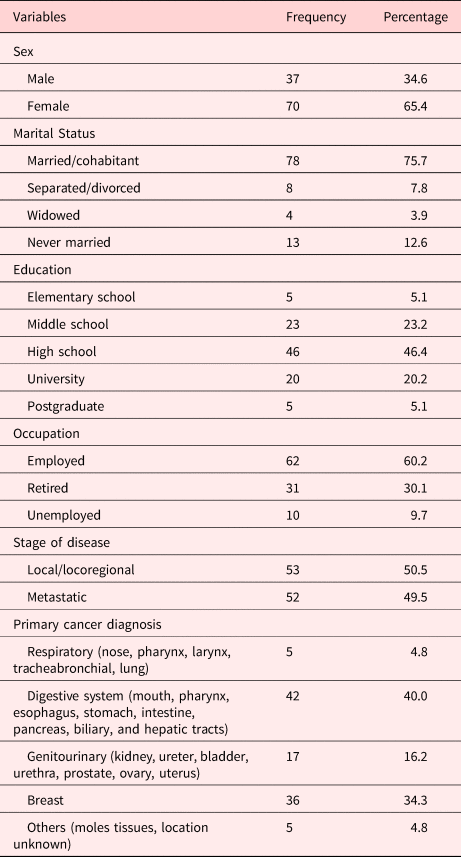
Table 1 shows demographic and clinical data.
Summary of the demographic and clinical data

Measures
Patient Dignity Inventory (PDI-IT)
Italian version of the PDI-IT (Grassi et al., Reference Grassi, Costantini and Caruso2017) was administered to assess the perceived level of dignity among patients. PDI-IT is 25 items questionnaire, designed to identify different sources of distress (physical, functional, psychosocial, existential, and spiritual) commonly experienced in patients diagnosed with cancer. Each item was rated on a 5-point scale (1, not a problem; 2, a slight problem; 3, a problem; 4, a major problem; 5, an overwhelming problem). PDI-IT evaluates (Cronbach alpha 0.96) the three factors of the dignity of cancer patients: existential distress, psychological distress, and physical distress.
Zimbardo Time Perspective Inventory Scale (ZTPI)
Zimbardo Time Perspective Inventory (ZTPI) is a cross-culturally validated instrument in 24 countries across more than 15,000 people (Zimbardo and Boyd, Reference Zimbardo and Boyd2009; Stolarski et al., Reference Stolarski, Fieulaine and VanBeek2014).
For our study, we used the Italian version of the ZTPI, which consists of 56 items divided into five subscales (positive past, negative past, hedonistic present, fatalistic present, and future), each comprising between 9 and 15 items. Participants were asked to answers using a five-point Likert scale (1 = very uncharacteristic; 5 = very characteristic). Internal consistency estimates for subscale scores based on Cronbach's Alpha coefficients ranging from 0.74 to 0.82 were reported by the developer. The five subscales’ test–retest reliabilities (during a 4-week period) varied from 0.7 to 0.8.
The average score of each of the five subscales determines the individual's categorization in a specific temporal orientation.
Procedure
After reading and signing the consent form, participants were asked to fill out the questionnaires. The compilation took about 15 min. Debriefing and answers to questions were provided at the end of the compilation.
Data analysis
SPSS Statics V22 (2013) was used to carry out the analysis. In particular, one sample t-test was used to compare patients that participated in this study with the reference population of the study by Grassi et al. (Reference Grassi, Costantini and Caruso2017), which had similar characteristics to our sample: Italian socio-cultural context, patients in active treatment, both with metastatic and local disease. Kruskal–Wallis was used to calculate the variance between clinical and demographic data and the PDI-IT total score.
The ZTPI scored was calculated as the frequencies obtained on the five temporal orientations by each participant. Chi-square test was used to calculate the association between demographic and clinical data and ZTPI total score. Finally, Pearson correlation was used to calculate the association between PDI-IT and ZTPI.
Results
PDI-IT
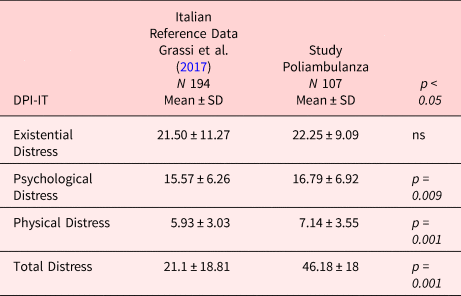
T-test analysis showed that our sample reported higher levels of physical and psychological distress compared to the reference population. No differences were found between the two groups regarding the existential distress (Table 2). Finally, Kruskal–Wallis showed higher distress in patients under 55 years (p = 0.04) and lower distress in retired patients (p = 0.01). No significant differences were found among stage, site of the primary cancer diagnosis and DPI-IT scores.
Comparison of means for single sample (DPI-IT)

ZTPI
The results showed that 42 patients were focused on the past-positive (39.3%), 40 on the future (37.4%), 12 patients on the present-hedonistic (11.2%), 11 on the past-negative (the 10.3%), and only 2 on the present-fatalistic (1.9%). Furthermore, results showed a gender difference regarding time orientation: men were mainly oriented to the future while women to the past-positive.
Finally, married subjects reported a prevalent orientation to past-positive and the future. No significant differences were found between the stage of the cancer (χ 2 (4) = 5.377, p = 0.251) and the site of primary (χ 2 (16) = 14,419, p = 0.568) with the time orientation.
DPI-IT and ZTPI
The correlation between PDI-IT and ZTPI showed a positive association between total score distress (r = 0.192, p = 0.01), physical distress (r = 0.203, p = 0.03), psychological distress (r = 0.236, p = 0.01), and the past-negative orientation of the ZTPI.
Discussion
Our study aimed to explore level of distress related to dignity in cancer patients, their temporal orientation and how these two factors are related. Consistent with the published research literature (Ripamonti et al., Reference Ripamonti, Buonaccorso and Maruelli2012; Buonaccorso et al., Reference Buonaccorso, Miccinesi and Belloni2016a, Reference Buonaccorso, Ripamonti and Maruelli2016b; Ripamonti, Reference Ripamonti2016), our results showed that patients have high levels of physical and psychological distress, in terms of greater nausea, inability to perform tasks of daily life, depression, anxiety, and sense of uncertainty about the future. Specifically, our study revealed higher levels of distress in young patients (under 55 years old) compared to older patients. Young patients might experience a major burden of injustice and existential crisis due to the diagnosis of cancer compared to older patients (Chochinov et al., Reference Chochinov, Hack and Hassard2002; Cianfarini, Reference Cianfarini2010), and feel unprepared to face the unexpected, to manage their vulnerabilities and to ask for help (Chochinov, Reference Chochinov2015). These data are consistent with previous studies (Noyes et al., Reference Noyes, Kathol and Debelius-Enemark1990) and are endorsed by our results indicating a significant relationship between “retirees” and low levels of distress. Retirees are likely to have developed identity-protection measures as a result of their shift from worker to not-worker. In this perspective, the preservation of a social role could lead to dignity's preservation (Chochinov, Reference Chochinov2015).
Furthermore, our results did not show any significant relationship between locations and stage of diseases and level of distress related to dignity.
Regarding to temporal perspective, most our patients showed an orientation toward the past-positive (PP) and toward the future, these findings are consistent with study conducted by Nozari et al. (Reference Nozari, Janbabai and Dousti2013) on a group of patients with breast and digestive cancer. The PP orientation (Zimbardo and Boyd, Reference Zimbardo and Boyd2009) involves the ability to re-elaborate past experiences through a positive perspective which could help cancer patients to cope the experience of their disease. Past and future experiences are mediated through the patient's perceptions of the events, rather than being direct experiences, according to this it seems that the orientation to the past-positive and to the future in cancer patients allows them to construe new meanings related to the cancer experience (Nozari et al., Reference Nozari, Janbabai and Dousti2013).
In relation to gender differences, our study showed that males are most oriented toward to the future, while females toward the past-positive, according to Zimbardo and Boyd (Reference Zimbardo and Boyd2015). Furthermore, our results showed that married tend to be oriented toward both the past-positive and the future.
The literature highlights, in support of our hypothesis, that married cancer patients gain benefits from family resources, from a good couple relationship, and from the evolution of their role within their family (Saita, Reference Saita2009; Chochinov, Reference Chochinov2015). Finally, we did not find significant relationship between the time perspective, age, stage disease, or site of primary tumor.
The study's main purpose was to explore the relationship between the distress linked to dignity and temporal orientation. Regarding this, our data showed an association between the past-negative perspective and the existential and psychological distress. Previous research has found an association between negative rumination and depression, anxiety, and high levels of distress (Laguette et al., Reference Laguette, Apostolidis and Dany2013; Sword et al., Reference Sword, Sword and Brunskill2013; Zimbardo and Boyd, Reference Zimbardo and Boyd2015; Faury et al., Reference Faury, Zenad and Laguette2019; Zimbardo et al., Reference Zimbardo, Sword and Sword2019).
Our results refer to a sample of cancer patients who are faced sadness, isolation, and a damaged sense of identity and self-worth. These patients live suspended between the present time, generally experienced as a “no time,” marked by the vicissitudes related to the treatment process (Cianfarini, Reference Cianfarini2010) and a past time full of objectives and projects sometimes hard to complete (Morasso and Tomamichel, Reference Morasso and Tomamichel2005). Zimbardo and Boyd (Reference Zimbardo and Boyd2015) implied that time perspective's changing depend on several factors, from personal and social to institutional. One of the main objectives in psychological support is to accompany patients in the processing and realizing of the disease (Morasso and Tomamichel, Reference Morasso and Tomamichel2005). In this sense, the cancer experience could be seen as a process of transformation that offers the opportunity to build new meanings (Martino and Freda, Reference Martino and Freda2016). For this purpose, it may be useful to propose the Dignity therapy that is a short and individualized psychotherapy based on the empirical model of Chochinov (Reference Chochinov2002).
This psychotherapeutic intervention accompanies patients in creating a generative document based upon the most significant experiences of their life and what they want to be remembered for, patients deliver the generative document produced as a legacy to the closest once (Martinez et al., Reference Martinez, Arantzamendi and Belar2017).
In the psychological experience of cancer, the constructs of time perspective and dignity are strongly intertwined, therefore it might be interesting to integrate both into patient-centered care to help patients reformulate their past experiences, foster processes of meaning making of the cancer condition in the present, and promote self-continuity (generative document).
Outlining their temporal profile in cancer patients allows us to have an important indicator to orient the therapeutic work of supporting hope. Where there is a temporal functioning unbalanced towards a general pessimism, the first therapeutic objective should be to try to balance the temporal orientations in order to decrease the sense of anguish and increase the sense of hope. It could therefore be hypothesized that temporal profiles could be considered a predictive and supportive element for the goals of Dignity Therapy. In our cultural context, Dignity Therapy is still little used and employed especially with patients close to the end of life. Therefore, it is important to further develop research to be able to extend the benefits of this psychotherapy to cancer patients in every phase of disease.
In conclusion, our study presents some limitations. The aims of this descriptive preliminary study led us to correlational analysis, a more comprehensive and complex analysis is needed to deep the relationship between the Past Negative orientation and the psychological distress linked to dignity. Future research should focus on the central role of temporal orientation, from diagnosis to treatment. In addition, it would be interesting to explore if the interaction between age, marital status, occupational status, and stage of the disease can influence the temporal perspective in cancer patients. Regarding the dignity dimension, it would be useful to investigate whether the stage or site of primary tumor constitute dignity-related stress factors in young patients. Finally, it would be interesting to investigate the relationship between coping styles and the factors that maintain sense of dignity, in order to generate different level of interventions in the care path.
Conclusion
Our results have highlighted the main sources of distress related to dignity and the role of the temporal perspective in dealing with the disease. The data underlined the importance of designing a personalized treatment path for each patient focused on supporting dignity.
Furthermore, these findings indicate the need of a psychotherapy approach that considers temporal orientation, which may be re-balanced to promote psychological well-being if it is unbalanced. Dignity and temporal perspective should not be considered as isolated elements, but in an integrated strategy, our study provides a framework for future research aiming to assess a central role of both dimensions as indicators of quality of care.
Therefore, it becomes essential to consider these dimensions not only in the psychotherapeutic intervention, but in the training of dignity in care to all oncology health workers.