Introduction
Depression is one of the most prevalent psychiatric disorders worldwide, and is caused by a combination of genetic, biological, and psychosocial factors that can be accelerated by individual vulnerability to stressors (de Wit, van Straten, van Herten, Penninx, & Cuijpers, Reference de Wit, van Straten, van Herten, Penninx and Cuijpers2009). Obesity is a risk factor for various medical conditions such as diabetes mellitus, hypertension, dyslipidemia, coronary heart disease, and depression (Faith, Matz, & Jorge, Reference Faith, Matz and Jorge2002). The relationship between obesity and depression has been analyzed in multiple cross-sectional and observational studies (Faith et al. Reference Faith, Matz and Jorge2002; Roberts, Deleger, Strawbridge, & Kaplan, Reference Roberts, Deleger, Strawbridge and Kaplan2003; Scott, McGee, Wells, & Oakley Browne, Reference Scott, McGee, Wells and Oakley Browne2008). A recent systematic review examined 15 prospective cohort association studies found that obesity or overweight at baseline was associated with increased risk of depression at follow-up (Luppino et al. Reference Luppino, de Wit, Bouvy, Stijnen, Cuijpers, Penninx and Zitman2010).
Body weight tends to fluctuate rather than remain constant, and interest in the effect of body weight variability (BWV) on health-related outcomes has been increasing steadily. BWV (or weight fluctuation) refers to repeated episodes of weight gain and loss over time, which can be intentional or unintentional (Oh et al. Reference Oh, Moon, Choi, Lim, Park, Cho and Jang2019), whereas weight cycling tends to mean repeated weight gain after intentional weight loss (Bangalore et al. Reference Bangalore, Fayyad, Laskey, DeMicco, Messerli and Waters2017). The literature has shown that BWV correlates with higher mortality, especially in coronary heart disease (Lee et al. Reference Lee, Han, Cho, Park, Kwon, Kang and Kim2018; Lissner et al. Reference Lissner, Odell, D'Agostino, Stokes, Kreger, Belanger and Brownell1991), an increased risk of atrial fibrillation (Lee et al. Reference Lee, Choi, Han, Lee, Moon, Lee and Lip2020), diabetes mellitus (Morris & Rimm, Reference Morris and Rimm1992), dementia (Ravona-Springer, Schnaider-Beeri, & Goldbourt, Reference Ravona-Springer, Schnaider-Beeri and Goldbourt2013), and bone fractures (Meyer, Tverdal, & Selmer, Reference Meyer, Tverdal and Selmer1998). To date, most studies examining the association between body weight and depression have focused on the weight changes (i.e. weight loss or gain) or status (e.g. under-weight or overweight) assessed at baseline or an endpoint, without considering the variability (Jung et al. Reference Jung, Woo, Cho, Park, Jeong, Lee and Shin2017; Kloiber et al. Reference Kloiber, Ising, Reppermund, Horstmann, Dose, Majer and Lucae2007; Rofey et al. Reference Rofey, Kolko, Iosif, Silk, Bost, Feng and Dahl2009; Sahle et al. Reference Sahle, Breslin, Sanderson, Patton, Dwyer, Venn and Gall2019). A few studies have attempted to discern whether BWV (mainly intentional) has psychological consequences, but the results have been inconsistent (Bartlett, Wadden, & Vogt, Reference Bartlett, Wadden and Vogt1996; Foreyt et al. Reference Foreyt, Brunner, Goodrick, Cutter, Brownell and St Jeor1995; Kiernan, Rodin, Brownell, Wilmore, & Crandall, Reference Kiernan, Rodin, Brownell, Wilmore and Crandall1992; Kuehnel & Wadden, Reference Kuehnel and Wadden1994). Recently published papers have revealed a positive association between intentional weight fluctuation and depressive symptoms in a large population database (Madigan, Pavey, Daley, Jolly, & Brown, Reference Madigan, Pavey, Daley, Jolly and Brown2018; Quinn, Puhl, & Reinka, Reference Quinn, Puhl and Reinka2020). However, most previous studies have defined the degree of weight fluctuation using participant’ self-reports, and some studies have examined only subjects with obesity or eating disorders, limiting generalizability. To our knowledge, no studies have investigated directly whether BWV increases the risk of depression in a nationwide population. BWV can affect inflammation by activating the immune system, which is considered a major mechanism for depression onset. This indicates the importance of understanding the relationship between BWV and depression.
In this study, we aimed to determine the association between BWV and new-onset depression in a nation-wide population-based cohort. We calculated BWV using weight measured repeatedly over time to reduce the information bias inherent in self-reported weight variability.
Materials and methods
Study population
The National Health Insurance Service (NHIS) of South Korea is a universal healthcare system, that covers approximately 98% of the population. The NHIS publishes databases including anonymized information, such as sociodemographic variables, health care utilization data, diagnosis codes for diseases, treatments, and results of health examinations. The NHIS provides free health examinations to subscribers every 2 years through the National Health Screening Program. In this study, we used the national health screening dataset from the NHIS to select a population of people aged 20 or older who received health check-ups in 2009 or 2010 (n = 17 498 154, year of health examination as baseline year). Including check-ups in 2009 or 2010, we limited subjects to those who had been screened at least three times in the previous 5 years (n = 8 393 409) and excluded those with missing data (n = 971 316) and those with a previous diagnosis of depression (n = 823 523). Finally, a total of 6 598 570 subjects were included in the study population. Baseline characteristics and health check-up data were collected from the baseline year (2009 or 2010). This study was approved by the Institutional Review Board of Samsung Medical Center (No. 2020-10-034), with NHIS approval for the use of its data. Informed consent was waived because all the information was de-identified.
Demographic and clinical measurements
Demographic data of the study participants (age, sex and income); clinical measurements (height, weight, waist circumference, systolic and diastolic blood pressure); blood test results (lipid profiles, triglycerides, fasting glucose, and glomerular filtration rate); lifestyle data; and comorbidity information were collected at baseline year. Body mass index (BMI) was calculated by dividing body weight (kg) by the square of height (m2), and obesity was defined as BMI ⩾ 25 kg/m2. Abdominal obesity was defined as waist circumference ⩾90 cm for men and ⩾85 cm for women. Information about current smoking and alcohol consumption was obtained using a self-report questionnaire. Regular physical activity was defined as vigorous exercise for more than 20 min at least three times per week or moderate exercise for more than 30 min at least 5 days per week. Income level was divided into the lower 20% (including medical aid subjects) and the remaining 80%. Peripheral blood samples to measure fasting glucose and lipid levels were drawn after an overnight fast, and all the clinical measurements were assessed by well-trained examiners.
Definitions of comorbidities
Baseline comorbidities were defined based on diagnosis and prescription codes of the International Classification of Diseases, 10th revision (ICD-10) and/or on results of health examinations. Diabetes mellitus was defined as fasting glucose level ⩾126 mg/dl or request for at least one prescription for antidiabetic medications under ICD-10-CM codes E11–E14. Hypertension was defined as systolic BP ⩾140 mmHg, diastolic BP ⩾90 mmHg or request for at least one prescription for antihypertensive medication under ICD-10-CM codes I10–13 or I15. Dyslipidemia was defined as total cholesterol ⩾240 mg/dl or request for at least one prescription for dyslipidemia medication under ICD-10-CM code E78. Cerebrovascular disease was defined as a record of ICD-10-CM codes I21–22 for myocardial infarction or I63–64 with imaging studies for ischemic stroke. Chronic kidney disease was defined as an estimated glomerular filtration rate <60 ml/min/1.73 m2.
Definition of body weight variability
Several indices have been suggested to define weight variabilities such as standard deviation (s.d.), coefficient of variation (CV), or average real variability (ARV), but there is no consensus on standard approaches. We used variability independent of the mean (VIM) for assessing BWV to prevent confounding effects of the mean of weights (Selvarajah, Pasea, Ojha, Wilkinson, & Tomlinson, Reference Selvarajah, Pasea, Ojha, Wilkinson and Tomlinson2014). VIM was calculated as 100 × s.d./meanβ, where β is a regression coefficient designed to remove any correlation with the mean based on the natural logarithm of the s.d. over the natural logarithm of the mean (Lee et al. Reference Lee, Han, Cho, Park, Kwon, Kang and Kim2018). In this paper, quartiles were used to define BWV. This is because previous studies related to BWV have mainly adopted the quartile (French et al. Reference French, Folsom, Jeffery, Zheng, Mink and Baxter1997; Ravona-Springer et al. Reference Ravona-Springer, Schnaider-Beeri and Goldbourt2013), and it was judged that the quartile was more suitable for comparing the risk of depression between high BWV (75% BWV) v. low BWV (25% BWV). VIM was divided into quartiles according to extent of variability, Q1 with the lowest BWV, O4 with the highest BWV. Changes in body weight were calculated by dividing the difference between the weight measured at baseline and the weight measured at the first health examination by the weight at the first health examination. Using that calculation, we defined stable weight as a change in weight within 5% between the two measurements, weight loss as a loss of 5% or more, and weight gain as a gain of 5% or more.
Study outcome and follow-up
The primary outcome of this study was newly diagnosed depression. All participants were followed until they received a diagnosis of depression or 31 December 2016, whichever came first. New-onset depression was defined as newly enrolled ICD-10-CM codes F32–F33 (major depressive disorder) during the follow-up period.
Statistical analysis
Baseline characteristics were shown as mean ± s.d. for continuous variables and number (percentage) for categorical variables according to VIM quartile for BWV. Continuous variables were compared using analysis of variance, and categorical data were compared using the chi-square test. The incidence rate of depression was calculated by dividing the number of incident cases by the total duration of follow-up in person-years. To determine incidence probabilities of depression according to the VIM quartile for BWV, we calculated Kaplan–Meier curves and applied the log-rank test to compare the groups. Cox proportional hazard models were used according to the VIM quartile for BWV to determine the association between BWV and risk of new-onset depression, and the results are shown as hazard ratio (HR) and 95% confidence interval (95% CI). Multivariate-adjusted Cox proportional hazards regression modeling was performed: model 1 was non-adjusted; model 2 was adjusted for age and sex; model 3 was adjusted further for smoking, alcohol consumption, physical activity, and income; and model 4 was adjusted further for diabetes mellitus, hypertension, and dyslipidemia. Stratified analyses were performed to identify the HR (95% CI) of the highest quartile (Q4) compared with those of the lower three quartiles (Q1–Q3) as a reference. Statistical analyses were executed using SAS ver. 9.4 (SAS Institute Inc., Cary, NC, USA), and p value <0.05 was considered for statistical significance.
Results
Baseline characteristics
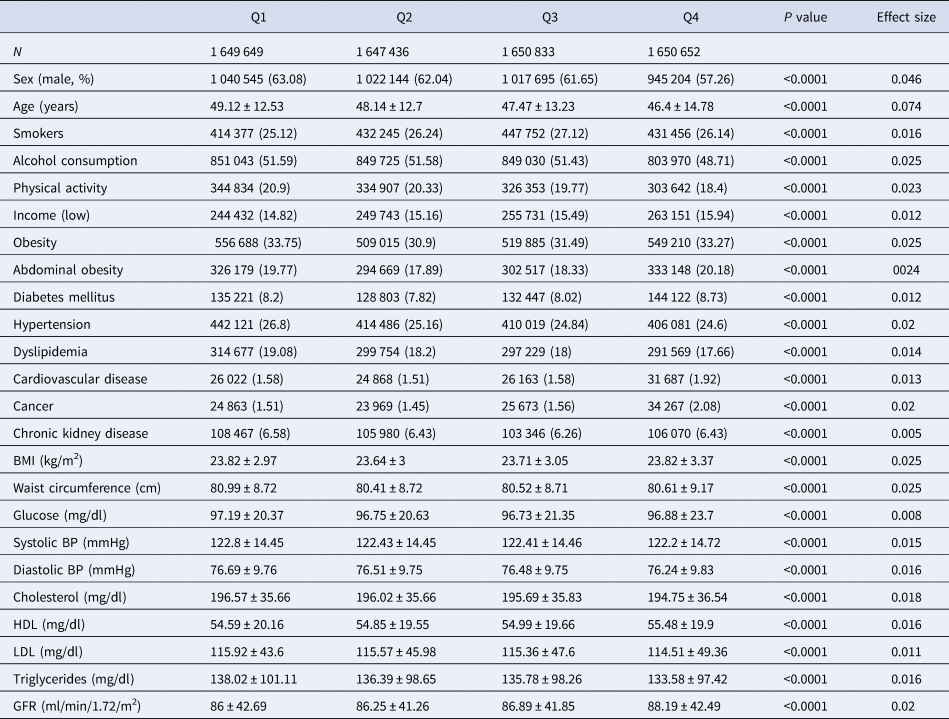
Table 1 shows the baseline characteristics of the study population (n = 6 598 570) according to the VIM quartile for BWV. There were statistically significant differences (p < 0.0001) in demographic and clinical characteristics between the study population and those who excluded due to lack of 3 health check-ups (n = 8 848 495), but the effect sizes were small (Online Supplementary Table S1). The proportion of men and mean age of the participants were highest in Q1 and lowest in Q4, with a decreasing trend over the quartiles. The proportions of current drinkers and subjects engaging in regular physical activity were highest in Q1 and decreased as the quartile increased. The proportion of subjects with obesity or abdominal obesity was lowest in Q2. The mean values of waist circumference and BMI also were the lowest in Q2, with an increasing trend toward both extremes. The mean values of cardio-metabolic parameters (systolic and diastolic blood pressure, total cholesterol, low-density lipoprotein cholesterol, and triglycerides) were the highest in Q1 and decreased with increasing BWV quartile. The prevalence of cardiovascular disease, diabetes mellitus, and cancer was highest in Q4 and lowest in Q2. The p value was <0.0001 for all variables but the effect size was small.
Baseline characteristics of study participants according to quartile of body weight variability (VIM)

BMI, Body mass index; BP, Blood pressure; HDL, High-density lipoprotein; LDL, Low-density lipoprotein; GFR, Glomerular filtration rate.
Association between variability in body weight and incidence of depression
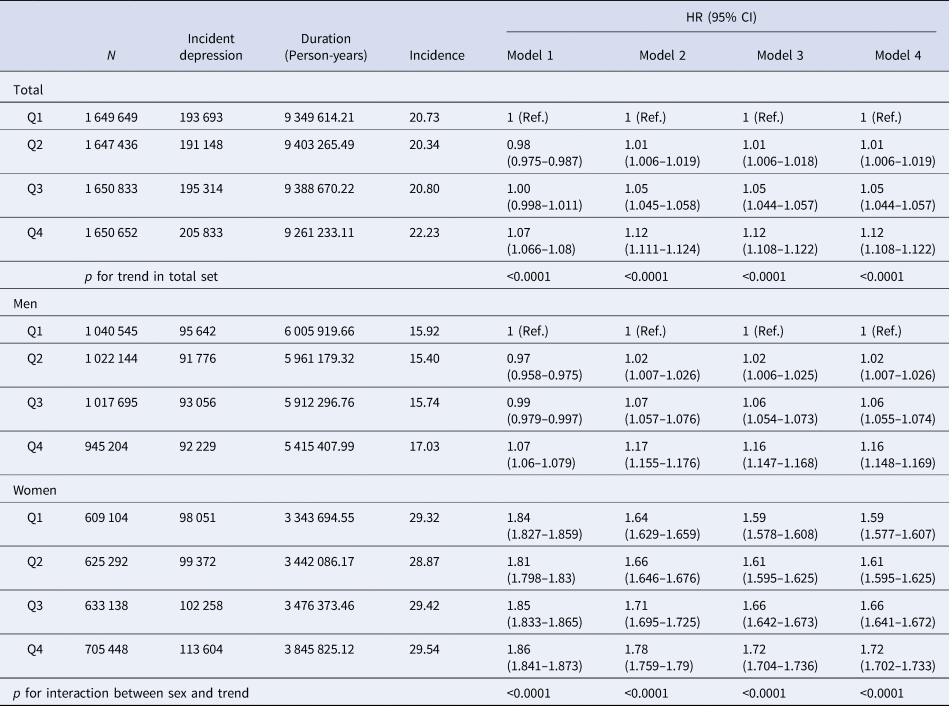
The Kaplan–Meier curves for incidence probability of depression according to VIM quartile for BWV showed a significant increase in the highest quartile (Q4) compared with the other three (Fig. 1a, all log-rank p < 0.001). This tendency was observed in both men and women (Fig. 1b, c). After follow-up of 9 261 233 person-years, the crude incidence of depression among those with the highest VIM for BWV was 22.23 per 1000 person-years (Table 2).
Cumulative incidence of depression. (a) Kaplan–Meier curves according to BWV quartile in all participants. (b) Kaplan–Meier curves according to BWV quartile for men. (c) Kaplan–Meier curves according to BWV quartile for women.

Hazard ratios of new-onset depression according to VIM quartile for BWV using a cox regression model

M1 Non-adjusted.
M2 Age, sex (in total set).
M3 Age, sex (in total set), smoking, alcohol consumption, physical activity, income.
M4 Age, sex (in total set), smoking, alcohol consumption, physical activity, income, diabetes mellitus, hypertension, dyslipidemia.
Association between BWV and the risk of new-onset depression
Table 2 presents the adjusted HRs (95% CIs) for new-onset depression according to the VIM quartile for BWV. Even after adjusting for confounding factors, the HR for depression increased significantly with the VIM quartile (all p for trend <0.0001). In model 4, the HRs (95% CIs) for depression in Q4 compared with those in Q1 were 1.12 (CI 1.108–1.122) in the total study population. In model 4 of the analysis for an interaction effect between sex, the HRs (95% CIs) for depression in Q4 compared with those in Q1 of men were 1.16 (CI 1.148–1.169) in men and 1.72 (CI 1.702–1.733) in women.
Stratified analyses of the risk of new-onset depression
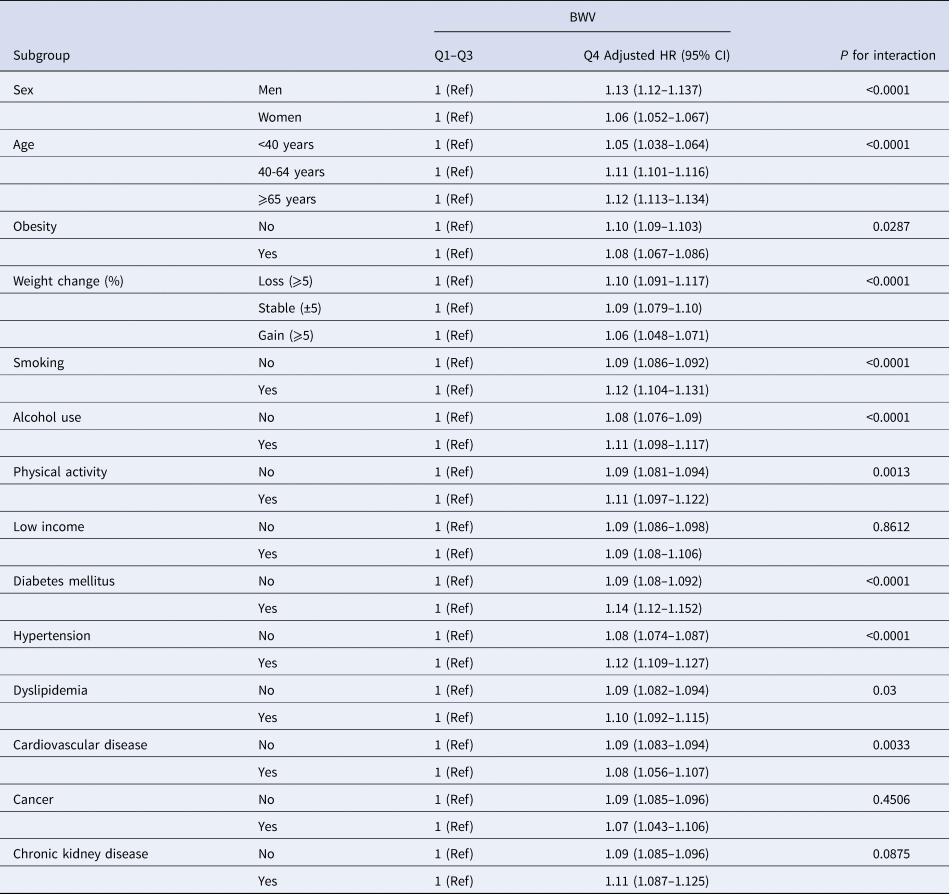
The stratified analyses in Table 3 present the adjusted HR (95% CI) of risk of depression for subjects in the highest VIM quartile for BWV compared with that for subjects in the lower three quartiles. High BWV was consistently associated with new-onset depression in all subgroups after all adjustments. Regardless of sex and age classification, high BWV was associated strongly with the risk of depression, but the association was more prominent in men than in women (HRs, 1.13 v. 1.06, respectively, p-interaction <0.0001), and those aged 65 years and older showed a stronger association with new-onset depression than did younger people (HRs, 1.12 v. 1.11 v. 1.05 for those with age ⩾65 years, 40–64 years, and <40 years, respectively, p-interaction <0.0001). High BWV increased the risk for depression in all three weight change status groups (stable, weight loss, and weight gain). The weight loss group showed the most prominent association with risk of new-onset depression (HRs, 1.10 v.1.09 v. 1.06 for the weight loss, stable, and weight gain groups, respectively, p-interaction <0.0001). The association between BWV and depression was more pronounced in current smokers than in non-smokers (HR, 1.12 v. 1.09, respectively, p-interaction <0.0001), in current alcohol drinkers than in non-drinkers (HR, 1.11 v. 1.08, respectively, p-interaction <0.0001), and in patients who engaged in regular physical activity compared to those who did not (HR, 1.11 v. 1.09, respectively, p-interaction = 0.0013). The highest quartile of BWV was associated with the development of depression irrespective of comorbidities, but the association was more prominent in participants with diabetes mellitus, hypertension, or dyslipidemia than in those without. Online Supplementary Table S2 presents the results of stratified analysis according to both sexes. In both sexes, regardless of obesity or weight change status, the highest VIM quartile for BWV was associated with an increased risk of depression when compared with the lower three quartiles.
Comparison of hazard ratios and 95% confidence intervals of depression in the highest VIM quartile (Q4) v. the lower three quartiles (Q1–Q3) for BWV by subgroup

p for interaction between subgroup and BWV.
Adjusted for age, sex, smoking, alcohol consumption, physical activity, income, diabetes mellitus, hypertension, dyslipidemia.
Deciles of BWV and new-onset depression
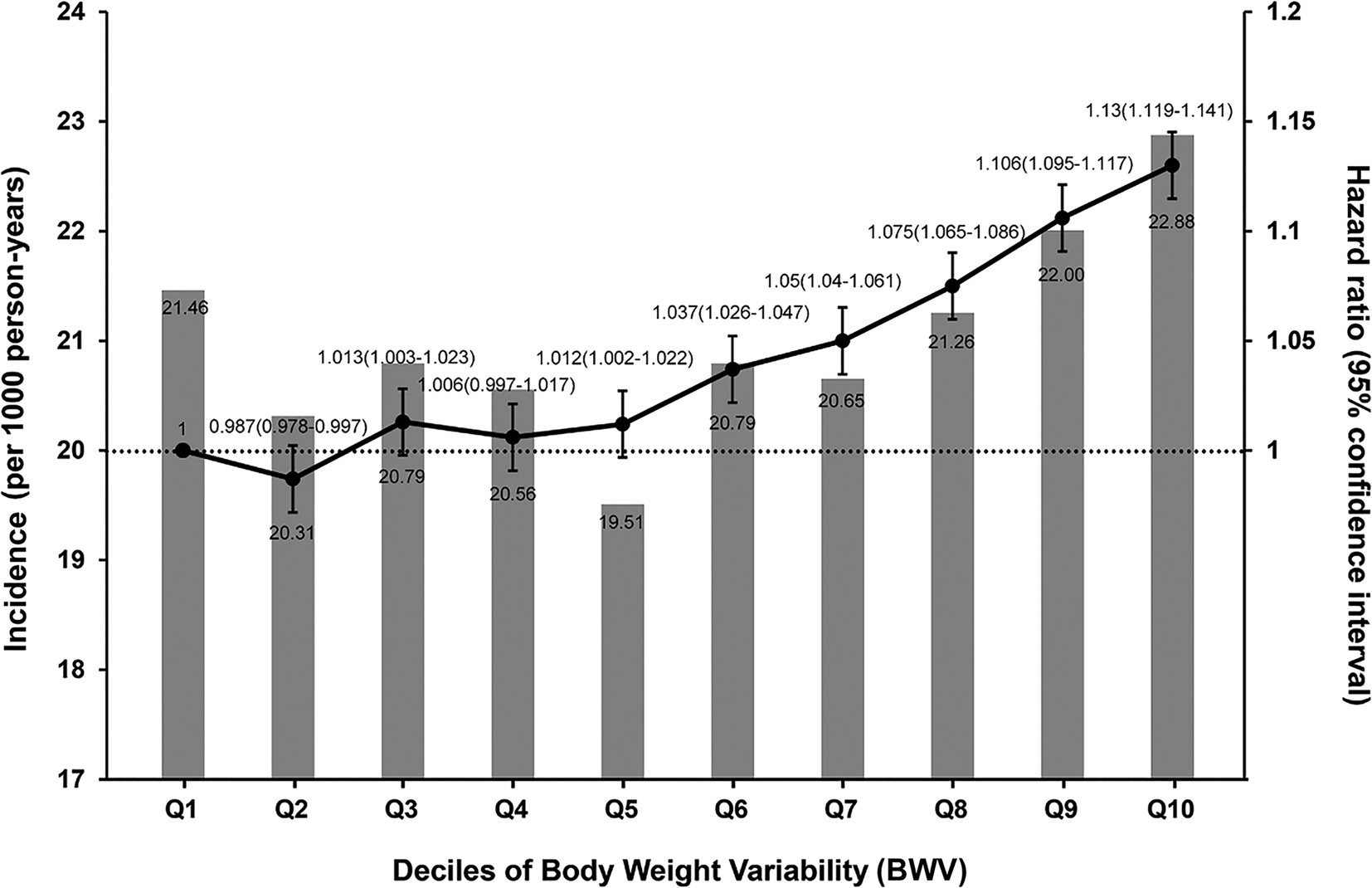
We additionally categorized BWV into VIM deciles. Figure 2 shows the incidence rate and HRs (95% CIs) of new-onset depression according to the VIM decile. The highest decile (Q10) had a high depression incidence of 22.88 per 1000 person-years and a high HR of 1.13 (CI 1.119–1.141) after adjusting for age, sex, smoking, alcohol consumption, regular physical activity, low income, diabetes mellitus, hypertension, and dyslipidemia. When the risk of new-onset depression was analyzed using continuous BWV data, HR of depression was 1.025 (CI 1.024–1.027) after adjustment of confounding variables.
Incidence rate and HR (95% CI) of new-onset depression according to BWV decile.

Discussion/conclusion
This study is the first to demonstrate the association between BWV and the risk of new-onset depression. In this nationwide population-based cohort of 6.5 million, the risk of new-onset depression rose with BWV even after multivariable adjustment for possible confounders. In the stratified analysis, BWV remained consistent as an independent risk factor for depression regardless of baseline characteristics.
To our knowledge, no previous studies have investigated new-onset depression over time according to BWV using our method. Studies that used different definitions of weight fluctuation and methodologies showed comparable findings. A cohort study of 10 428 middle-aged women divided the subjects into four groups: frequent weight cyclers, low-frequency weight cyclers, non-weight cyclers, and weight loss only. Both the low-frequency and frequent weight cyclers had a higher odds ratio of depressive symptoms, 1.5 and 1.7, respectively, compared to the non-weight cyclers (Madigan et al. Reference Madigan, Pavey, Daley, Jolly and Brown2018). Another related study subcategorized adults (n = 2702) according to weight cycling and found that higher depressive symptoms were associated with greater weight cycling, even after adjusting for age, sex, education, income, and BMI (Quinn et al. Reference Quinn, Puhl and Reinka2020). In both papers, weight cycling was defined based on questions about intentional weight loss, and depressive symptoms were assessed using a self-report scale.
In this study, we found that, when body weight fluctuated highly, the risk of depression was increased in all subgroups regardless of age classification, sex, weight change, obesity, lifestyle, income, and medical comorbidities. Interestingly, the risk of depression was greater for non-obese individuals than obese individuals if body weights fluctuated highly. Given the correlation between depression and obesity (Milaneschi, Simmons, van Rossum, & Penninx, Reference Milaneschi, Simmons, van Rossum and Penninx2019), this result suggests that, apart from obesity, weight variability itself may be important for the onset of depression. Another interesting finding is that, among the weight change subgroups, weight loss ⩾5% carried a greater risk of depression than did stable weight (< 5%) or weight gain ⩾5%. The link between weight change and depression has not yet produced a consensus, probably due to diversity in methodology and study populations (Singh, Jackson, Dobson, & Mishra, Reference Singh, Jackson, Dobson and Mishra2014). The findings of this study seem contrary to the results of a recent systematic review, which found that the odds ratio for risk of depression was higher in the weight gain group than the weight loss group (Jung et al. Reference Jung, Woo, Cho, Park, Jeong, Lee and Shin2017). One possible explanation is that the intentionality of weight loss can change the results. While intentional weight loss in subjects with obesity was associated with improvement of depressive symptoms (Dixon, Dixon, & O'Brien, Reference Dixon, Dixon and O'Brien2003; Fabricatore et al. Reference Fabricatore, Wadden, Higginbotham, Faulconbridge, Nguyen, Heymsfield and Faith2011), unintentional weight loss may be associated with stressful conditions such as comorbid chronic disease, malnutrition, or loss of body mass, which can promote depression. In addition, weight loss has been reported to be associated with an increased risk of mortality in a large nationwide cohort study (Kim et al. Reference Kim, Kim, Han, Son, Lee and Oh2017).
The mechanism of association between BWV and depression is not well established, but several explanations are plausible. Exploration of the underlying mechanisms was mostly focused on intentional weight loss followed by regain, in other words, weight cycling. Repeated cycles of weight loss and gain decrease the insulin sensitivity of adipose tissue and increase both CD4+ and CD8+ T cells, resulting in increased secretion of inflammatory cytokine and gene expression of Th1-stimulating cytokines (Anderson, Gutierrez, Kennedy, & Hasty, Reference Anderson, Gutierrez, Kennedy and Hasty2013). Depression could share the key inflammatory mechanisms of weight variability. Visceral adipose tissue also secretes pro-inflammatory cytokines that stimulate the hypothalamic–pituitary–adrenal (HPA) axis, which is a core characteristic of depression (Kyrou, Chrousos, & Tsigos, Reference Kyrou, Chrousos and Tsigos2006). Some results from cytokine therapies support this correlation between inflammatory mediators and depression by showing an increase in depression or neuro-vegetative symptoms in patients (Kiecolt-Glaser, Derry, & Fagundes, Reference Kiecolt-Glaser, Derry and Fagundes2015). Unintentional weight variability can mean that homeostasis of the body is disturbed. Hypothalamus and related neural circuits play an important role in maintaining stable energy levels, body weight, temperatures, day and night sleep cycles, and even a stable mood, and dysfunction of the HPA axis is also known as one of the mechanisms of depression (Bao & Swaab, Reference Bao and Swaab2019; Rui, Reference Rui2013). Unintentional weight variability can indicate failure of homeostasis, which means increased vulnerability to develop depression. In this sense, repeated weight gains and losses may be a marker of subclinical depression prior to the diagnosis of depression. Considering that the direction or extent of weight change has been proposed as possible endogenous subtypes of recurrent depression (Stunkard, Fernstrom, Price, Frank, & Kupfer, Reference Stunkard, Fernstrom, Price, Frank and Kupfer1990), a large BWV can be a phenotypical indicator of depression. Finally, it is possible that BWV may be an indicator of increased allostatic load, which in turn may be a risk factor for depression (Guidi, Lucente, Sonino, & Fava, Reference Guidi, Lucente, Sonino and Fava2021). Thus, it is necessary to be alert for the onset of depression in people with this characteristic. Because this apparent reverse causality is still hypothetical, further research is needed.
In this study, we also explored the difference of BWV in the regards of sexes. Compared to the lowest quartile (Q1) of men, the highest quartile (Q4) of BWV increased the risk of depression greater in women than in men. Differences in sex in relation between obesity and depression have been widely researched, but studies for differences in sex between weight variability and depression is sparse. As weight cycling is thought to influence increased adiposity and future weight gain (Mackie, Samocha-Bonet, & Tam, Reference Mackie, Samocha-Bonet and Tam2017), the evidence from obesity studies can be helpful to understand the disparity between sexes in weight variability. Some childhood or adolescent-adulthood cohort studies demonstrated an association between obesity or overweight and subsequent risk of depression in women but not in men (Martinson & Vasunilashorn, Reference Martinson and Vasunilashorn2016; Sahle et al. Reference Sahle, Breslin, Sanderson, Patton, Dwyer, Venn and Gall2019; Sanderson, Patton, McKercher, Dwyer, & Venn, Reference Sanderson, Patton, McKercher, Dwyer and Venn2011). According to a meta-analysis and systematic review, association with depression was more robust in obese women than in obese men (de Wit et al. Reference de Wit, Luppino, van Straten, Penninx, Zitman and Cuijpers2010; Preiss, Brennan, & Clarke, Reference Preiss, Brennan and Clarke2013). This difference may reflect the epidemiologic trend that women have higher rates of depression than men do. Another possible explanation for this disparity is that women are more related with negative body image and dissatisfaction, more risk of emotional eating and repetitive weight regulation (Bibiloni, Coll, Pich, Pons, & Tur, Reference Bibiloni, Coll, Pich, Pons and Tur2017; Richard, Rohrmann, Lohse, & Eichholzer, Reference Richard, Rohrmann, Lohse and Eichholzer2016). A women's high BWV can be the result of a vicious cycle of negative interactions with such experiences, which can make them more susceptible to mood disorders. In the study where explored the relation between BMI fluctuation and depression, BMI fluctuation was more related with environment factors in men than in women (Bergin et al. Reference Bergin, Neale, Eaves, Martin, Heath and Maes2012). Weight variability is not identical with BMI variability, but we can speculate women with higher weight variability might have more biological vulnerability for generating depression.
The clinical implication of this study is that the development of depression seems to be related not only to obesity or weight gain, but also to weight variability. In line with the findings of associations between weight variability and various health-related indicators or diseases, it is necessary to pay attention to the risk of depression in individuals with extensive weight variability and to avoid severe fluctuations in body weight.
This study has several strengths and limitations. As strengths, it is the first large population-based cohort study to investigate the association between BWV and new-onset depression. The NHIS database includes nearly 98% of the Korean population, so the completeness of data can be guaranteed. Second, whereas most relevant studies have used self-report questionnaires to obtain information about weight fluctuation, this study used measured weights, which reduced information bias. As limitations, the diagnosis of depression was based on the appearance of a new depression code in a subject's medical record, so participants who did not receive treatment would have gone undetected. However, people with severe depressive symptoms are likely to visit a hospital to be diagnosed and receive prescriptions for medication, so the specificity of our diagnosis is high. Second, our study population included only those who regularly received national health examination, which is not mandatory. Thus, our sample might suffer from selection bias, such as including a population with a healthier than average lifestyle. However, concerns about that bias are minimal because the participation rate in health examinations exceeds 70%, and the interpretation of our results will be applied to a healthy population. Third, some depressive symptoms such as change of appetite or energy level might affect BWV, but we were not able to explore the association due to a lack of relevant information. Fourth, this was an observational cohort study, which cannot establish causality between BWV and depression. Finally, we do not have information about the intentionality of BWV.
In conclusion, BWV was independently associated with increased risk of new-onset depression in a dose-dependent manner, such that the greater was BWV, the greater was the risk of new-onset depression. Subgroup findings suggest that even participants without obesity and those with stable weights at baseline had a higher risk of depression when bodyweight fluctuations were high. Further studies need to evaluate the role of high BWV with respect to the onset of depression.
Supplementary material
The supplementary material for this article can be found at https://doi.org/10.1017/S003329172200040X.
Acknowledgements
None.
Author contributions
Conceptualization: Mi Jin Park, Hong Jin Jeon and Kyungdo Han; Acquisition, analysis and interpretation of data: Juhwan Yoo, Kyungdo Han, Mi Jin Park and Hong Jin Jeon; Writing- original draft. Mi Jin Park; Writing- critical review & editing: Dong Wook Shin, Maurizio Fava, David Mischoulon, and Hong Jin Jeon
Financial support
This research was supported by the Healthcare AI Convergence Research & Development Program through the National IT Industry Promotion Agency of Korea (NIPA) funded by the Ministry of Science and ICT (No. S1601-20-1041), and by a grant of the Korea Health Technology R&D Project through the Korea Health Industry Development Institute (KHIDI), funded by the Ministry of Health & Welfare, the Republic of Korea (No. HR21C0885).
Conflict of interest
None.