Introduction
For millennia, people have worn leather shoes to protect their feet from rough surfaces and the weather (Hald, Reference Hald1972; Goubitz et al., Reference Goubitz, van Driel-Murray, Groenman-van Waateringe and Bardet2001). Shoes varied considerably in construction, style, and decoration over time and space, from primitive one-piece shoes to elaborately decorated examples made of multiple elements with separate soles (Swann, Reference Swann2001; Volken, Reference Volken2014). The state of preservation of archaeological leather finds depends on a complex set of pre-depositional factors and burial environment, such as the pH level, oxygen, and water content and the microorganisms present (Cameron et al., Reference Cameron, Spriggs, Wills, Kite and Thomson2006: 245). Therefore, leather shoes are not equally represented over time, cultural contexts, or in urban settlements vs rural sites. In northern Europe, they survive in, amongst others, the waterlogged and anaerobic contexts of urban environments (e.g. Groenman-van Waateringe, Reference Groenman-van Waateringe1984, Reference Groenman-van Waateringe1988; Madsen & Mikkelsen, Reference Madsen and Mikkelsen1985; Mould et al., Reference Mould, Carlisle and Cameron2003; Pedersen, Reference Pedersen and Iversen2005; Harjula, Reference Harjula2008; Hansen, Reference Hansen, Risvåg, Brattli and Berge2015; Haase & Larsen, Reference Haase, Eg Larsen, Runge and Hansen2017: 153). To date, the earliest large assemblages of leather in Denmark are the eighth-century ad finds from Ribe and the slightly later assemblage from Haithabu (Hedeby, now in Schleswig-Holstein, Germany), where large quantities of leather waste associated with a workshop were recovered (Groenman-van Waateringe, Reference Groenman-van Waateringe1984). The recovery of such assemblages is probably related to the accumulation of archaeological stratigraphy often seen in urban environments compared to rural settings.
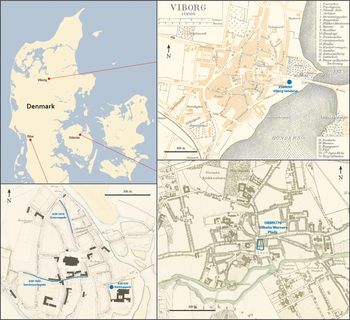
In the excavations at Viborg Søndersø, dated to the first half of the eleventh century, the leather and waste from shoemaking appears to represent a seasonal or part-time occupation (Pedersen, Reference Pedersen and Iversen2005; see Figure 1). For the twelfth century onwards, shoemaking is documented more frequently through leather waste from various workshops in medieval Danish citiesFootnote 1 (e.g. Groenman-van Waateringe, Reference Groenman-van Waateringe1988; Haase & Larsen, Reference Haase, Eg Larsen, Runge and Hansen2017: 153). From the amount of leather material recovered at such sites, and given the obvious need to protect feet from rough surfaces and weather, shoes must have been a commonplace commodity, and everyday products for much of the population in Viking (c. ad 800–1050) and medieval (c. ad 1050–1536) urban settlements.
Maps of the three medieval Danish cities of Ribe, Viborg, and Odense, and the excavation sites from which the archaeological leather finds derive (graphics: Grafisk Tegnestue, Moesgaard Museum).

According to Saxo's Gesta Danorum, a shoemaker trained in Germany settled to work in the city of Roskilde in ad 1133, which makes shoemaking one of the earliest crafts mentioned in Danish written sources (Søgaard, Reference Søgaard, Hjejle and Brøndsted1970; Friis-Jensen & Fisher, Reference Friis-Jensen, Fisher and Friis-Jensen2015: 961). Since Saxo mentions this, we surmise that specialized artisans were rare in Denmark at that time, though they may have existed before written sources mention them. Shoemakers are frequently mentioned in written sources from the early thirteenth century onwards and are often depicted throughout the medieval period (Hybel & Poulsen, Reference Hybel and Poulsen2007: 263–64) (See Supplementary Material, Figure S1).
In the medieval period, butchering and tanning became professionalized in Denmark. Together, these crafts formed a chain of (technical) processes in which live animals were brought to the butcher, who then delivered bones to the comb-maker and skins to the tanner, from whom the shoemakers would buy leather (MacGregor, Reference MacGregor and Cameron1998; Hybel & Poulsen, Reference Hybel and Poulsen2007: 264–65; Mould & Cameron, Reference Mould, Cameron, Hansen, Ashby and Baug2015). Croix et al. (Reference Croix, Neiß and Sindbæk2019) described such a network as a ‘réseau opératoire’, and argued that a chain of processes was necessary for specialized crafts and a probable explanation and catalyst for urbanization.
Assemblages of medieval leather shoes have been studied from various perspectives. Several scholars have worked on identifying medieval leather shoe types and their development over time (e.g. Dahlerup Koch, Reference Dahlerup Koch1988, Reference Dahlerup Koch, Hjermind, Iversen and Kristensen1998; Groenman-van Waateringe, Reference Groenman-van Waateringe1988; Andersen, Reference Andersen2016a). By applying these typologies of shoes from medieval cities, Carelli (Reference Carelli2001: 166–71) demonstrates a diversification of types in the twelfth century, which he correlates with urbanization and the increasing desire of the cities’ inhabitants to position themselves socially via wearable cultural markers.
The decoration of medieval leather shoes has been analysed to examine the consumers’ purchasing power and social status. This is exemplified by Gitte Hansen in her analysis of medieval leather shoes from Bergen (Hansen, Reference Hansen, Risvåg, Brattli and Berge2015), where she uses silk thread decoration as an indicator of wealth and status. Shoe construction has been touched on several times (Mould et al., Reference Mould, Carlisle and Cameron2003), and, most recently, Vivi Andersen's dissertation has focused on various aspects of medieval and early modern footwear from Copenhagen, from foot health to fashion (Andersen, Reference Andersen2016a).
From a functional perspective, the animal species sourced for leather have been identified in several early studies (e.g. Groenman-van Waateringe, Reference Groenman-van Waateringe1984, Reference Groenman-van Waateringe1988; Mould et al., Reference Mould, Carlisle and Cameron2003), which provide information about resource exploitation, the properties of the finished products, and shoemaking processes. Microscopic visualization of the skins’ follicle patterns (grain pattern analysis) was used to identify the species sourced among archaeological leather finds, and this is often the preferred method even after biomolecular methods of species identification were introduced. However, determining the animal sources of raw materials through microscopically evaluating grain patterns can be challenging, because of the wear, degradation, and variation of these surfaces (Mould et al., Reference Mould, Carlisle and Cameron2003: 3235), which require great expertise to distinguish. On the other hand, methods such as aDNA analysis and shotgun proteomics are expensive, time-consuming, and difficult to apply to large assemblages of leather.
Leather and medieval leather shoes have been studied from perspectives that span symbolic and more functional approaches. Newer lines of research employ materiality approaches to combine these, acknowledging that resource choices are rarely made for purely functional or symbolic considerations, but encompass both (Harris, Reference Harris, Harris and Veldmeijer2014a).
In sum, despite existing studies of written sources and leather assemblages, the choices of leather for medieval shoes are still not fully understood, partly because of the lack of reliable identification methods.
In contrast to the shoe material from Copenhagen (Andersen, Reference Andersen2016a) and Bergen (Hansen, Reference Hansen, Risvåg, Brattli and Berge2015), for instance, excavations of medieval urban settlements often yield only very fragmented parts of shoes, which naturally limits the opportunity for detailed documentation. In the case of highly fragmented elements of soles and uppers, shoe type is difficult to determine. Measurements of length, width, and shoe size often cannot be made on fragments, whereas decoration may be visible on uppers, for instance. Such fragments have received far less attention than the more complete and highly decorated shoes of the elite.
It may be difficult to determine animal species from leather fragments (see Ebsen et al., Reference Ebsen, Haase, Larsen, Vestergaard Poulsen Sommer and Ørsted Brandt2019) because certain shoe elements, such as soles, rands, and laces, reveal little or no grain pattern, compared to the uppers. Therefore, the exploitation of animal species for leather and the choices of leather for different shoe elements requires refining further. Leather fragments with no grain pattern can now be identified in a minimally destructive, fast, and cost-effective way (van Doorn, Reference van Doorn and Smith2014), based on the introduction of a new method known as ZooMS (zooarchaeology by mass spectrometry), which identifies the animal from small differences in collagen protein (Buckley et al., Reference Buckley, Collins, Thomas-Oates and Wilson2009).
This article is the first to investigate leather from various shoe elements by applying ZooMS to identify the selection of leather for specific parts of shoes. What species were exploited, and for which purposes? Were the choices based on the various leathers’ material properties or probable function as a social marker in a given cultural context? What does our material say about shoemaking in the Danish urban environments of the eleventh to thirteenth centuries? By identifying the species used, we build a new dataset that provides insights into the consumption of animal skins for everyday purposes and luxury applications and discuss it in terms of long-distance trade or the use of local products.
Leather and its Properties
Leather is a sheet material made from animal skins, and generally refers to a group of materials that have undergone tanning, a process or a series of processes that inhibit its decay even under warm and moist conditions (Thomson, Reference Thomson, Kite and Thomson2006a: 1–3).
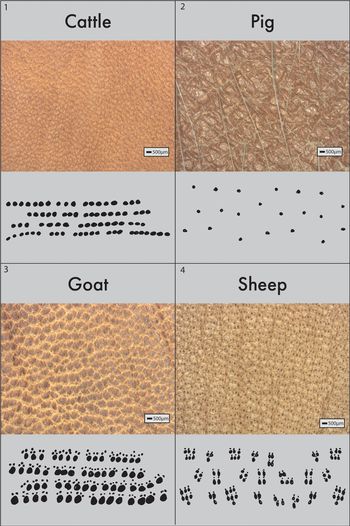
Leather is a visually pleasing material because of its grain pattern, which varies among species and even breeds (Figure 2). The skin of all vertebrates has the same basic structure of fibre bundles of collagen that interweave in a three-dimensional manner. Apart from this basic structure, each animal species has a specific skin structure. The pattern of collagen fibre bundles varies in compactness, angle, and dimensions, as does the proportion of the grain layer (the upper part of the dermis, i.e. the surface left in leather after tanning, and whose surface pattern varies among species; Larsen et al., Reference Larsen, Vestergaard Poulsen and Rahme2009: 7–9) in the entire skin thickness. These properties vary not only among animal species, but also according to the age and the body part of an animal. The nature of these traits influences the properties of the skin, which are retained in the finished leather product (Haines, Reference Haines, Calnan and Haines1991). This affects a skin's unique physical properties, such as flexibility, tear strength, and resistance to wear (Haines, Reference Haines, Calnan and Haines1991, Reference Haines, Kite and Thomson2006: 11). The properties of skins of various animal species has been described by several authors (e.g. Reed, Reference Reed1972; Haines, Reference Haines, Kite and Thomson2006: 11): briefly, skin from adult cattle is thick and strong, whereas calfskin is thinner, but still strong and compact. Goatskin is thinner and compact, whereas sheepskin is softer and more flexible (Haines, Reference Haines, Kite and Thomson2006).
Grain-pattern differences among animal species, observed in modern leather (magnification ×10). 1: cattle, 2: pig, 3: goat, 4: sheep (graphics: Bjørn Koch Klausen).

The variation among raw hides from different animal species provides a wide range of mechanical and aesthetic properties for the tanner to work with to obtain specific properties for the finished leather. Though the overall properties of the finished leather originate in the natural structure of the skin, tanning processes can bring about minor changes in the final product (Haines, Reference Haines, Calnan and Haines1991). The present analysis focuses on identifying species sourced for leather. Because skin's natural structure restricts the tanners’ options for the finished leather, the information we have retrieved from our analysis can provide a reliable indication of why a specific animal skin was chosen to deliver the desired properties of a specific product.
Zooarchaeology by Mass Spectrometry
Using the ZooMS biomolecular approach (Buckley et al., Reference Buckley, Collins, Thomas-Oates and Wilson2009), we analysed 115 samples of archaeological leather shoe elements to identify the species of animals sourced for their skin. Grain patterns were also investigated: thirty-two of the 115 samples provided enough information to allow grain pattern analysis (Ebsen et al., Reference Ebsen, Haase, Larsen, Vestergaard Poulsen Sommer and Ørsted Brandt2019). To the best of our knowledge, identifications using ZooMS on waterlogged leather have previously only been published in one brief pilot study of two samples and a comparison between the methods of grain pattern analysis and ZooMS (Brandt, Reference Brandt, Raja and Sindbæk2018; Ebsen et al., Reference Ebsen, Haase, Larsen, Vestergaard Poulsen Sommer and Ørsted Brandt2019), although studies have shown its potential for parchment and historical leather artefacts (Kirby et al., Reference Kirby, Buckley, Promise, Trauger and Holdcraft2013; Fiddyment et al., Reference Fiddyment, Holsinger, Ruzzier, Devine, Binois and Albarella2015; Teasdale et al., Reference Teasdale, Fiddyment, Vnouček, Mattiangeli, Speller and Binois2017).
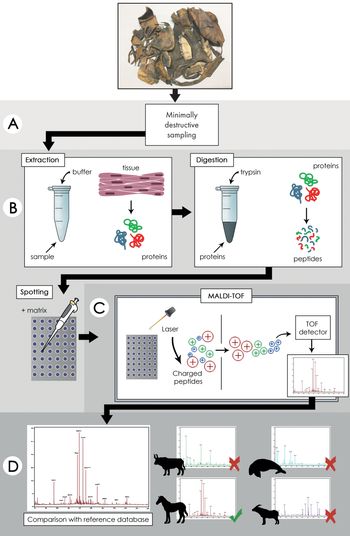
ZooMS is a method of species identification based on small differences in proteins among animal species (the so-called ‘fingerprints’), a combination of markers (Figure 3; see methodology in Supplementary Material S1). To identify species, the method examines collagen, which is abundant in tissues such as bone, antler, and skin. During the procedure, trypsin is used to cleave collagen into shorter chains of amino acids (peptides). Trypsin cleaves only at lysine and arginine residues, which are not evenly distributed throughout the collagen, which is why the average length of tryptic peptides varies in length and composition, and thus mass. These masses make it possible to identify species, owing to differences in the amino acid sequences among animal species. However, the low degree of sequence variation in collagen, and the degree of structural constraint means that different peptides may share the same mass.
Flowchart of a ZooMS analysis (graphics: Sidsel Frisch, modifications by Bjørn Koch Klausen).

Material
The material selected for this study comes from the earliest phases of three Danish cities: Viborg, Ribe, and Odense (Figure 1 and Supplementary Material S2). Each city saw settlement activity in the Viking period and is amongst the oldest Danish urban settlements (Kristensen & Poulsen, Reference Kristensen and Poulsen2016; Runge, Reference Runge, Runge and Hansen2017). Viborg and Odense are inland cities, located at nodal points for land transport, whereas Ribe had a harbour. Throughout the Middle Ages, the three cities grew and became centres of multiple and diverse activities and functions (more detail in Supplementary Material S1). All three have areas with waterlogged stratified deposits where the preservation of organic material such as leather is generally good. However, some local soil conditions and taphonomic processes seem to have affected the condition of the leather. Hence, leather is better preserved at Ribe and Viborg, compared to Odense.
All excavations followed stratigraphic methods, and they are generally well-documented. Therefore, the material from Viborg Søndersø, Ribe, and Odense may be contextualized and linked to specific events and periods.
The Samples and their Context
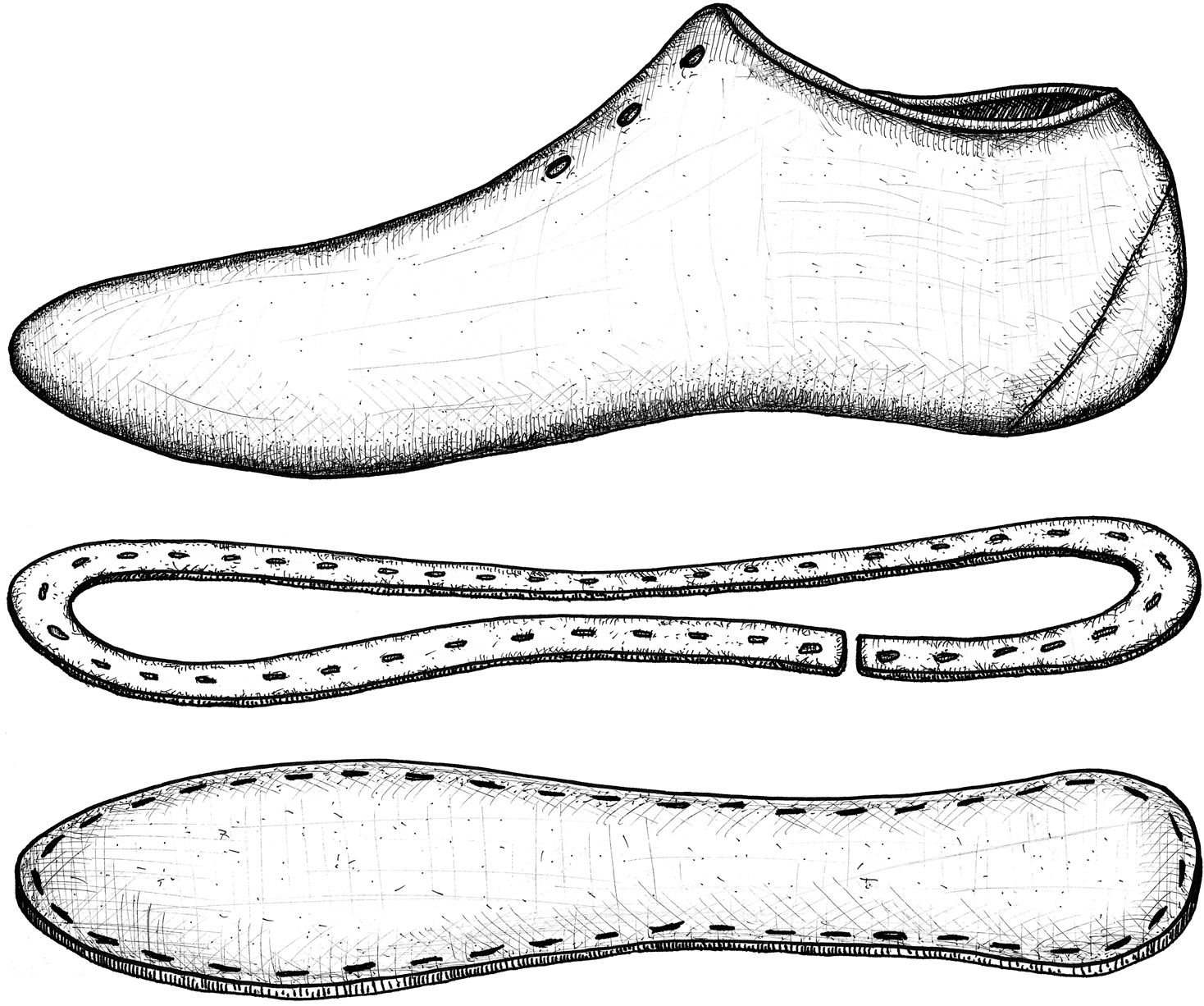
Leather fragments that could be recognised as parts of shoes, or whole shoes, were sampled. Samples were taken from soles (sixty), uppers (thirty-four), rands (nine), and laces (five) (Figure 4). Seven elements could not be identified but probably derive from shoes.
The construction of a shoe with sole, rand, and upper. Lace-holes and laces could be positioned in various places, depending on the type of shoe (graphics: Bjørn Koch Klausen).

Leather fragments or shoes are common among archaeological finds. All those sampled were used and discarded items. This means that, in theory, they could have been manufactured in a place that was different from where they were found. Nonetheless, they are representative of the preferences of local inhabitants.
The material has been dated to ad 1000–1300, based on its contextual and stratigraphic relationships. The Viborg assemblage dates to the eleventh century, and the material from Odense and Ribe to the twelfth and thirteenth centuries (see Supplementary Material S2 and S3).
The samples derive mainly from deposits that represent waste or redeposited material, whose content and nature indicate that it accumulated or was deposited close to its place of use within the perimeter of the city.
Results of the ZooMS Analysis
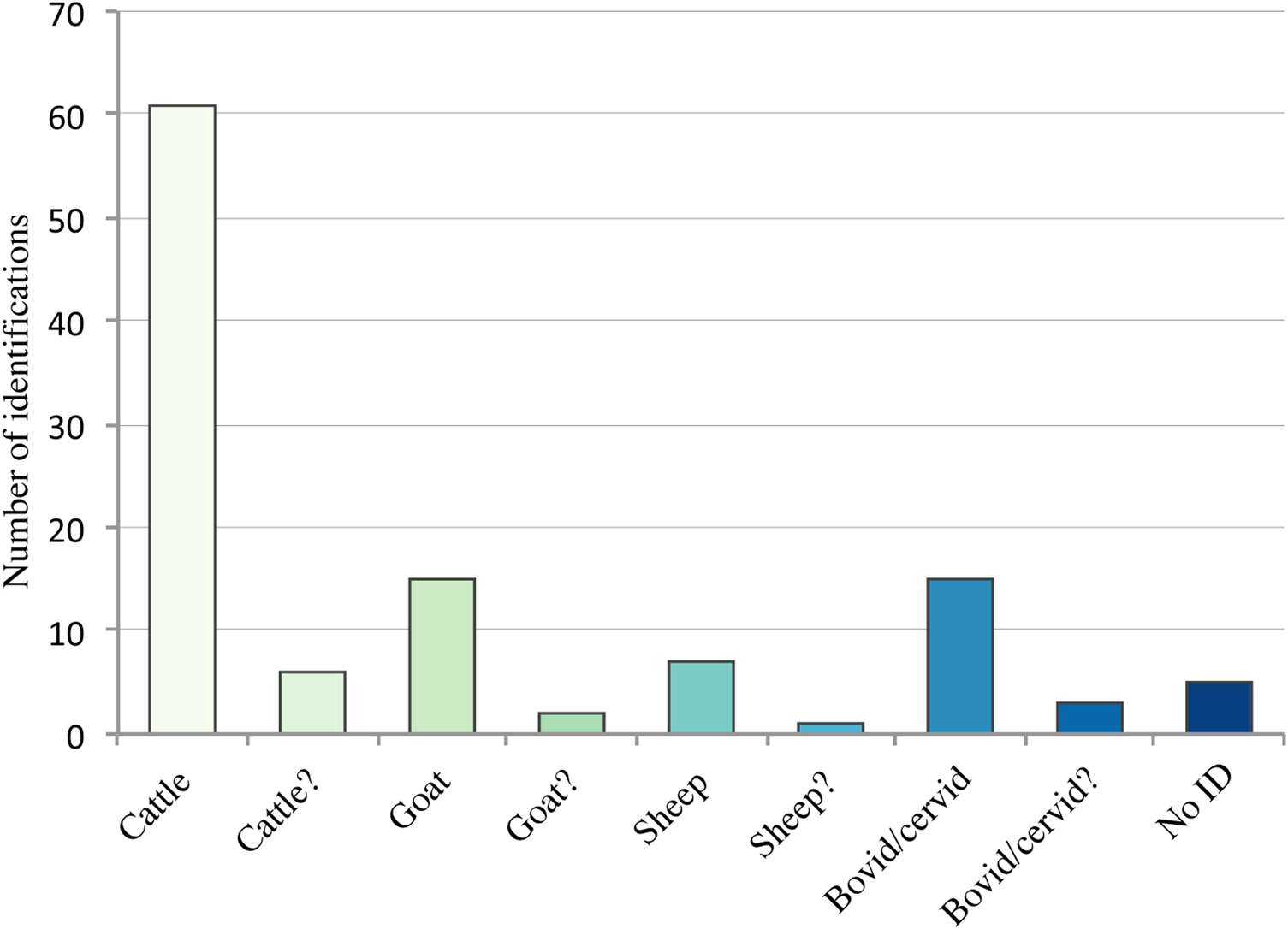
The ZooMS identifications produced four kinds of outcomes. The first was an unambiguous identification based on one or more peaks not shared with other species. For the second outcome (‘species?’), one or more species-diagnostic peaks were present at a low intensity or low S/N ratio. The third encompassed peaks that were shared by a large group of animals as bovids and cervids. Here, species-diagnostic peaks were missing, precluding any further identification (see Supplementary Material S1). The fourth outcome was ‘No ID’, which was used for samples of very poor quality in which no peaks, or only very common peaks, could be recognized. The ZooMS's overall success rate for matches to a single species was c. seventy-two per cent for the 115 samples. The peptide markers observed are presented in Supplementary Material S3.
The results demonstrate that all samples identified to specific species derive from domesticated animals—sheep, goat, and cattle—although a few samples could not be identified more precisely than bovid or cervid (Figure 5).
Species identifications of all samples from all sites (n = 115).

The three sites differ in terms of the success of species identification. This is one of the reasons for the differing representations of species. For instance, the proportion of cattle/calf makes up only seventeen per cent of the identifications for Odense, compared to seventy-one per cent for Ribe. However, seventy-five per cent of the samples from Odense could not be identified to species (Supplementary Material Figure S2).
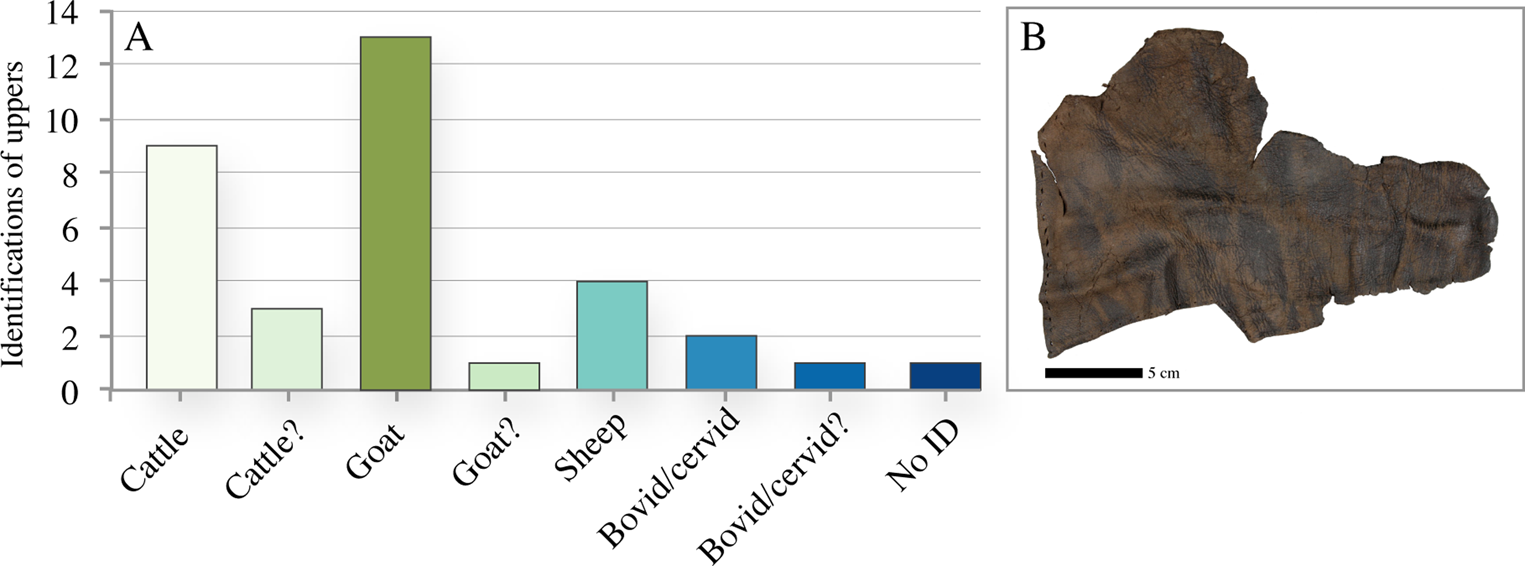
The species identifications show that shoe uppers were made of goat, cattle, and sheep skin, with goat and cattle/calf dominant (Figure 6).
a) Identifications of uppers from all sites (n = 34). b) Upper from Ribe (ASR1843 x180a), identified as goat by ZooMS.

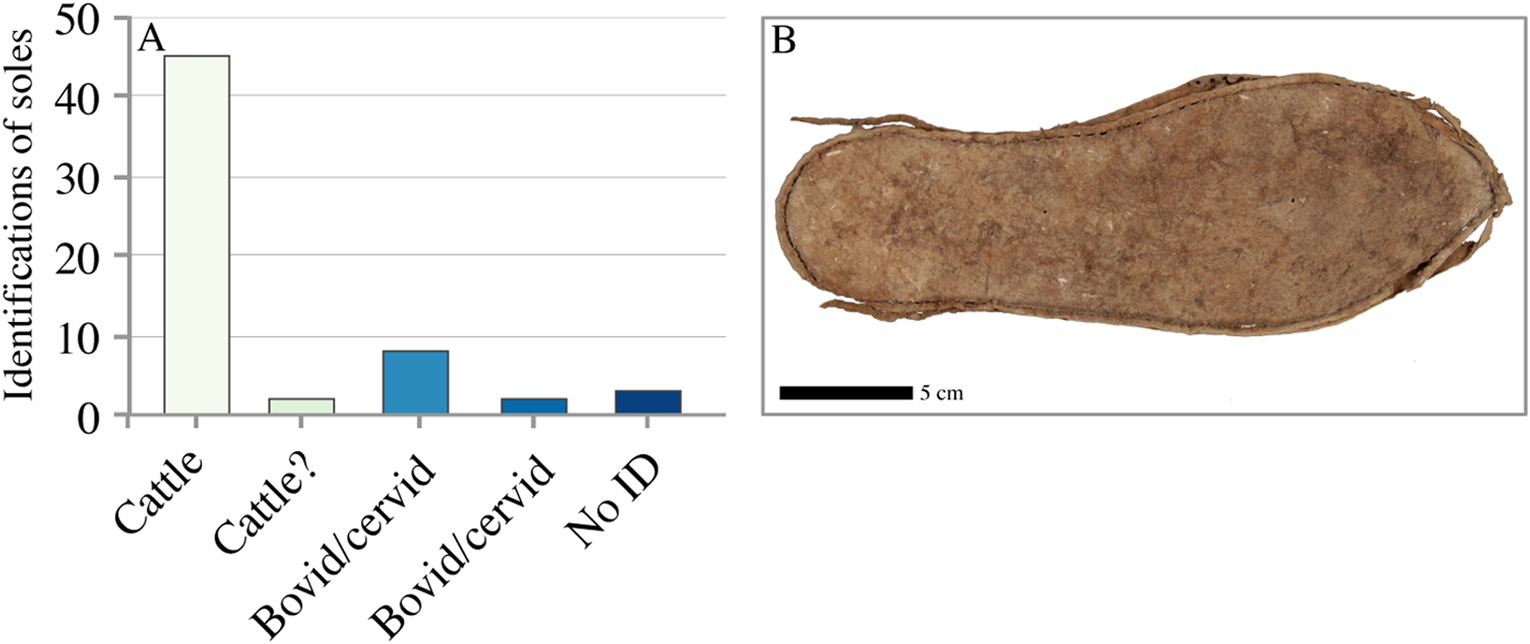
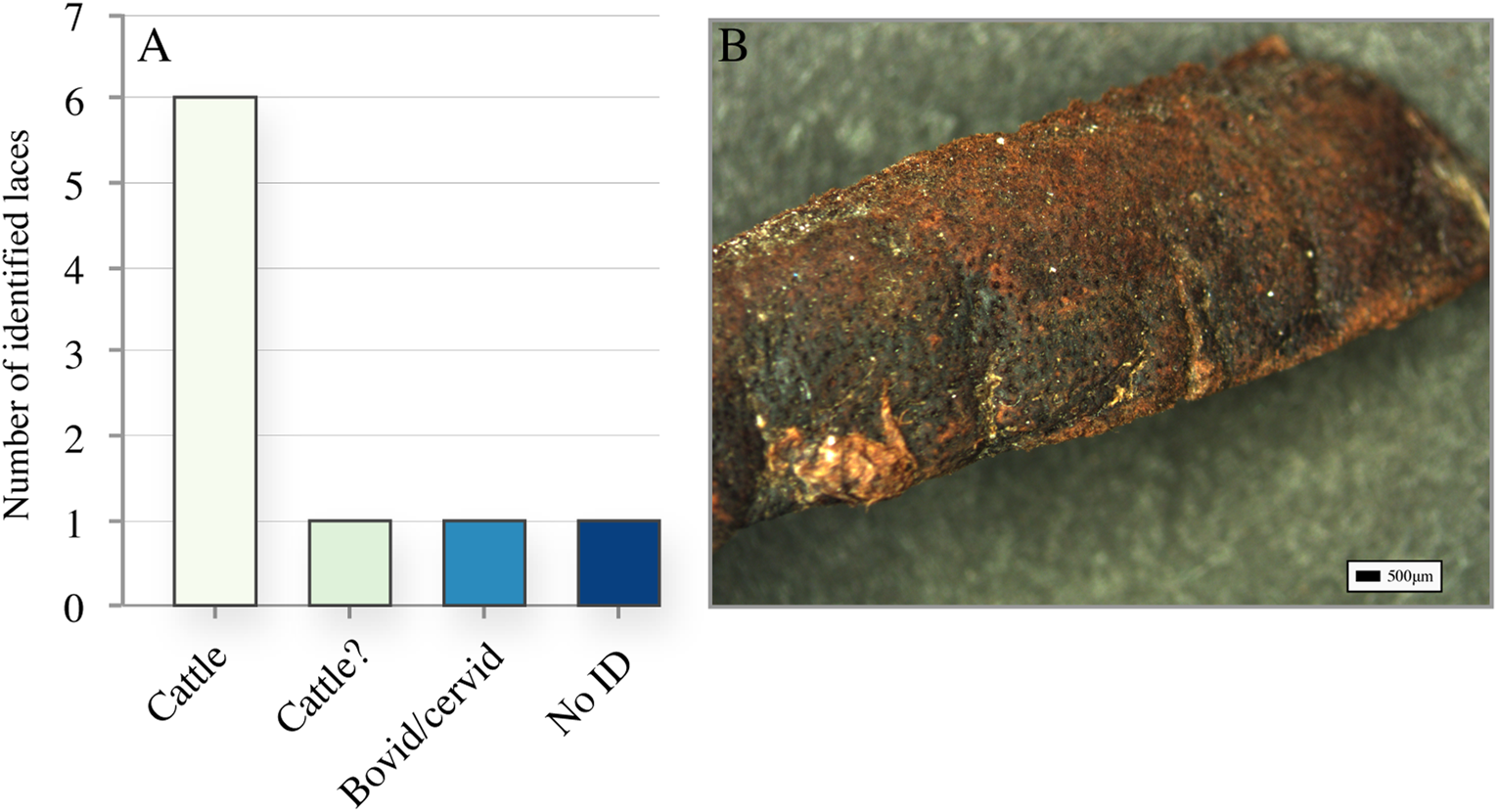
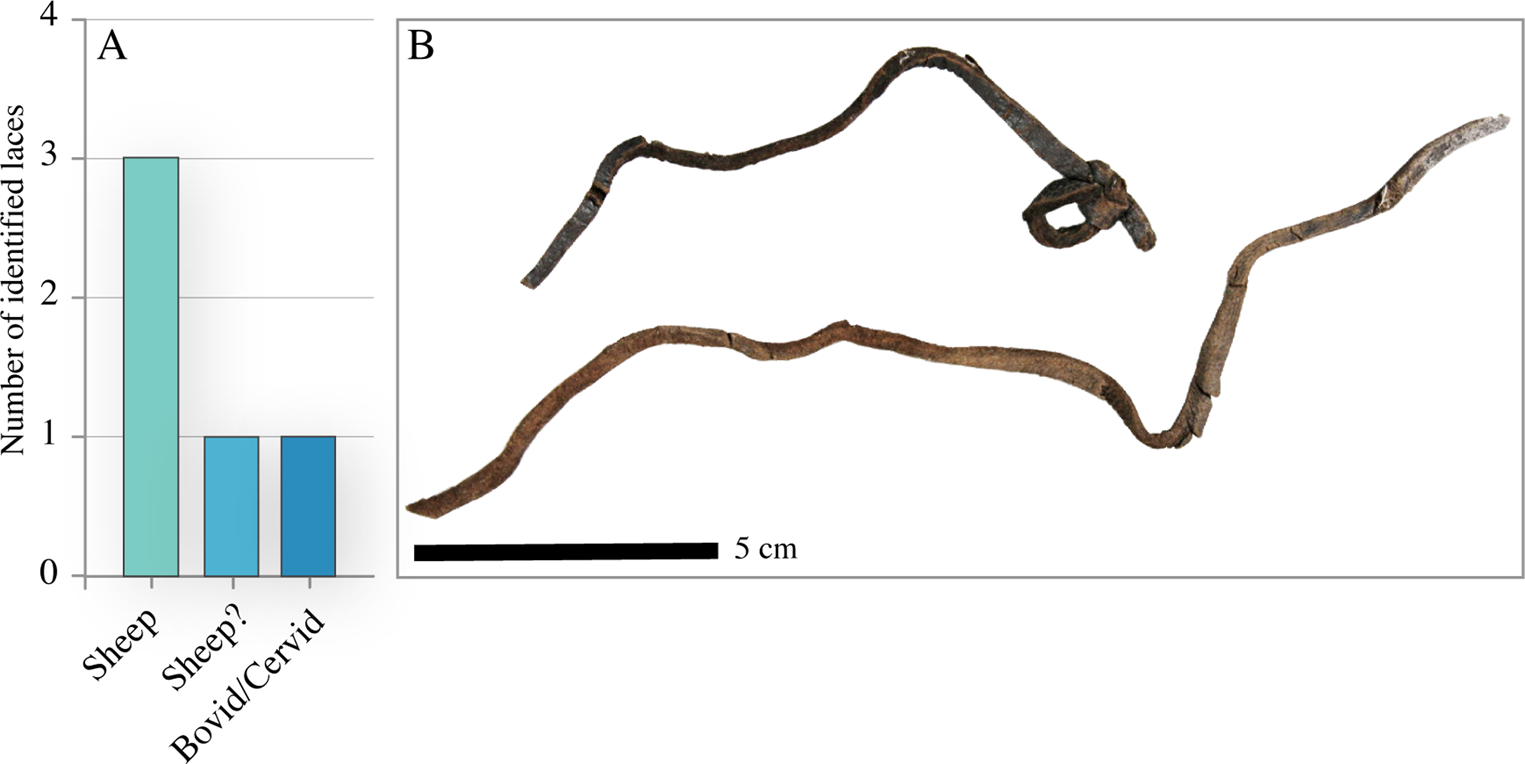
All soles (Figure 7) and rands (Figure 8) that could be identified more precisely than at family level (forty-seven of sixty and seven out of nine samples, respectively) were identified as cattle skin or cattle?, whereas all laces that could be identified more precisely than at family level (four out of five samples) were identified as sheep (three) or sheep? (one) (Figure 9).
a) Identifications of soles from all sites (n = 60). b) Sole from Ribe (ASR420 x113), both layers identified as cattle by ZooMS.

a) Identifications of rands from all sites (n = 9). b) Rand from Odense (OBM/9776 x5042a; ×10 magnification), no species identification.

a) Identifications of laces from all sites (n = 5). b) Two laces from Ribe (ASR1843 x252b and ASR1843 x252c) identified as respectively sheep and sheep? by ZooMS.

The distribution of species identified from soles, rands, and laces reveals the same pattern among the three cities. On the other hand, the trend among the uppers is less clear. Only six uppers were analysed from Viborg and five from Odense, and some of these are not identified to species. Nonetheless, sheep is represented in Viborg and Odense, whereas in Ribe cattle/calfskin and goatskin are dominant, and only four per cent of the uppers derive from sheepskin.
Other Observations: Shoe Types and Decoration
In contrast to Andersen's record of material from Copenhagen (Andersen, Reference Andersen2016a, Reference Andersen2016b: 18–20), many features cannot be investigated for the highly fragmented shoe elements from Odense, Ribe, and Viborg.
The shapes of soles and uppers may indicate a shoe type, but not all these were complete, and several shoe types could have had the same sole shape. Pedersen (Reference Pedersen and Iversen2005: 405) notes that, in the material from Viborg, there are both symmetrical and asymmetrical soles, with pointed or rounded toes, and rounded or pointed heels.
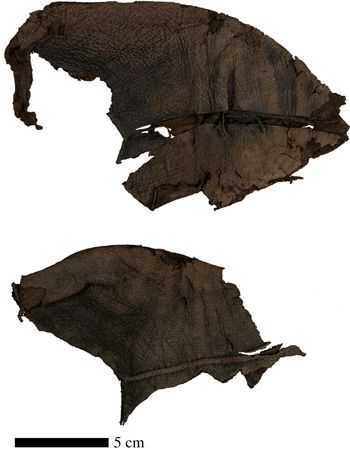
Decoration is discussed below, but the examination of the samples from Odense, Ribe, and Viborg reveals that only two uppers have decorative elements. One upper (ASR 1843 x121a) had cut-out decorations, another upper (ASR 1843 x121g-h) had a decorative seam (Figure 10).
Two uppers from Ribe with decorative elements (ASR1843 x121a (top) and ASR1843 x121 g (bottom)), both identified as goat by ZooMS.

Discussion
Identification of shoe leather with ZooMS
Out of the 115 samples of medieval shoe leather investigated c. seventy-two per cent were identified to species level by ZooMS. Of these, 105 were also analysed for preserved grain patterns by Ebsen et al. (Reference Ebsen, Haase, Larsen, Vestergaard Poulsen Sommer and Ørsted Brandt2019). Sixty-eight shoe parts (primarily soles) did not have preserved grain patterns and hence could not be analysed. Pros and cons of grain pattern analysis and ZooMS of archaeological leather finds are further discussed by Ebsen et al. (Reference Ebsen, Haase, Larsen, Vestergaard Poulsen Sommer and Ørsted Brandt2019). Despite the prospects offered by grain pattern analysis, here the success rate of ZooMS demonstrates the method's great potential for species identification, even from decayed archaeological leather finds without characteristic morphological features (Ebsen et al., Reference Ebsen, Haase, Larsen, Vestergaard Poulsen Sommer and Ørsted Brandt2019).
Preservation
Figure S2 in the Supplementary Material shows a clear difference in the success rate achieved in the different sites in terms of species identification by ZooMS. Odense has the lowest rate: c. twenty-two per cent identified to species, compared to seventy per cent for Viborg and c. eighty-nine per cent for all the Ribe sites. This indicates better preservation of collagen at the Ribe and Viborg sites, compared to Odense. In the macroscopic examination of the leather, it was noted that the material from Ribe displayed a high degree of the leather's original feel and texture, whereas the material from Odense varied with regard to these factors. It is hypothesized that pH, water, oxygen, and microorganism activity levels in the various archaeological environments had the strongest influences on the state of preservation.
Animal resource exploitation
All samples that could be identified to a single species come from sheep, goat, or cattle. The shoe fragments that are identified as made of bovid/cervid leather may be made of deer hide. Though deer was identified by microscopy in a few shoes from medieval Svendborg (Groenman-van Waateringe, Reference Groenman-van Waateringe1988: 72) and in a few uppers and rands from Haithabu (Groenman-van Waateringe, Reference Groenman-van Waateringe1984: 30, 35), these seem to be exceptions, since access to game was highly regulated in the medieval period and was reserved for kings and the nobility (Hybel & Poulsen, Reference Hybel and Poulsen2007: 220). Therefore, the animals whose skins were used for shoe leather were probably domesticated species (cattle, sheep, goat) that are well documented in, or immediately around, medieval cities in general (Hatting, Reference Hatting and Roesdahl2004) and in the specific cities studied here (Østergaard, Reference Østergaard2016).
In the Ribe material, which has the largest number of samples, goatskin constitutes at least seventeen per cent of the assemblage, whereas goats account for one to six per cent of the identifiable animal bones from the site at Sønderportsgade (ASR 1843; Kveiborg, Reference Kveiborg2010: 6). Between thirty-six and forty-five per cent of the identifiable bones were identified as either sheep or goat (Kveiborg, Reference Kveiborg2010: 6). In Odense, less than 0.1 per cent of the identifiable bones were assigned to goat, whereas twenty-seven per cent were identified as sheep or goat (Østergaard, Reference Østergaard2016). The paucity of goat bones may be simply due to the difficulty of distinguishing between sheep and goat, which often end up in an ‘ovicaprid’ category (Salvagno & Albarella, Reference Salvagno and Albarella2017 with references). In Ribe, bones identified as goat are predominantly horn cores, whereas a minority come from the postcranial skeleton (Kveiborg, Reference Kveiborg2010). This pattern, described by MacGregor (Reference MacGregor and Cameron1998: 14), may indicate that skins with feet and skulls with horns were brought to Ribe for tanning, either from the local countryside or as part of the import of luxury materials from further abroad. However, it is worth noting that the skull, metacarpals, and metatarsals are amongst the elements that may be identified to species, and that postcranial bones are found in the undetermined sheep/goat category (Kveiborg, Reference Kveiborg2010). In Odense, osteological analyses of sheep and goat bones reveal that the meat-bearing parts of the animal are more frequent than skull parts and foot bones (Østergaard, Reference Østergaard2016). This may suggest a more local reliance on meat and skins, which is consistent with the general interpretation of Odense depending on more local resources (Haase & Hammers, Reference Haase, Hammers and Haase2019), unlike Ribe, which, along with Schleswig, was the dominant trading town of early medieval Denmark (Søvsø, Reference Søvsø and Bitsch Christensen2010b: 98).
The analysis also reveals that some species, namely pig and horse, which are known from both written sources and bone assemblages to have been present in the cities, were not used for shoe leather in Odense, Ribe, and Viborg. Pigskin may have been excluded because of its coarse-grained surface and the hairs penetrating the skin, which makes it less suitable for footwear (Haines, Reference Haines, Kite and Thomson2006). On the other hand, horseskin has areas with a thickness that resembles that of cattleskin, and has properties ranging from compact to thin, and hence would have been a material suitable for making shoes. Although it has not been commonly utilized, its use for soles and uppers has been documented (Groenman-van Waateringe, Reference Groenman-van Waateringe1988; Larsen et al., Reference Larsen, Vestergaard Poulsen and Rahme2009: 18, 93).
Horse skins are not mentioned among trade goods; Janne Harjula mentions that, in Stockholm, the shoemakers’ guild strictly forbade the use of horse, seal, and sheep skins for shoe leather (Harjula, Reference Harjula2008: 158; see also Yrving et al., Reference Yrving, Enemark, Blom, Dorsteinsson, Hjejle and Brøndsted1970: 526 ff.; Hybel & Poulsen, Reference Hybel and Poulsen2007: 211). Horseskin may have been regarded as inferior because of the variation in its properties over the body (Haines, Reference Haines1981: 50), which made it difficult to tan (Forbes, Reference Forbes1966: 19), or because symbolic perceptions also played a role. On the one hand, the horse was a valued animal, but on the other, eating its meat was taboo, and horse skinning was left to so-called ‘dishonest people’ (Finsen, Reference Finsen1870: 33). We may speculate that this perception excluded its use for shoes. It is also likely that there was no clear distinction between functionality and symbolism. We have yet to discover what horse skins were used for.
Selection of skins for various shoe elements
Although the range of species used for shoe leather revealed in our analysis is not surprising compared to other Danish cities (Groenman-van Waateringe, Reference Groenman-van Waateringe1984: 10–15, Reference Groenman-van Waateringe1988: 71–73; Andersen, Reference Andersen2016a: 122), the distribution of species used for different parts of shoes shows an interesting and standardized pattern. All soles that could be identified to species were found to be made of cattleskin, as are rands; whereas sheep is the species identified for all lace samples. The uppers can be made of either cattle or goatskin, and, in a few cases, sheep skin. Though the number of rands and laces analysed is small, the data indicate that specific kinds of animal skin were consistently chosen for the various shoe elements.
Soles required strong and thick skins because of the wear from contact with paved streets or soil, and for protection against the weather. The skin of adult cattle is thick and sturdy and would have been best suited for this purpose; moreover, it is possible to split it into appropriate thicknesses. Laces that were easily tied would benefit from being flexible, which is particularly true of sheepskin, which has a more open and, therefore, flexible structure, compared to cattle and calfskin (Haines, Reference Haines, Kite and Thomson2006: 14–15). Rands protect the seam of the sole and, therefore, must also be wear-resistant.
The greatest variety is seen in the uppers. Uppers need to be more flexible to mould to the foot, which is consistent with the thinner and finer goat, calf, and sheep skins. At the same time, uppers are visible and, therefore, the obvious place to display social identity, status and taste.
ZooMS cannot distinguish between adult cattle and calf skins, but we believe that the uppers were made of calf and not adult cattle skin, as the latter would be too thick and inflexible for uppers, unless it was split (Haines, Reference Haines, Kite and Thomson2006: 13). Though there are differences between the grain layer of calfskin and goatskin, both skins are thinner than cattle skin and compact. Therefore, in terms of their properties, they are quite similar.
We conclude that at least some of the choices of skins for soles, rands, and laces are based on an awareness of their mechanical properties and suitability to these specific purposes.
Expressing identity in Viking and medieval cities
Except for two fragments (Figure 10), all the medieval shoe parts analysed are undecorated. This is interesting, as other leather objects from that time (e.g. scabbards) were often decorated. In Odense, leather objects other than shoes were decorated, for instance with small punched fleur-de-lys motifs, and various scabbards were decorated with geometric line patterns (Ebsen et al., Reference Ebsen, Himmelstrup Trinderup, Ørsted Brandt and Gundlach2017). For the entire leather shoe assemblage from the 2001 excavation of Viborg Søndersø, Pedersen (Reference Pedersen and Iversen2005: 405) notes that a few have seams for edge bindings and a few had stitches indicating decorative seams. From an earlier excavation at Viborg Søndersø covering the eleventh to thirteenth centuries, Hanne Dahlerup Koch (Reference Dahlerup Koch1988: 178) describes four fragments with decorative seams, resembling the example shown on Figure 10 (element ASR1843 x121g), while other fragments had elaborate, impressed decoration. Decoration on shoes is known from other excavations of medieval layers in Ribe but does not appear common in the twelfth to thirteenth centuries. In medieval Ribe, there are several examples of decorated scabbards; and in medieval Svendborg, where shoes lack decoration, other leather objects are decorated (Groenman-van Waateringe, Reference Groenman-van Waateringe1988). It therefore seems that people cared for decoration but that it rarely appeared on their shoes. It is possible that medieval shoes wore out after only a few months (Andersen, Reference Andersen2016a: 154–64), hence decoration was perhaps applied to objects that lasted longer than shoes. Decorated shoes made of delicate materials, which would wear out even faster, must have been reserved for a limited group of people who could afford to replace them frequently. The two decorated uppers from Ribe may be such examples.
The lack of decorated shoe parts in our analysis suggests that the shoes the medieval citizens of Odense, Ribe, and Viborg wore everyday were undecorated. However, variations in the leather upper may have been where individual taste or financial means were displayed through the use of more attractive skins. Wearers of medieval shoes would probably have had preferences of skin determined by cultural context, and the leather's sensory qualities in terms of feel, smell, and appearance (Harris, Reference Harris2014b).
It is interesting that the only two decorated uppers from Ribe are made of goatskin. It is in keeping with the findings of previous studies, and studies of late medieval and Renaissance shoes from Copenhagen, which indicate that goatskin was the preferred raw material for the uppers of fine shoes (Andersen, Reference Andersen2016a). Other goatskin uppers from Ribe are not decorated; it may be that the decorated uppers represented the most luxurious shoes.
Goatskin seems to have been common in the Viking and medieval periods in Scandinavia (Swann, Reference Swann2001: 42–43), but, according to Swann, calfskin became more frequently used than goatskin in northern Europe in the thirteenth century, as it was more easily available (Swann, Reference Swann, Schwinges, Schorta and Oschema2010: 16). A 1282 Bergen price list also reveals that goatskin was the most expensive leather (Swann, Reference Swann2001: 52). These indications support the idea that goatskin was reserved for finer shoes from the thirteenth century onwards.
In twelfth-century Bergen, goatskin was commonly used for shoes (Hansen, Reference Hansen, Risvåg, Brattli and Berge2015, Reference Hansen, Glørstad and Loftsgarden2017: 72). Though shoes from Bergen are highly decorated with silk embroidery, Hansen states that they are so common that they must have been everyday shoes, affordable even by people that did not belong to the higher ranks of society (Hansen, Reference Hansen, Risvåg, Brattli and Berge2015: 49). As the species identifications of leather from Bergen are still at an early stage (Hansen, Reference Hansen, Glørstad and Loftsgarden2017: 72), we can only speculate that goatskin shoes were not necessarily linked to a specific social group; it may also reflect different access to animal species in Norway, compared to Denmark.
The alternatives to leather shoes made from multiple parts sewn together would have been simple, one-piece rawhide shoes, or walking barefoot (Mould, Reference Mould, Hansen, Ashby and Baug2015), as often seen in contemporary depictions. Though they seem common, shoes made of multiple elements may not have been obtainable by everyone or may have been more easily available in cities. Mould invokes the possibility that one-piece shoes are not found archaeologically because their inadequate tanning may have caused them to decay faster than shoe parts made of tanned skin (Mould, Reference Mould, Hansen, Ashby and Baug2015).
In sum, the shoes analysed here indicate that functionality and comfort were more important than aesthetics, with the possible exception of the uppers. The study also suggests that social identity, culture, and status were not expressed through footwear to the same degree as Carelli (Reference Carelli2001) proposes.
Differences between Odense, Viborg, and Ribe
As mentioned, Viborg Søndersø has been interpreted as a seasonal workshop, and may have had different access to leather than the two later, permanent settlements at Odense and Ribe, because it takes approximately one year to tan a skin; therefore, Viborg could have functioned as a shoemaking workshop using already tanned leather (MacGregor, Reference MacGregor and Cameron1998).
In Odense, it seems that the local hinterland was the major provider of food and raw materials throughout the medieval period, even though the quantity of imported goods in general seems to have increased from the thirteenth century. The city itself also provided a significant quantity of foodstuffs and raw materials, as animals were kept in the inhabited areas and city fields (Haase, Reference Haase2019). The pattern shown by the leather artefacts appears consistent with that of the animal bone assemblages. As with the bone assemblages, from which luxury foodstuffs such as game are absent, there are no indications among the shoe material of a high social and financial status among its inhabitants. This seems to have been expressed in other ways, perhaps through architecture and clothing.
In the Viking Age, Ribe was a node in an international network of emporia and received resources and products over long distances (Feveile, Reference Feveile, Gelichi and Hodges2012; Ashby et al., Reference Ashby, Coutu and Sindbæk2015). After what seems to have been a period of decline in the tenth century, the city once again became an important port within the North Sea trade in the eleventh and twelfth centuries, which is reflected archaeologically by vast amounts of imported goods (Søvsø, Reference Søvsø and Bitsch Christensen2010a: 45). Judging from the very few postcranial goat bones, one might speculate that Ribe's connectedness may have provided greater access to imported goatskins, compared to the more regionally oriented Odense. However, this may also be due to the problem of identifying postcranial bones as belonging to either sheep or goat. It would be interesting to investigate this by identifying the postcranial bones by ZooMS and subjecting the goatskins to isotope analyses to trace their provenance. Let us recall that Ribe is the only city in our study in which we discovered decorated shoes. Considering that Ribe may have had direct, international trade connections, it is possible that it was the first to have been exposed new fashions and to have had access to the greatest variety of goods. A similar situation may explain the silk-embroidered shoes in Bergen.
Specialization, standardization, and urbanization
The consistent choices of materials and awareness of their mechanical properties suggest that shoe production was limited to a restricted group of artisans who shared their knowledge systematically. Perhaps the consistent patterns that we see in the leather shoes from Odense, Viborg, and Ribe are evidence of a master and apprentice system, where skill and knowledge were formally transferred from one generation to the next. The written sources that record the rise of the shoemaking profession in Denmark in the twelfth century may, thus, describe a situation that had existed for some time.
The shoe elements demonstrate that leather from two or more animal species could be used for the same shoe. This shows that careful choices applied even to everyday shoes and indicates that shoemakers probably had access to a stable supply of four different types of leather—adult cattle, calf, sheep, and goat—and that these may even have been tanned in different ways. Economically, such production would require a range of customers and suppliers. Tanning is a time-consuming process involving several steps and raw materials, such as dung and tanning agents (Thomson, Reference Thomson1981, Reference Thomson, Kite and Thomson2006b). Therefore, it is not surprising to discover specialized shoemaking in early medieval Danish cities, since the urban environment would have facilitated the chains of materials and resources, where one craft would acquire products from another. Moreover, the city was a place with a steady supply of buyers of leather shoes, a necessity for professional artisans. Whether this situation is related to the emergence of cities and urbanization, or whether a similar pattern of production predated cities can only be established by studying earlier finds of shoes and leather assemblages.
The urban environment has often been described as highly competitive, a milieu in which social status and wealth were frequently expressed through dress, jewellery, and so on. However, the diversification that Carelli (Reference Carelli2001) describes in the twelfth century is impossible to detect in the fragmented material from Odense, Ribe, and Viborg Søndersø. The samples’ relatively uniform character, except for differences in the uppers and a few decorations, does not allow us to determine the various identities of their urban wearers and their attempts to position themselves. In the three cities studied here, identity seems to have been displayed mainly through objects other than shoes, perhaps as decoration on other leather objects, or through dress, jewellery, or architecture.
Perspectives for leather assemblages
The results of our study demonstrate the potential of ZooMS on a sample of Danish medieval leather. The phenomenon of waterlogged medieval leather is not limited to Denmark. Scandinavia, Great Britain, and northern Europe have rich assemblages of waterlogged leather, not just from medieval contexts but also from prehistoric periods, such as, for example, leather associated with bog bodies (van der Sanden, Reference van der Sanden1996). Because of the durability of collagen even in acidic environments, these leather finds hold excellent potential for exploring past animal resource exploitation and preferences of skin for a variety of purposes.
Identifying leather from other northern European medieval cities in future studies would allow us to compare and discuss differences in the use of animal resources, preferences of skin, the role of urbanization in relation to specialized crafts as well as the proposed trade in goatskins.
Conclusion
This article presents the first full study of ZooMS identifications of a large assemblage of archaeological leather finds. ZooMS had a high success rate (around 72 per cent) and provided more identifications than would have been possible with other biomolecular approaches, given the project's budget, the preservation of the material, and sample size. Moreover, it was possible to identify elements that could not have been detected by microscopy, due to missing diagnostic features caused by wear, and the small surfaces of laces and soles.
The ZooMS identifications demonstrate that all elements identified to species are associated with domesticated animals: sheep, goat, and cattle. Though some samples are identified as bovid/cervid, it is unlikely that deer would be found in our sample. Shoes were made of raw materials that could be found locally in, or immediately around, cities.
There were clear preferences in skin for specific parts of the shoes. Cattle skin was consistently preferred for soles and rands, whereas calf and goat skin was favoured for uppers, and sheepskin seems to have been chosen for laces. These choices may be explained from a functional standpoint, as the properties of the skins fit the requirements of the elements. It is however also possible that perceptions and craft traditions played a role in these choices, or a combination of factors was involved.
The clear choices of skins demonstrate a great knowledge of animal skin properties in the twelfth century, which is consistent with the written sources that state that shoemaking is a specialized craft. We cannot say whether this situation was unique to urban settlements, since assemblages from rural sites are poorly preserved. However, the urban environment was an advantage for the artisan, offering interaction among providers of materials, a steady supply of customers, and the possibility of sharing knowledge and technological know-how.
As the material studied consists of shoe elements rather than complete shoes, it is difficult to determine what kind of people wore them. Nevertheless, it seems that the uppers were the only elements where people chose to stand out, perhaps based on personally or culturally determined sensory preferences.
Supplementary Material
To view supplementary material for this article, please visit https://doi.org/10.1017/eaa.2020.2.
Acknowledgements
This work was supported by the Carlsberg Foundation under Grant CF15-0573 (Fur and skin trade in Viking and medieval Denmark), the Danish National Research Foundation under Grant DNRF128 and DNRF119 (Centre of Excellence for Urban Network Evolutions), and the Velux Foundation under Grant Urban Encounters (Urbaniseringens Møder og Mennesker). We would like to thank Luke Spindler at BioArCh, University of York, for his help with MS and input on the ZooMS protocol. We also thank Mette Søvsø, Museum of Southwest Jutland, and Margit Pedersen, Viborg Museum, for their kind assistance with locating and handling the leather finds discussed. We are very grateful to curator Vivi Lena Andersen, Museum of Copenhagen, and head curator Morten Søvsø, Museum of Southwest Jutland, for their valuable comments. Our thanks also go to Thomas Beck at Odense City Museums for logistics, and Bjørn Koch Klausen at Odense City Museums for artwork. We are grateful to PhD fellow Sidsel Frisch, PhD Theis Zetner Trolle Jensen and the ‘Grafisk Tegnestue’ at Moesgaard Museum for additional graphics. We thank the Language Services office at the Faculty of Arts, Aarhus University, for help with the English text.