INTRODUCTION
The controversy surrounding the issue of interspecific competition has been a major bottleneck for effective multi-species range management in Trans-Himalaya and elsewhere. Information on when (temporally) and where (spatially) phylogenetically related ungulates interact with respect to their use of resources is required to understand the processes of resource partitioning and competition, the latter taking place only when shared resources become limited (de Boer & Prins Reference de Boer and Prins1990). However, the occurrence and effects of interspecific competition are poorly understood (Schoener Reference Schoener1983; Arsenault & Owen-Smith Reference Arsenault and Owen-Smith2002). An indirect approach for detecting strong likelihood for competition is observation of negative effects on populations or individuals resulting from overlapping use of resources (Putman Reference Putman1996), as overstocking is known to reduce animal body growth and adversely affect life-history traits such as fecundity, sexual maturation and survivorship (Saether Reference Saether1985; Skogland Reference Skogland1986). These approaches work in systems where the environmental conditions are relatively homogenous both in time and space, allowing herbivore populations to increase until they are stabilized by density-dependent limitations. However, in rugged mountainous regions, the spatio-temporal heterogeneity of resources and their consumers may facilitate the coexistence of competitors, because here the relationship between species' per caput growth rates and resource densities is probably not linear (Armstrong & McGehee Reference Armstrong and McGehee1980). Hence, it would be difficult to ascertain the extent of competition merely on the basis of conventional density-dependent models in such regions.
Naur (blue sheep/bharal, Pseudois nayaur) and domestic stock are widely and sympatrically distributed throughout the Trans-Himalaya (Schaller Reference Schaller1977, Reference Schaller1998). While the former is an important prey species of the globally endangered snow leopard (Uncia uncia) (Oli et al. Reference Oli, Taylor and Rogers1993), the latter constitute an integral part of local subsistence livelihoods. Owing to close phylogenetic relationship and the recent history of co-occurrence, naur and smallstock (sheep and goats) are expected to show limited resource partitioning. Also, because of the tendency of herders to maintain domestic stock at artificially high densities by supplemental feeding, shelter and medical attention, domestic stock are at a competitive advantage over wild relatives and may therefore out-compete the latter.
Excessive grazing by livestock is widely believed to pose a threat to the native ungulates in Asia (Schaller Reference Schaller1977; Fox Reference Fox, Miller and Craig1996; Shackleton Reference Shackleton and Shackleton1997; Mishra et al. Reference Mishra, Prins and van Weieren2001), yet only recently has this question been a subject of more systematic research, mainly in the Indian trans-Himalaya (Bhatnagar et al. Reference Bhatnagar, Rawat, Johnsingh, Stuwe and Richard2000; Bagchi et al. Reference Bagchi, Mishra and Bhatnagar2004; Mishra et al. Reference Mishra, van Wieren, Ketner, Heitkonig and Prins2004; Namgail et al. Reference Namgail, Fox and Bhatnagar2007). Mishra et al. (Reference Mishra, van Wieren, Ketner, Heitkonig and Prins2004) reported substantial diet overlap with livestock and concluded that this adversely affected the naur population. Schaller and Gu (Reference Schaller and Gu1994) reported spatial overlap during summer in Tibet. Conversely, Harris and Miller (Reference Harris and Miller1995) reported both diet and habitat separation between the two animal groups during summer, also in Tibet. In Nepal, while they overlapped in their summer diet, spatial separation was apparent among them (Shrestha et al. Reference Shrestha, Wegge and Koirala2005). The contrasting results and different perceptions about their competitive relationships might be due to local variation across their large geographical range (Wang et al. Reference Wang, Hobbs, Boone, Illius, Gordon, Gross and Hamlin2006), and because most studies have compared only diets, and then restricted to only parts of the year.
In mountainous regions, altitude plays a crucial role in determining abundance and distribution of ungulates across the landscape (Green Reference Green1987; Mysterud et al. Reference Mysterud, Langvatn, Yoccoz and Stenseth2001). Yet, this important component of the habitat has seldom been adequately accounted for by other studies in the Trans-Himalaya (but see Bhatnagar et al. Reference Bhatnagar, Rawat, Johnsingh, Stuwe and Richard2000). Furthermore, studies undertaken so far have focused only on the overlap in habitat and diet within the same season (Bagchi et al. Reference Bagchi, Mishra and Bhatnagar2004; Mishra et al. Reference Mishra, van Wieren, Ketner, Heitkonig and Prins2004), although the use of the same habitat or food plants in successive seasons by same and/or different herbivores (hereafter referred to as ‘cross-seasonal overlap’) is equally important (Jarman & Sinclair Reference Jarman, Sinclair, Sinclair and Norton-Griffiths1979). Cross-seasonal overlap can facilitate another herbivore, if feeding by one species increases the access to and/or quality of forage for the other (McNaughton Reference McNaughton1976; Arsenault & Owen-Smith Reference Arsenault and Owen-Smith2002). Yet cross-seasonal overlap can lead to competition if such use limits the availability of forage to the other species (Illius & Gordon Reference Illius and Gordon1987).
In this paper, we combine information on the seasonal habitat use and diets of the interacting ungulates and identify the most closely related species pairs (both within and among seasons) as well as the critical periods of the year. We then discuss our results with regards to species coexistence and competition in light of the current stocking densities and the reproductive performance of naur.
METHODS
Study area
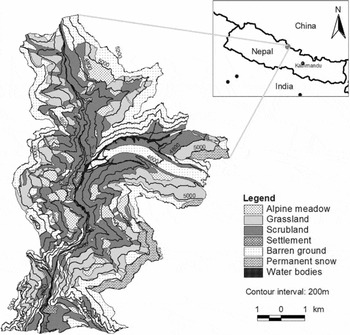
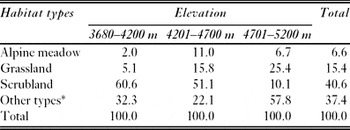
We conducted fieldwork within a 125 km2 study area in the Phu Valley (28°46′ N, 84°17′ E) of Manang District in Nepal (Fig. 1). The study area adjoins the Tibetan plateau to the north and spreads across an altitudinal range of c. 3700–6000 m. Topography is dominated by steep slopes, massive cliffs and glaciers. Local climate is influenced by the rain shadow effect of the Annapurna Himalaya. Total precipitation is less than 400 mm annually (Anon. 1996) and occurs mostly in the form of snow during winter. Mean maximum and minimum temperatures recorded during fieldwork were 5.8 °C and −7.3 °C in January and 18 °C and 9.5 °C in July. The snow and frozen ground start to thaw in late March. The area is sparsely vegetated by xerophytic plants, characterized by aromatic, dwarf, cushionoid and hairy species. In general, altitude and slope govern the distribution of vegetation types. Three broad vegetation types were identified based on dominant life forms: (1) alpine meadows, distributed in pockets of relatively flat areas; (2) alpine grasslands, located at higher altitudes in mesic sites; and (3) scrublands, widespread on dry rugged slopes. Among these types, alpine meadow is the least abundant and is mainly found at middle altitudes (Fig. 1; Table 1). Faunal diversity is generally low; naur is the only large wild ungulate and snow leopard (Uncia uncia) is relatively common, whereas wolf (Canis lupus) and brown bear (Ursus arctos) are absent.
Map of study area showing vegetation types and other habitat features in Phu valley (Manang, Nepal).

Distribution of habitat types (%) at different elevations in Phu valley (Manang, Nepal).* Includes settlement, barren land, permanent snow and water bodies.

Phu village, populated by 33 households, is the only permanent settlement in the study area. People here follow Tibetan Buddhism, and the local abbot has imposed a total ban on hunting, which is strictly followed by the villagers. The main subsistence occupation is animal husbandry. The herders own multiple species of domestic stock, yak (38%), goats (34%), sheep (19%), cow (5%) and horse (3%). Altogether the total stocking density of domestic animals is nearly double that of naur. Herders move their stock to different seasonal pastures throughout the year. While in the pastures, yaks are generally free-ranging and the sheep and goats (hereafter referred to as ‘smallstock’) and cows are herded. During winter, except for free-ranging horses and non-lactating yaks, the domestic stock is given supplemental stall-feed.
Data collection
Food habits
We applied microhistological analysis of faeces to study food habits (Sparks & Malechek Reference Sparks and Malechek1968; Shrestha et al. Reference Shrestha, Wegge and Koirala2005) and used correction factors to adjust for differential digestion of forage categories (Shrestha & Wegge Reference Shrestha and Wegge2006).
Each season, fresh faecal samples produced by free-ranging yaks and naur were collected from different parts of the study area. To detect seasonal changes in diet, we consistently followed the same trails across seasons and collected samples from sites located within 50 m of the trail. A total of 397 pellet groups of naur and 153 dung piles of yak were sampled over the four seasons (winter: 1 January–30 March, spring: 1 April–15 June, summer: 16 June–15 September, and autumn: 16 September–31 December), with roughly the same number of subsamples per species in each season. The definition of seasons followed the calendar of local livestock movements. Fresh pellets of 190 goats and 163 sheep were collected in their holding pens throughout the course of the year. Samples were stored in paper bags and air-dried in the field.
As composite faecal samples yield similar results to the means from individual samples (Jenks et al. Reference Jenks, Leslie, Lochmiller, Melchiors and Warde1989), we used composite samples to expedite laboratory work (Harris & Miller Reference Harris and Miller1995). One composite sample per season per ungulate was prepared by randomly selecting five pellets and c. 5 g of dung from each individual naur, goat, sheep and yak sample, respectively. Five slides from each composite faecal sample were prepared following the procedure detailed in Shrestha and Wegge (Reference Shrestha and Wegge2006). We used a plant reference library consisting of 2831 photomicrographs of 63 different plant species in our study area that had been prepared by Shrestha and Wegge (Reference Shrestha and Wegge2006) to identify plant fragments in faeces. While doing so, faecal images were maintained at a similar level of magnification (100× and 400×), brightness and colour conditions to that of the reference photomicrographs. The first 20 non-overlapping fragments intercepted by a randomly selected transect line were counted. A total of five slides and two transects per slide yielded 200 counts per composite sample. Thus, a total of 800 fragments were counted for each ungulate in four seasons.
Fragments that could not be identified to species or genera but to forage category, were grouped into ‘unidentified graminoids’, ‘unidentified forbs’, ‘unidentified browse’ and ‘unidentified dicots’. Completely unknown fragments were placed in the ‘unknown’ category.
Habitat use
Vegetation type and altitude were the most influential variables in explaining the distribution of ungulates in our study area (Shrestha & Wegge Reference Shrestha and Wegge2008). We therefore used data on use of vegetation types and altitude from our earlier habitat study (Shrestha & Wegge Reference Shrestha and Wegge2008), based on direct observation of 766 groups of naur, 392 groups of yak and 257 groups of smallstock throughout the course of a year. While doing so, we systematically searched the opposite slopes from fixed vantage points and mapped the distribution of animals on 1:10000 topographic maps. To exclude the confounding effect of human presence, data on naur were collected from those parts of the rangeland where domestic stock were not attended by herders. When possible, global positioning system (GPS) readings of animal locations were also taken to validate the points marked on the topographic map. The use of different habitat categories was obtained using the Geo Processing facility in Arc View 3.1, which was later verified with field records for accuracy. We used correspondence analysis (Greenacre Reference Greenacre1984) to determine the most influential habitat variables explaining the distribution of animal groups.
Forage availability
We conducted a vegetation survey in summer to estimate the abundance of forage plants. A total of 639 quadrats (each 1 m2) were randomly laid in the three vegetation types (alpine meadow = 232, grassland = 133 and scrubland = 274). The percentage cover of individual species in each quadrat was estimated visually following the procedure described by Smartt et al. (Reference Smartt, Meacock and Lambert1976). In addition, we recorded the GPS position, altitude, aspect, slope and percentage of bare ground to assess general habitat characteristics. We used Pohle (Reference Pohle1990), and Polunin and Stainton (Reference Polunin and Stainton1987) to identify plant specimens during fieldwork. Moreover, a herbarium of all plant species encountered in the field was prepared and unidentified specimens (mostly graminoids) were later identified with the help of experts.
Stocking densities and naur recruitment
We obtained numbers of domestic species through a total count (smallstock and cows), as well as interviews with herders (free-ranging yaks and horses). To estimate naur population size, we did total counts in autumn (October–December) by systematically scanning from vantage points (Wegge Reference Wegge1979), recording the numbers of young (< 1 year) and adult females (> 2 years) in each group. We analysed the population productivity of naur using only those observations where we could classify all the members of a group (n = 20 groups). We calculated biomass densities of naur and domestic stock using average adult body mass of each species as reported by Mishra et al. (Reference Mishra, van Wieren, Heitkonig and Prins2002).
Data analysis
Diet composition
In order to account for bias due to differential digestion (Holechek et al. Reference Holechek, Vavra and Pieper1982), we first adjusted the data from the faecal analysis by applying conversion factors (forbs × 3.85, graminoids × 0.90, browse × 0.89) derived from a comparative study of methods in the same study area (Shrestha & Wegge Reference Shrestha and Wegge2006). The proportions of individual food plants were also adjusted by using the same factors as the category to which they belonged (Shrestha et al. Reference Shrestha, Wegge and Koirala2005). We did not apply conversion factors to our winter data because bias due to differential digestibility is considered minimal during that period (Chapuis et al. Reference Chapuis, Bousses, Pisanu and Reale2001).
We then applied G-tests (log likelihood χ2 tests) in two- and three-dimensional contingency tables to test for significant differences in the proportions of forage categories and plant species over the year (Zar Reference Zar1996). We applied Yates correction for continuity in 2 × 2 contingency tables (Zar Reference Zar1996). Equal sample sizes allowed us to use one-tailed tests by dividing the resultant P by 2 to ascertain the directional change between pairs (Zar Reference Zar1996). We carried out statistical tests using Pop Tools (Microsoft Excel add-in) and Sigma Stat.
Diet selection
To estimate the relative abundance of food within the study area, we computed the relative frequencies of mean cover values for each plant species and forage category for each vegetation type. Because spatial overlap between the four ungulates occurred mostly in the altitudinal range 4200–4700 m in all seasons, except for smallstock during winter (Shrestha & Wegge Reference Shrestha and Wegge2008), we weighted the available forage on the basis of proportion of area occupied by each vegetation type within this altitudinal range. In winter, when the smallstock were confined to the altitudinal range of 3700–4200 m, we used the proportion of area occupied by each vegetation type within this altitudinal range to calculate availability of forage.
We then examined if an ungulate used the forage categories and plant species according to availability in each season by applying G-tests (Manly et al. Reference Manly, McDonald, Thomas, McDonald and Erickson2002). To determine if a particular forage category or plant species was preferred or avoided, we created 95% confidence intervals by applying Bonferroni corrections to the Z-statistic (Neu et al. Reference Neu, Byers and Peek1974). Because availability data were recorded in summer, they were somewhat overestimated for the winter and spring seasons, hence any preferential usage in these periods was conservative.
Diet and habitat overlap
We calculated the seasonal (hereafter termed temporal) and cross-seasonal overlaps in diet (plant species), elevation (band width of 40 m) and vegetation types between naur and domestic stock using proportional overlap indices (Schoener's [Reference Schoener1968] index):

where O12 is the overlap of species 1 on species 2, and Pi1 and Pi2 are the proportions of resource (vegetation types, elevation and food plant species) i used by species 1 and species 2, respectively.
This index has been shown to be relatively robust against differential availability of resources as well as the number of resource categories considered for the analysis (Hanski Reference Hanski1978). The index approaches 0 for species that share few resources and approaches 1.0 for species pairs that overlap substantially in resource use.
Resource-use overlap
Following Case (Reference Case1983), we calculated the geometric mean of the three overlap indices, namely (1) plant species in diet, (2) elevation above sea level and (3) vegetation type, to obtain the combined measure of resource-use overlap between naur and domestic stock:

where Oresource-use is the resource-use overlap, Ovegetation type is the overlap in the vegetation types, Oelevation is the overlap in the elevation and Oplant species the overlap in the food plant species.
We used this measure because the distribution of elevation, vegetation type and diet can neither be completely independent (whereby overlaps along each niche dimension are multiplied) nor be totally dependent (whereby the arithmetic mean is taken) of each other (May Reference May1975; Hanski Reference Hanski1978). The resource-use overlap indices thus obtained were ordered into three different classes: high (≥ 0.70), moderate (0.51–0.69) and low (≤ 0.50). Although these overlap indices did not provide statistical inferences about ecological relationships between species, they provide a relative measure of ecological similarity among them.
Furthermore, we compared the resource-use overlap between naur and domestic species by calculating proportions of temporal and cross-seasonal high, moderate and low overlap indices:

where i is the intensity of resource-use overlap (i.e. high, moderate and low), j is the nature of resource-use overlap (i.e. temporal and cross-seasonal), P is the proportion of given type (i and j) of resource-use overlap, n is the number of instances the given type of resource-use overlap occurred between naur and domestic species and N is the total number of possibilities that a given type of overlap occurs.
RESULTS
General diet composition
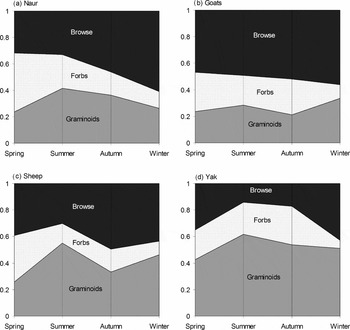
Proportions of forage categories (χ2 = 411.4, df = 30, p < 0.01) and plant species (χ2 = 1760.0, df = 540, p < 0.01) differed among the four ungulates during the year. In general, goats consumed mostly browse, graminoids made up the bulk of the yak diet for most part of the year, while the diets of naur and sheep were more mixed across the seasons (Fig. 2).
Proportions of forage categories in the diets of (a) naur, (b) domestic goat, (c) domestic sheep and (d) free-ranging domestic yaks in spring, summer, autumn and winter in Phu valley (Manang, Nepal).

Forbs dominated the naur diet at the start of growing season in spring. Its proportion decreased in successive seasons as browse steadily increased during autumn and winter, while in summer the three forage categories did not differ significantly (χ2 = 13.5, df = 2, p = 0.28; Fig. 2a). Carex spp. was the food plant most frequently eaten by naur throughout the year, while the shrub Chesneya nubigena dominated the winter browse diet (> 13%), followed closely by L. spinosa and Artemesia spp. (Appendix 1, see Supplementary material at URL http://www.ncl.ac.uk/icef/EC_Supplement.htm). Among forbs, Oxytropis sp. contributed the highest amount in all seasons, except in summer.
The proportion of browse increased gradually in the domestic goat diet as the seasons advanced from spring to winter (Fig. 2b). Compared with naur, goats ate more shrubs in spring and in summer (both χ2 > 9.8, df = 1, p < 0.01) and fewer graminoids in summer and in autumn (both χ2 > 7.4, df = 1, p < 0.01). Among browse, Lonicera and Astragalus sp. were the most common species (Appendix 1, see Supplementary material at URL http://www.ncl.ac.uk/icef/EC_Supplement.htm). As with naur, sedges dominated among the graminoid component for most of the year, except in winter, and Oxytropis made up the bulk of the goats' forb diet (Appendix 1, see Supplementary material at URL http://www.ncl.ac.uk/icef/EC_Supplement.htm).
The forage category composition of domestic sheep diet resembled that of naur in spring and in autumn (both χ2 < 0.12, df = 2, p > 0.12; Fig. 2c), while in summer and in winter sheep ate significantly more graminoids than naur (both χ2 > 7.0, df = 1, p < 0.01), especially Poa sp. (Appendix 1, see Supplementary material at URL http://www.ncl.ac.uk/icef/EC_Supplement.htm). Like goats, but unlike naur, sheep selectively fed on the shrub Clematis sp. in autumn; otherwise the seasonal diets were quite similar to naur, including a high usage of Oxytropis in spring and summer.
Contrary to the other ungulates, domestic yak consistently consumed mostly graminoids throughout the year (χ2 = 86.5, df = 6, p < 0.01; Fig. 2d), and the proportions of forage categories differed from naur in every season (four seasons χ2 > 23.5, df = 2, p < 0.01). Besides sedges, the grass Stipa sp., not Poa, was an important graminoid in all seasons. In winter, when browse made up > 40% of the diet, yaks ate mainly the same shrubs as naur. Oxytropis was a particularly important forb in every season; as with naur, this legume comprised c. 10% of the diet during winter (Appendix 1, see Supplementary material at URL http://www.ncl.ac.uk/icef/EC_Supplement.htm).
Resource-use overlap
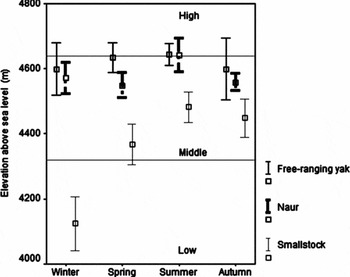
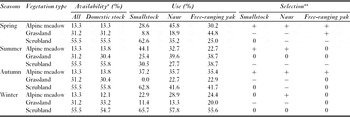
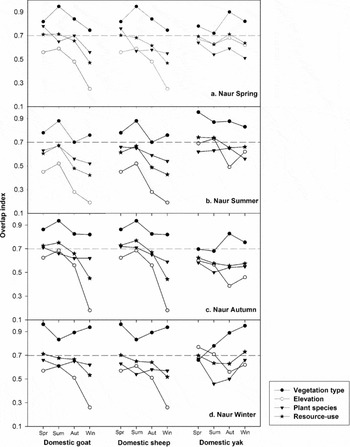
Every season, most naur used higher elevations than smallstock, then overlapping extensively with yak (Fig. 3), and all three groups preferred the alpine meadow habitat during most of the year (Table 2). The pattern of resource-use overlap (i.e. combined measure of overlap of vegetation type, elevation and plant species in diet) between naur and goats and between naur and sheep was similar; greatest temporal overlap occurred during spring and summer and the least temporal overlap occurred in winter (Fig. 4).
Altitudinal distribution of animal groups in different seasons. The error bars denote 99% confidence intervals of the means. Three elevation zones (high, middle and low) are shown (extracted from Shrestha & Wegge Reference Shrestha and Wegge2008).

Seasonal use of vegetation types by domestic stock and naur in Phu valley (Manang, Nepal) (extracted from Shrestha & Wegge Reference Shrestha and Wegge2008). *Availability was assumed to be constant for naur in all seasons, but was adjusted for domestic stock according to seasonal restrictions imposed on certain pastures by herders. **Symbols (+, 0, −) represent vegetation types that are preferred, randomly used, or avoided according to their availability (based on 95% Bonferroni confidence intervals).

Seasonal and cross-seasonal (interseasonal) overlaps in vegetation types, elevation and food plant species shown by proportional overlap indices (Schoener's [Reference Schoener1968] index) between naur and three species of domestic stock in Phu valley (Nepal). Resource-use overlap is the combined measure of overlap of vegetation types, elevation and plant species. The area above the dashed horizontal line that crosses the y-axis at 0.7 denotes high resource-use overlap (see text).

In general, temporal and cross-seasonal overlaps occurred at similar frequencies, with a tendency to greater overlap between naur and yak (Table 3). As high overlaps signify greater potential for interspecific competition, we subsequently concentrate on those pairs with high overlap indices (≥ 0.70; Fig. 4).
Proportions of temporal and cross-seasonal high (≥ 0.70), moderate (0.50–0.69), and low (≤ 0.49) resource-use overlaps between naur and three species of domestic stock in Phu Valley (Manang, Nepal).

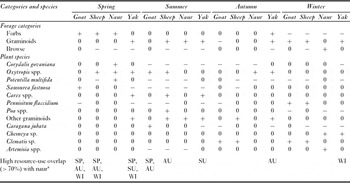
In spring, the temporal and cross-seasonal resource-use overlap indices were high between naur and all three species of domestic stock (Fig. 4a). The high temporal overlap with smallstock occurred because of similar strong preference for alpine meadows (Table 2) and forbs (Table 4). Out of the three species of forbs that were preferred by naur, Oxytropis was also preferentially eaten by sheep, whereas goats consumed this species in proportion to availability.
Degree of preference for forage categories and plant species by naur, domestic goats, sheep and yak in spring, summer, autumn and winter seasons. Symbols (+, 0, −) represent plant species or forage categories that are preferred, randomly used or avoided according to their availability (based on 95% Bonferroni confidence intervals). Only those plant species that were preferred in at least one diet are shown. *The high resource-use overlap (> 70%; Fig. 3) of domestic species with naur in spring (SP), summer (SU), autumn (AU) and winter (WI), respectively.

When domestic stock moved to higher pastures in summer, the resource-use of goats overlapped strongly with that of naur in spring (Fig 4a). Cross-seasonally, both preferred alpine meadows and avoided scrublands (Table 2) and fed preferentially on Oxytropis (Table 4). Two other forbs preferred by naur in spring, Corydalis govaniana and Potentilla multifida, were significantly avoided by goats in summer.
Between naur and yak, high resource-use overlaps occurred temporally in spring and cross-seasonally in autumn (Fig. 4a), at which times both preferentially used alpine meadows (Table 2) and ate mainly grasses and forbs, including Oxytropis (Table 4).
Naur overlap with domestic stock was generally low in summer compared with other seasons, as high overlap occurred only between naur and yak (Fig. 4b). The high temporal overlap occurred because they then occupied the same high elevations (Fig. 3), preferentially feeding on graminoids in alpine meadows and grasslands (Tables 2 and 4).
The resource-use by yak earlier in spring also overlapped extensively with that of naur in summer (Fig. 4b). This was mainly because their consistent preference for middle elevation (Fig. 3) and alpine meadows (Table 2) during these periods. Both preferentially fed on graminoids (Table 4). However, the two plants preferred by yak in spring, (Oxytropis and sedges), were not selectively eaten by naur in summer.
The naur resource-use overlap pattern in autumn was quite similar to that in spring (Fig. 3c). Smallstock preferentially used alpine meadows in spring and summer like naur in autumn (Table 2). However, except for selective feeding on Oxytropis during these seasons, their diet selection did not match, possibly because of less selective consumption of forage categories and plant species by naur in autumn (Table 4).
In the autumn, resource-use overlap between naur and yak was also low in spite of little spatial separation, mainly because of a much higher proportion of browse in the naur diet (Appendix 1, see Supplementary material at URL http://www.ncl.ac.uk/icef/EC_Supplement.htm).
In winter, domestic stock was kept at lower elevations, spatially below the zone inhabited by naur. High temporal overlap occurred then only between naur and free-ranging yak (Fig. 4d), as they used the same middle and high elevations and fed on similar plants (Appendix 1, see Supplementary material at URL http://www.ncl.ac.uk/icef/EC_Supplement.htm). Out of two shrubs preferred by naur, Chesneya was also significantly preferred by yak.
Naur resource use in winter overlapped with the resource use of all three domestic species in spring (Fig. 4d), when domestic species used the middle elevation zone and alpine meadows like naur did in winter (Fig. 3, Tables 2 and 3). However, naur avoided the grasslands in winter, while yak in spring preferred them. Likewise, shrubs were preferentially eaten by naur in winter but avoided by yak and sheep in spring (Table 4).
Stocking densities and naur recruitment
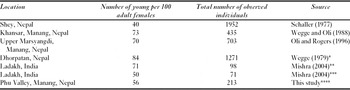
Our study area was being grazed by a total of 802 domestic yaks, 718 goats, 406 sheep, 96 cows and 71 horses, a total density of 16.7 animals km−2 or a biomass of 2509 kg km−2. This, together with a naur density of 9.4 animals km−2 (519 kg km−2), yielded a total ungulate biomass density of 3028 kg km−2. Autumn naur counts yielded 56 young per 100 adult females out of a total classified count of 213 individuals belonging to 20 groups (Table 5). Both total ungulate biomass density and ratio of young to adult females compared closely with Mishra et al. (Reference Mishra, van Wieren, Ketner, Heitkonig and Prins2004)'s intensively grazed rangeland in Ladakh, India. Recruitment rate was lower than that reported from Mishra et al. (Reference Mishra, van Wieren, Ketner, Heitkonig and Prins2004)'s moderately grazed rangeland and other ranges elsewhere in Nepal (Schaller Reference Schaller1977; Wegge Reference Wegge1979; Oli & Rogers Reference Oli and Rogers1996), but higher than that reported by Schaller (Reference Schaller1977) from presumably highly overgrazed rangelands in Shey, Nepal (Table 5).
Comparison of population productivity of naur (number of young per 100 adult females in autumn) between the study area in Phu Valley (Nepal) and other locations. *Average figure for the counts made during 1974–1977. **Moderately grazed rangeland with ungulate biomass density (naur and domestic stock) of 2586 kg km−2. ***Intensively grazed rangeland with ungulate biomass density of 3248 kg km−2. ****Ungulate biomass density of 3037 kg km−2.

DISCUSSION
Diet composition
In all seasons, the four ungulates had mixed diets with varying proportions of forage categories and plant species. However, evaluating dominant forage categories on an annual basis, yaks showed the characteristics of a grazer, goats a browser, while naur and sheep were intermediate feeders.
At the start of the growing season, all ungulates preferentially used alpine meadows (Shrestha & Wegge Reference Shrestha and Wegge2008) where the forbs, which are highly nutritious in spring (Larter & Nagy Reference Larter and Nagy2001), were most abundant. All ungulates, except yak, consumed greater amounts of forbs in this period compared to other seasons. Yaks preferentially used grasslands in spring, grasses comprising the bulk of their spring diet. In summer, all ungulates increased their consumption of grasses. Monocots contain highest concentration of nutrients during summer and then lose nutrients more rapidly compared to forbs and shrubs (Long et al. Reference Long, Apori, Castro and Orskov1999). In autumn through winter, the proportion of shrubs increased in the diets of all ungulates, except domestic sheep. Shrubs are known to be very important food for yak on the Tibetan plateau, especially during autumn and winter as the level of secondary compounds decreases during these periods (Yanjun et al. Reference Yanjun, Ruijun, Degang, Jiangang and Jianlin2002), and shrubs therefore serve as an alternative source of protein (Shikui et al. Reference Shikui, Ruijun, Xiaopeng, Zizhi and Jianlin2002). As the goats and sheep were shifted to lower pasture during winter, they then fed more on grasses. In summer and autumn, the winter pastures are protected from grazing by domestic stock, hence grasses were more abundant in the vicinity of the winter settlement.
Only few species made up the bulk of the diet of all four species for most parts of the year. Again, these plants were among the most abundant forage species in the study area. The high consumption of the grass Pennisetum flaccidum and the shrub Clematis sp. by goats and sheep during winter can also be explained by their availability; the former was the most abundant graminoid in the winter pasture, while the latter was given as supplementary feed during this period. Therefore, consistent with previous studies (Schaller & Gu Reference Schaller and Gu1994; Mishra et al. Reference Mishra, van Wieren, Ketner, Heitkonig and Prins2004; Shrestha et al. Reference Shrestha, Wegge and Koirala2005), all ungulates in our study were feeding opportunistically, and this trait was particularly evident in naur and domestic sheep.
The two legumes Oxytropis and Chesneya appeared to be crucial food plants, as they were selected by most ungulates in the same season as well as in successive seasons. The shrub Chesneya was preferentially eaten by naur and yak during winter when they did not feed on Oxytropis. This switch probably occurred because of difficult access (snow) and depleted availability (continuously fed on by most of the ungulates in other seasons) of Oxytropis during winter, rather than a change in nutritive quality. Generally, legumes reach peak digestibility in spring and retain higher amounts of protein in summer through winter compared to graminoids (Long et al. Reference Long, Apori, Castro and Orskov1999; Larter & Nagy Reference Larter and Nagy2001). The strong selection for Oxytropis by all ungulates deserves a special note because plants belonging to the genera Oxytropis are known to be toxic. The ungulates in our study area may have become ‘habituated’ to consuming Oxytropis, possibly due to adaptation of rumen microbes to secondary compounds (Menke et al. Reference Menke, Leinmüller, Steingass and Shazly1992). As such, this plant represents a significant food resource that enables ungulates to survive on rangeland with a prolonged dormant period when preferred defenceless species are absent.
Resource-use relationships between naur and domestic ungulates
Naur overlapped more with yak in elevation and overlapped less in plant species, while the opposite was true with respect to smallstock. The seasonal and cross-seasonal overlaps among naur and smallstock appeared to be governed mainly by seasonal movement of the latter across the gradient of altitude.
In spring, as the herders brought the domestic stock up from winter pastures, high overlap (both seasonal and cross-seasonal) occurred with naur. In seasonal environments, spring is a crucial period for ungulates because they need to replenish depleted fat reserves and produce offspring. Most parturition (especially naur and yak) takes place during this season, and good quality forage is essential for lactating females. Alpine meadows are known to be a principal source of good quality forage in the Trans-Himalaya (Long et al. Reference Long, Apori, Castro and Orskov1999), and all ungulates concentrated there during spring. Despite some separation in elevation between naur and smallstock in spring (Shrestha & Wegge Reference Shrestha and Wegge2008), it is highly likely that they would compete for food, particularly for Oxytropis if stocking densities increase.
In summer, people moved their smallstock to higher pastures where they greatly overlapped with the habitat naur used in spring. Naur then moved to even higher elevations, and as they then consumed more graminoids, they overlapped more extensively with yak. Excessive grazing by yak both in spring and summer might limit the availability of graminoids for naur during summer and hence lead to interspecific competition. For temperate ungulates, summer nutrition is known to be important for winter survival and population performance (Reimers et al. Reference Reimers, Holmengen and Mysterud2005).
During winter, people shifted the smallstock to low-lying winter pastures, thus separating them from naur altitudinally and minimizing the potential for competition. However, in winter naur overlapped extensively with the free-ranging yaks, as they used similar elevation and both consumed high proportions of browse.
Potential for competition and partitioning of resources
Acknowledging density-dependent effects on population recruitment (Skogland Reference Skogland1986), and assuming similar range productivity as that of Mishra et al. (Reference Mishra, van Wieren, Ketner, Heitkonig and Prins2004)'s study area in Ladakh (India), it appears that our study area was overstocked. The observed low ratio of young to adult female naur in autumn, which was similar to Mishra et al. (Reference Mishra, van Wieren, Ketner, Heitkonig and Prins2004)'s intensively grazed study area, suggests a competitive relationship between naur and domestic stock in the study area.
In general, high niche overlap among different species translates into competition only when shared resources become limited (de Boer & Prins Reference de Boer and Prins1990; Putman Reference Putman1996). Another factor affecting competitive relationships among domestic and wild ungulates is physical disturbance by herders (Harris & Loggers Reference Harris and Loggers2004). The lower density of naur observed in the intensively grazed area in Ladakh (2.6 animals km−2) compared to ours (9.4 animals km−2) might also be due to a difference in the level of human disturbance between these studies, as Mishra et al. (Reference Mishra, van Wieren, Ketner, Heitkonig and Prins2004), unlike us, made population counts in a relatively small area (31 km2) that was also actively used by herders.
Predicting competition on the basis of conventional density-dependent models alone is difficult, especially in the Trans-Himalayan mountains where rugged topography brings about spatio-temporal heterogeneity in the composition and phenology of plant species across gradients of aspect and altitude (Bhatnagar et al. Reference Bhatnagar, Rawat, Johnsingh, Stuwe and Richard2000). Here, the Armstrong and McGehee (Reference Armstrong and McGehee1980) model may apply owing to a presumed non-linear relationship between resources and species' life history characteristics (fecundity and survivorship), which mitigate the effects of interspecific competition (Cromsigt & Olff Reference Cromsigt and Olff2006). The existing system of seasonally rotating domestic stock among different key pastures based on local topographic and climatic patterns is a human-adapted strategy developed to optimize the use of limited food resources for domestic stock production (Miller Reference Miller, Miller and Craig1997). Coincidentally, such a system probably also facilitates coexistence with naur through partitioning of resources. This may especially be true in the case of goats, as their foraging regime closely resembles naur owing to similar mouth morphology, diets, body weights (Schaller & Gu Reference Schaller and Gu1994; Shrestha et al. Reference Shrestha, Wegge and Koirala2005) and behaviour (Schaller Reference Schaller1977).
Conversely, both temporal and cross-seasonal overlaps were consistently high for the most of the year between naur and free-ranging yaks. Large grazing animals are expected to facilitate the smaller ones by promoting the growth of high quality forage (Olff & Ritchie Reference Olff and Ritchie1998; but see also Woolnough & du Toit Reference Woolnough and du Toit2001). However, this may not be true in less productive environments such as the Trans-Himalaya (Mishra Reference Mishra2001), because here reduced standing biomass of food plants coupled with slow growth of vegetation makes competition more likely to take place than facilitation (Van de Koppel & Prins Reference Van de Koppel and Prins1998). Owing to their opportunistic foraging styles and quite similar mixed diets, we expected naur to compete more with yak, and our results indicated that the winter season (a period of food scarcity) is particularly crucial in this regard. Also, if livestock densities should increase, the spring and autumn seasons may become crucial for naur because of more cross-seasonal overlaps with smallstock. Because we collected the habitat data on naur from those parts of the rangeland where domestic stock were not attended by herders, human disturbance from the normal practice of herding may accentuate the effect of resource competition.
ACKNOWLEDGEMENTS
A research grant from the Norwegian Agency for Development Cooperation (NORAD) made this study possible. Ø. Holand, G. Austrheim, R.B. Harris and anonymous reviewers provided useful comments on the manuscript, the staff of the Annapurna Consevation Area Project (Manang) provided support during fieldwork, K. Thapa, T. Joshi, G. Gurung and Y. Aryal ably assisted in data collection, N. R. Chapagain and M. Odden guided GIS analyses, G. S. Rawat and C. Richard helped identify plant specimens, K. S. Joshi, P. Mathema and A. Pradhanang assisted data processing and N. M. B. Pradhan, A. K. Shrestha and S. Mathema helped with the laboratory work. We thank all of them.