Introduction
The Syllidae (Annelida) are widespread in almost every benthic marine habitat, from the deep-sea (Böggemann, Reference Böggemann2009; Barroso et al., Reference Barroso, De Paiva, De Matos Nogueira and Veronesi Fukuda2017; Langeneck et al., Reference Langeneck, Musco, Busoni, Conese, Aliani and Castelli2018) to the surface (Çinar, Reference Çinar2003; Serrano et al., Reference Serrano, San Martín and López2006; Martins et al., Reference Martins, Magalhães, Peter, San Martín, Rodrigues and Quintino2013), where they can represent the majority of the macrofaunal individuals (Musco, Reference Musco2012). This taxon shows remarkable diversity being characterized by the largest number of species (~700) among polychaete families (Aguado et al., Reference Aguado, San Martín and Siddall2012). High diversity is also evident in biological traits of syllids, such as their feeding habits (Jumars et al., Reference Jumars, Dorgan and Lindsay2015), and especially in the variety of reproductive modes (Daly, Reference Daly1975; Schroeder & Hermans, Reference Schroeder, Hermans, Giese and Pearse1975; Franke & Pfannenstiel, Reference Franke, Pfannenstiel, Fischer and Pfannenstiel1984; Garwood, Reference Garwood1991; Buhrmann et al., Reference Buhrmann, Westheide and Purschke1996; Franke, Reference Franke1999; San Martín, Reference San Martín2003). The family Syllidae is divided into five sub-families (Syllinae, Eusyllinae, Autolytinae, Exogoninae and Anoplosyllinae) also according to reproductive characters (Aguado & San Martín, Reference Aguado and San Martín2009; Aguado et al., Reference Aguado, San Martín and Siddall2012). The majority of syllids reproduce by epitoky, which may be divided into epigamy and schizogamy. The first is characteristic for Anoplosyllinae, Eusyllinae and Exogoninae, in which the ripe individual undergoes reversible morphological-functional modifications. Schizogamy (stolonization) occurs among Syllinae and Autolytinae, in which the epitokous posterior end detaches from the atokous individual and migrates as a stolon in the water column. According to Nygren (Reference Nygren1999) and Aguado et al. (Reference Aguado, San Martín and Siddall2012), schizogamy is a derived condition from epigamy, appearing twice independently in the evolutionary history of the family. Syllids are mostly gonochoric and usually lack an evident sexual dimorphism in both atokous and epitokous individuals, apart from the Autolytinae whose male stolons are usually distinguishable from the female ones (San Martín, Reference San Martín2003) and a unique case among the Syllinae represented by Ramisyllis multicaudata, described to have sexually dimorphic stolons (Schroeder et al., Reference Schroeder, Aguado, Malpartida and Glasby2017). The suppression of epitoky is often associated with hermaphroditism (Garwood, Reference Garwood1991; Buhrmann et al., Reference Buhrmann, Westheide and Purschke1996; Giangrande, Reference Giangrande1997; Kuper & Westheide, Reference Kuper and Westheide1997) and external gestation (Mastrodonato et al., Reference Mastrodonato, Sciscioli, Lepore, Gherardi, Giangrande, Mercati, Dallai and Lupetti2003). In schizogamous species sexualization occurs in both males and females in a certain number of posterior segments, the number of which is relatively constant for each species and related to the total numbers of segments. This sexualized posterior part forms the stolon which, ultimately, breaks away from the anterior part (the stock), thus releasing gametes at spawning time. Among the Syllinae stolons are usually considered mere gamete carriers, lacking the gut and thus being unable to feed. After spawning the stolon dies, whilst the stock is able to regenerate the posterior part and then capable of further stolonization (Franke, Reference Franke1999). In some species of the genus Syllis sex reversal was also observed (Durchon, Reference Durchon and Reinboth1975; Aguado et al., Reference Aguado, Helm, Weidhase and Bleidorn2015b). However, only few species have been cultured successfully over generations (Franke, Reference Franke1980; Aguado et al., Reference Aguado, Helm, Weidhase and Bleidorn2015b). Although the Syllinae are preferentially free spawning species, viviparity was also observed (Simon et al., Reference Simon, San Martín and Robinson2014). Larval development has been investigated in several syllid species, especially in brooding Exogoninae, that are all characterized by reversible epitoky (Mastrodonato et al., Reference Mastrodonato, Sciscioli, Lepore, Gherardi, Giangrande, Mercati, Dallai and Lupetti2003). The sequence in which digestive and locomotory organs appear in syllid larvae and the different modes of development were revised by Simon et al. (Reference Simon, San Martín and Robinson2014). Among the Syllinae, some information on reproduction and larval development is available for a few species (Giangrande, Reference Giangrande1997; Simon et al., Reference Simon, San Martín and Robinson2014) including Syllis hyalina Grube, 1863 (Malaquin, Reference Malaquin1893), Syllis amica (Quatrefages, 1866) (Herpin, Reference Herpin1925) and Syllis prolifera Krohn, 1852 (Franke, Reference Franke1980). Detailed studies, however, have been carried out only on Syllis variegata Grube, 1860 (Cazaux, Reference Cazaux1969) and Syllis pulchra Berkeley & Berkeley, 1938 (Heacox, Reference Heacox1980).
Syllis rosea (Langerhans, 1879) is a Syllinae species widespread in the Atlantic-Mediterranean area (Musco & Giangrande, Reference Musco and Giangrande2005) usually inhabiting shallow-water vegetated rocky shores (e.g. Musco et al., Reference Musco, Terlizzi, Licciano and Giangrande2009; Mikac & Musco, Reference Mikac and Musco2010). Although its biology and ecology are scarcely known, as well as its precise phylogenetic placement within Syllinae (Aguado et al., Reference Aguado, San Martín and Siddall2012), it is considered an herbivorous species (Giangrande et al., Reference Giangrande, Licciano and Pagliara2000) and it is known to reproduce by stolonization (San Martín, Reference San Martín2003). However, its reproductive strategy was not directly observed until present and was considered allegedly identical to that of the other non-viviparous Syllinae.
We hereby describe the peculiar reproductive strategy of Syllis rosea, discussing its evolutionary meaning and reporting on its early stages of development.
Materials and methods
Ripe specimens of Syllis rosea were collected at Santa Caterina di Nardò (Italy, Ionian Sea) (40°08′27.96″N 17°58′41.80″E) and rapidly transported in the laboratory in aerated and refrigerated tanks. Samplings were carried out by scraping off the hard substrate during scuba diving in July 2008 at 1.5 m depth on vegetated rocky bottom. The living syllid specimens were rapidly sorted using a stereomicroscope and identified under the light microscope. The specimens of S. rosea, including ripe specimens, were then transferred into glass cups moved to an acclimatized chamber. After detaching from the stocks, the male and female stolons were gently collected using a pipette, put together in a new glass cup with aeration gently provided through a pipette tip in order to avoid chaotic water movement, and kept in a thermostatic chamber set to 13°C, with a controlled photoperiod of 12 h day/night.
Results
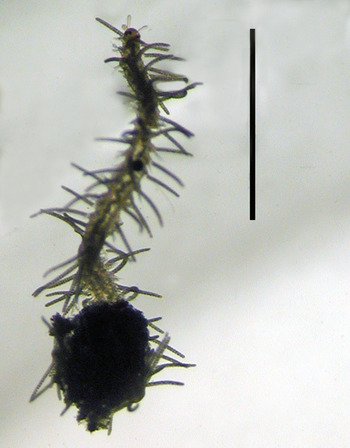
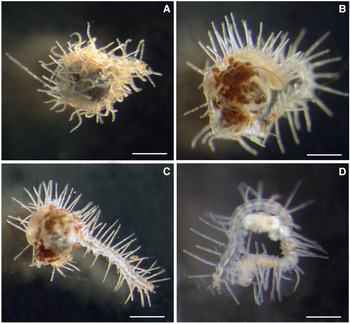
Stolons of S. rosea were tetracerous, in agreement with Estapé & San Martín (Reference Estapé and San Martín1991). The head was rounded, with four large reddish eyes, one pair of palps and one pair of lateral, inarticulated antennae. Palps were approximately as long as the head, while antennae were slightly longer. Male stolons were formed by 25–26 segments, and sperm packages gave them a light orange colour, while female stolons were formed by 39–40 segments and showed an evident dark grey to black colour due to oocytes (Figure 1). One day after detaching from the stock, female ripe stolons laid eggs in a gelatinous mass that remained attached to the posterior chaetigers (Figure 1). The eggs measured about 100 μm in diameter. Male ripe stolons rapidly died (2 days after). The gel mass in females progressively compacted as a cocoon wrapped by the stolon body (Figure 2A). Hatching occurred 8 days after egg deposition, and larvae remained in touch with the stolon (Figure 2B). During the early stages the larvae moved above the stolon being associated with it (Figure 2C). After another 5 days, post-larvae were observed freely moving around on the bottom of the glass cup and the cocoon residuals were still visible on the stolon body (Figure 2D). More than 2 weeks after eggs deposition the stolon started degenerating and died 2 days later (Figure 3).
Syllis rosea female stolon showing in the posterior chaetigers a gelatinous mass containing eggs laid by ripe stolons. Scale bar: 2 mm.

Development of eggs mass and hatching procedure of Syllis rosea. (A) Detail of eggs mass enveloped by the stolon body in a cocoon. (B) Hatching phase occurring 8 days after eggs deposition with larvae remaining in touch with the stolon. (C) Detail of the early stage larvae moving above the stolon. (D) Detail of the cocoon residuals visible on the stolon body 5 days after hatching. Scale bars: 1 mm.

(A, B) Degeneration of the stolon 2 weeks after eggs deposition. Scale bars: 0.5 mm.

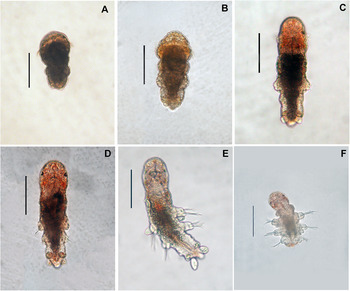
In Figure 4 the larval development from metatrochophore stage (Figure 4A, B) to three-chaetiger stage (Figure 4F) is shown. Metamorphosis occurred between 6 and 13 days after the hatching from the cocoon. Metatrochophore elongated and lost the prototroch, giving rise to the erpochaeta stage with the appearance of the first chaetiger (Figure 4C, D). After about another 10 days a second chaetiger appeared (Figure 4E), and finally after another 10 days the three-chaetiger stage was observed (Figure 4F).
Development in the larvae of Syllis rosea from metatrochophore to three-chaetiger stage. (A, B) Different metatrochophore stages at 5 days after hatching. (C, D) Different erpochaeta stages with the detail of the first chaetiger at 6 and 13 days after the hatching. (E) Erpochaeta stage at 20 days after the hatching with the detail of the second chaetiger. (F) Three-chaetiger larva at 30 days. Scale bars: 0.1 mm.

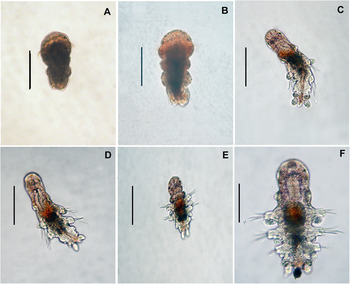
Metatrochophore, at first measuring about 120 μm (Figure 5A), could be recognized by a posterior segment separating the episphere from the pygidium, After one day it became more elongate (Figure 5B), and the apical tuft became a diffuse band of cilia bordering the anterior end of the episphere. Some chaetae and the proventricle were already visible. The prototroch divided the episphere transversely into approximately equal halves, with the anterior half later developing into the prostomium, while the posterior half of the episphere becoming the peristomium. During the development of the first chaetiger, the pygidial segment showed two light-coloured spots. The pygidial cirri arose near these spots (Figure 5C). After metamorphosis the prototroch disappeared and the first chaetiger was complete. The mouth appeared as a transverse opening, surrounded by cilia, and located centrally on the ventral surface of the episphere (Figure 5D). At this stage the pharynx and the gut were well developed, but there was no indication that the larva had started to feed. The one-chaetiger larva was about 300 μm long. The first pair of parapodia appeared as fleshy lateral outgrowths from the second larval segment following the episphere. Each parapodium contained one simple notochaeta and one compound chaeta. In the three-chaetiger stage a median antennal bud appeared on the head region between the eyes and the second pair of eyes formed, as well as the caudal cirri (Figure 5E). At this stage, the presence of gut content and production of faeces confirmed that worms had already started feeding, possibly on the biofilm formed within the cup, since no food was added during the observation period (Figure 5F). The young specimens of S. rosea survived only up to the three-chaetiger stage.
(A) Early metatrochophore larva with detail of the prototroch separating the episphere from the pygidium. (B) Early metatrochophore larvae after 1 day with detail of the band of cilia in the anterior end of the episphere. (C) Elongated erpochaeta stage with details of the first chaetiger, the pygidial cirri and the light-coloured spots. (D) Two-chaetiger larva with detail of the mouth and the proventricle. (E) Three-chaetiger larva. (F) Three-chaetiger larva with detail of faeces production.

Discussion
Syllis rosea is the first Syllinae species observed to release eggs in gelatinous masses, brooding them in a cocoon, guarding the offspring up to the time they are able to move away from the mother, and lacking free-swimming larval phases during its development. Although brooding is widespread in Syllidae, until now the only brooding strategy known in Syllinae was represented by viviparity, in which juveniles emerge from the mother body at a very advanced development stage and immediately acquire benthic habits (Simon et al., Reference Simon, San Martín and Robinson2014). Viviparity in Syllidae might be facultative (Pocklington & Hutcheson, Reference Pocklington and Hutcheson1983); in Syllinae it has been interpreted as an adaptation to very narrow ecological requirements, such as interstitial environments or symbiotic lifestyle (Aguado & San Martín, Reference Aguado and San Martín2006; Simon et al., Reference Simon, San Martín and Robinson2014). Molecular data suggest that epigamy is a primitive reproductive mode in Syllidae, while schizogamy evolved independently twice (Aguado et al., Reference Aguado, San Martín and Siddall2012; Fukuda & Barroso, Reference Fukuda and Barroso2019). Syllinae are overall characterized by a strict schizogamous reproduction by scissiparity, and alternative reproductive strategies such as gemmiparity and viviparity are regarded as derived from a typical schizogamy (Aguado et al., Reference Aguado, San Martín and Siddall2012).
As regards the other sub-families, Autolytinae show the occurrence of both ancestral epigamic forms, characterized by the absence of stolons and by the development of epitoke modification on the atoke individual (Qian & Chia, Reference Qian and Chia1989), and derived forms, where egg sacs are developed on differentiated stolons (Imajima, Reference Imajima1966). Interestingly, both Anoplosyllis edentula Claparède, 1868 (belonging to the basally branching subfamily Anoplosyllinae), and the genus Amblyosyllis (representing the sister clade of Autolytinae in the majority of phylogenetic reconstructions) lay eggs in benthic egg masses, with limited parental care (Cognetti-Varriale, Reference Cognetti-Varriale1971; Pernet, Reference Pernet1998). The one herein observed might possibly be an ancestral reproduction mode for the Syllidae, whilst different epigamic strategies (i.e. brooding of eggs attached to the body wall, brooding in ventral egg sacs, brooding in dorsal cirri) might be derived (Aguado et al., Reference Aguado, San Martín and Siddall2012), even if several early branching Anoplosyllinae and the basally branching genus Anguillosyllis are characterized by reversible epitoky and by brooding of eggs attached at the body wall (Garwood, Reference Garwood1982; Fukuda & Barroso, Reference Fukuda and Barroso2019). The observed reproduction strategy of S. rosea recalls what was observed in Anoplosyllis and Amblyosyllis, as the eggs are laid in a gelatinous mass and the female stolon shows parental care, while the main difference is represented by the occurrence of a stolonization. Stolonization, on the other hand, occurs in schizogamous Autolytinae, in which stolons produce a cocoon remaining attached to the body of the mother, but in the case of S. rosea there is no trace of morphological modifications such as the formation of ventral egg sacs. This similarity is clearly due to convergent evolution, mirroring similar adaptive strategies between S. rosea and the subfamily Autolytinae. Also the period within the cocoon of S. rosea larvae is similar to that reported for some Autolytinae (e.g Proceraea fasciata (Bosc, 1902) – see Allen, Reference Allen1964), and shorter than that reported for Amblyosyllis anae Aguado, Capa, Lago-Barcia, Gil, Pleijel & Nygren 2019 (Pernet, Reference Pernet1998 – as Amblyosyllis speciosa Izuka, 1912: see Aguado et al., Reference Aguado, Capa, Lago-Barcia, Gil, Pleijel and Nygren2019). However, contrary to what was observed for S. rosea, Autolytinae generally have free-swimming larval stages, as reported in Epigamia alexandri (Qian & Chia, Reference Qian and Chia1989). In cocoon-brooding Syllidae, the stage at which larvae emerge from the cocoon is the metatrochophore, with the exception of Anoplosyllis edentula, in which the worms emerge at one chaetiger stage (Cognetti-Varriale, Reference Cognetti-Varriale1971). Moreover, according to available literature, the formation of the metatrochophore stage takes a longer time in brooding species than in free spawners (Table 1).
Comparison of larval development and parental care between Syllis rosea and literature data for other Syllidae species belonging to Syllinae, Anoplosyllinae and Autolytinae; Exogoninae are excluded from the comparison because of their homogeneous reproductive pattern implying direct development

Although the family Syllidae is characterized by a great variety of reproduction strategies and development models, species within the family Syllinae are usually characterized by spawning in the water column, and by larvae characterized by a swimming phase, showing well-developed ciliary bands in early development stages. Although the larvae can swim, however, this swimming phase is possibly short, as no syllid species is known to have an extended phase of pelagic development, and on the other hand, syllid larvae and post-larvae are remarkably sporadic in planktonic samples (Thorson, Reference Thorson1946; Bhaud, Reference Bhaud1972). Despite the striking difference in the female stolon behaviour detected in S. rosea, and the absence of free-swimming larva, its development does not differ from that recorded in the few Syllinae studied from this point of view (Table 1). Aside from the egg size, slightly larger than those observed in congeneric species (Giangrande, Reference Giangrande1997), differences relate primarily to the timing and duration of larval stages and the development of cephalic structures. However, such differences in the timing may possibly be related to the temperatures at which larvae were reared. Thus, the main difference among S. rosea and the other Syllis species is that the trochophore develops within the cocoon and the worm becomes free living at the metatrochophore stage with no pelagic larval stages (Table 1). Contrary to what was observed in our study, the few comprehensive studies on sexual reproduction in Syllinae identified pelagic spawning and free swimming larval stages in S. prolifera (Franke, Reference Franke1980), S. pulchra (Heacox, Reference Heacox1980) and S. variegata (Cazaux, Reference Cazaux1984); partial data available for S. hyalina (Malaquin, Reference Malaquin1893), S. amica (Herpin, Reference Herpin1925; Verger-Bocquet, Reference Verger-Bocquet1983) and the recently described Syllis antoni (Aguado et al., Reference Aguado, Glasby, Schroeder, Weigert and Bleidorn2015a, Reference Aguado, Helm, Weidhase and Bleidorn2015b) (Ponz-Segrelles et al., Reference Ponz-Segrelles, Bleidorn and Aguado2018) suggest that this is the most widespread reproduction strategy in this subfamily.
Although Syllidae are considered a rather promising group for developmental studies (Aguado et al., Reference Aguado, Helm, Weidhase and Bleidorn2015b), the majority of studies concentrated on molecular and physiological mechanisms underlying regeneration and asexual reproduction by fission (Weidhase et al., Reference Weidhase, Beckers, Bleidorn and Aguado2016, Reference Weidhase, Beckers, Bleidorn and Aguado2017; Ribeiro et al., Reference Ribeiro, Bleidorn and Aguado2018, Reference Ribeiro, Ponz-Segrelles, Bleidorn and Aguado2019), stolonization (Weidhase et al., Reference Weidhase, Beckers, Bleidorn and Aguado2016; Ponz-Segrelles et al., Reference Ponz-Segrelles, Bleidorn and Aguado2018) and gemmiparity (Aguado et al., Reference Aguado, Glasby, Schroeder, Weigert and Bleidorn2015a; Álvarez-Campos et al., Reference Álvarez-Campos, Taboada, San Martín, Leiva and Riesgo2018). Further phases of the sexual reproduction, and in particular larval development and dispersal, have been investigated only in a few species (see Table 1), despite the important contribution that this kind of data might give to the understanding of the evolutionary radiation of Syllidae (Aguado et al., Reference Aguado, San Martín and Siddall2012). Further research is needed to understand possible relationships between reproduction and phylogeny, egg size and larval development, stolon morphology and its adaptation to parental care, reproductive strategies and ecology. Syllis rosea is at present the only Syllinae showing the occurrence of a benthic stolon, benthic larval development and parental care from the stolon; however, the scarce coverage of reproductive cycles within this subfamily leads to speculate that this strategy might be more widespread, and possibly have a phylogenetic meaning, that might help to disentangle the extremely complicated evolutionary relationships within Syllinae (Aguado et al., Reference Aguado, San Martín and Siddall2012). Further study on sexual reproduction and larval development in Syllinae is needed to clarify if this strategy is unique in this sub-family, and its evolutionary and ecological meaning.
Acknowledgements
We are grateful to two anonymous reviewers for their valuable comments on the manuscript.