In their target article, Mitchell et al. point out that, in contrast to the propositional approach, associative models cannot explain some causal learning results. Here we show that an attentional-associative model, previously evaluated against multiple sets of classical conditioning data, provides explanations for causal learning experiments.
An attentional-associative model of conditioning
Schmajuk et al. (Reference Schmajuk, Lam and Gray1996; henceforth SLG) proposed a neural network model of classical conditioning (see also, Larrauri & Schmajuk Reference Larrauri and Schmajuk2008; Schmajuk & Larrauri Reference Schmajuk and Larrauri2006). The network incorporates (a) an attentional mechanism regulated not only by novelty (difference between actual and predicted magnitude) of the unconditioned stimulus (US) as in the Pearce and Hall (Reference Pearce and Hall1980) model, but also by novelty of the conditioned stimuli (CSs) and the context (CX); (b) a network in which associations are controlled by a modified, moment-to-moment (vs. trial-to-trial) constrained version of the Rescorla and Wagner (Reference Rescorla, Wagner, Black and Prokasy1972) competitive rule; and (c) feedback from the associative network to the input. The attentional mechanism was designed to explain latent inhibition (Lubow & Moore Reference Lubow and Moore1959), and the feedback loop was included to describe inferential processes such as sensory preconditioning.
Gray et al. (Reference Gray, Buhusi and Schmajuk1997) showed that the SLG model also describes automatic (or unconscious) and controlled (or conscious) processing (Pearce & Hall Reference Pearce and Hall1980; Schneider & Shiffrin Reference Schneider and Shiffrin1977). In the framework of the model, stimulus X might be processed in controlled or conscious mode when environmental novelty and the representation of X, X X, are large; and in automatic or non-conscious mode when novelty and X X are small. Therefore, in agreement with Mitchell et al.'s position, the SLG model suggests conditioning occurs mostly consciously. However, according to the model, in the case of latent inhibition, a pre-exposed X with a small X X remains unconscious. Therefore, in line with Mitchell et al.'s reference to the effects of masking on learning processes, the SLG model suggests that X pre-exposure reduces conscious processing of the X but conditioning still occurs at a slower pace.
Causal learning
Several studies on causal learning were concerned with the effect of additivity information on blocking and backward blocking (e.g., Beckers et al. Reference Beckers, De Houwer, Pineno and Miller2005). Blocking refers to the fact that a potential cause X is not considered a cause of a given outcome (OUT, represented by “+”) when it is presented together with another potential cause A, if A had been previously shown to be a cause of that US (A+, AX+). Two potential causes, G and H, are additive if, when presented together OUT is equal to the sum of their OUTs when presented separately (this is represented as G+, H+, GH++). When the joint OUT of G and H is less than the sum of their individual OUTs, the causes are subadditive (G+, H+, GH+). Beckers et al. (Reference Beckers, De Houwer, Pineno and Miller2005) demonstrated that additivity pre-training resulted in stronger blocking than subadditivity pretraining (Experiment 2); additivity pre-training resulted in stronger backward blocking than subadditivity pre-training (Experiment 3); additivity post-training resulted in stronger blocking than subadditivity post-training (Experiment 4); and blocking is stronger when OUT is weaker than the maximum OUT experienced by the subjects (Experiment 1). According to Beckers et al. (Reference Beckers, De Houwer, Pineno and Miller2005), their results can be explained in inferential terms: blocking is not present if either the additivity premise or the submaximal premise is not satisfied. In the following paragraphs, we describe how the model addresses two of these experimental results.
Additivity training preceding blocking
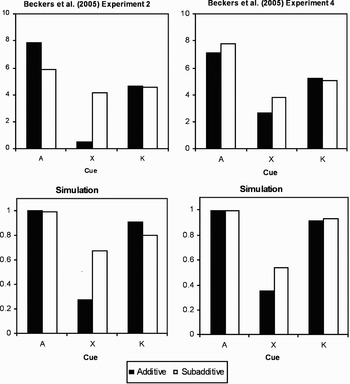
Like the Rescorla-Wagner model, the SLG model explains blocking because, at the time of the presentation of X, A already predicts the OUT. According to the model, the compound stimulus (C) activated by G and H and associated with OUT during pre-training, is fully activated by A and X. This association, together with the blocking stimulus A, contributes to predict the OUT, thereby increasing blocking. Because the C-OUT association acquired during pre-training is stronger in the additive than in the subadditive case, blocking is stronger in the former than in the latter case (see Fig. 1, Left Panels).
Left Upper Panel: Mean causal ratings for cue A, X, and K in a blocking experiment following additivity pre-training; data from Beckers et al. (Reference Beckers, De Houwer, Pineno and Miller2005, Experiment 2). Right Upper Panel: Same blocking experiment followed by additivity post-training, data from Beckers et al. (Reference Beckers, De Houwer, Pineno and Miller2005, Experiment 4). Lower Panels: Corresponding simulations with the SLG model. Parameters used were analogous to those used in previous papers. The Outcome is represented as a CS. Rating is given by the sigmoid R=Predicted Outcome6/(Predicted Outcome6+β6), where β=Average of predicted outcomes for all A, X, and K. Simulations for Experiment 2 included 90 additive or subadditive pre-training, 20 A+, 40 AX+ trials, and 40 KL+ trials. Simulations for Experiment 4 included 20 A+, 20 AX+, 20 KL+, and 90 additive or subadditive post-training trials. Stimulus duration was 10 time units, stimulus intensity was .6, C intensity was 1, OUT was 2 for additivity and 1 for subadditive training.

We assumed generalization between compounds GH and AX to be strong based in Young & Wasserman's (Reference Young and Wasserman2002) experimental data showing that generalization between elements is much smaller than generalization between compounds. In addition, the model implements generalization among elements and between elements and compounds through the presence of a common contextual stimulus that is always active.
Additivity training following blocking
As Mitchell et al. correctly observe in the target article, in the absence of pre-training, the C compound is already associated with OUT during post-training and, therefore, increased C-OUT associations cannot be used to explain increased blocking. Interestingly, the SLG model provides an attentional interpretation for the result. In terms of the model, during the AX+ phase of blocking, OUT-X and C-X associations are formed. During the subsequent additivity post-training, OUT-X and C-X associations predict X, but X is not there. In the additive case, the stronger OUT extinguishes its OUT-X association faster than the weaker non-additive OUT does. During additivity post-training, presentation of the novel stimuli G and H, as well as the absence of stimuli A and X, increases novelty. Thus, because the representation of X is weaker in the additive case, attention to X increases less, and blocking is stronger than in the subadditive case (see Fig. 1, Right Panels).
Conclusion
In agreement with Mitchell et al.'s position, the SLG model suggests that associative learning can be a conscious, controlled process related to higher-order cognition. Furthermore, in addition to the above experiments, computer simulations show that the SLG model describes (a) the facilitatory effect of additivity training before backward blocking (Beckers et al. Reference Beckers, De Houwer, Pineno and Miller2005), (b) maximality effects (Beckers et al. Reference Beckers, De Houwer, Pineno and Miller2005, Experiment 1), (c) the facilitatory effect of subtractivity pre-training results on backward blocking (Mitchell et al. Reference Mitchell, Lovibond and Condoleon2005), and (d) higher-order retrospective revaluation (De Hower & Beckers Reference De Houwer and Beckers2002). Interestingly, whereas the propositional approach predicts no blocking following subadditive pre- and post-training (see Beckers et al. Reference Beckers, De Houwer, Pineno and Miller2005, pp. 241, 246), the SLG model can account for those results. Furthermore, these finely graded results are also present in the model description of latent inhibition, in which weaker conditioned responding is observed.